Article

FASSD-Net Model for Person Semantic Segmentation
by
Luis Brandon Garcia-Ortiz
1,*,
Jose Portillo-Portillo
1,
Aldo Hernandez-Suarez
1,
Jesus Olivares-Mercado
1,
Gabriel Sanchez-Perez
1,
Karina Toscano-Medina
1,
Hector Perez-Meana
1 and
Gibran Benitez-Garcia
2
1
Instituto Politecnico Nacional, ESIME Culhuacan, Mexico City 04440, Mexico
2
Department of Informatics, The University of Electro-Communications, Chofu-shi 182-8585, Japan
*
Author to whom correspondence should be addressed.
Electronics 2021, 10(12), 1393; https://doi.org/10.3390/electronics10121393

Submission received: 7 May 2021 / Revised: 24 May 2021 / Accepted: 3 June 2021 / Published: 10 June 2021
(This article belongs to the Special Issue Deep Learning for Computer Vision and Pattern Recognition)

Abstract

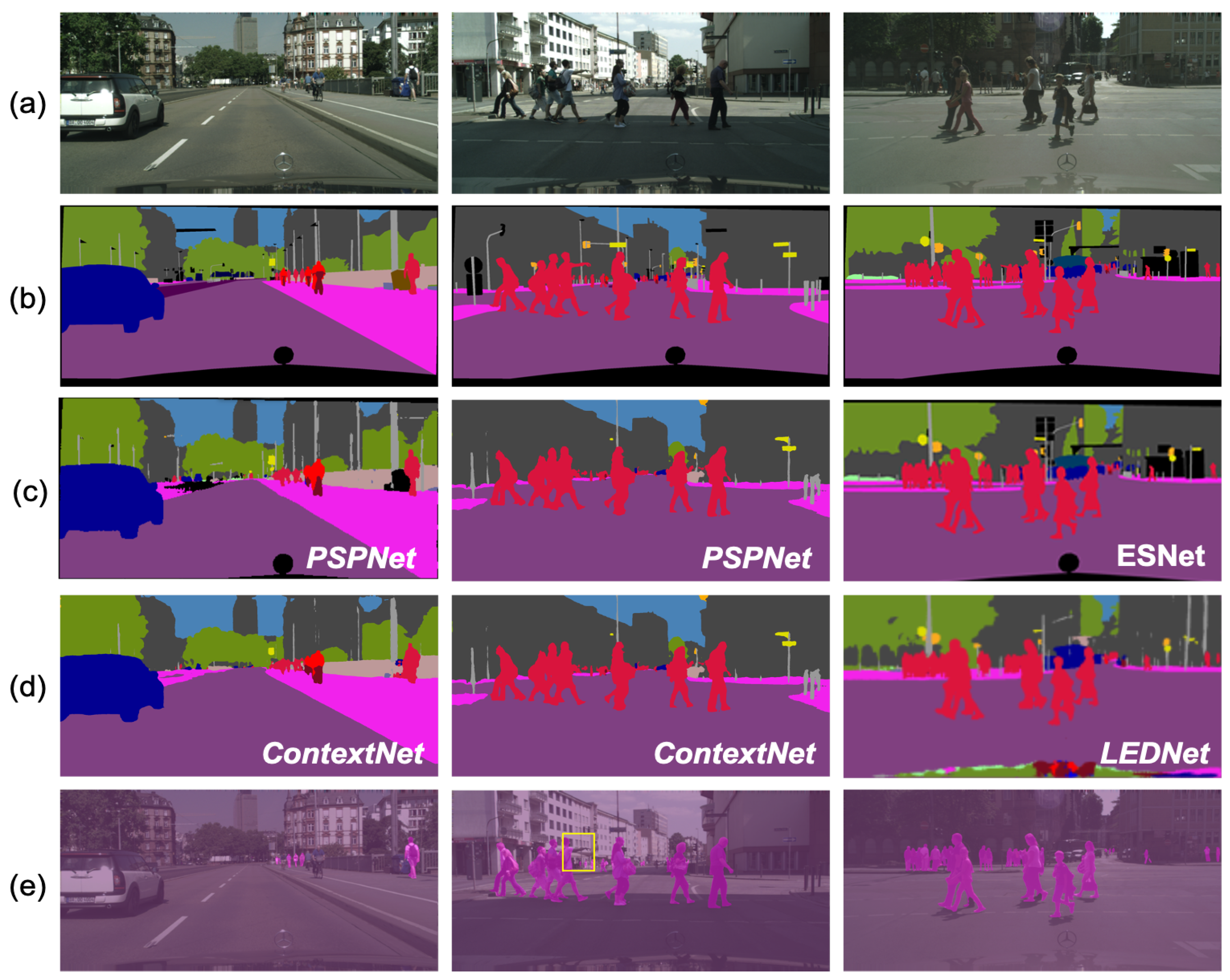
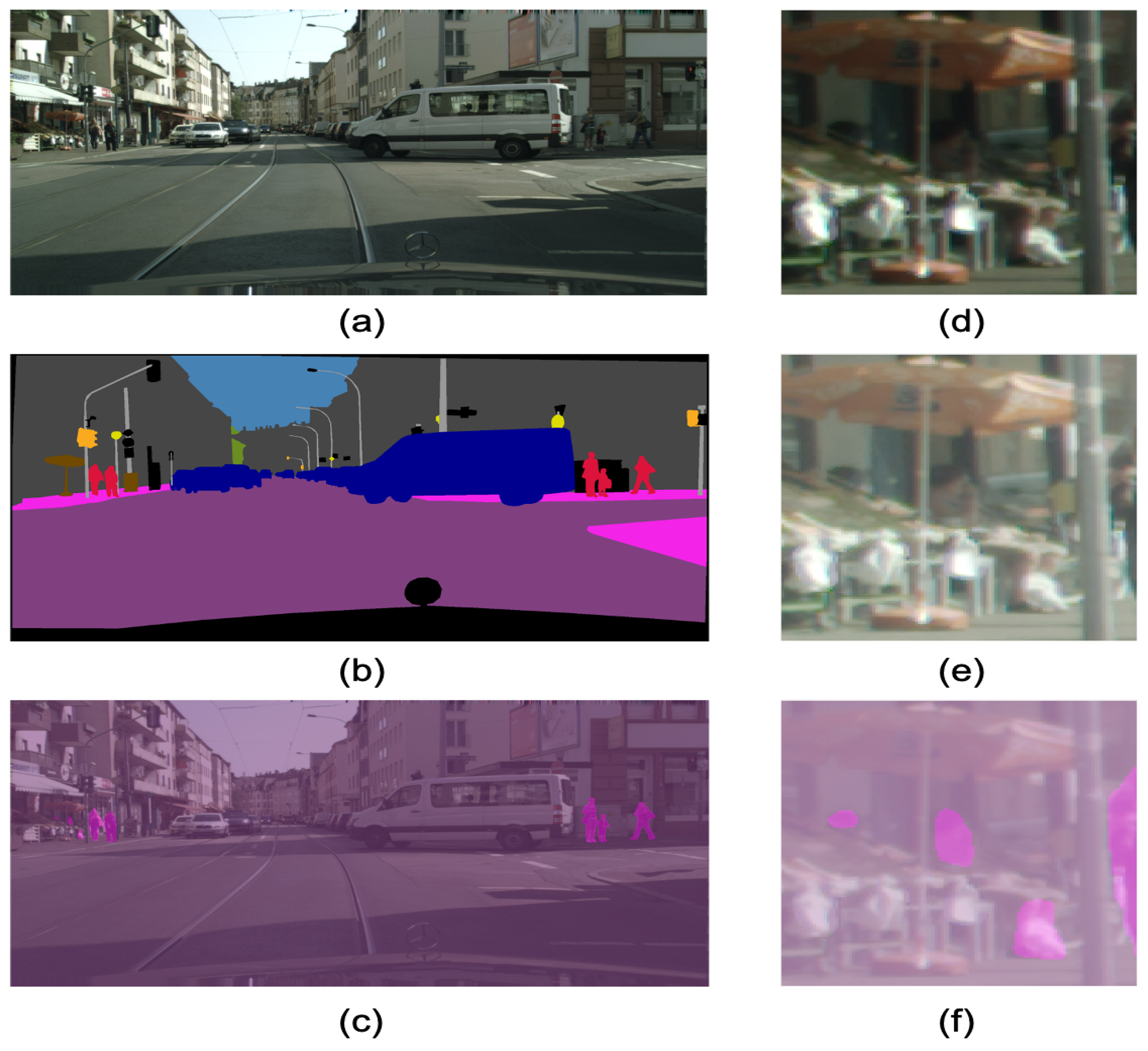
This paper proposes the use of the FASSD-Net model for semantic segmentation of human silhouettes, these silhouettes can later be used in various applications that require specific characteristics of human interaction observed in video sequences for the understanding of human activities or for human identification. These applications are classified as high-level task semantic understanding. Since semantic segmentation is presented as one solution for human silhouette extraction, it is concluded that convolutional neural networks (CNN) have a clear advantage over traditional methods for computer vision, based on their ability to learn the representations of appropriate characteristics for the task of segmentation. In this work, the FASSD-Net model is used as a novel proposal that promises real-time segmentation in high-resolution images exceeding 20 FPS. To evaluate the proposed scheme, we use the Cityscapes database, which consists of sundry scenarios that represent human interaction with its environment (these scenarios show the semantic segmentation of people, difficult to solve, that favors the evaluation of our proposal), To adapt the FASSD-Net model to human silhouette semantic segmentation, the indexes of the 19 classes traditionally proposed for Cityscapes were modified, leaving only two labels: One for the class of interest labeled as person and one for the background. The Cityscapes database includes the category “human” composed for “rider” and “person” classes, in which the rider class contains incomplete human silhouettes due to self-occlusions for the activity or transport used. For this reason, we only train the model using the person class rather than human category. The implementation of the FASSD-Net model with only two classes shows promising results in both a qualitative and quantitative manner for the segmentation of human silhouettes.
Keywords: semantic segmentation; person class; deep learning; human silhouette; cityscapes semantic segmentation; person class; deep learning; human silhouette; cityscapes