Skip to Content
CosmeticsCosmetics
  • Review
  • Open Access

22 March 2026

Progress in the Application of Raman Spectroscopy to Cosmetic Analysis: From Component Detection to Transdermal Mechanism Research

,
,
,
,
and
National Institute for Food and Drug Control, Beijing 100050, China
*
Authors to whom correspondence should be addressed.
Cosmetics2026, 13(2), 79;https://doi.org/10.3390/cosmetics13020079 
(registering DOI)
This article belongs to the Section Cosmetic Technology

Abstract

Assessing cosmetic quality, safety, and effectiveness demands advanced in situ, real-time, and multi-dimensional analytical technologies, while conventional methods suffer from complex sample preparation and incomplete analysis. Raman spectroscopy, with its non-invasiveness, specific molecular fingerprint, and micron-level spatial resolution, has become a key tool for cosmetic analysis. Based on a comprehensive review of the literature from 2000 to 2025, this article systematically examined the application of Raman spectroscopy in cosmetic analysis. The systematic search and screening process ensured the comprehensiveness and rigor of the review’s research foundation, as the 69 high-quality studies covered all core application areas of Raman spectroscopy in cosmetic analysis, providing solid literature support for subsequent technical summaries and trend analysis. This article systematically reviews the application of Raman spectroscopy in the cosmetic industry for ingredient detection (approved ingredients and hazardous substances), quality control (authenticity verification and production traceability), transdermal mechanism analysis (penetration pathways and interaction with skin barriers), and efficacy assessment. Combined with typical research cases, this study examined the technical principles and practical value, as well as the limitations and shortcomings of Raman technology applications. It ultimately provides suggestions for future developments in terms of portability, intelligence, and standardization, offering references for researchers to enable technological innovation and regulatory improvements in the cosmetics industry.

1. Introduction

Cosmetics are daily products closely related to consumers’ health, and there is growing concern about their quality, safety, and actual efficacy [1]. With the rapid development of the industry, product categories have expanded from early basic skin care to products with complex formulas and multiple functions such as whitening, anti-aging, and sun protection, the market for which is constantly expanding [2]. At the same time, consumers’ expectations for products are rising. They not only hope for a good user experience but also place great importance on “knowable cosmetic ingredients” and “evidence-based efficacy”, which has driven the industry to shift from previous methods of formulation based on experience to one that relies on scientific verification methods [3,4,5,6]. This change urgently requires technologies that can integrate ingredients and the analysis of transdermal behavior and biological response effects.
However, conventional analytical methods have obvious shortcomings [7]. For example, techniques such as high-performance liquid chromatography, gas chromatography, and gas chromatography-mass spectrometry can determine the quantity of ingredients. However, they usually require the complex and time-consuming pre-treatment of samples such as extraction and purification. Such methods cannot monitor the in situ dynamic distribution of ingredients in the skin in real-time. Methods commonly used in transdermal research, such as Franz diffusion cells, rely on ex vivo skin models, which fail to accurately reflect the physiological state of ingredients in vivo. Additionally, sensory evaluation and in vitro efficacy tests often do not effectively connect specific ingredients to their mechanisms of action. Therefore, developing new technologies that are non-invasive, fast, and capable of multi-dimensional analysis has become essential to meet the needs of the cosmetics industry [8,9,10].
Raman spectroscopy is a technique based on molecular vibrations. It offers many advantages, such as being non-invasive, requiring no complex pre-treatment, having a strong ability to identify unique “fingerprints” of molecules, and providing high spatial resolution, which has led to rapid development in the field of cosmetic analysis [11]. Raman spectroscopy is one of the key vibrational spectroscopy techniques, distinct from Fourier transform infrared (FTIR) spectroscopy in its fundamental principle and analytical characteristics: while FTIR relies on infrared absorption and exhibits high sensitivity to polar bonds (e.g., O-H, C=O) and asymmetric vibrations, Raman is based on inelastic light scattering (Raman scattering) and shows superior responsiveness to non-polar bonds (e.g., C-C, S-S) and symmetric vibrations [9]. It can address various analytical needs, from ingredient detection to transdermal mechanism research, offering new technical methods for the quality control, safety assessment, and efficacy verification of cosmetics [12]. For this review, a systematic literature search was performed in the PubMed and Web of Science databases for the period 2000 to 2025. The search employed a core keyword combination that included “Raman”, “personal care products”, “cosmetics”, “efficacy ingredients”, “prohibited substances”, “confocal Raman”, “surface-enhanced Raman spectroscopy”, and “efficacy assessment”, which initially yielded 93 potentially relevant articles. A standardized screening process was then implemented by two independent reviewers. The inclusion criteria were as follows: (1) original research or review articles focusing on the application of Raman spectroscopy in cosmetic analysis; (2) studies published in peer-reviewed journals; (3) articles written in English. Studies were excluded if they: (1) were conference abstracts, editorials, or non-peer-reviewed publications; (2) lacked original data or clear methodological descriptions; (3) were not directly relevant to cosmetic ingredients, skin penetration, or product quality control. Methodological rigor was assessed based on clarity of experimental design, appropriateness of Raman techniques used, reproducibility of spectral acquisition, and robustness of data analysis (e.g., use of chemometric models, control groups, or statistical validation). After full-text evaluation, 24 articles were excluded due to insufficient methodological detail, lack of relevance, or incomplete data reporting. Ultimately, 69 high-quality studies were included for in-depth analysis in this review. This article reviews the principles of Raman spectroscopy, as well as its specific applications in cosmetic analysis, including ingredient detection, quality control, and transdermal mechanism research. It thoroughly examines its advantages, disadvantages, and explores future development trends. The aim is to provide comprehensive technical references for researchers, manufacturers, and regulatory authorities in the cosmetics industry and promote the further development and broad application of this technology in cosmetic analysis.

2. Introduction to Raman Spectroscopy Technology

Raman spectroscopy is a spectroscopic analysis method based on the phenomenon of inelastic light scattering. Its fundamental physical process is the Raman scattering effect, which was first experimentally observed by Indian scientist C. V. Raman in 1928 [13]. When a beam of monochromatic light, usually from a laser, irradiates sample molecules, most photons undergo elastic collisions with the molecules; that is, the frequency of the scattered light remains the same as that of the incident light, known as Rayleigh scattering. Rayleigh scattering is the main type of light scattering, but its usefulness for analyzing material structure is limited. However, only a tiny fraction of photons (about one in a million) undergo inelastic collisions with molecules. In this process, energy is exchanged between photons and molecules, resulting in a change in the frequency of the scattered light compared to the original light (that is, a frequency shift). This phenomenon is called Raman scattering. This tiny fraction of scattering provides detailed molecular information [14].
The frequency shift caused by Raman scattering (usually expressed as the wavenumber difference Δν in cm−1) relates to the vibrational or rotational energy level transitions of chemical bonds within molecules. These can be categorized into two types: Stokes scattering (where photons lose energy, resulting in a decreased frequency and high intensity) and anti-Stokes scattering (where photons gain energy, leading to increased frequency and a low intensity). The Raman shift is the key parameter in Raman spectroscopy, representing the frequency difference (Δν) between scattered and incident light. Notably, the Raman shift is independent of the wavelength of the incident light and is determined solely by the molecule’s vibrational or rotational modes. This property gives Raman spectroscopy its high specificity. Each chemical bond or functional group exhibits its own characteristic Raman shift, creating a unique “molecular vibration fingerprint” of the molecule. Using this fingerprint, various substances can be precisely identified and differentiated.
A Raman spectrum graph uses the Raman shift (cm−1) as the abscissa and scattered light intensity as the ordinate. Each characteristic peak in the graph corresponds to the vibrational (or rotational) mode of a specific chemical bond or group in the sample molecule. Through in-depth analysis of the position (Raman shift), intensity, peak shape, and number of these characteristic peaks, we can gain extensive information about the molecular structure, chemical composition, crystal form, phase transition, stress, intermolecular interactions, and more of a sample. For example, when analyzing organic compounds, different hydroxyl, carbonyl, and methyl functional groups display specific characteristic peaks in the Raman spectrum. By identifying the positions and intensities of these peaks, the structure and composition of the compound can be determined.
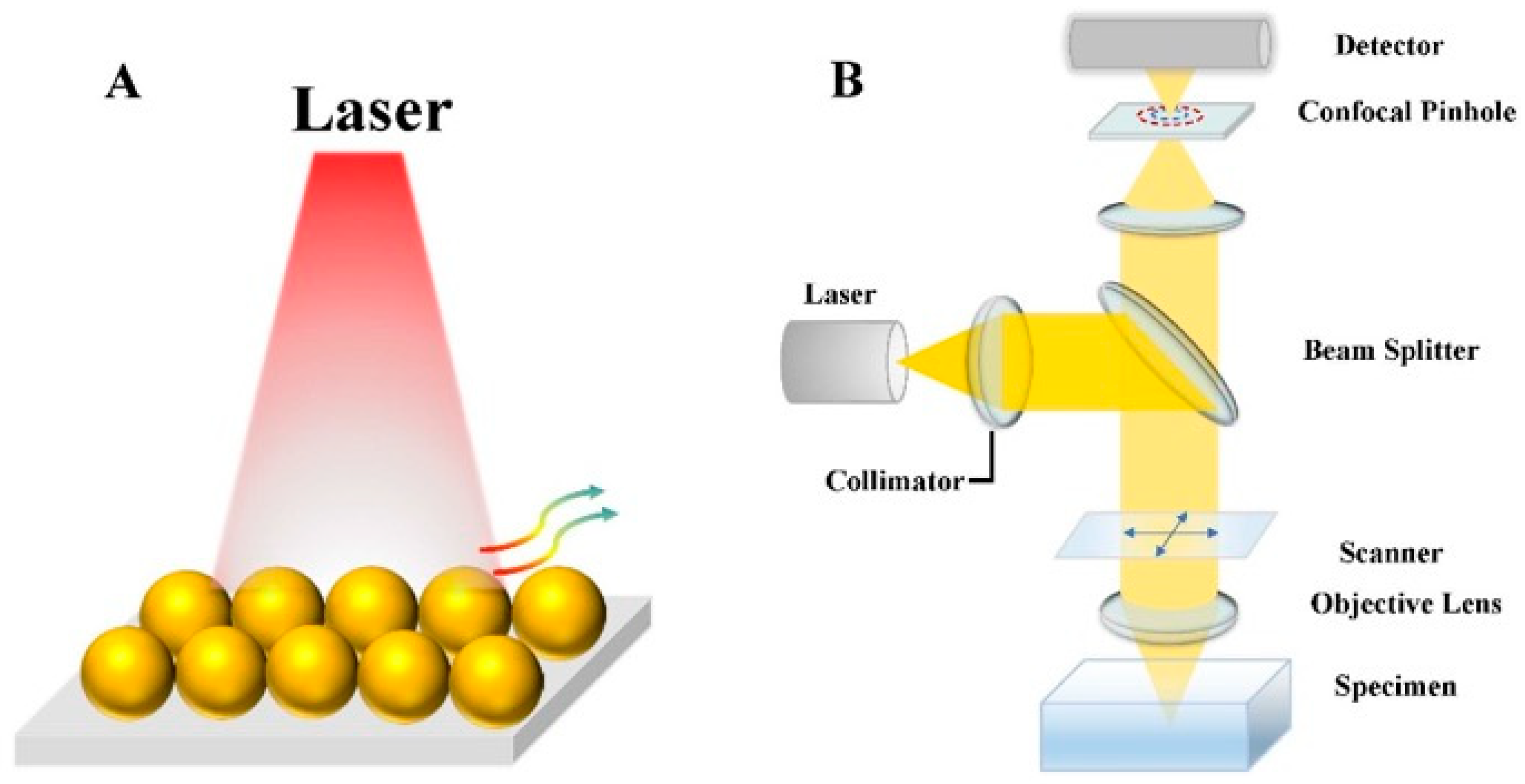
Conventional Raman spectroscopy has limited applications due to its inherently weak signal intensity. This significant limitation has directly driven the development of Raman spectroscopy technology. By improving light sources, optical systems, and signal processing techniques, various Raman spectroscopy methods have been created to suit different application scenarios [15,16,17,18,19,20]. Among them, Surface-Enhanced Raman Scattering (SERS) technology involves adsorbing samples onto rough metal surfaces like gold and silver, which can greatly increase the Raman signal and significantly improve the sensitivity of analysis, even enabling detection at the single-molecule level [21,22]. Confocal Raman microscopy (CRM) combines Raman spectroscopy with microscopy, enabling micron-scale spatial resolution analysis of samples and the extraction of chemical information from different micro-regions [14,23]. A comparison of the principles of SERS and CRM technologies is shown in Figure 1. These two techniques are the most commonly used in cosmetic analysis: SERS utilizes the surface plasmon resonance effect of nanometals such as gold and silver core–shell structures, which can amplify the signal of target molecules by 106 to 108 times, overcoming the limitations of traditional Raman in detecting trace substances [24]; CRM concentrates the laser on a micron-level spot using a focusing lens. When combined with axial scanning, it can generate “depth–component” distribution curves, a common method for studying the transdermal mechanism of components [25]. Compared to infrared spectroscopy, Raman spectroscopy is more sensitive to non-polar bonds like C-C and S-S, as well as symmetric vibrations. Additionally, the Raman signal of water is very weak due to the low Raman activity of O-H bonds, making it particularly suitable for analyzing water-containing systems such as emulsions and lotions [14]. This feature gives it an unmatched advantage in detecting cosmetics with complex ingredients.
Figure 1. Schematic comparison of (A) Surface-Enhanced Raman Scattering (SERS) and (B) Confocal Raman Microscopy (CRM). (A) SERS utilizes metallic nanostructures to amplify the Raman signal of analytes adsorbed on the surface, enabling trace detection. (B) CRM uses a focused laser and confocal pinhole to achieve high spatial resolution depth profiling, ideal for analyzing the distribution of components in stratified samples like skin.

3. Application of Raman Spectroscopy for the Detection of Cosmetic Ingredients and Identification of Hazardous Impurities

Raman spectroscopy serves as a versatile and powerful analytical tool that can both detect cosmetic ingredients and identify hazardous contaminants. For a structured and comprehensive overview of the key Raman techniques, specific applications, research findings, and corresponding references elaborated in this paper, the content is summarized in Table 1. The table is subdivided by research focus (e.g., sunscreens, hair care products) to facilitate easy reference and access.
Table 1. Summary of the applications of Raman spectroscopy in cosmetics.

3.1. Detection of Sunscreens

Beyere and colleagues have made significant progress in the study of interactions between solvents and sunscreens. They analyzed the impact of solvent hydrogen bonds on sunscreens using a conventional Raman spectroscopy system, examining the Raman spectra of five sunscreens in ten solvents. They found that the displacement in the CO stretching vibration region (1600–1700 cm−1) is related to solvent polarity, confirming that hydrogen bonds are the main interaction force between solvents and sunscreens. This study established, for the first time, a quantitative structure–activity relationship between Raman shifts and sunscreen efficiency. By analyzing the conventional Raman spectra of the five sunscreens in solvent systems, it clarified the influence of solvent hydrogen bonds on ultraviolet absorption characteristics and Raman shifts, providing direct spectral evidence for analyzing intermolecular interactions [26].
Oladepo and Loppnow made a breakthrough in the field of in situ detection regarding sunscreen formulations. Using ultraviolet resonance Raman spectroscopy (UVRRS) with 244 nm excitation, they successfully addressed matrix interference to enable in situ analysis of ultraviolet filters. This method achieved a detection limit of 0.23% (w/w) in complex formulation systems, allowing, for the first time, label-free and direct detection of sunscreen ingredients without pretreatment, thus setting a new standard for formulation quality control [27]. Regarding the photostability issue of benzophenone-3 (BP3), Schallreuter made important discoveries using Fourier transform-Raman spectroscopy. By tracking changes in characteristic peaks, the photooxidation mechanism through which BP3 generates semiquinone free radicals under light exposure was clarified. The study also quantitatively demonstrated that after 30 min of light exposure, semiquinone products increased by 270%; simultaneously, there was an 83% decrease in the intensity of the S–S bond of oxidized glutathione (GSSG) at 510 cm−1. This indicates that these free radicals can inactivate antioxidants like glutathione and highlights the biological activity risk associated with sunscreen photodegradation products [28]. Wang et al. combined confocal Raman spectroscopy with the monitoring of human metabolism and developed an innovative method for studying transdermal penetration kinetics. They used confocal Raman spectroscopy to track the real-time penetration process of BP3 in the stratum corneum and integrated urine metabolism analysis to establish a comprehensive kinetic model. The results demonstrated that BP3 can penetrate the stratum corneum within 60 min, and its concentration in urine peaks at 6 h, enabling in situ dynamic quantification of the in vivo behavior of sunscreens for the first time [29].
Regarding the safety controversy of organic particulate sunscreens, Adlhart and Baschong gained new insights into their spatial distribution through Raman imaging technology. They created a three-dimensional distribution model of methylene bis-benzotriazolyl tetramethylbutylphenol (MBBT) particles by combining high-resolution Raman imaging with tape stripping techniques. Using a 785 nm laser to excite the characteristic peak of MBBT (and triazole ring vibration at 1557 cm−1), they scanned the cross-section of skin layer by layer and quantitatively found that 75% of the particles clustered in the skin folds (with a depth less than 10 μm), while only 0.06% penetrated below 30 μm. This finding provides direct spatial distribution evidence for the safety assessment of particulate sunscreens [30].
In their research on advancing the stability of sunscreens, the d’Agostino team synthesized β-CD inclusion complexes of avobenzone and cinoxacin using mechanochemical methods. They confirmed the formation of these complexes with Raman spectroscopy. Spectroscopy revealed that after forming the inclusion complex, the C=O peak of avobenzone shifted from 1645 cm−1 to 1628 cm−1, while the benzene ring breathing vibration of cinoxacin broadened from 1003 cm−1 to 998 cm−1. These spectral changes verified interactions between the host and guest molecules. Photostability tests showed that the photodegradation rate of this inclusion system was significantly reduced, providing an alternative approach for the development of environmentally friendly sunscreens [31].
Raman spectroscopy demonstrates multi-dimensional analytical capabilities in sunscreen research, from intermolecular interaction analysis to in situ dynamic tracking. Conventional Raman has clarified the hydrogen bond mechanism between solvents and sunscreens, while UVRRS achieves label-free in situ detection in complex matrices. There are discrepancies in BP3 safety studies: Schallreuter et al. revealed potential biological risks of its photodegradation products via FT-Raman, yet Wang et al. confirmed with confocal Raman that BP3 penetrates the stratum corneum rapidly but not the bloodstream, with risks limited to the skin surface. A consensus holds that most particulate sunscreens (e.g., MBBT) stay in superficial skin folds (<10 μm) with low transdermal risk. While cyclodextrin inclusion technology inspires eco-friendly sunscreens, the link between its in vitro spectral stability and in situ long-term efficacy remains unestablished. Future research should use Raman imaging to monitor the dynamic structural changes of encapsulated sunscreens under simulated sunlight.
To concisely summarize the key sunscreen ingredients addressed above and their Raman-detectable characteristics, Table 2 outlines the characteristic Raman peaks, the underlying chemical mechanisms supporting their detection, and representative analytical applications—including reported detection limits, where available. This table underscores the diversity of molecular targets and their corresponding Raman spectral signatures, which facilitate the identification, quantification, and spatial localization of these ingredients in complex cosmetic formulations and skin-related matrices.
Table 2. Representative Raman-sensitive sunscreen ingredients, their characteristic spectral features, chemical basis for detection, and reported analytical performance.

3.2. Detection of Hair Dyes and Hair Care Products

In hair dye research, Raman spectroscopy offers distinct and efficient analytical advantages. The Higgins team analyzed colorants in over 30 different hair dyes using SERS [32]. The results revealed notable differences in the spectral patterns of different colorants. By capturing the characteristic peak shifts and intensity changes in the fingerprint spectra of dye molecules, this method achieved an average recognition accuracy of 97% for individual colorants and nearly 100% accuracy in its differentiation between hair dyes from various brands, offering a new approach for high-precision hair dye identification. Esparza found that SERS can penetrate the upper layer of the dye to detect the characteristic peaks of the underlying colorant [33]. For example, if hair is first dyed with a blue semi-permanent dye and then covered with a black dye, the characteristic peaks of the blue dye are still revealed beneath the black layer. This feature provides essential technical support for tracing the history of multi-layer hair dyeing and helps clarify the complex process of hair coloring. In the study of ingredient permeability, Santos combined Raman spectroscopy with infrared spectroscopy, finding that hair dyes mainly accumulate in the cuticle, as indicated by vibrational spectroscopy peaks showing a gradient distribution. Additionally, they evaluated ingredient permeability and changes in hair structure, offering a multi-dimensional tool for cosmetic safety analysis [34]. Notably, Kocak used the combined method of ATR FTIR and SERS. These techniques complement each other to detect differences in vibrational modes; together, these two techniques capture more complete and accurate vibrational information of hair dye ingredients with complex structures and low concentrations. This provides more detailed data for analyzing hair dye ingredients, improves identification accuracy, and establishes an efficient detection process scheme [35].
Confocal Raman spectroscopy (CRS) also has an important role in hair care research. Essendoubi used CRS to monitor changing molecular conformations caused by active ingredients in real-time by observing shifts in characteristic peaks of keratin disulfide bonds, such as S-S stretching vibrations [36]. The disulfide bonds in keratin are crucial for maintaining the structure and properties of hair. When active ingredients in hair care products work, they influence these bonds, resulting in changes in molecular shape. This technology can monitor this process in real-time and on-site without damaging the sample. For example, when studying how hair conditioners repair damaged hair, the dynamic changes in the position and strength of the characteristic peaks of keratin disulfide bonds can be clearly observed. This provides direct and accurate data for evaluating hair care products and gaining a deeper understanding of hair health mechanisms.
Raman applications in hair products combine “surface identification” and “deep structure–activity relationship” research. SERS enables high-precision hair dye identification and layered colorant detection, but spectral overlap requires ATR FTIR cross-validation, highlighting the necessity of multi-technique integration. Confocal Raman provides molecular evidence for hair care efficacy by monitoring keratin disulfide bond conformational changes. Current gaps include the absence of multi-scale correlation models between microstructural changes (e.g., S-S bond rearrangement) and macro hair quality improvements, as well as limited real-time tracking of damaged hair repair processes.

3.3. Detection of Prohibited Ingredients

To prevent oversights in cosmetic safety, accurately identifying prohibited ingredients and harmful impurities is crucial to protect consumer health. Raman spectroscopy, particularly SERS and its combined techniques, has become a vital detection method due to its high sensitivity, strong specificity, and quick analysis.
Dąbrowska focused on the growing issue of plastic particles, such as polyethylene and polypropylene, in cosmetics, and often combined confocal Raman spectroscopy with techniques like scanning electron microscopy/energy dispersive X-ray spectroscopy (SEM/EDS) for both qualitative and quantitative identification to avoid misjudgment [37]. Zhao et al. developed a thin-layer chromatography Raman spectroscopy in situ enrichment method, which enables both qualitative and quantitative analysis with extremely low minimum detectable amounts (0.2–1.2 μg, referring to the absolute mass of analytes) and simple pretreatment. They tested this on six types of caine anesthetics illegally added to cosmetics and serums and for the trace detection of harmful substances like hydroquinone (HQ) in whitening products [38].
In addition to organic compounds, Raman spectroscopy—particularly in its SERS configuration—has proven highly effective for detecting inorganic analytes. This capability arises from specific interactions between the target inorganic species and the metal nanostructure surface, such as chemisorption, coordination bond formation, or charge transfer. These interactions not only anchor the analyte near the enhancing substrate but also modulate its vibrational modes, leading to characteristic spectral changes or signal amplification. Saputra et al. used green-synthesized gold nanoparticles (Au NPs) as SERS substrates for detection, achieving a detection limit at the ng/L level with significantly enhanced characteristic response peaks [25]. Similarly, Chen et al. detected mercury ions (Hg2+) in whitening products using SERS technology combined with specific Fe3O4@Ag-DMcT nanoprobes, with a detection limit as low as 1 nM (~0.2 ppb), and the change in the 1360 cm−1 band was related to the analyte concentration [39]. To identify the prohibited ingredient zinc pyrithione (ZPT) in anti-dandruff products, Ou et al. achieved quick on-site detection at the ng/L level using the SERS method with electrochemically-treated silver needle substrates. Its high selectivity originates from the formation of Ag-Zn/Ag-S bonds [40].
Coumarin is a restricted fragrance listed in Annex III of Regulation (EC) No. 1223/2009 on Cosmetic Products. It is subject to strict concentration limits in cosmetics, and illegal excessive addition poses potential risks to human health. To detect this substance, researchers such as J. Huang employed SERS coupled with binary linear regression for qualitative and quantitative analysis and achieved a detection limit of 1.46 μg/kg [41].
SERS exhibits ultra-high sensitivity for prohibited substances, with detection limits reaching ppb/ppt levels for heavy metals, restricted preservatives, and allergens. However, practical robustness varies: thin-layer chromatography-Raman is affected by plate batch differences, while green-synthesized Au NP substrates suffer from reproducibility issues due to particle size variation. Consensus identifies SERS substrate controllable synthesis and signal reproducibility as critical industrialization bottlenecks. Future breakthroughs require self-calibrating substrates with internal standards and universal pretreatment protocols for complex cosmetic matrices to reduce matrix effects.

4. Application of Raman Spectroscopy for Cosmetics Authentication and Traceability

In the cosmetics industry, authenticating and tracing the source of raw materials are essential steps for ensuring product quality and protecting consumer rights and interests. Raman spectroscopy, which can accurately identify molecular structures and perform precise analysis when combined with chemometric methods, offers clear advantages in this area. Whether it is accurately distinguishing essential oil types, measuring ingredient contents, rapidly inspecting perfume components, or effectively detecting adulterants, Raman spectroscopy provides robust technical support for the comprehensive quality control of cosmetic raw materials.
Lafhal et al. used Raman spectroscopy combined with partial least squares regression (PLSR) and partial least squares discriminant analysis (PLS-DA) methods to study lavender and its essential oils. This approach not only effectively differentiates between various species and their differences but also allows for the high-precision quantitative analysis of key components such as linalool (with a coefficient of determination R2 > 0.9), greatly supporting the traceability of variations and component identification quantification [42].
In the analysis of perfume components, Godinho et al. used Raman spectroscopy combined with principal component analysis (PCA) to identify elements and predict concentrations through characteristic peaks, such as the ethanol peak at 880 cm−1, enabling rapid detection screening [43]. Additionally, Kočiščáková et al. used CRM to study how fragrances interact with skin and could identify different perfumes even 22 h after application, demonstrating its potential in related fields of research [44].
Jentzsch et al. successfully identified adulterants such as solvents and vegetable oils (e.g., benzyl alcohol) in clove essential oil using a handheld Raman spectrometer combined with chemometric techniques like PCA and independent component analysis (ICA), enabling efficient quality control [45]. Regarding the authentication of halal cosmetics, Fadzillah et al. used Raman spectroscopy combined with chemometrics, such as PLSR, to effectively identify animal fats like beef tallow, chicken fat, lard, and mutton tallow in nail polish matrices, achieving excellent model performance (coefficient of determination R2 > 0.99, root mean square error of calibration RMSEC < 2.4%). With advantages of speed, sensitivity, and specificity, this technology is increasingly important in preventing and controlling cosmetic safety risks [46].
Raman spectroscopy also exhibits remarkable value in the authenticity identification and traceability of lipstick. For instance, the López-López group performed dual-wavelength Raman analysis on 80 lipstick samples at 532 nm and 780 nm, confirming that 780 nm could effectively overcome fluorescence interference, and 95% of lipsticks were distinguishable by their characteristic Raman peaks [47]. Although precise classification by manufacturer was unattainable, this study provided a feasible approach for in situ non-destructive identification. For complex real-world scenarios, López-López further achieved the non-destructive traceability of 49 lipstick samples in 12 types of surface smudges via confocal Raman microscopy (CRM) at 780 nm combined with spectral subtraction, which enabled accurate origin tracing by eliminating background interferences [48]. Alblooshi et al. coupled vacuum Fourier transform infrared (FTIR) spectroscopy with Raman spectroscopy, supplemented by Principal Component Analysis (PCA)-based data mining, and achieved a discrimination accuracy of 95.8% for 20 pink lipstick samples of the same brand, furnishing crucial chemical evidence for forensic traceability [49]. Focusing on multi-brand lipstick identification, Salahioglu et al. adopted dispersive Raman spectroscopy at 632.8 nm and found that 68% of 69 lipstick samples could be categorized into 7 characteristic groups; they also verified that the spectral stability of deposited lipstick samples remained for more than one year, highlighting the technique’s advantages in the analysis of long-term preserved forensic evidence [50]. In addition, the strategy of multi-wavelength Raman spectroscopy (473/633/784 nm) combined with PCA-k-nearest neighbor (kNN) classification has been applied to the analysis of trace lipstick smudges on carriers such as fibers and cigarette butts [51]. This approach not only effectively addresses fluorescence interference but also achieves a classification accuracy of 98.7–100%, significantly enhancing the reliability of on-site trace evidence identification. Collectively, these studies corroborate the pivotal role of Raman spectroscopy—via the combination of characteristic peak analysis and chemometrics—in lipstick authenticity discrimination, batch traceability, and trace forensic evidence examination.
Raman combined with chemometrics effectively distinguishes cosmetics by origin and detects adulteration. It can effectively distinguish products by variety or origin, as shown in lavender oil PLS-DA analysis, perfume PCA analysis, and lipstick multi-wavelength analysis. Notably, lipstick studies have reached a consensus: near-infrared excitation (780 nm/785 nm) strongly suppresses cosmetic fluorescence interference, and deposited samples maintain spectral stability for over 1 year, fitting forensic traceability well. However, this method has limitations: though classification accuracy is generally over 95%, manufacturer-level traceability remains challenging, as minor formula adjustments in different batches of the same brand may cause spectral drift. Current knowledge gaps are twofold: first, the lack of a public Raman spectral database covering various brands and batches hinders model generalization validation; second, quantitative detection of adulterants relies heavily on adulterant spectral intensity, leading to insufficient sensitivity for low-concentration, weak-signal adulterants.
Although Raman spectroscopy holds promise for high-sensitivity cosmetic authentication, current studies remain predominantly qualitative, with limited systematic reporting of LOD/LOQ for adulteration analysis. Establishing standardized sensitivity evaluation protocols using reference materials and chemometrics is essential for broader application.

5. Application of Raman Spectroscopy for the Detection of Active Ingredients and Examining Transdermal Behavior

Raman spectroscopy and related technologies have become essential tools in the cosmetics industry due to their non-invasiveness, accurate molecular recognition, and in situ analytical capabilities for studying the skin’s absorption of active ingredients, tracking dynamic changes in penetration, and evaluating efficacy. Whether performing involves routine component quantification, analyzing the transdermal conditions of complex formulations, undertaking precise detection in laboratories, or on-site analysis with portable devices, Raman technology provides comprehensive molecular-level evidence for the mechanisms of action of active ingredients and the optimization of products.

5.1. Detection of Active Ingredients

Raman technology can identify active ingredients in cosmetics in real-time without damaging the samples and help decipher the microstructure and mechanism of these ingredients. This offers valuable technical support for the scientific assessment of cosmetic formulations and the quality control of new cosmetic raw materials like nano-liposomes.

5.1.1. Quantitative Analysis of Active Ingredients

Miloudi et al. combined Raman spectroscopy with PLSR to quantitatively analyze curcumin-loaded alginate nanocarriers in hydrogels and compared this method to attenuated total reflection infrared spectroscopy. They developed quantitative models for nanocarriers and curcumin in hydrogels and assessed the specificity of Raman spectroscopy in measuring active ingredients. Raman spectroscopy demonstrated higher selectivity in quantifying active molecules like curcumin, outperforming infrared spectroscopy in detecting the main components of nanocarriers [52]. Elderderi et al. used conventional Raman spectroscopy combined with PLSR to quantitatively analyze alginate nano-encapsulated piperonyl ester (ANC-PE) in hydrogels. They identified the characteristic Raman spectra of piperonyl ester within the concentration range of 0.4% w/w to 8.3% w/w and developed a quantitative model. The label-free and non-destructive quantification of piperonyl ester in hydrogels was successfully achieved through the characteristic peaks of Raman spectroscopy, and the linear range met the needs of cosmetic formulation analysis. Raman spectroscopy enables the quantification of active ingredients without labeling or destroying samples, offering an efficient and convenient method for analyzing the concentration of active ingredients in nano-encapsulated systems [53].

5.1.2. Monitoring of Chemical Stability

Raman spectroscopy also provides invaluable insights for evaluating the chemical stability of active ingredients in the final cosmetic formulations. In the study by Miloudi et al., the structural integrity of curcumin-loaded alginate nanocarriers dispersed in hydrogels was evaluated by analyzing the spectral features of curcumin [53]. The intensity ratio of the 1637 cm−1 and 1603 cm−1 bands in the PLSR weighting vector differed from that in the spectrum of pure curcumin, which was attributed to the stable enol form of curcumin existing in the hydrogel at pH 7. Importantly, no new spectral features or peak shifts were observed in all tested samples throughout the study, indicating that curcumin maintained its chemical integrity without degradation during formulation preparation and storage.

5.1.3. Assessment of Formulation Compatibility

The ability of Raman spectroscopy to distinguish the spectral contributions of active ingredients from excipients in formulations makes it a powerful tool for assessing the compatibility of finished cosmetic formulations. Miloudi et al. demonstrated that Raman spectroscopy could clearly differentiate the spectral signals of curcumin (the active ingredient) from those of the hydrogel matrix components (e.g., glycerol, water, sodium carboxymethylcellulose) [52]. The absence of new spectral peaks or peak shifts in the combined spectra confirmed the absence of chemical interactions or degradation product formation between the nano-encapsulated active ingredient and the surrounding formulation matrix, which is direct evidence of their good compatibility.

5.2. Monitoring the Transdermal Process of Cosmetic Ingredients

5.2.1. Penetration Path of Active Ingredients

Using Raman spectroscopy imaging technology, the pathway by which cosmetic active ingredients penetrate the skin can be directly observed. Hu et al. used three-dimensional Raman imaging combined with a multiple linear regression algorithm. They created a specific signal attenuation correction equation for the distribution characteristics of niacinamide in the skin. They quantitatively analyzed niacinamide in the stratum corneum (SC) and viable epidermis (EP) layers, addressing signal attenuation during three-dimensional Raman data collection. The visualization of niacinamide in these layers was successfully achieved, and the correction equation effectively improved accuracy. Three-dimensional Raman imaging technology not only allows for the visualization of layered active ingredient concentrations but also overcomes the technical challenge of depth signal attenuation through correction, enabling the accurate quantification of active ingredients in the skin [15].
Wang et al. used CRM to monitor liposome-encapsulated glabridin in vivo and evaluate its transdermal penetration kinetics. They investigated how liposome technology enhances the transdermal absorption of glabridin and analyzed the level of skin penetration and types of release patterns present at different time points. Liposome encapsulation increased the transdermal absorption efficiency of glabridin by 3.8 times and exhibited a gradual release profile, which could effectively improve its dermal absorption and bioavailability. Confocal Raman spectroscopy allowed for the real-time monitoring of glabridin’s penetration kinetics in vivo, providing direct molecular evidence for evaluating the synergistic effect of liposome carriers [54]. Regarding the use of Melaleuca alternifolia essential oil in cosmetics, Infante et al. used CRM to determine how its nanoemulsion penetrates the skin, confirming that this formulation can help the essential oil reach deep skin layers, thereby improving photoaged skin and providing direct evidence of its effective evaluation [55].

5.2.2. Research on Penetration Kinetics

By continuously monitoring changes in the Raman spectra of cosmetic ingredients in the skin at different time points and establishing penetration kinetic models, Raman spectroscopy serves as a practical tool for analyzing the transdermal process of cosmetic ingredients. Mateus et al. conducted in vivo and in vitro transdermal absorption studies on salicylic acid using CRM combined with Franz diffusion cells. They examined how different gelling agents affect the efficiency of salicylic acid delivery and established a correlation between in vivo CRM signals and in vitro penetration amounts. CRM can be used to directly detect salicylic acid in vivo and perform depth analysis, showing a good correlation with in vitro penetration data. CRM enables the non-invasive detection of salicylic acid distribution in vivo, providing key technical support for establishing in vivo-in vitro absorption correlation and optimizing formulation recipes [56].
Yang et al. used CRM to evaluate in vivo how rice ferment filtrate (RFF) from yeast penetrates the skin. They examined the depth of skin penetration and the quantitative distribution of RFF at different time points (0.5, 1, 2, and 4 h). RFF can penetrate the stratum corneum within 30 min and reach the dermis after 4 h, demonstrating rapid penetration kinetics [57].
Tfaili et al. used CRM to continuously monitor low-concentration caffeine and resveratrol solutions applied topically for up to 9 h. They documented the penetration kinetic curves of the two ingredients in the skin and investigated how the skin’s structural heterogeneity influences molecular diffusion. The penetration dynamics of caffeine and resveratrol were effectively captured over nine hours, and the results demonstrated the heterogeneity of the skin’s structure and the complexity of molecular diffusion. CRS can dynamically track the skin penetration process of external molecules on the skin, providing a detection method with high spatiotemporal resolution for studying the penetration behaviors of low-concentration active ingredients [58]. In this study, the limits of detection (LOD) of caffeine and resveratrol measured by CRS were 0.01% (w/w) and 0.05% (w/w), with the corresponding signal-to-noise ratios (S/N) of 15.2 and 10.8, respectively. Caffeine showed a higher detection sensitivity due to the larger Raman scattering cross-section of the purine ring in its molecular structure and the fact that its characteristic peak at 1340 cm−1 (assigned to C-N stretching vibration) exhibited no peak overlap with that of the skin matrix. In contrast, the characteristic peak of resveratrol at 1600 cm−1 (attributed to benzene ring stretching vibration) had slight overlap with the characteristic peaks of stratum corneum lipids in the skin, which resulted in a relatively low S/N ratio and thus necessitated peak resolution with the aid of chemometric methods (e.g., multiple linear regression, MLR).

5.3. Molecular-Level Investigation of Transdermal Mechanisms

5.3.1. Interaction Between Skin Barrier and Ingredients

Raman spectroscopy is used to detect shifts in characteristic peaks and changes in the intensity of stratum corneum lipids before and after exposure to cosmetic ingredients. This enables the analysis of how ingredients affect intermolecular interactions among lipids and helps investigate the interactions between cosmetic components and skin barrier elements—such as lipids and proteins in the stratum corneum. Xu used CRM to monitor and analyze the penetration and moisturizing effects of ceramide NP nanoemulsion in the skin. He tracked changes in the penetration depth of ceramide NP nanoemulsion over time and evaluated its impact on the hydration and barrier function of the skin’s stratum corneum. A ceramide NP nanoemulsion can enhance skin hydration, improve barrier function, and exhibit a gradual increase in penetration depth, indicating good transdermal absorption properties [59].
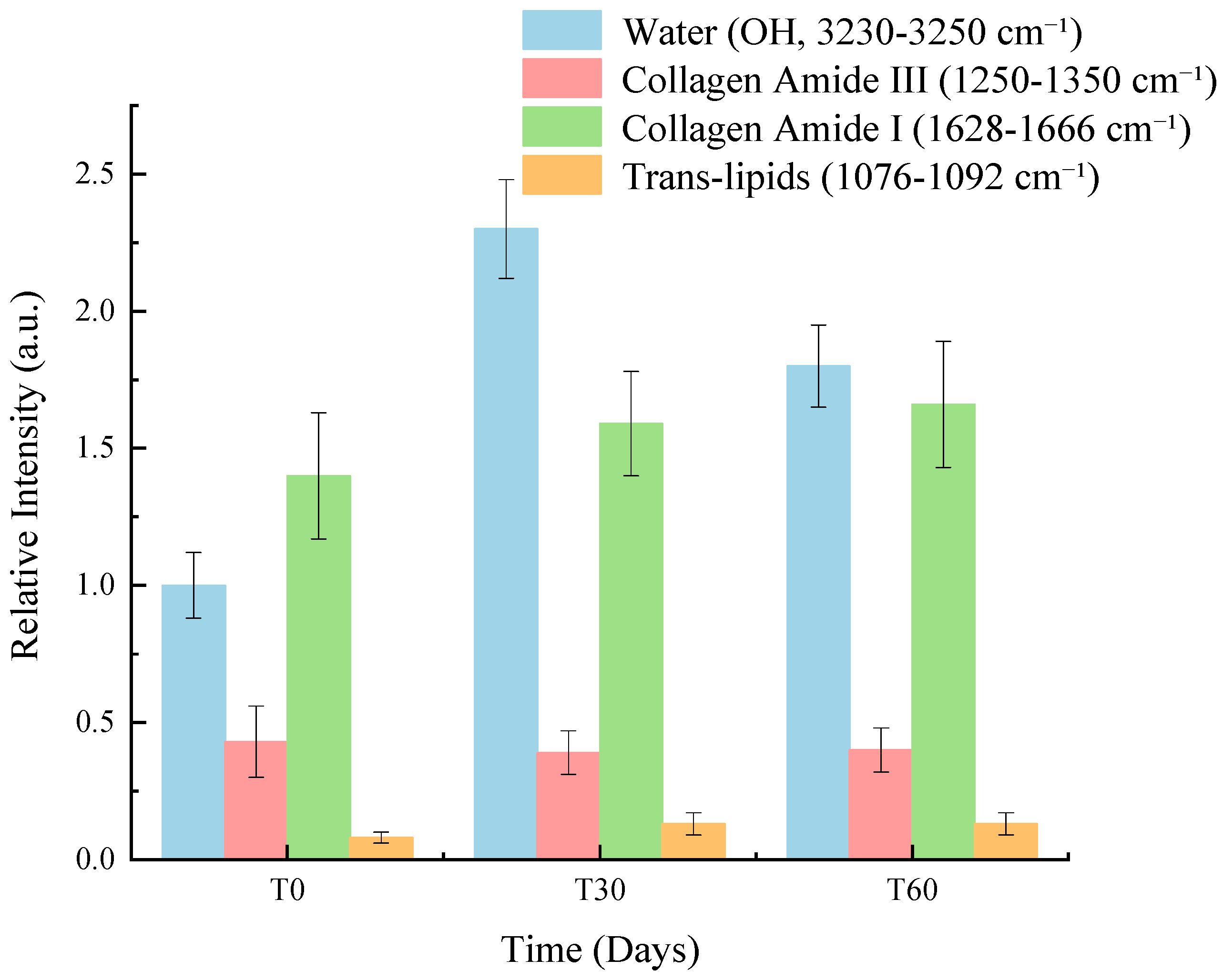
Tosato and colleagues used Fourier transform-Raman spectroscopy and dispersive Raman spectroscopy combined with PCA to assess the effects of anti-aging cosmetics on the skin. They examined biochemical changes in skin hydration and proteins, such as collagen, after cosmetic use, and linked these changes to molecular features of skin aging. After 30 days of continuous application, the intensity of the amide III band (1250–1350 cm−1) of collagen and the OH stretching vibration (3230–3250 cm−1) of water in the skin increased, indicating improved skin barrier function; although these effects were not sustained at the same intensity at 60 days, the intensity of amide I (related to collagen) still showed an upward trend (Figure 2). Fourier transform/dispersive Raman spectroscopy can monitor changes in skin biomolecules in real-time, providing molecular-level evidence for evaluating the moisturizing and anti-aging effects of cosmetics [60].
Figure 2. Grouped bar chart showing normalized relative intensities of key Raman bands at baseline (T0), 30 days (T30), and 60 days (T60) of continuous anti-aging cosmetic use. Analyzed bands: water (OH stretching, 3230–3250 cm−1), collagen amide III (1250–1350 cm−1), collagen amide I (1628–1666 cm−1), and trans-lipids/ceramides (1076–1092 cm−1). Error bars represent standard error (SE, n = 16). Relative to T0, the amide III band intensity rose at T30 but was not maintained at that level at T60, while the amide I band intensity increased continuously. The trans-lipid peak intensity was elevated at both T30 and T60. These spectral changes suggest that the cosmetic enhances collagen preservation and lipid organization, thus alleviating aging-related biochemical alterations in the skin. Error bars denote the standard error of the measurements (data adapted from [60] 2012, Photomedicine and Laser Surgery).
Teo et al. used a handheld CRM to compare the absorption kinetics of ceramide-based moisturizers and water-based moisturizers in the skin. They conducted a correlation analysis with liquid chromatography-mass spectrometry (LC-MS) results. The research results showed that the retention time of ceramide-based moisturizers in the skin’s stratum corneum was longer than that of water-based moisturizers. Their Raman detection results were highly correlated with the LC-MS analysis results (r = 0.96), verifying the reliability of the detection method and providing practical technical support for efficient evaluation of the skin retention effect when using different types of moisturizers [61].

5.3.2. Transformation and Metabolism of Active Ingredients in the Skin

Raman spectroscopy can be utilized to track the transformation and metabolites of active ingredients in the skin. Wang et al. combined Raman spectroscopy, high-performance liquid chromatography (HPLC), and skin transcriptome analysis to study the transdermal penetration behavior of retinol in semi-solid formulations. They investigated the skin’s penetration depth, in vivo distribution, and metabolic pathway of retinol, as well as its effect on epidermal gene expression. Retinol mainly resides in the skin’s stratum corneum, does not penetrate the skin’s barrier into the bloodstream, and can upregulate 126 genes associated with epidermal development. Raman spectroscopy accurately determined the skin penetration depth of retinol, providing key data for revealing its penetration characteristics of “being confined to the stratum corneum without systemic exposure” [62].
Kim et al. used CRM to quantitatively analyze the impact of ceramides in facial creams on skin absorption parameters. They examined how ceramides affect factors such as the amount of absorption, the absorption rate, and the depth of absorption. They evaluated how ceramides influence skin absorption efficiency in facial cream formulations. Facial creams containing ceramides can significantly increase the absorption of active ingredients by the skin, accelerate the absorption rate, and deepen absorption, thereby effectively improving the skin’s absorption efficiency. The skin absorption parameters were measured using Raman spectroscopy, providing direct data to support the role of ceramides in enhancing skin absorption in facial creams [63].
De Tollenaere et al. used CRM to study the impact of bentonite carriers on the skin through the permeability of high-molecular-weight hyaluronic acid (HMW HA). They analyzed how vectorization technology (bentonite carriers) affects the penetration depth of HMW HA and its clinical effectiveness, such as moisturizing and improving skin brightness 4. Vectorization technology can help HMW HA penetrate deeper into the skin, significantly boost long-term moisturizing effects, improve skin brightness, and enhance clinical outcomes [64].
CRM has advanced from simple “depth tracking” to complex “kinetic modeling” and “carrier mechanism analysis” in transdermal research. A consensus has been reached in multiple studies (e.g., Wang, Yang, Tfaili et al.) that Raman technology can non-invasively and in real-time monitor the dynamic distribution of active ingredients in the stratum corneum and viable epidermis. Regarding transdermal mechanisms, existing research presents certain discrepancies: on the one hand, some studies (e.g., Hu, Wang) have demonstrated that certain ingredients (e.g., retinol) mainly remain in the stratum corneum, functioning as a “reservoir”; on the other hand, carrier technologies (e.g., liposomes, bentonite) can significantly deliver ingredients (e.g., glabridin, high-molecular-weight hyaluronic acid) to deeper skin layers. This suggests that the final transdermal fate of ingredients depends not only on their intrinsic molecular properties but also, more importantly, on the design of the carrier system. Key gaps persist in current research: it mostly focuses on short-term behaviors, with insufficient attention to long-term effects and metabolic pathways within the skin; there is a lack of transdermal kinetic models for different active ingredients across various skin types; the integration of Raman spectroscopy with other technologies (e.g., LC-MS) for metabolite analysis is inadequate; and accurately extrapolating in vitro transdermal data to in vivo effects remains unresolved. Future research should focus on establishing multi-time-scale transdermal kinetic models and exploring the metabolic transformation mechanisms of active ingredients in the skin.

6. Limitations and Challenges

Mainstream Raman-based techniques for cosmetic analysis exhibit remarkable differences in their core performance: SERS boasts the lowest detection limit (at the ng/L~ppb level) and is suitable for the detection of trace hazardous substances; UVRRS has a detection limit of 0.1%~0.5% (w/w), which is ideal for the in situ analysis of active ingredients such as sunscreens; CRS can achieve a skin penetration detection depth of up to 200 μm and is applicable to transdermal mechanism research; handheld Raman spectroscopy features a detection limit of 0.5%~1% (w/w), making it fit for on-site rapid identification, but its penetration depth is only around 50 μm, which precludes deep-layer analytical capability. The advantages and limitations of Raman-based technologies for cosmetic analysis are summarized in Table 3, which outlines the core merits and application constraints of mainstream Raman-derived techniques in this field. This table facilitates the targeted selection of appropriate technologies aligned with specific research needs (e.g., trace detection, depth-resolved analysis, in situ monitoring). The main challenge for Raman spectroscopy in cosmetic analysis is signal interference and complex matrices. Strong background noise from endogenous fluorescent substances in samples, such as lipstick pigments and aromatic compounds in hair dyes, can greatly obscure characteristic Raman signals. For example, in the analysis of 69 lipstick samples, around 10% of the samples failed during spectral collection due to excessive fluorescence, which led to the adoption of near-infrared excitation (780 nm) or surface enhancement strategies. However, these approaches increased operational complexity [50]. At the same time, emulsifiers, oils, and fats in multiphase cosmetic systems (emulsions, gels) tend to cause overlaps between spectral peaks. For example, the accurate analysis of residual hair dye compounds often necessitates cross-validation with infrared spectroscopy, as relying solely on Raman spectroscopy may be insufficient to resolve complex spectral overlaps, thereby compromising identification accuracy [34].
Table 3. Advantages and limitations of Raman technology in cosmetic analysis.
Limitations in sensitivity and detection depth significantly restrict the application of Raman technology. Conventional Raman scattering cross-sections are very small, which limits the detection of trace substances like mercury ions. Although SERS can increase the detection limit of mercury ions to 1 nM using nano-probes such as Fe3O4@Ag, matrices such as thickeners in real samples can trap target molecules and reduce the enhancement effect. In skin penetration studies, the optical penetration depth of confocal Raman is limited by tissue scattering, and effective detection usually stops at the shallow dermis (around 200 μm) [20].
Issues with quantitative models and reproducibility directly impact the reliability of the analytical results. Raman quantification depends heavily on chemometric algorithms, and model performance is greatly affected by the diversity of cosmetic matrices and individual biological differences: calculating layered concentrations of niacinamide requires skin-specific attenuation correction equations. However, individual differences in stratum corneum thickness (10–200 μm) limit the model’s universality. Although SERS detection of coumarin reduces the detection limit to 1.46 μg/kg with binary linear regression, signal fluctuations caused by different formulation matrices, like creams and solutions, limit the model’s transferability. Reproducibility risks come from the instability of nano-substrates and instruments: during ZPT detection, batch-to-batch variations in the nanostructure of electrochemically-treated silver needle surfaces can lead to signal fluctuations over 30%. Three-dimensional reconstruction in Raman imaging is sensitive to uneven sample surfaces, such as when analyzing sunscreen particles in skin folds, which often requires multiple scans and data stitching, increasing the chance of human error.
Limitations in real-world applications have revealed gaps in the adaptability of Raman technology. Regarding dynamic process monitoring, there is a blind spot in temporal resolution: while confocal Raman spectroscopy can follow penetration processes on an hourly basis, it cannot detect millisecond-scale burst release events. For in vivo detection, physiological interferences pose a significant challenge. For example, research on sunscreens and their penetration of human skin is affected by factors like sweat secretion and physical activity, which introduce unpredictable disturbances to the detection system, reducing the reliability of spectral data and the accuracy of penetration assessments. Additionally, Raman technology has limited usefulness for complex systems. For instance, analyzing microplastics in facial scrubs is challenging because of the substantial background interference from other matrix components such as abrasive particles and emulsifiers. To tackle these issues, progress can be achieved through strategies like combining multiple techniques and improving data processing algorithms.
Beyond the aforementioned technical limitations, several practical barriers hinder the large-scale industrial adoption of Raman spectroscopy in cosmetics. First, the lack of standardized Raman measurement protocols leads to inconsistent results due to inter-laboratory variations in instrumental setups, spectral acquisition parameters and data processing workflows, complicating cross-laboratory comparisons and the development of universal spectral databases. Furthermore, Raman-derived evidence remains unvalidated for regulatory submissions in cosmetic safety assessment and efficacy claims, as authorities require cross-validation with traditional methods like HPLC-MS, and formal acceptance criteria for Raman-based quantitative models are yet to be defined. Additionally, high costs of advanced systems (e.g., CRM, SERS) and the need for specialized expertise in spectral data interpretation and chemometric model development create major hurdles, especially for small and medium-sized cosmetic enterprises with limited resources. Addressing these interconnected challenges is critical to transforming Raman spectroscopy from a specialized research tool into a routine, reliable analytical technique for widespread industrial use in the cosmetics sector.

7. Conclusions and Future Prospects

Raman technology has a variety of uses in the cosmetics industry, with different Raman techniques tailored to specific scenarios, aims, and limitations. Conventional Raman spectroscopy is user-friendly, allowing for non-destructive and label-free analysis. It is commonly employed to analyze the fundamental components of cosmetic raw materials and finished products, quantifying active ingredients, studying molecular interactions, and verifying authenticity. However, it has a limited ability to resist interference in complex samples, is prone to fluorescence interference, has restricted detection sensitivity, and often requires additional technologies to detect trace substances. SERS offers high sensitivity and can detect harmful substances and components in complex matrices. However, its substrate preparation is comparatively complex, with poor reproducibility and high costs. Confocal Raman spectroscopy, including CRM and CRS, provides a three-dimensional spatial resolution, enabling the layered analysis of component distribution within the skin. It is mainly used to study the dynamic penetration process of active ingredients, such as depth and absorption changes over time. Handheld devices are suitable for on-site monitoring and are closely related to other technologies. Nonetheless, such devices tend to be expensive, have limited penetration depth, and require complex data processing. UVRRS enhances detection sensitivity for target components like sunscreens through resonance effects and minimizes background interference. However, its excitation wavelength is limited, making it unsuitable for non-resonant components, which may lead to the photodegradation of samples. FT-RS reduces fluorescent interference, making it suitable for analyzing samples with fluorescent substances, and it is often used to study metabolic processes and structural changes in biomolecules. However, this type of instrument is costly and has limited sensitivity for trace components. Overall, Raman technology supports the entire spectrum of cosmetic research. In practical applications, it often necessitates a combination with other technologies to improve analytical accuracy.
The current development of Raman technology in the cosmetics industry primarily focuses on three key areas: First, the increasing speed of miniaturization and portability is considered. Handheld confocal Raman spectrometers have been successfully used for the non-invasive analysis of moisturizer absorption kinetics, and have become a practical tool for on-site rapid detection, allowing this technology to be more widely used in real-time monitoring. Second, the strategy of combining multiple technologies continues to improve. For example, integrating Raman technology with infrared spectroscopy, scanning electron microscopy, and other methods—each complementing the other—can more accurately identify microplastics in cosmetics, broadening the scope of analysis and making the results more dependable. Subsequently, coherent anti-Stokes Raman scattering (CARS) and stimulated Raman scattering (SRS) microscopes, developed based on new forms of coherent Raman scattering imaging technology, can more precisely locate the skin’s surface and enhance the resolution of skin depth [65,66]. Ultimately, the deep integration of intelligent algorithms has achieved excellent results. Algorithms like PLS, Multivariate Curve Resolution-Alternating Least Squares (MCR-ALS), PCA, and deep learning models have effectively solved technical challenges such as spectral overlap and fluorescence background subtraction, significantly improving the accuracy of layered quantification and complex classification outcomes [66,67,68].
In the future, advancements in this technology should focus on developing anti-fluorescence interference laser sources, improving detection sensitivity for deep tissues, establishing standardized spectral databases, and promoting the uniform production of SERS substrates. These steps will help facilitate large-scale application throughout the entire cosmetics industry chain.

Author Contributions

Conceptualization, H.-Y.W. and G.-L.W.; investigation, L.L., J.-S.W., L.-N.K. and N.-Y.W.; writing—original draft, L.L., L.-N.K. and H.-Y.W.; writing—review, editing, and revision, L.L. and J.-S.W. All authors have read and agreed to the published version of the manuscript.

Funding

This research was funded by the National Key Research and Development Program of China (grant number 2024YFF0726104).

Institutional Review Board Statement

Not applicable.

Data Availability Statement

The original contributions presented in this study are included in the article. Further inquiries can be directed to the corresponding author(s).

Conflicts of Interest

The authors declare no conflicts of interest.

Abbreviations

The following abbreviations are used in this manuscript:
SERSSurface-Enhanced Raman Scattering
CRMConfocal Raman Microscopy
CRSConfocal Raman Spectroscopy
UVRRSUltraviolet Raman spectroscopy
BP3Bnzophenone-3
MBBTMethylene Bis-Benzotriazolyl Tetramethylbutylphenol
SEM/EDSScanning Electron Microscopy/Energy Dispersive X-Ray Spectroscopy
HQHydroquinone
ZPTZinc Pyrithione
PLSRPartial Least Squares Regression
PLS-DAPartial Least Squares Discriminant Analysis
PCAPrincipal Component Analysis
ICAIndependent Component Analysis
ANC-PEAlginate Nano-Encapsulated Piperonyl Ester
SCStratum Corneum
EPViable Epidermis
RFFRice Ferment Filtrate
LC-MSLiquid Chromatography-Mass Spectrometry
HPLCLiquid Chromatography
HMW HAHigh Molecular Weight Hyaluronic Acid
FT-RSFourier Transform-Raman Spectroscopy
CARSCoherent Anti-Stokes Raman Scattering
RSRaman Spectroscopy
MCR-ALSMultivariate Curve Resolution-Alternating Least Squares

References

  1. Dhapte-Pawar, V.; Kadam, S.; Saptarsi, S.; Kenjale, P.P. Nanocosmeceuticals: Facets and aspects. Future Sci. OA 2020, 6, Fso613. [Google Scholar] [CrossRef]
  2. Rischard, F.; Gore, E.; Flourat, A.; Savary, G. The challenges faced by multifunctional ingredients: A critical review from sourcing to cosmetic applications. Adv. Colloid Interface Sci. 2025, 340, 103463. [Google Scholar] [CrossRef]
  3. Thiyagarasaiyar, K.; Goh, B.-H.; Jeon, Y.-J.; Yow, Y.-Y. Algae Metabolites in Cosmeceutical: An Overview of Current Applications and Challenges. Mar. Drugs 2020, 18, 323. [Google Scholar] [CrossRef]
  4. Ahmadi-Ashtiani, H.-R.; Baldisserotto, A.; Cesa, E.; Manfredini, S.; Sedghi Zadeh, H.; Ghafori Gorab, M.; Khanahmadi, M.; Zakizadeh, S.; Buso, P.; Vertuani, S. Microbial Biosurfactants as Key Multifunctional Ingredients for Sustainable Cosmetics. Cosmetics 2020, 7, 46. [Google Scholar] [CrossRef]
  5. Taofiq, O.; González-Paramás, A.M.; Barreiro, M.F.; Ferreira, I.C.F.R. Hydroxycinnamic Acids and Their Derivatives: Cosmeceutical Significance, Challenges and Future Perspectives, a Review. Molecules 2017, 22, 281. [Google Scholar] [CrossRef]
  6. Guzmán, E.; Ortega, F.; Rubio, R.G. Chitosan: A Promising Multifunctional Cosmetic Ingredient for Skin and Hair Care. Cosmetics 2022, 9, 99. [Google Scholar] [CrossRef]
  7. Tan, T.Y.; Wee, H.N.; Lee, L.S.; Han, H.Y.; Ong, C.T.; Neela, M.; Masilamani, J.; Phan, T.T.; Ching, J. Sensitive ex vivo human skin transdermal assay testing method with mass spectrometric analysis for cosmetics application. J. Cosmet. Dermatol. 2022, 21, 6124–6128. [Google Scholar] [CrossRef] [PubMed]
  8. Boyadzhiev, A.; Trevithick-Sutton, C.; Wu, D.; Decan, N.; Bazin, M.; Shah, G.M.; Halappanavar, S. Enhanced Dark-Field Hyperspectral Imaging and Spectral Angle Mapping for Nanomaterial Detection in Consumer Care Products and in Skin Following Dermal Exposure. Chem. Res. Toxicol. 2020, 33, 1266–1278. [Google Scholar] [CrossRef] [PubMed]
  9. Lunter, D.; Klang, V.; Kocsis, D.; Varga-Medveczky, Z.; Berkó, S.; Erdő, F. Novel aspects of Raman spectroscopy in skin research. Exp. Dermatol. 2022, 31, 1311–1329. [Google Scholar] [CrossRef] [PubMed]
  10. Sjövall, P.; Skedung, L.; Gregoire, S.; Biganska, O.; Clément, F.; Luengo, G.S. Imaging the distribution of skin lipids and topically applied compounds in human skin using mass spectrometry. Sci. Rep. 2018, 8, 16683. [Google Scholar] [CrossRef]
  11. Evangeline, W.P.; Saranya, E.; Rajalakshmi, E.; Murugan, M.; Mahalakshmi, S.; Ramya, V.; Vishwakarma, A.; Ramya, M. Advancements of Raman spectroscopy in cosmetics and dermatology. S. Afr. J. Bot. 2024, 167, 122–129. [Google Scholar] [CrossRef]
  12. Hu, X.; He, H. A review of cosmetic skin delivery. J. Cosmet. Dermatol. 2021, 20, 2020–2030. [Google Scholar] [CrossRef]
  13. Smith, R.; Wright, K.L.; Ashton, L. Raman spectroscopy: An evolving technique for live cell studies. Analyst 2016, 141, 3590–3600. [Google Scholar] [CrossRef]
  14. Zhang, S.; Qi, Y.; Tan, S.P.H.; Bi, R.; Olivo, M. Molecular Fingerprint Detection Using Raman and Infrared Spectroscopy Technologies for Cancer Detection: A Progress Review. Biosensors 2023, 13, 557. [Google Scholar] [CrossRef] [PubMed]
  15. Hu, Y.; Ha, T.; Kang, Y.; Du, Y. Stratified quantification of targets in skin by three-dimensional Raman spectroscopic imaging. Anal. Sci. 2025, 41, 803–812. [Google Scholar] [CrossRef]
  16. Darvin, M.E.; Schleusener, J.; Lademann, J.; Choe, C.S. Current Views on Noninvasive in vivo Determination of Physiological Parameters of the Stratum Corneum Using Confocal Raman Microspectroscopy. Ski. Pharmacol. Physiol. 2022, 35, 125–136. [Google Scholar] [CrossRef] [PubMed]
  17. Darvin, M.E. Optical Methods for Non-Invasive Determination of Skin Penetration: Current Trends, Advances, Possibilities, Prospects, and Translation into In Vivo Human Studies. Pharmaceutics 2023, 15, 2272. [Google Scholar] [CrossRef]
  18. Klossek, A.; Thierbach, S.; Rancan, F.; Vogt, A.; Blume-Peytavi, U.; Rühl, E. Studies for improved understanding of lipid distributions in human skin by combining stimulated and spontaneous Raman microscopy. Eur. J. Pharm. Biopharm. 2017, 116, 76–84. [Google Scholar] [CrossRef] [PubMed]
  19. Sarri, B.; Chen, X.; Canonge, R.; Grégoire, S.; Formanek, F.; Galey, J.-B.; Potter, A.; Bornschlögl, T.; Rigneault, H. In vivo quantitative molecular absorption of glycerol in human skin using coherent anti-Stokes Raman scattering (CARS) and two-photon auto-fluorescence. J. Control. Release 2019, 308, 190–196. [Google Scholar] [CrossRef]
  20. Khan, K.M.; Srivastava, A.; Dutta, S.B.; Kumar, N.; Majumder, S.K. Reverse confocal polarized Raman spectroscopy (RCPRS) for tissue analysis. Lasers Med. Sci. 2025, 40, 212. [Google Scholar] [CrossRef]
  21. Sharma, N.; Singh, A.; Ratnesh, R.K.; Adhana, A.; Tyagi, L.; Singh, J. Insights of surface enhancing Raman spectroscopy for biomedical application. Methods 2025, 243, 16–30. [Google Scholar] [CrossRef] [PubMed]
  22. Han, X.X.; Rodriguez, R.S.; Haynes, C.L.; Ozaki, Y.; Zhao, B. Surface-enhanced Raman spectroscopy. Nat. Rev. Methods Primers 2022, 1, 87. [Google Scholar] [CrossRef]
  23. Opilik, L.; Schmid, T.; Zenobi, R. Modern Raman imaging: Vibrational spectroscopy on the micrometer and nanometer scales. Annu. Rev. Anal. Chem. 2013, 6, 379–398. [Google Scholar] [CrossRef]
  24. Saputra, I.S.; Yulizar, Y.; Krisnandi, Y.K.; Annas, D.; Sembiring, K.C.; Saputro, A.H.; Fahmi, A.G. Green fabrication of Au nanoparticles as SERS-active substrate for enhancement hydroquinone detection in cosmetics. Vib. Spectrosc. 2023, 126, 103543. [Google Scholar] [CrossRef]
  25. Falcone, D.; Uzunbajakava, N.E.; Varghese, B.; de Aquino Santos, G.R.; Richters, R.J.; van de Kerkhof, P.C.; van Erp, P.E. Microspectroscopic Confocal Raman and Macroscopic Biophysical Measurements in the in vivo Assessment of the Skin Barrier: Perspective for Dermatology and Cosmetic Sciences. Ski. Pharmacol. Physiol. 2015, 28, 307–317. [Google Scholar] [CrossRef]
  26. Beyere, L.H.; Yarasi, S.; Loppnow, G.R. Solvent effects on sunscreen active ingredients using Raman spectroscopy. J. Raman Spectrosc. 2003, 34, 743–750. [Google Scholar] [CrossRef]
  27. Oladepo, S.A.; Loppnow, G.R. Ultraviolet resonance Raman spectroscopy as a robust spectroscopic tool for in situ sunscreen analysis. Anal. Chim. Acta 2008, 628, 57–66. [Google Scholar] [CrossRef]
  28. Schallreuter, K.U.; Wood, J.M.; Farwell, D.W.; Moore, J.; Edwards, H.G.M. Oxybenzone Oxidation Following Solar Irradiation of Skin: Photoprotection versus Antioxidant Inactivation. J. Investig. Dermatol. 1996, 106, 583–586. [Google Scholar] [CrossRef]
  29. Wang, M.; Tan, J.; Qi, Z.; Ge, X.; Li, G.; Yu, Y. A combined study of skin penetration by confocal Raman spectroscopy and human metabolism: A case of benzophenone-3 in sunscreen. Env. Pollut 2024, 340, 122868. [Google Scholar] [CrossRef] [PubMed]
  30. Adlhart, C.; Baschong, W. Surface distribution and depths profiling of particulate organic UV absorbers by Raman imaging and tape stripping. Int. J. Cosmet. Sci. 2011, 33, 527–534. [Google Scholar] [CrossRef] [PubMed]
  31. d’Agostino, S.; Azzali, A.; Casali, L.; Taddei, P.; Grepioni, F. Environmentally Friendly Sunscreens: Mechanochemical Synthesis and Characterization of β-CD Inclusion Complexes of Avobenzone and Octinoxate with Improved Photostability. ACS Sustain. Chem. Eng. 2020, 8, 13215–13225. [Google Scholar] [CrossRef]
  32. Higgins, S.; Kurouski, D. Surface-enhanced Raman spectroscopy enables highly accurate identification of different brands, types and colors of hair dyes. Talanta 2023, 251, 123762. [Google Scholar] [CrossRef]
  33. Esparza, I.; Wang, R.; Kurouski, D. Surface-Enhanced Raman Analysis of Underlaying Colorants on Redyed Hair. Anal. Chem. 2019, 91, 7313–7318. [Google Scholar] [CrossRef]
  34. Dias Santos, J.; Pinto, P.F.; Edwards, H.G.M.; Cappa de Oliveira, L.F. Characterization by Raman and infrared spectroscopy and fluorescence microscopy of human hair treated with cosmetic products. Spectrochim. Acta A Mol. Biomol. Spectrosc. 2022, 280, 121577. [Google Scholar] [CrossRef] [PubMed]
  35. Kocak, A.; Lovera, N.; Comanescu, M.A. Identification of different hair dyes in dyed hair using Attenuated Total Reflection Fourier Transform Infrared (ATR FT-IR) and Surface Enhancing Raman Spectroscopy (SERS). Spectrochim. Acta A Mol. Biomol. Spectrosc. 2025, 335, 125952. [Google Scholar] [CrossRef]
  36. Essendoubi, M.; Meunier, M.; Scandolera, A.; Gobinet, C.; Manfait, M.; Lambert, C.; Auriol, D.; Reynaud, R.; Piot, O. Conformation changes in human hair keratin observed using confocal Raman spectroscopy after active ingredient application. Int. J. Cosmet. Sci. 2019, 41, 203–212. [Google Scholar] [CrossRef] [PubMed]
  37. Dąbrowska, A.; Mielańczuk, M.; Syczewski, M. The Raman spectroscopy and SEM/EDS investigation of the primary sources of microplastics from cosmetics available in Poland. Chemosphere 2022, 308, 136407. [Google Scholar] [CrossRef] [PubMed]
  38. Zhao, C.-Y.; Ma, X.; Zang, J.; Liu, T.; Wang, H.; Fu, S.; Han, C.; Sui, H. In situ enrichment and determination of 6 kinds of caine-type anesthetics in cosmetics and rat serum by thin layer chromatography-Raman spectroscopy. Arab. J. Chem. 2023, 16, 105121. [Google Scholar] [CrossRef]
  39. Chen, Z.-Y.; Gupta, A.; Chattopadhyay, S. Detection of mercury in spiked cosmetics by surface enhanced Raman spectroscopy using silver shelled iron oxide nanoparticles. Sens. Actuators B Chem. 2021, 337, 129788. [Google Scholar] [CrossRef]
  40. Ou, W.; Shen, J.; Zhong, J.; He, J.; Lei, D.; Li, H.; Chen, Y.; Wang, C.; Wu, H.; Zhou, B.; et al. Rapid on-site detection of zinc pyrithione in real-life samples with unprecedented selectivity and sensitivity. Sens. Actuators B Chem. 2023, 378, 133129. [Google Scholar] [CrossRef]
  41. Huang, J.; Liang, P.; Xu, J.; Wu, Y.; Shen, W.; Xu, B.; Zhang, D.; Xia, J.; Zhuang, S. Qualitative and quantitative determination of coumarin using surface-enhanced Raman spectroscopy coupled with intelligent multivariate analysis. RSC Adv. 2017, 7, 49097–49101. [Google Scholar] [CrossRef]
  42. Lafhal, S.; Vanloot, P.; Bombarda, I.; Valls, R.; Kister, J.; Dupuy, N. Raman spectroscopy for identification and quantification analysis of essential oil varieties: A multivariate approach applied to lavender and lavandin essential oils. J. Raman Spectrosc. 2015, 46, 577–585. [Google Scholar] [CrossRef]
  43. Godinho, R.B.; Santos, M.C.; Poppi, R.J. Determination of fragrance content in perfume by Raman spectroscopy and multivariate calibration. Spectrochim. Acta A Mol. Biomol. Spectrosc. 2016, 157, 158–163. [Google Scholar] [CrossRef]
  44. Kočiščáková, Z.; Král, M.; Jeništová, A. Detection of fragrances on the skin and study of their interaction using infrared and Raman spectroscopy. Spectrochim. Acta A Mol. Biomol. Spectrosc. 2024, 308, 123698. [Google Scholar] [CrossRef]
  45. Vargas Jentzsch, P.; Gualpa, F.; Ramos, L.A.; Ciobotă, V. Adulteration of clove essential oil: Detection using a handheld Raman spectrometer. Flavour Fragr. J. 2017, 33, 184–190. [Google Scholar] [CrossRef]
  46. Fadzillah, N.A.; Elgharbawy, A.; Jamaluddin, M.A.; Tukiran, N.A.; Windarsih, A.; Rohman, A.; Sukri, S.J.M.; Muhammad, N.W.F.; Hamid, A.H. Authentication analysis of animal fats adulteration in nail polish simulation using Raman spectroscopy coupled with chemometrics. Vib. Spectrosc. 2025, 138, 103785. [Google Scholar] [CrossRef]
  47. Gardner, P.; Bertino, M.F.; Weimer, R.; Hazelrigg, E. Analysis of lipsticks using Raman spectroscopy. Forensic Sci. Int. 2013, 232, 67–72. [Google Scholar] [CrossRef] [PubMed]
  48. López-López, M.; Özbek, N.; García-Ruiz, C. Confocal Raman spectroscopy to trace lipstick with their smudges on different surfaces. Talanta 2014, 123, 135–139. [Google Scholar] [CrossRef] [PubMed]
  49. Alblooshi, R.A.; Alremeithi, R.H.; Aljannahi, A.H.; Nahlé, A. Comparative forensic discrimination of pink lipsticks using fourier transform infra-red and Raman spectroscopy. Vib. Spectrosc. 2024, 130, 103640. [Google Scholar] [CrossRef]
  50. Salahioglu, F.; Went, M.J. Differentiation of lipsticks by Raman spectroscopy. Forensic Sci. Int. 2012, 223, 148–152. [Google Scholar] [CrossRef]
  51. Salahioglu, F.; Went, M.J.; Gibson, S.J. Application of Raman spectroscopy for the differentiation of lipstick traces. Anal. Methods 2013, 5, 5392–5401. [Google Scholar] [CrossRef]
  52. Miloudi, L.; Bonnier, F.; Bertrand, D.; Byrne, H.J.; Perse, X.; Chourpa, I.; Munnier, E. Quantitative analysis of curcumin-loaded alginate nanocarriers in hydrogels using Raman and attenuated total reflection infrared spectroscopy. Anal. Bioanal. Chem. 2017, 409, 4593–4605. [Google Scholar] [CrossRef]
  53. Elderderi, S.; Bonnier, F.; Perse, X.; Byrne, H.J.; Yvergnaux, F.; Chourpa, I.; Elbashir, A.A.; Munnier, E. Label-Free Quantification of Nanoencapsulated Piperonyl Esters in Cosmetic Hydrogels Using Raman Spectroscopy. Pharmaceutics 2023, 15, 1571. [Google Scholar] [CrossRef] [PubMed]
  54. Wang, Y.; Wu, K.; Li, S.; Li, X.; He, Y. In vivo confocal Raman spectroscopy investigation of glabridin liposomes dermal penetration process in human skin. Vib. Spectrosc. 2023, 129, 103610. [Google Scholar] [CrossRef]
  55. Hugo Infante, V.; Maria Maia Campos, P.; Darvin, M.; Lohan, S.; Schleusener, J.; Schanzer, S.; Lademann, J.; Meinke, M. Cosmetic Formulations with Melaleuca alternifolia Essential Oil for the Improvement of Photoaged Skin: A Double-Blind, Randomized, Placebo-Controlled Clinical Study. Photochem. Photobiol. 2023, 99, 176–183. [Google Scholar] [CrossRef] [PubMed]
  56. Mateus, R.; Moore, D.J.; Hadgraft, J.; Lane, M.E. Percutaneous absorption of salicylic acid--in vitro and in vivo studies. Int. J. Pharm. 2014, 475, 471–474. [Google Scholar] [CrossRef] [PubMed]
  57. Yang, F.; Guo, M.; Wang, H. Evaluating In Vivo Penetration of Yeast Rice Ferment Filtrate Into Skin Using Confocal Raman Microspectroscopy: A Pilot Study. Ski. Res. Technol. 2025, 31, e70166. [Google Scholar] [CrossRef]
  58. Tfaili, S.; Josse, G.; Angiboust, J.F.; Manfait, M.; Piot, O. Monitoring caffeine and resveratrol cutaneous permeation by confocal Raman microspectroscopy. J. Biophotonics 2014, 7, 676–681. [Google Scholar] [CrossRef]
  59. Xu, F.; Zhu, J.Z.; Zhang, Z.; Li, S.; He, Y.; Dong, Y.; Zhan, X. In vivo evaluation of the skin penetration and efficacy of ceramide nanomulsions by confocal Raman spectroscopy. J. Raman Spectrosc. 2023, 54, 1408–1415. [Google Scholar] [CrossRef]
  60. Tosato, M.G.; Alves, R.S.; Dos Santos, E.A.; Raniero, L.; Menezes, P.F.; Belletti, K.M.; Praes, C.E.; Martin, A.A. Raman spectroscopic investigation of the effects of cosmetic formulations on the constituents and properties of human skin. Photomed. Laser Surg. 2012, 30, 85–91. [Google Scholar] [CrossRef]
  61. Teo, V.X.; Bi, R.; Lee, S.H.; Chan, J.; Thng, S.T.G.; Olivo, M.; Dinish, U.S. Non-Invasive Depth Profiling of Base Cosmetic Formulations in the Skin Using Handheld Confocal Raman Spectroscopy. J. Biophotonics 2025, 18, e202400423. [Google Scholar] [CrossRef]
  62. Wang, Y.; Zhang, Q.; Wei, Y.; Cai, X.; Li, Z.; Wu, Q.; Zhang, X.; Deng, C.; Shu, P.; Xiang, Q. Retinol semisolid preparations in cosmetics: Transcutaneous permeation mechanism and behaviour. Sci. Rep. 2024, 14, 22793. [Google Scholar] [CrossRef]
  63. Kim, S.H.; Yun, J.; Kim, W.; Seon, E.; Lee, C.; Jeon, J.; Yun, M.E.; Park, K.H. The effect of ceramides on skin absorption by Raman spectroscopy. Ski. Res. Technol. 2024, 30, e70046. [Google Scholar] [CrossRef]
  64. De Tollenaere, M.; Meunier, M.; Lapierre, L.; Chapuis, E.; Guilleret, A.; Harrison, I.; Jean, T.; Rannou, A.; Scandolera, A.; Reynaud, R. High molecular weight hyaluronic acid vectorised with clay provides long-term hydration and reduces skin brightness. Ski. Res. Technol. 2024, 30, e13672. [Google Scholar] [CrossRef] [PubMed]
  65. Zarmpi, P.; Tsikritsis, D.; Vorng, J.-L.; Belsey, N.A.; Bunge, A.L.; Woodman, T.J.; Delgado-Charro, M.B.; Guy, R.H. Evaluation of chemical disposition in skin by stimulated Raman scattering microscopy. J. Control. Release 2024, 368, 797–807. [Google Scholar] [CrossRef] [PubMed]
  66. Egawa, M. Raman microscopy for skin evaluation. Analyst 2021, 146, 1142–1150. [Google Scholar] [CrossRef] [PubMed]
  67. Guo, M.; Li, M.; Fu, H.; Zhang, Y.; Chen, T.; Tang, H.; Zhang, T.; Li, H. Quantitative analysis of polycyclic aromatic hydrocarbons (PAHs) in water by surface-enhanced Raman spectroscopy (SERS) combined with Random Forest. Spectrochim. Acta Part A Mol. Biomol. Spectrosc. 2023, 287, 122057. [Google Scholar] [CrossRef]
  68. Jie, R.; Shijie, M.; Jidong, L.; Ying, X.; Qiaoqiao, Z.; Ning, X. Research Progress of Raman Spectroscopy and Raman Imaging in Pharmaceutical Analysis. Curr. Pharm. Des. 2022, 28, 1445–1456. [Google Scholar] [CrossRef]
Disclaimer/Publisher’s Note: The statements, opinions and data contained in all publications are solely those of the individual author(s) and contributor(s) and not of MDPI and/or the editor(s). MDPI and/or the editor(s) disclaim responsibility for any injury to people or property resulting from any ideas, methods, instructions or products referred to in the content.

Article Metrics

Citations

Article Access Statistics

Multiple requests from the same IP address are counted as one view.