

Improving Water Productivity and Reducing Water and Energy Consumption in Rice Production Through Natural Farming-Based Management Practices in Southern India
 , , , and
Abstract
1. Introduction
2. Background and Related Work
2.1. Natural Farming, Rice Productivity, and Economic Performance
2.2. Water Use and Energy Consumption
2.3. Soil Health and Fertility
2.4. Synthesis and Research Gap

| Author(s) | Location | Farming System | Water Use | Water Productivity (WP) | Energy Consumption | Yield/Productivity Change Under NF vs. CF | Cost of Cultivation | Gross Returns | Net Returns | Benefit–Cost Ratio | Soil Health/Fertility Change | Research Gap |
|---|---|---|---|---|---|---|---|---|---|---|---|---|
| Carrijo et al. [43] | Global rice meta-analysis; 56 studies, 528 comparisons | AWD vs. continuous flooding | 25.7% ↓ | 24.2% ↑ | NR | 5.40% ↓ | NR | NR | NR | NR | NR | AWD reduces water use and improves WP, but yield response depends on AWD severity and soil conditions; not an NF study. |
| Deelstra et al. [42] | Guntur, Andhra Pradesh and Nalgonda, Telangana, India | AWD vs. conventional paddy rice | 33.4–55.8% ↓ | 104.5–168.2% ↑ | NR | 21.4–29.7% ↑ | NR | NR | NR | NR | NR | The study did not evaluate NF specifically or provide an integrated NF–CF assessment across multiple seasons and agro-climatic conditions. |
| Shyam et al. [27] | Andhra Pradesh, India | NF vs. CF | NR | NR | NR | 12.00% ↓ | 23.90% ↓ | NR | 92.17% ↑ | NR | SOC: 52.1% ↑; total N: 70.0% ↑ | Limited soil sampling; yield penalty and variability require long-term, multi-location validation. |
| Kumar et al. [25] | Andhra Pradesh and Karnataka, India | NF vs. CF | NR | NR | NR | AP: 11.8% ↑; Karnataka: 14.3% ↓ | AP: 5.4% ↓; Karnataka: 30.7% ↓ | NR | NR | AP: 29.4% ↑; Karnataka: 256.8% ↑ | NR | Water, WP and energy not quantified; soil-health evidence largely qualitative. |
| Galab et al. [25] | 13 districts, Andhra Pradesh, India | NF vs. CF | NR | NR | NR | Kharif: 5.18% ↓; Rabi: 6.83% ↓ | Kharif: 13.72% ↓; Rabi: 28.76% ↓ | NR | Kharif: 8.52% ↑; Rabi: 47.59% ↑ | NR | NR | No quantitative paddy-specific water, WP or energy assessment. |
| Shrine et al. [49] | Andhra Pradesh, India | NF vs. CF | NR | NR | 38.15% ↓ | 13.06% ↑ | 6.24% ↓ | 3.14% ↑ | 77.41% ↑ | 9.73% ↑ | NR | Water use/WP and soil-health changes not assessed. |
| Bharucha et al. [41] | Andhra Pradesh, India | NF vs. CF | NR | NR | NR | 16.50% ↑ (rainfed) | 23.70% ↓ | 14.20% ↑ | 50.00% ↑ | NR | NR | Water, WP and energy not quantified; systematic longitudinal soil-health assessment required. |
| Koner and Laha [50] | West Bengal, India | NF vs. CF | NR | NR | NR | 25.00% ↓ | 11.62% ↓ | 27.68% ↓ | 41.42% ↓ | 18.52% ↓ † | NR | One ZBNF cluster; no quantitative water, energy or measured soil-fertility assessment. |
| Babalad et al. [37] | Karnataka, India | NF vs. CF | NR | NR | NR | 30.26% ↓ | 30.09% ↓ | 30.27% ↓ | 30.37% ↓ | 1.09% ↓ | NR | Water, WP and energy not quantified |
| Laishram et al. [35] | Himachal Pradesh, India | NF vs. CF | NR | NR | NR | 3.08–7.98% ↑ | 6.86–30.7% ↓ | NR | NR | NR | NR | Water, WP, energy and soil fertility changes were not quantified. |
| Jayaraj and Periyasam [28] | Tamil Nadu, India | NF vs. CF | NR | NR | NR | 15.38% ↑ | 27.29% ↓ | 15.38% ↑ | 114.69% ↑ | 59.15% ↑ | NR | Single-district study; no quantitative water, energy or measured soil indicators. |
| Kumar et al. [51] | Visakhapatnam & Vizianagaram, Andhra Pradesh, India | NF vs. non-NF | NR | NR | NR | 4.20% ↑ | 5.44% ↓ | NR † | NR † | NR † | NR | Water/energy savings not quantified; NF practices not standardized; long-term controlled experiments needed. |
| Kumar et al. [51] | Mandya, Ramanagara and Tumakuru, Karnataka, India | NF vs. non-NF | NR | NR | NR | 16.35% ↓ | 40.34% ↓ | NR † | NR † | NR † | NR | Standardized NF practices and long-term controlled experiments needed. |
| Saharan et al. [17] | Kurukshetra, Haryana, India | ZBNF vs. farmer practice | NR | NR | NR | PR114: 11.54% ↑; CSR30: 6.56% ↑ | PR114: 30.54% ↓; CSR30: 28.21% ↓ | PR114: 16.08% ↑; CSR30: 45.00% ↑ | PR114: 45.37% ↑; CSR30: 111.34% ↑ | PR114: 67.18% ↑; CSR30: 102.38% ↑ | SOC: 46.0% ↑; available P and micronutrients increased | Short duration; water/energy not quantified; long-term yield and nutrient dynamics require validation. |
| Manisha et al. [29] | North Coastal Andhra Pradesh, India | NF vs. CF | NR | NR | NR | 21.42% ↓ | 15.45% ↓ | 6.38% ↓ | 27.44% ↑ | 10.24% ↑ | NR | Water, WP, energy and soil health not quantified; limited spatial and temporal coverage. |
| Darjee et al. [30] | Gautam Budh Nagar, Uttar Pradesh | NF vs CF | NR | NR | NR | 5.34% ↓ (rice) | NR | NR | NR | NR | SOC: 20.22% ↑; MBC: 37.51% ↑; MBN: 80.58% ↑ | Water, WP, energy and economic indicators not reported; longer-term assessment required. |
| Ghasal et al. [31] | Meerut, Uttar Pradesh, India | NF vs. ICM | NR | NR | NR | 51.17% ↓ (rice) | 10.59% ↓ | 46.35% ↓ | 67.23% ↓ | 39.85% ↓ | SOC: 8.33% ↓; N: 3.70% ↓; P: 34.00% ↓; K: 1.60% ↑ | Substantial productivity/economic penalty; water, WP and energy not evaluated. |
| Athawale et al. [52] | Arunachal Pradesh, India | NF vs. CF | NR | NR | NR | 11.89% ↓ | 29.49% ↓ | 14.79% ↓ | 17.06% ↑ | NR | NR | Water, WP and energy not quantified. |
| Yadav et al. [53] | Kangra, Himachal Pradesh, India | NF vs. CF | NR | NR | NR | 1.37–5.99% ↑ | NR | 9.04–29.80% ↑ | NR | NR | NR | No integrated assessment of water, WP, energy and measured soil health. |
| Supraja et al. [54] | YSR Kadapa, Andhra Pradesh, India | NF vs. CF | NR | NR | NR | 20.0% ↑ | 9.55% ↓ | 43.30% ↑ | 166.41% ↑ | NR | NR | Single district and limited farmer sample; water, energy and soil-health indicators not quantified. |
| Majhi et al. [55] | Jagatsinghpur, Odisha, India | NF vs. CF | NR | NR | NR | NR | NR | NR | NR | NR | SOC: 4.65% ↑; N: 6.46% ↑; bacteria: 47.5% ↑; fungi: 40.12% ↑; actinomycetes: 70.4% ↑ | Two-season study; water, WP and energy not quantified; long-term multi-location validation required. |
3. Material and Methods
3.1. Study Area
3.2. Experimental Design
3.3. Crop Management Practices
3.4. Soil Sampling and Analysis
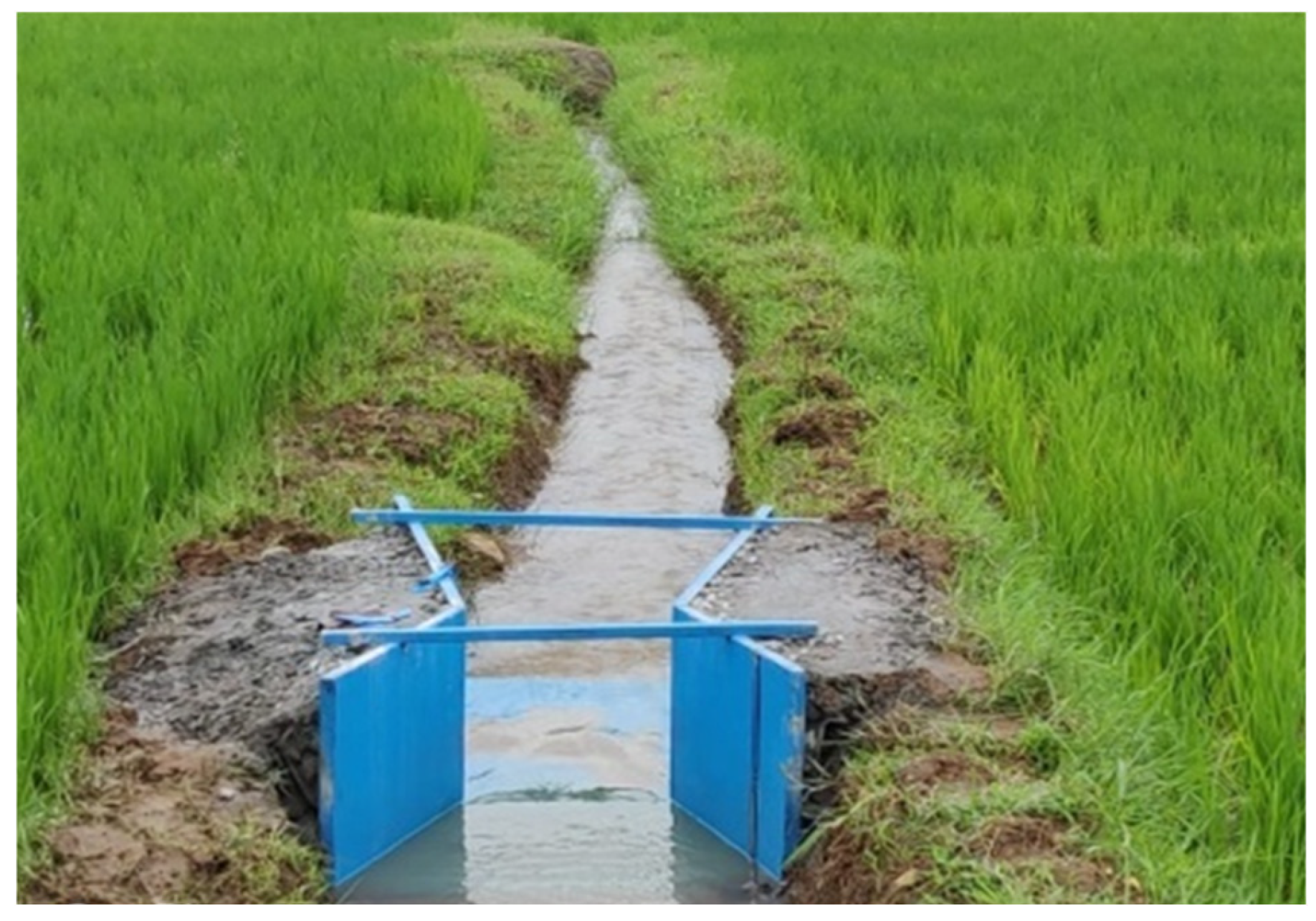
3.5. Measurement of Irrigation Water
3.6. Estimation of Energy Consumption for Irrigation
3.7. Crop Productivity
3.8. Estimation of Water Productivity
3.9. Computation of Economic Analysis
3.10. Sustainable Yield Index
3.11. Statistical Analysis
4. Result
4.1. Total Water Utilization
4.2. Water Productivity
4.3. Energy Consumption
4.4. Rice Productivity
4.5. Economic Analysis
4.6. Sustainable Yield Index (SYI)
4.7. Soil Health
5. Discussion
5.1. Resource Conservation
5.2. Productivity
5.3. Profitability
5.4. Yield Stability and Soil Health
6. Conclusions
Author Contributions
Funding
Data Availability Statement
Acknowledgments
Conflicts of Interest
References
- Wang, Y.; Chen, J.; Sun, Y.; Jiao, Y.; Yang, Y.; Yuan, X.; Lærke, P.E.; Wu, Q.; Chi, D. Zeolite reduces N leaching and runoff loss while increasing rice yields under alternate wetting and drying irrigation regime. Agric. Water Manag. 2023, 277, 108130. [Google Scholar] [CrossRef] [Scilit]
- Ravisankar, N.; Raghavendra, K.J.; Joshi, H.; Bhagat, R.; Prusty, A.K.; Shamim, M.; Ansari, M.A.; Singh, R.; Kashyap, P.; Rani, M.; et al. Adoption drivers and diversification barriers in Indian rice cultivation: Pathways to sustainable agriculture. Front. Sustain. Food Syst. 2026, 9, 1711493. [Google Scholar] [CrossRef] [Scilit]
- Department of Agriculture & Farmers Welfare. Agricultural Statistics at a Glance 2024–25; Ministry of Agriculture & Farmers Welfare, Government of India: New Delhi, India, 2025.
- Vyas, S.; Anand, B.; Sharma, S.N. Status and Importance of Traditional Water Conservation Systems in the Present Scenario; Central Soil and Materials Research Station: New Delhi, India, 2019. [Google Scholar]
- CGWB: Central Ground Water Board. National Compilation on Dynamic Ground Water Resources of India, 2024; Department of Water Resources, River Development and Ganga Rejuvenation, Ministry of Jal Shakti, Government of India: New Delhi, India, 2024.
- Verma, S.; Phansalkar, S.J. India’s water future 2050: Potential deviations from business-as-usual. Int. J. Rural Manag. 2007, 3, 149–179. [Google Scholar] [CrossRef] [Scilit]
- Dhawan, V. Water and Agriculture in India: Background Paper for the South Asia Expert Panel During the Global Forum for Food and Agriculture (GFFA); OAV–German Asia-Pacific Business Association: Hamburg, Germany, 2017. [Google Scholar]
- Siebert, S.; Burke, J.; Faures, J.M.; Frenken, K.; Hoogeveen, J.; Döll, P.; Portmann, F.T. Groundwater use for irrigation-A global inventory. Hydrol. Earth Syst. Sci. 2010, 14, 1863–1880. [Google Scholar] [CrossRef] [Scilit]
- Geethalakshmi, V.; Ramesh, T.; Palamuthirsolai, A.; Lakshmanan. Agronomic evaluation of rice cultivation systems for water and grain productivity. Arch. Agron. Soil Sci. 2011, 57, 159–166. [Google Scholar] [CrossRef] [Scilit]
- Rao, B.K.; Rajput, T.B.S. Rainfall effectiveness for different crops in canal command areas. J. Agrometeorol. 2008, 10, 328–332. [Google Scholar]
- Ramya, B.; Tripathi, M.P.; Rao, B.K.; Khalkho, D. Effectiveness of rainfall for major crops grown under the canal command areas of Musi Irrigation Project in Telangana, India. Int. J. Environ. Clim. Change 2025, 15, 209–216. [Google Scholar] [CrossRef] [Scilit]
- Tuong, T.P.; Bouman, B.A.M. Rice production in water scarce environments. In Water Productivity in Agriculture: Limits and Opportunities for Improvement; Kijne, J.W., Barker, R., Molden, D., Eds.; CABI Publishing: Wallingford, UK, 2003; pp. 53–67. [Google Scholar]
- Bhatt, R.; Kukal, S.S.; Busari, M.A.; Arora, A.; Yadav, M. Sustainability issues in rice–wheat cropping system. Int. Soil Water Conserv. Res. 2016, 4, 64–74. [Google Scholar] [CrossRef] [Scilit]
- Duary, S.; Biswas, K.; Biswas, A.; Biswas, T.; Paul, S.K.; Netaji, O. Assessing the role of natural farming in enhancing ecosystem services and sustainable agriculture. Front. Agron. 2026, 8, 1805343. [Google Scholar] [CrossRef] [Scilit]
- Duddigan, S.; Shaw, L.J.; Sizmur, T.; Hussain, Z.; Jirra, K.; Kaliki, H.; Sanka, R.; Soma, R.; Thallam, V.; Vattikuti, H.P.; et al. Quantifying the contribution of individual inputs used in Zero Budget Natural Farming. Soil Use Manag. 2024, 40, e13126. [Google Scholar] [CrossRef] [Scilit]
- RySS. Zero Budget Natural Farming: Official Website of ZBNF Programme of RythuSadhikara Samstha, Government of Andhra Pradesh; RySS: Vijayawada, India, 2026. [Google Scholar]
- Saharan, B.S.; Tyagi, S.; Kumar, R.; Vijay; Om, H.; Mandal, B.S.; Duhan, J.S. Application of Jeevamrit improves soil properties in Zero Budget Natural Farming fields. Agriculture 2023, 13, 196. [Google Scholar] [CrossRef] [Scilit]
- Thapa, A.; Muthuprakash, S.; Damani, O.; Bell, T.H.; Isaac, M.E. Soil quality changes along an agroecological transition: Evidence from natural farming in Madhya Pradesh, India. Environ. Sustain. Indic. 2025, 28, 100995. [Google Scholar] [CrossRef] [Scilit]
- Kumar, G.; Kurothe, R.S.; Brajendra, V.A.; Rao, B.K.; Pande, V.C. Effect of farmyard manure and fertilizer application on crop yield, runoff and soil erosion and soil organic carbon under rainfed pearl millet (Pennisetum glaucum). Indian J. Agric. Sci. 2014, 84, 816–823. [Google Scholar] [CrossRef] [Scilit]
- Rao, B.K.; Kurothe, R.S.; Mishra, P.K.; Kumar, G.; Pande, V.C. Climate change impact on design and costing of soil and water conservation structures in watersheds. Curr. Sci. 2015, 108, 960–966. [Google Scholar]
- Kamble, T.; Rao, B.K.; Sharma, R. Mulch farming techniques for improving resource conservation, carbon sequestration and crop production in rainfed regions: A review. J. Soil Water Conserv. 2020, 15, 14–21. Available online: https://epubs.icar.org.in/index.php/JSWC/article/view/108532 (accessed on 21 July 2026).
- Rao, B.K.; Singh, G.; Kumar, G.; Pande, V.C.; Lenka, N.K.; Dinesh, D.; Mishra, P.K.; Singh, A.K. Effect of selected bioengineering measures on runoff, soil loss, and cotton (Gossypium hirsutum L.) productivity in the semi-arid region of western India. Ind. Crops Prod. 2022, 184, 115029. [Google Scholar] [CrossRef] [Scilit]
- Ramya, B.; Rao, B.K.; Kumar, G.M.; Lakshmi, Y.S.; Sandeep, H.; Ramesh, V. Recycling of tank silt for improving soil health and crop productivity in Telangana. Indian J. Soil Conserv. 2022, 50, 107–112. [Google Scholar]
- Rao, B.K.; Annapurna, S.; Rani, B.R.; Rao, Z.S.; Sunitha, K.; SchinDutt, M.; Jamanal, S.K.; Ramesh, V. Soil and Water Conservation Techniques in Rainfed Areas [E-book]; National Institute of Agricultural Extension Management (MANAGE) & Water and Land Management Training and Research Institute (WALAMTARI): Hyderabad, India, 2022. Available online: https://www.manage.gov.in/publications/eBooks/Soil%20and%20Water%20Conservation%20Techniques%20in%20Rainfed%20Areas.pdf (accessed on 27 July 2026).
- Kumar, R.; Kumar, S.; Yashavanth, B.S.; Meena, P.C. Natural farming practices in India: Its adoption and impact on crop yield and farmers’ income. Indian J. Agric. Econ. 2019, 74, 420–432. [Google Scholar]
- Galab, S.; Reddy, P.P.; Raju, D.S.R.; Ravi, C.; Rajani, A. Impact Assessment of Zero Budget Natural Farming in Andhra Pradesh: A Comprehensive Approach Using Crop Cutting Experiments. Report for the Agricultural Year 2018–19; Centre for Economic and Social Studies: Hyderabad, India, 2020; Available online: https://apcnf.in/wp-content/uploads/2021/09/CESS-2018-2019-Report.pdf (accessed on 24 July 2026).
- Shyam, D.M.; Dixit, S.; Nune, R.; Sawargaonkar, G.; Chander, G. Zero Budget Natural Farming—An Empirical Analysis. Green Farming 2019, 10, 661–667. [Google Scholar] [CrossRef] [Scilit]
- Jayaraj, D.; Periyasamy, M. Comparative Economic Indicators of the Farmers Practising Natural Farming vs. Conventional Farming System. J. Agric. Ecol. 2023, 16, 64–66. [Google Scholar] [CrossRef] [Scilit]
- Manisha, V.V.D.; Gaddi, G.M.; Lokesha, H.; Achoth, L.; Jayaramiah, R.; Nataraj, O.R. Sources of Growth of Returns in Paddy Cultivation under Natural Farming vs. Conventional Farming: An Economic Analysis. J. Exp. Agric. Int. 2024, 46, 539–552. [Google Scholar] [CrossRef] [Scilit]
- Darjee, S.; Singh, R.; Dhar, S.; Pandey, R.; Dwivedi, N.; Sahu, P.K.; Rai, M.K.; Alekhya, G.; Padhan, S.R.; Ramalingappa, P.L.; et al. Empirical observation of natural farming inputs on nitrogen uptake, soil health, and crop yield of rice–wheat cropping system in the organically managed Inceptisol of Trans-Gangetic Plain. Front. Sustain. Food Syst. 2024, 8, 1324798. [Google Scholar] [CrossRef] [Scilit]
- Ghasal, P.C.; Mishra, R.P.; Choudhary, J.; Dutta, D.; Bhanu, C.; Meena, A.L.; Ravisankar, N.; Kumar, A.; Panwar, A.S. Evaluation of integrated crop management, organic management and natural farming in basmati rice-wheat system under Upper Indo-Gangetic Plains. J. Plant Nutr. 2024, 47, 1189–1199. [Google Scholar] [CrossRef] [Scilit]
- Sidhu, A.S.; Shard, D.; Aulakh, C.S.; Bhullar, S.S.; Singh, S. Evaluating the sustainability of natural, organic and conventional farming practices: A comparative study in maize-wheat cropping system in North-west India. Environ. Dev. Sustain. 2025, 1–18. [Google Scholar] [CrossRef] [Scilit]
- Chowdhuri, A.; Chaudhary, M.; Purakayastha, T.J.; Singh, T.; Rosin, K.G.; Sinha, N.K.; Gupta, D.K.; Sharma, A.; Jangra, P.; Rakshit, S.; et al. Optimizing soil fertility and climate resilience: Superiority of organic farming in enhancing carbon sequestration and nitrogen supply. J. Environ. Manag. 2025, 393, 127131. [Google Scholar] [CrossRef] [Scilit]
- Duddigan, S.; Collins, C.D.; Hussain, Z.; Osbahr, H.; Shaw, L.J.; Sinclair, F.; Sizmur, T.; Thallam, V.; Winowiecki, L.A. Impact of Zero Budget Natural Farming on crop yields in Andhra Pradesh, SE India. Sustainability 2022, 14, 1689. [Google Scholar] [CrossRef] [Scilit]
- Laishram, C.; Vashishat, R.K.; Sharma, S.; Rajkumari, B.; Mishra, N.; Barwal, P.; Vaidya, M.K.; Sharma, R.; Chandel, R.S.; Chandel, A.; et al. Impact of natural farming cropping system on rural households—Evidence from Solan district of Himachal Pradesh, India. Front. Sustain. Food Syst. 2022, 6, 878015. [Google Scholar] [CrossRef] [Scilit]
- Divyanshu; Sharma, S.; Chandel, R.S.; Vashishat, R.; Verma, S.C.; Verma, S.; Bharat, N.K.; Thakur, K.S.; Dev, I.; Chauhan, S.; et al. Evidence of transitioning apple farming to an agro-ecological model in Himachal Pradesh. Front. Nutr. 2025, 12, 1611137. [Google Scholar] [CrossRef] [Scilit]
- Babalad, H.B.; Gunabhagya; Saraswathi; Navali, G.V. Comparative economics of zero budget natural farming with conventional farming systems in Northern Dry Zone (Zone-3) of Karnataka. Econ. Aff. 2021, 66, 355–361. [Google Scholar] [CrossRef] [Scilit]
- Khandelwal, A.; Agarwal, N.; Jain, B.; Gupta, D.; John, A.T. Investigating Pathways for Agricultural Innovation at Scale: Case Studies from India; Commission on Sustainable Agriculture Intensification: Colombo, Sri Lanka, 2022. [Google Scholar]
- GIST Impact Report. “Natural Farming Through a Wide-Angle Lens: True Cost Accounting Study of Community Managed Natural Farming in Andhra Pradesh, India.” GIST Impact, Switzerland and India. 2023. Available online: https://futureoffood.org/wp-content/uploads/2025/05/apcnf-tca-study_2023.pdf (accessed on 24 July 2026).
- CSTEP: Centre for Study of Science, Technology and Policy (CSTEP). Life Cycle Assessment of ZBNF and Non-ZBNF: A Study in Andhra Pradesh; CSTEP: Bengaluru, India, 2019. [Google Scholar]
- Bharucha, Z.P.; Mitjans, S.B.; Pretty, J. Towards redesign at scale through zero budget natural farming in Andhra Pradesh, India. Int. J. Agric. Sustain. 2020, 18, 1–20. [Google Scholar] [CrossRef] [Scilit]
- Deelstra, J.; Nagothu, U.S.; Kakumanu, K.R.; Kaluvai, Y.R.; Kallam, S.R. Enhancing water productivity using alternative rice growing practices: A case study from Southern India. J. Agric. Sci. 2018, 156, 673–679. [Google Scholar] [CrossRef] [Scilit]
- Carrijo, D.R.; Lundy, M.E.; Linquist, B.A. Rice yields and water use under alternate wetting and drying irrigation: A meta-analysis. Field Crops Res. 2017, 203, 173–180. [Google Scholar] [CrossRef] [Scilit]
- Kumar, A.; Jain, A. Comparative Analysis of Energy Requirement in the Zero Budget Natural Farming (ZBNF) and Non-ZBNF Method; Monograph No. 115; SIFF-RySS Fellowship Report; RySS: Guntur, India, 2024. [Google Scholar]
- Lakhani, H.N.; Vaja, M.; Kulshrestha, K. Natural farming in India: A sustainable alternative to conventional agricultural practices. J. Farming Manag. 2024, 9, 63–65. [Google Scholar]
- Pagani, M.; Johnson, T.G.; Vittuari, M. Energy input in conventional and organic paddy rice production in Missouri and Italy: A comparative case study. J. Environ. Manag. 2017, 188, 173–182. [Google Scholar] [CrossRef] [Scilit]
- Smith, J.; Yeluripati, J.; Smith, P.; Nayak, D.R. Potential yield challenges to scale-up of zero budget natural farming. Nat. Sustain. 2020, 3, 247–252. [Google Scholar] [CrossRef] [Scilit]
- Mishra, A.K.; Maurya, P.K.; Sharma, S. Impact of different farming scenarios on key soil sustainability indicators driving soil carbon and system productivity of rice-based cropping systems. Front. Plant Sci. 2024, 15, 1408515. [Google Scholar] [CrossRef] [Scilit]
- Shrine, S.; Umadevi, K.; Radha, Y.; Srinivasa Rao, V.; Edukondalu, L. An economic analysis of energy use in ZBNF, conventional farming and organic farming in rice production in Visakhapatnam district of Andhra Pradesh. Andhra Agric. J. 2019, 66, 544–547. [Google Scholar]
- Koner, N.; Laha, A. Economics of zero budget natural farming in Purulia District of West Bengal: Is it economically viable? Stud. Agric. Econ. 2020, 122, 22–28. [Google Scholar] [CrossRef] [Scilit]
- Kumar, R.; Kumar, S.; Yashavanth, B.; Venu, N.; Meena, P.; Dhandapani, A.; Kumar, A. Natural Farming Practices for Chemical-Free Agriculture: Implications for Crop Yield and Profitability. Agriculture 2023, 13, 647. [Google Scholar] [CrossRef] [Scilit]
- Athawale, S.; Singh, R.; Hatai, L.D.; Bey, B.S.; Anandkumar Singh, N.; Singh, R.J.; Hemchandra, L. A comparative economics of natural farming and conventional farming of rice cultivation in Arunachal Pradesh. Oryza 2024, 61, 160–169. [Google Scholar] [CrossRef] [Scilit]
- Yadav, A.K.; Chandel, A.; Chandel, R.S.; Gupta, R.K.; Sharma, S.; Shankar, S.V.; Ananthakrishnan, S. Economic assessment of natural farming over conventional methods in Himachal Pradesh, India. Curr. Sci. 2025, 129, 537–543. [Google Scholar] [CrossRef] [Scilit]
- Supraja, P.; Anjugam, M.; Varadha Raj, S.; Malarkodi, M.; Gangai Selvi, R. Economic performance of natural and conventional paddy farming in Andhra Pradesh. Genet. Mol. Res. 2026, 25, 1–9. [Google Scholar]
- Majhi, P.; Panda, D.; Sen, J.; Das, D.M.; Mishra, P.; Haldar, A.; Rout, B.M.; Majhi, B.; Palai, T.K.; Phonglosa, A.; et al. Effect of natural farming on soil fertility and carbon sequestration: A case study from Eastern India. Plant Sci. Today 2026, 13, 1–11. [Google Scholar] [CrossRef] [Scilit]
- Ghosh, M. Climate-smart agriculture, productivity and food security in India. J. Dev. Policy Pract. 2019, 4, 166–187. [Google Scholar] [CrossRef] [Scilit]
- Khadse, A.; Rosset, P.M. Zero budget natural farming in India: From inception to institutionalization. Agroecol. Sustain. Food Syst. 2019, 43, 848–871. [Google Scholar] [CrossRef] [Scilit]
- Mevada, M.S.; Patel, D.D.; Ramani, V.P.; Korat, H.V.; Amipara, R.P. Effect of Ghanjeevamrut and Jeevamrut on soil microbial activity, nutrient and yield performance of kodo millet under natural farming. J. Nat. Resour. Conserv. Manag. 2025, 6, 65–71. [Google Scholar] [CrossRef] [Scilit]
- Mukherjee, S.; Gupta, A.; Nandi, R.; Chakraborty, A.; Bhattacharjee, A.; Sarkar, S.; Ray, K.; Tripathi, S.; Ravisankar, N.; Chatterjee, G. Exploring the Microbial Community Dynamics of Jeevamrit Reveals the Multifaceted Roles of the Bacillus and Pseudomonas Genera in Nutrient Availability and Plant Growth Promotion in India’s Zero Budget Natural Farming. J. Soil Sci. Plant Nutr. 2025, 25, 5836–5852. [Google Scholar] [CrossRef] [Scilit]
- Jackson, M.L. Soil Chemical Analysis; Prentice Hall of India Pvt. Ltd.: New Delhi, India, 1973; pp. 106–203. [Google Scholar]
- Walkley, A.; Black, I.A. An examination of the Degtjareff method for determining soil organic matter and a proposed modification of the chromic acid titration method. Soil Sci. 1934, 37, 29–38. [Google Scholar] [CrossRef] [Scilit]
- Subbaiah, B.V.; Asija, G.L. A rapid procedure for the estimation of available nitrogen in soil. Curr. Sci. 1956, 25, 258–260. [Google Scholar]
- Bray, R.H.; Kurtz, L.T. Determination of total, organic, and available forms of phosphorus in soils. Soil Sci. 1945, 59, 39–46. [Google Scholar] [CrossRef] [Scilit]
- Olsen, S.R.; Cole, C.V.; Watanabe, F.S.; Dean, L.A. Estimation of Available Phosphorus in Soils by Extraction with Sodium Bicarbonate; USDA Circular No. 939; U.S. Department of Agriculture: Washington, DC, USA, 1954.
- Sapkota, T.B.; Jat, M.L.; Jat, R.K.; Kapoor, P.; Stirling, C. Yield estimation of food and non-food crops in smallholder production systems. In Methods for Measuring Greenhouse Gas Balances and Evaluating Mitigation Options in Smallholder Agriculture; Rosenstock, T., Rufino, M., Butterbach-Bahl, K., Wollenberg, L., Richards, M., Eds.; Springer International Publishing: Cham, Switzerland, 2016; pp. 163–174. [Google Scholar] [CrossRef] [Scilit]
- Ahmad, T.; Rai, A.; Sahoo, P.M.; Jha, S.N.; Vishwakarma, R.K. Sampling methodology for estimation of harvest and post-harvest losses of major crops and commodities. J. Indian Soc. Agric. Stat. 2021, 75, 37–46. [Google Scholar]
- Singh, R.P.; Das, S.K.; Bhaskarrao, U.M.; Reddy, M.N. Sustainability Index under Different Management: Annual Report; CRIDA: Hyderabad, India, 1990. [Google Scholar]
- Gomez, K.A.; Gomez, A.A. Statistical Procedures for Agricultural Research, 2nd ed.; John Wiley & Sons: New York, NY, USA, 1984. [Google Scholar]
- R Core Team. R: A Language and Environment for Statistical Computing; R Foundation for Statistical Computing: Vienna, Austria, 2025. [Google Scholar]
- Mandal, U.K.; Singh, G.; Victor, U.S.; Sharma, K.L. Green manuring: Its effect on soil properties and crop growth under rice–wheat cropping system. Eur. J. Agron. 2003, 19, 225–237. [Google Scholar] [CrossRef] [Scilit]
- Duddigan, S.; Shaw, L.J.; Sizmur, T.; Gogu, D.; Hussain, Z.; Jirra, K.; Kaliki, H.; Sanka, R.; Sohail, M.; Soma, R.; et al. Natural farming improves crop yield in SE India when compared to conventional or organic systems by enhancing soil quality. Agron. Sustain. Dev. 2023, 43, 31. [Google Scholar] [CrossRef] [Scilit]
- CEEW: Council on Energy, Environment and Water (CEEW). What Is Natural Farming Cultivation in India? CEEW: Council on Energy, Environment and Water (CEEW): New Delhi, India, 2023. [Google Scholar]
- Sawargaonkar, G.L.; Rakesh, S.; Kale, S.; Kamdi, P.J.; Karanam, P.; Pasumarthi, R.; Choudhari, P.; Singh, A.; Patil, M.; Murali, G.; et al. Regenerative Rice Farming for Sustaining Productivity, Reducing Energy Demand, and Methane Emissions in India: A Comprehensive Review. Results Eng. 2026, 29, 109197. [Google Scholar] [CrossRef] [Scilit]
- Ponisio, L.C.; M’Gonigle, L.K.; Mace, K.C.; Palomino, J.; De Valpine, P.; Kremen, C. Diversification practices reduce organic to conventional yield gap. Proc. R. Soc. B 2015, 282, 20141396. [Google Scholar] [CrossRef] [Scilit]
- Röös, E.; Mie, A.; Wivstad, M.; Salomon, E.; Johansson, B.; Gunnarsson, S.; Wallenbeck, A.; Hoffmann, R.; Nilsson, U.; Sundberg, C.; et al. Risks and opportunities of increasing yields in organic farming: A review. Agron. Sustain. Dev. 2018, 38, 14. [Google Scholar] [CrossRef] [Scilit]
- Tripathi, S.; Shahidi, T.; Nagbhushan, S.; Gupta, N. Zero Budget Natural Farming for the Sustainable Development Goals, 2nd ed.; Council on Energy, Environment and Water: New Delhi, India, 2018. [Google Scholar]
- Walker, G.; Osbahr, H.; Duddigan, S.; George, J.; Ponnolu, S.; Anisetti, H.; Collins, C.; Hussain, Z. “It feels like we’re doing something good.” Mapping farmer perceptions of Zero Budget Natural Farming onto crop yields in Andhra Pradesh. World Dev. Perspect. 2025, 37, 100665. [Google Scholar] [CrossRef] [Scilit]
- Padakandla, S.R. Climate sensitivity of rice yields: An agro climatic zone analysis in the undivided state of Andhra Pradesh, India. J. Public Aff. 2021, 21, e2261. [Google Scholar] [CrossRef] [Scilit]
- Amareswari, P.U.; Sujathamma, P. Jeevamrutha as an alternative to chemical fertilizers in rice production. Agric. Sci. Dig. 2014, 34, 240. [Google Scholar] [CrossRef] [Scilit]
- CEEW. Council on Energy, Environment and Water (CEEW). 2018. Available online: https://www.ceew.in/publications/zero-budget-natural-farming-sustainable-development-goals-0 (accessed on 23 July 2026).
- Pathania, N.; Spehia, R. Potential of natural farming: Improves soil health and reduces production cost-A study of Solan District, Himachal Pradesh, India. Veg. Sci. 2024, 51, 327–334. [Google Scholar] [CrossRef] [Scilit]
- Wanjari, R.H.; Singh, M.V.; Ghosh, P.K. Sustainable yield index: An approach to evaluate the sustainability of long-term intensive cropping systems in India. J. Sustain. Agric. 2004, 24, 39–56. [Google Scholar] [CrossRef] [Scilit]
- Han, X.; Hu, C.; Chen, Y.; Qiao, Y.; Liu, D.; Fan, J.; Li, S.; Zhang, Z. Crop yield stability and sustainability in a rice-wheat cropping system based on 34-year field experiment. Eur. J. Agron. 2020, 113, 125965. [Google Scholar] [CrossRef] [Scilit]
- Meena, A.L.; Pandey, R.N.; Kumar, D.; Dotaniya, M.L.; Sharma, V.K.; Singh, G.; Meena, B.P.; Kumar, A.; Bhanu, C. Impact of 12-year-long rice based organic farming on soil quality in terms of soil physical properties, available micronutrients and rice yield in a typic Ustochrept soil of India. Commun. Soil Sci. Plant Anal. 2020, 51, 2391–2406. [Google Scholar] [CrossRef] [Scilit]
- Whalen, J.K.; Chang, C.; Clayton, G.W.; Carefoot, J.P. Cattle manure amendments can increase the pH of acid soils. Soil Sci. Soc. Am. J. 2000, 64, 962–966. [Google Scholar] [CrossRef] [Scilit]
- Brown, T.T.; Koenig, R.T.; Huggins, D.R.; Harsh, J.B.; Rossi, R.E. Lime effects on soil acidity, crop yield, and aluminum chemistry in direct-seeded cropping systems. Soil Sci. Soc. Am. J. 2008, 72, 634–640. [Google Scholar] [CrossRef] [Scilit]
- Lourenzi, C.R.; Ceretta, C.A.; Silva, L.S.; Trentin, G.; Girotto, E.; Lorensini, F.; Brunetto, G. Soil chemical properties related to acidity under successive pig slurry application. Rev. Bras. Cienc. Solo 2011, 35, 1827–1836. [Google Scholar] [CrossRef] [Scilit]
- Kumar, V.; Chopra, A.K. Accumulation and translocation of metals in soil and different parts of French bean (Phaseolus vulgaris L.) amended with sewage sludge. Bull. Environ. Contam. Toxicol. 2014, 92, 103–108. [Google Scholar] [CrossRef] [Scilit]
- Paradelo, R.; Barral, M.T. Availability and fractionation of Cu, Pb and Zn in an acid soil from Galicia (NW Spain) amended with municipal solid waste compost. Span. J. Soil Sci. 2017, 7, 31–39. [Google Scholar] [CrossRef] [Scilit]
- Radder, V.S.; Yadahalli, V.G.; Gundlur, S.S.; Yadahalli, G.S. Comparative studies on soil fertility status of natural farming and farmers’ practice in northern dry zone of Karnataka. J. Farm Sci. 2025, 38, 401–406. [Google Scholar] [CrossRef] [Scilit]
- Marriott, E.E.; Wander, M.M. Total and labile soil organic matter in organic and conventional farming systems. Soil Sci. Soc. Am. J. 2006, 70, 950–959. [Google Scholar] [CrossRef] [Scilit]
- Lal, R. Soil carbon sequestration impacts on global climate change and food security. Science 2004, 304, 1623–1627. [Google Scholar] [CrossRef] [Scilit]
- Kourgialas, N.N. Reconsidering the Soil–Water–Crops–Energy (SWCE) Nexus Under. Climate Complexity—A Critical Review. Agriculture 2025, 15, 1891. [Google Scholar] [CrossRef] [Scilit]
- Kulkarni, S.S.; Gargelwar, A.P. Production and microbial analysis of Jeevamrutham for nitrogen fixers and phosphate solubilizers in the rural area from Maharashtra. IOSR J. Agric. Vet. Sci. 2019, 12, 85–92. [Google Scholar]
- Duraivadivel, P.; Kongkham, B.; Satya, S.; Hariprasad, P. Untangling microbial diversity and functional properties of Jeevamrutha. J. Clean. Prod. 2022, 369, 133218. [Google Scholar] [CrossRef] [Scilit]
- Jobbágy, E.G.; Jackson, R.B. The distribution of soil nutrients with depth: Global patterns and the imprint of plants. Biogeochemistry 2001, 53, 51–77. [Google Scholar] [CrossRef] [Scilit]
- Shen, Y.; Ma, Z.; Chen, H.; Lin, H.; Li, G.; Li, M.; Tan, D.; Gao, W.; Jiao, S.; Liu, P.; et al. Effects of macromolecular organic acids on reducing inorganic phosphorus fixation in soil. Heliyon 2023, 9, e14892. [Google Scholar] [CrossRef] [Scilit]
- Kalayu, G. Phosphate solubilizing microorganisms: Promising approach as biofertilizers. Int. J. Agron. 2019, 2019, 4917256. [Google Scholar] [CrossRef] [Scilit]
- Wilding, L.P. Spatial variability: Its documentation, accommodation and implication to soil surveys. In Soil Spatial Variability; Nielsen, D.R., Bouma, J., Eds.; Pudoc: Wageningen, The Netherlands, 1985; pp. 166–194. [Google Scholar]
- Dzombak, R.M.; Sheldon, N.D. Weathering intensity and presence of vegetation are key controls on soil phosphorus concentrations: Implications for past and future terrestrial ecosystems. Soil Syst. 2020, 4, 73. [Google Scholar] [CrossRef] [Scilit]
- Bader, B.R.; Taban, S.K.; Fahmi, A.H.; Abood, M.A.; Hamdi, G.J. Potassium availability in soil amended with organic matter and phosphorous fertiliser under water stress during maize (Zea mays L.) growth. J. Saudi Soc. Agric. Sci. 2021, 20, 390–394. [Google Scholar] [CrossRef] [Scilit]
- Wafaa, S.M.; Mona, A.O. Impact of feldspar acidulation on potassium dissolution and pea production. Int. J. Chem. Tech. Res. 2015, 8, 1–10. [Google Scholar]
- Najafi-Ghiri, M.; Niksirat, S.H.; Soleimanpour, L.; Nowzari, S. Comparison of different organic amendments on potassium release from two fine-textured soils. Org. Agric. 2018, 8, 129–140. [Google Scholar] [CrossRef] [Scilit]

| Agro-Climatic Zone | Districts Covered | Climate Type | Avg. Annual Rainfall (mm) | Avg. Annual Min–Max Temp (°C) | Soil Type | Soil Texture |
|---|---|---|---|---|---|---|
| Southern Zone | Nellore, Tirupathi, Chittor, Kadapa, Annamayya | Semi-arid tropical | 600–1000 mm | 20–42 | Black soil (Vertisols) | Clay |
| Krishna Zone | Krishna, Guntur Bapatla, NTR, Palnadu and parts of Prakasam | Sub-humid tropical (Aw) | 700–1100 mm | 22–41 | Black soil (Vertisols) | Clay/sandy clay/sandy clay loam |
| Godavari Zone | Eluru, Kakinada, Konaseema, West Godavari, East Godavari | Sub-humid maritime tropical (Aw) | 1000–1200 mm | 22–39 | Deep alluvial soils (Entisols and Inceptisols)/Black soil (Vertisols) | Sandy clay loam/clay/sandy loam |
| High Altitude and Tribal Zone | Manyam, Alluri Seetaramaraju | Humid subtropical highland | >1400 mm | 12–32 | Red soil (Alfisols), with lateritic soils (Ultisols) | Loamy/sandy loam |
| Season | Agro-Climatic Zone | n | Natural Farming | Conventional Farming | Water Saving (%) | p-Value | Significance |
|---|---|---|---|---|---|---|---|
| Total Water Utilization (m3 acre−1) | |||||||
| Kharif | Southern Zone | 6 | 5003 ± 133 ¥ | 6979 ± 299 | 28.3 | <0.001 | *** |
| Krishna Zone | 29 | 4983 ± 409 | 6695 ± 1216 | 25.6 | <0.001 | *** | |
| Godavari Zone | 20 | 5041 ± 538 | 6147 ± 1019 | 18.0 | <0.001 | *** | |
| High Altitude Zone | 23 | 4808 ± 247 | 7853 ± 253 | 38.8 | <0.001 | *** | |
| Rabi | Southern Zone | 6 | 5062 ± 288 | 6851 ± 239 | 26.1 | <0.001 | *** |
| Krishna Zone | 16 | 4850 ± 483 | 6201 ± 1197 | 21.8 | 0.001 | ** | |
| Godavari Zone | 9 | 4950 ± 462 | 6565 ± 861 | 24.6 | 0.001 | ** | |
| High Altitude Zone | 24 | 4851 ± 242 | 7956 ± 260 | 39.0 | <0.001 | *** | |
| Season | Agro-Climatic Zone | n | Natural Farming | Conventional Farming | Improvement (%) | p-Value | Significance |
|---|---|---|---|---|---|---|---|
| Water Productivity (kg m−3) | |||||||
| Kharif | Southern Zone | 6 | 0.432 ± 0.017 ¥ | 0.324 ± 0.018 | 33.1 | <0.001 | *** |
| Krishna Zone | 29 | 0.490 ± 0.045 | 0.395 ± 0.079 | 24.0 | <0.001 | *** | |
| Godavari Zone | 20 | 0.477 ± 0.071 | 0.400 ± 0.100 | 18.8 | <0.001 | *** | |
| High Altitude Zone | 23 | 0.443 ± 0.027 | 0.285 ± 0.014 | 55.5 | <0.001 | *** | |
| Rabi | Southern Zone | 6 | 0.445 ± 0.079 | 0.321 ± 0.066 | 38.6 | <0.001 | *** |
| Krishna Zone | 16 | 0.502 ± 0.054 | 0.436 ± 0.068 | 15.0 | 0.012 | * | |
| Godavari Zone | 9 | 0.521 ± 0.070 | 0.416 ± 0.131 | 25.4 | 0.002 | ** | |
| High Altitude Zone | 24 | 0.449 ± 0.023 | 0.294 ± 0.013 | 52.8 | <0.001 | *** | |
| Season | Agro-Climatic Zone | n | Natural Farming | Conventional Farming | Reduction Under NF (%) | p-Value | Significance |
|---|---|---|---|---|---|---|---|
| Energy Consumption (kWh) | |||||||
| Kharif | Southern Zone | 6 | 2859 ± 1573 ¥ | 5758 ± 2830 | 50.3 | 0.0170 | * |
| Krishna Zone | 18 | 910.7 ± 386.6 | 1543 ± 551.9 | 40.9 | <0.001 | *** | |
| Godavari Zone | 20 | 2327 ± 358.8 | 2974 ± 527.2 | 21.7 | <0.001 | *** | |
| High Altitude Zone | 11 | 542.8 ± 185.5 | 1283 ± 415.8 | 57.7 | <0.001 | *** | |
| Rabi | Southern Zone | 6 | 2841 ± 1774 | 3987 ± 2424 | 28.7 | 0.0383 | * |
| Krishna Zone | 16 | 1193 ± 442.6 | 1865 ± 532.3 | 36.0 | <0.001 | *** | |
| Godavari Zone | 9 | 2623 ± 562.9 | 3513 ± 808.4 | 25.3 | 0.0018 | ** | |
| High Altitude Zone | 12 | 722.7 ± 204.8 | 1502 ± 480.9 | 51.9 | <0.001 | *** | |
| Season | Agro-Climatic Zone | n | Natural Farming | Conventional Farming | Yield Change (%) | p-Value | Significance |
|---|---|---|---|---|---|---|---|
| Rice Yield (kg acre−1) | |||||||
| Kharif | Southern Zone | 6 | 2160 ± 65.20 ¥ | 2260 ± 41.80 | −4.40 | 0.011 | * |
| Krishna Zone | 29 | 2428 ± 134.6 | 2559 ± 170.1 | −5.10 | <0.001 | *** | |
| Godavari Zone | 20 | 2374 ± 210.7 | 2367 ± 244.8 | +0.30 | 0.929 | NS | |
| High Altitude Zone | 23 | 2125 ± 82.40 | 2243 ± 74.30 | −5.30 | <0.001 | *** | |
| Rabi | Southern Zone | 6 | 2237 ± 263.9 | 2192 ± 394.2 | +2.10 | 0.557 | NS |
| Krishna Zone | 16 | 2411 ± 77.70 | 2633 ± 120.9 | −8.40 | <0.001 | *** | |
| Godavari Zone | 9 | 2566 ± 218.4 | 2523 ± 301.7 | +1.70 | 0.655 | NS | |
| High Altitude Zone | 24 | 2173 ± 47.20 | 2337 ± 62.40 | −7.00 | <0.001 | *** | |
| S. No. | Package of Practices/Operations | Natural Farming | Conventional Farming | Reduction Under NF over CF (RS acre−1) |
|---|---|---|---|---|
| Cost of Cultivation (RS acre−1) | ||||
| 1 | Land preparation (Ploughing, puddling, levelling) | 5000 * | 5000 | 0 |
| 2 | Seeds | 1100 | 1100 | 0 |
| 3 | Seed treatment (Beejamrit/insecticide and fungicide) | 100 | 300 | 200 |
| 4 | Transplantation (Labour and related transplanting expenses) | 5000 | 5000 | 0 |
| 5 | Fertilization (Jeevamruth, green manure/NPK, micronutrients) | 1400 | 4900 | 3500 |
| 6 | Irrigation (Labour and irrigation-related expenses) | 800 | 1600 | 800 |
| 7 | Intercultural operations (Weeding and other field operations) | 1600 | 2600 | 1000 |
| 8 | Disease and pest management (Neem oil, pheromone traps, biopesticides/chemical pesticides) | 1800 | 3400 | 1600 |
| 9 | Harvesting, threshing and packing (post-harvest handling) | 2500 | 2500 | 0 |
| Total | 19,300 | 26,400 | 7100 | |
| Season | Agro-Climatic Zone | n | Natural Farming | Conventional Farming | Reduction Under NF (%) | p-Value | Significance |
|---|---|---|---|---|---|---|---|
| Cost of Cultivation (RS acre−1) | |||||||
| Kharif | Southern Zone | 6 | 16,800 ± 1304 ¥ | 25,900 ± 742.0 | 35.1 | <0.001 | *** |
| Krishna Zone | 29 | 18,631 ± 3077 | 26,994 ± 3984 | 31.0 | <0.001 | *** | |
| Godavari Zone | 20 | 20,964 ± 2330 | 27,898 ± 3913 | 24.9 | <0.001 | *** | |
| High Altitude Zone | 23 | 18,225 ± 1737 | 25,274 ± 2287 | 27.9 | <0.001 | *** | |
| Rabi | Southern Zone | 6 | 20,460 ± 1545 | 25,783 ± 1822 | 20.6 | <0.001 | *** |
| Krishna Zone | 16 | 18,475 ± 3001 | 24,045 ± 2778 | 23.2 | <0.001 | *** | |
| Godavari Zone | 9 | 21,699 ± 2267 | 28,216 ± 3312 | 23.1 | <0.001 | *** | |
| High Altitude Zone | 24 | 18,837 ± 1287 | 27,151 ± 1516 | 30.6 | <0.001 | *** | |
| Season | Agro-Climatic Zone | n | Natural Farming | Conventional Farming | Change (%) | p-Value | Significance |
|---|---|---|---|---|---|---|---|
| Gross Return (RS acre−1) | |||||||
| Kharif | Southern Zone | 6 | 49,680 ± 1499 ¥ | 51,980 ± 962.0 | −4.42 | 0.011 | * |
| Krishna Zone | 29 | 55,190 ± 3367 | 56,738 ± 3336 | −2.73 | 0.023 | * | |
| Godavari Zone | 20 | 53,565 ± 4669 | 52,031 ± 2771 | +2.95 | 0.269 | NS | |
| High Altitude Zone | 23 | 48,885 ± 1895 | 51,600 ± 1709 | −5.26 | <0.001 | *** | |
| Rabi | Southern Zone | 6 | 52,543 ± 6470 | 50,017 ± 8928 | +5.05 | 0.153 | NS |
| Krishna Zone | 16 | 54,280 ± 3283 | 57,692 ± 4235 | −5.91 | <0.001 | *** | |
| Godavari Zone | 9 | 53,420 ± 4802 | 52,740 ± 3960 | +1.29 | 0.695 | NS | |
| High Altitude Zone | 24 | 49,987 ± 1086 | 53,748 ± 1435 | −7.00 | <0.001 | *** | |
| Season | Agro-Climatic Zone | n | Natural Farming | Conventional Farming | Increase Under NF over CF (%) | p-Value | Significance |
|---|---|---|---|---|---|---|---|
| Net Return (RS acre−1) | |||||||
| Kharif | Southern Zone | 6 | 32,880 ± 1611 ¥ | 26,080 ± 1306 | 26.1 | <0.001 | *** |
| Krishna Zone | 29 | 36,547 ± 5249 | 29,730 ± 5083 | 22.9 | <0.001 | *** | |
| Godavari Zone | 20 | 34,640 ± 4255 | 26,846 ± 4881 | 29.0 | <0.001 | *** | |
| High Altitude Zone | 23 | 30,031 ± 2098 | 25,454 ± 2728 | 18.0 | <0.001 | *** | |
| Rabi | Southern Zone | 6 | 31,633 ± 5006 | 24,783 ± 7416 | 27.6 | 0.003 | ** |
| Krishna Zone | 16 | 33,902 ± 4164 | 31,170 ± 4221 | 8.80 | <0.001 | *** | |
| Godavari Zone | 9 | 33,938 ± 5323 | 27,407 ± 5406 | 23.8 | 0.005 | ** | |
| High Altitude Zone | 24 | 31,160 ± 1339 | 26,613 ± 2284 | 17.1 | <0.001 | *** | |
| Season | Agro-Climatic Zone | n | Natural Farming | Conventional Farming | Increase Under NF (%) | p-Value | Significance |
|---|---|---|---|---|---|---|---|
| Benefit–Cost Ratio (BCR) | |||||||
| Kharif | Southern Zone | 6 | 2.97 ± 0.20 ¥ | 2.01 ± 0.07 | 47.8 | <0.001 | *** |
| Krishna Zone | 29 | 3.07 ± 0.58 | 2.14 ± 0.34 | 43.2 | <0.001 | *** | |
| Godavari Zone | 20 | 3.00 ± 0.81 | 2.12 ± 0.38 | 41.6 | <0.001 | *** | |
| High Altitude Zone | 23 | 2.60 ± 0.19 | 1.99 ± 0.18 | 30.9 | <0.001 | *** | |
| Rabi | Southern Zone | 6 | 2.57 ± 0.23 | 1.93 ± 0.20 | 33.1 | <0.001 | *** |
| Krishna Zone | 16 | 2.72 ± 0.45 | 2.20 ± 0.26 | 23.7 | <0.001 | *** | |
| Godavari Zone | 9 | 2.83 ± 0.61 | 2.12 ± 0.37 | 33.2 | <0.001 | *** | |
| High Altitude Zone | 24 | 2.66 ± 0.15 | 1.99 ± 0.14 | 34.0 | <0.001 | *** | |
| Season | Agro-Climatic Zone | n | Natural Farming | Conventional Farming | Change Under NF (%) | p-Value | Significance |
|---|---|---|---|---|---|---|---|
| Sustainable Yield Index (SYI) | |||||||
| Kharif | Southern Zone | 6 | 0.911 ¥ | 0.964 | −5.56 | 0.0111 | * |
| Krishna Zone | 29 | 0.796 | 0.829 | −3.97 | 0.0006 | *** | |
| Godavari Zone | 20 | 0.739 | 0.726 | +1.90 | 0.9295 | NS | |
| High Altitude Zone | 23 | 0.869 | 0.923 | −5.81 | 0.0000 | *** | |
| Rabi | Southern Zone | 6 | 0.680 | 0.620 | +9.76 | 0.5570 | NS |
| Krishna Zone | 16 | 0.833 | 0.897 | −7.11 | 0.0000 | *** | |
| Godavari Zone | 9 | 0.796 | 0.753 | +5.66 | 0.6547 | NS | |
| High Altitude Zone | 24 | 0.868 | 0.928 | −6.52 | 0.0000 | *** | |
| Agro-Climatic Zone | Natural Farming | Conventional Farming | Change Under NF (%) | p-Value | Significance |
|---|---|---|---|---|---|
| Soil pH | |||||
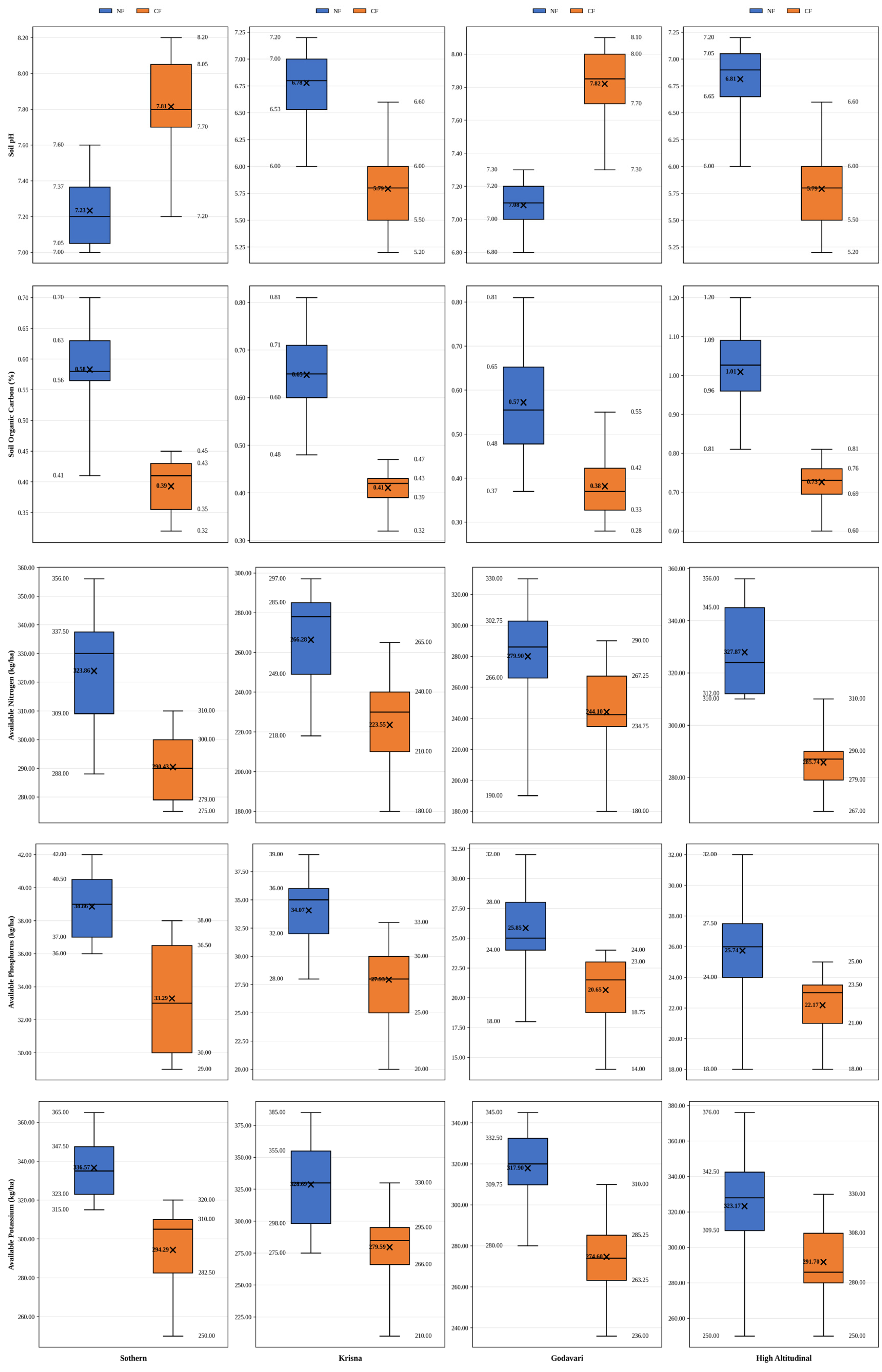
| Southern zone | 7.23 ± 0.24 ¥ | 7.81 ± 0.34 | −7.43 | 0.0035 | ** |
| Krishna zone | 6.78 ± 0.30 | 5.79 ± 0.35 | +17.1 | <0.0001 | *** |
| Godavari zone | 7.08 ± 0.15 | 7.82 ± 0.22 | −9.46 | <0.0001 | *** |
| High Altitude zone | 6.81 ± 0.32 | 5.79 ± 0.39 | +17.6 | <0.0001 | *** |
| Soil organic carbon (%) | |||||
| Southern zone | 0.58 ± 0.09 | 0.39 ± 0.05 | +48.7 | 0.0008 | *** |
| Krishna zone | 0.65 ± 0.08 | 0.41 ± 0.04 | +58.5 | <0.0001 | *** |
| Godavari zone | 0.57 ± 0.12 | 0.38 ± 0.08 | +50.0 | <0.0001 | *** |
| High Altitude zone | 1.01 ± 0.11 | 0.73 ± 0.05 | +38.3 | <0.0001 | *** |
| Available nitrogen (kg ha−1) | |||||
| Southern zone | 323 ± 24.2 | 290 ± 13.5 | +11.3 | 0.0105 | * |
| Krishna zone | 266 ± 22.6 | 223 ± 20.7 | +19.3 | <0.0001 | *** |
| Godavari zone | 279 ± 36.7 | 244 ± 30.0 | +14.3 | 0.0018 | ** |
| High Altitude zone | 327 ± 16.1 | 285. ± 9.91 | +14.7 | <0.0001 | *** |
| Available phosphorus (kg ha−1) | |||||
| Southern zone | 38.8 ± 2.34 | 33.3 ± 3.73 | +16.5 | 0.0073 | ** |
| Krishna zone | 34.0 ± 2.83 | 27.9 ± 3.18 | +21.8 | <0.0001 | *** |
| Godavari zone | 25.9 ± 3.39 | 20.7 ± 3.07 | +25.1 | <0.0001 | *** |
| High Altitude zone | 25.7 ± 3.36 | 22.2 ± 1.87 | +15.7 | <0.0001 | *** |
| Available potassium (kg ha−1) | |||||
| Southern zone | 336 ± 17.8 | 294 ± 25.2 | +14.3 | 0.0042 | ** |
| Krishna zone | 328 ± 31.4 | 279 ± 27.6 | +17.5 | <0.0001 | *** |
| Godavari zone | 317 ± 20.8 | 274 ± 21.0 | +15.7 | <0.0001 | *** |
| High Altitude zone | 323 ± 30.5 | 291 ± 20.5 | +11.0 | 0.0002 | *** |
Disclaimer/Publisher’s Note: The statements, opinions and data contained in all publications are solely those of the individual author(s) and contributor(s) and not of MDPI and/or the editor(s). MDPI and/or the editor(s) disclaim responsibility for any injury to people or property resulting from any ideas, methods, instructions or products referred to in the content. |
© 2026 by the authors. Licensee MDPI, Basel, Switzerland. This article is an open access article distributed under the terms and conditions of the Creative Commons Attribution (CC BY) license.
Share and Cite
Rao, B.K.; Annapurna, S.; Gireesh, B.; Jha, P.; Sruthi, M.; Gowri, K.V.; Sunitha, K.; Nag, R.H.; Choudhary, M.; Hussain, Z.; et al. Improving Water Productivity and Reducing Water and Energy Consumption in Rice Production Through Natural Farming-Based Management Practices in Southern India. Resources 2026, 15, 122. https://doi.org/10.3390/resources15090122
Rao BK, Annapurna S, Gireesh B, Jha P, Sruthi M, Gowri KV, Sunitha K, Nag RH, Choudhary M, Hussain Z, et al. Improving Water Productivity and Reducing Water and Energy Consumption in Rice Production Through Natural Farming-Based Management Practices in Southern India. Resources. 2026; 15(9):122. https://doi.org/10.3390/resources15090122
Chicago/Turabian StyleRao, Battu Krishna, Somepalli Annapurna, Brahmanapuduru Gireesh, Priyanka Jha, Masireddy Sruthi, Kunapuli Vijaya Gowri, Karanam Sunitha, Ramineni Harsha Nag, Mahipal Choudhary, Zakir Hussain, and et al. 2026. "Improving Water Productivity and Reducing Water and Energy Consumption in Rice Production Through Natural Farming-Based Management Practices in Southern India" Resources 15, no. 9: 122. https://doi.org/10.3390/resources15090122
APA StyleRao, B. K., Annapurna, S., Gireesh, B., Jha, P., Sruthi, M., Gowri, K. V., Sunitha, K., Nag, R. H., Choudhary, M., Hussain, Z., & Anitha, M. (2026). Improving Water Productivity and Reducing Water and Energy Consumption in Rice Production Through Natural Farming-Based Management Practices in Southern India. Resources, 15(9), 122. https://doi.org/10.3390/resources15090122