


Valorisation of Food Processing Wastes into High-Value Platform Chemicals: Industrial Pathways and Circular Bioeconomy Perspectives
 ,
,  , ,
, ,  and
and 
Highlights
- Food waste can be valorized into high-value chemicals, biofuels, biopolymers, and other bio-based products through integrated biorefinery approaches.
- Cascading strategies improve resource recovery, sustainability, and circular bioeconomy outcomes.
- Techno-economic, life cycle, commercialization, and regulatory aspects are critically assessed.
- Integrated food waste biorefineries offer a sustainable pathway for waste minimization, resource efficiency, and value creation from renewable feedstocks.
- This review provides strategic guidance to support researchers, industries, and policymakers in accelerating commercialization and promoting the implementation of circular bioeconomy principles.
Abstract
1. Introduction
2. Classification and Characteristics of Food Processing Wastes (FPWs)
3. Concept of Platform Chemicals

| Feedstock Type | Conversion Process | Pretreatment (Microorganism/Enzyme/Catalyst) | Conversion Process | Platform Chemicals | References |
|---|---|---|---|---|---|
| Sugar obtained from food waste | Lactic acid fermentation | Lactobacillus sp. | - | l-lactic acid and d-lactic acid | [31] |
| Citrus peel | Dark fermentation | Escherichia coli and Clostridium species | - | Biohydrogen | [43] |
| Sweet sorghum waste | Acetone-butanol-ethanol fermentation | C. acetobutylicum | - | Biobutanol | [44] |
| Rice starch | Catalytic conversion | Pinewood sawdust-derived biochar activated by phosphoric acid | 150 °C temperature for 20 min volumetric dimethyl sulfoxide: water ratio (3:1) | Glucose (86.5 mol%) | [45] |
| Food waste collected from the students’ canteen | Two-stage enzymatic treatment | Amylase and glucoamylase | 1st stage: enzyme dosage = 150 U g(TS)−1; pH = 5.5 2nd stage: enzyme dosage = 150 U g(TS)−1; pH = 4 | Reducing sugar (204.2 g L−1) | [46] |
| Food waste collected from the university | Microbial fermentation | Bacillus sp. AM5 | 55 °C and pH 10.5 | Total volatile fatty acids (34.8 g L−1) | [47] |
| Melon rind waste | Catalytic conversion | Montmorillonite KSF clay | 180 °C temperature for 30 min volumetric tetrahydrofuran: water ratio (3:1) | Hydroxymethylfurfural (5.9% wt) | [42] |
| Food and beverage waste | Catalytic conversion | Glucoamylase conversion followed by Amberlyst 36 | 140 °C temperature for 40 min dimethyl sulfoxide: water ratio (1:1) | Hydroxymethylfurfural (71% mol%) | [47] |
| Food waste collected from the municipality | Microbial fermentation with engineered microbes | Genetically modified Yarrowia lipolytica | T = 28 °C pH = 6 | Succinic acid (54.4 gL−1) | [48] |
| Sweet potato waste | Anaerobic fermentation with engineered microbes | Genetically modified Escherichia coli | T = 37 °C; t = 48 h | Succinic acid (18.65 g L−1) | [49] |
| Simulated food waste | Mesophilic fermentation | Lactobacillus amylolyticus | T = 52 °C; pH = 5.5 | Lactic acid (0.57 g g−1) | [50] |
4. Conversion Technologies for Platform Chemical Production
4.1. Biological Processes
4.2. Thermochemical Processes
4.3. Physicochemical Methods
4.3.1. Acid–Base Hydrolysis
4.3.2. Cold Plasma-Assisted Extraction
4.3.3. Microwave-Assisted Extraction
4.3.4. Supercritical Fluid Extraction (SFE)
5. Biorefinery Approaches for Food Waste Valorisation
6. Industrial Applications of Derived Platform Chemicals
6.1. Biofuels and Energy Carriers
6.2. Bioplastics and Biodegradable Polymers
6.3. Pharmaceuticals and Nutraceuticals
6.4. Agrochemicals and Food Additives
6.5. Market Opportunities, Commercial Risks, and Competitiveness of Food Waste-Derived Platform Chemicals
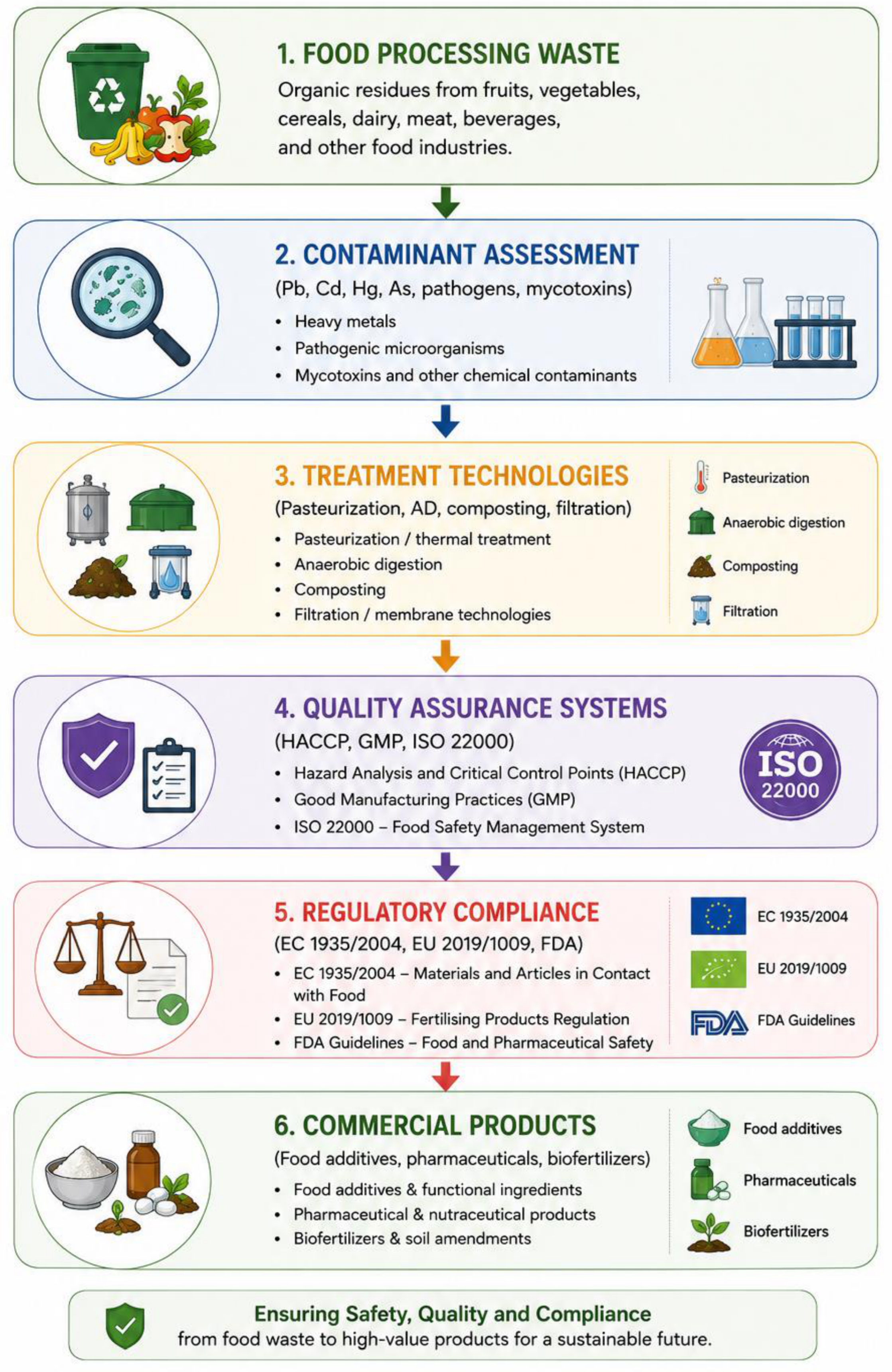
6.6. Safety Considerations, Contaminant Control, and Regulatory Compliance of Food Waste-Derived Products
7. Circular Bioeconomy and Sustainability Perspectives
7.1. Resource Efficiency and Waste Minimisation
7.2. Carbon Footprint Reduction and Climate Benefits
7.3. Life Cycle Assessment (LCA) Insights
7.4. Integration with Sustainable Development Goals (SDGs)
7.5. Global Certification Frameworks and Policy Instruments for Industrial Deployment
8. Techno-Economic Analysis, Life-Cycle Assessment, and Policy Perspectives
8.1. Production Cost, Economic Feasibility, and Scalability Challenges
8.2. Feedstock Logistics and Supply-Chain Management
8.3. Market Value, Product Diversification, and Industrial Competitiveness
8.4. Energy Balance, Greenhouse-Gas Reduction, and Life-Cycle Assessment
8.5. Policy Incentives and Regulatory Frameworks
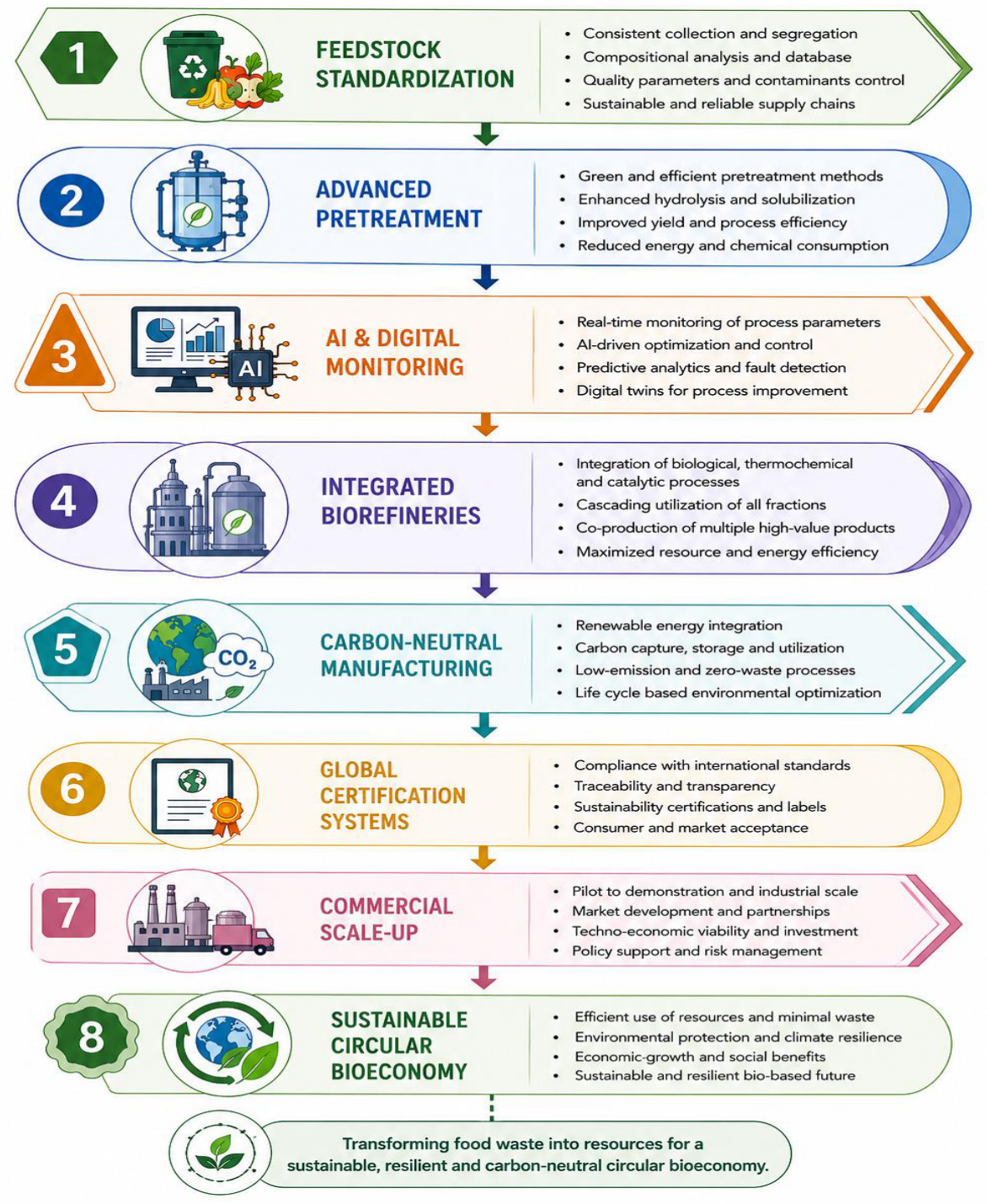
9. Challenges and Future Research Directions
9.1. Feedstock Heterogeneity and Process Optimisation
9.2. Advances in Synthetic Biology and Metabolic Engineering
9.3. Digitalisation and Smart Biorefineries
9.4. Need for Interdisciplinary and Industry–Academia Collaboration
10. Conclusions
Author Contributions
Funding
Data Availability Statement
Conflicts of Interest
References
- Okuthe, G. Valorizing Fruit and Vegetable Waste: The Untapped Potential for Entrepreneurship in Sub-Saharan Africa—A Systematic Review. Recycling 2024, 9, 40. [Google Scholar] [CrossRef] [Scilit]
- Read, Q.D.; Brown, S.; Cuéllar, A.D.; Finn, S.M.; Gephart, J.A.; Marston, L.T.; Meyer, E.; Weitz, K.A.; Muth, M.K. Assessing the Environmental Impacts of Halving Food Loss and Waste along the Food Supply Chain. Sci. Total Environ. 2020, 712, 136255. [Google Scholar] [CrossRef] [Scilit]
- David, L.O.; Aigbavboa, C.; Nwulu, N.; Adepoju, O.O. General Description of Water, Energy, and Food Resources. In Sustainable Synergy: A Digital Framework for the Water-Energy-Food Nexus Project Delivery in Developing Economies; Green Energy and Technology; Springer: Cham, Switzerland, 2024. [Google Scholar] [CrossRef] [Scilit]
- Mahmood, A.; Farooq, A.; Akbar, H.; Ghani, H.U.; Gheewala, S.H. An Integrated Approach to Analyze the Progress of Developing Economies in Asia toward the Sustainable Development Goals. Sustainability 2023, 15, 13645. [Google Scholar] [CrossRef] [Scilit]
- Gautam, M.; Agrawal, M. Greenhouse Gas Emissions from Municipal Solid Waste Management: A Review of Global Scenario. In Carbon Footprint Case Studies; Muthu, S.S., Ed.; Environmental Footprints and Eco-Design of Products and Processes; Springer: Singapore, 2021. [Google Scholar] [CrossRef] [Scilit]
- Gonal, B.N.; Ravikumar, S.K.; Pattanad, V.B.; Patil, R.; Arakera, S.B. Valorization of Food Processing By-Products: A Sustainable Approach for a Circular Bioeconomy. Food Ethics 2026, 11, 24. [Google Scholar] [CrossRef] [Scilit]
- Aiguobarueghian, I.; Adanma, U.M.; Ogunbiyi, E.O.; Solomon, N.O. Waste Management and Circular Economy: A Review of Sustainable Practices and Economic Benefits. World J. Adv. Res. Rev. 2024, 22, 1708–1719. [Google Scholar] [CrossRef] [Scilit]
- Socas-Rodríguez, B.; Álvarez-Rivera, G.; Valdés, A.; Ibáñez, E.; Cifuentes, A. Food By-Products and Food Wastes: Are They Safe Enough for Their Valorization? Trends Food Sci. Technol. 2021, 114, 133–147. [Google Scholar] [CrossRef] [Scilit]
- Bibra, M.; Samanta, D.; Sharma, N.K.; Singh, G.; Johnson, G.R.; Sani, R.K. Food Waste to Bioethanol: Opportunities and Challenges. Fermentation 2023, 9, 8. [Google Scholar]
- Rolewicz-Kalińska, A.; Lelicińska-Serafin, K.; Manczarski, P. Selection Path for Energy-Efficient Food Waste Management in Urban Areas: Scenario Analysis and Insights from Poland. Energies 2025, 18, 385. [Google Scholar] [CrossRef] [Scilit]
- U.S. Environmental Protection Agency. Sustainable Materials Management: Non-Hazardous Materials and Waste Management Hierarchy. 2022. Available online: https://www.epa.gov/smm/sustainable-materials-management-non-hazardous-materials-and-waste-management-hierarchy (accessed on 10 May 2026).
- Eurostat. Waste Statistics. Statistics Explained. 2022. Available online: https://ec.europa.eu/eurostat/statistics-explained/index.php?title=Waste_statistics (accessed on 10 May 2026).
- Correani, L.; Morganti, P.; Silvestri, C.; Ruggieri, A. Food Waste, Circular Economy, and Policy with Oligopolistic Retailers. J. Clean. Prod. 2023, 407, 137092. [Google Scholar] [CrossRef] [Scilit]
- Mabee, W. Assessing Outcomes of Policies and Programs Supporting Biorefining in Canada and Internationally. 2025. Available online: https://mission-innovation.net/wp-content/uploads/2026/03/Mabee-2025-Policy-instruments-NRCan-Final-2025.pdf (accessed on 10 May 2026).
- Pal, P.; Singh, A.K.; Srivastava, R.K.; Rathore, S.S.; Sahoo, U.K.; Subudhi, S.; Sarangi, P.K.; Prus, P. Circular Bioeconomy in Action: Transforming Food Wastes into Renewable Food Resources. Foods 2024, 13, 3007. [Google Scholar] [CrossRef] [Scilit] [PubMed]
- de Abreu, Í.B.S.; Silva, R.K.; Siqueira, J.G.W.; Silva, P.K.N.d.; Sonego, J.L.S.; de Souza, R.B.; Antonino, A.C.D.; Menezes, R.S.C.; Dutra, E.D. Brazilian Food Waste as a Substrate for Bioethanol Production. Foods 2024, 13, 4032. [Google Scholar] [CrossRef] [Scilit] [PubMed]
- Díez, M.P.; Villanueva-Galindo, E.; Moreno-Andrade, I.; Díaz, E.; de la Rubia, M.A.; Mohedano, A.F.; Perez-Rangel, M. Enhanced Hydrogen Production from Food Waste via Bioaugmentation with Clostridium and Lactobacillus. Biomass Convers. Biorefin. 2025, 15, 27501–27513. [Google Scholar] [CrossRef] [Scilit]
- International Energy Agency (IEA). Renewable Energy Progress Tracker. 2023. Available online: https://www.iea.org/data-and-statistics/data-tools/renewable-energy-progress-tracker (accessed on 9 February 2023).
- Di Fraia, S.; Godvin Sharmila, V.; Rajesh Banu, J.; Massarotti, N. A Comprehensive Review on Upcycling of Food Waste into Value Added Products towards a Circular Economy: Holistic Approaches and Life Cycle Assessments. Trends Food Sci. Technol. 2024, 143, 104288. [Google Scholar] [CrossRef] [Scilit]
- Arvelli, S.; Jia, L.; Zhang, M.; Zhao, J. Review of Advanced Technologies and Circular Pathways for Food Waste Valorization. J. Agric. Food Chem. 2025, 73, 16085–16108. [Google Scholar] [CrossRef] [Scilit] [PubMed]
- Cerdán, J.M.A.; Kodama, T.K.; Oliveira, G.H.D.; Fuess, L.T.; Andrade, J.F.C.; Ometto, A.R. Conversion of Municipal Biowaste into Value-Added Products toward a Circular Bioeconomy: Bridging the Gap between Laboratory-Scale and Full-Scale Implementation. Clean Technol. Environ. Policy 2026, 28, 89. [Google Scholar] [CrossRef] [Scilit]
- Madzak, C. Yarrowia Lipolytica Strains and Their Biotechnological Applications: How Natural Biodiversity and Metabolic Engineering Could Contribute to Cell Factories Improvement. J. Fungi 2021, 7, 548. [Google Scholar] [CrossRef] [Scilit]
- Tsegaye, B.; Jaiswal, S.; Jaiswal, A.K. Food Waste Biorefinery: Pathway towards Circular Bioeconomy. Foods 2021, 10, 1174. [Google Scholar] [CrossRef] [Scilit] [PubMed]
- Ubando, A.T.; Felix, C.B.; Chen, W.H. Biorefineries in Circular Bioeconomy: A Comprehensive Review. Bioresour. Technol. 2020, 299, 122585. [Google Scholar] [CrossRef] [Scilit] [PubMed]
- Battista, F.; Frison, N.; Pavan, P.; Cavinato, C.; Gottardo, M.; Fatone, F.; Eusebi, A.L.; Majone, M.; Zeppilli, M.; Valentino, F.; et al. Food Wastes and Sewage Sludge as Feedstock for an Urban Biorefinery Producing Biofuels and Added-Value Bioproducts. J. Chem. Technol. Biotechnol. 2020, 95, 328–338. [Google Scholar]
- Pant, M.; Bisen, D.; Kewlani, P.; Srivastav, A.L.; Bhatt, I.D.; Chakma, S. Review of Food Waste Valorization Technologies: A Sustainable Approach to Resource Recovery and Utilization. Biomass Futures 2026, 1, 100001. [Google Scholar] [CrossRef] [Scilit]
- Ibarz-Blanch, N.; Alcaide-Hidalgo, J.M.; Cortés-Espinar, A.J.; Albi-Puig, J.; Suárez, M.; Mulero, M.; Morales, D.; Bravo, F.I. Chicken Slaughterhouse By-Products: A Source of Protein Hydrolysates to Manage Non-Communicable Diseases. Trends Food Sci. Technol. 2023, 139, 104125. [Google Scholar] [CrossRef] [Scilit]
- Hamad, A.; Sabeq, I.I. Food Processing Waste: Understanding the Sources, Composition, and Characteristics. In Waste to Resources; Giri, A., Kumar, R., Dhull, S.B., Acharya, S., Eds.; Academic Press: New York, NY, USA, 2026; pp. 61–77. [Google Scholar] [CrossRef] [Scilit]
- Lang, M.; Li, H. Sustainable Routes for the Synthesis of Renewable Adipic Acid from Biomass Derivatives. ChemSusChem 2022, 15, e202101531. [Google Scholar] [CrossRef] [Scilit] [PubMed]
- Esteban, J.; Ladero, M. Food Waste as a Source of Value-Added Chemicals and Materials: A Biorefinery Perspective. Int. J. Food Sci. Technol. 2018, 53, 1095–1108. [Google Scholar] [CrossRef] [Scilit]
- Tang, J.; Wang, X.; Hu, Y.; Zhang, Y.; Li, Y. Lactic Acid Fermentation from Food Waste with Indigenous Microbiota: Effects of PH, Temperature and High OLR. Waste Manag. 2016, 52, 278–285. [Google Scholar] [CrossRef] [Scilit] [PubMed]
- Harirchi, S.; Wainaina, S.; Sar, T.; Nojoumi, S.A.; Parchami, M.; Parchami, M.; Varjani, S.; Khanal, S.K.; Wong, J.; Awasthi, M.K.; et al. Microbiological Insights into Anaerobic Digestion for Biogas, Hydrogen or Volatile Fatty Acids (VFAs): A Review. Bioengineered 2022, 13, 6521–6557. [Google Scholar] [CrossRef] [Scilit] [PubMed]
- Ray, S.; Mukherjee, A.; Ghosh, U. Advancements in Microbial Fermentation of Agro and Food Processing Wastes for Generation of Biofuel. In Solid-Gaseous Biofuels Production; Inamuddin, Altalhi, T., Eds.; Wiley: New York, NY, USA, 2024. [Google Scholar] [CrossRef] [Scilit]
- Ghai, M.; Agnihotri, N.; Kumar, V.; Agnihotri, R.; Kumar, A.; Sahu, K. Global Organic Acids Production and Their Industrial Applications. Phys. Sci. Rev. 2024, 9, 3097–3115. [Google Scholar] [CrossRef] [Scilit]
- Dessie, W.; Zhang, W.; Xin, F.; Dong, W.; Zhang, M.; Ma, J.; Jiang, M. Succinic Acid Production from Fruit and Vegetable Wastes Hydrolyzed by On-Site Enzyme Mixtures through Solid State Fermentation. Bioresour. Technol. 2018, 247, 1177–1180. [Google Scholar] [CrossRef] [Scilit] [PubMed]
- Ratanapariyanuch, K. Recovery of Protein and Organic Compounds from Secondary-Fermented Thin Stillage. Ph.D. Thesis, University of Saskatchewan, Saskatchewan, SK, Canada, 2016. [Google Scholar]
- Shen, D.; Yin, J.; Yu, X.; Wang, M.; Long, Y.; Shentu, J.; Chen, T. Acidogenic Fermentation Characteristics of Different Types of Protein-Rich Substrates in Food Waste to Produce Volatile Fatty Acids. Bioresour. Technol. 2017, 227, 125–132. [Google Scholar] [CrossRef] [Scilit] [PubMed]
- Pereira, A.S.; Lopes, M.; Duarte, M.S.; Alves, M.M.; Belo, I. Integrated Bioprocess of Microbial Lipids Production in Yarrowia Lipolytica Using Food-Waste Derived Volatile Fatty Acids. Renew. Energy 2023, 202, 1470–1478. [Google Scholar] [CrossRef] [Scilit]
- Wu, L.; Wei, W.; Chen, Z.; Shi, X.; Wang, D.; Chen, X.; Ni, B.J. Medium Chain Fatty Acids Production from Anaerobic Fermentation of Food Wastes: The Role of Fermentation PH in Metabolic Pathways. Chem. Eng. J. 2023, 472, 144824. [Google Scholar] [CrossRef] [Scilit]
- Zhou, X.; Lu, Y.; Huang, L.; Zhang, Q.; Wang, X.; Zhu, J. Effect of pH on Volatile Fatty Acid Production and the Microbial Community during Anaerobic Digestion of Chinese Cabbage Waste. Bioresour. Technol. 2021, 336, 125338. [Google Scholar] [CrossRef] [Scilit] [PubMed]
- Rusanen, A.; Lahti, R.; Lappalainen, K.; Kärkkäinen, J.; Hu, T.; Romar, H.; Lassi, U. Catalytic Conversion of Glucose to 5-Hydroxymethylfurfural over Biomass-Based Activated Carbon Catalyst. Catal. Today 2020, 357, 94–101. [Google Scholar] [CrossRef] [Scilit]
- Lucas-Torres, C.; Lorente, A.; Cabañas, B.; Moreno, A. Microwave Heating for the Catalytic Conversion of Melon Rind Waste into Biofuel Precursors. J. Clean. Prod. 2016, 138, 59–69. [Google Scholar] [CrossRef] [Scilit]
- Su, C.; Qi, L.; Cai, D.; Chen, B.; Chen, H.; Zhang, C.; Si, Z.; Wang, Z.; Li, G.; Qin, P. Integrated Ethanol Fermentation and Acetone-Butanol-Ethanol Fermentation Using Sweet Sorghum Bagasse. Renew. Energy 2020, 162, 1125–1131. [Google Scholar] [CrossRef] [Scilit]
- Cao, L.; Yu, I.K.M.; Tsang, D.C.W.; Zhang, S.; Ok, Y.S.; Kwon, E.E.; Song, H.; Poon, C.S. Phosphoric Acid-Activated Wood Biochar for Catalytic Conversion of Starch-Rich Food Waste into Glucose and 5-Hydroxymethylfurfural. Bioresour. Technol. 2018, 267, 242–248. [Google Scholar] [CrossRef] [Scilit] [PubMed]
- Zhang, C.; Kang, X.; Wang, F.; Tian, Y.; Liu, T.; Su, Y.; Qian, T.; Zhang, Y. Valorization of Food Waste for Cost-Effective Reducing Sugar Recovery in a Two-Stage Enzymatic Hydrolysis Platform. Energy 2020, 208, 118379. [Google Scholar] [CrossRef] [Scilit]
- Pham, V.H.T.; Ahn, J.; Kim, J.; Lee, S.; Lee, I.; Kim, S.; Chang, S.; Chung, W. Volatile Fatty Acid Production from Food Waste Leachate Using Enriched Bacterial Culture and Soil Bacteria as Co-Digester. Sustainability 2021, 13, 9606. [Google Scholar] [CrossRef] [Scilit]
- Yu, I.K.M.; Ong, K.L.; Tsang, D.C.W.; Haque, M.A.; Kwan, T.H.; Chen, S.S.; Uisan, K.; Kulkarni, S.; Lin, C.S.K. Chemical Transformation of Food and Beverage Waste-Derived Fructose to Hydroxymethylfurfural as a Value-Added Product. Catal. Today 2018, 314, 70–77. [Google Scholar] [CrossRef] [Scilit]
- Stylianou, E.; Pateraki, C.; Ladakis, D.; Damala, C.; Vlysidis, A.; Latorre-Sánchez, M.; Coll, C.; Lin, C.S.K.; Koutinas, A. Bioprocess Development Using Organic Biowaste and Sustainability Assessment of Succinic Acid Production with Engineered Yarrowia Lipolytica Strain. Biochem. Eng. J. 2021, 174, 108099. [Google Scholar] [CrossRef] [Scilit]
- Huang, M.; Cheng, J.; Chen, P.; Zheng, G.; Wang, D.; Hu, Y. Efficient Production of Succinic Acid in Engineered Escherichia Coli Strains Controlled by Anaerobically-Induced NirB Promoter Using Sweet Potato Waste Hydrolysate. J. Environ. Manag. 2019, 237, 147–154. [Google Scholar] [CrossRef] [Scilit] [PubMed]
- Yang, L.; Chen, L.; Li, H.; Deng, Z.; Liu, J. Lactic Acid Production from Mesophilic and Thermophilic Fermentation of Food Waste at Different pH. J. Environ. Manag. 2022, 304, 114312. [Google Scholar] [CrossRef] [Scilit] [PubMed]
- Su, G.; Chan, C.; He, J. Enhanced Biobutanol Production from Starch Waste via Orange Peel Doping. Renew. Energy 2022, 193, 576–583. [Google Scholar] [CrossRef] [Scilit]
- Beluhan, S.; Mihajlovski, K.; Šantek, B.; Ivančić Šantek, M. The Production of Bioethanol from Lignocellulosic Biomass: Pretreatment Methods, Fermentation, and Downstream Processing. Energies 2023, 16, 7003. [Google Scholar] [CrossRef] [Scilit]
- Aboelela, D.; Saleh, H.; Attia, A.M.; Elhenawy, Y.; Majozi, T.; Bassyouni, M. Recent Advances in Biomass Pyrolysis Processes for Bioenergy Production: Optimization of Operating Conditions. Sustainability 2023, 15, 11238. [Google Scholar] [CrossRef] [Scilit]
- Nie, E.; He, P.; Zhang, H.; Hao, L.; Shao, L.; Lü, F. How Does Temperature Regulate Anaerobic Digestion? Renew. Sustain. Energy Rev. 2021, 150, 111453. [Google Scholar] [CrossRef] [Scilit]
- Deng, L.; Liu, Y.; Wang, W. Anaerobic Digestion Microorganisms. In Biogas Technology; Springer: Singapore, 2020. [Google Scholar] [CrossRef] [Scilit]
- Kaur, M.; Rathour, R.K.; Kamboj, S.; Menon, V.; Kaur, M.J.; Sharma, D.; Kaushik, M. Food Waste Conversion Routes and Commercial Implications. In Microbial Cell Factories in Food Waste Biorefinery; Elsevier: Amsterdam, The Netherlands, 2025; pp. 59–80. ISBN 9780443363023. [Google Scholar]
- Elmore, J.R.; Dexter, G.N.; Salvachúa, D.; O’Brien, M.; Klingeman, D.M.; Gorday, K.; Michener, J.K.; Peterson, D.J.; Beckham, G.T.; Guss, A.M. Engineered Pseudomonas Putida Simultaneously Catabolizes Five Major Components of Corn Stover Lignocellulose: Glucose, Xylose, Arabinose, p-Coumaric Acid, and Acetic Acid. Metab. Eng. 2020, 62, 62–71. [Google Scholar] [CrossRef] [Scilit] [PubMed]
- Chacón, M.; Alvarez-Gonzalez, G.; Gosalvitr, P.; Berepiki, A.; Fisher, K.; Cuéllar-Franca, R.; Dixon, N. Complex Waste Stream Valorization through Combined Enzymatic Hydrolysis and Catabolic Assimilation by Pseudomonas Putida. Trends Biotechnol. 2025, 43, 647–672. [Google Scholar] [CrossRef] [Scilit] [PubMed]
- Li, Z.-B.; Yu, Y.; Jia, L.; Wu, Y.-W.; Cheng, P.; Zhang, Z.; Li, Z.-K.; Fan, C.-H.; Guo, X.-M. Thermal Characteristic Analysis and Performance Optimization of a Novel Heating Boiler Based on a Porous Media Model. Appl. Therm. Eng. 2026, 289, 130035. [Google Scholar] [CrossRef] [Scilit]
- Wang, X.; Sheng, L.; Yang, X. Pyrolysis Characteristics and Pathways of Protein, Lipid and Carbohydrate Isolated from Microalgae Nannochloropsis sp. Bioresour. Technol. 2017, 229, 119–125. [Google Scholar] [CrossRef] [Scilit] [PubMed]
- Frolov, S.M. Organic Waste Gasification: A Selective Review. Fuels 2021, 2, 556–650. [Google Scholar] [CrossRef] [Scilit]
- Das, D.; Roy, S. Biohythane: Fuel for the Future, 1st ed.; Jenny Stanford Publishing: Singapore, 2016. [Google Scholar] [CrossRef] [Scilit]
- Kumar, A.; Škoro, N.; Gernjak, W.; Puač, N. Cold Atmospheric Plasma Technology for Removal of Organic Micropollutants from Wastewater—A Review. Eur. Phys. J. D 2021, 75, 283. [Google Scholar] [CrossRef] [Scilit]
- Abolore, R.S.; Jaiswal, S.; Jaiswal, A.K. Green and Sustainable Pretreatment Methods for Cellulose Extraction from Lignocellulosic Biomass and Its Applications: A Review. Carbohydr. Polym. Technol. Appl. 2024, 7, 100396. [Google Scholar] [CrossRef] [Scilit]
- Anari, E.S.; Soltanizadeh, N.; Fathi, M. The Potential of DBD Plasma Pretreatment for the Isolation of Micro- and Nano-Cellulose Fibers from the Walnut Shells. Carbohydr. Polym. 2024, 327, 121692. [Google Scholar] [CrossRef] [Scilit] [PubMed]
- Zhu, H.; Han, Z.; Cheng, J.H.; Sun, D.W. Modification of Cellulose from Sugarcane (Saccharum officinarum) Bagasse Pulp by Cold Plasma: Dissolution, Structure and Surface Chemistry Analysis. Food Chem. 2022, 374, 131675. [Google Scholar] [CrossRef] [Scilit] [PubMed]
- Bagade, S.B.; Patil, M. Recent Advances in Microwave Assisted Extraction of Bioactive Compounds from Complex Herbal Samples: A Review. Crit. Rev. Anal. Chem. 2021, 51, 138–149. [Google Scholar] [PubMed]
- Mladenović, D.; Djukić-Vuković, A.; Veselinović, L.; Mijin, D.; Kocić-Tanackov, S.; Mojović, L. Short-Term Microwave-Assisted Peroxide Treatment for Intensified Lignin and Sugar Recovery from Corncob. Waste Biomass Valoriz. 2025, 16, 3909–3923. [Google Scholar] [CrossRef] [Scilit]
- Mankar, A.R.; Pandey, A.; Modak, A.; Pant, K.K. Pretreatment of Lignocellulosic Biomass: A Review on Recent Advances. Bioresour. Technol. 2021, 334, 125235. [Google Scholar] [CrossRef] [Scilit] [PubMed]
- Herzyk, F.; Piłakowska-Pietras, D.; Korzeniowska, M. Supercritical Extraction Techniques for Obtaining Biologically Active Substances from a Variety of Plant Byproducts. Foods 2024, 13, 1713. [Google Scholar] [CrossRef] [Scilit] [PubMed]
- Colombo, B.; Favini, F.; Scaglia, B.; Sciarria, T.P.; D’Imporzano, G.; Pognani, M.; Alekseeva, A.; Eisele, G.; Cosentino, C.; Adani, F. Enhanced Polyhydroxyalkanoate (PHA) Production from the Organic Fraction of Municipal Solid Waste by Using Mixed Microbial Culture. Biotechnol. Biofuels 2017, 10, 201. [Google Scholar] [CrossRef] [Scilit] [PubMed]
- Zhang, J.; Hu, Q.; Qu, Y.; Dai, Y.; He, Y.; Wang, C.H.; Tong, Y.W. Integrating Food Waste Sorting System with Anaerobic Digestion and Gasification for Hydrogen and Methane Co-Production. Appl. Energy 2020, 257, 113988. [Google Scholar] [CrossRef] [Scilit]
- Fraguela-Meissimilly, H.; Bastías-Monte, J.M.; Vergara, C.; Ortiz-Viedma, J.; Lemus-Mondaca, R.; Flores, M.; Toledo-Merma, P.; Alcázar-Alay, S.; Gallón-Bedoya, M. New Trends in Supercritical Fluid Technology and Pressurised Liquids for the Extraction and Recovery of Bioactive Compounds from Agro-Industrial and Marine Food Waste. Molecules 2023, 28, 4421. [Google Scholar] [CrossRef] [Scilit] [PubMed]
- Aussanasuwannakul, A.; Boonbumrung, S.; Pantoa, T. Valorisation of Soybean Residue (Okara) by Supercritical Carbon Dioxide Extraction: Compositional, Physicochemical, and Functional Properties of Oil and Defatted Powder. Foods 2023, 12, 2698. [Google Scholar] [CrossRef] [Scilit] [PubMed]
- Ozbay, N.; Yargic, A.S.; Yarbay Sahin, R.Z.; Yaman, E. Valorisation of Banana Peel Waste via In-Situ Catalytic Pyrolysis Using Al-Modified SBA-15. Renew. Energy 2019, 140, 633–646. [Google Scholar] [CrossRef] [Scilit]
- Shewa, W.A.; Hussain, A.; Chandra, R.; Lee, J.; Saha, S.; Lee, H.S. Valorisation of Food Waste and Economical Treatment: Effect of Inoculation Methods. J. Clean. Prod. 2020, 261, 121170. [Google Scholar] [CrossRef] [Scilit]
- Ambaye, T.G.; Rene, E.R.; Dupont, C.; Wongrod, S.; van Hullebusch, E.D. Anaerobic Digestion of Fruit Waste Mixed With Sewage Sludge Digestate Biochar: Influence on Biomethane Production. Front. Energy Res. 2020, 8, 31. [Google Scholar] [CrossRef] [Scilit]
- Moretto, G.; Russo, I.; Bolzonella, D.; Pavan, P.; Majone, M.; Valentino, F. An Urban Biorefinery for Food Waste and Biological Sludge Conversion into Polyhydroxyalkanoates and Biogas. Water Res. 2020, 170, 115371. [Google Scholar] [CrossRef] [Scilit] [PubMed]
- Lohani, S.P.; Shakya, S.; Gurung, P.; Dhungana, B.; Paudel, D.; Mainali, B. Anaerobic Co-Digestion of Food Waste, Poultry Litter and Sewage Sludge: Seasonal Performance under Ambient Conditions and Model Evaluation. Energy Sources Part A Recovery Util. Environ. Eff. 2025, 47, 1887976. [Google Scholar] [CrossRef] [Scilit]
- Yadav, S.; Singh, D.; Mohanty, P.; Sarangi, P.K. Biochemical and Thermochemical Routes of H2 Production from Food Waste: A Comparative Review. Chem. Eng. Technol. 2023, 46, 191–203. [Google Scholar]
- Rodríguez-Valderrama, S.; Escamilla-Alvarado, C.; Rivas-García, P.; Magnin, J.P.; Alcalá-Rodríguez, M.; García-Reyes, R.B. Biorefinery Concept Comprising Acid Hydrolysis, Dark Fermentation, and Anaerobic Digestion for Co-Processing of Fruit and Vegetable Wastes and Corn Stover. Environ. Sci. Pollut. Res. 2020, 27, 28585–28596. [Google Scholar] [CrossRef] [Scilit] [PubMed]
- Summers, S.; Valentine, A.; Wang, Z.; Zhang, Y. Pilot-Scale Continuous Plug-Flow Hydrothermal Liquefaction of Food Waste for Biocrude Production. Ind. Eng. Chem. Res. 2023, 62, 12174–12182. [Google Scholar] [CrossRef] [Scilit]
- Pham, T.P.T.; Kaushik, R.; Parshetti, G.K.; Mahmood, R.; Balasubramanian, R. Food Waste-to-Energy Conversion Technologies: Current Status and Future Directions. Waste Manag. 2015, 38, 399–408. [Google Scholar] [CrossRef] [Scilit] [PubMed]
- Thi Nguyen, M.L.; Hung, P.C.; Vo, T.P.; Lay, C.H.; Lin, C.Y. Effect of Food to Microorganisms (F/M) Ratio on Biohythane Production via Single-Stage Dark Fermentation. Int. J. Hydrogen Energy 2021, 46, 11313–11324. [Google Scholar] [CrossRef] [Scilit]
- Romero-Güiza, M.S.; Vila, J.; Mata-Alvarez, J.; Chimenos, J.M.; Astals, S. The role of additives on anaerobic digestion: A review. Renew. Sustain. Energy Rev. 2016, 58, 1486–1499. [Google Scholar] [CrossRef] [Scilit]
- Bayu, A.B.; Akuma, D.A.; Hundie, K.B. An Integrated Approach to Optimization of Fermentation Conditions for Bioethanol Production from Local Leftover Injera Waste Using Central Composite Design. Environ. Health Eng. Manag. 2022, 9, 281–293. [Google Scholar] [CrossRef] [Scilit]
- Feng, S.; Guo, W.; Zhang, S.; Luo, G.; Nguyen, H.T.; Nguyen, N.C.; Cheng, D.; Ye, Y.; Ngo, H.H. Optimization of Hydraulic Retention Time in Continuous Orange Peel Crude Enzyme—Mediated Dark Fermentation for Sustainable Biohydrogen Production from Synthetic Swine Wastewater. J. Water Process Eng. 2025, 73, 107714. [Google Scholar] [CrossRef] [Scilit]
- Bustos-Terrones, V. Valorization Routes for Crop Residues in Sustainable Bioeconomy: A Scoping Review of Technologies and Impacts. J. Environ. Sci. Health Part B 2026, 61, 393–415. [Google Scholar] [CrossRef] [Scilit] [PubMed]
- da Silva, S.B.; Silva, R.K.; de Abreu, Í.B.S.; de Sousa, M.H.; Dutra, E.D.; Albuquerque, A.A.; de Morais Junior, M.A.; de Souza, R.B. Integrated Bioprocesses for Urban Food Waste: Insights into Biological Pathways, Process Integration, and Circular Economy Perspectives. Recycling 2025, 10, 188. [Google Scholar] [CrossRef] [Scilit]
- Kover, A.; Kraljić, D.; Marinaro, R.; Rene, E.R. Processes for the Valorization of Food and Agricultural Wastes to Value-Added Products: Recent Practices and Perspectives. Syst. Microbiol. Biomanuf. 2022, 2, 50–66. [Google Scholar]
- Varjani, S.; Yan, W.; Priya, A.; Xin, F.; Lin, C.S.K. Management and Valorisation Strategies for Transforming Food Waste into Bio-Based Products: Roadblocks and the Way Forward. Curr. Opin. Green Sustain. Chem. 2023, 41, 100806. [Google Scholar] [CrossRef] [Scilit]
- Russo, G.L.; Langellotti, A.L. New Biotechnological Routes to Upcycle Food By-Products and Waste into High-Value Lipids through Microalgae. Crit. Rev. Biotechnol. 2026, 46, 742–759. [Google Scholar] [CrossRef] [Scilit] [PubMed]
- Boiteau, J.; Pingali, P. From Data to Action: Building Evidence on Food Loss and Waste. In Wasted Potential; Sustainable Development Goals Series; Springer: Cham, Switzerland, 2026; pp. 53–74. [Google Scholar] [CrossRef] [Scilit]
- Clostridium Butyricum TM-9A at Regulated PH under Decreased Partial Pressure. Renew. Energy 2021, 170, 1178–1185. [CrossRef] [Scilit]
- Wharton, C.; Vizcaino, M.; Berardy, A.; Opejin, A. Waste Watchers: A Food Waste Reduction Intervention among Households in Arizona. Resour. Conserv. Recycl. 2021, 164, 105109. [Google Scholar] [CrossRef] [Scilit]
- Shahbazi, F.; Shahbazi, S.; Zare, D. Losses in Agricultural Produce: Causes and Effects on Food Security. Food Energy Secur. 2025, 14, 70086. [Google Scholar] [CrossRef] [Scilit]
- Inayat, A.; Dafalla, M.; Asaad, S.; Jamil, F.; Al-Haj, L.; Shah, F.M.; Ghenai, C.; Shanableh, A. Sustainable Energy Production From Waste: A Review of Hybrid Approaches Combining Anaerobic Digestion and Gasification. Int. J. Energy Res. 2025, 2025, 6644084. [Google Scholar] [CrossRef] [Scilit]
- Dey, S.; Santra, M.; Choudhury, M.; Ghosh, A.R.; Samanta, P. Food Waste Generation and Its Industrial Utilization: An Overview. Environ. Sci. Pollut. Res. 2025, 32, 7493–7512. [Google Scholar] [CrossRef] [Scilit] [PubMed]
- Agrawal, D.; Gopaliya, D.; Willoughby, N.; Khare, S.K.; Kumar, V. Recycling Potential of Brewer’s Spent Grains for Circular Biorefineries. Curr. Opin. Green Sustain. Chem. 2023, 40, 100748. [Google Scholar] [CrossRef] [Scilit]
- Aleisa, E.; Alsaleh, A. Upcycling Food Waste into Animal Feed: An Environmental Assessment Based on Food Waste Quantities in Different District Types in Kuwait. J. Eng. Res. 2025, 13, 2212–2223. [Google Scholar] [CrossRef] [Scilit]
- Alli, Y.A.; Bamisaye, A.; Bamidele, M.O.; Etafo, N.O.; Chkirida, S.; Lawal, A.; Hammed, V.O.; Akinfenwa, A.S.; Hanson, E.; Nwakile, C.; et al. Transforming Waste to Wealth: Harnessing Carbon Dioxide for Sustainable Solutions. Results Surf. Interfaces 2024, 17, 100321. [Google Scholar] [CrossRef] [Scilit]
- Arfan, M.; Eriksson, O.; Wang, Z.; Soam, S. Life Cycle Assessment and Life Cycle Costing of Hydrogen Production from Biowaste and Biomass in Sweden. Energy Convers. Manag. 2023, 291, 117262. [Google Scholar] [CrossRef] [Scilit]
- Pérez, N.P.; Cabral, E.A.; Bimestre, T.A.; Loures, C.A.; Maya, D.M.Y.; Ribeiro, L.F. On-Site Power Generation Using Biogas in Sewage Treatment Plants: A Techno-Economic Assessment of a Brazilian UASB Facility. Bioenergy Res. 2025, 18, 10863. [Google Scholar] [CrossRef] [Scilit]
- Arriaga, M.; Pinar, F.J.; Izarra, I.; Amo, J.d.; Vicente, J.; Fernández-Morales, F.J.; Mena, J. Valorization of Agri-Food Waste into PHA and Bioplastics: From Waste Selection to Transformation. Appl. Sci. 2025, 15, 1008. [Google Scholar] [CrossRef] [Scilit]
- Yousefi, A.M.; Wnek, G.E. Poly(Hydroxyalkanoates): Emerging Biopolymers in Biomedical Fields and Packaging Industries for a Circular Economy. Biomed. Mater. Devices 2025, 3, 19–44. [Google Scholar] [CrossRef] [Scilit]
- Ong, K.L.; Kaur, G.; Pensupa, N.; Uisan, K.; Lin, C.S.K. Trends in Food Waste Valorization for the Production of Chemicals, Materials and Fuels: Case Study South and Southeast Asia. Bioresour. Technol. 2018, 248, 100–112. [Google Scholar] [CrossRef] [Scilit] [PubMed]
- Dey, S.; Sen, K.; Ghosh, S.; Saha, N.C.; Avino, P.; Prokic, M.D.; Vadiveloo, A.; Saha, S. Case Study on Platform Chemicals Derived from Food and Agro-Industrial Wastes. In Food and Agro-Industrial Wastes; Sillanpää, M., Choudhury, M., Goswami, S., Eds.; Academic Press: New York, NY, USA, 2026; pp. 417–437. [Google Scholar] [CrossRef] [Scilit]
- Sawant, S.S.; Park, H.-Y.; Sim, E.-Y.; Kim, H.-S.; Choi, H.-S. Microbial Fermentation in Food: Impact on Functional Properties and Nutritional Enhancement—A Review of Recent Developments. Fermentation 2025, 11, 15. [Google Scholar] [CrossRef] [Scilit]
- Wang, M.; Yin, Y. Fermented Foods: Raw Materials, Microorganisms, Emerging Technologies, and Novel Products. Foods 2025, 14, 3775. [Google Scholar] [CrossRef] [Scilit] [PubMed]
- Mathura, S.R.; Landázuri, A.C.; Mathura, F.; Andrade Sosa, A.G.; Orejuela-Escobar, L.M. Hemicelluloses from Bioresidues and Their Applications in the Food Industry—Towards an Advanced Bioeconomy and a Sustainable Global Value Chain of Chemicals and Materials. Sustain. Food Technol. 2024, 2, 1183–1205. [Google Scholar] [CrossRef] [Scilit]
- Dhar, P.; Deka, S.C.; Panigrahi, R.; Roopashree, R.; Chennakesavulu, K.; Sharma, R.; Sinha, A.; Abate, L. Circular Bioeconomy of Fruits and Vegetable Waste Into Biosolvents and Bioresources: Advancement in Sustainable Bioremediation Technologies. Eng. Rep. 2025, 7, e70396. [Google Scholar] [CrossRef] [Scilit]
- Costa, C.F.F.A.; Amorim, C.L.; Duque, A.F.; Reis, M.A.M.; Castro, P.M.L. Valorization of Wastewater from Food Industry: Moving to a Circular Bioeconomy. Rev. Environ. Sci. Biotechnol. 2022, 21, 269–295. [Google Scholar]
- Barrera-Chamorro, L.; Fernandez-Prior, Á.; Rivero-Pino, F.; Montserrat-de la Paz, S. A Comprehensive Review on the Functionality and Biological Relevance of Pectin and the Use in the Food Industry. Carbohydr. Polym. 2025, 348, 122794. [Google Scholar] [CrossRef] [Scilit] [PubMed]
- Comunian, T.A.; Silva, M.P.; Souza, C.J.F. The Use of Food By-Products as a Novel for Functional Foods: Their Use as Ingredients and for the Encapsulation Process. Trends Food Sci. Technol. 2021, 108, 269–280. [Google Scholar] [CrossRef] [Scilit]
- European Commission. A Sustainable Bioeconomy for Europe: Strengthening the Connection between Economy, Society and the Environment. 2018. Available online: https://www.univ-reims.fr/aebb-en/media-files/18808/ec_bioeconomy_strategy_2018.pdf (accessed on 10 May 2026).
- Igwebuike, C.M.; Awad, S.; Andrès, Y. Renewable Energy Potential: Second-Generation Biomass as Feedstock for Bioethanol Production. Molecules 2024, 29, 1619. [Google Scholar] [CrossRef] [Scilit] [PubMed]
- Niu, Y.; Starrett, N.; Ahmad, M.I.; Wang, S.; Li, Y.; Han, T. Sustainability Assessment of Bioethanol from Food Industry Lignocellulosic Wastes: A Life Cycle Perspective. Sustainability 2026, 18, 1478. [Google Scholar] [CrossRef] [Scilit]
- Pérez, L.; Salgueiro, J.L.; Maceiras, R.; Cancela, Á.; Sánchez, Á. An Effective Method for Harvesting of Marine Microalgae: PH Induced Flocculation. Biomass Bioenergy 2017, 97, 20–26. [Google Scholar] [CrossRef] [Scilit]
- Junghare, M.; Saxena, S.; Ingle, A.; Moharil, M. Biorefineries: Current Scenario, Feedstocks, Challenges, and Future Perspectives. In Biorefineries: A Step Towards Renewable and Clean Energy; Springer: New York, NY, USA, 2023; pp. 1–25. [Google Scholar] [CrossRef] [Scilit]
- Conteratto, C.; Artuzo, F.D.; Benedetti Santos, O.I.; Talamini, E. Biorefinery: A Comprehensive Concept for the Sociotechnical Transition toward Bioeconomy. Renew. Sustain. Energy Rev. 2021, 151, 111527. [Google Scholar] [CrossRef] [Scilit]
- Ueno, K.; Negishi, H.; Okuno, T.; Saito, T.; Tawarayama, H.; Ishikawa, S.; Miyamoto, M.; Uemiya, S.; Sawada, Y.; Oumi, Y. High-Performance Silicalite-1 Membranes on Porous Tubular Silica Supports for Separation of Ethanol/Water Mixtures. Sep. Purif. Technol. 2017, 187, 343–354. [Google Scholar] [CrossRef] [Scilit]
- Abreu, T.M.; Monteiro, V.S.; Martins, A.B.S.; Teles, F.B.; da Conceição Rivanor, R.L.; Mota, É.F.; Macedo, D.S.; de Vasconcelos, S.M.M.; Júnior, J.E.R.H.; Benevides, N.M.B. Involvement of the Dopaminergic System in the Antidepressant-like Effect of the Lectin Isolated from the Red Marine Alga Solieria filiformis in Mice. Int. J. Biol. Macromol. 2018, 111, 534–541. [Google Scholar] [CrossRef] [Scilit] [PubMed]
- Bibi, R.; Ahmad, Z.; Imran, M.; Hussain, S.; Ditta, A.; Mahmood, S.; Khalid, A. Algal Bioethanol Production Technology: A Trend towards Sustainable Development. Renew. Sustain. Energy Rev. 2017, 71, 976–985. [Google Scholar] [CrossRef] [Scilit]
- Ebrahimian, F.; Khoshnevisan, B.; Mohammadi, A.; Karimi, K.; Birkved, M. A Biorefinery Platform to Valorize Organic Fraction of Municipal Solid Waste to Biofuels: An Early Environmental Sustainability Guidance Based on Life Cycle Assessment. Energy Convers. Manag. 2023, 283, 116905. [Google Scholar] [CrossRef] [Scilit]
- Amorim, A.; Deliza, R.; Hubinger, M.D.; Sobral, P.J.A. State of the Art of Food Front-of-Package Labeling Systems Considering Consumer Trends and Perceptions about Natural Health, and Food Processing and Sustainability. ACS Nutr. Sci. 2026, 1, 111–126. [Google Scholar] [CrossRef] [Scilit]
- Waheed, A.; Xu, Q.; Cui, D.; Muhammad, M.; Xu, H.; Aili, A.; Kuerban, A.; Ali, S. Biochar as a Climate-Smart Strategy for Restoring Dryland Soils and Mitigating Desertification. Biochar 2026, 8, 59. [Google Scholar] [CrossRef] [Scilit]
- Obayomi, O.V.; Mustapha, L.S.; Olawoyin, D.C.; Oladoye, P.O.; Obayomi, K.S. Waste to Wealth: Circular Utilization of Dairy Waste for Sustainability in Agri-Food Industries. Sustain. Chem. One World 2026, 10, 100217. [Google Scholar] [CrossRef] [Scilit]
- Kandel, G.P.; Poláková, J.; Hamouz, P.; Hruška, A.; Varvaris, I.; Manikas, I. The Role of Digitalization in Supporting Farmers and Strategic Policies for Food Security and Sustainability in Europe: A Review. Sustain. Futures 2026, 11, 101702. [Google Scholar] [CrossRef] [Scilit]
- Sivalingam, S.; Nandhitha, S.; Pragadheeshwaran, S.T. A Comprehensive Review on Cradle to Cradle Strategies for Sustainable Food Waste Valorization. Discov. Food 2026, 6, 226. [Google Scholar] [CrossRef] [Scilit]
- Foti, P.; Caggia, C.; Romeo, F.V. New Insight into Microbial Exploitation to Produce Bioactive Molecules from Agrifood and By-Products’ Fermentation. Foods 2025, 14, 1439. [Google Scholar] [CrossRef] [Scilit] [PubMed]
- Nawirska-Olszańska, A.; Oziembłowski, M. Fruit and Vegetable Processing Waste as Potential Raw Material for Food Enrichment with Dietary Fiber. Food Sci. Nutr. 2025, 13, e70766. [Google Scholar] [CrossRef] [Scilit] [PubMed]
- Gonçalves, E.M.; Pestana, J.M.; Alvarenga, N. Fermenting the Unused: Microbial Biotransformation of Food Industry By-Products for Circular Bioeconomy Valorisation. Fermentation 2026, 12, 73. [Google Scholar] [CrossRef] [Scilit]
- Mia, M.S.; Ahmed, M.M.; Zzaman, W. Valorization of Food Waste into Functional Ingredients Supports a Sustainable Strategy for the Food Industry. Discov. Food 2025, 5, 275. [Google Scholar] [CrossRef] [Scilit]
- Shastak, Y.; Pelletier, W. Nutritional Balance Matters: Assessing the Ramifications of Vitamin A Deficiency on Poultry Health and Productivity. Poultry 2023, 2, 493–515. [Google Scholar] [CrossRef] [Scilit]
- Shariatifar, M.; Rizi, M.S.; Sotudeh-Gharebagh, R.; Zarghami, R.; Mostoufi, N. On Digital Twins in Bioprocessing: Opportunities and Limitations. Process Biochem. 2025, 156, 274–299. [Google Scholar] [CrossRef] [Scilit]
- Velenturf, A.P.M.; Purnell, P. Principles for a Sustainable Circular Economy. Sustain. Prod. Consum. 2021, 27, 1437–1457. [Google Scholar] [CrossRef] [Scilit]
- Tchonkouang, R.D.; Onyeaka, H.; Miri, T. From Waste to Plate: Exploring the Impact of Food Waste Valorisation on Achieving Zero Hunger. Sustainability 2023, 15, 10571. [Google Scholar] [CrossRef] [Scilit]
- Kaya Akça, M.; Gündoğan, M.; Budak, G. An Integrated Symbiotic Production System Design of Agro-Based Industries with Profit and Environmental Objectives. Sustainability 2025, 17, 6396. [Google Scholar] [CrossRef] [Scilit]
- Wanapat, M.; Suriyapha, C.; Dagaew, G.; Prachumchai, R.; Phupaboon, S.; Sommai, S.; Matra, M. The Recycling of Tropical Fruit Peel Waste-Products Applied in Feed Additive for Ruminants: Food Manufacturing Industries, Phytonutrient Properties, Mechanisms, and Future Applications. J. Agric. Food Res. 2024, 17, 101234. [Google Scholar] [CrossRef] [Scilit]
- Sarangi, P.K.; Pal, P.; Singh, A.K.; Sahoo, U.K.; Prus, P. Food Waste to Food Security: Transition from Bioresources to Sustainability. Resources 2024, 13, 164. [Google Scholar] [CrossRef] [Scilit]
- Sarker, A.; Ahmmed, R.; Ahsan, S.M.; Rana, J.; Ghosh, M.K.; Nandi, R. A Comprehensive Review of Food Waste Valorization for the Sustainable Management of Global Food Waste. Sustain. Food Technol. 2023, 2, 48–69. [Google Scholar] [CrossRef] [Scilit]


| Recent Review | Focus | Scope | How the Current Review Differs |
|---|---|---|---|
| [23] | Food-waste biorefinery and circular economy | Broad discussion on the conversion of food waste into biofuels and platform chemicals | Provides a more integrated, industry-oriented roadmap that links multiple technologies and their cascading uses. |
| [24] | Circular bioeconomy and biorefineries | General biorefinery concepts across biomass streams | Focuses specifically on FPW and practical Valorisation bottlenecks |
| [25] | Urban biorefinery from food waste and sewage sludge | VFA, PHA, and biogas recovery | Covers a wide spectrum of FPW conversion routes and industrial relevance |
| [26] | Food waste valorisation technologies | Thermochemical, biochemical, and chemical routes | Emphasises cascading Valorisation and practical solutions towards development |
| [27] | Circular pathway and advanced FW Valorisation | Includes thermochemical, biological, and green extraction | Highlights high-value products along with different conversion methodologies, with their industrial case linkage |
| Food Waste | Category of Waste | Origin of Waste | Production (MMT) |
|---|---|---|---|
| Citrus and banana peels | Vegetables | Fruit and vegetable processing plant, Starch manufacturers | 114.1–124.7 |
| Fish waste | Animal | Marine industry, fish processing plants | 2 |
| Waste cooking oil | Animal and vegetable | Vegetable processing plant, distilleries, fish and egg processing plants | 4.5 |
| Dairy product | Animal | Milk processing industry | 275 |
| Main Product | Feedstock | Conversion Methodology | Conversion Efficiency (%) | References |
|---|---|---|---|---|
| Micro- and nano-cellulose fibers | Walnut shells | Cold Plasma-Assisted Extraction | ~22–26% | [65] |
| Cellulose | Saccharum officinarum | cold plasma | 60.88% | [66] |
| Hexose and pentose sugars | Corncob | Microwave-assisted | 61.2% and 60.24% | [68] |
| Biopolymer (Polyhydroxyalkanoates, PHA) | Organic fraction of municipal solid waste | Acedogenic fermentation | 114.4 g kg−1 | [73] |
| Reducing sugar | Food waste | Two-stage enzymatic hydrolysis | 204.2 g L−1 | [74] |
| Methane | Anaerobic digestion-integrated with gasification | 557–680 mL g−1 | ||
| Biooil | Banana peel waste | Pyrolysis, 500 °C, 20 min | 18–28% | [75] |
| Volatile fatty acids | Food waste | Fermentation | 649 g kg−1 | [76] |
| Methane | Municipal food waste | Anaerobic digestion | 285.7 mL g−1 | [77] |
| Biogas and biopolymer (Polyhydroxyalkanoates) | Urban food waste | Acidogenic fermentation | 76 g kg−1 PHA and 0.44–0.51 m3 | [78] |
| Parameters | Fermentation | Anaerobic Digestion | Pyrolysis | Gasification | Hydrothermal Liquefaction (HTL) | Acid/Base Hydrolysis |
|---|---|---|---|---|---|---|
| Primary product | Bioethanol, biohydrogen, VFAs | Biomethane, digestate | Biooil, biochar, syngas | Syngas (H2 and CO) | Biocrude oil | Fermentable sugars |
| Energy yield | 42% ethanol | 90% energy recovery | 52% biooil yield | 1.2 m3/kg syngas | 47–52% biocrude; 68–71% energy recovery | 86.8% sugar conversion |
| Carbon conversion | Variable (13–27% H2 efficiency) | High (76.7% vs. removal) | 52.3% | 63.6% | 65–67% | ~87% |
| Advantages | Low energy input with low temperature and atmospheric pressure | Highest environmental benefit with low carbon emissions, with high energy recovery | Fast process and works with diverse waste streams | Highest hydrogen fraction with lowest operation costs | Ideal for wet biomass with the highest biocrude yield | Highest sugar conversion efficiency |
| Limitations | Downstream processing is required | Long retention time required | High capital cost. | A very high temperature is required. | High pressure is required. | No final energy product is synthesised. |
| Platform Chemical | Feedstock Source | Conversion Process | Industrial Application | Commercial/Industrial Example | References |
|---|---|---|---|---|---|
| Ethanol | Fruit waste, lignocellulosic biomass | Enzymatic hydrolysis + fermentation (S. cerevisiae) | Biofuel, fuel blending | Beta Renewables (Italy)—40,000 tons/year | [103,104,105] |
| Biogas (Methane) | Mixed food waste | Anaerobic digestion | Electricity, heat, fuel | Germany biogas plants (>9000 units) | [91,99,106] |
| Lactic Acid | Starch-rich food waste | Lactic acid fermentation | PLA bioplastics, pharmaceuticals | NatureWorks LLC (>150,000 tons/year PLA) | [19,107,108] |
| Succinic Acid | Agro-industrial residues | Microbial fermentation (A. succinogenes) | PBS bioplastics, solvents | Reverdia (DSM-Roquette) | [92,109,110,111] |
| Citric Acid | Molasses, fruit waste | Fermentation (Aspergillus niger) | Food additive, pharmaceuticals | Global production > 2.5 million tons/year | [112,113,114] |
| Furfural | Hemicellulosic biomass | Acid hydrolysis | Resins, solvents, fuels | China (the largest producer globally) | [112,115,116] |
| Volatile Fatty Acids (VFAs) | Food waste slurry | Acidogenic fermentation | Feed additives, biofertilizers | Used in EU waste Valorisation plants | [93,117,118] |
| Pectin | Citrus peel waste | Acid extraction | Food, pharmaceuticals | Citrus processing industries (Brazil, USA) | [119,120,121] |
| Product | Petrochemical Counterpart | Major Opportunity | Key Commercial Risk | Industrial Example |
|---|---|---|---|---|
| Bioethanol | Gasoline | Renewable fuel mandates | Dependence on crude oil prices | Beta Renewables (Rivalta Scrivia, Italy) |
| PLA | Polyethene (PE) | Demand for biodegradable packaging | Higher production costs | NatureWorks (Ingeo®) (Plymouth, MN, USA) |
| PHA | Polypropylene (PP) | Complete biodegradability | Limited economies of scale | Pilot municipal biorefineries |
| Succinic acid | Maleic anhydride derivatives | Green polymer production | Expensive purification processes | Reverdia (DSM–Roquette) (Delft, The Netherlands) |
| Citric acid | Synthetic acidulants | Strong food and pharmaceutical demand | Feedstock price variability | Aspergillus niger fermentation industry |
| Biogas | Natural gas | Carbon-neutral energy generation | Feedstock logistics and storage | Decentralised Indian biogas plants |
Disclaimer/Publisher’s Note: The statements, opinions and data contained in all publications are solely those of the individual author(s) and contributor(s) and not of MDPI and/or the editor(s). MDPI and/or the editor(s) disclaim responsibility for any injury to people or property resulting from any ideas, methods, instructions or products referred to in the content. |
© 2026 by the authors. Licensee MDPI, Basel, Switzerland. This article is an open access article distributed under the terms and conditions of the Creative Commons Attribution (CC BY) license.
Share and Cite
Maity, S.; Pal, P.; Singh, A.K.; Prakash, A.; Kondratowicz-Maciejewska, K.; Prus, P.; Sarangi, P.K. Valorisation of Food Processing Wastes into High-Value Platform Chemicals: Industrial Pathways and Circular Bioeconomy Perspectives. Resources 2026, 15, 98. https://doi.org/10.3390/resources15080098
Maity S, Pal P, Singh AK, Prakash A, Kondratowicz-Maciejewska K, Prus P, Sarangi PK. Valorisation of Food Processing Wastes into High-Value Platform Chemicals: Industrial Pathways and Circular Bioeconomy Perspectives. Resources. 2026; 15(8):98. https://doi.org/10.3390/resources15080098
Chicago/Turabian StyleMaity, Sudatta, Priti Pal, Akhilesh Kumar Singh, Anand Prakash, Krystyna Kondratowicz-Maciejewska, Piotr Prus, and Prakash Kumar Sarangi. 2026. "Valorisation of Food Processing Wastes into High-Value Platform Chemicals: Industrial Pathways and Circular Bioeconomy Perspectives" Resources 15, no. 8: 98. https://doi.org/10.3390/resources15080098
APA StyleMaity, S., Pal, P., Singh, A. K., Prakash, A., Kondratowicz-Maciejewska, K., Prus, P., & Sarangi, P. K. (2026). Valorisation of Food Processing Wastes into High-Value Platform Chemicals: Industrial Pathways and Circular Bioeconomy Perspectives. Resources, 15(8), 98. https://doi.org/10.3390/resources15080098