Article

On the Economics of Low-Carbon Hydrogen Production for Large-Scale Industrial Facilities in Southeast Asia


by
Alloysius Joko Purwanto
1,
Ridwan Dewayanto Rusli
2,3,*,
Citra Endah Nur Setyawati
1,4,
Tanawat Papaeng
5,6,
Nadiya Pranindita
1,
Ryan Wiratama Bhaskara
1 and
Samantha Wibawa
7
1
Economic Research Institute for ASEAN and East Asia (ERIA), Jakarta 10270, Indonesia
2
Faculty of Economics and Law, Technische Hochschule Köln, 51379 Leverkusen, Germany
3
Department of Economics and Management, University of Luxembourg, L-1359 Luxembourg, Luxembourg
4
Graduate School of Energy Science, Kyoto University, Kyoto 615-8510, Japan
5
Graduate School of Public Policy, University of Tokyo, Tokyo 153-8902, Japan
6
Graduate School of Global Environmental Studies, Kyoto University, Kyoto 615-8510, Japan
7
Civil and Environmental Engineering, Rice University, Houston, TX 77005, USA
*
Author to whom correspondence should be addressed.
Resources 2026, 15(5), 64; https://doi.org/10.3390/resources15050064
Submission received: 5 February 2026 / Revised: 29 March 2026 / Accepted: 28 April 2026 / Published: 7 May 2026

Abstract

This study examines the economics of blue and green hydrogen as feedstock for large industrial facilities in Southeast Asia. To understand how industries can adopt low-emission and renewable hydrogen, the levelised costs of blue and green hydrogen are calculated. Four pathways are examined, including a large-scale carbon capture and sequestration facility located a distance away from an existing steam methane reforming hydrogen plant, a gigawatt-scale electrolysis facility adjacent to a large industrial site fed by an adjacent solar photovoltaic electricity source, as well as two pathways with either remote electrolyser and solar photovoltaic, necessitating hydrogen transport and storage, or a remote solar photovoltaic source with a dedicated power transmission line. The region’s transition to green hydrogen must overcome the challenges of high renewable electricity costs, the need for large land banks for solar photovoltaic farms and efficient long-distance hydrogen transport solutions or power transmission lines. Moreover, the region must improve its inconsistent track record in implementing billion-dollar public–private projects within budget and on time.

1. Introduction

Hydrogen has emerged as a critical enabler of deep industrial decarbonisation, especially in hard-to-abate sectors like chemicals, refining, and steel [1]. Unlike electricity, hydrogen can be stored at scale and transported via pipelines or ships. Globally, most hydrogen is still produced from fossil fuels (steam reforming of natural gas (SRNG) or coal gasification), resulting in significant CO2 emissions. Transitioning this “grey” hydrogen to low-carbon forms (“blue” hydrogen with carbon capture and sequestration (CCS) or “green” hydrogen from renewables such as solar photovoltaic (PV)) is critical for meeting climate targets in heavy industries [2]. Nowadays roughly 60 million tons of hydrogen are produced annually, ~96% of which is derived from fossil fuels (natural gas, coal, oil), resulting in significant CO2 emissions [3]. Most of this hydrogen is consumed in heavy industries such as ammonia, oil refineries and methanol production [4], and future demand is expected to grow substantially as economies strive for net-zero targets. In a 1.5 °C scenario, hydrogen could supply about 52 exajoules (~15% of global final energy) by mid-century—with the vast majority coming from “green” hydrogen produced via renewables [5].
This observation is echoed in Southeast Asia, where hydrogen is already used as feedstock for oil refining, fertilizer and chemicals production, but predominantly via carbon-intensive routes. Several of the Association of South East Asian Nations (ASEAN) Member States have accordingly launched hydrogen strategies (e.g., Indonesia, Malaysia, Singapore, Thailand, and Viet Nam) and pilot projects to explore cleaner hydrogen supply for industry [6]. ASEAN, in particular, views low-carbon hydrogen as a strategic tool to decarbonise industrial growth while leveraging the region’s rich renewable resources [5]. ASEAN’s geographical advantages—including equatorial solar irradiance, sizeable biomass stocks, geothermal potential, and proximity to major import markets—position the region well in the emerging hydrogen economy [5].
There is a notable research gap: to date, there has been a lack of integrated, comparative economic assessments examining how much different hydrogen supply pathways including production, storage and transport of hydrogen would cost for ASEAN’s industrial sectors, more precisely, understanding the advantages of using resources available in the short-distance range for low-carbon hydrogen provision, for instance, carbon storage plants and/or renewable-based electricity generation. This paper tries to answer several key research questions. Which hydrogen supply pathways are the most economical for large-scale industrial plants in ASEAN? What are the most determining cost components within each pathway? What would be the prices of the final commodities, such as ammonia, methanol, or direct reduced iron (DRI), once low-carbon hydrogen is used? How can ASEAN countries support low-carbon hydrogen adoption in their industrial sectors? Most of the existing studies on hydrogen production and transport economics focus on either broad global scenarios or isolated national export potential without providing a side-by-side evaluation of the various production and delivery routes in an ASEAN industrial context.
This study addresses that gap by analysing and comparing four representative low-carbon hydrogen supply pathways for a large industrial facility in Southeast Asia. These pathways include the following: (1) blue hydrogen (SMR (steam methane reforming) + CCS)—hydrogen produced from natural gas via steam methane reforming with carbon capture, located a few hundred kilometres away from the industrial site; (2) on-site green hydrogen (electrolysis + solar PV)—hydrogen generated on-site using a gigawatt (GW)-scale water electrolyser powered by an adjacent solar PV electricity source; (3) remote electrolysis and solar PV with hydrogen transport—hydrogen produced at a remote solar PV-powered electrolyser, transported by pipeline or trucking to the industrial plant; and (4) remote solar PV with power transmission—hydrogen produced on-site via electrolysis using electricity transmitted from a remote large-scale solar PV farm.
Each of these four pathways is modelled with consistent assumptions for scale (to reflect large industrial hydrogen demand) and evaluated on the levelised cost of hydrogen (LCOH) delivered. By evaluating these distinct supply routes under consistent assumptions, we provide an integrated economic comparison tailored to ASEAN industrial applications. This study identifies the cost drivers of each pathway, offering insights into which options are most feasible for scaling up hydrogen use in the region’s ammonia factories, oil refineries, methanol plants, and steel mills. The analysis of these four pathways indicates that the region’s transition to green hydrogen must overcome the challenges of high renewable electricity costs, the need for large land banks for solar photovoltaic farms and efficient long-distance hydrogen transport solutions or power transmission lines. Moreover, the region must improve its inconsistent track record in implementing billion-dollar public–private projects within budget and on time.
The study put focus on the LCOH of each pathway and the economic implication of the use of low-carbon hydrogen in the industry. Emission consideration is discussed but not in detail with the scope given in the emissions generated directly at the hydrogen production site, i.e., stack or process emissions and emissions generated from the electricity used in the electrolysis or compression process.
The remainder of the article is organized as follows. Section 2 presents a literature review of global hydrogen economics and applications in key industrial processes. Section 3 outlines the calculational methodology, detailing the assumptions and input parameters for each of the four supply pathways based on regional data. Section 4 presents the results of this model, discussing and comparing the costs, efficiencies, and CO2 emissions of each hydrogen supply route under various scenarios. Section 5 concludes with a summary of findings and offers policy recommendations to support low-carbon hydrogen adoption in Southeast Asia’s industrial sector.

2. Literature Reviews

Hydrogen has increasingly been recognized as a critical enabler for deep decarbonisation of heavy industries, especially in hard-to-abate sectors like chemicals, fertilizers, and steel [1]. With many countries adopting net-zero emission targets, hydrogen demand is projected to grow substantially. This outlook has spurred strong interest in transitioning to and examining the economic potential of industrial hydrogen use from grey to low-carbon blue and green hydrogen sources [2].

2.1. Hydrogen Production Pathways and Costs

A wide array of low-carbon hydrogen production pathways has been explored in the literature, each with distinct cost structures and emissions profiles. Each pathway involves trade-offs in terms of efficiency, cost, and carbon intensity [7]. Green hydrogen offers virtually zero greenhouse gas emissions at the point of use, but historically, it has been more expensive than hydrogen from unabated fossil processes [8]. Blue hydrogen leverages mature reforming technology and can produce hydrogen at a lower cost than green hydrogen in many cases, but the added CCS steps increase capital and operating costs and cannot capture 100% of the emissions [8]. The nascent aqua hydrogen technology, demonstrated in Western Canada, suggests it may be possible to produce hydrogen from fossil resources without CO2 release, though this approach remains at an early stage of commercialization [8].
Overall, comprehensive comparisons of production methods have found that as of the early 2020s, fossil-based routes remain the most cost-competitive. For instance, a life-cycle cost analysis by Al-Qahtani et al. [3] concluded that natural gas reforming with CCS (a blue hydrogen route) is currently the lowest-cost low-carbon option, outperforming newer alternatives like methane pyrolysis and renewable electrolysis. This finding underscores the challenge for green hydrogen: significant improvements in efficiency and cost reduction are needed for electrolysis-based hydrogen to displace conventional fossil-based hydrogen [3].
Many studies anticipate rapid progress in green hydrogen economics. Learning curve and scale effects are expected to drive down the costs of electrolysis technology and renewable power. Global modelling by Brändle et al. [1] projected that green hydrogen production costs could fall to around US$1.5 per kg by 2050 under median technology assumptions and even below US$1.0 per kg in optimistically favourable cases (e.g., with ultra-cheap renewables and very low electrolyser capital costs). In the near to medium term, however, blue hydrogen is likely to retain a cost advantage. Between 2020 and 2030, blue hydrogen (SMR + CCS) would remain more cost-efficient than green hydrogen in most regions, given present cost trajectories [1].
By the 2030s and 2040s, green hydrogen can become competitive if substantial capital cost reductions are achieved for electrolysis and if low-cost renewable energy is widely available [1]. For example, Yates et al. [9] demonstrated through a techno-economic simulation that in high-solar locations, a dedicated off-grid solar PV electrolysis system could produce hydrogen at a levelised cost around US$3.7 per kg (median value), with optimistic scenarios reaching ~US$2.9 per kg under favourable conditions. Their analysis highlighted that key enablers for cost-competitive green hydrogen are access to very cheap renewable electricity (e.g., high-irradiance, low-cost solar farms), a large-scale electrolyser system (to harness economies of scale), and a high-capacity factor for the electrolyser [9]. These factors help overcome the historical cost gap between green and fossil-derived hydrogen.

2.2. Key Drivers for Levelised Cost of Hydrogen

To compare hydrogen pathways on an equal basis, researchers commonly use the levelised cost of hydrogen (LCOH) as a summary metric. Prior techno-economic studies have identified a few dominant drivers for LCOH across production routes. Chief among these are the price of electricity and the utilisation rate (capacity factor) of the hydrogen production plant [5,10]. Because electrolytic hydrogen is electricity-intensive, low electricity costs (or high renewable energy availability) are critical for economic viability; concurrently, keeping the electrolyser running at a high utilisation improves capital utilisation and lowers the cost per kilogram produced.
Vives et al. [11] demonstrate that a high electrolyser load factor can markedly reduce the LCOH for green hydrogen, whereas low utilisation (for instance, due to intermittent operation or curtailment of renewables) drives up the unit cost [11]. This implies that strategies like buffering storage or oversizing renewable capacity may be needed to maintain steady hydrogen output.
Conversely, Gerloff [10] cautions that differences in cost accounting methods can significantly affect reported LCOH values—studies that include more indirect costs or realistic project contingencies often report higher hydrogen costs than more idealized analyses. Such discrepancies highlight the importance of standardized, comprehensive economic assessments when comparing hydrogen options.
Nonetheless, optimism around cost reduction is prevalent. Zun and McLellan [4] emphasize that with supportive policies and continued innovation, learning curve and scale projections suggest that electrolyser capital costs could decline by an order of magnitude (e.g., to ~$60–88/kW by 2050) as deployment expands. As a result, green hydrogen costs could drop below US$5 per kg within the 2020s. They note that realizing these cost declines in practice will likely require policy measures such as carbon pricing, production incentives (subsidies or tax credits), and mechanisms like contracts-for-difference to bridge the remaining cost gap between low-carbon hydrogen and conventional fuels [4,11].
Integrating hydrogen production with flexible energy systems can also improve economics. Öberg et al. [12] demonstrate that aligning hydrogen generation with periods of low power prices or with interruptible industrial processes can reduce hydrogen costs by over 30% through better asset utilisation. In summary, the literature converges on the view that while current low-carbon hydrogen costs are generally higher than incumbent fossil options, a combination of technology learning, scale-up, high operational efficiency, and policy support can dramatically improve competitiveness in the coming decades.
Yet it is important to acknowledge several shortcomings of the choice of LCOH as a realistic time-invariant measure of hydrogen production costs over the lifetime of combined electricity generation and electrolyser systems [13,14,15]. First, the average capacity factors, assumed to be constant throughout the lifetime of the system, underutilize system CAPEX. For example, electrolyser capacity in particular is generally oversized, to account for the intermittency of its electricity inputs [13]. Second, system integration costs are seldom fully reflected, as intermittency and oversizing may necessitate electricity and hydrogen storage and backup grid electricity and may not internalize curtailment losses [14,15]. Thus LCOH may ignore timing mismatch and market value differences [13]. Third, intermittent solar PV electricity inputs reduce electrolyser efficiency and affect stack replacement timing and cost [16].

2.3. Hydrogen Production Costs in ASEAN

Within ASEAN, the hydrogen opportunity is underpinned by the region’s abundant renewable energy and growing industrial energy needs. Recent assessments suggest that several Southeast Asian countries could produce green hydrogen at a large scale with competitive economics by 2050 [5]. For example, Thailand and Myanmar are identified as promising producers, together potentially accounting for over 60% of ASEAN’s green hydrogen output by 2050, with projected hydrogen production costs on the order of US$3.8–3.9 per kg under favourable technology and cost assumptions [5]. Such low costs assume the continued improvements in electrolysis efficiency, e.g., stack efficiency rising from ~59% to 80% [5], and exploitation of the region’s excellent solar resources. In the near term, resource variability poses a challenge for continuous hydrogen supply; studies indicate that more constant renewable sources like biomass and geothermal (with high-capacity factors ~80%) could play a crucial role in early market development to ensure stable hydrogen production [5]. ASEAN’s geographical advantages—including equatorial solar irradiance, sizeable biomass stocks, geothermal potential, and proximity to major import markets—position the region well in the emerging hydrogen economy [5].
ERIA (2024) [17] reported its hydrogen demand and supply forecasts for the oil refining, ammonia, methanol and steel industries in the ASEAN region towards 2050. The study also examines the economics and politics of hydrogen in ASEAN. The study examines four distinct future scenarios: the frozen/business-as-usual scenario; the Stated Policies and the Announced Pledges Scenarios, both leaning on IEA (2022) [18] with ASEAN region-specific adaptations; and the Likely Scenario, following Det Norske Veritas (DNV, 2022) [19] with ASEAN-specific adjustments. ERIA’s LCOH modelling assumptions result in levelised green hydrogen production costs across ASEAN of US$8.4–12.9/kg at today’s cost assumptions, declining towards US$2.7–4.1/kg by 2050. The study does not, however, estimate the cost of storing and transporting hydrogen or electricity to the industrial facility [20].
Besides, IESR (2022) [7] provides a detailed analysis of green hydrogen production costs in Indonesia under various electrolysis technologies and solar electricity price assumptions of US$60–100 per MWh, finding that solar PV-based green hydrogen could fall to around US$2.6–4.7/kg by 2050 using alkaline electrolysis (with PEM and solid oxide systems reaching US$2.8–5.7/kg and US$3.1–5.3/kg, respectively); moreover, high-capacity-factor renewables like geothermal or hydropower (due to their greater availability) could further lower these costs to about US$2.0–3.2/kg by 2050 [7].
Chang and Han (2021) [21] similarly evaluate hydrogen production using otherwise-curtailed renewable electricity in ASEAN, and their cost–benefit analysis shows that hydrogen from surplus power can be produced for under US$2/kg when electrolyser utilisation exceeds 1500 h per year, whereas very low utilisation (around 500 h per year) drives the unit cost above US$10/kg [21]. They further estimate that the monetized CO2 abatement benefit of this green hydrogen ranges around roughly US$0.25–9.00/kg in ASEAN; under a carbon pricing regime, this could significantly improve the economic viability of hydrogen derived from curtailed renewables [21].
Looking ahead, Li et al. (2023) [22] outline a strategic roadmap in which ASEAN’s hydrogen supply shifts from grey and blue sources in the 2020s to predominantly green hydrogen after 2030, as renewable electricity costs continue to fall. They project a levelised cost of hydrogen (LCOH) of about US$2.49/kg by 2030 using solar PV power [22] and suggest that repurposing existing infrastructure—such as converting LNG liquefaction plants for hydrogen and using gas pipelines—could significantly reduce hydrogen transport and distribution costs [22].

2.4. Hydrogen Delivery Logistics and Pathways

In addition to production costs, the logistics of hydrogen transport, storage, and delivery play a pivotal role in the overall economics of industrial hydrogen supply. The physical properties of hydrogen (low energy density per volume in gaseous form, requiring compression or liquefaction) make delivery a non-trivial cost component for large-scale use. Li and Taghizadeh-Hesary [23] note that hydrogen transport and delivery costs can be as significant as production costs in many scenarios, meaning that choosing the right delivery pathway is crucial for cost-effective supply chains. Key delivery options include compressed hydrogen gas pipelines or trucking, liquefied hydrogen shipping, and chemical carriers such as liquid organic hydrogen carriers or ammonia. Each has advantages and drawbacks. Their study suggests that, among these options, the liquefied hydrogen pathway tends to be the most expensive at present, primarily due to the energy-intensive liquefaction process and the small scale of current liquefaction projects. By contrast, transporting hydrogen as a compressed gas (via pipelines or tube trailers) or using liquid organic carriers can be relatively cheaper per unit of hydrogen delivered, especially over moderate distances, because they avoid the extreme cooling needed for liquefaction [23]. There is also significant potential for cost reduction in delivery as systems scale up. The same study observed that expanding a hydrogen supply chain from 1000 MW to 4000 MW of renewable generation could cut the delivered hydrogen cost by roughly 50–70% for liquefied hydrogen pathways due to economies of scale in production, liquefaction, and shipping infrastructure.
Another crucial insight from global studies is that geography heavily influences optimal delivery modes. Due to the high cost of seaborne transport, hydrogen trade is likely to develop regionally at first, favouring pipeline connections between neighbouring countries or regions [1]. Regions that can repurpose existing natural gas pipelines for hydrogen (by blending or conversion) have a head-start in establishing lower-cost transport routes, whereas long-distance overseas shipment of hydrogen (whether as liquid H2 or derivative forms like ammonia) remains costly and will require significant demand to become economical [23]. These considerations imply that for Southeast Asia, domestic pipelines or short-range shipping may be more viable near-term delivery strategies, while large-scale export of hydrogen (for example, to East Asian markets) would likely involve converting hydrogen to ammonia or other carriers to leverage existing fuel transport networks.

2.5. Large-Scale Chemical Consumers of Hydrogen

The main large-scale applications of hydrogen as chemical feedstock include the production of ammonia, methanol, and steel. While the cost of hydrogen is an important element in the total production cost of these commodities, the level of its integration into the production processes differs from one commodity to another. Therefore, the total cost of ammonia, methanol, or steel cannot be calculated as a simple sum of their cost components, including the hydrogen cost.

2.5.1. Cost Estimates for Ammonia Production

Based on parameters applicable in the German chemical industry and assuming that the electricity price remains at €0.05/kWh, the cost of production for green hydrogen can be calculated. No on-site alkaline electrolysis technology is assumed. Since hydrogen is a crucial precursor for ammonia and methanol, one can use the cost of production for grey and green hydrogen to estimate the costs for grey and green ammonia as well as for grey and green methanol (Table 1).
According to Neuwirth, M. and T. Fleiter [24], the 2020 production cost for green ammonia in Germany was US$1250/tonne, higher than the SMR-based production costs of US$960/tonne. The study anticipated that the cost of green ammonia would decline to US$1030/tonne in 2050, as economies of scale and learning gain importance. In comparison, IEA [25] estimated green and blue hydrogen-based ammonia production costs to heavily depend on electricity (i.e., energy costs and technology expenditures) and future carbon prices.
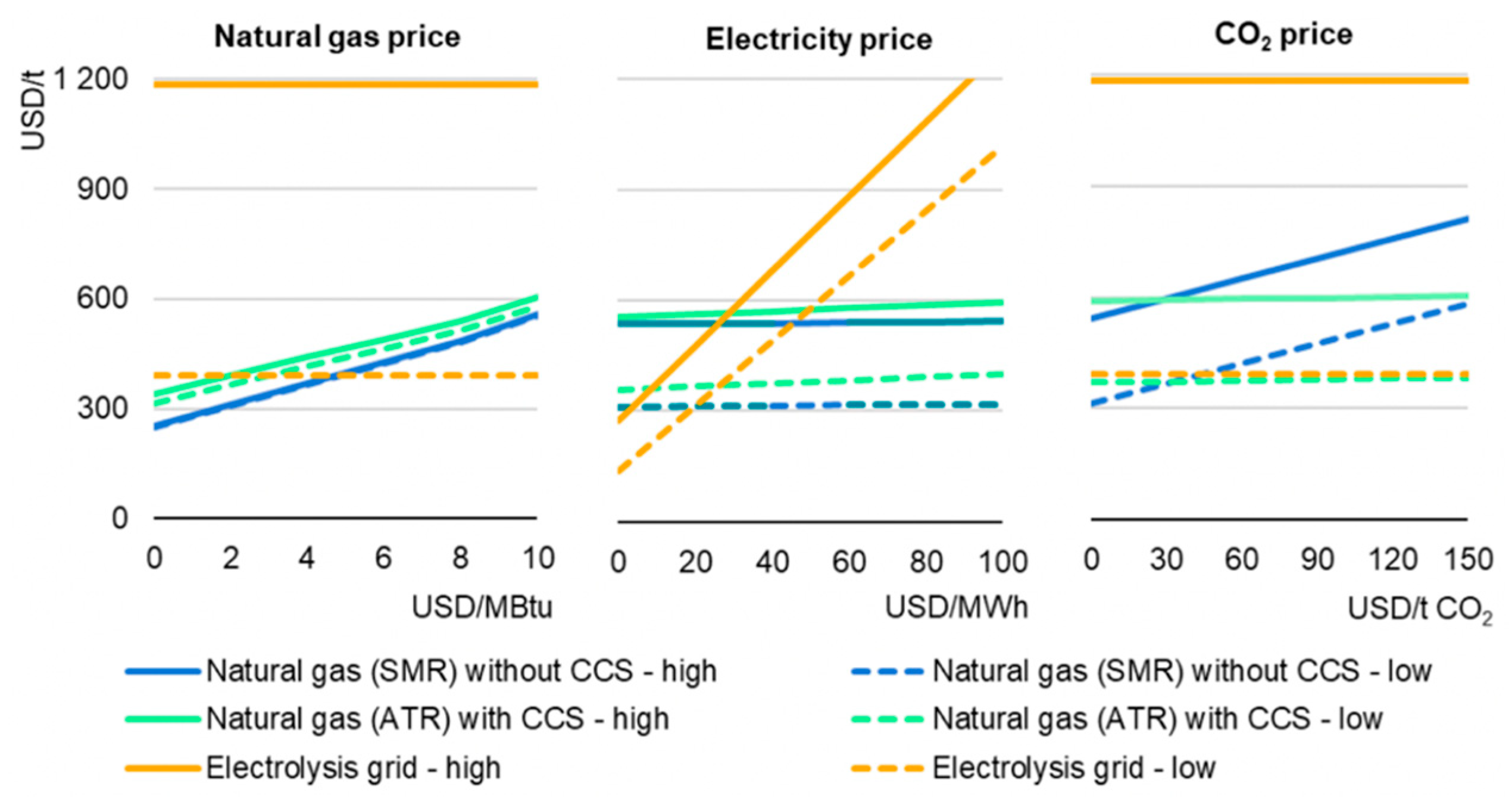
Figure 1 shows that ammonia produced using grey or blue hydrogen, thus via SMR with and without CCS, are both cheaper than ammonia derived from green hydrogen, even at low-to-moderate natural gas prices and low-carbon prices.
As shown above, IEA [26] observed that the US$600/tonne production of blue hydrogen-based ammonia breaks even with SMR hydrogen-based ammonia at a carbon price of about US$30/tonne. Electrolysis-based ammonia production costs range from US$120/tonne to US$1200/tonne, depending on electricity and electrolyser costs. Green hydrogen is more likely to be competitive with SMR with low electricity prices, high natural gas prices, high carbon prices, and low electrolyser costs. Nevertheless, even with low electrolyser costs, electricity costs less than US$0.04/kWh are required to render green hydrogen-based ammonia competitive. Electrolyser costs must decline by 60% to reach the US$400/kW electrolyser capacity to become comparable to the cost to produce grey hydrogen. In contrast, according to [26,27,28], electrolyser CAPEX estimates today range from US$1000/kW to US$1750/kW. Only in 2030 will the CAPEX fall to US$230–US$380/kW. Uncertainties in technological innovation affect the feasibility and timing of the necessary cost reductions [25].
It can thus be concluded that low electrolyser prices are the key to reaching price-competitive green hydrogen-based ammonia when three conditions are met: (i) the carbon price is higher than US$60/tCO2, (ii) electricity price is lower than US$20/MWh, and (iii) natural gas price is higher than US$4/million British thermal units (MMBtu). By contrast, high electrolyser prices can only make green hydrogen-based ammonia competitive when the electricity price is negligibly low (e.g., US$0/kWh).

2.5.2. Cost Estimates for Methanol Production

IRENA & Methanol Institute [29] estimated the current production costs of green hydrogen-based methanol to be US$800–US$1600/tonne. The upper boundary is the case for bioenergy with CCS. For CO2 from direct air capture, the range is US$1200–US$2400/tonne. IEA [30] estimated that methanol production cost to be US$300–US$1300. These studies estimated electricity grid-based methanol production costs to be US$365–US$826/tonne, while the corresponding production costs for green methanol was estimated to be US$645–US$1190/tonne. Only the largest 1.8 million-tonne green methanol plant production cost was estimated to come close to electricity grid-based costs.
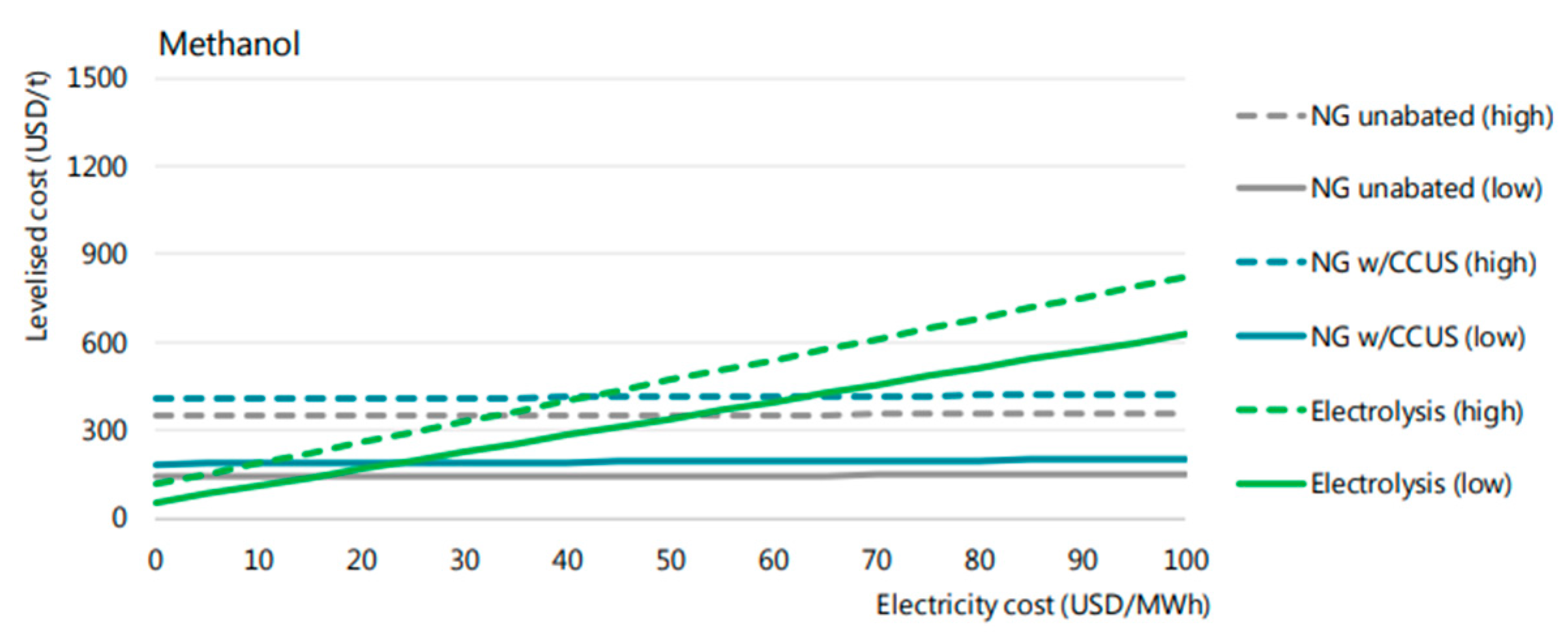
IEA [30] also compared different fuel types towards methanol production costs. Producing methanol with electrolysis proved to be more cost-effective when the electricity price is low. As shown in Figure 2, when the electricity price reaches US$25/MWh or more, producing methanol using natural gas with CCS is more competitive.
Del Pozo et al. [31] found that, under European gas prices of €6.50/gigajoule (GJ), state-of-the-art methanol production from natural gas can reach levelised costs as low as €268.50/tonne, while more advanced plants using gas-switching reforming can achieve €252.20/tonne with 60% CO2 reduction. For green methanol to break even, the required carbon price is €121.50–€146.70/tonne for direct air capture and €300.00/tonne for pipeline.
The current observation is that the main barrier to green methanol is its higher cost compared to SMR. However, IRENA & Methanol Institute [29] cited anticipated decreasing renewable power prices, with green methanol production costs reaching US$250–US$630/tonne by 2050.

2.5.3. Cost Estimates of Steel Production

Similar to ammonia and methanol, IRENA [32] estimated that investment and operating costs for direct reduced iron (DRI) steelmaking would be 30–50% higher compared to traditional SMR. IEA [33] estimated that implementing CCS in natural gas-based DRI-electric arc furnace (EAF) would increase the cost by 8% while switching completely to biomass hydrogen-based DRI-EAF would need 60% more capital costs than the SMR-based DRI-EAF. This is in line with IEA [30], in which steel production costs for 50–100% DRI-EAF reached almost double those SMR-based, even including CCS.
The cost of electricity is the key factor that determines the future competitiveness of green hydrogen-based DRI-EAF plants. IEA [33], for instance, estimated that the electricity consumed in hydrogen-based DRI-EAFs need around 14.7 GJ of electricity to produce 1 tonne of crude steel today, which is almost six times the electricity—2.5 GJ/tonne—needed to produce 1 tonne of crude steel in natural gas-based DRI-EAFs. In the long term, this amount of electricity needed in hydrogen-based DRI-EAFs will decrease to 13.2 GJ/tonne of crude steel. Thus, from this pricing calculation, hydrogen-based DRI-EAFs—even in the long-term—are the most expensive alternative.
Devlin et al. [34] studied the economics of steel production with hydrogen in Europe from an islanded renewable energy supply. By comparing the production costs of a blast furnace/basic oxygen furnace and green hydrogen-based steel production, the study found that the average cost of steel production dropped in line with the reduction of renewable energy infrastructure costs.

2.6. Research Gap

While numerous studies have examined hydrogen production costs and specific use-cases globally, there is a notable gap in the literature when it comes to integrated, comparative assessments for Southeast Asia’s industrial hydrogen pathways. Existing research tends to either focus on broad global scenarios [1,4] or on individual national contexts and niche applications, such as export potential of hydrogen from a single ASEAN country [5] or the use of hydrogen for power storage and transport [23]. These studies provide valuable pieces of the puzzle but do not offer a side-by-side evaluation of different hydrogen supply routes under consistent assumptions tailored to the ASEAN industrial sector.
In particular, there is a lack of comparative analysis that looks at multiple production pathways (e.g., blue vs. various green hydrogen options) and delivery methods (on-site generation vs. importing hydrogen or electricity) for large-scale industrial consumers in Southeast Asia. No prior work was found that comprehensively computes the delivered LCOH for a range of hydrogen supply configurations and then relates those costs to key industrial uses like ammonia production, methanol synthesis, and steelmaking in the ASEAN context. This absence of an integrated regional perspective represents a critical research gap. The present study addresses this gap by modelling and compares four representative low-carbon hydrogen supply pathways for a hypothetical large industrial facility in Southeast Asia, evaluating their economics (LCOH delivered), emissions, and practical considerations side by side. By doing so, it aims to provide insights into which hydrogen supply strategies could be most viable for ASEAN’s heavy industries and under what conditions, thereby informing both industrial stakeholders and policymakers in the region.

3. Methodology

3.1. Production and Transport Pathways

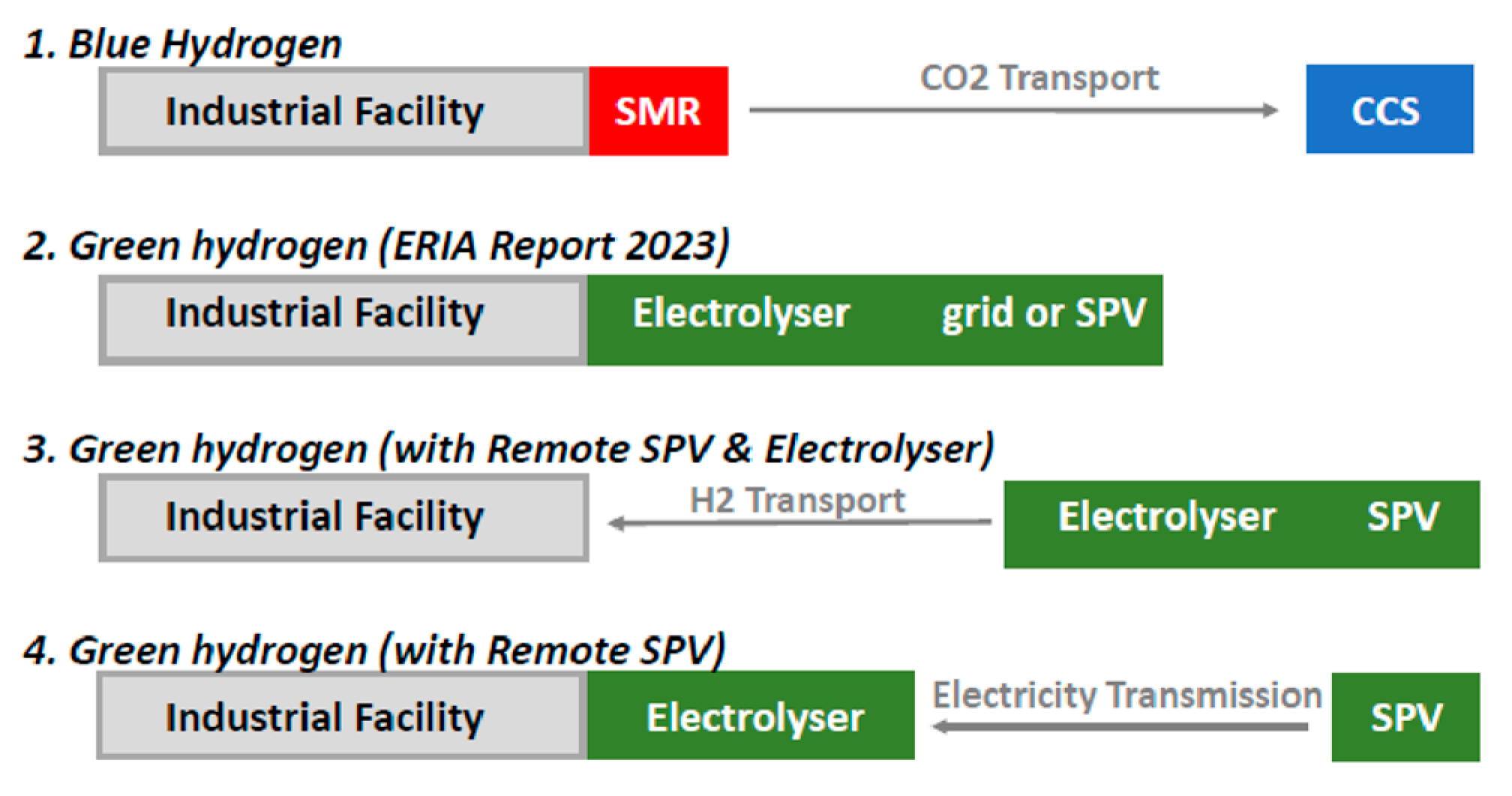
This study models and compares the costs of four pathways to producing low-carbon hydrogen for a large-scale industrial facility in Southeast Asia, as depicted in Figure 3. In the first pathway, blue hydrogen is produced by locating a large-scale CCS facility several hundred kilometres away from an existing conventional steam methane reforming (SMR) hydrogen plant. Captive SMR hydrogen is located on-site, i.e., inside or directly adjacent to a refinery or ammonia, methanol, or steel facility. CO2 emitted from the SMR is transported through a pipeline to the CCS.
In the second pathway, green hydrogen is produced via an on-site electrolysis powered by solar photovoltaic (PV) electricity. The examined solar photovoltaic (solar PV) electricity is either independently sourced from the grid or produced in an adjacent, gigawatt-scale solar PV farm. Given that 1–2 gigawatts single-site solar PV facilities may require up to 10–20 km2 of land area, the solar PV farm may need to be located remotely. Therefore, the third pathway assumes that both solar PV electricity generation and hydrogen electrolysis take place 200–400 km away from the industrial facility, necessitating the transport of the hydrogen via pipelines or trucking. Lastly, the fourth pathway locates the solar PV electricity generation remotely, i.e., 200–400 km away, while the electrolyser is built and operated on-site. By contrast to the third pathway, the low-carbon electricity must then be transmitted through the grid to the electrolyser.
The four pathways were qualitatively selected as they are considered to be the most economical pathways to deliver low-carbon hydrogen for large-scale industry plants in the region using resources in the short-distance range. For example, hydrogen transported as ammonia or liquid hydrogen would be advantageous in terms of volumetric energy density, but this pathway is only economical for long-distance hydrogen shipping. Furthermore, for liquid hydrogen, liquefaction and regasification costs are not negligible. Blending hydrogen with natural gas in existing gas pipelines may also offer some economic advantages, as it uses existing pipelines. However, decreasing efficiency following the increasing blending ratio will lead to higher power requirements for compressors and pressure drops. Finally, the use of autothermal reforming (ATR) would provide a superior performance in carbon capturing and thermal efficiency compared to steam methane reforming (SMR), but ATR capital cost is currently higher than SMR.
It should be noted that in pathways involving grid-supplied electricity (particularly fourth pathway), the model assumes that renewable electricity is sourced through dedicated supply arrangements, such as direct power purchase agreements and dedicated transmission from solar PV facilities. Therefore, the electricity used for electrolysis is treated as fully renewable for the purpose of estimating green hydrogen production costs. This assumption avoids including grid-average electricity mixes, which in most ASEAN countries still include a significant share of fossil-based generation. As such, the results represent a best-case scenario for green hydrogen production based on access to dedicated renewable energy sources rather than the current grid mix.

3.2. Production Cost

For each production pathway, the levelised cost of producing hydrogen (LCOH) and the levelised cost of transporting hydrogen or the cost of transmitting electricity are calculated. Throughout the text, “today” and “current” are used to reflect 2019–2022 state of technology advancement. All cost assumptions and levelised cost calculations are defined in real 2019 US$ terms. In the first pathway to blue hydrogen, this study takes advantage of the ubiquitous grey hydrogen capacity in place worldwide and the numerous cost estimations of grey and blue hydrogen in the literature. In particular, IEA [35] and Katebah et al. [36] estimate the capital expenditures (CAPEX) and operating expenditures (OPEX) of several SMR and CCS capacity scenarios Table 2. The detail of base case inputs of CAPEX and OPEX assumptions can be found in Supplementary Materials Table S8.
Between 35,000 and 80,000 tonnes/year—equivalent to about 100–220 tonnes/day—of hydrogen SMR capacity are required to serve a medium or large-scale ammonia, methanol, or refinery facility. While hydrogen production capacity of about 173 tonnes/day for a relatively short system lifetime of 16 years is used as the base case in the hydrogen pathways studied here, IEA [35] assume a larger 500-tonne/day SMR and CCS capacity and estimate CAPEX investments of about US$0.15/kg for grey and US$0.28/kg for blue hydrogen. These volumes are much larger than the capacities of green hydrogen volumes required for the industrial feedstocks studied below, which require GW-scale renewable electricity capacities. Additionally, for OPEX, IEA [35] assumes natural gas prices of US$3.70/GJ plus an efficiency factor of 90%. Given this model’s smaller production volume, an additional efficiency factor of 80% is applied to Katebah et al.’s [36] 90%, which is in line with IEA’s SMR and CCS efficiency factors depicted in Table 2 [35].
CAPEX estimated by IEA [35] for 2019 and 2050 can be reconciled with those of Katebah et al. [36] by using a hydrogen energy content of 33.33 kWh/kg, a 16-year system lifetime and full load of 8322 h/year, and applying these to this study’s base case of 173 tonne/day production capacity at a cost of capital of 8%/year. This results in CAPEX of US$0.23/kg for grey hydrogen and US$0.40/kg for blue hydrogen produced. While these are higher than the respective [36] estimates, they could be attributed to the much higher scale economies studied by Katebah et al. [36].
The LCOH of grey and blue hydrogen are dependent on the assumed natural gas input prices. Katebah et al. [36] assume natural gas prices of US$3.70/GJ, equivalent to US$3.90/MMBtu. Since the European energy crisis of 2022, Southeast Asian, e.g., Indonesian liquefied natural gas prices have tripled from 2021 levels and effectively doubled from the average price level over the last decade between 2012 and 2022 [37]. Since natural gas prices make up more than 70% of total OPEX of SMR, the LCOH are also recalculated using higher natural gas prices.
For the remaining three green hydrogen pathways described in Section 3.1, the LCOH in US$/kg of producing green hydrogen is calculated using the standard formula:
L C O H = A n n u a l   C A P E X e l e c t r o l y s e r +   A n n u a l   O P E X e l e c t r i c i t y + A n n u a l   O P E X o t h e r v o l u m e   i n   k g   o f   a n n u a l   h y d r o g e n   p r o d u c e d
The green hydrogen production infrastructure for industry requires huge electrolysers and significant amounts of renewable electricity to feed them. To feed a mid-size 400 kilotonne/year ammonia or 600 kilotonne/year methanol plant, the hydrogen supply required ranges from 75 to 85 kilotonnes/year. ASEAN’s largest refineries—in Indonesia, Singapore, and Thailand—produce only 30–70 kilotonnes/year of hydrogen. To supply these industrial facilities with low carbon or green hydrogen, IEA [26] suggests a requirement of 1–2 GW single site or aggregate solar PV generation capacity and corresponding 0.7–1.5 GW of electrolyser capacity [26].
This model assumes a large 2 GW solar PV capacity supply. As discussed in ERIA [17], selected assumptions on solar PV, electricity, and electrolyser costs from [7,21,22,23] are combined. Using an electrolyser capacity of 0.67 of the solar PV capacity following Yates et al. [9] results in a 1.33 GW electrolyser capacity. This electrolyser capacity compares well with DNV’s estimated 0.70 of solar PV capacity [19]. Following Li & Taghizadeh-Hesary [23] a multiple stack electrolyser is assumed, with alkaline versus PEM electrolyser CAPEX estimated at US$1102/kW and US$1808/kW, respectively, and an annual OPEX of about 4.7% of the corresponding CAPEX.
The corresponding electrolyser CAPEX and OPEX for 2030 and 2050 are estimated [7,30,38]. To be conservative, following ERIA [17], 20–30% regional cost buffers are added to the 2030 and 2050 CAPEX estimates. While similar problems are observed in industrialized countries, project planning, approvals and implementation in developing countries including Southeast Asia (excl. Singapore) often result in more than 20% cost overruns due to weak governance, inefficient procurement and corruption [39,40,41]. Thus, CAPEX declines to US$500/kW for alkaline and US$800/kW for PEM electrolysers by 2030, and US$300/kW for alkaline and US$400/kW for PEM electrolysers by 2050 are assumed. The modelled electrolyser parameters used are summarised in Table 3 below.
The electrolyser CAPEX and its 16-year lifetime form the basis of the Annual CAPEXelectrolyser calculation. The base model assumes a system utilisation rate of 80% [23]. Thus, an average 80% of the 3504 GWh p.a. curtailed electricity generated is effectively used to produce hydrogen. The base case 1.33 GW maximum electrolyser capacity thus implies an average capacity factor of 24% for the chosen 1.33 GW electrolyser capacity. By comparison, Roeder et al. estimate that alkaline and PEM electrolysers running at capacity factors below 30% for 25 years straight, much longer than 16 years, do not require stack replacement [16].
The estimated electrolyser energy consumption efficiencies of rates of 3.98 kWh/normal cubic metre of hydrogen for alkaline and 3.48 kWh/normal cubic metre for PEM electrolysers in Table 3 above are consistent with other studies, for example that of [21]; this base model results in hydrogen production of about 173 tonnes/day and 63,304 tonnes/year, respectively.
The 8% p.a. cost of capital used in the base model is in line with other studies [42,43,44,45,46]. IEA (2023) [46] suggests 6–8% p.a. for advanced economies and 8–12% p.a. for higher risk regions, implying a global average of 8–9% p.a. IRENA (2022) [45], for example, assumes 8–12% p.a. for projects in emerging markets, with a global average of 7–9%.
It should be noted that in all green hydrogen pathways, the study considers the cost of purchasing solar PV electricity from a third-party generation company at input prices following [22], as summarised in Table 4 below. Therefore, neither separate CAPEX and OPEX estimates for the solar PV generation nor electricity storage facilities are explicitly considered.
Annual electricity expenditures (Annual OPEXelectricity) are calculated using each country’s solar PV electricity prices estimated by Li et al. [22], multiplied by the 3.5 TWh of electricity consumed to produce the target annual hydrogen volumes. For future year 2030 and 2050 electricity price estimates, estimates of IESR [7] and IEA [38] for Indonesia are utilized. For 2030, the mid-point of IESR’s [7] estimated prices in Indonesia of US$0.06–US$0.10/kWh are used, combined with proportional reductions for other ASEAN Member States in line with Li et al. [22] estimates. Finally, following ERIA [17], this study estimates price reductions towards the mid-point between US$0.04–US$0.08/kWh of electricity by 2050 in Indonesia, while assuming region-wide price reductions proportional to Li et al. [22] with country variations.
For blue hydrogen LCOH the contrasting effects of diverging natural gas price levels between Indonesian (exporters) and Thai (importer) are discussed in Section 4.1 below. For green hydrogen production LCOH, solar PV electricity prices are already varied across countries and future cost curves, i.e., using today’s costs versus forecast 2030E and 2050E forecasts. Beyond electricity prices, the 8% cost capital, which was adopted from Li and Taghizadeh-Hesary [23] and ERIA [17], was varied between 6% and 10% p.a. (see Suplementary Materials Table S1). Additional sensitivities studied include changing electrolyser CAPEX and maximum lifetime of operations by plus or minus 20% (see Suplementary Materials Table S2), changing electrolyser load factors to 70% and 90% (see Suplementary Materials Table S3), and solar PV curtailment resulting in average electricity production of 16% and 24% of total generation capacity (see Suplementary Materials Table S4). Moreover, to better understand the impact of electrolyser capacity factors (see Suplementary Materials Table S6), the electrolyser capacity is varied between 1.06 GW and 1.60 GW. These imply capacity factors of 30% and 20%, staying well within the limit of one-time stack installation, i.e., not requiring stack replacement.

3.3. Transport Cost

A 2 GW single-site solar PV facility in the ASEAN region requires approximately 20 km2 of land, which may not be available in the vicinity of typical refinery, ammonia, methanol, and steel facilities. Therefore, an analysis of remote solar PV, or solar-electricity connection and electrolyser facilities located 100–400 km away from the industrial facility, is necessary. In this pathway, the produced hydrogen must be transported to the industrial facility over a distance of 100–400 km.
Two distinct hydrogen transport and storage scenarios are examined, namely pipeline transport of gaseous hydrogen and trucking of compressed hydrogen. Liquid hydrogen is not considered, as it is generally costlier due to the liquefaction, cryogenic transport and regasification costs [47,48]. The key technical and cost parameters are adopted from Li and Taghizadeh-Hesary [23]. First, a hydrogen gas pipeline is assumed to require CAPEX of US$400,000/km and incur OPEX of 8% of total CAPEX. Given the study’s base model of 173 tonnes/day of hydrogen produced, the pipeline is sized for flow rates of 100–200 tonnes/day and should be operational for 50 years. Next, hydrogen gas storage capacity of 7 days is assumed to cost US$226/kg of hydrogen in terms of CAPEX, OPEX of 1.50% of total CAPEX, and a lifetime of 40 years. Additionally, for flow rates of 100–200 tonnes/day following Khan et al. [49], one compressor is assumed for each 100 km pipeline distance. Each compressor incurs CAPEX of US$260/kg of hydrogen and a 10% OPEX ratio, consumes energy at a rate of 1.1 kWh/kg of hydrogen, and operates for 15 years.
Second, the cost of transporting compressed hydrogen via trucking is calculated. Modern gaseous tube trailer trucks are supposed to cost US$1015/kg of hydrogen, which can transport up to 1 tonne of hydrogen daily and operate for 15 years [20,23]. However, compressed hydrogen storage is more expensive than gaseous storage at US$1100/kg CAPEX and 1.50% OPEX. One to three days of contingency storage capacity and a 30-year lifetime are assumed. One terminal compressor is assumed, with the same parameters as in the pipeline scenario above.
An OPEX ratio of 11%/year is assumed for the compressed hydrogen trucks, plus diesel consumption of 0.0004 L/km-kg of hydrogen at an average fuel cost of US$1.00/L. The base case diesel consumption of 0.0004 L/(km·kg H2) corresponds to a truck fuel use of approximately 0.40 L/km combined with a hydrogen payload of about 1000 kg per trailer. This assumption is consistent with the recent hydrogen logistics literature, where heavy-duty trucks typically exhibit fuel consumption in the range of 0.35–0.45 L/km [50,51,52]. The implied compressed hydrogen payload is consistent with advanced 500 bar composite-cylinder trailers which can reach approximately 900–1100 kg hydrogen [51,53].
Both hydrogen transport scenarios are applied to the base case alkaline and PEM electrolyser production rates of 63,304 tonnes/year and 72,400 tonnes/year of green hydrogen, respectively. Energy costs to drive the compressors are assumed identical to the solar PV electricity costs in Table 4 above. Thus, the total incremental CAPEX and levelised costs of transport facilities depend on the type of electrolysers and the country in which the industrial, electrolyser and transport facilities are located.
When only the solar PV or other renewable electricity source is located remotely, any distance between the solar farm and electrolyser sites requires additional power transmission lines and contracting with the responsible power transmission and grid operators. Several studies helped estimate the additional costs associated with such transmission lines. Li & Chang [21] summarises the estimated investment and levelised costs of electricity transmission lines in the ASEAN region from Hedgehock & Gallet [54]. Assuming 500-kilovolt transmission voltages and 200–400-km distances, the average CAPEX decreases from US$1500–US$1700/megawatt (MW)-km for 500 MW capacity to US$730–US$920/MW-km for 2000 MW capacity [54]. These CAPEX levels per MW-km are comparable to Mlilo et al. [55] for high-voltage direct current systems.
The technical and cost parameters for hydrogen transport adopted from Li and Taghizadeh-Hesar [23] are broadly in line with other studies [48,56]. Thus the impact of CAPEX variations of up to plus and minus 20% for both pipeline and compressed hydrogen trucking are examined. For pipeline and compressed hydrogen trucking transport calculations, the effects of system losses and leakages of 5–10% are estimated in line with Restrepo and Fulton [57]. Furthermore, the effects of increased diesel consumption to 0.0005 L/km-kg and fuel costs to US$2.00/L are calculated.
Dedicated hydrogen pipeline networks already operate over hundreds to thousands of kilometres, particularly in industrial regions such as the U.S. Gulf Coast (about 2500 km) and parts of Europe (>1500 km of Air Liquide, Air Products, etc.). These systems demonstrate that long-distance hydrogen transport via pipelines is technically feasible and industrially mature. In the literature, Reuß et al. (2019) [58] model national-scale hydrogen pipeline networks and explicitly treat pipelines as the default option for bulk transport over regional distances.
Safety concerns, while important, are engineering challenges rather than feasibility barriers. Hydrogen embrittlement, leakage, and fatigue are well-understood phenomena addressed through material selection, pipeline design standards, and operational controls. Modern standards (e.g., ASME B31.12) specifically address hydrogen service pipelines. We agree that pipeline safety hinges on material selection, pressure and fracture control, and design limits include hydrogen embrittlement, fatigue growth and permeation. While we have included provisions for leakages in our sensitivity analysis, the literature supports the feasibility of tackling these engineering problems. For example, Fan & Cheng (2025) [59] argue that hydrogen pipelines are viable but require material-aware design to control embrittlement and fatigue. Witkowski et al. (2017) [60] assert that safety is explicitly incorporated into pressure/compression optimization, while not treated as prohibitive. Hydrogen’s physical properties (high diffusivity and low density) can actually reduce explosion risk in open environments because leaked gas disperses rapidly. The literature consistently treats safety as a design constraint rather than a prohibitive factor.
Typical modelled pipeline pressures range from 4 to 10 MPa (40–100 bar) and thus require appropriate optimized compressor design and configuration. Witkowski et al. (2017) [60] analyses pipelines of up to 10 MPa, while Yu et al. (2024) [61] estimate that techno-economic design optima depend on pressure, compressor spacing and flow rates. From an economic perspective, pipelines are the preferred transport mode for large, continuous hydrogen flows over medium to long distances. Truck, rail, and ship transport are more suitable for small-scale or early-stage markets, but become cost-inefficient at scale. Peer-reviewed studies show that hydrogen pipelines are viable over distances of several hundred to more than 1000 km. Typical operating pressures range from 4 to 10 MPa, with compressor stations deployed along the route. System optimization balances pressure, diameter, and compression energy. For example, Yang & Ogden (2007) [62] estimate that pipelines become lowest-cost option beyond ~100–300 km at scale. Yu et al. (2024) [61] calculate that pipelines operating at 4–10 MPa are economically viable over 200–1800 km. Their levelised cost of transportation range from US$0.13 to US$1.81/kg. Moreover, trucks are a transitional/logistics solution, not the end-state for bulk hydrogen.
Ammonia can be more easily shipped over very long distances, but it is not required for feasible hydrogen transport. Ammonia transport trades off conversion losses and reconversion costs against higher material specifications and pipeline costs. Direct hydrogen pipeline transport remains a benchmark solution for regional hydrogen networks up to medium distances, except that ammonia and liquid routes compete at long overseas distances [63].

4. Results

4.1. LCOH of Pathway 1: On-Site Blue Hydrogen

For the first blue hydrogen pathway, combining the assumptions described in Section 3.2 with various natural gas price scenarios, the LCOH are modelled following the estimates of IEA (2020), Katebah et al. (2022) [35,36]. The results are summarised in Table 5.
First, we assume a hydrogen production rate of 173 tonnes/day totalling 63,304 tonnes/year over a lifetime of 16 years. which corresponds to the volumes to be produced by the alkaline electrolyser base model. Using IEA’s [35] CAPEX estimates of 910 US$/kWh for the mature SMR technology and energy content of 33.33 kWh/kg hydrogen results in CAPEX of US$231 million for the SMR facility with the same production capacity. Using IEA’s [35] 2020 estimate of US$1580/kWh for SMR plus CCS, which is anticipated to decrease to US$1280/kWh by 2050, results in CAPEX estimates of US$401 million for blue hydrogen using 2019 estimates of IEA [35], which may decrease to US$325 million by 2050.
By contrast, Katebah et al. [36] 2022 estimates US$/kg hydrogen CAPEX for a much larger value, i.e., 500 tonnes/day hydrogen SMR at 0.15 US$/kg grey hydrogen produced and 0.28 US$/kg blue hydrogen produced. For the base model’s production rates of 63,304 tonnes/year over 16 years, the resulting CAPEX totals US$152 million for the SMR facility and US$283 million for SMR plus CCS. Furthermore, if the cost decline curve projected by IEA [35] was applied to Katebah et al. [36], the latter would lead to an estimated SMR plus CCS CAPEX of 0.23 US$/kg blue hydrogen, which for the same production volume would require a CAPEX of US$230 million. However, given the much smaller capacity than that of Katebah et al. [36], this model assumes lower efficiency, multiplying their 90% efficiency factor by another 80% factor.
As a result, assuming Katebah et al.’s [36] 2022 CAPEX, OPEX and efficiency factor estimates, a production rate of 173 tonnes/day of hydrogen over 16 years results in a higher LCOH of US$1.10/kg for grey SMR and US$1.58/kg for blue SMR plus CCS. When unit CAPEX declines similar to IEA [35] are introduced, the cost of blue hydrogen decreases to US$1.47/kg. The incremental LCOH of CCS using Katebah et al. [36] parameters decline from US$0.48/kg using 2022 CAPEX estimates to US$0.37/kg by 2050.
By comparison, using IEA [35] CAPEX assumptions for 2019 yields LCOH of US$1.26/kg for SMR and US$1.84/kg for SMR plus CCS. Introducing future cost reduction assumptions and thus even lower unit CAPEX further reduces the LCOH to US$1.63/kg for SMR plus CCS by 2050. In other words, the incremental LCOH impact of CCS is expected to decrease from US$0.58/kg using 2019 costs to US$0.37/kg by 2050. Note that SMR technology is considered mature, and its cost structure is thus assumed to remain unchanged in the future. These results are broadly in line with [64] estimates discussed previously, where CCS adds US$0.60–US$0.80/kg of hydrogen today and US$0.10–US$0.30/kg by 2050.
Varying the SMR and CCS efficiency factors naturally affect the above LCOH for grey and blue hydrogen. On the one hand, using Katebah et al.’s efficiency factor, without the 80% base case adjustment, decreases the 2022 grey and blue LCOH to US$1.05/kg and US$1.47/kg. On the other hand, reducing the adjustment down to 60% increases 2022 grey LCOH to US$1.2/kg and 2022 blue LCOH to US$1.76/kg.
With regard to feedstock prices, average Indonesian natural gas prices ranged around US$7.00/MMBtu between 2012 and 2022. More recent 2019–2025 Indonesian LNG fob prices ranged from about US$7.50/MMBtu to the temporary highs of US$14.00–18.00/MMBtu during the 2022 energy crisis, down again to US$9.00–11.00/MMBtu in 2025 (See Tables S7 and S9 in Supplementary Materials). Thai LNG cif prices were slightly higher over the same 2019–2025 period. Considering partially regulated domestic natural gas prices, without liquefaction costs, the base case model assumes a natural gas price range between US$7.00/MMBtu and US$11.00/MMBtu. At the low end, the estimated blue LCOH of production including CCS reaches about US$2.36/kg using current cost assumptions and US$2.15/kg in 2050. At the high end, the blue LCOH increases to US$3.01/kg in 2019 and US$2.80/kg in 2050. These blue hydrogen cost levels can be anticipated for SMR and CCS facilities located in either country, with Thai projects generally experiencing slightly higher natural gas prices than in Indonesia.

4.2. LCOH of Pathway 2: On-Site Electrolyser and Solar PV

In this model, the 2 GW solar PV capacity is assumed to produce 3.5 TWh of electricity annually at a capacity factor of 20%. The corresponding 1.33 GW alkaline and PEM electrolysers are sized to produce roughly 63,300 tonnes/year, or 72,400 tonnes/year of green hydrogen, implying electrolyser efficiencies of 55.35 kWh/kg and 48.4 kWh/kg, respectively, showing the PEM being more efficient.
Making use of current cost assumptions laid out in Section 3.2, the model calculates a total CAPEX of US$1.47 billion for the alkaline and US$2.41 billion for the PEM electrolyser; considering potential future cost reductions, these CAPEX estimates decline to US$667 million and US$1.07 billion in 2030, declining further to US$400 million and US$533 million by 2050, respectively. The calculated Levelised CAPEXelectrolyser are estimated to amount to US$166 million and US$272 million for the alkaline and PEM electrolysers, respectively, with the Annual OPEXother estimating a cost of US$69 million and US$111 million, respectively, while the Annual OPEXelectricity depend on the solar PV electricity price multiplied by the annual electricity consumption.
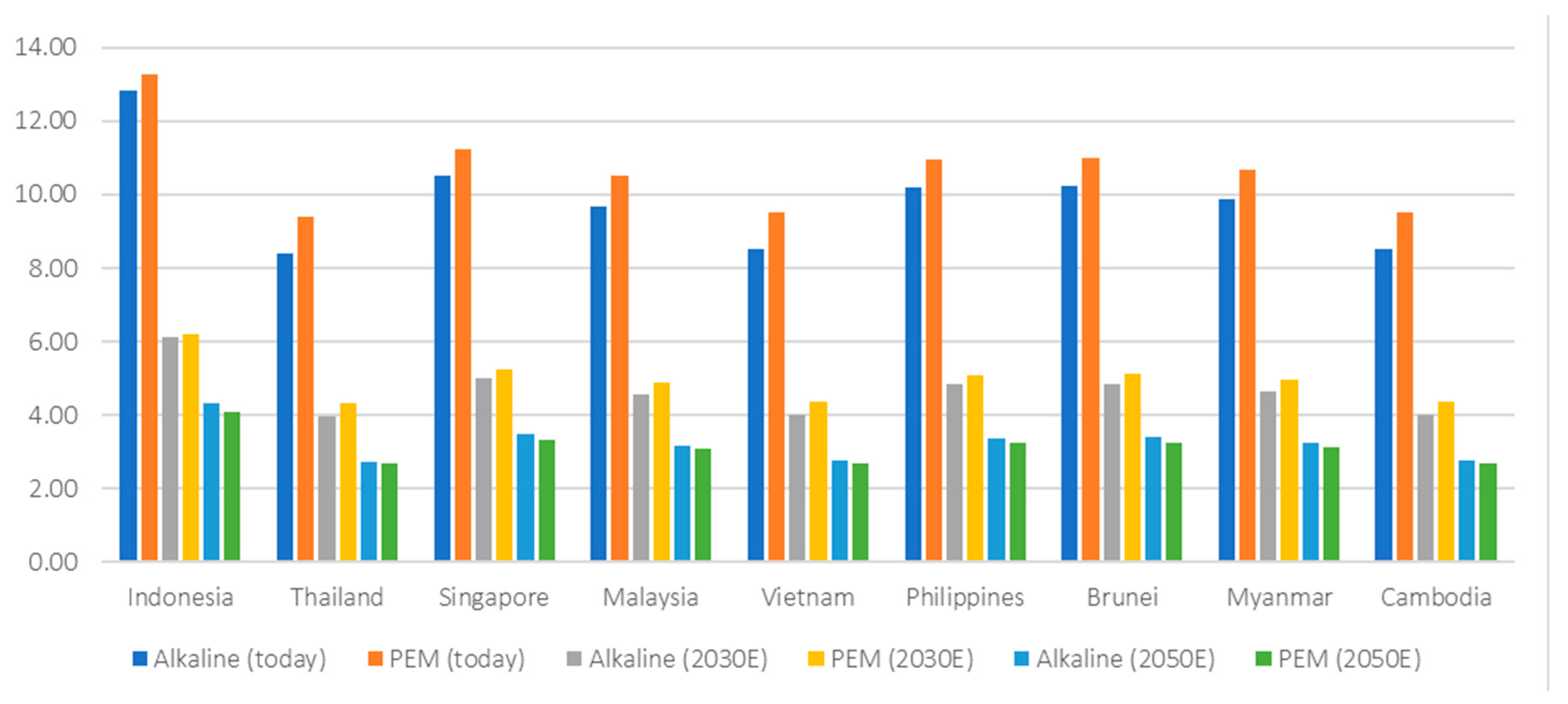
For an on-site 1.33 GW alkaline electrolyser located in Indonesia, for example, this results in an LCOH of 12.85 US$/kg for alkaline and 13.28 US$/kg for PEM; these estimates are anticipated to decline to 6.11 US$/kg and 6.21 US$/kg in 2030, respectively, and 4.33 US$/kg and 4.07 US$/kg by 2050, respectively. By contrast, with its lower solar PV electricity cost forecasts a similar on-site electrolyser in Thailand is estimated to cost 8.42 US$/kg and 9.41 US$/kg today, 3.97 US$/kg and 4.34 US$/kg in 2030, and 2.72 US$/kg and 2.67 US$/kg by 2050. As per [21], running an electrolyser at high-load factors and full-load hours decreases the annualised cost of the CAPEX, thus lowering the unit production cost of hydrogen. It can be seen that due to its higher efficiency and faster cost decline, PEM electrolysers will result in lower LCOH than alkaline ones by 2050. These results are depicted in Figure 4.
While the current costs of producing green hydrogen in the ASEAN region reach as high as US$8.00–US$13.00/kg, a lower LCOH of US$4.00–US$6.20/kg in 2030 and US$2.70–US$4.30/kg in 2050 are anticipated. As electrolyser and renewable energy CAPEX and OPEX decrease due to technological improvements, economies of scales and learning, green hydrogen will become more competitive towards 2030 and especially towards 2050.
Given their importance, the used solar PV electricity prices must be put in context. Each country produces different levels of electricity, different types of electricity, and at different prices. This study’s base model follows [21] and conservatively uses higher estimated solar PV electricity prices across the region. By contrast, the solar PV electricity prices that [23] assumes is a range from US$0.040/kWh in Indonesia and Malaysia to US$0.038/kWh in Thailand and US$0.041/kWh in Viet Nam. Additionally, ref. [64] used Indonesian Ministry of Energy and Mineral Resources data to estimate the cost of US$0.06–US$0.10/kWh for large-scale solar PV generation. As can be seen in Figure 4 above, the solar PV electricity cost estimates of [23] result in LCOH levels similar to this model’s 2050 LCOH in Malaysia and the Philippines, while [64] LCOH estimates straddle a similar LCOH range implied by this model’s current and 2030 LCOH in these two countries.
Several sensitivity calculations were conducted and compared with the base case results in Figure 4. Given the widest gap in electricity prices and base case LCOH between Indonesia and Thailand, we calculate the % and value sensitivities of LCOH for these two countries. Specifically, the cost of capital electrolyser CAPEX, load factors, lifetime, and solar PV efficiency. The results are depicted in the Supplementary Material (Table S5). First, increasing the capital cost by 10% or 6% decreases the LCOH by (+)2.2–5.3% or (−)2.0–5.0%, respectively. Thus, the LCOH increases to US$13. Second, increasing or decreasing the electrolyser CAPEX by 20% decreases LCOH of production by 4.7–11.3%. Third, decreasing or increasing the system utilization rate to 70% or 90% increases LCOH by (+)14.3% or decreases it by (−)11.1%, respectively. Fourth, decreasing or increasing intermittent solar PV supply, i.e., the solar PV capacity factor, to 16% or 24% increases LCOH by approximately (+)5.8–14.1% or decreases it by (−)3.9–9.4%, respectively. Additionally, electrolyser lifetime is varied to shorter 12 years and longer 20 years, resulting in estimated changes in LCOH up by (+)2.9–7.0% and down by (−)1.9–3.9%, respectively, compared to the base case in Figure 4. Lastly, varying the maximum design capacity of the electrolyser and consequentially the electrolyser capacity factor down to 20% or up to 30% changes the LCOH from (+)4.7–11.3 to (−)4.7–11.4% for the higher electrolyser capacity (80% of solar PV capacity) and lower capacity (50.3% of solar PV) scenarios, respectively.

4.3. LCOH of Pathway 3: Remote Electrolyser and Solar PV

The LCOH of producing green hydrogen remotely is assumed similar to those of pathway 2, with the same variations across countries and cost reduction potential towards 2030 and 2050. It should be noted, however, that large, remotely located solar PV and electrolyser sites may pose additional logistical and other region-specific challenges. Thus, the model implicitly assumes the same solar PV electricity input prices as an on-site solar PV generation and electrolyser.
In this pathway, hydrogen is to be transported across distances of 100–400 km from the remote solar PV and electrolyser location to the industrial site. The 200–400 km pipeline facilities, including compressor and gaseous storage, require CAPEX totalling US$360–480 million. While the largest portion of these CAPEX comprise the gaseous storage facility, the increase over longer distances is driven by the number of compressors required, which according to Khan et al. [49] require additional compressors every 100 km of distance. The Levelised CAPEX, Annual OPEX and Annual Energy Cost for hydrogen pipeline transport, including 7-day storage and compressors, are estimated to be the following.
Note that the above figures and LCOH calculations use the base case 1.33 GW alkaline electrolyser capacity producing 63,304 tonnes/year of hydrogen and assume compressor energy, i.e., electricity costs in Indonesia today. Transporting gaseous hydrogen via pipelines over distances of 100 and 200 to 400 km adds an additional 0.87, 1.30 and 2.18 US$/kg of hydrogen for a 1.33 GW alkaline electrolyser in Indonesia today. As can be seen, the largest cost component is the gaseous hydrogen storage tanks, followed by the compressors, primarily when more units are required to transport the hydrogen gas over longer distances. For example, reducing the storage capacity to 3-day volumes reduces these transport costs to 0.62, 1.06 and 1.94 US$/kg.
Increasing or decreasing pipeline, storage and compressor CAPEX and OPEX by plus or minus 20%, however, increases or decreases levelised pipeline transport cost for alkaline electrolysers in Indonesia to 1.00–2.47 US$/kg and 0.73–1.89 US$/kg, respectively, for the same distance range of 100 to 400 km. With regard to potential leakage through pipeline transport, compressors are the main sources of losses, since hydrogen transport requires higher volume throughput and compression energy, given hydrogen’s low energy density. Restrepo and Fulton [57] estimate whole-chain leakages of around 4.5%, lower than losses in mixed liquid–gaseous transport of roughly 6.8–9.4% and liquid transport losses of around 12%. Assuming total leakages of between 5 and 10%, the levelised pipeline transport cost for Indonesian alkaline electrolysers in Table 6 increases to 0.91–2.30 US$/kg and 0.96–2.42 US$/kg, respectively, for the same distance range of 100 to 400 km.
In addition, the cases of 1.33 GW PEM electrolysers and projected electricity costs for 2050 are examined. Furthermore, a comparative alkaline electrolyser for Thailand with today’s lowest electricity cost level is estimated as well (see Appendix D). The comparative results are depicted in Appendix A. Taking the mid-distance of 200 km case, these pipeline transport costs decrease from 1.30 US$/kg to 1.07 US$/kg when electricity costs in Indonesia decrease towards 2050. These compare 1.28 US$/kg and 1.05 US$/kg for a 1.33 GW PEM electrolyser in Indonesia today to 2050. The corresponding estimates at Thailand’s lower electricity costs for the alkaline electrolyser range from 1.13 US$/kg today to 1.01 US$/kg in 2050 and, for the PEM electrolyser, from 1.10 US$/kg today to 0.98 US$/kg by 2050.
By contrast the Levelised CAPEX, Annual OPEX and Annual Energy Cost for transporting compressed hydrogen over these distances amounts to the following.
Trucking compressed hydrogen necessitates transport costs of 1.95, 1.99 and 2.07 US$/kg of hydrogen over distances of 100, 200 and 400 km are estimated for an alkaline electrolyser in Indonesia, at today’s electricity cost levels. For the 200 km distance, levelised costs of trucking compressed hydrogen declines from 1.99 to 1.88 US$/kg as Indonesian electricity prices decline towards 2050, while in Thailand these costs decrease from 1.91 US$/kg to 1.85 US$/kg between today’s and 2050 electricity prices.
As per the sensitivity analysis for pipelines, assuming 5–10% total leakage the levelised hydrogen trucking cost for Indonesian alkaline electrolysers in Table 7 increase to about 2.06–2.18 US$/kg and 2.71–2.31 US$/kg, respectively, for the same distances between 100 and 400 km. Moreover, increasing or decreasing CAPEX by 20% shifts the levelised trucking cost to 2.27–2.39 US$/kg and 1.64–1.76 US$/kg, respectively, for the same compressed hydrogen trucking project over the same distance.
It is observed that trucking compressed hydrogen is more expensive than piping hydrogen at shorter and medium distances. Only over longer distances will pipeline transport costs increase significantly, as more compressors are required (see Appendix B and Appendix C). At distances beyond 300 km, for example, the cost of adding additional compressors for each additional 100 km of pipeline renders the LCOH of pipeline infrastructure more expensive than compressed hydrogen trucking, despite the higher cost of storing compressed hydrogen in the latter case. Note that in this case of trucking compressed hydrogen, a storage capacity worth 3 days of volumes is assumed, as opposed to 7 days in the pipeline case above. Otherwise trucking compressed hydrogen will always be higher. In fact, the cost of storing compressed hydrogen is much higher than the cost of storing gaseous hydrogen, given the higher pressure and thus stronger material specifications required. Additionally, at higher production volumes, as in the case of this model’s PEM (versus alkaline) electrolysers, pipeline infrastructure costs exhibit better economies of scale.

4.4. LCOH of Pathway 4: On-Site Electrolyser with Remote Solar PV

Just like pathway 3, the LCOH of producing green hydrogen follows pathway 2. When only the solar PV source is located remotely, any distance between the solar farm and electrolyser site requires additional power transmission lines and contracting with the responsible power transmission and grid operators. Several studies helped estimate the additional costs associated with such transmission lines. Li & Chang [21] summarised the estimated investment and levelised costs of electricity transmission lines in the ASEAN region from Hedgehock & Gallet [54]. Assuming 500-kilovolt transmission voltages and 200–400 km distances, the average CAPEX decreases from US$1500–US$1700/megawatt (MW)-km for 500 MW capacity to US$730–US$920/MW-km for 2000 MW capacity. These CAPEX levels per MW-km are comparable to Mlilo et al. [55] for high-voltage direct current systems.
Assuming the larger, more cost-efficient transmission capacity of 2000 MW, the above solar PV capacity factor of 20% and the same electrolyser efficiencies results in an estimated hydrogen production of 173 tonnes/day and 63,304 tonnes/year, respectively. For the 2000 MW capacity, using the mid-point of US$825/MW-km, the CAPEX for a 100–400 km transmission line thus ranges from US$165 million to US$660 million. Assuming a conservative transmission loss factor of 10%, higher than the world average 8% loss factor [65], the LCOH of electricity transmission cost can be estimated to range from about US$0.33/kg, US$0.65/kg and US$1.31/kg of hydrogen for transmission distances of 100, 200 and 400 km, respectively. While these hydrogen weight-equivalent electricity transmission costs are subject to country-specific infrastructure and regulatory and institutional factors, they are still lower than the hydrogen transport costs calculated in the third pathway, where both the solar PV and electrolyser facilities are remotely located.
Note that the base model assumes a dedicated, autonomous energy systems that interact less with the existing grids [66]. It avoids intermittent system overloads during sunny periods by scaling up the dedicated transmission line. However, investing in such a 2 GW transmission line for an average electricity capacity factor of 20% due to the intermittency of solar PV is oversized and expensive. Additionally, given the weather-dependent intermittent nature of renewable electricity production, locating the electrolyser away from the solar PV farm may pose technical and operating challenges.
Furthermore, electric batteries can be expensive and are neither as efficient nor as flexible as storing the produced hydrogen. Smart grid technologies and management are also necessary as the proportion of intermittent and distributed renewable electricity in a network grid increases [55,67]. This is consistent with other studies that observe that grid integration decreases the cost of storage and increases the capacity utilisation of transmission lines [68].
The results are broadly consistent with international estimates. The modelled blue hydrogen costs (US$2.15–2.80/kg) fall within the range reported by the IEA (US$1.50–3.00/kg), while the estimated CCS cost increments are also aligned with existing studies. For green hydrogen, current ASEAN costs (US$8.00–13.00/kg) are higher than those in regions with lower renewable electricity prices, but the projected decline to US$2.70–4.30/kg by 2050 is consistent with global projections. The relatively higher costs in ASEAN are mainly driven by electricity prices and infrastructure-related costs, particularly hydrogen transport and storage.

5. Discussion

5.1. Capex and LCOH of Producing, Transporting and Storing Blue and Green Hydrogen

For each of the four pathways described in Section 4.1, Section 4.2, Section 4.3 and Section 4.4 above, the incremental upfront CAPEX is summarised in Table 8. The base case hydrogen production capacity of 173 tonnes/day for alkaline and 198 tonnes/day for PEM electrolysers are assumed. The calculated CAPEX is incremental to the existing SMR infrastructure and therefore includes either only the CCS infrastructure or the investment required for the electrolyser plus hydrogen transport and storage, respectively, electricity transmission facilities. The cost of renewable electricity is excluded, whereby a 2 GW solar PV farm could add another US$1.0 billion–US$1.2 billion of upfront investments. It is assumed that the cost of hydrogen pipelines and electricity transmission infrastructure will mature and thus remain the same in 2050. The cost of compressed hydrogen trailer trucks, however, may evolve and are assumed to offer a cost reduction potential of about 10% by 2050. Table 8 and Table 9 summarise aggregated results from the modelling framework described in Section 3 and the pathway-specific cost calculations presented in Section 4.1, Section 4.2, Section 4.3 and Section 4.4. All investment, production, transport, and storage costs are calculated using input parameters drawn from the referenced literature.
As can be seen in Section 4.1, the incremental CAPEX of blue hydrogen is a manageable US$170 million, which leaning on IEA [35] is expected to decline to US$94 million by 2050. For the green hydrogen scenarios at today’s capital and energy cost levels, upfront electrolyser and hydrogen transport investments of US$1.47–2.26 billion are necessary to fund alkaline electrolysers, and US$2.41–3.32 billion is necessary to finance PEM electrolysers.
Electrolyser costs are expected to decrease significantly between now and 2050, thus green hydrogen projects including the hydrogen transport costs planned starting 2050 will require smaller upfront investments of US$400 million–US$1.19 billion for alkaline electrolysers and US$533 million–US$1.44 billion for PEM electrolysers. These are significantly higher than the incremental cost of investing in CCS and do not include investing in dedicated solar PV generation capacity. Even in the case of new electrolyser technologies—whose efficiencies and economic feasibility have yet to be established—the cost of any green hydrogen pathway will be multiple times more expensive than that of blue hydrogen.
Next, comparing the levelised production and transport cost analyses and overall CAPEX estimates of the four pathways, the following comparative total LCOH levels for Indonesia and Thailand are outlined in Table 9. As mentioned in Section 4.1, Section 4.2, Section 4.3 and Section 4.4 these two countries are chosen as representatives of the upper and lower bounds of solar PV electricity price levels, respectively. As depicted below, levelised hydrogen production costs are the highest in Indonesia and the lowest in Thailand.
Several observations are noteworthy. First, SMR continues to be the cheapest option for hydrogen production in the region. Concurrently, in this base model the LCOH of grey and blue hydrogen in Indonesia are lower than in Thailand. This is a consequence of the generally lower average natural gas prices in Indonesia compared to in Thailand. Indonesia, like Malaysia and Brunei Darussalam, is anticipated to remain an important exporter of liquefied natural gas due to its natural gas reserves and resources base and its established liquefaction infrastructure. By contrast, Thailand is becoming increasingly dependent on liquefied natural gas imports to feed its power generation and plastics industry. While Indonesia’s liquefied natural gas prices increased to around US$11/MMBtu in 2022, the corresponding import prices into Thailand increased to more than US$21/MMBtu 2022, before falling to more than US$11/MMBtu by 2023 [69].
Second, introducing CCS technology—even accounting for CO2 transport costs—increases the LCOH only marginally. Thus, it is generally cheaper and easier for companies to transition from grey to blue hydrogen, especially in the short to medium term. The exception to this would be in countries with low electricity costs but higher natural gas prices, such as Thailand. However, while high capture rates are assumed in Table 2, CCS performance in practice may vary due to operational risks and uncertainties in long-term storage integrity, including potential leakage [70,71]. Nevertheless, when the electrolyser and the solar PV facilities are located remotely, hydrogen transport or electricity transmission costs will prevent the cost of green hydrogen from falling below that of blue.
Third, when electrolyser costs decline towards 2050, either through advances in PEM technology or economies of scale, the cost of on-site green hydrogen can fall below that of blue hydrogen. It is noteworthy that recent research results on solid oxide electrolysis cell technology promises significantly higher efficiency and ultimately lower levelised costs even compared to PEM. For example, the Bloom electrolyser claims 37.7 kWh/kg of hydrogen versus the energy requirements assumed in this study of 55.4 kWh/kg for alkaline and 48.4 kWh/kg for PEM [72]. Anion exchange membrane electrolyser technology is at an earlier stage of development [73].
Fourth, the cost of transmitting electricity is generally lower than that of transporting hydrogen. Thus, locating the solar PV farm remotely and transmitting the electricity to an on-site electrolyser is cheaper than locating both solar PV and electrolyser facilities remotely. Yet, the questions of dedicated versus shared or grid transmission, the choice of optimal transmission line capacity are questions to be further examined.
Fifth, pipeline hydrogen transport costs are lower than the cost of transporting compressed hydrogen by trucks at shorter and medium distances, as the 200 km case shows in the above table. As discussed in Section 4.3 above, on the one hand, pipeline transport costs rise significantly at higher distances, as more compressors become necessary. On the other hand, pipeline facility CAPEX exhibit higher scale economies and become comparatively more competitive at higher hydrogen production volumes.

5.2. Impact on Product Costs

Finally, lowering the carbon intensity of hydrogen use as feedstocks in the industrial sector would have significant impacts on the price of the commodities concerned. Schorn et al. [74] provided a table where methanol production costs can be estimated in function of the costs of hydrogen and CO2 for a 300 MW system. With a 2018 fossil methanol market price of around €400/tonne (average 2018 rate) and assuming that the carbon price obtained from industry would be around €80/tonne, then blue methanol production in Indonesia today should cost around €556/tonne, while in Thailand, it would be around €689/tonne, corresponding to an increase of 39% and 72% in Indonesia and Thailand, respectively. Today’s green hydrogen production costs of US$7–US$12/kg appear to be not competitive with methanol production in Schron et al. [74], regardless of the carbon price.
Devlin et al. [34] found that the blast furnace–basic oxygen furnace OPEX in 2021 ranged from US$621 to US$782/tonne of steel in 17 countries representing different world regions. They projected that in 2030, several regions will see market competitiveness—that is, the production cost of green H2-based steel powered by islanded solar and onshore wind will be less than US$782/tonne of steel.
Moreover, in ERIA [17] the average production cost of green steel production dropped in line with the reduction of renewable energy infrastructure cost and the share of the energy source (i.e., solar) capacity in the total capacity of renewable power. With its share of solar power capacity to the total renewable power capacity of around 30% currently, the production cost of green H2-based steel powered by solar in Thailand by 2030 should be at the high end of the selected countries, around US$1000/tonne of steel. Currently, at around 2% of solar power capacity to total renewable capacity, Indonesia’s 2030 production cost of green H2-based steel power by solar should remain uncompetitive.

6. Policy Recommendations

The comparative analysis of four low-carbon hydrogen pathways for large-scale industrial facilities in Southeast Asia demonstrates that technology choice, infrastructure configuration, and spatial logistics jointly determine the levelised cost of hydrogen (LCOH). Three overarching insights are particularly salient for policy. First, blue hydrogen produced via steam methane reforming with carbon capture and storage (SMR + CCS) remains the most cost-competitive near-term option in relatively gas-rich economies such as Indonesia, with incremental CCS costs of approximately US$0.6–0.8/kg today and declining toward 2050. Second, green hydrogen pathways, whether produced on-site or remotely, are currently capital-intensive, requiring upfront investments of US$1.5–3.3 billion per facility (see Table 8); however, they become increasingly competitive by mid-century under scenarios of declining renewable electricity prices and electrolyser costs, especially in high-irradiance countries such as Thailand. Third, transmitting renewable electricity to on-site electrolysers is generally more cost-effective than transporting hydrogen over long distances, suggesting that electricity grid expansion is often preferable to dedicated hydrogen pipeline networks, except in short-distance (<200 km) industrial clusters.
These findings imply that ASEAN’s hydrogen transition should be sequenced rather than uniform: a transitional phase dominated by blue hydrogen with CCS (2025–2035), followed by a gradual scaling of green hydrogen (2035–2050) as renewable power systems mature and costs decline. Policy instruments should therefore be differentiated across time horizons, pathways, and national contexts rather than adopting a single regional template.
Assessments are made of the cost of green hydrogen production powered by GW-scale solar-PV. The solar PV farm could either be located on-site next to the electrolyser or be located around a few kilometres away. The latter scenario is considered because a large amount of space is needed to build a GW-scale solar-PV farm along with solar PV panels, and a large amount of space near the industrial facilities is not always available. Compared to the higher incremental cost of green hydrogen pathways in Indonesia and Thailand (including transport and storage costs), of more than US$6–11/kg today and US$0.40–2.40/kg by 2050, the cost of CCS in Southeast Asia is expected to increase the cost of grey hydrogen by only about US$0.60/kg today and US$0.40/kg by 2050 in both countries.
The findings offer quantitative guidance for policy formulation. In Indonesia, the cost differential between blue hydrogen (US$2.15–2.36/kg) and green hydrogen (US$4.07–4.33/kg by 2050) remains substantial at approximately US$2/kg. Addressing this disparity will require significant policy measures. Carbon pricing mechanisms would need to reach approximately US$100–200/tCO2, depending on residual emissions from blue hydrogen pathways, to render green hydrogen cost-competitive. Alternatively, direct production subsidies or contracts-for-difference schemes of around US$2/kg hydrogen would be necessary in the absence of robust carbon pricing. Furthermore, the analysis underscores the importance of infrastructure policy. Hydrogen transport and storage costs alone contribute US$0.87–2.18/kg, indicating that public investment in shared pipeline infrastructure and grid expansion could substantially lower overall system costs and expedite deployment.

6.1. Optimizing the Carbon Pricing Role in Industrial Decarbonisation

Based on the findings, several policy implications can be derived from this study. Firstly, implying a carbon pricing mechanism, a credible and gradually escalating carbon price is the central policy lever to align private investment with socially optimal decarbonisation trajectories. Increasing the carbon prices would also reduce the present value of subsidies required for industrial hydrogen to become economically viable.
In the near term, moderate carbon pricing (e.g., US$30–60/tCO2) or sectoral carbon levies for heavy industry would materially improve the relative competitiveness of blue hydrogen with CCS without prematurely locking in costly green hydrogen investments. Such pricing could be implemented through national emissions trading schemes (ETS), industrial carbon taxes with rebates for CCS-equipped facilities, or output-based pricing mechanisms that protect trade-exposed industries while rewarding abatement.
In the medium to long term, a rising carbon price trajectory would accelerate the shift toward green hydrogen by narrowing the LCOH gap between blue and green pathways. Our modelling suggests that in countries with lower solar electricity prices, such as Thailand, on-site green hydrogen could approach parity with blue hydrogen by 2050; a predictable carbon price pathway would bring forward this crossover point. Complementary demand-side measures, including green hydrogen quotas in ammonia, methanol, and steel production, could further stimulate early markets once costs decline toward US$3–4/kg.

6.2. Promoting Spatial-Analysis-Based Hydrogen Strategies

Given the strong cost sensitivity of hydrogen logistics, infrastructure planning should prioritise integrated electricity–hydrogen spatial strategies. While still prioritizing the use of renewable electricity to meet electricity demand, national or state-level governments should develop strategies that include a mapping of the specially defined zones that co-locate large renewable generation zones, transmission infrastructure, and industrial demand centres.
As transportation and storage costs of hydrogen are higher than those of ammonia or fertilizer, green hydrogen produced from renewable energy might need to be consumed directly as feedstock in plants for instance in ammonia or fertilizer plants. The ideal scenario for developing a green ammonia or fertilizer industry would be to locate these plants as near as possible to the green hydrogen production sites and then transport the final products, green ammonia or fertilizer, to buyers.
When the need to transport is unavoidable, our results indicate that, for most configurations, expanding high-voltage transmission networks to deliver renewable power to industrial electrolysers is more cost-effective than constructing long-distance hydrogen pipelines, particularly beyond 200–300 km where compression and storage costs rise steeply.
Public agencies, especially state-owned utilities and transmission operators, should lead coordinated grid upgrades, streamlined permitting for large-scale solar installations, and right-of-way acquisition for transmission lines. In countries where land availability near industrial sites is constrained, remote solar generation paired with robust grid integration offers a lower-cost pathway than remote hydrogen production and transport. Smart grid management, storage coordination, and curtailment minimisation will be essential to raise electrolyser utilisation rates and reduce LCOH.

6.3. Prioritizing Potential Export Market or Hydrogen-Related Low-Carbon Commodities as the Initial Phase

Producing hydrogen-related low-carbon commodities in Southeast Asia, for instance blue ammonia and blue methanol, would add, respectively, 19% to 28% and 39% to 72% to costs. With low-carbon hydrogen prices remaining high in Southeast Asian Countries, export markets such as advanced economies in East Asia should be considered the main consumers during the early stages of commercialization.
These advanced economies, driven by exigence and efforts to reduce the carbon intensity of their industries, have the high purchasing power to import low-carbon commodities such as green ammonia or fertilizer or methanol from ASEAN.

6.4. Leveraging the Use of the Different Financing Structures and Risk-Sharing Mechanisms

The absence of a financial market for trading hydrogen or its derivatives, along with the need for infrastructure to be built, presents additional difficulties. However, financial institutions, especially early movers with a deeper understanding of project risks, key value chain relationships and stakeholder roles, are likely to back renewable-energy-powered electrolyzers for green hydrogen production or carbon capture and storage (CCS) facilities to produce blue hydrogen. The certainty of demand and buyers, as well as the limited new infrastructure to build, are the most motivating factors for the support.
The substantial capital intensity of green hydrogen projects necessitates blended finance models that combine public and private capital. Multilateral development banks (e.g., ADB, World Bank, AIIB) can provide concessional loans, guarantees, and first-loss tranches to de-risk pioneer projects, particularly for grid-connected electrolysis or shared hydrogen infrastructure serving multiple industrial users.
ASEAN countries could also emulate the European Hydrogen Back Auctions, where companies bid for lowest subsidies for kg of hydrogen produced [75].
A promising mechanism is contracts-for-difference (CfD) for green hydrogen, analogous to renewable energy auctions. Under this model, governments guarantee a strike price for certified green hydrogen; if market prices fall below this level, producers receive compensation, while windfall gains are returned to the state if prices rise. This approach reduces revenue risk for investors while incentivising cost reductions over time.
State-owned enterprises (SOEs), which dominate energy sectors in many ASEAN countries, can play a catalytic role as early adopters and anchor off-takers. SOE-led pilot projects, particularly in refinery, ammonia, and steel clusters, can demonstrate technical feasibility, crowd in private capital, and build domestic supply chains for electrolysers, pipelines, and storage.

6.5. Regional Cooperation Within ASEAN

Hydrogen development in ASEAN would benefit from deeper regional coordination. First, harmonised standards for hydrogen certification, carbon accounting, and CCS monitoring would reduce transaction costs and facilitate cross-border investment. Second, cross-border power interconnections, building on existing ASEAN Power Grid (APG) initiatives, could enable renewable electricity trade that lowers system-wide costs and supports large-scale electrolysis. Third, knowledge-sharing platforms coordinated by ERIA or ASEAN energy bodies could disseminate best practices on permitting, land acquisition, and project delivery, addressing the region’s mixed track record on mega-project implementation. Finally, selective regional pilot projects, such as shared hydrogen pipelines between industrial clusters or joint offshore wind-to-hydrogen projects, could create economies of scale that individual countries cannot achieve alone.

7. Conclusions

ASEAN’s hydrogen transition will be neither purely blue nor purely green. Rather, it will be a managed transition shaped by the increasing cost of carbon-intensive power generation, infrastructure coordination, and innovative financing. Blue hydrogen with CCS offers a pragmatic bridge in the 2020s, while green hydrogen, enabled by cheap solar power and expanded smart grids, has become the dominant pathway by mid-centuries. Effective policy must therefore be adaptive, pathway-specific, and regionally coordinated. First, apart from the cost of electrolysers, the price of renewable electricity is a key parameter that will determine the final price of low-carbon or green hydrogen. Policymakers in ASEAN Member States must create policy measures, such as feed-in-tariffs or reversed auctions, to reduce the levelised cost of electricity of renewable resources, including the necessary grid infrastructure to be developed. These policy measures should contribute to increasing the domestic industry’s capability to produce modules, panels, and other components of renewable-based power plants and infrastructure and building the skills and capacity of domestic human resources. Viet Nam is considering replacing its feed-in-tariffs with an inverse auction, whilst the Philippines has just started auctioning their green energy-based electricity. Indonesia still equips its maximum purchase price setting with the selection or appointment process of independent power providers followed by final purchase price negotiations. These long-term conclusions should be interpreted cautiously due to the inherent uncertainty of cost projections to 2050. The study’s results are scenario-based and rely on several key assumptions, particularly regarding electrolyser cost reductions, renewable electricity price trajectories, utilisation rates, natural gas prices, and infrastructure costs. Among these factors, electrolyser capital expenditure and electricity prices are most influential in determining the future competitiveness of green hydrogen, while natural gas prices shape the relative advantage of blue hydrogen pathways. Consequently, the projected transition toward green hydrogen dominance by mid-century should be viewed as conditional on favourable technological progress and market developments, rather than as a predetermined outcome.
Second, the existing and obvious current demand for hydrogen use as feedstock in the industry sectors is a low-hanging fruit for ASEAN to start its low-carbon hydrogen economy with a significant potential to get financial support.
Financial institutions may still be reluctant to provide loans to finance future demand for hydrogen fuel cell vehicles, hydrogen gas stations, or hydrogen power plants. The absence of a financial market for trading hydrogen or its derivatives, along with the need for infrastructures to be built, present additional difficulties.
However, financial institutions, especially the early movers who understand better about project risks, value chain’s key relationship, and the different stakeholders’ roles, are likely to back renewable energy-powered electrolysers for green hydrogen production or carbon capture and storage (CCS) facilities to produce blue hydrogen for example at ammonia plants. The certainty of demand and buyers as well as the limited new infrastructure to build are the most motivating factors for the support.
Third, the region’s industrial sector; state-owned enterprises; and energy, power, infrastructure, and finance ministries should coordinate and set coherent “green hydrogen-for-industry transition” taskforces or coalitions with mandates to work with both domestic and multinational private sector companies and their regional counterparts. With the goal of incentivising state-controlled and private companies to support the green hydrogen transitions, these ministries should work with relevant multilateral agencies, partner governments, and non-governmental organisations to explore possible public and private financing alternatives, including taking advantage of carbon pricing and credit instruments. Governments should also support their state-controlled companies, including those in the oil and gas, fertilizer, power, and steel sectors, to help promote decarbonisation and a more rapid transition to green hydrogen-based refinery, ammonia, methanol, and steel facilities.
Fourth, governments need to elaborate policies to combine public sector co-financing, subsidies, and/or tax breaks with optimal carbon pricing to incentivise the production of low-carbon hydrogen in the near term. They should encourage private sector ammonia, methanol, steel, and industrial gas companies to seek all possible financing alternatives, and, if necessary, fiscal support to purchase costlier green hydrogen or to collaborate with renewable electricity companies to co-invest in large-scale renewable-based electrolysis technologies and infrastructure. Country budgets can be the practical source of fiscal support, whilst external financing must be considered to increase domestic public co-financing. This must be augmented by external financing promised through the United Nations Conference of the Parties negotiations and subsequent bilateral or multilateral discussions with partner governments, multilateral development banks and institutions, and non-governmental organisations.
When the price of low-carbon hydrogen is still very high in the ASEAN region, export markets such as Japan and other developed economies should be considered the main consumers at the beginning of commercialisation. Advanced economies are interested in reducing the carbon intensity of hydrogen use in their countries and industries. Given their high purchasing power, importing low-carbon hydrogen from ASEAN Member States could become a viable option. They can expect that after some years, the increase of low-carbon production in their countries will trigger an economy of scale that should bring down the price to a more affordable level for the ASEAN industrial sector to absorb.
Finally, as the role of blue hydrogen is crucial in the development of a low-carbon or green hydrogen economy, governments need to collaborate to accelerate investments in CCS technology and infrastructure based on least-cost principles to produce blue hydrogen. The cost increases of CCS are, in fact, moderate, whilst the infrastructure and technological requirements are more incremental. In the meantime, governments need to build detailed cross-industry plans to ensure timely development of large-scale solar PV, wind, geothermal, and other renewable electricity capacities necessary to produce the required volume of low-carbon or green hydrogen. In this regard, cross-country regional coordination and cooperation are required to find the optimal regional mix of hydrogen capacities and supply chains to maximise economies of scale and scope.

Supplementary Materials

The following supporting information can be downloaded at https://www.mdpi.com/article/10.3390/resources15050064/s1. Table S1: Cost of capital; Table S2: Electrolyser CAPEX; Table S3: System Utilization Rate; Table S4: Solar PV Capacity Factor; Table S5: Electrolyser Lifetime of Operation; Table S6: Electrolyser Capacity Ratio and Electrolyser Capacity Factor; Table S7: Base Case Inputs: Electricity Prices (US$/kWh); Table S8: Base Case Inputs: CAPEX, OPEX Assumptions (US$); Table S9: Southeast Asian LNG Prices.

Author Contributions

Conceptualization, R.D.R. and A.J.P.; methodology, R.D.R. and A.J.P.; software, C.E.N.S.; validation, R.D.R., A.J.P. and C.E.N.S.; formal analysis, R.D.R., A.J.P. and C.E.N.S.; investigation, R.D.R., A.J.P., C.E.N.S. and T.P.; resources, R.D.R., A.J.P., C.E.N.S. and S.W.; data curation, R.D.R., A.J.P., C.E.N.S., N.P., S.W. and R.W.B.; writing—original draft preparation, R.D.R., A.J.P., C.E.N.S., T.P., N.P., S.W. and R.W.B.; writing—review and editing, R.D.R., A.J.P. and C.E.N.S.; visualization, R.D.R., A.J.P. and C.E.N.S.; supervision, R.D.R. and A.J.P.; project administration, A.J.P. and C.E.N.S.; funding acquisition, A.J.P. All authors have read and agreed to the published version of the manuscript.

Funding

This research was funded by the Economic Research for ASEAN and East Asia (ERIA).

Data Availability Statement

The data supporting the findings of this study are derived from publicly available sources, including reports from international organizations, national statistics, and the existing literature. All data processing, assumptions, and additional results (including sensitivity analyses and model inputs) are provided in the Supplementary Materials accompanying this article. Further details can be provided by the corresponding author upon a reasonable request.

Conflicts of Interest

Not applicable.

Appendix A. Levelised Hydrogen Pipeline Transport Costs

Table A1. With 7-day gaseous storage (alkaline, Indonesia, 2050).
Pipeline Length100 km 200 km 400 km
H2 Pipeline
    Levelised CAPEX (US$/year)3,269,7146,539,42913,078,857
    OPEX (US$/year)3,200,0006,400,00012,800,000
Gaseous H2 Storage (7-days)
    Levelised CAPEX (US$/year)23,009,18723,009,18723,009,187
    OPEX (US$/year)4,115,6354,115,6354,115,635
Compressor
    Number of units124
    Levelised CAPEX (US$/year) per unit5,268,2355,268,2355,268,235
    OPEX (US$/year) per unit4,509,3344,509,3344,509,334
    Energy Cost (US$/year) per unit4,178,0724,178,0724,178,072
Total H2 Pipeline including Infrastructure
    Levelised CAPEX (US$/year)31,547,13640,085,08557,160,983
    OPEX (US$/year)11,824,96919,534,30434,952,972
    Energy Cost (US$/year)4,178,0728,356,14316,712,287
LCOH Pipeline Transport (US$/kg)0.751.071.72
Sources: Authors’ estimates based on [22,23,49].

Appendix B. Levelised Hydrogen Pipeline Transport Costs

Table A2. With 7-day gaseous storage (PEM, Indonesia, today).
Pipeline Length100 km 200 km 400 km
H2 Pipeline
    Levelised CAPEX (US$/year)3,269,7146,539,42913,078,857
    OPEX (US$/year)3,200,0006,400,00012,800,000
Gaseous H2 Storage (7-days)
    Levelised CAPEX (US$/year)26,315,10426,315,10426,315,104
    OPEX (US$/year)4,706,9624,706,9624,706,962
Compressor
    Number of units124
    Levelised CAPEX (US$/year) per unit6,025,1656,025,1656,025,165
    OPEX (US$/year) per unit5,157,2275,157,2275,157,227
    Energy Cost (US$/year) per unit13,140,51613,140,51613,140,516
Total H2 Pipeline including Infrastructure
    Levelised CAPEX (US$/year)35,609,98444,904,86363,494,622
    OPEX (US$/year)13,064,18921,421,41638,135,871
    Energy Cost (US$/year)13,140,51626,281,03252,562,063
LCOH Pipeline Transport (US$/kg)0.851.282.13
Sources: Authors’ estimates based on [22,23,49].

Appendix C. Levelised Hydrogen Pipeline Transport Costs

Table A3. With 7-days gaseous storage (PEM, Indonesia, 2050).
Pipeline Length100 km 200 km400 km
H2 Pipeline
    Levelised CAPEX (US$/year)3,269,7146,539,42913,078,857
    OPEX (US$/year)3,200,0006,400,00012,800,000
Gaseous H2 Storage (7-days)
    Levelised CAPEX (US$/year)26,315,10426,315,10426,315,104
    OPEX (US$/year)4,706,9624,706,9624,706,962
Compressor
    Number of units124
    Levelised CAPEX (US$/year) per unit6,025,1656,025,1656,025,165
    OPEX (US$/year) per unit5,157,2275,157,2275,157,227
    Energy Cost (US$/year) per unit4,778,3694,778,3694,778,369
Total H2 Pipeline including Infrastructure
    Levelised CAPEX (US$/year)35,609,98444,904,86363,494,622
    OPEX (US$/year)13,064,18921,421,41638,135,871
    Energy Cost (US$/year)4,778,3699.556.73919.113.478
LCOH Pipeline Transport (US$/kg)0.741.051.67
Sources: Authors’ estimates based on [22,23,49].

Appendix D. Levelized Hydrogen Pipeline Transport Costs

Table A4. With 7-day gaseous storage (alkaline, Thailand, today).
Pipeline Length100 km 200 km 400 km
H2 Pipeline
    Levelized CAPEX (US$/year)3,269,7146,539,42913,078,857
    OPEX (US$/year)3,200,0006,400,00012,800,000
Gaseous H2 Storage (7-days)
    Levelized CAPEX (US$/year)23,009,18723,009,18723,009,187
    OPEX (US$/year)4,115,6354,115,6354,115,635
Compressor
    Number of units124
    Levelized CAPEX (US$/year) per unit5,268,2355,268,2355,268,235
    OPEX (US$/year) per unit4,509,3344,509,3344,509,334
    Energy Cost (US$/year) per unit5,918,9355,918,9355,918,935
Total H2 Pipeline including Infrastructure
    Levelized CAPEX (US$/year)31,547,13640,085,08557,160,983
    OPEX (US$/year)11,824,96919,534,30434,952,972
    Energy Cost (US$/year)5,918,93511,837,87023,675,740
LCOH Pipeline Transport (US$/kg)0.781.131.83
Sources: Authors’ estimates based on [22,23,49].

References

  1. Brändle, G.; Schönfisch, M.; Schulte, S. Estimating long-term global supply costs for low-carbon hydrogen. Appl. Energy 2021, 302, 117481. [Google Scholar] [CrossRef]
  2. Phoumin, H. Hydrogen: A Game-Changer for ASEAN; ERIA—Economic Research Institute for ASEAN and East Asia: Jakarta, Indonesia, 2020; Available online: https://www.eria.org/news-and-views/hydrogen-a-game-changer-for-asean/#:~:text=As%20of%20today%2C%20about%2095,%27green%20hydrogen (accessed on 20 April 2025).
  3. Al-Qahtani, A.; Parkinson, B.; Hellgardt, K.; Shah, N.; Guillen-Gosalbez, G. Uncovering the true cost of hydrogen production routes using life cycle monetisation. Appl. Energy 2021, 281, 115958. [Google Scholar] [CrossRef]
  4. Zun, M.T.; McLellan, B.C. Cost Projection of Global Green Hydrogen Production Scenarios. Hydrogen 2023, 4, 932–960. [Google Scholar] [CrossRef]
  5. Kim, H.; Song, G.; Ha, Y. Green hydrogen export potential in each Southeast Asian country based on exportable volumes and levelized cost of hydrogen. Appl. Energy 2025, 383, 125371. [Google Scholar] [CrossRef]
  6. Fairuza, S.N.; Arianto, M.N.; Rakhiemah, A.N. Breaking the Cycle: Unlocking the Potential of Low-Carbon Hydrogen in ASEAN. ASEAN Climate Change and Energy Project (ACCEPT II). Available online: https://accept.aseanenergy.org/breaking-the-cycle-unlocking-the-potential-of-low-carbon-hydrogen-in-asean#:~:text=hydrogen%E2%80%99s%20duality%20as%20both%20a,abate%E2%80%99 (accessed on 23 September 2024).
  7. IESR. Green Hydrogen in Indonesia: Stakeholders, Regulations and Business Prospects; Tumiwa, F., Simamora, P., Eds.; Institute for Essential Services Reform: Jakarta, Indonesia; EKONID: Jakarta, Indonesia, 2022. [Google Scholar]
  8. Dincer, I. Green methods for hydrogen production. Int. J. Hydrogen Energy 2012, 37, 1954–1971. [Google Scholar] [CrossRef]
  9. Yates, J.; Daiyan, R.; Patterson, R.; Egan, R.; Amal, R.; Ho-Baille, A.; Chang, N.L. Techno-economic Analysis of Hydrogen Electrolysis from Off-Grid Stand-Alone Photovoltaics Incorporating Uncertainty Analysis. Cell. Rep. Phys. Sci. 2020, 1, 100209. [Google Scholar] [CrossRef]
  10. Gerloff, N. Levelized and environmental costs of power-to-gas generation in Germany. Int. J. Hydrogen Energy 2023, 48, 18541–18556. [Google Scholar] [CrossRef]
  11. María Villarreal Vives, A.; Wang, R.; Roy, S.; Smallbone, A. Techno-economic analysis of large-scale green hydrogen production and storage. Appl. Energy 2023, 346, 121333. [Google Scholar] [CrossRef]
  12. Öberg, S.; Odenberger, M.; Johnsson, F. The cost dynamics of hydrogen supply in future energy systems—A techno-economic study. Appl. Energy 2022, 328, 120233. [Google Scholar] [CrossRef]
  13. Ueckerdt, F.; Hirth, L.; Luderer, G.; Edenhofer, O. System LCOE: What are the costs of variable renewables? Energy 2013, 63, 61–75. [Google Scholar] [CrossRef]
  14. Mallapragada, D.S.; Gençer, E.; Insinger, P.; Keith, D.W.; O’Sullivan, F.M. Can Industrial-Scale Solar Hydrogen Supplied from Commodity Technologies Be Cost Competitive by 2030? Cell. Rep. Phys. Sci. 2020, 1, 100174. [Google Scholar] [CrossRef]
  15. Glenk, G.; Reichelstein, S. Economics of converting renewable power to hydrogen. Nat. Energy 2019, 4, 216–222. [Google Scholar] [CrossRef]
  16. Roeder, T.; Rosenstiel, A.; Monnerie, N.; Sattler, C. Impact of expected cost reduction and lifetime extension of electrolysis stacks on hydrogen production costs. Int. J. Hydrogen Energy 2024, 95, 1242–1251. [Google Scholar] [CrossRef]
  17. ERIA. Hydrogen Demand and Supply in ASEAN’s Industry Sector: Current Situation and Potential of a Greener Future; Purwanto, A.J., Rusli, R.D., Eds.; ERIA—Economic Research Institute for ASEAN and East Asia: Jakarta, Indonesia, 2024; Available online: https://www.eria.org/research/hydrogen-demand-and-supply-in-asean-s-industry-sector (accessed on 20 April 2025).
  18. IEA. World Energy Outlook; International Energy Agency: Paris, France, 2022. Available online: https://iea.blob.core.windows.net/assets/830fe099-5530-48f2-a7c1-11f35d510983/WorldEnergyOutlook2022.pdf (accessed on 20 April 2025).
  19. Det Norske Veritas (DNV). Hydrogen Forecast to 2050. 2022. Available online: https://www.dnv.com/focus-areas/hydrogen/forecast-to-2050.html (accessed on 20 April 2025).
  20. Reddi, K.; Elgowainy, A.; Rustagi, N.; Gupta, E. Techno-economic Analysis of Conventional and Advanced High-pressure Tube Trailer Configurations for Compressed Hydrogen Gas Transportation and Refueling. Int. J. Hydrogen Energy 2018, 43, 4428–4438. [Google Scholar] [CrossRef]
  21. Li, Y.; Chang, Y.; Phoumin, H. Curtailed Electricity Surplus from Renewables for Hydrogen: Economic and Environmental Analysis. In Hydrogen Sourced from Renewables and Clean Energy: A Feasibility Study of Achieving Large-scale Demonstration; ERIA—Economic Research Institute for ASEAN and East Asia: Jakarta, Indonesia, 2021; pp. 225–242. [Google Scholar]
  22. Li, Y.; Suryadi, B.; Yan, J.; Feng, J.; Bhaskoro, A.G.; Suwanto. A strategic roadmap for ASEAN to develop hydrogen energy: Economic prospects and carbon emission reduction. Int. J. Hydrogen Energy 2023, 48, 11113–11130. [Google Scholar] [CrossRef]
  23. Li, Y.; Taghizadeh-Hesary, F. Energy Storage for Renewable Energy Integration in ASEAN and East Asian Countries: Prospects of Hydrogen as an Energy Carrier vs. Other Alternatives; ERIA Research Project Report 2020, No. 09; ERIA: Jakarta, Indonesia, 2020; Available online: https://www.eria.org/publications/energy-storage-for-renewable-energy-integration-in-asean-and-east-asian-countries-prospects-of-hydrogen-as-an-energy-carrier-vs-other-alternatives/ (accessed on 20 April 2025).
  24. Neuwirth, M.; Fleiter, T. Hydrogen Technologies for a CO2-Neutral Chemical Industry—A Plant-Specific Bottomup Assessment of Pathways to Decarbonise the German Chemical Industry. (ECEEE Industrial Summer Study Proceedings) 2020. Available online: https://publica-rest.fraunhofer.de/server/api/core/bitstreams/6e35fa31-09a5-462a-87d7-51bb242f8af5/content (accessed on 20 April 2025).
  25. International Energy Agency. Ammonia Technology Roadmap: Towards More Sustainable Nitrogen Fertiliser Production; International Energy Agency: Paris, France, 2021. [CrossRef]
  26. IEA. Global Hydrogen Review 2021; International Energy Agency: Paris, France, 2021.
  27. Hydrogen Council; McKinsey. Hydrogen Insight 2022—An Updated Perspective on Hydrogen Market Development and Actions Required to Unlock Hydrogen at Scale, 2022. Available online: https://hydrogencouncil.com/wp-content/uploads/2022/09/Hydrogen-Insights-2022-2.pdf (accessed on 20 April 2025).
  28. IRENA. Green Hydrogen Cost Reduction: Scaling Up Electrolysers to Meet the 1.5C Climate Goal; National Renewable Energy Laboratory: Abu Dhabi, United Arab Emirates, 2020. [Google Scholar]
  29. IRENA; Methanol Institute. Innovation Outlook: Renewable Methanol; International Renewable Energy Agency: Abu Dhabi, United Arab Emirates, 2021; Available online: https://www.irena.org/-/media/Files/IRENA/Agency/Publication/2021/Jan/IRENA_Innovation_Renewable_Methanol_2021.pdf (accessed on 20 April 2025).
  30. IEA. The Future of Hydrogen (Seizing Today’s Opportunities); International Energy Agency: Paris, France, 2019. Available online: https://www.oecd.org/content/dam/oecd/en/publications/reports/2019/06/the-future-of-hydrogen_2d59d5dd/1e0514c4-en.pdf (accessed on 20 April 2025).
  31. Arnaiz Del Pozo, C.; Cloete, S.; Jiménez Álvaro, Á. Techno-economic assessment of long-term methanol production from natural gas and renewables. Energy Convers. Manag. 2022, 266, 115785. [Google Scholar] [CrossRef]
  32. IRENA. Renewable Energy Outlook ASEAN. 2022. Available online: https://www.irena.org/-/media/Files/IRENA/Agency/Publication/2022/Sep/IRENA_Renewable_energy_outlook_ASEAN_2022.pdf (accessed on 20 April 2025).
  33. IEA. IEA G20 Hydrogen Report: Assumptions; International Energy Agency: Paris, France, 2020. Available online: https://iea.blob.core.windows.net/assets/29b027e5-fefc-47df-aed0-456b1bb38844/IEA-The-Future-of-Hydrogen-Assumptions-Annex_CORR.pdf (accessed on 20 April 2025).
  34. Devlin, A.; Kossen, J.; Goldie-Jones, H.; Yang, A. Global green hydrogen-based steel opportunities surrounding high quality renewable energy and iron ore deposits. Nat. Commun. 2023, 14, 2578. [Google Scholar] [CrossRef]
  35. IEA. Energy Technology Perspectives 2020; International Energy Agency: Paris, France, 2020.
  36. Katebah, M.; Al-Rawashdeh, M.; Linke, P. Analysis of hydrogen production costs in Steam-Methane Reforming considering integration with electrolysis and CO2 capture. Clean. Eng. Technol. 2022, 10, 100552. [Google Scholar] [CrossRef]
  37. MEMR. Handbook of Energy; Economic Statistics of Indonesia; Ministry of Energy and Mineral Resource Indonesia: Jakarta, Indonesia, 2023. Available online: https://www.esdm.go.id/en/publication/handbook-of-energy-economic-statistics-of-indonesia-heesi (accessed on 20 April 2025).
  38. IEA. Global Hydrogen Review 2022; International Energy Agency: Paris, France, 2022. Available online: https://www.iea.org/reports/global-hydrogen-review-2022 (accessed on 20 April 2025).
  39. Bosio, E.; Djankov, S.; Glaeser, E.L.; Shleifer, A. Public Procurement in Law and Practice; National Bureau of Economic Research: Cambridge, MA, USA, 2020; Available online: https://www.nber.org/system/files/working_papers/w27188/w27188.pdf (accessed on 20 April 2025).
  40. ADB. Governance and Infrastructure: Issues, Challenges, and Opportunities in Asia; Asian Development Bank: Mandaluyong City, Philippines, 2020. [Google Scholar]
  41. Calderón, C.; Servén, L. Infrastructure, Growth, and Inequality: An Overview; World Bank Policy Research Working Paper No. 7034; World Bank Group: Washington, DC, USA, 2014; Available online: http://hdl.handle.net/10986/20365 (accessed on 20 April 2025).
  42. Armijo, J.; Philibert, C. Flexible production of green hydrogen and ammonia from variable solar and wind energy: Case study of Chile and Argentina. Int. J. Hydrogen Energy 2020, 45, 1541–1558. [Google Scholar] [CrossRef]
  43. Ruhnau, O.; Bannik, S.; Otten, S.; Praktiknjo, A.; Robinius, M. Direct or indirect electrification? A review of heat generation and road transport decarbonisation scenarios for Germany 2050. Energy 2019, 166, 989–999. [Google Scholar] [CrossRef]
  44. Antonini, C.; Treyer, K.; Streb, A.; van der Spek, M.; Bauer, C.; Mazzotti, M. Hydrogen production from natural gas and biomethane with carbon capture and storage—A techno-environmental analysis. Sustain. Energy Fuels 2020, 4, 2967–2986. [Google Scholar] [CrossRef]
  45. IRENA. Global Hydrogen Trade to Meet the 1.5 °C Climate Goal: Part III—Green Hydrogen Cost and Potential; International Renewable Energy Agency: Abu Dhabi, United Arab Emirates, 2022. [Google Scholar]
  46. IEA. Global Hydrogen Review 2023; International Energy Agency: Paris, France, 2023. Available online: https://iea.blob.core.windows.net/assets/ecdfc3bb-d212-4a4c-9ff7-6ce5b1e19cef/GlobalHydrogenReview2023.pdf (accessed on 20 April 2025).
  47. Restelli, F.; Spatolisano, E.; Pellegrini, L.A.; Cattaneo, S.; de Angelis, A.R.; Lainati, A.; Roccaro, E. Liquefied hydrogen value chain: A detailed techno-economic evaluation for its application in the industrial and mobility sectors. Int. J. Hydrogen Energy 2024, 52, 454–466. [Google Scholar] [CrossRef]
  48. Lei, J.; Zhang, H.; Pan, J.; Zhuo, Y.; Chen, A.; Chen, W.; Yang, Z.; Feng, K.; Li, L.; Wang, B.; et al. Techno-Economic Assessment of a Full-Chain Hydrogen Production by Offshore Wind Power. Energies 2024, 17, 2447. [Google Scholar] [CrossRef]
  49. Khan, M.A.; Young, C.; Layzell, D.B. The Techno-Economics of Hydrogen Pipelines. Transit. Accel. Tech. Briefs 2021, 1, 1–40. [Google Scholar]
  50. Di Lullo, G.; Giwa, T.; Okunlola, A.; Davis, M.; Mehedi, T.; Oni, A.O.; Kumar, A. Large-scale long-distance land-based hydrogen transportation systems: A comparative techno-economic and greenhouse gas emission assessment. Int. J. Hydrogen Energy 2022, 47, 35293–35319. [Google Scholar] [CrossRef]
  51. Kanz, O.; Bittkau, K.; Ding, K.; Rau, U.; Reinders, A. Life Cycle Global Warming Impact of Long-Distance Liquid Hydrogen Transport from Africa to Germany. Hydrogen 2023, 4, 760–775. [Google Scholar] [CrossRef]
  52. Hurskainen, M.; Ihonen, J. Techno-economic feasibility of road transport of hydrogen using liquid organic hydrogen carriers. Int. J. Hydrogen Energy 2020, 45, 32098–32112. [Google Scholar] [CrossRef]
  53. Cava, C.; Gagliardi, G.G.; Piscolla, E.; Borello, D. Techno-Economic Analysis of Hydrogen Transport via Truck Using Liquid Organic Hydrogen Carriers. Processes 2025, 13, 1081. [Google Scholar] [CrossRef]
  54. Hedgehock, J.; Gallet, Z. Facilitating Regional Power Trading and Environmentally Sustainable Development of Electricity Infrastructure in the Greater Mekong Subregion. In Proceedings of the Asian Development Bank Workshop, Bangkok, Thailand, 29 September–1 October 2010. [Google Scholar]
  55. Mlilo, N.; Brown, J.; Ahfock, T. Impact of Intermittent Renewable Energy Generation Penetration on the Power System Networks—A Review. Technol. Econ. Smart Grids Sustain. Energy 2021, 6, 25. [Google Scholar] [CrossRef]
  56. Solomon, M.D.; Heineken, W.; Scheffler, M.; Birth-Reichert, T. Cost Optimization of Compressed Hydrogen Gas Transport via Trucks and Pipelines. Energy Technol. 2024, 12, 2300785. [Google Scholar] [CrossRef]
  57. Restrepo, L.; Fulton, L.M. Assessing Hydrogen Supply Chains: An Integrated Review of Leakage and Energy Efficiency Studies; SSRN Scholarly Paper No. 5208210; Social Science Research Network: Rochester, NY, USA, 2025. [Google Scholar] [CrossRef]
  58. Reuß, M.; Grube, T.; Robinius, M.; Stolten, D. A hydrogen supply chain with spatial resolution: Comparative analysis of infrastructure technologies in Germany. Appl. Energy 2019, 247, 438–453. [Google Scholar] [CrossRef]
  59. Fan, X.; Cheng, Y.F. Hydrogen pipelines and embrittlement in gaseous environments: An up-to-date review. Appl. Energy 2025, 387, 125636. [Google Scholar] [CrossRef]
  60. Witkowski, A.; Rusin, A.; Majkut, M.; Stolecka, K. Comprehensive analysis of hydrogen compression and pipeline transportation from thermodynamics and safety aspects. Energy 2017, 141, 2508–2518. [Google Scholar] [CrossRef]
  61. Yu, Q.; Hao, Y.; Ali, K.; Hua, Q.; Sun, L. Techno-economic analysis of hydrogen pipeline network in China based on levelized cost of transportation. Energy Convers. Manag. 2024, 301, 118025. [Google Scholar] [CrossRef]
  62. Yang, C.; Ogden, J. Determining the lowest-cost hydrogen delivery mode. Int. J. Hydrogen Energy 2007, 32, 268–286. [Google Scholar] [CrossRef]
  63. Dinh, Q.V.; Pereira, P.H.T.; Dinh, V.N.; Nagle, A.J.; Leahy, P.G. Levelised cost of transmission comparison for green hydrogen and ammonia in new-build offshore energy infrastructure: Pipelines, tankers, and HVDC. Int. J. Hydrogen Energy 2024, 62, 684–698. [Google Scholar] [CrossRef]
  64. Arinaldo, D.; Pujantoro, M. Levelized Cost of Electricity in Indonesia: Understanding the Levelized Cost of Electricity Reform; Institute for Essential Services Reform (IESR): Jakarta, Indonesia; Agora Energiewende: Berlin, Germany, 2019; Available online: https://iesr.or.id/wp-content/uploads/2020/01/LCOE-Full-Report-ENG.pdf (accessed on 20 April 2025).
  65. World Nuclear Association. Current and Future Generation: Electricity Transmission Systems; World Nuclear Association: London, UK, 2020; Available online: https://world-nuclear.org/information-library/current-and-future-generation/electricity-transmission-grids (accessed on 20 April 2025).
  66. Wu, H. A Survey of Battery Swapping Stations for Electric Vehicles: Operation Modes and Decision Scenarios. IEEE Trans. Intell. Transp. Syst. 2021, 23, 10163–10185. [Google Scholar] [CrossRef]
  67. Santos-Alamillos, F.; Brayshaw, D.J.; Methven, J.; Thomaidis, N.S.; Ruiz-Arias, J.A.; Pozo-Vázquez, D. Exploring the meteorological potential for planning a high performance European electricity super-grid: Optimal power capacity distribution among countries. Environ. Res. Lett. 2017, 12, 114030. [Google Scholar] [CrossRef]
  68. Gulagi, A.; Bogdanov, D.; Breyer, C. A Cost Optimized Fully Sustainable Power System for Southeast Asia and the Pacific Rim. Energies 2017, 10, 583. [Google Scholar] [CrossRef]
  69. Argus Media. Thailand’s LNG Imports Rise to Record High in June. Available online: https://www.argusmedia.com/en/news-and-insights/latest-market-news/2481364-thailand-s-lng-imports-rise-to-record-high-in-june (accessed on 21 August 2023).
  70. Xiao, T.; Chen, T.; Ma, Z.; Tian, H.; Meguerdijian, S.; Chen, B.; Pawar, R.; Huang, L.; Xu, T.; Cather, M.; et al. A review of risk and uncertainty assessment for geologic carbon storage. Renew. Sustain. Energy Rev. 2026, 189, 113945. [Google Scholar] [CrossRef]
  71. Mahjour, S.K.; Faroughi, S.A. Risks and uncertainties in carbon capture, transport, and storage projects: A comprehensive review. Gas. Sci. Eng. 2023, 119, 205117. [Google Scholar] [CrossRef]
  72. Bloom Energy. Bloom Energy Demonstrates Hydrogen Production with the World’s Most Efficient Electrolyzer and Largest Solid Oxide System, 2023. Available online: https://www.bloomenergy.com/news/bloom-energy-demonstrates-hydrogen-production-with-the-worlds-most-efficient-electrolyzer-and-largest-solid-oxide-system/ (accessed on 20 April 2025).
  73. IEA. Towards Hydrogen Definitions Based on Their Emissions Intensity; International Energy Agency: Paris, France, 2023. Available online: https://www.iea.org/reports/towards-hydrogen-definitions-based-on-their-emissions-intensity (accessed on 20 April 2025).
  74. Schorn, F.; Breuer, J.; Samsun, R.; Schnorbus, T.; Heuser, B.; Peters, R.; Stolten, D. Methanol as a renewable energy carrier: An assessment of production and transportation costs for selected global locations. Adv. Appl. Energy 2022, 3, 100050. [Google Scholar] [CrossRef]
  75. Hydrogen Europe. EU Makes €6 Billion Available to Hydrogen Sector with Launch of 3rd Hydrogen Bank Auction and Innovation Fund Call, 2025. Available online: https://hydrogeneurope.eu/eu-makes-e6bn-available-to-hydrogen-sector-with-launch-of-3rd-hydrogen-bank-auction-and-innovation-fund-call/ (accessed on 20 April 2025).
Figure 1. Levelised cost of ammonia production. ATR = autothermal reforming; CCS = carbon capture and sequestration; CO2 = carbon dioxide; MBtu = million British thermal units; MWh = megawatt-hour; SMR = steam methane reforming; t = tonne. Source: [25].
Resources 15 00064 g001
Figure 2. Long-term estimation of methanol production levelised cost against fuel prices. CCUS = carbon capture, use, and sequestration; MWh = megawatt-hour; NG = natural gas; t = tonne. Source: [30].
Resources 15 00064 g002
Figure 3. Four hydrogen production and transport pathways. CCS = carbon capture and sequestration; CO2 = carbon dioxide; H2 = hydrogen; SMR = steam methane reforming; SPV = solar photovoltaic. Source: [17].
Resources 15 00064 g003
Figure 4. LCOH—On-site electrolyser and solar PV (US$/kg). E = estimated; PEM = proton exchange membrane. Source: Authors based on ERIA [17].
Resources 15 00064 g004
Table 1. Hydrogen, ammonia, and methanol production costs in Germany.
ProductParameterTechnologyUnit20202030E2050E
HydrogenCAPEXSMR€/kWh710710710
Electrolysis1100700300
Production costsSMR€/kg2.02.02.0
Electrolysis3.43.22.8
AmmoniaCAPEXAmmonia synthesis€/kW870830750
Production costsSMR€/tonne960960960
Electrolysis125011701030
MethanolCAPEXMethanol synthesis€/kW750730700
Production costsSMR€/tonne112011201120
Electrolysis134012801120
Capex = capital expenditures; E = estimated; kg = kilogram; kW = kilowatt; kWh = kilowatt-hour; SMR = steam methane reforming. Source: [24].
Table 2. CAPEX and OPEX of grey and blue hydrogen capacity scenarios.
StudyEst. YearScenariosEfficiencyCO2 Capture
CAPEX
(US$)
OPEX
(% CAPEX)
IEA (2020) 2019SMR only 910/kWSMR only 4.7%76%
SMR plus CCS 1580/kWSMR plus CCS 3.0%69%95%
2050SMR only 910/kWSMR only 4.7%76%
SMR plus CCS 1280/kWSMR plus CCS 3.0%69%95%
Katebah et al. (2022) SMR only 0.15/kg H2SMR grey 0.81/kg H290%
SMR + CCS 0.28/kg H2SMR blue 0.88/kg H2
+ CCS equation 0.15/kg H2
90%
CAPEX = capital expenditures; CCS = carbon capture and sequestration; CO2 = carbon dioxide; H2 = liquid hydrogen; kg = kilogram; kW = kilowatt; OPEX = operating expenses; SMR = steam methane reforming. Source: [35,36].
Table 3. Modelled Electrolyser parameters.
DateElectrolyser CAPEX
(US$/kW)
Electrolyser Annual OPEX
(% CAPEX)
Electrolyser Energy Consumption
(kWh/Nm3)
Hydrogen Production
(Nm3/h)
Sources
TodayAlkaline: 11024.73.9880,402[21,23]
PEM: 18084.63.4891,954
2030EAlkaline: 5004.73.9880,402[21,38]
PEM: 8004.63.4891,954
2050EAlkaline: 2004.73.9880,402[21,38]
PEM: 3004.63.4891,954
CAPEX = capital expenditures; E = estimated; kW = kilowatt; kWh = kilowatt-hour; Nm3 = normal cubic metre; OPEX = operating expenses; PEM = proton exchange membrane. Source: CAPEX and OPEX estimates adopted from Li, Y. and F. Taghizadeh-Hesary [23] for today and IEA [38] for 2030E and 2050E; energy consumption follows Chang and Phoumin [21].
Table 4. Costs of electricity across ASEAN Member State (US$).
CountrySolar PV Today (/kWh)Solar PV
2030E (/kWh)
Solar PV
2050E (/kWh)
Brunei Darussalam0.1180.0570.043
Cambodia0.0870.0420.032
Indonesia0.1650.0800.060
Malaysia0.1080.0520.039
Myanmar0.0790.0380.029
Philippines0.1170.0570.043
Singapore0.1230.0600.045
Thailand0.0850.0410.031
Viet Nam0.0870.0420.032
kWh = kilowatt-hour. Source: Adapted from [17,22,38] and authors’ estimates for 2030E and 2050E.
Table 5. Levelised cost of grey versus blue hydrogen.
[36] 2022 Low Gas Price[36] 2050
Low Gas Price
[35] 2019 Low Gas Price[35] 2050 Low Gas Price[35] 2019 Mid. Gas Price[35] 2050 Mid. Gas Price[35] 2019 High Gas Price[35] 2050 High Gas Price
Production (tonnes/day H2)173173173173173173173173
NG price (US$/MMBtu)3.873.873.873.877.007.0011.0011.00
SMR Only (US$/kg H2)
Levelised CAPEX0.290.450.450.45
Levelised OPEX0.810.811.331.98
LCOH grey1.101.261.782.43
SMR plus CCS (US$/kg H2)
Levelised CAPEX0.550.440.860.690.860.690.860.69
Levelised OPEX0.880.880.830.791.341.312.001.96
Levelised CCS cost (H2 equiv.)0.150.150.150.150.150.150.150.15
LCOH blue1.581.471.841.632.362.153.012.80
CAPEX = capital expenditure. CCS = carbon capture and sequestration. H2 = liquid hydrogen. kg = kilogram. LCOH = levelised cost of hydrogen. MMBtu = million British thermal units. NG = natural gas. OPEX = operating expenses. SMR = steam methane reforming. Sources: Authors calculations based on [35,36].
Table 6. Levelised hydrogen pipeline transport costs with 7-day gaseous storage (alkaline, Indonesia, today).
Pipeline Length100 km200 km400 km
H2 Pipeline
    Levelised CAPEX (US$/year)3,269,7146,539,42913,078,857
    OPEX (US$/year)3,200,0006,400,00012,800,000
Gaseous H2 Storage (7-days)
    Levelised CAPEX (US$/year)23,009,18723,009,18723,009,187
    OPEX (US$/year)4,115,6354,115,6354,115,635
Compressor
    Number of units124
    Levelised CAPEX (US$/year) per unit5,268,2355,268,2355,268,235
    OPEX (US$/year) per unit4,509,3344,509,3344,509,334
    Energy Cost (US$/year) per unit11,489,69711,489,69711,489,697
Total H2 Pipeline including Infrastructure
    Levelised CAPEX (US$/year)31,547,13640,085,08557,160,983
    OPEX (US$/year)11,824,96919,534,30434,952,972
    Energy Cost (US$/year)11,489,69722,979,39545,958,789
LCOH Pipeline Transport (US$/kg)0.871.302.18
Sources: Authors’ estimates based on [23,49].
Table 7. Levelised compressed hydrogen trucking costs with 3-day compressed storage (alkaline, Indonesia, today).
Trucking Distance100 km 200 km 400 km
Trucks
    Levelised CAPEX (US$/year)20,566,37820,566,37820,566,378
    OPEX (US$/year)19,945,04619,945,04619,945,046
    Diesel fuel cost (US$/year)2,532,1655,064,32910,128,659
Compressed H2 Storage (3-day)
    Levelised CAPEX (US$/year)50,839,36850,839,36850,839,368
    OPEX (US$/year)8,585,0798,585,0798,585,079
Terminal Compressor
    Number of units111
    Levelised CAPEX (US$/year)5,268,2355,268,2355,268,235
    OPEX (US$/year)4,509,3344,509,3344,509,334
    Energy Cost (US$/year)11,489,69711,489,69711,489,697
Total H2 Pipeline including Infrastructure
    Levelised CAPEX (US$/year)76,673,98176,673,98176,673,981
    OPEX (US$/year)33,039,45933,039,45933,039,459
    Diesel and Energy Cost (US$/year)14,021,86216,554,02721,618,356
LCOH Pipeline Transport (US$/kg)1.951.992.07
Sources: Authors’ estimates based on [20,23].
Table 8. Incremental capital expenditures (US$ million).
Incremental CAPEXSMRSMR + CCSAlkaline ElectrolyserPEM Electrolyser
20192050EToday2050EToday2050E
Grey0
Blue 17094
Green H2 On-Site 14694002411533
Green H2 200-km Pipeline 191484529081030
Green CH2 200-km Truck 2263119333181441
Green Power 200-km 17997302741863
CAPEX = capital expenditures; CCS = carbon capture and sequestration; CH2 = compressed hydrogen; E = estimated; H2 = liquid hydrogen; km = kilometre; PEM = proton exchange membrane; PV = photovoltaic; SMR = steam methane reforming. Note: Solar PV Green On-Site consists only of an electrolyser and excludes the costs of a solar PV farm. Source: Authors’ calculations based on input assumptions from IEA (2020) [35], Katebah et al. (2022) [36], ERIA (2024) [17], Li & Chang (2022) [21] and related studies, as described in Section 4.1, Section 4.2, Section 4.3 and Section 4.4.
Table 9. LCOH production and transport, Indonesia and Thailand (US$/kg).
LCOH SMRSMR + CCSAlkaline ElectrolyserPEM Electrolyser
20192050EToday2050EToday2050E
Indonesia
Grey1.78
Blue 2.362.15
Green On-site 12.854.3313.284.07
Green H2 200 km Pipe 14.155.4014.565.12
Green CH2 200 km Truck 14.846.2115.566.22
Green Power 200 km 13.504.9813.934.72
Thailand
Grey2.43
Blue 3.012.80
Solar PV Green On-Site 8.422.729.412.67
Green H2 200 km Pipe 9.553.7310.513.65
Green CH2 200 km Truck 10.334.5711.594.78
Green Power 200 km 9.073.3710.063.32
CCS = carbon capture and sequestration; CH2 = compressed hydrogen; E = estimated; H2 = liquid hydrogen; km = kilometre; LCOH = levelised cost of hydrogen; PEM = proton exchange membrane; PV = photovoltaic; SMR = steam methane reforming. Source: Authors.
Disclaimer/Publisher’s Note: The statements, opinions and data contained in all publications are solely those of the individual author(s) and contributor(s) and not of MDPI and/or the editor(s). MDPI and/or the editor(s) disclaim responsibility for any injury to people or property resulting from any ideas, methods, instructions or products referred to in the content.