Article

A Scalable Formal Framework for the Verification and Vulnerability Analysis of Redundancy-Based Error-Resilient Null Convention Logic Asynchronous Circuits


Department of Electrical and Computer Engineering, Florida Polytechnic University, Lakeland, FL 33805, USA
*
Author to whom correspondence should be addressed.
J. Low Power Electron. Appl. 2024, 14(1), 5; https://doi.org/10.3390/jlpea14010005
Submission received: 25 November 2023 / Revised: 7 January 2024 / Accepted: 9 January 2024 / Published: 14 January 2024

Abstract

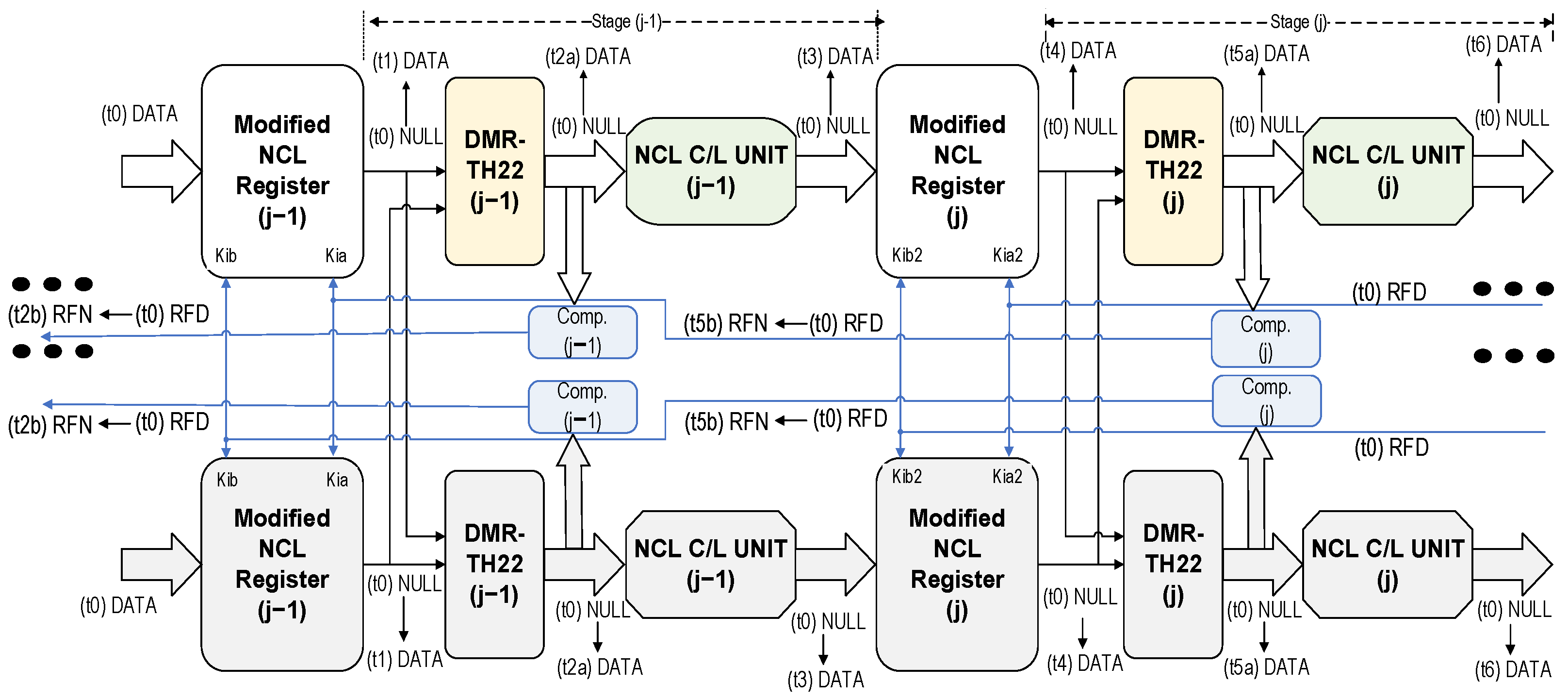
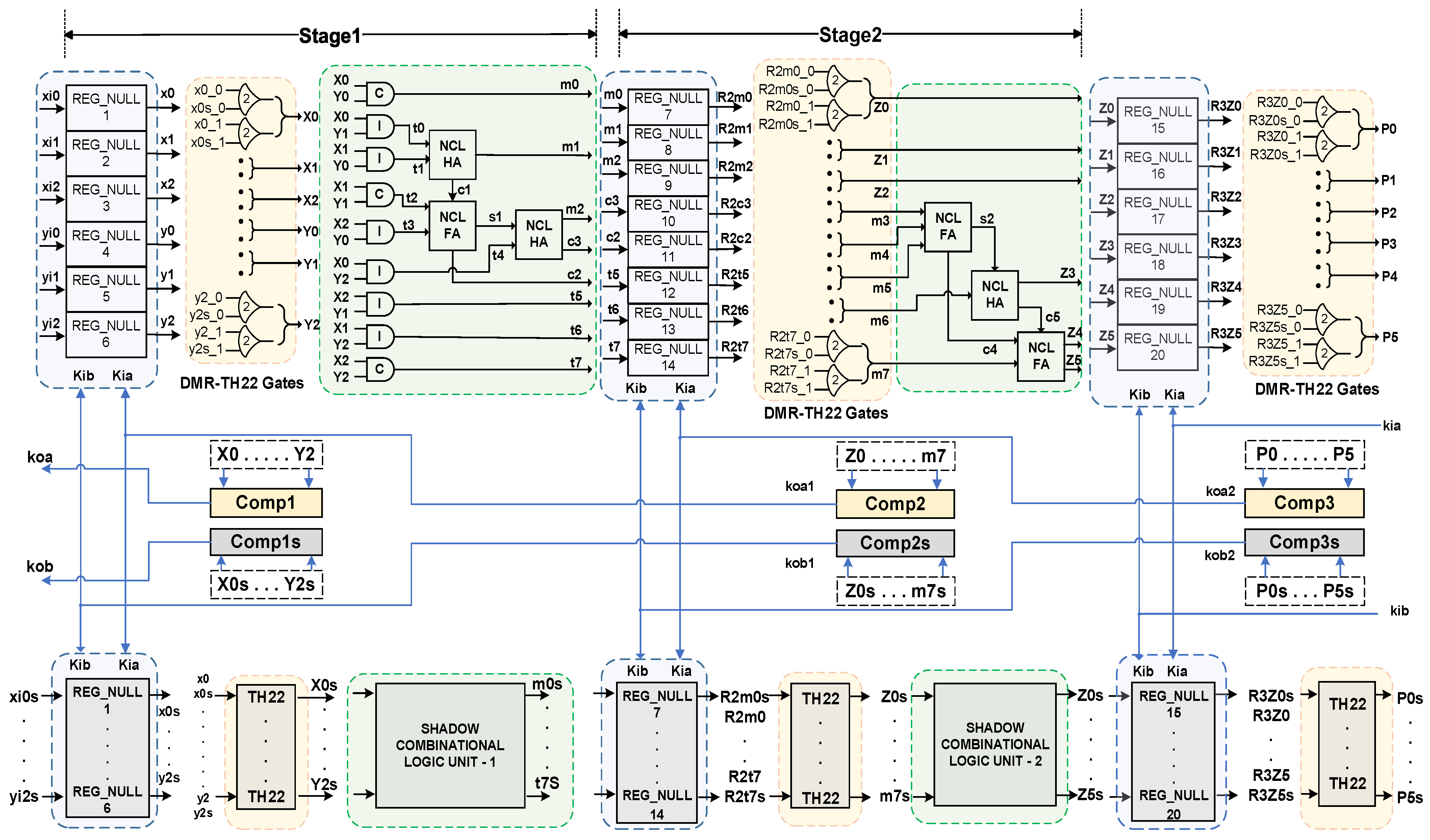
The increasing demand for high-speed, energy-efficient, and miniaturized electronics has led to significant challenges and compromises in the domain of conventional clock-based digital designs, most notably reduced circuit reliability, particularly in mission-critical hardware. At scaled technology nodes, devices are vulnerable to transient or soft errors, such as Single Event Upset (SEU) and Single Event Latch-up (SEL). External radiation, internal electromagnetic interference (EMI), or noise are the primary sources of these errors, which can compromise the circuit functionality. In response to these challenges, the Quasi-Delay-Insensitive (QDI) Null Convention Logic (NCL) asynchronous design paradigm has emerged as a promising alternative, offering advantages such as ultra-low power performance, reduced noise and EMI, and resilience to process, voltage, and temperature variations. Moreover, its unique architecture and insensitivity to timing variations offers a degree of resistance against transient errors; however, it is not entirely resilient. Several resiliency schemes are available to detect and mitigate soft errors in QDI circuits, with approaches based on redundancy proving to be the most effective in ensuring complete resilience across all major QDI implementation paradigms, including NCL, Pre-charge/Weak-charge Half Buffers (PCHB/WCHB), and Sleep Convention Logic (SCL). This research focuses on one such redundancy-based resiliency scheme for QDI NCL circuits, known as the dual-modular redundancy-based NCL (DMR-NCL) architecture, and addresses the absence of formal methods for the verification and analysis of such circuits. A novel methodology has been proposed for formally verifying the correctness of DMR-NCL circuits synthesized from their synchronous counterparts, covering both safety (functional correctness) and liveness (the absence of deadlock). In addition, this research introduces a formal framework for the vulnerability analysis of DMR-NCL circuits against SEU/SEL. To demonstrate the framework’s efficacy and scalability, a prototype computer-aided support tool has been developed, which verifies and analyzes multiple DMR-NCL benchmark circuits of varying sizes and complexities.
Keywords: asynchronous logic; quasi-delay insensitive (QDI); null convention logic (NCL); error resilience; design validation asynchronous logic; quasi-delay insensitive (QDI); null convention logic (NCL); error resilience; design validation