1. Introduction
The construction sector is a key component of European economies, with implications for infrastructure, investment, employment, and sustainable development. Recent studies show that the sector is strongly correlated with overall economic growth, especially when infrastructure, housing, and urban renewal are the main drivers [
1]. Nevertheless, construction still lags in technological modernization, with productivity growth that is slower than in other sectors. The economic impact of innovation, however, is hindered by broken value chains, reliance on subcontractors, project-based employment, and difficulties in standardizing processes [
2]. Unlike manufacturing, where repetitive operations can be automated, implementing smart technology in construction is more difficult and organization-dependent due to project uniqueness, site heterogeneity, and coordination requirements [
3]. Artificial intelligence is widely regarded as a tool for transforming construction, not only through task automation but also through enhanced data collection, analysis, and application throughout project lifecycles. AI can assist with cost estimation, scheduling, safety, predictive analytics, building management, and data integration from BIM (Building Information Modeling), sensors, smart models, and decision-support systems [
2,
4]. AI should be considered part of a broader digitalization movement, where economic efficiency, decision-making, sustainability, and safety depend on the smart use of data and models. Nonetheless, AI productivity gains are not automatic. They can be hindered by a lack of digital skills, poor data quality, aversion to change, high implementation costs, and difficulties integrating new technologies into existing workflows [
5,
6,
7,
8].
In this paper, we examine the effects of AI deployment on worker productivity in European construction sectors, using a comparative and systemic approach. We measure the relationship between AI adoption and labor productivity per worker and per hour worked, accounting for labor volume, hours worked, and output. The study also investigates whether there are distinct structural tendencies across European economies by clustering them according to AI use, productivity, job intensity, and industry performance.
The study does not claim to introduce a completely new cross-country framework, since comparative approaches are already widely used in digital economy and productivity research. Its incremental contribution lies in applying such a framework specifically to the construction sector, where much of the existing literature focuses on technological applications of AI, such as cost estimation, safety monitoring, scheduling, building management, and project control, rather than on sector-level productivity differences. Using recent Eurostat data, the study examines early-stage AI adoption across European economies and distinguishes between labor productivity per person employed and labor productivity per hour worked. This distinction allows for a more nuanced interpretation of productivity, as the two indicators reflect distinct economic and organizational mechanisms. In this way, the study provides sector-specific evidence on how AI adoption is associated with productivity differences in European construction, without overstating the novelty of the comparative framework itself.
This paper seeks to bridge these gaps by using a standardized European dataset from 2023 to 2024 and applying several quantitative techniques. AI adoption affects both productivity metrics, as shown by log-linear regression models controlling for labor input and construction output. Complementary techniques such as hierarchical and K-means clustering are useful for revealing groups of economies with similar characteristics in terms of digitalization, performance, and job intensity. This methodological approach enables a deeper understanding of digital transformation in the construction sector and a more nuanced view of the relationship between AI and productivity, beyond simple linear assumptions.
The novelty of the study lies in combining an econometric approach with a systemic analysis of European economies. Major contributions include the simultaneous analysis of labor productivity per person and per hour, the inclusion of construction output and labor input as control variables, and the identification of national groups with distinct orientations toward digitalization. In summary, the research contributes to the literature by showing that AI’s impact on productivity depends not only on the adoption of smart technologies but also on organizational maturity, sector structure, learning capacity, and the broader economic climate that shapes digital transformation.
In this study, systemic analysis refers to a configuration-oriented perspective that treats national construction sectors as interconnected subsystems rather than as isolated observations. From this perspective, AI adoption, labor input, working time, construction output, productivity, organizational maturity, and sectoral structure are understood as interdependent elements of the same transformation process. Cluster analysis is a key component of this systemic perspective because it identifies groups of economies with similar digital and labor-productivity configurations. However, the systemic analysis is not limited to clustering alone. It also includes the interpretation of regression results within broader country-level configurations, showing that the productivity effects of AI depend on the interaction between technology adoption, labor organization, production dynamics, and structural conditions.
The paper is structured as follows. The introduction provides an overview of the research topic, its objectives, the existing gaps in the literature, the paper’s contribution, and its novelty. The literature review sets the theoretical background for the relationship between AI, labor productivity, and systemic European differences. The materials and methods section presents the data, variables, econometric models, and clustering techniques used. The results section presents the statistical findings. The discussion interprets these results in light of the existing literature and the peculiarities of the construction sector. The conclusion summarizes the main insights, the research’s implications, limitations, and future directions.
3. Materials and Methods
3.1. Research Design
The research design is based on a comparative quantitative approach, with the economies of the European Union Member States as units of analysis. Its primary objective is to examine the relationship between the application of artificial intelligence and labor productivity in the construction industry. The study adopts a systemic approach, treating each national economy as a subsystem shaped by intricate interrelations among technology, labor, and production, and viewing its performance as the outcome of this dynamic interaction. This conceptual framework allows us to move beyond a purely linear reading of AI’s impact and to capture structural differences across countries and at different stages of the digital transition.
Operationally, this systemic approach is implemented by combining regression analysis, which captures the statistical association between AI adoption and productivity, with cluster analysis, which reveals broader configurations of countries sharing similar patterns of AI use, labor intensity, construction output, and productivity.
The analysis proceeds along the three hypotheses given above and combines two complementary levels of analysis. First, the study assesses statistical associations using multivariate regression models to estimate the relationship between artificial intelligence adoption and labor productivity, controlling for labor input and construction output. Second, it analyzes systemic patterns across European economies by applying clustering algorithms to identify groups of countries with similar profiles in terms of digitization and labor performance. This methodological combination enables the capture of marginal effects of technology as well as the broader structural configurations in which these effects occur.
3.2. Selected Data
The analysis is based solely on Eurostat data and covers the period 2023–2024. This period was chosen to reflect the most recent advances in the application of artificial intelligence in organizations and to capture the initial impacts of faster digitalization in the construction sector. Eurostat harmonizes data at the European level, ensuring comparability across Member States and facilitating a cohesive cross-sectional analysis.
Although the dataset covers two consecutive years, 2023 and 2024, the empirical design does not employ fixed- or random-effects panel models because the time dimension is too short to support robust longitudinal estimation. With only two years of observations, fixed-effects models would rely on very limited within-country variation and would absorb much of the structural cross-country heterogeneity that is central to the study. Random-effects models were also not considered appropriate because their assumptions regarding unobserved country-specific effects are difficult to validate over such a short period. Therefore, the study uses a pooled country-level comparative approach, focusing on recent differences among European economies rather than on long-term within-country dynamics.
Table 1 summarizes the variables used in the study, providing descriptions of the indicators, their sources, and units of measurement.
The variable AICONS measures the level of artificial intelligence adoption as the percentage of construction enterprises using at least one AI technology, relative to all firms in the sector. The AICONS variable captures the extensive margin of AI adoption, namely, whether construction enterprises report using at least one AI technology. However, this indicator does not distinguish between different AI application scenarios, such as cost estimation, scheduling, safety monitoring, predictive maintenance, BIM-related analytics, computer vision, or decision-support systems. It also does not measure the depth of integration into operational workflows, the intensity of investment, the level of employee training, or the organizational maturity required to transform AI use into productivity gains. Therefore, the variable should be interpreted as a broad sector-level adoption indicator rather than as a measure of advanced or fully integrated AI implementation. This limitation is important because the productivity effects of AI may differ substantially between isolated, experimental uses and deeply embedded applications that reorganize planning, coordination, and execution processes.
In addition, the indicator does not capture the duration of AI use or the number of AI technologies adopted by each enterprise. Therefore, firms that have only recently introduced one AI application are treated in the same way as firms that have used several AI technologies for a longer period and have integrated them into multiple operational processes. This limits the ability of the present study to distinguish between early, superficial adoption and mature, multi-technology AI integration.
Two complementary variables capture labor size and intensity. The number of employed persons (LIPE) serves as a measure of labor input, while the variable LIHWE captures total hours worked by employees. Both variables are expressed as indices relative to the base year 2021. Labor productivity is examined from two perspectives: real labor productivity per employed person (RLPP) and real labor productivity per hour worked (RLPHW). Both indicators are derived as indices with 2020 as the base year, providing a more nuanced assessment of labor performance. The level of the industry’s economic activity is measured by the construction production (PIC) index, with 2021 as the base year.
The indicators expressed as indices use a base-year normalization method, in which the value of the selected base period is set equal to 100. Values above 100 indicate an increase relative to the base period, while values below 100 indicate a decrease. This approach facilitates cross-country comparison by expressing labor input, productivity, and construction production in standardized relative terms rather than in absolute national units. The base years used in the analysis follow the structure of the Eurostat datasets from which the variables were extracted. Labor input and construction production are reported as short-term indices with 2021 = 100, whereas real labor productivity per person employed and real labor productivity per hour worked are provided as national accounts productivity indices with 2020 = 100. Therefore, the base periods were retained from the official Eurostat methodology to ensure consistency, comparability, and reproducibility of the empirical analysis.
These measures allow consideration of the technical dimension, the labor factor, and sectoral production. They also avoid reducing productivity to a single measure and allow for controlling fundamental disparities among economies. The final sample consists of 27 Member States after harmonizing the series and deleting observations with missing values. The choice of variables and the database construction aim to provide a balanced depiction of the digital transformation process in construction and its consequences for labor productivity.
3.3. Methods
The empirical analysis proceeds along two complementary methodological directions: econometric modeling of the relationships between artificial intelligence adoption and labor productivity in construction, and identification of systemic patterns across European economies using unsupervised classification techniques. The entire approach is based on a consistent data-processing strategy. Variables were transformed using the natural logarithm to linearize relationships, minimize heteroscedasticity, and enable an intuitive economic interpretation of the parameters as elasticities [
76]. The transformation used is
ln(
X) for any variable
X. In this approach, the coefficient
β represents the approximate percentage change in the dependent variable associated with a 1% change in the explanatory variable [
77].
To test hypotheses H1 and H2, two log-linear regression models were estimated using ordinary least squares, with the national economy,
i, as the unit of observation. Model 1 focuses on productivity per employed person and takes the following form:
—real labor productivity per employed person;
—share of construction enterprises using at least one AI technology;
—labor input expressed through employed persons;
—construction production;
—the intercept, representing the estimated value of the dependent variable in the absence of explanatory influences;
—regression coefficients that measure the elasticity of the dependent variable relative to each explanatory variable;
—the error term, capturing unobserved influences and external factors not included explicitly in the model.
Model 2 focuses on productivity per hour worked and retains the same structure, while replacing both the labor input indicator and the dependent variable:
—real labor productivity per hour worked;
—the share of construction enterprises using at least one AI technology;
—labor input measured through hours worked by employees;
—construction production;
—the intercept, representing the estimated value of the dependent variable in the absence of explanatory influences;
—regression coefficients that measure the elasticity of the dependent variable relative to each explanatory variable;
—the error term, capturing unobserved influences and external factors not included explicitly in the model.
To investigate the third hypothesis, the study applies a two-step clustering procedure. In the first stage, Ward’s hierarchical clustering method was applied using standardized Euclidean distance. Ward’s method was selected because it minimizes the increase in within-cluster variance at each step and therefore produces compact and relatively homogeneous clusters [
78], which is appropriate for continuous standardized indicators such as AI adoption, labor productivity, labor input, and construction output. The optimal number of clusters was determined by jointly considering the dendrogram structure, the agglomeration schedule, the size of the increase in fusion coefficients between successive stages, and the substantive interpretability of the resulting country groups. The three-cluster solution was retained because it provided a clear separation among country profiles while avoiding excessive fragmentation of a relatively small sample. In the second stage, the K-means method was used to refine the initial hierarchical solution by reassigning countries to the nearest cluster center. Differences between the final clusters were then assessed using ANOVA.
Equation (3) defines the distance between two observations:
—observations from cluster 1;
—observations from cluster 2;
d(X,Y)—the distance between a subject with observation vector x and a subject with an observation vector;
k,l—cases.
In the next stage, the K-means method refines the solution. It stabilizes the cluster centers by assigning each economy to the group that best matches its digital profile and labor performance. The analysis then statistically tests for differences between clusters using ANOVA.
This combination of multivariate regression and cluster analysis offers an integrated perspective on the impact of artificial intelligence in construction. It enables the study to evaluate the marginal effects of technological adoption while identifying the distinct structural trajectories of European economies. The approach reflects the idea that digital transformation does not generate uniform outcomes. Instead, it produces differentiated effects that depend on the economic, organizational, and institutional context in which enterprises implement it.
4. Results
4.1. The Impact of Artificial Intelligence Adoption on Labor Productivity in the Construction Sector
The empirical analysis tests Hypothesis H1, which posits that the adoption of artificial intelligence in the construction sector has a statistically significant effect on labor productivity per employed person across European economies, while accounting for labor input and construction output. For this purpose, the study estimates a log-linear regression model, referred to as Model 1, in which real labor productivity per employed person (ln_RLPP) is the dependent variable. The explanatory variables include the degree of artificial-intelligence adoption in construction (ln_AICONS), labor input (ln_LIPE), and construction output (ln_PIC). The logarithmic transformation of all variables allows the coefficients to be interpreted as elasticities and reduces the influence of extreme values, thereby increasing the robustness of the estimates.
The model summary in
Table 2 indicates a multiple correlation coefficient of 0.596, suggesting a moderate relationship between the explanatory variables and labor productivity.
The coefficient of determination (R2) of 0.356 indicates that the model explains approximately 35.6% of the variation in labor productivity per employed person, while the adjusted R2 of 0.317 shows that the explanatory power remains moderate after accounting for the number of predictors. To avoid relying only on the coefficient of determination, the model was further assessed through complementary diagnostic indicators. The ANOVA test indicates that the model is statistically significant as a whole, while the Durbin–Watson value of 1.911 is close to 2, suggesting no relevant residual autocorrelation. In addition, the tolerance and VIF values indicate that there is no serious multicollinearity among the explanatory variables. The standardized residuals remain within an acceptable range, indicating stable estimation. Therefore, the R2 value should be interpreted as indicating moderate, but methodologically acceptable, explanatory power in a short cross-country model characterized by structural heterogeneity.
The ANOVA test in
Table 3 confirms the model’s overall significance, with an F-statistic of 9.205 and
p < 0.001.
This result shows that the set of explanatory variables makes a statistically significant contribution to explaining variation in labor productivity in the construction sector, and that the estimated model performs better than one without independent variables.
The coefficient associated with ln_AICONS has a negative value of −0.042 and reaches a marginal level of statistical significance, with
p = 0.087. This result, reported in
Table 4, suggests that, in the short term, an increase in the share of construction enterprises using artificial intelligence technologies is associated with a slight decrease in real labor productivity per employed person, holding other factors constant.
Although this effect does not meet the conventional 5% significance threshold, it becomes relevant at the 10% level. This pattern points to adjustment costs that often accompany the early stages of digital transformation, such as learning periods, the reorganization of work processes, or an initial mismatch between new technologies and the skills available within the workforce.
By contrast, construction production, expressed as ln_PIC, emerges as the main determinant of labor productivity, with a positive, strongly statistically significant coefficient (p = 0.004). The estimated elasticity of 0.508 indicates that productivity dynamics closely track sector-level economic activity, confirming the central role of demand and production volume in explaining performance differences across economies. The variable ln_LIPE, although associated with a positive coefficient, is not statistically significant. This result suggests that a quantitative expansion of the labor force does not automatically generate productivity gains unless it coincides with corresponding increases in production or technological efficiency.
The collinearity indicators show low VIF values and adequate tolerance levels, confirming that the model does not suffer from serious multicollinearity problems and supports the stability of the estimated coefficients. The detailed collinearity diagnostics further reinforce this conclusion, as they do not reveal problematic structural overlaps among the explanatory variables.
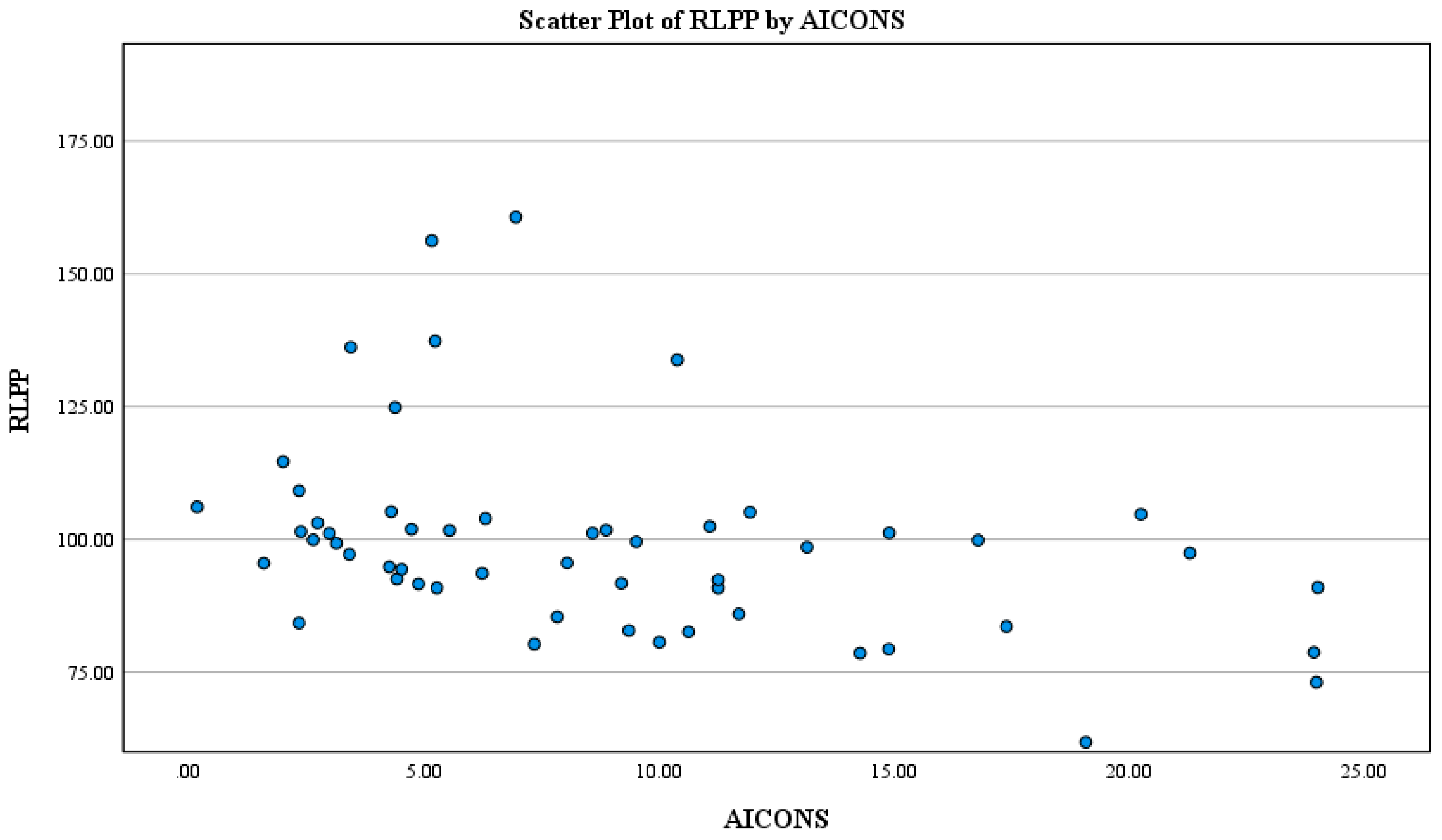
Figure 1, the scatter plot of AICONS and RLPP, further illustrates the relationship between artificial intelligence adoption and labor productivity. The figure shows a weak and slightly downward association, with considerable dispersion across observations.
This graphical representation confirms the regression results and suggests that higher levels of AI adoption did not automatically translate into higher labor productivity in the construction sector during the period under analysis. Differences among Member States appear to reflect broader structural and institutional factors rather than the direct effect of AI adoption alone.
Overall, the results indicate that the impact of artificial intelligence on labor productivity in construction should be understood as a gradual and systemic process. The benefits of technology depend on organizational maturity, skills adaptation, and the alignment between digital investment and production dynamics. Therefore, Hypothesis H1 receives partial support, as artificial intelligence adoption shows a statistically detectable but weakly significant and negative effect on labor productivity per employed person in the European economies analyzed.
4.2. The Impact of Artificial Intelligence Adoption on Labor Productivity per Hour Worked in the Construction Sector
The analysis then turns to Hypothesis H2, which argues that the adoption of artificial intelligence in the construction sector significantly influences labor productivity per hour worked in European economies, while accounting for total hours worked and the level of construction output. To test this hypothesis, the study estimates a second log-linear regression model, referred to as Model 2. In this model, real labor productivity per hour worked (ln_RLPHW) serves as the dependent variable. The explanatory variables include the degree of artificial-intelligence adoption in construction (ln_AICONS), labor input (ln_LIHWE), and construction output (ln_PIC). As in the previous model, the logarithmic transformation of all variables allows the coefficients to be interpreted as elasticities and ensures comparability of results across Member States.
The summary results of the estimation appear in
Table 5.
The multiple correlation coefficient (R = 0.561) indicates a moderate relationship between the explanatory variables and labor productivity per hour worked. The coefficient of determination (R2) of 0.315 shows that the model explains approximately 31.5% of the variation in hourly labor productivity, while the adjusted R2 of 0.274 indicates that the explanatory power remains moderate after accounting for the number of predictors. To avoid relying only on the coefficient of determination, the model was further assessed through complementary diagnostic indicators. The ANOVA test confirms that the model is statistically significant as a whole, while the Durbin–Watson value of 2.050 is very close to 2, suggesting no relevant residual autocorrelation. In addition, the tolerance and VIF values indicate that there is no serious multicollinearity among the explanatory variables. The residual statistics do not suggest systematic instability of the model, although the results should be interpreted with caution, given the short observation period and the structural heterogeneity of national construction sectors. Therefore, the R2 value should be understood as indicating moderate, but methodologically acceptable, explanatory power for a short country-level comparative model.
The ANOVA test in
Table 6 confirms the overall significance of Model 2, as the F-statistic of 7.663 is highly significant (
p < 0.001).
This result indicates that the variables included in the model make a statistically significant contribution to explaining variation in labor productivity per hour worked across the European economies analyzed.
The coefficient associated with ln_AICONS is −0.044 and is marginally significant (
p = 0.061). This result, presented in
Table 7, suggests that, in the short term, a higher degree of artificial intelligence adoption in construction is associated with a slight decrease in labor productivity per hour worked, when the volume of hours worked and the level of production remain constant.
Although this effect does not meet the 5% significance threshold, it is significant at the 10% level. Once again, the result points to transitional adjustment costs, which may reflect the time required to adapt workflows, temporary disruptions in activity, or the incomplete use of the AI solutions’ technological potential.
The variable ln_LIHWE, which reflects the total volume of hours worked, has a positive coefficient of 0.520 and a p-value of 0.089, close to the 10% threshold. This result suggests that, in certain contexts, a more intensive use of working time is associated with higher hourly productivity, possibly due to better process organization or reduced downtime. However, the relationship does not appear strong enough to support a robust statistical conclusion. By contrast, construction production, expressed as ln_PIC, remains an essential determinant of productivity, with a positive, statistically significant coefficient (p = 0.021). The estimated elasticity of 0.371 indicates that increases in hourly productivity are closely linked to sector dynamics, confirming the importance of the macro-sectoral context in which new technologies are implemented.
The collinearity diagnostics show low VIF values and adequate tolerance levels for all variables, and the condition index analysis indicates no structural multicollinearity. These results support the stability of the estimated coefficients and reinforce the robustness of the conclusions derived from Model 2.
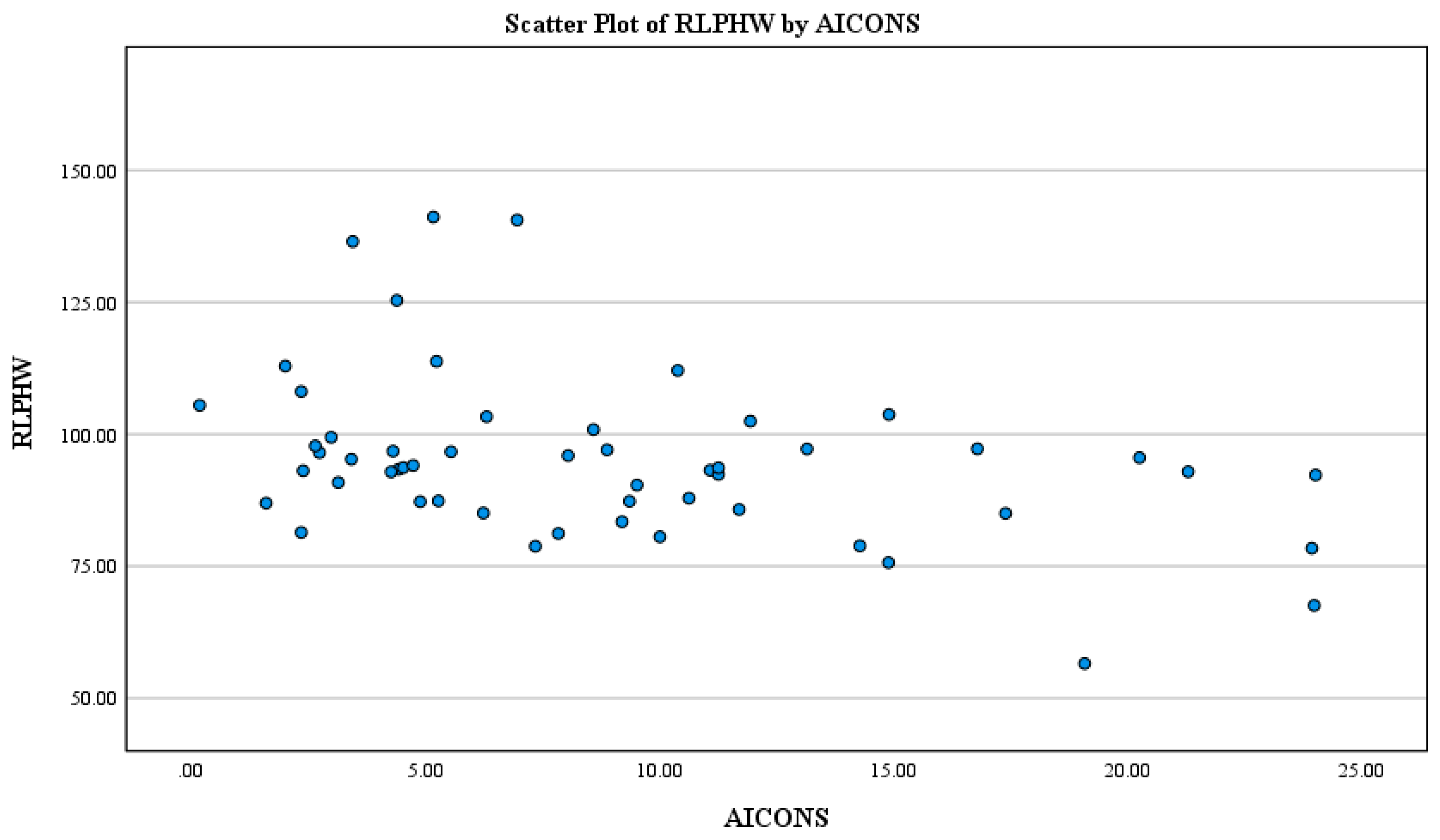
To complement the econometric interpretation,
Figure 2 illustrates the bivariate relationship between the degree of artificial intelligence adoption in the construction sector and real labor productivity per hour worked.
The distribution of points shows a weak, downward trend, with considerable dispersion across Member States. This pattern indicates that higher levels of AI adoption do not systematically correspond to higher values of hourly labor productivity, at least in the period considered. The figure graphically confirms the regression results and illustrates that the impact of artificial intelligence on the efficiency of working time use remains heterogeneous and highly dependent on the structural context, digital maturity, and the concrete integration of AI technologies into operational processes in construction.
Overall, the results suggest that the association between artificial intelligence adoption and labor productivity per hour worked in the construction sector shows a marginally significant negative effect, comparable to the relationship observed for productivity per employed person. These results indicate that the potential benefits of AI for the efficient use of working time have not been fully realized at the current stage of the digital transformation. Complementary elements, such as process restructuring, digital skills, and the incorporation of technology into current operational workflows, continue to shape these outcomes. Hypothesis H2 is only partially confirmed because the adoption of artificial intelligence has a statistically detectable, but weakly significant and negative impact on labor productivity per hour worked in the European economies considered in this study.
4.3. Systemic Patterns of Digital Transformation in Construction
The study of Hypothesis H3 begins with the premise that European economies do not follow a common path in the digitalization of the construction sector. Instead, they cluster into separate groups based on their levels of artificial-intelligence adoption, labor productivity, labor-input characteristics, and production patterns. The study uses a two-stage technique to capture these systemic patterns: the first step is Ward’s hierarchical analysis based on standardized Euclidean distance, and the second step is a K-means analysis to refine and validate the structure of the detected clusters.
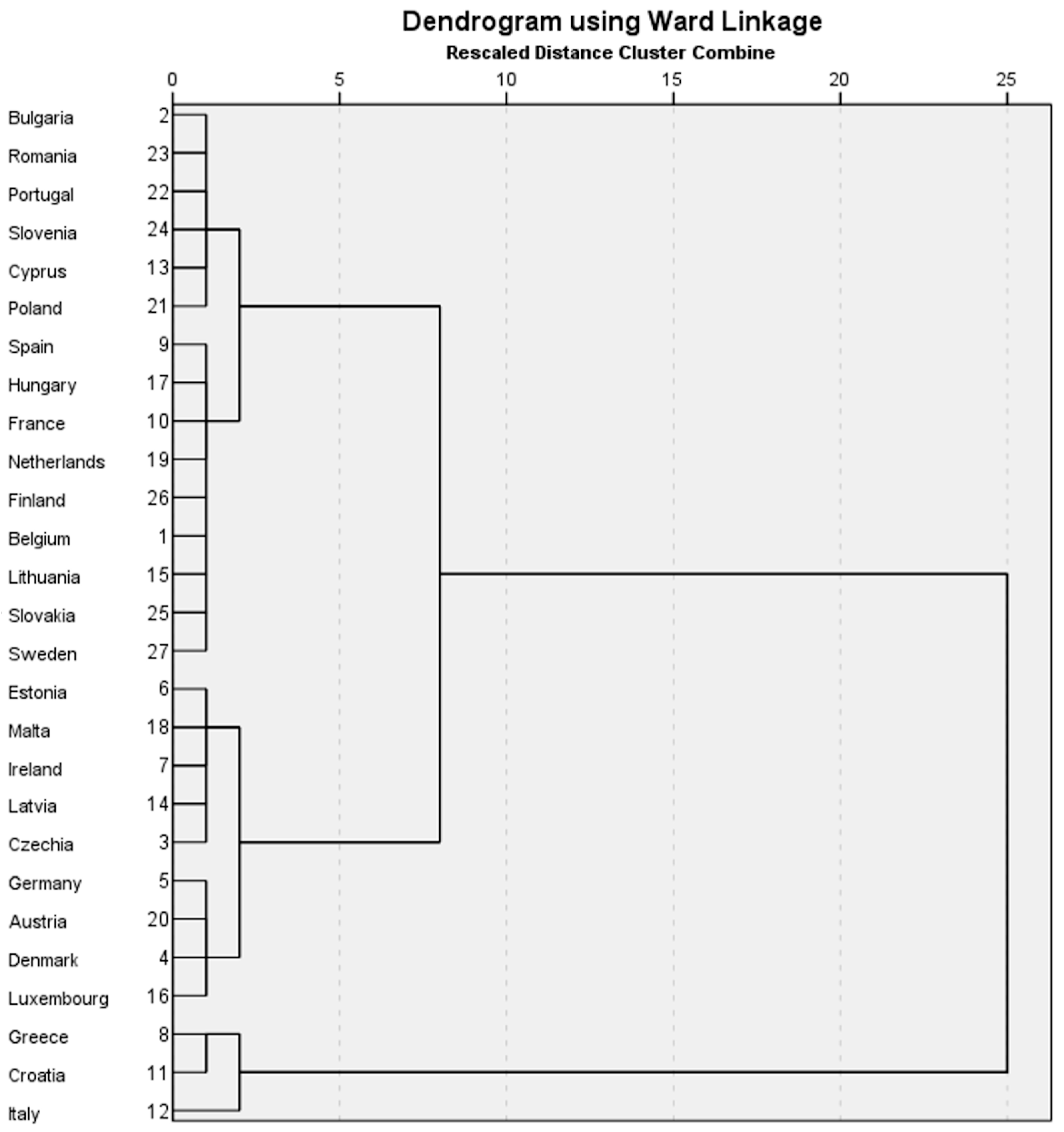
The results of the hierarchical analysis are summarized in
Figure 3, which suggests three distinct groupings of European economies.
The dendrogram shows a clear distinction among a cluster with high productivity, a cluster with medium, heterogeneous performance, and a cluster with lower labor productivity but significantly higher AI technology adoption. The first stage provides strong evidence of distinct structural patterns in the digital transformation of the building industry. It supports selecting a three-cluster solution for the next round of analysis.
The K-means approach with 3 clusters confirms this structure and allows for a more precise understanding of each group’s profile. In
Appendix A, the countries’ cluster membership, their distance from the cluster center, and the values of the variables analyzed are presented in
Table A1. The distribution is uneven with respect to cluster size: 15 economies fall into Cluster 1, just 3 into Cluster 2, and 9 into Cluster 3. This distribution shows the structural variety of the construction sector in the European Union.
Cluster 1, the largest group, displays values around the EU average for labor productivity per person employed and per hour worked, as well as a moderate level of artificial intelligence adoption. This category includes countries such as Belgium, France, Spain, the Netherlands, and Romania. These countries may be on a gradual path of digital transformation, with enterprises adopting AI gradually and not yet achieving significant productivity gains. The average values of this cluster suggest relative stability in productivity, primarily due to construction production dynamics rather than to higher utilization of new technology.
Cluster 2 is characterized by high labor productivity, both per person employed and per hour worked, but very limited AI adoption. This small group of Greece, Croatia, and Italy combines strong construction production with intensive labor use, as evidenced by higher values for both persons employed and hours worked. This profile reflects a performance model that is more attributable to structural, organizational, or cyclical issues than to advanced digitalization. It also implies that economies can achieve high production levels even without widespread use of artificial intelligence.
Cluster 3, comprising economies such as Germany, Denmark, Austria, and Luxembourg, has the highest average level of artificial intelligence adoption but the lowest labor productivity. This apparent contradiction suggests that the costs of accelerating digitalization can be high, particularly in nations with complex building-industry structures and stringent regulatory and quality standards. The nature of this cluster indicates that investment in AI is in a transition period, during which productivity gains have yet to be fully realized.
The ANOVA results presented in
Table 8 statistically validate the differences between clusters, showing high F-statistic values and very low significance levels for all three variables used in the clustering procedure: AICONS, RLPP, and RLPHW.
These data demonstrate that the cluster means differ significantly. Thus, the identified structure does not reflect random grouping but rather significant systemic disparities across the European economies included in the investigation.
The distances between the final cluster centers also support this view, showing a significant gap, especially between the high-productivity cluster and the cluster with considerable AI adoption but low productivity. This pattern indicates that the relationship between artificial intelligence and labor productivity in construction is neither linear nor immediate. Rather, it is a function of the intricate interplay among technology, labor organization, and the structural backdrop of each economy.
To move beyond a purely descriptive interpretation of the cluster solution, the contrast between representative economies from different clusters provides additional insight into the systemic nature of the AI–productivity relationship. Germany, included in the cluster with higher AI adoption but lower labor productivity, illustrates a configuration in which digital transformation appears to be more advanced in terms of formal technology use, but where productivity gains may be delayed by the complexity of construction projects, regulatory requirements, high-quality standards, fragmented subcontracting chains, and the need to integrate AI into already complex organizational and technical systems. In such contexts, AI adoption may initially increase coordination, training, data management, and workflow adjustment costs before generating measurable productivity improvements.
By contrast, Italy, included in the high-productivity but lower-AI cluster, suggests that construction productivity may still be strongly supported by sectoral output, accumulated industrial experience, project execution capacity, established organizational routines, and labor-intensive production models. This finding does not imply that AI is irrelevant, but rather that productivity can remain high in the short term when construction activity is dynamic and traditional sectoral capabilities remain effective. The comparison between these two configurations shows that AI adoption and labor productivity do not evolve in a linear or synchronized way. High AI adoption may reflect an early transformation phase, while high productivity may still result from production volume, sectoral specialization, and institutional or industrial conditions that precede large-scale AI integration.
These findings help explain why construction output remains the dominant productivity driver in the regression models. At the current stage, AI adoption in construction appears to operate more as a transitional capability than as an immediate productivity engine. Its productivity effects depend on complementary conditions, including digital skills, data interoperability, process redesign, managerial capacity, firm size, and the integration of AI with BIM, scheduling, safety monitoring, cost control, and project-management systems. Therefore, the weakly negative AI–productivity association should not be interpreted as evidence that AI reduces productivity in a structural sense, but rather as an indication that many European construction sectors may still be in an adjustment phase in which the costs of adoption precede measurable efficiency gains.
The cluster analysis should not be interpreted as a direct test of the causal impact of AI adoption on labor productivity. Rather, it identifies significantly different country profiles in which AI adoption and labor productivity are combined in distinct ways. The descriptive cluster results show that Cluster 2 records the highest labor productivity, both per person employed and per hour worked, despite relatively low AI adoption, whereas Cluster 3 records the highest average AI adoption but the lowest labor productivity indicators. This contrast suggests that AI adoption is not automatically associated with immediate productivity gains and that its relationship with productivity depends on broader sectoral and organizational conditions. The ANOVA results support this interpretation, showing statistically significant differences between clusters for AICONS, RLPP, and RLPHW. Therefore, the cluster analysis provides evidence of heterogeneous structural configurations rather than direct causal effects.
Overall, the cluster analysis provides a systematic view of the digital transition in construction. It illustrates the varied development paths of European economies and demonstrates the heterogeneity of country-level configurations linking artificial intelligence adoption, labor productivity, labor intensity, and construction output, depending on economic and institutional circumstances. Hence, Hypothesis H3 is verified, since European economies can be organized into discrete clusters that characterize diverse systemic patterns of digitization and labor performance in the construction sector.
5. Discussion
The research results offer a detailed picture of the interaction between the use of artificial intelligence and worker productivity in the construction sector, demonstrating that digital transformation does not have uniform, rapid, or solely positive effects. The three hypotheses are, in general, supported to varying degrees. The first two hypotheses are partially confirmed, as AI has a statistically significant but weak, negative impact on labor productivity. On the other hand, the third hypothesis is confirmed by the existence of separate groups of European economies. This empirical configuration is important because it shows that AI cannot be understood only in terms of its technological potential, but also in terms of the stage of digital maturity, the structure of the construction sector, and the capacity of organizations to integrate new technologies into everyday work processes.
In terms of Hypothesis H1, the data imply limited validity. The model’s estimates of labor productivity per employed person are statistically significant worldwide. However, the AI adoption variable has a negligible statistical effect, and its coefficient is still negative. On the face of it, this result may seem counterintuitive, especially given that the literature attributes a key role to AI in cost estimation, task planning, risk monitoring, and decision-making. The efficiency of construction can be enhanced by AI technologies, as shown by Abioye et al. [
5], Akinosho et al. [
14], and Na et al. [
15], and intelligent algorithms can be employed in cost estimation and delay prediction, as cited by Dimitriou et al. [
16], Hashemi et al. [
18], and Gondia et al. [
20]. This marginally significant negative result does not negate their contributions. Instead, it shows that the benefits of AI have not yet been fully realized at the macro-sectoral level. This theory is consistent with the productivity dilemma posed by Brynjolfsson et al. [
6], namely that sophisticated digital technologies may require adaptation, reorganization, and reskilling before their benefits are reflected in productivity indices. In the construction industry, this delay is exacerbated by sectoral fragmentation, project uniqueness, and resistance to change [
7,
8,
9,
10,
11].
Another key outcome for H1 is the prominent importance of construction output as the main predictor of productivity per employed worker. The conclusion implies that, over the period under investigation, disparities in productivity among European economies were driven more by sectoral production dynamics than by the formal level of AI adoption. This finding is consistent with the literature on labor productivity, which shows that performance depends not only on a single factor but also on interactions among production, firm size, sectoral organization, financial resources, and innovation potential. The economic and sectoral context, not simply the existence of technology, matters for productivity, as shown by Albuquerque et al. [
54], Dvouletý and Blažková [
58], Ferrando and Ruggieri [
60], and Turégano [
61]. The absence of AI as the main driver of productivity per employee can thus be read as a sign of an early stage of digitalization in construction, where technology adoption exists but has not yet reached sufficient depth to reshape the relationship between labor and output decisively.
Hypothesis H2 is also partially confirmed. The model shows that labor productivity per hour worked is substantial and that AI has a weakly significant negative effect, similar to that observed for productivity per employed person. This similarity suggests that the introduction of AI has not yet significantly altered the use of working time in the construction industry. The literature indicates that AI, IoT, BIM, computer vision, and digital twins can reduce downtime, improve site monitoring, prevent accidents, and increase hourly productivity. Teizer et al. [
24], Alzubi et al. [
27], Jeon et al. [
26], Kong et al. [
30], Choi et al. [
40], and Fang et al. [
41] report that intelligent monitoring and predictive analytics can enhance safety and workflow continuity. Meanwhile, Ballard and Howell [
22,
23] show that hourly efficiency remains contingent on workflow stability. However, the current study’s findings imply that these positive effects require deeper operational integration than mere use of AI technology.
This perspective is also supported by the literature on BIM and Construction 4.0/5.5.0. The value of digitalization depends on data quality and on the integration and interoperability of information across the entire project life cycle, as noted by ISO [
31], Sacks et al. [
32], Valdebenito and Forcael [
33], Sacks et al. [
34], and Memon et al. [
36]. The scattered use of AI by enterprises, without a clear link to planning, execution control, and resource management, may have a limited effect on labor productivity per hour worked. In addition, the Industry 5. 0 perspective developed by Xu et al. [
46], Ghobakhloo et al. [
47], Behúnová et al. [
48], Samuelson and Stehn [
49], Naji et al. [
50], and Yitmen [
51] emphasizes that technology creates value when it supports human- technology collaboration rather than when organizations introduce it as an isolated tool. The research results confirm this assumption: installing AI can boost hourly productivity only if digital skills, procedural reorganization, and worker acceptance are in place. Otherwise, technology may lead to yet more complexity, more learning time, and more operational adjustments.
Regarding hypothesis H3, the data support diverse systemic patterns of digital transformation in construction. Three distinct clusters of European economies, differing significantly in AI adoption and productivity indices, were identified through cluster analysis. This check is useful because it shows that no single model can explain the relationship between AI and productivity. In some economies, productivity is high despite relatively low AI adoption, suggesting that structural, cyclical, or organizational factors are driving performance. Other economies have higher rates of AI adoption but lower productivity, perhaps reflecting transition costs. This finding is consistent with Regona et al. [
7], who show that AI adoption depends on context, institutional capacity, and technology maturity. Adebayo et al. and Lu [
63] also show that AI adoption depends on context, institutional capacity, and technology maturity. This finding is also consistent with the literature on sustainability and the circular economy, in which Veres [
1], Lee et al. [
64], UNEP [
67], and zu Castell-Rüdenhausen and Wahlström [
68] argue that the modernization of construction is a matter of complex systems, not isolated digital tools [
62].
The cluster comparison reinforces this interpretation by showing that economies with higher AI adoption are not necessarily those with the highest current productivity, suggesting that AI’s productivity effects depend on institutional, industrial, and organizational complementarities rather than on adoption alone.
Therefore, the primary value of the study is to demonstrate that AI cannot be considered a separate factor in construction worker productivity. Instead, the results suggest a relationship that is still evolving: the technology exists, and its impacts can be measured statistically but have not yet been converted into obvious productivity improvements at the European level. This conclusion does not diminish the importance of AI. It embeds it in a more realistic framework in which performance depends on the complementarity among technology, production, talent, work organization, and institutional maturity. This interpretation is consistent with recent evidence from agriculture and public-sector marketing showing that digital transformation delivers measurable performance benefits only when advanced technologies are embedded in organizational processes, predictive decision-making, and user-acceptance mechanisms [
79,
80].
In this regard, the study verifies the systemic approach developed in the research design. The findings suggest that digital transformation in construction should be managed gradually, taking into account people, processes, and national contexts, rather than focusing solely on the formal rate of adoption of intelligent technology. The results presented are consistent with the article’s empirical framework, providing partial confirmation of H1 and H2 and supporting H3 by identifying discrete clusters of European economies.
5.1. Theoretical Implications
The empirical findings of this study make a substantial theoretical contribution to understanding the relationship between artificial intelligence and labor productivity in the construction sector by showing that this relationship cannot be explained by a simple, linear, and immediately positive logic. The negative but weakly significant effect of AI adoption on labor productivity per employed person and per hour worked is consistent with the view that advanced digital technologies entail adjustment, reorganization, and learning costs before their benefits are reflected in economic indicators. Therefore, the study extends the productivity paradox view to the AI setting. It extends it to a sector where processes are still difficult to standardize, and performance relies heavily on coordination among people, technologies, and the specific conditions of each project.
The research indicates that, from a theoretical perspective, the official adoption of a technology does not imply its mature and productive application. This distinction is crucial to research on construction digitalization. Aggregate measures of AI adoption may capture the presence of technology but not the degree of its integration into organizational processes. The importance of construction production as the main driver of productivity suggests that labor performance remains strongly linked to sectoral dynamics and the broader economic environment rather than solely to technological development.
The study also contributes to the broader digital transformation literature by supporting the existence of clusters. European economies do not follow a single route to modernization; they differ in particular combinations of productivity, labor intensity, production, and AI adoption. This conclusion supports the premise that digitalization in construction should be understood as a contextual process, shaped by institutional maturity, sectoral structure, and organizational capacity to absorb innovation.
5.2. Practical Implications
The study’s outcomes are practically relevant to construction enterprises, managers, public decision-makers, and institutions promoting digital transformation. First, the negative and weakly significant effect of AI adoption on labor productivity suggests that simply introducing intelligent technologies does not automatically deliver efficiency gains. For enterprises, this outcome conveys an essential message: investment in AI must be accompanied by process redesign, staff training, improved data quality, and the integration of technology into daily planning, execution, and control. AI only increases productivity when enterprises use it as part of a coherent managerial framework, not as an isolated tool.
The findings indicate that construction managers should be realistic about the era of digital transition. The costs of learning, adaptation, and coordination may lead to a temporary loss of efficiency, especially in organizations with still-limited digital capabilities or internal procedures that are not sufficiently standardized. Thus, companies should progressively adopt AI through trial projects, ongoing review, and alignment with their actual needs. At the same time, the results reveal that construction output remains a key element of productivity, suggesting that digitalization should align with the true dynamics of the project portfolio and with enterprises’ capacity to convert demand into efficient output.
The cluster results also require differentiated policy and managerial responses, as the three groups of economies face distinct digitalization challenges. For Cluster 1, which includes economies with moderate AI adoption and productivity levels, the priority should be gradual digital upgrading. Public authorities, sectoral associations, and construction firms should support step-by-step adoption through AI readiness audits, small-scale pilot projects, digital skills certification, and the progressive integration of AI with BIM, scheduling, cost-control, and safety-monitoring systems. In this group, an indicative allocation of digitalization resources could prioritize workforce training and managerial capacity building, followed by data-quality improvement and pilot AI applications. The short-term objective should be to identify operational areas where AI can reduce delays and coordination costs, while the medium-term objective should be to scale successful applications across project portfolios.
For Cluster 2, which includes economies with high labor productivity but limited AI adoption, the main objective should not be rapid, generalized digitalization, but selective AI deployment in high-value construction segments. In these economies, public policy should encourage demonstration projects in infrastructure, energy-efficient buildings, renovation, complex engineering works, and public procurement, where AI can add value without disrupting existing productive routines. Construction companies should prioritize AI applications with direct operational relevance, such as cost estimation, delay prediction, procurement optimization, quality control, and safety monitoring. An indicative implementation path could allocate resources primarily to pilot deployment and technology testing, while reserving a smaller share for staff training, data integration, and evaluation. The short-term objective should be to prove the usefulness of AI in selected high-impact projects, while the medium-term objective should be to transfer these solutions to broader market segments.
For Cluster 3, which includes economies with higher AI adoption but lower labor productivity, the key challenge is not the absence of technology, but the incomplete conversion of AI adoption into productivity gains. In this group, policy measures should focus on business process reengineering, workflow redesign, interoperability standards, data governance, and structured digital upskilling programs. Targeted subsidies should not support technology acquisition alone; they should be conditional on redesigning organizational processes and on measurable improvements in project coordination, downtime reduction, cost control, and labor productivity. An indicative investment structure could prioritize process redesign and data interoperability, followed by workforce reskilling, managerial training, and monitoring of productivity outcomes. The short-term objective should be to reduce adjustment costs; the medium-term objective, to integrate AI into operational routines; and the long-term objective, to transform AI from a formal adoption indicator into a mature productivity-enhancing capability.
Across all clusters, implementation should involve a shared responsibility structure. Governments and EU-level institutions should provide funding instruments, standards, and incentives; professional associations should develop sector-specific guidelines and training frameworks; construction firms should integrate AI into project-management routines; and universities or vocational institutions should support digital skills development. These cluster-specific recommendations show that the practical implications of AI adoption cannot be reduced to generic calls for training or digitalization. They require phased, context-sensitive policies that connect technology adoption with organizational change, human capital, and sectoral productivity objectives.
5.3. Limitations and Future Research
The results provide important insight into the relationship between artificial intelligence adoption and labor productivity in construction. However, they should be interpreted with the study’s inherent limitations in mind. The first constraint concerns the cross-sectional nature of the dataset (2023–2024). This period allows us to capture recent developments but not to conduct a thorough assessment of AI’s long-term effects on productivity. If the benefits of intelligent technology are delayed, as suggested by the productivity paradox literature, a longer analysis period might reveal different, and probably more positive, outcomes as firms gain experience and change their operations. A second restriction pertains to the measurement of AI adoption. In the study, the indicator is the share of construction businesses using at least one AI technology. However, it does not differentiate between application types, use intensity, investment levels, or integration levels in current operations. Therefore, two economies may have similar levels of AI adoption even if one uses advanced technology in planning, BIM, and predictive analytics. At the same time, the other relies on limited solutions with less impact on operations. Future research could consider more precise indicators of digital maturity, data quality, personnel skills, and the types of AI technology deployed. Future research should also address this limitation by using firm-level or project-level data that capture the duration, breadth, and maturity of AI adoption. More specifically, future models could include variables such as the number of AI technologies used, the number of years since first AI adoption, the share of projects supported by AI tools, the level of AI-related investment, and the degree of integration with BIM, scheduling, safety monitoring, cost estimation, procurement, or predictive analytics. This would make it possible to test whether productivity gains differ between recent adopters and long-term adopters, or between firms using only one AI application and firms combining several AI technologies. With longer time series, lagged variables or dynamic panel models could also be used to examine whether AI adoption produces delayed productivity effects after firms accumulate experience, reorganize workflows, and develop the required digital skills.
Another drawback is the analysis at the aggregate level. The study provides a systemic perspective by comparing national economies, but it does not account for differences among firms, project types, or building sectors. Future research could combine macroeconomic data with firm-level data or case studies to better understand how AI affects productivity. It would also be interesting to broaden the analysis and include variables on regulation, public investment, sustainability, and professional training. Future studies should also extend the time horizon and apply fixed-, random-, or dynamic-panel models once longer time series of AI adoption in construction become available.
Future research should also incorporate additional determinants of labor productivity that could not be included in the present model because of the limited time span and the relatively small number of country-level observations. These variables may include wage levels, labor costs, capital investment, R&D expenditure, firm size distribution, access to finance, digital skills, BIM maturity, public infrastructure investment, regulatory quality, and the degree of technological integration within construction firms. Including such variables would allow future studies to examine whether AI adoption has an independent productivity effect or whether its impact depends on complementary conditions such as investment capacity, workforce qualification, organizational scale, and institutional support. With longer time series and more detailed firm-level or project-level data, future research could apply extended panel models, interaction effects, mediation models, or multilevel designs to assess how these factors shape the AI–productivity relationship across countries and types of construction activity.





 ,
,