2. Theoretical Background and Literature Review
The transition of Original Equipment Manufacturers (OEMs) toward ecosystem orchestration is prominent in operations literature [
1,
2]. Early deterministic views assumed digital technologies would linearly enhance external collaboration [
3]. However, recent research reveals a “digitalization paradox” [
4,
5]: substantial digital investments frequently yield short-term operational degradation rather than proportional improvements. Tortorella et al. [
6] attribute this to “operational friction,” where unrefined digital innovations disrupt Lean practices in zero-tolerance manufacturing. Furthermore, digitalization without a strategic shift merely automates legacy inefficiencies [
7]. Escaping this paradox requires a Digital Innovation Orientation (DIO)—a proactive commitment to technological disruption [
8]. Yet, a gap remains regarding the routines required to execute this orientation, leading scholars to the Dynamic Capabilities theory.
Dynamic Capabilities (DC) theory bifurcates in asset-heavy contexts. The foundational perspective conceptualizes DC as embedded routines to “sense, seize, and reconfigure” assets [
9,
10,
11], demanding systemic IT and business model reconfiguration in the digital era [
12]. Conversely, in chaotic startup ecosystems, scholars argue embedded routines become core rigidities, asserting DC must manifest as agile “simple rules” or heuristics [
13,
14]. Recent meta-analyses note these theories were primarily developed for digital platforms [
15]. A theoretical void exists for hardware manufacturing: Teece’s “reconfiguration” threatens rigid mass-production SOPs, while Eisenhardt’s trial-and-error is incompatible with zero-tolerance floors. Consequently, DC literature lacks a structural mechanism for simultaneously executing agile exploration and stable exploitation.
This difficulty compounds in Open Innovation (OI) literature. Since Chesbrough’s [
16] seminal work, scholars advocate integrating startup technologies to accelerate R&D [
17,
18]. We conceptualize this as Dynamic Innovation Capabilities (DIC). However, an “orchestration gap” exists [
19]: OI implicitly assumes sourced knowledge assimilates seamlessly. In reality, startup innovations lack Design for Manufacturing (DFM) readiness. Importing them directly into a structured core generates immense “open innovation friction” [
20], triggering the digitalization paradox. This tension highlights the critical need for a boundary-spanning mechanism to safely translate external chaos into standardized manufacturing intelligence.
To resolve this conflict, scholars invoke Structural Ambidexterity [
21], positing that firms must physically separate exploratory ecosystem engagement from exploitative mass-production [
22]. Recently, corporate accelerators have been viewed as manifestations of this ambidexterity [
23,
24]. While primarily conceptualized as “incubators”, we argue they must function as an “Innovation Translation Interface”. Boundary-spanning literature asserts that interfaces translate and de-risk [
25]. Here, Bingham et al.’s [
14] “simple rules” are operationalized, running high-speed DFM checks outside the core factory to absorb friction. Yet, while structural ambidexterity explains physical separation, it exhibits a significant blind spot regarding the cognitive integration mechanisms required for translated knowledge to effectively penetrate the firm’s core.
The baseline for internalizing knowledge is Nonaka’s [
26] SECI model, expanded by Nonaka and von Krogh [
27]. However, recent studies reveal a bottleneck within the “Externalization” phase in high-velocity environments [
28], which requires articulating tacit intuition into codified formats. In OEMs, engineers prioritize execution over documentation, and knowledge from iterative failures is notoriously “sticky” [
29] and difficult to codify. Consequently, the SECI spiral stalls, relying on “Socialization” (apprenticeship) for transfer. This over-reliance creates a “Seniority Trap,” where capability scaling is limited by veteran engineers’ bandwidth. Without automating externalization, dynamic capabilities fail to institutionalize.
To overcome this bottleneck, the literature explores Artificial Intelligence (AI) in knowledge management. Dominant narratives treat Large Language Models (LLMs) as exogenous, “plug-and-play” resources [
30]. However, critical literature challenges this in domain-specific applications [
30,
31,
32], arguing that generic AI models may generate serious reliability risks or hallucination errors in zero-tolerance manufacturing. We theorize a Digital Knowledge Infrastructure that demands “domain-grounding”. Transcending the plug-and-play illusion requires training AI strictly on proprietary operational friction. ECOs and failed prototypes—traditionally “lean waste”—become the mandatory training corpus. Grounded in this data, the infrastructure transforms into an “externalized cognitive container,” automating the Externalization phase. By rapidly codifying historical failures, junior engineers may reduce reliance on slow socialization processes, thereby accelerating the Combination and Internalization phases.
In summary, neither Dynamic Capabilities nor Structural Ambidexterity alone explains how legacy OEMs internalize open innovation. Our framework links DIO and DIC to a novel construct: Systematized Innovation Capability (SIC)—the capacity to transform high-variance shocks into standardized procedures. Achieving SIC requires a Translation Interface to absorb friction, and a domain-grounded Digital Knowledge Infrastructure to automate the SECI spiral, mitigating the digitalization paradox.
3. Research Framework and Hypotheses
While recent literature strongly advocates for ecosystem-based open innovation, scholars have increasingly observed a “digitalization paradox” where unbuffered technology integration leads to short-term performance degradation [
4]. In asset-heavy manufacturing environments, injecting chaotic, high-variance innovations from external startups directly into zero-tolerance production lines generates severe operational friction [
6]. Traditional Original Equipment Manufacturers (OEMs) operate within highly standardized production systems optimized for flawless execution rather than agile experimentation. Consequently, an unmanaged influx of open innovation does not inherently create value; it often disrupts established routines and compromises yield rates.
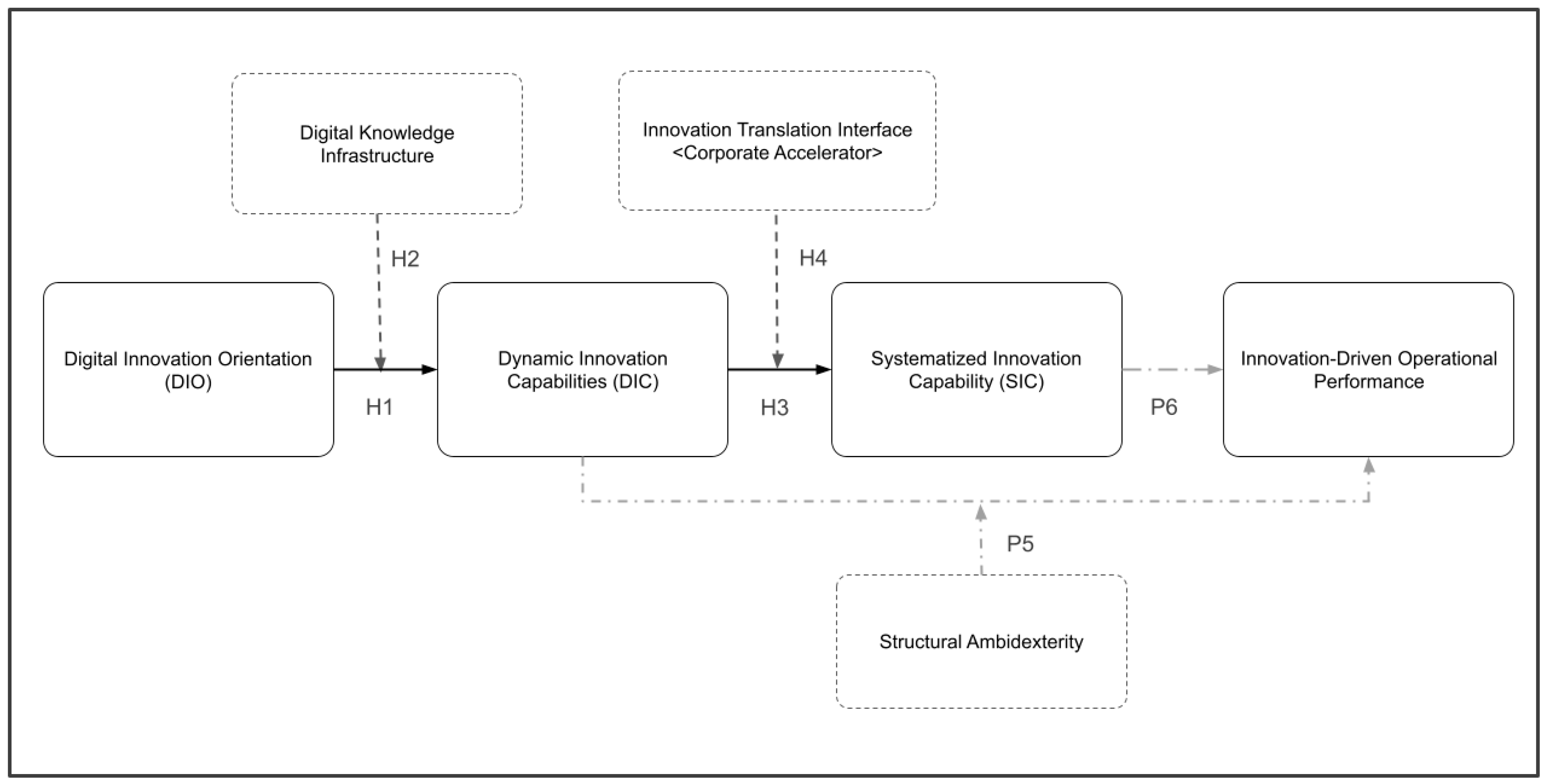
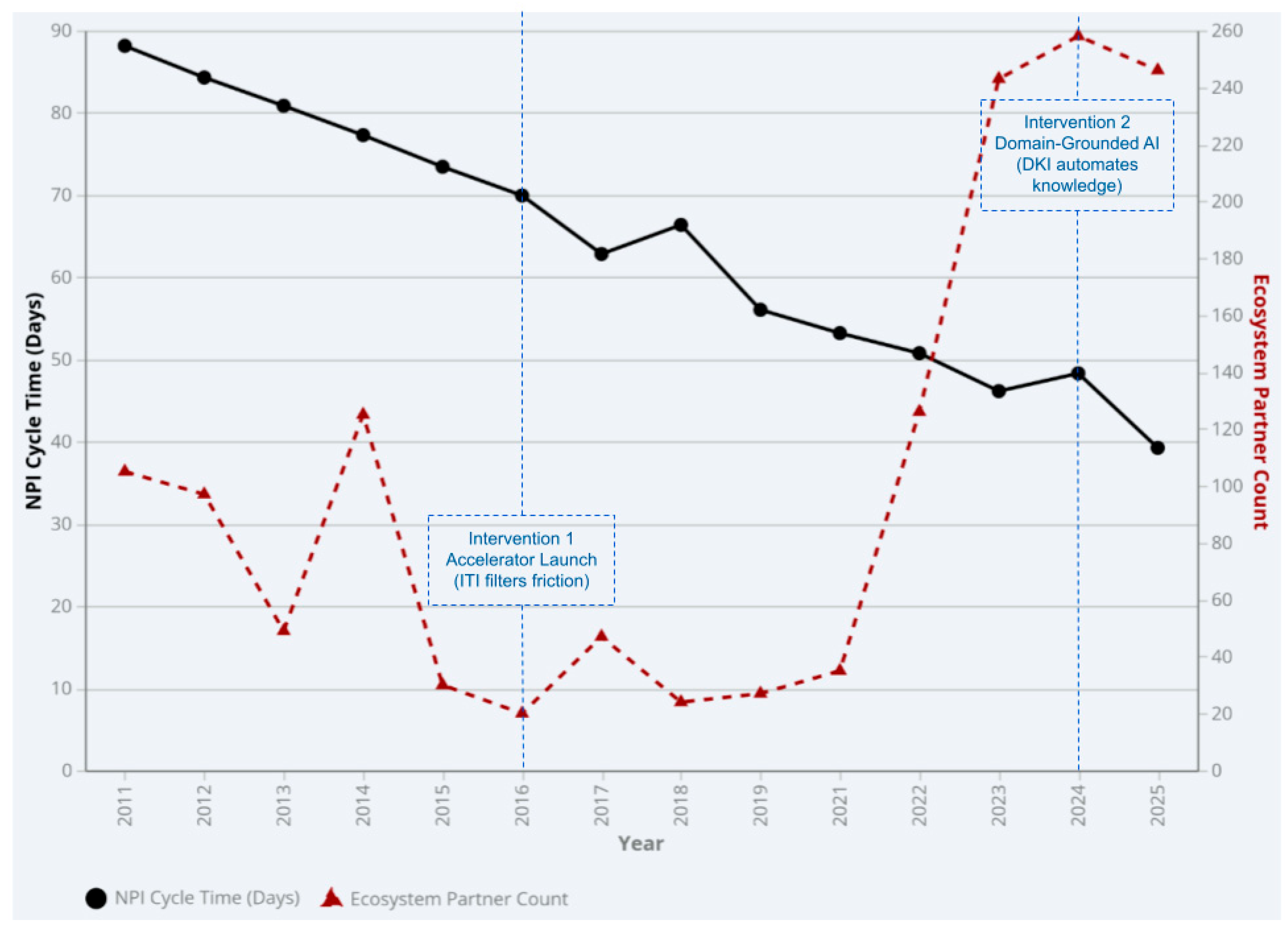
To overcome this digitalization paradox, our 15-year longitudinal framework reveals that innovation in asset-heavy manufacturing is not a sudden event, but a staged evolutionary process. Prior to 2016, the case firm focused on building a Knowledge Management Foundation through basic data digitalization. However, digitized knowledge alone does not equal innovation. To break the OEM competency trap, the firm required a deliberate mechanism to process external shocks. Our framework posits that a firm’s Digital Innovation Orientation (DIO) is positively associated with the development of Dynamic Innovation Capabilities (DIC). However, the conversion of these capabilities into a proprietary Systematized Innovation Capability (SIC) depends critically on two moderating forces: a robust Digital Knowledge Infrastructure (which evolved from basic manufacturing execution systems to advanced, domain-grounded artificial intelligence) and an Innovation Translation Interface. By structurally isolating these exploratory activities through Structural Ambidexterity, the firm may internalize external technologies while protecting core operational stability, thereby contributing to Innovation-Driven Operational Performance.
Figure 1. Research Framework Distinguishing Survey-Based Hypotheses and Triangulated Propositions. Solid arrows represent survey-based PLS-SEM hypotheses (H1–H4), whereas proposition-labeled links (P5–P6) represent qualitative, archival, and longitudinal triangulated propositions rather than direct PLS-SEM paths.
In traditional manufacturing logic, value is embedded purely in cost-efficiency and variance reduction. A Digital Innovation Orientation (DIO) represents a fundamental strategic shift: it is the firm’s proactive posture to embrace technological disruption, open innovation, and ecosystem orchestration rather than remaining a passive capacity provider.
For mature hardware factories deeply conditioned by total quality management, adopting this orientation is highly unnatural. Without a deliberate strategic mandate, mid-level production managers will inherently resist the integration of uncertain digital tools or external startup projects to protect their short-term yield metrics. A strong Digital Innovation Orientation legitimizes experimentation and catalyzes the development of Dynamic Innovation Capabilities (DIC). DIC refers to the organizational routines required to sense emerging external technologies, seize open innovation opportunities within the startup ecosystem, and reconfigure internal resources to match these new technological trajectories. By committing to a continuous innovation mindset, the factory environment becomes receptive to absorbing external knowledge. Therefore, we hypothesize:
H1. Digital Innovation Orientation (DIO) is positively associated with the development of Dynamic Innovation Capabilities (DIC).
Contemporary research highlights that digital transformation is fundamentally a process of dynamic knowledge creation [
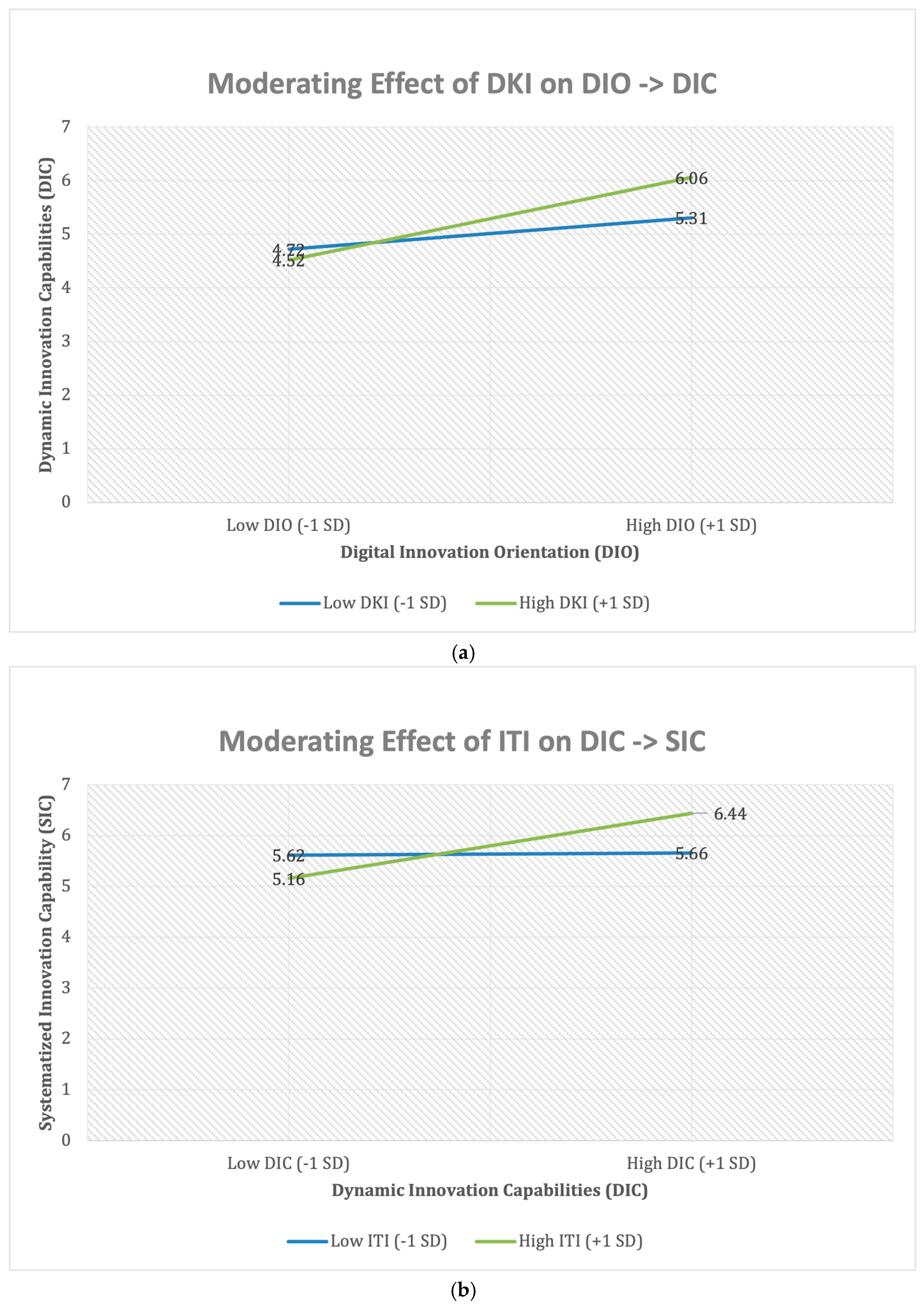
32]. However, strategic orientation alone is insufficient to build true capabilities if the firm lacks the underlying technical architecture to capture and process new data. We propose that the relationship between DIO and DIC is positively moderated by the firm’s Digital Knowledge Infrastructure.
Digital Knowledge Infrastructure represents the technological backbone that records, stores, and processes operational data. In the early phases of a firm’s evolution (the Knowledge Management Foundation), this infrastructure consists of digitized enterprise resource planning and manufacturing execution systems. However, as the firm scales its open innovation orchestration, the volume of iterative data—such as engineering change orders, failure logs, and testing reports—becomes overwhelming. Integrating advanced technologies, particularly internal Large Language Models (LLMs), into this infrastructure marks a critical turning point. While many manufacturing firms blindly adopt generic AI models, resulting in unmanageable “AI hallucinations” and operational errors, a domain-grounded Digital Knowledge Infrastructure strictly utilizes years of proprietary pre- and post-digitalization historical data. Extending recent AI and knowledge-management perspectives [
30,
31,
32], this grounded infrastructure allows the firm to accurately interpret external technological shocks, significantly amplifying the effect of its innovation orientation on capability development. Thus:
H2. Digital Knowledge Infrastructure positively moderates the relationship between Digital Innovation Orientation (DIO) and Dynamic Innovation Capabilities (DIC).
Possessing dynamic capabilities allows a firm to engage with the external ecosystem, but engaging with startups is only the beginning of the innovation process. The true measure of competitive advantage in manufacturing is the ability to internalize these external innovations so deeply that they become routine. We define Systematized Innovation Capability (SIC) as the firm’s ability to transform fragmented, high-variance external knowledge into standardized, repeatable, and scalable internal operating procedures.
To understand the operational friction inherent in this transformation, we anchor our perspective in Nonaka’s [
26] foundational SECI model of knowledge creation. The SECI framework posits that organizational knowledge evolves through a continuous cycle of Socialization, Externalization, Combination, and Internalization. In traditional manufacturing, the conversion of tacit engineering intuition into explicit, documented routines (Externalization) is notoriously slow and laborious. Engineers prioritize execution over codification, creating a severe knowledge bottleneck.
Dynamic Innovation Capabilities (DIC) provide the sensing and seizing mechanisms to bring open innovation into the firm’s orbit. However, if this knowledge remains tacit—residing only in the minds of individual veteran engineers through traditional “Socialization” (e.g., human-to-human apprenticeship)—it cannot scale. Higher levels of DIC are associated with the firm’s tendency to actively process the iterative learnings generated from joint startup projects. Over time, the repeated exercise of DIC ensures that chaotic external inputs bypass traditional codification bottlenecks and are systematically mapped into proprietary manufacturing intelligence. This allows the OEM to autonomously replicate and scale these innovations across different product lines. Therefore:
H3. Dynamic Innovation Capabilities (DIC) are positively associated with Systematized Innovation Capability (SIC).
A critical gap in existing innovation management literature is the assumption that dynamic capabilities automatically yield systematized outcomes. In hardware manufacturing, external innovations generated by startups are inherently unstructured and severely lack Design for Manufacturing (DFM) readiness. Attempting to force these unrefined technologies directly into the systematization process creates an insurmountable bottleneck.
To solve this operational paradox, firms require an Innovation Translation Interface. In this study, this interface is operationalized as a corporate hardware accelerator—a dedicated, boundary-spanning mechanism established to orchestrate the open innovation startup ecosystem.
The Innovation Translation Interface functions as a knowledge filter and a de-risking engine. It employs “simple rules” to quickly filter, organize, and clean incoming technological data before it reaches the core factory floor. It absorbs the high variance of external innovations, allowing internal engineers and external partners to engage in rapid, small-scale iterations and quick pivots. Through this interface, unrefined digital concepts are systematically translated and validated. Consequently, the Innovation Translation Interface serves as the crucial mechanism that activates the value of DIC, bridging the gap between external chaotic innovation and internal systematized knowledge. We hypothesize:
H4. The Innovation Translation Interface positively moderates the relationship between Dynamic Innovation Capabilities (DIC) and Systematized Innovation Capability (SIC) by reducing open innovation friction.
Because this study combines survey-based PLS-SEM with qualitative and archival triangulation, we distinguish between hypotheses and propositions in the research framework. H1–H4 are formulated as hypotheses because they involve survey-based latent constructs that can be directly estimated through PLS-SEM path coefficients, bootstrapped confidence intervals, and significance testing. By contrast, Structural Ambidexterity and Innovation-Driven Operational Performance are not treated as survey-based latent variables. Structural Ambidexterity is assessed through CEO interviews, organizational observations, and archival evidence, while Innovation-Driven Operational Performance is evaluated through longitudinal ERP/MES operational indicators. Therefore, the relationships involving these two elements are formulated as propositions (P5 and P6) rather than PLS-SEM hypotheses.
While Dynamic Innovation Capabilities (DIC) are closely associated with the systematization of knowledge (SIC), the broader operational consequences of these capabilities cannot be fully assessed through executive survey perceptions alone. In an asset-heavy Original Equipment Manufacturer (OEM), innovation-driven performance is observable through longitudinal operational indicators such as New Product Introduction (NPI) cycle time, yield rate, PoC-to-production rate, ecosystem partner count, and international revenue share. Therefore, in this study, Innovation-Driven Operational Performance (IOP) is treated as an objective, longitudinally observed outcome rather than as a purely survey-based latent construct.
This distinction is important because the exercise of DIC can generate both innovation benefits and operational turbulence. The relentless sensing of external technologies and seizing of unrefined startup prototypes may jeopardize current operational reliability if these exploratory activities are not properly contained. This necessitates the role of Structural Ambidexterity. Structural Ambidexterity refers to the deliberate organizational separation of exploratory innovation activities from exploitative mass-production routines [
21]. In the present case, this separation is assessed through qualitative triangulation, including CEO interviews, organizational observations, and archival evidence concerning the separation between the accelerator interface and the core manufacturing unit.
Accordingly, Structural Ambidexterity is not estimated as a survey-based latent variable in the PLS-SEM model. Instead, it is interpreted as a qualitative boundary condition that helps explain why exploratory innovation activities could be conducted without destabilizing the firm’s zero-tolerance production baseline. Thus, we propose:
P5. Structural Ambidexterity serves as a qualitative boundary condition that helps explain why Dynamic Innovation Capabilities can be exercised without destabilizing core production performance.
Ultimately, the goal of transitioning from a traditional OEM to an innovation ecosystem orchestrator is to improve operational outcomes while preserving manufacturing reliability. When a firm develops Systematized Innovation Capability (SIC), external knowledge from startups and advanced technologies from internal AI integration can be embedded into repeatable operating routines. Because the firm’s Digital Knowledge Infrastructure captures and systematizes historical failure logs, testing reports, and prior engineering iterations, the learning curve for new engineering challenges may be shortened. Junior engineers can retrieve prior troubleshooting knowledge, avoid repeating past errors, and accelerate design iterations.
In this study, the relationship between SIC and Innovation-Driven Operational Performance is therefore evaluated through triangulated longitudinal evidence rather than through a survey-based PLS-SEM path. The relevant operational indicators include NPI cycle time, yield rate, PoC-to-production rate, ecosystem partner count, and international revenue share. Thus, we propose:
P6. The development of Systematized Innovation Capability is associated with improvements in longitudinal operational indicators, including shorter NPI cycle time, higher PoC-to-production rates, and expanded ecosystem partner counts, while maintaining attention to short-term calibration friction in yield and revenue outcomes.
4. Methodology
4.1. Research Design and Case Selection
This study adopts a 15-year longitudinal single-case design to analyze how legacy manufacturers structurally internalize external innovation turbulence. To ensure revelatory insights, we selected MightyNet from over 140,000 small and medium-sized enterprise (SME) manufacturers operating in Taiwan. MightyNet represents an extreme, highly successful outlier that systematically transitioned from a traditional OEM into an AI-driven ecosystem orchestrator between 2011 and 2025.
Although MightyNet operates with the agility and organizational structure of a medium-sized specialist manufacturer, it possesses disproportionate operational leverage. The firm maintains a lean core of approximately 300 regular employees while managing an elastic production scale of up to 1000 variable workers, generating annual revenue exceeding NT$1.8 billion. The specific boundary of this case analysis encompasses the firm’s central manufacturing core and its dedicated corporate accelerator unit.
4.2. Data Collection and Triangulation
To avoid relying solely on survey-based inference and to capture the operational complexity of the case, we adopted a triangulated research design combining executive survey data, objective longitudinal operational records, micro-level AI execution logs, CEO interviews, and organizational observations. The executive survey was used to estimate internal strategic capability associations among survey-based constructs. By contrast, Structural Ambidexterity and Innovation-Driven Operational Performance were assessed through qualitative and archival triangulation rather than as purely survey-based latent variables.
Longitudinal Operational Records: 15 years of macro-metrics extracted from ERP and MES, including New Product Introduction (NPI) cycle times, yield rates, and ecosystem partner counts.
Micro-level AI Execution Logs: For the recent advanced technology internalization phase (2023–2025), we analyzed concrete AI training and validation data. To operationalize the Innovation Translation Interface, the firm deployed computer vision trained on approximately 30,000 production images containing exactly 235,942 annotated bounding boxes. This was strictly validated using 120 min of real-time footage and 55 live production samples, achieving a 94.3% detection accuracy. To operationalize the Digital Knowledge Infrastructure, a Text2SQL AI Agent was fine-tuned using hundreds of textual training datasets, ultimately achieving an average SQL generation accuracy of 96% across eight core ERP themes.
Strategic Survey Data: Structured responses were collected from 45 key executives. Critically, this sample (N = 45) is not a random sampling of general workers, but a near-census of the firm’s Top Management Team (TMT). Given the core headcount of 300, this captures virtually the entire strategic decision-making body. These subjective strategic assessments are triangulated with massive objective historical datasets (ERP/MES macro-metrics). To address potential common method bias (CMB) arising from a single-organization survey, we conducted Harman’s single-factor test. The first factor accounted for less than the 50% threshold, suggesting that CMB does not severely distort the structural estimates. Furthermore, these 45 respondents represent a near-census of the Top Management Team (TMT), capturing their shared strategic consensus rather than generalized employee perceptions.
Qualitative Case Evidence: CEO interviews, organizational observations, and accelerator records were used to assess Structural Ambidexterity and the organizational separation between exploratory innovation and core production routines.
Table 1 summarizes the study’s triangulation strategy by linking each data source to its analytical role in the research design.
4.3. Analytical Strategy and Structural Equations
We utilized a two-layer analytical strategy. First, Interrupted Time-Series (ITS) analysis was used to examine macro-level operational trend shifts across the firm’s evolutionary phases. Second, Partial Least Squares Structural Equation Modeling (PLS-SEM) was used to estimate survey-based strategic capability associations among Digital Innovation Orientation (DIO), Digital Knowledge Infrastructure (DKI), Dynamic Innovation Capabilities (DIC), Innovation Translation Interface (ITI), and Systematized Innovation Capability (SIC).
Importantly, the PLS-SEM component was not designed to capture the entire case mechanism. Structural Ambidexterity (SA) and Innovation-Driven Operational Performance (IOP) were not treated as purely survey-based latent variables in the structural model. Instead, SA was assessed through CEO interviews, organizational observations, and archival evidence regarding the separation between the accelerator interface and the core manufacturing unit. IOP was evaluated using objective longitudinal ERP/MES indicators, including NPI cycle time, yield rate, PoC-to-production rate, ecosystem partner count, and international revenue share. Accordingly, the PLS-SEM results are interpreted as one component of a broader triangulated case analysis rather than as a standalone causal test.
To formally estimate the survey-based strategic capability associations, the inner PLS-SEM model is represented by the following equations. All indicator variables were mean-centered prior to computing interaction terms to minimize multicollinearity.
In the structural equations above, β0 and γ0 represent model intercepts; βn and γn denote standardized path coefficients; and ε1 and ε2 represent residual error terms. The first equation tests H1 through β1 and the moderating effect of H2 through β3. The second equation tests H3 through γ1 and the moderating effect of H4 through γ3.
For the ITS analysis, to directly estimate and compare the absolute trajectories before and after the structural intervention, we utilized the following segmented regression specification:
where T
t is the time elapsed (Year—2010). T
pre,t = T
t × (1 − X
t) represents the continuous time trend in the pre-intervention phase, while T
post,t = T
t × X
t captures the absolute trend slope in the post-intervention phase. X
t is the intervention dummy variable (0 for 2011–2016; 1 for 2017–2025). The parameter β
post represents the absolute post-intervention slope and is reported as the Beta in
Table 2.
Given the structural limitation of 15 annual observations, we reviewed Durbin-Watson statistics to monitor autocorrelation. Consequently, the ITS results are interpreted strictly as exploratory descriptive trends rather than definitive counterfactual causal proofs.
6. Discussion and Implications
Our findings offer several conceptual extensions to the literature on digital servitization and organizational learning in asset-heavy manufacturing. Primarily, this study provides an exploratory, triangulated account of how a traditional OEM may navigate the tension between external technological shocks and internal operational stability. Rather than relying solely on survey-based PLS-SEM, the study combines executive survey evidence, longitudinal ERP/MES operational data, AI execution logs, CEO interviews, and organizational observations.
First, we extend the Dynamic Capabilities (DC) theory by contextualizing it within the strict constraints of zero-tolerance manufacturing environments. Prior literature highlights a theoretical tension between Teece’s formal [
10] “reconfiguration routines” and Bingham et al.’s [
14] agile “simple rules.” Our structural model suggests that these two paradigms do not need to be mutually exclusive if mediated by an Innovation Translation Interface. Building upon O’Reilly and Tushman’s foundational concept [
21] of Structural Ambidexterity—which traditionally emphasizes the physical or spatial separation of exploratory and exploitative units—our findings delineate the cognitive and operational boundary conditions required for such ambidexterity to succeed. We propose that sensing and seizing high-variance open innovations without a buffering mechanism may lead to systemic yield disruptions. By operationalizing a corporate accelerator as a structural knowledge filter, firms can apply agile “simple rules” to external startup technologies, de-risking them before they interact with the exploitative, zero-tolerance core. This suggests a novel pathway for developing Systematized Innovation Capability (SIC), where external shocks are systematically translated into standardized operating procedures.
Second, this study contributes to knowledge management literature by proposing a potential way to address the “Externalization” bottleneck inherent in Nonaka’s [
26] SECI model. In high-velocity manufacturing, the conversion of tacit engineering intuition into codified knowledge is notoriously sluggish, often resulting in a “Seniority Trap” where capability scaling is constrained by the availability of veteran engineers. While recent literature increasingly positions Artificial Intelligence as a solution to organizational learning, generic AI applications frequently falter in specialized industrial contexts. Our descriptive evidence regarding the case firm’s AI implementation suggests that a domain-grounded Digital Knowledge Infrastructure—trained specifically on proprietary operational friction such as historical Engineering Change Orders (ECOs) and failed prototypes—may function as an automated externalization support mechanism. By systematizing what is traditionally viewed as “lean waste” into an accessible cognitive container, organizations may bypass traditional human-centric apprenticeship, accelerating the SECI spiral.
Third, our longitudinal observations offer empirical support for mechanisms that mitigate the “digitalization paradox” [
4]. Our initial macro-trend analysis indicated that deploying data digitalization without an innovation interface inadvertently reinforced the OEM competency trap, temporarily contracting the firm’s ecosystem. This highlights that a Digital Innovation Orientation (DIO) is insufficient on its own; Innovation-Driven Operational Performance appears to be associated with staged orchestration. Firms must first structurally buffer the friction of open innovation, and subsequently deploy domain-grounded technologies to internalize those localized learnings into broader organizational routines.
Managerial Implications
For executives navigating digital transformation, this exploratory study offers several strategic heuristics. First, leaders should critically evaluate the “plug-and-play” narrative of digital integration. Injecting startup technologies directly into mass-production environments often compromises yields. Establishing an Innovation Translation Interface—such as a dedicated hardware accelerator equipped with strict Design for Manufacturing (DFM) viability checks—is highly recommended to filter chaotic innovations.
Second, organizations must re-frame their perception of historical operational errors. The cost of failed prototypes and ECOs should be viewed not merely as operational waste, but as high-value, proprietary training data. Grounding internal AI systems strictly in these historical iteration logs is crucial for developing context-aware digital infrastructures. Finally, managers must anticipate short-term “calibration friction” when deploying internalized technologies to the main production line. Communicating these temporary performance dips as a necessary “strategic deep-squat” is vital for aligning organizational expectations toward long-term capability scaling.
7. Conclusions and Limitations
This study explored the structural relationships enabling asset-heavy manufacturers to internalize open innovation without destabilizing core operations. Through a 15-year exploratory case study of MightyNet, we conceptualized an architectural framework highlighting two critical mechanisms: an Innovation Translation Interface that structurally absorbs external friction, and a domain-grounded Digital Knowledge Infrastructure that leverages historical failure data to automate knowledge externalization. Our findings suggest that Systematized Innovation Capability (SIC) is not an immediate byproduct of digital investments but rather the outcome of deliberately mitigating the digitalization paradox through these structural and technological buffers.
Despite its contributions, this study possesses substantial limitations, primarily rooted in its single-case design.
This study aims solely at theoretical generalization rather than statistical generalizability. Relying on a single successful outlier means we lack failed comparison cases or counterfactual trajectories. Therefore, we cannot rule out that unmeasured factors—such as exceptional leadership traits, serendipitous market timing, or legacy customer capital—served as the true underlying drivers of the firm’s survival. The proposed relationships (e.g., PLS-SEM structural paths) represent subjective strategic associations among the focal firm’s executives, not universal causal mechanisms for digital transformation.
The statistical associations and temporal trends observed at MightyNet cannot be universally generalized. The outcomes measured—such as enhanced NPI speeds and ecosystem growth—are subject to alternative explanations not fully controlled for in our models. Macro-economic conditions, shifts in global hardware supply chains, specific leadership transitions, and capital market fluctuations may have independently contributed to the observed operational improvements.
Furthermore, the PLS-SEM analysis, based on a limited sample of 45 executive respondents, measures subjective strategic perceptions and estimates structural associations among survey-based constructs, not definitive causal mechanisms. Structural Ambidexterity and Innovation-Driven Operational Performance were assessed through qualitative and archival triangulation rather than through survey-based latent-variable estimation. Future research should transition from this exploratory framework to rigorous confirmatory studies, utilizing large-scale cross-sectional datasets and comparative case designs across diverse manufacturing sectors to test the generalizability of the Translation Interface and SIC constructs against robust control groups.