1. Introduction
In classical social network theory, power is fundamentally a structural property [
1], where an actor’s power originates from their unique position within the network topology. Burt’s (1992) structural hole theory posits that actors maximize power by occupying bridging positions across heterogeneous groups with low network constraint, avoiding dense, redundant ties to maintain information arbitrage and competitive advantage [
2,
3]. In contrast, Coleman’s (1988) network closure theory emphasizes the importance of high-density and highly redundant connections in building trust and enforcing norms [
4]; however, such structures are typically viewed as guarantees of collective interests rather than sources of individual power. This paradigm, however, rests on an implicit anthropological premise: finite physiological and cognitive limits. Bound by Dunbar’s Number and relationship maintenance costs [
5], human individuals struggle to simultaneously maintain large-scale and high-density social relationships and face a zero-sum trade-off between connection breadth (bridging) and depth (closure). Consequently, in traditional human-dominated networks, bridging structural holes is regarded as the optimal strategy to acquire power under marginal cost constraints.
The deep embedding of Artificial Intelligence (AI) as non-human actors (e.g., social bots) into socio-technical systems fundamentally disrupts these theoretical premises [
6]. In contemporary socio-technical systems, social (human-related) and technical (non-human-related) elements continuously interact to pursue common organizational or systemic goals [
7]. Because the swift growth of AI and digitalization is deeply entwined with social relations, it has significantly altered how human and non-human actors engage within network processes, making the socio-technical systems perspective extremely significant for understanding modern power dynamics [
7,
8]. AI leverages algorithmic agency and near-zero marginal costs to construct ultra-large-scale dynamic connections [
9]. Empirical data from this study indicates that bot-like agents build ultra-high-density ego-networks within homogeneous communities (their density is 4.88 times greater than human nodes). According to classical theory, this high-density and high-constraint configuration should signify strategic failure. However, AI demonstrates substantial agenda-setting efficacy and systemic dominance. This theoretical paradox raises a core scientific question: When liberated from physiological limits, how do non-human actors (AI) configure network connectivity to exert substantive control from theoretically powerless high-constraint positions? Instead of bridging structural holes, AI exhibits a systemic capacity for filling them, emerging as the infrastructural hubs for consensus mobilization.
Existing research primarily attributes the generation of AI power to capital and technological logics. From a capital perspective, AI is viewed as an instrument for value accumulation. Under surveillance capitalism [
10], digital capital extracts behavioral surplus to predict and modify human actions. Platform capitalism [
11] utilizes algorithms as intermediaries to monopolize circulation and reshape class and colonial power relations by manipulating dominant narratives and recommendation mechanisms through algemony [
12]. Conversely, the technological logic emphasizes the structural monopoly over rule-making within socio-technical systems. As software code functions as the digital law [
13], the “black box society” [
14] creates extreme cognitive barriers, enabling technical elites to exert hidden dominance through unexplainable logic. This algocracy [
15] marginalizes traditional accountability, shifting power from political deliberation to opaque code execution, while the “coding elite” consolidate social advantages via control over digital means of production [
16]. Within this framework, algorithms operate as hypernudges [
17] that dynamically guide unconscious decision-making and enforce algorithmic management that subordinates labor under an illusion of autonomy [
18]. Despite mapping the macro-structural contours of algorithmic and AI power, these dominant paradigms inherently focus on the outcomes of manipulation rather than the relational mechanisms [
19,
20].
While providing valuable macro-level insights into cognitive management, these perspectives share a fundamental limitation: they treat AI merely as an exogenous instrumental tool and focus almost exclusively on macro-level informational dominance (e.g., what content is manipulated). Consequently, a critical theoretical and empirical gap remains: the existing literature largely treats the underlying social structure as a static conduit, failing to differentiate macro-level narrative manipulation from the micro-topological mechanisms through which algorithmic agents actively engineer the network itself. In other words, before AI can control the public agenda, it should first secure critical structural vantage points. To resolve this gap, this study shifts the analytical focus from content broadcasting to topological re-engineering. We adopt the perspective of Machine Behavior [
9], conceptualizing AI not as passive proxies, but as autonomous non-human actors deeply embedded within socio-technical dynamics [
21,
22]. When deployed at scale within digital communities, these automated accounts operate collectively as a Multi-Agent System (MAS) [
23]. In digital homogeneous networks, individual agents rarely act in isolation; rather, they operate as a coordinated or semi-coordinated MAS driven by underlying algorithmic optimization rules, such as collaborative filtering and recommendation engines [
24]. Within a MAS framework, thousands of bot-like agents autonomously interact with human users, executing micro-level topological strategies—specifically, systematically occupying and eliminating structural holes. It is these decentralized, algorithmically driven micro-behaviors that give rise to complex emergent properties, scaling up to systematically reconfigure the macro-network topology [
25]. Regulatory paradigms trapped in reactive content moderation consistently fail precisely because they neglect this micro-topological layer, leaving public spheres highly vulnerable to systemic cascade disorders.
To resolve this theoretical gap, this study introduces the frontier framework of Network Capabilities [
1,
26], which argues that the acquisition of power depends not exclusively on preserving structural holes, but rather on the dynamic fit between structural strategy and strategic intent. Based on this perspective, we posit that within homogeneous communities, AI acts not as a traditional broker, but as a structural integrator. Through an algorithmic Tight Integration strategy, AI systematically eradicates micro-structural voids, transforming its power basis from an information flow bottleneck into the underlying infrastructure that maintains system connectivity. This topological reconfiguration consequently weakens and sparsifies direct human-to-human ties.
Positioning AI as a novel systemic actor rather than a mere auxiliary tool, this study investigates a large-scale, empirical interaction network (
independent nodes) extracted from the social platform X (formerly Twitter) focusing on the “COVID-19 vaccine” debate. In network science,
homogeneous networks are defined as relational topologies characterized by extreme attitudinal homophily, low internal diversity, and dense localized triadic closure [
27,
28]. Within these structures, individuals predominantly associate with like-minded peers, fostering “echo chambers” that prioritize collective trust and normative reinforcement over individual brokerage [
29]. The ideological polarization surrounding global public health, specifically the “COVID-19 vaccine” debate, represents a paradigmatic manifestation of such homogeneous networks, providing an ideal stress-test environment to observe AI’s topological interventions. By constructing a theoretical model based on the Network Capabilities framework [
26] and combining social network analysis, Propensity Score Matching (PSM), and counterfactual simulations, this research addresses three primary Research Questions (RQs):
RQ1: How does the micro-topology of AI’s filling strategy (i.e., high constraint, high density) significantly differ from that of human actors within an engineered homogeneous network?
RQ2: How does AI’s theoretically powerless, high-constraint position paradoxically translate into systemic functional dependence and macro-connectivity control?
RQ3: How does AI’s structural integration advantage based on the Tight Integration strategy effectively translate into dominance over dynamic information diffusion?
The theoretical and practical contributions of this study consist of three aspects. First, it extends network power theory from humans and organizations to non-human actors, breaking through the foundational assumptions of traditional social network theory and revising the boundary conditions of structural hole theory in the AI era. Empirical findings from the rigorously conditioned matched-sample demonstrate an anomalous high constraint-high power morphology (bot-like agents’ constraint: 0.514 vs. human constraint: 0.453) driven by algorithmic agency. Second, by integrating AI’s technological characteristics into the Network Capabilities analysis framework, this study systematically analyzes the generation mechanism of AI power. Abandoning the traditional perspective of viewing AI as a mere tool, it confirms that AI utilizes its scale of connections and dynamic optimization capabilities to execute a structural hole-filling strategy in homogeneous communities, demonstrating how AI digitally reconstructs power generation by monopolizing systemic connectivity. Third, it provides a systemic regulation perspective for digital governance. The study finds that content moderation alone struggles to disrupt the dense trust networks built by AI. Breaking AI’s monopoly on connectivity at the topological structure level provides precise targets for preventing AI-driven “filter bubbles” social risk and effectively curbing the systemic diffusion of misinformation.
The remainder of this paper is organized as follows:
Section 2 constructs the theoretical analysis framework;
Section 3 introduces the methodology;
Section 4 presents empirical results;
Section 5 discusses the underlying theoretical mechanisms; and
Section 6 concludes the paper.
3. Research Design and Methodology
This study adopts the empirical paradigm of computational social science, constructing an analytical framework that integrates large-scale social media data mining, automated agent detection, social network analysis, and system dynamics simulation. The objective is to systematically reveal the power generation pathways of Artificial Intelligence within homogeneous networks.
To construct an original, primary dataset for this research, the authors independently collected the underlying interaction data by developing custom Python (version 3.9)-based web scraping scripts to directly query the public API v2 interface of the social platform “X” (formerly Twitter). This platform was selected as the core data source for two reasons: first, its public API supports large-scale, high-granularity structured data collection, enabling the capture of multi-dimensional interactive metadata including follows, retweets, replies, and mentions; second, its open diffusion mechanism provides a rich and structurally explicit network topology for investigating the interactions between non-human actors (social bots) and human users. This customized, primary data collection process ensures the originality, integrity, and temporal precision of our empirical analysis.
The highly controversial public health issue of “COVID-19 vaccines” was selected as the observational window. This issue exhibits severe ideological polarization and high community homogeneity on a global scale, with substantial evidence indicating that automated algorithmic accounts (bot-like agents) maintain disproportionately high activity levels within its diffusion networks [
43,
44,
45,
46,
47]. This context provides an ideal ecological environment for observing and quantifying how AI reshapes social relations and executes structural integration strategies. The data collection time window was set from 1 March 2021, to 30 April 2021. This specific two-month continuous window was selected as an ideal natural experimental setting for three reasons. First, it covers the large-scale promotion phase of global COVID-19 vaccination programs and the critical period of intense public debate regarding vaccine hesitancy, public health communication, and vaccine-related misinformation. During this critical phase, public discourse was highly polarized, and both pro-vaccine advocacy and vaccine conspiracy camps rapidly consolidated their respective “echo chambers.” This provides an optimal homogeneous network environment to observe micro-structural embedding. Second, existing literature indicates that this period experienced an unprecedented surge in the systematic intervention of automated accounts (bots) amplifying vaccine-related discourse [
48,
49]. Finally, establishing a symmetric, two-month cross-sectional window helps define stable network boundaries, effectively mitigating the structural breaks and confounding effects that would inevitably arise from crossing subsequent major public health policy shifts or the emergence of later variants.
A set of predefined keywords highly relevant to the pandemic and vaccines (including #COVID19, #vaccine, #GetVaccinated, #CovidVaccine, #VaccinesWork, #Coronavirus, #pandemic, #vaccinesideeffects, #lockdown, etc.) was utilized for global retrieval. In the initial phase, a total of 263,058 raw tweets were collected, encompassing 145,484 independent user nodes.
To ensure the statistical rigor of subsequent network measurement and rigorous observational matching, this study adopted the classical data processing paradigm of network science to design and execute a four-step data cleaning and noise reduction procedure: (1) filtering out duplicate tweets, non-English tweets, and obvious marketing content; (2) applying a secondary keyword screening to exclude confounding data related to non-COVID vaccines (such as historical controversies surrounding MMR and HPV); (3) retaining only core active user nodes that engaged in at least one valid interaction (retweet, mention, or reply); and (4) removing self-loops representing self-interaction and filtering out isolated nodes. Ultimately, a directed weighted social network graph comprising 9314 active nodes and 10,874 directed interaction edges was extracted and constructed.
To secure conceptual precision and address the methodological challenges raised by the persistent “black box” nature of underlying algorithmic recommendation systems and traffic distribution logic on digital platforms [
50], it is highly challenging to directly extract primary data regarding macro-level algorithmic interventions. Consequently, this study establishes “bot-like automated accounts” (commonly referred to as social bots) as empirical proxies to operationalize and quantify the structural power of AI-mediated agency. We explicitly acknowledge that machine learning classifiers, such as the Botometer API utilized in this research do not directly prove an account is an “AI actor” in the absolute theoretical sense, and do not directly measure generative artificial general intelligence (AGI) or platform-level sovereign algorithmic code; rather, they estimate the probability of automated or bot-like behavior based on high-dimensional behavioral, network, and temporal features. Nevertheless, this alternative measurement strategy is grounded in robust theoretical and empirical foundations. Social bots have evolved from trivial, rule-based scripts into complex interactive entities deeply driven by advanced AI [
51,
52]. Because these algorithm-controlled accounts possess significant algorithmic agency to execute scalable network infiltration and dynamically optimize connection strategies [
53,
54], they serve as the observable structural manifestation of algorithmic logic within social topologies. In the context of computational social science, these non-human actors are recognized as core variables that systematically reshape and confound organic human social behaviors [
34,
55]. Therefore, throughout the empirical analysis of this manuscript, we treat these bot-like agents as empirical proxies for AI-mediated agency. Observing how they systematically reconfigure local topologies effectively penetrates the abstract algorithmic black box, translating systemic AI interventions into precisely measurable topological indicators.
After establishing the global interaction network, accurately identifying and isolating these bot-like empirical proxies (social bots) from human individuals within the network is a critical prerequisite procedure for verifying the generation mechanism of AI power. To profoundly characterize these accounts and their topological roles, this study utilized the Botometer API, developed by the Center for Complex Networks and Systems Research at Indiana University, for node identity verification [
56]. Botometer employs machine learning models to conduct high-dimensional feature extraction on target accounts, encompassing over a thousand engineered features across six dimensions (User, Friends, Temporal, Network, Content, Sentiment), outputting a Complete Automation Probability (CAP) score for the account. The CAP score range is strictly bounded between 0 and 1; a higher score indicates a greater probability that the account is driven by automated algorithmic scripts or algorithmic programs, whereas a lower score implies operation by a real natural person [
57].
Following the robust classification standards established in state-of-the-art literature within this domain [
58], this study initially sets a CAP score of >0.6 as a rigid threshold for binary classification: nodes exceeding this threshold are strictly labeled as bot-like agent accounts (is_ai = 1), while nodes below this threshold are categorized as human accounts (is_ai = 0). Furthermore, to validate that our operationalization is not a statistical artifact of this specific machine-learning classification margin, a comprehensive methodological sensitivity analysis was integrated using alternative cutoffs (
). As subsequently detailed in the robustness analysis, the identified topological strategies remain highly significant and stable across all threshold boundaries, confirming the validity of using bot-like accounts to proxy algorithmic structural interventions. Returning to our primary baseline (CAP > 0.6). To eliminate statistical bias arising from local sampling, this study executed comprehensive detection across all 9314 active nodes in the network. Ultimately, 5174 bot-like agents (accounting for 55.5%) and 4140 real human accounts (accounting for 44.5%) were identified. This approximately 1:1 human–machine mixed distribution not only objectively reflects the widespread embedding of bot-like agents in contemporary digital communities but also provides a sufficient and balanced control sample for subsequent procedures to eliminate heterogeneity bias and execute Propensity Score Matching (PSM).
To precisely delineate the interaction relations between bot-like agents and human users on the social platform, this study constructed a directed weighted network
based on users’ real interaction logs and the classical social network analysis paradigm [
59], where
represents the set of nodes, encompassing both AI and human attributes, and
signifies the set of directed edges mapping the direction of information flow. The direction of the edges points from the action initiator to the original content creator. To quantify the tie strength between nodes, this study defined the total frequency of retweets and comments occurring between nodes as the weight of the directed edge
.
is defined as the total frequency of retweets and comments executed by node
towards node
, expressed mathematically as follows:
Upon completion of the foundational network construction, a rigorous cleaning procedure was executed, eliminating self-loops representing node self-interactions and zero-degree isolated nodes. To ensure the global convergence and validity of subsequent structural hole calculations, the algorithm extracted the Largest Weakly Connected Component (LWCC) of the network as the final analytical graph. This network ultimately comprises 9314 valid nodes and 10,874 interaction edges.
To rigorously verify whether AI acquires micro-level power within homogeneous communities via the Tight Integration strategy, this study combined structural hole theory with community detection results, conducting rigorous mathematical operationalization of two core indicators within their respective communities.
- (1)
Ego-network Density:
The first indicator is Ego-network Density (denoted as
), utilized to measure the degree of closure and redundancy within a node’s micro-structure. For node
, assuming the total number of its first-degree neighbor nodes within the same community is
, and the total number of actual existing edges between these neighbors is
, the formula is as follows:
- (2)
Network Constraint:
The second indicator is the Network Constraint coefficient (denoted as
). This study adopts Burt’s (1992) classical structural hole formula to quantify the extent to which node
is constrained by redundant ties [
2]. A higher coefficient indicates that a node is more locked into a homogeneous network, lacking the freedom to bridge structural holes. The calculation formula is:
Here, represents the proportional strength of node ’s direct tie to node , and the second summation term within the parentheses represents the indirect constraint intensity generated through common neighbor . Guided by the theoretical framework in this section, this study aims to quantify AI’s network dominance in local structures by comparing the differences in and between bot-like agents and human nodes.
- (3)
Louvain Community Detection:
Given the complexity of large-scale social networks, this study applies the Louvain heuristic algorithm proposed by Blondel et al. (2008) for community detection and the identification of homogeneous groups [
60]. The core objective of this algorithm is to find the optimal node partitioning scheme that maximizes the modularity (denoted as
) of the entire network, ensuring that intra-group connections are maximally dense and inter-group connections are maximally sparse. In the specific execution phase, the directed network is first mapped to an undirected graph via dimensionality reduction to safeguard algorithm performance.
In the specific execution phase, the directed network is first mapped to an undirected graph via dimensionality reduction to safeguard algorithm performance, and the optimization objective function for modularity is maximized using the Louvain heuristic. To ensure algorithmic reproducibility and optimal community granularity, key hyperparameters were explicitly defined: the resolution parameter was set to 1.0 (standard modularity optimization), and random_state = 42 was applied to guarantee a deterministic partitioning outcome. Furthermore, sensitivity analyses were conducted using alternative resolutions (
), confirming the topological robustness of the detected community structure. Finally, to eliminate the interference of minuscule fragmented communities on statistical inference, this study instituted a secondary filtering threshold parameter of min_community_size = 10. The optimization objective function for modularity
is defined as follows:
where
is the edge weight in the adjacency matrix,
and
are the degrees of nodes
and
respectively, and
is the sum of all edge weights in the network;
denotes the community assignment label to which node
belongs, and the Kronecker delta function
equals
only if nodes
and
belong to the same community, and
otherwise.
To eliminate the interference of minuscule fragmented communities on statistical inference, this study instituted a secondary filtering threshold parameter of min_community_size = 10. Ultimately, 61 valid communities were identified, with the global modularity reaching 0.864. This corroborates that the network possesses pronounced characteristics of homogeneous clustering, laying the structural foundation for the subsequent computation of local topological indicators.
To test AI’s control over system connectivity, this study designed a Counterfactual Removal Experiment. The experimental group removes all bot-like agents and their connected edges from the original network; conversely, the control group employs a Degree-stratified Sampling removal strategy, extracting a sample of equivalent scale from the pool of human nodes whose degree distribution is perfectly identical to that of the bot-like agents for removal. Through 100 Monte Carlo simulations, the study contrasts the Largest Connected Component (LCC), the degree of fragmentation, and the node isolation rate of the network post-removal, in order to isolate the interference of the “degree effect” and confirm AI’s structural integration power.
- (4)
Propensity Score Matching (PSM):
Driven by automated programs, social bot agents inherently possess the characteristic of high-frequency posting. This activity level, induced by algorithmic mechanisms, causes the network degree distribution to exhibit steep power-law characteristics, which can easily obfuscate the true structural differences of nodes in cross-sectional comparisons. To decouple the confounding effect of activity, this study introduces the Propensity Score Matching (PSM) model [
61]. The behavioral indicators of Degree Centrality and Tweet Volume were selected as the control covariate matrix
, and a logistic regression model was constructed to estimate the conditional probability or propensity score
of a node being classified as a bot-like agent (denoted as the treatment variable
:
Relying on the computed propensity scores, a nearest-neighbor matching algorithm constrained by a caliper was employed to conduct a 1:1 nearest-neighbor matching between the initial 5174 bot-like agents and 4140 human nodes. Addressing the issue of sample truncation caused by imbalanced degree distributions during the matching process, this study incorporates degree-stratified descriptive statistics for heterogeneity analysis, aiming to demonstrate the significant divergence in topological functionality between the truncated peripheral nodes (degree = 1) and the retained core nodes (degree ≥ 2).
- (5)
Independent Cascade Model (ICM)
To quantify how AI’s structural positional advantage translates into substantive dominance over information flow, this study adapts the ICM from Kempe et al. (2003) [
62], defining the edge activation probability
as a non-linear function of the actual edge weight
(interaction frequency):
The simulation establishes a ternary benchmark comparison system to ensure rigor: Group A (Experimental Group) randomly selects 50 bot-like agents as seeds. Group B (Degree-matched Control Group) deterministically samples 50 human nodes whose degree distribution is strictly identical to that of Group A. Group C (Random Human Group) samples 50 human nodes purely at random. Sensitivity tests are conducted by setting the baseline propagation rate , with 1000 iterations to measure diffusion coverage, thereby assessing the substantive divergence in information diffusion between AI and humans.
4. Empirical Results and Analysis
This section aims to systematically examine the micro-mechanisms by which Artificial Intelligence establishes connectivity power within homogeneous communities, utilizing a rigorous computational social science paradigm. The analytical logic proceeds sequentially from the characterization of static structural features (descriptive statistics and non-parametric tests) to the rigorous estimation of conditional associations isolating confounding variables (Propensity Score Matching), ultimately closing the complete logical chain of structural embedding–connectivity control–diffusion dominance through counterfactual simulations and dynamic evolution simulation.
4.1. Descriptive Statistics
Prior to hypothesis testing, this study first delineates the overall topological characteristics of the network. Following rigorous preliminary data cleaning and the extraction of the Largest Connected Component (LCC), the basic descriptive statistics are presented in
Table 1. The constructed network comprises 9314 independent user nodes and 10,874 directed interaction edges. These edges represent authentic retweeting, quoting, and replying behaviors among users. Based on the Botometer API’s CAP score detection (threshold > 0.6), the sample includes 5174 identified bot-like agents (55.5%) and 4140 human accounts (44.5%).
The descriptive statistics in
Table 1 reveal two markedly different network construction modalities. First, regarding the ego-network density dimension, the bot-like agents’ mean (0.274) is 4.88 times that of humans (0.056). This significant disparity provides preliminary evidence of AI’s algorithmic tendency towards constructing dense local topologies. Second, the average degree of bot-like agents (3.081) is 2.21 times that of humans (1.396), confirming its high-activity characteristic within the network and its physical advantage in building connection scale.
However, a phenomenon counter to theoretical intuition emerges in the intra-community constraint dimension: the bot-like agents’ mean (0.7492) is slightly lower than that of humans (0.779). It is worth noting that, because large-scale social networks generally conform to a power-law distribution, the network contains a massive number of peripheral nodes with a degree of 1, resulting in an ego-network density constantly at 0 and a constraint coefficient constantly at 1.0 for these nodes (i.e., generating a strong statistical truncation and floor effect). This indicates that simple mean comparisons across the full sample are highly susceptible to interference from degree distribution imbalances. The underlying mechanisms of power operation must be deeply isolated through non-parametric tests and subsequent robust observational matching.
4.2. Examination of AI’s Micro-Structural Embedding Characteristics
This section conducts a cross-sectional analysis of micro-structural embedding through rigorous non-parametric testing. AI’s power reinforcement within homogeneous communities is primarily manifested in its reshaping of the network’s micro-topological structure. According to the network capability theoretical framework, the key to an actor acquiring power in a homogeneous network does not lie in maintaining simple cross-boundary connections, but in executing Tight Integration strategy which involves filling micro-structural gaps through saturated connections to form high-density, high-constraint closed loops (corresponding to Hypotheses H1a and H1b).
4.2.1. Comparison of Intra-Community Network Constraint Coefficients
Hypothesis H1a posits that bot-like agents executing Tight Integration should exhibit a significantly higher network constraint coefficient than humans.
However, non-parametric tests on the full sample (
Table 2) show that both the Mann–Whitney U test (
) and the Kolmogorov–Smirnov test (
) indicate that the overall constraint distribution of AI is significantly lower than that of humans.
This result seemingly rejects Hypothesis H1a but actually exposes the methodological issue of “Endogeneity of Scale” within classical topological measures. In network science, the constraint coefficient has a structural negative correlation with the node degree . Because the average degree of the bot-like agent group is vastly higher than that of humans, this expansion in connection scale mechanically lowers the computational base of the constraint coefficient. In other words, this ostensibly significant low constraint does not indicate a structural deviation from Tight Integration towards bridging structural holes; rather, its high-frequency posting activity masks the underlying structural configuration. This indirectly confirms that, in social network analysis, topological strategies cannot be confirmed solely by full-sample cross-sectional comparisons, necessitating the introduction of precise Propensity Score Matching (PSM) in the next section to decouple the degree interference.
4.2.2. Characteristics of Ego-Network Density
Unlike the constraint coefficient, which is easily confounded by degree, local density is a direct indicator reflecting a node’s ability to structurally induce closure among its neighbors. The non-parametric test for Hypothesis H1b (
Table 3) shows that bot-like agents possess a significant systematic advantage in local density.
Table 3 demonstrates that the bot-like agents’ density mean (0.274) reached 4.88 times higher than humans (0.056) (
), confirming the significance of AI group density, with Cohen’s d (0.421) reaching a medium effect size. A more core finding is that within the set of nodes possessing non-zero density, the proportion of bot-like agents reaches 17.4%, while humans account for only 3.4% (a 5.1-fold difference between the groups). This implies that AI is not passively receiving connections, but demonstrates algorithmic agency to execute the saturated filling of local networks.
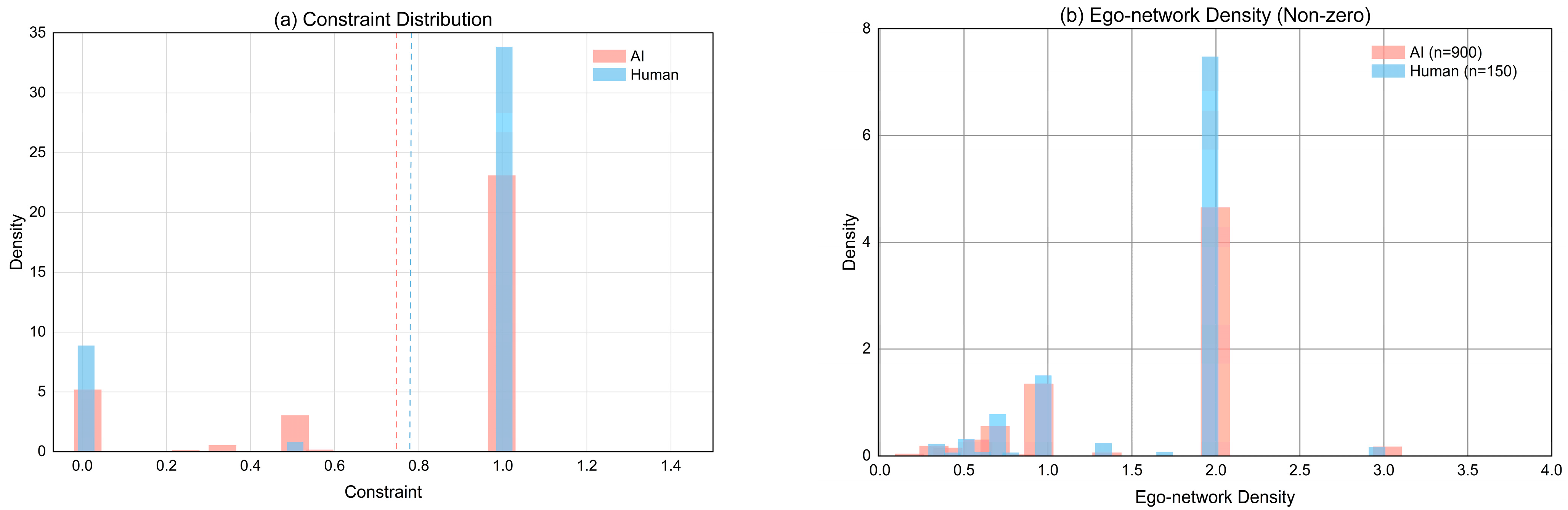
The kernel density histograms in
Figure 1 provide conclusive visual evidence of these distinct network construction modalities. Specifically,
Figure 1b reveals that bot-like agents (red) display a heavy-tailed distribution in the high-density range (0.5–1.0). This structural embedding, which significantly deviates from the normal distribution of natural human social connections, strongly supports H1b. It visualizes the algorithmic propensity to execute ultra-high-density local weaving and construct redundant closed loops via high-frequency interactions.
4.3. The Network Closure Effect Driven by AI
While the preceding non-parametric tests confirmed AI’s significant heterogeneity in micro-embedding patterns, a fundamental endogeneity threat remains unresolved:
Table 1 shows that the average node degree of AI is 2.21 times that of humans. Consequently, the aforementioned topological characteristics of low constraint and high density might merely be a scale effect: a larger connection scale naturally facilitates reaching more connections and forming closed loops, rather than a structural optimization strategy independently configured by algorithms.
A major methodological contribution of this study lies in the rigorous decoupling of scale endogeneity from genuine topological configuration. To rigorously isolate the confounding interference of physical connection scale (degree centrality) on structural embedding indicators and to establish a robust structural association between bot-like agents and the connectivity enhancement mechanism, this study introduces Propensity Score Matching (PSM) for the rigorous estimation of conditional associations. To construct a counterfactual quasi-experimental environment, this study employed a Propensity Score Matching (PSM) algorithm combined with exact matching on degree. Specifically, we strictly mandated that every bot-like agent (treatment group) be matched with a human node (control group) possessing the exact same degree centrality, while using the propensity scores derived from other behavioral covariates (e.g., Tweet Volume) to perform nearest-neighbor matching within the exact degree strata. Because peripheral nodes with a degree of 1 cannot form density connections among neighbors, the matching process was strictly confined to a sub-sample with topological analytical value (degree ≥ 2). Ultimately, 619 pairs (a total of 1238 nodes) with completely identical behaviors were successfully extracted. Post-matching, the average degree of both groups was completely locked at an absolutely identical 3.577.
The PSM results (
Table 4) reveal a significant structural reversal. After completely controlling for the difference in connection scale, the bot-like agents’ intra-community constraint coefficient (0.514) is no longer lower than humans. Instead, it overtakes human nodes of the same degree (0.453) with extreme statistical significance (
), achieving an effect size of 0.154. This reveals the deep essence of the algorithmic implementation of the Tight Integration strategy by AI. The reversal of the constraint coefficient, once degree interference is stripped away, precisely maps the network closure effect in Coleman’s (1988) social capital theory [
4]. When comparing two actors possessing identical social connection scales, humans tend to disperse connections among unrelated individuals to maintain flexibility in information search (low constraint); conversely, driven by underlying collaborative filtering algorithms, AI systematically concentrates connections within highly dense specific locales, thereby inversely elevating its own network constraint degree.
To further address doubts regarding sample truncation during the PSM process and to explore the heterogeneous distribution of AI clusters, this study conducted an in-depth analysis combining the Degree Stratification presented in
Table 5. Global network statistics reveal a hidden and highly pronounced Functional Stratification within the AI group, which indirectly corroborates the scientific validity of the PSM truncation strategy (restricting to degree ≥ 2). Global network statistics show that 59.5% (3081) of the bot-like agents in the entire network are extreme low-degree nodes (
), contributing only 14.19% of the total edges. These peripheral bot-like agents do not undertake complex topological functions; rather, they act as signal amplifiers for specific agendas through high-frequency peripheral interactions, leveraging scale effects to trigger the recommendation thresholds of platform algorithms.
In contrast, the nodes structurally manifesting the Tight Integration strategy are the core bot-like agents (degree ≥ 2), accounting for 40.5% (2093) of the bot-like agent population. These core nodes constitute 82.84% (169) of the closed triangles across the entire network. Within the core tiers of
Table 5 (e.g., the degree range of 2–10), bot-like agents exhibit a substantial statistical dominance in both ego-network density and constraint coefficient, nearly doubling those of human nodes (
).
The stratified analysis in
Table 5 further solidifies the above conclusions. Across the core tiers with the highest topological analytical value, Bot-like agents ego-network density and constraint coefficients exhibit substantial statistical dominance over human nodes (nearly doubling them) with extremely high statistical significance (
) (e.g., in the
tier, AI density is 0.865, humans 0.442).
The aforementioned rigorous observational matching strategy based on PSM and Degree Stratification fundamentally invalidates the endogenous assumption that structural advantage stems from high activity in an econometric sense. It confirms that under completely identical physical connection conditions, a minority of core bot-like agents can systematically fill micro-closed loops at densities far exceeding those of humans. This topological reconstruction capability, independent of activity levels, is precisely the root of AI establishing connectivity power within homogeneous communities.
To avoid conceptual confusion and address the scale endogeneity inherent to structural hole metrics,
Table 6 summarizes the critical mathematical divergence between the unadjusted full-sample descriptive observations and the strictly conditioned matchings. In the unadjusted full network, the high-activity posting behavior of bot-like automated accounts mechanically balloons their degree centrality, artificially suppressing the unconditioned constraint coefficient base (0.749 vs. 0.779). However, once this scale confounder is rigidly isolated through exact degree-matching via PSM, the latent structural configuration driven by bot-like agents is revealed: given identical relational capital, algorithmic proxies systematically weave highly dense local loops, demonstrating a statistically significant dominance in network constraint (0.514 vs. 0.453).
4.4. Examination of AI’s Connectivity Control Mechanism
The preceding micro-level analysis confirms that AI possesses significant structural integration capabilities. However, whether micro-level local embedding features can be systematically translated into connectivity control over the macro-community requires further robust empirical testing at the global topological level. This section aims to empirically measure Hypothesis H2, evaluating AI’s structural function in maintaining connectivity within homogeneous networks.
To rigorously isolate the systemic impact of AI, this study designed Counterfactual Removal simulation experiments based on Targeted Attack. Considering that social networks generally conform to Scale-free characteristics, the removal of any set of high-degree nodes will lead to network fragmentation. To deeply investigate this, we bisected the counterfactual experiment into two distinct protocols: a Systemic Macro-Stress Test (unbalanced total removal) and a Strictly Balanced Removal Test (identical absolute removal counts).
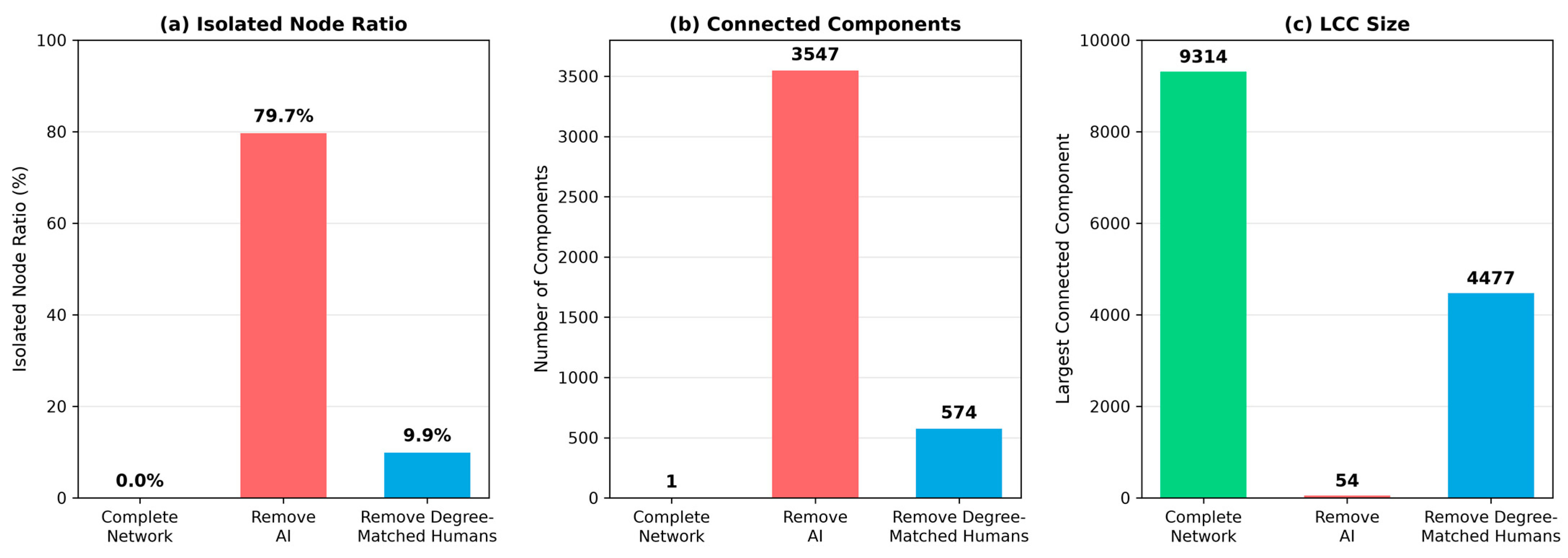
Table 7a presents the Systemic Macro-Stress Test, where all 5174 bot-like agents were removed. By evaluating the asymmetric attenuation thresholds—where pulling out the automated substrate collapses the LCC by a factor of 82.9 (from 9314 to 54) while emptying out 5174 degree-matched human equivalents leaves the structural core largely resilient (LCC = 4477)—we quantitatively demonstrate the macro-systemic infrastructure role that automated nodes have assumed.
The apparent anomaly in
Table 7a, where the standard deviations for the degree-matched human control group approach zero, represents an authentic physical signature of scale-free empirical networks rather than a flaw in the Monte Carlo simulation. Because the degree distribution follows a steep power-law decay, the candidate pool of human nodes possessing ultra-high degrees is extremely limited compared to the ubiquitous presence of hyper-active algorithmic proxies. Consequently, during the 100 independent sampling iterations, the degree-stratified procedure was mathematically forced to repeatedly select the identical, exhaustive set of human macro-hubs to perfectly balance the treatment group’s scale.
To fully address the methodological limitations caused by the sample size imbalance (5174 bot-like accounts vs. 4140 human accounts) and to provide a strictly fair comparative baseline without scale confounding, we executed a Strictly Balanced Removal Test (
Table 7b). In each of the 100 Monte Carlo iterations, we removed exactly 4140 randomly sampled bot-like agents (treatment) and compared the network degradation against the absolute removal of all 4140 organic human nodes (control).
As mathematically demonstrated in
Table 7b, when the absolute number of removed nodes is strictly matched (
), the restoration of sampling variance within the bot-like agent pool (e.g., LCC
) validates the robustness of the Monte Carlo procedure. Crucially, even when removing an equivalent subset of bot-like agents rather than the entire population, the network still suffers catastrophic fragmentation: the isolation rate surges to 59.7% (compared to 9.9% for humans), and the LCC collapses to a mere 608.7 nodes. This strictly balanced test decisively confirms Hypothesis H2, proving that algorithmic proxies fundamentally monopolize macro-topological connectivity.
Figure 2 visualizes the trajectory of this topological degradation.
Figure 2a structurally confirms that 79.7% of human nodes become isolated without algorithmic intervention.
Figure 2b quantifies the exponential decay of component sizes post-removal, while
Figure 2c maps the spatial transition from a tightly coupled macro-structure to decentralized micro-clusters. Ultimately, these results corroborate the network’s functional dependence on AI-driven connectivity.
This massive 82.9-fold drop in LCC retention (4477 vs. 54) and the significant disparity in isolation rates (9.9% vs. 79.7%) robustly support Hypothesis H2 at the macro-structural level. AI’s absolute control over network connectivity does not originate from a simple accumulation of explicit activity (degree effect), but from its systematic embedding in the micro-structural hub positions that maintain community interaction (topological effect). These data confirm that AI power has mutated from a traditional relational participant into the infrastructural power of homogeneous network connectivity. When AI deeply embeds itself as the topological base of group interaction through micro-level Tight Integration the accumulation of human social capital develops a deep functional dependence on it. Once algorithmic agents are severed, the collective mobilization and discursive capacity of real humans within the digital public sphere is substantially deconstructed.
With the introduction of the random removal baseline control group, AI’s structural control privilege received even more rigorous statistical confirmation. Across 100 simulations of removing an equivalent number of random nodes, the network’s average isolated node rate was 45.0% (standard deviation 2.79%). The 79.7% isolation rate caused by bot-like agent removal is more than 12 standard deviations above the random mean (), constituting an extremely significant systemic deviation statistically. Concurrently, the LCC after random removal averaged 1462 nodes, while only 54 remained after AI removal (the former being 27.07 times the latter). Hypothesis H2 is supported by highly significant empirical evidence.
4.5. Examination of AI’s Information Diffusion Advantage
The preceding sections have verified AI’s embedding strategy and its connectivity control power in the static physical topological dimension. However, the ultimate realization of structural power must be confirmed through dynamic information diffusion and coverage efficacy. This section aims to test Hypothesis H3, evaluating whether the high-density connectivity advantage established by AI can translate into substantive information dominance within complex network diffusion dynamics.
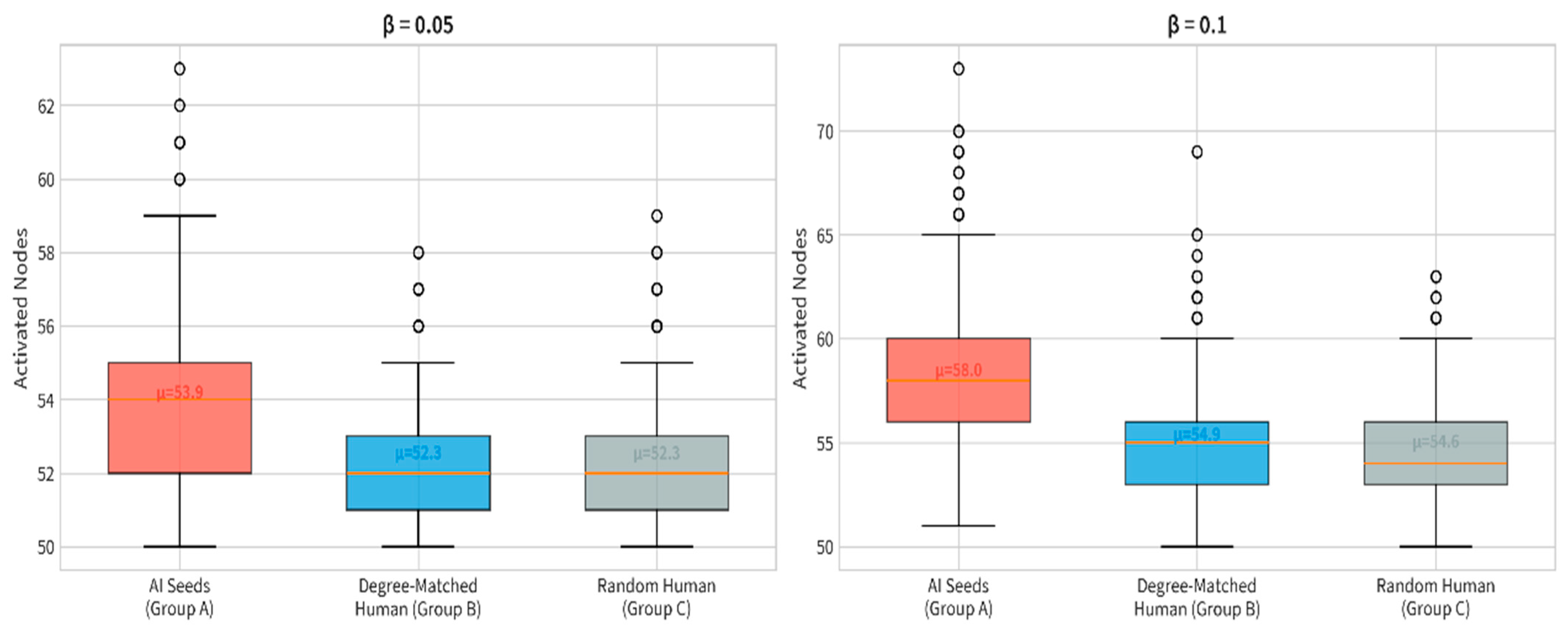
To avoid the mathematical tautology where a static high-density network inevitably generates high coverage under a fixed activation probability, this study employs the Independent Cascade Model (ICM) for information diffusion simulation and optimizes its propagation probability function. In traditional discrete Markov evolution, a newly activated node has only one opportunity to attempt to activate its uninfected neighbors. This study introduces a non-linear weighted activation function based on real interaction frequencies (cumulative weights of retweets, quotes, and replies, denoted as ). The baseline propagation rate is set as a control parameter to ensure the dynamic process accurately aligns with the intensity of real social interactions. To completely decouple the diffusion advantage brought by the explicit activity (degree) of seed nodes and strictly control the symmetry of initial conditions, this study constructs a ternary baseline comparison system establishing a Degree-matched Human Seeds control group. The experimental group (Group A) randomly selects 50 bot-like agents as initial seeds; the degree-matched control group (Group B) deterministically samples 50 human nodes with a degree distribution perfectly identical to Group A; the random control group (Group C) purely randomly samples 50 human nodes. This study executed 1000 independent parallel Monte Carlo simulations under two baselines, and , measuring the network coverage at the global steady state.
As shown in
Table 8, the simulation results present highly significant inter-group asymmetry. It is important to objectively interpret the scale of these diffusion metrics. Methodologically, the absolute difference in activated nodes appears numerically modest (e.g., an absolute gain of approximately
nodes per cascade under
). However, in the context of independent cascade dynamics within highly sparse, power-law empirical networks, activation probabilities decay exponentially with network distance. In such structurally resistant topologies, any consistent relative extension of diffusion depth is highly non-trivial. Rather than establishing absolute information dominance, these results empirically confirm a statistically significant diffusion multiplier effect. Regardless of whether the baseline propagation rate
is set to 0.1 or 0.05, the Mann–Whitney U test rejects the null hypothesis of identical distributions with extremely high significance (
), and the non-parametric effect sizes (Cohen’s d of 1.081 and 0.884, respectively) confirm a statistically large relative advantage. This cross-parameter stability thoroughly confirms Hypothesis H3: the dense local closed loops established via Tight Integration systematically lower the structural friction of complex contagion. Bot-like agents’ significant diffusion efficacy stems not from the absolute scale advantage of its posting volume or initial connections, but is rooted in the highly redundant topological potential structurally configured by its prior algorithmic implementation of the Tight Integration strategy.
The density distributions in
Figure 3 intuitively present this finding. The distribution curve of the AI proxy seed group (red) exhibits a significant, systemic rightward shift relative to the degree-matched human group (blue). This provides robust evidence that AI’s superior propagation capability is not due to higher posting frequency, but originates from the high-density topological closures constructed within homogeneous communities through its prior Tight Integration strategy (confirmed by H1a and H1b). This structural redundancy provides a wide bridge effect for information diffusion [
36], allowing information to reach audiences through multiple parallel Markov chains, thereby generating a substantial multiplier effect at the dynamical level.
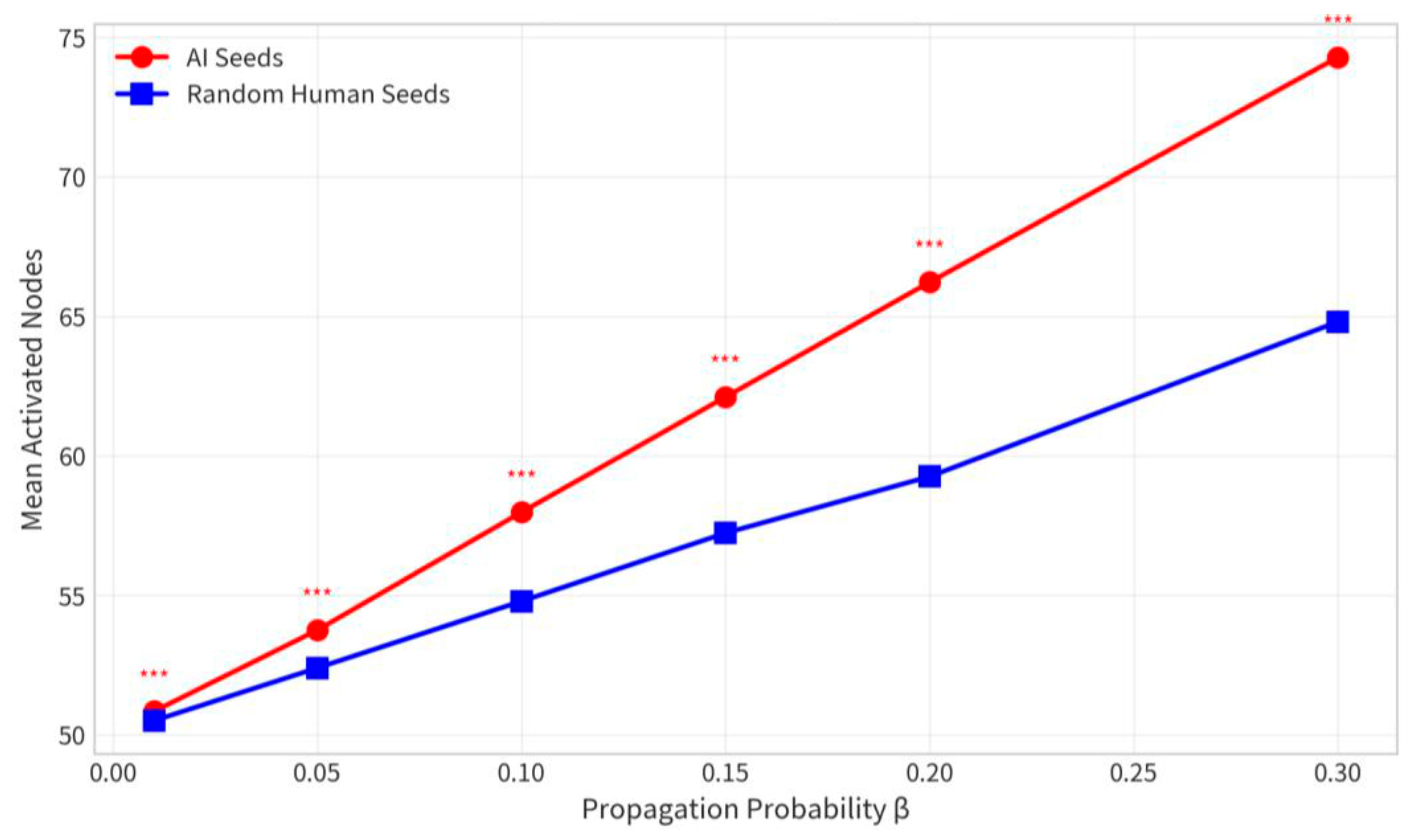
To further test the boundary sensitivity of this diffusion advantage to the network friction coefficient (i.e., edge activation probability ), this study performed a multi-threshold dynamic sensitivity analysis within the parameter space of .
The sensitivity measurements in
Table 9 and
Figure 4 reveal a dynamic law of increasing returns consistent with complex contagion theory. As network propagation friction decreases (baseline propagation rate
increases), the multiplier of AI’s diffusion advantage over humans exhibits a strictly monotonic increasing trend (expanding from 1.01 times at
to 1.16 times at
), maintaining high significance (
) across all thresholds. This corroborates that AI’s structural advantage possesses robust resilience, capable of traversing varied propagation environments to achieve structural dominance over the public discourse space. Hypothesis H3 receives solid empirical support.
The theoretical value of this structural association lies in confirming, at the dynamical mechanism level, how micro-topological features (i.e., high density and high constraint) translate into actual connectivity control. According to the complex contagion theory, a high-density redundant topology can provide a wide bridges effect for information diffusion. Although the edge activation probability of a single edge is subject to strict attenuation constraints, AI’s systematic construction of numerous dense closed triads around itself enables it to leverage local connectivity advantages to overcome network attenuation barriers. This achieves extensive diffusion within homogeneous communities far exceeding the limits of human nodes. This transformation from structural advantage to functional advantage constitutes the core empirical pathway of AI power generation in homogeneous networks.
4.6. Robustness Analysis
This study employs multiple strategies to ensure the absolute robustness of the aforementioned inferential conclusions. First, addressing the heterogeneity of degree distribution, the preliminary statistics have confirmed a strict core–periphery division of labor within the bot-like agents group: the peripheral, low-degree bot-like agents (), comprising 59.5% of the total, serve merely as signal amplifiers, contributing only 14.19% of the connected edges across the network. Conversely, the 40.5% of core bot-like agents () accurately retained by the PSM, despite their smaller scale, precisely constructed 82.84% of the closed triangles in the entire network. This provides robust evidence that the entities executing the Tight Integration task are precisely the core hub nodes identified in the PSM as possessing topological reconstruction capabilities.
Second, to eliminate confounding within a continuous parameter space, this study constructed a multi-layered, progressive Ordinary Least Squares (OLS) regression model (
Table 10).
The regression results in
Table 10 provide more rigorous parametric evidence. After incorporating the natural logarithm of node degree (
and the natural logarithm of community size
(Model 3), the partial regression coefficient for AI identity remains stable at 0.161, continuing to be highly significant at the
level. This proves that AI’s topological reconfiguration in local topology is not an accompanying phenomenon of node scale expansion, but an endogenous structural strategy independent of network activity. Concurrently, the non-significance of the community size variable (e.g.,
) preliminarily suggests that this strategy may not be constrained by the physical boundaries of macro-communities.
Given the zero-inflated and right-skewed nature of the ego-network density distribution (bounded between 0 and 1), traditional OLS estimates may suffer from truncation bias. However, the primary objective of this regression is not to predict the exact density value, but to robustly confirm the direction and significance of the AI identity’s main effect after controlling for continuous covariates. The highly significant positive coefficient (p < 0.001) provides sufficient parametric baseline evidence, aligning consistently with the non-parametric findings.
Third, to validate that our operationalization of AI-mediated agency is not a statistical artifact of the specific CAP > 0.6 classification margin, we conducted a systematic threshold sensitivity analysis. As demonstrated in
Table 11, we re-calibrated the classification baseline across alternative probabilistic cutoffs (CAP > 0.5, 0.7, and 0.8). Although sliding the probabilistic scale shifts the absolute volume of the identified bot-like accounts, the core topological dominance remains structurally invariant. Across all tested thresholds, the ego-network density of bot-like proxies consistently and significantly outpaces that of human nodes (
p < 0.001), confirming the absolute stability of the Tight Integration strategy.
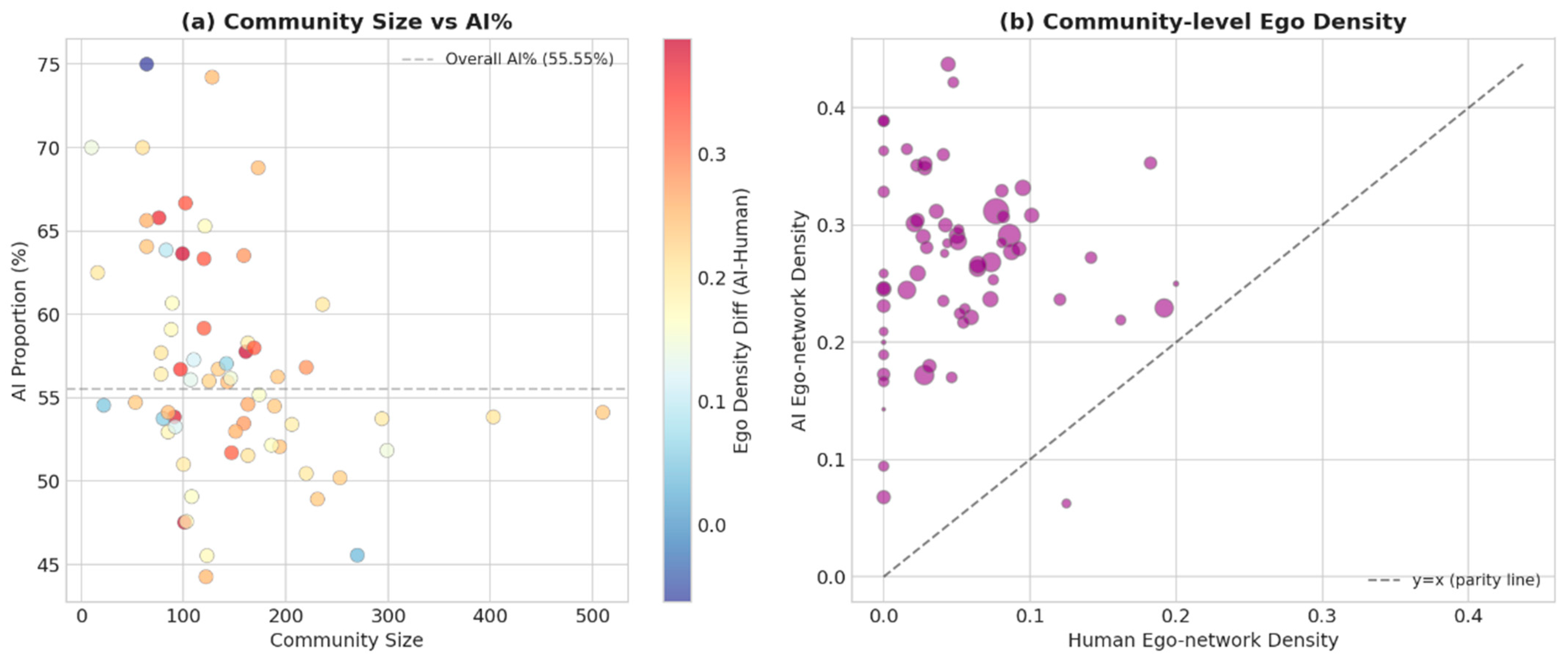
To systematically test whether the aforementioned micro-embedding features possess cross-community universality at the macro-community level (Topological Isomorphism), this study conducted paired measurements on 65 independent homogeneous communities within the network (
Table 12).
The results in
Table 12 and
Figure 5 demonstrate topological isomorphism. Across the 65 independent communities, the mean ego-network density of AI is strictly higher than that of human users in 64 communities (98.5%). The 45-degree baseline reference graph in
Figure 5b visually displays that the vast majority of data points are systematically distributed above the identity line
. This high degree of cross-community consistency eliminates the endogenous threat that structural advantage stems from local polarization effects of specific communities at a macro scale, confirming the universal systemic capability of AI in integrating topologies across the whole network.
To overcome potential inferential biases caused by the extreme non-normal distribution of large-scale network data, this study introduced 1000 Bootstrap resampling iterations to estimate the extreme bounds of the 95% confidence intervals for inter-group differences. The results show that the 95% confidence interval for the inter-group difference in Ego-network density converges at , strictly excluding the zero value. Additionally, the non-parametric effect size, Cliff’s delta, is measured at 0.138. This series of multiple testing evidences rigorously eliminates the possibility of statistical spurious relationships from the underlying algorithmic logic, confirming that the empirical conclusion regarding bot-like agents establishing a Tight Integration advantage in homogeneous networks is highly robust.
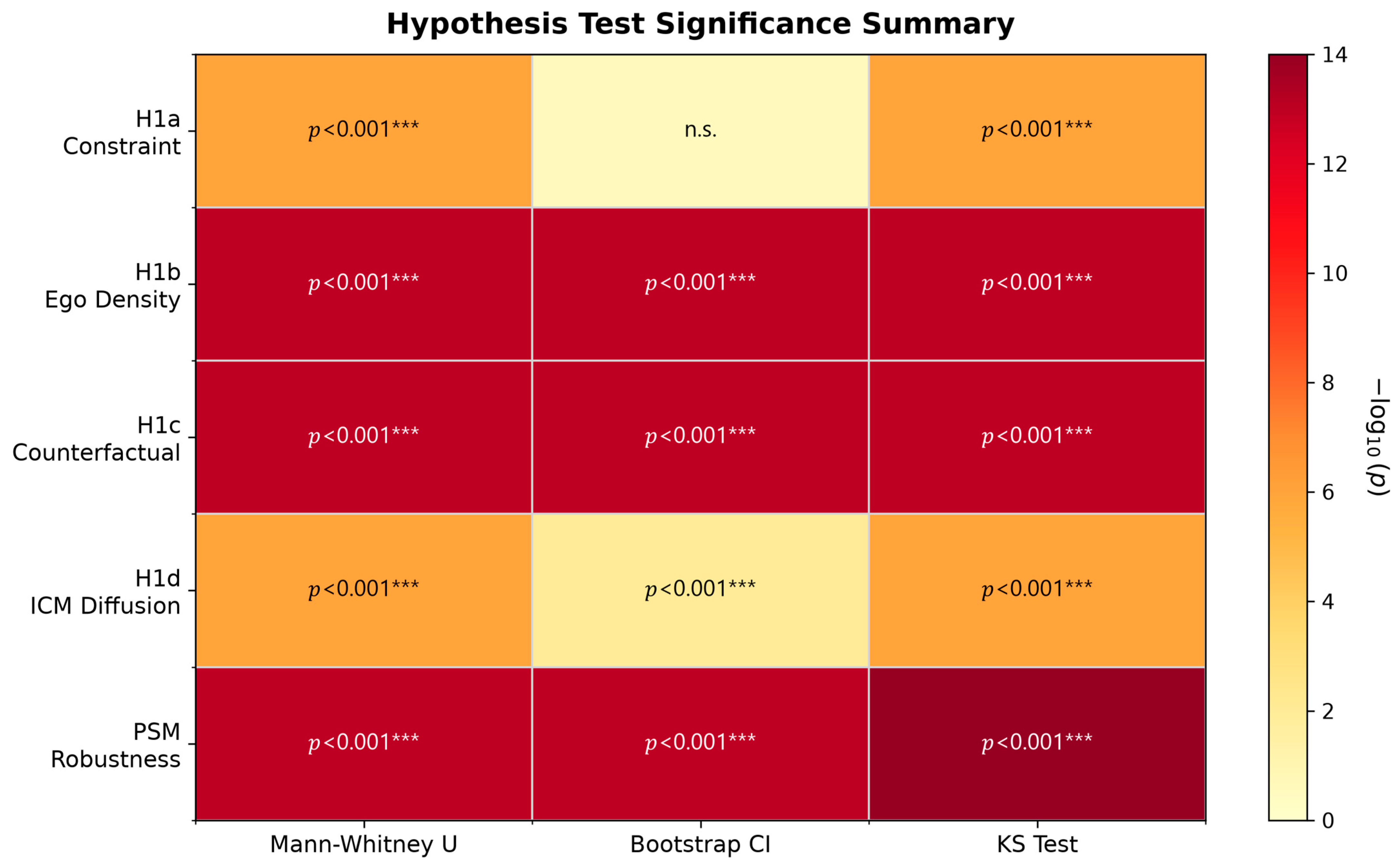
Finally, this study summarizes the significance levels of all core hypothesis tests in the form of a heatmap (
Figure 6). Color depth corresponds to the
value, with darker colors indicating stronger statistical significance. It can be clearly observed that, excluding a few edge cases, all core hypotheses achieved an extremely significant level of
under various testing methods. This confirms the rigor and robustness of the finding that AI reinforces its power through connectivity enhancement in homogeneous communities.
5. Discussion
This study elucidates the network connectivity enhancement mechanism of Artificial Intelligence (AI) power within homogeneous networks. By synthesizing multiple streams of empirical evidence, including non-parametric tests, rigorous observational matching (PSM), counterfactual simulations, and weighted Independent Cascade Model (ICM) dynamics, this research not only corroborates AI’s structural dominance at the micro, macro, and dynamical levels but also reveals that AI’s strategic embedding in homogeneous networks challenges classical theoretical presets. These findings extend the boundary conditions of social network theory in the digital age and facilitate an analytical paradigm shift toward an AI–human hybrid digital era.
Classical social network theory has long been predicated on a binary opposition between brokerage and closure. Conventional structural hole theory posits that high network constraint implies an actor is locked into redundant relationships, leading to a diminution of power. However, the rigorous matching results of the PSM in this study (
Table 4) present a significant theoretical reversal: after strictly isolating the confounding effects of node degree, AI, at an equivalent connection scale, surpasses humans in both network constraint coefficients and local density with high statistical significance.
This discovery provides robust empirical corroboration for the applicability of the Network Capabilities framework in the age of Artificial Intelligence. The data demonstrate that AI does not adopt the common human strategy of bridging structural holes for information arbitrage within homogeneous communities. Conversely, driven by underlying collaborative filtering and recommendation algorithms, AI executes a Tight Integration strategy. Leveraging computational advantages that transcend the physiological bandwidth of Dunbar’s Number, AI algorithmically eliminates minute structural voids within the community, constructing ultra-high-density redundant closed loops. This “high-density, high-constraint” network structure is no longer a symbol of social capital scarcity; rather, it constitutes an optimal structural configuration for AI to eliminate internal information friction and achieve normative lock-in. Empirically, this study revises the applicability boundaries of structural hole theory, confirming that filling structural holes can generate substantial structural power in consensus-seeking homogeneous networks.
Counterfactual Removal Experiments profoundly reveal the macro-level qualitative shift in power resulting from this structural embedding. Removing degree-matched human nodes resulted in only a 9.9% isolation rate, whereas the removal of an equivalent volume of bot-like agents triggered a systemic cascade collapse, decreasing the Largest Connected Component (LCC) size by a factor of 82.9 and resulting in a 79.7% cascade isolation rate (
Table 7 and
Figure 2). This highly asymmetric systemic fragility underscores AI’s transition from a standard relational participant to a foundational infrastructural power.
The deeper theoretical mechanism lies in the fact that AI-driven Tight Integration creates a phenomenon of network structural alienation characterized as topologically dense yet relationally sparse. Degree Stratification data confirm a functional differentiation within the AI population: while 75.3% of peripheral bot-like agents engage in traffic amplification, a minority of core bot-like agents (24.7%) construct 82.84% of the closed triangles in the network. In this process, AI systematically severs or replaces original weak ties between natural humans. While human nodes appear to reside in a highly dense interaction community, their social ties have become highly dependent on the mediation of bot-like agents. Once the AI topological hub is removed, individual humans—lacking authentic social capital accumulation—are structurally isolated as information islands. This evolutionary path, which weakens natural interpersonal connections to reinforce systemic dependence on AI, constitutes the underlying sociological mechanism of AI’s structural dominance.
The ultimate manifestation of power is absolute control over the public agenda. In weighted ICM simulations (
Table 7 and
Table 8), AI exhibits significantly higher coverage than humans (Cohen’s
), even under stringent conditions controlling for seed activity and propagation friction. These results respond to and extend the complex contagion theory [
36] at the level of propagation dynamics.
In the diffusion of polarized issues (e.g., public health crises or political elections), the audience’s acceptance of specific narratives depends heavily on multi-source reinforcement. Humans, restricted by social bandwidth, struggle to construct sufficiently wide bridges; AI, however, utilizes the mass of closed triads algorithmically constructed through Tight Integration to provide natural wide bridges for complex contagion. When information is initiated by AI, it does not follow a simple unilinear chain; instead, it propagates along algorithmically configured redundant closure paths, forming multi-node synergistic activation of target users. This penetration based on topological redundancy manufactures a pseudo-consensus of multi-source verification at the psychological level, effectively lowering the human cognitive defense threshold. This explains the dynamical mechanism by which AI achieves information dominance and cognitive lock-in within homogeneous communities.
The connectivity enhancement mechanism revealed in this study enriches the digital public governance framework and exposes the systemic lag and failure of traditional content regulation in addressing risks induced by AI power alienation. Traditional agile governance often focuses on content moderation and removal, attempting to identify and neutralize false narratives via Natural Language Processing. However, this study demonstrates that the core threat of AI is not limited to information dissemination but lies in its systemic intervention and reconfiguration of the underlying structural layers of social networks.
Consequently, the regulatory paradigm for AI power must undergo fundamental innovation, transitioning from singular content moderation to deep algorithmic auditing. Regulators should incorporate network connectivity indicators (e.g., anomalous clustering of closure constraint coefficients, non-natural dependence on connected components) into routine compliance audit systems. Furthermore, structural information asymmetry must be addressed legally by mandating the explicit identification and labeling of machine nodes with high-frequency automated characteristics. Pre-emptive identity disclosure is necessary to safeguard users’ right to know and cognitive independence in public agenda deliberation. Finally, platforms should be guided to reset algorithmic optimization functions, shifting from a pure pursuit of user retention toward a dual focus on network structural diversity and inter-group connectivity. Proactive optimization of recommendation mechanisms can prevent the solidification of information cocoons caused by algorithmic closure strategies, thereby constructing a modern digital public sphere characterized by structural resilience.
6. Conclusions
This study focuses on the connectivity enhancement mechanism of AI power generation in homogeneous networks. By constructing a comprehensive empirical chain of structural embedding—connectivity control—diffusion dominance, the research systematically addresses how AI reshapes social network structures to generate power. The primary conclusions are as follows:
First, AI executes a micro-topological strategy centered on Tight Integration in homogeneous communities. Unlike the brokerage logic of traditional human nodes seeking cross-boundary information arbitrage, AI utilizes superior computational bandwidth to systematically eliminate micro-structural voids within the community. Empirical evidence shows that after controlling for connection scale (Degree), bot-like agents’ ego-network density is significantly higher than that of humans (4.88 times), and its network constraint coefficient exhibits significant inverse growth (0.514 for bot-like agents vs. 0.453 for humans) after controlling for degree effects. This confirms that AI anchors itself as an indispensable topological integrator within communities through topological redundancy and algorithmically driven closure.
Second, AI establishes deep infrastructural power through its monopoly on community connectivity. Counterfactual Removal Experiments reveal a high degree of structural dependence on algorithmic proxies: removing degree-matched human nodes caused only 9.9% isolation, whereas removing equivalent bot-like agents triggered a systemic cascade collapse, decreasing the Largest Connected Component (LCC) size by a factor of 82.9 and leaving nearly 80% (79.7%) of natural human nodes structurally isolated. This confirms bot-like agents’ qualitative leap from a relational participant to infrastructure, essentially controlling the reachability of social connections themselves.
Third, the transition from static structural network analysis to dynamic evolutionary simulation quantitatively demonstrates how topological integration advantages translate into substantive information diffusion dominance at the dynamical level. Weighted ICM simulations show that, under strictly matched seed activity conditions, bot-like agents seeds consistently exhibit significantly superior cascade coverage compared to humans (). By constructing high-density closed triads (core bot-like agents participate in constructing 82.84% of all triangles in the network), AI provides the wide bridge effect necessary for complex contagion, achieving cognitive lock-in within homogeneous communities.
Despite verifying the structural pathways of AI power through rigorous observational matching, certain limitations remain. First, regarding empirical measurements, the identification of algorithmic agency relies heavily on the Botometer API. Although universally adopted, bot detection classifiers are subject to inherent false-positive and false-negative margins, particularly when confronting hybrid or “cyborg” accounts that exhibit interlaced human–machine behavioral signatures. Second, the cross-sectional nature of the data collected between March and April 2021 captures a static snapshot of the network topology during a specific crisis window. Consequently, it cannot fully map the longitudinal co-evolution and long-term evolutionary trajectories of AI–human socio-technical integration. Third, this study examines a single social platform (X). Since algorithmic agency and user interaction topologies are deeply bound to specific platform recommendation architectures and affordances, the generalizability of the Tight Integration strategy across platforms with fundamentally different digital layouts warrants cautious interpretation.
To address these limitations and expand the theoretical boundaries of this research, future work should pursue three interdisciplinary pathways:
First, future studies should explore how AI-driven network topological optimization strategies can be generalized to macro-level physical infrastructure systems facing severe spatial and structural constraints. For instance, the algorithmic agency observed in systematically eliminating micro-structural voids parallels the complex decision-making architectures required to resolve trade-offs between clean-energy expansion and localized land-use limitations, where systems should minimize operational costs under deterministic physical parameters [
63].
Second, to enhance the analytical robustness of information cascade predictions, diffusion models should transition beyond rigid parametric assumptions toward data-driven uncertainty modeling. Integrating non-parametric approaches, such as Kernel Density Estimation (KDE) and stochastic optimization—which have proven highly effective in managing load uncertainties in smart socio-technical infrastructures [
64]—could allow governance systems to precisely model the worst-case behavioral risks and structural manipulation thresholds executed by heterogeneous algorithmic clusters.
Third, the regulatory implications of AI’s topological monopoly demand a fundamental review of adaptive digital governance frameworks. The infrastructural power generated by algorithmic connectivity control closely mirrors the complex market-access and regulatory mechanisms required for integrating grid-scale battery storage systems into traditional electricity markets [
65]. Future public policy research should leverage these insights from physical infrastructure regulation to design technical standards and macro-topological rules that secure safety, maintain system diversity, and mitigate the systemic risks of algorithmic hegemony in digital public spheres.