Article

Institutionalizing Blue Carbon Markets: Lessons from China and Implications for Developing Countries Through Complex Adaptive Systems

Institute of Public Management, Ningbo University, Ningbo 315211, China
*
Author to whom correspondence should be addressed.
Systems 2026, 14(7), 803; https://doi.org/10.3390/systems14070803
Submission received: 14 April 2026 / Revised: 21 May 2026 / Accepted: 6 July 2026 / Published: 8 July 2026

Abstract

As a crucial nature-based climate change solution, the realization of blue carbon’s value is primarily impeded by three interrelated obstacles in developing nations: a weak scientific foundation, fragmented market structures across different levels, and the absence of dedicated institutional frameworks. This study focuses on the institutional bottlenecks hindering the marketization of blue carbon in developing countries. By integrating Complex Adaptive Systems (CASs), Coase’s Theory of Property Rights, and the Institutional Analysis and Development (IAD) framework, we constructed a theoretical framework encompassing five dimensions: transaction objects, transaction participants, transaction markets, transaction rules, and benefit distributions. This framework was validated through an empirical analysis of the blue carbon practice in Ningbo, China. The research identified three critical stages in Ningbo’s governance trajectory: initial founding, synergistic stagnation, and iterative upgrading. The core determinant of governance success or failure lies in the capacity to continuously optimize this five-dimensional rule system through a combination of “top-down regulation” and “bottom-up innovation”, thereby reducing transaction costs and generating effective incentives. The findings indicate that successful blue carbon governance depends on establishing a rule system that is both locally adaptive and dynamically adjustable. The analytical framework proposed in this study offers a systematic new perspective for developing countries to remedy institutional gaps in blue carbon governance. By demonstrating China’s locally adapted innovations in resource rights delineation and value realization, it also promotes greater inclusiveness and diversity within the global blue carbon standard system, contributing a governance approach from the Global South that is applicable to countries at varying stages of development.

1. Introduction

The global climate crisis poses a profound threat to humanity, making climate mitigation and adaptation urgent governance priorities [1,2]. The evolution of international climate governance reflects a transition from the principle of “common but differentiated responsibilities and respective capabilities”—which underpinned the Copenhagen Conference and assigned developed countries a larger share of obligations—toward a collective framework of Nationally Determined Contributions (NDCs) under the Paris Agreement [3]. Nature-based Solutions (NbS), recognized by the International Union for Conservation of Nature (IUCN) as a critical pathway [4], include blue carbon, which offers superior sequestration efficiency and longer storage than green carbon [5], providing irreplaceable offset value [6,7]. Many nations now integrate blue carbon into their NDCs [8], positioning it as vital for low-carbon transition. International carbon markets provide an institutional template, originating from the Kyoto Protocol’s flexible mechanisms—EU Emissions Trading System (EU ETS), Joint Implementation (JI), and Clean Development Mechanism (CDM)—which commodified emissions [9]. The EU ETS and CDM established the dominant paradigms of EU Allowance (EUA) and Certified Emission Reduction (CER) [10], demonstrating the necessity of market-based incentives for emission reductions [11].
China’s carbon market systematically learns from and localizes these international paradigms. Through deep engagement with CDM, China developed a dual system: a compliance market (China Emission Allowance, CEA) as the core of mandatory allowance trading, covering key emission sectors like power, and a voluntary market (China Certified Emission Reduction, CCER) that inherits and optimizes the design kernel of international project-based credit mechanisms [12,13]. Following the CCER’s 2024 relaunch, local governments developed projects complementing the national system [14]. Concurrently, China pioneered local “carbon inclusive” systems targeting consumption-side behaviors, forming a complete closed loop of behavior recording, emission quantification, and value transformation, which turns individual low-carbon actions into tradable credits to bottom-up incentivize small and medium-sized enterprises, communities, and the public [15,16]. Differentiated practices exist regionally, such as in Guangdong, Beijing, and Shanghai. The market is now entering a critical transition where the focus shifts from pursuing higher volume to improving quality, and from fragmented local operations to linked cross-regional coordination. This transition, together with emerging cross-regional collaboration, exemplifies China’s integrated and innovative multi-level market design [17].
Through a series of key policy documents, notably the Opinions on Accelerating the Construction of Ecological Civilization and the General Plan for Institutional Reform of Ecological Civilization, there has been a strategic embedding by China of the enhancement of marine carbon sinks into its priorities [18]. Since this top-down commitment, substantive breakthroughs in value realization have emerged, as evidenced by multiple blue carbon transactions completed in Guangdong, Fujian, Hainan, and Zhejiang [19]. However, the integration of blue carbon faces three structural constraints: (1) weak scientific foundations, where high ecosystem dynamism and the lack of MRV (Measurable, Reportable, Verifiable) systems drive up costs [20]; (2) market fragmentation, where local schemes fail to align with CCER methodologies and lack national conversion pathways, suppressing market vitality [21,22]; and (3) the absence of targeted regulations, where unclear property rights and governance gaps create institutional voids [23]. These deficiencies hinder value realization and stifle market momentum, undermining the positive “protection–development–returns–reinvestment” feedback loop [24,25].
Globally, idealized blue carbon templates often prove difficult to implement effectively in developing countries, primarily due to structural pressures arising from weak formal institutions and informal constraints, which leave such projects trapped at a “potted-plant” pilot stage. Integrating complex adaptive systems (CASs), the Institutional Analysis and Development (IAD) framework, and Coase’s theory of property rights, this study proposes a context-specific analytical framework aimed at exploring how to construct a five-dimensional rule system—covering “transaction objects, transaction participants, transaction markets, transaction rules, and benefit distributions”—in order to dismantle institutional barriers [26]. Taking Ningbo, China, as a case study, the research achieves a systematic paradigm shift through a full-chain closed-loop design and distills universally applicable governance logic. It reveals the formation mechanism of institutional resilience in complex systems, offers a localized reference for developing countries facing institutional deficits, and contributes to the diversified development of global blue carbon standards.

2. Literature Review

Blue carbon research has evolved from scientific understanding to market practice, following a clear trajectory of science advancements, methodology innovations, and institutional progress. These developments closely relate to our analytical framework. Scientific and methodological advances define transaction objects through biophysical boundaries, carbon quantification, and monitoring protocols. Institutional progress from global advocacy to local experimentation directly configures transaction participants, markets, rules, and benefit distributions, providing templates for actor engagement, market design, and incentive alignment. This correspondence justifies the five-dimensional structure and guides subsequent analysis.

2.1. Science Advancements

Scientific understanding of blue carbon has progressed through three paradigm shifts: discovery of carbon sink phenomena, dynamic carbon cycle analysis, and its framing as a Nature-based Solution (NbS). This evolution has elevated blue carbon from a peripheral element to a core mitigation strategy within global climate governance. The first stage, before the formal concept, recognized coastal vegetation’s sequestration function but treated it as marginal to terrestrial cycles [26]. Nellemann et al. characterized mangroves, salt marshes, and seagrass beds as high-burial systems with burial rates 10–100 times those of tropical forests, prompting UNEP to introduce the “blue carbon” concept [27]. The second stage (2009–2019) shifted from static stock descriptions to dynamic analysis. Fourqurean et al. and Mcleod et al., using eddy covariance and sediment core comparisons, analyzed allochthonous inputs and autochthonous burial mechanisms, expanding the “vegetation–soil” model to a “watershed–tidal flat–coastal waters” continuum [26,28]. The third stage (2020–present) has integrated ecosystem services and NbS perspectives. Seddon et al. and Macreadie et al. advocated placing blue carbon within the Social–Ecological System (SES) framework, viewing it as a comprehensive governance tool for climate mitigation, coastal resilience, and biodiversity [29,30,31,32,33,34]. This systemic turn demands higher measurement precision and refined institutional design for value realization as a public good [35].

2.2. Methodology Innovations

The evolution of blue carbon accounting methodologies has progressed through four stages: empirical estimation, field measurements, remote sensing inversion, and multi-source integration (see Table 1). The empirical estimation stage (2006–2009) relied on IPCC Tier 1 default factors, introducing substantial uncertainty from habitat heterogeneity; Chmura et al. and Duarte et al. established the three major proportionality coefficients through UNEP reports [36,37]. The field measurement stage (2010–2015) saw Donato et al. and Fourqurean et al. establish a standardized survey paradigm (Tier 2/3) using stump-soil core stratification and 210Pb/137Cs dating [38,39,40], while Siikamäki et al. integrated global sample points, reducing estimation error to ±25% [41]. During the remote sensing inversion stage (2016–2020), Earth observation technologies enabled large-scale dynamic monitoring based on LULC; Hamilton et al. generated 30 m resolution global mangrove carbon density maps, cutting spatial errors from ±50% to ±20% [42], and high-frequency dynamic models were incorporated into IPCC Tier 3 guidelines. Since 2020, the multi-source integration stage has focused on full-cycle MRV systems, with Fatoyinbo et al. and Costa et al. assimilating eddy covariance, spaceborne LiDAR, and machine learning to overcome scale-extrapolation bottlenecks, providing technical foundations for market access [43,44].

2.3. Institutional Progress

Institutional innovation has unfolded through three stages: global advocacy, national piloting, and local experimentation. The “global advocacy stage” (2009–2012), centered on the Blue Carbon Initiative launched by Conservation International (CI) and the International Union for Conservation of Nature (IUCN), introduced blue carbon into the United Nations Framework Convention on Climate Change (UNFCCC) negotiation framework. The Blue Carbon Policy Framework proposed including coastal wetlands in the Clean Development Mechanism (CDM) and Reducing Emissions from Deforestation and Forest Degradation (REDD+). During the “national piloting stage” (2013–2018), developed countries translated global methodologies into national standards, integrating blue carbon into Nationally Determined Contributions (NDCs). Howard et al. emphasized integrating blue carbon with marine spatial planning [45]. The three-stage roadmap by Herr et al.—“national wetland inventory—NDC—carbon market” [46]—was adopted by Australia and Indonesia [47], enabling explorations in legal rights confirmation and policy design [48]. Since 2021, the “local experimentation stage” has fostered polycentric-hybrid governance with multi-tiered credit recognition systems. Community co-management mechanisms have emerged [49], transforming blue carbon into grassroots governance [50]. This phase has witnessed a proliferation of case studies, enriching the empirical evidence base. Quevedo et al. conducted community perception experiments in the Philippines and Indonesia [51,52,53], proposing a “carbon-livelihood-disaster prevention” bundled payment model. Wylie et al., analyzing Kenya’s Mikoko Pamoja project, demonstrated voluntary carbon standards (VCS) effectiveness in addressing “tragedy of the commons” issues [54], emphasizing stakeholder incentive alignment [55]. In Guangxi, China, a “cooperative + carbon credit” mangrove management model returned 30% of carbon revenues to communities as “ecological shares” [55]. This institutional evolution provides differentiated governance templates for countries at various development stages.
Despite progress, the literature reveals structural mismatches in applying international blue carbon frameworks to developing countries [56], arising from three salient research gaps: cognitive frameworks derived from Western ecosystems inadequately capture local social–ecological couplings [11,57]; high-precision MRV is constrained by prohibitive costs and data scarcity [58,59]; and developing nations exhibit path dependence on developed-country models [60], leaving a theoretical void in cost internalization under ambiguous property rights and multi-stakeholder coordination [61]. To bridge these gaps, this paper examines the positive and negative feedback mechanisms in blue carbon governance, employing the Ningbo case to trace the transition of blue carbon from a resource to an asset and the co-evolution of institutional rules, thereby generating context-sensitive insights for developing countries.

3. Research Methodology

3.1. Research Site

This study selected Ningbo City and its subordinate Xiangshan County in Zhejiang Province as the research site. Located on the southern wing of the Yangtze River Delta, Ningbo covers 9816 km2 of land and 9758 km2 of sea area with 1562 km of coastline. By the end of 2024, its population reached 9.78 million with a GDP of 1.81 trillion RMB, establishing it as a major port city with rich commercial and maritime traditions. Xiangshan County, situated between Xiangshan Harbor and Sanmen Bay, encompasses 1382 km2 of land and 6618 km2 of sea area with 988 km of coastline. By the end of 2024, its population reached 0.58 million with a GDP of RMB 94.3 billion, establishing it as a nationally designated marine fishery ecological protection area characterized by fisheries and the marine economy.
Three considerations justify this selection: First, this site pioneers China’s first blue carbon auction, demonstrating temporal completeness from resource accounting to financial support. Second, its temperate estuarine tidal flats and algal cultivation systems represent coastal East and North China, contrasting with tropical mangrove regions [62]. Third, its algae and shellfish cultivated carbon sinks constitute important components of China’s blue carbon system with national promotion potential, reflecting resource typicality.

3.2. Research Method

To investigate in depth the institutional evolution of blue carbon governance in China, this study adopted structured process tracing as its core research method. This method is not a mere descriptive tool, but a rigorous analytical approach designed to uncover complex causal relationships, particularly suited to answering the “how” and “why” questions in complex social phenomena—focusing not only on “what happened” but also on explaining the underlying logic chain of “why it unfolded in this way” [63]. It thus aligns closely with the present research: as an emerging field, the institutional evolution of blue carbon governance is not the result of top-down linear design, but a nonlinear process in which multiple actors continuously interact, experiment, and learn amidst multiple uncertainties in policy, market, and science. Because process tracing emphasizes temporality, mechanistic evidence, and causal process observations, it can effectively capture the causal mechanisms and critical decision nodes in blue carbon governance from initial conditions to outcomes, thereby transcending static correlational or comparative analyses and providing a rigorous analytical pathway for explaining the logic of institutional emergence and evolution.
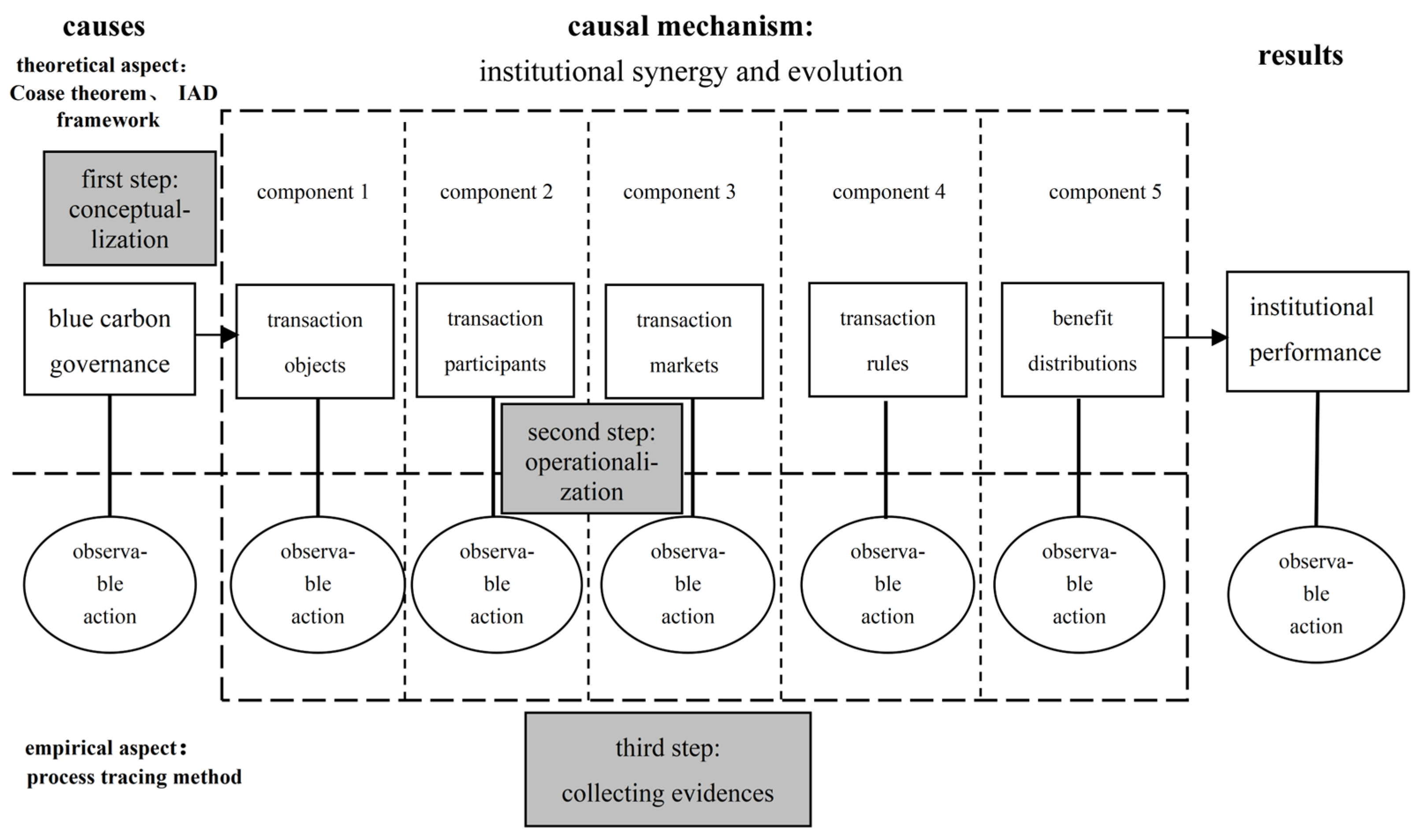
In this study, this means conceptualizing blue carbon governance as a dynamic, multi-actor interactive complex adaptive system, focusing on the strategic interactions among diverse actors—including government, enterprises, and research institutions—based on their respective behavioral logics. The research aims to reveal how these micro-level interactions, through temporal progression and interconnectedness, ultimately “emerge” as macro-level institutional structural changes and governance performance.
Based on this method, we constructed a structured analytical framework (see Figure 1), with the analytical process divided into three closely related steps. First, drawing on Coase’s theory of property rights and the Institution Analysis and Development framework (IAD), we articulated the causal mechanisms of blue carbon governance evolution—specifically how key variables such as transaction objects, transaction subjects, and transaction rules interact in a sequenced manner to drive institutional transitions. Second, we operationalized these theoretical mechanisms into observable and verifiable empirical manifestations. Third, through systematic collection and analysis of multi-source historical evidence, we tested and evaluated the theoretical pathway, thereby revealing the dynamic causal process from strategic interactions among actors to adaptive adjustments in governance structures and ultimately to the emergence of institutional resilience or difficulties [64].

3.3. Data Collection

To ensure the reliability and validity of the research, this study adopted the triangulation principle, collecting multiple sources of data through various channels to form a complete evidence chain. First, we conducted an in-depth analysis of policy documents and reports at various levels, systematically examining the policy texts, public reports, internal reports, and academic literature involved in the project implementation process. Second, between July and August 2025, we carried out four in-depth, semi-structured, face-to-face interviews. Prior to the interviews, we made initial contact by telephone with research institutions, government agencies, trading platforms, and representative enterprises, explaining the research purpose and confirming the core informants. On this basis, drawing on the theoretical analytical framework constructed in this study, we designed an interview guide covering five dimensions: “transaction objects, transaction participants, transaction markets, transaction rules, and benefit distributions”. During the in-person interviews, we focused on the actors’ role perceptions, behavioral logic, and interaction details at key decision nodes. We also compiled and preserved complete interview records, cross-validated the narratives of different actors regarding the same key events, and reconstructed the full picture. Although the interview sample consists of four sessions, it covers four core categories of actors—government, research institutions, trading platforms, and enterprises—constituting a “minimal sufficient actor set” for local blue carbon governance. Their perspectives are complementary, and the information approaches saturation, enabling a complete reflection of the decision-making chain and collaboration network. In addition, we conducted field visits to Xiangshan County, including blue carbon auction sites, algae farming areas, and tidal flat wetlands, to corroborate textual and interview information, together forming a cross-verifiable evidence chain.

4. Theoretical Framework

4.1. IAD Framework

Blue carbon governance exhibits three distinctive characteristics: prominent common-pool resource attributes, diverse governance subjects, and complex nested rule systems. Traditional analytical tools struggle to decipher its mechanisms, whereas Ostrom’s IAD framework, centered on rules and focusing on the structural composition and dynamic adaptation of institutional elements, provides a highly suitable research tool for such multi-level, multi-actor interactions [65].
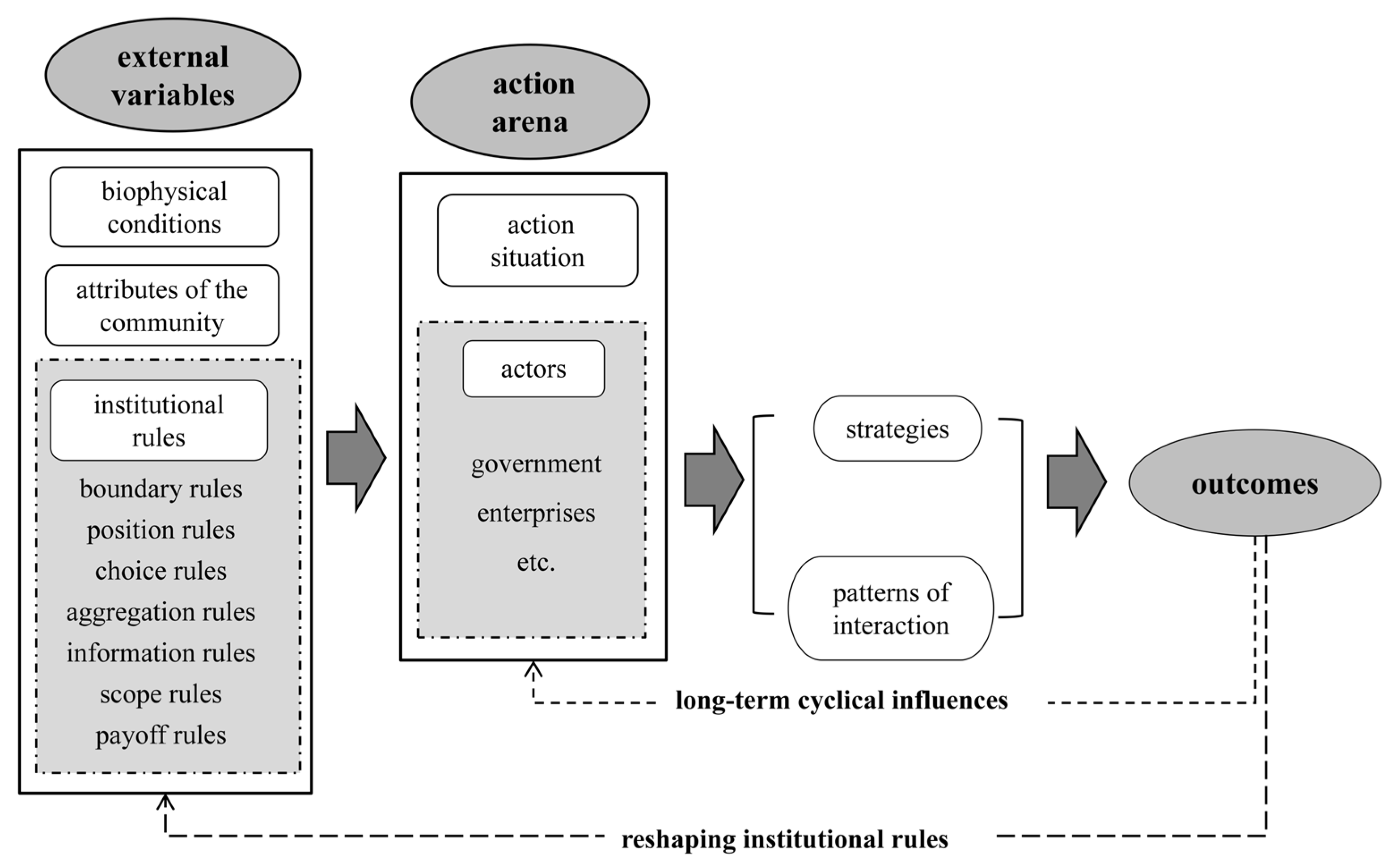
Overall, the IAD framework is used to analyze blue carbon governance by constructing a dynamic cyclic system of “exogenous variables—action arena—outcomes/feedback” (see Figure 2). Exogenous variables—such as biophysical conditions, community attributes, and rules-in-use—establish the basic constraints of the system and shape the action arena encompassing actors and their interaction contexts. Within this arena, diverse actors—including government, enterprises, and research institutions—engage in strategic interactions based on their understanding of rules and their own interests. The resulting outcomes subsequently provide feedback to influence actor strategies and drive rule adjustments. These updated rules and perceptions, as new inputs, propel system evolution, thereby revealing the critical pathways of institutional change [66].
Among these, institutional rules constitute the most critical component of the IAD framework. Ostrom categorized rules into seven types: boundary, position, choice, aggregation, information, scope, and payoff rules. Specifically applied to blue carbon governance: boundary rules determine who can participate in the development, utilization, or trading of blue carbon resources; position rules clarify the roles and responsibilities of different participants throughout the blue carbon formation process; choice rules constrain the specific behaviors of various actors in blue carbon governance, ensuring operational standardization and legitimacy; aggregation rules govern how individual choices are translated into collective outcomes in blue carbon governance; information rules stipulate the disclosure and sharing mechanisms for key information such as blue carbon monitoring data and transaction prices; scope rules define the range of tradable carbon sink assets and the realization framework for ecological benefits; payoff rules directly influence actors’ motivations to participate in governance by establishing rewards and penalties for blue carbon protection and destructive behaviors.
Through this systematic deconstruction of the seven rule types, the abstract concept of “institution” is transformed into concrete, operable rules. This approach not only effectively helps identify core problems and their interaction mechanisms within governance practices but also establishes a solid theoretical foundation for understanding how institutions dynamically shape actor behaviors and influence governance performance.

4.2. Coase’s Theory of Property Rights

4.2.1. Transaction Costs and Institutional Logic

The core contribution of Coase’s theory of property rights lies in revealing the logic of institutional choice from the perspective of transaction costs. In his classic 1937 paper “The Nature of the Firm”, Coase proposed that the essence of a firm’s existence is to save market transaction costs [67]. When market transaction costs are low, market mechanisms are chosen; conversely, when market transaction costs are high, resources are allocated through the firm’s hierarchical structure. The government, as a higher-level hierarchical mechanism, similarly replaces dispersed negotiations with authority and directives to reduce costs and increase efficiency. Therefore, this logic of “transaction cost comparison” also applies to public governance—in public resource issues involving numerous stakeholders and difficult negotiations, relying solely on market negotiation may incur extremely high transaction costs, making government coordination economically rational. Based on this, in public resource governance, an “effective government” and an “efficient market” are not opposed but represent complementary arrangements under the goal of minimizing transaction costs, with their effective coordination being key to achieving optimal resource allocation [68].

4.2.2. Property Rights in Public Resources and Market Design

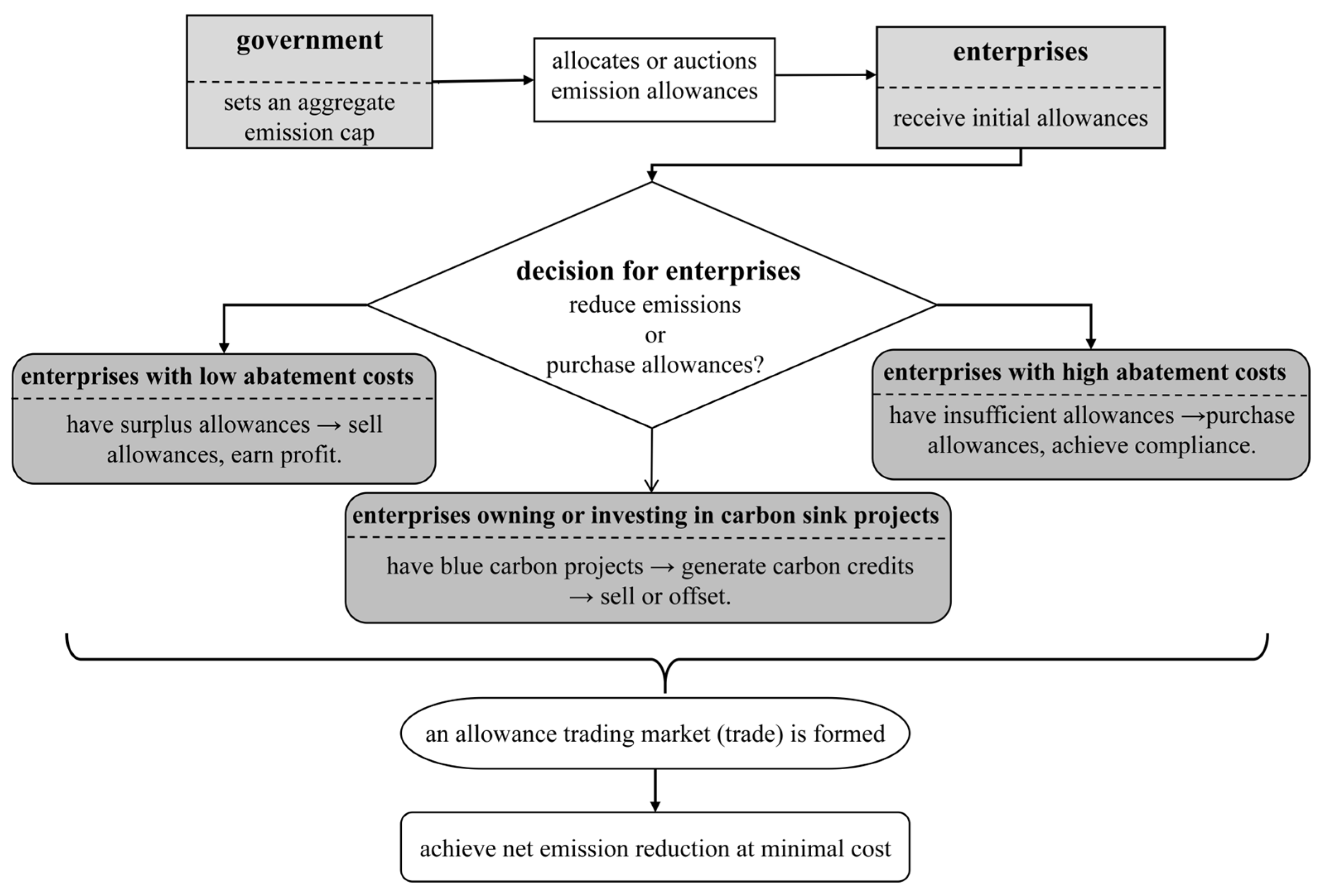
Applied to blue carbon governance, the design of the “cap and trade” mechanism stems precisely from this logic: blue carbon possesses non-excludability and non-rivalry characteristics, with high costs associated with defining property rights. Relying solely on market regulation could easily lead to a “tragedy of the commons”, while government intervention alone struggles to achieve efficient governance. The mechanism with the lowest matching costs is the optimal governance structure [69]. Therefore, this mechanism operates in two phases, led respectively by government and market, with its operational process illustrated in Figure 3.
In the “cap” phase, the government sets the overall carbon emission cap for society and allocates quotas based on environmental carrying capacity, emission reduction targets, and economic development needs. Quotas are then distributed to regulated enterprises through free allocation or auctions. In this phase, without mandatory government definition, relying on market spontaneous negotiation to determine the cap and allocation rules would lead to composition fallacies due to individual rationality, incur extremely high transaction costs, and potentially fail to reach consensus altogether [70]. Therefore, government intervention is necessary, utilizing its hierarchical authority for unified coordination, thereby bridging individual rationality and collective rationality and laying an indispensable institutional foundation for subsequent market transactions.
In the “trade” phase, after initial quota allocation, enterprises buy and sell quotas in the market based on their respective emission reduction costs. Enterprises with higher abatement costs can purchase additional quotas to reduce compliance costs, while those with lower abatement costs can sell surplus quotas for profit. Price signals guide abatement actions toward the lowest-cost actors, minimizing total emission reduction costs. Compared to the high information and supervision costs associated with direct government command of enterprise emission reductions, market mechanisms allocate resources more efficiently through price leverage [71].
Therefore, blue carbon governance does not simply replicate “free market” logic but represents a sophisticated institutional design based on Coase’s theory: the “cap” component relies on hierarchical systems to resolve property rights definition challenges, while the “trade” component depends on market mechanisms to optimize resource allocation. The key to success lies in whether the government can clearly define carbon sink property rights and reduce transaction costs for the market [72]; otherwise, even if both the ecological potential of blue carbon and market demand are present, governance bottlenecks remain difficult to overcome.

4.3. An Integrated Analytical Framework for Blue Carbon Governance

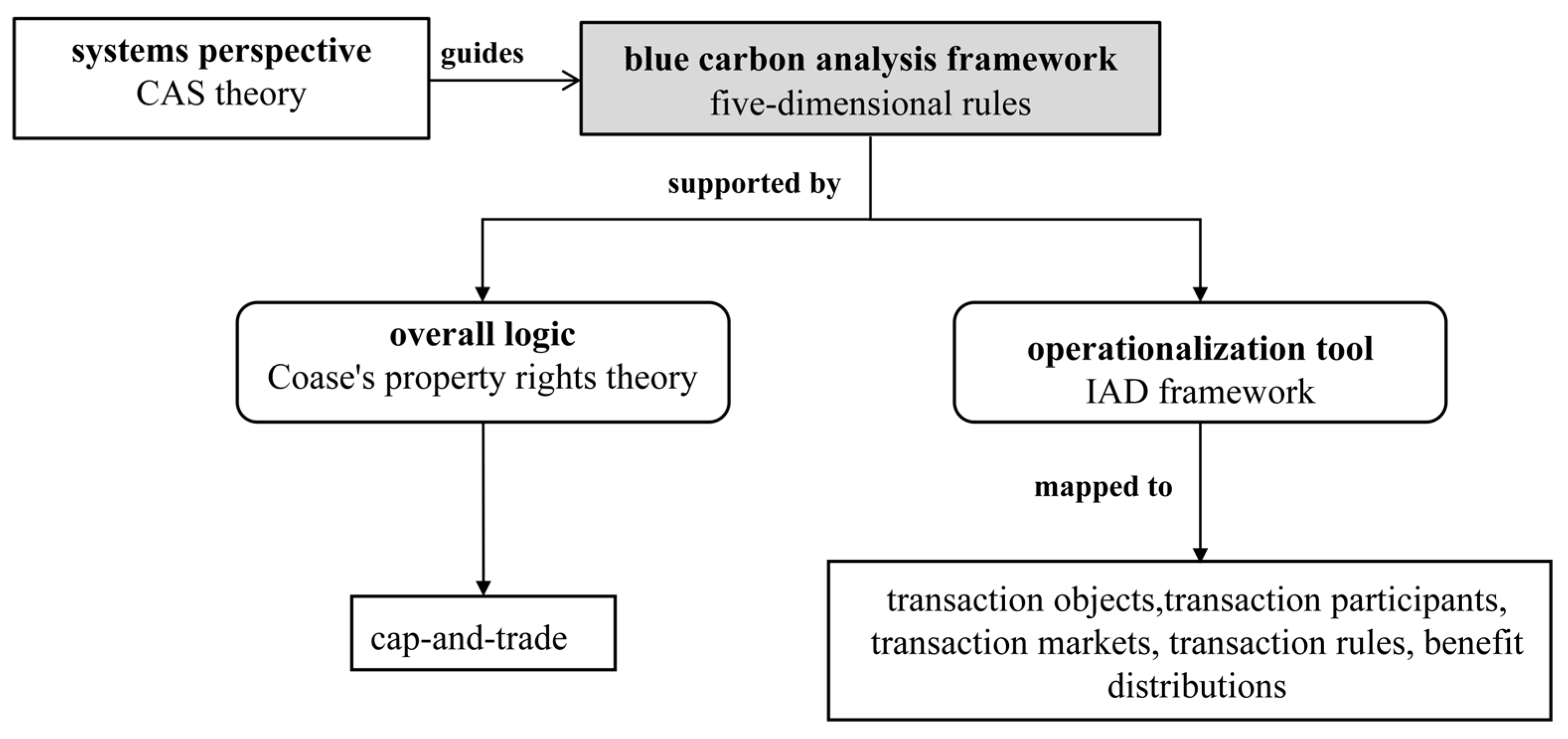
To analyze the patterns of institutional evolution in China’s blue carbon governance, this study constructs an integrative analytical framework (see Figure 4). This framework synthesizes the complex adaptive systems (CASs) perspective, Coase’s theory of property rights, and the Institutional Analysis and Development (IAD) framework into a clearly structured theoretical system, laying the scientific foundation for institutional evolution analysis and case-based empirical research. Such integration is necessary: although the IAD framework provides an excellent tool for operationalizing rules, it cannot alone fully explain the dynamics and direction of blue carbon institutional evolution. Therefore, this framework introduces the CAS perspective to reveal the macro-level logic of how the system undergoes adaptive evolution, and embeds Coase’s theory of property rights to elucidate the core economic logic of why a division of labor between government and market, based on transaction cost comparison, is required. Only through the complementary integration of these three perspectives can the framework provide complete and rigorous theoretical support for analyzing the entire process from micro-level interactions to macro-level institutional emergence.

4.3.1. CAS Perspective: System Dynamic Evolution

The CAS perspective is conducive to revealing the dynamic evolutionary patterns of blue carbon governance systems [73]. In blue carbon governance practice, the external environment (natural conditions, policy orientations, etc.) and internal attributes (actor perceptions, resource endowments, etc.) jointly shape the governance context. Within this context, diverse actors interact around issues such as carbon sink measurement and benefit allocation, generating outcomes including transaction completion, ecological improvement, or cooperation breakdown. These outcomes, through learning mechanisms and policy feedback, influence subsequent institutional adjustments, driving the system progressively from exploratory phases toward maturity.

4.3.2. Coase’s Theory: Property Rights and Market

Coase’s theory of property rights provides the core rule basis for blue carbon governance. Given the public good attributes and high transaction costs characteristic of blue carbon resources, governments must employ authoritative mechanisms to complete carbon sink assessment and initial quota definition, thereby reducing institution-building costs. Once property rights are clearly defined, market transactions enable the allocation of carbon sinks toward more efficient actors, coordinating the dual objectives of ecological protection and economic development. This dual logic materializes in China’s carbon market architecture. The CEA system functions as a cap mechanism, with the government progressively tightening binding caps on high-emission sectors—power, steel, cement, and aluminum smelting—to pursue carbon peak and neutrality goals. The CCER system operates as a complementary trade mechanism, permitting verified carbon sinks, including blue and green carbon, to enter the market for offset purposes. Together, they operationalize Coase’s framework through authoritative initial allocation followed by market-driven reallocation.

4.3.3. An Adapted IAD Framework: Five-Dimensional Rules

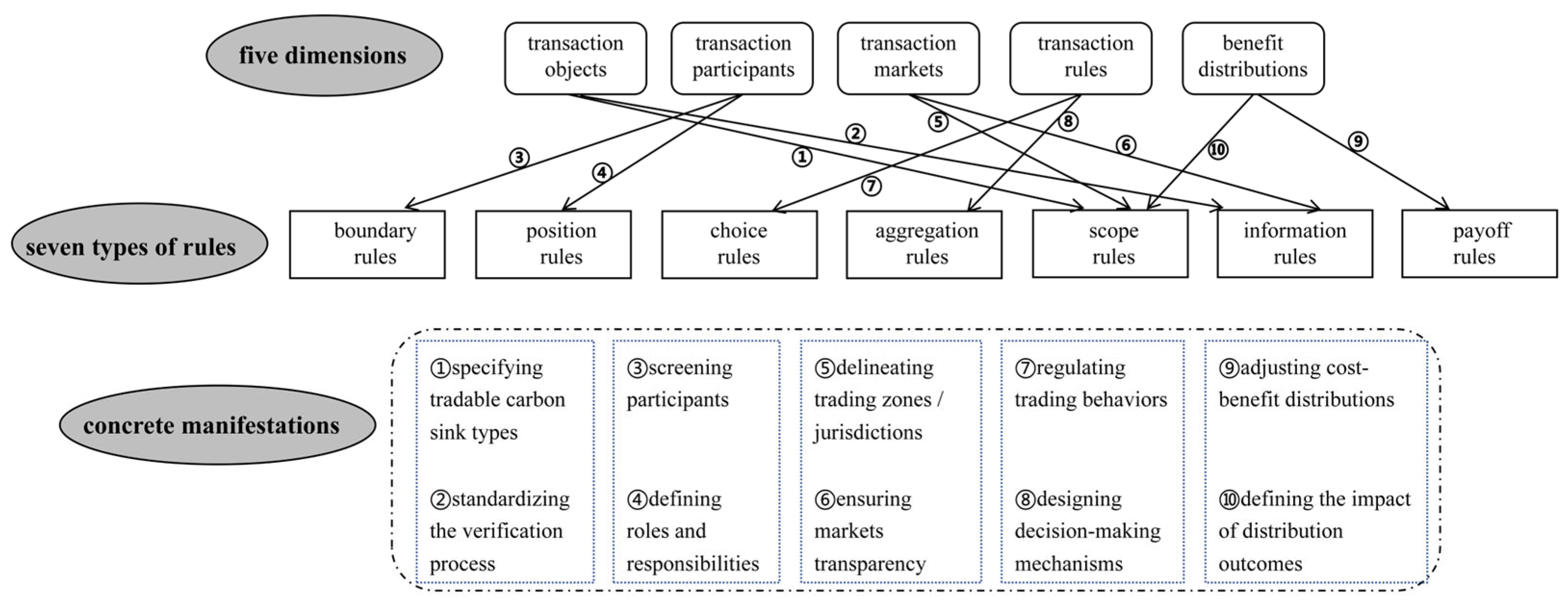
Building on this foundation, the IAD framework provides complementary pathways for rule operationalization. Based on its seven rule types, this study reconstructs the institutional elements into five core dimensions: transaction objects, transaction participants, transaction markets, transaction rules, and benefit distributions (see Figure 5). These dimensions respectively address the fundamental questions of “who participates, what is traded, how trading occurs, where trading takes place, and how benefits are distributed.” This reconstruction preserves the IAD framework’s systemic advantages while enabling analysis to directly engage with critical nodes in governance practice, thereby enhancing analytical operability.
The transaction objects dimension, relying on scope rules and information rules, specifies tradable assets and their credibility. Within the Chinese context, blue carbon sources mainly consist of net increments in carbon sinks derived from mangroves, seagrass beds, salt marshes, and algal cultivation systems [74]. Their measurement requires unified methodologies, while high monitoring costs, carbon stock uncertainties, and legal property rights dilemmas collectively constitute institutional thresholds for transforming ecological value into credible transaction targets.
The transaction participants dimension, determined by boundary rules and position rules, defines participant eligibility and role differentiation. Within this dimension, governments act as rule-setters and regulators, guided by public interest, policy objectives, and risk control considerations. Enterprises, as both demand-side actors and potential suppliers, participate in transactions and asset operations based on cost–benefit logic, constituting the core of market vitality. Research institutions focus on methodological innovation and authoritative verification, providing technical credibility. Financial institutions and judicial bodies participate through green finance expansion or ecological restoration responsibilities. These diverse actors, differentiated by their positioning, form interactive, competitive, and collaborative relationships, constituting the primary driving force behind blue carbon governance evolution [75].
The transaction markets dimension, defined by scope rules and information rules, delineates market boundaries and operational transparency. Vertically, national markets coordinate platforms and rules, supporting cross-regional circulation and value discovery, while local markets emphasize differentiated exploration and primary cultivation. Horizontally, the production side focuses on project development, certification, and initial allocation, serving as the value source; the consumption side undertakes transaction circulation and offset functions, enabling value realization. The institutional articulation and functional complementarity between the two market levels and two operational sides jointly construct a fully integrated market ecosystem.
The transaction rules dimension, through aggregation rules and choice rules, governs the actions and decision-making processes throughout the entire cycle of carbon sink generation, certification, and trading. At the national level, the focus is on establishing unified measurement standards, registration systems, and trading procedures to ensure institutional authority and cross-regional mutual recognition. At the local level, adaptive innovations occur within the unified framework, developing specific project implementation rules and regulatory requirements tailored to local resource conditions and management needs, reflecting the flexibility of regionally differentiated exploration. These two levels complement each other, jointly constituting the multi-level governance structure of the blue carbon trading system.
The benefit distributions dimension, through payoff rules and scope rules, establishes an institutional framework for benefit distributions and sustainable development. Its core logic operates as follows: primary distribution follows market efficiency principles, allocating benefits to producers and investors based on property rights definitions to stimulate market vitality. Secondary distribution channels benefits through ecological funds, community sharing mechanisms, and similar instruments to reinvest in ecological restoration and livelihood improvement, implementing the principle of “benefits for protectors, payment by users, compensation from destroyers.” Primary distribution focuses on ensuring economic efficiency, while secondary distribution strengthens equity and sustainability. These two levels complement each other, jointly advancing the dual objectives of sustainable economic development and social equity [76].

5. Case Study

This study selected Ningbo, China, as the research site. Ningbo possesses comprehensive blue carbon ecosystems including coastal tidal flats and salt marshes, with nearshore shallow waters providing natural conditions suitable for the growth of blue carbon organisms. Additionally, approximately one-third of the carbon from fisheries can be deposited on the seabed for long-term sequestration, establishing Ningbo as a pioneering demonstration of blue carbon marketization pathways for developing countries. Within this specific action context, diverse actors engaged in decision-making and gaming centered around the five-dimensional rules of blue carbon governance, with gaming outcomes directly shaping current governance performance and establishing new rule boundaries and action contexts for subsequent rounds of gaming through feedback mechanisms, thereby driving the construction of the blue carbon governance system.
This study adopted a three-stage analytical framework to examine the blue carbon marketization process: the initial founding stage focused on property rights definition and basic institutional establishment; the synergistic stagnation stage centered on system adaptation and deepened collaboration; the iterative upgrading stage emphasized institutional reconstruction and comprehensive coordination. These three stages captured China’s blue carbon trajectory: decentralized multi-scenario pilot transactions in the founding stage; gradual clarification of property rights and nascent market infrastructure in the stagnation stage; and integration of local pilots into the CCER framework, ultimately linking to the CEA compliance market, in the upgrading stage. The following sections analyze the institutional evolution logic and internal operational mechanisms from the perspective of full transaction elements.

5.1. The Initial Founding Stage: Institutional Construction and Early Performance

5.1.1. Transaction Objects

Defining the transaction objects is central to the marketization of blue carbon value. Ningbo City, supported by institutional and technological innovation, transformed ecological service value into identifiable, rights-confirmed, and transferable property assets. Regarding the object boundary, the transaction target was explicitly defined as the incremental carbon sink formed through human intervention, primarily covering two types: fishery carbon sinks and salt marsh carbon sinks. Natural stock carbon sinks were strictly excluded, adhering to the principle of additionality. In terms of technical support, tailored to the characteristics of the local muddy coast, technologies such as “sediment core sampling + drone monitoring” were adopted to achieve high-precision measurement. Professional teams collaborated with third-party institutions to establish a standardized full-chain system for accounting, verification, and certification. For compliance assurance, the “integration of the Sea Area Use Right Certificate and the Aquaculture Certificate” was implemented to clarify ownership of benefits. Concurrently, a compliance certification mechanism known as the “triple review integration” was constructed, involving production record filing by the fisheries department, technical review by the marine research institute, and compliance verification by the property rights exchange center. This mechanism strictly reviewed subject qualifications during the access stage, ensuring the legality and compliance of the transaction objects.

5.1.2. Transaction Participants

The transaction participants in Ningbo’s blue carbon governance exhibited a concentric circle structure. Enterprises acted as initiators, promoters, and resource suppliers throughout the marketization process. Notably, Wenrong Zhu, Chairman of Xiangshan Xuwen Seaweed Development Co., Ltd. (Ningbo, China), took a pioneering role. Leveraging advanced blue carbon concepts and technologies, he was the first to explore carbon sink value, providing carbon sink supply carriers and practical samples through large-scale aquaculture, thereby promoting the implementation of the blue carbon market and proactively funding technological breakthroughs. Government departments and research institutions served as collaborative core subjects. The Development and Reform Bureau of Xiangshan County, as the policy leader, spearheaded the formation of a cross-departmental task force, coordinating resources to build the institutional framework and trading platform. The team led by Congying He from the Ningbo Marine Research Institute solved critical challenges in carbon sink measurement and provided scientific endorsement. Judicial authorities, market institutions, grassroots fishing villages, and fishermen constituted the peripheral participating subjects. Judicial authorities integrated blue carbon transactions into compensatory ecological damage restoration. Market institutions provided services for transaction matching, witnessing, and cross-regional cooperation. Village collectives were responsible for property rights coordination and benefit consolidation. Fishermen, as direct producers of carbon sinks, provided supplementary supply. These diverse subjects collectively formed the participation system for Ningbo’s blue carbon governance and market operation.

5.1.3. Transaction Markets

Ningbo built its transaction markets with the goal of creating diverse transaction scenarios and a low-cost trading environment. Initially, it established the Xiangshan Blue Carbon Trading Sub-center based on the property rights exchange center and developed the “Yongtanhui” digital platform. This platform integrated functions such as carbon sink accounting, transaction matching, and information disclosure to reduce information search costs. The platform focused on three core scenarios: judicial restoration, corporate ESG performance, and carbon neutrality for large-scale events, generating several typical transaction cases. In the judicial scenario, in 2024, Zhang and Li in Xiangshan were sentenced for illegal fishing during the moratorium; their voluntary purchase of 422.5 tons of blue carbon for ecological compensation became Zhejiang Province’s first case integrating blue carbon with judicial and property rights transactions. In the corporate scenario, numerous enterprises participated in auctions to reserve resources for potential CCER compliance obligations. In the event scenario, events like the World Buddhist Forum and the Taohua Marathon achieved carbon neutrality by purchasing blue carbon. Simultaneously, Ningbo cooperated with Xiamen across provinces to transcend geographical limitations. At the financial level, it issued Zhejiang Province’s first blue carbon pledge loan. The platform publicly disclosed various market information, enhancing transparency and reducing transaction risks.

5.1.4. Transaction Rules

Ningbo designed its transaction rules with the core aim of reducing transaction costs. In February 2023, China’s first blue carbon auction was held in Huangbi’ao Township, Xiangshan County. The transaction object was 2340.1 tons of fishery carbon sink from Xihu Harbor, with a starting price of 30 yuan/ton. After 76 rounds of bidding, it was sold at 106 yuan/ton, achieving a premium rate of 253%. Public bidding generated a genuine price signal, avoiding the subjectivity of administrative pricing and resolving the pricing challenge. Based on this, Ningbo constructed a closed-loop process for blue carbon trading: “filing, verification, trading, and write-off.” During the filing phase, the Natural Resources and Planning Bureau reviewed the compliance of sea area use rights and aquaculture. In the verification phase, third-party institutions conducted on-site monitoring and data verification, publicly announcing the results. The trading phase relied on the property rights exchange center to organize bidding. The write-off phase completed transaction confirmation through the blue carbon ecological carbon account, ensuring full traceability of the transaction process. In March 2024, Ningbo and Xiamen jointly established the nation’s first cross-provincial blue carbon ecological carbon account, enabling data interoperability and mutual recognition, promoting the evolution of transaction rules towards regional coordination.

5.1.5. Benefit Distributions

Centered on the principle of “beneficiaries pay”, Ningbo constructed a dual-layer revenue distribution architecture that was both market-oriented and policy-driven. At the micro level, carbon sink trading revenue was preferentially tilted toward grassroots producers. Thirty percent of the revenue was directly distributed in cash to the participating fishermen, covering their production costs. Small amounts of revenue were collectively managed by village collectives for public affairs in fishing villages, such as net cage renovation and ecological restoration. At the meso level, enterprises participating in blue carbon trading received government innovation incentives, and research institutions were compensated according to the volume of technical services provided. At the macro level, 5% to 8% of the funds from each blue carbon transaction were allocated to the Blue Carbon Ecological Compensation Fund, managed by the government for regional blue carbon ecological restoration and species protection, ensuring the sustainability of blue carbon governance.

5.1.6. Action Situation and Subject Interaction

The initial founding stage of Ningbo’s blue carbon governance coincided with a critical stage in advancing the national “dual carbon” strategy. The national level incorporated marine carbon sinks into the overall development plan, and Zhejiang Province regarded it as a core lever for high-quality development of the marine economy, establishing a favorable policy environment for Ningbo’s blue carbon development. Given the scarcity of domestic blue carbon trading pilots, Ningbo’s institutional innovation was both necessary and urgent. By that time, Ningbo had accumulated multi-dimensional practical experience: private enterprises took the lead in exploring blue carbon value; research institutions solved measurement challenges, providing technical support; the government took the lead in building cross-departmental collaboration platforms, accumulating trading experience. Regional practices within the province, such as mangrove restoration in Cangnan and mussel carbon sink trading on Dachen Island in Taizhou, also provided referential experiences for Ningbo.
The subject interaction in Ningbo’s blue carbon governance exhibited characteristics of core leadership, coordinated linkage, and diversified participation. Dynamic synergy among subjects was achieved through rule-binding and benefit-sharing, forming a social structure with both formal institutions and informal consensus. Within the core triangle, enterprises, government, and research institutions established normalized interaction mechanisms such as joint offices and collaborative decision-making, based on a division of labor leveraging comparative advantages: enterprises proposed demands, the government built the platform, and the research institute provided support. Together, they tackled multiple challenges related to concepts, technology, and policy in blue carbon trading. In interactions with peripheral subjects, the core triangle, by constructing the rule system and market foundation, provided convenient pathways for judicial authorities, market institutions, and grassroots fishing villages to participate in blue carbon governance, reducing their participation costs. Conversely, the involvement of peripheral subjects injected new demand and supply into the blue carbon market, feeding back into the governance practices of the core triangle. At the grassroots level, fishing villages formed informal property rights coordination mechanisms based on the traditional consensus of “ancestral seas”, complementing the government’s formal property rights definition system. Village collectives acted as an intermediary link, coordinating interests among fishermen and between fishermen and enterprises, safeguarding the participation and perceived benefits of grassroots producers. This allowed blue carbon governance to reach deep into the grassroots, forming an interconnected social structure linking upper and lower levels.

5.1.7. Game Outcomes and Institutional Feedback

The interactions and strategic games among various actors successfully broke the ice for blue carbon marketization, achieving multiple breakthroughs including the completion of the nation’s first blue carbon auction and the establishment of the first cross-provincial blue carbon ecological carbon account. Concurrently, the outcomes of these games restructured the institutional structure through feedback loops. They affirmed institutional rules such as the “integration of two certificates” property rights certification system, the “triple review integration” compliance verification system, and the closed-loop “filing–verification–trading–write-off” transaction process. At the same time, based on market trends, they unearthed new demands, such as the unification of cross-regional blue carbon transaction rules and the innovative development of blue carbon financial products, thereby setting new rule boundaries and action situations for subsequent rounds of subject interaction.

5.2. The Synergistic Stagnation Stage: Institutional Deepening and Evolutionary Dilemmas

5.2.1. Transaction Objects

Although the blue carbon transaction object had been successfully marketized, the supporting systems for measurement standards, property rights certification, and technical support lagged behind, preventing the formation of stable and replicable transaction targets. In terms of measurement standards, the localized accounting method developed by the Ningbo Marine Research Institute was only applicable to specific aquaculture varieties along the muddy coast of Xiangshan, exhibiting limited universality. This led to the problem of mutually unrecognizable measurement results when surrounding projects attempted to integrate. Regarding property rights certification, the high transfer fees required for the dual certificates deterred most fishermen. Among the vast tidal flats covering thousands of hectares in Xihu Harbor, Xiangshan, only a few village collectives and state-owned enterprises held both certificates. Furthermore, the aquaculture certificates lacked precise coordinate boundaries, resulting in disputes over overlapping property rights. In terms of technical support, a third-party verification market had yet to be cultivated. Research funding relied on private enterprise sponsorship and project grants, representing a single source of funding. Moreover, existing accounting methods could not precisely quantify the impact of natural factors such as climate. In 2023, algae production in Xiangshan decreased by 15% due to extreme weather, causing fluctuations in carbon sink value that exceeded market expectations and discouraging enterprises from large-scale credit accumulation in the short term. Additionally, Ningbo’s local carbon sink credits had not yet been linked with other regional carbon inclusion markets or the national carbon trading market. This institutional “island effect” constrained the value boundary of the transaction objects, but it also reserved space for exploration regarding future integration with a national blue carbon trading system.

5.2.2. Transaction Participants

The success of China’s first blue carbon auction acted like a magnet, attracting various entities to join in a “free-rider” manner. The transaction system further expanded, and continuous exploration of cross-regional subject collaboration models occurred. On the consumption side, enterprises actively participated in auctions to reserve resources for compliance purposes. The participation of manufacturing and carbon service enterprises injected fundamental market demand. From the Development and Reform Bureau of Xiangshan County to multiple municipal government departments such as Ecology and Environment and Natural Resources, responsibilities were redefined, and a governance framework was established, reducing the institutional transaction costs associated with “fragmented management”. Some policy entrepreneurs actively promoted the elevation of governance levels and cross-departmental collaboration, strengthening blue carbon governance as a regular task. Research institutes formed an “industry-university-research-application” collaborative system, providing scientific support. Judicial authorities innovated transaction models, injecting administrative demand. Fishing village collectives and fishermen improved aquaculture conditions and supplemented carbon sink supply. Ningbo and Xiamen achieved data interoperability, accumulating experience in cross-regional collaboration. These diverse subjects collectively constituted the participation system for blue carbon governance.

5.2.3. Transaction Markets

Ningbo’s blue carbon market achieved a breakthrough from nothing, initially establishing three major transaction scenarios: judicial restoration, corporate ESG reserves, and carbon neutrality for large-scale events. It cultivated core consumer-side subjects such as judicial authorities and local enterprises, completed the basic market layout, and validated the diverse application possibilities of blue carbon trading. However, at this stage, the market remained in a niche and fragmented developmental phase. Supply-side coverage was insufficient, and the pace of scaling up was slow. As of January 2026, Ningbo City had completed only two judicial transactions, both related to ecological compensation for illegal fishing cases. Corporate participation was primarily limited to a few local entities. Event carbon neutrality relied on sporadic large-scale events, exhibiting overall characteristics of “point-based” transactions. Regarding market structure, supply and demand were imbalanced. Fishermen and fishing village collectives on the supply side were excluded due to property rights and distribution issues. Cross-regional expansion remained at the level of government demonstration projects, with high participation barriers for grassroots projects. Financial support had not yet extended to fishermen, and the carbon sink potential on the supply side remained untapped.

5.2.4. Transaction Rules

Following the first blue carbon auction, Ningbo established a foundational rule framework for blue carbon trading. However, constrained by institutional supply and subject coordination, the rules lacked systematic coherence. Current pricing relied on the scarcity premium of the first auction, lacking normalized standards, which dampened enthusiasm for spontaneous market transactions. The verification method was poorly aligned with national-level approaches, and the absence of a third-party market led to insufficient efficiency and authority. The dual-certificate access rule was disconnected from the traditional concepts and payment capacity of Xiangshan fishermen, excluding a large amount of carbon sink due to property rights non-compliance. The supply side thus fell into a state of “impoverished abundance.” The division of responsibilities across departments lacked a top-level coordination mechanism, resulting in high communication costs. As Yang Yang, Section Chief of the Development and Reform Bureau of Xiangshan County, candidly stated, to facilitate the first auction, the team convened over a hundred meetings to coordinate among various departments. These pain points clarified the direction for standardizing rules and optimizing marketization.

5.2.5. Benefit Distributions

A preliminary framework for revenue distribution in Ningbo’s blue carbon governance had been established, but its incentive function was gradually weakening. A portion of the actual revenue generated from blue carbon transactions was invested in public affairs of fishing villages to improve aquaculture conditions. However, most fishermen were unable to participate in the distribution due to property rights issues. Even among eligible fishermen, the dividends received after the first auction in 2023 amounted to only a few hundred yuan, which was insufficient to cover aquaculture costs and even led some to reduce their farming scale. The distribution rules lacked quantitative standards, leading to interest disagreements. The ecological compensation fund established by the government was small in scale and narrow in scope, with limited capacity for reinvestment. The benefit distributions urgently needed to be further tilted towards fishermen, and the benefit boundary required optimization.

5.2.6. Action Situation and Subject Interaction

During this stage, blue carbon governance transitioned from local innovation towards scaling and systematization. The pace of development slowed down. The core contradiction was the imbalance between the rapid expansion of governance subjects and the adaptability of institutional supply, technical support, and interest distribution, where challenges and opportunities were intertwined. Various participating entities—including enterprises, government departments, research institutions, judicial authorities, fishing village collectives, and cross-regional governments—engaged in diverse practices surrounding blue carbon trading. A preliminary interaction pattern had taken shape, and cross-regional and cross-type collaborations were gradually unfolding. However, superimposed issues—such as the lack of a stable consensus on emission reduction among enterprises, poor policy coordination among government departments, data silos in the research field, weak interest linkage mechanisms for fishermen, and disagreements over cross-provincial collaboration rules—prevented the establishment of a systematic coordination mechanism. Consequently, the governance effectiveness brought by the expansion of subjects had not been fully realized.

5.2.7. Game Outcomes and Institutional Feedback

The games among diverse subjects achieved a breakthrough from single-point exploration to diversified participation. However, the lag in supporting underlying institutions resulted in insufficient coordination and limited effectiveness. The interest demands and action logics of various subjects struggled to form a synergy, even leading to localized conflicts. This game situation exposed shortcomings in current institutional supply and coordination mechanisms, while also clarifying the targets for institutional optimization. It propelled the evolution of the blue carbon governance system towards a direction that better aligns with practical needs and is more coordinated and sustainable.

5.3. The Iterative Upgrading Stage: Systematic Reconstruction and Optimization of Institutions

5.3.1. Transaction Objects

At the level of transaction objects, a transformation from “local characteristic pilots” to “standardized assets” was achieved, with blue carbon becoming a standardized transaction target possessing cross-regional circulation value.
Ningbo, in collaboration with Xiamen and other coastal pilot cities, integrated measurement experiences from different scenarios based on local characteristic methodologies. It formulated unified local standards for blue carbon accounting and aligned them with the national “Marine Carbon Sink Accounting Methods” to complete optimization, achieving cross-regional interoperability of carbon sink data. Addressing the controversy over the stability of fishery carbon sinks, a dual-track accounting approach of “life cycle assessment + sediment carbon monitoring” was adopted. This clarified the long-term sequestration properties of one-third of the sediment carbon from shellfish and algae aquaculture carbon sinks, incorporating it into the nationally unified carbon sink measurement scope. Regarding property rights certification, the application process for the dual certificates was simplified. Policies for installment payments of sea area use fees and fiscal subsidies were established. Digital technology supplemented the boundary markers of aquaculture certificates, increasing the supply of compliant carbon sinks in Xihu Harbor by 40%. Simultaneously, carbon sinks from salt marsh ecological restoration and coastal wetland conservation were included in the transaction scope, forming the dual-core transaction objects system. Furthermore, Ningbo’s blue carbon methodology passed the national CCER methodology filing, achieving value linkage with the national carbon market and breaking the institutional “island effect.”

5.3.2. Transaction Participants

The transaction participants system evolved from “concentric circle participation” to a “region-wide collaborative network,” with the roles of various subjects transforming towards multi-functional empowerment, forming a mature pattern. Regarding enterprises, Xuwen Seaweed transformed into an industry integrator, and leading local enterprises planned to establish a blue carbon alliance to drive small and medium-sized aquaculture households. Government departments clarified responsibility lists, constructed a collaborative regulatory framework, and provided think tank support. Research subjects formed an innovation alliance and built a data-sharing platform. Among grassroots subjects, fishermen participated in aquaculture and obtained credit support through “carbon sink equity certificates,” while fishing village collectives coordinated property rights to promote large-scale aquaculture. Cross-regional and international subjects advanced the mutual recognition of rules across provinces and initiated international cooperation to align standards and project certifications.

5.3.3. Transaction Markets

Ningbo’s blue carbon trading market, oriented towards optimizing the market ecology and strengthening the foundation of trust, continuously expanded its scenarios and scope of linkage. Transaction scenarios extended from single-village carbon inclusion to areas such as salt marsh ecological restoration and corporate compliance. The “Yongtanhui” platform attracted citizen participation. Blue carbon was included in the offset scope for corporate carbon emission compliance, driving transaction volume growth. Cross-regional collaboration deepened. Ningbo and Xiamen jointly built carbon accounts and unified standards and specifications, facilitating the entry of Ningbo’s blue carbon into markets like Fujian and Guangdong. Simultaneously, a bilateral linkage mechanism involving leading enterprises, fishing villages, and research institutions was constructed, forming a full-chain service system and continuously stimulating market vitality.

5.3.4. Transaction Rules

The optimization of transaction rules followed a dual-track path of “bottom-up experience summation and top-down institutional improvement,” evolving towards maturity and systematization. At the market rule level, a dual-level trading system comprising carbon inclusion and CCER was constructed. Carbon inclusion models were piloted in fishing villages such as Huangbi’ao Township and Qiangjiao Town. Local blue carbon accounting methods were developed with reference to national CCER standards, promoting the transformation and upgrading of local projects. At the verification rule level, a three-tier certification system was established, encompassing local standards, national recognition, and international alignment. Technical specifications for fishery blue carbon measurement were released, achieving cross-provincial data interoperability between Ningbo and Xiamen. International VCS certification was introduced to enhance international recognition. At the subject rule level, mechanisms for using sea area use rights as equity shares and benefit-sharing were innovated. Market access was relaxed, forming a pattern of diversified participation. At the coordination rule level, a governance framework led by the government, operated by the market, and guaranteed by the judiciary was constructed. Transaction management measures were issued, clarifying departmental responsibilities and whole-process supervision. Concurrently, financial products such as blue carbon pledge loans and carbon sink insurance were launched, reducing institutional transaction costs. Overall, Ningbo’s blue carbon trading rules achieved a spiral progression through practice, trial and error, and optimization between 2023 and 2025.

5.3.5. Benefit Distributions

Revenue distribution, centered on fairness and stability, achieved sustainable operation through rule precision, subject expansion, and risk prevention. Specialized management measures were formulated. A dual-indicator approach of “aquaculture area + carbon sink contribution” was adopted to calculate fishermen’s revenue. The revenue sharing ratios for enterprises and research institutions, along with service fee standards, were clarified. A public information platform was established to ensure transparency. Grassroots entities were empowered through methods such as using sea area use rights as equity shares and providing carbon sink loans. Revenue was preferentially tilted towards research institutions and small and medium-sized enterprises. A dispute mediation mechanism and an ecological compensation fund were established. Leveraging blockchain technology and third-party audits, supervision was strengthened to prevent market risks and conflicts of interest.

5.3.6. Action Situation and Subject Interaction

The action situation during the iterative upgrading stage exhibited diverse characteristics, including national strategic guidance, market demand drive, and technological innovation support. At the national level, blue carbon was formally incorporated into the CCER and CEA market systems. The “Interim Measures for the Management of Blue Carbon Trading” were issued, providing top-level institutional guarantees. The accelerated development of the global blue carbon market created conditions for Ningbo’s blue carbon to interface with international markets. The formation of a competitive and collaborative pattern among blue carbon pilots in domestic coastal cities forced Ningbo to accelerate institutional innovation and standard export.
Subject interaction formed a mature pattern of region-wide collaboration and bidirectional empowerment. Regularized cooperation was established among core subjects. The government formulated rules and built platforms. Enterprises led market operations and product innovation. Research institutions provided technical support and standard development. These three parties formed a closed-loop linkage of “rules-market-technology.” Grassroots subjects were precisely connected with core subjects through “blue carbon cooperatives”. Fishermen’s aquaculture needs and ecological demands were directly incorporated into institutional design and market operations. Cross-regional subjects achieved data sharing, standard mutual recognition, and transaction interoperability through collaborative platforms, forming a community for blue carbon governance among coastal cities nationwide. International subjects participated in interactions through channels such as VCS certification and carbon market linkage. Ningbo’s blue carbon methodologies and transaction models were exported to coastal countries along the “Belt and Road,” forming an interactive network characterized by domestic coordination and international alignment.

5.3.7. Game Outcomes and Institutional Feedback

During the iterative upgrading stage, a benign game equilibrium was achieved among local practices and national top-level design, as well as regional competition and cross-regional collaboration. Local experiences were incorporated into the national institutional framework. Regionally dispersed pilots transitioned towards a governance community with standard mutual recognition and market interoperability. The interest demands of various subjects were effectively reconciled, and core contradictions were systematically resolved, forming a win-win pattern. Institutional operation exhibited a positive closed-loop feedback. Problems encountered in practice were continuously corrected through standard optimization and mechanism innovation. The mature institutional system further stimulated market vitality and enhanced credibility, ultimately promoting the formation of an institutionalized paradigm for Ningbo’s blue carbon that is replicable, scalable, and capable of interfacing with national and international markets.

5.4. Three-Stage Comparison and Causal Mechanism Testing

5.4.1. Comparison Across Three Stages

To clearly delineate the evolutionary trajectory of the blue carbon governance institution, this study systematically compares the three stages across five dimensions: transaction objects, transaction participants, transaction markets, transaction rules, and benefit distributions (see Table 2). The three-stage evolution reveals differentiated trajectories across five dimensions. Transaction objects advance from localized single-category accounting to multi-category standardization with cross-regional mutual recognition, where rule supply preconditions object standardization. Participants shift from a core triangle-led structure to a region-wide collaborative network, requiring a matching coordination mechanism. Markets sediment from scattered explorations to a dual-track, three-tier certification system, providing institutional infrastructure. Transaction rules evolve from single-point breakthroughs to multi-scenario linkage, with early dilemmas stemming from supply-side contraction caused by weakened distribution incentives. Benefit distribution transforms from grassroots-tilted establishment to mature multi-layered quantification, highlighting the criticality of negative-feedback recognition. Thus, synergistic optimization of the five-dimensional rules, not isolated breakthroughs, drives institutional evolution.

5.4.2. Causal Mechanism Testing

Weak formal institutions in developing countries trap blue carbon projects in “potted-plant” pilots; the Ningbo case demonstrates how institutionalized operation can be achieved through five-dimensional rule synergy. While the developed-country paradigm of “institutions first, market follows” offers reference, developing nations require adapted pathways. Ningbo follows an asymmetric “problem-orientation, dynamic-adaptation” route driven by internal-external interaction: top-down administrative authority establishes foundational rules and legitimacy to address international pressures and initial institutional scarcity; bottom-up pluralistic innovation converts informal constraints into governance resources to ease enforcement difficulties. This interaction imparts dynamic momentum, enabling continuous adjustment through contestation and feedback, ultimately achieving system coupling after negative-feedback corrections during synergy obstruction. Breaking the impasse thus requires constructing adaptive institutional resilience via five-dimensional synergy. By anchoring benefit distribution to grassroots producers and aligning local practices with national and international standards, the case proves that developing countries can marketize blue carbon value through localized innovation, validating the framework and contributing an empirical reference to diversified blue carbon governance.

6. Conclusions and Policy Implications

6.1. Conclusions

This study constructed a theoretical framework for blue carbon governance based on the CAS-IAD-Coase’s theory. Using Ningbo, China as a case study, it revealed the dynamic evolutionary logic and institutional bottlenecks in the marketization of blue carbon in developing countries. The research finds that, under structural constraints such as ambiguous property rights, the absence of MRV, and inefficient cross-sectoral coordination, the value transformation of blue carbon relies on the coupling of “top-down” government guidance and “bottom-up” stakeholder innovation. The current market dilemma, characterized by “an absent supply side but an active consumption side,” stems fundamentally from weak universality of transaction subjects, high participation costs, and inequitable rules and benefit distributions.
The essence of sustainable blue carbon development lies in institutional transformation. This requires the dynamic adjustment of the “five-dimensional rules”—namely, transaction subjects, objects, rules, markets, and benefit distributions—to convert ecological value into standardized assets that are tradable, verifiable, and distributable. Developing countries should abandon the wholesale copying of models and instead construct a localized pathway featuring “gradual evolution, multi-stakeholder synergy, and community co-governance”. This pathway also offers three insights for global governance: First, countries with high institutional capacity can incorporate informal knowledge to enhance MRV credibility. Second, global standard-setting must respect local heterogeneity and prevent technological rationality from overshadowing social equity. Third, South-South cooperation serves as a crucial hub for building an “equitable and effective” blue carbon system, where institutional experimentation in developing countries can, in turn, inform the evolution of global rules.

6.2. Policy Implications

Successful blue carbon governance depends on a dynamically coupled institutional ecosystem, necessitating the integration of the five-dimensional rules to form a sustainable closed loop.

6.2.1. Transaction Objects

Implement a “tiered access” system. Tier 1 (e.g., mangroves) should align with national methodologies and compliance markets. Tier 2 (e.g., algae) can adopt local accounting guidelines to enter the carbon-inclusive market. Tier 3 (e.g., small wetlands) should pilot a simplified registration system.

6.2.2. Transaction Participants

Support community co-management and equitable oversight. Establish local blue carbon cooperative alliances, using village collectives as hubs to uniformly apply for and verify carbon credits. Globally, promote South-South cooperation and advocate for an integration model combining “local ecosystems with international standards”.

6.2.3. Transaction Markets

Stimulate rigid demand through mechanisms like judicial restoration and carbon neutrality for major events. Innovate financial products such as blue carbon pledge loans and climate resilience bonds. Build and connect a three-tiered market—“local carbon inclusion, regional interconnection, national integration”—in a phased manner. Support regional blue carbon exchanges, reducing arbitrage costs through standard mutual recognition and data sharing.

6.2.4. Transaction Rules

At the local level, strengthen multi-stakeholder participation in project design. At the national level, promote “dual-track decision-making” where the government sets baseline rules to form a closed loop of “filing-verification-trading-crediting”, while local actors design processes contextually, embedding digital platforms to reduce costs. Internationally, advocate for the establishment of a Blue Carbon Rules Coordination Group under the UNFCCC to coordinate the comparability and verifiability of blue carbon targets within Nationally Determined Contributions (NDCs).

6.2.5. Benefit Distributions

Implement the Payments for Ecosystem Services (PES) principle. Adopt a four-tier distribution model: “direct payments to fishermen, village collective coordination, enterprise incentives, and scientific research feedback”. Explore a “carbon share certificate” model that links benefits to long-term ecological performance. Globally, establish a “Blue Carbon Equity Fund” to allocate resources from international transactions, supporting capacity building in less-developed regions and the protection of vulnerable systems.

6.3. Research Limitations

This study is limited by its single-case design, with conclusions contingent on China’s administrative, fiscal, and industrial strengths. Transferability requires three preconditions: blue carbon resources, basic property-rights legislation, and carbon-market participation intent. Spatially, resource-intensive mechanisms (e.g., standardized trading, digital MRV) suit state-led economies but not capacity-constrained small island or least developed states; equity-oriented rules (rights delineation, benefit sharing) offer broader universality yet demand adaptation. Temporally, initial stages should prioritize foundational rights and benefit mechanisms, with higher-order MRV and financial controls introduced later. In addition, the analysis centers on institutional structure, under-exploring measurement methodologies and price mechanisms. Future research will pursue cross-regional comparative studies to test five-dimensional rule applicability and, through interdisciplinary collaboration, develop integration schemes addressing technical errors and price volatility to strengthen governance resilience.

Author Contributions

Conceptualization, Z.X.; Resources, Z.X.; Funding Acquisition, Z.X.; Supervision, Z.X.; Writing—Review and Editing, Z.X.; Investigation, Z.X., Q.J., S.Y. and M.L.; Writing—Original Draft Preparation, Q.J. (Introduction, Literature Review, Conclusions and Policy Implications), S.Y. (Case Study), and M.L. (Research Methodology, Theoretical Framework). All authors have read and agreed to the published version of the manuscript.

Funding

This research was funded by the National Natural Science Foundation of China (NSFC No. 42171254).

Institutional Review Board Statement

The study was conducted in accordance with the Declaration of Helsinki and approved by the Institutional Review Board of Law College, Ningbo University (protocol code [23]) on 13 May 2025.

Informed Consent Statement

Informed consent for publication was also obtained from all identifiable human participants.

Data Availability Statement

The data supporting this study are available upon reasonable request from readers, and the authors will provide them in a timely manner.

Acknowledgments

Zhongguo Xu sincerely thanks Jianmei Luo, Ruikun Xu, Ruihao Xu and other family members for their firm support of his work over the years. This article is dedicated to Zhongguo Xu’s mother, Jinglian Dong, and his deceased father, Muxian Xu.

Conflicts of Interest

The authors declare no conflicts of interest.

Abbreviations

The following abbreviations are used in this manuscript:
CASComplex Adaptive System
CCERChina Certified Emission Reduction
CDMClean Development Mechanism
CEAChina Emission Allowance
CERCertified Emission Reduction
CIConservation International
EU ETSEU Emissions Trading System
EUAEU Allowance
IADInstitutional Analysis and Development
IPCCIntergovernmental Panel on Climate Change
IUCNInternational Union for Conservation of Nature
JIJoint Implementation
LULCLand Use/Land Cover Change
MRVMeasurable, Reportable, Verifiable
NbSNature-based Solutions
NDCsNationally Determined Contributions
REDD+Reducing Emissions from Deforestation and Forest Degradation
SESSocial–Ecological System
UNEPUnited Nations Environment Programme
UNFCCCUnited Nations Framework Convention on Climate Change
VCSVoluntary Carbon Standards

References

  1. Ogunbode, C.A.; Doran, R.; Böhm, G. Exposure to the IPCC Special Report on 1.5 °C Global Warming Is Linked to Perceived Threat and Increased Concern about Climate Change. Clim. Change 2019, 158, 361–375. [Google Scholar] [CrossRef]
  2. Ji, L.W.; Yu, G.R.; Hu, D.; Liu, T.T.; Xiao, G.C.; Zhang, X.R. Current Status of Coastal Blue Carbon Assessment: Theory, Methods, and Carbon Sequestration Pathways. Sci. China Earth Sci. 2025, 68, 1403–1418. [Google Scholar] [CrossRef]
  3. Kuyper, J.W.; Linnér, B.; Schroeder, H.K. Non-state Actors in Hybrid Global Climate Governance: Justice, Legitimacy, and Effectiveness in a post-Paris Era. WIREs Clim. Change 2017, 9, e497. [Google Scholar] [CrossRef]
  4. Khetan, A.K.; Yakkali, S.; Dholakia, H.H.; Hejjaji, V. Adaptation to Heat Stress: A Qualitative Study from Eastern India. Environ. Res. Lett. 2024, 19, 044035. [Google Scholar] [CrossRef]
  5. White, A.; Kline, R.J.; Rahman, M.S. Interactions between Black, Brown, Blue and Green Carbon from Terrestrial to Marine Ecosystems: A Critical Review. Sustain. Horiz. 2025, 16, 100158. [Google Scholar] [CrossRef]
  6. Chan, N. Linking Ocean and Climate Change Governance. WIREs Clim. Change 2021, 12, e711. [Google Scholar] [CrossRef]
  7. Hilmi, N.; Chami, R.; Sutherland, M.D.; Hall-Spencer, J.M.; Lebleu, L.; Benitez, M.B.; Levin, L.A. The Role of Blue Carbon in Climate Change Mitigation and Carbon Stock Conservation. Front. Clim. 2021, 3, 710546. [Google Scholar] [CrossRef]
  8. Wedding, L.M.; Moritsch, M.; Verutes, G.; Arkema, K.; Hartge, E.; Reiblich, J.; Douglass, J.; Taylor, S.; Strong, A.L. Incorporating Blue Carbon Sequestration Benefits into Sub-National Climate Policies. Glob. Environ. Change 2021, 69, 102206. [Google Scholar] [CrossRef]
  9. Schleich, J.; Ehrhart, K.-M.; Hoppe, C.; Seifert, S. Banning Banking in EU Emissions Trading? Energy Policy 2006, 34, 112–120. [Google Scholar] [CrossRef]
  10. Ye, B.; Miao, L.X.; Jiang, J.J.; Yang, P. The Analysis of the EU-ETS Carbon Allowance Cap Setting Method. In Proceedings of the 2015 International Conference on Management Science and Innovative Education, Xi’an, China, 12–13 December 2015. [Google Scholar] [CrossRef]
  11. Friess, D.A.; Howard, J.; Huxham, M.; Macreadie, P.I.; Ross, F. Capitalizing on the Global Financial Interest in Blue Carbon. PLoS Clim. 2022, 1, e0000061. [Google Scholar] [CrossRef]
  12. Ye, X. The Potential CEA/CCER Market Value for Natural Gas+ System: An Assessment Using the Logistic Growth and Technology Transfer Model. In Proceedings of the Abu Dhabi International Petroleum Exhibition and Conference, Abu Dhabi, United Arab Emirates, 2–5 October 2023. [Google Scholar] [CrossRef]
  13. Sun, Q.K.; Li, M.; Meng, H.F.; Xiao, J.W.; Zheng, Z.; Shi, Y.R. Lessons from the Development and Operational Experiences of International Carbon Markets for the Construction of China’s Carbon Market. Glob. Energy Interconnect. 2025, 8, 188–204. [Google Scholar] [CrossRef]
  14. Luo, Z.G.; Liao, K.H.; Zhang, X.Y.; Shi, S.H. Blockchain Application in Methodology for CCER. In Proceedings of the 2022 IEEE PES Innovative Smart Grid Technologies, New Orleans, LA, USA, 24–28 April 2022. [Google Scholar] [CrossRef]
  15. Zhang, L.; Tao, L.; Sun, D.J.; Yang, F.Y. China: Personalized Carbon Accounting for Consumers. Nature 2023, 623, 696. [Google Scholar] [CrossRef] [PubMed]
  16. Xiao, Y.-H.; Jiang, Y.-P.; Du, M.; Gan, S.-J.; Tan, Z.-T.; Tan, X.-X.; Zhang, M.; Wu, X.-B. A New Carbon Emission Reduction Mechanism: Carbon Generalized System of Preferences (CGSP). Environ. Sci. Pollut. Res. 2020, 28, 1267–1274. [Google Scholar] [CrossRef] [PubMed]
  17. Si, H.Y.; Li, N.; Duan, X.; Cheng, L.; Bao, Z.K. Understanding the Public’s Willingness to Participate in the Carbon Generalized System of Preferences (CGSP): An Innovative Mechanism to Drive Low-Carbon Behavior in China. Sustain. Prod. Consum. 2023, 38, 1–12. [Google Scholar] [CrossRef]
  18. Wang, Y.H.; Bai, Y. Unlocking the Potential of Ocean Carbon Sinks: Opportunities and Challenges for China’s Development. Front. Mar. Sci. 2025, 12, 1683087. [Google Scholar] [CrossRef]
  19. Zhang, F.X.; He, Y.X.; Xie, S.M.; Shi, W.T.; Zheng, M.X.; Wang, Y.W. Research on the Game of Fishermen’s Cooperative Behavior in Developing Marine Carbon Sink Fisheries from a Complex Network Perspective. Ocean Coast. Manag. 2023, 244, 106832. [Google Scholar] [CrossRef]
  20. Wu, J.H.; Zhao, Y.H.; Fan, S.N.; Zhao, Z.Y.; Zuo, S.M.; Wang, J.Y. Study on the Diffusion of China Certified Emission Reduction Scheme under Carbon Trading Mechanism: Based on the Tripartite Evolutionary Game Model. Energy 2025, 322, 135643. [Google Scholar] [CrossRef]
  21. Li, P.; Liu, D.H.; Liu, C.; Li, X.X.; Liu, Z.H.; Zhu, Y.J.; Peng, B. Blue Carbon Development in China: Realistic Foundation, Internal Demands, and the Construction of Blue Carbon Market Trading Mode. Front. Mar. Sci. 2024, 10, 1310261. [Google Scholar] [CrossRef]
  22. Sun, Q.Y.; Xu, S.S.; Wang, F.M.; Chen, M.R.; Wang, L. Research on Ecological Value Realization Based on Carbon Trading—Take Blue Carbon as an Example. River 2025, 4, 193–204. [Google Scholar] [CrossRef]
  23. Quevedo, J.M.D.; Uchiyama, Y.T.; Kohsaka, R. Progress of Blue Carbon Research: 12 Years of Global Trends Based on Content Analysis of Peer-Reviewed and “Gray Literature” Documents. Ocean Coast. Manag. 2023, 236, 106495. [Google Scholar] [CrossRef]
  24. Wang, Y.Y.; Guo, T.T.; Cheng, T.C.E.; Wang, N. Evolution of Blue Carbon Trading of China’s Marine Ranching under the Blue Carbon Special Subsidy Mechanism. Ocean Coast. Manag. 2022, 222, 106123. [Google Scholar] [CrossRef]
  25. Locatelli, T.; Binet, T.; Kairo, J.G.; King, L.; Madden, S.; Patenaude, G.; Upton, C.; Huxham, M. Turning the Tide: How Blue Carbon and Payments for Ecosystem Services (PES) Might Help Save Mangrove Forests. Ambio 2014, 43, 981–995. [Google Scholar] [CrossRef] [PubMed]
  26. Fourqurean, J.; Zieman, J. Photosynthesis, Respiration and Whole Plant Carbon Budget of the Seagrass Thalassia testudinum. Mar. Ecol. Prog. Ser. 1991, 69, 161–170. [Google Scholar] [CrossRef]
  27. Nellemann, C.; Corcoran, E.; Duarte, C.M.; Valdés, L.; De Young, C.; Fonseca, L.; Grimsditch, G. Blue Carbon: A Rapid Response Assessment; United Nations Environment Programme, GRID-Arendal: Arendal, Norway, 2009; pp. 7–18. [Google Scholar]
  28. Mcleod, E.; Chmura, G.L.; Bouillon, S.; Salm, R.; Björk, M.; Duarte, C.M.; Lovelock, C.E.; Schlesinger, W.H.; Silliman, B.R. A Blueprint for Blue Carbon: Toward an Improved Understanding of the Role of Vegetated Coastal Habitats in Sequestering CO2. Front. Ecol. Environ. 2011, 9, 552–560. [Google Scholar] [CrossRef]
  29. Bertram, C.; Quaas, M.; Reusch, T.B.H.; Vafeidis, A.T.; Wolff, C.; Rickels, W. The Blue Carbon Wealth of Nations. Nat. Clim. Change 2021, 11, 704–709. [Google Scholar] [CrossRef]
  30. Atchison, J.; Foster, R.; Bell-James, J. Blue Carbon as Just Transition? A Structured Literature Review. Glob. Sustain. 2024, 7, e27. [Google Scholar] [CrossRef]
  31. Macreadie, P.I.; Robertson, A.I.; Spinks, B.; Adams, M.P.; Atchison, J.M.; Bell-James, J.; Bryan, B.A.; Chu, L.; Filbee-Dexter, K.R.; Drake, L.; et al. Operationalizing Marketable Blue Carbon. One Earth 2022, 5, 485–492. [Google Scholar] [CrossRef]
  32. Seddon, N.; Chausson, A.; Berry, P.; Cecil, C.A.; Hauler, I.; Turner, B.; Sutherland, W.J. Understanding the value and limits of nature-based solutions to climate change and other global challenges. Philos. Trans. R. Soc. B Biol. Sci. 2020, 375, 20190120. [Google Scholar] [CrossRef] [PubMed]
  33. Macreadie, P.I.; Costa, M.D.P.; Atwood, T.B.; Friess, D.A.; Kelleway, J.J.; Kennedy, H.; Lovelock, C.E.; Serrano, O.; Duarte, C.M. Blue Carbon as a Natural Climate Solution. Nat. Rev. Earth Environ. 2021, 2, 826–839. [Google Scholar] [CrossRef]
  34. Macreadie, P.I.; Anton, A.; Raven, J.A.; Beaumont, N.; Connolly, R.M.; Friess, D.A.; Kelleway, J.J.; Kennedy, H.; Kuwae, T.; Lavery, P.S.; et al. The Future of Blue Carbon Science. Nat. Commun. 2019, 10, 3998. [Google Scholar] [CrossRef] [PubMed]
  35. Lovelock, C.E.; Duarte, C.M. Dimensions of Blue Carbon and Emerging Perspectives. Biol. Lett. 2019, 15, 20180781. [Google Scholar] [CrossRef] [PubMed]
  36. Chmura, G.L.; Anisfeld, S.C.; Cahoon, D.R.; Lynch, J.C. Global Carbon Sequestration in Tidal, Saline Wetland Soils. Glob. Biogeochem. Cycles 2003, 17, 1111. [Google Scholar] [CrossRef]
  37. Duarte, C.M.; Middelburg, J.J.; Caraco, N. Major Role of Marine Vegetation on the Oceanic Carbon Cycle. Biogeosciences 2005, 2, 1–8. [Google Scholar] [CrossRef]
  38. Donato, D.C.; Kauffman, J.B.; Murdiyarso, D.; Kurnianto, S.; Stidham, M.L.N.; Kanninen, M. Mangroves among the Most Carbon-Rich Forests in the Tropics. Nat. Geosci. 2011, 4, 293–297. [Google Scholar] [CrossRef]
  39. Arias-Ortiz, A.; Masqué, P.; Garcia-Orellana, J.; Serrano, O.; Mazarrasa, I.; Marbà, N.; Lovelock, C.E.; Lavery, P.S.; Duarte, C.M. Reviews and Syntheses: 210Pb-Derived Sediment and Carbon Accumulation Rates in Vegetated Coastal Ecosystems—Setting the Record Straight. Biogeosciences 2018, 15, 6791–6818. [Google Scholar] [CrossRef]
  40. Fourqurean, J.W.; Duarte, C.M.; Kennedy, H.; Marbà, N.; Holmer, M.; Mateo, M.A.; Apostolaki, E.T.; Kendrick, G.A.; Krause-Jensen, D.; McGlathery, K.J.; et al. Seagrass Ecosystems as a Globally Significant Carbon Stock. Nat. Geosci. 2012, 5, 505–509. [Google Scholar] [CrossRef]
  41. Siikamäki, J.H.; Sanchirico, J.N.; Jardine, S.; McLaughlin, D.; Morris, D. Blue Carbon: Coastal Ecosystems, Their Carbon Storage, and Potential for Reducing Emissions. Environ. Sci. Policy Sustain. Dev. 2013, 55, 14–29. [Google Scholar] [CrossRef]
  42. Hamilton, S.E.; Casey, D. Creation of a High Spatio-temporal Resolution Global Database of Continuous Mangrove Forest Cover for the 21st Century (CGMFC-21). Glob. Ecol. Biogeogr. 2016, 25, 729–738. [Google Scholar] [CrossRef]
  43. Fatoyinbo, T.E.; Simard, M. Height and biomass of mangroves in Africa from ICESat/GLAS and SRTM. Int. J. Remote Sens. 2013, 34, 668–681. [Google Scholar] [CrossRef]
  44. de Paula Costa, M.D.; Macreadie, P.I. The Evolution of Blue Carbon Science. Wetlands 2022, 42, 109. [Google Scholar] [CrossRef]
  45. Howard, J.; Sutton-Grier, A.; Herr, D.; Kleypas, J.; Landis, E.; Mcleod, E.; Pidgeon, E.; Simpson, S. Clarifying the Role of Coastal and Marine Systems in Climate Mitigation. Front. Ecol. Environ. 2017, 15, 42–50. [Google Scholar] [CrossRef]
  46. Herr, D.; Landis, E. Coastal Blue Carbon Ecosystems: Opportunities for Nationally Determined Contributions; Policy Brief; IUCN: Gland, Switzerland, 2016. [Google Scholar]
  47. Ralph, P.J.; Crosswell, J.R.; Cannard, T.; Steven, A.D.L. Estimating Seagrass Blue Carbon and Policy Implications: The Australian Perspective. In Seagrasses of Australia: Structure, Ecology and Conservation; Springer International Publishing: Cham, Switzerland, 2018; pp. 743–758. [Google Scholar] [CrossRef]
  48. Lovelock, C.E.; Adame, M.F.; Bradley, J.; Dittmann, S.B.N.; Hagger, V.; Hickey, S.M.; Hutley, L.B.; Jones, A.; Kelleway, J.J.; Lavery, P.S.; et al. An Australian Blue Carbon Method to Estimate Climate Change Mitigation Benefits of Coastal Wetland Restoration. Restor. Ecol. 2023, 31, e13739. [Google Scholar] [CrossRef]
  49. Gu, J.L.; Luo, M.; Zhang, X.J.; Christakos, G.; Agusti, S.S.N.; Duarte, C.M.; Wu, J.P. Losses of Salt Marsh in China: Trends, Threats and Management. Estuar. Coast. Shelf Sci. 2018, 214, 98–109. [Google Scholar] [CrossRef]
  50. Ha, N.T.; Manley-Harris, M.; Pham, T.D.; Hawes, I. The Use of Radar and Optical Satellite Imagery Combined with Advanced Machine Learning and Metaheuristic Optimization Techniques to Detect and Quantify Above Ground Biomass of Intertidal Seagrass in a New Zealand Estuary. Int. J. Remote Sens. 2021, 42, 4712–4738. [Google Scholar] [CrossRef]
  51. Quevedo, J.M.D.; Uchiyama, Y.T.; Lukman, K.M.; Kohsaka, R. Are Municipalities Ready for Integrating Blue Carbon Concepts?: Content Analysis of Coastal Management Plans in the Philippines. Coast. Manag. 2021, 49, 334–355. [Google Scholar] [CrossRef]
  52. Quevedo, J.M.D.; Uchiyama, Y.T.; Lukman, K.M.; Kohsaka, R. How Blue Carbon Ecosystems Are Perceived by Local Communities in the Coral Triangle: Comparative and Empirical Examinations in the Philippines and Indonesia. Sustainability 2020, 13, 127. [Google Scholar] [CrossRef]
  53. Ayostina, I.; Napitupulu, L.; Robyn, B.; Maharani, C.; Murdiyarso, D. Network Analysis of Blue Carbon Governance Process in Indonesia. Mar. Policy 2022, 137, 104955. [Google Scholar] [CrossRef]
  54. Wylie, L.; Sutton-Grier, A.E.; Moore, A. Keys to Successful Blue Carbon Projects: Lessons Learned from Global Case Studies. Mar. Policy 2016, 65, 76–84. [Google Scholar] [CrossRef]
  55. Xu, X.; Wang, G.A.; Fang, R.Q.; Xu, S.Q. Blue Carbon Governance for Carbon Neutrality in China: Policy Evaluation and Perspectives. Heliyon 2023, 9, e20782. [Google Scholar] [CrossRef] [PubMed]
  56. Benani, N.; Yang, P.J.; Miwornunyuie, N.; Wang, T.; Wu, D.; Wang, F.M.; Chen, J.L.; Lv, S.G.; Mao, G.Z. Bridging Blue Carbon and Carbon Markets: An Interdisciplinary Analysis of Research and Technology for Climate Mitigation. Ocean Coast. Manag. 2025, 269, 107808. [Google Scholar] [CrossRef]
  57. Thomas, S. Blue Carbon: Knowledge Gaps, Critical Issues, and Novel Approaches. Ecol. Econ. 2014, 107, 22–38. [Google Scholar] [CrossRef]
  58. Arkema, K.K.; Delevaux, J.M.S.; Silver, J.M.; Winder, S.G.; Schile-Beers, L.M.; Bood, N.D.; Crooks, S.; Douthwaite, K.R.; Durham, C.; Hawthorne, P.L.; et al. Evidence-Based Target Setting Informs Blue Carbon Strategies for Nationally Determined Contributions. Nat. Ecol. Evol. 2023, 7, 1045–1059. [Google Scholar] [CrossRef] [PubMed]
  59. Morganti, T.M.; Yao, W.X.; Mengis, N.D.N.; Oschlies, A.; Rehder, G. Monitoring Marine Carbon Dioxide Removal: Quantitative Analysis of Indicators for Carbon Removed and Environmental Side-Effects. Environ. Res. Lett. 2025, 20, 123003. [Google Scholar] [CrossRef]
  60. Singhania, M.N.C.; Saini, N.H. Institutional Framework of ESG Disclosures: Comparative Analysis of Developed and Developing Countries. J. Sustain. Financ. Investig. 2021, 13, 516–559. [Google Scholar] [CrossRef]
  61. Friess, D.A. The Potential for Mangrove and Seagrass Blue Carbon in Small Island States. Curr. Opin. Environ. Sustain. 2023, 64, 101324. [Google Scholar] [CrossRef]
  62. Zhang, X.L.; Wang, Q.J.; Fei, J.X.; Zhang, S.H.; Zhang, Q.; Ma, B.; Xu, S.X. Assessment of Imazapyr’s Control Effects and Soil Environmental Safety in Salt Marsh Wetlands Invaded by Spartina alterniflora. Mar. Pollut. Bull. 2025, 221, 118551. [Google Scholar] [CrossRef] [PubMed]
  63. Melbourne-Thomas, J.; Tommasi, D.; Gehlen, M.; Murphy, E.J.; Beckensteiner, J.; Bravo, F.; Eddy, T.D.; Fischer, M.B.; Fulton, E.; Gogina, M.; et al. Integrating Human Dimensions in Decadal-Scale Prediction for Marine Social–Ecological Systems: Lighting the Grey Zone. ICES J. Mar. Sci. 2022, 80, 16–30. [Google Scholar] [CrossRef]
  64. Xu, Z.G.; Zhuo, Y.F.; Li, G. Multiple-Agent Logics as Drivers of Rural Transformation: A Complex Adaptive Systems Analysis of Lin’an, Zhejiang, China. Systems 2026, 14, 81. [Google Scholar] [CrossRef]
  65. Ostrom, E. Understanding Institutional Diversity; Princeton University Press: Princeton, NJ, USA, 2005; pp. 21–25. [Google Scholar]
  66. Purnomo, H.; Puspitaloka, D.; Okarda, B.; Andrianto, A.; Qomar, N.; Sutikno, S.; Muhammad, A.; Basuki, I.; Jalil, A.; Ye, S.; et al. Community-Based Fire Prevention and Peatland Restoration in Indonesia: A Participatory Action Research Approach. Environ. Dev. 2024, 50, 100971. [Google Scholar] [CrossRef]
  67. Coase, R.H. The Nature of the Firm. Economica 1937, 4, 386–405. [Google Scholar] [CrossRef]
  68. Onofri, L.; Markandya, A. Computing the Social Costs of Carbon through Coase Bargaining in the Context of an Offsetting Program in the Venetian Lagoon. Humanit. Soc. Sci. Commun. 2024, 11, 3870. [Google Scholar] [CrossRef]
  69. Ullman, R.; Bilbao-Bastida, V.; Grimsditch, G. Including Blue Carbon in Climate Market Mechanisms. Ocean Coast. Manag. 2013, 83, 15–18. [Google Scholar] [CrossRef]
  70. Meramveliotakis, G.; Milonakis, D. Coasean Theory of Property Rights and Law Revisited: A Critical Inquiry. Sci. Soc. 2018, 82, 38–66. [Google Scholar] [CrossRef]
  71. Kaiser, J.; Haase, D.; Krueger, T. Payments for Ecosystem Services: A Review of Definitions, the Role of Spatial Scales, and Critique. Ecol. Soc. 2021, 26, 12. [Google Scholar] [CrossRef]
  72. Huang, Y.; Zhang, Z.; Sun, S. Research on the Role of Marine Ranching Construction in Enhancing Market-Oriented Energy-Saving and Emission-Reduction Potential: Experience from China’s Coastal Cities. Water 2024, 16, 3577. [Google Scholar] [CrossRef]
  73. Prabakaran, N.; Poti, M.; Hugé, J.; Koedam, N.; Shanker, K.; Dahdouh-Guebas, F. Shifted Baselines: Using the Adaptive Cycle to Assess the Post-Tsunami Mangrove Social-Ecological System Recovery in the Nicobar Islands. Ambio 2024, 54, 536–551. [Google Scholar] [CrossRef] [PubMed]
  74. Tang, J.W.; Ye, S.F.; Chen, X.C.; Yang, H.L.; Sun, X.H.; Wang, F.M.; Wen, Q.; Chen, S.B. Coastal blue carbon: Concept, study method, and the application to ecological restoration. Sci. China Earth Sci. 2018, 61, 637–646. [Google Scholar] [CrossRef]
  75. Li, H.T.; Liu, Y. Legal Pathways for China’s Blue Carbon Conservation: A Perspective of Synergizing Ocean and Climate Rule of Law. Front. Mar. Sci. 2024, 11, 1497767. [Google Scholar] [CrossRef]
  76. Huxham, M.; Kairu, A.N.; Lang’at, J.K.; Kivugo, R.; Mwafrica, M.; Huff, A.; Shilland, R. Rawls in the Mangrove: Perceptions of Justice in Nature-based Solutions Projects. People Nat. 2023, 5, 1497–1511. [Google Scholar] [CrossRef]
Figure 1. Research Methodology for Blue Carbon Governance.
Systems 14 00803 g001
Figure 2. Institutional Analysis and Development Framework for Blue Carbon Governance.
Systems 14 00803 g002
Figure 3. Cap-and-Trade Mechanism for Blue Carbon Governance.
Systems 14 00803 g003
Figure 4. Integrated Framework for Analyzing Blue Carbon Governance.
Systems 14 00803 g004
Figure 5. Five-Dimensional Governance Mechanism for Blue Carbon Market.
Systems 14 00803 g005
Table 1. Key Technologies, Advantages, and Contributions across Evolutionary Stages.
Evolution StageKey TechnologiesAdvantages & Contributions
Empirical Estimation Phase
(2006–2009)
IPCC Tier 1established global
baseline ratios
Field Measurement Phase
(2010–2015)
Tier 2/3error reduced to ±25%
Remote Sensing Inversion Phase
(2016–2020)
satellite (LULC)resolution: 30 m
error reduced from 50% to 20%
Multi-source Data Fusion Phase
(2020–Present)
LiDAR & machine learningfull-lifecycle MRV system
real-time tracking.
Table 2. Comparison of Characteristics across the Three Stages.
DimensionThe Initial
Founding Stage
The Synergistic
Stagnation Stage
The Iterative
Upgrading Stage
The Evolutionary
Trajectory
Transaction
Objects
single category, local accountinginconsistent standards, obstructed certificationmulti-category standardization, cross-regional mutual recognitionstepwise leap
Transaction
Participants
core-triangle dominant, limited peripheryrapid expansion,
enhanced coordination
region-wide network, role differentiationstructural reorganization
Transaction
Rules
fragmented exploration, first-auction pricingfragmented rules, weak effectivenessdual-layer system (carbon inclusion + CCER) with three-tier certificationinstitutional sedimentation
Transaction
Markets
single-point breakthrough, initial scenariosslow scaling, single-point transactionsmulti-scenario linkage, cross-regional coordinationfunctional reshaping
Benefit Distributionspreliminary setup, grassroots-orientedweakened incentives, low fisher participationprecise quantification, mature multi-layer mechanismparadigm shift
Disclaimer/Publisher’s Note: The statements, opinions and data contained in all publications are solely those of the individual author(s) and contributor(s) and not of MDPI and/or the editor(s). MDPI and/or the editor(s) disclaim responsibility for any injury to people or property resulting from any ideas, methods, instructions or products referred to in the content.