Article

AI Usage and Employee Performance: The Dual Roles of AI Self-Efficacy and AI-Enabled HRM

Graduate School of Technology Management, Kyung Hee University, Yongin 1732, Republic of Korea
*
Authors to whom correspondence should be addressed.
Systems 2026, 14(7), 786; https://doi.org/10.3390/systems14070786
Submission received: 27 May 2026 / Revised: 22 June 2026 / Accepted: 30 June 2026 / Published: 6 July 2026

Abstract

In the context of accelerating artificial intelligence (AI) development, this study explores how AI Usage contributes to employee job performance and innovation performance by activating cognitive and HR system–level mechanisms. Adopting an integrative individual–organizational perspective, this study examines the mediating roles of AI self-efficacy and digital human resource management (HRM) practices in translating AI adoption into employee performance outcomes. Survey data were collected from firms located in major Chinese cities (Beijing, Shenzhen, Xi’an, and Zhengzhou), resulting in 750 valid responses for analysis. The results indicate that AI self-efficacy and digital HRM practices function as significant positive mediators, facilitating the conversion of AI adoption into enhanced work performance and innovation outcomes. Theoretically, this study advances knowledge management studies by highlighting the complementary roles of individual cognitive beliefs and HR systems in enabling AI-driven learning and capability development. Practically, the findings suggest that organizations should embed AI technologies in HR systems that foster learning, knowledge utilization, and continuous innovation.

1. Introduction

Artificial Intelligence (AI) encompasses a range of technologies that enable machines or systems to perceive and learn from external environments and simulate and extend human cognitive and behavioral capabilities. This includes areas such as semiconductors, algorithms, machine learning, and intelligent terminals [1]. AI adoption is transforming workplaces by improving efficiency, supporting decision-making, and enhancing human capabilities across industries [2]. It has become a key factor in establishing and maintaining a unique market advantage, with its application surging globally at an unprecedented pace [3]. Moreover, AI is reshaping the nature of work and driving the shift toward an intelligent work model. In this context, human–computer interaction is fostering the development of employees’ self-awareness and strengthening role identity and self-efficacy [4]. The continuous innovation and application of AI have created new career opportunities and development paths, enhanced skill levels, promoted talent growth, and improved employee performance and job satisfaction [5]. Additionally, companies can significantly boost operational efficiency, freeing employees from mechanical work to focus on tasks that require subjective judgment and emotional engagement. This transformation enhances employees’ adaptability to workplace changes, stimulates a continuous learning mindset, and comprehensively improves work performance [6]. In this process, AI self-efficacy has a crucial mediating role, becoming the core driver of employee motivation. Employees with high AI self-efficacy are willing to proactively learn new knowledge and acquire new skills, driving the generation and implementation of innovative ideas [7]. These employees are confident in their creativity and actively embrace challenges during the innovation process, demonstrating exceptional creativity in team collaboration [8].
In the era of digital transformation, Digital (Intelligent) HRM has become an important organizational mechanism for managing technology-enabled work. A systematic Digital (Intelligent) HRM framework promotes innovative work practices, enhances employee performance, drives organizational innovation, and strengthens corporate competitiveness, thereby contributing to sustainable organizational development [9]. As AI technologies continue to penetrate various business functions, including human resources, finance, marketing, and production, organizations are increasingly able to perform tasks more efficiently and effectively. Consequently, AI is widely recognized as an important driver of productivity improvement and organizational transformation [10].
Drawing upon Social Cognitive Theory, this study conceptualizes AI self-efficacy as a critical psychological resource that influences employees’ confidence in using AI technologies, encourages engagement in innovative activities, and enhances motivation to apply AI in work-related problem-solving. In addition, this study is grounded in Socio-Technical Systems (STS) theory, which argues that organizational effectiveness results from the joint optimization of social and technical subsystems rather than from technology adoption alone [11,12]. From this perspective, AI technologies may not automatically generate performance improvements unless employees possess the necessary capabilities and organizations establish supportive systems and practices.
Accordingly, Digital (Intelligent) HRM can play a crucial role in integrating AI technologies into organizational processes by facilitating learning, capability development, and job redesign. Based on these theoretical foundations, this study examines the mediating roles of AI self-efficacy and Digital (Intelligent) HRM in translating AI usage into enhanced job performance and innovative performance [13,14].
Theoretically, this study extends existing research by moving beyond technology-deterministic explanations and highlighting the complementary roles of individual cognitive resources and organizational HR systems in shaping AI-enabled performance outcomes. Practically, the findings suggest that organizations should not only invest in AI technologies but also strengthen employees’ AI-related self-efficacy and redesign HR systems to support continuous learning, capability development, and innovation, thereby fully realizing the performance potential of AI adoption.

2. Theoretical Background and Hypothesis

2.1. AI Usage and AI Self-Efficacy

As society continues to develop, Bandura’s theory of self-efficacy has gradually expanded its application to various fields, such as healthcare, communication, education, and services, providing guidance for studies and practice in an increasingly intelligent era [15,16]. As studies deepened, the traditional framework of self-efficacy innovatively expanded, leading to the concept of digital self-efficacy [17]. AI self-efficacy refers to an individual’s belief in their ability to effectively use AI technologies and applications in the workplace. It reflects users’ confidence in applying AI tools to support task completion, learning, and performance improvement [18].
However, AI self-efficacy can be defined as an individual’s overall belief in their ability to effectively use and interact with AI. At the operational level, AI self-efficacy is regarded as a multidimensional structure encompassing various interrelated beliefs [19]. As the integration of intelligence in work and daily life expands, the application of AI has enhanced digital self-efficacy in multiple domains, far beyond traditional computing and internet environments [20]. For example, based on an analysis of the self-efficacy of employees in logistics companies in an AI-enabled work environment, Xiang et al. (2024) found that self-efficacy in an AI-enabled work environment was significantly higher than in other fields [21]. As smart devices increasingly integrate into daily life and workplaces, digital self-efficacy is also gradually being incorporated into AI-driven scenarios [22]. Employees can enhance their AI self-efficacy by observing the success of others, thereby increasing their perceived ability to master the technology and gain vicarious experience [23]. Encouraging and supporting others in completing work tasks can enhance an individual’s self-efficacy and motivate them to invest more effort in AI-related tasks. Notably, employees who advocate for integrating AI tools into their daily work often exhibit stronger AI self-efficacy [24].
Therefore, we propose the following hypothesis:
H1. 
AI usage positively influences employees’ AI self-efficacy.

2.2. AI Usage and Digital (Intelligent) HRM

In an era of rapid technological advancement, AI has become a core driving force for industry transformation and development. Moreover, AI has fundamentally reshaped HRM. These changes have contributed to improvements in operational efficiency and the overall employee experience [25]. Empirical studies have confirmed that the key mechanism for enhancing economic productivity is through effective digital HRM strategies. Investment in digital skills training by enterprises can enhance employees’ ability to adapt to evolving developments. Combined with AI-driven HRM models, these strategies can optimize organizational efficiency, boost economic productivity, and generate broader positive social impacts [26]. Based on intelligent digital technology, it is characterized by openness, convenience, and self-updating capabilities. Employees who use Digital HRM in their work practices are likely to exhibit innovative work behaviors that support the implementation of employee-centered management strategies [27]. For example, in a study on the data-driven transformation of HRM in the tourism industry, Hong (2025) revealed the transformative role of AI and big data technologies in HRM by examining their strategic value [28]. Through automation, traditionally labor-intensive tasks, such as recruitment screening, attendance tracking, and payroll calculations, are completed efficiently and accurately, thereby enhancing the operational performance of tourism enterprises. Similarly, Memon et al. (2025) indicated that the application of AI in HRM offers unique advantages in the context of structural talent shortages in the industry [29]. Traditional HRM processes are constrained by procedural complexity and high costs, making it difficult to meet the specific needs of the industry [29]. Moreover, organizations can accurately identify performance gaps, uncover potential issues, and design personalized training programs. Additionally, in an analysis of agile HRM practices in the postal industry, that intelligent digital transformation provides practical value and quality support for enhancing the agility of HRM, which strengthens the core competitiveness of postal enterprises. Moreover, Digital HRM empowers employees with greater autonomy to choose flexible work methods, enabling them to discover efficient workflows. This autonomy saves time and resources and creates conditions for continuous organizational innovation, accelerating the virtuous cycle of innovative practices [30].
Therefore, we propose the following hypothesis:
H2. 
AI usage positively influences the implementation of AI-enabled human resource management.

2.3. AI Usage and Innovative Performance

In recent years, AI has developed at an unprecedented pace. It has automated routine tasks, enabling employees to focus on the creative and complex aspects of their work [31]. The integration of AI technology with innovative processes has entered the stage of open application, enhancing employee performance and satisfaction, creating new opportunities for skill development, and opening up new avenues for talent cultivation in enterprises. In addition, the quality of communication between organizational leaders and employees has a crucial role in promoting innovative job performance, increasing job satisfaction, and improving efficiency [32]. Innovative performance refers to the intentional generation, promotion, and realization of new ideas in a specific position, work team, or organization. Employees’ digital literacy and AI readiness significantly impact their innovative performance; those with higher digital skills and stronger readiness can adapt more quickly and effectively to AI-driven innovations [33]. From an organizational perspective, employees are the key drivers of maintaining competitiveness. In increasingly competitive markets, employee performance is a critical determinant of business success, and innovative performance is closely related to the overall innovation vitality of the organization [34]. From the perspective of AI consciousness, organizations can cultivate employees’ positive attitudes toward the use of AI and create an interactive AI environment to enhance employees’ openness to AI usage and their awareness of actively participating in human-AI collaboration. This, in turn, can boost employees’ breakthrough creative performance, helping enterprises gain core competitive advantages that are difficult for competitors to replicate in the era of rapid AI development [35]. Additionally, Wei et al. (2025) emphasized that as traditional human collaboration models shift toward human–machine collaboration for innovative tasks, people begin to view creativity as a role-based responsibility, forming a cognitive mindset of “I should innovate.” This finding confirmed the impact of AI usage on the formation of a creative personality [36].
Therefore, we propose the following hypothesis:
H3. 
AI usage positively influences employees’ innovative performance.

2.4. AI Usage and Job Performance

In the process of globalization, the expanding internet technology is leading to significant changes in organizational structures. Increasingly intense competitive pressures have made digital transformation an indispensable strategic task for enterprises [37]. In this context, the digital capabilities of enterprises empower employees to effectively utilize digital platforms, tools, and technologies, thereby improving work performance [38]. The core of AI applications is in enhancing workplace flexibility, professionalism, autonomy, and leadership. Moreover, AI significantly boosts employee engagement and improves work performance by promoting autonomous knowledge acquisition [39]. According to Borman and Motowidlo (1997), job performance, particularly task performance, refers to the extent to which employees effectively execute assigned tasks to achieve organizational goals and bring corresponding rewards to both the organization and individual [40]. In an era where intelligence and digitalization are increasingly integrated, employees’ technological adaptability, competitive attitudes, behaviors, and dynamic capabilities collectively enhance digital performance [41]. The empirical study by Wang et al. (2024) demonstrated that technological adaptability can positively predict competitive attitudes and behaviors while simultaneously enhancing employees’ job capabilities [42]. Moreover, AI is widely regarded as a key driver of digital technology development, transforming production processes, marketing strategies, and internal operations in the business sector, becoming a powerful catalyst for corporate growth. For instance, AI can improve management efficiency, reduce operational costs, and optimize decision-making processes [43]. From a psychological perspective, Fan et al. (2023) confirmed that the application of deep learning and AI technologies can enhance employees’ psychological empowerment, thereby optimizing work performance and providing a theoretical and empirical foundation for sustainable organizational management and employee well-being [44].
Therefore, we propose the following hypothesis:
H4. 
AI usage positively influences employees’ job performance.

2.5. AI Self-Efficacy and Innovation Performance

Currently, as AI technology is becoming increasingly prevalent and rapidly transforming organizational landscapes, a key area of enterprise studies is understanding the impact of AI integration on employees’ autonomy and creative self-efficacy across different cultural contexts [45]. Moreover, employees can overcome obstacles and build confidence in their ability to complete tasks. This sense of self-efficacy, in turn, encourages employees to engage actively in innovative behaviors [46]. Utomo et al. (2025) empirically demonstrated that job changes and promotions markedly increase employees’ job satisfaction, which positively influences self-efficacy and overall performance [47]. Furthermore, transparent and equitable policies regarding promotion, compensation, and job rotation are vital for sustaining employee satisfaction. With the widespread adoption of generative AI tools in the workplace, Wang and Zhang (2025) found that employees using these technologies exhibit stronger innovative behaviors [48]. Organizations that actively promote the application of generative AI maintain a competitive edge through continuous innovation. In the technology-driven modern work environment, employees’ digital capabilities and self-efficacy are two key factors influencing performance. These factors help employees adapt to their environment and improve work efficiency, thereby driving the achievement of organizational goals. Employees with high self-efficacy typically exhibit greater adaptability, initiative, and creativity, which enhance overall performance levels [49].
Therefore, we propose the following hypothesis:
H5. 
AI self-efficacy positively influences employees’ innovative performance.

2.6. Job Performance and AI Self-Efficacy

Previous studies have considered employee job performance as a key focus of organizational attention, emphasizing the theoretical and practical value of studying the internal and external determinants of performance [50]. Kızrak (2025) explored the impact of psychological safety, organizational respect, and self-efficacy on job performance, with data indicating that the indirect effect of psychological safety on performance depends on the level of employees’ self-efficacy [51]. This finding highlights the critical role of situational and individual psychological resources in organizational contexts, suggesting that individuals with higher self-efficacy are more likely to leverage psychological safety to achieve positive work outcomes. Scholars such as Hameli et al. (2025) advocated for organization-centered initiatives focused on training and development, creating an environment that supports employees in building confidence, thereby enhancing their self-efficacy [52]. These efforts enable employees to grow, creating an efficient and sustainable workplace where employees systematically integrate AI technology, further enhancing fairness, efficiency, empowerment, working conditions, organizational culture, and economic stability, stimulating employee engagement and motivation [53].
Therefore, we propose the following hypothesis:
H6. 
AI self-efficacy positively influences employees’ job performance.

2.7. Innovation Performance and Digital (Intelligent) HRM

With technology as the core and premise, intelligent HRM, an emerging concept, has emerged through optimizing human capital and leading organizational innovation [54]. Effective management requires a precise understanding of core digital capabilities and strategic resource allocation to achieve digital transformation and performance improvement [55]. In the context of increasingly diversified human resource allocation, organizations must strengthen collaboration and coordination among team members. Performance management methods need to be closely integrated with organizational strategy and corporate culture to effectively address the multiple challenges brought by the digital intelligence era. This requires companies to increase investment in the development of key talent capabilities [56]. This capability enables digital empowerment, thereby accelerating the realization of employees’ innovative performance and organizational innovation. Organizations should leverage digital technology to safeguard employee rights, foster a positive digital innovation environment, and continuously encourage employees to learn and use digital tools to enhance personal creativity, thereby achieving overall innovation output for the enterprise. In recruitment and training, emphasis should be placed on innovative capabilities to ensure sustained high performance [57].
Therefore, we propose the following hypothesis:
H7. 
AI-enabled human resource management positively influences employees’ innovative performance.

2.8. Job Performance and Digital (Intelligent) HRM

The advent of the digital age has triggered transformations, prompting organizations to re-examine their strategic frameworks through the perspective of strategic HRM theory. They recognize the importance of agility in strategic adaptation for strengthening core competitive advantages [58]. Digital HRM, as an innovative and technology-driven paradigm, fundamentally enhances the employee experience by leveraging emerging digital technologies. This evolving management model creates a human–machine symbiotic work environment, reshaping how employees access information and collaborate to complete tasks, highlighting the empowering role of digital technology in improving work performance [59]. Saleh et al. (2024) investigated the impact of compensation, human resource digitalization, and emotional intelligence on management performance in the manufacturing sector of Johor, Malaysia [60]. The study confirmed that both human resource digitalization and emotional intelligence can moderate the relationship between compensation and employees’ work performance [60]. Organizations should tailor efficient digital platforms to their specific development needs, such as promoting effective information processing related to employee growth, fostering positive self-awareness and professional attitudes, and enhancing work engagement and productivity [61].
Therefore, we propose the following hypothesis:
H8. 
AI-enabled human resource management positively influences employees’ job performance.

2.9. Mediating Role of AI Self-Efficacy

As organizations and societies become increasingly integrated into the global digital system, digital technologies have become a key driver for improving operational efficiency, creating new value, and achieving strategic transformation. The widespread application of smart devices and AI in professional fields is constantly reshaping the skill structures required for effective employee engagement and performance improvement [62]. Human–computer interaction has been shown to accelerate workflows, optimize resource utilization, and improve organizational efficiency, thereby supporting employees’ higher-order cognitive functions and value-added activities [63]. Drawing on the Job Demands–Resources theory, human–AI collaboration influences employees’ work engagement through underlying psychological mechanisms and relevant boundary conditions [64]. Similarly, improved employee experience, knowledge acquisition, learning ability, and technical skills can enhance their creative self-efficacy, thereby stimulating innovation motivation and improving innovation performance [65]. Further, Yin et al. (2024) expanded the direction of these studies, demonstrating that organizational preparedness for AI can strengthen the positive correlation between AI assistance and employee creative self-efficacy and highlighting the importance of a supportive organizational environment [66]. In summary, these findings emphasized that self-efficacy, as a fundamental psychological mechanism supporting individual innovative behavior, had a broad impact on employee innovation outcomes and organizational performance [67]. The application of AI can help employees to reduce repetitive daily tasks, allowing them to focus on creative and value-creating activities, thereby strengthening innovation-related self-beliefs and behaviors [68].
Therefore, we propose the following hypothesis:
H9-1. 
AI self-efficacy mediates the relationship between AI usage and employees’ innovative performance.
In the emerging data-driven economy, technological innovation is driving organizations to transition to increasingly digital work models, leading to profound changes in operational processes [69]. Simultaneously, self-efficacy, or an individual’s belief in their ability to successfully complete tasks, has a critical impact on employees’ motivation, attitudes, and behavior, directly influencing work performance [70]. From the perspective of organizational behavior theory, work-related self-efficacy reflects employees’ confidence in their technical skills and knowledge, which is conducive to employees efficiently completing assigned tasks and forming the basis for effective performance [71]. From a management perspective, Wiyanto et al. (2024) provided empirical evidence from the aviation sector confirming that self-efficacy, career development, and work engagement collectively drive positive and significant effects on employee performance [72]. Meanwhile, Chen et al. (2022) emphasized the importance of perceived fairness in the dimensions of distribution, procedure, and interaction [73]. Moreover, enhancing team trust and improving work performance provide new avenues for promoting constructive employee-organization interactions that contribute to sustainable organizational development [73].
Therefore, we propose the following hypothesis:
H9-2. 
AI self-efficacy mediates the relationship between AI usage and employees’ job performance.

2.10. Mediating Role of Digital (Intelligent) HRM

The application of AI in HRM has attracted increasing scholarly attention amid accelerated digital transformation across industries. Moreover, AI-enabled analytics and forecasting tools enhance HR decision-making by enabling precise performance monitoring and goal alignment, thereby improving organizational effectiveness [74]. As digitalization, the systematic conversion of information, processes, and operations into digital forms, becomes central to competitiveness, HRM assumes a strategic role in sustaining innovation, optimizing resource allocation, and balancing organizational performance with employee well-being [75]. Empirical evidence indicates that the performance benefits of AI adoption are contingent on human resource systems that effectively integrate advanced technologies. For example, Al-Faouri et al. (2024) demonstrated that strategic human resource management (SHRM) plays a critical mediating role in translating technology investments into innovation performance [76]. Consistent with these findings, Nugroho et al. (2025) provided evidence that AI adoption positively influences HR performance, particularly when accompanied by AI-driven training and capability development [77]. Collectively, these studies suggest that AI-enhanced HRM contributes to sustainable competitive advantage through technology and the development of distinctive human capital that supports innovation, adaptability, and high performance [77].
Therefore, we propose the following hypothesis:
H10-1. 
AI-enabled human resource management mediates the relationship between AI usage and employees’ innovative performance.
The deep integration of AI into HRM is fundamentally reshaping traditional management models and has become a central focus of contemporary organizational studies. In performance management, AI-enabled recruitment, data-driven decision support, and intelligent workforce planning enhance managerial efficiency and strengthen internal HR capabilities [78]. Previous studies emphasized that intelligent HRM automates routine tasks and reallocates employee effort toward higher-value activities, enabling continuous skill development and improved work performance [79]. Similarly, AI-driven automation allows HR professionals to concentrate on strategic functions, streamlining workflows and enhancing productivity, employee experience, and performance management outcomes [80]. Further, empirical evidence suggests that the performance effects of digital transformation are mediated by HRM and human resource development practices. For example, Lou et al. (2024) demonstrated that HRM and HRD play critical mediating roles in translating digital transformation into employee innovation behavior and job performance [81]. Consistent findings from the insurance industry show that digital HRM practices, such as e-recruitment, online learning, and electronic performance appraisal, significantly enhance operational efficiency and organizational performance, reinforcing competitive advantage [82]. Collectively, these studies indicated that intelligent digital technologies drive an inevitable transformation of HRM, and organizations that strategically leverage digital intelligence can improve talent allocation, employee performance, and long-term organizational sustainability [83].
Therefore, we propose the following hypothesis:
H10-2. 
AI-enabled human resource management mediates the relationship between AI usage and employees’ job performance.
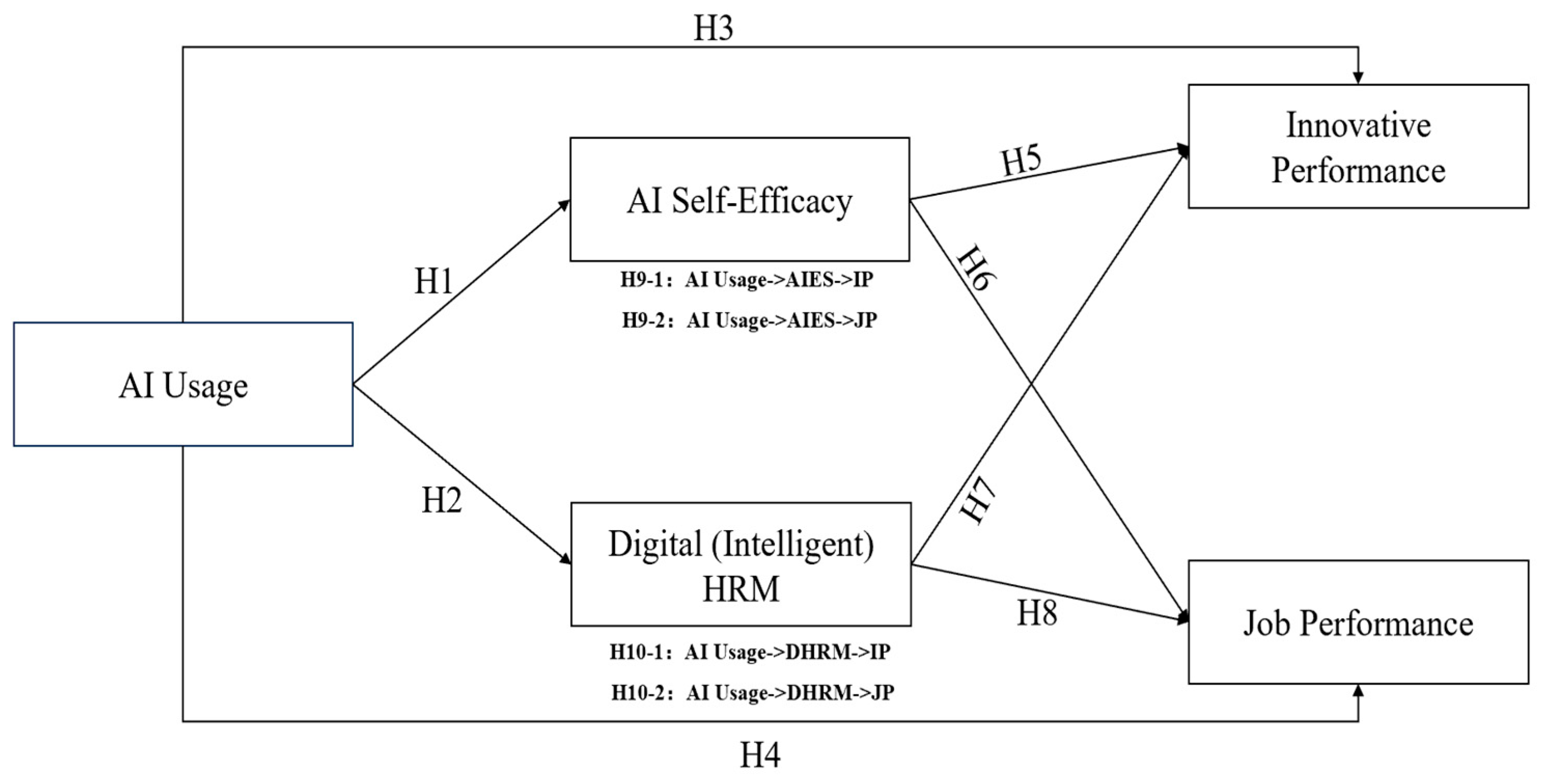
Figure 1 presents the conceptual framework of this study, summarizing the hypotheses above.

3. Methods

3.1. Sample and Data Collection

To examine the effects of artificial intelligence (AI) adoption on employees’ job performance and innovation performance, this study employed an online survey targeting employees working in Chinese enterprises. Data collection was conducted between 18 April 2025 and 4 February 2026, using purposive sampling to recruit employees from firms located in major Chinese cities, including Beijing, Shenzhen, Xi’an, and Zhengzhou, across a range of industries (e.g., IT and internet services, finance, manufacturing and services, consulting and professional services, education and training, and higher education and research institutions). Prior to survey administration, participants were informed of the study’s purpose, research content, and ethical considerations through both offline briefings (face-to-face explanations provided to enterprise representatives) and online informed consent procedures embedded in the survey platform. Participation was entirely voluntary, and respondents were explicitly informed of their right to withdraw from the study at any time without penalty. All questionnaires were collected anonymously, and no personally identifiable information was obtained. The collected data were treated with strict confidentiality and used solely for academic research purposes, in accordance with established research ethics guidelines. To ensure the relevance of responses, employees who had no prior experience using AI tools in their work were excluded from the analysis. A total of 900 questionnaires were distributed in two waves, resulting in 750 valid responses that were retained for empirical analysis.
A summary of respondents’ demographic characteristics is presented in Table 1. In terms of gender, the sample comprised 350 males (46.7%) and 400 females (53.3%), indicating a relatively balanced gender distribution. Regarding age, respondents were predominantly concentrated in the 30–39 (38.9%) and 40–49 (32.5%) age groups, together accounting for more than two-thirds of the sample. With respect to educational attainment, nearly half of the respondents held a bachelor’s degree (49.7%), and approximately one quarter possessed a master’s degree or above (24.9%), suggesting that the majority of participants had sufficient educational backgrounds to understand and respond meaningfully to the survey items. From an industry perspective, respondents were drawn from a diverse range of sectors, with relatively higher representation from IT/Internet/Technology (21.3%), Finance (20.8%), and Manufacturing/Service (20.7%), followed by Consulting/Education and Training (14.1%) and Higher Education/Research Institutes (11.2%). In terms of functional areas, participants were distributed across multiple departments, including production/operations, technology and R&D, product/project management, administration/logistics, human resources, finance/audit, and sales/business, reflecting broad coverage of organizational functions. Finally, regarding firm size, most respondents were employed in organizations with 101–500 employees (39.3%) or 501–1000 employees (26.7%), indicating a predominance of medium- to large-sized enterprises in the sample.

3.2. Measurement of Variables

To test the research hypotheses, the questionnaire used in this study included five measurement constructs: the AI Usage Scale, the AI Self-Efficacy Scale, the Work Performance Scale, the Digital–Intelligent Human Resource Management Scale, and the Innovative Performance Scale. All five scales were adapted from well-established instruments that have been developed and validated by domestic and international scholars to ensure the validity and reliability of the research results. Since the original measurement tools were in English, the scales were translated into Chinese and revised to better fit the context of AI application among enterprise employees. Following the translation, necessary modifications and adjustments were made based on qualitative analysis results to improve the accuracy and contextual relevance of the questionnaire items. Specifically, the AI Usage Scale was adapted from [84,85] and consists of six items. The AI Self-Efficacy Scale was adapted from [14] and includes five items. The Job Performance Scale was adapted from [38] and contains six items. The Digital–Intelligent Human Resource Management Scale was adapted from [79] and includes six items. The Innovative Performance Scale was also adapted from [15] and consists of six items. All items were measured using a five-point Likert scale, where responses ranged from 1 (strongly disagree) to 5 (strongly agree). Detailed items for each construct are presented in Table 2.
Because all variables were measured using self-reported questionnaires, Harman’s single-factor test was conducted to assess the potential influence of common method bias. The exploratory factor analysis extracted five factors with eigenvalues greater than 1. The first unrotated factor explained 48.281% of the total variance, which is below the recommended threshold of 50% [86]. Therefore, common method bias is not considered a serious threat to the validity of the findings.

4. Result

Measurement Reliability and Validity Assessment

To verify the measurement model’s reliability and validity, confirmatory factor analysis (CFA) was conducted on the proposed five-factor structure using AMOS 24. As shown in Table 3, the model demonstrated an acceptable fit to the data: χ2/df = 2.186, p < 0.001, RMR = 0.026, GFI = 0.931, CFI = 0.974, TLI = 0.971, IFI = 0.974, RFI = 0.948, NFI = 0.953, RMSEA = 0.040, all of which met the recommended thresholds [87], supporting the overall adequacy of the model specification. All standardized factor loadings ranged from 0.705 to 0.856 and were statistically significant at the 0.001 level, providing strong support for item reliability. The composite reliability (CR) of each latent construct exceeded the acceptable benchmark of 0.70, indicating high internal consistency: Digital Human Resource Management (CR = 0.938), Job Performance (CR = 0.927), Innovative Performance (CR = 0.924), AI Usage (CR = 0.907), and AI Self-Efficacy (CR = 0.898). In addition, all average variance extracted (AVE) values were above the minimum threshold of 0.50, further confirming convergent validity: DHRM = 0.716, JP = 0.679, IP = 0.671, AI = 0.619, and AISE = 0.638. To evaluate discriminant validity, the Fornell and Larcker (1981) criterion was employed [88]. The square root of the AVE for each construct was greater than the inter-construct correlations, indicating that each construct shared more variance with its own indicators than with other latent variables in the model. Collectively, these results support the reliability and validity of the measurement model for subsequent structural modeling.
Table 4 reports the means, standard deviations, and Pearson correlation coefficients among the study variables. As shown, all key constructs were positively and significantly correlated at the 0.01 level (p < 0.01), indicating meaningful associations among the variables. AI usage was positively related to AI self-efficacy (r = 0.664), job performance (r = 0.541), digital human resource management (r = 0.555), and innovative performance (r = 0.584). AI self-efficacy also exhibited significant positive correlations with job performance (r = 0.605) and innovative performance (r = 0.610). Digital human resource management was moderately to strongly associated with job performance (r = 0.537) and innovative performance (r = 0.629). In addition, job performance and innovative performance were strongly correlated (r = 0.638), reflecting their conceptual relatedness. Discriminant validity was further assessed using the Fornell and Larcker (1981) [88] criterion. As reported in Table 3, the square roots of the average variance extracted (AVE) for all constructs—including AI usage, AI self-efficacy, digital human resource management, job performance, and innovative performance—exceeded the corresponding inter-construct correlations, providing evidence of adequate discriminant validity. Collectively, these results offer preliminary support for the hypothesized relationships and justify subsequent structural model testing.
The hypothesized structural relationships were examined using structural equation modeling. As shown in Table 5, AI usage exerted a strong and positive effect on AI self-efficacy (β = 0.797, p < 0.001), providing support for H1. In addition, AI usage was positively associated with digital human resource management practices (β = 0.684, p < 0.001), supporting H2. With respect to performance outcomes, AI usage had a significant direct effect on innovative performance (β = 0.115, p < 0.05), supporting H3, whereas its direct effect on job performance was not statistically significant (β = 0.067, p = 0.236); thus, H4 was not supported. AI self-efficacy demonstrated significant positive effects on both innovative performance (β = 0.389, p < 0.001) and job performance (β = 0.450, p < 0.001), lending support to H5 and H6. Similarly, digital human resource management showed significant positive relationships with innovative performance (β = 0.398, p < 0.001) and job performance (β = 0.277, p < 0.001), supporting H7 and H8.
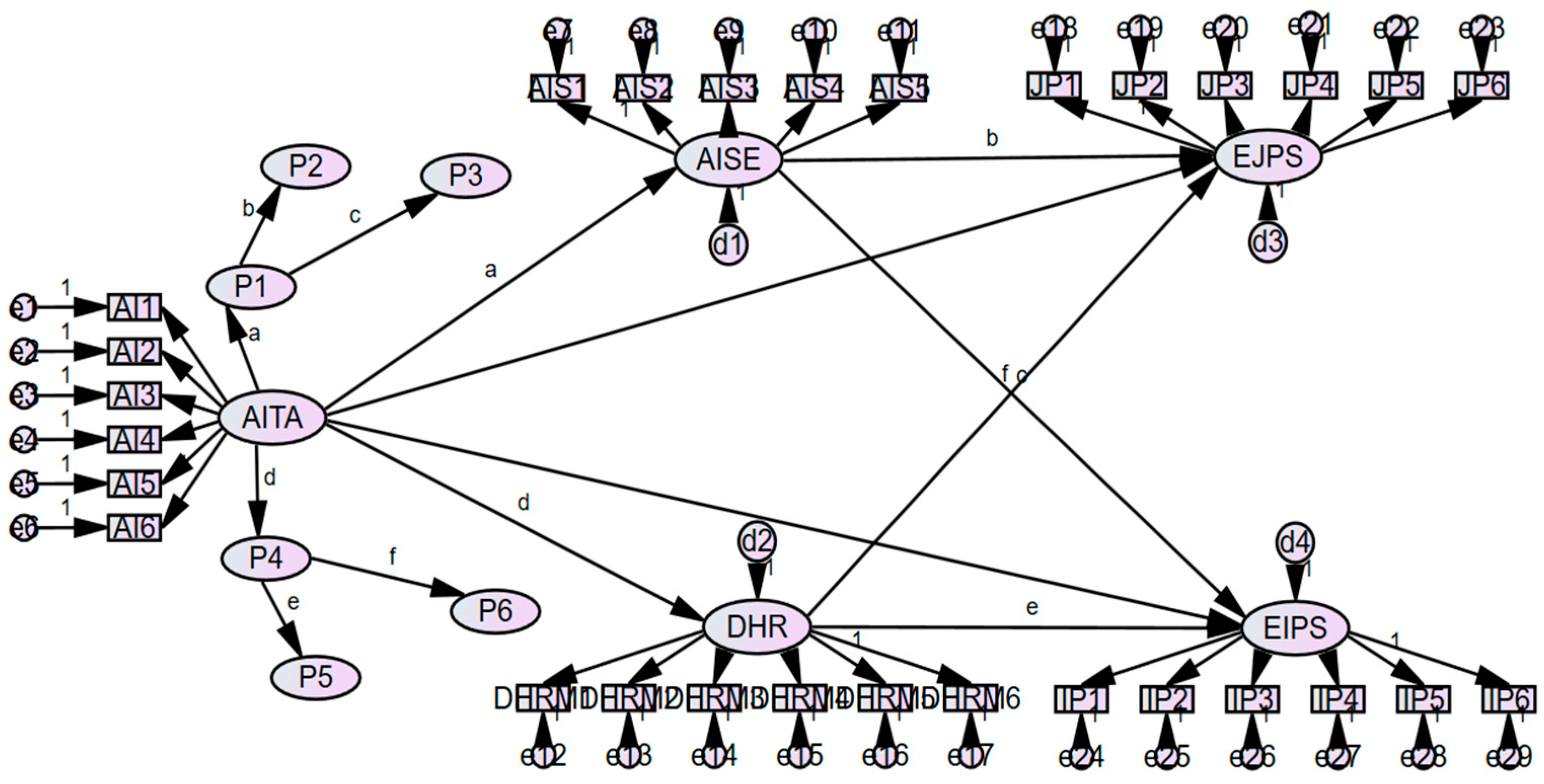
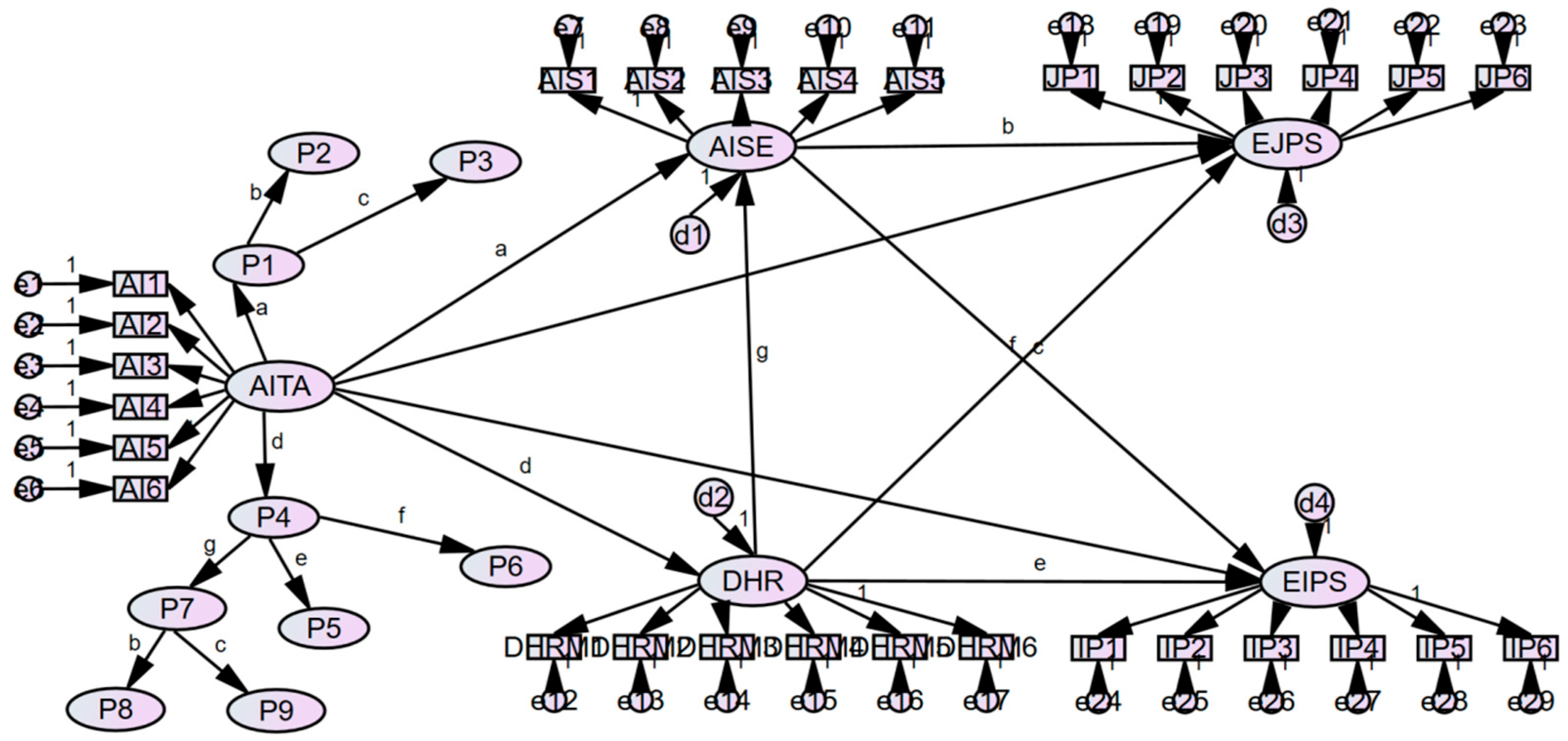
To assess mediation effects, indirect paths were estimated using the phantom variable approach with bias-corrected bootstrap procedures (5000 resamples) (see Figure 2 and Figure 3). AI usage had a significant indirect effect on innovative performance through AI self-efficacy (β = 0.310, 95% CI [0.198, 0.435]), supporting H9-1. The same pattern was observed for job performance (β = 0.359, 95% CI [0.262, 0.474]), supporting H9-2. DHRM also acted as a significant mediator. AI usage influenced innovative performance through DHRM (β = 0.272, 95% CI [0.194, 0.374]; H10-1 supported) and job performance (β = 0.198, 95% CI [0.121, 0.270]; H10-2 supported). More importantly, the analysis reveals a significant sequential mediation mechanism. AI usage enhances DHRM practices. DHRM, in turn, strengthens employees’ AI self-efficacy. AI self-efficacy then improves both innovative performance and job performance. The indirect effects of this chain are significant for innovative performance (β = 0.029, 95% CI [0.001, 0.067]) and job performance (β = 0.033, 95% CI [0.001, 0.073]). This finding provides a critical theoretical contribution. It clarifies that AI usage does not directly translate into performance outcomes. Instead, its impact is realized through a two-stage mechanism. The first stage is organizational (DHRM). The second stage is cognitive (AI self-efficacy). The results advance prior research by identifying a structured pathway linking AI usage to performance. They demonstrate that organizational digital HR practices and individual cognitive beliefs jointly enable value creation from AI.

5. Discussion

5.1. Theoretical Contributions

This study advances research on technology-enabled work and digital human resource management (HRM) by explaining how artificial intelligence (AI) usage is translated into employee performance through individual cognitive and organizational HRM mechanisms. Previous research has largely focused on the impact of technological innovation on enterprise-level performance, often adopting a technology-deterministic perspective. In contrast, this study shifts its focus to the employee level, demonstrating that the impact of AI use varies across different performance dimensions.
First, this study empirically validates AI self-efficacy as a key psychological mechanism, thereby contributing to social cognitive theory. Consistent with previous research emphasizing the importance of self-efficacy in shaping employee adaptation and performance under technological change [21,52], this study finds that AI use enhances employees’ confidence in using AI technologies. This enhanced self-efficacy subsequently improves innovative and work performance. By explicitly linking AI use with self-efficacy and performance outcomes, this study expands existing research and demonstrates that cognitive beliefs are crucial for translating technology exposure into productive behavior.
An important and theoretically meaningful finding is that AI Usage did not exert a significant direct effect on Job Performance. This result suggests that merely adopting or using AI technologies may be insufficient to improve employees’ work outcomes. While AI tools can facilitate access to information, automate routine tasks, and support decision-making processes, their effectiveness largely depends on employees’ ability to use these technologies effectively and on the organizational context in which they are implemented. From the perspective of Socio-Technical Systems (STS) theory, technological resources alone are unlikely to generate performance gains unless they are accompanied by appropriate human capabilities and supportive organizational arrangements. The significant mediating roles of AI Self-Efficacy and AI-Enabled HRM further reinforce this interpretation, indicating that the performance benefits of AI are realized primarily through cognitive and organizational mechanisms rather than through technology use alone.

Secondly, this study advances research in the field of digital HRM by viewing digital (intelligent) HRM as a key organizational mechanism. The results show that the use of AI significantly promotes the development of digital HRM practices, thereby improving work performance and innovation performance. This finding is consistent with previous research emphasizing the strategic role of digital HRM systems in supporting employee learning, capability development, and job design [29,44,64,73]. Importantly, this study transcends the traditional HRM perspective as a passive support function, conceptualizing digital HRM as an active transformation mechanism that aligns technological capabilities with human resource development.
Thirdly, this study makes new theoretical contributions by revealing two mediating mechanisms: parallel and sequential. Previous studies have typically examined only a single mediating variable, but this study’s results indicate that the use of artificial intelligence (AI) influences performance through two independent yet complementary pathways: a cognitive pathway (AI self-efficacy) and an organizational pathway (digital human resource management). More importantly, the findings confirm a sequential mediation structure: AI use enhances digital human resource management, digital human resource management reinforces AI self-efficacy, and AI self-efficacy subsequently improves innovation and job performance. This sequential mechanism provides a more nuanced explanation of how organizational systems and individual cognition jointly influence performance outcomes.
Fifth, this study highlights the synergistic effect between technology, organizational systems, and human capabilities, contributing to the emerging literature on human–machine collaboration. Consistent with recent research demonstrating that effective AI implementation requires a coordinated approach across technological infrastructure, human resource systems, and employee capabilities [65,72], this study suggests that AI alone is insufficient to improve performance. Instead, value creation occurs when digital human resource management systems support continuous learning and employees cultivate strong AI-related self-efficacy. This perspective expands upon previous research, positioning artificial intelligence (AI) as a socio-technical system embedded in organizational and human environments, rather than merely a tool.
Finally, this study challenges mainstream technological determinism by proposing a comprehensive framework integrating AI use, digital human resource management, AI self-efficacy, and employee performance. By demonstrating that performance outcomes depend on organizational structure and individual cognition, this research provides a comprehensive theoretical model for understanding how AI can promote sustainable performance improvement in digitally transformed workplaces.

5.2. Practical Implications

This study provides important practical implications for organizations seeking to promote artificial intelligence (AI) adoption and digital (intelligent) HRM transformation. The findings indicate that the impact of AI use on employee performance does not occur automatically; rather, it is closely associated with employees’ cognitive mechanisms and organizational management systems. Therefore, organizations should emphasize the coordinated development of technology application, employee capability building, and digital HRM system optimization when implementing AI technologies.
First, organizations should not limit AI development to technological upgrades alone, but should simultaneously promote the digital transformation of HRM systems. Firms can develop intelligent recruitment systems tailored to organizational needs in order to accurately identify talent that matches digital transformation requirements and optimize job allocation accordingly, thereby laying the foundation for cultivating interdisciplinary AI-related talent. In addition, from a technological perspective, organizations should establish AI platforms that provide employees with intelligent and stable working environments, thereby facilitating complementary human–AI work patterns. At the organizational level, firms should formulate standardized AI governance policies, particularly for cross-departmental collaboration, by clearly defining responsibilities, performance evaluation standards, and data management requirements associated with AI use. Relevant policies and practices should also be continuously refined according to different application scenarios.
Second, organizations should leverage digital HRM systems to identify technical difficulties employees encounter during AI-related work processes and provide feasible solutions to address these technological challenges in a timely manner, thereby strengthening employees’ confidence in using AI technologies. For example, organizations can utilize real-time feedback mechanisms and personalized capability development pathways through digital platforms to help employees gradually improve their AI application competence and technological adaptability. Such practices can further enhance employees’ confidence in AI use, promote innovation and job performance, and facilitate the effective transformation of technological capability into actual performance outcomes.
Finally, organizations should place greater emphasis on cultivating employees’ AI self-efficacy. On the one hand, firms should provide regular professional training programs for employees at different organizational levels and foster a continuous learning climate. On the other hand, organizations should establish appropriate performance-based incentive systems by incorporating employee capability development into performance evaluation and reward mechanisms, thereby encouraging proactive learning and innovative behavior and enhancing employees’ AI self-efficacy. In doing so, organizations can promote complementary human–AI collaboration in the workplace. Furthermore, organizations should recognize that improvements in employees’ AI-related capabilities can influence performance only when these capabilities are effectively translated into actual work behaviors.
Overall, this study demonstrates that the positive effect of AI on employee performance does not stem solely from the technology itself, but rather from the joint influence of technological factors, organizational mechanisms, and employee cognitive capabilities. Organizations should therefore move beyond a purely technology-oriented approach toward a systematic AI-enabled governance model by enhancing employees’ AI self-efficacy, advancing digital HRM transformation, and establishing effective human–AI collaborative systems. In this way, firms can fully realize the organizational value of AI and promote sustainable organizational development.

5.3. Limitations and Future Research Directions

Despite its theoretical and practical contributions, this study has several limitations that should be acknowledged.
First, this study employed a cross-sectional research design based on survey data collected at a single point in time. Therefore, the observed relationships should be interpreted as statistical associations rather than definitive causal effects. Although the proposed model was grounded in established theoretical frameworks and supported by empirical evidence, the cross-sectional nature of the data limits the ability to establish causal relationships among AI usage, AI self-efficacy, Digital (Intelligent) HRM, and employee performance outcomes. Moreover, as AI technologies continue to evolve and become increasingly integrated into organizational processes, employees’ perceptions, capabilities, and performance outcomes may change over time. Future research is encouraged to adopt longitudinal, multi-wave, or experimental research designs to capture the dynamic nature of AI adoption and provide stronger evidence regarding the causal mechanisms underlying AI-enabled performance outcomes.
Second, the empirical data were collected from employees working in organizations located in four major cities in China. While the sample covered multiple industries and organizational contexts, the findings may still reflect institutional, cultural, and technological characteristics specific to the Chinese context. Given that AI implementation practices, digital transformation strategies, and HRM systems vary across countries and regions, caution should be exercised when generalizing the findings to other settings. Future studies are encouraged to conduct cross-cultural and cross-national comparisons to examine whether the relationships identified in this study remain stable across different institutional and cultural environments.
In addition, the present study focused on AI self-efficacy and intelligent HRM as key mechanisms linking AI usage to employee job performance and innovative performance. However, AI-enabled workplaces are complex socio-technical systems in which individual, organizational, and technological factors interact continuously. Future research may extend the current framework by incorporating additional contextual factors, such as leadership styles, organizational learning climate, digital culture, algorithmic transparency, and employee trust in AI systems, to develop a more comprehensive understanding of how AI creates value within organizations.

Author Contributions

Conceptualization, Y.L. and X.G.; methodology, Y.L.; validation, Y.L.; formal analysis, Y.L.; investigation, Y.L.; resources, X.G.; data curation, X.G.; writing—original draft preparation, Y.L. and X.G.; writing—review and editing, X.G.; visualization, Y.L.; supervision, Y.L.; project administration, Y.L.; funding acquisition, Y.L. All authors have read and agreed to the published version of the manuscript.

Funding

This research was funded by Kyung Hee University in 2025, grant number 20251489.

Institutional Review Board Statement

The study involved an anonymous survey of adult participants and did not collect any personally identifiable information. Prior to participation, respondents were informed of the study purpose, research procedures, data confidentiality, and ethical considerations through both offline briefings and an online informed consent mechanism embedded within the survey platform. Participants were required to read the consent information and indicate their agreement before accessing the questionnaire. Participation was entirely voluntary, and respondents were informed of their right to withdraw from the study at any time without penalty. All collected data were anonymized, treated confidentially, and used solely for academic research purposes in accordance with established research ethics principles. The study was conducted in China, and the Research Ethics Center of Kyung Hee University confirmed that compliance with the applicable Chinese research ethics regulations was sufficient and that a separate dual ethics review was not required.

Informed Consent Statement

Informed consent was obtained electronically from all participants through the online consent procedure prior to survey participation.

Data Availability Statement

The datasets generated and/or analyzed during the current study are not publicly available due to confidentiality considerations but are available from the corresponding author upon reasonable request.

Acknowledgments

During the preparation of this manuscript, the authors used ChatGPT 5.5 and Grammarly Pro AI solely for English language editing, grammar correction, and improving readability and fluency. No artificial intelligence tools were used for study design, theoretical development, data collection, data analysis, interpretation of results, or substantive content generation. The authors carefully reviewed and edited all outputs and take full responsibility for the content of this publication.

Conflicts of Interest

The authors declare no conflicts of interest. The funders had no role in the design of the study; in the collection, analyses, or interpretation of data; in the writing of the manuscript; or in the decision to publish the results.

References

  1. Ganiyat, S.; Bright, G. Integrating Artificial Intelligence into Mechatronics: A Comprehensive Study of Its Influence on System Performance, Autonomy, and Manufacturing Efficiency. Technologies 2026, 14, 143. [Google Scholar] [CrossRef] [Scilit]
  2. Mossavar-Rahmani, F.; Zohuri, B. Artificial intelligence at work: Transforming industries and redefining the workforce landscape. J. Econ. Manag. Res. 2024, 5, 2–4. [Google Scholar] [CrossRef] [Scilit]
  3. Gao, Y.; Liu, S.; Yang, L. Artificial intelligence and innovation capability: A dynamic capabilities perspective. Int. Rev. Econ. Financ. 2025, 98, 103923. [Google Scholar] [CrossRef] [Scilit]
  4. Kong, X.; Yuan, W.; Ma, C. Service robots, artificial intelligence awareness, self-efficacy and work engagement. Manag. Decis. 2025, 64, 1960–1977. [Google Scholar] [CrossRef] [Scilit]
  5. Sundari, S.; Silalahi, V.A.J.M.; Wardani, F.P.; Siahaan, R.S.; Sacha, S.; Krismayanti, Y.; Anjarsari, N. Artificial Intelligence (AI) and Automation in Human Resources: Shifting the Focus from Routine Tasks to Strategic Initiatives for Improved Employee Engagement. East Asian J. Multidiscip. Res. 2024, 3, 4983–4996. [Google Scholar] [CrossRef] [Scilit]
  6. Callari, T.C.; Puppione, L. Can generative artificial intelligence productivity tools support workplace learning? A qualitative study on employee perceptions in a multinational corporation. J. Workplace Learn. 2025, 37, 266–283. [Google Scholar] [CrossRef] [Scilit]
  7. Ahmad, Z.; AlWadi, B.M.; Kumar, H.; Ng, B.-K.; Nguyen, D.N. Digital transformation of family-owned small businesses: A nexus of internet entrepreneurial self-efficacy, artificial intelligence usage and strategic agility. Kybernetes 2024, 54, 6223–6251. [Google Scholar] [CrossRef] [Scilit]
  8. Ji, Y.; Zhong, M.; Lyu, S.; Li, T.; Niu, S.; Zhan, Z. How does AI literacy affect individual innovative behavior: The mediating role of psychological need satisfaction, creative self-efficacy, and self-regulated learning. Educ. Inf. Technol. 2025, 30, 16133–16162. [Google Scholar] [CrossRef] [Scilit]
  9. Zahra, N.; Manthar, S.; Anwar, R.S. Innovative work behaviors in the digital age: The influence of organizational structures and processes. Transform. Sustain. 2026, 2, 12–40. [Google Scholar] [CrossRef] [Scilit]
  10. Enshassi, M.; Nathan, R.J.; Soekmawati, S.; Al-Mulali, U.; Ismail, H. Potentials of artificial intelligence in digital marketing and financial technology for small and medium enterprises. IAES Int. J. Artif. Intell. (IJ-AI) 2024, 13, 639. [Google Scholar] [CrossRef] [Scilit]
  11. Trist, E.L.; Bamforth, K.W. Some social and psychological consequences of the longwall method of coal-getting: An examination of the psychological situation and defences of a work group in relation to the social structure and technological content of the work system. Hum. Relat. 1951, 4, 3–38. [Google Scholar] [CrossRef] [Scilit]
  12. Trist, E.L. The Evolution of Socio-Technical Systems; Ontario Quality of Working Life Centre: Toronto, ON, Canada, 1981; Volume 2, p. 1981. [Google Scholar]
  13. Zhang, Y.; Lin, Y.; Esfahbodi, A. Digital transformations of supply chain management via RFID technology: A systematic literature review. J. Digit. Econ. 2025, 4, 251–267. [Google Scholar] [CrossRef] [Scilit]
  14. Chi, O.H.; Jia, S.; Li, Y.; Gursoy, D. Developing a formative scale to measure consumers’ trust toward interaction with artificially intelligent (AI) social robots in service delivery. Comput. Hum. Behav. 2021, 118, 106700. [Google Scholar] [CrossRef] [Scilit]
  15. Janssen, O.; Van Yperen, N.W. Employees’ Goal Orientations, the Quality of Leader-Member Exchange, and the Outcomes of Job Performance and Job Satisfaction. Acad. Manag. J. 2004, 47, 368–384. [Google Scholar] [CrossRef] [Scilit]
  16. Bandura, A. Self-efficacy: Toward a unifying theory of behavioral change. Psychol. Rev. 1977, 84, 191–215. [Google Scholar] [CrossRef] [PubMed]
  17. Addula, S.R. Mobile Banking Adoption: A Multi-Factorial Study on Social Influence, Compatibility, Digital Self-Efficacy, and Perceived Cost Among Generation Z Consumers in the United States. J. Theor. Appl. Electron. Commer. Res. 2025, 20, 192. [Google Scholar] [CrossRef] [Scilit]
  18. Ou, J.; Nogueira, J.; Qin, C. Exploring the impact of AI-assisted practice applications on music learners’ performance, self-efficacy, and self-regulated learning. Front. Psychol. 2025, 16, 1675762. [Google Scholar] [CrossRef] [Scilit] [PubMed]
  19. Wang, Y.-Y.; Chuang, Y.-W. Artificial intelligence self-efficacy: Scale development and validation. Educ. Inf. Technol. 2024, 29, 4785–4808. [Google Scholar] [CrossRef] [Scilit]
  20. Xavier, D.F.; Korunka, C. Integrating Artificial Intelligence across cultural orientations: A longitudinal examination of creative self-efficacy and employee autonomy. Comput. Hum. Behav. Rep. 2025, 18, 100623. [Google Scholar] [CrossRef] [Scilit]
  21. Xiang, Y.; Wei, C.; Huang, J. Research on enhancing the self-efficacy of logistics enterprise employees in the era of artificial intelligence. China Storage Transp. 2024, 4, 94–95. [Google Scholar] [CrossRef]
  22. Yu, T.-Y.; Liu, C.-H.; Horng, J.-S.; Chou, S.-F.; Huang, Y.-C.; Fang, Y.-P.; Lin, J.-Y.; Vu, H.T. Discovering how digital attitudes, control, self-efficacy and social norms influence the digital behavior decision-making of leisure and recreation activities participants. Curr. Psychol. 2025, 44, 1032–1054. [Google Scholar] [CrossRef] [Scilit]
  23. Ali El Deen, A.; Albasis, H.H.; Mohamed, A.M. Teacher charisma and AI-mediated education: Effects on EFL learners’ attitudes and self-efficacy. Acta Psychol. 2026, 263, 106244. [Google Scholar] [CrossRef] [Scilit] [PubMed]
  24. Hwang, Y.; Wu, Y. The influence of generative artificial intelligence on creative cognition of design students: A chain mediation model of self-efficacy and anxiety. Front. Psychol. 2025, 15, 1455015. [Google Scholar] [CrossRef] [Scilit] [PubMed]
  25. El Garem, R.A. HR digital transformation: Enhancing human resource management through technology. Future Bus. J. 2026, 12, 5. [Google Scholar] [CrossRef] [Scilit]
  26. Wang, G.; Niu, Y.; Mansor, Z.D.; Leong, Y.C.; Yan, Z. Unlocking digital potential: Exploring the drivers of employee dynamic capability on employee digital performance in Chinese SMEs-moderation effect of competitive climate. Heliyon 2024, 10, e25583. [Google Scholar] [CrossRef] [Scilit] [PubMed]
  27. Setiawan, S.; Rusilowati, U.; Jaya, A.; Wang, R. Transforming Human Resource Practices in the Digital Age: A Study on Workforce Resilience and Innovation. J. Comput. Sci. Technol. Appl. 2025, 2, 84–92. [Google Scholar] [CrossRef] [Scilit]
  28. Hong, T. Practical Research on the Digital Intelligent Transformation of Human Resource Management in Tourism Enterprises. China Mark. 2025, 1, 77–81. [Google Scholar] [CrossRef]
  29. Memon, F.A.; Memon, M.B.; Mughal, S.A. Impact of Artificial Intelligence on Human Resource Management Practices: A Qualitative Study in Hyderabad, Pakistan’s Banking Sector. J. Manag. Res. 2025, 12, 97–126. [Google Scholar] [CrossRef] [Scilit]
  30. Zhang, Z.; Kang, Y.; Lu, Y.; Li, P. The Role of Artificial Intelligence in Business Model Innovation of Digital Platform Enterprises. Systems 2025, 13, 507. [Google Scholar] [CrossRef] [Scilit]
  31. Bastida, M.; Vaquero García, A.; Vazquez Taín, M.Á.; Del Río Araujo, M. From automation to augmentation: Human resource’s journey with artificial intelligence. J. Ind. Inf. Integr. 2025, 46, 100872. [Google Scholar] [CrossRef] [Scilit]
  32. Omidi, L.; Zakerian, S.A.; Hadavandi, E.; Saraji, J.N. Boosted neural network modeling of psychological and social factors of work affecting safety performance and job satisfaction in the process industry. BMC Psychol. 2025, 13, 866. [Google Scholar] [CrossRef] [Scilit] [PubMed]
  33. Wang, Y.; Park, J.; Gao, Q. Digital leadership and employee innovative performance: The role of job crafting and person-job fit. Front. Psychol. 2025, 16, 1492264. [Google Scholar] [CrossRef] [Scilit] [PubMed]
  34. Yadav, U.S.; Yadav, N.; Yadav, A.K.; Gupta, V.P.; Singh, K.; Saxena, G. Factors influencing digital payments and its association with digital transaction experiences, level of education, digital skills, social factors and modearting effect of internet usage. J. Knowl. Econ. 2026, 17, 8186–8232. [Google Scholar] [CrossRef] [Scilit]
  35. Gazi, M.A.I.; Rahman, M.K.H.; Masud, A.A.; Amin, M.B.; Chaity, N.S.; Senathirajah, A.R.b.S.; Abdullah, M. AI Capability and Sustainable Performance: Unveiling the Mediating Effects of Organizational Creativity and Green Innovation with Knowledge Sharing Culture as a Moderator. Sustainability 2024, 16, 7466. [Google Scholar] [CrossRef] [Scilit]
  36. Wei, X.; Wang, L.; Lee, L.-K.; Liu, R. The effects of generative AI on collaborative problem-solving and team creativity performance in digital story creation: An experimental study. Int. J. Educ. Technol. High. Educ. 2025, 22, 23. [Google Scholar] [CrossRef] [Scilit]
  37. Li, J.; Song, H.; Ma, Y. The mechanism and impact of digital transformation on supply chain resilience in the manufacturing industry. Sci. Rep. 2026, 16, 7635. [Google Scholar] [CrossRef] [Scilit] [PubMed]
  38. Becker, T.E.; Billings, R.S.; Eveleth, D.M.; Gilbert, N.L. Foci and Bases of Employee Commitment: Implications for Job Performance. Acad. Manag. J. 1996, 39, 464–482. [Google Scholar] [CrossRef] [Scilit]
  39. Shanmuga Sundari, M.; Gangalapudi, K.P. Balancing Digital Efficiency with Human Connection in the Workplace. In Humanizing the Hyperconnected Workplace; IGI Global Scientific Publishing: Hershey, PA, USA, 2025; pp. 31–68. [Google Scholar] [CrossRef] [Scilit]
  40. Borman, W.C.; Motowidlo, S.J. Task Performance and Contextual Performance: The Meaning for Personnel Selection Research. Hum. Perform. 1997, 10, 99–109. [Google Scholar] [CrossRef] [Scilit] [PubMed]
  41. Subramaniam, S.N.; Dorasamy, M.; Malarvizhi, C.A.N. Personality trait and employee performance in digital transformation: The mediating effect of employee dynamic capability. Cogent Bus. Manag. 2025, 12, 2448774. [Google Scholar] [CrossRef] [Scilit]
  42. Wang, G.; Mansor, Z.D.; Leong, Y.C. Fostering Digital Excellence: A Multidimensional Exploration of the Collective Effects of Technological Adaptability, Employee Competitiveness, and Employee Dynamic Capabilities on Employee Digital Performance in Chinese SMEs. Int. J. Soc. Sci. Res. 2024, 12, 116. [Google Scholar] [CrossRef] [Scilit]
  43. Perifanis, N.-A.; Kitsios, F. Investigating the Influence of Artificial Intelligence on Business Value in the Digital Era of Strategy: A Literature Review. Information 2023, 14, 85. [Google Scholar] [CrossRef] [Scilit]
  44. Fan, X.; Zhao, S.; Zhang, X.; Meng, L. The Impact of Improving Employee Psychological Empowerment and Job Performance Based on Deep Learning and Artificial Intelligence. J. Organ. End. User Comput. 2023, 35, 1–14. [Google Scholar] [CrossRef] [Scilit]
  45. Jeong, J. The innovative side of AI adoption in South Korea: How job crafting and technology self-efficacy influence employee innovative work behaviour. Asia Pac. Bus. Rev. 2025, 1–34. [Google Scholar] [CrossRef] [Scilit]
  46. Hameli, K.; Vehapi, A.; Tafili, E. Fostering innovative work behavior: The role of organizational support and employee self-efficacy. Corp. Commun. Int. J. 2025, ahead-of-print. [Google Scholar] [CrossRef] [Scilit]
  47. Utomo, H.J.N.; Pujiastuti, E.E.; Sugiarto, M.; Ramadani, N. The Effect of Job Mutation and Job Promotion on Job Satisfaction and Self-Efficacy, and its Implication on Job performance. Int. J. Appl. Bus. Res. 2025, 7, 77–102. [Google Scholar] [CrossRef] [Scilit]
  48. Wang, S.; Zhang, H. Generative AI in international hotel marketing: Impacts on employee creativity and performance. Int. J. Contemp. Hosp. Manag. 2025, 37, 2601–2626. [Google Scholar] [CrossRef] [Scilit]
  49. Dewi, N.P.; Nurhatisyah, N.; Elkarima, N.; Pawar, A. Transformational Leadership, Digital Competence, and Employee Performance: Examining the Mediating Role of Self-Efficacy and the Moderating Influence of Perceived Organizational Support. J. Manaj. Bisnis 2025, 16, 47–72. [Google Scholar] [CrossRef] [Scilit]
  50. Hemsworth, D.; Muterera, J.; Khorakian, A.; Garcia-Rivera, B.R. Exploring the Theory of Employee Planned Behavior: Job Satisfaction as a Key to Organizational Performance. Psychol. Rep. 2026, 129, 1584–1615. [Google Scholar] [CrossRef] [Scilit] [PubMed]
  51. Kızrak, M. Exploring the effects of psychological safety, organization-based self-esteem, and self-efficacy on job performance. Sos. Mucit Acad. Rev. 2025, 6, 1–28. [Google Scholar] [CrossRef] [Scilit]
  52. Hameli, K.; Ukaj, L.; Çollaku, L. The role of self-efficacy and psychological empowerment in explaining the relationship between emotional intelligence and work engagement. EuroMed J. Bus. 2025, 20, 378–398. [Google Scholar] [CrossRef] [Scilit]
  53. Adityaksa, R.; Suyoso, A.L.A. The impact of AI adoption on job engagement and employee trust. Gold. Ratio Hum. Resour. Manag. 2025, 5, 133–140. [Google Scholar] [CrossRef] [Scilit]
  54. Abbasi, M.A.; Yon, L.C.; Amran, A. Alliance Networks, Innovative Culture, and Intellectual Human Capital as Key Enablers of Corporate Social Innovation: A Hybrid Approach Using PLS-SEM and fsQCA. Corp. Soc. Responsib. Environ. Manag. 2025, 32, 3227–3245. [Google Scholar] [CrossRef] [Scilit]
  55. Zhang, Y.; Li, H.; Yao, Z. Intellectual capital, digital transformation and firm performance: Evidence based on listed companies in the Chinese construction industry. Eng. Constr. Archit. Manag. 2025, 32, 2128–2159. [Google Scholar] [CrossRef] [Scilit]
  56. Obeng, H.A.; Gyamfi, B.A.; Mensah, L.; Arhinful, R.; Sarwar, A. Employees’ behavioral intention to use AI and organizational efficiency in an emerging economy: The serial mediating roles of technology readiness and digital culture. Discov. Artif. Intell. 2026, 6, 251. [Google Scholar] [CrossRef] [Scilit]
  57. Fan, X.; Yang, N. When digital meets human: How organizational digital capability promotes service innovation via cognitive flexibility and empowering leadership. Acta Psychol. 2026, 262, 106014. [Google Scholar] [CrossRef] [Scilit] [PubMed]
  58. Hussein Ali, F.; Abdullah Ibrahim, K. Digital Human Resource Management and Its Role in Achieving Competitive Advantage: An Exploratory Study of the Opinions of a Sample of Leaders in Private Banks. F1000Research 2026, 15, 207. [Google Scholar] [CrossRef] [Scilit]
  59. Çelik, D. Digital Empowerment and Competitiveness in Businesses. In Insights into Digital Business, Human Resource Management, and Competitiveness; IGI Global Scientific Publishing: Hershey, PA, USA, 2025; pp. 69–102. [Google Scholar] [CrossRef] [Scilit]
  60. Saleh, A.; Omar, S.S.; Milhem, M.; Ateeq, A. The moderating role of emotional intelligence and HR digitalization on the relationship between compensation and employee job performance in Johor manufacturing sector. Int. J. Manag. 2024, 13, 910–934. [Google Scholar] [CrossRef] [Scilit]
  61. Palmucci, D.N.; Giovando, G.; Vincurova, Z. The post-Covid era: Digital leadership, organizational performance and employee motivation. Manag. Decis. 2025, 63, 2452–2485. [Google Scholar] [CrossRef] [Scilit]
  62. Qu, C.; Kim, E. Artificial-Intelligence-Enabled Innovation Ecosystems: A Novel Triple-Layer Framework for Micro, Small, and Medium-Sized Enterprises in the Chinese Apparel-Manufacturing Industry. Sustainability 2025, 17, 5019. [Google Scholar] [CrossRef] [Scilit]
  63. Qudus, L. Leveraging Artificial Intelligence to Enhance Process Control and Improve Efficiency in Manufacturing Industries. Int. J. Comput. Appl. Technol. Res. 2025, 14, 18–38. [Google Scholar] [CrossRef] [Scilit]
  64. Wang, B.; Liu, S.; Luo, C. How does human-AI collaboration task complexity affect employee work engagement? The roles of humble leadership and AI self-efficacy. Front. Psychol. 2026, 17, 1767967. [Google Scholar] [CrossRef] [Scilit] [PubMed]
  65. Zhang, X.; Yu, P.; Ma, L. How and when generative AI use affects employee incremental and radical creativity: An empirical study in China. Eur. J. Innov. Manag. 2025, 29, 702–727. [Google Scholar] [CrossRef] [Scilit]
  66. Yin, M.; Jiang, S.; Niu, X. Can AI really help? The double-edged sword effect of AI assistant on employees’ innovation behavior. Comput. Hum. Behav. 2024, 150, 107987. [Google Scholar] [CrossRef] [Scilit]
  67. Alshahrani, M.A.; Yaqub, M.Z.; Ali, M.; El Hakimi, I.; Salam, M.A. Could entrepreneurial leadership promote employees’ IWB? The roles of intrinsic motivation, creative self-efficacy and firms’ innovation climate. Int. J. Innov. Sci. 2025, ahead-of-print. [Google Scholar] [CrossRef] [Scilit]
  68. Al Naqbi, H.; Bahroun, Z.; Ahmed, V. Enhancing work productivity through generative artificial intelligence: A comprehensive literature review. Sustainability 2024, 16, 1166. [Google Scholar] [CrossRef] [Scilit]
  69. Entezami, M.; Basirat, S.; Moghaddami, B.; Bazmandeh, D.; Charkhian, D. Examining the importance of AI-based criteria in the development of the digital economy: A multi-criteria decision-making approach. J. Soft Comput. Decis. Anal. 2025, 3, 72–95. [Google Scholar] [CrossRef] [Scilit]
  70. Han, Z.; Song, G.; Zhang, Y.; Li, B. Trust the Machine or Trust Yourself: How AI Usage Reshapes Employee Self-Efficacy and Willingness to Take Risks. Behav. Sci. 2025, 15, 1046. [Google Scholar] [CrossRef] [Scilit] [PubMed]
  71. Parker, S.K. Enhancing role breadth self-efficacy: The roles of job enrichment and other organizational interventions. J. Appl. Psychol. 1998, 83, 835. [Google Scholar] [CrossRef] [Scilit] [PubMed]
  72. Wiyanto, J.; Ratnaningsih, D.J.; Suratini, S. Self-efficacy, career development, and work engagement on employee performance: Evidence from aviation sector organizations. J. Enterp. Dev. 2024, 6, 223–236. [Google Scholar] [CrossRef]
  73. Chen, R.Z.; Zhang, L.; Peng, X.F. The impact of compensation fairness and team trust on the job performance of employees in the securities industry-based on the moderating effect of self-efficacy. Oper. Manag. 2022, 10, 96–107. [Google Scholar] [CrossRef]
  74. Tummalapalli, H.K.; Rao, A.N.; Kamal, G.; Kumari, N.; Kumar, J.R.S. Exploring AI-driven management: Impact on organizational performance, decision making, efficiency, and employee engagement. J. Adv. Res. Appl. Sci. Eng. Technol. 2025, 52, 148–163. [Google Scholar] [CrossRef] [Scilit]
  75. Alkish, I.; Iyiola, K.; Alzubi, A.B.; Aljuhmani, H.Y. Does Digitization Lead to Sustainable Economic Behavior? Investigating the Roles of Employee Well-Being and Learning Orientation. Sustainability 2025, 17, 4365. [Google Scholar] [CrossRef] [Scilit]
  76. Al-Faouri, E.H.; Abu Huson, Y.; Aljawarneh, N.M.; Alqmool, T.J. The role of smart human resource management in the relationship between technology application and innovation performance. Sustainability 2024, 16, 4747. [Google Scholar] [CrossRef] [Scilit]
  77. Nugroho, F.S.; Purwaamijaya, B.M.; Prehanto, A. The Impact of Artificial Intelligence and Work Training on Human Resource Performance: A Case Study of PT Satria Bahana Sarana. Eduvest J. Univers. Stud. 2025, 5, 3227–3244. [Google Scholar] [CrossRef] [Scilit]
  78. Gupta, P.; Lakhera, G.; Sharma, M. Examining the impact of artificial intelligence on employee performance in the digital era: An analysis and future research direction. J. High Technol. Manag. Res. 2024, 35, 100520. [Google Scholar] [CrossRef] [Scilit]
  79. Cheng, X.M. The Process Mechanism of the Impact of Digital Intelligence Human Resource Management on the Performance of New Generation Employees. Master’s Thesis, Shandong University of Finance and Economics, Jinan, China, 2023. Available online: https://link.cnki.net/doi/10.27274/d.cnki.gsdjc.2023.000202 (accessed on 20 December 2025).
  80. Chukwuka, E.J.; Dibie, K.E. Strategic role of artificial intelligence (AI) on human resource management (HR) employee performance evaluation function. Int. J. Entrep. Bus. Innov. 2024, 7, 269–282. [Google Scholar] [CrossRef] [Scilit]
  81. Lou, Y.; Hong, A.; Li, Y. Assessing the Role of HRM and HRD in Enhancing Sustainable Job Performance and Innovative Work Behaviors through Digital Transformation in ICT Companies. Sustainability 2024, 16, 5162. [Google Scholar] [CrossRef] [Scilit]
  82. Nematollahi, H.; Mohammadi, H.; Gholipour, A.; Mohammad Esmaeili, N. Impact of Digital Human Resource Management Practices and Digital Transformation on Human Resource Management System Strength: Evidence from Insurance Industry. Interdiscip. J. Manag. Stud. 2024, 17, 1077–1096. [Google Scholar] [CrossRef]
  83. Benhala, B.; Grace Herlina, M.; Iskandar, K.; Lachhab, A.; Raihani, A.; Qbadou, M.; Sallem, A. Integrating Sustainable HRM, AI, and Employee Well-Being to Enhance Engagement in Greater Jakarta: An SDG 3 Perspective. E3S Web Conf. 2025, 601, 00020. [Google Scholar] [CrossRef] [Scilit]
  84. Poushneh, A. Augmented reality in retail: A trade-off between user’s control of access to personal information and augmentation quality. J. Retail. Consum. Serv. 2018, 41, 169–176. [Google Scholar] [CrossRef] [Scilit]
  85. Wang, B.; Rau, P.-L.P.; Yuan, T. Measuring user competence in using artificial intelligence: Validity and reliability of artificial intelligence literacy scale. Behav. Inf. Technol. 2022, 42, 1324–1337. [Google Scholar] [CrossRef] [Scilit]
  86. Podsakoff, P.M.; MacKenzie, S.B.; Lee, J.Y.; Podsakoff, N.P. Common method biases in behavioral research: A critical review of the literature and recommended remedies. J. Appl. Psychol. 2003, 88, 879. [Google Scholar] [CrossRef] [Scilit] [PubMed]
  87. Hair, J.F., Jr.; Black, W.C.; Babin, B.J.; Anderson, R.E. Multivariate Data Analysis; Cengage Inc.: Independence, KY, USA, 2010; p. 785. [Google Scholar]
  88. Fornell, C.; Larcker, D.F. Evaluating structural equation models with unobservable variables and measurement error. J. Mark. Res. 1981, 18, 39–50. [Google Scholar] [CrossRef] [Scilit]
Figure 1. Research model.
Systems 14 00786 g001
Figure 2. Structural Model with Parallel Mediation.
Systems 14 00786 g002
Figure 3. Structural Model with Sequential Mediation.
Systems 14 00786 g003
Table 1. Demographic information.
CategoriesN%
GenderMale35046.7
Female40053.3
Age20–29 years17723.6
30–39 years29238.9
40–49 years24432.5
50–59 years283.7
60 and above91.2
EducationBelow Associate degree395.2
Associate degree15120.1
Bachelor’s degree37349.7
Master’s degree or above18724.9
IndustryIT/Internet/Technology16021.3
Finance15620.8
Manufacturing/Service15520.7
Consulting/Education & Training10614.1
Higher Education/Research Institutes8411.2
Others8911.9
functional areasProduction/Operations9913.2
Technology/R&D12716.9
Product/Project Management11815.7
Administration/Logistics7510.0
Human Resources7710.3
Finance/Audit9312.4
Sales/Business7910.5
Others8210.9
Corporate size0~100 employees14619.5
101~500 employees29539.3
501~1000 employees20026.7
>1000 employees10914.5
Table 2. Measurement of variables.
VariableItems
AI Usage
[84,85]
When using AI tools for work, I often rely on AI to complete my tasks.
When using AI tools for work, I do not need to think excessively, as AI helps me accomplish tasks more effectively.
When using AI tools for work, I feel that I can skillfully use various AI functions.
I believe that learning and using AI software and products is an easy task.
I am proficient in using AI applications or products to assist me in completing my daily work.
I can use AI applications or products to improve my work efficiency
AI Self-Efficacy
[14]
I am confident in my ability to use AI services effectively.
I can use AI services if someone shows me how to do it first.
I can use AI services if I receive assistance when encountering difficulties.
I can use AI services after trying them myself and observing others use them.
I can use AI services if help instructions are available.
Job Performance
[38]
I am able to complete my work with high quality.
I am able to complete my work in a timely and efficient manner.
The work I complete satisfies others.
The quantity of my completed work is satisfactory.
The quality of my completed work is satisfactory.
My overall job performance is satisfactory.
Digital (Intelligent) HRM
[79]
The degree of digital intelligence in our company’s human resource plan module.
The degree of digital intelligence in our company’s recruitment and placement module.
The extent to which digital intelligence is applied (or embedded) in our company’s training and development module.
The degree of digital intelligence in our company’s career development and succession management module.
The degree of digital intelligence in our company’s performance management module.
The degree of digital intelligence in our company’s compensation and benefits module.
Innovative Performance
[15]
I seek new work methods, skills, or tools through continuous learning.
I am able to transform innovative ideas into practical applications.
I generate creative ideas to improve my work content.
My innovative ideas enhance my task performance.
I propose innovative solutions to problems encountered in my work.
I receive recognition or praise from my supervisor for my innovative ideas.
Table 3. Confirmatory Factor Analysis Results.
ItemEstimateS.E.C.R.AVECR
βB
AI60.7861.000 0.6190.907
AI50.8111.1040.04624.141 ***
AI40.7981.0880.04623.690 ***
AI30.8221.1900.04824.576 ***
AI20.7051.0330.05120.309 ***
AI10.7941.1430.04923.525 ***
AISE10.7851.000 0.6380.898
AISE20.7620.9200.04122.180 ***
AISE30.8150.9910.04124.087 ***
AISE40.8150.9590.04024.109 ***
AISE50.8150.9460.03924.086 ***
DHRM50.8321.000 0.7160.938
DHRM60.8381.0140.03628.186 ***
DHRM40.8320.9900.03627.863 ***
DHRM30.8561.0530.03629.129 ***
DHRM20.8471.0360.03628.636 ***
DHRM10.8721.0540.03530.066 ***
JP10.8771.000 0.6790.927
JP20.8160.9180.03229.028 ***
JP30.8140.9320.03228.884 ***
JP40.8080.8680.03028.546 ***
JP50.8280.9240.03129.785 ***
JP60.7980.8790.03127.924 ***
IP50.8191.000 0.6710.924
IP40.8290.9550.03626.746 ***
IP30.8251.0200.03826.578 ***
IP20.8210.9330.03526.368 ***
IP10.8170.9230.03526.177 ***
IP60.8020.9900.03925.499 ***
Model fit: CMIN/DF = 2.186, p < 0.001, RMR = 0.026, GFI = 0.931, CFI = 0.974, TLI = 0.971, IFI = 0.974, RFI = 0.948, NFI = 0.953, RMSEA = 0.040
Notes. N = 750, *** p < 0.001. Digital Human Resource Management (DHRM), Job Performance (JP), Innovative Performance (IP), AI Usage (AI), and AI Self-Efficacy (AISE).
Table 4. Mean, Standard Deviations and Correlations.
MeanSDAIAISEJPDHRMIP
AI3.89040.825820.787
EAIS4.03950.786560.664 **0.799
EJP4.15820.704800.541 **0.605 **0.846
DHRM4.00040.858650.555 **0.476 **0.537 **0.824
EIP4.09020.778700.584 **0.610 **0.638 **0.629 **0.819
Notes. N = 750, ** p < 0.001. Digital Human Resource Management (DHRM), Job Performance (JP), Innovative Performance (IP), AI Usage (AI), and AI Self-Efficacy (AISE).
Table 5. Structural Equation Modeling Results for Hypothesis Testing.
Hypothesized PathEstimateS.E.C.R.pResults
H1 AI ➔ AISE0.7970.04517.641***Supported
H2 AI ➔ DHRM0.6840.04515.327***Supported
H3 AI ➔ IP0.1150.0552.0910.036Supported
H4 AI ➔ JP0.0670.0571.1850.236Rejected
H5 AISE ➔ IP0.3890.0478.246***Supported
H6 AISE ➔ JP0.4500.0499.207***Supported
H7 DHRM ➔ IP0.3980.03611.109***Supported
H8 DHRM ➔ JP0.2770.0357.887***Supported
SEM Model with Multiple Mediators Using Phantom Variables (Indirect Effects)
hypothesized pathEstimateS.E.p95% CIResults
LowerUpper
H9-1 AI ➔ AISE ➔ IP (P3)0.3100.059***0.1980.435Supported
H9-2 AI ➔ AISE ➔ JP (P2)0.3590.054***0.2620.474Supported
H10-1 AI ➔ DHRM ➔ IP(P5)0.2720.046***0.1940.374Supported
H10-2 AI ➔ DHRM ➔ JP(P6)0.1980.038***0.1210.270Supported
AI ➔ DHRM ➔ AISE ➔ JP(P8)0.0330.0180.044 *0.0010.073Supported
AI ➔ DHRM ➔ AISE ➔ IP(P9)0.0290.0170.043 *0.0010.067Supported
Model fit: CMIN/DF = 2.329, p < 0.001, RMR = 0.035, GFI = 0.926, CFI = 0.971, TLI = 0.968, IFI = 0.971, RFI = 0.945, NFI = 0.971, RMSEA = 0.042
Notes. N = 750,* p <0.05, *** p < 0.001. Digital Human Resource Management (DHRM), Job Performance (JP), Innovative Performance (IP), AI Usage (AI), and AI Self-Efficacy (AISE).
Disclaimer/Publisher’s Note: The statements, opinions and data contained in all publications are solely those of the individual author(s) and contributor(s) and not of MDPI and/or the editor(s). MDPI and/or the editor(s) disclaim responsibility for any injury to people or property resulting from any ideas, methods, instructions or products referred to in the content.