Article

Capital Market Liberalization as a Systemic Stabilizer of Corporate Default Risk: A Structural-Coupling Model with Quasi-Experimental Evidence from China

School of Economics, Qingdao University, Qingdao 266100, China
*
Author to whom correspondence should be addressed.
Systems 2026, 14(7), 785; https://doi.org/10.3390/systems14070785 (registering DOI)
Submission received: 21 May 2026 / Revised: 3 July 2026 / Accepted: 3 July 2026 / Published: 5 July 2026
(This article belongs to the Section Systems Theory and Methodology)

Abstract

We re-conceptualize corporate debt default risk (EDF) as an emergent state variable of a coupled financial system and ask how capital-market opening reshapes its equilibrium. Extending the structural credit-risk framework with three interacting subsystem channels—external financing, investment efficiency, and information disclosure—we derive a closed-form result showing that an exogenous increase in liberalization strictly reduces the system-level corporate debt default probability through three complementary channels. We then exploit the staggered roll-out of China’s Shanghai–Hong Kong and Shenzhen–Hong Kong Stock Connect (HSGT) programs as a quasi-natural experiment on a panel of 21,351 firm-year observations over 2011–2023. A difference-in-differences (DID) estimator confirms a significant stabilizing effect on the firm’s market-implied default probability that is robust to an extensive battery of identification and specification checks; mechanism regressions confirm all three model-implied channels. The stabilizing effect is further amplified in firms facing greater environmental uncertainty and greater customer concentration—precisely the regimes in which our model predicts the underlying subsystem coupling to be most fragile. Our findings recast capital-market opening as a system-level intervention that simultaneously re-balances financing, investment, and information subsystems of the financial system, with implications for financial-stability policy in emerging economies.

1. Introduction

In November 2014, the gates of one of the world’s largest equity markets were quietly cracked open. The Shanghai–Hong Kong Stock Connect, followed in December 2016 by the HSGT, gave international institutional investors direct, frictionless access to designated Chinese A-shares for the first time. What was presented as a technical reform turned out to be something more fundamental: a structural intervention on the topology of the Chinese financial system itself.
Why does that distinction matter? Because the corporate default risk that has gathered around Chinese non-financial firms is not a property of any single firm. After implicit guarantees the credit-bond market gave way in 2014, defaulted bond principal grew from RMB 13.4 million that year to RMB 8.79 billion by 2022—a roughly thousand-fold cumulative escalation that cascaded through credit lines, operating cash flows, and creditor risk premia. As Haldane and May (2011) [1] and Battiston et al. (2012) [2] have argued for banking ecosystems and global credit networks, modern financial systems behave as coupled adaptive networks; their fragility is not the sum of firm-level vulnerabilities but a property of how the subsystems—capital flows, information channels, governance structures—are tied together. The systems-science tradition of Sterman (2000) [3] and Forrester (1997) [4] makes this point in its most general form: the state of a complex system cannot be inferred from any one subsystem in isolation; it emerges from the configuration of the whole.
Yet most existing work on what drives corporate default risk takes a single-subsystem view. Cathcart et al. (2020) [5] probe the role of leverage; Do (2022) [6] studies social responsibility; Lu et al. (2023) [7] examines economic-policy uncertainty; Liu and Feng (2025) [8] trace climate shocks. Each contribution adds an important piece, but none asks the question that the HSGT episode invites: when a single policy simultaneously perturbs three interlocking subsystems—the cost of external capital, the precision of price signals, and the conduct of corporate governance—how does the system as a whole respond? Single-subsystem analyses cannot answer it; a coupled systems analysis is needed.
China provides that laboratory. Its financial system is bank-dominated [9,10], retail-investor-driven, and historically characterized by frequent disconnection between equity prices and underlying fundamentals. These structural features systematically widen firm-level financing, investment, and information wedges, accumulating default risk at the system level. The HSGT roll-out injects external capital, external information, and external governance norms into a previously closed regime—producing, in effect, an exogenous shock to all three subsystems at once and an unusually clean opportunity to identify the system’s causal response.
This paper makes four contributions. Theoretically, we are—to our knowledge—the first to formalize corporate default risk as the emergent equilibrium of a coupled three-subsystem financial network. By embedding the financing, investment, and information subsystems into a single structural credit-risk model that nests Merton (1974) [11] and Bharath and Shumway (2008) [12] as the closed-system special case, we derive in closed form a system-level monotonicity result for the response of default probability to liberalization and a sharper, derivable comparative-statics prediction for the heterogeneity of that response. The literature on default risk has so far proceeded subsystem by subsystem; the coupled-systems formulation offered here delivers a unifying analytical structure. Methodologically, by mapping each model wedge to an observable proxy, we tie the empirical mechanism tests directly to the underlying coupled-system structure, and we use the same model to generate heterogeneity predictions that are model-derived rather than descriptive. Empirically, we provide the first systems-level evidence on the consequences of capital-market opening for corporate default risk, exploiting the staggered Stock Connect roll-out on a large panel of Chinese A-share firms and validating the finding through an extensive battery of identification and robustness procedures. Policy-wise, by characterizing where the subsystem coupling is most fragile, we deliver actionable guidance for the sequencing and targeting of liberalization policy in emerging financial systems—a guidance that a single-subsystem analysis cannot provide. This market-implied, systems-level perspective further distinguishes our contribution from the large literature that examines how capital-market liberalization affects corporate financing, governance, or performance one outcome at a time: rather than asking whether opening improves a single subsystem, we ask how it re-prices the firm’s default risk—a forward-looking, market-determined state variable that aggregates the joint response of all three subsystems—and we show that the effects documented separately in that literature combine into a single, quantifiable compression of system-level default probability.
To establish these contributions, the paper develops the structural model in Section 3, tests its predictions on a panel of Chinese A-share listed firms over 2011–2023 using a staggered DID design (Section 4 and Section 5), subjects the result to a comprehensive robustness battery (Section 6), and tests the heterogeneity predictions (Section 7).
The remainder of the paper proceeds as follows. Section 2 develops the theoretical framework. Section 3 derives the structural model and states the formal propositions. Section 4 describes the empirical design, including a detailed discussion of selection endogeneity. Section 5 reports baseline and mechanism results. Section 6 conducts robustness checks. Section 7 investigates heterogeneity. Section 8 discusses limitations and concludes with systemic-policy implications.

2. Theoretical Framework: Default Risk in a Coupled Financial System

2.1. The Financial System as a Coupled Adaptive Network

Following the systems-economics tradition of Sterman (2000) [3] and Forrester (1961) [4], and its application to financial networks by Haldane and May (2011) [1], Battiston et al. (2012) [2], and Levin (1998) [13], we treat the financial system as a directed weighted network whose nodes are firms and financial intermediaries and whose edges are capital, information, and governance flows. Within this network, the state of any single firm i at time t is represented by a triple x i ( t ) = ( V i ( t ) , F i ( t ) , ξ i ( t ) ) , where V denotes asset value, F denotes debt obligation, and ξ denotes the prevailing information friction between the firm and external creditors. Default at the firm level occurs when V crosses the debt boundary F . The system-level distribution of default events is, however, jointly determined by the structure of wedge variables that govern firm–creditor interactions across the network. The fundamental insight of the systems-science approach is that policy interventions shifting the wedge variables simultaneously reconfigure the entire default-risk surface, generating first-order (direct) and second-order (lateral-coupling) effects that cannot be recovered from any single-subsystem analysis.

2.2. Three Subsystem Channels

We organize the systemic response of default risk to liberalization around three subsystem channels that have been recognized separately in the prior literature but are here treated as coupled. (i) The financing-cost subsystem: in a bank-dominated regime, private firms face credit rationing, collateral demands, and elevated rate spreads [10,14,15]. Liberalization broadens the investor base, deepens market liquidity, and lowers the equity cost of capital [16,17]; firms substitute from costly debt toward equity, reducing the effective debt boundary. (ii) The investment-drift subsystem: sophisticated foreign investors produce more informative equity prices and exercise external monitoring over project choice [18,19,20], steering management toward positive- net present value (NPV) projects and lifting the asset-value drift. (iii) The information-wedge subsystem: foreign institutional investors intensify disclosure, transplant governance norms, and reduce managerial discretion [21,22,23], so that the wedge between intrinsic and creditor-perceived firm value contracts. Crucially, these three subsystems are not independent. A relaxed financing wedge raises investment efficiency by enabling capital reach to positive-NPV projects; sharper information lowers the financing wedge by reducing creditor risk premia; and stronger governance both amplifies and is amplified by improved investment efficiency. The system therefore exhibits lateral positive-feedback coupling, internalized in the structural model of Section 3 through the joint specification of the d 2 statistic. These channels share a common economic logic long emphasized in the international-finance literature: by widening the investor base and exposing firms to the scrutiny of sophisticated outside capital, liberalization improves the credibility of firm disclosures, sharpens the informativeness of prices, and lowers the risk premium that creditors demand [24,25,26]. In our setting these signaling, disclosure, and cost-of-capital effects are not separate stories but the microfoundations of the three subsystem wedges, so that a shock which enhances credibility simultaneously relaxes financing constraints, disciplines investment, and compresses the information wedge.

3. The Structural Model and Hypothesis Derivation

3.1. Baseline Structural Credit-Risk Model

Following Merton (1974) [11] and Bharath and Shumway (2008) [12], we model the asset value of firm i , V t , as a geometric Brownian motion under the physical measure:
d V t = μ V t d t + σ V t d W t
where μ and σ are the constant instantaneous drift and volatility of asset value and W is a standard Brownian motion. Applying Itô’s lemma to the function f ( V t ) = l n V t —so that the log asset value evolves with mean drift μ σ 2 2 and volatility σ —and integrating from 0 to T yields the closed-form solution,
l n V T = l n V 0 + μ σ 2 2 T + σ T Z ,             Z ~ N 0,1
Default occurs at horizon T whenever V T F . Substituting (2) and rearranging, the closed-form physical-measure default probability is
P D = P r V T F = Φ d 2 ,           d 2 = l n V 0 F + μ σ 2 2 T σ T
where Φ ( · ) is the standard normal CDF and d 2 is the Merton distance-to-default. Equation (3) is the closed-system baseline: it describes a regime in which firms face no informational, financing-cost, or drift wedge with respect to outside investors. We now embed the three subsystem wedges and derive the open-system equilibrium.

3.2. Subsystem Wedges and the Open-System Equilibrium

Let L [ 0,1 ] index liberalization intensity (with L = 0 the closed regime and L = 1 full liberalization). We introduce three subsystem wedges, each indexed by L :
l n V ~ ( L ) = l n V 0 ξ L ,             F e f f L = F 0 e κ ( L ) T ,             μ e f f L = μ 0 + η L
Each wedge has an economic interpretation rooted in a distinct subsystem. κ ( L ) 0 is the financing-cost wedge that scales the effective debt boundary above its frictionless level F 0 ; η ( L ) is the investment-drift wedge that augments the asset drift above μ 0 ; and ξ ( L ) 0 is the information wedge that distorts creditor perception of firm value downward from V 0 . The notation κ for the financing-cost wedge avoids conflict with the default stopping time. Substituting (4) into Merton’s structure yields the open-system default probability:
P D L = Φ d 2 ( L ) ,   d 2 L = l n V 0 ξ ( L ) l n F 0 κ ( L ) T + μ 0 + η ( L ) σ 2 2 T σ T
Equation (5) collapses to the closed-system baseline (3) when κ = η = ξ = 0 and characterizes the open-system equilibrium otherwise.

3.3. Comparative Statics: The System-Level Response to Liberalization

Differentiating P D ( L ) with respect to L and applying the chain rule yields the system-level marginal effect of capital-market opening:
P D L = φ d 2 ( L ) · ξ ( L ) κ ( L ) T + η ( L ) T σ T
where φ ( · ) is the standard normal density. Equation (6) decomposes the system-level response of default risk into three additive subsystem channels: the financing-wedge channel κ ( L ) , the investment-drift channel η ( L ) , and the information-wedge channel ξ ( L ) . Each channel’s sign is dictated by the structural mechanism developed in Section 2.

3.4. Hypotheses and the Central Proposition

We state three channel-level hypotheses corresponding to the three subsystem channels, followed by the central system-level proposition.
Hypothesis 1 (Financing-cost channel). 
Capital-market liberalization compresses the financing-cost wedge, i.e., κ ( L )   <   0 .
Hypothesis 2 (Investment-drift channel). 
Capital-market liberalization raises the investment-drift wedge, i.e., η ( L )   >   0 .
Hypothesis 3 (Information-wedge channel). 
Capital-market liberalization compresses the information wedge, i.e., ξ ( L ) < 0 .
Proposition 1 (System monotonicity). 
Under H1–H3, capital-market liberalization strictly reduces the system-level corporate default probability:
P D ( L ) L < 0
Proof. 
From (6) the sign of P D ( L ) L is the negative of the sign of d 2 L . By H1, κ ( L ) · T > 0 ; by H2, η ( L ) · T > 0 ; by H3, ξ ( L ) > 0 . The numerator of d 2 L is, therefore, strictly positive, so d 2 L > 0 . Combined with φ ( d 2 ( L ) ) > 0 for all L, Equation (6) yields P D ( L ) L < 0 . □

3.5. Heterogeneity in Coupling Fragility

Beyond the system-level monotonicity result, the model delivers a sharper prediction for heterogeneity. The system’s response to liberalization in (6) is proportional to the magnitudes of the three wedge derivatives. In regimes where the closed-system wedges are widest, the marginal elasticity of each wedge to liberalization (in absolute value) is largest, so the stabilizing return is largest. Formally, let Z be a regime variable (e.g., environmental uncertainty or customer concentration) such that the closed-system wedges κ ( 0 , Z ) , | ξ ( 0 , Z ) | , and the wedge to potential drift μ μ ( 0 , Z ) are all monotonically increasing in Z . Then | κ ( L , Z ) | , η ( L , Z ) , | ξ ( L , Z ) | are correspondingly larger in Z , yielding:
Proposition 2 (Coupling-fragility amplification). 
Under the regime-monotonicity condition,
2 P D ( L , Z ) L Z > 0
So, the marginal stabilizing effect of liberalization is strictly larger in regimes where the subsystem coupling is more fragile. Proposition 2 yields two directly testable predictions:
Hypothesis 4. 
The stabilizing effect of HSGT on EDF is larger in firms with higher customer concentration (proxied by the top-five-customer Herfindahl index).
Hypothesis 5. 
The stabilizing effect of HSGT on EDF is larger in firms with higher environmental uncertainty (proxied by sales-revenue volatility).
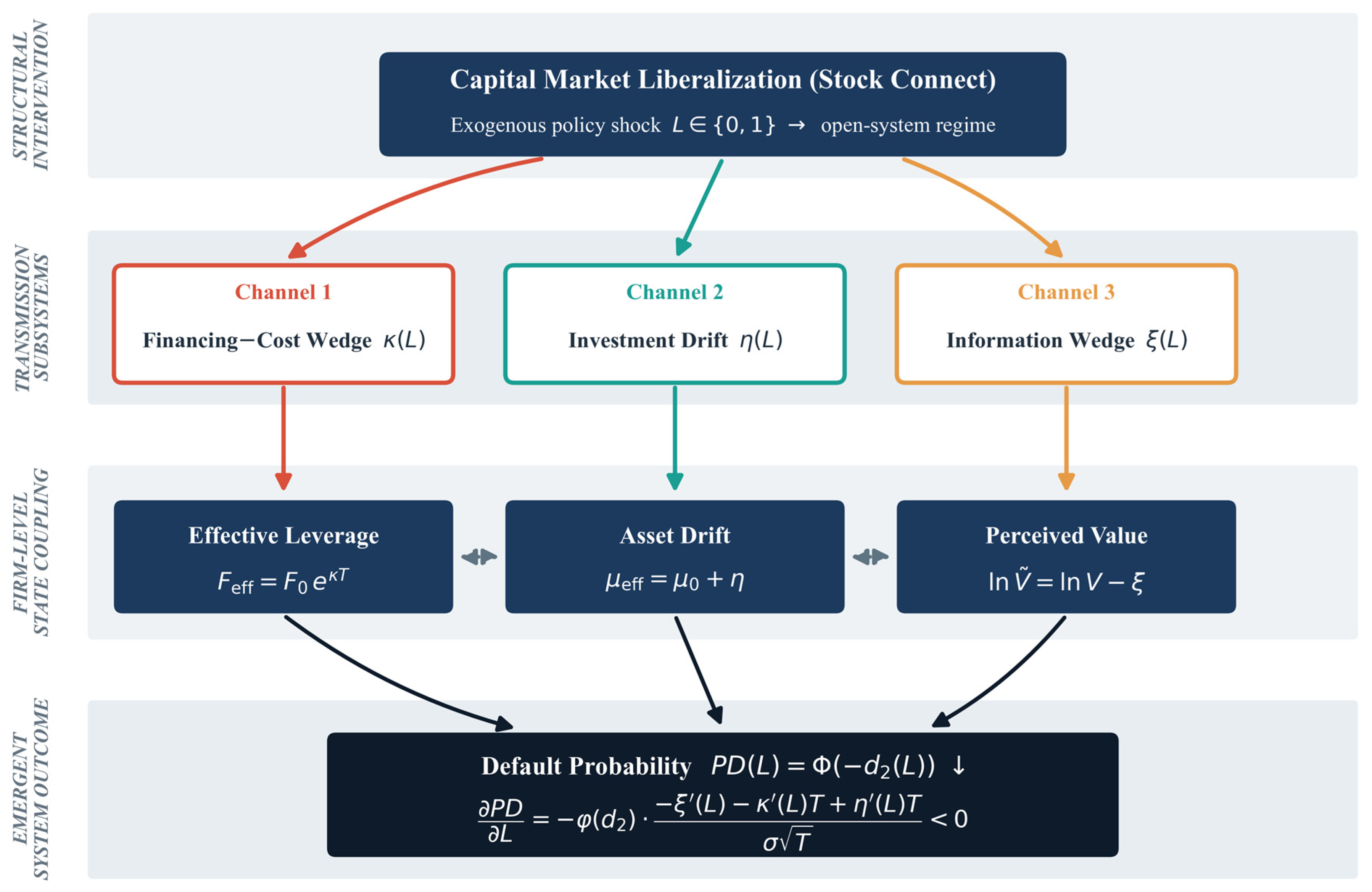
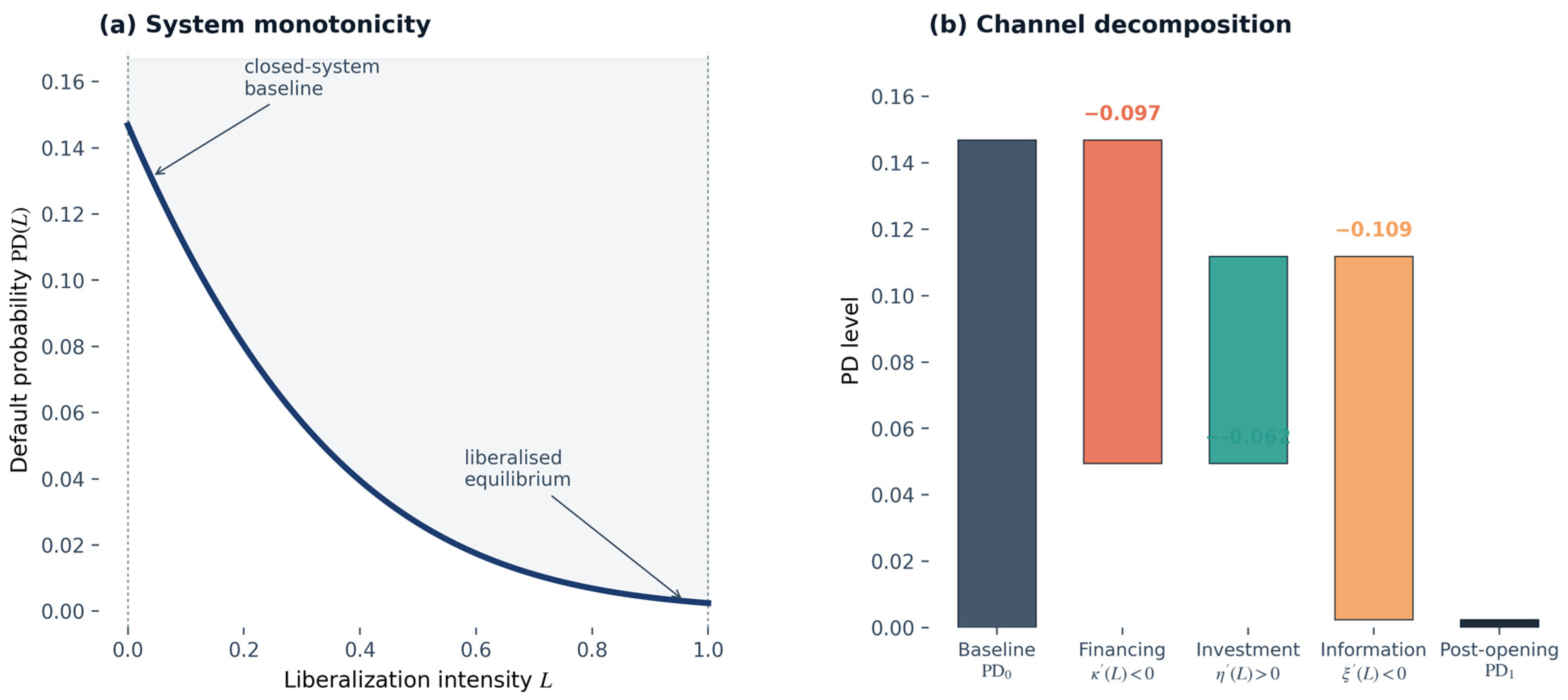
Figure 1 summarizes the multi-layer coupling structure that the model describes, while Figure 2 visualizes the comparative-statics results of Propositions 1 and 2.

4. Empirical Design

4.1. Identification Strategy: HSGT as a Quasi-Natural Experiment

Mapping the model to data, we exploit the staggered roll-out of the Shanghai–Hong Kong Stock Connect (November 2014) and Shenzhen–Hong Kong Stock Connect (December 2016) as an exogenous shock to liberalization intensity L . Treated firms are A-share listed firms included in the HSGT eligible pool; control firms are A-share listed firms never admitted to either programme during the sample window.

4.1.1. Endogeneity of HSGT Eligibility and Our Identification Response

Eligibility for HSGT is governed by stock-exchange criteria related to market capitalization, free-float liquidity, index membership, and trading-status standing—all of which may also correlate with firm-level default risk. If HSGT eligibility merely selects ex ante low-default-risk firms, our DID estimate could conflate selection with treatment. We address this threat along four complementary dimensions. First, the DID design itself differences out time-invariant heterogeneity by including firm fixed effects, so any static selection on observed or unobserved firm attributes is absorbed. Second, we verify the parallel-trends assumption using event-study coefficients (see Section 6.1). Third, we replicate the analysis on PSM-matched samples using 1:1 nearest-neighbor, radius (caliper = 0.05), and kernel matching following Lei et al. (2023) [27] to approximate the counterfactual of comparable non-treated firms (see Section 6.6). Fourth, we run a 500-replication placebo test (see Section 6.2) and find the empirical distribution of placebo coefficients tightly centered at zero. Collectively, these tests substantially reduce the likelihood that the estimated effect is driven by HSGT-eligibility selection. We also acknowledge the recent econometric literature on staggered DID [28,29,30] documenting that two-way fixed-effects estimators can deliver biased average treatment effects under dynamic and heterogeneous treatment effects; we therefore augment our baseline with high-dimensional industry × year and city × year fixed-effects specifications (see Section 6.4), which yield economically and statistically comparable estimates.

4.1.2. The DID Specification

We estimate the following staggered DID model:
E D F i , t = α 0 + α 1 H S G T i , t + γ C o n t r o l s i , t + μ i + λ t + ε i , t
Here E D F i , t is the expected default frequency of firm i in year t , H S G T i , t equals one once firm i is admitted to the HSGT eligible pool, μ i and λ t are firm and year fixed effects, and standard errors are clustered at the firm level. The mapping to the structural model is direct: α 1 is the empirical analogue of the system-level marginal effect P D L of Proposition 1.

4.2. Data, EDF Construction, and Variables

Our sample comprises Chinese A-share listed firms during 2011–2023, drawn from the CSMAR database. We exclude firms in the financial industry and those classified as ST or PT, drop firm-years with missing key variables, and winsorize all continuous variables at the 1% level. The final sample contains 21,351 firm-year observations.
The dependent variable corporate debt default risk (EDF) is the Bharath and Shumway (2008) [12] simplified Merton distance-to-default probability, constructed by iteratively solving for asset value V and asset volatility σ V from observed equity value E and equity volatility σ E using E = V · Φ ( d 1 ) F · e ^ ( r T ) · Φ ( d 2 ) and σ E = ( V / E ) · Φ ( d 1 ) · σ V . We then compute distance-to-default D D = [ l n ( V / F ) + ( μ σ V 2 / 2 ) T ] / ( σ V T ) and set E D F = Φ ( D D ) . Larger EDF reflects higher market-implied default probability. Following Chen et al. (2018) [31] and Shang et al. (2025) [32], firm-level controls cover firm age, return on assets, leverage, asset liquidity, board size, firm size, revenue growth, growth opportunity, institutional ownership, and chairman–CEO duality. Variable definitions appear in Table 1; sample descriptive statistics appear in Table 2. All variable construction and estimation were performed in Stata (StataNow 19).

5. Empirical Results

5.1. Baseline: System-Level Response of EDF to Liberalization

Table 3 reports baseline estimates of Equation (9). Across all four specifications—from no controls to the fully saturated model—the coefficient on HSGT is negative and significant at the 1% level. In Column (4) the estimate is −0.0134 (SE 0.0023). Economically, this corresponds to approximately 17% of the EDF sample standard deviation, or—at the sample mean EDF of 0.012—a 112% relative reduction in expected default risk for treated firm-years. The coefficient is essentially flat from Column (2) onward, indicating that the system-level stabilizing effect is not driven by omitted controls. These findings match the model prediction of Proposition 1 ( P D L < 0 ). Because this mean-based figure is difficult to interpret when the sample-mean EDF is so close to zero (its interquartile range is itself zero), we also benchmark the Column (4) estimate against more informative scales: it equals 17% of the EDF standard deviation and 48% of the mean EDF among at-risk firms—those with strictly positive default probability, which make up 42.9% of the sample—so the effect represents a substantial, rather than an implausibly large, compression of default risk.
The adjusted R2 of roughly 0.19 is typical of within-firm default-risk regressions and is not the relevant yardstick here: with firm and year fixed effects absorbing the bulk of cross-sectional and common-time variation, the reported figure reflects only residual within-firm variation, whereas the object of a DID design is the causal treatment coefficient rather than predictive fit. Consistent with this within-firm reading, firm age and revenue growth enter insignificantly: once firm and year fixed effects are included, the slow-moving life-cycle content of firm age is largely absorbed, and revenue growth—already embedded in the market-based inputs to EDF—adds little further explanatory power for default risk.

5.2. Mechanism Analysis: Mapping Wedges to Observable Proxies

Proposition 1 decomposes the system-level response of the probability of default into three subsystem channels. The empirical proxies we use map onto the three structural wedges as follows. The financing-cost wedge κ ( L ) is proxied by the Hadlock and Pierce (2010) [33] SA index of financing constraints (absSA); the model prediction κ′(L) < 0 corresponds to a negative HSGT coefficient on absSA. The investment-drift wedge η(L) is proxied by −InefficInvest, where InefficInvest is the absolute Richardson (2006) [34] investment-inefficiency residual; the prediction η ( L ) > 0 implies a negative HSGT coefficient on InefficInvest. The information wedge ξ ( L ) is proxied by −CorpGov, where CorpGov is the Wang and Ding (2025) [35] principal-component governance index; the prediction ξ ( L ) < 0 implies a positive HSGT coefficient on CorpGov.

5.2.1. Channel 1—Financing-Cost Wedge κ ( L )

Following Hadlock and Pierce (2010) [33], we proxy financing-constraint tightness by the absolute SA index. Column (1) of Table 4 reports a HSGT coefficient of −0.0284 (p < 0.01), providing direct evidence that liberalization compresses the financing-cost wedge:   κ ( L ) < 0 . Hypothesis 1 is supported.

5.2.2. Channel 2—Investment-Drift Wedge η ( L )

Inefficient investment is measured following Richardson (2006) [34] as the absolute residual from a benchmark investment regression. Column (2) of Table 4 reports a HSGT coefficient of −0.0029 (p < 0.05), so liberalization improves project selection and raises the asset-value drift:   η ( L ) > 0 . Hypothesis 2 is supported.

5.2.3. Channel 3—Information Wedge ξ(L)

Following Wang and Ding (2025) [35], we proxy governance quality by a principal-component index of eight governance attributes (top-three executive compensation, executive shareholding, share of independent directors, board shareholding, top-shareholder stake, board and supervisory-board size, and chair–CEO separation). Column (3) of Table 4 reports a HSGT coefficient of 0.0227 (p < 0.01), confirming that liberalization strengthens governance and compresses the information wedge: ξ ( L ) < 0 . Hypothesis 3 is supported.

5.2.4. Coupling Between the Subsystem Channels

The three tests above establish that liberalization compresses each wedge separately. Our framework, however, treats the subsystems as coupled rather than independent (Section 2.2), which calls for direct evidence that the channels co-move. We provide it in two forms. First, conditioning on the HSGT shock and the full control set within firm and year fixed effects, improvements in the financing and information subsystems move together: a one-standard-deviation relaxation of the financing-cost wedge is associated with a 0.112-standard-deviation improvement in governance quality (p < 0.01), and the relationship is symmetric in the reverse direction—the empirical counterpart of the lateral positive feedback posited by the model. Second, the system-level stabilizing effect is amplified along the information channel: interacting the treatment with the governance-improvement measure yields a negative and significant coefficient (−0.0036, p < 0.05), so liberalization compresses default risk more where it also strengthens governance. The investment subsystem does not display the same conditional co-movement, indicating that it operates more autonomously; we, therefore, characterize the coupling as running principally between the financing and information subsystems rather than uniformly across all three.

6. Robustness Checks

6.1. Parallel-Trend Test

Identification under DID requires that, absent HSGT, treated and control firms would have followed parallel default-risk trajectories. We test this by estimating the event-study version of Equation (9):
E D F i , t = α 0 + k 1 β k 1 t T i = k H S G T i + γ C o n t r o l s i , t + μ i + λ t + ε i , t
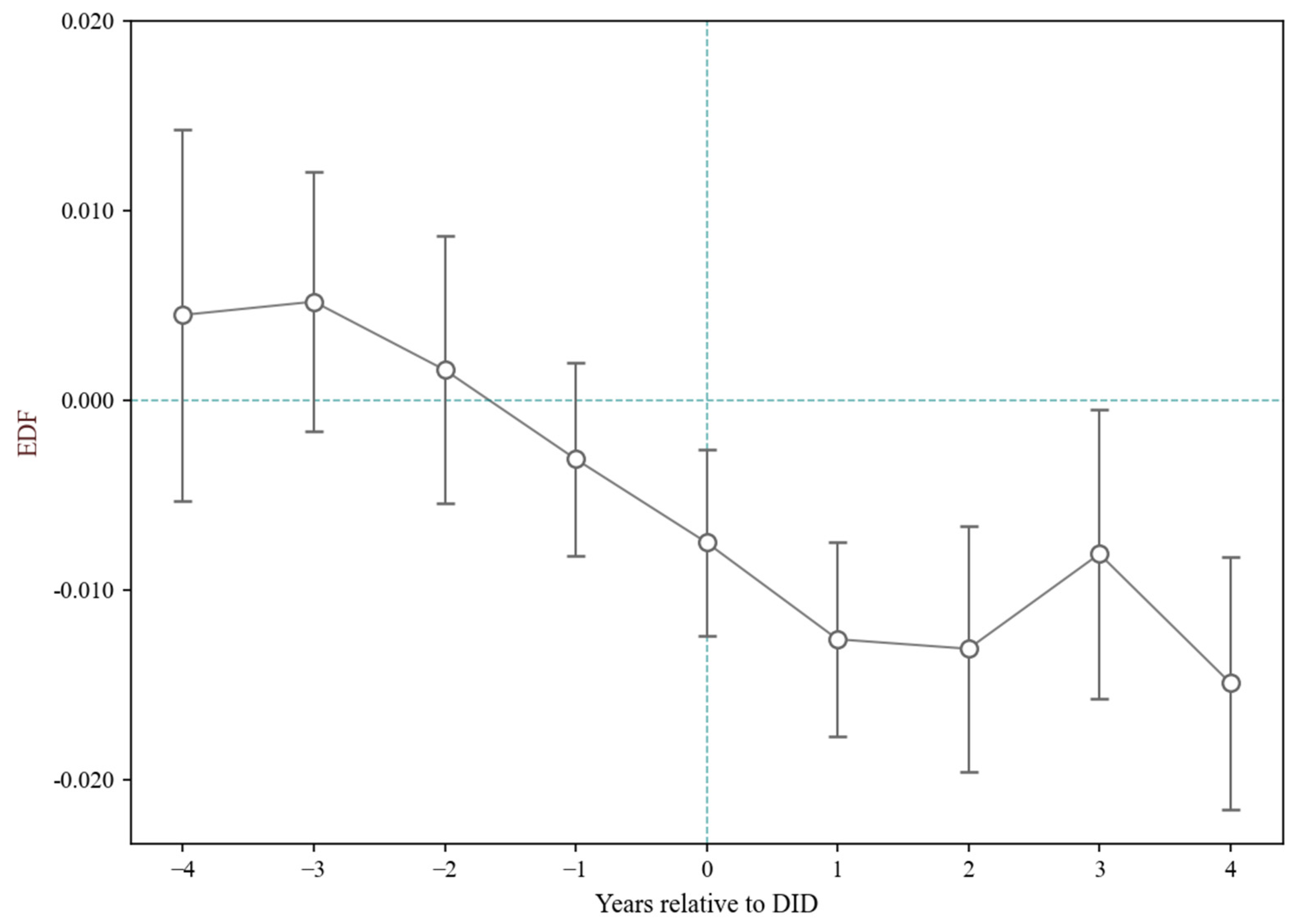
Figure 3 plots the estimated event-study coefficients with 95% confidence intervals. Pre-treatment coefficients are statistically indistinguishable from zero, satisfying parallel pre-trends. Post-treatment coefficients are uniformly negative and grow in absolute magnitude with time since treatment, consistent with the system-level monotonicity result of Proposition 1.
Because the sample begins in 2011, three years before the November 2014 launch, a natural concern is that anticipation of HSGT eligibility contaminates the pre-treatment period. Three pieces of evidence indicate that it does not. First, the event-study leads in Figure 3 are individually and jointly insignificant: a joint test of the two years immediately preceding eligibility cannot reject zero (p = 0.30), nor can a joint test of all four pre-treatment leads (p = 0.13), so treated and control firms do not diverge before treatment. Second, the estimate is essentially unchanged when we drop the 2014 launch year, or the entire 2013–2014 window over which eligibility lists were announced and could have been anticipated (the estimate is −0.0142 and −0.0155, respectively; p < 0.01). Third, HSGT eligibility is governed by mechanical size- and liquidity-based index criteria published only shortly before implementation, leaving little scope for firms to reposition default risk in advance. We, therefore, conclude that anticipation is unlikely to drive the estimated stabilizing effect.

6.2. Placebo Test (500 Replications)

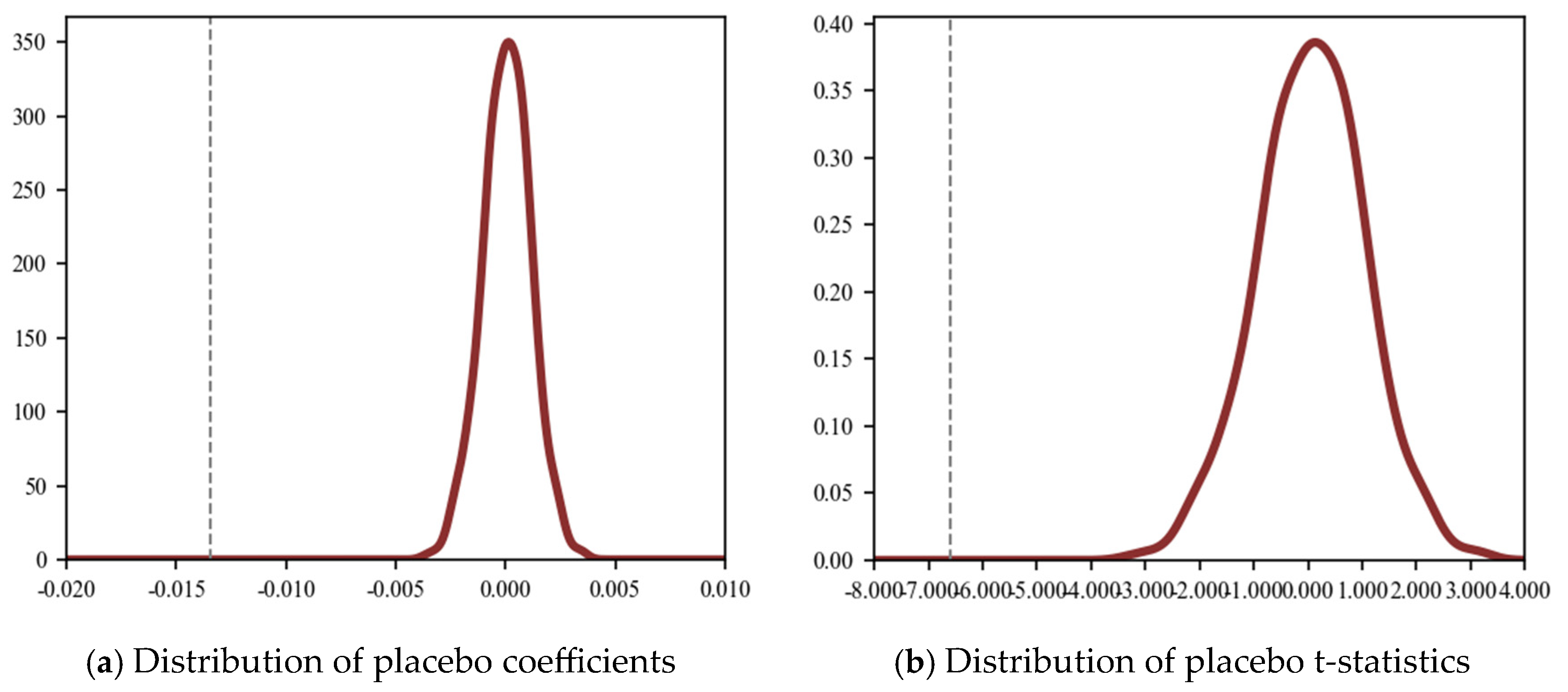
To rule out spurious results from unobserved confounders, we conduct a placebo test in the spirit of Si et al. (2025) [36]. In each of 500 iterations, we randomly assign a pseudo-treatment year and a pseudo-treatment group, then re-estimate Equation (9). Figure 4 shows that the empirical distribution of placebo coefficients is tightly centered at zero and the actual baseline coefficient lies in the extreme left tail.

6.3. Alternative Measurement of the Outcome

Following Ren et al. (2022) [37] and Shang et al. (2025) [32], we replace EDF with (i) a binary indicator of ex-post actual default and (ii) a continuous excess-debt variable defined as the gap between realized leverage and target leverage. Table 5 shows that the HSGT coefficient remains negative and significant under both alternative outcomes.

6.4. Confounding Macro Shocks and Alternative Fixed Effects

Three potential confounders threaten identification: the COVID-19 pandemic, China’s supply-side structural reform, and time-varying industry- or city-level shocks. We address each in turn. Column (1) of Table 6 drops 2020 to remove the pandemic period. Column (2) introduces a binary indicator equal to one for firms in supply-side-reform industries during reform years. Columns (3)–(4) replace the firm fixed effect with industry × year and city × year high-dimensional fixed effects, in part as a response to recent critiques of two-way FE with staggered timing [28,29,30]. The HSGT coefficient remains negative and significant in all four specifications, confirming the robustness of the system-level stabilizing effect.

6.5. Controlling for Prior Liberalization Channels

Two earlier liberalization channels could potentially confound the HSGT effect. First, firms simultaneously listed in the Mainland China A-share market and the Hong Kong H-share market, hereafter referred to as A + H cross-listed firms, had already been exposed to international investor scrutiny before the Stock Connect program. Second, firms with prior Qualified Foreign Institutional Investor (QFII) ownership had already been exposed to foreign institutional investors since the introduction of the QFII scheme in 2002. To purge these channels, we re-estimate Equation (9) by separately excluding A + H cross-listed firms (Column (1) of Table 7) and firms with prior QFII ownership (Column (2)). In both cases, the HSGT coefficient remains negative and significant. Because excluding prior-QFII firms removes about one quarter of the sample, we verified that the retained sample remains representative. Although large-sample t-tests detect mean differences between the excluded and retained subsamples, the standardized differences are uniformly small (all below 0.15 of a pooled standard deviation) across size, age, profitability, leverage, growth, and governance, indicating no material compositional shift. The stabilizing effect is present but smaller and statistically weaker within the excluded prior-QFII firms themselves (−0.0087), consistent with our mechanism: firms already exposed to foreign institutional investors through the earlier QFII channel had partially closed the subsystem wedges before the Stock Connect, leaving a smaller marginal effect to identify. The main estimate therefore generalizes to firms without prior foreign exposure, where the liberalization shock is cleanest, and does not overstate the effect for the broader A-share population.

6.6. PSM-DID Matching

We further address selection-on-observables concerns by a propensity-score-matched DID estimator following Lei et al. (2023) [27]. Treated firms are matched to control firms via 1:1 nearest-neighbor, radius (caliper = 0.05), and kernel matching on the firm-level covariate vector. Table 8 shows that the HSGT coefficient remains negative and significant across all three matching algorithms.
Across this extensive battery of robustness specifications, the HSGT coefficient remains negative and statistically significant. Estimates range from −0.0062 (PSM 1:1 NN) to −0.0284 (mechanism regression on absSA), with a median around −0.013, consistent across (i) alternative outcome metrics, (ii) confounding-shock controls, (iii) high-dimensional fixed effects, (iv) exclusion of prior-liberalization channels, (v) propensity-score matching, and (vi) exclusion of the 2014 launch and 2013–2014 announcement windows. The systemic-stabilization result is, therefore, not driven by any single specification choice.

7. Heterogeneity Tests of Proposition 2

Proposition 2 yields directly testable predictions: the marginal stabilizing effect of HSGT should be amplified in regimes with wider closed-system wedges. We test this prediction along two dimensions—customer concentration (Hypothesis 4) and environmental uncertainty (Hypothesis 5).

7.1. Customer Concentration (Hypothesis 4)

When a firm depends on a few large customers, both the financing-cost wedge and the information wedge are wide: concentrated demand raises cash-flow volatility and collateral risk, while opaque, relationship-specific customer exposures are difficult for external creditors to assess [38]. Proposition 2, therefore, predicts a larger stabilizing effect for high-concentration firms. We proxy customer concentration by the Herfindahl–Hirschman index (HHI) of a firm’s top five customers and split the sample at the annual median. Table 9 shows that the HSGT coefficient is −0.0183 (p < 0.01) for high-concentration firms and −0.0071 (p < 0.05) for low-concentration firms; the stabilizing effect is thus more than twice as large where customer-driven risk is greatest, and a cluster-bootstrap test of the between-group difference is significant at the 10% level (p = 0.056). H4 is supported.

7.2. Environmental Uncertainty (Hypothesis 5)

When environmental uncertainty is high, the information wedge ξ ( 0 ) widens (disclosure noise rises and creditor inference becomes more biased) and the investment-drift wedge η ( 0 ) shrinks (managerial risk aversion suppresses long-horizon capital expenditure). Proposition 2 again predicts a larger stabilizing effect in high-uncertainty firms. Following Deng et al. (2022) [39], we proxy environmental uncertainty by sales-revenue volatility and split the sample at the mean. Table 10 reports a HSGT coefficient of −0.0176 (p < 0.01) for high-uncertainty firms and −0.0087 (p < 0.05) for low-uncertainty firms. The point estimate for high-uncertainty firms is roughly twice that for low-uncertainty firms and each subgroup effect is individually significant; although the between-group difference is not statistically decisive (Clogg z-test p = 0.21), the ordering is consistent with H5.

8. Discussion and Conclusions

8.1. Summary of Findings

Treating corporate default risk as an emergent state variable of a coupled financial system, we developed a structural model in which capital-market liberalization simultaneously compresses three subsystem wedges—financing-cost κ ( L ) , investment-drift η ( L ) , and information ξ ( L ) —and we derived, in closed form, the system-level monotonicity result P D L < 0 (Proposition 1) and the coupling-fragility amplification 2 P D L Z > 0 (Proposition 2). The model’s predictions were confirmed by a staggered DID design on Chinese A-share firms over 2011–2023, with the systemic-stabilization finding surviving an extensive battery of robustness checks and amplified in regimes where the subsystem coupling is most fragile.

8.2. Theoretical Contribution

Our paper makes three theoretical contributions to the systems-science and financial-stability literatures. First, we formalize the financial system as a coupled network of capital, information, and governance flows in which default risk is an emergent property rather than a firm-level attribute, extending the systems-economics tradition of Sterman (2000) [3] and the financial-networks tradition of Haldane and May (2011) [1] and Battiston et al. (2012) [2]. Second, we deliver the first closed-form decomposition of how a structural opening intervention propagates through three coupled subsystems, with derivable comparative statics. Third, by formally linking heterogeneity to coupling fragility, we move heterogeneity analysis from descriptive to model-derived—a step that, to our knowledge, has not been taken in the capital-market-liberalization literature. Consistent with this coupling view, we further show that the financing and information subsystems move together in response to the shock and that the stabilizing effect is amplified along the information channel—direct evidence that the subsystems operate as a coupled set rather than in isolation.

8.3. Policy Implications

Three systemic-policy implications follow. First, capital-market opening should be conceived not as a single-channel reform but as a structural intervention that re-balances multiple coupled subsystems; regulators should monitor financing-cost, investment-drift, and information-wedge indicators jointly rather than separately. Second, the system-level return to liberalization is largest precisely where the underlying coupling is most fragile—firms with concentrated customer bases and high environmental uncertainty—suggesting that liberalization roadmaps should prioritize these firms. Third, because the financing and information subsystems exhibit positive lateral feedback, complementary reforms (disclosure tightening, institutional-investor activism, bond-market deepening) interact with capital-market opening to amplify the systemic-stability dividend; policy should exploit this complementarity through coordinated rather than isolated reform sequencing.

8.4. Limitations

Three limitations should be acknowledged. First, our model treats the three subsystem wedges as functions of L without endogenizing their joint dynamics; a fully dynamic version with stochastic κ ( L , t ) , η ( L , t ) , and ξ ( L , t ) would permit analysis of system stability under shocks but lies beyond the scope of this paper. Second, our empirical design identifies the system-level response on the intensive margin (within the HSGT-eligible pool); generalization to firms outside the eligibility threshold requires further evidence. Third, although we extensively address selection endogeneity through PSM-DID, parallel trends, placebo tests, and high-dimensional fixed effects, residual selection on time-varying unobservables cannot be fully ruled out without an external instrument.

8.5. Future Research

Several extensions are worth pursuing. First, a network-economic treatment of the lateral coupling—mapping off-diagonal interactions among subsystems as edges in a directed weighted graph—would permit estimation of higher-order propagation effects. Second, extending the model to allow stochastic wedge dynamics enables analysis of system stability under aggregate shocks. Third, the framework can be applied to other emerging-market liberalization episodes (e.g., the Association of Southeast Asian Nations Plus Three (ASEAN+3) Bond Market Initiative, India’s FPI liberalization) to test the external validity of the systemic-stabilization mechanism. We leave these directions to future work.


Author Contributions

Conceptualization, X.L. and P.L.; methodology, X.L.; software, X.L.; validation, X.L. and P.L.; formal analysis, X.L.; investigation, X.L.; resources, X.L.; data curation, X.L.; writing—original draft preparation, X.L. and P.L.; writing—review and editing, X.L. and P.L.; visualization, X.L.; supervision, P.L.; project administration, X.L.; funding acquisition, X.L. All authors have read and agreed to the published version of the manuscript.

Funding

This research received no external funding.

Institutional Review Board Statement

Not applicable.

Informed Consent Statement

Not applicable.

Data Availability Statement

The data presented are available on request from the corresponding author.

Acknowledgments

We acknowledge the support provided by Qingdao University. We express our gratitude to the reviewers and editors for their invaluable recommendations in revising and enhancing the manuscript.

Conflicts of Interest

The authors declare no conflicts of interest.

Abbreviations

The following abbreviations are used in this manuscript:
HSGTShanghai–Hong Kong and Shenzhen–Hong Kong Stock Connect
EDFCorporate debt default risk
QFIIQualified Foreign Institutional Investor
A + HFirms listed on both a Mainland A-share market and the Hong Kong H-share market
HHIHerfindahl–Hirschman Index
DIDDifference-in-Differences
PSMPropensity Score Matching
NPVNet Present Value

References

  1. Haldane, A.G.; May, R.M. Systemic Risk in Banking Ecosystems. Nature 2011, 469, 351–355. [Google Scholar] [CrossRef] [PubMed]
  2. Battiston, S.; Puliga, M.; Kaushik, R.; Tasca, P.; Caldarelli, G. DebtRank: Too Central to Fail? Financial Networks, the FED and Systemic Risk. Sci. Rep. 2012, 2, 541. [Google Scholar] [CrossRef] [PubMed]
  3. Sterman, J. System Dynamics: Systems Thinking and Modeling for a Complex World; MIT Sloan School of Management: Cambridge, MA, USA, 2002. [Google Scholar]
  4. Forrester, J.W. Industrial Dynamics. J. Oper. Res. Soc. 1997, 48, 1037–1041. [Google Scholar] [CrossRef]
  5. Cathcart, L.; Dufour, A.; Rossi, L.; Varotto, S. The Differential Impact of Leverage on the Default Risk of Small and Large Firms. J. Corp. Financ. 2020, 60, 101541. [Google Scholar] [CrossRef]
  6. Do, T.K. Corporate Social Responsibility and Default Risk: International Evidence. Financ. Res. Lett. 2022, 44, 102063. [Google Scholar] [CrossRef]
  7. Lu, C.; Yang, M.; Xia, X. Economic Policy Uncertainty and Default Risk: Evidence from China. Econ. Anal. Policy 2023, 79, 821–836. [Google Scholar] [CrossRef]
  8. Liu, Z.; Feng, J. Climate Shocks and Corporate Default Risk: Evidence from China. Energy 2025, 323, 135786. [Google Scholar] [CrossRef]
  9. Allen, F.; Qian, J.; Qian, M. Law, Finance, and Economic Growth in China. J. Financ. Econ. 2005, 77, 57–116. [Google Scholar] [CrossRef]
  10. Allen, F.; Qian, Y.; Tu, G.; Yu, F. Entrusted Loans: A Close Look at China’s Shadow Banking System. J. Financ. Econ. 2019, 133, 18–41. [Google Scholar] [CrossRef]
  11. Merton, R.C. On the Pricing of Corporate Debt: The Risk Structure of Interest Rates. J. Financ. 1974, 29, 449. [Google Scholar] [CrossRef]
  12. Bharath, S.T.; Shumway, T. Forecasting Default with the Merton Distance to Default Model. Rev. Financ. Stud. 2008, 21, 1339–1369. [Google Scholar] [CrossRef]
  13. Levin, S.A. Ecosystems and the Biosphere as Complex Adaptive Systems. Ecosystems 1998, 1, 431–436. [Google Scholar] [CrossRef]
  14. Ding, N.; Gu, L.; Peng, Y. Fintech, Financial Constraints and Innovation: Evidence from China. J. Corp. Financ. 2022, 73, 102194. [Google Scholar] [CrossRef]
  15. Liang, Y.; Zhou, B.; Zhao, S. Risking or De-Risking? The Effect of Banking Competition on Large State-Owned Banks and Small and Medium-Sized Enterprise Lending: Evidence from China. Int. Rev. Financ. Anal. 2024, 94, 103258. [Google Scholar] [CrossRef]
  16. Bau, N.; Matray, A. Misallocation and Capital Market Integration: Evidence From India. Econometrica 2023, 91, 67–106. [Google Scholar] [CrossRef]
  17. Meng, Y.; Xiong, L.; Xiao, L.; Bai, M. The Effect of Overseas Investors on Local Market Efficiency: Evidence from the Shanghai/Shenzhen–Hong Kong Stock Connect. Financ. Innov. 2023, 9, 42. [Google Scholar] [CrossRef]
  18. Bena, J.; Ferreira, M.A.; Matos, P.; Pires, P. Are Foreign Investors Locusts? The Long-Term Effects of Foreign Institutional Ownership. J. Financ. Econ. 2017, 126, 122–146. [Google Scholar] [CrossRef]
  19. Kacperczyk, M.; Sundaresan, S.; Wang, T. Do Foreign Institutional Investors Improve Price Efficiency? Rev. Financ. Stud. 2021, 34, 1317–1367. [Google Scholar] [CrossRef]
  20. Li, Z.; Liu, C.; Ni, X.; Pang, J. Stock Market Liberalization and Corporate Investment Revisited: Evidence from China. J. Bank. Financ. 2024, 158, 107053. [Google Scholar] [CrossRef]
  21. Huang, W.; Zhu, T. Foreign Institutional Investors and Corporate Governance in Emerging Markets: Evidence of a Split-Share Structure Reform in China. J. Corp. Financ. 2015, 32, 312–326. [Google Scholar] [CrossRef]
  22. Kim, J.-B.; Pevzner, M.; Xin, X. Foreign Institutional Ownership and Auditor Choice: Evidence from Worldwide Institutional Ownership. J. Int. Bus. Stud. 2019, 50, 83–110. [Google Scholar] [CrossRef]
  23. Tsang, A.; Xie, F.; Xin, X. Foreign Institutional Investors and Corporate Voluntary Disclosure Around the World. Account. Rev. 2019, 94, 319–348. [Google Scholar] [CrossRef]
  24. Henry, P.B. Stock Market Liberalization, Economic Reform, and Emerging Market Equity Prices. J. Financ. 2000, 55, 529–564. [Google Scholar] [CrossRef]
  25. Henry, P.B. Capital Account Liberalization: Theory, Evidence, and Speculation. J. Econ. Lit. 2007, 45, 887–935. [Google Scholar] [CrossRef]
  26. Stiglitz, J.E.; Ocampo, J.A. (Eds.) Capital Market Liberalization and Development; Oxford University Press: Oxford, UK, 2008. [Google Scholar] [CrossRef]
  27. Lei, Q.; Qi, C.; Ye, C.; Fang, G. Health Shock, the Green for Grain Program and Medical Expenses: Empirical Evidence on the Well-Being of Chinese Farmers. Econ. Anal. Policy 2023, 78, 406–418. [Google Scholar] [CrossRef]
  28. De Chaisemartin, C.; D’Haultfœuille, X. Two-Way Fixed Effects Estimators with Heterogeneous Treatment Effects. Am. Econ. Rev. 2020, 110, 2964–2996. [Google Scholar] [CrossRef]
  29. Goodman-Bacon, A. Difference-in-Differences with Variation in Treatment Timing. J. Econom. 2021, 225, 254–277. [Google Scholar] [CrossRef]
  30. Sun, L.; Abraham, S. Estimating Dynamic Treatment Effects in Event Studies with Heterogeneous Treatment Effects. J. Econom. 2021, 225, 175–199. [Google Scholar] [CrossRef]
  31. Chen, H.; Cui, R.; He, Z.; Milbradt, K. Quantifying Liquidity and Default Risks of Corporate Bonds over the Business Cycle. Rev. Financ. Stud. 2018, 31, 852–897. [Google Scholar] [CrossRef]
  32. Shang, Y.; Xiao, Z.; Nasim, A.; Zhao, X. Influence of ESG on Corporate Debt Default Risk: An Analysis of the Dual Risk Scenarios. J. Int. Money Financ. 2025, 151, 103248. [Google Scholar] [CrossRef]
  33. Hadlock, C.J.; Pierce, J.R. New Evidence on Measuring Financial Constraints: Moving Beyond the KZ Index. Rev. Financ. Stud. 2010, 23, 1909–1940. [Google Scholar] [CrossRef]
  34. Richardson, S. Over-Investment of Free Cash Flow. Rev. Account. Stud. 2006, 11, 159–189. [Google Scholar] [CrossRef]
  35. Wang, D.; Ding, B. The Strength of Intellectual Property Protection, Corporate Financing Constraints, and Corporate Governance Efficiency: Mechanisms and Heterogeneity Analysis. Int. Rev. Econ. Financ. 2025, 103, 104449. [Google Scholar] [CrossRef]
  36. Si, D.-K.; Li, H.-X.; Pei, T. Does Bond Market Liberalization Mitigate Corporate Risk-Taking? Evidence from China. Econ. Model. 2026, 155, 107427. [Google Scholar] [CrossRef]
  37. Ren, X.; Qin, J.; Jin, C.; Yan, C. Global Oil Price Uncertainty and Excessive Corporate Debt in China. Energy Econ. 2022, 115, 106378. [Google Scholar] [CrossRef]
  38. Campello, M.; Gao, J. Customer Concentration and Loan Contract Terms. J. Financ. Econ. 2017, 123, 108–136. [Google Scholar] [CrossRef]
  39. Deng, M.; Fang, X.; Tian, Z.; Luo, W. The Impact of Environmental Uncertainty on Corporate Innovation: Evidence from Chinese Listed Companies. Sustainability 2022, 14, 4902. [Google Scholar] [CrossRef]
Figure 1. Multi-layer coupled-mechanism schematic of capital-market liberalization in the corporate default-risk system. The four bands depict the structural intervention (HSGT shock L), three transmission subsystems (financing-cost, investment-drift, information), firm-level state coupling, and the emergent system outcome. Coloured solid arrows denote the transmission of the liberalization shock L through the three subsystem channels to the firm-level state variables and then to the emergent default-risk outcome; grey dashed double-headed connectors denote the lateral positive-feedback coupling among the three firm-level state variables.
Systems 14 00785 g001
Figure 2. Theoretical comparative statics derived from Equation (6). Panel (a): system monotonicity of default probability P D ( L ) under liberalization intensity L (Proposition 1). Panel (b): waterfall decomposition of the default-probability response into the three subsystem channels. In panel (b), each coloured band is the contribution of one subsystem channel (financing-cost, investment-drift, information) to the total default-probability response; L denotes liberalization intensity.
Systems 14 00785 g002
Figure 3. Parallel-trend test. Event-study coefficients from Equation (10) with 95% confidence intervals, plotted relative to the year of HSGT eligibility. Circles are point estimates and capped vertical spikes are 95% confidence intervals; the horizontal dashed line marks zero and the vertical dashed line marks the year of HSGT eligibility (period 0).
Systems 14 00785 g003
Figure 4. Placebo test (500 replications). Panel (a): empirical distribution of placebo coefficients; (b) placebo t-statistics. The actual baseline coefficient (vertical dashed line) lies in the extreme left tail. The vertical dashed line marks the actual baseline estimate; the density is the empirical distribution of the 500 placebo coefficients (panel (a)) and t-statistics (panel (b)).
Systems 14 00785 g004
Table 1. Variable definitions and measurement.
VariableSymbolDefinitionMeasurement
Dependent variableEDFCorporate debt default riskExpected default frequency from Bharath–Shumway (2008) simplified Merton model
Treatment indicatorHSGTLiberalization dummy1 if firm i ∈ HSGT eligible pool in year t; 0 otherwise
Firm sizeSizeFirm scaleNatural log of total assets
Firm ageFirmAgeYears since foundingNatural log of (1 + firm age in years)
ProfitabilityROAReturn on assetsNet profit/total assets
LeverageLevCapital structureTotal liabilities/total assets
LiquidityLiquidAsset liquidityCurrent assets/total assets
GrowthGrowthRevenue growth( R e v e n u e t / R e v e n u e { t 1 } ) − 1
Tobin’s QTobinQGrowth opportunity(Market value of equity + total liabilities)/total assets
Board sizeBoardGovernance scaleNatural log of total board members
Institutional ownershipIndepInstitutional shareholdingShares held by institutional investors/total shares
DualityDualCEO/Chair concurrence1 if chairman = CEO; 0 otherwise
Notes: All firm-level data are obtained from the CSMAR database. EDF is constructed iteratively from observed equity returns and capital structure via the Bharath–Shumway (2008) simplified Merton model.
Table 2. Summary statistics.
VariablesNMeanSDP5P25P50P75P95
EDF21,3510.01200.079000000.001
HSGT21,3510.3400.47400011
Size21,35122.361.36320.5421.3822.1123.1325.04
FirmAge21,3512.9860.3032.4852.7732.9963.1783.434
ROA21,3510.03600.0600−0.06600.01200.03500.06600.131
Lev21,3510.4300.2000.1170.2730.4230.5780.776
Liquid21,3512.2902.0810.6001.1521.6422.5846.305
Growth21,3510.2970.793−0.327−0.04400.1060.3531.492
TobinQ21,3512.0661.3040.9581.2471.6522.3804.682
Board21,3512.1230.1961.7921.9462.1972.1972.398
Indep21,3510.3760.05300.3330.3330.3640.4290.455
Dual21,3510.2880.45300011
Notes: EDF has a low sample mean (0.012) and large dispersion (SD = 0.079), indicating substantial cross-firm heterogeneity in market-implied default risk. The HSGT indicator equals one for roughly 34% of firm-years, reflecting the staggered roll-out of the Stock Connect programs.
Table 3. Baseline DID estimates of the system-level response of default risk.
Variables(1)(2)(3)(4)
EDFEDFEDFEDF
HSGT−0.0057 ***−0.0142 ***−0.0135 ***−0.0134 ***
(0.0021)(0.0023)(0.0023)(0.0023)
Size 0.0193 ***0.0194 ***0.0192 ***
(0.0018)(0.0019)(0.0019)
FirmAge 0.0020−0.0096−0.0093
(0.0145)(0.0147)(0.0147)
ROA −0.0862 ***−0.0863 ***
(0.0117)(0.0117)
Lev 0.0431 ***0.0432 ***
(0.0070)(0.0070)
Liquid 0.0015 ***0.0015 ***
(0.0003)(0.0003)
Growth 0.00080.0008
(0.0013)(0.0013)
TobinQ 0.0037 ***0.0037 ***
(0.0005)(0.0005)
Board 0.0067
(0.0065)
Indep 0.0024
(0.0230)
Dual 0.0001
(0.0018)
Constant0.0140 ***−0.4204 ***−0.4147 ***−0.4275 ***
(0.0009)(0.0562)(0.0578)(0.0615)
N21,35121,35121,35121,351
Adj. R20.17540.18400.19040.1904
Year FEYESYESYESYES
Firm FEYESYESYESYES
Notes: *** denote significance at 1% level. Robust standard errors clustered at the firm level are reported in parentheses. The dependent variable is the Bharath–Shumway EDF.
Table 4. Mechanism analysis: empirical tests of the three subsystem channels.
Variables(1)(2)(3)
absSAInefficInvestCorpGov
HSGT−0.0284 ***−0.0029 **0.0227 ***
(0.0018)(0.0013)(0.0067)
Size−0.0141 ***0.0038 ***−0.0178 ***
(0.0022)(0.0011)(0.0064)
FirmAge0.1391 ***−0.0380 ***−0.7664 ***
(0.0146)(0.0074)(0.0456)
ROA0.0743 ***0.0708 ***0.3916 ***
(0.0102)(0.0084)(0.0453)
Lev0.0178 **0.0128 **−0.0631 **
(0.0073)(0.0051)(0.0245)
Liquid−0.0045 ***−0.00040.0060 ***
(0.0005)(0.0004)(0.0021)
Growth0.0019 **0.0020 ***−0.0060 **
(0.0009)(0.0007)(0.0030)
TobinQ−0.0098 ***0.0038 ***−0.0169 ***
(0.0007)(0.0005)(0.0025)
Board0.0058−0.0047−1.1085 ***
(0.0055)(0.0036)(0.0259)
Indep0.0075−0.0201 *3.1775 ***
(0.0174)(0.0111)(0.0756)
Dual−0.0066 ***0.00000.6679 ***
(0.0015)(0.0012)(0.0089)
Constant3.7814 ***0.0706 **3.7030 ***
(0.0619)(0.0328)(0.2064)
N21,35121,29320,656
Adj. R20.95800.19870.9435
Year FEYESYESYES
Firm FEYESYESYES
Notes: Column (1) tests κ ( L )   <   0 with absSA. Column (2) tests η′(L) > 0 with InefficInvest (predicted negative HSGT coefficient, since InefficInvest measures the inverse of investment efficiency). Column (3) tests ξ′(L) < 0 with CorpGov (predicted positive HSGT coefficient, since CorpGov captures the inverse of the information wedge, so higher CorpGov implies lower ξ). ***, **, * denote significance at 1%, 5%, 10% levels.
Table 5. Robustness: alternative default-risk metrics.
Variables(1)(2)
EDF1EDF2
HSGT−0.0230 **−0.0045 ***
(0.0091)(0.0015)
Size−0.0480 ***−0.0371 ***
(0.0073)(0.0015)
FirmAge0.0664−0.0874 ***
(0.0564)(0.0102)
ROA−0.2609 ***0.2994 ***
(0.0667)(0.0140)
Lev0.1271 ***0.8692 ***
(0.0354)(0.0067)
Liquid0.00560.0006
(0.0036)(0.0004)
Growth−0.0082 **0.0027 ***
(0.0040)(0.0008)
TobinQ0.0105 ***0.0009
(0.0038)(0.0006)
Board−0.0250−0.0029
(0.0305)(0.0053)
Indep−0.02060.0145
(0.0908)(0.0162)
Dual0.00150.0013
(0.0089)(0.0015)
Constant1.0086 ***0.7013 ***
(0.2363)(0.0450)
N17,99720,899
Adj. R20.23980.8901
Year FEYESYES
Firm FEYESYES
Notes: EDF1 = binary indicator equal to one if firm i actually defaulted in year t. EDF2 = excess-debt variable (deviation of realized from target leverage). ***, ** denote significance at 1%, 5% levels.
Table 6. Robustness: confounding shocks, anticipation, and alternative fixed effects.
Variables(1)(2)(3)(4)(5)(6)
Controlling for the COVID-19 PandemicControlling for Supply-Side Structural ReformChanging Fixed EffectChanging Fixed EffectExcluding 2014Excluding 2013–2014
EDFEDFEDFEDFEDFEDF
HSGT−0.0141 ***−0.0130 ***−0.0215 ***−0.0189 ***−0.0142 ***−0.0155 ***
(0.0024)(0.0023)(0.0018)(0.0017)(0.0029)(0.0029)
Size0.0211 ***0.0195 ***0.0166 ***0.0143 ***0.0200 ***0.0211 ***
(0.0020)(0.0019)(0.0010)(0.0009)(0.0027)(0.0027)
FirmAge−0.0155−0.00680.0030−0.0018−0.00580.0053
(0.0155)(0.0147)(0.0021)(0.0020)(0.0171)(0.0188)
ROA−0.0969 ***−0.0876 ***−0.0699 ***−0.0703 ***−0.0853 ***−0.0854 ***
(0.0133)(0.0117)(0.0085)(0.0085)(0.0143)(0.0147)
Lev0.0467 ***0.0427 ***0.0838 ***0.0697 ***0.0453 ***0.0449 ***
(0.0076)(0.0070)(0.0049)(0.0046)(0.0091)(0.0092)
Liquid0.0017 ***0.0014 ***0.0049 ***0.0041 ***0.0016 ***0.0015 ***
(0.0003)(0.0003)(0.0003)(0.0002)(0.0004)(0.0004)
Growth0.00100.00080.0030 ***0.00130.00110.0014
(0.0014)(0.0013)(0.0010)(0.0010)(0.0015)(0.0016)
TobinQ0.0040 ***0.0036 ***0.0026 ***0.0028 ***0.0038 ***0.0042 ***
(0.0005)(0.0005)(0.0003)(0.0003)(0.0006)(0.0006)
Board0.00910.0070−0.0097 **−0.00590.00770.0103
(0.0070)(0.0065)(0.0039)(0.0039)(0.0086)(0.0087)
Indep0.00730.0024−0.0002−0.00200.00470.0190
(0.0250)(0.0230)(0.0146)(0.0137)(0.0303)(0.0300)
Dual0.00030.0000−0.00030.00020.0004−0.0001
(0.0020)(0.0018)(0.0010)(0.0009)(0.0021)(0.0022)
Constant−0.4596 ***−0.4384 ***−0.3917 ***−0.3263 ***−0.4588 ***−0.5284 ***
(0.0651)(0.0617)(0.0235)(0.0219)(0.0851)(0.0917)
N19,27321,35121,80121,82020,61119,410
Adj. R20.19660.19090.13520.15240.18150.1912
Year FEYESYESYESYESYESYES
Firm FEYESYESNONOYESYES
City FENONOYESNONONO
Industry FENONONOYESNONO
Notes: Column (1) drops 2020. Column (2) controls for supply-side structural reform. Columns (3)–(4) replace the firm FE with high-dimensional Industry × Year or City × Year fixed effects. ***, ** denote significance at 1%, 5% levels. Columns (5)–(6) exclude the 2014 launch year and the 2013–2014 announcement window, respectively, to address anticipation of HSGT eligibility.
Table 7. Robustness: controlling for prior liberalization channels.
Variables(1)(2)
Excl. A + H Cross-Listed FirmsExcl. Prior-QFII Firms
EDFEDF
HSGT−0.0133 ***−0.0146 ***
(0.0023)(0.0028)
Size0.0195 ***0.0203 ***
(0.0019)(0.0022)
FirmAge−0.0161−0.0043
(0.0146)(0.0161)
ROA−0.0850 ***−0.0848 ***
(0.0117)(0.0136)
Lev0.0442 ***0.0450 ***
(0.0070)(0.0082)
Liquid0.0015 ***0.0016 ***
(0.0003)(0.0004)
Growth0.00080.0001
(0.0013)(0.0014)
TobinQ0.0038 ***0.0040 ***
(0.0005)(0.0006)
Board0.00640.0058
(0.0065)(0.0077)
Indep−0.00350.0089
(0.0229)(0.0284)
Dual0.0001−0.0016
(0.0018)(0.0021)
Constant−0.4106 ***−0.4663 ***
(0.0615)(0.0697)
N21,13015,948
Adj. R20.18950.2021
Year FEYESYES
Firm FEYESYES
Notes: Column (1) excludes A + H cross-listed firms; Column (2) excludes firms with prior QFII ownership. *** denote significance at 1% level.
Table 8. Robustness: PSM-DID.
Variables(1)(2)(3)
1:1 NNRadius MatchingKernel Matching
EDFEDFEDF
HSGT−0.0062 ***−0.0071 ***−0.0072 ***
(0.0021)(0.0019)(0.0019)
Size0.0144 ***0.0138 ***0.0138 ***
(0.0022)(0.0019)(0.0019)
FirmAge−0.0073−0.0072−0.0077
(0.0164)(0.0125)(0.0124)
ROA−0.0632 ***−0.0527 ***−0.0523 ***
(0.0154)(0.0113)(0.0112)
Lev0.0462 ***0.0376 ***0.0373 ***
(0.0095)(0.0068)(0.0067)
Liquid0.0016 ***0.0014 ***0.0014 ***
(0.0004)(0.0003)(0.0003)
Growth0.00170.00120.0012
(0.0017)(0.0012)(0.0012)
TobinQ0.0035 ***0.0031 ***0.0031 ***
(0.0007)(0.0005)(0.0005)
Board−0.00180.00090.0009
(0.0074)(0.0056)(0.0056)
Indep−0.0243−0.0062−0.0061
(0.0222)(0.0185)(0.0185)
Dual0.0016−0.0002−0.0002
(0.0024)(0.0017)(0.0017)
Constant−0.3034 ***−0.2951 ***−0.2938 ***
(0.0753)(0.0602)(0.0598)
N12,66717,75417,770
Adj. R20.17700.17520.1752
Year FEYESYESYES
Firm FEYESYESYES
Notes: PSM employs 1:1 nearest-neighbor, radius (caliper = 0.05), and kernel matching on the firm-level covariate vector. *** denote significance at 1% level.
Table 9. Heterogeneity: customer concentration.
Variables(1)(2)
Higher Customer ConcentrationLower Customer Concentration
EDFEDF
HSGT−0.0183 ***−0.0071 **
(0.0048)(0.0033)
Size0.0238 ***0.0159 ***
(0.0041)(0.0039)
FirmAge0.0013−0.0126
(0.0262)(0.0281)
ROA−0.1245 ***−0.0534 ***
(0.0254)(0.0164)
Lev0.0510 ***0.0392 ***
(0.0159)(0.0137)
Liquid0.0020 ***0.0009 *
(0.0006)(0.0005)
Growth−0.00100.0021
(0.0022)(0.0021)
TobinQ0.0043 ***0.0032 ***
(0.0009)(0.0008)
Board0.02000.0006
(0.0155)(0.0091)
Indep0.0354−0.0085
(0.0538)(0.0353)
Dual0.0008−0.0007
(0.0031)(0.0032)
Constant−0.6025 ***−0.3259 ***
(0.1333)(0.1132)
N10,90610,906
Adj. R20.17850.1500
Year FEYESYES
Firm FEYESYES
Notes: Customer concentration is proxied by the top-five-customer Herfindahl index; samples are split at the annual median. The between-group difference in the HSGT coefficient is significant at the 10% level (cluster-bootstrap p = 0.056, 250 replications; Clogg z-test p = 0.054). ***, **, * denote significance at 1%, 5%, 10% levels.
Table 10. Heterogeneity: environmental uncertainty.
Variables(1)(2)
Higher Environmental UncertaintyLower Environmental Uncertainty
EDFEDF
HSGT−0.0176 ***−0.0087 **
(0.0045)(0.0039)
Size0.0263 ***0.0117 ***
(0.0034)(0.0036)
FirmAge−0.0433−0.0079
(0.0270)(0.0262)
ROA−0.0845 ***−0.0962 ***
(0.0176)(0.0237)
Lev0.0657 ***0.0251 **
(0.0123)(0.0120)
Liquid0.0024 ***0.0009 *
(0.0007)(0.0005)
Growth0.0020−0.0018
(0.0016)(0.0044)
TobinQ0.0046 ***0.0034 ***
(0.0009)(0.0007)
Board0.00140.0125
(0.0119)(0.0119)
Indep−0.02310.0232
(0.0393)(0.0393)
Dual0.00070.0012
(0.0031)(0.0036)
Constant−0.4768 ***−0.2748 ***
(0.1190)(0.1062)
N85748533
Adj. R20.19800.1955
Year FEYESYES
Firm FEYESYES
Notes: Environmental uncertainty is proxied by sales-revenue volatility (Deng et al., 2022). Samples are split at the mean uncertainty index. ***, **, * denote significance at 1%, 5%, 10% levels. The between-group difference in the HSGT coefficient is not statistically significant (Clogg z-test p = 0.21).
Disclaimer/Publisher’s Note: The statements, opinions and data contained in all publications are solely those of the individual author(s) and contributor(s) and not of MDPI and/or the editor(s). MDPI and/or the editor(s) disclaim responsibility for any injury to people or property resulting from any ideas, methods, instructions or products referred to in the content.