1. Introduction
Academic plagiarism remains a persistent challenge in higher education, affecting fairness, learning quality, and institutional trust. Prior studies have shown that plagiarism is associated with academic pressure, weak citation literacy, insufficient policy awareness, and perceived low risk of punishment [
1,
2,
3]. Academic integrity is therefore not only a matter of rule enforcement but also a core condition for maintaining credible educational assessment and supporting quality education more broadly [
4,
5,
6]. A preliminary implementation of the basic design of the simulation (without AI-augmented plagiarism or LLM plausibility assessment) was reported by the authors [
7], and related analysis of cloud-based educational platforms using multi-agent learning was reported in the earlier work as well [
8].
The rise of generative artificial intelligence has changed this problem in important ways. Students now have access to AI-assisted methods for producing academic work, creating a new dishonest pathway that differs from conventional direct copying in accessibility, detectability, and strategic use [
9,
10]. This shift is particularly important because institutional responses to plagiarism have traditionally been designed around direct copying, textual similarity, and source overlap, even in these cases we have observed various types of academic misconduct and the existence of engagements to them from the students, depending on the types of misconduct [
11,
12]. In AI-augmented learning environments, however, misconduct may no longer be limited to copying from peers or documents but may instead include AI-supported production that is more individualized and potentially less transparent. While a similar effect might already be seen in the context of “contract cheating” [
13], which outsources the assignments outside by a contract, the costs for doing will be significantly lower in the case of the use of AI. While the use of generative AI is not dominant in the performance of the work (e.g., in the business field, [
14,
15,
16]), shutting out access to AI-based assistance in an academic educational environment is not meaningful since it also links to the necessity for constructing ethical governance in there.
This development raises a new question for computational research on plagiarism. The central issue is no longer only whether anti-plagiarism interventions reduce misconduct but also whether they change the form that misconduct takes. In particular, interventions aimed at reducing direct copying may suppress one dishonest strategy while leaving open the possibility that students adapt by shifting toward AI-assisted plagiarism. Thus, plagiarism in the AI era should be understood not only as a problem of deterrence but also as a problem of behavioral adaptation under changing technological and institutional conditions.
Existing research provides useful but incomplete foundations for studying this issue. Detection-centered studies have made strong progress in identifying copied or transformed content [
17,
18]. Academic integrity studies emphasize institutional culture, policy clarity, and student awareness [
3,
4,
5]. Agent-based modeling offers tools for analyzing how local interaction rules produce population-level social diffusion [
19,
20,
21,
22], while reinforcement learning provides a framework for adaptive sequential decision-making under reward and penalty [
23,
24,
25]. However, these strands are often treated separately, and relatively little work explicitly models AI-assisted plagiarism as a distinct behavioral option within a socially interacting adaptive population [
26,
27,
28].
A further limitation in some earlier computational approaches is the tendency to represent intervention as direct modification of internal reward preferences. While such techniques may be useful in some reinforcement learning contexts, they are less appropriate for a social–behavioral interpretation of academic misconduct. In actual educational settings, institutions do not directly alter student conscience. Rather, they alter the surrounding environment through policy, monitoring, sanctions, and access conditions. This study therefore adopts a revised modeling perspective that focuses on environmental and institutional change instead of morality-like internal manipulation.
Based on this perspective, this paper develops a scenario-based simulation of plagiarism behavior in academic social environments, using Q-learning as a simplified heuristic adaptation mechanism for reproducing repeated student decision-making. The simulation distinguishes between honest submission, direct copying, and AI-assisted plagiarism as separate behavioral choices, while representing intervention through detection probability and sanction severity. This design allows the study to examine whether AI-assisted plagiarism changes the distribution of dishonest behavior, whether intervention reduces misconduct overall or redirects it toward less detectable forms, and how these effects interact with peer influence.
Here, another important issue in this topic is the difficulties of precisely observing and investigating the AI-assisted plagiarism behaviors in an academic environment. This issue will also make it difficult to verify how the simulation-based reproduction matches what the actual situation would be in an actual environment. To overcome this issue, we introduce a Cross-LLM qualitative plausibility assessment to assess the simulation setting and analysis of the results on there.
Accordingly, the main purpose of this study is to examine under what realistic educational conditions dishonest academic behavior, including AI-assisted plagiarism, is suppressed or sustained in a multi-agent learning environment. More specifically, the study asks whether the availability of AI-assisted plagiarism changes the proportion of honest submission, direct copying, and AI-assisted cheating; whether classroom or institutional intervention reduces dishonest behavior overall; whether such intervention reduces AI-assisted plagiarism specifically rather than only direct copying; and whether differences in social interaction conditions influence the spread and persistence of dishonest behavior.
The contribution of this study is threefold. First, it introduces AI-assisted plagiarism as a distinct behavioral option in a plagiarism diffusion simulation. Second, it represents intervention through environmental and institutional conditions rather than direct internal reward manipulation. Third, it provides a first-stage baseline simulation for examining suppression, persistence, and substitution of dishonest behavior in AI-augmented academic environments.
3. Research Methodology and Experiment Design
This study develops a scenario-based simulation of plagiarism behavior in an academic social environment. Q-learning is used as a baseline adaptive mechanism for repeated agent choice rather than as the main research contribution. The simulation is designed to reflect environmental and institutional conditions that can realistically be changed, rather than directly manipulating morality-like internal reward preferences. In particular, the model focuses on four components: scenario, state, action, and intervention.
The scenario defines the behavioral environment available to student agents. Two scenarios are considered. The first is a conventional plagiarism environment, in which agents may choose either honest submission or direct copying. The second is an AI-augmented environment, in which agents may additionally choose AI-assisted plagiarism. This distinction allows the study to examine whether the presence of AI-assisted cheating changes the diffusion and adaptation of dishonest behavior.
The state represents the current condition of an agent within the academic environment. Each student occupies one of three states at time t: regular, under_pressure, or sanctioned. The regular state represents a normal academic condition. The under_pressure state represents temporary academic or social pressure that may increase the attractiveness of dishonest shortcuts. The sanctioned state represents an institutional consequence after a student has been caught engaging in misconduct. This state design treats misconduct as a behavioral choice rather than as a fixed moral identity.
The action represents the behavior selected by the student each week. Depending on the scenario, agents choose from the following action set:
Honest submission, representing legitimate completion of the academic task;
Direct copying, representing conventional plagiarism from peers or existing sources;
AI-assisted plagiarism, representing the dishonest use of generative AI or related tools.
The intervention represents the institutional policy environment. In the present model, intervention affects the probability that dishonest behavior is detected and the severity of the sanction applied after detection. Two intervention conditions are considered: no_intervention and active_intervention. These conditions do not alter agent morality directly; instead, they modify the external policy setting under which agents adapt their behavior.
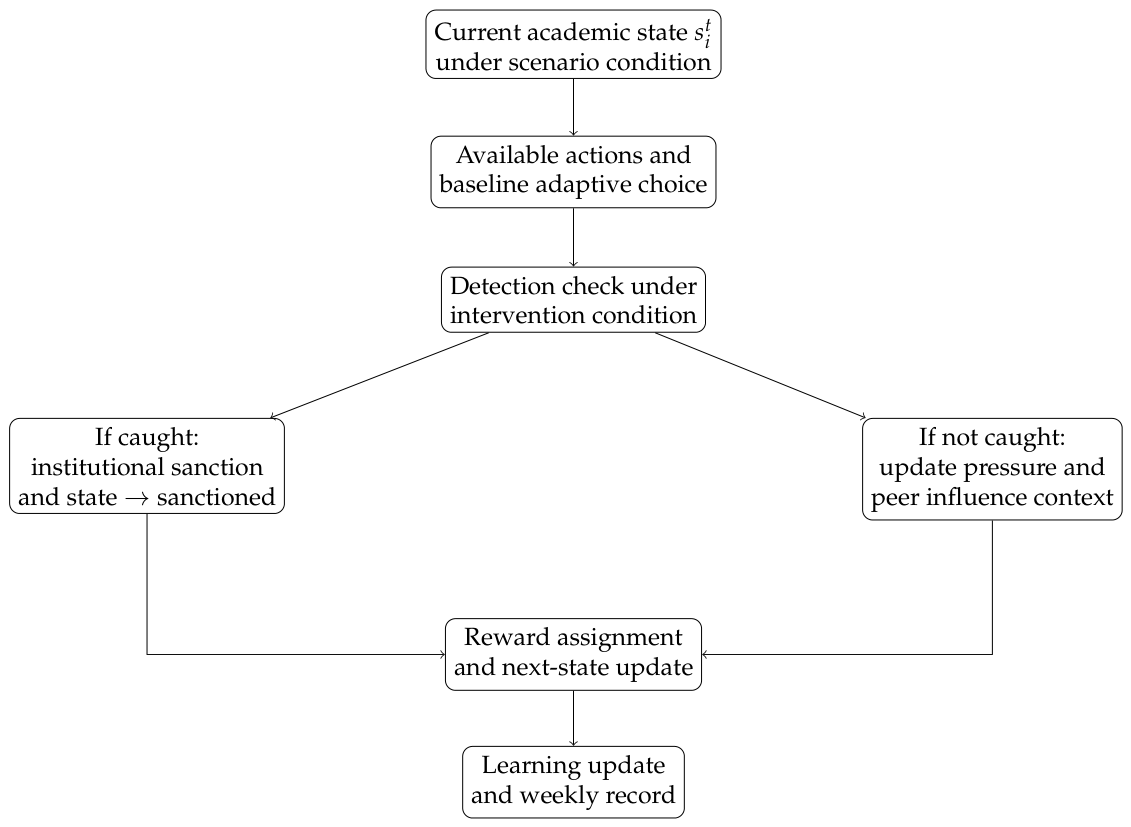
Figure 1 presents the simulation cycle used in the classroom misconduct model. In each week, a student agent occupies a current academic state under a given scenario, observes the set of available actions, selects one action using a baseline adaptive policy, undergoes detection depending on the intervention condition, receives a reward, transitions to the next state, and updates its Q-value. The scenario determines which behavioral options are available to the agent, while the intervention condition determines the probability of detection and the severity of institutional sanction. This cycle is repeated across the semester in order to examine how dishonest behavior is suppressed, sustained, or redirected under different educational conditions. Simulation Cycle 1 summarizes the weekly simulation procedure, including scenario-dependent action selection, intervention-based detection, state transition under academic pressure and social influence, and repeated independent runs across random seeds.
| Simulation Cycle 1 Simulation cycle for AI-assisted plagiarism under scenario and intervention conditions. |
- 1:
for each scenario in {conventional, AI-augmented} do - 2:
for each intervention in {no intervention, active intervention} do - 3:
for each social influence level do - 4:
for each random seed r do - 5:
Initialize random seed r - 6:
Initialize Q-table for each student i - 7:
Pretrain for 100 iterations using scenario-available actions and intervention-specific detection probabilities - 8:
Initialize all agent states regular - 9:
Initialize sanction timers and weekly records - 10:
Build social groups and peer connections - 11:
for week to T do - 12:
Determine task type and task weight - 13:
for each student i do - 14:
Observe current state - 15:
Determine the set of actions available under the current scenario - 16:
Select action using -greedy policy - 17:
Check whether is detected under the current intervention condition - 18:
Compute reward based on state, action, task type, and detection outcome - 19:
if is dishonest and caught then - 20:
Set next state sanctioned - 21:
Start or refresh sanction timer - 22:
else - 23:
Observe recent dishonest behavior among connected peers - 24:
Update next state using academic pressure and social influence - 25:
end if - 26:
Update using temporal-difference learning - 27:
end for - 28:
Decay exploration rate - 29:
Record weekly counts of honest submission, direct copying, AI-assisted plagiarism, and detected cases - 30:
end for - 31:
Store aggregate outcomes for the current {scenario, intervention, , seed} run - 32:
end for - 33:
Aggregate results across random seeds for the current {scenario, intervention, } setting - 34:
end for - 35:
end for - 36:
end for
|
3.1. Agent Learning Policy
Each agent maintains a Q-table
that stores the expected utility of taking action
a in state
s. Action selection follows an
-greedy rule:
where
,
is the exploration rate at week
t, and
is the set of actions available in the given scenario.
The exploration rate decays over time according to
where
is the minimum exploration rate and
is the decay factor.
After receiving reward
and transitioning to the next state
, the Q-value is updated using the temporal-difference rule:
where
is the learning rate and
is the discount factor.
3.2. Detection and Intervention Logic
The model distinguishes direct copying from AI-assisted plagiarism through action-specific detection probabilities. Honest submission is assumed not to trigger detection. Direct copying is modeled as more detectable, while AI-assisted plagiarism is modeled as less detectable or more uncertain to detect.
For a dishonest action
, the probability of detection depends on both the action type and the intervention condition. Let
denote the current intervention condition. Then detection is defined as
Accordingly, the model distinguishes between lower-detection and higher-detection policy environments by assigning different values to
and
under
no_intervention and
active_intervention. In the same way, sanction severity is also conditioned on the intervention setting. This design allows the simulation to examine whether institutional intervention reduces dishonest behavior overall or instead shifts it toward a less detectable cheating strategy. The exact parameter values used under each intervention condition are summarized in
Table 1.
3.3. Reward Structure
The reward function reflects the relative attractiveness and risk of the available behavioral options under different academic conditions. Honest submission yields a positive reward, reflecting legitimate task completion. Direct copying and AI-assisted plagiarism yield higher short-term benefits when not detected because both represent effort-reducing dishonest shortcuts. However, when detected, these actions incur punishment-based penalties.
Let denote the weight of the academic task at week t. Conceptually, the reward design follows three principles:
Honest submission yields a positive reward that varies by state, with lower value under academic pressure and moderate value under sanction.
Direct copying yields a higher short-term reward when not caught but incurs a penalty when detected.
AI-assisted plagiarism also yields a positive short-term reward when not caught but differs from direct copying in its detection probability and strategic role.
This formulation reflects practical academic trade-offs such as effort reduction, submission benefit, and institutional consequence, rather than moral judgment embedded directly into the reward signal. The implemented reward function is specified as follows.
Let
c be the intervention condition and
be the sanction penalty under intervention condition
c. The reward is defined as a task-weighted function of the current state, selected action, and detection outcome:
where
indicates whether the agent is detected. The unweighted reward component is
Thus, honest submission receives a state-dependent positive reward, dishonest actions receive a larger short-term reward when undetected, and detected dishonest actions receive a negative reward proportional to sanction severity. The values are intentionally stylized rather than estimated from individual-level student data, and they are used to create a transparent first-stage behavioral simulation.
3.4. Social Interaction Structure
Students are connected through a simplified peer network constructed from random social groups. Each group forms a local clique, meaning that students within the same group are mutually connected. This produces an undirected and unweighted local interaction network rather than a fully connected classroom. A simplified procedure of peer-network construction algorithm is shown in Procedure Simulation Cycle 1. We use this simplified procedure since we use a small number for
N (i.e., 30 as shown in
Table 1) in our simulation. When we extend the size of a class, further well-studied network construction algorithms should be applied [
34].
Social influence is modeled through recent dishonest exposure. Let denote the peer set of agent i. If a higher share of the agent’s peers engaged in dishonest behavior in the previous step, the agent is more likely to experience social pressure in the current step. This design allows dishonest behavior to diffuse through observed peer behavior rather than through direct internal manipulation.
At the start of each simulation run, students are randomly partitioned into local peer groups with group size between 2 and 6. Each group forms an undirected clique, and the resulting peer network is fixed throughout that run. The peer set of agent i is denoted by . The network is regenerated for each independent random seed but not regenerated weekly. This design represents stable local classroom peer circles rather than a fully connected classroom or a dynamically changing social network.
Social influence is based on exposure to dishonest peer behavior in the previous week. Let
be the share of agent
i’s peers who selected a dishonest action in the previous week. If
is empty,
. The social-pressure event is then modeled as
where
is the social influence level. Thus, social exposure affects the probability of entering the under-pressure state, but it does not directly force the agent to choose a dishonest action.
3.5. State Transition Logic
State transition depends on detection, academic pressure, sanction duration, and social influence. If an agent is caught engaging in dishonest behavior, it transitions to the sanctioned state for a fixed sanction duration. Once the sanction period ends, the agent returns to the regular state.
If the agent is not caught, the next state is determined by a combination of academic pressure and social exposure. During high-pressure weeks, such as quiz, midterm, or final assessment periods, or when dishonest peer exposure is sufficiently high, an agent may transition to the under_pressure state. Otherwise, the agent remains in or returns to the regular state.
This transition design treats institutional status and academic context as the main drivers of state change. As a result, the model represents misconduct as adaptive behavior under changing environmental conditions rather than as a permanent agent identity.
3.6. Experimental Setup
The experiment is designed to examine whether the introduction of AI-assisted plagiarism changes behavioral patterns in a multi-agent learning environment and whether institutional intervention suppresses dishonest behavior or redirects it toward less detectable strategies. To keep the model minimal and interpretable at the current stage, the experiment is organized around a small set of scenario, intervention, and social influence conditions.
Two behavioral scenarios are considered. The first is a conventional environment, in which agents may choose between honest submission and direct copying. The second is an AI-augmented environment, in which agents may additionally choose AI-assisted plagiarism. This scenario comparison allows the study to test whether the availability of AI-assisted cheating alters the balance between honest and dishonest behavior.
Two institutional conditions are also considered. Under the no_intervention condition, dishonest actions are detected with lower probability and result in a weaker sanction. Under the active_intervention condition, both direct copying and AI-assisted plagiarism are detected with higher probability and punished more strongly. This comparison is intended to test whether intervention reduces dishonest behavior overall or instead shifts it from conventional plagiarism toward AI-assisted misconduct.
The simulation is conducted over a 16-week academic semester. The weekly schedule includes homework, two quizzes, a midterm examination, and a final examination. Task weights are incorporated into the reward structure so that high-stakes academic periods carry greater consequence than ordinary homework weeks. Homework jointly contributes 0.20 of the task-weight scale, the two quizzes jointly contribute 0.10 with 0.05 assigned to each quiz, the midterm contributes 0.30, and the final examination contributes 0.40. These periods also serve as natural points at which academic pressure may increase.
Social influence is varied across three levels, represented by . These values represent low, medium, and relatively stronger peer influence on behavioral adaptation. Students are grouped into local peer networks rather than a fully connected classroom, allowing dishonest behavior to spread through neighborhood-level exposure. Here, we assume that the peer-network in the class is stable in each 16-week academic semester.
For each combination of scenario, intervention, and social influence level, the simulation is repeated over multiple random seeds to reduce sensitivity to stochastic variation and improve reproducibility. Note that we keep the peer-network structure in a simulation with each 16-week academic semester. The primary purpose of this first-stage experiment is not to exhaustively optimize all parameters but to establish a healthy and interpretable baseline model for the revised research direction.
3.7. Model Parameters
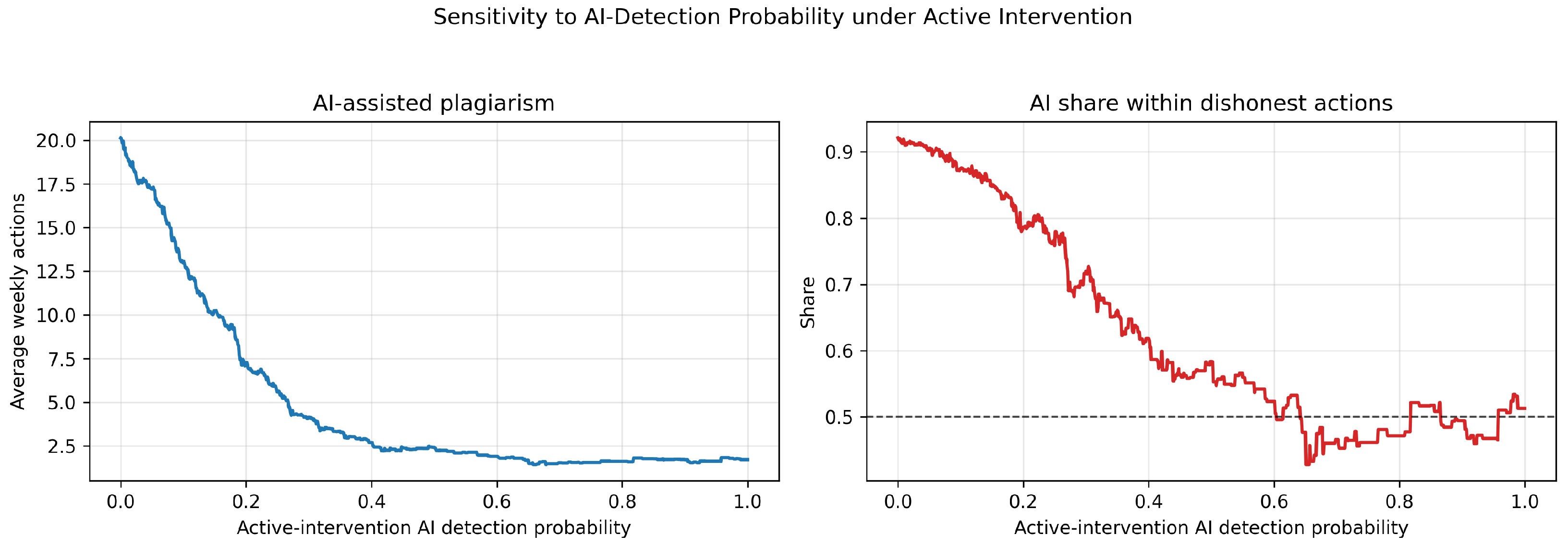
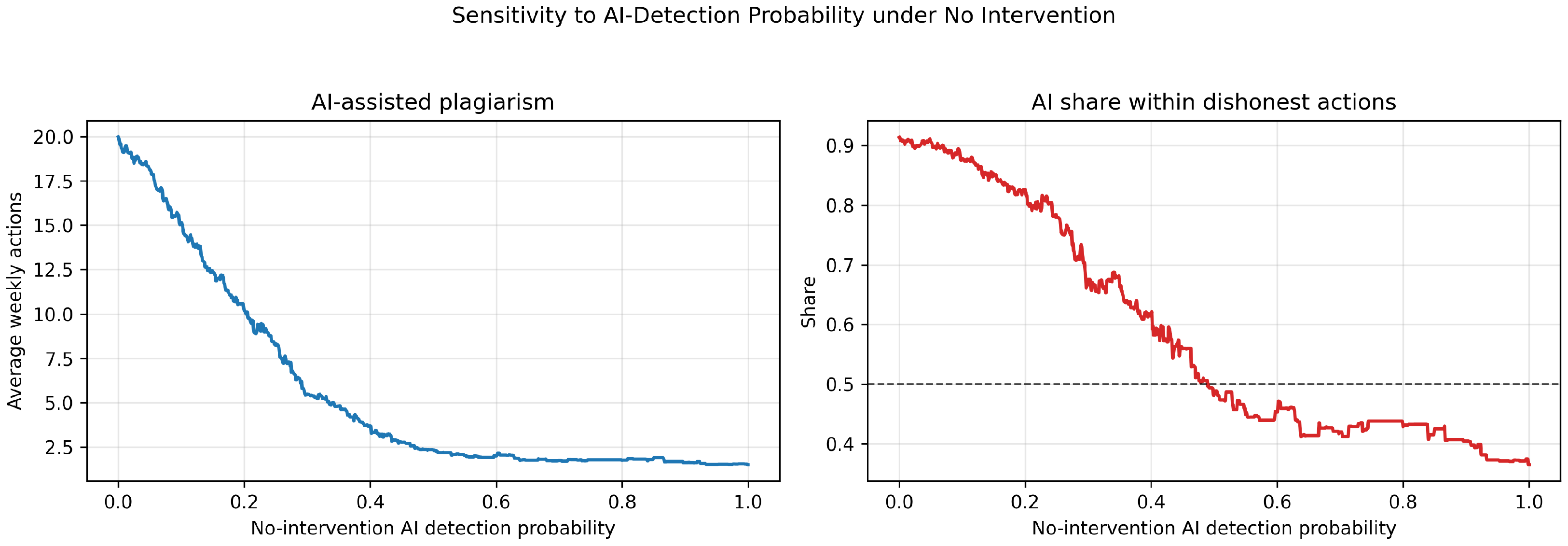
Table 1 summarizes the main parameters used in the simulation, including learning settings, classroom structure, intervention conditions, and temporal configuration. The key parameters have been decided based on the authors’ experience on their educational activities, especially on the detection probabilities and reward values, which should not produce inconsistent behaviors to our intuition in the simulation. These values were kept intentionally simple in order to support a first-stage interpretable baseline rather than exhaustive parameter optimization. To give the right initial setup to the Q-tables used in the Q-learning, we also applied a pretraining step before starting the actual simulation. This is necessary to avoid producing completely random behaviors in the initial steps of learning, which would be far from the actual human’s behaviors. Regarding the pretraining step shown in Simulation Cycle 1, we performed 100 iterations of pretraining. This pretraining iteration parameter was set to warm up the Q-tables to work, while it was expected to be lower than their complete convergence to give the agent further learning in the actual simulation cycles including the case of receiving penalties in there. We decided this hyper-parameter heuristically to well mimic the students’ behaviors while keeping the learning working as well. As mentioned in the related work section, we could not find any good reference to decide this value from the literature. Further investigations regarding these hyper-parameter settings without heuristics is among our future work. We also prepared two sensitivity analysis setups, which fixes one of
or
and changes another from 0 to 1 in 0.001 steps, to see the sensitivity of these parameter setups.
The source code for all simulations and the associated data are available in the
supplementary file.
3.8. Outcome Measures
The experiment records both weekly and aggregate outcomes. The main behavioral measures are:
Honest submission: the number of agents choosing legitimate submission;
Direct copying: the number of agents choosing conventional plagiarism;
AI-assisted plagiarism: the number of agents choosing AI-supported dishonest behavior;
Total dishonest behavior: the combined number of direct copying and AI-assisted plagiarism actions.
In addition, the experiment records:
Caught direct plagiarism: the number of direct copying actions detected by the institution;
Caught AI-assisted plagiarism: the number of AI-assisted dishonest actions detected by the institution;
Average cumulative reward: the mean reward accumulated across agents.
Among these measures, the most important are the proportions of honest behavior, direct copying, and AI-assisted plagiarism because they directly indicate whether the availability of AI-assisted cheating changes the behavioral composition of the system. Total dishonest behavior is used to assess whether intervention suppresses misconduct overall, while the separate direct and AI-assisted counts are used to assess whether misconduct is redirected from one dishonest strategy to another.
3.9. Qualitative Plausibility Review
To support the realism assessment of the simulation design, this study conducted a structured qualitative plausibility assessment using multiple large language models (LLMs). The purpose of this procedure was not to validate the simulation empirically but to examine whether the model assumptions were judged plausible as a first-stage behavioral and educational simulation of classroom misconduct.
Five LLM families were used: ChatGPT 5.4, Gemini 3 Flash, Claude Sonnet 4.6, DeepSeek R1 7B, and Qwen 3.5 4B. For each model, the same prompt was submitted in ten independent runs, resulting in 50 review outputs in total. Each run used the same simulation description, research question, state and action definitions, intervention settings, social interaction assumptions, and requested evaluation structure. No follow-up prompts were used during the assessment.
The prompt explicitly instructed the models to evaluate the setup as a behavioral and educational simulation rather than as a machine learning benchmark or optimization problem. The requested evaluation categories were: overall realism judgment, realistic elements, unrealistic or weak elements, the three most important realism gaps, policy realism, recommended minimum revision, and writing advice. The responses were analyzed in two stages. First, the ten responses from each model family were summarized to identify within-model stability. Second, the five model-level summaries were compared to identify cross-model consensus and model-specific differences.
This procedure is treated as a qualitative plausibility and repeatability check of the LLM assessment for the simulation description. Therefore, the LLM assessment is used to clarify the defensible scope and limitations of the model, rather than to claim that the model accurately predicts real student behavior.
4. Experiment Results and Discussions
4.1. Results
This section examines whether the introduction of AI-assisted plagiarism changes the behavioral composition of academic misconduct and whether institutional intervention reduces dishonest behavior overall or shifts it between dishonest strategies. The analysis focuses on the proportions of honest submission, direct copying, and AI-assisted plagiarism, together with total dishonest behavior and detected cases.
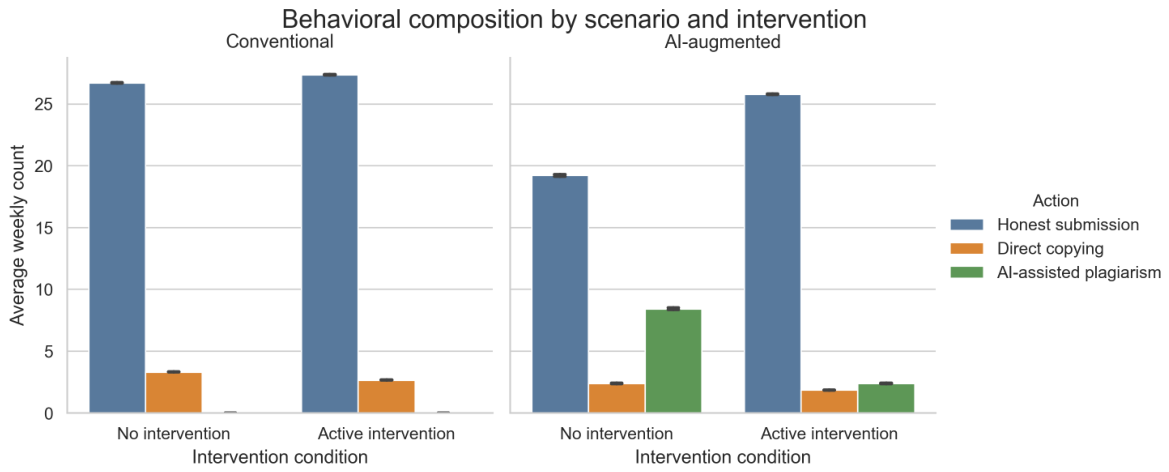
The results show that our simulation can produce the scenario that the availability of AI-assisted plagiarism substantially changes agent behavior. In the conventional scenario under no intervention, the mean weekly number of honest submissions was
, while direct copying accounted for
actions per week. In contrast, under the AI-augmented scenario with no intervention, honest submissions decreased to
, while total dishonest behavior increased to
actions per week. Most of this increase was attributable to AI-assisted plagiarism, which reached
actions per week, compared with
for direct copying. These results indicate that, under the assumed detection and reward settings, the introduction of AI-assisted plagiarism does not merely add a new option to the system but changes the behavioral composition of misconduct. This behavioral shift is summarized in
Table 2 and illustrated in
Figure 2.
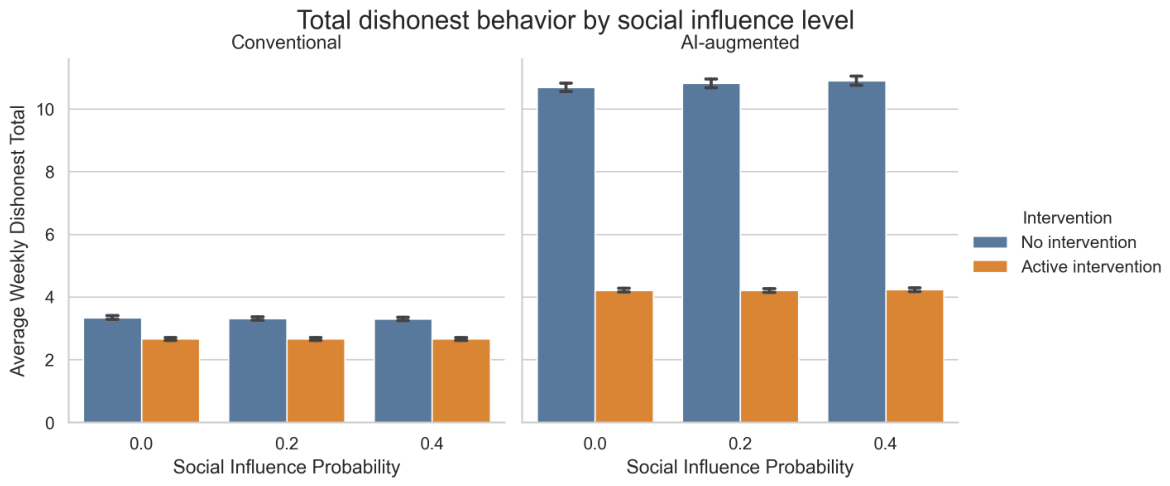
Institutional intervention reduced dishonest behavior in both scenarios under the baseline parameterization. In the conventional scenario, active intervention reduced direct copying from
to
actions per week, while honest submissions increased from
to
. In the AI-augmented scenario, total dishonest behavior decreased from
under no intervention to
under active intervention, while honest submission increased from
to
. Thus, within the tested intervention setting, higher detection probability and stronger sanction severity reduced misconduct overall. The overall intervention effect across social influence conditions is shown in
Figure 3. Also we have performed the necessary statistical tests for the above and summarized in
Table 3 and
Table 4.
Because intervention acts through detection probability and sanction severity, detected-case outcomes were also examined.
Table 5 summarizes the average weekly detected cases for direct copying and AI-assisted plagiarism. In the conventional scenario, active intervention increased detected direct-copying cases from
to
actions per week, even though total direct copying decreased. In the AI-augmented scenario, detected AI-assisted plagiarism decreased from
under no intervention to 1.06 ± 0.32 under active intervention because the total number of AI-assisted plagiarism actions was reduced. These results indicate that intervention changes both the frequency of dishonest behavior and the number of detected cases within the tested parameter setting.
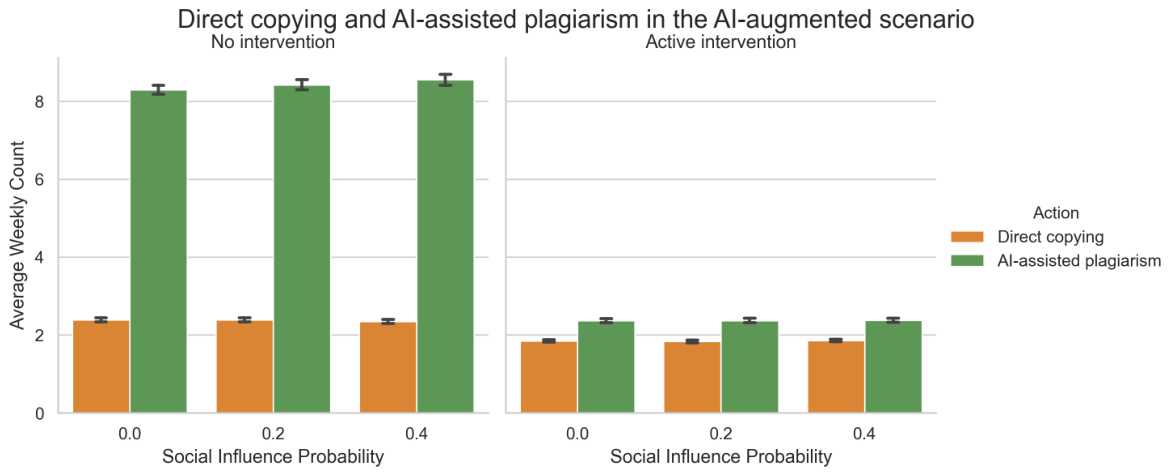
However, under the baseline parameterization, active intervention did not fully remove AI-assisted plagiarism as the larger component of dishonest behavior in the AI-augmented environment. Under active intervention, direct copying averaged actions per week, whereas AI-assisted plagiarism averaged actions per week. This indicates that, when AI-assisted plagiarism is modeled with lower detection probability than direct copying, it may remain behaviorally attractive within the model even under stricter detection and stronger sanction settings.
Figure 4 and
Figure 5 show the results of the two sensitivity analysis setup, which fixes one of
or
and change another from 0 to 1 in 0.001 step, to see the sensitivity of these parameter setups. With the decrease in each value, the effect of the associated parameter dropped smoothly.
The substitution analysis further supports this conditional interpretation. Under no intervention, the share of AI-assisted plagiarism within total dishonest behavior ranged from approximately
to
across the tested social influence levels. Under active intervention, this share declined but remained approximately
to
. Therefore, intervention reduced total dishonest behavior, but under the baseline detection setting the AI-assisted option continued to account for more than half of all dishonest actions. The relative balance between direct copying and AI-assisted plagiarism is shown in
Figure 6.
The results also show that the current social influence variation produced only modest changes in aggregate behavior. Across the tested values of social influence probability, the mean weekly levels of honest and dishonest behavior remained relatively stable within each scenario–intervention setting. For example, in the AI-augmented scenario under active intervention, total dishonest behavior remained between approximately and actions per week across the tested influence levels. Similar stability was observed under no intervention, where total dishonest behavior remained between approximately and actions per week. This suggests that, in the current minimal implementation, the effect of AI availability and intervention is more pronounced than the effect of the present social influence mechanism.
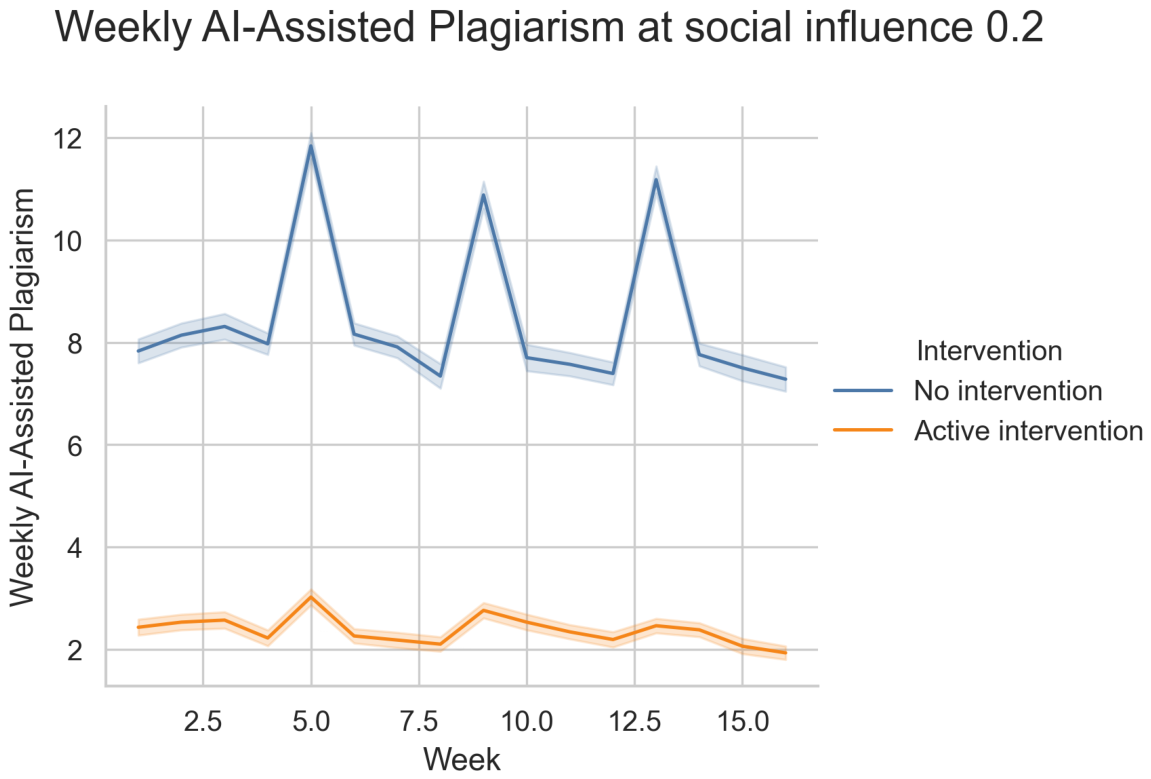
The weekly trend analysis is consistent with this interpretation. AI-assisted plagiarism remains visible throughout the semester in the AI-augmented environment, although at lower levels under active intervention than under no intervention. The temporal pattern of this behavior is illustrated in
Figure 7, which shows that intervention suppresses but does not remove the AI-assisted cheating pathway.
Taken together, these findings support the view that AI-assisted plagiarism changes the structure of behavioral choice in the academic misconduct environment. The model shows that once AI-assisted plagiarism becomes available, dishonest behavior increases and becomes concentrated in the AI-assisted category. Although intervention can reduce misconduct overall, it does not fully remove the strategic attractiveness of AI-assisted plagiarism. At the current stage, the strongest result of the experiment is therefore the behavioral shift introduced by AI-assisted cheating and the partial, rather than complete, corrective effect of institutional intervention.
4.2. Discussion
The results suggest that our simulation can produce the scenario that the introduction of AI-assisted plagiarism changes academic misconduct not only quantitatively but also structurally. In the conventional scenario, dishonest behavior is limited to direct copying, and intervention reduces that behavior in a relatively straightforward manner. In the AI-augmented scenario, however, the action space becomes richer, and the system adapts by allocating a substantial share of dishonest behavior to AI-assisted plagiarism. This indicates that the presence of AI-assisted cheating is not simply an additional option but a qualitatively important change in the behavioral environment.
A central implication of the findings is that anti-plagiarism intervention should not be evaluated solely in terms of whether total misconduct decreases. In the current model, active intervention reduces dishonest behavior overall, especially in the AI-augmented scenario. However, even after intervention, AI-assisted plagiarism remains more prevalent than direct copying. This suggests that institutional measures may suppress misconduct without fully eliminating the strategic attractiveness of less detectable cheating modes. In practical terms, a reduction in one form of misconduct does not necessarily imply a reduction in all forms.
This interpretation is particularly relevant in contemporary educational settings. Traditional plagiarism control mechanisms are often designed around direct copying, source similarity, and textual overlap. By contrast, AI-assisted plagiarism may be more individualized, more flexible, and less dependent on peer access. The model reflects this difference through distinct detection probabilities, and the results suggest that such differences are sufficient to change the behavioral balance of misconduct. Accordingly, academic integrity policy should be interpreted not only as a deterrence mechanism but also as a factor that may unintentionally reshape the strategic landscape of cheating.
The experiment also highlights the importance of distinguishing between external environmental factors and internal moral assumptions. In the previous reward-shaping direction, part of the intervention logic risked appearing as though the simulations were directly altering student conscience. The revised model instead treats the environment, available cheating options, detection conditions, and institutional sanctions as the primary intervention channels. This makes the model more consistent with a social–behavioral interpretation of academic misconduct, where behavior changes in response to opportunity structure and policy environment rather than through direct internal moral programming.
At the same time, the results show that the present implementation of social influence has only a modest effect on aggregate outcomes. This does not necessarily mean that peer effects are unimportant in real educational settings but rather that the current minimal influence mechanism is weaker than the effects of scenario design and institutional intervention. In other words, the model at this stage answers the AI-availability and intervention questions more clearly than the social diffusion question. This is acceptable for an early-stage experiment, but it also suggests an important direction for improvement. Future versions of the model may require stronger or more expressive peer mechanisms, such as weighted networks, directed influence, or explicit observation of peer sanction events.
The repeated multi-LLM plausibility assessment produced a stable cross-model judgment. Across five LLM families and 50 total outputs, the simulation was consistently judged to be acceptable as a stylized first-stage baseline but not as a strongly realistic model of student psychology or classroom behavior. The strongest positive consensus was that separating AI-assisted plagiarism from direct copying is a realistic and valuable design choice. The strongest repeated limitations concerned the use of Q-learning as a simplified adaptive heuristic, limited agent heterogeneity, and the need for richer treatment of AI-related task utility and social dynamics.
Table 6 summarizes the stable judgments and distinctive emphases observed across ten repeated runs for each of the five LLM families
2.
The model-specific emphases also provide useful guidance for interpreting and extending the simulation. ChatGPT 5.4 provided a balanced critique across multiple realism dimensions. Gemini 3 Flash emphasized the missing effort cost of honest work and the practical value of AI-resistant assessment design. Claude Sonnet 4.6 emphasized theoretical defensibility and the risk of overclaiming. DeepSeek R1 7B repeatedly emphasized longitudinal student history and dynamic peer influence. Qwen 3.5 4B emphasized the behavioral attractiveness of AI-assisted misconduct through task utility and effort reduction. Taken together, these findings support the use of the present simulation as an exploratory, hypothesis-generating baseline while clarifying that stronger behavioral realism would require richer modeling of student heterogeneity, task design, and social learning. These convergent judgments support the decision to present the current model as a first-stage exploratory simulation while also clarifying where future refinement is most needed. There should be further discussions regarding the use of LLMs for a plausibility assessment on behalf of humans.
Actually, some works started trying to use LLMs on behalf of humans for evaluation in the situations where they would be very hard to be assessed by humans (e.g., [
40] in a healthcare field and [
41] in a smart electricity control). However, these were mainly focused on comparing and benchmarking the performance of the implemented systems or methods, and therefore they deeply depend on the use of a specific LLM for easier comparisons under equal conditions. Therefore, directly applying these results into our approach is difficult. In this paper, we have tried to utilize different families of LLMs in a different model size. Here, we would note one thing about the limitations regarding the obtained consistent results from these LLMs. We believe having consistent results in this context would be good. However, in [
42], it has been reported that having consistent results from multiple AIs would lead to more acceptance of these AIs’ recommendations for decision-making by humans. Therefore, even in the case of having consistent results from different LLMs for a given matter, the use of these results in a practical decision-making context should be carefully reviewed. Our primary aim of using LLMs in this context is just to provide some help for assessing the design of a simulation but not to replace the empirical evidence to support them. This is one of the limitations of our work.
Overall, the present experiment should be understood as a first-stage plausibility assessment under the revised research direction. Its main contribution is to demonstrate that introducing AI-assisted plagiarism materially changes the adaptive landscape of misconduct and that institutional intervention reduces dishonest behavior only partially when AI-assisted strategies remain available. The findings therefore support the idea that plagiarism in the AI era is best understood as a problem of behavioral adaptation under changing technological and institutional conditions, rather than as a static problem of direct copying alone.
5. Conclusions
This study presented an approach to produce and assess a simulation to examine how AI-assisted plagiarism changes dishonest academic behavior in a socially interacting learning environment under different educational conditions. Using a scenario-based simulation with Q-learning as a baseline adaptive mechanism, the study compared a conventional plagiarism environment with an AI-augmented environment and evaluated how institutional intervention influences the resulting behavioral composition in a simulation.
The results show that the implemented simulation is able to produce the scenario where the introduction of AI-assisted plagiarism materially changes the structure of dishonest behavior. When AI-assisted plagiarism is available, total dishonest behavior increases and a large share of misconduct shifts toward the AI-assisted category rather than remaining concentrated in conventional direct copying. This can be used to make the suggestion that AI-assisted plagiarism should not be treated merely as an additional cheating option but as a qualitatively important change in the academic misconduct environment.
The results also show that intervention reduces dishonest behavior overall but does not fully eliminate AI-assisted plagiarism as a persistent strategic pathway in the simulation. In the AI-augmented environment, stricter detection and stronger sanctions will substantially reduce misconduct, yet AI-assisted plagiarism will remain behaviorally attractive and continues to account for a large share of dishonest actions as seen in the simulation. The simulation results can also be used to start arguing that institutional responses should be evaluated not only in terms of overall deterrence but also in terms of whether they unintentionally reshape misconduct toward less detectable forms.
At the same time, the present model should be interpreted as a first-stage exploratory simulation rather than a validated predictor of real classroom behavior. The qualitative plausibility review using multiple large language models supported the acceptability of the model as a stylized baseline, while also highlighting important limitations, especially the points that the LLM-based plausibility assessment itself does not replace any empirical validations, the use of Q-learning as a simplified adaptive heuristic, limited agent heterogeneity, and a relatively shallow social influence mechanism. Accordingly, the findings should be understood as directional and hypothesis-generating rather than as direct empirical claims about student psychology.
Future work may strengthen the realism of the model by expanding agent heterogeneity, refining the social interaction mechanism, and incorporating more explicit classroom-side policy conditions such as AI-resistant task design or discussion policy.