Does the Digital Economy Promote Urban Energy Transition? Evidence from China


Abstract
1. Introduction
2. Literature Review and Hypothesis Development
2.1. Energy Transition
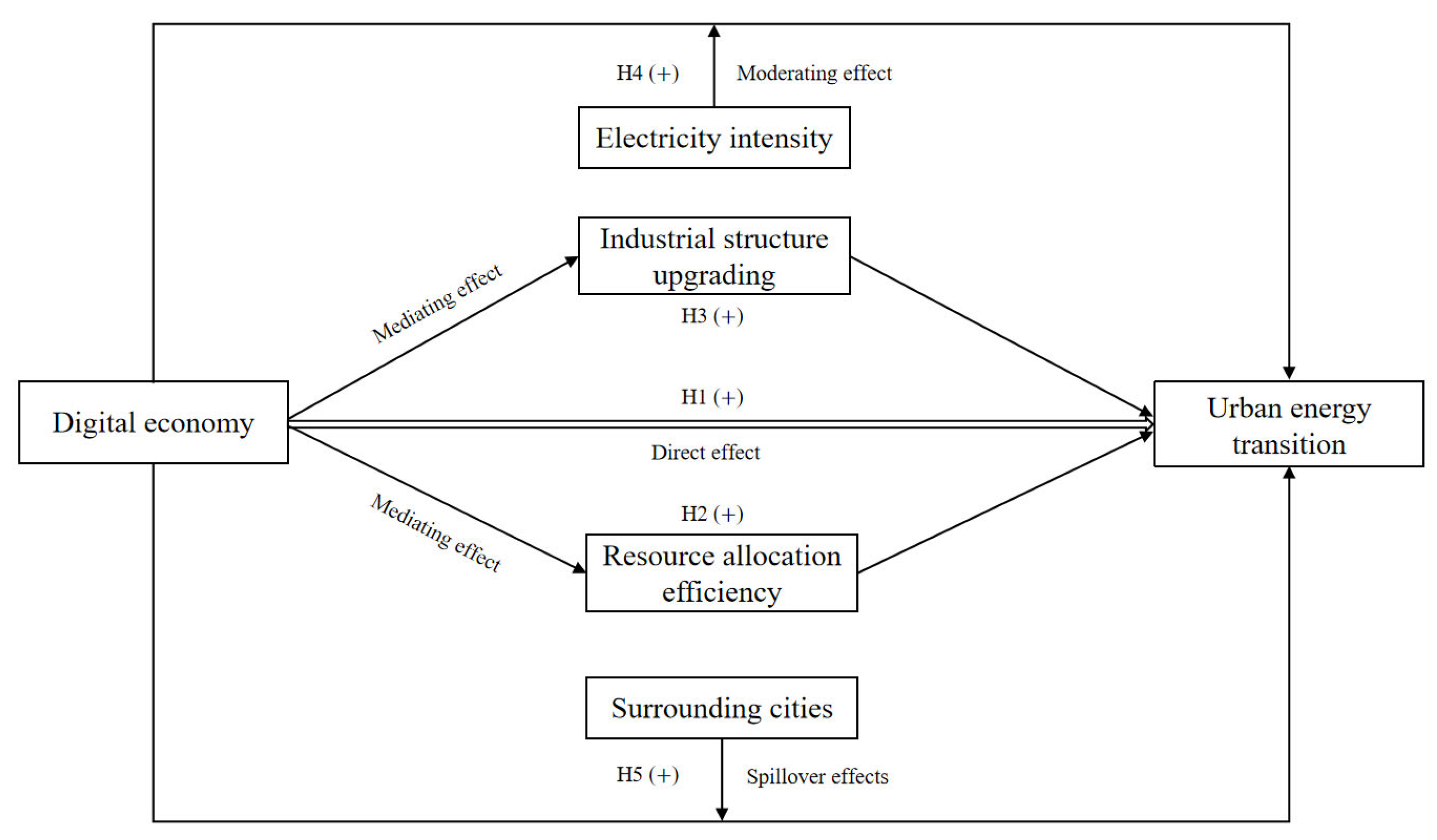
2.2. Digital Economy and Urban Energy Transition
3. Methodology
3.1. Econometric Model
3.2. Variables Measurement
3.2.1. Explained Variable
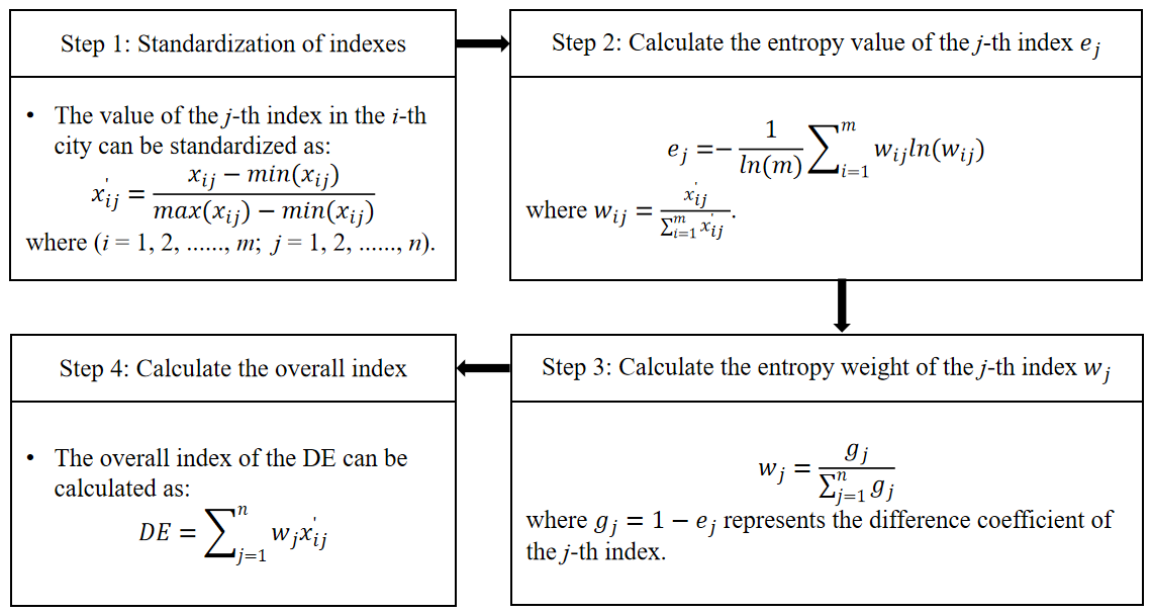
3.2.2. Core Explanatory Variable
3.2.3. Mechanism Variables
3.2.4. Control Variables
4. Results and Discussion
4.1. Benchmark Estimates
4.2. Robustness Tests
4.2.1. Removing the Impact of Municipalities
4.2.2. Changing the Evaluation Method for UET
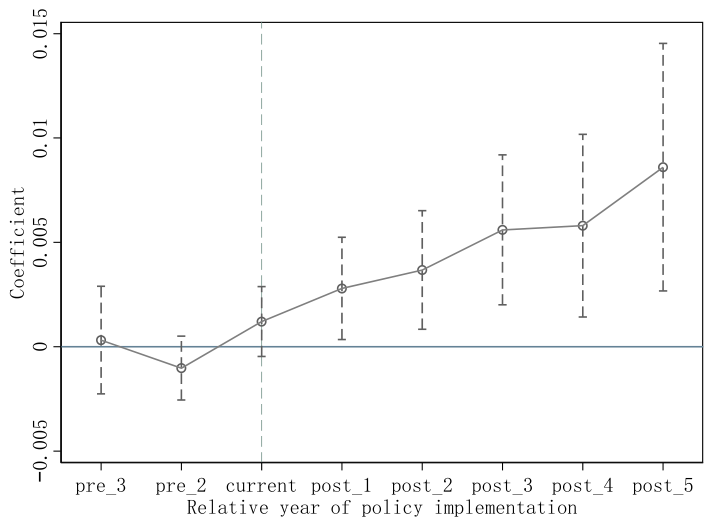
4.2.3. Representing DE Development with an Exogenous Shock
4.2.4. Endogeneity Test
4.3. Mechanism Test
4.3.1. Mediating Effect Analysis
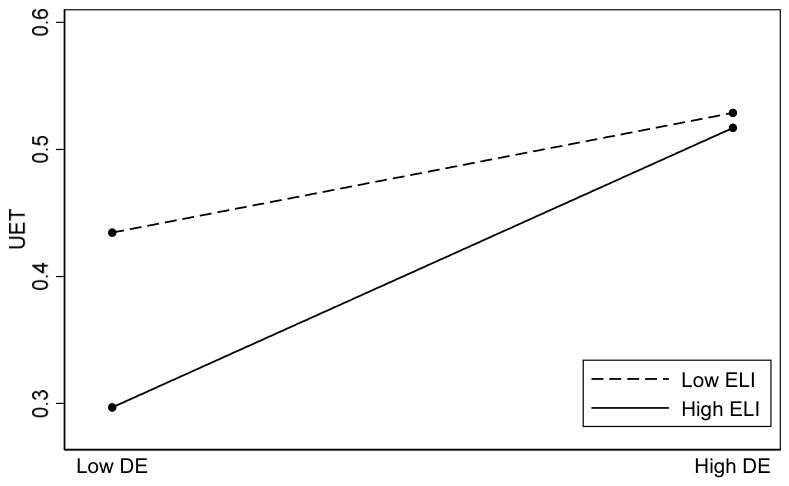
4.3.2. Moderating Effect Analysis
4.4. Heterogeneity Analysis
4.5. Spatial Effect Analysis
5. Conclusions and Policy Implications
Author Contributions
Funding
Institutional Review Board Statement
Informed Consent Statement
Data Availability Statement
Acknowledgments
Conflicts of Interest
Abbreviations
| UET | Urban energy transition |
| DE | Digital economy |
| RAE | Resource allocation efficiency |
| ISU | Industrial structure upgrading |
| ELI | Electricity intensity |
| IND | Industrialization |
| OPEN | Openness |
| POPU | Population density |
| FINA | Financial agglomeration |
| INFR | Infrastructure |
Appendix A

| Sub-Indexes | Dimensions | Components | Indicators | Unit | Direction |
|---|---|---|---|---|---|
| Energy system performance (50%) | Energy system structure (50%) | Energy mix (25%) | Coal consumption share (100%) | % | |
| Electricity structure (25%) | Local coal consumption for power generation vs. total electricity consumption (100%) | kg standard coal equivalent/kWh | |||
| Energy intensity (25%) | Energy consumption per unit of GDP (100%) | standard coal equivalent/104 yuan | |||
| Energy consumption (25%) | Energy consumption per capita (50%) | standard coal equivalent per capita | |||
| Electricity consumption per capita (50%) | kWh per capita | ||||
| Environmental sustainability (50%) | Carbon intensity (33%) | Carbon emissions per unit of GDP (100%) | t/104 yuan | ||
| Carbon emissions per capita (33%) | Carbon emissions per capita within urban territory (100%) | t/per capita | |||
| Air pollution (33%) | PM2.5 concentration (100%) | μg/m3 | |||
| Transition readiness (50%) | Economic development (25%) | Economic growth (50%) | Per capita GDP (50%) | yuan per capita | |
| GDP growth rate (50%) | % | ||||
| Economic structure (50%) | Share of employees in mining (50%) | % | |||
| Tertiary industry share in GDP (50%) | % | ||||
| Capital & investment (25%) | Capital stock (33%) | Annual average net value of fixed assets per capita (33%) | yuan per capita | ||
| Urban construction land share in municipal districts (33%) | % | ||||
| Per capita deposits of the national banking system at year-end (33%) | yuan per capita | ||||
| Investment (33%) | Per capita total social fixed asset investment (50%) | yuan per capita | |||
| Amount of foreign capital per capita (50%) | US dollars per capita | ||||
| Fiscal capacity (33%) | Per capita fiscal revenue (100%) | yuan per capita | |||
| Technology capacity (25%) | Innovation capacity (33%) | China innovation and entrepreneurship index (33%) | 0–100 | ||
| Internet service user share (33%) | % | ||||
| Number of green patent applications per capita (33%) | number per 104 capita | ||||
| Technology expenditure (33%) | Per capita science and technology expenditure (100%) | yuan per capita | |||
| Adaptive technology (33%) | Ratio of industrial SO2 removed (25%) | % | |||
| Ratio of wastewater centralized treated (25%) | % | ||||
| Ratio of consumption waste treated (25%) | % | ||||
| Ratio of industrial solid waste treated (25%) | % | ||||
| Human capital (25%) | R&D and new economy (33%) | Number of employees in scientific research and technical services (50%) | 104 persons | ||
| Number of employees in information technology (50%) | 104 persons | ||||
| Education and training capacity (33%) | Proportion of employees in the education industry (33%) | per 104 capita | |||
| Number of full-time teachers in vocational secondary schools (33%) | per 104 capita | ||||
| Number of full-time teachers in regular institutions of higher education (33%) | per 104 capita | ||||
| Quality of education (33%) | Per capita education expenditure (50%) | yuan per capita | |||
| Number of students enrolled in regular institutions of higher education (50%) | per 104 capita |
References
- Johnsson, F.; Kjärstad, J.; Rootzén, J. The threat to climate change mitigation posed by the abundance of fossil fuels. Clim. Policy 2019, 19, 258–274. [Google Scholar]
- Niu, X.; Zhan, Z.; Li, B.; Chen, Z. Environmental governance and cleaner energy transition: Evaluating the role of environment friendly technologies. Sustain. Energy Technol. Assess. 2022, 53, 102669. [Google Scholar] [CrossRef] [Scilit]
- Ramzan, M.; Razi, U.; Quddoos, M.U.; Adebayo, T.S. Do green innovation and financial globalization contribute to the ecological sustainability and energy transition in the United Kingdom? Policy insights from a bootstrap rolling window approach. Sustain. Dev. 2023, 31, 393–414. [Google Scholar]
- Shen, Y.; Shi, X.; Zhao, Z.; Xu, J.; Sun, Y.; Liao, Z.; Li, Y.; Shan, Y. A dataset of low-carbon energy transition index for Chinese cities 2003–2019. Sci. Data 2023, 10, 906. [Google Scholar] [CrossRef] [Scilit] [PubMed]
- Adams, S.; Kaffo Fotio, H. Economic integration and environmental quality: Accounting for the roles of financial development, industrialization, urbanization and renewable energy. J. Environ. Plan. Manag. 2024, 67, 688–713. [Google Scholar]
- Cheung, T.T.T.; Fuller, S.; Oßenbrügge, J. Mobilising change in cities: A capacity framework for understanding urban energy transition pathways. Environ. Policy Gov. 2023, 33, 531–545. [Google Scholar] [CrossRef] [Scilit]
- Lampropoulos, I.; Alskaif, T.; Schram, W.; Bontekoe, E.; Coccato, S.; Van Sark, W. Review of energy in the built environment. Smart Cities 2020, 3, 248–288. [Google Scholar] [CrossRef] [Scilit]
- Bompard, E.F.; Conti, S.; Masera, M.J.; Soma, G.G. A New Electricity Infrastructure for Fostering Urban Sustainability: Challenges and Emerging Trends. Energies 2024, 17, 5573. [Google Scholar] [CrossRef] [Scilit]
- Song, H.; Chen, W. Data-driven smart governance for dual-dimensional optimization of urban renewable energy systems: Enhancing transition depth and breadth. Energy Strateg. Rev. 2026, 64, 102087. [Google Scholar]
- Derkenbaeva, E.; Vega, S.H.; Hofstede, G.J.; Van Leeuwen, E. Positive energy districts: Mainstreaming energy transition in urban areas. Renew. Sustain. Energy Rev. 2022, 153, 111782. [Google Scholar] [CrossRef] [Scilit]
- Chen, P. Is the digital economy driving clean energy development?-New evidence from 276 cities in China. J. Clean. Prod. 2022, 372, 133783. [Google Scholar]
- Zhou, Y. Low-carbon urban-rural modern energy systems with energy resilience under climate change and extreme events in China-A state-of-the-art review. Energy Build. 2024, 321, 114661. [Google Scholar]
- Wu, R.; Su, S.; Hou, J.; Wang, X. Digital Economy, Green Technology Innovation and Urban Carbon Emissions: Evidence from Chinese Cities. Systems 2026, 14, 291. [Google Scholar] [CrossRef] [Scilit]
- Li, C.; Zhou, W. Can digital economy development contribute to urban carbon emission reduction?-Empirical evidence from China. J. Environ. Manag. 2024, 357, 120680. [Google Scholar]
- Zeng, P.; Wang, Y.; Tian, Z. Regional differences, source decomposition and formation mechanism of urban digital economy and energy market integration in China. J. Clean. Prod. 2024, 451, 141960. [Google Scholar] [CrossRef] [Scilit]
- Wu, J.; Lin, K.; Sun, J. Improving urban energy efficiency: What role does the digital economy play? J. Clean. Prod. 2023, 418, 138104. [Google Scholar] [CrossRef] [Scilit]
- Guo, Q.; You, W. How can the digital economy alleviate multidimensional energy poverty?—Empirical evidence of 21 prefecture-level cities in Guangdong Province. Energy 2024, 301, 131692. [Google Scholar]
- Jiang, W.; Li, J. Digital transformation and its effect on resource allocation efficiency and productivity in Chinese corporations. Technol. Soc. 2024, 78, 102638. [Google Scholar] [CrossRef] [Scilit]
- Guo, L.; Du, F.; Tang, M. Will the Development of the Digital Economy Impact the Clean Energy Transition? An Intermediary Utility Analysis Based on Technological Innovation and Industrial Structure. Sustainability 2025, 17, 4917. [Google Scholar] [CrossRef] [Scilit]
- Dian, J.; Song, T.; Li, S. Facilitating or inhibiting? Spatial effects of the digital economy affecting urban green technology innovation. Energy Econ. 2024, 129, 107223. [Google Scholar]
- Bhatt, V.; Friley, P.; Lee, J. Integrated energy and environmental systems analysis methodology for achieving low carbon cities. J. Renew. Sustain. Energy 2010, 2, 121–147. [Google Scholar] [CrossRef] [Scilit]
- Liu, L.; Zhou, R.; Wang, F. What Roles Do Local Governments Play in Chinese Urban Energy Transition? Systems 2025, 13, 1092. [Google Scholar] [CrossRef] [Scilit]
- Lu, Y.X.; Fang, X.M.; Zhang, A.Q. Digital economy, spatial spillover and high-quality development of urban economy. Econ. Surv. 2021, 38, 21–31. [Google Scholar]
- Kalair, A.; Abas, N.; Saleem, M.S.; Kalair, A.R.; Khan, N. Role of energy storage systems in energy transition from fossil fuels to renewables. Energy Storage 2021, 3, e135. [Google Scholar]
- Wang, B.; Liu, G.; Zhou, S.; Tang, Z.; Liu, Z.; Deng, N.; Wang, Z. Can China’s renewable energy policy synergies help clean energy transition? Environ. Impact Assess. Rev. 2025, 113, 107878. [Google Scholar]
- Hu, Y.; Liu, Y.; Wang, Z. How does China’s energy quota trading policy affect regional energy transition? Util. Policy 2026, 100, 102171. [Google Scholar]
- Kost, C.; Palzer, A.; Sterchele, P.; Stephanos, C.; Hartmann, N.; Henning, H.M. Coal phase out, energy efficiency, and electricity imports: Key elements to realize the energy transformation. Appl. Phys. Rev. 2019, 6, 011308. [Google Scholar] [CrossRef] [Scilit]
- Zhang, D.; Kong, Q. Green energy transition and sustainable development of energy firms: An assessment of renewable energy policy. Energy Econ. 2022, 111, 106060. [Google Scholar] [CrossRef] [Scilit]
- Bashir, M.F.; Pan, Y.; Shahbaz, M.; Ghosh, S. How energy transition and environmental innovation ensure environmental sustainability? Contextual evidence from Top-10 manufacturing countries. Renew. Energy 2023, 204, 697–709. [Google Scholar] [CrossRef] [Scilit]
- Liu, G.; Xu, W.; Nguyen, Q.M. Can the energy transition drive economic development? Empirical analysis of China’s provincial panel data. Technol. Forecast. Soc. Change 2024, 206, 123541. [Google Scholar]
- Bie, F.; Yang, Y.; Shen, H.; Zhao, Q. Inclusive digital economy, resource dependence and changes in the urban energy mix: City level analysis from China. Resour. Policy 2024, 92, 105027. [Google Scholar] [CrossRef] [Scilit]
- Wang, Q.; Fan, Z. Green finance and investment behavior of renewable energy enterprises: A case study of China. Int. Rev. Financ. Anal. 2023, 87, 102564. [Google Scholar] [CrossRef] [Scilit]
- Wang, W.; Yang, X.; Cao, J.; Bu, W.; Adebayo, T.S.; Dilanchiev, A.; Ren, S. Energy internet, digital economy, and green economic growth: Evidence from China. Innov. Green Dev. 2022, 1, 100011. [Google Scholar] [CrossRef] [Scilit]
- Lyu, Y.; Wu, Y.; Wu, G.; Wang, W.; Zhang, J. Digitalization and energy: How could digital economy eliminate energy poverty in China? Environ. Impact Assess. Rev. 2023, 103, 107243. [Google Scholar] [CrossRef] [Scilit]
- Xue, Y.; Tang, C.; Wu, H.; Liu, J.; Hao, Y. The emerging driving force of energy consumption in China: Does digital economy development matter? Energy Policy 2022, 165, 112997. [Google Scholar] [CrossRef] [Scilit]
- Ma, Q.; Tariq, M.; Mahmood, H.; Khan, Z. The nexus between digital economy and carbon dioxide emissions in China: The moderating role of investments in research and development. Technol. Soc. 2022, 68, 101910. [Google Scholar] [CrossRef] [Scilit]
- Xin, Y.; Chang, X.; Zhu, J. How does the digital economy affect energy efficiency? Empirical research on Chinese cities. Energy Environ. 2024, 35, 1703–1728. [Google Scholar]
- Wang, L.; Chen, L. Resource dependence and air pollution in China: Do the digital economy, income inequality, and industrial upgrading matter? Environ. Dev. Sustain. 2024, 26, 2069–2109. [Google Scholar]
- He, W.; Li, W.; Wang, C.; Wang, S.; Yang, Y. Does energy resource misallocation affect energy utilization efficiency? Evidence from Chinese provincial panel data. Energy 2024, 288, 129544. [Google Scholar] [CrossRef] [Scilit]
- Qi, S.; Wang, X.; Li, K. Smarter and cleaner energy transition: Exploring how digitalization affects energy efficiency with greening as a moderator. Energy 2025, 342, 139617. [Google Scholar] [CrossRef] [Scilit]
- Mohseni, S.; Brent, A.C. Long-term planning optimisation of sustainable energy systems: A systematic review and meta-analysis of trends, drivers, barriers, and prospects. Energy Strateg. Rev. 2025, 57, 101640. [Google Scholar]
- Zhao, S.; Peng, D.; Wen, H.; Song, H. Does the digital economy promote upgrading the industrial structure of Chinese cities? Sustainability 2022, 14, 10235. [Google Scholar] [CrossRef] [Scilit]
- Song, M.; Pan, H.; Vardanyan, M.; Shen, Z. Evaluating the energy efficiency-enhancing potential of the digital economy: Evidence from China. J. Environ. Manag. 2023, 344, 118408. [Google Scholar] [CrossRef] [Scilit]
- Javaid, M.; Haleem, A.; Singh, R.P.; Sinha, A.K. Digital economy to improve the culture of industry 4.0: A study on features, implementation and challenges. Green Technol. Sustain. 2024, 2, 100083. [Google Scholar] [CrossRef] [Scilit]
- Yang, F.; Li, C.; Zhang, S. Digital economy and carbon emission intensity: Evidence from ASEAN. Sustainability 2025, 17, 10266. [Google Scholar] [CrossRef] [Scilit]
- Lin, B.; Huang, C. How will promoting the digital economy affect electricity intensity? Energy Policy 2023, 173, 113341. [Google Scholar]
- Wang, L.; Shao, J. Digital economy, entrepreneurship and energy efficiency. Energy 2023, 269, 126801. [Google Scholar] [CrossRef] [Scilit]
- Shahbaz, M.; Wang, J.; Dong, K.; Zhao, J. The impact of digital economy on energy transition across the globe: The mediating role of government governance. Renew. Sustain. Energy Rev. 2022, 166, 112620. [Google Scholar] [CrossRef] [Scilit]
- Liu, L.; Liu, J.; Zhang, J.; Zhao, Y. Does the Digital Economy Promote Renewable Energy?—Evidence From a Cross-National Sample. Asia Pac. Policy Stud. 2025, 12, e70015. [Google Scholar]
- Gao, J.; Hua, G.; Randhawa, A.; Huo, B.; Li, Z. Towards a Green Digital City: Digital Economy, Digital Innovation, and Urban Haze Pollution. J. Urban Technol. 2024, 31, 157–189. [Google Scholar] [CrossRef] [Scilit]
- Hong, J.; Gu, J.; He, R.; Wang, X.; Shen, Q. Unfolding the spatial spillover effects of urbanization on interregional energy connectivity: Evidence from province-level data. Energy 2020, 196, 116990. [Google Scholar] [CrossRef] [Scilit]
- Wang, Z.; Cao, X.; Ren, X.; Gozgor, G. Digital finance and the energy transition: Evidence from Chinese prefecture-level cities. Glob. Financ. J. 2024, 61, 100987. [Google Scholar] [CrossRef] [Scilit]
- Xiao, Y.; Wu, S.; Liu, Z.Q.; Lin, H.J. Digital economy and green development: Empirical evidence from China’s cities. Front. Environ. Sci. 2023, 11, 1124680. [Google Scholar] [CrossRef] [Scilit]
- Zhou, Y.; Liu, J. Advances in emerging digital technologies for energy efficiency and energy integration in smart cities. Energy Build. 2024, 315, 114289. [Google Scholar] [CrossRef] [Scilit]
- Lin, B.; Zhang, A. Digital finance, regional innovation environment and renewable energy technology innovation: Threshold effects. Renew. Energy 2024, 223, 120036. [Google Scholar] [CrossRef] [Scilit]
- Hou, M.; Xie, Y.; Lu, W.; Cui, X.; Xi, Z.; Han, Y. Green finance drives the synergy of pollution control and carbon reduction in China: Dual perspective of effect and efficiency. Energy 2025, 330, 136873. [Google Scholar] [CrossRef] [Scilit]
- Feng, J.; Hu, W.; Liu, L.; Duan, J. How Carbon Emissions Trading Improves Corporate Carbon Performance: Evidence from China with a Moderated Chain Mediation Analysis. Systems 2026, 14, 62. [Google Scholar] [CrossRef] [Scilit]
- Wang, P.; Cen, C. Does digital economy development promote innovation efficiency? A spatial econometric approach for Chinese regions. Technol. Anal. Strateg. Manag. 2024, 36, 931–945. [Google Scholar]
- Yang, J.; Wang, J.; Wang, W.; Wu, H. Exploring the path to promote energy revolution: Assessing the impact of new energy demonstration city construction on urban energy transition in China. Renew. Energy 2024, 236, 121437. [Google Scholar] [CrossRef] [Scilit]
- Bai, J.H.; Liu, Y.Y. Can outward foreign direct investment improve the resource misallocation of China. China Ind. Econ. 2018, 1, 60–78. [Google Scholar] [CrossRef]
- Wang, C.; Liu, Y.; Wan, Y.; Hu, S.; Xia, H. How does the digital economy impact the green upgrading of manufacturing? Perspectives on technological innovation and resource allocation. Appl. Econ. 2024, 57, 5049–5064. [Google Scholar] [CrossRef] [Scilit]
- Wang, Z.; Fu, H.; Liu, H.; Liao, C. Urban development sustainability, industrial structure adjustment, and land use efficiency in China. Sust. Cities Soc. 2023, 89, 104338. [Google Scholar]
- Ma, D.; Zhu, Q. Innovation in emerging economies: Research on the digital economy driving high-quality green development. J. Bus. Res. 2022, 145, 801–813. [Google Scholar] [CrossRef] [Scilit]
- Zhou, Q.; Cheng, C.; Fang, Z.; Zhang, H.; Xu, Y. How does the development of the digital economy affect innovation output? Exploring mechanisms from the perspective of regional innovation systems. Struct. Change Econ. Dyn. 2024, 70, 1–17. [Google Scholar] [CrossRef] [Scilit]
- Xie, R.; Fu, W.; Yao, S.; Zhang, Q. Effects of financial agglomeration on green total factor productivity in Chinese cities: Insights from an empirical spatial Durbin model. Energy Econ. 2021, 101, 105449. [Google Scholar] [CrossRef] [Scilit]
- Xu, Y.; Tiwari, S.; Kazemzadeh, E.; Ghosh, S.; Doğan, B. How does smart cities and digital economy facilitate energy security and energy transition? Empirical evidence from China. Energy Build. 2025, 351, 116639. [Google Scholar] [CrossRef] [Scilit]
- Ding, W.; Du, J.; Kazancoglu, Y.; Mangla, S.K.; Song, M. Financial development and the energy net-zero transformation potential. Energy Econ. 2023, 125, 106863. [Google Scholar] [CrossRef] [Scilit]
- Andal, E.G.T. Industrialisation, state-related institutions, and the speed of energy substitution: The case in Europe. Energy 2022, 239, 122274. [Google Scholar] [CrossRef] [Scilit]
- Balsalobre-Lorente, D.; Driha, O.M.; Halkos, G.; Mishra, S. Influence of growth and urbanization on CO2 emissions: The moderating effect of foreign direct investment on energy use in BRICS. Sustain. Dev. 2022, 30, 227–240. [Google Scholar]
- Li, X.; Ma, D. Financial agglomeration, technological innovation, and green total factor energy efficiency. Alex. Eng. J. 2021, 60, 4085–4095. [Google Scholar] [CrossRef] [Scilit]
- Sadorsky, P. The impact of financial development on energy consumption in emerging economies. Energy Policy 2010, 38, 2528–2535. [Google Scholar] [CrossRef] [Scilit]
- Qu, C.; Shao, J.; Shi, Z. Does financial agglomeration promote the increase of energy efficiency in China? Energy Policy 2020, 146, 111810. [Google Scholar] [CrossRef] [Scilit]
- Liu, Y.; Tang, C.; Zhou, A.; Yang, K. A novel ensemble approach for road traffic carbon emission prediction: A case in Canada. Environ. Dev. Sustain. 2025, 27, 15977–16013. [Google Scholar]
- Wang, Q.; Gao, G. Impact of digital economy on carbon emission efficiency: Evidence from a quasi-natural experiment in “Broadband China” pilot cities. Sustain. Futures 2025, 10, 101025. [Google Scholar] [CrossRef] [Scilit]
- Liu, Y.; Xie, Y.; Zhong, K. Impact of digital economy on urban sustainable development: Evidence from Chinese cities. Sustain. Dev. 2024, 32, 307–324. [Google Scholar]
- Choi, B. Productivity and misallocation of energy resources: Evidence from Korea’s manufacturing Sector. Resour. Energy Econ. 2020, 61, 101184. [Google Scholar] [CrossRef] [Scilit]
- Li, X.; Huang, S.; Hamaguchi, Y.; Bhuiyan, M.A. Does Land Resource Misallocation Reduce Energy Efficiency? Empirical Evidence from 243 Prefecture Level Cities in China. Rev. Dev. Econ. 2026, 30, 716–729. [Google Scholar]
- Du, W.; Liu, X.; Liu, Y.; Xie, J. Digital Economy and carbon emission efficiency in three major urban agglomerations of China: A U-shaped journey towards green development. J. Environ. Manag. 2025, 373, 123571. [Google Scholar]
- Chang, H.; Ding, Q.; Zhao, W.; Hou, N.; Liu, W. The digital economy, industrial structure upgrading, and carbon emission intensity—Empirical evidence from China’s provinces. Energy Strateg. Rev. 2023, 50, 101218. [Google Scholar]
- Wu, B.; Wang, Z.; Tian, Y.; Zheng, S. The impact of industrial transformation and upgrading on fossil energy elasticity in China. J. Clean. Prod. 2024, 434, 140287. [Google Scholar]
- Batinge, B.; Musango, J.K.; Brent, A.C. Sustainable energy transition framework for unmet electricity markets. Energy Policy 2019, 129, 1090–1099. [Google Scholar] [CrossRef] [Scilit]
- Lin, B.; Raza, M.Y. Analysis of electricity consumption in Pakistan using index decomposition and decoupling approach. Energy 2021, 214, 118888. [Google Scholar] [CrossRef] [Scilit]
- Ren, H.; Zhang, Z. Digital Transformation and Energy Consumption: Efficiency Gains or Cost Pressures? Polit. Ekon. 2026. [Google Scholar] [CrossRef] [Scilit]
- Zhang, X.; Ding, R.; Yang, W. Study on spatial differentiation of digital economy and it’s driving factors in China: Based on geodetector. Sustainability 2024, 16, 10472. [Google Scholar] [CrossRef] [Scilit]
- Guo, D.; Li, L.; Pang, G. Does the integration of digital and real economies promote urban green total factor productivity? Evidence from China. J. Environ. Manag. 2024, 370, 122934. [Google Scholar] [CrossRef] [Scilit]
- Wang, S.; Song, Y.; Du, A.M.; Liang, J. The digital economy and entrepreneurial dynamics: An empirical analysis of urban regions in China. Res. Int. Bus. Finance 2024, 71, 102459. [Google Scholar] [CrossRef] [Scilit]
- Pace, R.K.; LeSage, J.P. A sampling approach to estimate the log determinant used in spatial likelihood problems. J. Geogr. Syst. 2009, 11, 209–225. [Google Scholar] [CrossRef] [Scilit]
- Lv, W.; Fan, W.; Wang, Z. How to enhance the resilience of domestic tourism? J. Hosp. Tour. Manag. 2024, 61, 165–177. [Google Scholar] [CrossRef] [Scilit]


| Variables | N | Mean | Std. Dev. | Min | Max |
|---|---|---|---|---|---|
| UET | 2926 | 0.4665 | 0.0466 | 0.3311 | 0.7344 |
| DE | 2926 | 0.1450 | 0.0750 | 0.0217 | 0.6876 |
| RAE | 2926 | 0.3877 | 0.3148 | 0.0053 | 2.6767 |
| ISU | 2926 | 1.0499 | 0.5821 | 0.2044 | 5.3482 |
| ELI | 2926 | 0.0825 | 0.0992 | 0.0038 | 1.7634 |
| IND | 2926 | 0.4550 | 0.1049 | 0.1170 | 0.8193 |
| OPEN | 2926 | 0.0170 | 0.0184 | 0.0000 | 0.2287 |
| POPU | 2926 | 0.3780 | 0.5477 | 0.0058 | 6.5017 |
| FINA | 2926 | 1.0384 | 0.4737 | 0.0743 | 6.2325 |
| INFR | 2926 | 17.9677 | 7.3466 | 1.3700 | 60.0700 |
| Variables | (1) | (2) | (3) | (4) | (5) | (6) |
|---|---|---|---|---|---|---|
| UET | UET | UET | UET | UET | UET | |
| DE | 0.1576 *** | 0.1573 *** | 0.1580 *** | 0.1579 *** | 0.1575 *** | 0.1566 *** |
| (0.0091) | (0.0091) | (0.0090) | (0.0090) | (0.0090) | (0.0090) | |
| IND | 0.0219 *** | 0.0228 *** | 0.0226 *** | 0.0222 *** | 0.0217 *** | |
| (0.0054) | (0.0054) | (0.0054) | (0.0054) | (0.0053) | ||
| OPEN | 0.1049 *** | 0.1054 *** | 0.1052 *** | 0.1051 *** | ||
| (0.0180) | (0.0180) | (0.0180) | (0.0179) | |||
| POPU | 0.0006 | 0.0006 | 0.0006 | |||
| (0.0008) | (0.0008) | (0.0008) | ||||
| FINA | −0.0015 ** | −0.0016 ** | ||||
| (0.0007) | (0.0007) | |||||
| INFR | −0.0003 *** | |||||
| (0.0001) | ||||||
| Constant | 0.4295 *** | 0.4182 *** | 0.4157 *** | 0.4155 *** | 0.4172 *** | 0.4220 *** |
| (0.0009) | (0.0030) | (0.0030) | (0.0030) | (0.0031) | (0.0032) | |
| City_FE | Yes | Yes | Yes | Yes | Yes | Yes |
| Year_FE | Yes | Yes | Yes | Yes | Yes | Yes |
| N | 2926 | 2926 | 2926 | 2926 | 2926 | 2926 |
| R-squared | 0.7322 | 0.7339 | 0.7372 | 0.7373 | 0.7377 | 0.7400 |
| Variables | (1) | (2) | (3) | (4) | (5) |
|---|---|---|---|---|---|
| UET | UET | UET | DE | UET | |
| DE | 0.1471 *** | 0.3052 *** | 0.2602 *** | ||
| (0.0090) | (0.0119) | (0.0273) | |||
| POLICY | 0.0048 *** | ||||
| (0.0018) | |||||
| IV | 0.0306 *** | ||||
| (0.0023) | |||||
| Constant | 0.4219 *** | 0.0239 *** | 0.4326 *** | 0.0973 *** | 0.4764 *** |
| (0.0032) | (0.0043) | (0.0065) | (0.0127) | (0.0077) | |
| Controls | Yes | Yes | Yes | Yes | |
| City_FE | Yes | Yes | Yes | Yes | |
| Year_FE | Yes | Yes | Yes | Yes | |
| Kleibergen–Paap rk LM statistic | 210.643 [0.0000] | ||||
| Kleibergen–Paap rk Wald F statistic | 180.150 {16.38} | ||||
| N | 2882 | 2926 | 2926 | 2926 | 2926 |
| R-squared | 0.7416 | 0.5706 | 0.7135 | 0.5602 |
| Variables | (1) | (2) | (3) |
|---|---|---|---|
| RAE | ISU | UET | |
| DE | −0.3361 *** | 0.2481 ** | 0.1411 *** |
| (0.1181) | (0.1247) | (0.0095) | |
| ELI | −0.0805 *** | ||
| (0.0072) | |||
| DE × ELI | 0.1073 *** | ||
| (0.0337) | |||
| Constant | 0.4425 *** | 2.9896 *** | 0.4317 *** |
| (0.0427) | (0.0451) | (0.0031) | |
| Controls | Yes | Yes | Yes |
| City_FE | Yes | Yes | Yes |
| Year_FE | Yes | Yes | Yes |
| N | 2926 | 2926 | 2926 |
| R-squared | 0.1396 | 0.8262 | 0.7718 |
| Variables | (1) | (2) | (3) | (4) |
|---|---|---|---|---|
| UET | UET | UET | UET | |
| DE | 0.1931 *** | 0.2035 *** | 0.0672 *** | 0.0428 |
| (0.0133) | (0.0162) | (0.0162) | (0.0319) | |
| Constant | 0.4620 *** | 0.4475 *** | 0.4246 *** | 0.4245 *** |
| (0.0080) | (0.0056) | (0.0055) | (0.0057) | |
| Controls | Yes | Yes | Yes | Yes |
| City_FE | Yes | Yes | Yes | Yes |
| Year_FE | Yes | Yes | Yes | Yes |
| N | 913 | 858 | 814 | 341 |
| R-squared | 0.8168 | 0.8678 | 0.6556 | 0.6154 |
| Year | DE | UET | ||
|---|---|---|---|---|
| Moran’s I | Z | Moran’s I | Z | |
| 2011 | 0.2906 | 7.1397 | 0.2255 | 5.5027 |
| 2012 | 0.3049 | 7.4884 | 0.2217 | 5.4116 |
| 2013 | 0.2834 | 6.9709 | 0.2172 | 5.3102 |
| 2014 | 0.2938 | 7.2166 | 0.1835 | 4.5034 |
| 2015 | 0.2977 | 7.3332 | 0.2061 | 5.0514 |
| 2016 | 0.3070 | 7.5792 | 0.2061 | 5.0565 |
| 2017 | 0.2907 | 7.1744 | 0.2026 | 4.9831 |
| 2018 | 0.2373 | 5.8633 | 0.1978 | 4.8655 |
| 2019 | 0.1896 | 4.7325 | 0.2119 | 5.2082 |
| 2020 | 0.2145 | 5.2848 | 0.2274 | 5.5817 |
| 2021 | 0.2164 | 5.3239 | 0.2330 | 5.7139 |
| Variables | (1) | (2) | (3) |
|---|---|---|---|
| Adjacency Matrix | Economic Distance Matrix | Economic-Geographic Weighting Matrix | |
| DE | 0.1340 *** | 0.1320 *** | 0.1254 *** |
| (0.0077) | (0.0084) | (0.0081) | |
| Wx | 0.0274 * | 0.1520 *** | 0.1450 *** |
| (0.0148) | (0.0270) | (0.0255) | |
| Rho | 0.4260 *** | 0.2043 *** | 0.3552 *** |
| (0.0206) | (0.0372) | (0.0325) | |
| Direct effect | 0.1438 *** | 0.1366 *** | 0.1352 *** |
| (0.0085) | (0.0087) | (0.0085) | |
| Indirect effect | 0.1340 *** | 0.2208 *** | 0.2847 *** |
| (0.0238) | (0.0336) | (0.0380) | |
| Total effect | 0.2778 *** | 0.3575 *** | 0.4199 *** |
| (0.0285) | (0.0359) | (0.0409) | |
| Controls | Yes | Yes | Yes |
| City_FE | Yes | Yes | Yes |
| Year_FE | Yes | Yes | Yes |
| N | 2926 | 2926 | 2926 |
Disclaimer/Publisher’s Note: The statements, opinions and data contained in all publications are solely those of the individual author(s) and contributor(s) and not of MDPI and/or the editor(s). MDPI and/or the editor(s) disclaim responsibility for any injury to people or property resulting from any ideas, methods, instructions or products referred to in the content. |
© 2026 by the authors. Licensee MDPI, Basel, Switzerland. This article is an open access article distributed under the terms and conditions of the Creative Commons Attribution (CC BY) license.
Share and Cite
Hu, Y.; Liu, Y.; Wang, Z. Does the Digital Economy Promote Urban Energy Transition? Evidence from China. Systems 2026, 14, 775. https://doi.org/10.3390/systems14070775
Hu Y, Liu Y, Wang Z. Does the Digital Economy Promote Urban Energy Transition? Evidence from China. Systems. 2026; 14(7):775. https://doi.org/10.3390/systems14070775
Chicago/Turabian StyleHu, Yushang, Yaqing Liu, and Zanxin Wang. 2026. "Does the Digital Economy Promote Urban Energy Transition? Evidence from China" Systems 14, no. 7: 775. https://doi.org/10.3390/systems14070775
APA StyleHu, Y., Liu, Y., & Wang, Z. (2026). Does the Digital Economy Promote Urban Energy Transition? Evidence from China. Systems, 14(7), 775. https://doi.org/10.3390/systems14070775