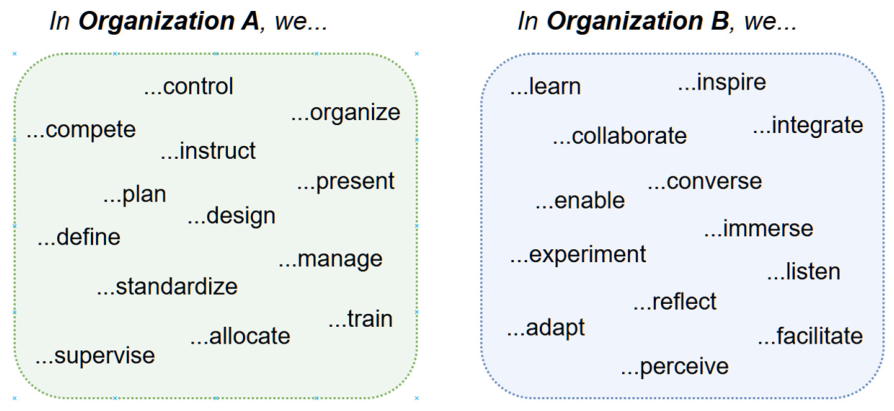
The Organization of the Future—An Integrated, Transdisciplinary Paradigm Shift



Abstract
1. Introduction
2. Related Work
3. Study Scope
- SRQ1: How can the difference between organizational paradigms be determined?
- SRQ2: What can serve as comparable paradigm representations?
- SRQ3: Can archetypal societal paradigms be mapped as shared mental model representations? How?
- SRQ4: How can these maps be compared to answer the main research question?
- SRQ5: What are the underlying ontological shifts that can be inferred from a comparison?
- SRQ6: What implications do the study outcomes have for theory and practice of organizational change?
4. Conceptual Development for the Study
4.1. Complexity Theory Perspective and Organizational Change
4.2. Social Constructionism and the Role of Language
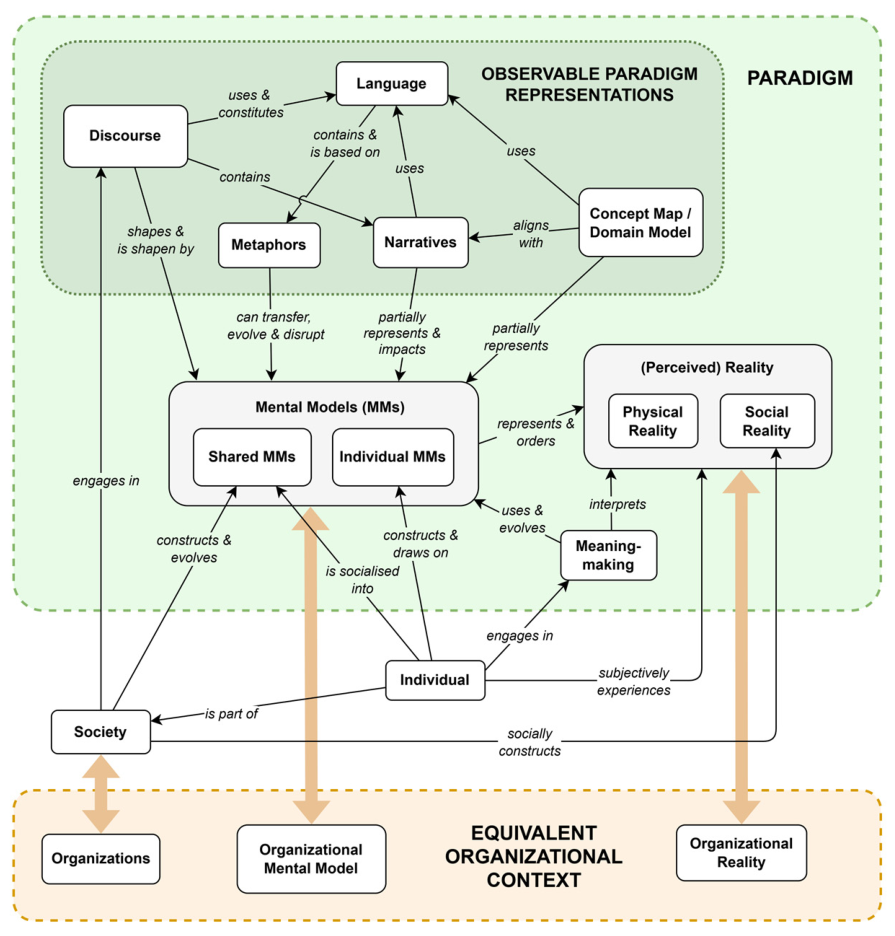
4.3. Cognition and Mental Models
4.4. Social Construction of Organizational Kuhnian-Type Paradigms
4.5. Mental Model Representations (Cognitive/Concept Maps and Domain Ontologies)
4.6. Researcher Meta-Paradigm
5. Methodology
- Embracing the subjectivity of the researcher in an unavoidable embedded research context.
- Navigating an ongoing interaction between the researcher’s own lived experiences, academic theory and the context of the inquiry.
- Applying a balance between rigor and creativity.
- The researcher being open to emergence and evolving the approach and herself through the process.
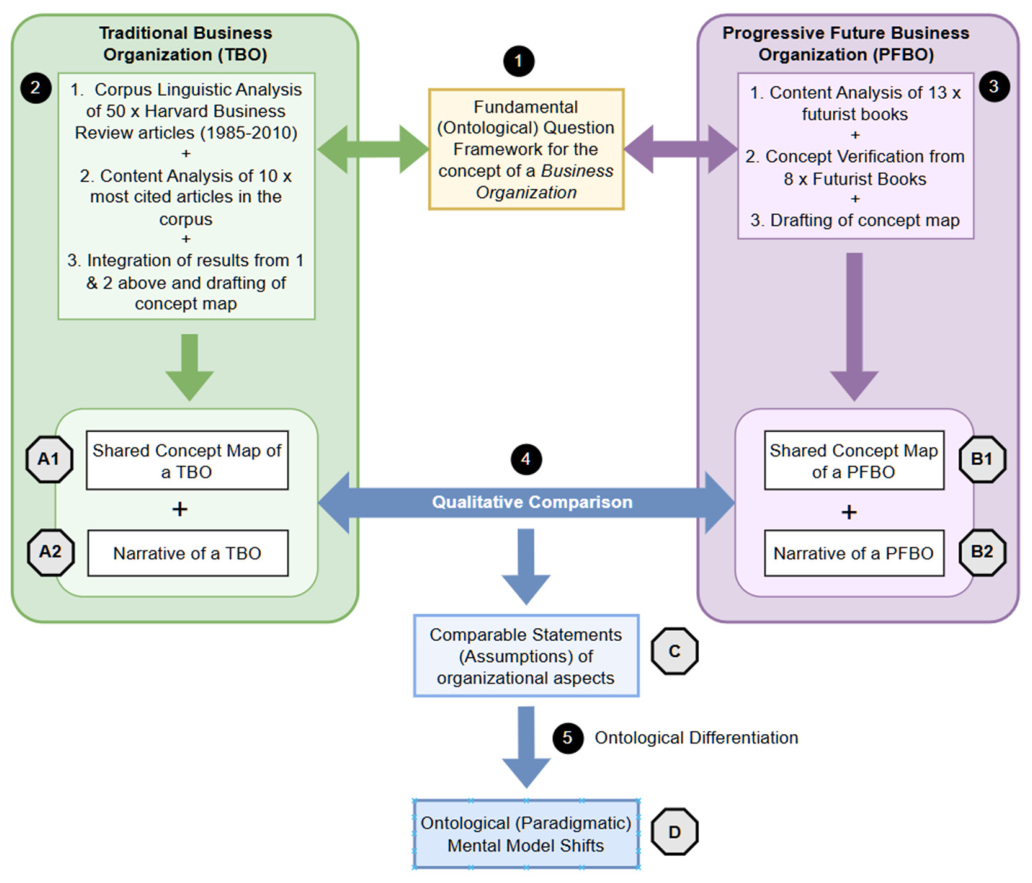
5.1. STEP 1: Compiling a Set of Fundamental (Ontological) Questions
5.2. STEP 2: Creating a Shared Concept Map for the Traditional Business Organization (TBO)
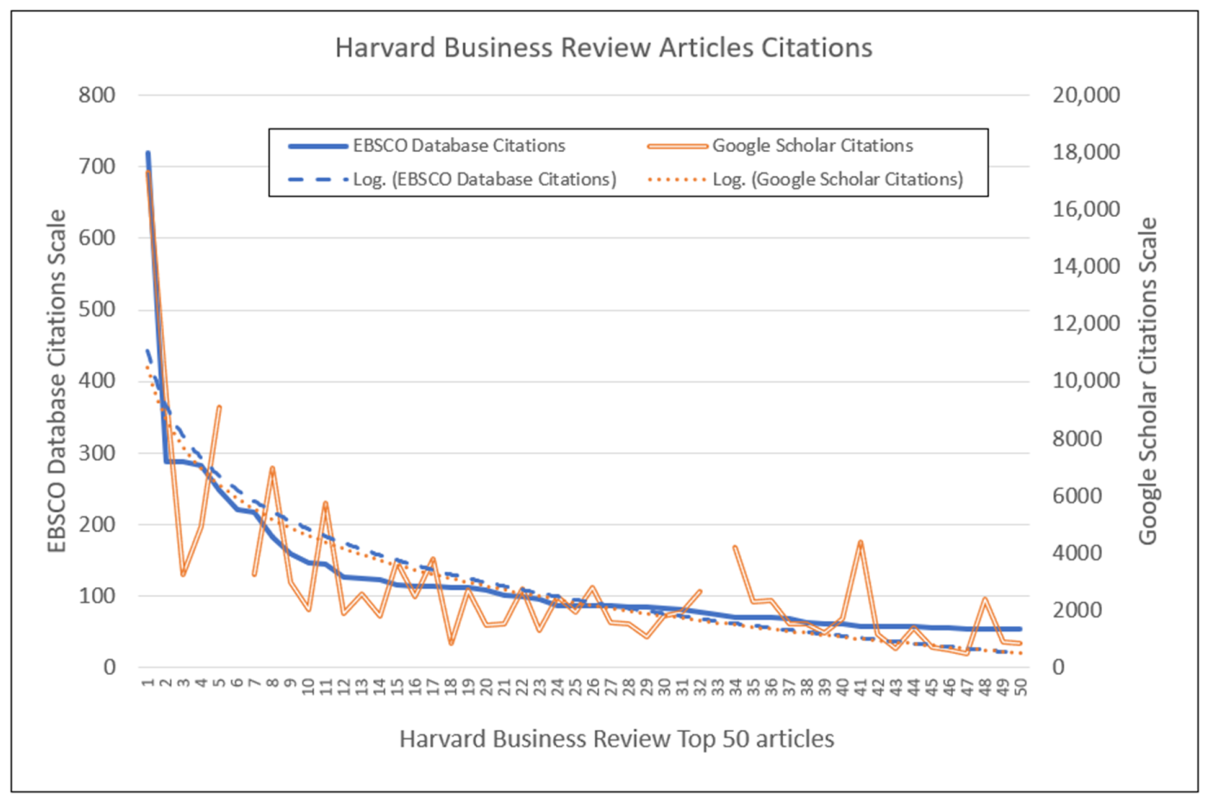
5.2.1. Step 2.1: Corpus Linguistics Analysis
5.2.2. Step 2.2: Content Analysis
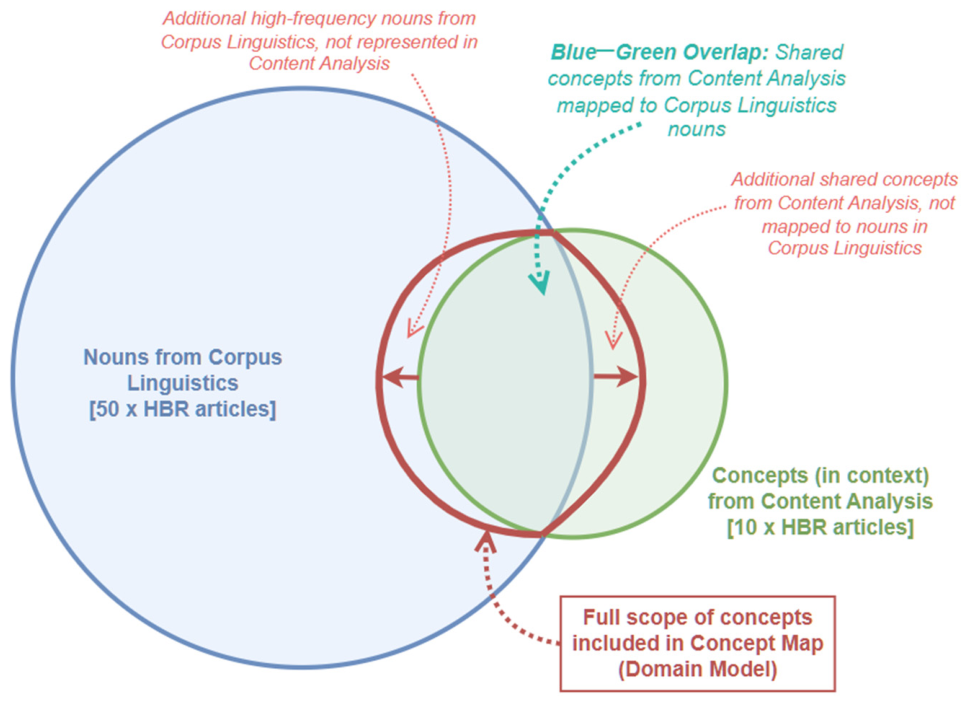
5.2.3. Step 2.3: Integrating the Results from Steps 2.1 and 2.2 and Creating a Concept Map and Narrative
5.3. STEP 3: Creating a Shared Concept Map and Narrative for an Emerging Progressive Future Business Organization (PFBO)
5.3.1. Step 3.1: Content Analysis
5.3.2. Step 3.2: Themes and Concepts Verification
5.3.3. Step 3.3: Creating a Concept Map with Its Corresponding Narrative
5.4. STEP 4: Concept Maps (And Narratives) Qualitative Comparison
5.5. STEP 5: Ontological Differentiation Between Comparable Statements
5.6. Methodological Validity
- A Fundamental Question Framework was compiled in Step 1 of the methodology. This question set contributes to the construct validity of the content analyses in that it specifically targets a layered (or nested) perspective of organizations as complex systems. Chassagnon [52], in his social ontology of the “firm”, integrates complexity theory with institutional theory to designate a “two-level institutional logics of the firm as an organizing entity” (p. 202). This refers to an organization as environment in which individuals display complex interactions and to the organization in its larger environment being an active participant in its contextual dynamics. In alignment with this, questions in the framework focus on: (1) the organization as a coherent system in its larger economic and societal context, and its interactions within this environment; (2) the organization as the system with processual, infrastructural, technological and human agent elements and dynamics between these; and (3) human individuals as complex systems in the organization as their context. The question framework also increases consistency in the analyses such that content analysis results from one corpus can more reliably be compared to outcomes from the other.
- In addition to the question framework, the colored categories that were introduced to structure the result-landscape also align with the same system levels represented in the question framework. This also assisted with the maintenance of construct validity and consistency across the whole methodology.
- Methodological triangulation [146] was performed in analyzing the literature for the TBO to curtail researcher bias in the question framework and enrich results.
- Creativity in research methodology and presentation of results can be considered a secondary criterion for validity in qualitative research, provided it remains grounded in scientific processes [145]. This study is intended to demonstrate this.
- The researcher’s long-term practical embeddedness in the application domain, applying complexity and systems theory in South African companies strengthens study credibility on the one hand, but also introduces a potential for unnoticed bias on the other [8]. To help curtail researcher bias in the textual analyses, certain principles of an emic approach [148] were followed to allow for emergence of themes from the data, including the use of words and phrases as contained in the original text on concept maps (i.e., not paraphrasing or introducing other summary descriptions by the researcher as far as practically possible). Section 7.5 describes limitations posed on the study due to potential researcher bias.
6. Results
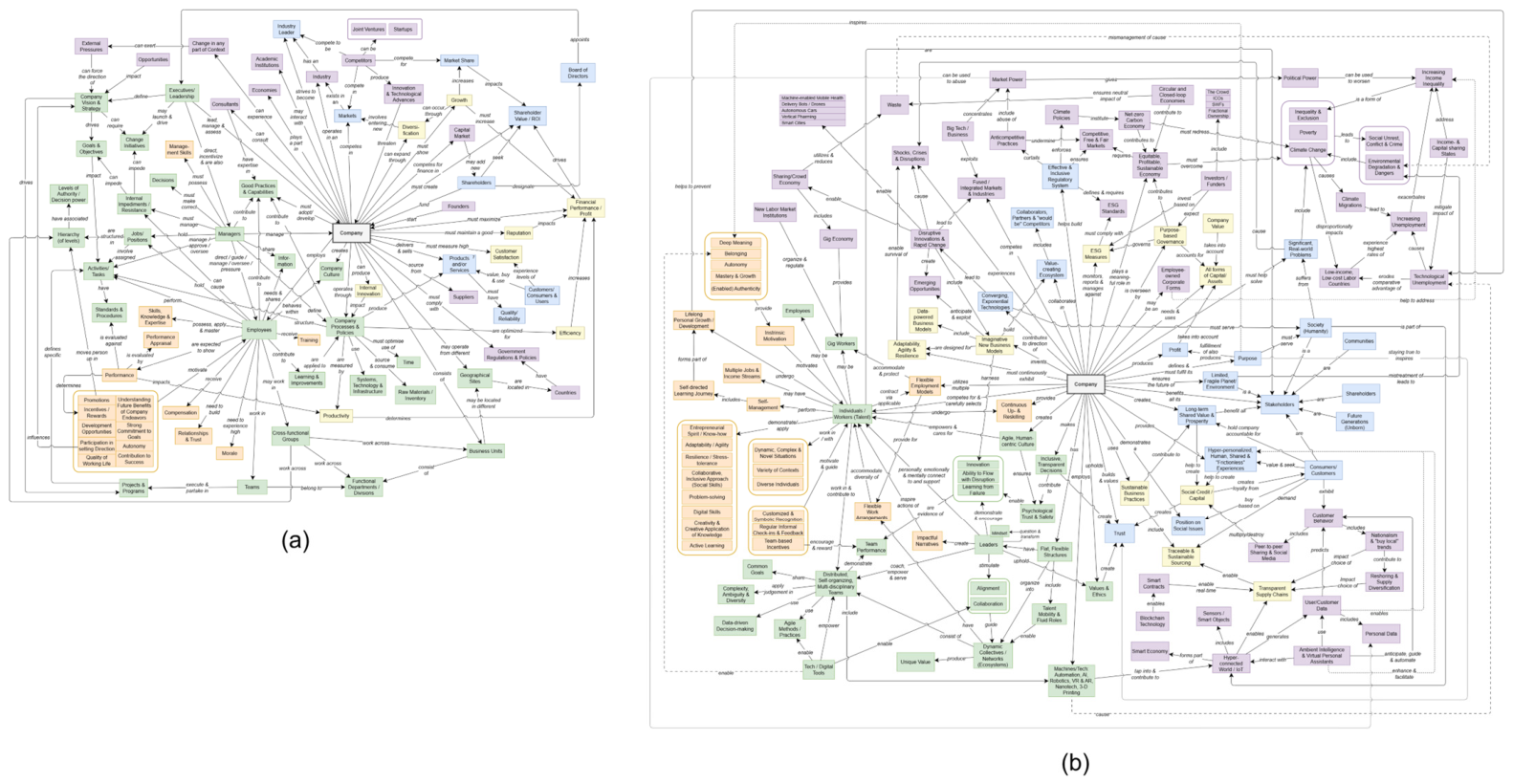
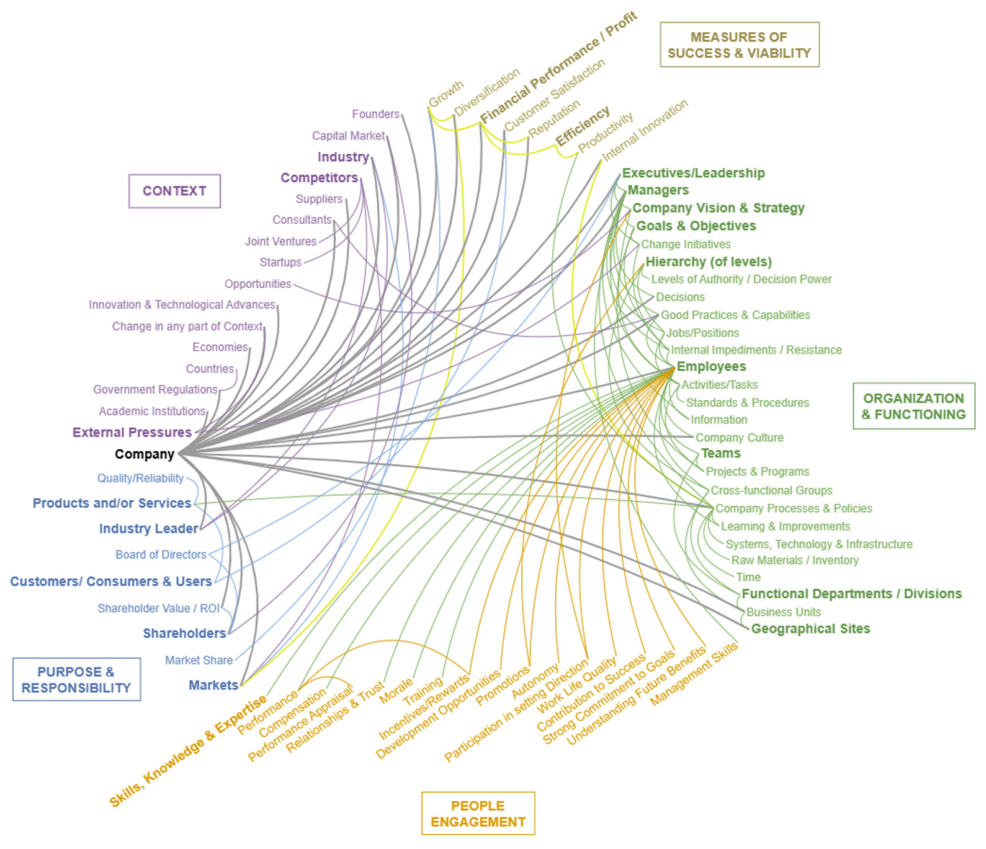
6.1. Concept Maps and Narratives
Methodology-Related Observations for Interpretation
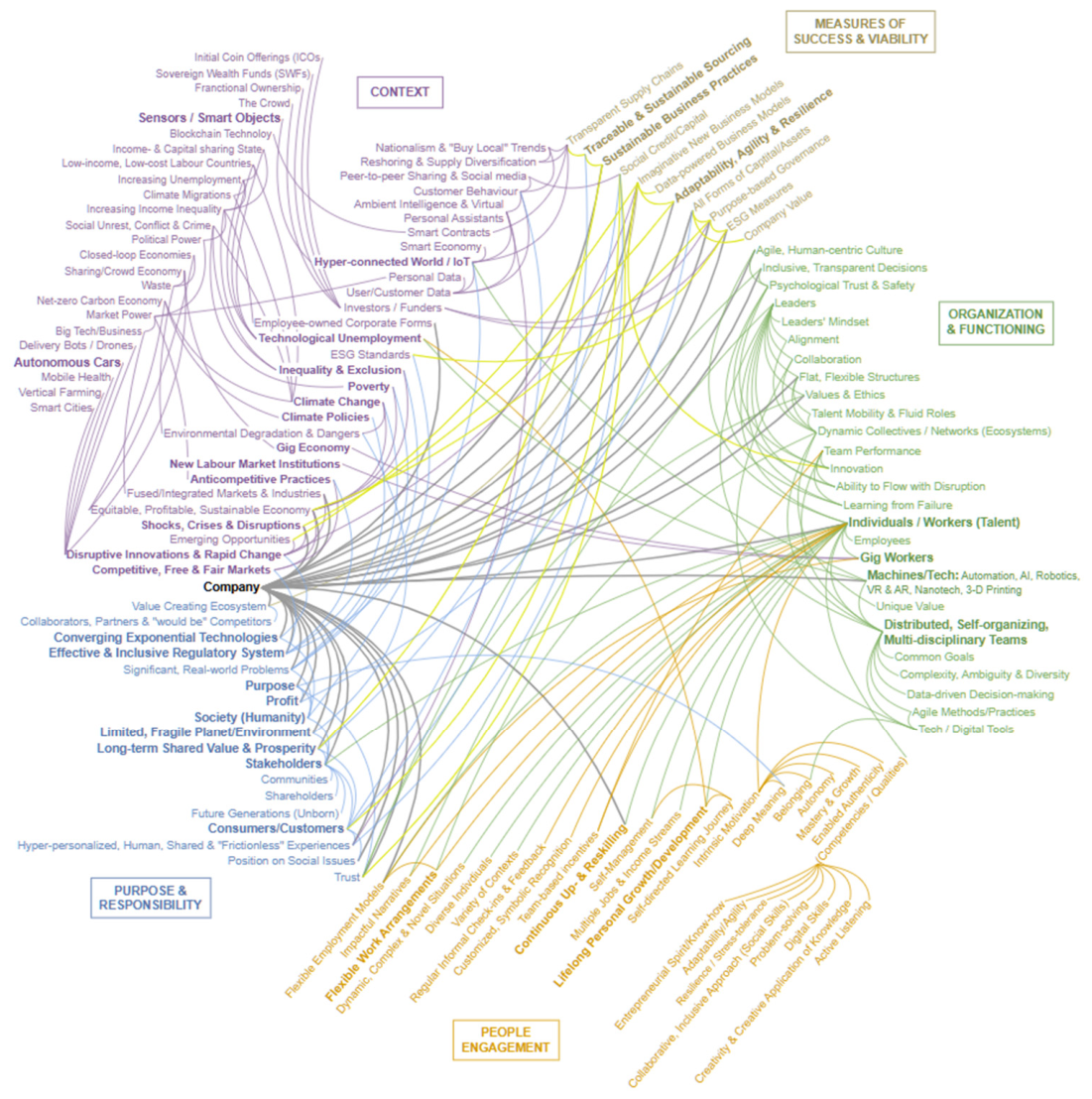
- The PFBO concept map contains more information, both in number of concepts and their relationships, than the TBO. Interpretations of this difference should take the following into account:
- The differences in types of texts used as input data (periodical articles vs. books).
- Potential differences in the intent of authors between the two literature sets. The HBR articles used for the TBO were typically attempting to convince their audience of a specific new useful development, which was contained within a specific aspect of a business organization, i.e., the articles had an enhancement focus. The PFBO literature aimed at describing significant all-encompassing changes for organizations and their contexts, which could be deemed transformation focused.
- A significant increase in emphasis on context in the literature used for the PFBO.
- An inherent increase in complexity of the domain as is clear from the PFBO concept map content (see Section 7.1.3 for the discussion of this aspect).
- Concepts in the PFBO concept map often have more descriptive information than concepts on the TBO map. This is due to the comparison purpose for drafting the concept maps. For the PFBO concept map, an emphasis was inevitably placed on how the concept might differ from something similar appearing on the TBO concept map. For example, Industries appear on the TBO map and Fused/Integrated Markets & Industries appear on the PFBO map. In the TBO reality, an industry will simply be what the shared understanding is. In the PFBO it becomes pertinent that an industry will not be the same anymore. We do not have a different word for it (maybe not yet), so some more description is needed to highlight the differences. Another example is Economies on the TBO map versus Equitable, Profitable, Sustainable Economy on the PFBO map, or Teams (TBO) compared to Distributed, Self-organizing, Multi-disciplinary Teams (PFBO).
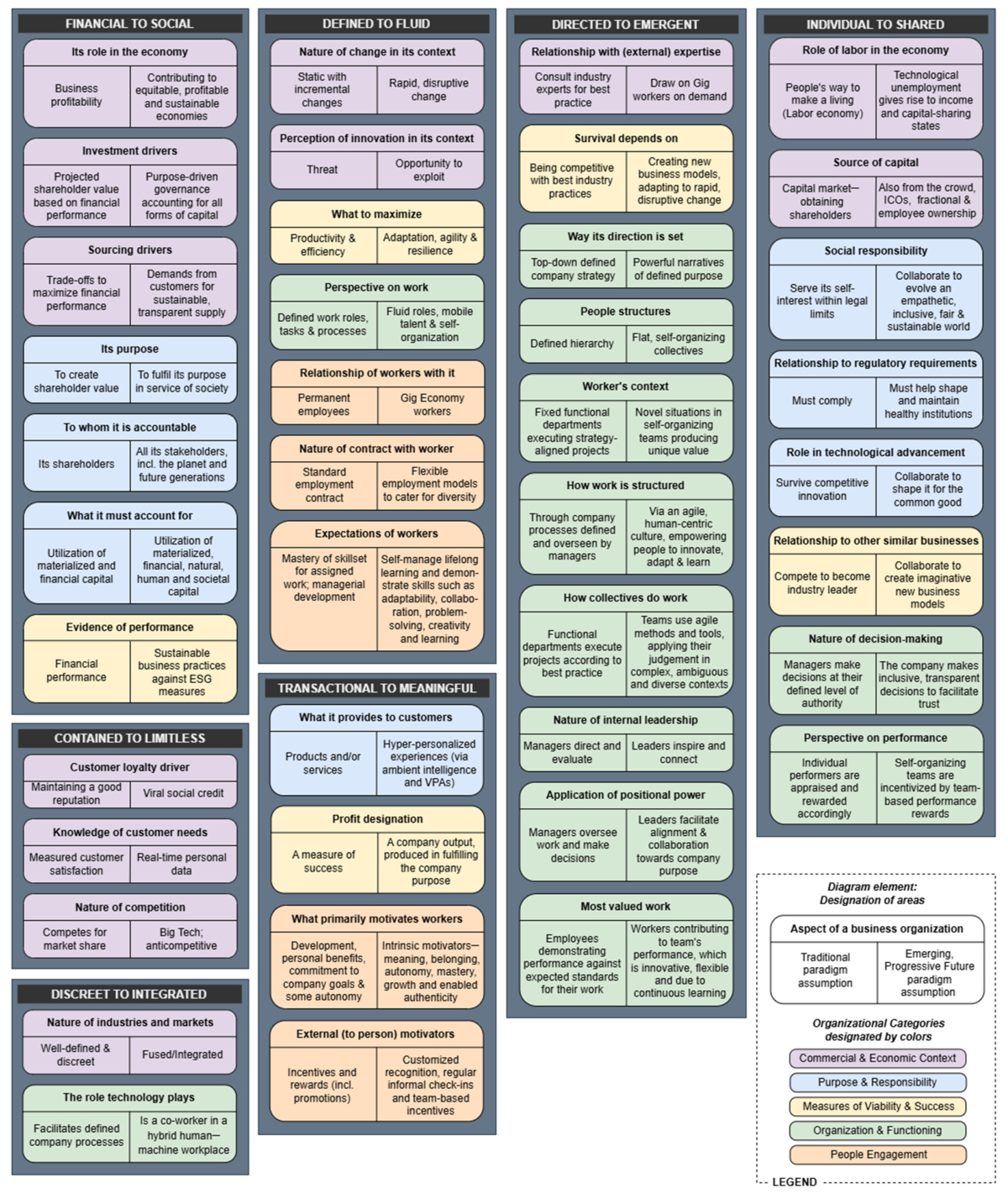
6.2. Comparable Statements (Assumptions) and Ontological Shifts
7. Discussion
7.1. Interpretation of Ontological Shifts
7.1.1. A Kuhnian-Type Paradigm Shift?
7.1.2. Social Responsibility and Participation
7.1.3. An Explicit Shift to Complexity
- Unpredictability of how organizational processes evolve, especially over the long-term, and the limits this condition places on plan-driven and controlled change.
- Interactive self-organization being the source of emerging transformative changes, which centralizes relationships and cooperation in the creative process.
- Stability in the organization, i.e., limits on the propagation of destructive effects, emerging from relationships in which power limits the full range of individual behavior.
- The importance of diversity amongst individuals for the organization to develop.
- The expression of identity and difference, individually and collectively, being essential to change and stability in organizations.
7.2. Implications for Theory
7.2.1. An Integrated, Transdisciplinary Paradigm Shift
- An understanding of how the wave of eco-socio demands on organizations, including regulatory and auditable transparency requirements, interrelates with the speed of technological progress, paradoxically requiring very adaptable and agile organizational forms. Perhaps we need to consciously expand the concept of sustainability to fully include the revolutionary technological change through which organizations and society must also sustain.
- Applying the principle of self-organization simultaneously across all the organizational system levels, and not just to self-organizing of teams in organizations. The PFBO indicates more collaboration between entities at all levels (e.g., value-creating ecosystems including ‘would be’ competitors and a company’s collaborative relationships with regulatory institutions to shape compliance requirements). From a complexity theory perspective, emerging realities via self-organization is a key mechanism for change. What new understandings can emerge when, from the complexity perspective, we see organizations self-organize in the larger context with other self-organizing companies and governments, concurrently with internal self-organization? How can this help us towards building societally shared mental models that fully embrace business organizations having co-responsibility to address societal crises?
- Gaining insights into solving inclusive stakeholder representational challenges for bodies that must hold companies accountable, not only for saving the planet and being socially responsible, but also for playing a responsible part in directing all new technology towards benefiting all of humanity. What representation for these purposes are practically, ethically and morally suitable for stakeholders such as the planet, the previously and currently disadvantaged, and the unborn? How must our thinking and practices change to consider this our reality?
- Engaging the cross-systems, cross-discipline impact of having non-human agents among us. On the surface, the PFBO shows the impact of machines doing work requiring some internal organizational changes and that this worsens the unemployment and skill misalignments that will need to be addressed. However, transdisciplinary inquiries are critical to prepare for this new reality. We need to consider individual human psychology of being in ‘relationships’ with bots in multiple complex adaptive systems, where ‘they’ do not have the same motivations and cognitions as humans. At the same time, their potential participation in practically all our (previously human-exclusive) engagements will change our socially constructed institutions and our subjective experiences in very unpredictable and human-foreign ways. We need to be better prepared for artificial intelligence being everyone’s virtual personal assistants and even occupying roles of power, e.g., running virtual companies, diagnosing illnesses, and representing constituents in government. Clearly, reliance on any theories built on human-specific characteristics, such as value systems, motivations, relational interactions, mental processing, etc., will become flawed in explaining and predicting phenomena in these newly constituted collectives.
7.2.2. Connecting Across Discourse Levels and the Practice–Theory Divide
7.3. Implications for Organizational Practice
Constructing and Recognizing a Paradigm by the Language Being Used
7.4. Methodological Contributions
7.5. Study Limitations and Future Research
8. Conclusions
Supplementary Materials
Author Contributions
Funding
Data Availability Statement
Acknowledgments
Conflicts of Interest
Abbreviations
| DOCF | Document Frequency |
| HBR | Harvard Business Review |
| MRQ | Main Research Questions |
| PFBO | Progressive Future Business Organization |
| SMM | Shared Mental Model |
| TBO | Traditional Business Organization |
References
- Schwab, K. The Fourth Industrial Revolution; Portfolio Penguin: London, UK, 2017. [Google Scholar]
- Melnyk, L.H.; Dehtyarova, I.B.; Kubatko, O.V.; Kharchenko, M.O. Economic and Social Challenges of Disruptive Technologies in Conditions of Industries 4.0 and 5.0: The EU Experience. Mech. Econ. Regul. 2019, 32–42. [Google Scholar] [CrossRef]
- Dhanda, U.; Shrotryia, V.K. Corporate Sustainability: The New Organizational Reality. Qual. Res. Organ. Manag. 2021, 16, 464–487. [Google Scholar] [CrossRef]
- Delbridge, R.; Helfen, M.; Pekarek, A.; Schuessler, E.; Zietsma, C. Organizing Sustainably: Introduction to the Special Issue. Organ. Stud. 2024, 45, 7–29. [Google Scholar] [CrossRef]
- Dasgupta, S.; Sanyal, D. The March towards Infinity—The Impending Era of Deep Thinking. Foresight 2020, 22, 129–143. [Google Scholar] [CrossRef]
- Horney, N.; Pasmore, B.; O’Shea, T. Leadership Agility: A Business Imperative for a VUCA World. People Strategy 2010, 33, 32–38. [Google Scholar]
- Kaivo-oja, J.R.L.; Lauraeus, I.T. The VUCA Approach as a Solution Concept to Corporate Foresight Challenges and Global Technological Disruption. Foresight 2018, 20, 27–49. [Google Scholar] [CrossRef]
- Maguire, K. Transdisciplinarity: Towards an Epistemology of What Matters. In Transdisciplinary Theory, Practice and Education; Fam, D., Neuhauser, L., Gibbs, P., Eds.; Springer: Cham, Switzerland, 2018; pp. 103–115. [Google Scholar]
- Cilliers, P.; Nicolescu, B. Complexity and Transdisciplinarity—Discontinuity, Levels of Reality and the Hidden Third. Futures 2012, 44, 711–718. [Google Scholar] [CrossRef]
- Kuhn, T.S. The Structure of Scientific Revolutions: 50th Anniversary Edition, 4th ed.; University of Chicago Press: Chicago, IL, USA, 2012. [Google Scholar]
- Denzau, A.T.; North, D.C. Shared Mental Models: Ideologies and Institutions. Kyklos 1994, 47, 3–31. [Google Scholar] [CrossRef]
- Whittle, A.; Vaara, E.; Maitlis, S. The Role of Language in Organizational Sensemaking: An Integrative Theoretical Framework and an Agenda for Future Research. J. Manag. 2023, 49, 1807–1840. [Google Scholar] [CrossRef]
- Montuori, A. Gregory Bateson and the Promise of Transdisciplinarity. Cybern. Hum. Knowing 2005, 12, 147–158. [Google Scholar]
- Brown, R.H. Bureaucracy as Praxis: Toward a Political Phenomenology of Formal Organizations. Adm. Sci. Q. 1978, 23, 365–382. [Google Scholar] [CrossRef]
- Imershein, A.W. Organizational Change as a Paradigm Shift. Sociol. Q. 1977, 18, 33–43. [Google Scholar] [CrossRef]
- Miller, D.; Friesen, P.H. Momentum and Revolution in Organizational Adaptation. Acad. Manag. J. 1980, 23, 591–614. [Google Scholar] [CrossRef] [PubMed]
- Sheldon, A. Organizational Paradigms: A Theory of Organizational Change. Organ. Dyn. 1980, 8, 61–80. [Google Scholar] [CrossRef]
- Simsek, H.; Louis, K.S. Organizational Change as Paradigm Shift: Analysis of the Change Process in a Large, Public University. J. High. Educ. 1994, 65, 670–695. [Google Scholar] [CrossRef]
- Mohammed, S.; Ferzandi, L.; Hamilton, K. Metaphor No More: A 15-Year Review of the Team Mental Model Construct. J. Manag. 2010, 36, 876–910. [Google Scholar] [CrossRef]
- Dechurch, L.A.; Mesmer-Magnus, J.R. Measuring Shared Team Mental Models: A Meta-Analysis. Group Dyn. 2010, 14, 1–14. [Google Scholar] [CrossRef]
- Kearney, A.R.; Bradley, G.; Kaplan, R.; Kaplan, S. Stakeholder Perspectives on Appropriate Forest Management in the Pacific Northwest. For. Sci. 1999, 45, 62–73. [Google Scholar] [CrossRef]
- Tikkanen, J.; Isokääntä, T.; Pykäläinen, J.; Leskinen, P. Applying Cognitive Mapping Approach to Explore the Objective–Structure of Forest Owners in a Northern Finnish Case Area. For. Policy Econ. 2006, 9, 139–152. [Google Scholar] [CrossRef]
- Aminpour, P.; Gray, S.A.; Jetter, A.J.; Introne, J.E.; Singer, A.; Arlinghaus, R. Wisdom of Stakeholder Crowds in Complex Social-Ecological Systems. Nat. Sustain. 2020, 3, 191–199. [Google Scholar] [CrossRef]
- Blacketer, M.P.; Brownlee, M.T.J.; Baldwin, E.D.; Bowen, B.B. Fuzzy Cognitive Maps of Social-Ecological Complexity: Applying Mental Modeler to the Bonneville Salt Flats. Ecol. Complex. 2021, 47, 100950. [Google Scholar] [CrossRef]
- Garrity, E.J. Using Systems Thinking to Understand and Enlarge Mental Models: Helping the Transition to a Sustainable World. Systems 2018, 6, 15. [Google Scholar] [CrossRef]
- Thomas, L.D.; Patterson, E. Systems Modeling Language Viewpoint Utilization to Facilitate Shared Mental Models among System Stakeholders. Syst. Res. Behav. Sci. 2020, 37, 128–140. [Google Scholar] [CrossRef]
- Stefanowitsch, A. Corpus Linguistics: A Guide to the Methodology; Language Science Press: Berlin, Germany, 2020. [Google Scholar]
- Rayson, P. From Key Words to Key Semantic Domains. Int. J. Corpus Linguist. 2008, 13, 519–549. [Google Scholar] [CrossRef]
- Fox, R. Using Corpus Linguistics to Describe Corporations’ Ideologies. Tour. Hosp. Manag. 2006, 12, 15–24. [Google Scholar] [CrossRef]
- Harper, S.; Dorton, S. Towards a Context-Dependent Framework for Visualizing Mental Models. In Proceedings of the Human Factors and Ergonomics Society Annual Meeting; SAGE Publications: Los Angeles, CA, USA, 2020; Volume 64, pp. 308–312. [Google Scholar] [CrossRef]
- Langan-Fox, J.; Code, S.; Langfield-Smith, K. Team Mental Models: Techniques, Methods, and Analytic Approaches. Hum. Factors 2000, 42, 242–271. [Google Scholar] [CrossRef] [PubMed]
- Wickson, F.; Carew, A.L.; Russell, A.W. Transdisciplinary Research: Characteristics, Quandaries and Quality. Futures 2006, 38, 1046–1059. [Google Scholar] [CrossRef]
- Booysen, L.; Beaty, D. Linking Transformation and Change Leadership in South Africa: A Review of Principles and Practices. South. Afr. Bus. Rev. 1997, 1, 9–18. [Google Scholar]
- Webster, E.; Omar, R. Work Restructuring in Post-Apartheid South Africa. Work Occup. 2003, 30, 194–213. [Google Scholar] [CrossRef]
- Strasheim, A. South African and Global Business Schools: An Industry Review. South. Afr. Bus. Rev. 2001, 5, 40–53. [Google Scholar] [PubMed]
- Polzer-Ngwato, T.; Shilakoe, L.; Morse, K.; Huston, K. National Reading Survey 2023 Findings Report 2023; Nal’ibali Trust: Cape Town, South Africa, 2023. [Google Scholar]
- Cilliers, P. Boundaries, Hierarchies and Networks in Complex Systems. Int. J. Innov. Manag. 2001, 5, 135–147. [Google Scholar] [CrossRef]
- Cilliers, P. What Can We Learn from a Theory of Complexity? Emerg. Complex. Organ. 2000, 2, 23–33. [Google Scholar] [CrossRef] [PubMed]
- Stacey, R.D.; Griffin, D.; Shaw, P. Complexity and Management—Fad or Radical Challenge to Systems Thinking? Routledge: London, UK, 2000. [Google Scholar]
- Cilliers, P. Complexity, Deconstruction and Relativism. Theory Cult. Soc. 2005, 22, 255–267. [Google Scholar] [CrossRef]
- Woermann, M.; Cilliers, P. The Ethics of Complexity and the Complexity of Ethics. S. Afr. J. Philos. 2012, 31, 447–463. [Google Scholar] [CrossRef]
- Richardson, K.A.; Cilliers, P.; Lissack, M. Complexity Science: A “Gray” Science for the “Stuff in Between”. Emerg. Complex. Organ. 2001, 3, 6–18. [Google Scholar] [CrossRef] [PubMed]
- Allen, P.; Maguire, S.; McKelvey, B. Complexity and Management: Introducing the SAGE Handbook. In The SAGE Handbook of Complexity and Management; Allen, P., Maguire, S., McKelvey, B., Eds.; SAGE: Los Angeles, CA, USA, 2011. [Google Scholar]
- Preiser, R.; Cilliers, P. Unpacking the Ethics of Complexity: Concluding Reflections. In Complexity, Difference and Identity—An Ethical Perspective; Preiser, R., Cilliers, P., Eds.; Springer: Dordrecht, The Netherlands, 2010; pp. 265–287. [Google Scholar]
- Capra, F.; Jakobsen, O.D. A Conceptual Framework for Ecological Economics Based on Systemic Principles of Life. Int. J. Soc. Econ. 2017, 44, 831–844. [Google Scholar] [CrossRef]
- Davelaar, D. Transformation for Sustainability: A Deep Leverage Points Approach. Sustain. Sci. 2021, 16, 727–747. [Google Scholar] [CrossRef]
- Voulvoulis, N.; Giakoumis, T.; Hunt, C.; Kioupi, V.; Petrou, N.; Souliotis, I.; Vaghela, C.; Binti Wan Rosely, W.I.H. Systems Thinking as a Paradigm Shift for Sustainability Transformation. Glob. Environ. Change 2022, 75, 102544. [Google Scholar] [CrossRef]
- Allen, P.M.; Strathern, M.; Varga, L. Complexity: The Evolution of Identity and Diversity. In Complexity, Difference and Identity—An Ethical Perspective; Cilliers, P., Preiser, R., Eds.; Springer: Dordrecht, The Netherlands, 2010; Volume 26, pp. 41–60. [Google Scholar]
- Cameron, E.; Green, M. Making Sense of Change Management—A Complete Guide to the Models, Tools & Techniques of Organizational Change, 2nd ed.; Kogan Page: London, UK, 2009. [Google Scholar]
- Morgan, G. Reflections on Images of Organization and Its Implications for Organization and Environment. Organ. Environ. 2011, 24, 459–478. [Google Scholar] [CrossRef]
- Tsoukas, H.; Chia, R. On Organizational Becoming: Rethinking Organizational Change. Organ. Sci. 2002, 13, 567–582. [Google Scholar] [CrossRef]
- Chassagnon, V. Toward a Social Ontology of the Firm: Reconstitution, Organizing Entity, Institution, Social Emergence and Power. J. Bus. Ethics 2014, 124, 197–208. [Google Scholar] [CrossRef]
- Thornton, P.H.; Ocasio, W. Institutional Logics. In The SAGE Handbook of Organizational Institutionalism; Greenwood, R., Oliver, C., Suddaby, R., Sahlin-Andersson, K., Eds.; SAGE Publications Ltd.: London, UK, 2013; pp. 99–129. [Google Scholar]
- Newton, T. Organization: The Relevance and the Limitations of Elias. Organization 2001, 8, 467–495. [Google Scholar] [CrossRef]
- Lissack, M.R. Complexity: The Science, Its Vocabulary, and Its Relation to Organizations. Emerg. Complex. Organ. 1999, 1, 110–126. [Google Scholar] [CrossRef] [PubMed]
- Luhman, J.T.; Boje, D.M. What Is Complexity Science? A Possible Answer from Narrative Research. Emerg. Complex. Organ. 2001, 3, 158–168. [Google Scholar] [CrossRef] [PubMed]
- Berger, P.L.; Luckmann, T. The Social Construction of Reality: A Treatise in the Sociology of Knowledge; Open Road Media: Soho, NY, USA, 2011. [Google Scholar]
- Searle, J.R. What Is an Institution? J. Institutional Econ. 2005, 1, 1–22. [Google Scholar] [CrossRef]
- Lawson, T. A Conception of Ontology; University of Cambridge: Cambridge, UK, 2004. [Google Scholar]
- Alvesson, M.; Kärreman, D. Taking the Linguistic Turn in Organizational Research: Challenges, Responses, Consequences. J. Appl. Behav. Sci. 2000, 36, 136–158. [Google Scholar] [CrossRef]
- Phillips, N.; Oswick, C. Organizational Discourse: Domains, Debates, and Directions. Acad. Manag. Ann. 2012, 6, 435–481. [Google Scholar] [CrossRef]
- Tsoukas, H. Afterword: Why Language Matters in the Analysis of Organizational Change. J. Organ. Change Manag. 2005, 18, 96–104. [Google Scholar] [CrossRef]
- Phillips, N.; Lawrence, T.B.; Hardy, C. Discourse and Institutions. Acad. Manag. Rev. 2004, 29, 635–652. [Google Scholar] [CrossRef]
- Fairclough, N. Discourse Analysis in Organization Studies: The Case for Critical Realism. Organ. Stud. 2005, 26, 915–939. [Google Scholar] [CrossRef]
- O’Leary, M.; Chia, R. Epistemes and Structures of Sensemaking in Organizational Life. J. Manag. Inq. 2007, 16, 392–406. [Google Scholar] [CrossRef]
- Fairhurst, G.T.; Putnam, L.L. Organizations as Discursive Constructions. Commun. Theory 2004, 14, 5–26. [Google Scholar] [CrossRef]
- Harrison, K. Ontological Commitments of Ethics and Economics. Econ. Thought 2013, 2, 1–19. [Google Scholar]
- Höllerer, M.A.; Jancsary, D.; Grafström, M. ‘A Picture Is Worth a Thousand Words’: Multimodal Sensemaking of the Global Financial Crisis. Organ. Stud. 2018, 39, 617–644. [Google Scholar] [CrossRef]
- Johnson, M.I.; Hudson, M.; Ryan, C.G. Perspectives on the Insidious Nature of Pain Metaphor: We Literally Need to Change Our Metaphors. Front. Pain Res. 2023, 4, 1224139. [Google Scholar] [CrossRef] [PubMed]
- Forseth, U.; Røyrvik, E.A.; Clegg, S. Naturalizing, Normalizing and Neutralizing: Metaphors Framing the Global Financial Crisis in Nordic Banks. Cult. Organ. 2023, 29, 157–174. [Google Scholar] [CrossRef]
- Flusberg, S.J.; Thibodeau, P.H. Why Is Mother Earth on Life Support? Metaphors in Environmental Discourse. Top. Cogn. Sci. 2023, 15, 522–545. [Google Scholar] [CrossRef] [PubMed]
- Hill, R.C.; Levenhagen, M. Metaphors and Mental Models: Sensemaking and Sensegiving in Innovative and Entrepreneurial Activities. J. Manag. 1995, 21, 1057–1074. [Google Scholar] [CrossRef]
- Lakoff, G.; Johnson, M. Metaphors We Live By; The University of Chicago Press: Chicago, IL, USA, 2003. [Google Scholar]
- Morgan, G. Paradigms, Metaphors, and Puzzle Solving in Organization Theory. Adm. Sci. Q. 1980, 25, 605–622. [Google Scholar] [CrossRef]
- Pinker, S. The Stuff of Thought—Language as a Window into Human Nature; Penguin Books: London, UK, 2007. [Google Scholar]
- Moray, N. A Taxonomy and Theory of Mental Models. In Proceedings of the Human Factors and Ergonomics Society Annual Meeting; SAGE Publications: Los Angeles, CA, USA, 1996; Volume 40, pp. 164–168. [Google Scholar] [CrossRef]
- Jones, N.A.; Ross, H.; Lynam, T.; Perez, P.; Leitch, A. Mental Models: An Interdisciplinary Synthesis of Theory and Methods. Ecol. Soc. 2011, 16, 46. [Google Scholar] [CrossRef]
- Nersessian, N.J. The Cognitive Basis of Model-Based Reasoning in Science. In The Cognitive Basis of Science; Carruthers, P., Stitch, S., Siegal, M., Eds.; Cambridge University Press: Cambridge, UK, 2002; pp. 133–153. [Google Scholar]
- Johnson-Laird, P.N. Mental Models in Cognitive Science. Cogn. Sci. 1980, 4, 71–115. [Google Scholar] [CrossRef] [PubMed]
- Senge, P.M. Mental Models. Plan. Rev. 1992, 20, 4–44. [Google Scholar] [CrossRef]
- van Dijk, T.A. Discourse, Context and Cognition. Discourse Stud. 2006, 8, 159–177. [Google Scholar] [CrossRef]
- Altman, M. Mental Models, Decision-Making, Bargaining Power, and Institutional Change. J. Econ. Issues 2023, 57, 1241–1259. [Google Scholar] [CrossRef]
- Rosenbaum, E. Mental Models and Institutional Inertia. J. Institutional Econ. 2022, 18, 361–378. [Google Scholar] [CrossRef]
- Bruner, J. The Narrative Construction of Reality. Crit. Inq. 1991, 18, 1–21. [Google Scholar] [CrossRef] [PubMed]
- Rhodes, C.; Brown, A.D. Narrative, Organizations and Research. Int. J. Manag. Rev. 2005, 7, 167–188. [Google Scholar] [CrossRef]
- Weick, K.E.; Sutcliffe, K.M.; Obstfeld, D. Organizing and the Process of Sensemaking. Organ. Sci. 2005, 16, 409–421. [Google Scholar] [CrossRef]
- Tuckett, D.; Nikolic, M. The Role of Conviction and Narrative in Decision-Making under Radical Uncertainty. Theory Psychol. 2017, 27, 501–523. [Google Scholar] [CrossRef] [PubMed]
- Kay, J.A.; King, M.A. Radical Uncertainty: Decision-Making for an Unknowable Future; The Bridge Street Press: London, UK, 2021. [Google Scholar]
- Tsoukas, H.; Hatch, M.J. Complex Thinking, Complex Practice: The Case for a Narrative Approach to Organizational Complexity. Hum. Relat. 2001, 54, 979–1013. [Google Scholar] [CrossRef]
- Masterman, M. The Nature of a Paradigm. In Criticism and the Growth of Knowledge, Proceedings of the International Colloquium in the Philosophy of Science; Lakatos, I., Musgrave, A., Eds.; Cambridge University Press: London, UK, 1970; pp. 59–89. [Google Scholar]
- Gladwin, T.N.; Kennelly, J.J.; Krause, T.-S. Shifting Paradigms for Sustainable Development: Implications for Management Theory and Research. Acad. Manag. Rev. 1995, 20, 874–907. [Google Scholar] [CrossRef]
- Güner, S. Evaluation of the Evolution of Green Management with a Kuhnian Perspective. Bus. Res. 2018, 11, 309–328. [Google Scholar]
- Khorasani, S.T.; Almasifard, M. Evolution of Management Theory within 20 Century: A Systemic Overview of Paradigm Shifts in Management. Int. Rev. Manag. Mark. 2017, 7, 134–137. [Google Scholar]
- Anand, G.; Larson, E.C.; Mahoney, J.T. Thomas Kuhn on Paradigms. Prod. Oper. Manag. 2020, 29, 1650–1657. [Google Scholar] [CrossRef]
- Ehrenfeld, J.R. Industrial Ecology: Paradigm Shift or Normal Science? Am. Behav. Sci. 2000, 44, 229–244. [Google Scholar] [CrossRef]
- Maia, A.G.; Zucatto, L.C.; Ferreira, E.; Neto, J.d.P.; da Silva, G.G.W.M. A Theoretical Essay on the Influences of Social Science Paradigms on Organizational Decisions for Sustainability. In Harmony of Knowledge: Exploring Interdisciplinary Synergies; Seven Editora: São José dos Pinhais, Brazil, 2023. [Google Scholar] [CrossRef]
- Kuhn, T.S. The Road since Structure. PSA Proc. Bienn. Meet. Philos. Sci. Assoc. 1990, 1990, 3–13. [Google Scholar] [CrossRef]
- O’Connor, D.L.; Johnson, T.E.; Khalil, M.K. Measuring Team Cognition: Concept Mapping Elicitation as a Means of Constructing Team Shared Mental Models in an Applied Setting. In Proceedings of the First International Conference on Concept Mapping, Pamplona, Spain, 14–17 September 2004; pp. 487–494. [Google Scholar]
- Lee, S.; Courtney, J.F.; O’Keefe, R.M. A System for Organizational Learning Using Cognitive Maps. Omega 1992, 20, 23–36. [Google Scholar] [CrossRef]
- Eden, C. Cognitive Mapping. Eur. J. Oper. Res. 1988, 36, 1–13. [Google Scholar] [CrossRef]
- Uschold, M.; King, M.; Moralee, S.; Zorgios, Y. The Enterprise Ontology. Knowl. Eng. Rev. 1998, 13, 31–89. [Google Scholar] [CrossRef]
- Upward, A.; Jones, P. An Ontology for Strongly Sustainable Business Models: Defining an Enterprise Framework Compatible with Natural and Social Science. Organ. Environ. 2016, 29, 97–123. [Google Scholar] [CrossRef]
- Norder, K.A.; Sullivan, D.P.; Emich, K.J.; Sawhney, A. Reanchoring the Ontology of International Business. Acad. Manag. Perspect. 2021, 35, 314–323. [Google Scholar] [CrossRef]
- Salem, A.B.M.; Parusheva, S. Developing a Web-Based Ontology for E-Business. Int. J. Electron. Commer. Stud. 2018, 9, 119–132. [Google Scholar] [CrossRef]
- Guarino, N.; Guizzardi, G.; Mylopoulos, J. On the Philosophical Foundations of Conceptual Models. In Information Modeling and Knowledge Bases XXXI; IOS Press: Amsterdam, The Netherlands, 2020; Volume 321, pp. 1–14. [Google Scholar]
- Aghina, W.; De Smet, A.; Weerda, K. Agility: It Rhymes with Stability. McKinsey Q. 2015, 51, 2–9. [Google Scholar]
- Avery, G.C.; Bergsteiner, H. Sustainable Leadership Practices for Enhancing Business Resilience and Performance. Strategy Leadersh. 2011, 39, 5–15. [Google Scholar] [CrossRef]
- Bonini, S.; Görner, S. The Business of Sustainability; McKinsey & Company: New York, NY, USA, 2011. [Google Scholar]
- Denning, S. How to Make the Whole Organization Agile. Strategy Leadersh. 2015, 43, 10–17. [Google Scholar] [CrossRef]
- Lubin, D.A.; Esty, D.C. The Sustainability Imperative. Harv. Bus. Rev. 2010, 88, 42–50. [Google Scholar]
- Rigby, D.K.; Sutherland, J.; Takeuchi, H. Embracing Agile. Harv. Bus. Rev. 2016, 94, 40–50. [Google Scholar]
- Kilgarriff, A.; Baisa, V.; Bušta, J.; Jakubíček, M.; Kovář, V.; Michelfeit, J.; Rychlý, P.; Suchomel, V. The Sketch Engine: Ten Years On. Lexicography 2014, 1, 7–36. [Google Scholar] [CrossRef]
- Sketch Engine. Available online: https://www.sketchengine.eu/ (accessed on 30 November 2025).
- Carney, M. Values—An Economist’s Guide to Everything That Matters; William Collins: London, UK, 2022; 499p. [Google Scholar]
- Diamandis, P.H.; Kotler, S. The Future is Faster than You Think; Simon & Schuster Paperbacks: New York, NY, USA, 2020; 365p. [Google Scholar]
- Henderson, R. Reimagining Capitalism in a World on Fire; Penguin Business: London, UK, 2021; 322p. [Google Scholar]
- Kotler, P. Confronting Capitalism—Real Solutions for a Troubled Economic System; American Management Association: New York, NY, USA, 2015; 248p. [Google Scholar]
- Mayer, C. Prosperity—Better Business Makes the Greater Good; Oxford University Press: Oxford, UK, 2021; 261p. [Google Scholar]
- Norman, P. (Ed.) HR—The New Agenda; KR Publishing: Johannesburg, South Africa, 2022; 236p. [Google Scholar]
- Sanei, J. Foresight; Mercury: Kenilworth, South Africa, 2019; 223p. [Google Scholar]
- Sanei, J.; Abedian, I. Future Next—Reimagining Our World & Conquering Uncertainty; Mercury: Kenilworth, South Africa, 2020; 191p. [Google Scholar]
- Stiglitz, J.E. People, Power and Profits—Progressive Capitalism for and Age of Discontent; Penguin Books: London, UK, 2020; 371p. [Google Scholar]
- Susskind, D. A World Without Work—Technology Automation and How We Should Respond; Penguin Books: London, UK, 2021; 326p. [Google Scholar]
- Van der Merwe, S.; Erixon, D. Distinguishers—Winning Customers at Speed, Scale & Lower Costs; Flyleaf Publishing & Distribution: Stellenbosch, South Africa, 2021; 368p. [Google Scholar]
- Verachia, A. Disruption Amplified—Reset, Rewire, Reimagine Everything; Tracey McDonald Publishers: Bryanston, South Africa, 2020; 217p. [Google Scholar]
- Galloway, S. Post Corona—Winners and Losers in a World Turned Upside Down; Bantam Press: London, UK, 2020; 229p. [Google Scholar]
- Govender, K. The Rise of the Sharing Economy—Access is the New Ownership; Tracey McDonald Publishers: Bryanston, South Africa, 2021; 261p. [Google Scholar]
- Gulati, R. Deep Purpose—The Heart and Soul of High-Performance Companies; Penguin Business: London, UK, 2022; 276p. [Google Scholar]
- Macaskill, W. What We Owe the Future—A Million Year View; Oneworld Publications: London, UK, 2022; 333p. [Google Scholar]
- Madsbjerg, C. Sensemaking—What Makes Human Intelligence Essential in the Age of the Algorithm; Abacus: London, UK, 2019; 216p. [Google Scholar]
- Mills, G.; Jonas, M.; Bhorat, H.; Hartley, R. (Eds.) Better Choices—Ensuring South Africa’s Future; Picador Africa: Johannesburg, South Africa, 2022; 403p. [Google Scholar]
- Pilling, D. The Growth Delusion—The Wealth and Well-Being of Nations; Bloomsbury Publishing: London, UK, 2019; 338p. [Google Scholar]
- Norman, P. HR at the Centre. In HR—The New Agenda; Norman, P., Ed.; KR Publishing: Johannesburg, South Africa, 2022; pp. 1–11. [Google Scholar]
- Millson, A. The Power of Purpose. In HR—The New Agenda; Norman, P., Ed.; KR Publishing: Johannesburg, South Africa, 2022; pp. 23–39. [Google Scholar]
- Bussin, M.; Christos, D. Reinventing Remuneration, Benefits and Recognition for the New Reality. In HR—The New Agenda; Norman, P., Ed.; KR Publishing: Johannesburg, South Africa, 2022; pp. 69–82. [Google Scholar]
- Crous, W. Preparing the HR Leader for the Future: Capabilities and Ongoing Development. In HR—The New Agenda; Norman, P., Ed.; KR Publishing: Johannesburg, South Africa, 2022; pp. 203–219. [Google Scholar]
- Norman, P. The New World of Work. In HR—The New Agenda; Norman, P., Ed.; KR Publishing: Johannesburg, South Africa, 2022; pp. 13–21. [Google Scholar]
- Govender, S. Radical New Talent Management Strategies for a Radical New Workplace. In HR—The New Agenda; Norman, P., Ed.; KR Publishing: Johannesburg, South Africa, 2022; pp. 41–48. [Google Scholar]
- Balgobind, V. People Development for the New World of Work. In HR—The New Agenda; Norman, P., Ed.; KR Publishing: Johannesburg, South Africa, 2022; pp. 49–57. [Google Scholar]
- Parker, W.S. Model Evaluation: An Adequacy-for-Purpose View. Philos. Sci. 2020, 87, 457–477. [Google Scholar] [CrossRef] [PubMed]
- Langfield-Smith, K.; Wirth, A. Measuring Differences Between Cognitive Maps. J. Oper. Res. Soc. 1992, 43, 1135–1150. [Google Scholar] [CrossRef]
- Carley, K.; Palmquist, M. Extracting, Representing, and Analyzing Mental Models. Soc. Forces 1992, 70, 601–636. [Google Scholar] [CrossRef]
- Calori, R.; Johnson, G.; Sarnin, P. CEOs’ Cognitive Maps and the Scope of the Organization. Strateg. Manag. J. 1994, 15, 437–457. [Google Scholar] [CrossRef]
- Hayashi, P.; Abib, G.; Hoppen, N. Validity in Qualitative Research: A Processual Approach. Qual. Rep. 2019, 24, 98–112. [Google Scholar] [CrossRef]
- Whittemore, R.; Chase, S.K.; Mandle, C.L. Validity in Qualitative Research. Qual. Health Res. 2001, 11, 522–537. [Google Scholar] [CrossRef] [PubMed]
- Gillings, M.; Jaworska, S. How Humans and Machines Identify Discourse Topics: A Methodological Triangulation. Appl. Corpus Linguist. 2025, 5, 100121. [Google Scholar] [CrossRef]
- Naeem, M.; Ozuem, W.; Howell, K.; Ranfagni, S. Demystification and Actualisation of Data Saturation in Qualitative Research Through Thematic Analysis. Int. J. Qual. Methods 2024, 23, 1–17. [Google Scholar] [CrossRef]
- Buckley, P.J.; Chapman, M.; Clegg, J.; Mattos, H.G.-D. A Linguistic and Philosophical Analysis of Emic and Etic and Their Use in International Business Research. Manag. Int. Rev. 2014, 54, 307–324. [Google Scholar] [CrossRef]
- Temesgen, A.K.; Storsletten, V.M.; Jakobsen, O.D. Circular Economy—Reducing Symptoms or Radical Change? Philos. Manag. 2021, 20, 37–56. [Google Scholar] [CrossRef]
- Kar, S.; Yadav, M.; Kumar Panda, T. Inclusive Organizational Behaviour—The Dynamic Rules of Building New Workplaces. VINE J. Inf. Knowl. Manag. Syst. 2025, 55, 492–510. [Google Scholar] [CrossRef]
- Kriger, M.P.; Hanson, B.J. A Value-Based Paradigm for Creating Truly Healthy Organizations. J. Organ. Change Manag. 1999, 12, 302–317. [Google Scholar] [CrossRef]
- Jordaan, B. Leading Organisations in Turbulent Times: Towards a Different Mental Model. In Leading in a VUCA World; Kok, J., Van den Heuvel, S.C., Eds.; Springer Nature: Cham, Switzerland, 2019; pp. 59–75. [Google Scholar]
- Ehnert, I.A.; Matthews, B.; Muller-Camen, M. Common Good HRM: A Paradigm Shift in Sustainable HRM? Hum. Resour. Manag. Rev. 2020, 30, 100705. [Google Scholar] [CrossRef]
- Zizic, M.C.; Mladineo, M.; Gjeldum, N.; Celent, L. From Industry 4.0 towards Industry 5.0: A Review and Analysis of Paradigm Shift for the People, Organization and Technology. Energies 2022, 15, 5221. [Google Scholar] [CrossRef]
- Bernstein, J.H. Transdisciplinarity: A Review of Its Origins, Development, and Current Issues. J. Res. Pract. 2015, 11, R1. [Google Scholar]
- Rupp, D.E.; Aguinis, H.; Siegel, D.; Glavas, A.; Aguilera, R.V. Corporate Social Responsibility Research: An Ongoing and Worthwhile Journey. Acad. Manag. Collect. 2024, 3, 1–16. [Google Scholar] [CrossRef]
- Sein, M.K.; Henfridsson, O.; Purao, S.; Rossi, M.; Lindgren, R. Action Design Research. MIS Q. 2011, 35, 37–56. [Google Scholar] [CrossRef]
- Raffnsøe, S.; Mennicken, A.; Miller, P. The Foucault Effect in Organization Studies. Organ. Stud. 2019, 40, 155–182. [Google Scholar] [CrossRef]
- Laudan, L.; Donovan, A.; Laudan, R.; Barker, P.; Brown, H.; Leplin, J.; Thagard, P.; Wykstra, S. Scientific Change: Philosophical Models and Historical Research. Synthese 1986, 69, 141–223. [Google Scholar] [CrossRef]







| Noun {DOCF} | Associated Themes/Concepts from Content Analysis of Top 10 Articles {DOCF} | Grouped Nouns {DOCF} | Concept(s) on Concept Map |
|---|---|---|---|
| manager {50} | Direction: Managers have authority and make decisions top down {3} Direction: Company/managers define incentive scheme for certain results/behaviors {3} Direction: Managers choose operational elements (e.g., operating framework, approach, technologies, capabilities) {3} Structure: Hierarchical Management (Levels) {10} Roles: Managers/Management {10} Roles: Heads {6} Roles: Supervisors {4} Work: Managers know, decide and direct the work/activities that must be done {4} Work: Managers drive new norms and changes {3} Work: Managers put policies, programs, processes/operating frameworks in place {2} Individual Performance: Manager oversees work and determines who performs well {6} Motivation: Managers make people perform {2} | head {28} management style/approach {17} supervisor {11} boss {10} | Managers Hierarchy (of levels) |
| customer {47} | Purpose: Create value for customer {7} Beneficiaries: Customers {10} Environment: Customers/clients {9} Environment: Buyers {2} Performance: Customer service/satisfaction {4} Performance: Value to customers {3} | consumer {33} client {22} buyer {17} customer value {20} value chain {10} | Customers/consumers & users |
| employee {46} | Beneficiaries: Employees {7} Performance: Management/People capability {6} Performance: Retaining talent/Low people turnover {3} Performance: People development {2} Performance: Rewarding people {2} Threats: Resignations of valued staff {3} Threats: Employee/Team non-performance {2} Inputs: People {9} Roles: Employees {8} Roles: People {7} Roles: Staff {5} Roles: Workers {3} Roles: Personnel {2} Work: Workers are trained and equipped for what they must do {2} | staff {26} talent {21} professional {18} worker {18} personnel {13} subordinate {13} | Employees |
| share {44} | <concepts: market share {23}; company shares {7}> <company shares grouped with “stock”> Purpose: Secure market share {3} Performance: Market share {5} Threats: Declining competitive position/market share {3} | <stock> | Market Share |
| efficiency {28} | <consistently refers to efficiency of aspects of a company’s functioning> Performance: Efficiency/Lower costs {8} Inputs: Time {5} | economies of scale {14} | Efficiency Time |
| Nr. | Author(s) | Title | Year |
|---|---|---|---|
| Literature analyzed to construct model and narrative (Step 3.1) | |||
| 1 | Mark Carney [114] | Values—An Economist’s Guide to Everything That Matters | 2022 |
| 2 | Peter H. Diamandis & Steven Kotler [115] | The Future is Faster than you Think | 2020 |
| 3 | Rebecca Henderson [116] | Reimagining Capitalism in a World on Fire | 2021 |
| 4 | Philip Kotler [117] | Confronting Capitalism—Real Solutions for a Troubled Economic System | 2015 |
| 5 | Colin Mayer [118] | Prosperity—Better Business Makes the Greater Good | 2021 |
| 6 | Paul Norman (Editor) [119] | HR—The New Agenda | 2022 |
| 7 | John Sanei [120] | Foresight | 2019 |
| 8 | John Sanei & Iraj Abedian [121] | Future Next—Reimagining our World & Conquering Uncertainty | 2020 |
| 9 | Klaus Schwab [1] | The Fourth Industrial Revolution | 2017 |
| 10 | Joseph E. Stiglitz [122] | People, Power and Profits—Progressive Capitalism for and Age of Discontent | 2020 |
| 11 | Daniel Susskind [123] | A World without Work—Technology Automation and How We Should Respond | 2021 |
| 12 | Sandra van der Merwe & David Erixon [124] | Distinguishers—Winning Customers at Speed, Scale & Lower Costs | 2021 |
| 13 | Abdullah Verachia [125] | Disruption Amplified—Reset, Rewire, Reimagine Everything | 2020 |
| Other Literature used for Verification (Step 3.2) | |||
| 14 | Scott Galloway [126] | Post Corona—Winners and Losers in a World Turned Upside Down | 2020 |
| 15 | Kevin Govender [127] | The Rise of the Sharing Economy—Access is the New Ownership | 2021 |
| 16 | Ranjay Gulati [128] | Deep Purpose—The Heart and Soul of High-Performance Companies | 2022 |
| 17 | Johan Kay & Mervyn King [88] | Radical Uncertainty—Decision-making for an Unknowable Future | 2021 |
| 18 | William Macaskill [129] | What We Owe the Future—A Million Year View | 2022 |
| 19 | Christian Madsbjerg [130] | Sensemaking—What Makes Human Intelligence Essential in the Age of the Algorithm | 2019 |
| 20 | Greg Mills, Mcebisi Jonas, Haroon Bhorat & Ray Hartley (Editors) [131] | Better Choices—Ensuring South Africa’s Future | 2022 |
| 21 | David Pilling [132] | The Growth Delusion—The Wealth and Well-being of Nations | 2019 |
| Question & Reference Count | Group Summary | Book References | Concepts on Concept Map |
|---|---|---|---|
| Why do business organizations exist (purpose)? TOTAL Count: 8 |
|
|
|
| What must an organization do to survive/continue existing? TOTAL Count: 7 |
|
|
|
| What must an organization do to survive/continue existing? TOTAL Count: 5 | Supply Chains:
|
| |
| What can be a threat/detrimental to an organization? TOTAL Count: 8 | Accelerating pace of change driven by converging exponential technological developments |
|
| From (TBO) | To (PFBO) |
|---|---|
| Financial | Social |
| Individual | Shared |
| Transactional | Meaningful |
| Defined | Fluid |
| Directed | Emergent |
| Contained | Limitless |
| Discreet | Integrated |
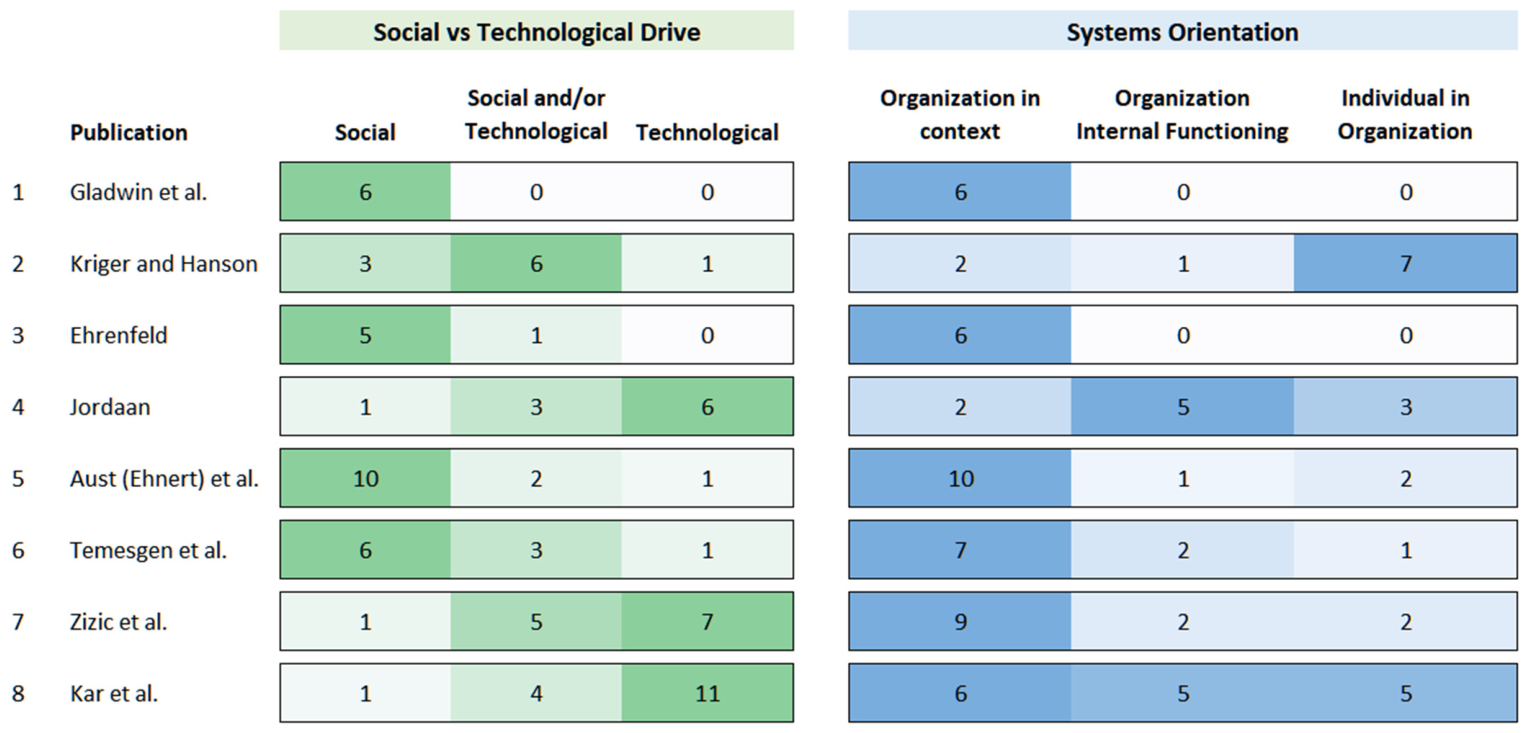
| Article No. | Article Title and Author(s) | Field of Study & Contribution | Paradigm/Framework Compared to PFBO |
|---|---|---|---|
| 1 | “Shifting Paradigms for Sustainable Development: Implications for Management Theory and Research” by Gladwin et al. [91] | Management Theory: Introduces “sustaincentrism” as a paradigm between the extremes of “technocentrism” and “ecocentrism”. | “Sustaincentrism” and some areas of “ecocentrism” paradigms |
| 2 | “A value-based paradigm for creating truly healthy organizations” by Kriger and Hanson [151] | Organizational Behavior & Change: Introduction of an aspirational set of organizational culture values and associated activities based on “the world’s major religions”. | The described aspirational culture |
| 3 | “Industrial Ecology: Paradigm Shift or Normal Science?” by Ehrenfeld [95] | Social & Behavioral Sciences: Ponders whether Industrial Ecology should be considered change within “normal science” within the paradigm of “Western Modernity” or a social “paradigm shift” as per Kuhn’s definition of scientific paradigms. | Industrial Ecology as paradigm shift |
| 4 | “Leading organizations in turbulent times: Towards a different mental model” by Jordaan [152] | Leadership: Introduces a leadership “mindset” required for “agile” and “collaborative” leadership needed in times of increased “complexity, turbulence and uncertainty”. | The introduced leadership “mindset” |
| 5 | “Common Good HRM: A paradigm shift in Sustainable HRM?” by Aust (Ehnert) et al. [153] | Human Resource Management: Introduces “Common Good HRM” as a new type of “sustainable HRM” applying “ideas from a common good economy perspective”. | “Common Good HRM” |
| 6 | “Circular Economy—Reducing Symptoms or Radical Change?” by Temesgen et al. [149] | Economics: Discusses the concept of a “circular economy” from the perspective of change within “Neoclassical Economics (NE)”, or a “paradigm change” to “Ecological Economics (EE)”. | “Circular Economy” as a “paradigm change” to “Ecological Economics (EE)” |
| 7 | “From Industry 4.0 towards Industry 5.0: A Review and Analysis of Paradigm Shift for the People, Organization and Technology” by Zizic et al. [154] | Engineering/Industry: Highlights “Industry 5.0” as extension of “Industry 4.0” with a “social and environmental dimension”. | “Industry 5.0” |
| 8 | “Inclusive organizational behavior—the dynamic rules of building new workplaces” by Kar et al. [150] | Organizational Behavior: Reflects on the new concept of “inclusive organizational behavior (IOB)” for “the future of work”. | “Inclusive Organizational Behaviour (IOB)” |
Disclaimer/Publisher’s Note: The statements, opinions and data contained in all publications are solely those of the individual author(s) and contributor(s) and not of MDPI and/or the editor(s). MDPI and/or the editor(s) disclaim responsibility for any injury to people or property resulting from any ideas, methods, instructions or products referred to in the content. |
© 2026 by the authors. Licensee MDPI, Basel, Switzerland. This article is an open access article distributed under the terms and conditions of the Creative Commons Attribution (CC BY) license.
Share and Cite
Gericke, L.; Schutte, C.S.L. The Organization of the Future—An Integrated, Transdisciplinary Paradigm Shift. Systems 2026, 14, 774. https://doi.org/10.3390/systems14070774
Gericke L, Schutte CSL. The Organization of the Future—An Integrated, Transdisciplinary Paradigm Shift. Systems. 2026; 14(7):774. https://doi.org/10.3390/systems14070774
Chicago/Turabian StyleGericke, Lizette, and Corné Stephanus Lodewyk Schutte. 2026. "The Organization of the Future—An Integrated, Transdisciplinary Paradigm Shift" Systems 14, no. 7: 774. https://doi.org/10.3390/systems14070774
APA StyleGericke, L., & Schutte, C. S. L. (2026). The Organization of the Future—An Integrated, Transdisciplinary Paradigm Shift. Systems, 14(7), 774. https://doi.org/10.3390/systems14070774