1. Introduction
As low-carbon transformation becomes embedded in supply chain collaboration, many manufacturers outsource specialized emission-reduction tasks to low-carbon service providers. In such settings, consumer low-carbon preference can affect firms’ emission-reduction investment, pricing decisions, and supply chain coordination, but only when low-carbon attributes are recognizable in the market [
1,
2,
3,
4,
5,
6]. Therefore, the governance problem is not simply whether consumers value low-carbon attributes, but how manufacturers can convert outsourced emission-reduction performance into identifiable market value through contract design and information disclosure.
Low-carbon service outsourcing is characterized by specialized processes, opaque implementation, and uncertain outcomes. Before contracting, providers’ emission-reduction capabilities are usually private information, which creates adverse selection. After contracting, actual effort during service implementation is difficult to observe, which creates moral hazard. Traditional procurement decisions or single incentive mechanisms are therefore insufficient to guarantee emission-reduction performance. Although contract design under information asymmetry involves screening, incentives, and risk sharing [
7,
8], and has been applied to green supply chains and low-carbon service scenarios [
9,
10,
11,
12,
13], existing studies have paid limited attention to cases in which hidden capability and hidden effort coexist in low-carbon service supply chains.
Consumer heterogeneity further complicates this governance problem. Consumers differ in environmental awareness, willingness to pay for green products, and ability to identify low-carbon attributes [
6,
14,
15,
16]. Consequently, manufacturers’ incentive decisions depend not only on providers’ emission-reduction capabilities, but also on whether a sufficient share of consumers can perceive and reward low-carbon performance. Since consumers cannot directly observe emission-reduction processes, they rely on labels, disclosure, traceability, and related communication to assess low-carbon attributes [
17,
18,
19]. Ignoring this perception channel makes it difficult to explain why similar emission-reduction conditions may lead to different contractual arrangements across markets.
Consumer perception also has a dynamic dimension. Green brand image, green satisfaction, and green trust are important sources of green brand value, whereas exaggerated or misleading green claims may erode trust through confusion, perceived risk, and social cynicism [
20,
21,
22]. In sustainable consumption contexts, trust and distrust shape behavioral responses, while transparency and traceability can strengthen sustainable trust and purchase intention [
23,
24,
25,
26,
27,
28,
29]. However, low-carbon trust is rarely formed by one disclosure activity. It is gradually accumulated through repeated consistency between actual emission-reduction performance and credible information communication. Low-carbon service supply chain governance should therefore be understood as a joint problem of contract incentives, information perception, and trust accumulation.
Based on this logic, this study constructs a principal–agent model for a low-carbon service supply chain comprising a manufacturer and a low-carbon service provider. The baseline model examines how a manufacturer uses menu contracts to screen high- and low-capability providers and induce effort under dual information asymmetry. The extended static model introduces heterogeneous consumer preferences and information perception, treating information disclosure as a manufacturer decision that affects the market return of emission-reduction effort. The dynamic model further incorporates consumer low-carbon trust to examine the long-term feedback among emission-reduction effort, disclosure, and market response. Parameter sensitivity analysis, model comparison, and joint parameter simulation are then used to examine the effects of key variables on incentive coefficients, effort levels, disclosure investment, steady-state trust, and manufacturer incremental profits.
Based on the above analysis, this study examines incentive mechanism design in a low-carbon service supply chain consisting of a manufacturer and a low-carbon service provider under dual information asymmetry. Different from prior studies that mainly focus on emission-reduction decisions, pricing strategies, or single-dimensional information asymmetry, this paper develops a progressive analytical framework that links internal contract governance with external market perception. Specifically, the baseline model first analyzes how the manufacturer designs a menu contract to identify heterogeneous service-provider capabilities and induce emission-reduction effort. The extended static model then incorporates heterogeneous consumer low-carbon preferences and information perception to examine how consumer-side market responses feed back into incentive and disclosure decisions. Finally, the dynamic model introduces consumer low-carbon trust as a state variable to reveal how sustained emission-reduction effort and credible disclosure jointly shape long-term governance outcomes. By doing so, this study clarifies that effective low-carbon service supply chain governance depends not only on screening and incentive design under dual information asymmetry, but also on whether actual low-carbon performance can be transformed into perceived value and accumulated trust through credible information disclosure. This framework also defines the applicable boundary of the model: the findings are particularly relevant to low-carbon service outsourcing contexts in which provider capability and effort are difficult to observe, and market returns depend on consumers’ perception and trust in low-carbon information.
2. Literature Review
2.1. Low-Carbon Supply Chain Governance and Consumer Preferences for Low-Carbon Products
Low-carbon supply chain governance has been widely examined from the perspectives of emission-reduction decisions, pricing strategies, channel coordination, and profit distribution. Existing studies show that consumers’ preferences for low-carbon attributes can significantly affect firms’ emission-reduction investments and supply chain coordination outcomes, while environmental regulations and channel structures further shape the conditions under which low-carbon decisions are implemented [
1,
2,
3,
4,
5]. These studies indicate that low-carbon governance is not only an internal operational issue of individual firms, but also a coordination problem embedded in supply chain relationships and market demand feedback.
Recent research has further introduced consumer heterogeneity and corporate social responsibility into low-carbon supply chain analysis. For example, differences in consumers’ environmental awareness and low-carbon preferences may affect green levels, pricing decisions, and profit allocation among supply chain members [
6,
16]. This line of research provides an important basis for understanding why firms may adopt different low-carbon strategies under different market structures.
However, existing studies still have two limitations. First, consumer low-carbon preference is often treated as a uniform or static demand parameter, while differences in environmental awareness, willingness to pay, and the ability to identify low-carbon attributes are not always sufficiently captured [
14,
15,
16]. Second, most studies focus on how consumer preference affects emission-reduction or pricing decisions, but they pay less attention to how consumer-side preference feeds back into contract design when low-carbon activities are performed by external service providers. In low-carbon service supply chains, manufacturers do not directly implement all emission-reduction activities; instead, they rely on low-carbon service providers whose capabilities and efforts may be difficult to observe. Therefore, it is necessary to examine how heterogeneous consumer low-carbon preferences influence manufacturers’ incentive decisions in service outsourcing contexts.
2.2. Contractual Incentives Under Information Asymmetry
Principal–agent theory provides a useful framework for analyzing incentive distortion, information rent, and risk sharing under information asymmetry [
7,
8]. In supply chain contexts, this theory has been applied to examine how firms design contracts when agents’ capabilities, costs, or behaviors are not fully observable [
30]. This perspective is particularly relevant to green and low-carbon supply chains because emission-reduction capability, environmental responsibility, and actual effort often involve substantial information opacity.
Existing studies have examined menu contracts, screening contracts, and information structure choices in green supply chains, showing how contract design affects green performance, cooperative efficiency, and profit distribution [
9,
12,
31]. Some studies have also extended the principal–agent framework to low-carbon service outsourcing and analyzed how manufacturers incentivize service providers under asymmetric information [
10,
11]. These studies provide important insights into the role of contractual mechanisms in mitigating information asymmetry.
Nevertheless, most existing studies still focus on a single dimension of information asymmetry, such as hidden capability, hidden cost, or hidden effort. In low-carbon service supply chains, however, manufacturers may face dual information asymmetry. Before contracting, the emission-reduction capability of the service provider may be private information; after contracting, the actual effort level may also be difficult to observe. Moreover, low-carbon service providers may differ in capability, exhibit risk aversion, and choose hidden effort levels during service implementation [
13]. This makes contract design more complex than in settings with only one type of information asymmetry. Therefore, this paper develops a baseline model to examine how manufacturers design screening and incentive contracts when emission-reduction capability and effort are both difficult to observe.
2.3. Consumer Low-Carbon Preferences, Information Perception, and Low-Carbon Trust
Consumer behavior research has shown that willingness to pay for environmentally friendly products, attention to sustainability attributes, and the use of environmental information are important foundations of green purchasing. Early research identified the characteristics of consumers willing to pay a premium for environmentally friendly products [
14]. Subsequent studies further indicate that whether consumer preference can be translated into actual purchasing behavior depends not only on environmental values, but also on consumers’ ability to identify product attributes and process low-carbon information [
18,
19,
27].
Information perception is therefore an important mechanism linking actual low-carbon performance with market response. Sustainability-related product information can affect consumers’ value perception and information use [
17]. Transparency and perceived benefits also shape green perceived value, brand associations, and consumer loyalty [
32]. In addition, environmental cues can enhance consumers’ purchase intention for sustainable products [
33]. These studies suggest that low-carbon information disclosure, certification, carbon labeling, and traceability mechanisms can help consumers recognize a product’s low-carbon attributes.
On this basis, low-carbon trust further affects consumers’ responses to firms’ environmental claims. Green brand image, green satisfaction, and green trust are important sources of green brand value [
20]. Conversely, greenwashing may reduce green trust through consumer confusion, perceived risk, and social cynicism [
21,
22,
23]. In sustainable consumption contexts, both trust and distrust may influence consumer behavior, while ESG-related communication and environmental transparency can affect consumers’ sustainable trust and purchase intention [
23,
24]. Recent studies on blockchain, QR code traceability, carbon transparency, and buyer–seller relationships also show that transparent and verifiable information can influence sustainable procurement and market responses [
25,
26,
27,
28,
29].
However, most of these studies examine information perception and trust mainly from the perspectives of consumer behavior, brand communication, or information transparency. Relatively limited attention has been paid to how information perception interacts with internal incentive mechanisms in low-carbon service supply chains. In particular, existing research seldom treats information disclosure as an endogenous decision of the manufacturer, nor does it fully examine low-carbon trust as a dynamic outcome accumulated through sustained emission-reduction performance and credible disclosure. Therefore, this paper further introduces low-carbon information perception and dynamic trust evolution into the contract framework to analyze how consumer-side responses affect incentive design and long-term governance outcomes. A summary of the relevant literature is presented in
Table 1.
2.4. Research Gap
In summary, existing studies have provided valuable insights into low-carbon supply chain coordination, contracts under information asymmetry, and environmental information transparency. However, three issues remain insufficiently addressed. First, low-carbon service outsourcing may involve both hidden capability before contracting and hidden effort after contracting, whereas most contract studies focus on a single information-asymmetry problem. Second, consumer low-carbon preference is often modeled as a direct demand parameter, although consumers usually need disclosure, certification, labeling, or traceability to perceive actual emission-reduction performance. Third, green trust is mostly treated as a consumer attitude or behavioral outcome, with less attention to its dynamic accumulation through sustained emission-reduction performance and credible disclosure. Based on these gaps, this paper examines how dual information asymmetry, information perception, and trust evolution jointly affect incentive mechanism design in low-carbon service supply chains.
3. Problem Description and Assumptions
Consider a low-carbon service supply chain comprising manufacturers and low-carbon service providers, in which manufacturers are responsible for product production and sales, while low-carbon service providers are responsible for delivering emissions reduction services. A typical principal–agent relationship exists between the two: manufacturers, as principals, design incentive contracts to guide low-carbon service providers in improving their emissions reduction performance; and low-carbon service providers, as agents, decide whether to accept the contract and the extent of their emissions reduction efforts based on their own capabilities and the contractual arrangements. However, in real-world scenarios, manufacturers often find it difficult to accurately assess the true emission reduction capabilities of low-carbon service providers, and they also struggle to observe the providers’ actual level of effort. Consequently, the relationship between manufacturers and low-carbon service providers faces both adverse selection, arising from the unobservability of emission reduction capabilities, and moral hazard, stemming from the unobservability of emission reduction efforts. At the same time, as consumers increasingly focus on the low-carbon attributes of products, emissions reduction not only holds environmental significance but also affects manufacturers’ profits through changes in market demand. Therefore, given consumers’ low-carbon preferences, how manufacturers design reasonable contractual mechanisms to effectively identify and incentivize low-carbon service providers has become a key issue in the governance of low-carbon service supply chains. To characterize the principal–agent relationship between manufacturers and low-carbon service providers in low-carbon service supply chains, this paper proposes the following assumptions. These assumptions form the analytical foundation for all three models. First, the linear contract is adopted because low-carbon service outsourcing commonly involves a fixed service payment and a performance-based incentive linked to emission-reduction outcomes. This setting allows the incentive coefficient to directly reflect the manufacturer’s incentive intensity. Second, the low-carbon service provider is assumed to have CARA utility because emission-reduction output is affected by technical uncertainty, implementation conditions, and measurement noise. Under such uncertainty, a risk-averse service provider requires risk compensation when accepting a performance-based contract. Third, the exponential perception function is used to capture the diminishing marginal effect of information disclosure. Initial disclosure through certification, carbon labeling, or traceability can significantly improve consumers’ perception of low-carbon attributes, but the marginal improvement decreases as disclosure investment increases.
Assumption 1. Both the manufacturer and the low-carbon service provider are fully rational economic agents. The manufacturer is risk-neutral, whereas the low-carbon service provider is risk-averse with constant absolute risk aversion. Let denote the provider’s coefficient of risk aversion, and let denote the provider’s reservation utility.
Assumption 2. There are two types of low-carbon service providers: a high-capability type and a low-capability type, with capability parameters and , respectively, satisfying . Let denote the proportion of high-capability providers in the market, and the proportion of low-capability providers, where . The provider’s capability is private information and cannot be directly observed by the manufacturer before contracting.
Assumption 3. For a type- provider, , the true emission-reduction output depends on the provider’s effort level, , and capability, , and is given bywhere is a stochastic disturbance term. The provider’s effort cost iswhere is the effort cost coefficient. Assumption 4. The manufacturer offers a linear incentive contract to the low-carbon service provider:
where is the fixed payment, and is the incentive coefficient. Assumption 5. In the benchmark setting, consumers exhibit homogeneous low-carbon preference. Market demand is given by
where is the baseline market size, is the consumer low-carbon preference coefficient, is the price sensitivity coefficient, and is the product price. Assumption 6. In the extended setting, consumers have heterogeneous low-carbon preferences. Let denote the proportion of high-preference consumers and the proportion of low-preference consumers. Their preference coefficients are and , respectively. The average low-carbon preference intensity is therefore Assumption 7. The manufacturer can improve consumers’ perception of the product’s low-carbon attributes through green certification, carbon labeling, traceability disclosure, and related communication activities. Let denote the disclosure investment level. The information perception function isand the associated disclosure cost iswhere is the disclosure cost coefficient. The summary of parameters is shown in
Table 2.
3.1. Model P1: Benchmark Incentive Model Under Dual Information Asymmetry
Model P1 is built on Assumptions 1–5. In this benchmark model, the manufacturer faces dual information asymmetry: the provider’s capability is unobservable ex ante, and the provider’s effort is unobservable ex post. The manufacturer must therefore design a screening-and-incentive contract menu.
For a type-
provider, the certainty equivalent is
The manufacturer’s expected payoff when matched with a type-
provider is
The manufacturer’s expected total payoff is
The manufacturer chooses and to maximize subject to the incentive compatibility and participation constraints of both types.
Given the contract, the provider chooses effort to maximize the certainty equivalent. Taking the first-order condition of Equation (1) with respect to
yields
Under the standard single-crossing condition, the low-type participation constraint and the high-type incentive compatibility constraint are binding at the optimum. Substituting Equation (4) and the binding constraints into the manufacturer’s objective function and solving for the decision variables yield the following proposition. The proof is provided in
Appendix A.
Proposition 1. In Model P1, the manufacturer’s optimal incentive coefficients for high-capability and low-capability providers are
Accordingly, the optimal effort levels are Proposition 1 indicates that differentiated incentives are necessary under dual information asymmetry. The key issue is not only that high-capability providers generate higher emission-reduction output, but also that the manufacturer must use contract terms to induce self-selection when capability cannot be observed before contracting. Therefore, incentive intensity reflects both the marginal productivity of emission-reduction effort and the screening requirement caused by hidden capability. This result extends conventional low-carbon supply chain contract studies by showing that, in low-carbon service outsourcing, incentive design must simultaneously consider effort inducement and capability identification.
Proposition 2. In Model P1, the low-capability provider obtains only the reservation utility, while the high-capability provider earns a positive information rent. The corresponding fixed payments are The equilibrium utilities are Proposition 2 further reveals the trade-off between screening efficiency and information rent. A differentiated contract can improve allocation efficiency by encouraging high-capability providers to choose the contract designed for them, but this requires the manufacturer to leave positive information rent to prevent imitation of the low-type contract. Thus, the manufacturer cannot simultaneously eliminate information rent and achieve truthful self-selection. This finding is consistent with the basic logic of principal–agent theory, but it further shows that such rent becomes a necessary governance cost in low-carbon service supply chains where emission-reduction capability is difficult to verify before contracting.
3.2. Model P2: Extended Static Model with Heterogeneous Consumer Preference and Information Perception
Model P2 is built on Assumptions 1–7. Relative to Model P1, this model introduces heterogeneous consumer low-carbon preference and manufacturer-driven information perception.
The low-carbon level perceived by consumers is
Accordingly, market demand becomes
The manufacturer’s expected payoff when matched with a type-
provider is
The provider’s certainty equivalent remains the same as in Model P1 and is still given by Equation (1).
Since the provider’s utility structure is unchanged, the optimal effort condition remains
Using the same binding-constraint structure as in Model P1, and then solving for , , and , the following results are obtained.
Proposition 3. In Model P2, the optimal incentive coefficients for high-capability and low-capability providers are
Accordingly, the optimal effort levels are Proposition 3 shows that consumer-side factors affect contract design through an information-perception channel. The result does not mean that stronger low-carbon preference automatically leads to stronger incentives. Rather, consumer preference increases the manufacturer’s incentive intensity only when actual emission-reduction performance can be converted into perceived low-carbon value through information disclosure. If consumers cannot recognize the low-carbon attributes generated by the service provider’s effort, the market return from stronger incentives remains limited. This finding complements existing studies that treat consumer low-carbon preference mainly as a demand parameter by showing how such preference feeds back into internal contract design.
Proposition 4. In Model P2, the manufacturer’s optimal disclosure investment, , satisfies Moreover, increases with , , and , and decreases with , , and .
Proposition 4 reveals a trade-off between market-response amplification and governance cost. Information disclosure increases the market value of emission-reduction effort by improving consumers’ perception of low-carbon attributes. However, disclosure also creates additional costs and may become less valuable when service providers are highly risk-averse or when output uncertainty is large. Therefore, disclosure is not always beneficial at a higher level. Its value depends on whether the demand-side gain generated by improved perception can offset disclosure costs and incentive-related governance costs. This result extends research on green information transparency by treating disclosure as an endogenous decision linked to contract incentives rather than as an exogenous transparency condition.
3.3. Model P3: Extended Dynamic Model with Trust Evolution
Model P3 is built on Assumptions 1–7, together with the dynamic interpretation of consumer trust. On the basis of Model P2, consumer low-carbon trust is allowed to evolve over time.
The trust evolution specification is introduced to reflect the gradual formation of consumer low-carbon trust. In green consumption contexts, trust is usually not formed immediately through a single disclosure activity. Instead, consumers update their trust according to the consistency between perceived low-carbon information and firms’ actual emission-reduction performance over time. Therefore, the dynamic trust equation is used to describe how consumer trust gradually adjusts toward a steady-state level determined by emission-reduction effort and information disclosure.
Let
denote the consumer trust level in period
. Its updating process is specified as
The period-
market demand is
To characterize the long-run behavior of the system, the stable policy obtained from Model P2, namely
, is substituted into Equation (15). The corresponding steady-state trust level is
The trust evolution equation can then be written as
Its closed-form solution is
Proposition 5. In Model P3, as long as , consumer low-carbon trust, , converges monotonically to the steady-state level, ; that is, The corresponding steady-state market demand is Proposition 5 indicates that the introduction of trust changes the governance problem from a static contract design issue to a dynamic adjustment process. In the static model, the manufacturer mainly balances incentive cost, disclosure cost, and current demand response. In the dynamic model, current incentive and disclosure decisions also affect the future stock of consumer trust. Therefore, low-carbon trust is not an immediate result of a single disclosure activity, but a state variable gradually adjusted toward the level supported by actual emission-reduction performance and credible disclosure. This finding is consistent with green trust studies emphasizing the role of credible environmental information, and further links trust accumulation with incentive governance in low-carbon service supply chains.
Proposition 6. The steady-state trust level, , and steady-state market demand, , increase with the proportion of high-capability providers, , and decrease with the risk-aversion coefficient and the disclosure cost coefficient, .
Proposition 6 further shows that long-run market outcomes are jointly determined by consumer-side preference and supply-side capability conditions. A higher proportion of high-capability service providers improves actual emission-reduction performance and strengthens the basis for trust accumulation. By contrast, stronger risk aversion and higher disclosure costs reduce the effectiveness of incentive and disclosure mechanisms, thereby weakening steady-state trust and demand. This result suggests that consumer trust cannot be sustained by disclosure alone; it also depends on whether the supply chain has sufficient capability to support credible low-carbon performance over time.
4. Comparative Analysis of Models
To clarify the incremental explanatory power of consumer heterogeneity, information perception, and trust evolution, this section compares the equilibrium results derived from the benchmark model, the extended static model, and the dynamic trust evolution model. For clarity, the equilibrium results are denoted by superscripts B, E, and D, respectively. In the benchmark model, the consumer low-carbon preference coefficient is denoted by η, whereas in the extended static model the effective low-carbon market response is denoted by
Equation (22) shows that, in the extended model, the effect of consumer low-carbon preference on market demand is not determined by a single parameter. Instead, it depends on the joint effect of average low-carbon preference intensity and information perception.
4.1. Comparison of the Benchmark Model and the Extended Static Model
The benchmark and extended static models have the same contract form but differ in the channel through which consumer preference enters the manufacturer’s decision. In the benchmark model, consumer preference affects demand through a homogeneous preference parameter. In the extended model, this effect depends jointly on average preference intensity and information perception. Thus, the comparison explains not only whether incentive intensity changes, but also why consumer preference may fail to affect contract design when perception is weak. Specifically, the extended model replaces η in the benchmark model with the effective low-carbon market response parameter, thereby linking consumer preferences to the manufacturer’s disclosure decision. Consequently, the incremental change in the optimal incentive coefficient for high-capability low-carbon service providers can be expressed as follows:
Similarly, the incremental change in the optimal incentive coefficient for low-carbon service providers with low emission-reduction capacity is as follows:
Equations (23) and (24) show that the key difference between the two models lies in the effective strength of low-carbon market response rather than in contract form. When the effective response generated by consumer heterogeneity and information perception is higher than η, the extended model produces stronger incentives for both high- and low-capability providers. When this effective response is lower than η, incentive intensity decreases relative to the benchmark model.
We can derive the incremental changes in the optimal effort levels of the two types of low-carbon service providers as follows:
Equations (25) and (26) indicate that heterogeneous low-carbon preferences and information perception mechanisms amplify the optimal effort levels of both types of low-carbon service providers by increasing the manufacturer’s incentive intensity. Because high-capability providers generate higher marginal emission-reduction output, changes in consumer preference structures have a stronger effect on their effort response in the extended model. Based on this comparison, the following proposition can be obtained.
Proposition 7. When , under the extended static model, the optimal incentive coefficients and optimal effort levels of manufacturers for both low- and high-emission-reduction-capacity low-carbon service providers are higher than those in the baseline model; when , both values are lower than those in the baseline model; when , the two models converge in terms of incentive intensity and effort levels.
Regarding revenue distribution, in both the baseline model and the extended static model, the certainty-equivalent revenue of low-emission-reduction-capacity low-carbon service providers is
; that is,
This indicates that the extended model does not alter the fundamental characteristic of low-emission-reduction-capacity low-carbon service providers, namely that they “merely satisfy the participation constraint.” Furthermore, the incremental information rent of high-emission-reduction-capacity low-carbon service providers is as follows:
Equation (28) shows that the information rent of high-capability providers increases when the effective low-carbon market response increases. When consumer heterogeneity and information disclosure jointly raise the marginal incentive level of the low-type contract, the manufacturer must leave a larger rent to prevent high-capability providers from mimicking the low-type contract. Therefore, the extended model not only increases system-level emission-reduction effort but also changes the distribution of information rent.
Based on this, the following proposition can be derived.
Proposition 8. Under both the baseline model and the extended static model, low-emission-reduction-capacity low-carbon service providers receive only retained rent, while the information rent of high-emission-reduction-capacity low-carbon service providers increases as increases. When , the information rent earned by high-emission-reduction-capacity low-carbon service providers under the extended static model is higher than that under the baseline model.
From the perspective of manufacturer profits, assuming the manufacturers’ objective functions under the baseline model and the extended static model are
and
, respectively, then
Equation (29) indicates that a stronger effective market response generated by consumer heterogeneity and information perception raises the manufacturer’s optimal revenue, whereas higher information disclosure costs reduce the incremental revenue of the extended model relative to the benchmark model. Therefore, whether the extended static model outperforms the benchmark model depends on whether the demand gain from perception amplification can offset the additional disclosure cost and information rent.
4.2. Comparison of the Extended Static Model and the Dynamic Trust Evolution Model
In the green consumer market, consumers’ perceptions of a firm’s low-carbon attributes often exhibit historical dependence. Sustained emission-reduction effort and credible information disclosure gradually build consumer trust, whereas disclosure gaps or poor emission-reduction performance may weaken market recognition of the firm’s low-carbon commitment. This motivates the introduction of a dynamic trust evolution mechanism.
In the dynamic trust evolution model, if manufacturers and low-carbon service providers adopt constant strategies under steady-state conditions
, then the target level of consumer trust in low-carbon initiatives is as follows:
In this case, the dynamic evolution equation for consumer low-carbon trust can be written as follows:
Solving this differential equation yields the level of consumer low-carbon trust at time t:
where
represents the initial trust level.
From Equation (32), as long as the trust updating speed lies between zero and one, consumer low-carbon trust gradually converges to the steady-state value over time. Therefore, under steady-state conditions, market demand can be expressed as follows:
Equation (33) indicates that steady-state demand in the dynamic trust evolution model depends not only on consumers’ average low-carbon preference and product price, but also on the trust stock accumulated through past emission-reduction performance and disclosure behavior.
This leads to the following proposition.
Proposition 9. Given a stable strategy , consumers’ level of trust in low-carbon products will monotonically converge to a steady-state value at a rate of . As increases, the steady-state market demand, , in the dynamic trust evolution model also rises.
Therefore, a higher proportion of green consumers, stronger average low-carbon preference, lower disclosure cost, and lower risk aversion make it more likely that the system will support higher incentives and greater disclosure. These conditions increase steady-state trust and move the system toward a long-run outcome characterized by higher trust, higher demand, and higher emission reductions. Proposition 10 follows.
Proposition 10. Under the dynamic trust evolution model, the steady-state trust level increases as the proportion of green consumers, the sensitivity coefficient of consumers with high low-carbon preferences, and the sensitivity coefficient of consumers with low low-carbon preferences rise; conversely, it decreases as the information disclosure cost coefficient, the risk aversion coefficient, and the variance of random disturbances increase.
5. Numerical Simulation
To more intuitively reveal the impact of consumers’ heterogeneous low-carbon preferences, perception of low-carbon information, and the evolution of dynamic trust on manufacturers’ contract design and low-carbon service providers’ effort decisions under conditions of dual information asymmetry, this paper conducts numerical simulations based on the theoretical analysis presented earlier. The simulation focuses on examining how changes in key parameters—such as the information disclosure cost coefficient, the proportion of high-capability low-carbon service providers, the proportion of green consumers, the risk aversion coefficient, and the initial trust level—affect incentive intensity, effort levels, information disclosure investment, steady-state trust, and manufacturers’ incremental profits.
To ensure consistency between the numerical simulation and the theoretical model, the baseline parameters are selected according to three principles. First, all parameter values satisfy the basic assumptions and equilibrium conditions of the model, including positive capability parameters, positive effort costs, positive disclosure costs, and feasible incentive coefficients. Second, the parameter setting reflects the key trade-offs examined in this study, namely the trade-off between incentive intensity and risk compensation, the trade-off between disclosure investment and market perception, and the trade-off between short-term governance cost and long-term trust accumulation. Third, the baseline setting allows both the benchmark model and the extended models to generate comparable interior solutions, so that the effects of consumer heterogeneity, information perception, and trust evolution can be clearly examined.
Based on these principles, the baseline parameters are set as follows: a = 10, p = 1, ϑH = 1.2, ϑL = 0.8, μ = 0.5, η = 1, ηH = 1.2, ηL = 0.8, h = 0.4, γ = 0.6, ρ = 0.3, σ2 = 0.1, k = 1, v = 0.5, λ = 0.4, and x0 = 0.3. Unless otherwise specified, all other parameters remain at their baseline values. In addition, robustness checks are conducted by changing key parameters within reasonable ranges to examine whether the main qualitative conclusions remain stable.
5.1. The Impact of Information Disclosure Costs on Equilibrium Outcomes
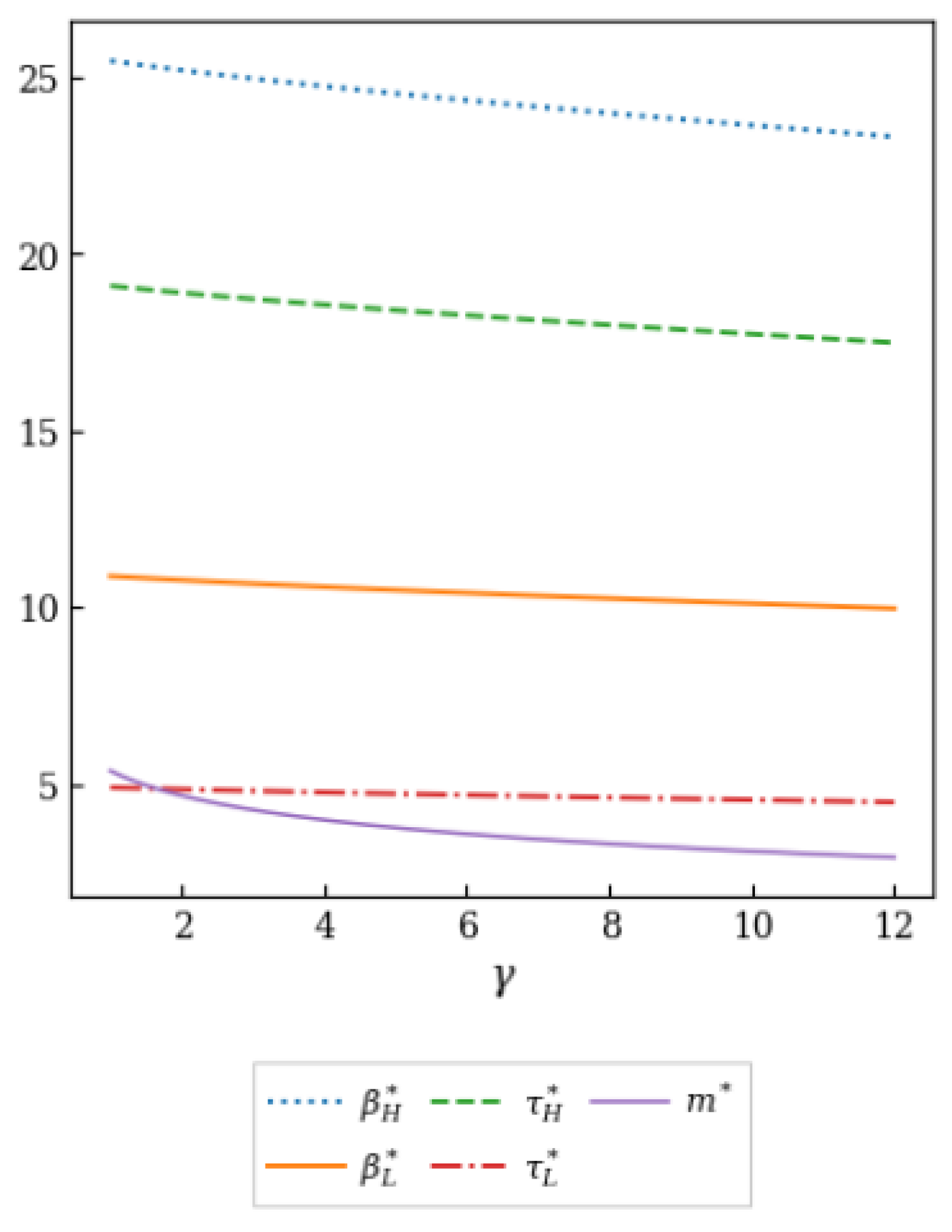
Figure 1 illustrates how the optimal incentive coefficient for manufacturers, the optimal effort level for low-carbon service providers, and the optimal level of investment in information disclosure vary with changes in the information disclosure cost coefficient.
Figure 1 shows that an increase in the disclosure cost coefficient reduces the manufacturer’s optimal disclosure investment, and it further weakens incentive intensity and the effort level of the low-carbon service provider. This result reflects the role of disclosure as a bridge between actual emission-reduction performance and market response. When disclosure is less costly, the manufacturer can more effectively transform the provider’s emission-reduction effort into consumers’ perceived low-carbon value, thereby increasing the marginal return of performance-based incentives. However, as disclosure cost increases, the market amplification effect of disclosure becomes weaker, and the manufacturer has less motivation to strengthen incentives. Therefore, disclosure cost affects not only the external communication decision but also the internal incentive structure of the low-carbon service supply chain.
5.2. The Impact of the Proportion of Low-Carbon Service Providers with High Emission Reduction Capabilities on System Steady State
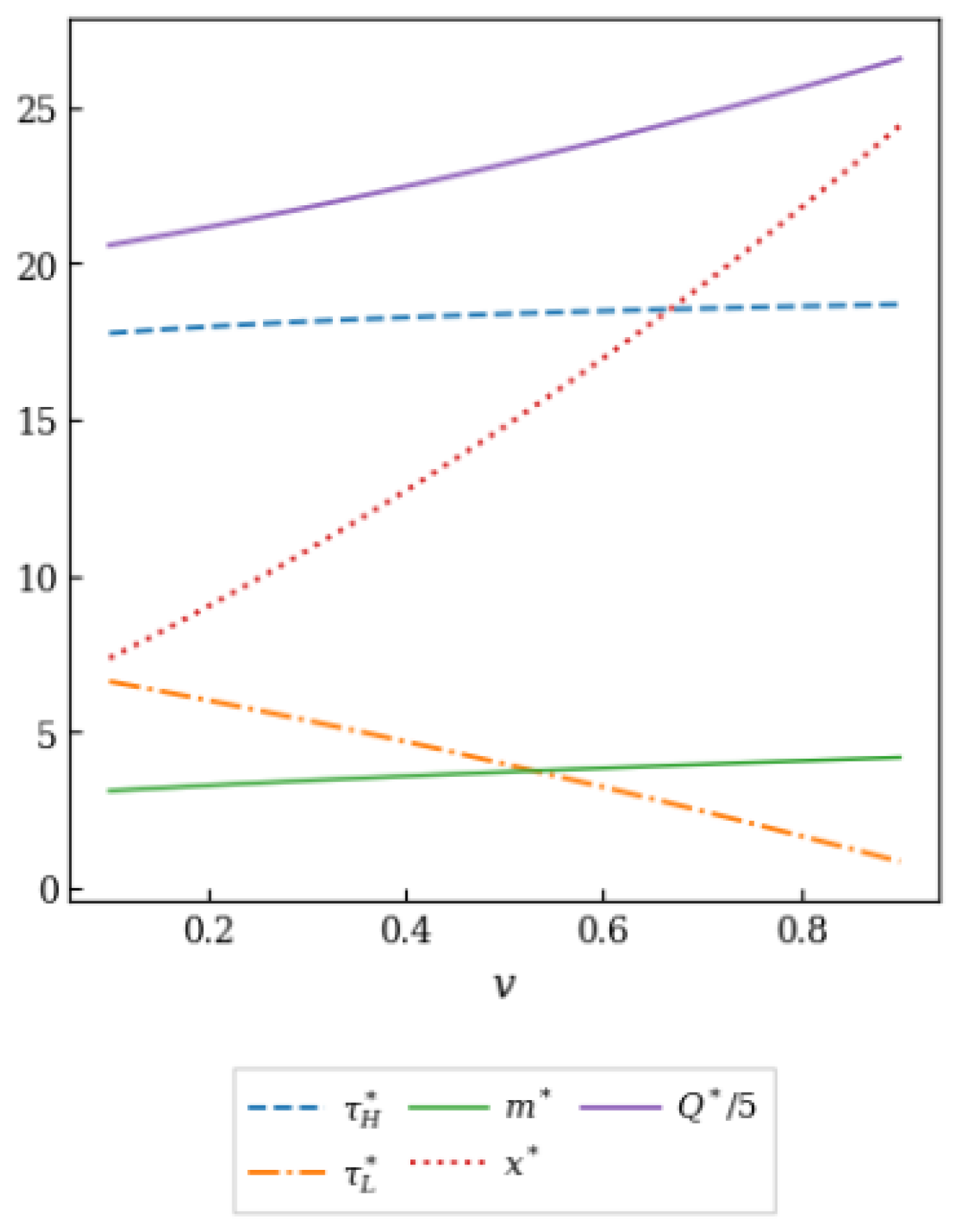
Figure 2 illustrates how
, and
change as the proportion,
, of low-carbon service providers with high emission-reduction capacity varies.
Figure 2 indicates that a higher proportion of high-capability low-carbon service providers improves the system’s overall low-carbon performance and raises steady-state trust. The mechanism is that high-capability providers generate higher emission-reduction output under the same incentive intensity, which increases the manufacturer’s expected return from both incentive provision and information disclosure. As a result, consumers can perceive more credible low-carbon performance, and trust accumulation becomes more stable. This finding suggests that the capability structure of the service-provider market is an important precondition for effective low-carbon governance. Disclosure and trust-building strategies are more effective when they are supported by sufficient supply-side emission-reduction capability.
5.3. An Analysis of the Dynamic Evolution of Low-Carbon Trust
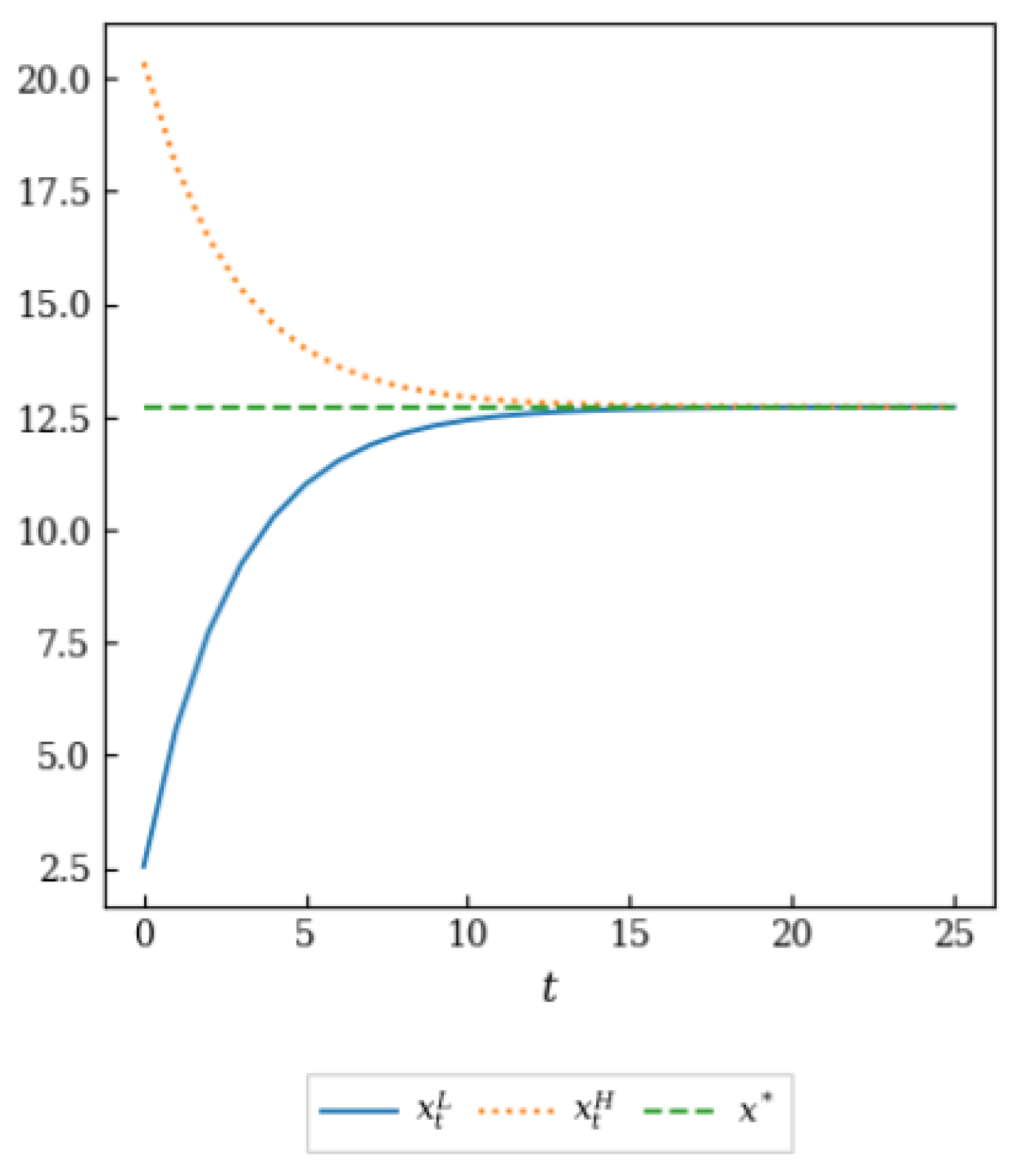
Figure 3 illustrates the dynamic evolution of consumer low-carbon trust under different initial trust levels.
Figure 3 shows that consumer low-carbon trust converges to the same steady-state level under different initial trust conditions. This result indicates that the long-term trust level is not determined by initial consumer attitudes alone, but by the sustained combination of emission-reduction effort and credible information disclosure. When initial trust is low, continuous low-carbon performance and disclosure help rebuild consumer confidence. When initial trust is higher than the level supported by actual performance, trust gradually declines toward the steady state. Therefore, short-term communication can influence initial perception, but long-term trust must be supported by stable low-carbon performance.
5.4. The Combined Effect of the Proportion of Green Consumers and Disclosure Costs on Optimal Disclosure Investment
Figure 4 shows the joint effect of green consumer proportion and disclosure cost on optimal disclosure investment. When the proportion of green consumers is high, the manufacturer has stronger incentives to invest in disclosure because more consumers are likely to respond to perceived low-carbon attributes. However, this positive effect is constrained by disclosure cost. When disclosure cost is high, even a large green consumer base may not be sufficient to justify substantial disclosure investment. This result suggests that disclosure strategy should be contingent on both market demand conditions and disclosure cost conditions. Firms should increase disclosure investment only when the expected market response can offset the additional cost of credible disclosure.
5.5. The Combined Effect of Risk Aversion and the Proportion of High-Capability Service Providers on Steady-State Trust
Figure 5 illustrates the effects of the risk-aversion coefficient,
, of low-carbon service providers and the proportion,
, of low-carbon service providers with high emission-reduction capacity on the system’s steady-state low-carbon trust level,
.
Figure 5 indicates that steady-state trust increases with the proportion of high-capability service providers but decreases with the risk-aversion coefficient. This result reflects the interaction between capability structure and incentive cost. A higher proportion of high-capability providers improves actual emission-reduction performance, which provides a stronger basis for trust accumulation. In contrast, higher risk aversion increases the manufacturer’s cost of providing performance-based incentives and weakens the provider’s effort response. As a result, the system’s ability to generate credible low-carbon performance is reduced. Therefore, long-term trust is not only a consumer-side outcome, but also depends on the capability and behavioral characteristics of service providers.
5.6. The Combined Effect of the Proportion of Green Consumers and Disclosure Costs on Manufacturers’ Incremental Revenue
Figure 6 shows the variation in the manufacturer’s incremental profit,
, as a function of the proportion of green consumers,
, and the information disclosure cost coefficient,
.
Figure 6 shows that the manufacturer’s incremental profit is highest when the proportion of green consumers is large and the disclosure cost coefficient is low. This result reveals the boundary condition of disclosure-based governance. Information disclosure does not automatically create additional profit; it becomes valuable only when a sufficiently large group of consumers can perceive and reward low-carbon performance. When the green consumer base is small, the market return from disclosure remains limited even if disclosure cost is relatively low. Conversely, when the green consumer base is large, a reduction in disclosure cost significantly enhances the profitability of disclosure. Therefore, manufacturers should not adopt uniform disclosure strategies across all markets, but should adjust disclosure intensity according to green demand and disclosure cost conditions.
5.7. Robustness Analysis
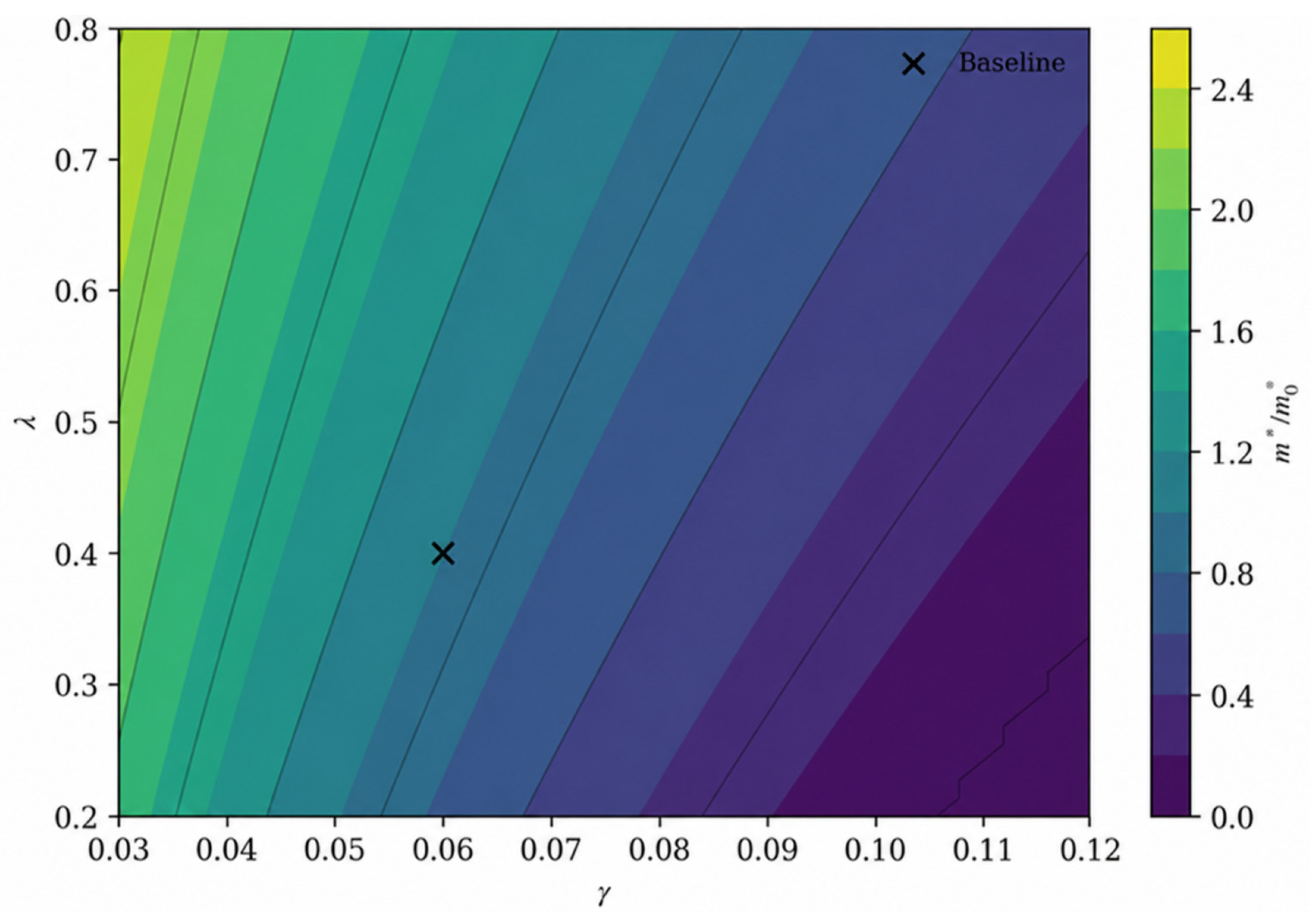
To examine whether the numerical results depend on a specific baseline parameter setting, this study further conducts robustness analysis by changing key parameters in pairs. Unlike the preceding single-parameter sensitivity analyses, this analysis considers joint parameter variations. All outcome variables are normalized by their corresponding baseline values.
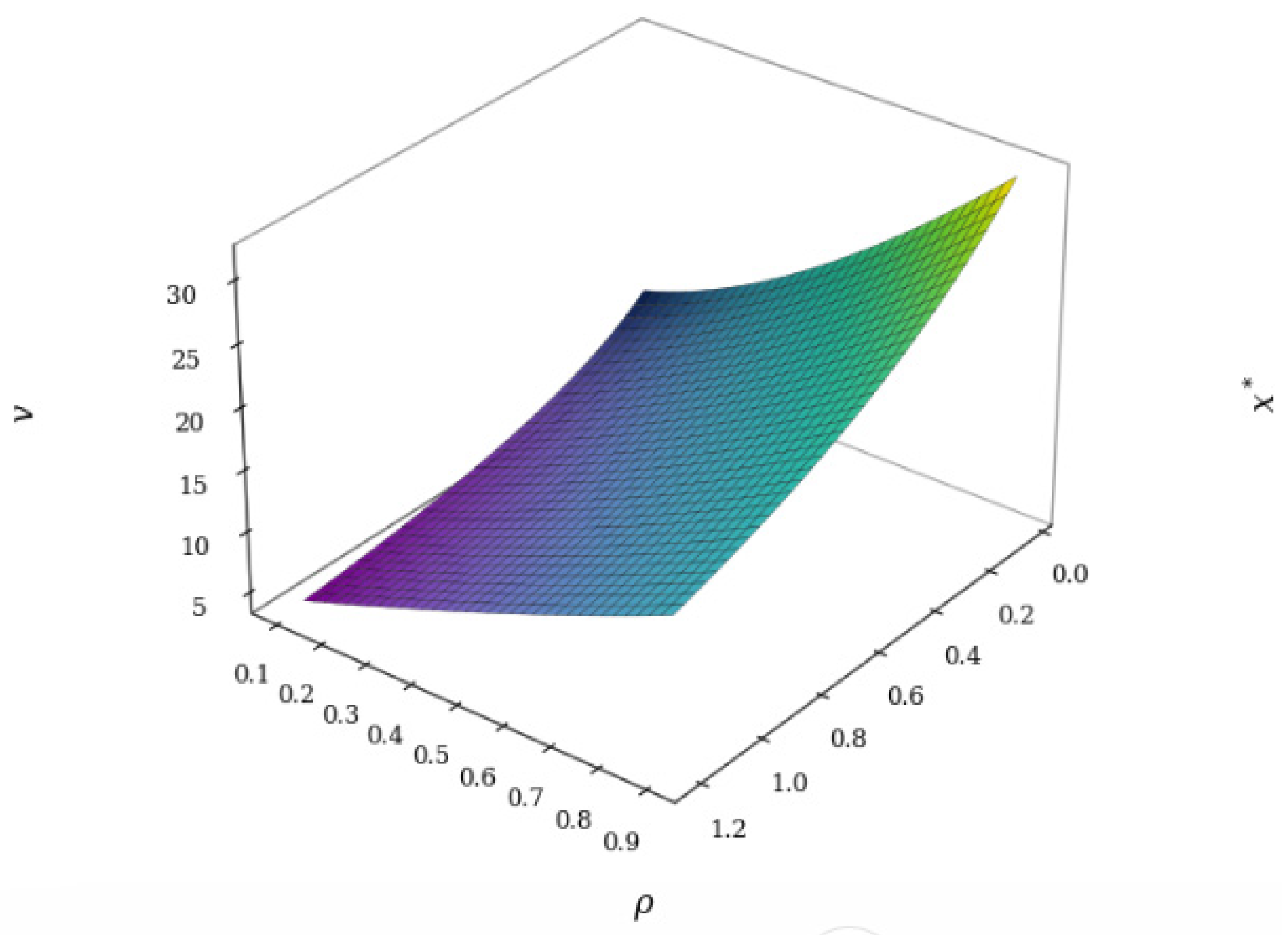
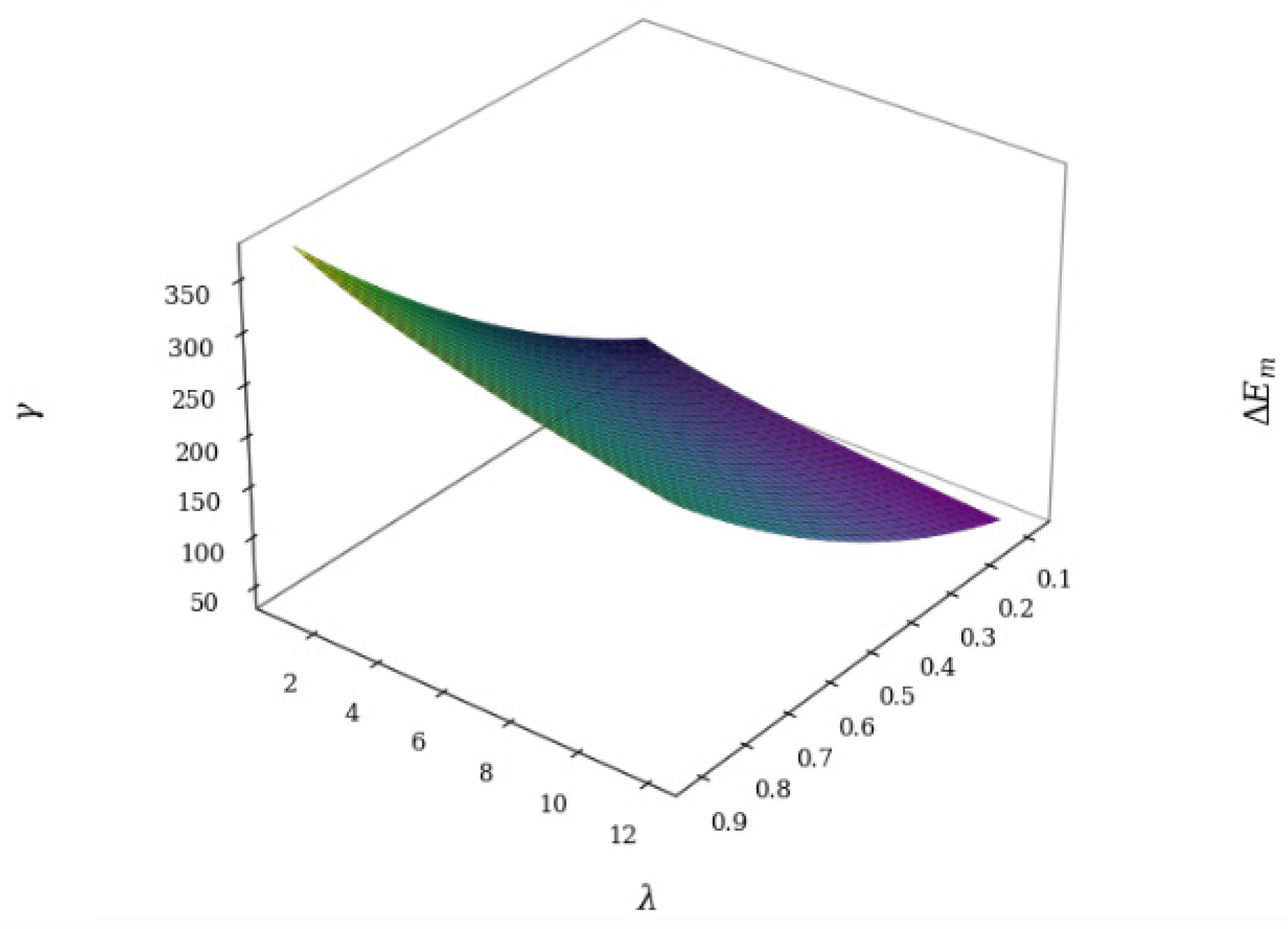
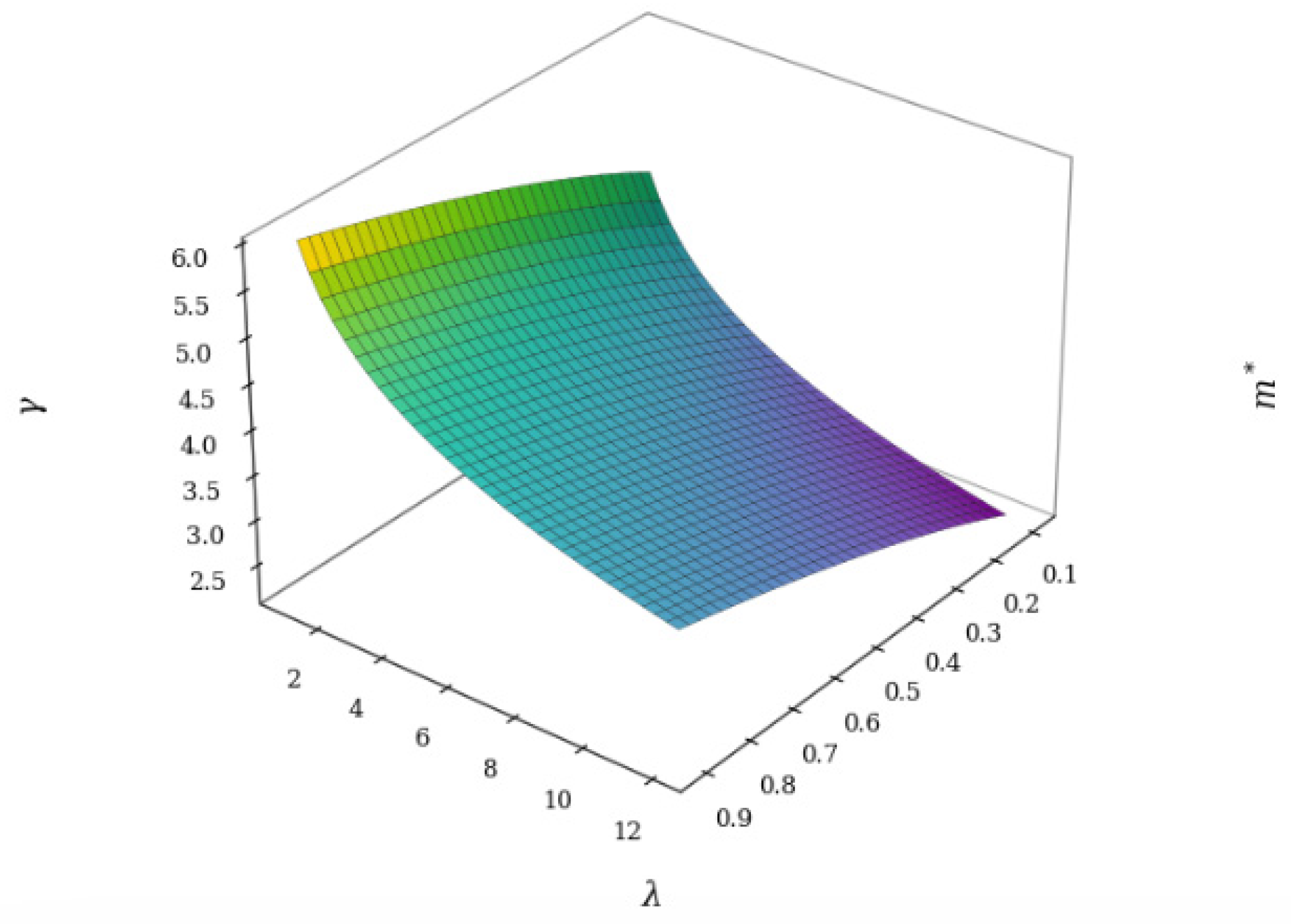
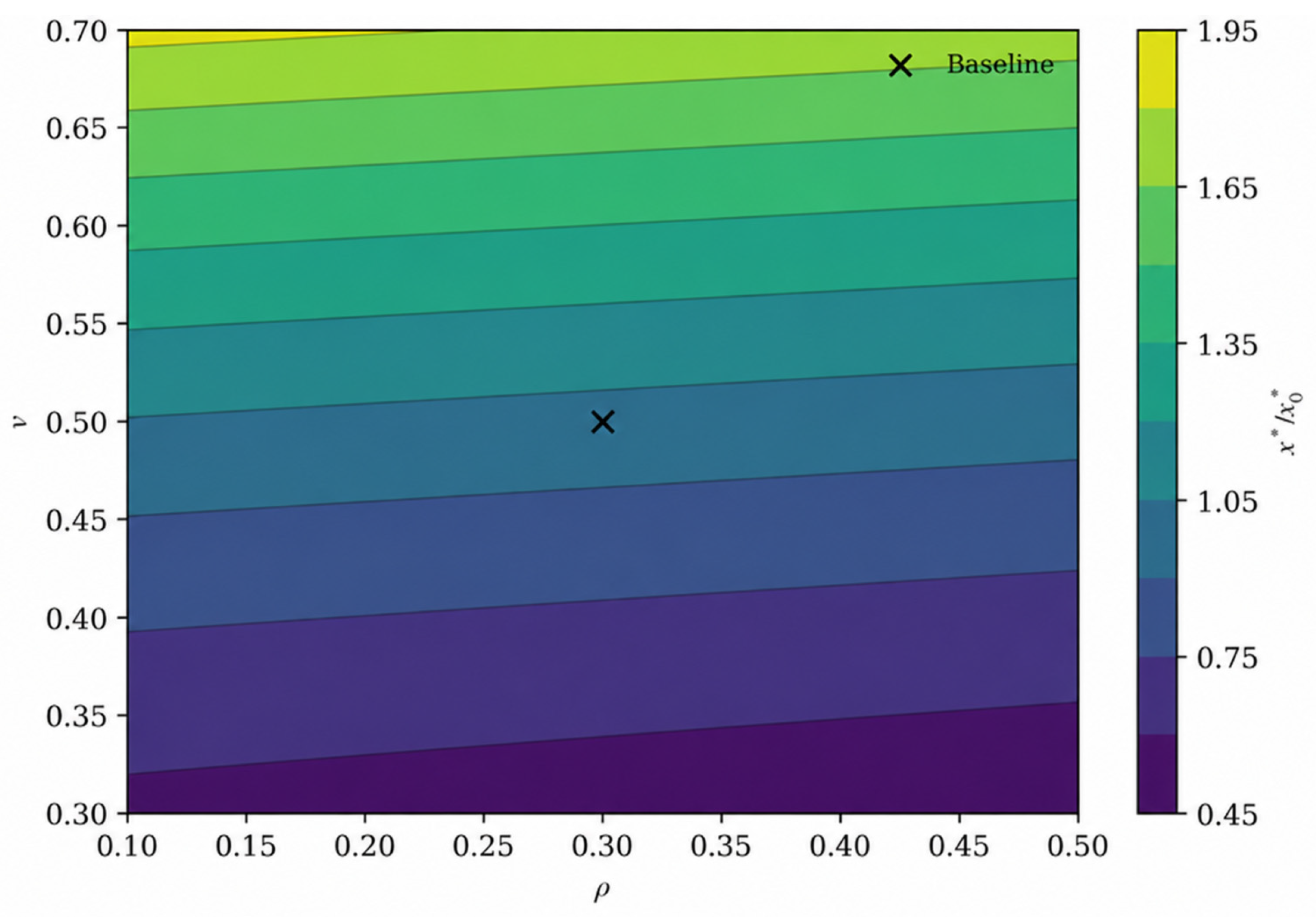
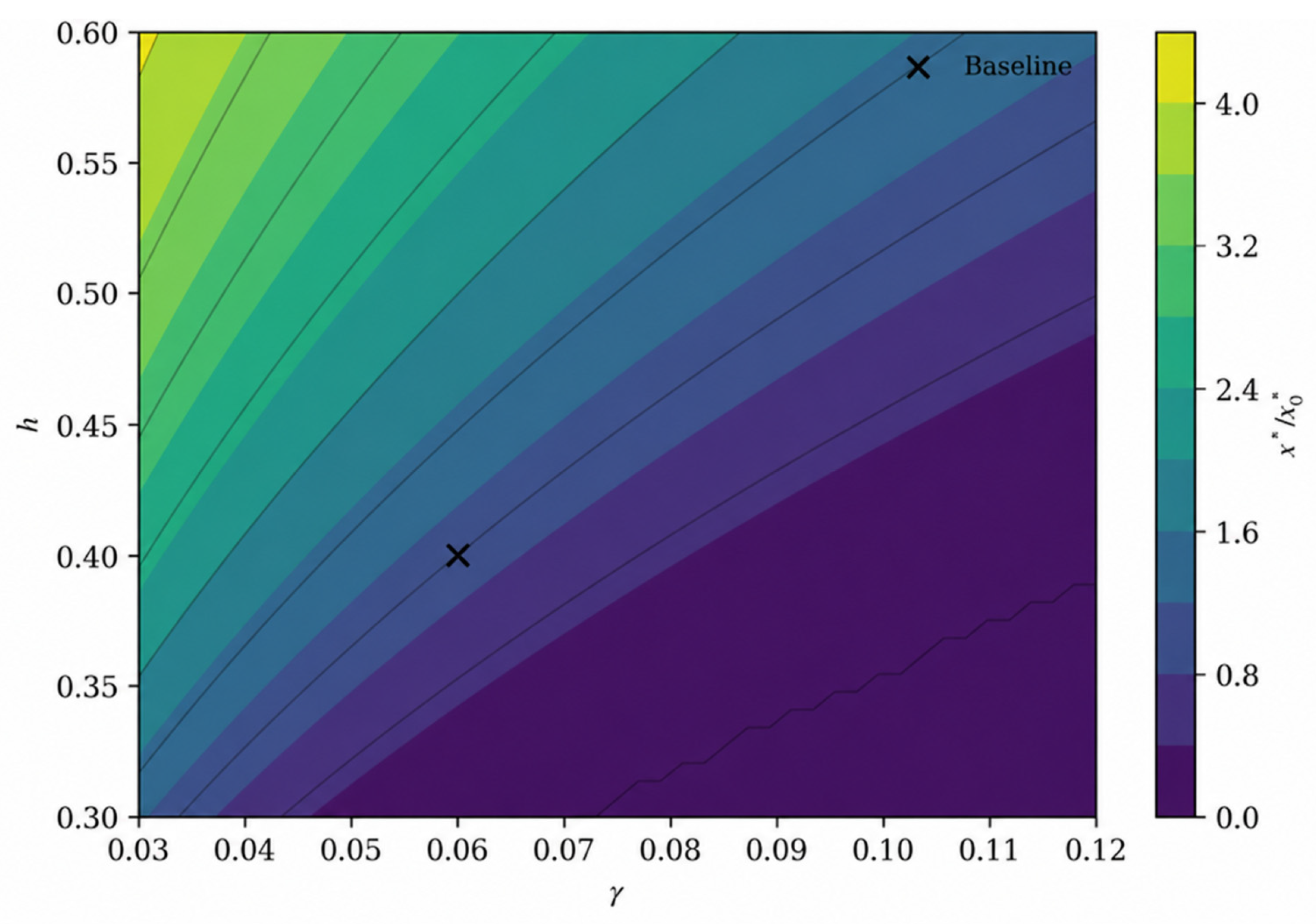
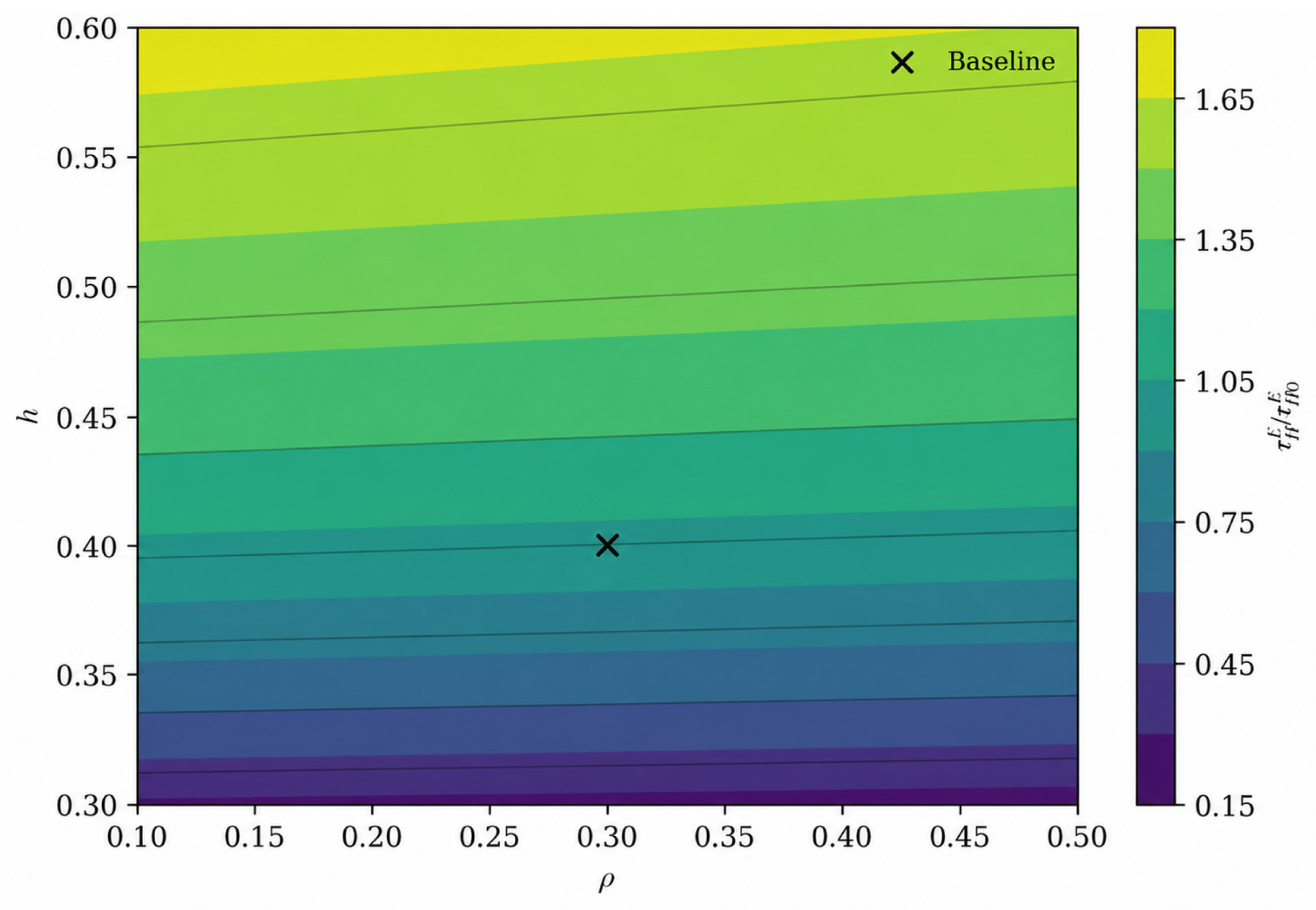
Figure 7,
Figure 8,
Figure 9 and
Figure 10 show that the main qualitative conclusions remain stable under joint parameter variations.
Figure 7 indicates that optimal disclosure investment decreases with the disclosure cost coefficient, γ, and increases with the proportion of high-preference consumers, λ.
Figure 8 shows that steady-state trust decreases with the risk-aversion coefficient, ρ, and increases with the proportion of high-capability service providers, v.
Figure 9 shows that higher information perception efficiency, h, weakens the negative effect of disclosure cost on trust.
Figure 10 indicates that high-capability providers’ effort decreases with risk aversion but improves when information perception efficiency increases. Overall, the robustness analysis confirms that the main findings are not driven by a specific baseline parameter setting.
6. Discussion
6.1. Theoretical Contributions
This study provides three main theoretical contributions.
First, this study extends principal–agent analysis in low-carbon supply chain research by focusing on low-carbon service outsourcing under dual information asymmetry. Existing studies have examined how consumer low-carbon preference affects emission-reduction investment, pricing, and supply chain coordination [
1,
2,
3,
4,
5,
6], and how contracts can mitigate information asymmetry in green or low-carbon supply chains [
7,
8,
9,
10,
11,
12,
13]. However, low-carbon service outsourcing involves the coexistence of hidden capability and hidden effort. By incorporating both into the same framework, this study shows that incentive contracts must perform both screening and effort-inducing functions. This provides a context-specific extension of principal–agent theory in low-carbon service governance.
Second, this study clarifies the mechanism through which consumer low-carbon preference affects contract design. Prior studies often treat consumer low-carbon preference as a direct demand-side parameter [
14,
15,
16]. This study further shows that consumer preference can influence manufacturers’ incentive and disclosure decisions only when actual low-carbon performance is transformed into perceived low-carbon value through information disclosure. In this sense, information perception is not only a consumer-side response mechanism, but also a channel connecting external green demand with internal incentive governance. This finding helps explain why similar emission-reduction efforts may lead to different contractual arrangements under different green market conditions.
Third, this study enriches research on green trust by treating consumer low-carbon trust as a dynamic governance outcome. Previous studies have shown that green brand image, green satisfaction, green trust, transparency, and traceability affect consumer purchase intention and market response [
17,
18,
19,
20,
21,
22,
23,
24,
25,
26,
27,
28,
29,
32,
33]. This study further links trust formation with low-carbon service supply chain governance. The results suggest that consumer trust is not formed through a single disclosure activity, but gradually accumulates through sustained emission-reduction performance and credible information communication. Therefore, trust is not merely a consumer attitude, but also a long-term market state that affects the effectiveness of low-carbon governance.
6.2. Managerial Implications
The findings provide several managerial implications.
First, manufacturers should design differentiated contracts for low-carbon service providers with different emission-reduction capabilities. Under dual information asymmetry, a uniform contract may fail to simultaneously identify provider capability and motivate effort. Menu contracts can help manufacturers balance screening efficiency, incentive intensity, and information rent. For high-capability providers, stronger performance-based incentives may be needed to release their emission-reduction potential; for low-capability providers, manufacturers should control excessive incentive distortion while satisfying participation constraints.
Second, manufacturers should incorporate consumer-side market conditions into low-carbon service contract design. When the proportion of green consumers is higher and consumers are more sensitive to low-carbon attributes, emission-reduction effort is more likely to be rewarded by the market. In such contexts, stronger incentives and greater disclosure investment become more valuable. By contrast, when consumer low-carbon preference or information perception is weak, increasing incentive intensity alone may not generate sufficient market returns.
Third, firms should treat low-carbon information disclosure and consumer trust as long-term governance tools. Certification, carbon labeling, traceability disclosure, and environmental communication can improve consumers’ perception of low-carbon performance, but disclosure should be adjusted according to disclosure cost, perception efficiency, and green demand. Moreover, consumer trust cannot be built through short-term communication alone. Manufacturers and service providers should establish continuous monitoring, reporting, and verification mechanisms to support credible disclosure and stable trust accumulation.
6.3. Policy Implications
The results also provide policy implications for improving low-carbon service supply chain governance.
First, policymakers should promote standardized carbon disclosure, carbon labeling, and third-party certification systems. Such mechanisms can reduce consumers’ information-processing costs, improve the credibility of low-carbon information, and help transform actual emission-reduction performance into perceived market value. This is particularly important when consumers cannot directly observe firms’ emission-reduction processes.
Second, governments and industry associations can support evaluation systems for low-carbon service providers. Since service providers’ emission-reduction capability may be difficult for manufacturers to identify before contracting, public or industry-level evaluation systems can reduce adverse selection in the low-carbon service market. These systems may include capability certification, historical performance records, service quality ratings, and traceability-based verification.
Third, policy support should also aim to reduce the cost of credible disclosure. When disclosure costs are too high, firms may reduce disclosure investment even if they have undertaken actual emission-reduction efforts. Subsidies for carbon accounting, digital traceability infrastructure, and low-carbon certification can therefore improve the effectiveness of information disclosure and strengthen trust-based low-carbon governance.
7. Conclusions
7.1. Research Conclusions
This paper examines incentive mechanism design in low-carbon service supply chains under dual information asymmetry. By developing a baseline principal–agent model, an extended static model with heterogeneous consumer preference and information perception, and a dynamic model with trust evolution, this study provides three main conclusions.
First, under dual information asymmetry, incentive mechanism design should address both capability screening and effort inducement. When the service provider’s emission-reduction capability is unobservable before contracting and its effort is unobservable after contracting, the manufacturer cannot rely on a uniform incentive contract. A menu contract is needed to induce truthful self-selection and motivate effort. This result shows that information rent is not merely a distributional outcome, but a necessary governance cost for improving contract efficiency under low-carbon service outsourcing.
Second, consumer low-carbon preference affects contract design through information perception. The analysis shows that stronger low-carbon preference does not automatically lead to higher incentive intensity or better governance outcomes. Only when low-carbon information disclosure enables consumers to perceive actual emission-reduction performance can consumer preference be transformed into market returns and stronger incentives for service providers. This finding clarifies the mechanism through which consumer-side market conditions enter internal contract design.
Third, dynamic trust changes low-carbon service supply chain governance from a static contract optimization problem into a long-term governance process. Sustained emission-reduction effort and credible disclosure jointly determine steady-state trust and steady-state demand. Therefore, low-carbon trust should be understood as a gradually accumulated market state rather than an immediate response to a single disclosure activity.
7.2. Limitations and Future Research
Although this study provides a theoretical framework for understanding incentive mechanism design in low-carbon service supply chains under dual information asymmetry, several limitations remain.
First, the model simplifies low-carbon service providers into two types: high-capability and low-capability providers. This setting helps capture the basic screening logic under adverse selection, but it cannot fully reflect the continuous heterogeneity of emission-reduction capability, technical expertise, and service quality in real markets. Future research could introduce multiple capability levels or a continuous capability distribution.
Second, the model focuses on a manufacturer and a representative low-carbon service provider. This setting helps isolate the core principal–agent mechanism, but it does not capture competition among multiple service providers, platform governance, or multi-tier supply chain structures. Future research could extend the model to multi-agent or platform-based low-carbon service supply chains.
Third, the model treats product price as exogenous or relatively static. This allows the analysis to focus on incentive design, information disclosure, and trust evolution, but it does not capture the joint decision of pricing, disclosure, and emission-reduction incentives. Future studies could further examine endogenous or dynamic pricing decisions in low-carbon service supply chains.
Fourth, the numerical simulations are mainly used to illustrate the theoretical mechanisms and directional effects of key parameters. Although the robustness analysis supports the stability of the main qualitative conclusions, the model has not yet been empirically calibrated or validated using real-world data. Future research could use low-carbon service outsourcing cases, firm-level survey data, or experimental data to further test and refine the model.