

Stability Limits of Coordinated Supply Chains Under Transportation Delays: Implications for Resilient Logistics Design
 , , , , , , , and
Abstract
1. Introduction
- Closed-form expressions relating the maximum tolerable total delay to system parameters.
- Analytical evidence that strong coordination reduces delay tolerance, establishing a fundamental tension between responsiveness and robustness that explains JIT vulnerability.
- Demonstrates that uncoupled systems exhibit marginal stability independent of delays but cannot maintain target inventory levels, while coupled systems achieve inventory control goals only within delay-dependent stability boundaries.
- Formulates the LQ optimal control problem for delay-constrained supply chains and shows that critical delays act as hard constraints on achievable performance
- Provides practical design methodology for supply chain designers to calculate stability margins, select coupling parameters, and optimize control policies within stability constraints, directly applicable to automotive, electronics, and other multi-echelon production–distribution systems.
2. Stability Analysis of the Uncoupled System
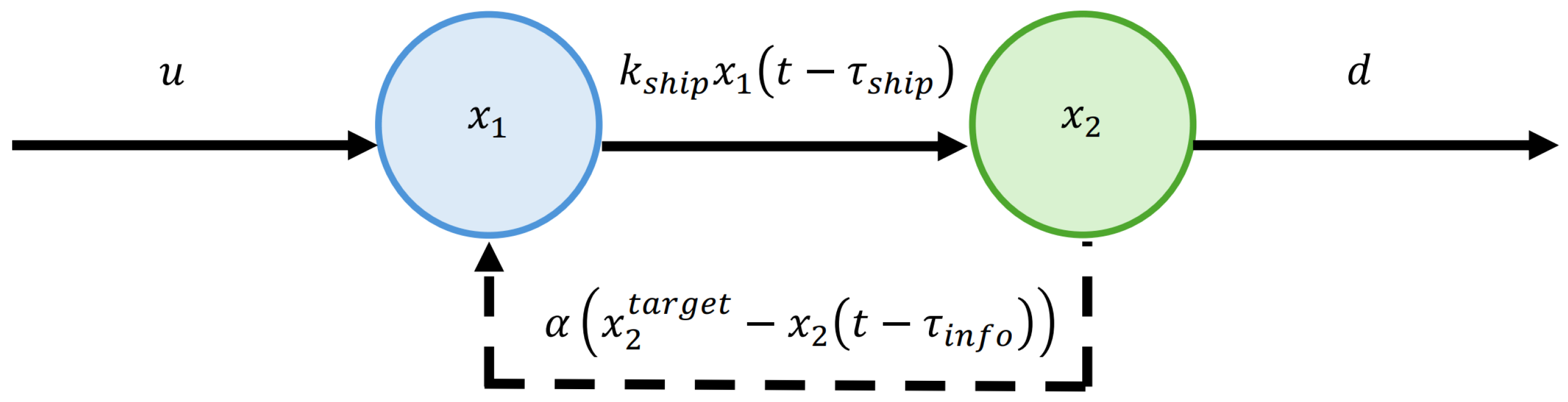
Stability Analysis
3. Coupled System: Delay-Dependent Stability Analysis
Stability Analysis
- Stability (): All eigenvalues have negative real parts; perturbations decay exponentially. The system exhibits a damped oscillatory response to disturbances.
- Marginal Stability (): A conjugate pair of eigenvalues lies on the imaginary axis at ; the system exhibits sustained oscillations at frequency .
- Instability (): At least one pair of eigenvalues has positive real parts; perturbations grow exponentially. The system exhibits divergent unbounded oscillations, representing a qualitatively different regime from the classical bullwhip effect, in which the coordinated supply chain transitions to true instability.
4. Optimal Control Formulation with Delay Constraints
4.1. Cost Function Formulation
- : Holding cost coefficient for supplier inventory [cost/(unit2·day)].
- : Penalty for deviation from target manufacturer inventory [cost/(unit2·day)].
- : Cost of production rate changes [cost/(unit2/day2·day)].
- Excess supplier inventory, : Holding costs, obsolescence risk, capital tie-up.
- Manufacturer inventory deviation, : Both excess and shortage.
- Production rate fluctuations (): Setup costs, workforce variability, equipment wear.
4.2. Simplified LQ Solution for Delay-Free Case
4.3. LQ Solution for Delay Case
5. Numerical Results and Validation
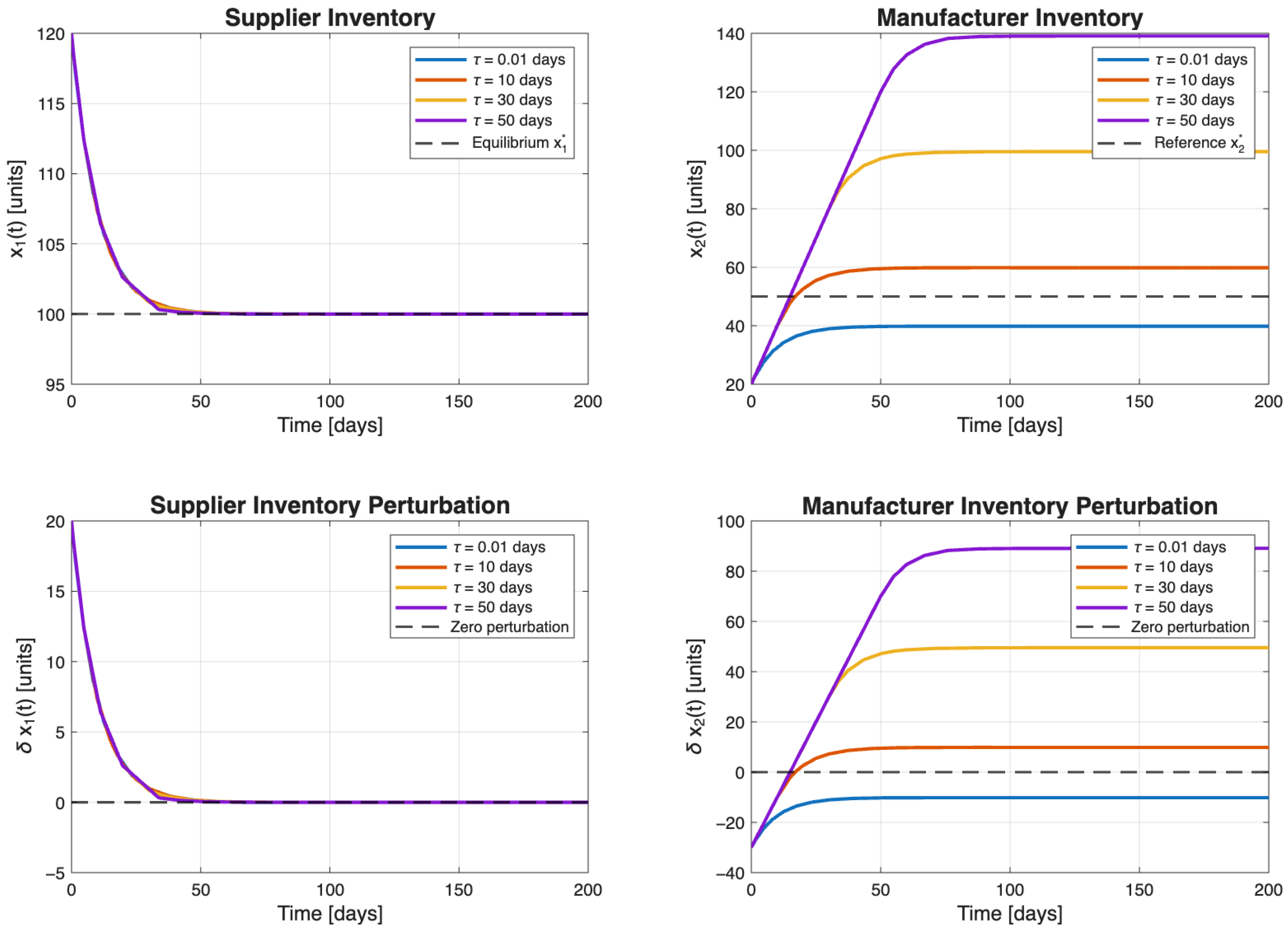
5.1. Uncoupled System Response
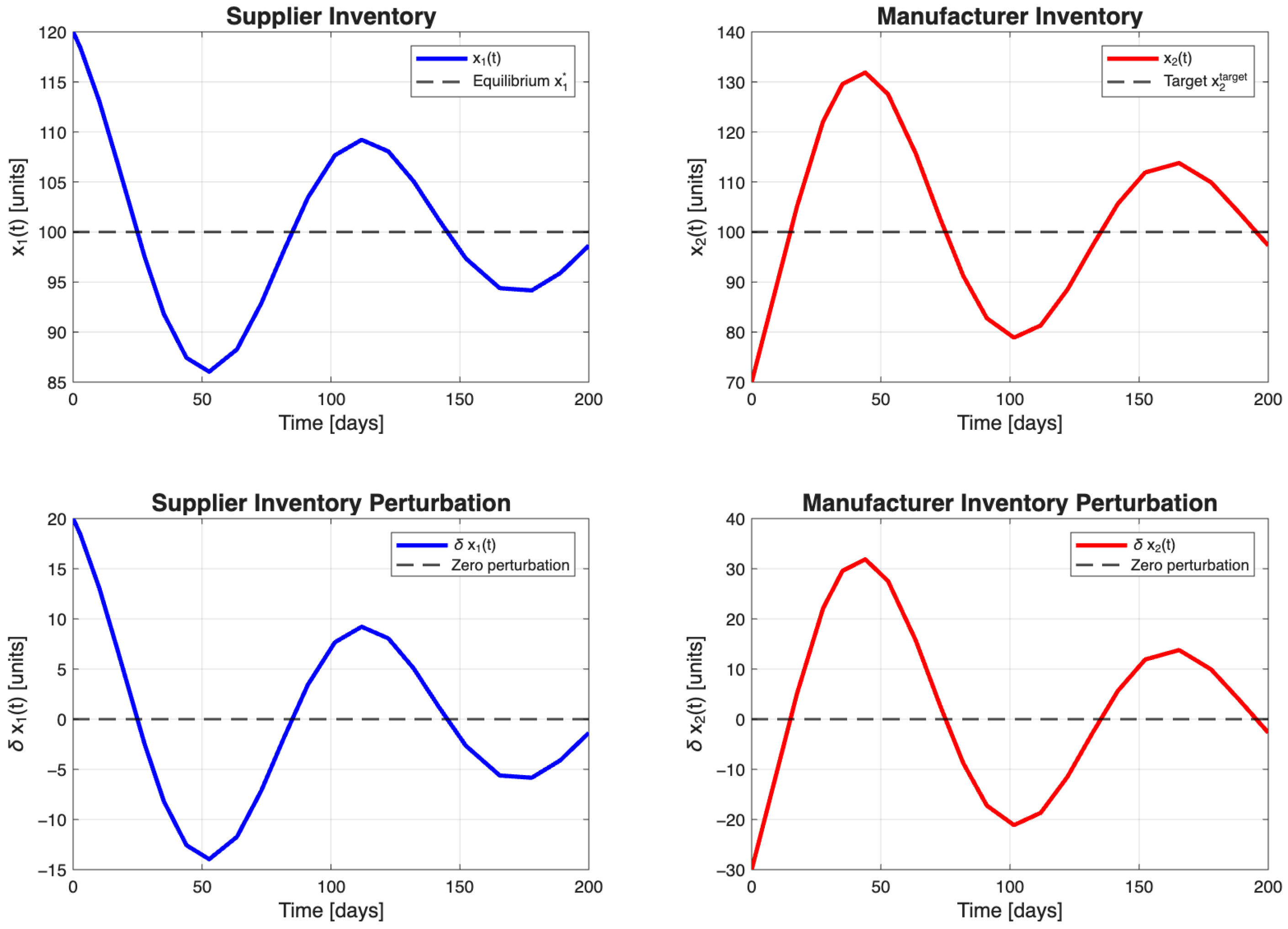
5.2. Coupled System—Stable Case
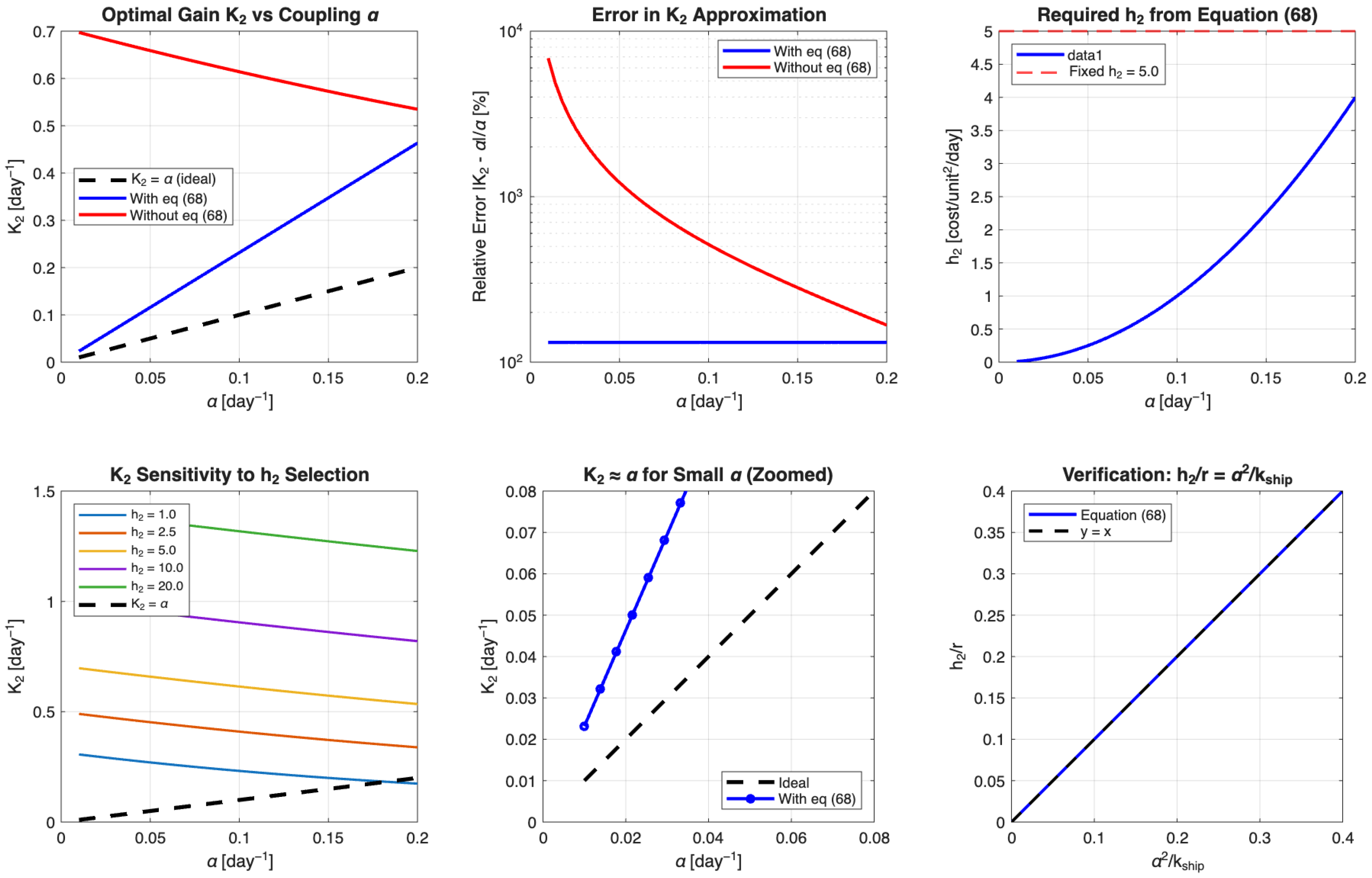
5.3. Optimal Control
6. Conclusions and Future Work
Author Contributions
Funding
Data Availability Statement
Conflicts of Interest
References
- Ivanov, D. Predicting the impacts of epidemic outbreaks on global supply chains: A simulation-based analysis on the coronavirus outbreak (COVID-19/SARS-CoV-2) case. Transp. Res. Part E Logist. Transp. Rev. 2020, 136, 101922. [Google Scholar] [CrossRef] [Scilit] [PubMed]
- Ramani, V.; Ghosh, D.; Sodhi, M.S. Understanding systemic disruption from the COVID-19-induced semiconductor shortage for the auto industry. Omega 2022, 113, 102720. [Google Scholar] [CrossRef] [Scilit] [PubMed]
- World Economic Forum. Supply Chain Resilience: How Are Pandemic-Related Disruptions Reshaping Managerial Thinking? 2021. Available online: https://www.weforum.org/stories/2021/12/supply-chain-resilience-lessons-from-covid-19/ (accessed on 26 April 2026).
- Forrester, J.W. Industrial Dynamics; MIT Press: Cambridge, MA, USA, 1961. [Google Scholar]
- Lee, H.L.; Padmanabhan, V.; Whang, S. The bullwhip effect in supply chains. Sloan Manag. Rev. 1997, 38, 93–102. [Google Scholar]
- Chen, F.; Drezner, Z.; Ryan, J.K.; Simchi-Levi, D. Quantifying the bullwhip effect in a simple supply chain: The impact of forecasting, lead times, and information. Manag. Sci. 2000, 46, 436–443. [Google Scholar] [CrossRef] [Scilit]
- Moritz, B.B.; Narayanan, A.; Parker, C. Unraveling behavioral ordering: Relative costs and the bullwhip effect. Manuf. Serv. Oper. Manag. 2022, 24, 1733–1750. [Google Scholar] [CrossRef] [Scilit]
- Yang, Y.; Lin, J.; Liu, G.; Zhou, L. The behavioural causes of bullwhip effect in supply chains: A systematic literature review. Int. J. Prod. Econ. 2021, 236, 108120. [Google Scholar] [CrossRef] [Scilit]
- Choi, T.Y.; Netland, T.H.; Sanders, N.; Sodhi, M.S.; Wagner, S.M. Just-in-time for supply chains in turbulent times. Prod. Oper. Manag. 2023, 32, 2331–2343. [Google Scholar] [CrossRef] [Scilit]
- Zhang, H.; Doan, H.T.T. Global sourcing and firm inventory during the pandemic. Emerg. Mark. Financ. Trade 2025, 62, 487–506. [Google Scholar] [CrossRef] [Scilit]
- Niu, Y.; Werle, N.; Cohen, M.; Cui, S.; Deshpande, V.; Ernst, R.; Huchzermeier, A.; Tsay, A.A.; Wu, J. Restructuring global supply chains: Navigating challenges of the COVID-19 pandemic and beyond. Manuf. Serv. Oper. Manag. 2025, 27, 1025–1036. [Google Scholar] [CrossRef] [Scilit]
- Mishra, R.; Singh, R.K.; Subramanian, N. Impact of disruptions in agri-food supply chain due to COVID-19 pandemic: Contextualised resilience framework to achieve operational excellence. Int. J. Logist. Manag. 2022, 33, 926–954. [Google Scholar] [CrossRef] [Scilit]
- Belhadi, A.; Kamble, S.; Jabbour, C.J.C.; Gunasekaran, A.; Ndubisi, N.O.; Venkatesh, M. Manufacturing and service supply chain resilience to the COVID-19 outbreak: Lessons learned from the automobile and airline industries. Technol. Forecast. Soc. Change 2021, 163, 120447. [Google Scholar] [CrossRef] [Scilit] [PubMed]
- Moosavi, J.; Fathollahi-Fard, A.M.; Dulebenets, M.A. Supply chain disruption during the COVID-19 pandemic: Recognizing potential disruption management strategies. Int. J. Disaster Risk Reduct. 2022, 75, 102983. [Google Scholar] [CrossRef] [Scilit] [PubMed]
- Canwat, V. COVID-19-related supply chain disruptions: Resilience and vulnerability of micro, small and medium enterprises. Cogent Bus. Manag. 2024, 11, 2315691. [Google Scholar] [CrossRef] [Scilit]
- Patil, C.; Prabhu, V. Supply chain cash-flow bullwhip effect: An empirical investigation. Int. J. Prod. Econ. 2024, 267, 109065. [Google Scholar] [CrossRef] [Scilit]
- Hu, Q. Bullwhip effects, disruptions and stabilities in a supply network model. Int. J. Dyn. Control 2022, 10, 1046–1061. [Google Scholar] [CrossRef] [Scilit]
- Warburton, R.D.H. An analytical investigation of the bullwhip effect. Prod. Oper. Manag. 2004, 13, 150–160. [Google Scholar] [CrossRef] [Scilit]
- Ignaciuk, P.; Bartoszewicz, A. LQ optimal sliding-mode supply policy for periodic-review inventory systems. IEEE Trans. Autom. Control 2010, 55, 269–274. [Google Scholar] [CrossRef] [Scilit]
- Ignaciuk, P. Linear-quadratic optimal control of periodic-review perishable inventory systems. IEEE Trans. Control Syst. Technol. 2012, 20, 1400–1407. [Google Scholar] [CrossRef] [Scilit]
- Gu, K.; Kharitonov, V.L.; Chen, J. Stability of Time-Delay Systems; Birkhäuser: Boston, MA, USA, 2003. [Google Scholar] [CrossRef] [Scilit]
- Lam, J. Model reduction of delay systems using Pade approximants. Int. J. Control 1993, 57, 377–391. [Google Scholar] [CrossRef] [Scilit]
- Michiels, W.; Van Assche, V.; Niculescu, S.I. Stabilization of time-delay systems with a controlled time-varying delay and applications. IEEE Trans. Autom. Control 2005, 50, 493–504. [Google Scholar] [CrossRef] [Scilit]
- Li, Y.; Qiu, T.; Yang, Y. Delay-dependent Stability Criteria for Linear Systems with Two Additive Time-varying Delays. Int. J. Control. Autom. Syst. 2022, 20, 392–402. [Google Scholar] [CrossRef] [Scilit]
- Wang, C.; Zhou, X.; Shi, X.; Jin, Y. Delay-dependent and order-dependent stability and stabilization analysis of variable fractional order uncertain differential systems with time-varying delay via linear matrix inequality approach. J. Vib. Control 2023, 29, 2763–2773. [Google Scholar] [CrossRef] [Scilit]
- Chen, L.; Wu, R.; Cheng, Y.; Chen, Y. Delay-dependent and order-dependent stability and stabilization of fractional-order linear systems with time-varying delay. IEEE Trans. Circuits Syst. II Express Briefs 2020, 67, 1064–1068. [Google Scholar] [CrossRef] [Scilit]
- Niamsup, P.; Phat, V.N. State feedback stabilization of linear descriptor time-varying delay systems. Trans. Inst. Meas. Control 2020, 42, 2191–2197. [Google Scholar] [CrossRef] [Scilit]
- Shahbazzadeh, M.; Sadati, S.J. Delay-dependent stabilization of time-delay systems with nonlinear perturbations. Circuits Syst. Signal Process. 2022, 41, 684–699. [Google Scholar] [CrossRef] [Scilit]
- Zhou, B.; Zhang, K. Stabilization of linear systems with multiple unknown time-varying input delays by linear time-varying feedback. Automatica 2025, 174, 112175. [Google Scholar] [CrossRef] [Scilit]





| Property | Uncoupled () | Coupled () |
|---|---|---|
| Characteristic equation | ||
| Delay dependence | None | Explicit through |
| Eigenvalues | , 0 | Functions of , , |
| Stability classification | Marginal (all ) | Stable if |
| Critical delay existence | No | Yes: |
| Inventory regulation | No ( drifts) | Yes () |
| Bullwhip susceptibility | Not generated | Generated when |
| [Day−1] | [Day−1] | Exact [Days] | Approx. [Days] | Error [%] |
|---|---|---|---|---|
| 0.020 | 0.100 | 70.16 | 78.54 | 11.9 |
| 0.050 | 0.100 | 25.13 | 31.42 | 25.0 |
| 0.100 | 0.100 | 11.51 | 15.71 | 36.5 |
| 0.150 | 0.100 | 7.37 | 10.47 | 42.2 |
| 0.200 | 0.100 | 5.40 | 7.85 | 45.4 |
| [Day−1] | [Day−1] | Exact [Days] | Approx. [Days] | Error [%] |
|---|---|---|---|---|
| 0.050 | 0.050 | 23.01 | 31.42 | 36.5 |
| 0.050 | 0.100 | 25.13 | 31.42 | 25.0 |
| 0.050 | 0.200 | 27.42 | 31.42 | 14.6 |
| 0.050 | 0.500 | 29.58 | 31.42 | 6.2 |
| 0.050 | 1.000 | 30.46 | 31.42 | 3.2 |
Disclaimer/Publisher’s Note: The statements, opinions and data contained in all publications are solely those of the individual author(s) and contributor(s) and not of MDPI and/or the editor(s). MDPI and/or the editor(s) disclaim responsibility for any injury to people or property resulting from any ideas, methods, instructions or products referred to in the content. |
© 2026 by the authors. Licensee MDPI, Basel, Switzerland. This article is an open access article distributed under the terms and conditions of the Creative Commons Attribution (CC BY) license.
Share and Cite
Hernandez-Santos, C.; Martinez-Malacara, G.A.; de la Cruz, N.; Reynoso-Guajardo, L.A.; Hernandez-Vega, J.I.; Gallardo-Morales, M.C.; Macias-Tobias, F.F.; Hernandez, A.; Garcia-Andrade, R. Stability Limits of Coordinated Supply Chains Under Transportation Delays: Implications for Resilient Logistics Design. Systems 2026, 14, 752. https://doi.org/10.3390/systems14070752
Hernandez-Santos C, Martinez-Malacara GA, de la Cruz N, Reynoso-Guajardo LA, Hernandez-Vega JI, Gallardo-Morales MC, Macias-Tobias FF, Hernandez A, Garcia-Andrade R. Stability Limits of Coordinated Supply Chains Under Transportation Delays: Implications for Resilient Logistics Design. Systems. 2026; 14(7):752. https://doi.org/10.3390/systems14070752
Chicago/Turabian StyleHernandez-Santos, Carlos, Gloria A. Martinez-Malacara, Nain de la Cruz, Luis Alejandro Reynoso-Guajardo, Jose Isidro Hernandez-Vega, Mario Carlos Gallardo-Morales, Francisco Fabian Macias-Tobias, Amadeo Hernandez, and Roxana Garcia-Andrade. 2026. "Stability Limits of Coordinated Supply Chains Under Transportation Delays: Implications for Resilient Logistics Design" Systems 14, no. 7: 752. https://doi.org/10.3390/systems14070752
APA StyleHernandez-Santos, C., Martinez-Malacara, G. A., de la Cruz, N., Reynoso-Guajardo, L. A., Hernandez-Vega, J. I., Gallardo-Morales, M. C., Macias-Tobias, F. F., Hernandez, A., & Garcia-Andrade, R. (2026). Stability Limits of Coordinated Supply Chains Under Transportation Delays: Implications for Resilient Logistics Design. Systems, 14(7), 752. https://doi.org/10.3390/systems14070752