1. Introduction
Recent research in transport and logistics highlights that the performance of supply chains increasingly depends on the ability to manage systemic uncertainty and operational risks. In transport systems, this dependency is further intensified by the interaction between operational efficiency, fuel consumption and emission levels, which directly affect system performance [
1,
2]. A review of the literature shows that research on the resilience of supply chains is rapidly expanding and includes a variety of quantitative optimization [
3,
4], risk assessment and scenario modeling methods that allow for the analysis of the performance of supply networks in the event of supply chain disruption [
5]. Such research highlights that modern supply chains must be understood as complex, multi-layered systems in which logistical, technological and organizational risks can interact and cause cascading consequences throughout the transport infrastructure [
6,
7]. Empirical research also shows that supply chain operations are often affected by different types of risks, from demand and supply disruptions to financial, infrastructural or geopolitical factors, which forces organizations to apply complex risk identification and management strategies that include planning, monitoring, risk allocation and systemic resilience building [
8]. Furthermore, the advancement of technology and the rise of digitalization are reshaping transport and logistics systems into data-centric frameworks, where sophisticated analytical techniques, automated management systems, and digital decision-making tools are becoming progressively vital. This evolution facilitates enhanced planning of transport processes and the optimization of logistics operations [
9]. This transformation is reshaping the structure of specialized skills, as organizations increasingly seek employees who can integrate technological, analytical, and managerial expertise to tackle complex challenges within transport systems [
10]. Research indicates that incorporating technological innovations, including digital manufacturing and advanced manufacturing technologies, into logistics systems enhances supply chain flexibility and mitigates the effects of disruptions. This integration facilitates quicker adaptation to demand fluctuations and optimizes material flow management [
11,
12,
13]. Therefore, it is important to mention that in the modern environment for training specialists operating in the transport management and logistics sector, a fundamental tension is emerging between the needs of the labor market and the ability of higher education institutions to respond to these needs. Many scientific studies agree that the sector is changing rapidly, both technologically and organizationally, and therefore traditional training models are no longer sufficient [
14,
15,
16]. The competencies of transport management graduates—especially those related to practical skills, critical thinking, digital knowledge and the ability to operate in interdisciplinary environments—are becoming a key factor for successful integration into the labor market [
17,
18,
19]. However, the literature analysis shows clear discrepancies between the formal education content and the realities of the sector, which may contribute to competence gaps and reduce the competitiveness of graduates.
A growing body of research highlights a persistent mismatch between the competencies acquired by graduates and the requirements of the labor market [
20,
21,
22], particularly in the transport and logistics sector [
23]. Studies indicate that graduates often lack practical experience, problem-solving abilities, and the capacity to operate in dynamic and technology-driven environments [
24,
25,
26]. At the same time, employers increasingly demand a combination of technical [
27], digital, and transversal competencies [
28,
29], including adaptability, critical thinking, and the ability to integrate knowledge across disciplines [
30,
31]. This gap is further intensified by rapid technological changes, digitalization, and the increasing complexity of supply chain systems [
32]. As a result, higher education institutions face significant challenges in aligning education systems as sources of competency formation with evolving industry needs, especially in logistics and transport systems, where real-world applicability and interdisciplinary competence are essential.
The aim of this article is to assess the compliance of transport/logistics specialists’ competencies with the requirements of data-driven decision-making and to evaluate their role as underlying factors influencing supply chain resilience under conditions of uncertainty. The contribution of this study does not lie in the novelty of the individual methods, but in their integrated application for analyzing the structural properties of decision criteria in a supply chain context.
2. Literature Review
Recent research on supply chains also highlights that strategic decisions in transport and logistics systems are increasingly based on multi-criteria decision-making methodologies that integrate economic, environmental and organizational criteria into a single analytical framework. Research shows that the problem of selecting sustainable and resilient suppliers is becoming one of the most important supply chain management challenges, and therefore hybrid fuzzy multi-criteria models are proposed that allow decision-makers to evaluate suppliers according to complex criteria and work effectively with incomplete or linguistic information [
33]. At the same time, the scientific literature emphasizes that the stability and financial sustainability of the supply chain increasingly depend on integrated optimization methods that combine fuzzy logic, digital technologies and multi-objective optimization methods, which allow for better modeling of complex supply chain structures and increase their resilience to risks [
34]. In addition, empirical studies emphasize that the efficiency of supply chains is increasingly assessed not only in terms of operational results, but also in terms of the ability to ensure sustainable resource use, environmental responsibility and social value; therefore, decision-making models need to integrate a wider range of sustainability indicators [
35]. This trend is further supported by research that investigates the intricacies of organizational decision-making in relation to technological advancements and digital transformation. These studies highlight the significance of analytical decision models in enabling organizations to methodically assess alternatives, diminish decision uncertainty, and enhance the quality of strategic choices [
36,
37,
38]. Recent research in innovation and technology management indicates that the integration of artificial intelligence, advanced analytics, and data-driven decision systems can significantly enhance organizations’ capabilities to predict risks, optimize processes, and strengthen the resilience of supply chains amid global disruptions [
39].
The examination of the competency requirements within the transport and logistics sector reveals that the core issue extends beyond mere deficiencies in technical or subject-specific knowledge; it also encompasses a wider understanding of what constitutes professionalism. The modern labor market requires professional versatility: the ability to integrate engineering, managerial, pedagogical and social competencies. Research reveals that effective training of a specialist in the transport sector can no longer be based solely on the traditional technological or managerial paradigm—holistic, competence-based education is needed, encompassing organizational, communicative and practical decision-making skills.
Empirical research shows that the effectiveness of engineering studies does not depend solely on the level of formal education. A clearly formed and constantly updated set of competencies is necessary, responding to the nature of real professional tasks. In other words, the quality of studies is determined not so much by formal qualifications as by the accuracy of the competency profile and its compliance with the needs of the sector [
40].
In the context of aviation transport, there is also a trend towards competency-based training. The training of cabin crew and aviation personnel has shown that formal theoretical knowledge is not enough—existing research indicates that competency development mechanisms often fail to provide the skill sets required for effective decision-making in complex supply chain environments. Areas where training remains too theoretical lead to less readiness to act in complex operational situations, generate recurring skill gaps and reduce confidence in one’s professional abilities. Research shows that the most effective training methods in this area are those that are based on practical experience, personalized feedback and consistent strengthening of instructor competencies [
41].
Similar patterns are repeated in the training of transport profile educators and training instructors. In this area, it is noted that a highly qualified specialist must be able to integrate engineering and technological knowledge with pedagogical competencies, and also be able to motivate, construct innovative training programs and generate new ideas. Pedagogical activity in the field of transport is increasingly determined by the ability to work innovatively, apply creative solutions, and combine technical and social perspectives. The role of professional teachers is becoming multifaceted: they must perform educational, communicative, engineering, technical and innovation creation functions. The most important thing is to be able to maintain a connection between technological content and the training process, ensuring that training meets the needs of real industry [
42,
43,
44,
45].
In addition, research shows that the modern transport sector is rapidly entering the era of digital transformation, and the labor market requires specialists who are able to work with artificial intelligence, IoT, data analysis, digital twins and automation solutions. This technological progress determines the need to restructure educational programs so that they not only familiarize students with technologies, but also develop their ability to critically evaluate, integrate and apply digital solutions in practical transport management situations [
46].
In this way, the literature analysis reveals a general trend: in the transport, logistics and mobility sectors, it is necessary to move from traditional theoretical studies to a competency-oriented, practice- and technology-based training model.
When analyzing the transport and logistics sector, another important direction emerges: the development of competencies cannot be isolated only in the academic environment [
47]. Research shows that the formation of professional skills is increasingly determined by the interaction between higher education institutions and the business sector [
48], and the development of practical training is considered one of the essential elements that can reduce the competency gap [
49,
50]. Many studies in the transport sector emphasize that closer cooperation with companies—through mentoring [
51,
52], project-based learning, internships and joint learning centers—significantly increases students’ readiness to solve real problems in the sector [
53,
54,
55].
A particularly important challenge is the insufficiency of practical training, which becomes apparent at an early stage of studies. Studies on dual training show that internships and training in the workplace are the most effective way to develop professional competencies, but their implementation faces structural and organizational difficulties. The quality of internships is determined not only by their duration, but also by the level of individual learning tasks, the competencies of instructors and methodological support. Studies emphasize that internships must be integrated into the structure of the study program as a systematic, consistent part of the formation of competencies, and not an episodic element of studies. Such models allow the development of both general and professional competencies, which are necessary in the rapidly changing transport sector [
56].
Another important research direction reveals that general competencies are particularly important for logistics and supply chain management specialists, including communication, problem solving, stress management, and intercultural interaction. These competencies are valued no less than professional knowledge, since logistics processes are based on coordination, negotiations, customer service and constant communication. Empirical research shows that supply chain managers working in the trade or service sectors usually lack professional–technical skills related to risk management, process analysis and supply chain optimization, but at the same time it is emphasized that general competencies have an even greater importance in everyday work. This shows that educational programs must be able to ensure the right balance between managerial, social and technical skills [
57].
The importance of intercultural competence is also constantly growing. Managers of manufacturing and transport companies note that working with partners, suppliers and customers from different cultures is an integral part of everyday life, and cultural misunderstandings often lead to mistakes, conflicts and disruptions in cooperation. Research reveals that in small companies, intercultural competence is most often developed informally—through practical experience and trial and error. This means that the formal education system leaves gaps in this area, although intercultural communication is essential for logistics companies operating in a globalized context. Researchers indicate that interactive methods should be used to develop intercultural competence, such as Story Circles, which allow students to reflect on their experiences, share real-life examples and learn through social interaction [
58].
Research data also shows that although technological competencies are necessary, they cannot replace human abilities such as critical thinking, decision-making, creativity and adaptation [
59,
60]. New challenges in the sector related to digitalization, automation, artificial intelligence and data analytics are putting significant pressure on educational institutions, but the integration of technological content must be combined with the ability to think systematically and independently solve problems [
61,
62,
63,
64,
65,
66,
67]. In the transport sector, technologies act as an enabling factor, but the ultimate value is created through the ability of specialists to apply them in complex process contexts [
17,
68,
69,
70,
71].
In summary, it can be stated that the literature clearly identifies the need to transform the training of transport management and logistics specialists so that the education system becomes significantly more focused on practical operation, interdisciplinary competencies, technological literacy and close cooperation with business. This is a necessary prerequisite in order to reduce the competence gap and ensure the successful integration of graduates into the globally competitive transport market.
However, it should be remembered that the boundaries between professional roles in supply chains and logistics are disappearing—specialists must be able to combine technical, managerial and analytical skills. Classic job models, based on clearly defined functions, are increasingly giving way to dynamic, competency-based models that allow organizations to quickly respond to market changes. Therefore, the assessment of competencies and the systematic application of their modeling methods are becoming particularly relevant. Studies analyzing the correspondence of strategic and operational roles to competency models show that supply chain specialists and logistics controllers have a very similar set of competencies, which confirms that professional profiles overlap and can be formed based on more universal competency models [
72].
On the other hand, empirical data show that the best-paid employees tend to have not only subject-specific but also transversal competencies, such as the ability to work unusual hours, travel readiness, information technology management and the ability to make decisions based on analytical data. The improvement of these skills increases the flexibility and inherent value of professionals within a company, thus creating important factors for the differentiation of pay and the progression of careers [
73].
The connection between higher education and the job market is profoundly influenced by the attractiveness of academic offerings and the ability of institutions to meet student expectations. Research shows that when choosing their academic paths, students are increasingly focusing on job opportunities, the international scope of programs, the quality of the educational environment, and the availability of practical experiences. This indicates that those engaged in curriculum development must ensure that the content is distinctly connected to actual labor market opportunities, particularly in global transport sectors like maritime, air transport, or international logistics [
74].
The significance of hands-on training becomes particularly clear when examining the objectives and shared expectations of learners, employers, and academic mentors. Research has uncovered a notable disparity in expectations surrounding internships: students view these experiences as a means to cultivate genuine professional skills, whereas employers frequently anticipate that interns will be equipped to handle particular tasks and possess fundamental professional training. In the meantime, those in positions of academic authority assess internships primarily based on scholarly outcomes—critical thinking abilities, reflective capacity, and proficiency in written communication. The discrepancy between these three perspectives may contribute to a decrease in the effectiveness of internships and limit students’ professional growth. Therefore, it is necessary to systematically improve internship organization models by increasing tripartite communication and clearly defining internship goals, assessment criteria, and methods necessary for the development of competencies [
75]. And companies that accept interns should delve deeper into the tasks presented by the higher education institution and the skills that specific practices should develop.
To summarize this part, it can be stated that the need for competencies in the transport sector is becoming increasingly multi-layered, and the labor market requires specialists who are able to operate in both technological and organizational systems. This means that higher education institutions need to systematically restructure the content of studies, combining professional, analytical, technological and social competencies, thus ensuring the sustainable integration of graduates into the rapidly changing transport industry. The business sector also needs to delve deeper into the content of the specific tasks assigned to interns.
In the transport and logistics sector, the ability to manage technological changes and understand their impact on the operational and strategic functioning of organizations is of particular importance. Artificial intelligence, automation, logistics information systems, digital twins and innovative data analysis tools are changing supply chains, requiring new skills and changing the structure of professional roles. Therefore, educational institutions must include these topics in their programs so that students not only learn to use technologies, but also understand the limits of their application, risks and strategic significance [
76]. Recent studies also emphasize the importance of integrating human and technological capabilities in enhancing supply chain resilience, particularly in the context of digital transformation and adaptive decision-making [
77].
Despite extensive research on supply chain resilience and decision-making under uncertainty, the role of human competencies remains insufficiently integrated into analytical frameworks. In complex supply chain systems, decision-making quality depends not only on data availability and analytical tools, but also on the competencies of individuals interpreting information and making strategic and operational decisions.
From a systems perspective, competencies can be understood as enabling elements that influence decision-making processes, which in turn affect the adaptive capacity and resilience of supply chains under uncertainty. Therefore, competencies act as an indirect but essential component linking human capital to system-level performance.
Summarizing the analysis of the scientific literature, it can be stated that specialists in the transport sector must be trained as professionals with a multifaceted competence structure in the future. They must be able to analyze processes, apply technologies, lead a team, solve ethical dilemmas, make decisions in complex situations and act as a connecting element between technological, organizational and social systems. This indicates the need to restructure the competency development mechanisms so that they are dynamic, practical, interdisciplinary and focused on a clearly defined competence result.
Despite intensive research in the field of supply chain resilience and decision-making under uncertainty, several key gaps remain in the existing scientific literature. First, most studies focus on technological, operational or structural factors (e.g., optimization models, supplier selection, risk scenarios), but the human factor—especially competencies as systemic decision variables—remains fragmentedly analyzed and rarely integrated into quantitative decision models. Second, although multi-criteria decision-making methods (MCDM) are widely used, they usually evaluate alternatives according to predefined criteria, but do not sufficiently examine the structural distribution of the criteria themselves, their diversity and their level of concentration in the decision system. Third, there is a lack of integrated methodological solutions that would allow for the simultaneous assessment of both the variance of the importance of criteria and their concentration structure, especially when applied to the analysis of human competencies in the context of supply chain resilience.
Considering these gaps, this study proposes an integrated multi-criteria assessment method that combines expert assessment with the application of Shannon entropy and the Gini coefficient. Such a combination of methods allows for the simultaneous assessment of the diversity (entropy) and the level of concentration (Gini coefficient) of the decision criteria structure, thus providing a more comprehensive understanding of the decision-making system.
The reviewed literature provides the basis for structuring the competency evaluation framework and selecting appropriate analytical methods applied in this study.
The contribution of this study lies in the integrated application of established statistical and information-theoretic measures for the analysis of competency structures in the context of supply chain resilience. First, for the first time, competencies are systematically treated as quantitatively assessed decision variables in the analysis of the resilience of supply chains. Second, the proposed integrated application of entropy and inequality indicators allows for a transition from the traditional determination of criteria weights to their structural analysis. Third, the study extends the paradigm of data-driven decision-making by including the human capital dimension as an essential systemic factor. While Shannon entropy and the Gini coefficient are widely used in different domains, their combined application for analyzing the structural properties of competency-based decision criteria in transport and logistics systems remains limited.
Based on this, the aim of this article is to assess the compliance of transport and logistics specialists’ competencies with the requirements of data-driven decision-making in the context of supply chain resilience, applying an integrated multi-criteria assessment methodology based on entropy and inequality indicators and identifying the main features of the competency structure and their significance for the decision-making system.
From a theoretical perspective, competencies can be interpreted within the framework of human capital theory, where individual skills and knowledge constitute key organizational resources that contribute to performance and adaptability. In the context of supply chain systems, this perspective can be further extended through the lens of dynamic capabilities, which emphasize the ability of organizations to integrate, build, and reconfigure competencies in response to rapidly changing environments. Therefore, competencies in this study are not treated as direct causal determinants of supply chain resilience, but rather as underlying enabling factors that shape the adaptive capacity of the system.
3. Materials and Methods
This study focuses on the assessment of competencies required for data-driven decision-making in the context of supply chain resilience in the transport and logistics sector. The research is based on an expert evaluation approach, which is widely applied in multi-criteria decision-making problems where empirical data are limited and professional judgment is essential.
The study aims to evaluate the relative importance of different competency groups and identify structural patterns in their distribution using statistical and information-theoretic measures.
The competency factors analyzed in this study were identified based on a structured review of the scientific literature on transport and logistics education, labor market requirements, supply chain resilience, and competency-based decision-making. The literature analysis allowed for the identification of recurring competency dimensions, which were grouped and transformed into evaluation criteria suitable for expert assessment.
Based on this process, the criteria were organized into six thematic groups: (1) factors influencing the competitiveness of young graduates in the labor market, (2) qualities of a good employee, (3) criteria for specialist training, (4) personal qualities of future employees, (5) priorities of a modern employee, and (6) competencies of transport management specialists. These groups formed the basis for the expert evaluation.
In this study, competencies are operationalized as perception-based evaluation criteria derived from expert judgment. These criteria do not directly measure causal effects on supply chain performance; rather, they reflect the perceived importance of different competency dimensions in shaping decision-making processes under uncertainty.
The empirical part of the study was based on expert evaluation. Experts were selected using purposive sampling, with the aim of ensuring relevance to the research problem. The selection criteria required that experts have professional or academic experience in at least one of the following areas: transport management, logistics, supply chain management, labor market analysis, or higher education in transport-related fields.
The expert panel was formed to reflect both academic and industry perspectives, ensuring a balanced evaluation of competency requirements from the viewpoint of education providers and labor market stakeholders.
Based on the identified competency framework and expert evaluation design, the study consists of the following main stages:
1. Expert assessment. Calculations (data collection and expert assessment, assessment of the consistency of expert opinions, assessment of the consistency of expert opinions using the Kendall concordance coefficient, checking statistical significance using the chi-square criterion, and determination of criterion weights) were made based on the methodologies used in the works of Kendall [
78], Podvezko [
79], and Sivilevičius [
80]. A total of 20 experts participated in the study, ensuring a sufficiently broad and reliable basis for the evaluation of competency-related criteria. The study involved representatives of Lithuanian companies that are actively involved in the transport sector. The main requirements for experts were work experience in the transport sector, including organizing international freight transport, forwarding, providing 3PL logistics services and managing supply chains. Experts were selected using a purposive sampling method, ensuring that each of them had at least 5 years of professional experience in the logistics sector and represented different companies and functional roles. In order to ensure sample diversity, experts represented companies of different sizes. The size of the analyzed companies ranged from small (up to 10 employees) to large (over 250 employees); therefore, different organizational structures, management levels and operational processes were reflected. The experts participated in a structured ranking procedure, where they evaluated the relative importance of the criteria within each thematic group. In summary, it can be stated that the sample of experts covers different activity profiles related to management and high-skilled functions, operational logistics activities and logistics coordination. This shows that the experts represent different segments of the logistics sector, therefore their assessments can be considered suitable for a comprehensive assessment of logistics processes. The results obtained allow us to state that the sample of experts is not homogeneous and covers various organizational, functional and competence perspectives relevant to companies in the transport sector. Therefore, the collected evaluations were aggregated and further analyzed using Kendall’s coefficient of concordance to assess the consistency of expert opinions.
The use of expert evaluation was chosen due to the complexity of competency assessment, where quantitative data are limited and professional experience plays a crucial role in evaluating real-world relevance.
To ensure transparency while preserving confidentiality, the characteristics of the experts are presented in aggregated form. It should be noted that Kendall’s coefficient values below 0.3 generally indicate low agreement; however, in studies involving complex and subjective evaluations, such levels may still be considered acceptable, especially when supported by statistical significance testing.
In this study, competencies are treated as conceptual constructions derived from literature and operationalized as evaluation criteria within a multi-criteria decision-making framework. These criteria represent aggregated dimensions of competencies rather than directly measured variables based on standardized psychometric scales.
The selected competency categories (e.g., personal qualities, adaptability, initiative) reflect commonly identified dimensions in the literature on competency-based education and labor market requirements, particularly in the transport and logistics sector.
In this study, expert evaluations are treated as structured input data, which are subsequently analyzed using statistical and information-theoretic methods. Therefore, the approach can be considered data-driven in the sense that decision-making is based on systematically processed and quantified information, rather than purely qualitative judgment. It should be noted that the results are based on expert evaluations and represent perceived relationships between factors. Therefore, the findings should be interpreted as indicative and descriptive rather than as evidence of causal relationships.
2. The Shannon entropy index was calculated [
81,
82,
83]. The Shannon entropy index is widely used in information theory, ecology, economics, and transport systems analysis to assess the heterogeneity or diversity of distribution of a system. This index measures the amount of uncertainty or information in a probabilistic system. Suppose that the system consists of
n categories (or classes), the relative parts of which are defined as
pi, where
Here: xi—observed value of the i-th category, n—total number of categories, pi—relative probability or proportion of the i-th category.
Shannon entropy is calculated as:
Here: H—Shannon entropy index, ln—natural logarithm.
The value of the index depends on the number of categories. Maximum entropy is obtained when all categories have equal probabilities:
To compare systems of different sizes, the normalized Shannon entropy is often used:
Here, H′ ∈ [0, 1], where H′ = 0 means complete concentration in one category, and H′ = 1 means completely uniform distribution.
In this study, Shannon entropy is used to evaluate the diversity and distribution of the importance of competency criteria within the decision-making structure.
3. Calculated Gini coefficient. The Gini coefficient is one of the most commonly used measures of inequality or concentration, widely used in economics, transport systems analysis, environmental studies, and resource allocation assessment. Suppose we have
n observations
xi, sorted in ascending order:
The average value is calculated as:
The Gini coefficient can be calculated using the formula:
Here: G—Gini coefficient, n—number of observations, μ—sample mean, |xi–xj|—absolute difference between two observations.
In practical calculations, a simplified formula is often used:
Here the data must be sorted in ascending order.
The Gini coefficient takes values in the interval:
Interpretation: G = 0—perfectly uniform distribution, G = 1—maximum concentration level.
The Gini coefficient is applied to assess the degree of concentration or inequality among the evaluated competency criteria.
In this study, the Shannon entropy index is used to assess the diversity of the distribution or the heterogeneity of the system, and the Gini coefficient is used to determine the level of concentration and inequality. The combination of these two indicators allows for the assessment of both dispersion and concentration, making the method suitable for the structural analysis of complex transport, energy or emissions systems.
From a structural perspective, such a distribution suggests a relatively high level of diversity among the evaluated criteria, which is later confirmed by the entropy and Gini coefficient analysis presented in subsequent sections.
In summary, it can be stated that the combination of expert evaluation and statistical measures enables a comprehensive analysis of both the relative importance and structural distribution of competencies within the decision-making framework. It should be noted that the methods applied in this study are not novel in themselves; however, their combined use allows for a complementary analysis of both diversity and concentration within the decision-making framework.
The competency framework used in this study is not intended to represent a latent variable measurement model, but rather a structured set of evaluation criteria derived from literature and expert knowledge. Therefore, statistical validation methods such as factor analysis were not applied, as the study focuses on decision-making structures rather than psychometric scale development.
The selection of competency groups is based on recurring themes identified in the literature and reflects commonly recognized dimensions in transport and logistics systems, particularly in the context of decision-making under uncertainty.
4. Results
It should be noted that the results reflect expert-based evaluations and represent perceived relationships between competency factors. Therefore, the interpretations provided below are indicative and should not be understood as evidence of direct causal relationships.
The analysis of scientific literature sources allowed us to identify that transport sector specialists must be trained as professionals with a multifaceted competence structure because employee competencies are directly related to the analysis of supply chain risk and resilience in the face of uncertainty. In addition, the development of employee competencies directly increases the adaptive capacity of the supply chain. Therefore, based on the example of the transport sector, it was relevant to find out the factors that most influence the competitiveness of a young person in the labor market. Since five main possible alternatives were presented during the study, the experts had to assess the importance of their placement by ranking. The results obtained are summarized and calculated according to the methodology specified in the methodology for calculating ranks and priority assessments (
Table 1).
The evaluated factors should be interpreted as generalized competency dimensions rather than narrowly defined measurable constructs.
Before prioritizing the results, the consistency of expert opinions was evaluated using Kendall’s coefficient of concordance (W). The obtained value of Kendall’s coefficient (W = 0.1338) indicates a low level of agreement among experts. However, the result is statistically significant (χ2 test), suggesting that the observed ranking structure is not random and reflects a consistent, though weak, tendency in expert evaluations. Here, W represents the degree of concordance among expert rankings, χ2 is used to test the statistical significance of this agreement, and Wmin denotes the minimum threshold required for the agreement to be considered sufficient. Therefore, the consistency of expert opinions allows for further analysis of the relative importance of the evaluated factors.
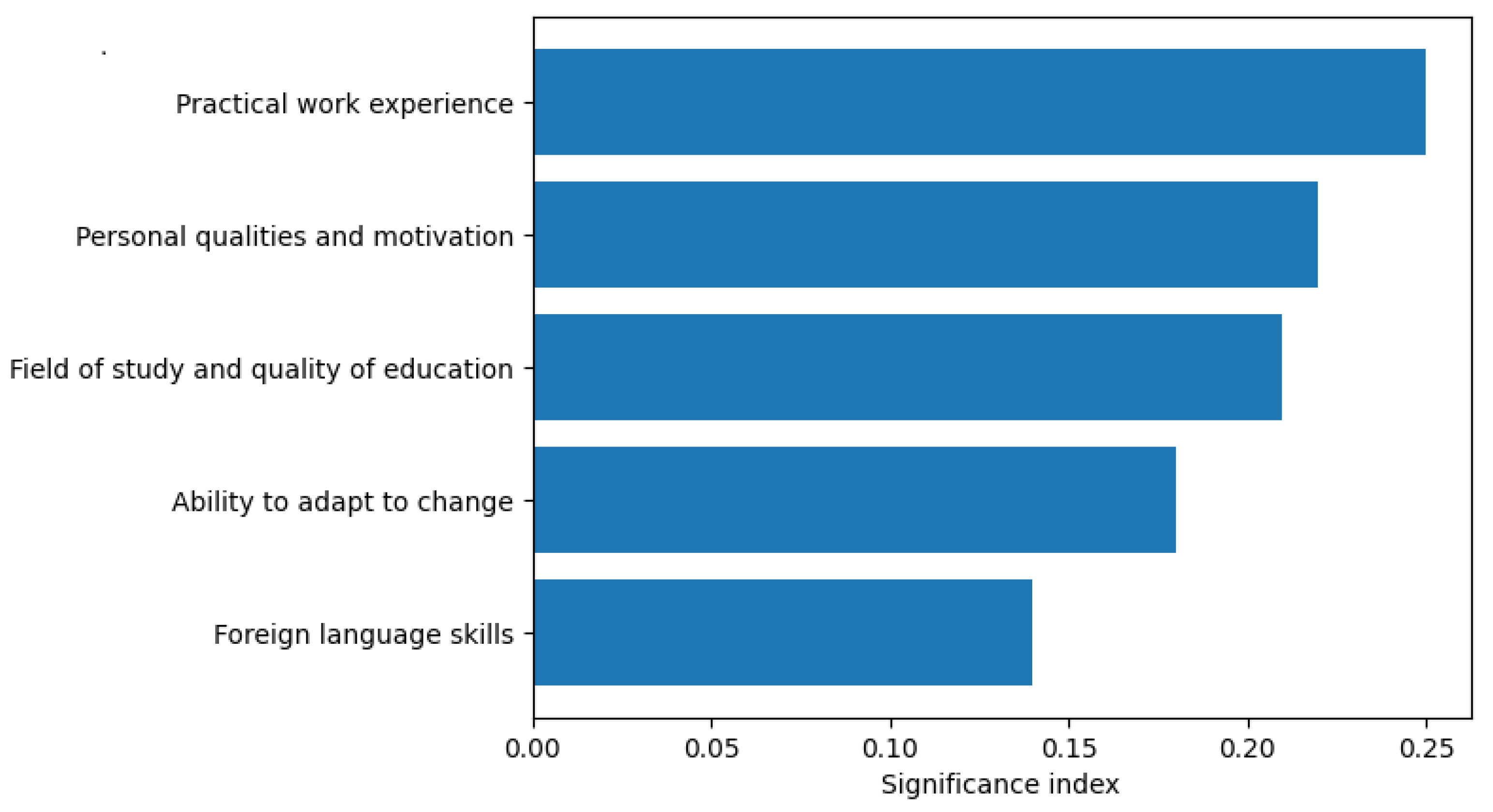
The calculations performed show that the results indicate a weak to moderate level of agreement among experts, and the factors that most influence the competitiveness of a young person in the labor market are arranged in the following order (from the most important to the least important) (
Figure 1).
Figure 1 clearly shows the relative importance of the criteria when assessing the competitiveness of young people in the labor market. The coefficient of variation of the weights is CV ≈ 0.17, indicating a relatively low to moderate level of variability among the evaluated factors. This suggests that although differences between criteria exist, the overall structure remains relatively balanced. The greatest weight is given to practical work experience (0.2475), followed by personal qualities and motivation (0.2174), acquired specialty and quality of education (0.2107), ability to adapt to changes (0.1873), and the lowest importance is given by respondents to knowledge of foreign languages (0.1438).
The results suggest a structured relationship between labor market expectations and the relative importance of the evaluated criteria. Practical work experience takes first place, which may be interpreted as reflecting its perceived importance in reducing employer-related uncertainty. In the labor market, each new employee generates adaptation costs—training, supervision, and loss of productivity at the beginning. A candidate with practical experience requires lower investments and reaches the level of productivity faster; therefore, his economic value to the organization becomes clearer and more defined. It is this logic of risk reduction that indicates practical experience has almost 1.7 times more weight than foreign language proficiency.
Personal qualities and motivation, which are in second place, indicate a structural shift in the labor market towards the assessment of behavioral competencies. Organizations operate in a dynamic environment where technological and organizational changes are taking place rapidly. As a result, employee motivation and responsibility become a guarantee of productivity stability. The causal relationship here is based on the fact that a motivated employee tends to invest additional effort, learn faster and maintain a higher level of commitment, which in the long run creates greater added value.
The specialty and quality of education, which are in third place, indicate that formal capital still remains important, but it is no longer the dominant factor. This can be explained by the transformation of the labor market: in the knowledge economy, information is widely available, so a diploma in itself no longer ensures competence. Practical experience and real tasks become more effective proof of abilities than a formal document.
The ability to adapt to change ranks fourth, but its weight still remains significant. This reflects the impact of technological progress on the labor market. Organizations are faced with digitalization, automation and the development of artificial intelligence, so the adaptability of an employee becomes a condition for long-term employment. If an employee is unable to adapt, his or her competencies quickly depreciate, which directly affects his or her competitiveness.
The least important criterion—knowledge of foreign languages—can be interpreted as a specific rather than a universal factor. Not all jobs require international communication, so language skills become important only in certain sectors. This suggests their lower weight in the overall assessment.
In summary, it can be stated that in the labor market, priority is given to factors that generate direct economic value. Practical experience and personal qualities create a direct impact on productivity; therefore, their significance is the greatest. Formal education and additional skills remain important, but their role is secondary. This shows that the competitiveness structure is moving from formal qualifications to a model of assessing real activities and behavioral competencies.
Although practical work experience is identified as the most important factor, further analysis focuses on personal qualities and motivation due to their multidimensional and less directly observable nature. Unlike practical experience, which reflects accumulated knowledge and skills, personal qualities represent behavioral and adaptive competencies that play a crucial role in decision-making processes and long-term employability. Therefore, a more detailed analysis of this factor allows for a deeper understanding of competency structures in the context of supply chain resilience.
Regardless of the factors determining the competitiveness of a young person, it is also important to consider what personal qualities he should have. Since five main possible alternatives were presented during the study, the experts had to assess the importance of their arrangement by ranking. The results obtained are summarized and calculated according to the methodology specified, including the calculations of ranks and priority assessment (
Table 2).
Before prioritizing the results, an assessment of the consistency of opinions was performed. The results obtained (W = 0.1640; χ2 = 13.1200; Wmin = 0.1186) allowed us to determine that the experts’ opinions are consistent, which allows us to further assess the importance of the arrangement of the characteristics of a good employee.
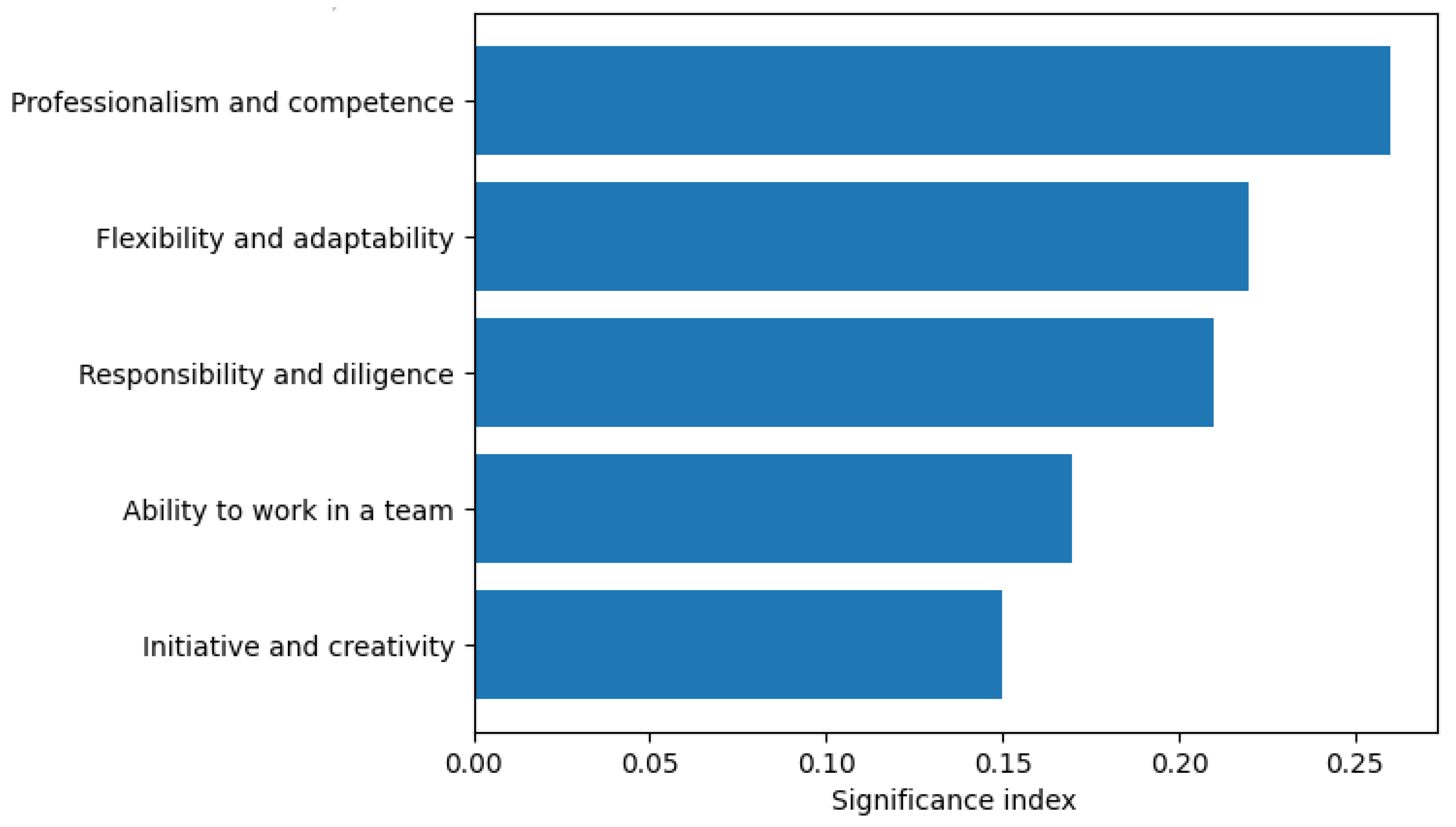
The calculations performed showed that the experts’ opinions are consistent, and the characteristics of a good employee are arranged in the following order (from the most important to the least important) (
Figure 2).
As shown in
Figure 2, the highest weight is given to professionalism and competence in one’s field (0.2600), followed by flexibility and the ability to adapt to changes (0.2167), responsibility and duty (0.2033), the ability to work in a team (0.1700), and the lowest value is given to initiative and creativity (0.1500).
The results show a clear structural hierarchy, allowing us to identify the relationship between organizational performance and the prioritization of employee characteristics. Professionalism and competence take first place because they are direct factors of productivity. A competent employee is able to independently solve problems, make informed decisions and ensure the quality of work without additional control. From an organizational point of view, this reduces maintenance costs, the likelihood of errors and process disruptions. In other words, high competence creates a direct economic effect—greater efficiency and lower operational risk. It is this clear relationship between competence and the organization’s performance that suggests the highest weight for this criterion.
Flexibility and adaptability, which are in second place, reflect the realities of a dynamic work environment. Technological changes, digitalization, project work and changing customer needs mean that static competence is no longer sufficient. If an employee is unable to adapt, their professionalism becomes limited in specific conditions. Thus, the causal relationship here is based on the fact that flexibility ensures the relevance of competence over time. In other words, professionalism creates value “today”, while adaptation allows it to be maintained “tomorrow”.
Responsibility and duty, which are in third place, indicate the need for stability and reliability in organizations. A responsible employee meets deadlines, fulfills obligations and reduces uncertainty in team processes. The causal mechanism here is related to coordination costs: the more reliable the employee, the less control, reminders and corrective actions are needed. This allows for a more efficient allocation of managers’ time and reduces administrative costs. Therefore, responsibility becomes a key factor in organizational stability.
The ability to work in a team, although important, ranks only fourth. This may mean that respondents primarily value individual contributions to the result, and only then collective interaction. The causal explanation may be related to the fact that the effectiveness of teamwork often depends on individual competencies. If team members are not professional or responsible, even good cooperation skills will not create high added value. Thus, team skills become a secondary factor that strengthens, but does not replace, the importance of individual competencies.
Initiative and creativity, which have the lowest weight, reveal an interesting trend. Although innovation is considered an important source of competitiveness, respondents evaluate them more cautiously than the basic qualities of work quality and reliability. This can be explained by the risk aspect: creativity can generate new ideas, but it can also increase uncertainty. In organizations where process stability is important, priority may be given to reliable performance rather than experimentation. Therefore, initiative becomes an additional, but not essential, criterion.
In summary, it can be stated that organizations primarily seek to ensure basic operational efficiency and quality (professionalism), then the ability to maintain this efficiency in changing conditions (flexibility), and then process stability (responsibility). Only after ensuring these fundamental factors do team and creative aspects gain importance. Such a hierarchy shows that the concept of a good employee is primarily based on economic rationality and risk management, and only later on innovative potential.
Therefore, when training specialists, a very important issue is the criteria for training specialists. Since 9 main possible alternatives were presented during the study, the experts had to assess the importance of their arrangement by ranking. The results obtained are summarized and calculated according to the methodology specified, along with calculations of ranks and priority assessment (
Table 3).
Before prioritizing the results, an assessment of the consistency of opinions was performed. The results obtained (W = 0.4735; χ2 = 75.7667; Wmin = 0.0969) allowed us to determine that the opinions of the experts are consistent, which allows us to further assess the importance of the arrangement of the criteria for training specialists.
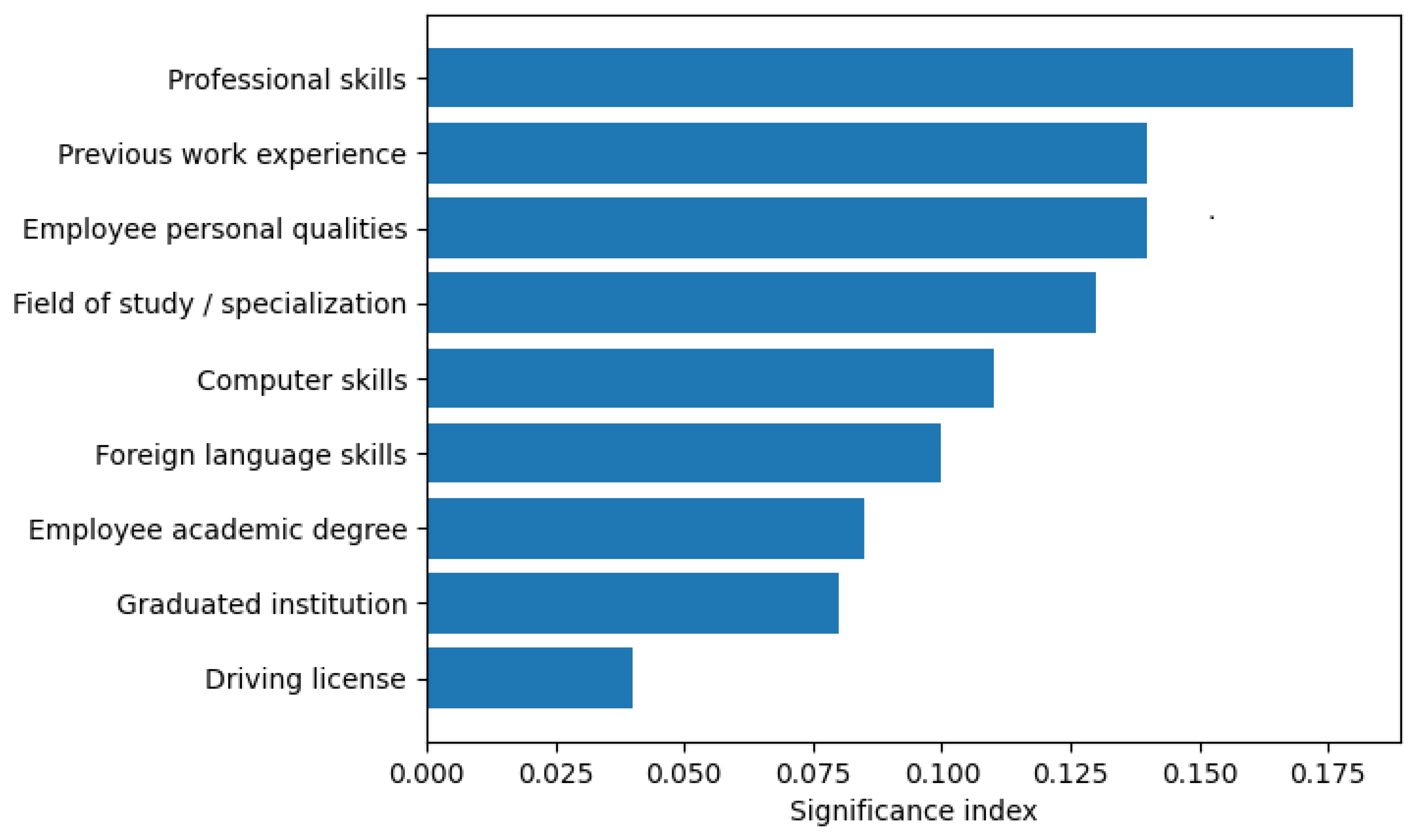
The calculations performed showed that the opinions of the experts are consistent, and the criteria for training specialists are arranged in the following order (from the most important to the least important) (
Figure 3).
From
Figure 3 it can be seen that professional skills have the greatest weight (0.1825), followed by previous work experience (0.1400), the employee’s personal qualities (0.1389), acquired specialty or specialization (0.1377), computer work (0.1086), foreign language skills (0.1008), the employee’s scientific degree (0.0851), educational institution graduated from (0.0840), and the least significant criterion is a driver’s license (0.0381).
This structure allows us to identify a clear association between the requirements of labor market efficiency and the prioritization of training criteria. Professional skills take first place because they directly correlate with the employee’s ability to create added value. Skills are operational-level competencies that allow for performing specific tasks without additional training. The higher the skill level, the lower the organization’s adaptation costs, the shorter the implementation period and the faster the achievement of productivity. Thus, the causal mechanism is direct: high skills → lower costs → higher efficiency → higher competitiveness.
Previous work experience, which is in second place, complements the importance of skills. Experience signals that the employee has already operated in real market conditions, faced practical problems and avoided the limitations of theoretical knowledge. The causal relationship here is related to the reduction of uncertainty: experience reduces the employer’s risk because it allows predicting the employee’s behavior and quality of performance. Therefore, experience becomes an important selection criterion that strengthens the value of professional skills.
Personal traits and acquired specialty, which are in third and fourth place, show that the labor market values both behavioral and formal qualification aspects, but they are inferior to direct practical abilities. The acquired specialty reflects theoretical preparation, but without real skills it does not have sufficient weight. This shows a causal sequence: a theoretical basis provides the opportunity to acquire skills, but does not in itself create direct economic value. Personal qualities such as responsibility or initiative act as productivity enhancers, but without basic professional competencies their impact is limited.
Computer skills and foreign language skills, which are in the medium-importance group, reflect the technological and global market context. Digital skills are becoming a prerequisite in many sectors, so their importance is significant, but they are considered general, not differentiating criteria. Foreign languages are particularly important in international activities, but they are not a critical factor in all positions, so their weight is lower than that of professional skills.
The lower weight of a scientific degree and a completed educational institution indicates a structural change in the labor market—formal indicators of prestige are losing dominance over real abilities. The causal relationship here is based on the fact that a diploma or the name of an institution are indirect indicators of competence. If an organization can directly assess skills or experience, formal reputation becomes a secondary criterion.
The least significant driver’s license reflects its specific nature. It is a functional but narrowly applied ability, required only in certain positions. Therefore, its weight is minimal in the general structure of training criteria.
In summary, it can be stated that there is a clear concentration of priorities on the criteria of operational efficiency. The labor market primarily values what can be directly interpreted within the framework of economic reasoning, where competencies are associated with productivity and efficiency and reduce adaptation costs. Theoretical and prestige aspects remain important, but their significance is subordinated to practical abilities. This confirms the transition of competence assessment from a formal qualification model to a performance-based model in which functionality and efficiency dominate.
On the other hand, no less important are the personal characteristics of the employee himself. Since 11 main possible alternatives were presented during the study, the experts had to assess the importance of their arrangement by ranking. The results obtained are summarized and calculated according to the methodology specified, including calculations of ranks and priority assessment (
Table 4).
Before prioritizing the results, an assessment of the consistency of opinions was performed. The results obtained (W = 0.2542; χ2 = 50.8409; Wmin = 0.0915) allowed us to determine that the experts’ opinions are consistent, which allows us to further assess the importance of the arrangement of employees’ personal characteristics.
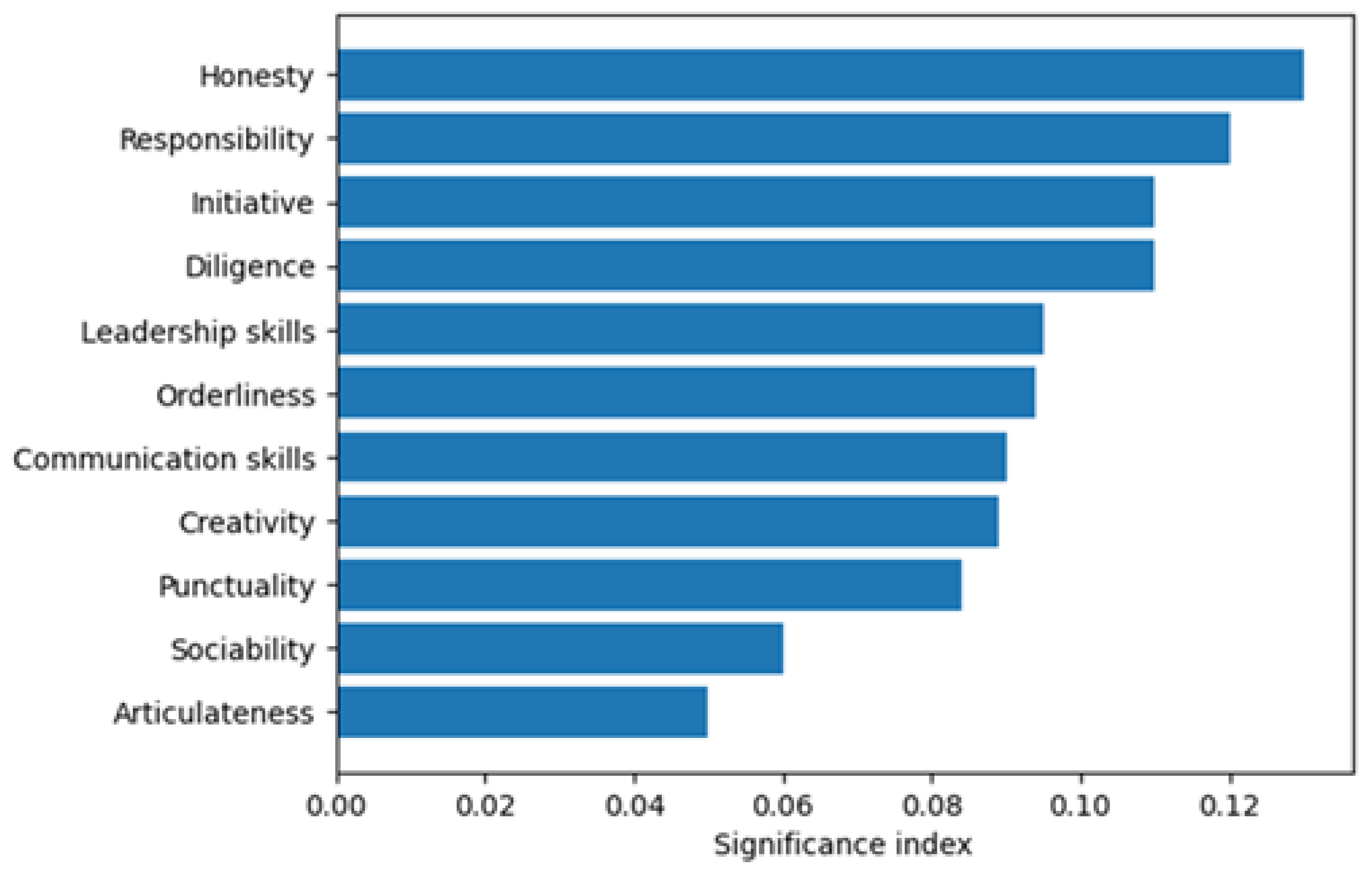
The calculations performed showed that the experts’ opinions are consistent, and the personal characteristics of future employees are arranged in the following order (from the most important to the least important) for the business sector (
Figure 4).
Figure 4 The distribution of the significance of eleven personal qualities reveals a clear value hierarchy. The greatest weight is given to honesty (0.1324), followed by duty (0.1224) in second place, and then initiative and diligence (0.1102 each) in the third and fourth place, respectively. This is followed by leadership skills (0.0926), orderliness (0.0910), sociability (0.0880), resourcefulness (0.0872), punctuality (0.0811), while the least significant qualities are sociability (0.0566) and eloquence (0.0482).
This structure allows us to establish a connection between the need for stability in organizations’ operations and the priority of valued personal qualities. Honesty takes first place because it is directly related to the trust mechanism within the organization. Any organization relies on internal control and coordination processes. If an employee is dishonest, additional control costs arise, and the risk of information leakage, financial losses or reputational damage increases. Thus, the causal relationship is clear: high level of honesty → lower intensity of the need for control → lower transaction costs → higher organizational efficiency. It is precisely because of this economic logic that honesty becomes a key priority.
In second place, conscientiousness complements honesty as a guarantee of stability. A conscientious employee adheres to established procedures, deadlines and obligations. This reduces process disruptions and the complexity of coordination. If employees systematically fail to perform their duties, the organization is forced to invest more resources in supervision and error correction. Therefore, conscientiousness becomes a structural condition that allows for maintaining operational consistency.
Initiative and diligence, occupying a middle position, show that respondents value the potential for increasing productivity, but only after basic ethical qualities. Initiative generates new ideas and solutions, and diligence ensures greater work intensity. The causal relationship here is related to performance: the higher the employee’s involvement and activity, the greater the likelihood of achieving higher performance indicators. However, without honesty and duty, these qualities may be ineffective or even risky, so their weight is lower than that of basic moral traits.
Leadership skills, orderliness, sociability and resourcefulness form a secondary group of qualities. These qualities strengthen team interaction and innovative potential, but they are not critical for everyday functional stability. For example, sociability helps to coordinate activities, but if an employee is not honest or dutiful, even good communication skills will not compensate for structural deficiencies. Resourcefulness can promote creative solutions, but without discipline it can cause procedural uncertainty. Therefore, their significance remains moderate.
The least important qualities—sociability and eloquence—reflect traits of a representational nature that are not directly related to operational productivity. Sociability may be valuable in certain positions (e.g., in public relations or sales), but in many professions it does not have a direct impact on results. Eloquence, although important in communication, is not necessary in every workplace, so its weight is the smallest.
Summarizing the results of the study, it can be stated that they reveal a clear pattern of priorities: first of all, qualities that reduce organizational risk and ensure stability (honesty, duty); then, qualities that increase productivity (initiative, diligence); and only later, qualities that strengthen representative or innovative potential. This shows that the assessment of a future employee is based on economic rationality: organizations primarily seek to ensure reliability and reduce control costs, and only then consider features that create an additional competitive advantage.
Therefore, it is important to find out what priorities of a modern employee are important. Since seven main possible alternatives were presented during the study, experts had to assess the importance of their arrangement by ranking. The results obtained are summarized and calculated according to the methodology specified for calculating ranks and priority evaluation (
Table 5).
Before determining the priorities of the results, an assessment of the compatibility of opinions was carried out. The results obtained (W = 0.2204; χ2 = 26.4536; Wmin = 0.1049) allowed us to conclude that the opinions of the experts are consistent, which allows us to further assess the importance of the arrangement of priorities in the activities of a modern employee.
The calculations performed showed that the opinions of the experts are consistent, and the priorities in the activities of a modern employee are arranged in the following order (from the most important to the least important) (
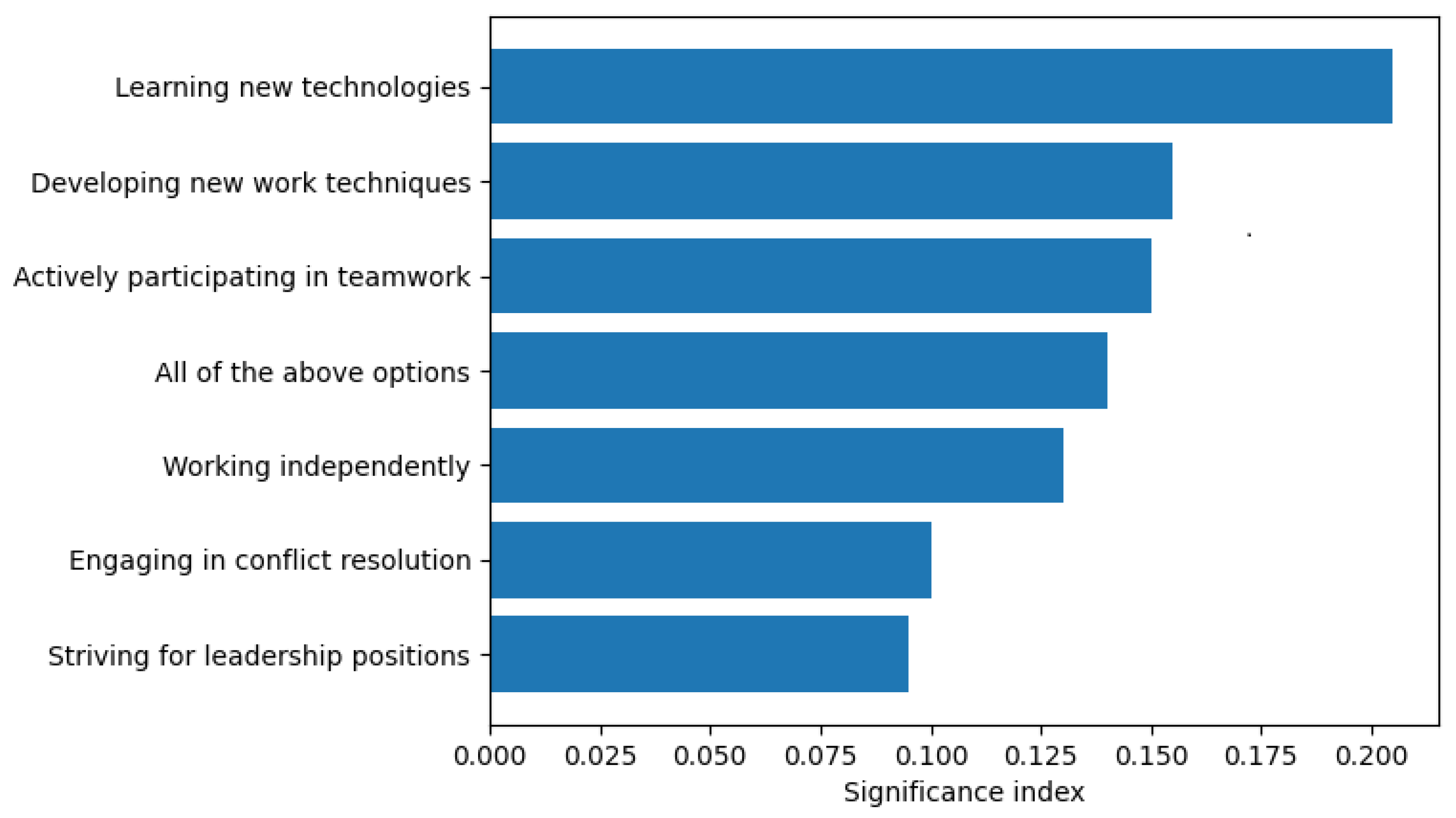
Figure 5).
The results of
Figure 5 show that learning new technologies (0.2035) has the highest weight, followed by developing new work techniques (0.1540) and active participation in teamwork (0.1504). Next in line are the options “all of the above” (0.1416), independent work (0.1345), involvement in conflict regulation (0.1009), and the lowest weight is the desire to occupy leadership positions (0.0973).
The structure of the results shows a clear association between changes in the technological environment and employee behavioral priorities. Learning new technologies takes the first place because technological progress directly affects the nature of work processes, productivity and competitiveness. Organizations that implement new technologies can reduce operating costs, automate processes and increase the quality of services or products. However, the effectiveness of technology implementation depends on the ability of employees to master them. Therefore, the causal mechanism is clear: technological change → the need for new competencies → employee learning → maintaining the organization’s competitive advantage. If an employee does not learn, his or her qualifications quickly depreciate, which directly reduces his or her value in the labor market.
The development of new work techniques, which is in second place, complements technological learning. Even after mastering technologies, it is necessary to optimize work processes. New techniques allow for improved efficiency, shorter cycles, and reduced error probability. The causal relationship here is based on the innovation principle: improvement of methods → higher process efficiency → better performance results → stronger position of the organization in the market. This shows that respondents understand not only the importance of technologies, but also the significance of process improvement.
Active participation in teamwork, which is in third place, reflects the structure of a modern organization. Most projects are implemented on a team basis, which requires the combination of different competencies. If employees are unable to cooperate, even high individual competencies do not create maximum results. Therefore, the causal relationship is related to the synergy effect: effective teamwork → better knowledge integration → higher quality of innovations and solutions → higher competitiveness.
The choice “all of the above options” in the middle position indicates a complex approach to the role of the employee. This can be interpreted as the perception that in a competitive market, one-way actions are not enough—multifaceted development is necessary. However, this answer is not a specific behavioral model; therefore, its weight is lower than that of specific actions.
Independent work takes fifth place. This shows that autonomy is valued, but it is not considered the most important factor. The causal explanation may be related to the fact that excessive individual autonomy without coordination can reduce team efficiency. Therefore, autonomy is important, but subordinate to technological and process development.
Conflict regulation and the aspiration to occupy leadership positions, which have lower weights, indicate that respondents prioritize competence development rather than power or status aspects. Conflict resolution is important for organizational climate, but it is considered a situational rather than a universal activity priority. The pursuit of leadership can be perceived as a career goal, but not every employee must occupy a leadership position in order to be competitive.
Summarizing the results, it can be stated that technological and process adaptation is the main condition for competitiveness. First, the employee must ensure the relevance of his or her competence (learning), then effectively apply knowledge (development of work techniques), and only then integrate into the organizational structure (teamwork). Aspects of status or power are considered secondary. This shows that the model of a modern employee is based on continuous improvement and functional adaptation to market dynamics.
Looking at the specifics of the transport sector, it is important to find out what competencies specialists in this field must possess. Since eight main possible alternatives were presented during the study, the experts had to assess the importance of their placement by ranking. The results obtained are summarized and calculated according to the methodology specified in the methodology for calculating ranks and priority evaluation (
Table 6).
Before prioritizing the results, an assessment of the consistency of opinions was performed. The results obtained (W = 0.1733; χ2 = 24.2667; Wmin = 0.1005) allowed us to determine that the experts’ opinions are consistent, which allows us to further assess the importance of the arrangement of priorities for the competencies of transport management specialists.
The calculations performed showed that the experts’ opinions are consistent, and the priorities for the competencies of transport management specialists are arranged in the following order (from the most important to the least important) (
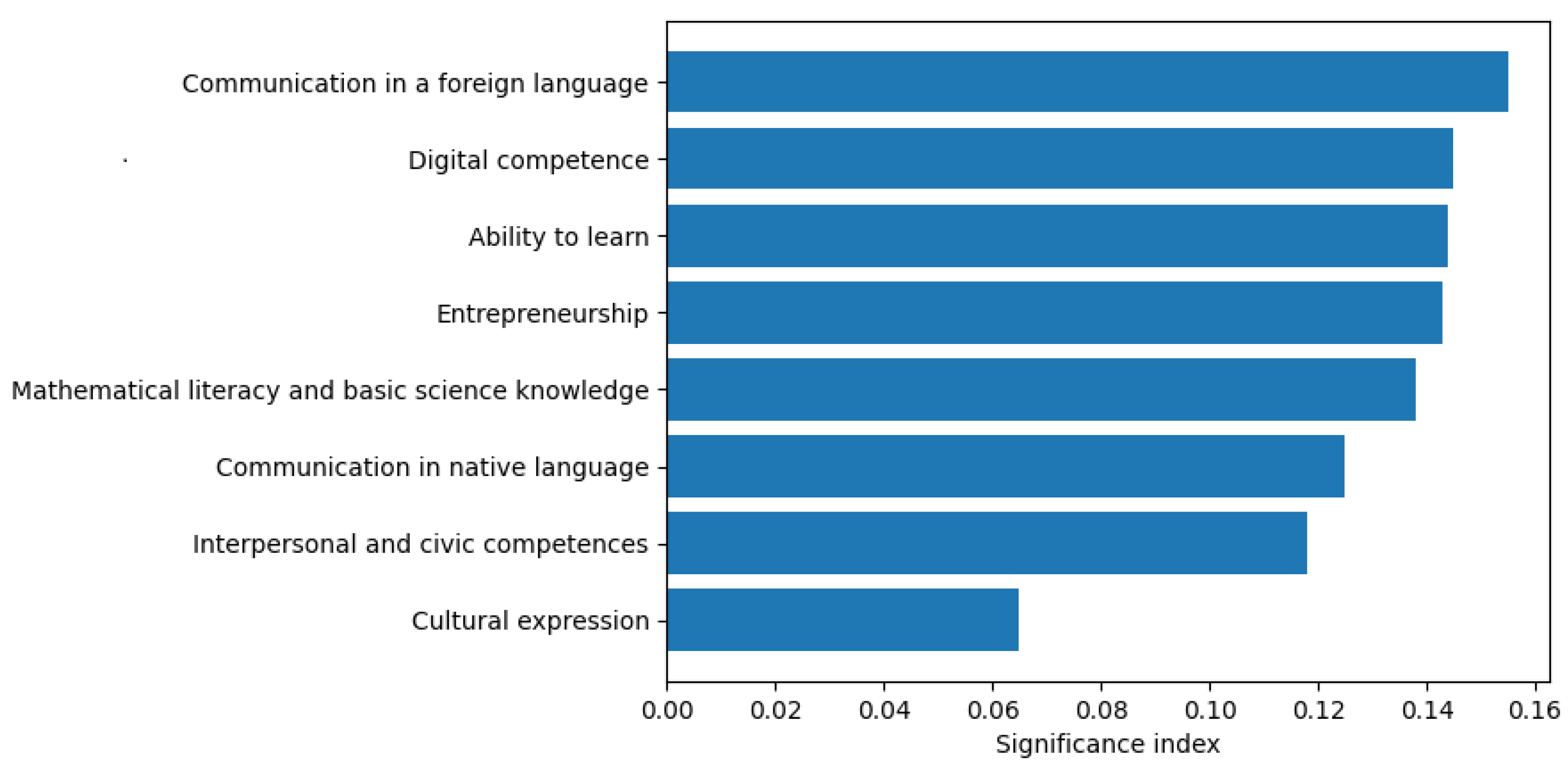
Figure 6).
The distribution of the significance of eight transport management specialist competencies presented in the visualization shows a clear structure of priorities. The highest weight is given to communication in a foreign language (0.1528), followed by digital competence (0.1417), learning to learn (0.1403), entrepreneurship (0.1389), mathematical literacy and basic scientific knowledge (0.1319), communication in the native language (0.1194), interpersonal and civic competencies (0.1125), and the lowest value is cultural self-expression (0.0625).
The structure of the results allows us to identify a clear association between the globalization of the transport sector, digitalization and the prioritization of competencies. Communication in a foreign language takes the first place because the transport and logistics sector is international by nature. The relative difference between the highest and lowest ranked factors is approximately 1.72 times, indicating a non-uniform but not highly concentrated distribution of importance. Cargo flows, supply chains and partnerships span different countries, so effective communication in a foreign language directly affects the quality of transactions, negotiation results and coordination of operations. The causal mechanism is clear: international activity → need for smooth communication → lower probability of errors and faster decisions → higher competitiveness of the organization. Language skills in such a sector become not an additional but an essential functional competence.
Digital competence, in second place, reflects the technological transformation of the transport sector. Modern logistics systems are based on digital management solutions, data analysis tools, transport tracking systems and automated planning models. If a specialist does not have sufficient digital skills, they cannot effectively manage processes or analyze data. Therefore, the causal relationship is based on technological dependence: digitalization → need for data management → importance of digital competencies → operational efficiency.
The ability to learn, in third place, shows the importance of long-term adaptability. The transport sector is characterized by the dynamics of regulatory, technological and market changes. New environmental requirements, emission standards or logistics optimization algorithms are constantly changing the nature of work. Therefore, the ability to constantly update knowledge becomes a strategic competence. The causal relationship here is related to sustainable competitiveness: ability to learn → maintaining the relevance of competence → long-term professional value.
Entrepreneurship and mathematical literacy form a group of medium significance. Entrepreneurship in transport management is related to the ability to identify new market opportunities, optimize routes or reduce costs. Mathematical literacy is needed when analyzing costs, planning capacities and assessing efficiency indicators. These competencies directly affect the quality of decisions, but they become effective only in combination with linguistic and digital skills; therefore, their weight is slightly lower.
Communication in the native language and interpersonal competencies, although important for organizational culture, are not considered critical conditions for competitiveness. They ensure internal coordination and teamwork, but do not have such a direct impact on international activities or technological efficiency.
The least significant cultural self-expression shows that this competence is valued as an aspect of general education or personal development, but not as a direct factor in creating economic value in the context of transport management. The causal relationship here is related to the functional nature of specialization: the sector prioritizes operational efficiency and international communication, rather than cultural representativeness.
In summary, it can be stated that the results obtained reveal a clear orientation of the sector towards globality and technological progress. First of all, competencies that allow for operating in an international and digital environment are assessed. Next, adaptive and analytical competencies that ensure long-term efficiency become important. Social and cultural competencies remain significant, but they are not the main source of competitiveness in the professional activities of a transport management specialist.
Overall, the results indicate a structured but not highly concentrated priority system, where multiple factors contribute to labor market competitiveness.
5. Discussion
The relatively large sample of 20 experts distinguishes this study from many similar MCDM-based analyses, where smaller panels are typically used, thereby increasing the robustness and generalizability of the findings. The proposed approach is primarily descriptive and analytical in nature, aiming to reveal structural patterns rather than to perform optimization or predictive modeling.
It should be noted that the study does not aim to develop or validate measurement scales, but rather to analyze the relative importance and structural relationships of competency dimensions based on expert judgment.
Multi-criteria decision-making (MCDM) methods are becoming particularly important in transport and logistics organizations, allowing them to formalize expert knowledge, manage uncertainty, and justify decisions that directly affect both operational efficiency and sustainability and risk management outcomes. In the context of sustainable supplier selection, fuzzy-based decision frameworks (e.g., integrating networked criteria relationships and incomplete information) allow for the alignment of economic, environmental, and social criteria, thereby reducing the risk of selection errors and increasing supply chain reliability [
84]. This direction is complemented by studies at the sustainability assessment level, in which fuzzy multi-criteria models are applied not only to an individual supplier, but also to measure the sustainability performance of the entire supply chain, emphasizing that sustainability indicators are multidimensional and often inevitably based on linguistic (subjective) assessments [
85]. In the context of a “green” supply chain, it is also emphasized that environmental criteria cannot be treated as secondary, and fuzzy TOPSIS-type methodologies allow linguistic preferences to be transformed into quantitative estimates and suppliers to be compared according to a complex “green” operational logic [
86]. At the same time, as supply chains face increased “nervousness” and frequency of disruptions, fuzzy PROMETHEE-type prioritization is applied to address strategy selection, emphasizing that the quality of decisions is determined not only by the implementation of technologies, but also by the ability to evaluate alternatives in a structured manner under conflicting criteria [
87]. Finally, recent reviews conceptualize resilience as a resource-competence-capability balance, in which organizations are forced to constantly address the trade-off between resilience and cost, and therefore competencies that allow for systematic risk assessment and justification of choices become a direct factor of competitiveness [
88]. Therefore, it is important to self-assess competency clusters (
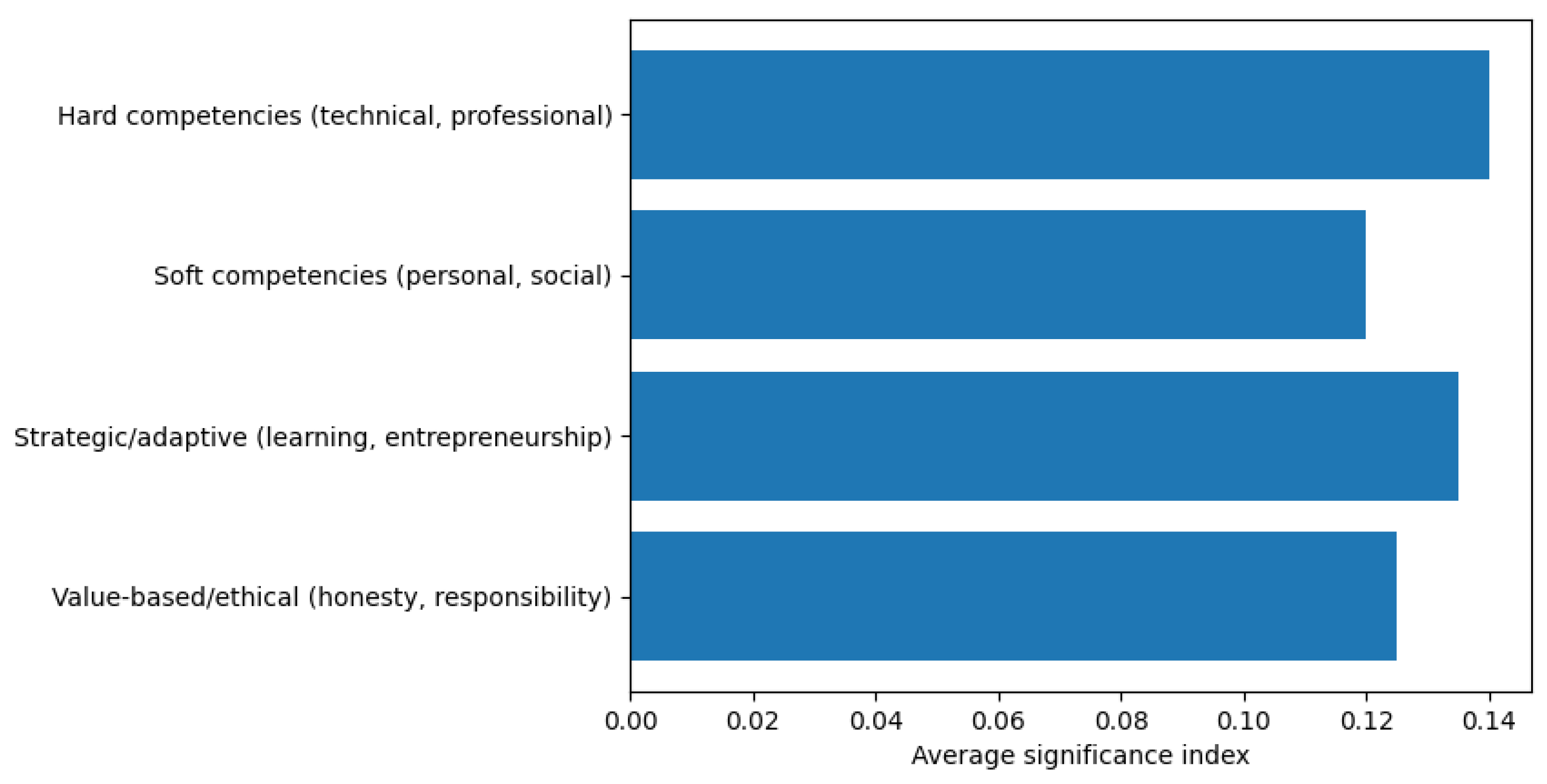
Figure 7).
Figure 7 visualizes the average significance indices of the four competence groups, calculated by aggregating the weights of the previously analyzed questions. The following groups are distinguished: hard (technical and professional), soft (personal and social), strategic/adaptive (learning, entrepreneurship, adaptability) and value/ethical (honesty, duty). Hard competencies have the highest average significance index (0.142), followed very closely by strategic/adaptive competencies (0.138). In third place are value/ethical competencies (0.127), and the lowest average weight is for soft competencies (0.118).
This structure allows us to identify a systemic cause-and-effect model that reflects the rationality of the labor market and the logic of the sector (especially in the context of transport management). Hard competencies dominate because they are directly related to functional results. Professional skills, digital literacy, mathematical knowledge or specialization are directly transformed into productivity. In the organization’s value creation chain, these competencies act as primary input factors: higher technical readiness → fewer errors → faster process execution → higher efficiency. Therefore, the causal relationship is direct and easily measured by economic indicators.
Strategic and adaptive competencies take second place, and their weight is almost equal to that of hard competencies. This shows that in the labor market it is not enough to have technical knowledge alone—it is necessary to ensure its relevance over time. The ability to learn, adapt to technological changes or act entrepreneurially allows for maintaining competitiveness in the long term. The causal mechanism here is based on the principle of dynamics: technological and market change → obsolescence of competencies → the need for constant renewal → adaptive competencies become a strategic guarantee of stability. In other words, if hard competencies create value “here and now”, then strategic competencies ensure the maintenance of value “in the future”.
Value and ethical competencies take third place, but their significance remains high. Honesty and duty reduce organizational risks, transaction costs and the need for control. The causal relationship is based on the logic of organizational economics: a high level of ethics → lower internal control → lower administrative costs → more efficient operations. Although these competencies do not directly create additional production, they ensure stability and reliability, without which other competencies could not function effectively.
Soft competencies, with the lowest average weight, indicate that social and communication skills are assessed as important, but they are not considered primary factors of competitiveness. The causal explanation may be related to the fact that social skills often act as catalysts—they enhance the impact of technical or strategic competencies, but do not create direct economic value in themselves. For example, sociability improves teamwork, but if an employee does not have professional skills, even high social activity will not create a significant result.
The analysis does not test causal relationships between competencies and organizational performance outcomes. Instead, it provides a structured representation of the perceived importance and relative positioning of competencies within a decision-making context.
It is important to note that the differences between the groups are not drastic, which indicates a balanced competency model. No group has absolute dominance; therefore, it can be concluded that a complex employee assessment model is being formed in the labor market. However, a clear causal sequence is visible: first, a functional base is needed (hard competencies); then, the ability to maintain and develop it (strategic competencies); then, operational reliability (value competencies); and only then, social interoperability (soft competencies). In summary,
Figure 8, comparing competency groups, reveals a rational and economically sound model of priorities. The labor market is oriented towards immediate productivity and long-term adaptability while recognizing the importance of ethical and social skills, but considering them as additional, rather than fundamental, elements of competitiveness. This indicates an integrated but clearly hierarchical competency structure that reflects the needs of the modern organizational environment.
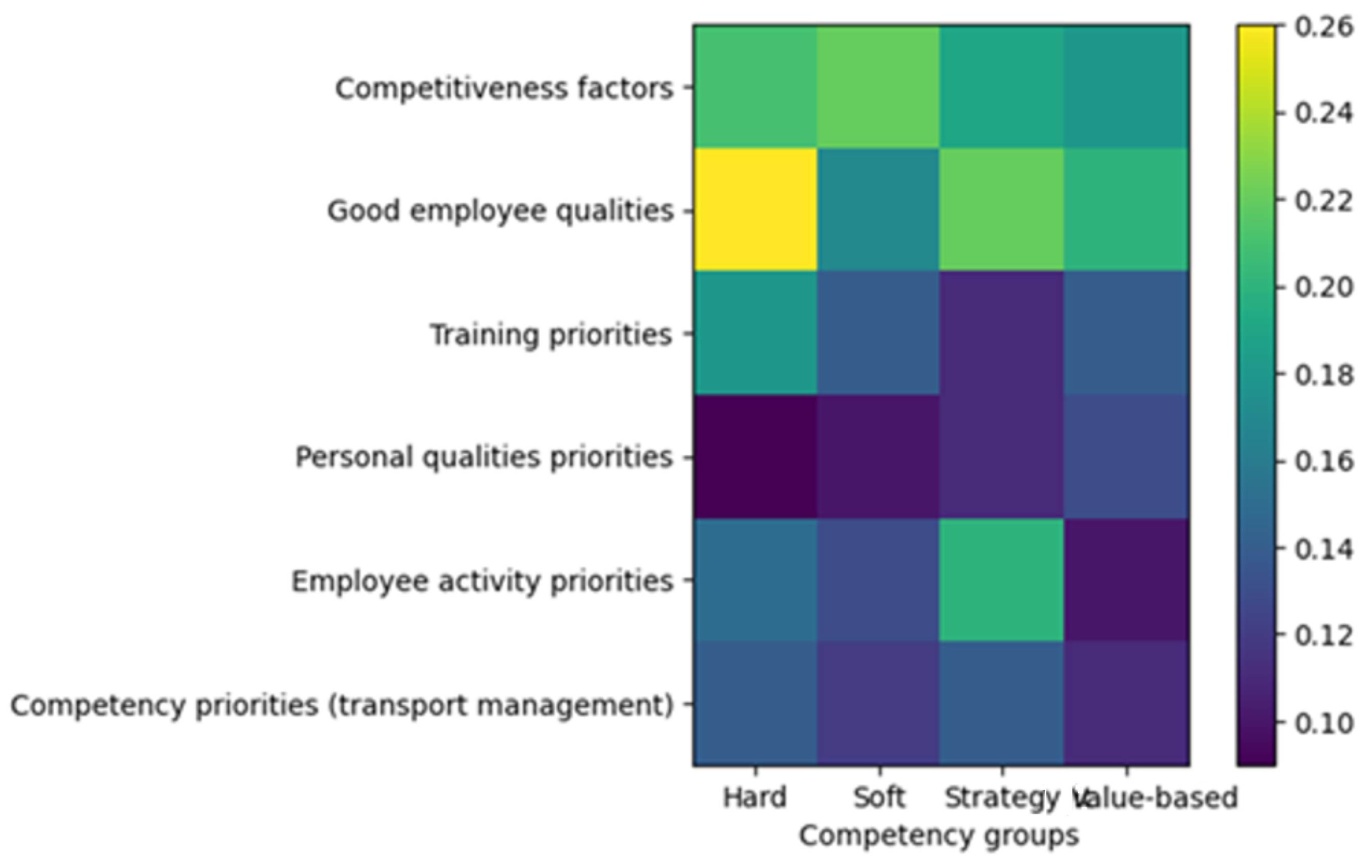
The heat matrix (
Figure 8) visually reflects the relative importance of four competency groups (hard, soft, strategic and value) in different questions. The color intensity shows the weight—the more intense the color, the greater the importance of the competency group in a specific question. Such visualization allows you to simultaneously identify both horizontal (between questions) and vertical (between competency groups) trends.
First of all, it can be seen that hard competencies are most clearly dominant in the “Characteristics of a Good Employee”. This shows that the concept of a good employee is primarily associated with professional training and functional efficiency. The causal relationship is clear: the performance of the organization directly depends on the employee’s ability to perform specific tasks qualitatively and independently. Therefore, when talking about a “good employee”, priority is given to competencies that directly generate added value.
The “Factors determining the competitiveness of a young person in the labor market” show a relatively balanced distribution between hard and soft competencies, but a slightly higher weight is given to soft competencies. This can be interpreted as a structure of competitiveness of young people, where not only technical qualifications are important, but also personal qualities and motivation. The causal mechanism is related to the probability of employment: the employer evaluates not only knowledge, but also behavior, responsibility and the ability to integrate into the organization.
The “Criteria for training specialists” clearly show the dominance of hard competencies, while strategic competencies are weaker. This shows that in the context of the criteria for training specialists, specific professional skills and practical experience are considered the most important. The causal relationship is based on the logic of labor market selection: when choosing an employee, what he or she already knows how to do is first assessed, and not his or her potential to learn in the future.
Value-based competencies dominate the “Personal qualities of future employees”. This is the only clearly distinguished area in the matrix where ethical qualities (honesty, duty) have the highest intensity. The causal relationship here is associated with organizational risk: a dishonest or irresponsible employee can cause financial and reputational losses; therefore, ethical traits become the basic criterion of reliability.
Strategic competencies stand out most clearly in the “activities of a modern employee”. This reflects the dynamics of the modern market: technological progress and global changes force employees to constantly learn and adapt. The causal mechanism is based on the necessity of adaptation—if an employee is unable to learn, his competencies quickly lose relevance, and the organization loses its competitive advantage.
A balanced but slightly stronger distribution of hard and strategic competencies is visible in the “Competencies of transport management specialists”. In the context of transport management, this is logical because the sector relies on both technical preparation and the ability to operate in an international and technological environment. The causal relationship here is related to the structure of the sector: global supply chains and digital management systems require technical knowledge, but at the same time constant adaptation.
When assessing the vertical analysis (i.e., the behavior of competence groups across all questions), it is seen that hard competencies remain stably significant almost everywhere. Strategic competencies increase significantly in dynamic areas (“Activities of the Modern Worker” and “Competencies of Transport Management Specialists”). Value competencies dominate in the context of personal qualities, but are less important in technological or professional aspects. Soft competencies remain significant, but they rarely become the main priority.
In summary, the heat matrix reveals a consistent causal structure: when the context is related to functional efficiency or selection, hard competencies dominate; when it comes to long-term competitiveness, strategic competencies emerge; and when reliability is assessed, priority is given to value qualities. This shows that the importance of competencies is not universal—it directly depends on the situational context and organizational goals.
The findings should be interpreted as reflecting perceived relationships between competencies and decision-making effectiveness rather than direct causal effects. In line with dynamic capabilities theory, competencies contribute to the system’s ability to respond to uncertainty by enhancing adaptability and decision quality, rather than acting as independently measurable performance drivers.
From a managerial perspective, the entropy and Gini coefficient results provide important insights into the structure of competency priorities. The relatively high entropy values indicate a balanced distribution of competencies, suggesting that organizations should avoid overemphasizing a single skill and instead support a diversified competency profile.
Similarly, low Gini coefficient values imply a low level of concentration, meaning that decision-making systems are not dominated by a narrow set of competencies. This highlights the importance of maintaining a broad competency base, which enhances flexibility and adaptability in dynamic and uncertain supply chain environments.
Therefore, the results suggest that managers should adopt competency development strategies that promote balance, diversity, and adaptability, rather than focusing exclusively on a limited number of dominant skills.
The following is an integrated statistical analysis of the priority structure, carried out on the basis of the aggregated weights of the criteria for specialist training, using three concentration and differentiation indicators: the coefficient of variation, the normalized Shannon entropy index and the Gini coefficient. The combination of these indicators allows for a systematic assessment of whether the importance of the criteria is concentrated in a narrow group or distributed evenly among all the elements being assessed.
From a decision-making perspective, Shannon entropy reflects the level of diversity and balance among decision criteria, indicating whether decision-makers consider multiple factors or rely on a limited set of dominant criteria. Higher entropy values suggest a more distributed decision structure, which may enhance adaptability under uncertainty by preventing over-reliance on single factors.
In contrast, the Gini coefficient captures the degree of concentration within the decision system. Lower Gini values indicate a more balanced distribution of importance, suggesting that decision-making is not dominated by a narrow subset of competencies. This can be interpreted as a sign of systemic flexibility, which is essential for resilience in complex and uncertain environments. The combined interpretation of entropy and Gini results provides insights into the structural characteristics of decision-making systems. A balanced distribution of competencies (high entropy, low Gini) suggests that the system is less vulnerable to disruptions affecting specific factors, thereby supporting resilience. Conversely, highly concentrated structures may increase systemic risk by creating dependency on a limited number of competencies. The analysis shifts the focus from individual criterion importance to the structure of the decision system itself.
It should be noted that in studies involving complex, multidimensional, and perception-based criteria, lower levels of agreement are common due to the diversity of expert perspectives and the subjective nature of the evaluated constructs. In such contexts, Kendall’s coefficient is used not only to assess agreement but also to identify whether a statistically meaningful structure exists in the evaluations.
The relatively low values of Kendall’s coefficient indicate that expert opinions were not strongly convergent, which reflects the complexity and multidimensional nature of the evaluated competencies. This limitation suggests that the results should be interpreted as indicative of general tendencies rather than as highly robust or universally agreed rankings. This variability may also reflect differences in professional backgrounds, organizational contexts, and individual experiences of experts, which is consistent with the heterogeneity of real-world supply chain environments.
6. Conclusions
This study contributes to the development of data-driven decision-making research in supply chain systems by proposing an integrated multi-criteria assessment methodology that combines expert assessment with entropy and inequality indicators. The proposed approach extends traditional decision-making models by including human competencies as quantifiable variables in the context of supply chain resilience under uncertainty.
It is important to note that the proposed framework combines expert-based input with quantitative analytical methods. While the initial data are derived from expert judgment, their transformation through entropy and inequality measures allows for a more objective and data-driven interpretation of decision structures.
The results of the study reveal a consistent structural hierarchy of competencies, dominated by professional (hard) and adaptive (strategic) competencies, while social (soft) competencies, although important, occupy a secondary position. This indicates a transformation of the labor market from formal qualifications-based assessment to performance-based and adaptive models. In addition, it was found that the structure of competencies is not concentrated, but characterized by a balanced distribution, as confirmed by relatively high entropy values and low Gini coefficient indicators. This allows us to state that the decision-making environment is multidimensional and not dominated by a single criterion.
From a systemic perspective, the study shows that competencies act as dynamic elements influencing the resilience of supply chains. Of particular importance is the interaction between technical capabilities and adaptive learning, which forms feedback mechanisms that allow organizations to respond effectively to uncertainty and disruptions. This confirms that the resilience of supply chains is determined not only by structural or technological factors, but also by the quality of human capital and its configuration in the system.
The study contributes by demonstrating the applicability of integrated statistical measures (Shannon entropy and Gini coefficient) for analyzing competency structures in a decision-making context. Such a combination allows for the simultaneous assessment of both the diversity of the distribution and the level of concentration, providing a more comprehensive assessment of the structure of decisions than when applying individual indicators.
Despite the significance of the results obtained, the study has certain limitations. First, the analysis is based on expert assessment, which, despite the application of the Kendall compatibility coefficient, may have elements of subjectivity and bias. Second, the study is limited to a specific sector context; therefore, the generalizability of the results may be limited. Third, the study does not analyze dynamics over time; therefore, it does not assess the change or evolution of competencies.
In further research, it is appropriate to expand the empirical sample to include a larger number of respondents and various sectors, as well as to integrate real operational data. In addition, it would be promising to develop dynamic modeling methods (e.g., system dynamics or agent modeling) in order to analyze the interaction between competencies and supply chain processes in more depth. It is also important to conduct a comparative analysis with other multi-criteria decision-making methods (e.g., AHP, TOPSIS or PROMETHEE) in order to further substantiate the reliability of the proposed methodology. The study contributes by providing a structured analysis of competency priorities and their distribution, offering insights into how competency configurations may support decision-making processes in supply chain contexts.
In conclusion, it can be stated that the integration of competency-based assessment into data-driven decision-making systems is an important prerequisite for increasing the resilience of supply chains. The proposed method provides both theoretical and practical insights that allow for more informed decisions in complex and uncertain environments. It should be noted that the study is descriptive in nature and does not aim to develop predictive or prescriptive models, but rather to provide a structured analytical perspective on competency-based decision-making.
It should be noted that the competency framework is based on expert evaluation and literature synthesis and was not validated using statistical techniques such as factor analysis. Therefore, the results should be interpreted as indicative of structural tendencies rather than as a validated measurement model.