1. Introduction
In the rapidly evolving aviation sector, fleet management represents a critical strategic decision that directly influences the long-term viability and operational efficiency of air transportation companies [
1,
2]. The growth of global air cargo transportation has necessitated fleet expansion to meet increasing demand. While major airlines frequently prioritize the direct acquisition of new aircraft from manufacturers to ensure operational uniformity and strengthen brand recognition, this strategy requires substantial capital investment [
3]. Consequently, smaller airlines and cargo transportation companies, often operating under tighter financial constraints, view the acquisition of used aircraft as a pragmatic and cost-effective alternative [
4,
5].
However, the acquisition of used aircraft is significantly more complex than the purchase of new units. Unlike new aircraft, which are delivered with standardized specifications and no operational history, used aircraft present a heterogeneous set of attributes. The selection process involves multiple considerations, and superior technical quality alone is insufficient to justify a purchase [
6]. Decision-makers must evaluate a wide range of factors, including the remaining useful life of the airframe, maintenance and repair history, engine cycles, and specific operational costs such as fuel efficiency per mile [
7,
8,
9,
10]. Furthermore, since most candidate aircraft satisfy fundamental airworthiness regulations, distinguishing among alternatives based solely on technical compliance is often difficult. As a result, the emphasis has shifted toward a trade-off analysis involving economic efficiency, technical reliability, and environmental impact [
11,
12,
13]. Developing a reliable, comprehensive, and computationally tractable mechanism that simultaneously evaluates these conflicting factors remains a substantial challenge for practitioners.
The selection of used aircraft is fundamentally a multi-criteria decision-making (MCDM) problem characterized by diverse criteria involving both quantitative data and qualitative assessments. To address such problems, fuzzy set (FS) theory, initially proposed by Zadeh et al. [
14], provides an effective framework for representing information under uncertainty. By utilizing membership functions to express degrees of truth, FS theory has proven effective in numerous decision-making scenarios where crisp data are unavailable [
15,
16].
Despite the usefulness of traditional fuzzy sets, they exhibit limitations in complex decision environments where experts may struggle to assign a single definitive membership degree to an attribute. In the context of aircraft selection, an expert may hesitate among multiple values because of incomplete maintenance records or uncertain future market conditions. To address this issue, Torra [
17] introduced the hesitant fuzzy set (HFS), which allows the membership degree to be expressed as a set of possible values rather than a single number. This extension more accurately captures human hesitation and has been widely applied in various MCDM domains [
18,
19,
20,
21,
22]. For instance, Alcantud [
23] introduced a novel decision-making method that integrates Fermatean hesitant fuzzy sets with a modified VIKOR approach, using a generalized distance measure and remoteness indices to handle ambiguous and imprecise information. Mishra et al. [
24] developed ranked hesitant fuzzy sets as an extension of hesitant fuzzy sets that incorporate hierarchical rankings of evaluations without requiring additional numerical information. Qahtan et al. [
25] developed an integrated decision-making framework that combines Pythagorean probabilistic hesitant fuzzy sets with the fuzzy weighted zero inconsistency method and the MARCOS method to benchmark electric-vehicle-based multiple fuel supply system modeling approaches. Raza et al. [
26] proposed a fuzzy stable compromise technique under hesitant fuzzy sets that uses relative metrics to identify stable compromise solutions when dealing with imprecise and uncertain information. Mahmood et al. [
27] developed a multi-attribute decision-making framework based on hesitant bipolar complex fuzzy sets to evaluate and select the most appropriate encryption algorithm by simultaneously modeling positive and negative aspects of alternatives.
Among the various ranking methods available for MCDM, the technique for order preference by similarity to ideal solution (TOPSIS) is one of the most widely used [
28,
29,
30,
31]. Its fundamental principle is to identify the alternative that is geometrically closest to the positive ideal solution (PIS) and farthest from the negative ideal solution (NIS) [
32,
33,
34]. Although TOPSIS is robust and straightforward to implement, its traditional application relies on crisp numbers or standard fuzzy sets. Modifications for hesitant fuzzy environments have been proposed, but they often face challenges in accurately measuring the distance between hesitant fuzzy elements.
Furthermore, the determination of criteria weights is a pivotal task in MCDM, since different factors exert different levels of influence on the final selection. The analytic hierarchy process (AHP) has been widely employed for this purpose, but it suffers from substantial computational requirements due to the large number of pairwise comparisons required, which often leads to inconsistency when the number of criteria is large [
35,
36]. In contrast, the best–worst method (BWM) offers a more efficient alternative. By comparing all criteria only with the best (most important) and worst (least important) criteria, BWM significantly reduces the number of pairwise comparisons while maintaining a high level of consistency [
37,
38,
39]. For hesitant fuzzy sets, Mi and Liao [
40] explored the application of BWM and introduced the hesitant fuzzy best–worst method (HFBWM), which has been successfully applied to problems such as product and supplier selection [
41,
42].
1.1. Motivation
Despite the extensive research on MCDM methodologies, the specific domain of used aircraft selection remains underexplored. The application of advanced decision-making frameworks to this problem is hindered by several persistent challenges that this study aims to address.
First, the evaluation process is inherently affected by deep uncertainty and hesitancy. The assessment of a used aircraft relies heavily on expert knowledge, which is subjective and often imprecise. Experts may express their assessments using multiple linguistic terms or values because of the inherent ambiguity of the aircraft’s condition or future performance. Existing methods often force these hesitant judgments into single values, leading to a loss of information. Therefore, there is a pressing need to effectively represent this type of uncertainty using hesitant fuzzy sets.
Second, the determination of criteria weights in this context is critical yet often oversimplified. Existing studies on aircraft selection frequently neglect the rigorous calculation of criteria importance, or they rely on methods that are computationally burdensome and prone to inconsistency. To develop an effective method, it is imperative to incorporate a weighting approach that is both efficient and mathematically consistent, such as BWM extended to the hesitant fuzzy environment.
Third, current distance measures within the TOPSIS framework are insufficient for hesitant fuzzy information. Most existing modifications of TOPSIS for HFSs focus on the values within the sets but neglect the hesitation degree itself. The hesitation degree, which reflects the uncertainty within the expert’s judgment, is a crucial indicator. Ignoring this parameter can lead to inaccurate rankings in which two alternatives with different uncertainty profiles are treated as identical. Therefore, developing a method that comprehensively considers the relationship between alternatives and ideal solutions, including the hesitation degree, is crucial for drawing reasonable conclusions.
1.2. Contribution and Novelty
Motivated by the limitations of existing studies and the complexity of used aircraft selection under uncertainty, this paper develops an integrated hesitant fuzzy decision-making framework. The main contributions and novelties of this study are summarized as follows:
A novel distance measure for hesitant fuzzy sets is developed on the basis of the Euclidean distance. Unlike conventional distance measures that mainly focus on the differences among membership values, the proposed measure explicitly incorporates the hesitation degree. As a result, it can more adequately characterize the distinction between hesitant fuzzy elements, especially when alternatives exhibit similar central tendency but different uncertainty patterns.
Based on the proposed distance measure, a modified hesitant fuzzy TOPSIS (M-HFTOPSIS) method is constructed to rank alternatives under hesitant fuzzy information. By incorporating both membership-value differences and hesitation differences into the distance calculation, the proposed ranking method provides a more informative and reliable basis for evaluating alternatives in hesitant fuzzy decision environments.
An integrated decision-making framework is established by combining HFBWM and the proposed M-HFTOPSIS, where HFBWM is used to derive criteria weights and M-HFTOPSIS is employed to rank the alternatives. This integration enables the framework to simultaneously consider the relative importance of evaluation criteria and the proximity of each alternative to the ideal solutions under hesitant fuzzy conditions.
The proposed framework is applied to the used aircraft selection problem to demonstrate its practicality and effectiveness in a realistic aviation decision-making context. Through this application, the study provides a structured approach for evaluating used aircraft alternatives involving technical, economic, and environmental criteria under uncertain and hesitant expert assessments.
1.3. Structure of the Paper
The remainder of the paper is organized as follows:
Section 2 reviews the related studies on aircraft selection and relevant decision-making methodologies.
Section 3 presents the mathematical preliminaries of hesitant fuzzy sets, TOPSIS, and BWM.
Section 4 introduces the proposed HFS distance measure and the corresponding modified hesitant fuzzy TOPSIS.
Section 5 describes the proposed integrated used aircraft selection framework, including the HFBWM-based criteria weighting process.
Section 6 presents the case study for used aircraft selection.
Section 7 reports the evaluation and validation results of the proposed method. Finally,
Section 8 concludes the paper.
4. TOPSIS Approach Under Hesitant Fuzzy Environment
This section presents the integration of the technique for order preference by similarity to ideal solution (TOPSIS) with hesitant fuzzy sets (HFSs), introducing the modified hesitant fuzzy TOPSIS (M-HFTOPSIS) approach. First, a novel HFS distance measure is proposed, which explicitly incorporates the hesitation degree to capture uncertainty. Subsequently, building upon this enhanced metric, the classical TOPSIS framework is extended to the hesitant fuzzy environment.
4.1. A New Distance Measure for HFS
The commonly employed Hamming and Euclidean distance measures can effectively capture the dissimilarity between two HFSs based on their values. However, given the inherently uncertain nature of information in a hesitant fuzzy environment, the hesitation degree serves as a crucial indicator of the variation in expert judgment. It should be taken into account when assessing the distance between two HFSs. Since existing distance measures often fail to adequately reflect this hesitancy, an enhanced HFS distance measure is proposed here. This measure is specifically designed to incorporate the deviation in hesitation degrees alongside the deviation in membership values.
Definition 6. Let A and B be two HFSs in the reference set . Let be the weight of with and . Furthermore, let and be the j-th largest values of in and , respectively. The improved distance measure is defined as follows: Evidently, the proposed distance measure is an adaptation of the normalized Euclidean distance that assigns equal weight to the value difference and the hesitation difference. Similar to the standard Euclidean distance, the improved distance measure possesses the following properties.
Properties:
Let A, B, and C be three HFSs in . Then:
- (P1)
- (P2)
if and only if
- (P3)
- (P4)
Proof. Proof of P1: .
Since the values are normalized within
, clearly:
The weighted average of these components must also lie within . Thus, .
Proof of P2: . If
, then for all
:
Substituting these into Equation (
16) yields
. Conversely, if
, the non-negativity of the squared terms implies that every term in the summation must be zero. Therefore,
and
, indicating
.
Proof of P3: . This follows immediately from the symmetry of the squared difference used in the definition.
Proof of P4: . Let the term under the outer summation for a specific element
be decomposed into two distance components. Let:
By the Minkowski inequality for sums and the triangle inequality for scalars, we have:
Substituting these into the distance formula and applying the Minkowski inequality to the outer weighted sum:
□
4.2. M-HFTOPSIS with New Distance Measure
In this subsection, the M-HFTOPSIS approach is detailed. Similar to the conventional TOPSIS method, the central concept is to identify the best alternative by assessing its geometric proximity to the positive ideal solution (PIS) and its remoteness from the negative ideal solution (NIS) using the improved distance measure derived above. The procedure is outlined as follows:
Consider a multi-criteria decision-making (MCDM) problem with
m alternatives
and
n criteria
. Each alternative is evaluated across all
n criteria with hesitant fuzzy information. The hesitant fuzzy evaluation of alternative
regarding criterion
is denoted as
, where
is the number of membership values. Let
be the weights of the criteria with
and
. Hence, the hesitant fuzzy decision matrix can be expressed as:
In the traditional TOPSIS approach, the maximum value of the criteria is typically chosen as the PIS, while the minimum value is chosen as the NIS. However, given the involvement of hesitant fuzzy information, Sun et al. [
65] utilized the potential values of the corresponding evaluation formats to establish two reference points. Building upon the findings of Sun et al. [
65], the PIS (
) and NIS (
) in this paper are defined as:
where
and
are the positive and negative hesitant fuzzy elements (HFEs), respectively:
Based on Equation (
16), the distance between the alternative
and the PIS
is calculated as:
where
, and
and
are the hesitation degrees of
and
, respectively.
Similarly, the distance between the alternative
and the NIS
is calculated as:
where
, and
and
are the hesitation degrees of
and
, respectively.
Finally, for alternative
, the relative closeness (
) with respect to the positive ideal solution is calculated to rank the alternatives:
5. Proposed Integrated Decision-Making Framework
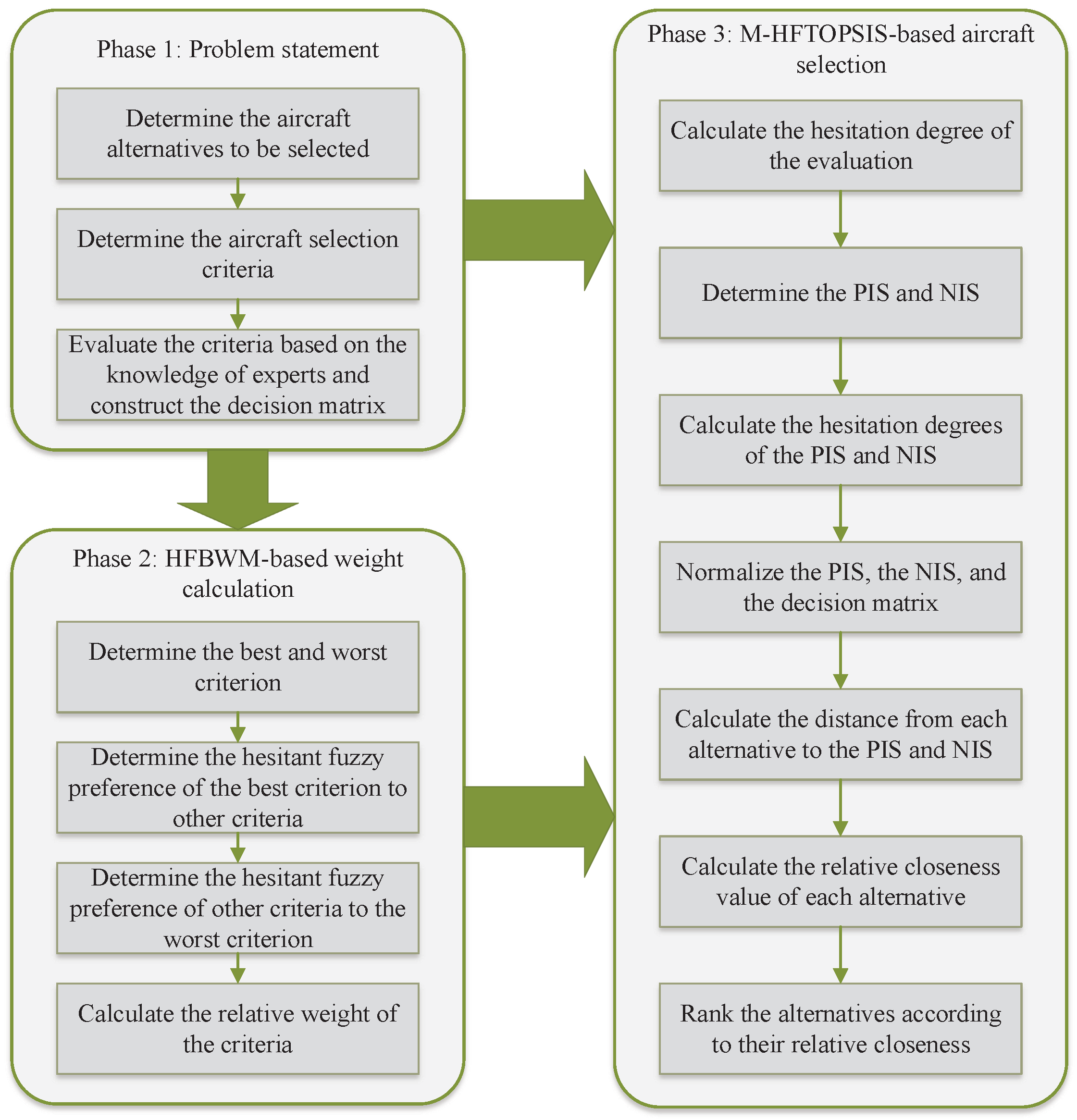
This section details the proposed integrated decision-making framework, which combines the M-HFTOPSIS with the HFBWM to address the complexity of used aircraft selection. The methodology is structured into three phases: first, the formal definition of the selection problem under a hesitant fuzzy environment; second, the determination of criteria weights using HFBWM; and third, the ranking of alternatives using the proposed M-HFTOPSIS. The overall framework is illustrated in
Figure 1.
5.1. Problem Statement
The selection of a used aircraft is modeled as a MCDM problem consisting of
m alternatives
and
n evaluation criteria
. The evaluation of alternative
with respect to criterion
is represented by a hesitant fuzzy element (HFE)
. Consequently, the decision matrix is expressed as:
The weights assigned to the evaluation criteria, reflecting their relative importance, are denoted as , where and . These weights are calculated using the hesitant fuzzy BWM.
Since the number of values contained in HFEs may vary, normalization is required before distance calculation to ensure comparability among HFEs. In this study, when two HFEs have different lengths, the shorter one is extended until it has the same number of values as the longer one by repeating its maximum value, as shown in Algorithm 1. This treatment is adopted to avoid the loss of original evaluation information during normalization and to preserve the upper bound of the expert-provided hesitant assessment without introducing additional external information, which is consistent with the common practice in previous hesitant fuzzy studies [
59]. After this normalization process, HFEs with different cardinalities can be compared in an element-wise manner in the subsequent calculations.
| Algorithm 1 HFEs normalization algorithm |
- Require:
Two HFEs and . - Ensure:
Normalized HFEs and . - 1:
Calculate the number of elements in and , denoted as and . - 2:
Identify the maximum values within and , denoted as and . - 3:
Let . - 4:
if then - 5:
Break - 6:
else - 7:
if then - 8:
Let . - 9:
for to n do - 10:
- 11:
end for - 12:
else - 13:
Let . - 14:
for to n do - 15:
- 16:
end for - 17:
end if - 18:
end if - 19:
Set and .
|
5.2. Weight Calculation of the Criteria Using HFBWM
The BWM, introduced by Rezaei [
64], is an improved pairwise comparison technique derived from the AHP. Compared with conventional pairwise comparison methods, it requires fewer comparisons and generally exhibits higher consistency. In this study, the hesitant fuzzy BWM (HFBWM) is employed to determine the criteria weights under hesitant fuzzy preference information [
40]. In the HFBWM procedure, hesitant fuzzy elements are used to preserve the uncertainty and hesitation contained in expert judgments at the elicitation stage. However, since the optimization model of BWM is formulated on the basis of numerical preference values, these hesitant fuzzy preferences must be transformed into crisp values before the weights can be derived. To this end, the score function of hesitant fuzzy elements (HFEs) is adopted to extract representative numerical preference values from the hesitant fuzzy judgments, and these score values are then incorporated into the optimization model to obtain the final deterministic criteria weights.
Step 1: Determine the best and worst criterion. Experts identify the most important (best) criterion and the least important (worst) criterion from the set of n criteria.
Step 2: Determine the hesitant fuzzy preference of the best criterion to other criteria. Experts express the preference of the best criterion
over all other criteria using hesitant fuzzy elements. This yields the hesitant fuzzy best-to-other vector:
where
denotes the hesitant fuzzy preference of
over
, and
.
Step 3: Determine the hesitant fuzzy preference of other criteria to the worst criterion. Similarly, the preference of all other criteria over the worst criterion
is determined, resulting in the vector:
where
denotes the hesitant fuzzy preference of
over
, and
.
Step 4: Transform hesitant fuzzy preferences into crisp values and calculate the relative weights of the criteria. To make the hesitant fuzzy preference information compatible with the BWM optimization framework, the score function is applied to each HFE to obtain its corresponding crisp preference value. Specifically, for
and
, the corresponding crisp values are calculated as
and
, respectively. In this way, the hesitant fuzzy representation retains the uncertainty and diversity of expert judgments, while the score-function-based transformation provides a practical bridge to the numerical optimization procedure of BWM. Based on these crisp preference values, the optimal criteria weights are obtained by minimizing the absolute deviations between the weight ratios and the corresponding score values. The optimization model is defined as:
This can be further transformed into the following equivalent optimization problem to solve for the weights
:
By solving the above model, the final criteria weights can be obtained.
5.3. Used Aircraft Selection Using M-HFTOPSIS
Once the criteria weights are obtained via HFBWM, the modified hesitant fuzzy TOPSIS is employed to rank the alternatives. The process is outlined below.
Step 1: Calculate the hesitation degree of the evaluation. Given the complexity of used aircraft selection, expert judgments inherently contain uncertainty. The hesitation degree of the evaluation
is calculated using Equation (
2) to quantify this uncertainty:
Step 2: Determine the PIS and NIS. The positive ideal solution (PIS) and negative ideal solution (NIS) are constructed by identifying the maximum and minimum values for benefit and cost criteria, respectively:
This yields the ideal sets
and
.
Step 3: Calculate the hesitation degrees of the PIS and NIS. The hesitation degrees for the ideal solutions are calculated to serve as reference points for the distance measure:
Step 4: Normalize the PIS, NIS, and decision matrix. To enable accurate distance calculation, the HFEs in the decision matrix and the ideal solutions are normalized to the same length using Algorithm 1.
Step 5: Calculate the distance from each alternative to the PIS and NIS. The distance is computed using the proposed measure, which accounts for both value difference and hesitation difference:
Step 6: Calculate the relative closeness and rank. The relative closeness
is calculated using Equation (
32). The alternatives are then ranked in descending order of
, where the highest value indicates the best used aircraft.
6. Application
In this paper, a novel used aircraft selection method based on M-HFTOPSIS and HFBWM is developed. To examine the effectiveness of the proposed method, a case study is presented in this section.
In recent years, the continuous growth of air cargo transportation demand has led to a substantial increase in cargo volume. Under this trend, many companies have sought to expand their fleets to maintain transport capacity and operational competitiveness. Compared with acquiring new aircraft, purchasing used aircraft is often more economically attractive. However, used aircraft selection is a complex decision problem, because it is influenced not only by technical factors such as useful life, flight hours, and maximum takeoff mass, but also by economic and environmental considerations. In addition, several evaluation factors cannot be described with complete precision and often involve subjective expert judgment. Therefore, used aircraft selection can be regarded as a multi-criteria decision-making problem under uncertainty.
In this study, an air cargo transportation company (referred to as “the company”) intends to acquire a used aircraft to expand its fleet, and four candidate used aircraft are considered, denoted by
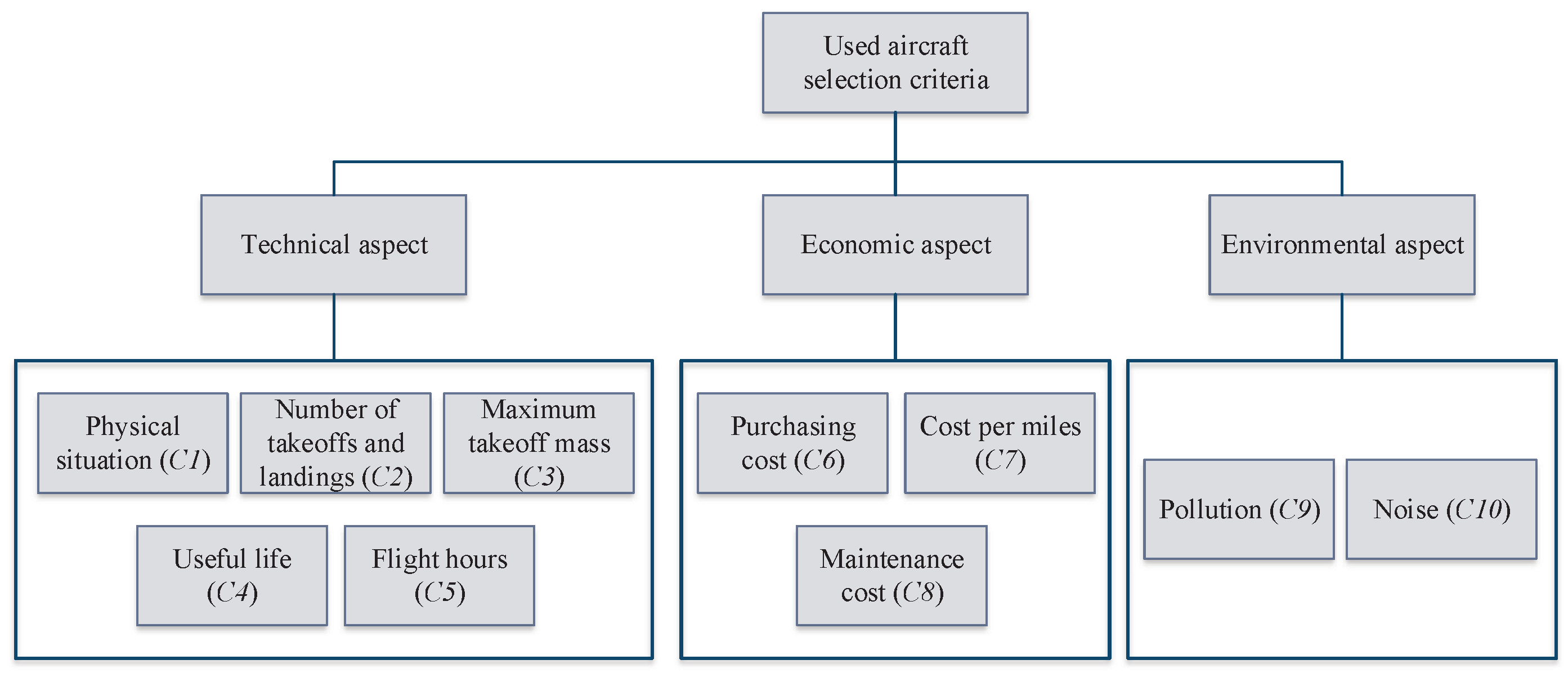
. To ensure the comprehensiveness and reliability of the evaluation, ten criteria from three dimensions, namely technical, economic, and environmental aspects, are determined based on previous literature, as shown in
Figure 2. Among these criteria, physical situation, number of takeoffs and landings, maximum takeoff mass, useful life, and flight hours are regarded as benefit criteria, for which larger values are preferred. By contrast, purchasing cost, cost per mile, maintenance cost, pollution, and noise are regarded as cost criteria, for which smaller values are preferred.
To support the evaluation process, a panel of five experts is invited to provide judgments. These experts are from airlines and aircraft maintenance companies, and each has more than 10 years of relevant professional experience in aircraft operation, maintenance management, or fleet-related decision analysis. Their industrial backgrounds provide practical support for the assessment of used aircraft alternatives. For each criterion evaluation and each pairwise comparison required in HFBWM, the experts first provide their judgments independently, and the distinct plausible assessment values are then aggregated into hesitant fuzzy elements to preserve the hesitation and diversity of expert opinions. All calculations and result analyses in this case study are implemented using MATLAB 2021a.
6.1. Criteria Weights Calculation
In this section, the first phase of the proposed aircraft selection method, i.e., the hesitant fuzzy BWM-based criteria weights calculation, is presented.
Step 1: Five experts are consulted to provide their judgments on the most and least important criteria for aircraft selection. Based on their collective expertise, the best (most important) criterion is identified as “Cost per mile”, while the worst (least important) criterion is determined to be “Noise”.
Step 2: Following the experts’ judgments, with the best criterion established as “Cost per mile”, the hesitant fuzzy preference of this criterion to others is determined as follows:
Step 3: For the worst criterion, i.e., “Noise”, the hesitant fuzzy preference of other criteria to it is determined as:
Step 4: After determining the hesitant fuzzy preferences, the score function of the hesitant fuzzy best-to-other and hesitant fuzzy other-to-worst are calculated as:
Based on Equation (
27), the weights of criteria are obtained by solving the optimization model as:
6.2. Aircraft Selection
In this section, the second phase of the proposed aircraft selection method, i.e., the M-HFTOPSIS-based aircraft selection, is presented.
Based on the knowledge of experts, the decision matrix for this problem is obtained in terms of HFEs, as shown in
Table 1.
Step 1: Based on the decision matrix, the hesitation degree of each HFE is calculated. Taking the evaluation on the criterion
of the alternative
as an example, the HFE is obtained as
, hence, the hesitation degree is calculated as:
The hesitation degree of the decision matrix is shown in
Table 2.
Step 2: Since criteria
–
are benefit criteria and criteria
–
are cost criteria, the PIS and NIS are constructed according to the corresponding hesitant fuzzy evaluations of the alternatives. For benefit criteria, the PIS is formed by selecting the maximum HFE among the alternatives, whereas the NIS is formed by selecting the minimum HFE. For cost criteria, the PIS is formed by selecting the minimum HFE, whereas the NIS is formed by selecting the maximum HFE. In addition, because the proposed distance measure explicitly incorporates the hesitation degrees of the PIS and NIS, the ideal HFEs are constructed according to the least length of the corresponding alternative HFEs, so as to avoid additional artificial extension of the ideal solutions and the resulting distortion in their hesitation degrees. Accordingly, the PIS and NIS are obtained as follows:
It should be noted that in this case, the PIS and NIS are selected according to the least length in the corresponding criterion HFEs of the four alternatives instead of the maximal length in HFEs. That is because as the hesitation degree of the PIS and NIS is calculated in the distance measure, which could better represent the PIS and NIS.
Step 3: After determining the PIS and NIS, the hesitation degrees of HFEs of the PIS and NIS can be calculated using Equation (
30) as:
Step 4: The HFEs of each criterion of the alternatives, as well as the PIS and NIS, are extended following Algorithm 1. For example, for alternative
,
is extended to
,
is extended to
. The normalized decision matrix is shown in
Table 3.
Step 5: The distance between each alternative and the PIS and NIS is calculated. For example, the distance between
and
is calculated as:
Similarly, the distance between other alternatives and the PIS and NIS could be calculated, and the result is shown in
Table 4.
Step 6: Based on the distance from each alternative to the PIS and NIS, the relative closeness of each alternative could be calculated with respect to the PIS, for example, the relative closeness of the alternative
is calculated as:
Similarly, the relative closeness of other alternatives are calculated, as shown in
Table 5.
Step 7: By sorting the relative closeness of different alternatives in the descending order, the ranking of the alternatives can be obtained, as shown in
Table 5. Hence, the final aircraft ranking result is
, and the final selection would be
.
7. Evaluation and Validation
7.1. Validity Test
The validity of a decision-making method is commonly examined from several fundamental perspectives. In this study, the validity of the proposed method is evaluated based on three widely used criteria [
33].
Criterion 1: The best alternative should remain unchanged when a non-optimal alternative is replaced by another alternative of lower quality, provided that the relative importance of the criteria is kept unchanged.
Criterion 2: The method should satisfy transitivity so that the resulting preference relations remain logically consistent across different comparison settings.
Criterion 3: When the original decision problem is decomposed into sub-problems, the combined ranking results should be consistent with the ranking obtained from the original problem.
In the following, the validity of the proposed method is examined according to these three criteria.
Criterion 4: In order to validate the proposed method through Criterion 1, the non-best alternative
is replaced with a worse alternative
, and the artificially generated values of
are summarized in
Table 6.
The criteria weights remain consistent. Utilizing the proposed method, the ranking results for the alternatives in used aircraft selection are determined as , signifying that the most suitable alternative continues to be . Therefore, when substituting the non-best alternative with a worse one , the best alternative remain unchanged. Similar conclusions can be drawn for other non-best alternatives. Thus, the proposed method is validated under Criterion 1.
Criteria 2 and 3: To test the validity of the proposed method under Criteria 2 and 3, the original problem in decomposed into two sub-problems containing alternatives
and
. Following the proposed method, the ranking results of two sub-problems can be obtained as:
By combining the ranking of the sub-problems, the final ranking result is , which is identical to the ranking result of the original problem, exhibiting transitivity. Thus, the proposed method is valid under Criteria 2 and 3.
7.2. Sensitivity Analysis
In this study, the HFBWM is adopted to determine the weights of criteria. As criteria weights often have direct effects on the final results, a sensitivity analysis on criteria weights is conducted to examine the influence of weight fluctuations on ranking outcomes [
66]. In this analysis, criteria weights are varied by 10%, 20%, 30% lower and 10%, 20%, 30% higher than the original weight. Each criterion undergoes six tests, resulting in a total of 60 tests. When the weight of a criterion is altered by a decrease or increase of 10%, 20%, or 30%, the weights of the remaining criteria adjust accordingly. Suppose the weight of the analyzed criterion is modified to
, where
, and the weights of the other criteria adapt as follows:
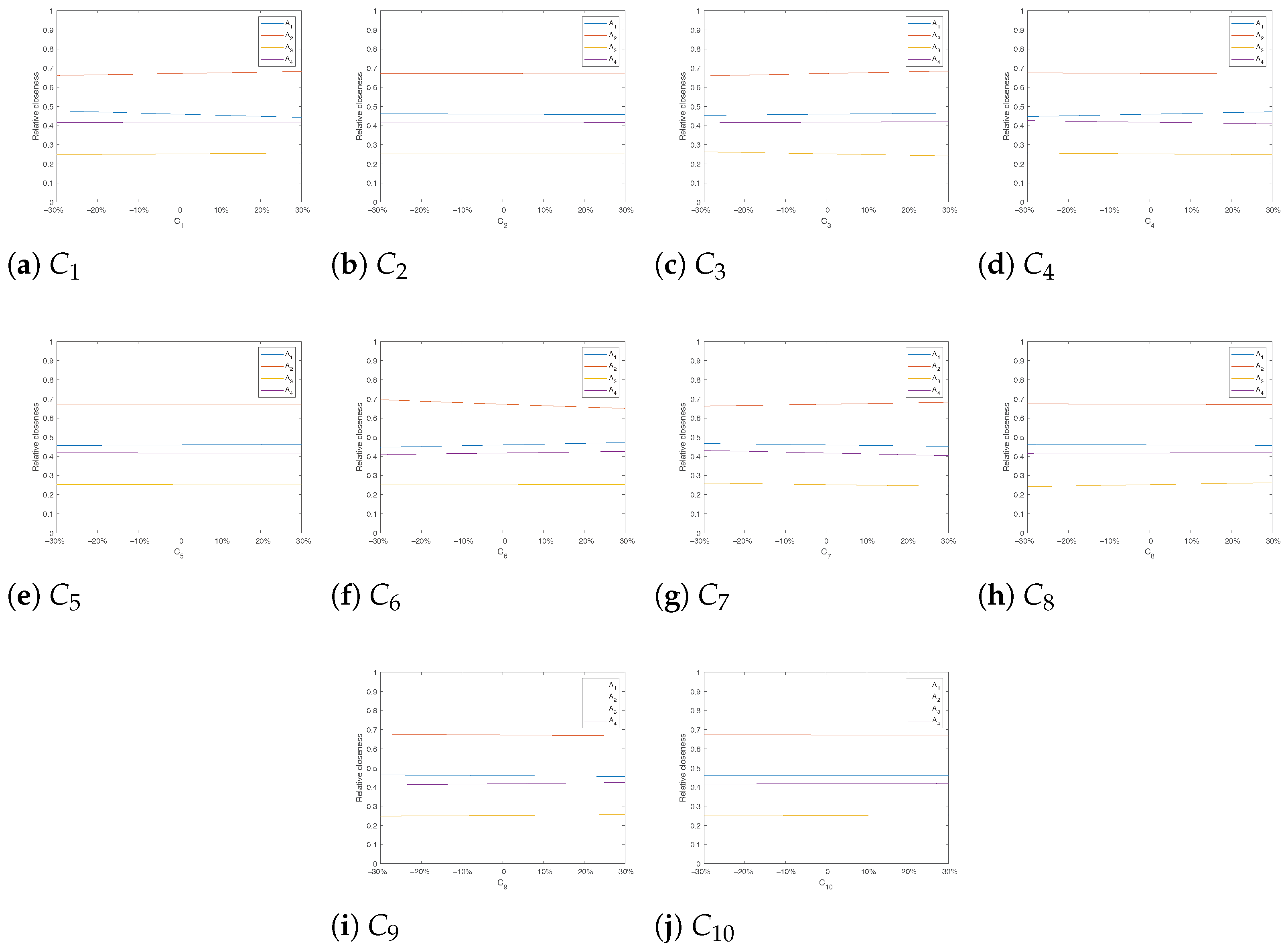
Sixty sensitivity analysis tests are conducted for the ten decision criteria, and the ranking results for all four aircraft alternatives (
,
,
, and
) remain stable using the proposed method, even with varying weights of the decision criteria. As depicted in
Figure 3, the ranking orders of all four alternatives consistently remain
, demonstrating the stability and consistency of the ranking results irrespective of fluctuations in criteria weights. Therefore, based on the sensitivity analysis of criteria weights, it is evident that the proposed method yields reasonable and robust results for aircraft selection.
7.3. Comparison Analysis
To further illustrate the effectiveness, applicability, and feasibility of the proposed method, a comparative analysis is conducted with other methods, and different HFS distance measures are considered.
7.3.1. Comparison with Other Methods
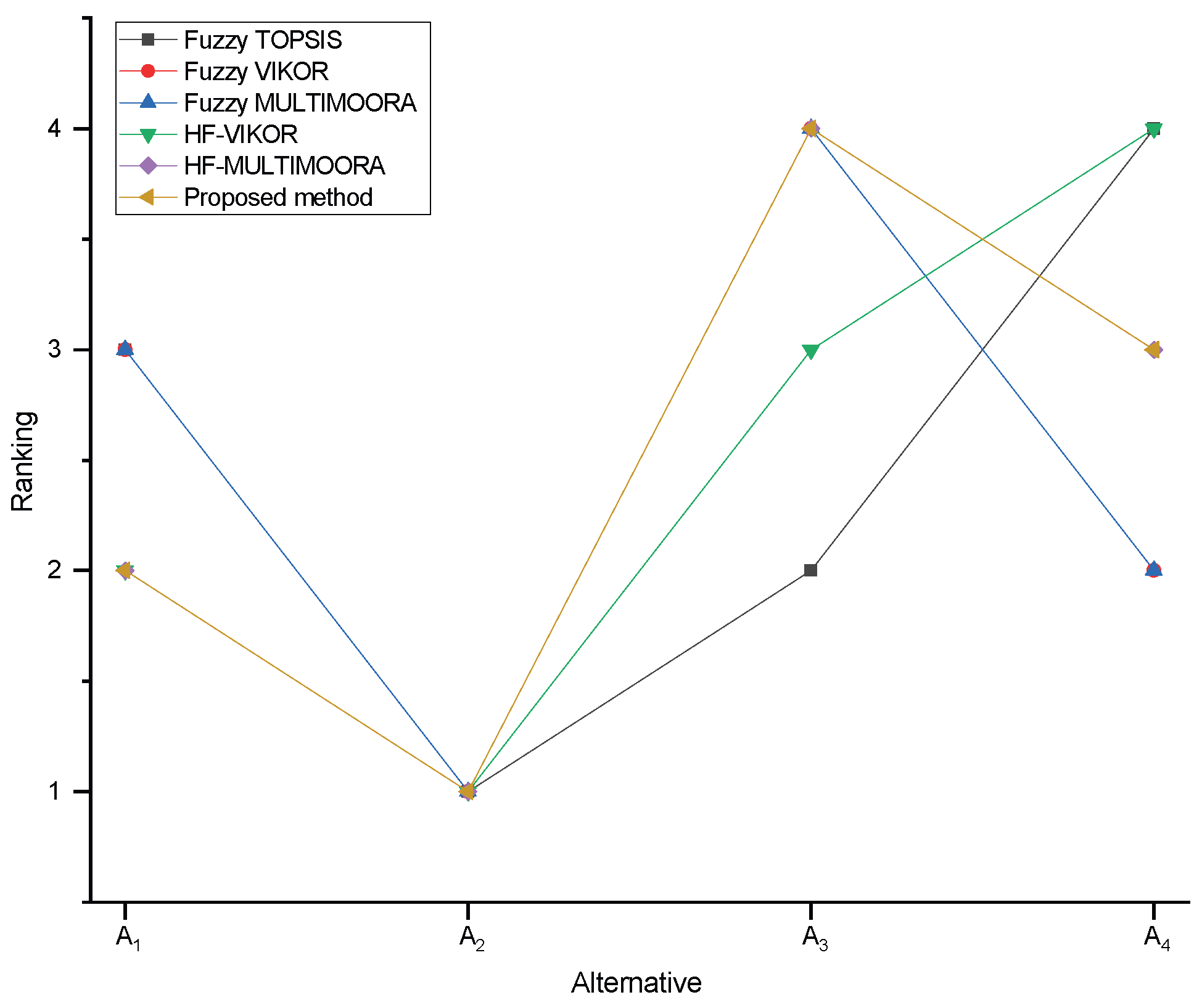
To further validate the proposed method, the results of this study are compared with those obtained using fuzzy TOPSIS, fuzzy VIKOR, fuzzy MULTIMOORA, hesitant fuzzy VIKOR, and hesitant fuzzy MULTIMOORA. The comparative results are summarized in
Table 7.
From the results in
Table 7, it can be observed that
is consistently determined as the best alternative by all the comparative methods. This consistency validates the effectiveness and reliability of the proposed method, as the best alternative identified by the proposed method aligns with the outcomes of the comparative methods. However, it is noteworthy that the ranking of some alternatives varies across different methods, especially for
and
. This discrepancy can be attributed to variations in handling uncertain information and differences in evaluation approaches among the methods. Nevertheless, the comparison results underscore the reliability and effectiveness of the proposed method, as its best results find support from other established methods. The ranking results are also illustrated in
Figure 4.
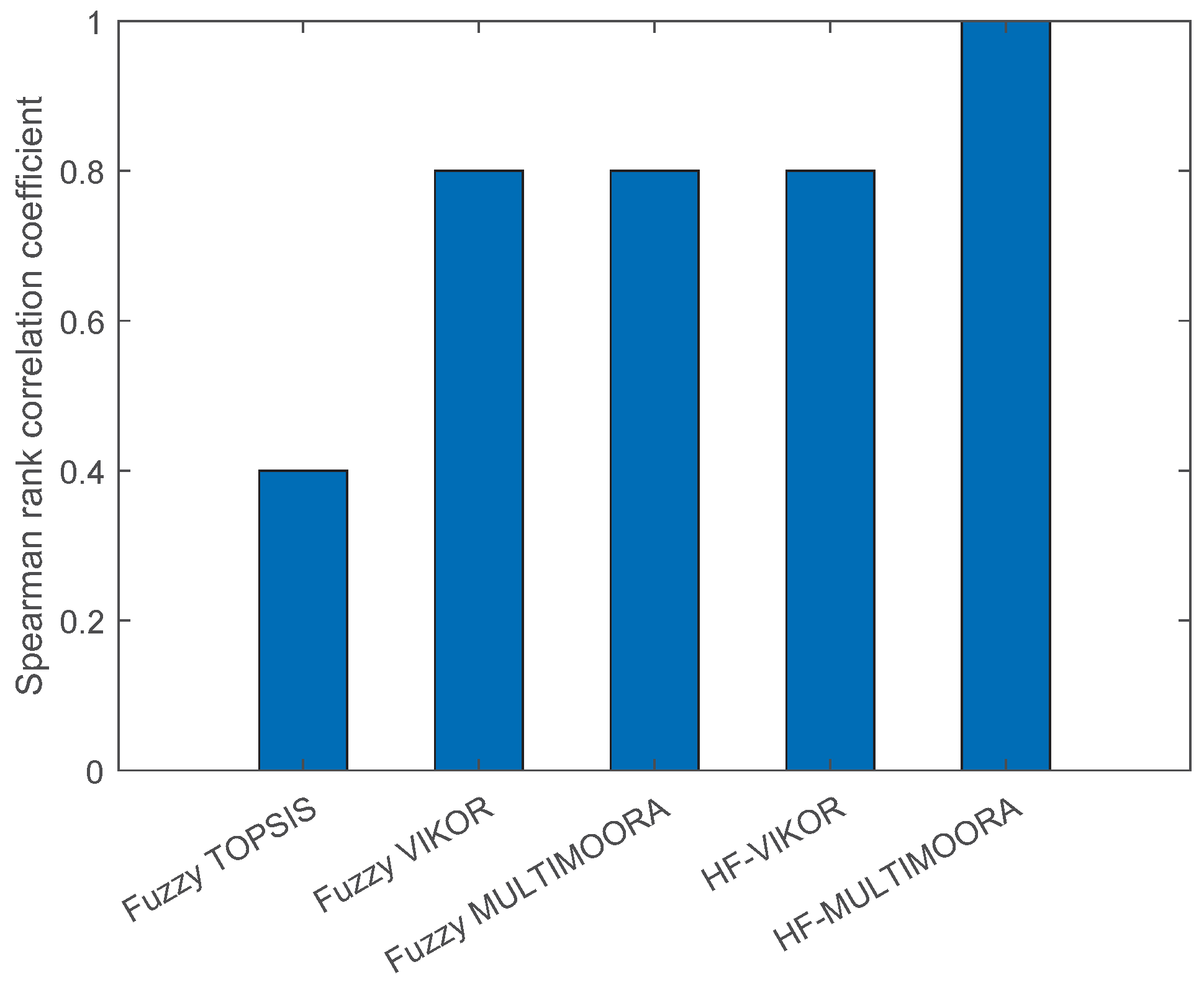
Moreover, considering the differing rankings between the comparative methods and the proposed method, a thorough analysis of the proposed method’s performance is warranted, particularly through consistency analysis. In this study, Spearman’s rank correlation coefficients between the comparative methods and the proposed method are calculated, and the results are presented in
Figure 5. It is evident from
Figure 5 that the rank correlation coefficients between the proposed method and the comparative methods are
, closely approaching
. This signifies a strong positive correlation between the outcomes of these methods. Thus, the results of the consistency analysis further validate the reliability and effectiveness of the proposed method, as its results exhibit a high level of consistency with those of the comparative methods. In summary, the comparative analysis highlights the following advantages of the proposed method:
(1) Similar to HF-VIKOR and HF-MULTIMOORA, the proposed method is grounded in HFS, distinguishing it from fuzzy TOPSIS, fuzzy VIKOR, and fuzzy MULTIMOORA, which rely on FSs. HFS, with its utilization of a more extensive array of membership degrees to represent uncertain information, offers increased flexibility and greater reliability in modeling expert judgments under uncertainty. This heightened flexibility and reliability contribute to enhancing the overall reliability and effectiveness of the proposed method.
(2) The proposed method employs the HFBWM method for criteria weight determination. By leveraging best-to-others and others-to-worst vectors to model criteria preferences, the proposed method presents a practical and reliable approach for calculating criterion weights with significantly reduced computation costs and increased consistency. This, in turn, strengthens the reliability of the obtained results.
(3) The proposed method introduces an innovative distance measure for HFS, incorporating it into the M-HFTOPSIS method. This novel distance measure accurately models the distance between each alternative and the PIS and NIS, facilitating effective evaluations based on relative closeness. The results demonstrate that the proposed method consistently delivers reliable, reasonable, and flexible outcomes.
7.3.2. Comparison with Different Distance Measures
As introduced in
Section 4, this paper proposes a novel distance measure for hesitant fuzzy sets, which is subsequently applied in the M-HFTOPSIS. To validate the effectiveness of the novel distance measure, we compare its results with those obtained using hesitant normalized Hamming distance and hesitant normalized Euclidean distance for the following HFSs:
The results of three different distance measures are shown in
Table 8, it should be noted that for the modified distance measure,
.
As shown in
Table 8, neither the Hamming distance nor the Euclidean distance can determine whether
B is closer to
A or
C, as the distances between these two are the same. However, it is rather intuitive that the difference between
A and
C should be larger than that between
A and
B, as the uncertainty in
C is clearly higher. The improved distance measure in this study, however, can effectively distinguish these HFSs, and the distance between
A and
B is smaller than the distance between
A and
C, which aligns with intuition. Furthermore, it is worth noting that since the improved distance measure takes the weights of criteria into account, it can more precisely and accurately reflect the differences between two HFSs while considering the relative weights of different criteria. Therefore, it can be seen that the improved distance measure in this study is more effective and more reliable.
7.4. Discussion
The primary objective of this study is to develop a mathematically rigorous and practically effective framework for used aircraft selection under uncertainty. To achieve this, the research addresses three pivotal questions regarding the handling of expert assessments, the determination of criteria importance, and the evaluation of alternatives, namely
RQ1: How can uncertain assessments from experts be handled in the process of selecting used aircraft?
RQ2: How can the importance of different criteria for used aircraft selection be determined?
RQ3: What approach can be used to evaluate, compare, and rank different used aircraft alternatives for selection?
Regarding the first research question concerning the modeling of uncertain assessments, the results indicate that experts struggle to assign crisp values to used aircraft attributes due to incomplete maintenance history and market volatility. The HFS proved superior to traditional fuzzy sets in this context. By allowing membership degrees to be defined by a set of possible values, the HFS successfully captured the granular uncertainty and hesitation of the decision-makers, thereby enhancing the flexibility of the information representation.
Regarding the second research question on criteria determination, the complexity of the criteria hierarchy necessitated a weighting method that minimizes cognitive load while maximizing consistency. The application of HFBWM demonstrated that reliable weights could be derived using structured best-to-others and others-to-worst vector comparisons. This significantly reduced the number of pairwise comparisons required compared to traditional AHP, while ensuring that the logical consistency of expert preferences was mathematically verified.
Regarding the third research question on the ranking approach, the evaluation of alternatives requires a sensitive discrimination between fuzzy evaluations. The proposed M-HFTOPSIS, underpinned by the novel distance measure, successfully ranked the aircraft alternatives. Crucially, the analysis showed that the new distance measure, which explicitly accounts for the degree of hesitation, resolved ambiguities where traditional Euclidean or Hamming distances might fail to distinguish between hesitant fuzzy sets with similar mean values but distinct uncertainty profiles.
7.5. Theoretical Implications
Beyond the practical application, this study offers significant theoretical contributions to the field of applied mathematics and decision science.
First, this study augments the theory of distance measures within the hesitant fuzzy environment. Traditional measures often focus solely on the geometric distance between values. This study mathematically integrates the hesitation degree, a second-order uncertainty parameter, into the Euclidean distance formula. This establishes a more comprehensive metric that satisfies fundamental axiomatic properties while providing higher discriminatory power in identifying the separation between fuzzy sets.
Second, the research contributes a methodological integration framework that bridges subjective weighting and objective ranking under a consistent uncertainty model. By coupling HFBWM and M-HFTOPSIS, the research demonstrates how to maintain the integrity of hesitant information throughout the entire decision lifecycle, from weight elicitation to final ranking. This enriches the theoretical landscape of hybrid MCDM methods by verifying that vector-based weighting methods can be effectively harmonized with distance-based ranking methods without information loss.
7.6. Managerial Implications
For industrial practitioners and decision-makers in the aviation sector, the proposed method offers a valuable strategic tool with several practical implications.
One significant implication is the mitigation of risk through advanced uncertainty modeling. The selection of used aircraft is a high-stakes investment characterized by information asymmetry. Managers must recognize that relying on precise, crisp projections can lead to suboptimal decisions. The adoption of the HFS framework allows organizations to capture and process the ambiguous nature of expert judgment. This leads to more realistic risk assessments and prevents the false confidence often associated with deterministic models.
Another implication involves the efficiency of strategic planning. Determining the trade-offs between cost, technical performance, and environmental impact is complex. The HFBWM employed in this study provides managers with a streamlined process to elicit criteria weights. By requiring fewer comparisons than traditional methods, this approach saves time during strategic planning sessions and reduces the inconsistency that often arises when experts are fatigued by excessive pairwise comparisons.
Finally, the study highlights the importance of robustness in fleet acquisition. The M-HFTOPSIS method provides a transparent and defensible ranking of candidates. By utilizing a distance measure that accounts for both performance values and the certainty of those values, managers can identify aircraft that not only meet performance targets but also represent the most stable choice relative to the ideal benchmark. This facilitates more informed negotiations and purchase decisions, ultimately enhancing the operational efficiency of the fleet.
8. Conclusions
This paper presents an integrated decision-making framework to address the complex problem of used aircraft selection in a hesitant fuzzy environment. The core innovation lies in the combination of the hesitant fuzzy best–worst method (HFBWM) and the modified hesitant fuzzy TOPSIS (M-HFTOPSIS), which provides a robust mechanism for handling the uncertainty inherent in aviation asset acquisition. The study first identified the limitations of traditional distance measures in effectively modeling uncertainty. Accordingly, an improved distance measure incorporating the hesitation degree was developed. Furthermore, a comprehensive evaluation criterion system covering technical, economic, and environmental aspects was established. By employing HFBWM for weight derivation and M-HFTOPSIS for ranking, the proposed methodology was validated through a practical case study. The comparative analysis demonstrates that the proposed method provides reasonable aircraft selection results and that the improved distance measure exhibits higher effectiveness and reliability than traditional metrics.
The main contributions and novelties of this study are as follows. First, a novel distance measure for hesitant fuzzy sets was proposed. Unlike traditional measures, this enhanced metric considers both the deterministic values and the hesitation degree, thereby enabling a more accurate differentiation of similar hesitant fuzzy information. Second, the classical TOPSIS method was extended to accommodate hesitant fuzzy information. By utilizing the novel distance measure to determine the geometric proximity to the positive and negative ideal solutions, the applicability of TOPSIS in uncertain environments is enhanced. Third, an integrated method for used aircraft selection was established by combining HFBWM with the extended M-HFTOPSIS. This framework provides an effective solution for selection problems characterized by deep uncertainty and conflicting criteria.
Despite these contributions, the proposed method still has certain limitations. The most notable limitation lies in the use of the score function, which may lead to partial information loss in some complex cases. Future research will address this issue by exploring more suitable calculation methods for determining the values of hesitant fuzzy sets without compromising information integrity. In addition, the proposed framework may be extended to a wider range of practical scenarios beyond aviation to further examine its robustness and versatility.