
A Novel Integrated Group Decision-Making Framework for Assessing Green Supply Chain Strategies Under Complex Uncertainty
 , , ,
, , ,  and
and 
Abstract
1. Introduction
1.1. Research Gap
1.2. Motivation
1.3. Contributions and Research Objectives
- (1)
- Development of the model: Unlike prior complex fuzzy methods ( [29], [30]), integrates the complex fractional orthopair, MF and NMF, enabling simultaneous modeling of magnitude, phase, and subtle fractional hesitation. This allows more precise representation of heterogeneous expert judgments across multiple criteria.
- (2)
- Comprehensive mathematical framework: This study establishes operational laws, score and accuracy functions, and aggregation mechanisms for , supporting reliable fusion of expert evaluations and facilitating accurate comparison of green supply chain alternatives under uncertainty.
- (3)
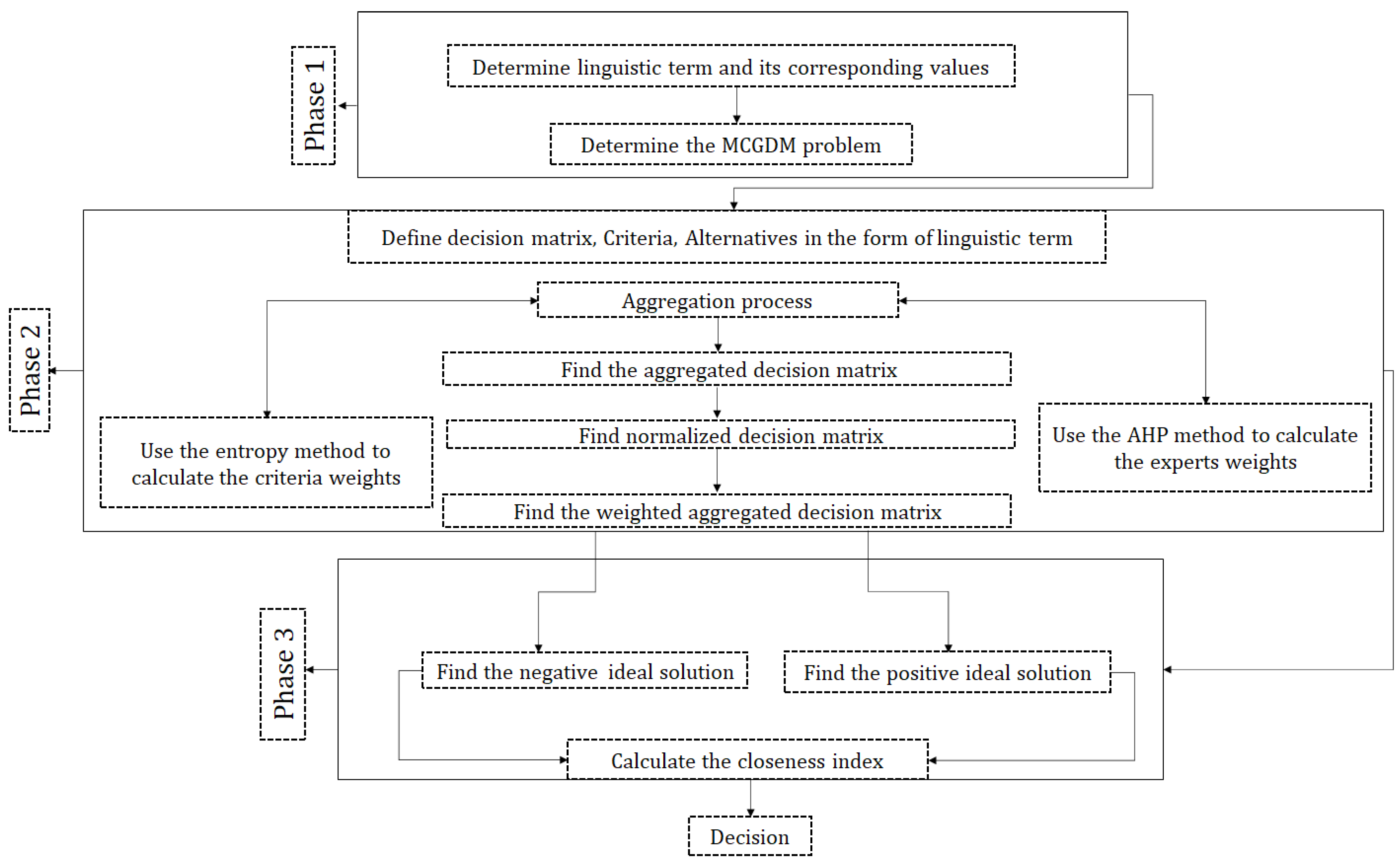
- Integrated weighting and ranking mechanism: Expert importance is determined using the AHP, while entropy weights capture objective criterion significance, and TOPSIS ranks alternatives based on proximity to the ideal solution. This unified approach ensures transparent, consistent, and actionable decision support for sustainability-oriented strategy selection.
- (4)
- Practical novelty and applicability: Compared to existing methods, the proposed framework provides enhanced capability to model fractional uncertainty, complex phase information, and heterogeneous expert assessments, making it particularly suitable for real-world green supply chain DM. As illustrated in Table 1, delivers richer, more actionable evaluations than other complex fuzzy approaches, directly supporting informed and robust sustainability decisions.
- (5)
- Practical implications: From a practical perspective, the proposed framework provides a structured and reliable decision support tool for organizations involved in green supply chain management. It enables decision-makers to prioritize competing sustainability strategies under uncertainty, considering multiple conflicting criteria, such as environmental performance, cost, and regulatory compliance. By accurately modeling expert hesitation and complex uncertainty, the framework supports more realistic and transparent evaluations, reducing the risk of biased or oversimplified decisions. Furthermore, the integration of expert and objective weighting allows organizations to optimize resource allocation, improve sustainability planning, and enhance strategic DM in dynamic and uncertain environments.
- To develop an intelligent -based MCGDM framework for evaluating green supply chain strategies under multi-dimensional uncertainty.
- To capture fractional and phase-based uncertainty in expert assessments using .
- To determine expert weights using the AHP and compute objective criteria weights using the entropy method.
- To apply TOPSIS to generate interpretable and actionable rankings of candidate green supply chain strategies.

| Method | Membership Structure | Ability to Handle Hesitation | Parameter Flexibility | Complex/Phase Information | Applicability to Green Supply Chain Evaluation |
|---|---|---|---|---|---|
| [31] | Complex MF and NMF | Moderate | No | Yes | Introduces phase modeling; partially suitable for sustainability decisions |
| [32] | Complex MF and NMF | High | Limited | Yes | Improved uncertainty tolerance with phase info; partially applicable |
| [29] | Complex MF and NMF | High | Yes | Yes | Captures multi-dimensional uncertainty, but integer-powered q-rungs limit fine-grained hesitation modeling |
| [30] | Complex MF and NMF | High | Yes | Yes | Allows flexible orthopair modeling across criteria; still constrained in representing fractional hesitation or subtle uncertainty |
| Proposed | Complex fractional orthopair MF and NMF | High | Yes | Yes | Integrates magnitude, phase, and fractional hesitation, enabling precise, multi-dimensional, and actionable evaluation of green supply chain strategies |
1.4. Manuscript Structure
2. Preliminaries
- (1)
- ,
- (2)
- ,
- (3)
- ,
- (4)
- .
- (1)
- ,
- (2)
- ,
- (3)
- ,
- (4)
- ,
- (5)
- .
3. Proposed Work
- , where and are positive integers such that . For simplicity, the FOFS can be written as . The parameters and control the flexibility of the orthopair space and generalize several existing fuzzy models.
- (1)
- ,
- (2)
- ,
- (3)
- ,
- (4)
- ,
- (5)
- ,
- (6)
- ,
- (7)
- .
- (1)
- If ,
- (2)
- If ,
- (3)
- If ,
- (4)
- If ,
- (5)
- If ,
- (6)
- .
- (1)
- ,
- (2)
- ,
- (3)
- ,
- (4)
- ,
- (5)
- ,
- (6)
- .
3.1. Aggregation Operators in the Framework
3.2. Proposed MCGDM Approach for the Framework
- (1)
- Identification of Evaluation Criteria: Select relevant attributes to assess the experts’ credibility. Commonly adopted criteria include: professional experience, domain knowledge, research or project contributions, reputation, reliability, and decision-making competence
- (2)
- Expert Scoring: Each expert is evaluated with respect to the selected criteria using a predefined scoring scale (1–5 or 1–9, depending on decision-making preference).
- (3)
- Score Aggregation: The individual criterion scores are summed to obtain the total score for each expert.
- (4)
- Normalization to Derive Expert Weights: The aggregated scores are normalized so that their sum equals 1. The normalization formula is given by:
- (5)
- Application of Weights: The normalized weights are then incorporated into the collective DM process to ensure balanced and proportional consideration of all expert judgments.
3.3. Differences Between the Classical TOPSIS Method and the Proposed TOPSIS Method
3.4. Linguistic Terms
4. An Intelligent MCGDM Framework for the Evaluation of Green Supply Chain Strategies
4.1. Expert Contribution and Decision Influence Structure for Green Supply Chain Strategy Evaluation
4.2. Methodology of the Analytic Hierarchy Process for Expert Weights
4.3. Multicriteria Evaluation Parameters for Green Supply Chain Strategy Assessment
4.4. Comprehensive Overview of Green Supply Chain Strategy Alternatives in the Proposed MCGDM Framework
5. Sensitivity Analysis
Weight-Wise Sensitivity Analysis
6. Comparative Analysis
Computational Performance Comparison
7. Conclusions
7.1. Limitations
7.2. Future Direction
Author Contributions
Funding
Data Availability Statement
Conflicts of Interest
References
- Lakhan, A.; Alyasseri, Z.A.A.; Mohammed, M.A.; AL-Attar, B.; Nedoma, J.; Alubady, R.; Memon, S.; Martinek, R. Sustainable secure blockchain assisted AIoT and green multi-constraints supply chain system. IEEE Internet Things J. 2025, 12, 39392–39406. [Google Scholar] [CrossRef]
- Badi, S.; Murtagh, N. Green supply chain management in construction: A systematic literature review and future research agenda. J. Clean. Prod. 2019, 223, 312–322. [Google Scholar] [CrossRef]
- Tseng, M.-L.; Islam, M.S.; Karia, N.; Fauzi, F.A.; Afrin, S. A literature review on green supply chain management: Trends and future challenges. Resour. Conserv. Recycl. 2019, 141, 145–162. [Google Scholar] [CrossRef]
- Wu, H.; Li, G.; Zheng, H. How does digital intelligence technology enhance supply chain resilience? Sustainable framework and agenda. Ann. Oper. Res. 2025, 355, 901–923. [Google Scholar] [CrossRef]
- Chen, G.; Lim, M.K.; Yeo, W.; Tseng, M.-L. Net zero vs. carbon neutrality: Supply chain management challenges and future research agenda. Int. J. Logist. Res. Appl. 2026, 29, 35–70. [Google Scholar] [CrossRef]
- Ahmed, M.; Raouf, M.; Siddig, K. What are the economic and poverty implications for Sudan if the conflict continues through 2025? J. Dev. Stud. 2026, 62, 106–127. [Google Scholar] [CrossRef]
- Kumar, R.; Dutta, J.; Vamsi, N.; Varri, U.S.; Puthal, D. Next-Generation Security in the 6G Era: The Role of AI in Safeguarding Future Networks. IEEE Access 2026, 14, 17347–17380. [Google Scholar] [CrossRef]
- Khojasteh, Y.; Mousavi Jahan Abadi, S.; Ng, C. Enabling supply chain transformation with cutting-edge digital tools. In Emerging Technologies in Supply Chains: Towards Digital Transformation; Springer: Berlin/Heidelberg, Germany, 2026; pp. 3–47. [Google Scholar]
- Vanalle, R.M.; Ganga, G.M.D.; Godinho Filho, M.; Lucato, W.C. Green supply chain management: An investigation of pressures, practices, and performance within the Brazilian automotive supply chain. J. Clean. Prod. 2017, 151, 250–259. [Google Scholar] [CrossRef]
- Afsar, B.; Silvennoinen, J.; Eyvindson, K.; Miettinen, K.; Ovaskainen, O. Identifying key components for multiobjective forest management decisions: A case study of state-owned Finnish forests. For. Policy Econ. 2026, 182, 103681. [Google Scholar] [CrossRef]
- Herrmann, F.F.; Barbosa-Povoa, A.P.; Butturi, M.A.; Marinelli, S.; Sellitto, M.A. Green supply chain management: Conceptual framework and models for analysis. Sustainability 2021, 13, 8127. [Google Scholar] [CrossRef]
- Kumar, H.; Sharma, R.; Malik, A.K.; Sharma, A.K.; Kumar, P.; Singh, D. Advancements in carbon capture and utilization technologies: Transforming CO2 into valuable resources for a sustainable carbon economy. Next Energy 2026, 10, 100476. [Google Scholar] [CrossRef]
- Khan, M.T.; Idrees, M.D.; Rauf, M.; Sami, A.; Ansari, A.; Jamil, A. Green supply chain management practices’ impact on operational performance with the mediation of technological innovation. Sustainability 2022, 14, 3362. [Google Scholar] [CrossRef]
- Bharambe, B.; Patil, N.; Kothari, N.; Shingade, S.; Shingade, S. Efficient Supply Chains in Agriculture Through Cluster-Based Route Optimization. Oper. Res. Forum 2026, 7, 13. [Google Scholar] [CrossRef]
- Chaudhari, R.S.; Rane, S.B.; Mahajan, S.K.; Phanden, R.K.; Mogal, Y.K. Integrated IoT-Blockchain architecture for sustainable green supply chains in agriculture equipment manufacturing industries: A TOPSIS approach. Int. J. Comput. Integr. Manuf. 2026, 39, 151–182. [Google Scholar] [CrossRef]
- Kant, S.; Ashuro, T.; Adula, M. Sustainable Supply Chain Management Effect on Global Sustainable Service Marketing by Mediation of Cross-Border Virtual Currencies in the Horn of Africa. In Sustainable Service Marketing with Virtual Currencies; IGI Global Scientific Publishing: New York, NY, USA, 2026; pp. 149–178. [Google Scholar]
- Vasconcelos, L.F.; Sigahi, T.F.; Rampasso, I.S.; Moraes, G.H.S.M.d.; Pinto, J.d.S.; Anholon, R. Supply chain 4.0: A multi-sector grey systems-based analysis of buyer-supplier relationship development in Brazil. Prod. Plan. Control 2026, 37, 67–83. [Google Scholar] [CrossRef]
- Micheli, G.J.; Cagno, E.; Mustillo, G.; Trianni, A. Green supply chain management drivers, practices and performance: A comprehensive study on the moderators. J. Clean. Prod. 2020, 259, 121024. [Google Scholar] [CrossRef]
- Trung, D.D.; Trang, B.T.T.; Özçalici, M.; Ersoy, N. CURLIA: A streamlined aggregation method that elevates ranking accuracy in complex MCDM problems. Yugosl. J. Oper. Res. 2025, 40. [Google Scholar] [CrossRef]
- Gul, R.; Shabir, M.; Ayub, S. A hybridization of modified rough bipolar soft sets and TOPSIS for MCGDM. J. N. Theory 2023, 55–73. [Google Scholar] [CrossRef]
- Khan, S.Z.; Alballa, T.; Rahim, M.; Alodhaibi, S.S.; Khalifa, H.A.E.-W. A Context-aware Cognitive Decision-making Framework for Green Supplier Selection Using Quasi-rung Orthopair Diophantine Fuzzy Modeling. Cogn. Comput. 2026, 18, 21. [Google Scholar] [CrossRef]
- Khan, S.Z.; Rahim, M.; Widyan, A.M.; Almutairi, A.; Almutire, N.S.E.; Khalifa, H.A.E.-W. Development of AHP-Based Divergence Distance Measure between p, q, r–Spherical Fuzzy Sets with Applications in Multi-Criteria Decision Making. Comput. Model. Eng. Sci. (CMES) 2025, 143, 2185–2211. [Google Scholar] [CrossRef]
- Ersoy, N.; Van Dua, T.; Thinh, H.X. A comparative evaluation of data normalization techniques using different metrics: Practical application to a MCDM method. Manuf. Rev. 2025, 12, 19. [Google Scholar] [CrossRef]
- Zadeh, L.A. Fuzzy sets. Inf. Control 1965, 8, 338–353. [Google Scholar] [CrossRef]
- Atanassov, K.T. Intuitionistic fuzzy sets. Fuzzy Sets Syst. 1986, 20, 87–96. [Google Scholar] [CrossRef]
- Yager, R.R. Pythagorean fuzzy subsets. In 2013 Joint IFSA World Congress and NAFIPS Annual Meeting (IFSA/NAFIPS); IEEE: New York, NY, USA, 2013; pp. 57–61. [Google Scholar]
- Peng, X.; Yang, Y. Some results for Pythagorean fuzzy sets. Int. J. Intell. Syst. 2015, 30, 1133–1160. [Google Scholar] [CrossRef]
- Yager, R.R. Generalized orthopair fuzzy sets. IEEE Trans. Fuzzy Syst. 2016, 25, 1222–1230. [Google Scholar] [CrossRef]
- Ali, Z.; Mahmood, T. Maclaurin symmetric mean operators and their applications in the environment of complex q-rung orthopair fuzzy sets. Comput. Appl. Math. 2020, 39, 161. [Google Scholar] [CrossRef]
- Rahim, M.; Bajri, S.A.; Alqahtani, H.; Alhabeeb, S.A.; Khalifa, H.A.E.-W. Multi-criteria Group Decision-Making Using Complex p, q-quasirung orthopair fuzzy sets: Application in the selection of renewable energy projects for investments. Cogn. Comput. 2025, 17, 86. [Google Scholar] [CrossRef]
- Ramot, D.; Milo, R.; Friedman, M.; Kandel, A. Complex fuzzy sets. IEEE Trans. Fuzzy Syst. 2002, 10, 171–186. [Google Scholar] [CrossRef]
- Ullah, K.; Mahmood, T.; Ali, Z.; Jan, N. On some distance measures of complex Pythagorean fuzzy sets and their applications in pattern recognition. Complex Intell. Syst. 2020, 6, 15–27. [Google Scholar] [CrossRef]
- Seikh, M.R.; Mandal, U. Multiple attribute group decision making based on quasirung orthopair fuzzy sets: Application to electric vehicle charging station site selection problem. Eng. Appl. Artif. Intell. 2022, 115, 105299. [Google Scholar] [CrossRef]
- Zhang, X.; Jia, P.; Khan, S.Z.; Syam, M.I.; Rahim, M.; Khalifa, H.A.E.-W. Fractional orthopair fuzzy decision framework for sustainable water resource management in urban areas. Sci. Rep. 2025, 15, 42888. [Google Scholar] [CrossRef] [PubMed]
- Shannon, C.E. A mathematical theory of communication. Bell Syst. Tech. J. 1948, 27, 379–423. [Google Scholar] [CrossRef]
- Saaty, T.L. The Analytic Hierarchy Process; McGraw-Hill: Columbus, OH, USA, 1980. [Google Scholar]
- Ersoy, N.; Van Dua, T.; Van Duc, D.; Diep, M.T. M-opara: A modified approach to the opara method. Decis. Mak. Appl. Manag. Eng. 2025, 8, 256–275. [Google Scholar]
- Akhtar, Y.; Ali, M.; Almaliki, F.A.; Almarzouki, R.A. A novel IoT-based approach using fractional fuzzy Hamacher aggregation operators application in revolutionizing healthcare selection. Sci. Rep. 2025, 15, 2712. [Google Scholar] [CrossRef]
- Hussain, R.; Hussain, Z.; Ali, M.; Akhtar, Y.; Syam, M.I. Advancing decision making with distance and similarity measures for belief and plausibility in Fermatean fuzzy sets. Sci. Rep. 2025, 15, 40303. [Google Scholar] [CrossRef]
- Rishabh, R.; Das, K.N. Selection of a Suitable Healthcare Supplier Using AHP and TOPSIS Methods Hybridized in Metaheuristic Environment. SN Comput. Sci. 2025, 6, 164. [Google Scholar] [CrossRef]
- Kong, X.; Chen, Z.; Liu, W.; Ning, K.; Zhang, L.; Muhammad Marier, S.; Liu, Y.; Chen, Y.; Xia, F. Deep learning for time series forecasting: A survey. Int. J. Mach. Learn. Cybern. 2025, 16, 5079–5112. [Google Scholar] [CrossRef]
- Sarkar, A.; Deb, N.K.; Rani, P.; Biswas, A. q-Rung Orthopair Fuzzy Soft Rough Aggregation Operators and Similarity to Ideal Solution Method Using Hamacher Operations for Solving Decision-Making Problems: A Case Study in Food Waste Treatment Technology Selection. Cogn. Comput. 2025, 17, 159. [Google Scholar] [CrossRef]
- Rahim, M.; Khan, S.Z.; Syam, M.I.; Bajri, S.A.; Alodhaibi, S.S.; Khalifa, H.A.E.-W. A Quasirung Orthopair Fuzzy Hamy Mean-Based Decision Support Framework with Application to E-Learning Platform Selection. Int. J. Comput. Intell. Syst. 2026, 19, 76. [Google Scholar] [CrossRef]
- Shabir, M.; Ayub, S.; Gul, R.; Ali, M.I. Algebraic structures of q-rung orthopair fuzzy relations with applications in decision-making. Math. Found. Comput. 2024, 9, 1–26. [Google Scholar] [CrossRef]
- Liu, C. Intelligent Evaluation of College Physical Education Quality Using Advanced Complex Interval-Valued Fermatean Fuzzy Models. IEEE Access 2025. [Google Scholar] [CrossRef]
- Ali, Z.; Waqas, M.; Moslem, S.; Senapati, T.; Esztergár-Kiss, D. Evaluation of public bus transport service quality based on circular Pythagorean fuzzy soft Einstein aggregation operators. Complex Intell. Syst. 2025, 11, 276. [Google Scholar] [CrossRef]
- Tang, F.; Zhang, Y.; Wang, J. A Novel Multi-attribute Group Decision-Making Method Under Linguistic q-Rung Orthopair Fuzzy Environment Based on Archimedean Copula and Extended Power Average Operator. Cogn. Comput. 2025, 17, 66. [Google Scholar] [CrossRef]
- Ünver, M. Gaussian Aggregation Operators and Applications to Intuitionistic Fuzzy Classification. J. Classif. 2025, 42, 596–623. [Google Scholar] [CrossRef]
- Liu, P.; Shen, J.; Zhang, P.; Ning, B. Multi-attribute group decision-making method using single-valued neutrosophic credibility numbers with fairly variable extended power average operators and GRA-MARCOS. Expert Syst. Appl. 2024, 263, 125703. [Google Scholar] [CrossRef]
- Palanikumar, M.; Kausar, N.; Pamucar, D.S.; Simic, V. Optimizing industrial robot selection using novel trigonometric Pythagorean fuzzy normal aggregation operators. Complex Intell. Syst. 2025, 11, 453. [Google Scholar] [CrossRef]
- Wang, P.; Zhu, B.; Yan, K.; Zhang, Z.; Ali, Z.; Pamucar, D.S. Power aggregation operators based on Aczel-Alsina T-norm and T-conorm for intuitionistic hesitant fuzzy information and their application to logistics service provider selection. Artif. Intell. Rev. 2025, 58, 204. [Google Scholar] [CrossRef]
| Aspect | Classical TOPSIS | Proposed TOPSIS |
|---|---|---|
| Data Representation | Crisp numerical values | numbers |
| Uncertainty Modeling | Limited | Complex fractional orthopair structure |
| Membership Representation | Not applicable | Complex-valued MF and NMF |
| Hesitancy Handling | Not explicitly modeled | Explicitly represented |
| Distance Calculation | Euclidean distance | Distance based on score values |
| Decision Environment | Deterministic | Uncertain and multi-dimensional |
| Linguistic Variable | Notation | Intensity Level | Fuzzy Interpretation | Application Relevance | |
|---|---|---|---|---|---|
| Minimal | Extremely weak MF; very strong NMF | Extremely weak MF; very strong NMF | Represents highly undesirable or severely underperforming technologies | ||
| Marginal | Very low agreement; high dissatisfaction | Very low MF; high NMF | Used when a technology barely meets the basic requirement | ||
| Subdued | Low MF, moderately high NMF | Low MF; moderately high NMF | Applied to technologies demonstrating below-average performance | ||
| Moderate Low | Slightly weak MF; noticeable hesitation | Weak MF; noticeable hesitation | Represents alternatives approaching but still below standard | ||
| Balanced | MF ≅ NMF; high neutrality | MF approximately equal to NMF | Appropriate when performance is average or ambiguous | ||
| Refined | Slightly dominant MF over NMF | Slight MF > NMF | Used for alternatives with modest but clear positive tendencies | ||
| Enhanced | Good agreement; reduced hesitation | Strong MF; reduced hesitation | Indicates reliably positive performance across technical criteria | ||
| Prominent | Strong MF; low NMF | Strong MF; low NMF | Reflects strong and consistent performance | ||
| Superior | Very strong MF; minimal disagreement | Very strong MF; minimal NMF | Applied to high-performing, efficient technologies | ||
| Exceptional | Near-maximum MF; very weak NMF | Near-maximum MF; very weak NMF | Represents standout breakthroughs or highly innovative technologies | ||
| Optimal | Almost perfect MF; negligible NMF | Very high MF; negligible NMF | Reserved for the best possible technology under all criteria | ||
| Advanced | Highly reliable MF; minimal NMF | Highly reliable MF; minimal NMF | Applied to technologies with advanced capabilities | ||
| Distinguished | Strong MF; very low disagreement | Strong MF; very low NMF | Represents technologies with exceptional distinction | ||
| Pioneering | Near-ideal MF; negligible NMF | Near-ideal MF; negligible NMF | Indicates technologies introducing novel and pioneering approaches | ||
| Ultimate | Almost perfect MF; nearly no NMF | Almost perfect MF; nearly no NMF | Reserved for the most superior, state-of-the-art technology |
| Expert | Designation/Role | Primary Specialization | Relevant Contribution to GSCM Strategy Evaluation | Experience (Years) | Assigned Weight |
|---|---|---|---|---|---|
| Senior Sustainability Manager | Environmental Sustainability and Green Operations | Environmental Sustainability and Green Operations | 14 | 0.109 | |
| Industrial Engineering Specialist | Industrial Engineering Specialist | Industrial Engineering Specialist | 12 | 0.205 | |
| Supply Chain Analytics Expert | Supply Chain Analytics Expert | Supply Chain Analytics Expert | 18 | 0.208 | |
| Logistics and Operations Manager | Logistics and Operations Manager | Logistics and Operations Manager | 10 | 0.110 | |
| Environmental Policy and Regulatory Advisor | Environmental Policy and Regulatory Advisor | Environmental Policy and Regulatory Advisor | 11 | 0.369 |
| Criterion Code | Criterion Name | Description | Reason for Inclusion | Measurement Domain | Type |
|---|---|---|---|---|---|
| Resource Efficiency | Measures how effectively resources are used in supply chain operations | Indicates operational productivity and sustainability | Operational/Resource | BC | |
| Waste Reduction | Volume of waste minimized during supply chain activities | Enhances environmental performance and sustainability | Environmental | BC | |
| Energy Consumption | Total energy used across supply chain processes | Lower consumption reduces environmental impact and cost | Engineering/Energy | CC | |
| System Complexity | Number and difficulty of processes or operations | High complexity increases risk, inefficiency, and maintenance difficulty | Operations | CC | |
| Reliability | Ability to maintain continuous operation without failure | Ensures supply chain continuity and reduces operational risks | Operations | BC | |
| Automation Level | Degree of automation in processes | Reduces human error, increases efficiency | Technology/AI | BC | |
| Scalability | Potential to expand operations sustainably | Supports growth without increasing environmental footprint | Strategic Planning | BC | |
| Environmental Impact Resilience | Ability to perform under variable environmental conditions | Ensures adaptability and sustainability under external pressures | Environmental | BC | |
| Process Complexity | Operational steps and technical difficulty | Simpler processes reduce errors and energy consumption | Operations | CC | |
| Throughput | Volume of products or materials processed per unit of time | Higher throughput increases efficiency | Operational/Logistics | BC | |
| Maintenance Requirements | Frequency and difficulty of upkeep | Minimizing maintenance reduces downtime and resource usage | Operations | CC | |
| Technology Maturity | Readiness and maturity of technology applied | Ensures feasibility and smooth implementation | Technology | BC | |
| Product Quality | Quality of products delivered | Impacts customer satisfaction and regulatory compliance | Operational/Quality | BC | |
| Regulatory Compliance | Adherence to environmental and industry regulations | Avoids legal risks and ensures sustainability | Legal/Regulatory | CC | |
| Implementation Cost | Total cost of implementing the supply chain strategy | Affects economic feasibility and decision-making | Economic | CC |
| Implementation Readiness | Resource Efficiency | Environmental Impact Reduction | Autonomy and Scalability | Process Complexity | Operational Cost | Research/ Adoption Level | Overall Sustainability Score (0–10) | |
|---|---|---|---|---|---|---|---|---|
| Low–Medium | Very High | Medium | Medium | Very High | High | Limited Pilots | 6.9 | |
| Medium | High | High | Very High | High | Medium | Academic + Pilot Projects | 7.7 | |
| Medium–High | High | Medium | High | Medium | High | Industry Demonstrators | 8.0 | |
| Medium–High | Very High | High | Medium | Medium | Medium | Government Programs | 8.4 | |
| Low | Moderate | Low–Medium | Low–Medium | Very High | Very High | Early Experimental Research | 6.0 | |
| Low–Medium | High | Very High | High | Very High | High | Research Prototypes | 7.2 | |
| Medium | Moderate | Medium | Medium | High | Medium | Corporate Research | 7.1 | |
| High | High | High | High | Medium | Low | Mature Industry Implementation | 8.5 | |
| Medium | Moderate | Very High | Medium | Medium | Low | Pilot Environmental Studies | 7.6 | |
| Medium–High | High | High | Medium | Medium | Low | Demonstration Projects | 8.1 | |
| High | Very High | High | High | Medium | Medium | Advanced Industry Labs | 8.7 | |
| Medium | High | Medium | Medium | High | High | Government + Industry Pilots | 7.5 | |
| Low | Moderate | Low | Medium | High | Low–Medium | Early Circular Economy Research | 6.3 | |
| High | High | High | High | Medium | Medium | Commercial + Pilot Projects | 8.2 | |
| Low–Medium | High | Medium | Low | Very High | Very High | Concept-Level Studies | 6.8 |
| Criteria | Corresponding Weights | Criteria | Corresponding Weights | Criteria | Corresponding Weights |
|---|---|---|---|---|---|
| 0.05785034 | 0.06340993 | 0.06335059 | |||
| 0.09337091 | 0.05969790 | 0.05997686 | |||
| 0.06180154 | 0.06101757 | 0.07031635 | |||
| 0.05469479 | 0.07068265 | 0.09168510 | |||
| 0.06340226 | 0.06123785 | 0.06750638 |
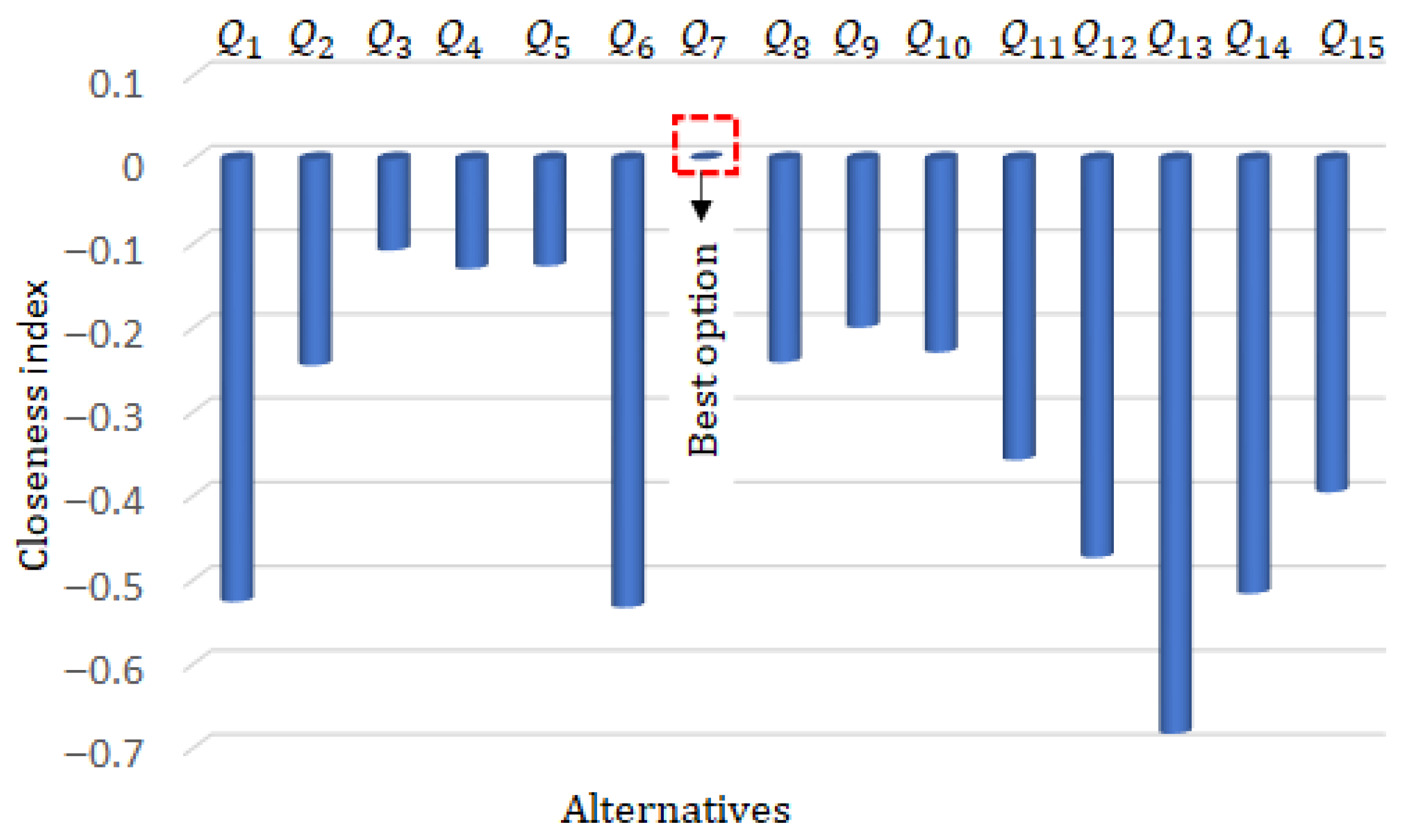
| Ranking | ||||
|---|---|---|---|---|
| 1.4748 | 1.4831 | 13 | ||
| 1.3988 | 1.3988 | 8 | ||
| 1.1542 | 1.1613 | 3 | ||
| 1.2580 | 1.2634 | 4 | ||
| 1.1974 | 1.2081 | 2 | ||
| 1.599 | 1.588 | 14 | ||
| 1.060 | 1.080 | 1 | ||
| 1.3793 | 1.3804 | 7 | ||
| 1.3400 | 1.3513 | 5 | ||
| 1.3414 | 1.3619 | 6 | ||
| 1.4137 | 1.4238 | 9 | ||
| 1.4431 | 1.4591 | 11 | ||
| 1.6783 | 1.6103 | 15 | ||
| 1.4638 | 1.4643 | 12 | ||
| 1.4152 | 1.4231 | 10 |
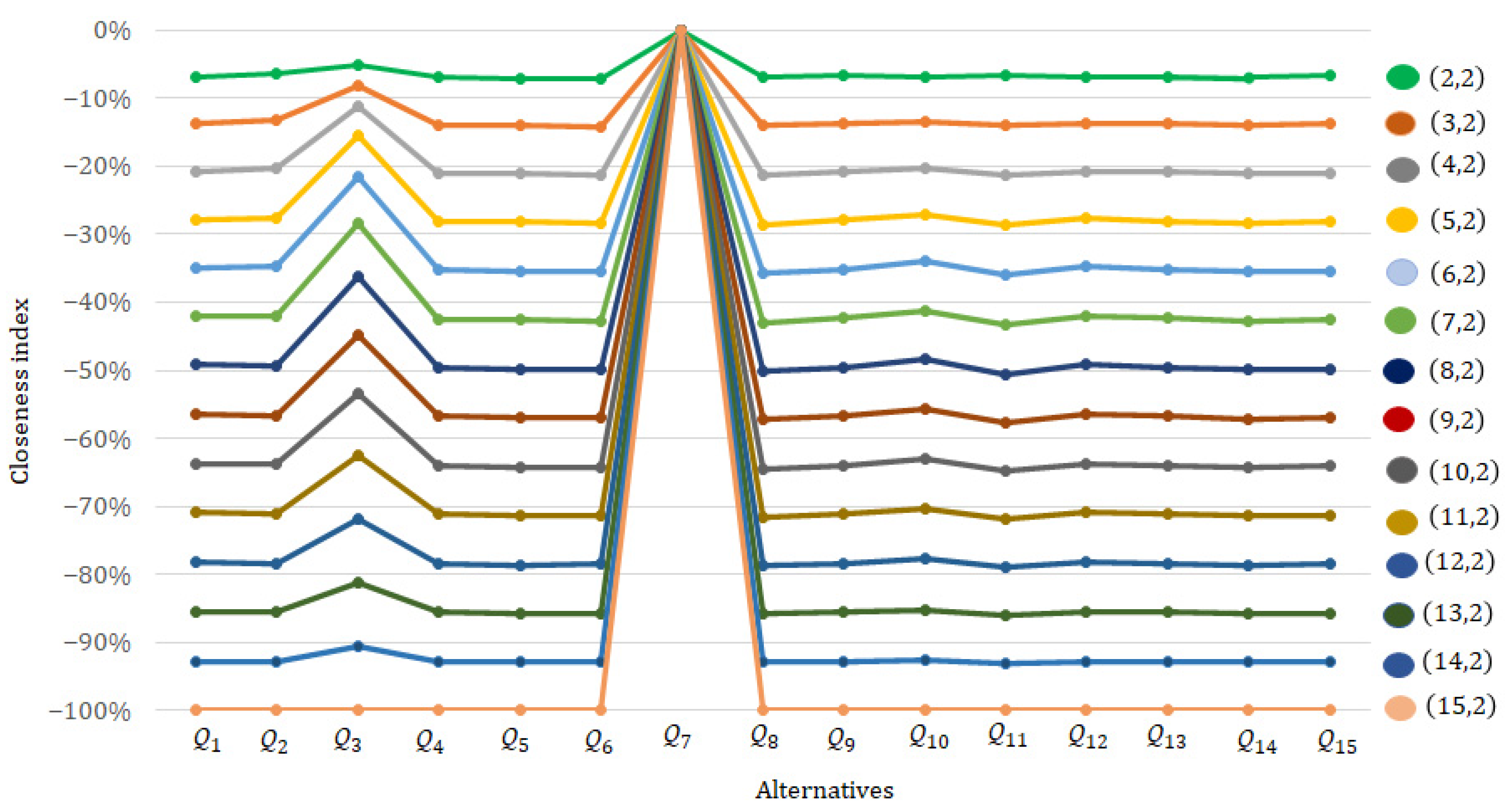
| (p, q) | |||||
| (2,2) | −0.824770375 | −0.316749381 | −0.001356483 | −0.284413228 | −0.236591776 |
| (3,2) | −0.830631005 | −0.304527351 | −0.012122527 | −0.260022299 | −0.250122378 |
| (4,2) | −0.834780546 | −0.295493813 | −0.001356483 | −0.229082315 | −0.260834007 |
| (5,2) | −0.835140555 | −0.286498182 | −0.012122527 | −0.197120939 | −0.266969342 |
| (6,2) | −0.833794544 | −0.277804185 | −0.001356483 | −0.166694157 | −0.269965655 |
| (7,2) | −0.832286522 | −0.269843454 | −0.012122527 | −0.138681786 | −0.271178007 |
| (8,2) | −0.830825044 | −0.262640399 | −0.001356483 | −0.113134482 | −0.271307591 |
| (9,2) | −0.829516900 | −0.256179937 | −0.012122527 | −0.089910921 | −0.270813189 |
| (10,2) | −0.828351658 | −0.250399547 | −0.001356483 | −0.068799036 | −0.269967326 |
| (11,2) | −0.827361987 | −0.245245548 | −0.012122527 | −0.049584543 | −0.268958526 |
| (12,2) | −0.826250532 | −0.240568138 | −0.001356483 | −0.032049559 | −0.267804438 |
| (13,2) | −0.824933349 | −0.236288095 | −0.012122527 | −0.016022429 | −0.266551403 |
| (14,2) | −0.825299659 | −0.233862577 | −0.001356483 | −0.002712654 | −0.266774148 |
| (15,2) | −0.836484900 | −0.241595018 | −0.012122527 | −0.012405000 | −0.276900628 |
| (p,q) | |||||
| (2,2) | −0.937945786 | 0.0000000 | −0.532785127 | −0.326510975 | −0.169017366 |
| (3,2) | −0.938458638 | 0.0000000 | −0.517358388 | −0.306772624 | −0.170319427 |
| (4,2) | −0.937924039 | 0.0000000 | −0.507916858 | −0.287809876 | −0.165399654 |
| (5,2) | −0.934715227 | 0.0000000 | −0.499621586 | −0.270144722 | −0.157555529 |
| (6,2) | −0.931053549 | 0.0000000 | −0.492130716 | −0.254586136 | −0.148964475 |
| (7,2) | −0.928376524 | 0.0000000 | −0.485636111 | −0.241366089 | −0.140639978 |
| (8,2) | −0.926610682 | 0.0000000 | −0.479902882 | −0.230202319 | −0.132886550 |
| (9,2) | −0.925613717 | 0.0000000 | −0.474806016 | −0.220791703 | −0.125796583 |
| (10,2) | −0.925172135 | 0.0000000 | −0.470232669 | −0.212833964 | −0.119360496 |
| (11,2) | −0.925175187 | 0.0000000 | −0.466133659 | −0.206083245 | −0.113541501 |
| (12,2) | −0.925186245 | 0.0000000 | −0.462294324 | −0.20025513 | −0.108247212 |
| (13,2) | −0.925038320 | 0.0000000 | −0.458633457 | −0.195161021 | −0.103417183 |
| (14,2) | −0.926635849 | 0.0000000 | −0.456774010 | −0.192144998 | −0.100425129 |
| (15,2) | −0.939217617 | 0.0000000 | −0.465335019 | −0.199389480 | −0.107398301 |
| (p,q) | |||||
| (2,2) | −0.540824902 | −0.69548968 | −0.947797229 | −0.409893332 | −0.484682618 |
| (3,2) | −0.517787673 | −0.704734627 | −0.933058465 | −0.40537307 | −0.455390249 |
| (4,2) | −0.504707808 | −0.709395486 | −0.926410366 | −0.400040665 | −0.431630146 |
| (5,2) | −0.493627516 | −0.708491159 | −0.920598226 | −0.392411972 | −0.410756853 |
| (6,2) | −0.483599526 | −0.704855256 | −0.91540438 | −0.383743868 | −0.392624806 |
| (7,2) | −0.474718835 | −0.700474662 | −0.911312242 | −0.375072581 | −0.377171307 |
| (8,2) | −0.466751389 | −0.695901421 | −0.907946729 | −0.366704465 | −0.363923277 |
| (9,2) | −0.459578411 | −0.691426488 | −0.905117719 | −0.35880374 | −0.352515672 |
| (10,2) | −0.453087028 | −0.687146773 | −0.902655313 | −0.351417077 | −0.342631862 |
| (11,2) | −0.447220691 | −0.683142881 | −0.900512601 | −0.344569887 | −0.334042602 |
| (12,2) | −0.441761531 | −0.679194755 | −0.898322849 | −0.338128897 | −0.326436926 |
| (13,2) | −0.436619809 | −0.675244924 | −0.895972541 | −0.332042709 | −0.319632899 |
| (14,2) | −0.433392149 | −0.673086759 | −0.89538428 | −0.327856329 | −0.315069005 |
| (15,2) | −0.440651311 | −0.681644509 | −0.905776018 | −0.334010637 | −0.321094178 |
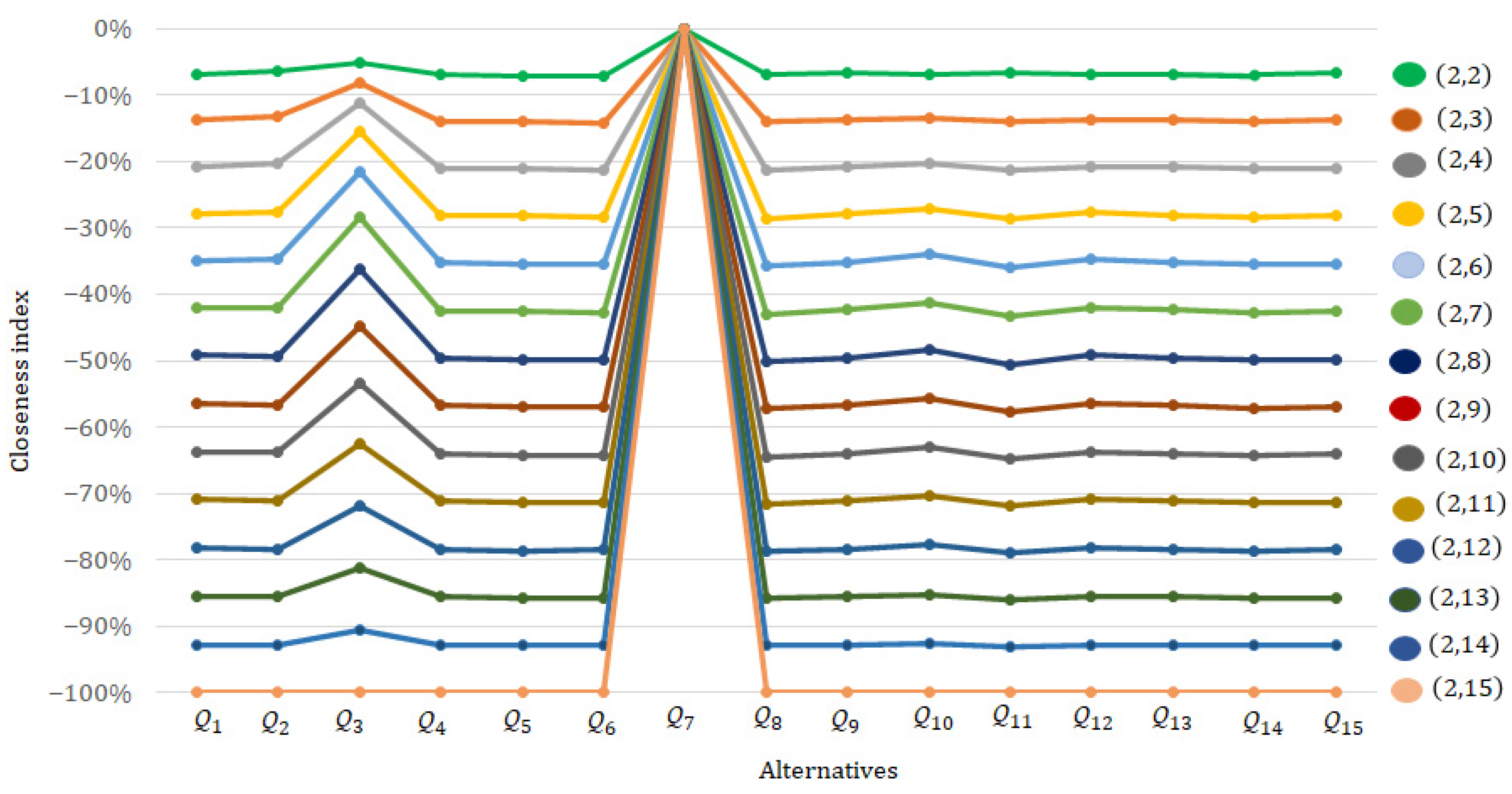
| (p, q) | |||||
| (2,2) | −0.824770375 | −0.316749381 | −0.926410366 | −0.284413228 | −0.236591776 |
| (2,3) | −0.824870291 | −0.331922387 | −0.920598226 | −0.290178648 | −0.232048189 |
| (2,4) | −0.832123730 | −0.343295186 | −0.915404380 | −0.288807792 | −0.234905566 |
| (2,5) | −0.840873024 | −0.349717643 | −0.926410366 | −0.287948732 | −0.238041265 |
| (2,6) | −0.848555245 | −0.352453832 | −0.920598226 | −0.288352285 | −0.239702957 |
| (2,7) | −0.854601206 | −0.353207215 | −0.915404380 | −0.289425956 | −0.240173778 |
| (2,8) | −0.859154884 | −0.353122048 | −0.926410366 | −0.290633199 | −0.240025942 |
| (2,9) | −0.862535535 | −0.352786267 | −0.920598226 | −0.291707190 | −0.239651560 |
| (2,10) | −0.865042843 | −0.352448205 | −0.915404380 | −0.292564075 | −0.239248092 |
| (2,11) | −0.866918095 | −0.352190853 | −0.284413228 | −0.293209751 | −0.238895111 |
| (2,12) | −0.868347620 | −0.352028695 | −0.290178648 | −0.293683940 | −0.238615123 |
| (2,13) | −0.869457989 | −0.351946805 | −0.288807792 | −0.294027727 | −0.238403260 |
| (2,14) | −0.870338139 | −0.351924489 | −0.287948732 | −0.294276552 | −0.238246690 |
| (2,15) | −0.871050318 | −0.351942943 | −0.284413228 | −0.294457873 | −0.238131986 |
| (p,q) | |||||
| (2,2) | −0.937945786 | 0.0000000 | −0.532785127 | −0.326510975 | −0.169017366 |
| (2,3) | −0.938871006 | 0.0000000 | −0.549702059 | −0.338738287 | −0.164089751 |
| (2,4) | −0.941634441 | 0.0000000 | −0.557931342 | −0.343945055 | −0.163823403 |
| (2,5) | −0.943859868 | 0.0000000 | −0.559209039 | −0.346285823 | −0.166699934 |
| (2,6) | −0.945280974 | 0.0000000 | −0.557247738 | −0.347373742 | −0.170365184 |
| (2,7) | −0.946259956 | 0.0000000 | −0.554606957 | −0.347962295 | −0.173631070 |
| (2,8) | −0.947028648 | 0.0000000 | −0.552352904 | −0.348361110 | −0.176166668 |
| (2,9) | −0.947679826 | 0.0000000 | −0.550727062 | −0.348684535 | −0.178017373 |
| (2,10) | −0.948237951 | 0.0000000 | −0.549652858 | −0.348969177 | −0.179333252 |
| (2,11) | −0.948713197 | 0.0000000 | −0.548983375 | −0.349226862 | −0.180263628 |
| (2,12) | −0.949121553 | 0.0000000 | −0.548590500 | −0.349464319 | −0.180927796 |
| (2,13) | −0.949469971 | 0.0000000 | −0.548374605 | −0.349682483 | −0.181410120 |
| (2,14) | −0.949766147 | 0.0000000 | −0.548267830 | −0.349882024 | −0.181768590 |
| (2,15) | −0.950017869 | 0.0000000 | −0.548226239 | −0.350063855 | −0.182042240 |
| (p,q) | |||||
| (2,2) | −0.540824902 | −0.69548968 | −0.947797229 | −0.409893332 | −0.484682618 |
| (2,3) | −0.570359571 | −0.692816718 | −0.968118831 | −0.415211512 | −0.507315131 |
| (2,4) | −0.587731100 | −0.699504634 | −0.982073405 | −0.419739837 | −0.516905736 |
| (2,5) | −0.592478510 | −0.708191617 | −0.989423419 | −0.422128933 | −0.519593405 |
| (2,6) | −0.589651342 | −0.715631650 | −0.992879700 | −0.422765690 | −0.519390298 |
| (2,7) | −0.583962341 | −0.721197281 | −0.994684124 | −0.422502015 | −0.518437365 |
| (2,8) | −0.578046540 | −0.725152317 | −0.995924681 | −0.421926985 | −0.517561554 |
| (2,9) | −0.572974200 | −0.727922644 | −0.996997644 | −0.421334168 | −0.516969867 |
| (2,10) | −0.568995693 | −0.729866991 | −0.998000747 | −0.420833887 | −0.516643102 |
| (2,11) | −0.566024197 | −0.731248542 | −0.998941301 | −0.420450756 | −0.516510100 |
| (2,12) | −0.563873846 | −0.732254246 | −0.999816351 | −0.420177618 | −0.516507555 |
| (2,13) | −0.562348250 | −0.733003887 | −0.000615895 | −0.419992233 | −0.516583761 |
| (2,14) | −0.561281012 | −0.733576907 | −0.001337044 | −0.419872211 | −0.516703507 |
| (2,15) | −0.560542558 | −0.734026169 | −0.001982534 | −0.419798775 | −0.516844193 |
| Ranking Order | Best Alternative | |
|---|---|---|
| 0.05 | ||
| 0.10 | ||
| 0.15 | ||
| 0.20 | ||
| 0.25 | ||
| 0.30 |
| Author/Method | Aggregation Operator | Best Alternative Identified | Ranking Stability | Robustness Index | Sensitivity to Criteria Uncertainty | Fuzzy Uncertainty Handling Strength | Suitability for Space Mining Tech. | Overall Class | Rank |
|---|---|---|---|---|---|---|---|---|---|
| Proposed FOFS MCGDM | -WA + Entropy + AHP | Very High | Very High | Low–Medium | Very Strong | Excellent | Excellent | ||
| Arun et al. [42] | Hamacher AO | High | High | Medium | Strong | Very Good | Very Good | ||
| Rahim et al. [43] | Hamy Mean AO | High | High | Medium | Strong | Very Good | Very Good | ||
| Shabir et al. [44] | Dombi AO | Medium | Medium | High | Moderate | Good | Good | ||
| Liu [45] | Choquet Integral AO | Medium | Medium | High | Strong | Good | Good | ||
| Surya et al. [45] | Bonferroni AO | Medium | Medium | Medium | Moderate | Good | Good | ||
| Ali et al. [46] | Einstein AO | High | High | Medium | Strong | Very Good | Very Good | ||
| Tang et al. [47] | Copula AO | High | High | Medium | Strong | Very Good | Very Good | ||
| Ünver [48] | Hybrid AO | High | High | Medium | Strong | Very Good | Very Good | ||
| Liu et al. [49] | Fairly AO | Medium–High | Medium | Medium | Strong | Very Good | Very Good | ||
| Palanikumar et al. [50] | Trigonometric AO | High | High | High | Moderate | Good | Good | ||
| Wang et al. [51] | Aczél–Alsina AO | Medium–High | Medium | High | Moderate | Good | Good |
| Computational Environment | Execution Time for Full Pipeline | Memory Load FOFS Matrices | Numerical Precision for Complex FOFS | Stability in Sensitivity Analysis (196 Runs) | Scalability to Larger Space Missions (Technologies) | Suitability for Complex FOFS TOPSIS | Overall Suitability for Proposed MCGDM |
|---|---|---|---|---|---|---|---|
| MATLAB R2024 | High | Very High | Very High | Medium–High | Excellent | Ideal for research, testing, validation | |
| MATLAB R2024 (Accelerated) | Medium | Very High | High | High | Excellent | Best for large-scale FOFS scenario testing | |
| Python 3.13 (NumPy + SciPy) | Very High | High | High | Very High | Very High | Best for industry + deployment pipelines | |
| Python 3.13 (PyTorch) | High | Extremely High | Very High | Excellent | High | Best for hybrid MCGDM + AI mission planning | |
| Python 3.13 (Google Colab) | Medium | Medium–High | Medium–High | High | High | Good for academic experimentation | |
| Python 3.13 (Anaconda + Jupyter) | High | High | Very High | Very High | Very High | Best for large-team research environments |


Disclaimer/Publisher’s Note: The statements, opinions and data contained in all publications are solely those of the individual author(s) and contributor(s) and not of MDPI and/or the editor(s). MDPI and/or the editor(s) disclaim responsibility for any injury to people or property resulting from any ideas, methods, instructions or products referred to in the content. |
© 2026 by the authors. Licensee MDPI, Basel, Switzerland. This article is an open access article distributed under the terms and conditions of the Creative Commons Attribution (CC BY) license.
Share and Cite
Khan, S.Z.; Akhtar, Y.; Salameh, W.M.M.; Karabasevic, D.; Stanujkic, D. A Novel Integrated Group Decision-Making Framework for Assessing Green Supply Chain Strategies Under Complex Uncertainty. Systems 2026, 14, 418. https://doi.org/10.3390/systems14040418
Khan SZ, Akhtar Y, Salameh WMM, Karabasevic D, Stanujkic D. A Novel Integrated Group Decision-Making Framework for Assessing Green Supply Chain Strategies Under Complex Uncertainty. Systems. 2026; 14(4):418. https://doi.org/10.3390/systems14040418
Chicago/Turabian StyleKhan, Shah Zeb, Yasir Akhtar, Wael Mahmoud Mohammad Salameh, Darjan Karabasevic, and Dragisa Stanujkic. 2026. "A Novel Integrated Group Decision-Making Framework for Assessing Green Supply Chain Strategies Under Complex Uncertainty" Systems 14, no. 4: 418. https://doi.org/10.3390/systems14040418
APA StyleKhan, S. Z., Akhtar, Y., Salameh, W. M. M., Karabasevic, D., & Stanujkic, D. (2026). A Novel Integrated Group Decision-Making Framework for Assessing Green Supply Chain Strategies Under Complex Uncertainty. Systems, 14(4), 418. https://doi.org/10.3390/systems14040418