Article

How Do Supply Chain Risks Inhibit Manufacturing Firms’ Global Expansion? A System Theory Perspective on Transmission Mechanisms and Mitigation Strategies

1
School of Economics, Capital University of Economics and Business, Beijing 100070, China
2
School of Electronic Information and Electrical Engineering, Shanghai Jiao Tong University, Shanghai 200240, China
*
Author to whom correspondence should be addressed.
Systems 2026, 14(3), 321; https://doi.org/10.3390/systems14030321
Submission received: 24 February 2026 / Revised: 10 March 2026 / Accepted: 16 March 2026 / Published: 18 March 2026
(This article belongs to the Special Issue Operation and Supply Chain Risk Management)

Abstract

Managing supply chain risks is a core pillar of operational and supply chain resilience building in the global industrial chain system, which is essential for the high-quality and sustainable development of manufacturing firms. Against the backdrop of escalating global economic uncertainties and interconnected supply chain vulnerabilities, mitigating the adverse impact of supply chain risks on firms’ overseas market expansion has become a critical research and practical issue in the field of operational and supply chain risk management. Based on the textual analysis of annual reports of listed firms, this study constructs a systematic supply chain risk measurement indicator system through standardized text preprocessing, multi-dimensional feature keyword lexicon construction, context co-occurrence frequency calculation and so on. We further validate the effectiveness of the indicator system by comparing its trend with the global economic uncertainty index, confirming that it can capture firm-specific supply chain risk information effectively. Employing text analysis, this study constructs a systematic supply chain risk measurement indicator system for A-share manufacturing firms and empirically verifies that elevated supply chain risks significantly constrain their overseas market expansion. Three interrelated operational mechanisms, namely surging operating costs, tightened financing constraints, and slumping R&D investments, drive this inhibitory effect. Notably, firms can effectively offset this negative effect by broadening overseas operational scope and intensifying overseas digital and technological innovation. Heterogeneity analyses further reveal that the inhibitory effect is more pronounced for five types of firms: those with lower overseas revenue, located in less market-oriented regions, operating in upstream value chain sectors, with lower current liabilities, and with a lower degree of digital transformation.

1. Introduction

Manufacturing serves as the core pillar of the modern economic system [1]. Its development relies on an efficient and stable supply chain system, which acts as the core interconnected component of the global industrial chain. The supply chain system integrates multiple functional links. It connects global resource suppliers and consumer markets as a unified whole. The industrial chain system features interrelated and interdependent elements [2]. Information transmission and resource flow within this system follow specific dynamic logic. When market demand fluctuates, demand signals transmit from downstream sales ends. They pass through logistics, production and processing links. Finally, they feed back to upstream raw material suppliers. This transmission process amplifies the lag of information response in the supply chain system.
Cross-border business adds time differences and language communication barriers. These factors increase the difficulty of information transmission in the global supply chain system [3]. They also raise the deviation of information feedback. The above factors jointly enhance the uncertainty of the manufacturing supply chain system. They turn supply chain risks into a systemic disturbance factor that restricts the development of manufacturing firms. Building a resilient supply chain system has thus become a key step for manufacturing firms to enhance their long-term competitiveness [4]. It helps firms respond to systemic shocks flexibly and maintain stable operation in the industrial chain system.
Listed manufacturing firms are the core entities of the manufacturing industrial chain system. They have large scale, advanced technology and standardized management. Their operational behaviors not only affect their own development. They also drive the operation of the entire upstream and downstream industrial chain system. They even exert a notable impact on the national economic system. Economic globalization deepens the integration of individual firms into the global industrial chain system. Expanding overseas markets has become a core strategic choice for listed manufacturing firms [5]. Domestic markets face saturation and fierce competition. These factors push firms to seek new profit growth points through overseas expansion [6]. Firms usually adopt export, overseas investment and franchising to enter overseas markets [7].
Scholars have conducted extensive research on firms’ overseas market expansion. Article [8] first examines how entry modes, host country environments and firm capabilities affect the performance of overseas expansion. With the rise in emerging market firms, research focuses on the motivations and modes of their overseas expansion [9,10]. However, existing studies lack a systemic perspective in analyzing the drivers and constraints of overseas expansion. Most studies treat supply chains as an isolated operational link of firms. They fail to regard supply chain risks as a systemic disturbance that spreads through the industrial chain. For example, Ho et al. (2015) [11] focused on the classification and direct operational impact of single-type supply chain risks, without considering the systemic spillover effect of risks across the industrial chain. Alora & Barua (2022) [12] mainly examined the direct impact of supply chain risks on firm production efficiency, ignoring the internal transmission of risks within the firm’s system. Pham et al. (2023) [13] conducted a literature review on supply chain risk and firm performance, but did not explore how supply chain risks transmit through internal firm elements to shape long-term strategic decisions such as overseas expansion. They also ignore the internal transmission of supply chain risks within the firm’s internal system.
This research gap is prominent in the context of the global industrial chain system’s increasing uncertainty. No study systematically reveals how supply chain risks transmit through the internal system elements of firms to inhibit overseas market expansion. This study fills the gaps. It takes Chinese A-share manufacturing firms as the research object. It constructs supply chain risk measurement indicators using textual analysis. It then builds an econometric model to test the impact of supply chain risks on firms’ overseas market expansion. It also verifies the three internal transmission mechanisms of the firm system: operating costs, financing constraints and R&D investment. In addition, this study explores the mitigating effects of overseas operational system expansion and overseas technological innovation system construction on supply chain risks. It further analyzes the heterogeneous impact of supply chain risks across different system levels, which include industrial chain system, regional market system and firm internal system.
This study adopts the general system theory founded by von Bertalanffy as the core theoretical framework, which follows four core principles: (1) wholeness: the system is an organic whole composed of interrelated and interdependent elements, and the whole is greater than the sum of its parts; (2) nested hierarchy: the system has a multi-level nested structure, in which the subsystem is embedded in the higher-level system; (3) dynamic correlation: the elements within the system interact and influence each other, and the change in one element will cause the chain reaction of other elements; (4) environmental adaptability: the system needs to interact with the external environment and adjust its internal structure to adapt to environmental disturbances. Based on this framework, we conceptualize the global industrial chain as a complex organic system, the supply chain as a core nested subsystem within the industrial chain system, and the manufacturing firm as an adaptive actor embedded in this dual system. So that the findings of this study offer critical theoretical and practical insights for operations and supply chain risk management, and are directly relevant to systematic solutions for modern supply chain risk challenges.
Theoretically, this study makes three core contributions. First, it embeds supply chain risk research within a robust system theory framework, breaking the traditional siloed perspective that treats supply chains as an isolated operational link, and advances the application of system theory in interdisciplinary supply chain risk management research. Second, it constructs a dual-layer analytical framework linking the macro industrial chain system and the micro firm internal system, revealing the dynamic transmission mechanisms of supply chain risks through three mutually reinforcing internal paths, and expanding the theoretical understanding of how systemic risks shape firm global operational strategies. Third, it provides empirical evidence for the system resilience enhancement effect of global operational subsystem optimization, enriching the theoretical research on organizational resilience building in the global industrial chain ecosystem.
Practically, this study delivers three actionable contributions. First, it develops a systematic supply chain risk measurement indicator system for manufacturing firms, which can help firms accurately identify and quantify their supply chain risk exposure in real time. Second, it proposes targeted risk mitigation strategies for firms to offset the negative impact of supply chain risks on global expansion, including broadening overseas operational scope and intensifying overseas technological innovation. Third, it provides evidence-based policy insights for industrial chain system governance, supply chain digital transformation, and the cultivation of supply chain resilience in manufacturing firms.

2. Literature Review

2.1. Research on Supply Chain Risk Definition, Classification and Measurement

Risk is an inherent characteristic of the supply chain system [14]. Scholars hold different views on the definition of firm-level supply chain risk [13], which can be generally summarized as the possibility that supply chain system goals cannot be achieved due to internal and external environmental uncertainties [15]. According to the sources of risks, scholars classify supply chain risks into five core categories: supply risks, demand risks, operational risks, environmental risks and financial risks [11,16,17,18,19]. Existing studies have fully recognized that all these risks are not isolated, and can spread and interact within the supply chain system [2].
In terms of risk measurement, existing studies have developed multiple methods to quantify supply chain risks, including financial indicator-based measurement, event study method, and textual analysis method. In recent years, textual analysis of corporate annual reports has been increasingly used in firm-specific risk measurement research [20], as annual reports can reflect the operational challenges and risk perceptions of firm management comprehensively and continuously [21]. For example, Ersahin et al. (2024) [20] measured supply chain risks through the co-occurrence frequency of supply chain and risk keywords in annual reports, and Li et al. (2023) [22] constructed a supply chain risk disclosure index based on textual analysis. However, existing studies have not yet constructed a systematic supply chain risk measurement indicator system for Chinese A-share manufacturing firms, and lack sufficient validation of the effectiveness of text-based risk indicators.

2.2. Research on Firms’ Overseas Market Expansion and Its Influencing Factors

Overseas market expansion is a core strategic choice for firms to seek new profit growth points and enhance global competitiveness [6]. Early classic studies first examined how entry modes, host country institutional environments, and firm-specific capabilities affect the performance of firms’ overseas expansion [8]. With the rise in emerging market multinational firms, scholars have focused on the motivations, modes and boundary conditions of their overseas expansion, and proposed classic theoretical frameworks such as the springboard perspective [9,10].
Existing studies have identified multiple core factors affecting firms’ overseas market expansion, including firm productivity, financing capacity, technological innovation capabilities, and host country institutional environments. However, most existing studies focus on the impact of firm internal capabilities and external institutional environments, and pay insufficient attention to the constraining effect of supply chain system risks on firms’ overseas expansion. In particular, few studies have explored how supply chain risks transmit through the firm’s internal system to affect long-term global expansion strategies.

2.3. Research on Supply Chain Risks and Firm Strategic Behaviors

Existing studies have widely examined the impact of supply chain risks on firm operational performance, production efficiency, and financial stability [12,13]. A large number of studies have recognized the complex system characteristics of supply chains, and analyzed the risk transmission mechanism within the supply chain system from the perspective of complex system theory [2,4]. For example, Patil & Prabhu (2025) [2] analyzed the bullwhip effect in the supply chain system through simulation methods, and Alfaqiyah et al. (2025) [4] explored how Industry 4.0 technologies enhance supply chain system resilience.
However, there are still three critical research gaps in existing studies. First, existing studies mostly focus on the risk transmission within the supply chain system itself, but rarely link the macro industrial chain system, supply chain subsystem and micro firm internal system, and ignore how supply chain risks transmit across system layers to affect the firm’s long-term strategic decisions. Second, existing studies that examine the impact of supply chain risks on firm internationalization mostly focus on the direct net effect, but fail to open the “black box” of the internal transmission mechanism within the firm system, and ignore the dynamic interaction between different transmission paths. Third, existing studies have not systematically explored the heterogeneous impact of supply chain risks on firms with different system characteristics, as well as the systematic mitigation strategies based on system optimization. This study fills the above research gaps.

3. Hypotheses Development

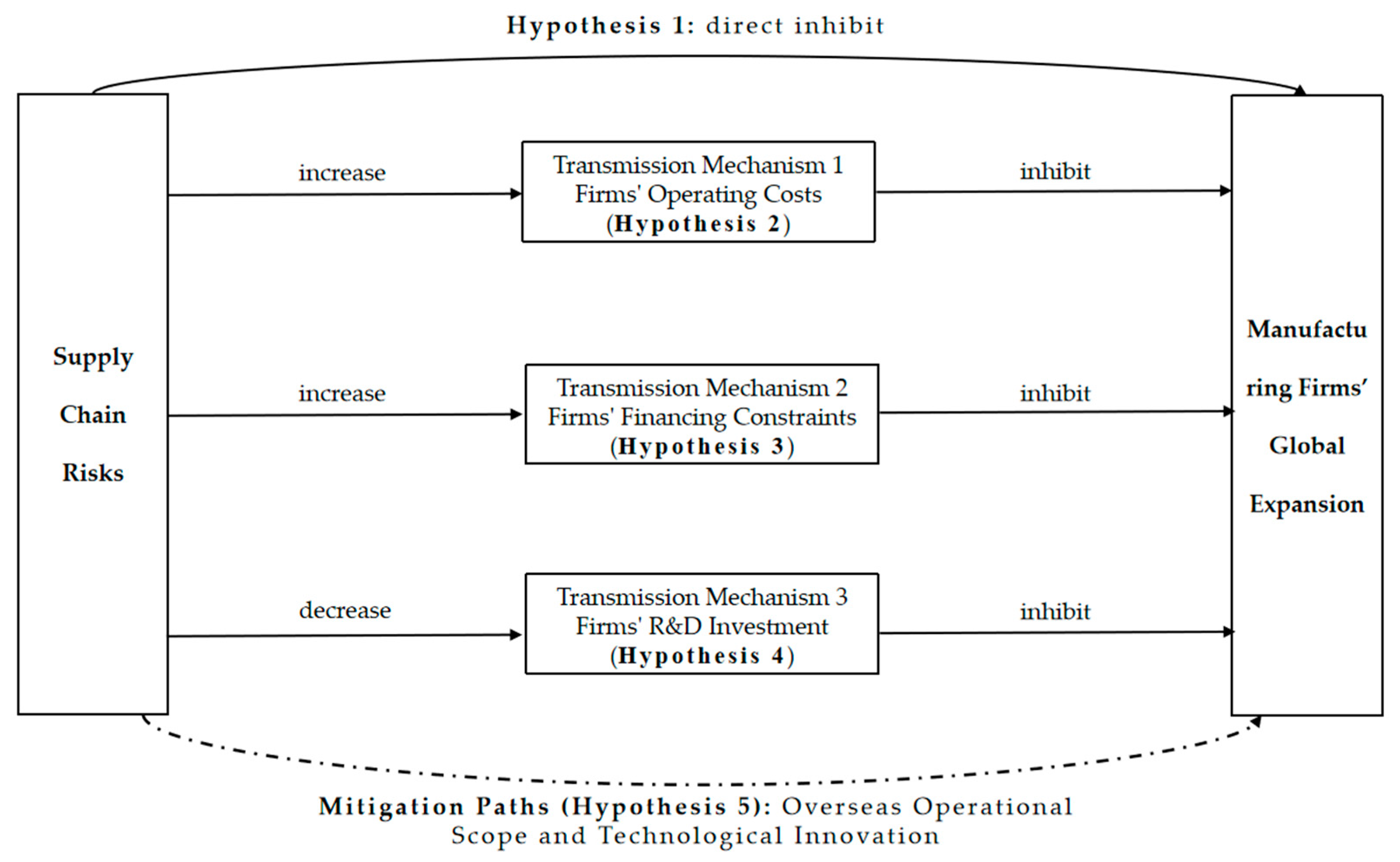
Based on the general system theory framework, this study regards supply chain risks as a systemic disturbance factor from the supply chain subsystem to the firm’s internal operation system. This disturbance will transmit through the dynamic interaction of core elements within the firm system, and ultimately inhibit the firm’s overseas market expansion. Firms can build a counteracting system by optimizing their overseas operation subsystem, to offset the inhibitory effect of supply chain risks. The theoretical model of the hypothesized relationships is shown in Figure 1.

3.1. The Inhibitory Effect of Supply Chain Risks

Based on the system theory, the supply chain system is a core subsystem nested within the firm’s operation system, and its stable operation is the prerequisite for the firm’s normal operation and strategic expansion. The outbreak of supply chain risks is a systemic disturbance to the firm’s entire operation system, which will disrupt the stability of the firm’s internal operation, damage its resource allocation capacity, and weaken its competitiveness in overseas markets.
On the one hand, supply chain risks will increase the uncertainty of the firm’s operation, making it difficult for the firm to maintain stable production and operation, and unable to guarantee the continuous supply of products for overseas markets. On the other hand, supply chain risks will consume a large amount of the firm’s resources and management attention, making the firm unable to invest sufficient resources in overseas market expansion. Therefore, this study proposes the baseline hypothesis:
Hypothesis 1.
Higher supply chain risks significantly inhibit the overseas market expansion of manufacturing firms.

3.2. Transmission Mechanism: Firms’ Operating Costs

Overseas market expansion requires substantial upfront and ongoing capital input from firms. Firms need to invest in market research, branch establishment and local talent recruitment in the early stage. They also need to invest in brand building and market promotion during formal operation. Rising operating costs reduce the capital available for firms’ overseas expansion. They fail to guarantee the necessary capital input for overseas market development [23]. Higher operating costs also force firms to raise product prices to maintain profit margins. This reduces the price competitiveness of firms in overseas markets. It makes firms lose price-sensitive consumers and hinders overseas market expansion.
The manufacturing supply chain system has more functional links and a more complex network structure than other industries. It covers procurement, production, sales and after-sales service. This complexity increases the probability of systemic accidents in the supply chain. It inevitably raises the operating costs of firms. Defective raw materials from upstream suppliers lead to unqualified products. Firms have to repurchase raw materials and rework products. This directly increases production costs. Unsmooth information transmission in the supply chain system causes the bullwhip effect [24]. Inaccurate demand forecasting leads to either inventory shortages or overstocking. Inventory overstocking occupies firm capital and warehousing space. It increases inventory management costs and capital occupation costs.
External environmental shocks disrupt the supply chain system. Natural disasters and political conflicts cause raw material supply interruptions. Firms have to find alternative suppliers, which raises procurement costs. Logistics cost increases are driven by fuel price hikes and policy changes [25]. Goods damage during transportation adds loss costs to firms. All these factors drive up the operating costs of manufacturing firms through the supply chain system. They further inhibit the overseas market expansion of firms.
Hypothesis 2.
Supply chain risks of manufacturing firms inhibit their overseas market expansion by increasing firms’ operating costs.

3.3. Transmission Mechanism: Firms’ Financing Constraints

Financing constraints reflect the difficulty of firms in obtaining capital in the financial system. Firms with high financing constraints adopt conservative operational strategies [23]. They lack sufficient capital to support overseas market expansion. They also have weak risk resistance capabilities. They tend to abandon high-potential but high-risk overseas projects. This limits the scope of their overseas market expansion. Overseas operation requires continuous capital input for daily production and management. Tighter financing constraints lead to tight operating capital for firms. It even causes capital chain breaks and disrupts the normal overseas operation of firms.
The complexity of the supply chain system makes firms more vulnerable to systemic chain break risks [12]. The outbreak of supply chain risks damages the synergy between firms and their upstream and downstream partners. It even breaks cooperative relationships in the industrial chain system. Financial institutions perceive the operational risks of firms. They reduce financial support and raise financing conditions for these firms [26]. Supply chain risk events such as product quality problems damage the corporate reputation. They lower the credit rating of firms in the financial system. This increases the financing cost and difficulty of firms.
Most manufacturing firms rely on core firm credit and accounts receivable financing in the supply chain system. This single financing channel makes firms face greater financing risks. The breakdown of cooperative relationships in the supply chain system cuts off this financing channel. It further tightens the financing constraints of firms. Supply chain risks also lead to inventory overstocking or depreciation. This reduces the value of inventory collateral. Financial institutions either refuse to accept inventory as collateral or lower the loan-to-value ratio. It limits the collateral financing capacity of firms. The transmission effect of the supply chain system makes the financial troubles of one firm affect other firms. It leads to accounts receivable recovery risks and worsens the cash flow of firms. All these factors intensify the financing constraints of manufacturing firms through the supply chain system and inhibit their overseas market expansion.
Hypothesis 3.
Supply chain risks of manufacturing firms inhibit their overseas market expansion by raising firms’ financing constraints.

3.4. Transmission Mechanism: Firms’ R&D Investment

Overseas markets have diverse consumer demands based on different cultures and habits. Firms need to adjust their products and services to meet local demand. This is a prerequisite for successful overseas market expansion. R&D investment is the core knowledge capital of firms [27]. More R&D investment enhances the independent and integrated innovation capabilities of firms. It helps firms launch new products adapted to overseas markets. It also improves the ability of firms to absorb external technologies and knowledge. It overcomes technological transfer barriers in overseas expansion.
Insufficient R&D investment makes firms unable to optimize product design for overseas markets. It leads to a mismatch between firm products and overseas market demand. Firms cannot continuously upgrade product functions to meet in-depth customer needs. This reduces the operating income of firms in existing overseas markets. It also hinders firms from entering potential overseas markets. Supply chain risks create a high-uncertainty operating environment for firms. Firms tend to allocate limited resources to short-term market competition to maintain their market position [28]. They are reluctant to invest large amounts of capital in long-term R&D activities.
The global supply chain system is a dynamic network ecosystem with strong inertia. Changes in one link of the firm’s supply chain system easily cause mismatches with the entire industrial chain system. Firms have to invest more capital to upgrade multiple links of the supply chain system. Otherwise, they have to abandon the R&D and innovation of new products and processes. This makes it difficult for firms to carry out R&D activities smoothly. It further reduces the R&D investment of firms. Supply chain risks thus reduce the R&D investment of manufacturing firms and inhibit their overseas market expansion.
Hypothesis 4.
Supply chain risks of manufacturing firms inhibit their overseas market expansion by reducing firms’ R&D investment.

3.5. Mitigation Paths: Overseas Operational Scope and Technological Innovation

Firms can build a counteracting system through two paths to offset the inhibitory effect of supply chain risks on overseas market expansion. The first path is to broaden the overseas operational scope. It forms economies of scale through vertical integration and horizontal diversification in the global market. The second path is to strengthen overseas technological innovation. It forms innovation synergy through technological and product innovation in overseas markets. Both paths optimize the firm’s overseas operation system. They reduce the dependence of firms on the domestic supply chain system. They also enhance the resilience of firms in the global supply chain system.
Broadening overseas operational scope enables firms to carry out vertical integration through overseas mergers and acquisitions and self-construction [29]. It extends the product chain of firms to overseas customers. It shortens the response time of the overseas supply chain system. It also alleviates external financing constraints and enhances the autonomy of firms in key technologies. Horizontal diversification is realized through multi-regional layout and multi-supplier cooperation. Firms establish production bases and warehousing centers in different countries and regions. It optimizes the global resource allocation of firms. It avoids the dependence of firms on a single market or supplier in the supply chain system.
Strengthening overseas technological innovation helps firms obtain authorized patents for core technologies in overseas markets [30]. It reduces the dependence of firms on external technologies. It also lowers the supply chain risks caused by technology supply restrictions. Firms can develop a variety of products based on overseas patents. When the supply chain of one product is disturbed, other products can maintain market share. It reduces the overall operational impact of single product supply disruptions. The above two paths jointly build a resilient overseas operation system for firms. They offset the inhibitory effect of supply chain risks on overseas market expansion.
Hypothesis 5.
Broadening the overseas operational scope and strengthening overseas technological innovation can offset the inhibitory effect of supply chain risks on the overseas market expansion of manufacturing firms.

4. Methodology

4.1. Model and Variables

This study sets the benchmark regression model as follows:
lninci,t = α0 + α1lrisk15i,t + Σα2Xi,t + μi + γt + εi,t
In Equation (1), the dependent variable lninci,t measures the overseas market expansion of listed manufacturing firms. The subscripts i and t denote firm and year respectively. The core independent variable lrisk15i,t is the one-period lagged measure of supply chain risk. Xi,t is a vector of firm-level control variables. μi captures firm fixed effects. γt captures year fixed effects. εi,t is the idiosyncratic error term. The definitions of all variables are detailed below.

4.1.1. Explained Variable

The explained variable is the overseas market expansion of listed manufacturing firms. Traditional studies only focus on exports or foreign investment when measuring firm internationalization. Overseas market expansion reflects the comprehensive sustainable development capability and international competitiveness of firms in overseas markets [31]. The overseas business income of listed manufacturing firms is disclosed in annual reports. It includes export income, overseas investment income and income from overseas subsidiaries. This data comprehensively reflects the overseas market expansion of firms. This study uses the natural logarithm of firms’ overseas business income (lninc) as the measurement indicator.
The selection of this indicator is based on three core considerations: First, it is highly consistent with the core connotation of “overseas market expansion” in this study, which can directly and comprehensively reflect the actual operating scale, market penetration effect and sustainable expansion capacity of firms in overseas markets. Second, it has the advantages of standardized disclosure, complete data and continuous time series, which can effectively avoid measurement bias. Third, the rationality of this indicator has been widely recognized by existing top studies in the same field (such as Zhang et al., 2024 [31]). We also use the natural logarithm of export volume as the alternative indicator in the robustness test, and the core conclusion remains unchanged, which further verifies the rationality of this benchmark indicator.

4.1.2. Explanatory Variable

This study uses textual analysis to quantify the supply chain risk of manufacturing firms. Corporate annual reports and performance briefings reflect the operational challenges and prospects perceived by firm management [21]. They are valuable data sources for measuring firm-specific supply chain risks. Textual analysis is increasingly used in risk measurement research [20].
This study builds on existing methodologies. It adopts the keyword glossary from article [22] and the measurement technique from article [20]. It analyzes the full text of annual reports of Chinese listed firms. It calculates the co-occurrence frequency of supply chain-related and risk-related keywords within different contextual windows. The window sizes are 5, 10, 15 and 20 words. The frequency is scaled by 100. To mitigate reverse causality, this study uses the one-period lagged value of the supply chain risk indicator with a 15-word window (lrisk15) as the core explanatory variable.
The detailed implementation procedure of the textual analysis method as follows: (1) We downloaded the PDF version of annual reports of A-share listed manufacturing firms from 2007 to 2022 from the CNINFO website, and converted the PDF files into TXT format using the pdfplumber module in Python 3.13.1; (2) We split the text into sentences with periods as the delimiter, and removed punctuation marks, English letters, numbers and stop words (such as “and”, “the”, “of”) from the text; (3) We used the Jieba module in Python to perform word segmentation on the preprocessed text, to obtain the standardized text corpus for subsequent analysis; (4) We constructed a two-dimensional feature keyword lexicon, including 16 risk-related keywords and 22 supply chain-related keywords (9 supplier-related keywords and 13 customer-related keywords), as shown in Table 1; (5) We calculated the co-occurrence frequency of supply chain-related keywords and risk-related keywords within the contextual window of 5, 10, 15 and 20 words respectively. The co-occurrence frequency is defined as the number of times that a supply chain keyword and a risk keyword appear in the same contextual window at the same time. We then scaled the obtained co-occurrence frequency by 100, to get the supply chain risk indicators under different window sizes.
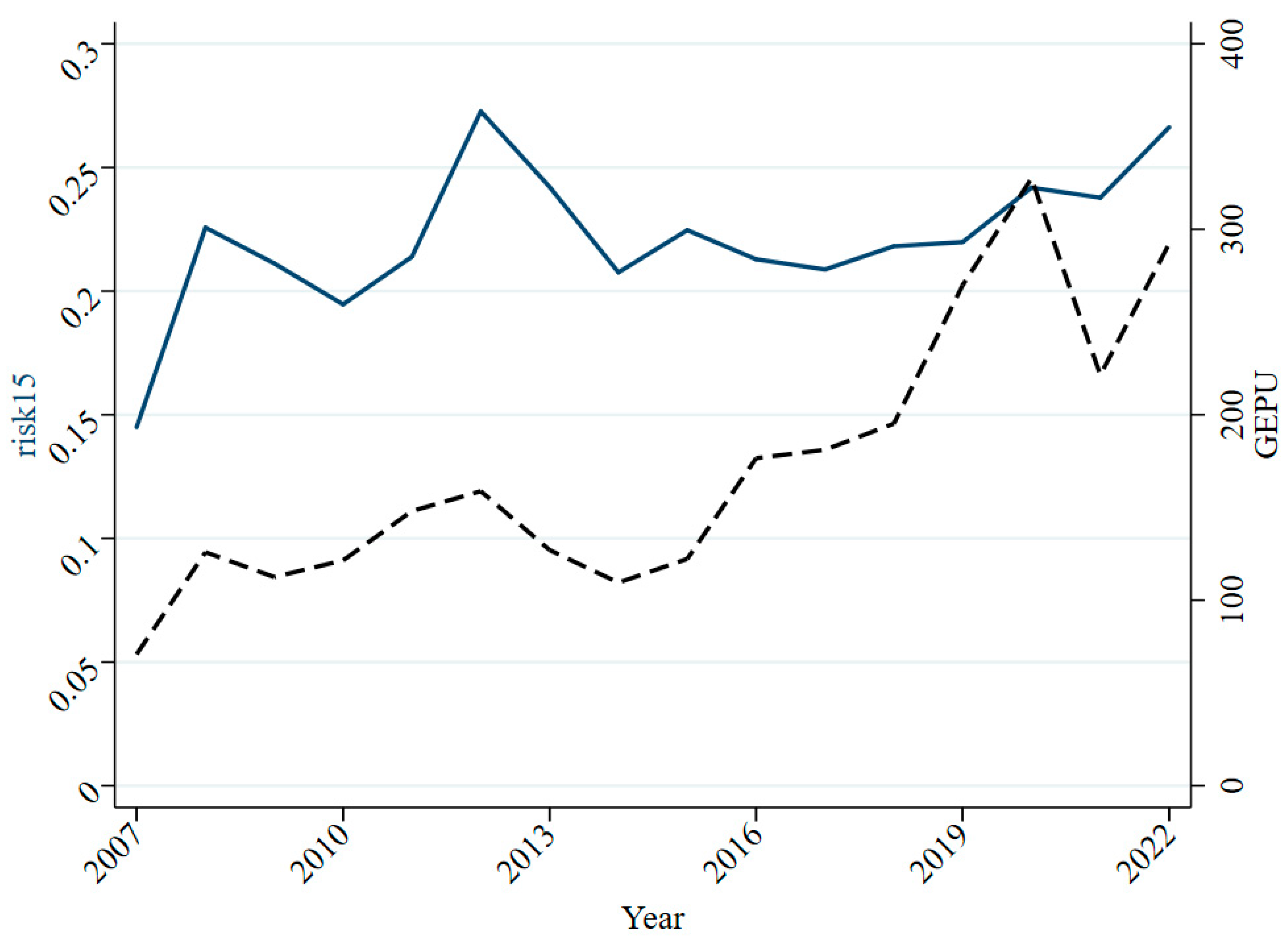
We compared the annual mean value of the measured supply chain risk of manufacturing firms (the solid line of Figure 2) with the annual mean value of the global economic policy uncertainty (GEPU) index (the dashed line of Figure 2). The results show that the two indicators have a similar changing trend, while the supply chain risk indicator we constructed can capture the firm-specific incremental risk information at the micro level, which fully verifies the effectiveness and rationality of the indicator. We also acknowledge the potential limitations of this text-based measurement: there may be reporting bias in annual report texts, heterogeneity in managerial disclosure practices, and human factors in lexicon construction, which are discussed in detail in Section 8.3.

4.1.3. Control Variables

This study controls for firm-level characteristic variables to reduce omitted variable bias. All variables are derived from firm fundamental information and financial statements. The control variables include firm age (FirmAge), measured as the natural logarithm of years since establishment; firm size (FixedAss), represented by the natural logarithm of net fixed assets; profitability (ROA), calculated as the ratio of net profit to total assets; leverage (Lev), defined as the ratio of total liabilities to total assets; operating cash flow (CashFlow), measured as net operating cash flow scaled by total assets; tangible asset ratio (TAR), computed as net tangible assets divided by total assets; and management shareholding ratio (Mshare), the proportion of total shares held by executives. All these variables reflect the core internal system characteristics of firms. They affect the overseas market expansion and supply chain risk bearing capacity of firms.

4.2. Data Source and Sample Description

The sample period starts in 2008. This study uses a lagged independent variable. It thus selects A-share listed manufacturing firms from 2008 to 2022 as the research sample. Data on overseas business income and annual report texts are collected from the CNINFO website. Firm financial and characteristic data are sourced from the CSMAR and Wind databases. The sample is refined with several screening criteria. It excludes ST, *ST and PT firms. It removes firms registered outside mainland China. It omits firms concurrently issuing B-shares or H-shares. It excludes firms listed for less than one year, delisted or suspended. It drops observations with missing data on overseas income or key financial variables. The final unbalanced panel dataset comprises 12720 firm-year observations. Descriptive statistics (Table 2) show substantial variation in supply chain risk across firms. They also show significant disparities in overseas business income. The results are consistent with empirical expectations.

5. Empirical Analysis

5.1. Benchmark Regression and Robustness Tests

Table 3 presents the results of the baseline regression and a robustness check. The dependent variable is replaced by the natural logarithm of export volume (lnexp) in the robustness check. Column (1) shows a significant negative correlation from a univariate regression. The significance level is 1%. The result indicates that higher supply chain risk strongly inhibits overseas market expansion. Column (2) reports the results of the full model in Equation (1). The negative and significant relationship remains after including control variables and fixed effects.
This study addresses potential omitted variable bias at the city and industry levels. Columns (3) to (5) incorporate city × year, industry × year, and combined city × year and industry × year fixed effects respectively. The coefficients on the core independent variable remain significantly negative. Their statistical significance often increases. The results further reinforce the main conclusion that supply chain risks significantly inhibit the overseas market expansion of manufacturing firms.
In terms of economic magnitude, the baseline regression results in Column (2) show that the coefficient of lrisk15 is −0.243 and significant at the 5% level. This means that for every one standard deviation (0.124) increase in the supply chain risk level of manufacturing firms, their overseas business income will decrease by 3.01% (0.243 × 0.124≈3.01%) on average. For a manufacturing firm with an average overseas business income of 270 million yuan (the mean value of the sample after logarithmic reduction), a one standard deviation increase in supply chain risk will lead to a decrease of about 8.13 million yuan in its overseas business income, which has significant practical economic implications.

5.2. Endogeneity Issues

Endogeneity may exist in the research model. It mainly comes from reverse causality and omitted variables. This study adopts two methods to address endogeneity: the instrumental variable method and the propensity score matching method. The core conclusion remains unchanged after addressing endogeneity.

5.2.1. Instrumental Variable (IV) Method

This study constructs the instrumental variable following common practices in similar research. The instrumental variable is the average supply chain risk of firms in the same year, same city and same industry. Firms in the same city and industry face similar external market and industrial chain system environments. The average supply chain risk only affects the overseas market expansion of individual firms through the firm-specific supply chain risk. It thus satisfies the relevance and exclusion restrictions of instrumental variables.
The validity of this instrumental variable is fully guaranteed: First, the relevance assumption is strongly verified by the first-stage regression results: the coefficient of the instrumental variable and lrisk15 is significantly positive at the 1% level, and the first-stage F statistic is 10,524.23, far higher than the critical value of 10, passing the weak instrumental variable test. Second, the exclusion restriction assumption is satisfied: the industry-city average supply chain risk is a macro systemic environmental factor, which cannot directly interfere with individual firms’ overseas expansion decisions, and can only affect the explained variable through influencing firms’ own supply chain risk. Meanwhile, the high-dimensional fixed effects of city × year and industry × year in the regression have fully absorbed the unobservable factors at the regional and industry levels, eliminating the possibility of other influence channels. The rationality of this instrumental variable has also been widely recognized by existing top studies in the same field (such as Ersahin et al., 2024 [20]).
Columns (1) and (2) of Table 4 report the test results of the instrumental variable. The instrumental variable passes the weak instrumental variable test. It also meets the requirements of the underidentification test. The instrumental variable has a significant positive correlation with the core explanatory variable. It has a significant negative correlation with the explained variable. The results are consistent with expected outcomes. The core conclusion remains valid after applying the instrumental variable method.

5.2.2. Propensity Score Matching (PSM) Method

Firms are divided into two groups using the median of supply chain risk as the cutoff. Kernel matching is used to conduct PSM on the two groups. Successfully matched observations are retained for regression analysis. Unmatched observations are excluded from the full sample. This leads to a marginal decrease in the number of regression samples. The results are displayed in Columns (3) and (4) of Table 4. The regression coefficients of the core variable are significantly negative. The conclusion remains valid after addressing endogeneity through the propensity score matching method.

5.3. Robustness Tests

This study implements a series of robustness checks to validate the baseline regression results. The core conclusion that supply chain risks inhibit overseas market expansion is robust across all tests.
First, this study recalculates the supply chain risk indicator with different contextual windows. It uses the co-occurrence frequency of keywords within 5-word, 10-word and 20-word windows. The one-period lagged values (lrisk5, lrisk10, lrisk20) replace the core explanatory variable (lrisk15) for regression. The findings are reported in Table 5. All regression coefficients of the core variable are significantly negative. The results validate the reliability of the baseline regression.
Second, this study replaces the explained variable with firm export volume. Overseas product export is the main component of the overseas business income of manufacturing firms. Export volume data are obtained from the Easy Data Website. The natural logarithm transformation is applied to the data. The regression results are displayed in Columns (1) and (2) of Table 6. The core variable coefficient is significantly negative.
Third, this study uses the Poisson pseudo-maximum likelihood (PPML) estimation method. The model applies high-dimensional fixed effects. The regression results are presented in Columns (3) and (4) of Table 6. The core conclusion remains unchanged.
Finally, this study narrows the sample period to 2010–2017 to avoid measurement errors. The 2008–2009 financial crisis causes abnormal supply chain risks. Some firms conceal supply chain risk information in annual reports after 2018 to enter the national supply chain innovation pilot list. The regression results are shown in Columns (5) and (6) of Table 6. The core variable coefficient is still significantly negative.
All robustness check results confirm that supply chain risks significantly inhibit the overseas market expansion of manufacturing firms.

5.4. Mechanism Analysis and Solution Paths

5.4.1. Mechanism Analysis

Hypotheses 2–4 propose three transmission mechanisms of supply chain risks on overseas market expansion: operating costs, financing constraints and R&D investment. These three variables are core elements of the firm’s internal system. They have direct and interactive impacts on the overseas market expansion of firms. This study adopts a two-step method to test the three hypotheses. It first verifies that supply chain risks affect the three mediating variables. It then verifies that the three mediating variables affect the overseas market expansion of firms.
The identification strategy of this mechanism analysis is standardized and rigorous: First, the core explanatory variable adopts a one-period lagged setting, which ensures the causal time sequence from the core explanatory variable to the mediating variable, and then to the explained variable. Second, both steps of regression include high-dimensional fixed effects and full control variables, which effectively alleviates the omitted variable problem. Third, the causal relationship between the three mediating variables and the core variables has a solid theoretical foundation, which fully conforms to the system theory-based transmission logic constructed in this paper. This two-step method is a classic and widely used strategy in existing top studies, and its rationality has been fully recognized by the academic community. We also acknowledge that this method cannot fully establish absolute causal mediation effects, which is a common limitation of empirical mediation analysis.
This study constructs the operating cost ratio (Cost) as the ratio of operating costs to operating income. It measures the operating cost level of firms. The WW index (WW) is used to measure financing constraints. It considers both firm financial characteristics and external industry system characteristics. It thus captures the financing constraint status of firms more accurately [32]. R&D investment (RD) is measured as the natural logarithm of R&D investment plus one. It reflects the R&D input level of firms. Some firms do not disclose R&D data or the data required for the WW index. This leads to a slight decrease in the number of regression samples.
The regression results in Table 7 verify Hypotheses 2, 3 and 4. Supply chain risks significantly increase the operating costs of firms. They also significantly tighten financing constraints and reduce R&D investment. The three mediating variables all have a significant negative impact on the overseas market expansion of firms. The results confirm that supply chain risks transmit through the internal system elements of firms to inhibit overseas market expansion. The three mechanisms are mutually reinforcing. Rising operating costs intensify financing constraints. Tighter financing constraints further reduce R&D investment. The joint effect of the three mechanisms amplifies the inhibitory effect of supply chain risks.

5.4.2. Solution Paths

Hypothesis 5 proposes that broadening overseas operational scope and strengthening overseas technological innovation can offset the inhibitory effect of supply chain risks. This study uses an interaction model to test the moderating effect. The model is set as follows:
lninci,t = β0 + β1lrisk15i,t + β2lrisk15i,t × Mi,t + Σβ3Xi,t + μi + γt + εi,t
In Equation (2), Mi,t represents the moderating variables. It includes overseas operational breadth and overseas technological innovation. A positive and significant β2 indicates that the moderating variable can offset the inhibitory effect of supply chain risks. It thus supports Hypothesis 5.
Overseas operational breadth is measured by two indicators: the number of overseas subsidiaries and the number of countries or regions where firms operate. The results are shown in Columns 1 and 2 of Table 8. The coefficient of the core independent variable is significantly negative. The coefficient of the interaction term is significantly positive. The results indicate that a broader overseas operational scope alleviates the inhibitory effect of supply chain risks on overseas market expansion.
Overseas technological innovation is measured by two indicators: the cumulative number of overseas authorized patents (O_allPat) and the current-year number of overseas authorized patents (O_recPat). Both indicators are processed as the natural logarithm plus one. The results are displayed in Columns 3 and 4 of Table 8. The coefficient of the core independent variable is significantly negative. The coefficient of the interaction term is significantly positive. The results confirm that stronger overseas technological innovation capabilities help firms overcome the barriers caused by supply chain risks. Hypothesis 5 is thus verified.

6. Heterogeneity Analysis

Supply chain risks are a systemic disturbance factor. Their inhibitory effect on overseas market expansion may vary across firms with different system characteristics. This study conducts heterogeneity analysis from three system levels: the firm’s overseas sub-system, the external industrial and market system, and the firm’s internal system. It uses quantile regression and grouped regression methods. The results show that the inhibitory effect of supply chain risks is more pronounced for firms with specific system characteristics.

6.1. Quantile Regression

This study explores the heterogeneous impact of supply chain risks across firms with different overseas revenue levels. These levels reflect the development status of the firm’s overseas sub-system. Quantile regression is more suitable for this analysis than ordinary fixed-effect regression. It provides more useful information when the explained variable distribution is uneven. It also has advantages in dealing with outliers [33]. This study conducts quantile regression at the 25%, 50% and 75% quantiles of overseas business income. The results are shown in Table 9.
The regression results show that the coefficient of supply chain risk is significantly negative at all quantiles. The absolute value of the coefficient gradually decreases with the increase in the quantile. The result indicates that the inhibitory effect of supply chain risks is more pronounced for firms with lower overseas revenue. Firms with higher overseas revenue have a more mature overseas sub-system. They have strong capital strength, diversified supplier networks and stable overseas customer relationships. They also have excellent supply chain system management capabilities. These characteristics enhance their resilience to supply chain risks. Firms with lower overseas revenue are new entrants to the overseas market. Their overseas sub-system is not yet mature. They lack sufficient risk resistance capabilities. Supply chain risks thus have a more severe impact on their overseas market expansion.

6.2. Grouped Regression

This study conducts grouped regression from two aspects: the external industrial and market system, and the firm’s internal system. It sets grouping variables and divides firms into two groups for each variable. The results show that the inhibitory effect of supply chain risks varies significantly across different groups.

6.2.1. External Industrial and Market System

The external industrial and market system includes the regional marketization level and the firm’s position in the industrial chain. The regional marketization level reflects the development status of the local market system. The industrial chain position reflects the firm’s role in the industrial chain system.
Regions with a high marketization level have a sound institutional environment and efficient resource allocation mechanism. They provide firms with international network and information advantages. Firms in these regions have lower costs to obtain high-quality resources. The financial market is more developed. Firms can obtain low-cost funds to support overseas expansion. The legal environment is more complete. It reduces the legal risks of firms in overseas operation. The international business network is denser. It helps firms obtain overseas market information and establish distribution channels. Firms in less market-oriented regions lack the above advantages. They are thus more affected by supply chain risks.
Firms in the upstream of the industrial chain mainly produce raw materials and basic parts. They rely on specific natural resources and specialized production equipment. These resources and equipment are concentrated in specific regions. Firms thus adopt a centralized production and global distribution model. This model has high inventory costs and strong supply chain rigidity. External shocks easily disrupt the supply chain system of these firms. Firms in the downstream of the industrial chain have more flexible production and operation models. They are less affected by supply chain risks.
This study groups firms by the provincial marketization index and industrial chain position. The provincial marketization index above the average is assigned 1 (mar = 1), and below is 0. Upstream industrial chain position is assigned 1 (indpo = 1), and downstream is 0. Table 10 shows the regression results. The inhibitory effect of supply chain risks is more pronounced for firms in less market-oriented regions and upstream industrial chain sectors.

6.2.2. Internal Firm System

The internal firm system includes current liabilities and digital transformation level. Current liabilities reflect the short-term financial liquidity of firms. Digital transformation level reflects the digital system construction status of firms.
Overseas market expansion requires substantial upfront capital input. Current liabilities provide immediate financial support for firms. They ease the cash flow pressure of overseas expansion. High current liabilities also reflect strong bargaining power of firms against upstream suppliers. Firms can occupy supplier funds by extending the payment cycle. It helps firms maintain a stable raw material supply. Firms with lower current liabilities lack sufficient short-term liquidity. They have weak bargaining power in the supply chain system. They are thus more affected by supply chain risks.
Digital transformation optimizes the internal operation system of firms. It reduces operating costs and enhances supply chain resilience. Firms use digital technology to track customer feedback in real time. They adjust production strategies and reduce inventory costs. Intelligent manufacturing technologies improve production efficiency and reduce unit production costs. Cross-border e-commerce platforms reduce the marketing costs of overseas expansion. Firms with a lower degree of digital transformation lack the above advantages. Their supply chain system has low information transmission efficiency and weak risk response capabilities. They are thus more affected by supply chain risks.
This study groups firms by current liabilities and digital transformation level. Current liabilities above the annual sample average are assigned 1, and below is 0. Digital transformation level is measured by textual analysis. It above the annual sample average is assigned 1, and below is 0. Table 11 shows the regression results. The inhibitory effect of supply chain risks is more pronounced for firms with lower current liabilities and a lower degree of digital transformation.

7. Discussion

The core finding of this study is that supply chain risks act as a systemic disturbance factor in the industrial chain system, which inhibits the overseas market expansion of manufacturing firms through the internal transmission of the firm’s system elements. Based on the general system theory framework, this section interprets the core findings, compares them with existing studies, and clarifies the theoretical advancement and practical value of this study.
From the perspective of system theory, the supply chain system is an important subsystem of the industrial chain system, which is closely linked with the firm’s internal operation system. The outbreak of supply chain risks is a systemic disturbance, which first affects the operational cost element of the firm’s internal system. The rise in operating costs then disturbs the financial element and leads to tighter financing constraints. Tighter financing constraints further squeeze the R&D investment element of the firm’s innovation system. The three elements interact and transmit within the firm’s internal system, and their joint effect leads to the decline of the firm’s overseas expansion capability. This finding verifies the dynamic transmission logic of system elements proposed by the general system theory, and confirms that the supply chain system and the firm’s internal system are an organic whole. Compared with existing studies that focus on the direct impact of single-type supply chain risks on firm operational performance (such as Ho et al., 2015 [11]; Alora & Barua, 2022 [12]), this study breaks the traditional siloed perspective, and reveals the cross-layer transmission mechanism of systemic risks from the supply chain subsystem to the firm’s internal system, which advances the application of system theory in supply chain risk management research.
The identified mitigating effects of expanded global operational reach and targeted overseas technological innovation align directly with core principles of systemic optimization in general system theory. Widening the geographic scope of overseas operations allows firms to build diversified, globally distributed operational subsystems. This structural shift reduces over-reliance on domestic supply chain networks, while spreading risk exposure across multiple regional markets and operational nodes. Intensifying overseas research and development and technological innovation efforts simultaneously optimizes firms’ global innovation subsystems. These investments enhance product portfolio diversity and core technological self-sufficiency, reducing the vulnerability of daily operations to unanticipated supply chain disruptions. These two mitigation strategies do not operate in isolation. They work in tandem to build comprehensive organizational resilience against global supply chain volatility, delivering a systemic offset to the disruptive impacts of supply chain risks. This finding complements existing research on supply chain resilience (such as Ali et al., 2025 [3]; Alfaqiyah et al., 2025 [4]), and provides new empirical evidence for how firms can enhance system resilience through global subsystem optimization.
Results from the heterogeneity analysis highlight the layered, hierarchical nature of systemic influence across organizational and market structures, which is consistent with the nested hierarchy principle of general system theory. The constraining impact of supply chain risks varies substantially across different levels of nested systemic frameworks. Firms with less developed global operational subsystems, marked by lower shares of overseas revenue, exhibit greater vulnerability to systemic supply chain shocks. Firms operating in regions with less mature market systems, characterized by lower levels of marketization, lack the systemic institutional support to buffer disruptions, and thus face more severe adverse impacts from supply chain risks. Firms positioned in upstream segments of the industrial chain system face higher structural rigidity in their operational models, making them more sensitive to even minor supply chain disturbances. Firms with less robust internal operational systems, including those with lower levels of current liabilities and limited digital transformation progress, have weaker inherent systemic resilience, and thus experience amplified negative effects from supply chain volatility. These findings collectively confirm that the impact of systemic disruptive factors is directly shaped by the maturity and robustness of the overarching system and its individual nested subsystems. Compared with existing research on firm internationalization (such as Luo & Tung, 2007 [9]; Ramamurti, 2012 [10]), this study expands the understanding of the heterogeneous constraints of emerging market firms’ overseas expansion, and provides a new theoretical explanation for the differentiated internationalization performance of firms from the perspective of system robustness.
In terms of practical implications, the findings of this study provide a systematic strategic framework for manufacturing firms to cope with supply chain risks in global expansion. Firms should not only focus on the management of single supply chain risk links, but also build comprehensive system resilience through holistic system optimization. Specifically, firms should strengthen the stability of their internal operation system by streamlining operational costs, alleviating financing constraints, and sustaining consistent R&D investment. Meanwhile, firms should actively build diversified global operational subsystems through expanding the geographic scope of their overseas footprint and deepening investment in overseas technological innovation. In addition, firms should implement differentiated risk mitigation strategies based on their own system characteristics, industrial chain position and regional institutional environment. For firms with low overseas revenue, upstream industrial chain position, low marketization regions and low digital transformation level, they should pay more attention to the prevention and mitigation of supply chain risks, and take targeted measures to enhance their system robustness.

8. Conclusions and Implications

Robust and proactive supply chain risk management plays an indispensable role in advancing firm internationalization and supporting high-quality, sustainable development across the global manufacturing industrial chain. This research develops a text-based metric to quantify supply chain risk for Chinese A-share manufacturing firms spanning the 2008 to 2022 period. It then empirically examines the causal impact of supply chain risks on firms’ overseas market expansion, alongside the internal transmission pathways that drive these effects. It further explores actionable risk mitigation strategies and heterogeneous impact patterns through the lens of system theory. The core empirical findings can be summarized as follows. Elevated supply chain risks exert a significant, negative impact on manufacturing firms’ ability to expand into global markets. This constraining effect operates through three mutually reinforcing transmission channels within firms’ internal operational systems: increased operational expenditures, tightened access to external financing, and reduced investment in research and development. Widening the geographic scope of overseas operations and deepening commitment to overseas technological innovation together enable firms to build more resilient organizational systems, directly offsetting the negative impact of supply chain risks on global expansion efforts. The constraining effect of supply chain risks is also disproportionately pronounced for specific firm subgroups. These include firms with lower overseas revenue shares, those operating in regions with limited marketization progress, firms positioned in upstream industrial chain segments, firms with lower levels of current liabilities, and those with limited advancement in digital transformation.

8.1. Theoretical Implications

This study makes three core theoretical contributions to the intersecting fields of supply chain management and firm internationalization.
First, it embeds supply chain risk research within a robust general system theory framework, breaking the traditional siloed perspective that treats supply chains as an isolated operational link, and advances the application of system theory in interdisciplinary supply chain risk management research. This study clarifies the core principles of system theory applied in the research, and constructs a nested system analytical framework of “global industrial chain system–supply chain subsystem–firm internal system”, which provides a new theoretical perspective for supply chain risk research.
Second, it constructs a dual-layered analytical framework that links the macro industrial chain system to the micro internal firm system. It unpacks the dynamic transmission mechanisms through which supply chain risks propagate across these two interconnected layers. It empirically validates the three core internal transmission channels, while confirming the mutually reinforcing nature of these pathways. This framework opens the “black box” between supply chain risks and firm long-term strategic decision-making, and expands the theoretical understanding of how systemic supply chain risks shape firms’ global operational strategies.
Third, it extends existing scholarship on organizational resilience building within the global industrial chain ecosystem. It provides robust empirical evidence that developing diversified global operational subsystems and targeted overseas innovation subsystems directly enhances firms’ ability to withstand and adapt to supply chain disruptions. This finding enriches the theoretical research on supply chain resilience, and provides a new theoretical direction for firms to cope with global supply chain volatility.

8.2. Policy and Managerial Implications

The empirical findings from this study deliver actionable practical implications for both manufacturing firms and governmental regulatory bodies, all grounded in a systemic governance perspective.
For manufacturing firms, the most effective strategy to address supply chain risks lies in holistic systemic optimization, rather than fragmented, isolated adjustments to individual operational processes. Firms should prioritize the refinement of their internal operational systems by streamlining operational costs, alleviating financing constraints, and sustaining consistent investment in research and development. They should simultaneously build out integrated global operational subsystems by expanding the geographic scope of their overseas footprint and deepening investment in overseas technological innovation. Combining these two dimensions of optimization strengthens the overall systemic resilience of firms operating within complex global supply chain networks. Firms should also formulate differentiated risk mitigation strategies based on their own system characteristics, to enhance the pertinence and effectiveness of risk management.
For governmental and regulatory bodies, policy focus should center on industrial chain system governance and regional market system optimization. Authorities should work to advance the marketization level of regional institutional systems, building robust institutional environments and efficient resource allocation mechanisms that support firm development. They should also strengthen systemic governance of the manufacturing industrial chain, support digital transformation across supply chain networks, and develop public service platforms that serve the entire industrial chain ecosystem. In addition, policymakers should design targeted, tailored policy measures for different firm subgroups. They should deliver enhanced support for firms operating in upstream industrial chain segments, those located in regions with lower marketization levels, and firms with limited progress in digital transformation. These targeted measures help these firms build greater systemic resilience against the adverse impacts of supply chain risks.

8.3. Research Limitations and Recommendations for Future Research

This study has several limitations that need to be acknowledged, which also provide clear directions for future research.
First, the research sample of this study is limited to Chinese A-share listed manufacturing firms, and the findings may be subject to the specific institutional environment and industrial development stage of China. Future research can expand the sample to manufacturing firms in other emerging economies or developed countries, to test the generalizability of the findings in different institutional contexts, and explore the heterogeneous impact of supply chain risks on firms’ overseas expansion in different countries and regions.
Second, the supply chain risk measure based on textual analysis of annual reports has potential limitations. On the one hand, there may be reporting bias in the annual report text: firm management may have the motivation to conceal or exaggerate supply chain risk information due to factors such as capital market performance and career development, which may lead to deviation between the measured risk and the actual risk. On the other hand, there may be heterogeneity in managerial disclosure practices: firms in different industries, with different sizes and different ownership may have significant differences in the disclosure norms and detail degree of supply chain risk information. In addition, there may be human factors in the construction of the keyword lexicon, which may affect the accuracy of the risk measurement. Future research can combine multiple data sources such as supply chain transaction data, logistics data and media reports to construct a more comprehensive and accurate supply chain risk measurement indicator system, to alleviate the potential measurement bias.
Third, this study mainly focuses on the firm-level transmission mechanisms and mitigation strategies, and has not fully explored the cross-firm spillover effect of supply chain risks in the industrial chain system. Future research can further explore how supply chain risks transmit between upstream and downstream firms in the industrial chain, and how the industrial chain collaborative governance can mitigate the adverse impact of supply chain risks on firms’ global expansion.
Fourth, this study examines the average effect of supply chain risks on firms’ overseas market expansion, but has not explored the heterogeneous impact of different types of supply chain risks (such as supply risk, demand risk, environmental risk). Future research can further decompose supply chain risks into different types, and explore the differential impact and transmission mechanisms of different types of risks on firms’ overseas expansion, to provide more targeted risk mitigation strategies for firms.


Author Contributions

Conceptualization, methodology, and writing—review and editing, M.W.; data curation, writing—original draft preparation, and funding acquisition, X.Y.; Validation, resources, and writing—review and editing, H.L. All authors have read and agreed to the published version of the manuscript.

Funding

This research was funded by National Social Science Fund of China, grant number 22CJL019.

Data Availability Statement

The raw data supporting the conclusions of this article will be made available by the authors on request.

Conflicts of Interest

The authors declare no conflicts of interest.

References

  1. Yu, Y.; Xu, L.; Wen, X. The Impact of Digital Transformation on Supply Chain Resilience in Manufacturing: The Mediating Role of Supply Chain Integration. Sustainability 2025, 17, 3873. [Google Scholar] [CrossRef]
  2. Patil, C.; Prabhu, R. Supply Chain Cash-Flow Bullwhip Effect: A Simulation Approach. Eng. Econ. 2025, 70, 258–289. [Google Scholar] [CrossRef]
  3. Ali, M.; Gunasekaran, A.; Papadopoulos, T. Enhancing Supply Chain Resilience and Economic Performance Through Industry 4.0 and ESG Integration: The Mediating Role of Sustainable Practices. J. Enterp. Inf. Manag. 2025, 38, 1245–1278. [Google Scholar] [CrossRef]
  4. Alfaqiyah, E.; Alzubi, A.; Aljuhmani, H.Y.; Öz, T. How Industry 4.0 Technologies Enhance Supply Chain Resilience: The Interplay of Agility, Adaptability, and Customer Integration in Manufacturing Firms. Sustainability 2025, 17, 7922. [Google Scholar] [CrossRef]
  5. Maurin, C.; Yeophantong, P. Going Global Responsibly? China’s Strategies Towards “Sustainable” Overseas Investments. Pac. Aff. 2013, 86, 281–303. [Google Scholar] [CrossRef]
  6. Dunning, J.H. The Eclectic Paradigm of International Production: A Restatement and Some Possible Extensions. J. Int. Bus. Stud. 1988, 19, 1–31. [Google Scholar] [CrossRef]
  7. Anderson, E.; Gatignon, H. Modes of Foreign Entry: A Transaction Cost Analysis and Propositions. J. Int. Bus. Stud. 1986, 17, 1–26. [Google Scholar] [CrossRef]
  8. Brouthers, K.D. Institutional, Cultural and Transaction Cost Influences on Entry Mode Choice and Performance. J. Int. Bus. Stud. 2002, 33, 203–221. [Google Scholar] [CrossRef]
  9. Luo, Y.; Tung, R.L. International Expansion of Emerging Market Enterprises: A Springboard Perspective. J. Int. Bus. Stud. 2007, 38, 481–498. [Google Scholar] [CrossRef]
  10. Ramamurti, R. What Is Really Different About Emerging Market Multinationals? Glob. Strategy J. 2012, 2, 41–47. [Google Scholar] [CrossRef]
  11. Ho, W.; Zheng, T.; Yildiz, H.; Talluri, S. Supply Chain Risk Management: A Literature Review. Int. J. Prod. Res. 2015, 53, 5031–5069. [Google Scholar] [CrossRef]
  12. Alora, A.; Barua, M.K. Development of a Supply Chain Risk Index for Manufacturing Supply Chains. Int. J. Product. Perform. Manag. 2022, 71, 477–503. [Google Scholar] [CrossRef]
  13. Pham, T.H.; Testorelli, R.; Verbano, C. Supply Chain Risk and Its Impact on Performance: A Structured Literature Review. J. Ind. Eng. Manag. 2023, 16, 236–262. [Google Scholar] [CrossRef]
  14. Hult, G.T.M.; Craighead, C.W.; Ketchen, D.J., Jr. Risk Uncertainty and Supply Chain Decisions: A Real Options Perspective. Decis. Sci. 2010, 41, 435–458. [Google Scholar] [CrossRef]
  15. Bak, O. Supply Chain Risk Management Research Agenda: From a Literature Review to a Call for Future Research Directions. Bus. Process Manag. J. 2018, 24, 567–588. [Google Scholar] [CrossRef]
  16. Zsidisin, G.A.; Smith, M.E. Managing Supply Risk with Early Supplier Involvement: A Case Study and Research Propositions. J. Supply Chain Manag. 2005, 41, 44–57. [Google Scholar] [CrossRef]
  17. Tang, C.; Tomlin, B. The Power of Flexibility for Mitigating Supply Chain Risks. Int. J. Prod. Econ. 2008, 116, 12–27. [Google Scholar] [CrossRef]
  18. Wagner, S.M.; Bode, C. An Empirical Investigation into Supply Chain Vulnerability. J. Purch. Supply Manag. 2006, 12, 301–312. [Google Scholar] [CrossRef]
  19. Hoffmann, P.; Schiele, H.; Krabbendam, K. Uncertainty, Supply Risk Management and Their Impact on Performance. J. Purch. Supply Manag. 2013, 19, 199–211. [Google Scholar] [CrossRef]
  20. Ersahin, N.; Giannetti, M.; Huang, R. Supply Chain Risk: Changes in Supplier Composition and Vertical Integration. J. Int. Econ. 2024, 147, 103854. [Google Scholar] [CrossRef]
  21. Hassan, T.A.; Hollander, S.; Van Lent, L.; Tahoun, A. Firm-Level Political Risk: Measurement and Effects. Q. J. Econ. 2019, 134, 2135–2202. [Google Scholar] [CrossRef]
  22. Li, Y.; Wang, X.; He, J.; Chan, K.C. Supply Chain Risk Disclosure and Seasoned Equity Offering Discount. Pac.-Basin Financ. J. 2023, 82, 102188. [Google Scholar] [CrossRef]
  23. Shi, X.; Tang, J.; Dong, C. Should a Domestic Firm Carve Out a Niche in Overseas Markets? Value of Purchasing Agents. Eur. J. Oper. Res. 2022, 300, 85–94. [Google Scholar] [CrossRef]
  24. Lee, H.L.; Padmanabhan, V.; Whang, S. Information Distortion in a Supply Chain: The Bullwhip Effect. Manag. Sci. 1997, 43, 546–558. [Google Scholar] [CrossRef]
  25. Ramos, E.; Dien, S.; Gonzales, A.; Chavez, M.; Hazen, B. Supply Chain Cost Research: A Bibliometric Mapping Perspective. Benchmarking Int. J. 2021, 28, 1083–1100. [Google Scholar] [CrossRef]
  26. Kanike, U.K. Factors Disrupting Supply Chain Management in Manufacturing Industries. J. Supply Chain Manag. Sci. 2023, 4, 1–24. [Google Scholar] [CrossRef]
  27. Pakes, A.; Griliches, Z. Patents and R&D at the Firm Level: A First Report. Econ. Lett. 1980, 5, 377–381. [Google Scholar] [CrossRef]
  28. Huang, H.; Zhang, J.; Yan, J.; Gong, Y.; Wang, L. Supply Chain Network Structure and Firm’s R&D Investments: Empirical Evidence from Chinese Manufacturing Firms. Eur. J. Innov. Manag. 2024, 27, 551–571. [Google Scholar] [CrossRef]
  29. Li, Y.; Redding, K.S.; Xie, E. Organizational Characteristics of Cross-Border Mergers and Acquisitions: A Synthesis and Classic Case Examples from Around the World. J. Organ. Change Manag. 2021, 34, 223–251. [Google Scholar] [CrossRef]
  30. Leech, D.P.; Scott, J.T. Foreign Patents for the Technology Transfer from Laboratories of US Federal Agencies. J. Technol. Transf. 2022, 47, 937–978. [Google Scholar] [CrossRef]
  31. Zhang, X.; Xue, Z.; Huang, Y. Does Capital Market Liberalization Enhance Overseas Market Power of Investment Firms? An Empirical Study Based on Chinese Multinational Corporations. Financ. Res. Lett. 2024, 69, 106056. [Google Scholar] [CrossRef]
  32. Li, C.; Wang, Y.; Zhou, Z.; Wang, Z.; Mardani, A. Digital Finance and Enterprise Financing Constraints: Structural Characteristics and Mechanism Identification. J. Bus. Res. 2023, 165, 114074. [Google Scholar] [CrossRef]
  33. Koenker, R. Quantile Regression for Longitudinal Data. J. Multivar. Anal. 2004, 91, 74–89. [Google Scholar] [CrossRef]
Figure 1. Theoretical Model of Hypothesized Relationships.
Systems 14 00321 g001
Figure 2. lrisk15 and GEPU (2007~2022).
Systems 14 00321 g002
Table 1. Feature Keyword Lexicon for Supply Chain Risk Measurement.
DimensionFeature Keywords (Translate Chinese Words into English)
RiskUncertain, unclear, ambiguous, unknown, unpredictable, hard to estimate, difficult to forecast, hard to anticipate, risk, crisis, danger, threat, volatility, instability, unpredictable, could
Supply Chain: SupplierSupplier, seller, upstream, supply side, provider, purchaser, producer, manufacturer, vendor
Supply Chain: CustomerCustomer, user, service, specificity, buyer, downstream, consumer, distributor, agent, end user, purchaser, terminal, retailer
Table 2. Descriptive Statistical Results.
ObsMeanSDMinMax
lninc12,72019.4222.0498.41725.990
lrisk1512,7200.2250.12401.554
FirmAge12,7202.8740.3501.0994.025
FixedAss12,72020.4451.33714.55926.127
ROA12,7200.0400.075−2.7460.786
Lev12,7200.4080.1860.0081.238
CashFlow12,7200.0530.067−0.4960.839
TAR12,7200.9250.0810.1891
Mshare12,7200.1610.20200.900
Table 3. Benchmark Regression and Robustness Tests.
(1)(2)(3)(4)(5)
lninclninclninclninclninc
lrisk15−0.523 ***−0.243 **−0.317 **−0.264 **−0.359 ***
(0.132)(0.118)(0.136)(0.118)(0.138)
FirmAge 0.827 ***0.929 ***0.848 ***0.976 ***
(0.276)(0.349)(0.276)(0.356)
FixedAss 0.565 ***0.544 ***0.538 ***0.508 ***
(0.037)(0.042)(0.038)(0.041)
ROA 1.717 ***1.575 ***1.700 ***1.614 ***
(0.254)(0.289)(0.254)(0.290)
Lev 0.713 ***0.653 ***0.668 ***0.635 ***
(0.167)(0.188)(0.163)(0.186)
CashFlow 0.631 ***0.684 ***0.618 ***0.582 ***
(0.173)(0.204)(0.177)(0.206)
TAR −0.916 ***−1.037 ***−1.006 ***−1.090 ***
(0.329)(0.362)(0.326)(0.358)
Mshare −0.271 *−0.316 *−0.190−0.265
(0.157)(0.192)(0.158)(0.195)
Constant19.546 ***6.046 ***6.353 ***6.632 ***7.010 ***
(0.030)(1.120)(1.304)(1.133)(1.349)
Firm FE and Year FEYYYYY
City × Year FENNYNY
Industry × Year FENNNYY
Observations12,72012,72012,72012,72012,720
Adj. R20.8330.8570.8650.8610.869
Note: ***, **, and * denote significance at the 1%, 5%, and 10% levels, respectively. Y means yes, and N means No. Robust standard errors clustered at the firm level are reported in parentheses.
Table 4. Endogeneity Issues.
(1)(2)(3)(4)
IVPSM
lrisk15lninclninclninc
ivrisk1.444 ***
(0.014)
lrisk15 −0.264 *−0.617 ***−0.361 ***
(0.156)(0.144)(0.131)
ConstantYYYY
ControlsYYNY
Firm FE and Year FEYYYY
City × Year FE and Industry × Year FEYYYY
Observations12,72012,72011,42111,421
Adj. R20.7940.1460.8520.871
The first-stage F statistic10,524.23
Kleibergen-Paap rk LM statistic 503.440
Cragg-Donald Wald F statistic 2.0 × 10⁴
Note: ***, and * denote significance at the 1%, and 10% levels, respectively. Y means yes, and N means No. Robust standard errors clustered at the firm level are reported in parentheses.
Table 5. Robustness Tests (a).
(1)(2)(3)(4)(5)(6)
lninclninclninclninclninclninc
lrisk5−0.956 ***−0.584 ***
(0.232)(0.210)
lrisk10 −0.750 ***−0.446 ***
(0.184)(0.167)
lrisk20 −0.523 ***−0.300 **
(0.130)(0.118)
ConstantYYYYYY
ControlsNYNYNY
Firm FE and Year FEYYYYYY
City × Year FE and Industry × Year FEYYYYYY
Observations12,72012,72012,72012,72012,72012,720
Adj. R20.8500.8690.8500.8690.8500.869
Note: ***, and ** denote significance at the 1%, and 5% levels, respectively. Y means yes, and N means No. Robust standard errors clustered at the firm level are reported in parentheses.
Table 6. Robustness Tests (b).
(1)(2)(3)(4)(5)(6)
The Export Volumeppmlhdfe2010~2017
lnexplnexplninclninclninclninc
lrisk15−0.572 ***−0.315 **−0.033 ***−0.019 ***−0.561 ***−0.443 **
(0.151)(0.137)(0.007)(0.006)(0.194)(0.183)
ConstantYYYYYY
ControlsNYNYNY
Firm FE and Year FEYYYYYY
City × Year FE and Industry × Year FEYYYYYY
Observations12,72012,72012,72012,72057085708
Adj. R2/Pseudo R20.8500.8700.0370.0380.8670.876
Note: ***, and ** denote significance at the 1%, and 5% levels, respectively. Y means yes, and N means No. Robust standard errors clustered at the firm level are reported in parentheses.
Table 7. Mechanism Analysis.
(1)(2)(3)
CostWWRD
lrisk150.027 ***0.008 *−0.265 ***
(0.008)(0.005)(0.076)
Constant, Controls, Firm FE, Year FE, City × Year FE and Industry × Year FEYesYesYes
Observations12,72011,09812,039
Adj. R20.8900.7960.909
Note: ***, and * denote significance at the 1%, and 10% levels, respectively. Robust standard errors clustered at the firm level are reported in parentheses.
Table 8. Solution Paths.
(1)(2)(3)(4)
lninclninclninclninc
lrisk15−0.636 ***−0.737 ***−0.385 ***−0.368 ***
(0.147)(0.153)(0.135)(0.137)
lrisk15 × Firms0.121 ***
(0.034)
lrisk15 × Countries 0.246 ***
(0.056)
lrisk15 × ln(1+O_allPat) 0.672 ***
(0.213)
lrisk15 × ln(1+O_recPat) 0.178 **
(0.087)
Constant, Controls, Firm FE, Year FE, City × Year FE and Industry × Year FEYesYesYesYes
Observations12,72012,72012,72012,720
Adj. R20.8710.8720.8690.869
Note: ***, and ** denote significance at the 1%, and 5% levels, respectively. Robust standard errors clustered at the firm level are reported in parentheses.
Table 9. Quantile Regression.
(1)(2)(3)
25%50%75%
lninclninclninc
lrisk15−0.315 ***−0.320 **−0.324
(0.124)(0.155)(0.255)
Constant, Controls, Firm FE, Year FE, City × Year FE and Industry × Year FEYesYesYes
Observations12,72012,72012,720
Note: ***, and ** denote significance at the 1%, and 5% levels, respectively. Robust standard errors clustered at the firm level are reported in parentheses.
Table 10. Grouped Regression of External Industrial and Market System.
(1)(2)(3)(4)
mar = 1mar = 0indpo = 1indpo = 0
lninclninclninclninc
lrisk15−0.213−0.659 **−0.467 **−0.112
(0.158)(0.264)(0.205)(0.230)
Constant, Controls, Firm FE, Year FE, City × Year FE and Industry × Year FEYesYesYesYes
Observations7170555060696651
Adj. R20.8890.8630.8740.864
Note: ** denote significance at the 5% level, respectively. Robust standard errors clustered at the firm level are reported in parentheses.
Table 11. Grouped Regression of Internal Firm System.
(1)(2)(3)(4)
Debt = 1Debt = 0Digit = 1Digit = 0
lninclninclninclninc
lrisk15−0.0002−0.672 ***0.047−0.665 ***
(0.193)(0.196)(0.200)(0.205)
Constant, Controls, Firm FE, Year FE, City × Year FE and Industry × Year FEYesYesYesYes
Observations6120660064666254
Adj. R20.8750.8530.9020.866
Note: *** denote significance at the 1% levels, respectively. Robust standard errors clustered at the firm level are reported in parentheses.
Disclaimer/Publisher’s Note: The statements, opinions and data contained in all publications are solely those of the individual author(s) and contributor(s) and not of MDPI and/or the editor(s). MDPI and/or the editor(s) disclaim responsibility for any injury to people or property resulting from any ideas, methods, instructions or products referred to in the content.