


Abstract
Under traditional spot-sale strategies, the perishability and demand uncertainty of fresh agricultural products often result in market share erosion and profit losses for retailers. To address this challenge, this study constructs and compares decision models under different combinations of ordering modes and sales strategies. Specifically, for ordering modes, retailers can choose between wholesale ordering and option ordering as their ordering mode, while for sales strategies, they can select either presale or spot sale based on consumer presale preference. The study aims to identify the conditions for implementing presales, examine the impact mechanism of option ordering on presales, and analyze differences in market share and expected profit across various ordering–sales strategy combinations. The results reveal the following: (1) presales outperform spot sales in market share and expected profit only when consumer presale preference exceeds a critical threshold, which is higher under option ordering; (2) compared to wholesale ordering, option ordering reduces the incremental market share and profit gains from presales but allows retailers adopting presales to achieve higher expected profits; (3) once the critical threshold for presale implementation is met, the presale strategy under wholesale ordering facilitates faster market share capture, whereas the presale strategy under option ordering maximizes retailer profits. Furthermore, retailers can lower the threshold for implementing presales and expand their applicability by optimizing freshness-keeping efforts or adjusting option contract parameters.
1. Introduction
Under traditional spot-sale strategies, fresh produce retailers must determine order quantities prior to sales. Due to demand uncertainty, these ordering decisions often misalign with market needs; supply shortages result in lost sales and market share erosion, while oversupply generates excess inventory that perishes rapidly, leading to substantial resource waste and reduced profit margins. If a retailer orders more than consumer demand, the excess products perish without buyers, causing direct profit loss. If the retailer orders less than consumer demand, unmet consumers leave the market, resulting in lost sales and potential long-term customer attrition. Data indicate that China’s fruit and vegetable loss rate reaches approximately 25–30%, causing annual economic losses exceeding CYN 1500 billion [1]. Consequently, overcoming the limitations of traditional spot-sale strategies—particularly the market share and profit losses driven by product perishability and demand uncertainty—has become central to enhancing retailer competitiveness.
To address this challenge, fresh food retailers are exploring solutions on both the demand and supply sides. On the demand side, presale strategies, in which consumers pay in advance to secure future product delivery commitments [2], enable retailers to convert uncertain demand into firm orders, thereby reducing discrepancies between procurement and market demand. This strategy is widely implemented on the “JD Fresh” platform [3]. On the supply side, option ordering provides retailers with the flexibility to adjust order quantities after observing market demand. The combined application of presales and option ordering offers a promising approach for fresh food retailers to mitigate market share and profit losses caused by product perishability and demand uncertainty.
However, research on presales of fresh agricultural products has primarily focused on channel competition [1], supply chain contract coordination [4], and consumer behavior [3]. Studies on option ordering have emphasized its value as a flexible contract for supply chain coordination [5,6]. Few studies have jointly employed both approaches to analyze their interactive mechanisms and potential synergies. More critically, existing research does not address potential conflicts arising from their concurrent use. For instance, does the supply flexibility provided by options diminish retailers’ incentive to implement presales? Conversely, does demand secured through presales compress the market size during the spot-sale period, thereby weakening the value of option ordering? Understanding how these potential conflicts affect retailers’ market share and profits represents a gap in the literature. Therefore, this study aims to investigate the following: (1) the critical conditions under which fresh produce retailers should implement presale strategies; (2) how option ordering influences the effectiveness of presales; and (3) how retailers can leverage option ordering and presales to mitigate dual losses in market share and profits.
To establish a clear analytical framework, we consider a supply chain consisting of a single fresh food retailer and a population of strategic consumers. In this framework, the retailer is the dominant decision-maker, with decisions made in two stages: first, selecting an ordering mode (wholesale or option ordering) to source products from upstream suppliers; second, choosing a sales strategy (presale or spot sale) to sell products to downstream consumers. Consumers, in contrast, are responders to the retailer’s decisions, making purchasing decisions based on the prices set by the retailer with the goal of maximizing their own utility. Their behavioral characteristics are captured by exogenous parameters, including consumer valuation () and the presale preference factor (). Specifically, consumers compare their utility under spot-sale and presale scenarios, and their individual decisions collectively shape the market demand faced by the retailer. Based on this logic of active retailer decisions and passive consumer responses, we construct separate presale and spot-sale models under both wholesale and option ordering modes, enabling a systematic comparison of the four strategy combinations. This framework helps clarify the interaction between the retailer’s ordering, sales decisions, and consumer responses, and provides insights for fresh produce retailers to better cope with the dual losses in market share and profits caused by demand uncertainty and product perishability.
Building on existing studies that have examined the combination of option ordering and presales [7,8], this paper makes three distinct contributions: first, by introducing the consumer presale preference factor (), we uncover a counteracting effect of option ordering on presales. While prior studies have demonstrated the profit advantages of jointly using options and presales, we further reveal that option ordering fundamentally alters the conditions for implementing presales—it raises the consumer presale preference threshold required for successful presale implementation (). This implies that retailers adopting option ordering must more accurately assess whether market conditions are suitable for presales, rather than uncritically adopting the joint strategy in pursuit of higher profits. This threshold effect has not been identified in previous research. Second, we uncover a strategic trade-off between market share and profit maximization. Our results show that when a retailer’s objective is to expand market share, the presale strategy under wholesale ordering with a lower presale price should be prioritized; when the objective is profit maximization, the presale strategy under option ordering with a higher presale price should be prioritized. This provides a decision-making framework that matches ordering mode selection with strategic objectives. Third, unlike existing studies [7,8], which assume that all consumers purchase in the presale period as long as the presale price falls below a certain threshold, our model captures heterogeneous consumer behavior by introducing the consumer presale preference factor (). Consumers make utility-maximizing purchasing decisions based on their individual valuations and presale preference, choosing freely between the presale and spot periods. This enables a more realistic analysis of how presale behavior interacts with different ordering modes—wholesale ordering or option ordering.
The remainder of this paper is structured as follows: Section 2 reviews the literature; Section 3 develops the theoretical model and proposes hypotheses; Section 4 analyzes the conditions for implementing presales under wholesale and option ordering and examines the influence mechanism of option ordering on presales, providing solutions for mitigating market share and profit losses; Section 5 validates the results through numerical analysis and derives management implications; Section 6 concludes, highlighting research limitations and suggesting directions for future research. The Appendix A, Appendix B, Appendix C, Appendix D, Appendix E, Appendix F and Appendix G include the proof processes of relevant propositions and corollaries.
2. Literature Review
This study is closely related to three areas: fresh agricultural product loss management, presale strategy, and option ordering.
2.1. Fresh Agricultural Product Loss Management
Regarding losses caused by the perishability of fresh agricultural products, existing research generally treats losses as a function of freshness-keeping effort and focuses on reducing losses and improving overall supply chain performance through optimized freshness-keeping decisions. Early research primarily employed static analytical frameworks, emphasizing freshness-keeping decision optimization and contract coordination mechanisms. For example, Cai et al. [9] and Ma et al. [10] discussed how contract design can motivate suppliers and retailers to invest in freshness-keeping. Cai et al. [9] found that, compared with centralized decision-making, decentralized decision-making leads the retailer to reduce order quantity and increase freshness-keeping effort, thereby harming the retailer’s own profit. Ma et al. [10] demonstrated that under decentralization, the third-party logistics service provider exaggerates market demand, while a cost-and-revenue-sharing contract can eliminate the profit loss caused by demand exaggeration. With the rise of fresh e-commerce, the research has been expanded to investigate the impact of multi-channel structure and power structure. Yang et al. [11] compared the total supply chain profits under retail, dual channel, and O2O modes, and found that under supply chain coordination, the O2O mode yields the highest total profit for the entire chain. Zhang et al. [12] analyzed power structures in fresh food e-retailing and revealed that when the supplier acts as the decision leader, both parties in the supply chain achieve higher profit levels. Liu et al. [13] examined the choice of e-platform sales mode under channel competition and demonstrated that channel competition incentivizes both suppliers and e-platforms to invest more in freshness and blockchain traceability.
More recently, research has expanded from static models to dynamic optimization, incorporating real world frictions such as information asymmetry. For instance, Liu et al. [14] constructed a dynamic model of freshness-keeping effort and advertising investment over a finite time horizon and found that the supplier may abandon freshness effort after receiving payment, thereby harming retailer goodwill. Dan et al. [15] investigated how a supplier’s freshness-keeping effort interacts with a platform’s private demand information under reselling versus agency selling, and found that whether the platform shares demand information depends on the cooperation mode. Liu et al. [16] explored information sharing between a supplier providing freshness-keeping effort and a fresh e-tailer providing value added services, and found that when the product’s freshness elasticity exceeds a threshold, the fresh e-tailer voluntarily shares information. Other studies have extended analytical boundaries by integrating external constraints and emerging technologies. Liu et al. [17] studied the optimal delivery area for fresh products in urban areas under budget constraints, and derived the optimal delivery areas for maintaining product freshness under in-house, outsourcing, and hybrid modes. Ma et al. [18] examined freshness-keeping effort optimization in a three-echelon cold chain under carbon trading policies, and found that a revenue-and-cost-sharing contract can increase product sales and achieve Pareto improvement for supply chain members. Liu et al. [19] analyzed the incentive problem for logistics service providers’ freshness-keeping effort when freshness is unobservable, and found that a revenue-sharing policy incentivizes logistics service providers to preserve freshness better than simple transfer payments. Li et al. [20] incorporated blockchain into a dynamic decision framework to explore the synergy between freshness-keeping effort and advertising investment, and found that the supplier abandons freshness effort after receiving payment, leading to product quality deterioration.
However, these studies primarily focus on optimizing supply chain profits through freshness-keeping effort, without directly addressing order deviations caused by demand uncertainty and the resulting market share and profit losses. Building on freshness-keeping considerations, this study develops a decision framework integrating presales and option ordering. It examines how retailers can leverage the demand-locking capability of presales and the supply flexibility of option ordering to mitigate market share and profit losses arising from demand uncertainty.
2.2. Presale Strategy
Presales serve as a key strategy for addressing demand uncertainty by converting uncertain demand into firm orders in advance [21,22,23], thereby reducing the risk that retailers’ order quantities deviate from actual market demand [24]. Research in this field has become increasingly refined. At the consumer behavior level, Zhang et al. [25] and Zhang et al. [26] optimized pricing and ordering decisions through deposit design and payment delay mechanisms. They found that deposit presales enable retailers to profit even when consumers have low valuations by leveraging valuation uncertainty to reduce inventory risk. Nasiry et al. [27], Zhang et al. [28], and Xu et al. [29] examined how consumers’ anticipated regret—action regret from buying in advance versus inaction regret from delaying purchase—shapes presale effectiveness. They found that these two opposing forms of regret have significant yet opposing effects on retailer profitability, and that their relative strength determines the retailer’s optimal presale pricing and ordering strategies. These studies demonstrate the important role of consumer behavior in presale strategy. However, they focus exclusively on demand-side factors and do not consider how different ordering modes on the supply side—wholesale ordering or option ordering—might interact with consumer behavior to influence overall retail performance. At the marketing and market-structure level, in terms of marketing mechanism and market environment, Cheng et al. [30] investigated the optimization of advertising effort under presale strategies and found that presales can extend the selling season and increase sales revenue, especially when combined with multiple marketing efforts. McCardle et al. [31], Khouja et al. [32], and Cachon et al. [33] analyzed how channel and market competition affect presale effectiveness, finding that the profit advantages gained from presales gradually diminish under competition, with firms adopting presales as a competitive tool rather than a profit enhancing instrument. While these studies reveal that presale strategies must be designed with attention to specific market contexts, they do not address how different ordering modes—wholesale ordering or option ordering—might alter a retailer’s optimal presale decisions.
More recently, research has expanded to incorporate dynamic elements and industry-specific applications. Lu et al. [34], Zhang et al. [35], and Peng et al. [36] examined how firms can use adaptive pricing and refund policies to respond to consumers’ strategic waiting and social learning behaviors, finding that dynamic strategies such as responsive pricing or partial refunds outperform static approaches. Wang et al. [37] compared four presale strategies under heterogeneous consumer time preferences and found that two-stage strategies generate higher seller revenue than single-stage strategies. Within the fresh agricultural product sector specifically, Wu et al. [4], Fan et al. [3], and He et al. [1] investigated presale strategies from perspectives including supply chain contract coordination, consumer behavior, and channel competition, expanding applied research in this niche field. For example, Fan et al. [3] investigated whether a fresh produce e-tailer should adopt advance selling considering consumer risk aversion and found that the value of presales depends on both the degree of consumer risk aversion and the effectiveness of demand information. However, the critical question of how presales interact with supply-side ordering modes—particularly option ordering, which allows retailers to adjust procurement quantities after demand realization—has yet to be systematically addressed. This gap is especially consequential for fresh produce retailers, who must simultaneously cope with demand uncertainty and product perishability.
In summary, the existing literature has extensively explored presale strategies from consumer behavior, marketing, and dynamic perspectives, yet it has largely overlooked the impact of different ordering modes—wholesale ordering or option ordering—on presale effectiveness. To address this gap, this paper develops an integrated decision model that jointly optimizes presale and option ordering decisions, explicitly incorporating consumer presale preference and retailer freshness-keeping effort. The objective is to investigate how retailers can leverage both presales and option ordering to mitigate the market share erosion and profit losses caused by demand uncertainty and product perishability.
2.3. Option Ordering
Option ordering constitutes another crucial tool for managing demand uncertainty. Early research primarily examined its coordination value. For instance, Cachon [38] reviewed supply chain coordination contracts, demonstrating how option ordering solves the double marginalization problem and achieves supply chain-wide optimal performance. Yang et al. [6] examined option contracts in a fresh agricultural supply chain where demand depends on sales effort, and found that call and put options mitigate shortage risk and overstock risk, respectively. Wang et al. [5,39,40] investigated the role of option ordering in fresh produce supply chains under various conditions—including circulation loss, demand uncertainty, and price volatility—and consistently found that option ordering coordinates the supply chain and achieves Pareto improvement. As research progressed, scholars incorporated more complex behavioral and contractual features: Chen et al. [41] examined ordering quantities under option contracts for a loss-averse retailer and found that the loss-averse retailer may order less, equal, or more than its risk neutral counterpart, with the optimal order quantity increasing in retail price but decreasing in option purchase price and exercise price; Liu et al. [42] studied the coordination role of option contracts in a two echelon supply chain consisting of a supplier and a retailer, and found that option contracts can achieve supply chain coordination under certain conditions. Zhao et al. [43] developed a bidirectional option contract that can be exercised as either a call or put option, and found that it enables the retailer to optimize initial order quantity and option purchase strategy while achieving supply chain coordination.
Although the literature has demonstrated the value of option ordering as a flexible tool, a key unresolved question remains: how do presales influence option exercise decisions when fresh produce retailers combine them with presale strategies? To address this issue, this study develops a decision model that integrates presales and option ordering, with the aim of revealing the counteracting mechanism of presales on option ordering. In doing so, it clarifies how retailers should jointly leverage both to mitigate market share and profit losses caused by demand uncertainty.
3. Description of Decisions and Assumptions
3.1. Retailer Decision Description
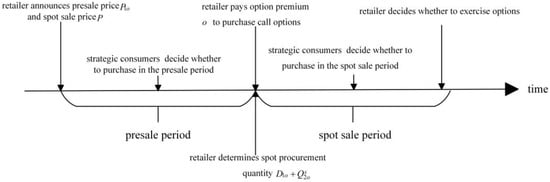
In a supply chain involving a single fresh food retailer and strategic consumers, consumers who maximize their utility by deciding whether to purchase in the presale period or wait for the spot-sale period based on their valuations and the prices offered [25]. The retailer plays a dual role: sourcing products from upstream suppliers and selling them to downstream consumers. When sourcing from suppliers, the retailer must choose how to order a certain quantity of products: wholesale ordering, where the entire order quantity is procured upfront at a unit cost , or option ordering, where a portion is procured upfront at cost while additional options are purchased, granting the right to acquire more products later at a predetermined strike price . When selling to consumers, the retailer must choose at what price and which sales strategy to adopt: spot sale, where products are sold only after they arrive from suppliers; or presale, where consumers are allowed to place orders before the retailer procures from suppliers. Therefore, the retailer must first select its ordering mode (wholesale ordering or option ordering). Subsequently, under the chosen mode, the retailer decides whether to adopt a presale or spot-sale strategy. To illustrate this decision-making process, Figure 1 shows the decision sequence when the retailer adopts the presale strategy under option ordering.
Figure 1.
Decision sequence when the retailer adopts the presale strategy under option ordering.
The sequence of events is as follows: stage is the presale period (prior to product launch), during which the retailer announces the presale price and the exogenous spot price , consumers decide whether to pay to secure the product based on utility; stage is the spot-sale period (after product launch), retailers pay the option premium to purchase a call option, after observing , the retailers first determine the order quantity to meet presale period demand and planned spot order quantity based on the unit procurement cost , consumers who participated in the presale receive their products. Once spot period demand is observed, the retailers decide whether to exercise the option at the strike price to replenish inventory.
3.2. Consumer Decision Description
Consumers are individuals who purchase fresh produce from the retailer for their own consumption. They respond to the retailer’s pricing decisions by deciding whether to buy, and their purchase decisions are determined by utility maximization: a consumer will purchase only if doing so yields positive utility, and will choose the purchasing timing (presale or spot sale) that offers higher utility. The aggregation of these individual decisions ultimately shapes market demand. Consumer valuation for the product follows a uniform distribution [1,3]. Given that presales involve the risk that realized product value may fall short of expectations, a consumer presale preference factor () is introduced to quantify consumer acceptance of the presale channel [37,44]. A higher indicates a stronger consumer inclination to participate in presales. Consumer decisions are based on intertemporal comparisons between spot-sale period utility and presale period utility . The subscripts denote the wholesale and option ordering modes, respectively.
Consumers purchase only when utility is non-negative and choose the period that offers the highest utility. This yields three valuation thresholds: the presale threshold , below which consumers would receive negative utility from presale purchase; the spot-sale threshold , below which consumers would receive negative utility from spot purchase; and the indifference threshold , at which presale and spot sale utilities are equal.
- (1)
- If , consumers with valuation purchase during the presale period, while those with purchase during the spot-sale period. Thus, consumers’ utility-based decisions generate demand for the retailer in different periods: presale period demand is , and spot-sale period demand is . Here, market size is a random variable uniformly distributed over , representing demand uncertainty.
- (2)
- If , the utility of purchasing during the presale period is always lower than during the spot-sale period, causing all consumers to delay purchase until the spot period. In this case, presale period demand is , and the demand during the spot-sale period is . The model thus degenerates into a spot-sale strategy and is not discussed further.
3.3. Assumptions and Notation
To focus on the synergistic mechanism between presales and option ordering, this study makes the following assumptions:
Hypothesis 1.
The spot market for fresh agricultural products approaches perfect competition, with individual retailers acting as price takers. Thus, the spot price
is exogenously determined [3,6].
Hypothesis 2.
The level of freshness-keeping effort by retailers directly affects both freshness-keeping costs and product survival rates , where and represent the minimum and maximum efforts [9]. The subscripts denote the presale period and the spot-sale period under the presale strategy, and the spot-sale strategy, respectively. The freshness-keeping cost and product survival rate parameters associated with the spot-sale strategy are consistent with those of the spot-sale period under the presale strategy. As presale products have shorter distribution channels, and . Survival rates and are strictly increasing functions of . The random variable reflects the influence of other external factors [9,45].
Hypothesis 3.
Option contract parameters satisfy to ensure that retailers have sufficient incentive to utilize and exercise options. Simultaneously, to maintain retailers’ motivation to exert freshness-keeping effort, the basic payoff condition must be satisfied [45].
Hypothesis 4.
Consistent with the characteristics of fresh products and prevailing industry practices, product residual value and consumer returns are not considered.
Hypothesis 5.
To focus on the market share and profit losses faced by retailers due to demand uncertainty, we assume that upstream supply is stable and reliable, meaning there are no supply-side mismatches.
Table 1 presents the symbols and their corresponding definitions used in the model.
Table 1.
Model symbols and definitions.
4. Model Construction and Analysis
4.1. Decision Analysis for Wholesale Ordering
4.1.1. Spot-Sale Strategy Under Wholesale Ordering
Under the spot-sale strategy, the consumer’s utility function is . Consumers purchase when and only when , that is, when . Therefore, demand during the spot-sale period is . The retailer’s expected profit is:
where the first term represents sales revenue and the second term represents the sum of freshness-keeping and procurement costs during the spot-sale period. The retailer’s optimal spot purchase quantity and expected profit are:
4.1.2. Presale Strategy Under Wholesale Ordering
Under the wholesale ordering model, the retailer’s expected profit under the presale strategy is:
where the first term denotes revenue during the presale period, the second term denotes the sum of freshness-keeping and procurement costs during the presale period, the third term denotes revenue during the spot-sale period, and the final term denotes the sum of freshness-keeping and procurement costs during the spot-sale period.
Then the retailer’s optimal presale price , spot purchase quantity during the spot-sale period , and expected profit , respectively, are:
Theorem 1.
Under the wholesale ordering model, a critical threshold exists for the consumer presale preference factors when implementing presales. Here, . The retailer can achieve both a higher expected profit and a larger market share compared to spot sales, if and only if .
Theorem 1 shows that the critical threshold for consumer presale preference () is jointly determined by the spot-sale price (), unit procurement cost (), product survival rate (), and unit freshness-keeping cost (). This implies that retailers achieve higher market share and expected profit through presales only when consumer acceptance of presales () exceeds this threshold . The underlying logic is that a higher signifies that consumers are more willing to bear the risk of presale products failing to meet their valuation expectations. In this case, retailers can lower the payment threshold by setting reasonable price discounts (), thereby attracting potential consumers whose valuations fall below the spot price () into the presale market. This generates additional demand that compensates for the unit profit sacrificed by the retailer caused by the price discount. Simultaneously, market demand insights from presale orders enable retailers to optimize () and freshness-keeping decisions, thereby reducing losses from over-ordering and avoiding unnecessary freshness-keeping costs. The revenue from increased demand and cost savings from procurement optimization sufficiently offset the unit profit reduction from presale discounts, ultimately boosting retailers’ expected profits.
Therefore, retailers must assess consumers’ presale preferences before implementing presale strategies. If , current market conditions are not conducive to presales. In such cases, retailers can invest in more efficient freshness-keeping technologies to reduce unit freshness-keeping costs or improve survival rates , thereby lowering the critical threshold for presales implementation and expanding the applicability of presales.
Proof of Theorem 1 is provided in Appendix A.
Corollary 1.
Under the wholesale ordering model, the optimal freshness-keeping effort for retailers adopting presale strategies is as follows:
- When , ; when , ; when , . Here, implies . When , expected profit moves in the same direction as freshness-keeping effort; when , expected profit moves in the opposite direction to freshness-keeping effort.
Corollary 1 indicates that freshness-keeping investment must be moderate under presale strategies. Insufficient freshness-keeping investment accelerates product spoilage and increases retailers’ loss costs, whereas excessive freshness-keeping investment—although improving product survival rates—reduces profit margins due to high costs. Therefore, retailers must maintain freshness-keeping effort within a reasonable range.
Proof of Corollary 1 is provided in Appendix B.
4.2. Decision Analysis for Option Ordering
4.2.1. Spot-Sale Strategy Under Option Ordering
Under the option ordering model, the retailer’s expected profit under the spot-sales strategy is given by:
where the first term represents sales revenue, the second term denotes the sum of freshness-keeping and procurement costs for spot sales, the third term is the option procurement cost, and the final term is the total procurement and freshness-keeping costs incurred when exercising the option.
The retailer’s optimal total purchase quantity , spot purchase quantity , and expected profit are therefore:
4.2.2. Presale Strategy Under Option Ordering
Under the option ordering model, the retailer’s expected profit under the presale strategy is:
where the first term represents presale period revenue, the second term denotes the sum of freshness-keeping and procurement costs for presale period, the third term is spot-sale period revenue, the fourth term is the sum of freshness-keeping and procurement costs during the spot-sale period, the fifth term is the option procurement costs, and the final term is the sum of procurement and freshness-keeping costs incurred when exercising the option.
The retailer’s optimal presale price , total purchase volume during the spot-sale period , spot purchase volume during the spot-sale period , and expected profit are therefore:
Theorem 2.
In the option ordering model, there exists a critical threshold for consumer presale preference factors to implement presales. Here, . If and only if , the retailer can achieve both a higher expected profit and a larger market share under the presale strategy compared to the spot-sale strategy.
Theorem 2 indicates that, compared to wholesale ordering, the critical threshold for presale implementation under option ordering () is more complex, as it incorporates both the option purchase price () and the option strike price (). This suggests that while option contracts enhance procurement flexibility, they also increase the complexity of presale decision-making. However, successful presales generate demand insights that help retailers expand market share and refine subsequent spot procurement () and option-exercise decisions. This enables retailers to balance the risks of over-stocking and stockouts, thereby maximizing expected profits.
Therefore, retailers adopting option ordering must accurately assess consumer presale preferences before implementing presales. If , presales are not feasible under the option ordering model, and retailers should instead rely on option ordering to manage demand uncertainty. If retailers nevertheless wish to implement presales, they should lower the presale implementation threshold by optimizing option contract parameters (i.e., adjusting the option purchase price and exercise price ), thereby expanding the applicability of presales.
Proof of Theorem 2 is provided in Appendix C.
Corollary 2.
Under the option ordering model, the optimal freshness-keeping effort under the retailer’s presale strategy is:
- When , ; when , ; when , . Here, when , . When , expected profit moves in the same direction as freshness-keeping effort; when , expected profit moves in the opposite direction to freshness-keeping effort.
Corollary 2 indicates that freshness-keeping effort exhibits an optimal range under option ordering. Insufficient freshness-keeping investment leads to a sharp increase in product spoilage. Although retailers can compensate for supply shortages caused by spoilage by exercising options, doing so incurs high restocking costs. Conversely, excessive freshness-keeping investment reduces spoilage but erodes retailer profit margins due to elevated freshness-keeping costs. Therefore, retailers must maintain freshness-keeping effort within a reasonable range.
Proof of Corollary 2 is provided in Appendix D.
4.3. Impact of Options on Presale
Proposition 1.
Compared to wholesale ordering, option ordering alters both the implementation conditions and performance outcomes of presales for the retailer by: (1) raising the critical threshold for implementing presales ( ); and (2) reducing the incremental demand and profit generated by presales (, ).
Proposition 1 indicates that although option ordering enables retailers to restock after observing market demand, its higher overall cost () erodes the additional profit margin that presales would otherwise generate by expanding demand. Consequently, retailers tend to set higher presale prices () to target consumers with a stronger willingness to pay, thereby raising the implementation threshold for presales (). Higher presale prices diminish the appeal of presales to low-valuation consumers, decreasing the incremental demand generated by presales (), which in turn lowers the incremental profit from presales ().
Therefore, when option ordering coexists with presales, retailers must adjust their decision-making logic. First, the primary role of presales shifts from mitigating demand uncertainty to generating more precise information for option exercise decisions. Second, marketing strategies should emphasize core consumer segments with higher presale acceptance rates, supported by elevated presale pricing. Third, retailers should evaluate whether implementing presales will yield significant incremental profits; if not, presales should be abandoned to avoid increasing decision-making complexity.
Proof of Proposition 1 is provided in Appendix E.
Proposition 2.
Presale strategies under wholesale ordering and option ordering differ in their capacity to help the retailer mitigate market share and profit losses arising from product perishability and demand uncertainty: (1) under wholesale ordering, presale strategies perform better in mitigating market share loss ; (2) under option ordering, presale strategies perform better in reducing profit loss .
Proposition 2 suggests that presale strategies under wholesale ordering stimulate market demand more effectively through lower presale prices (), resulting in greater market share acquisition () relative to presale strategies under option ordering. Although presale strategies under option ordering are slightly weaker in market share acquisition, the procurement flexibility provided by option ordering allows retailers to adjust spot purchase quantities at the beginning of the spot-sale period () and subsequently determine option exercise quantities based on actual market demand. When demand is high, retailers can exercise options to replenish inventory and avoid stockouts. Conversely, when demand is low, retailers can reduce option exercise to prevent excess inventory losses, thereby achieving higher expected profits ().
Accordingly, when the conditions for implementing presales are met, retailers whose strategic objective is market share expansion should prioritize presale strategies under wholesale ordering, using price incentives such as “limited-time discounts” and “early bird pricing” to attract participation. Conversely, when the strategic focus is on profit maximization, retailers should prioritize presale strategies under option ordering, leveraging presales to generate more precise information for exercising options. Simultaneously, firms may also switch flexibly between these strategies according to their evolving strategic objectives to support long-term, stable development.
Proof of Proposition 2 is provided in Appendix F.
Corollary 3.
Once the critical threshold for presale implementation is satisfied, the retailers’ optimal decisions are influenced by the consumer presale preference factor : (1) The presale price , expected profit , and market demand monotonically increase as rises. (2) The spot purchase quantity during the spot-sale period monotonically decreases as increases.
Corollary 3 indicates that increasing enhances consumers’ utility from participating in presales. To achieve this, retailers can reduce the level of presale price discounts required to incentivize participation, thereby setting higher presale pricing . As consumer utility from presales rises, more consumers purchase the product during the presales period, expanding total demand while boosting retailer profits. Furthermore, an increase in not only attracts low-valuation consumers to participate in presales but also causes some consumers in the spot-sales period to shift their purchases to the presale period, thereby reducing spot order volume during the spot-sales period.
Therefore, fresh-produce retailers should prioritize reducing consumers’ concerns about products failing to meet expectations, thereby increasing consumer willingness to participate in presales. For instance, measures such as displaying detailed product information, showcasing user reviews, and implementing a “bad fruit refund” policy can alleviate consumer apprehensions about product discrepancies and unmet expectations.
Proof of Corollary 3 is provided in Appendix G.
5. Numerical Analysis
To validate the theoretical model and extract managerial insights, this section examines a case study of a fruit and vegetable cooperative in Yantai. This cooperative operates as a retailer under an order-based agriculture model. It centrally procures Red Fuji apples from its members and sells them directly to end consumers. Its sales channels include its proprietary e-commerce platform, major third-party marketplaces, and community group-buying networks. A core feature of its strategy is the extensive use of a presale model. Specifically, prior to the harvest season, the cooperative announces product information, accepts orders, and collects advance payments through these channels. In , the cooperative’s total apple sales reached tons, with a procurement cost of CNY /kg and a spot-sale price of CNY /kg. The period loss rate during the spot-sale period is controlled within . Red Fuji apples are typically priced in the range of CNY 0–20/kg, which implies that consumer valuation follows . To ensure consistency with the consumer valuation assumption and maintain analytical tractability, we apply a uniform scaling factor of to all price-related parameters. Specifically, each parameter is divided by to obtain its standardized value, a process that preserves all key proportional relationships. After standardizing the relevant parameters, the results are , , and . The functional forms for unit freshness-keeping cost and product survival rate follow Cai et al. [9] and Zhao et al. [45]. The freshness-keeping cost functions are defined as and . This exponential form captures the characteristic that marginal freshness-keeping costs increase rapidly as effort intensifies. The exponent reflects the typical cost elasticity observed in cold chain operations for fresh produce; it ensures that as freshness-keeping effort increases from to , the cost rises by a factor of approximately , which aligns with the reality that for Red Fuji apples, high-level preservation technologies (e.g., controlled atmosphere storage) cost significantly more than basic refrigeration. The base coefficients and are derived from real-world data of the fruit and vegetable cooperative used in our case study. Based on operational records, the average per-unit freshness-keeping cost at a baseline effort level (e.g., standard refrigerated storage) is approximately CNY /kg for the presale channel and CNY /kg for the spot channel. After applying the same standardization factor of used for all price-related parameters, these values become and , respectively. The slight differences between the coefficients and reflect variations in freshness-keeping costs between the presale and spot-sale periods, arising from differences in distribution channels.
The product survival rate function is modeled as a power function of and , reflecting diminishing marginal returns of freshness-keeping effort on survival rates. The difference between the exponents and accounts for variations in survival rates between presale and post-sale periods due to differing distribution channels. The random variable simulates an operational environment where product loss is primarily driven by endogenous freshness-keeping effort. The specific values of the freshness-keeping cost function and product survival rate function are calibrated to ensure consistency with real-world conditions and to guarantee that the function values fall within reasonable ranges, while strictly satisfying the model’s assumptions: and . Option contract parameters were set with reference to the Zhengzhou Commodity Exchange’s apple call option (strike price CNY /ton, purchase price CNY /ton), where and . In summary, relevant parameter settings are as follows: , , , , , , , , , .
5.1. Impact of Consumer Presale Preference on Retailer Expected Profit and Demand Increment
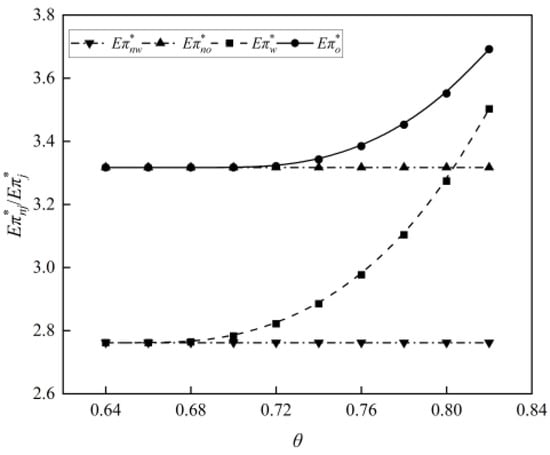
Figure 2 and Figure 3 illustrate the differences in expected profit and demand between presale strategies under wholesale and option ordering. First, the critical thresholds for implementing presales under wholesale and option ordering are and , respectively. indicates that retailers face stricter conditions and greater difficulty in implementing presales under option ordering. Second, once exceeds the critical threshold, the expected profit from presales increases with under both ordering modes. However, as demand growth is larger under wholesale ordering, the profit increment is greater. By contrast, demand growth is smaller under option ordering, resulting in a smaller profit increment. Finally, the presale strategy under option ordering yields higher expected profits.
Figure 2.
The variation of the retailer’s expected profit with the consumer presale preference factor.
Figure 3.
The variation of the retailer’s demand increment with the consumer presale preference factor.
Therefore, if , retailers’ choice depends on their strategic objective: if the goal is to maximize market share, they should adopt the presale strategy under wholesale ordering; if the goal is to maximize profits, they should choose the presale strategy under option ordering. If , it indicates that presales are feasible only under wholesale ordering. In such cases, retailers should avoid implementing presales under option ordering or reduce the critical threshold by optimizing option contract parameters to broaden the applicability of presales.
5.2. Impact of Option Contract Parameters on the Presale Implementation Threshold and Retailer Profitability
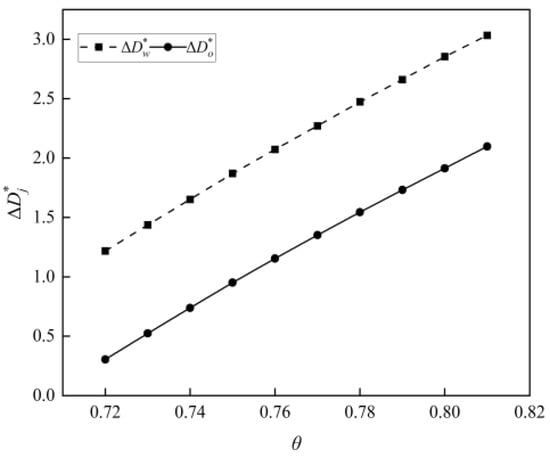
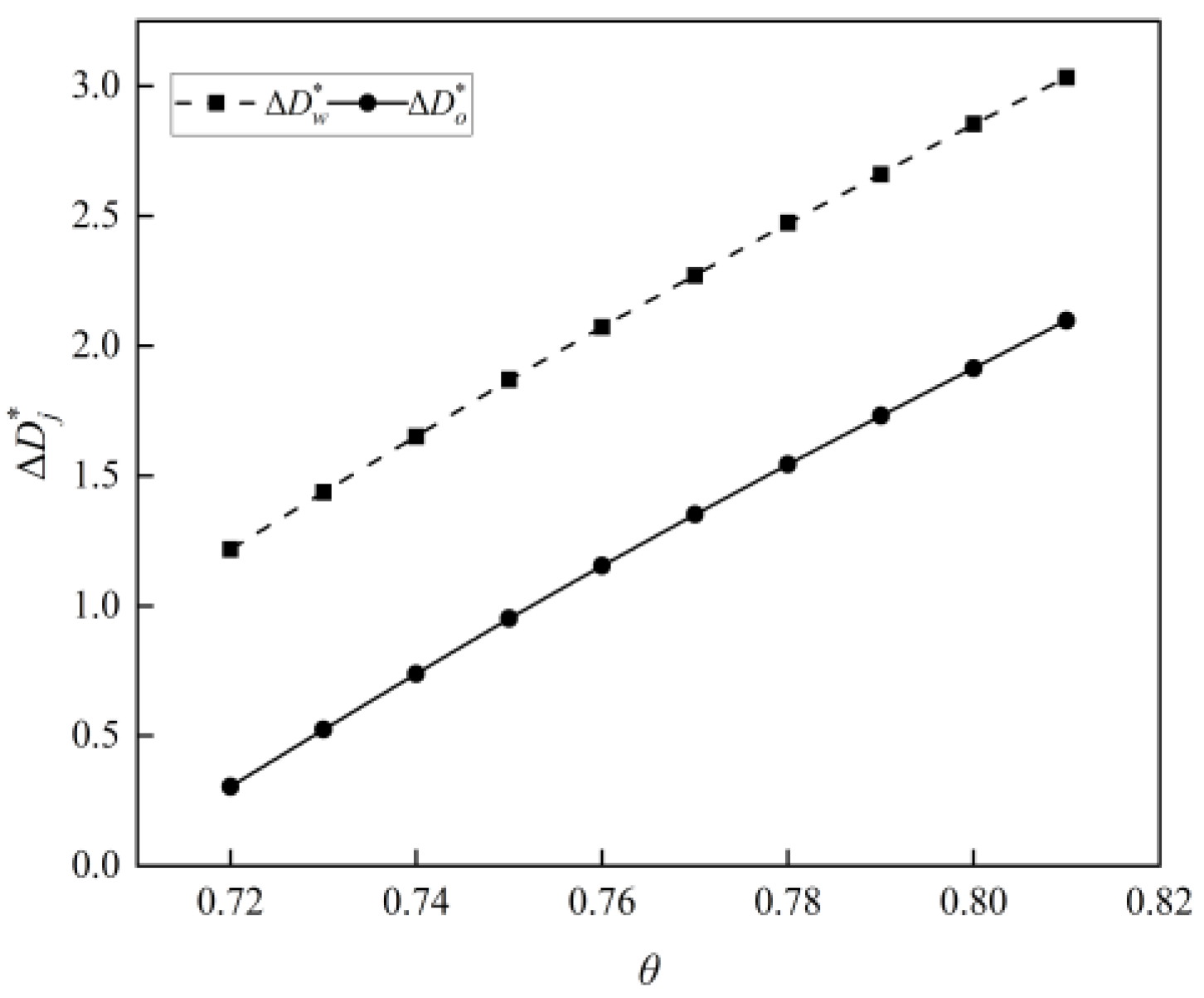
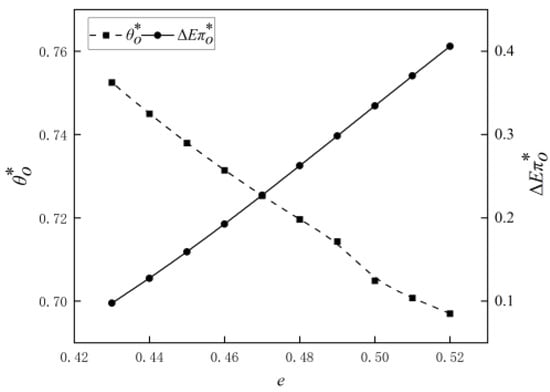
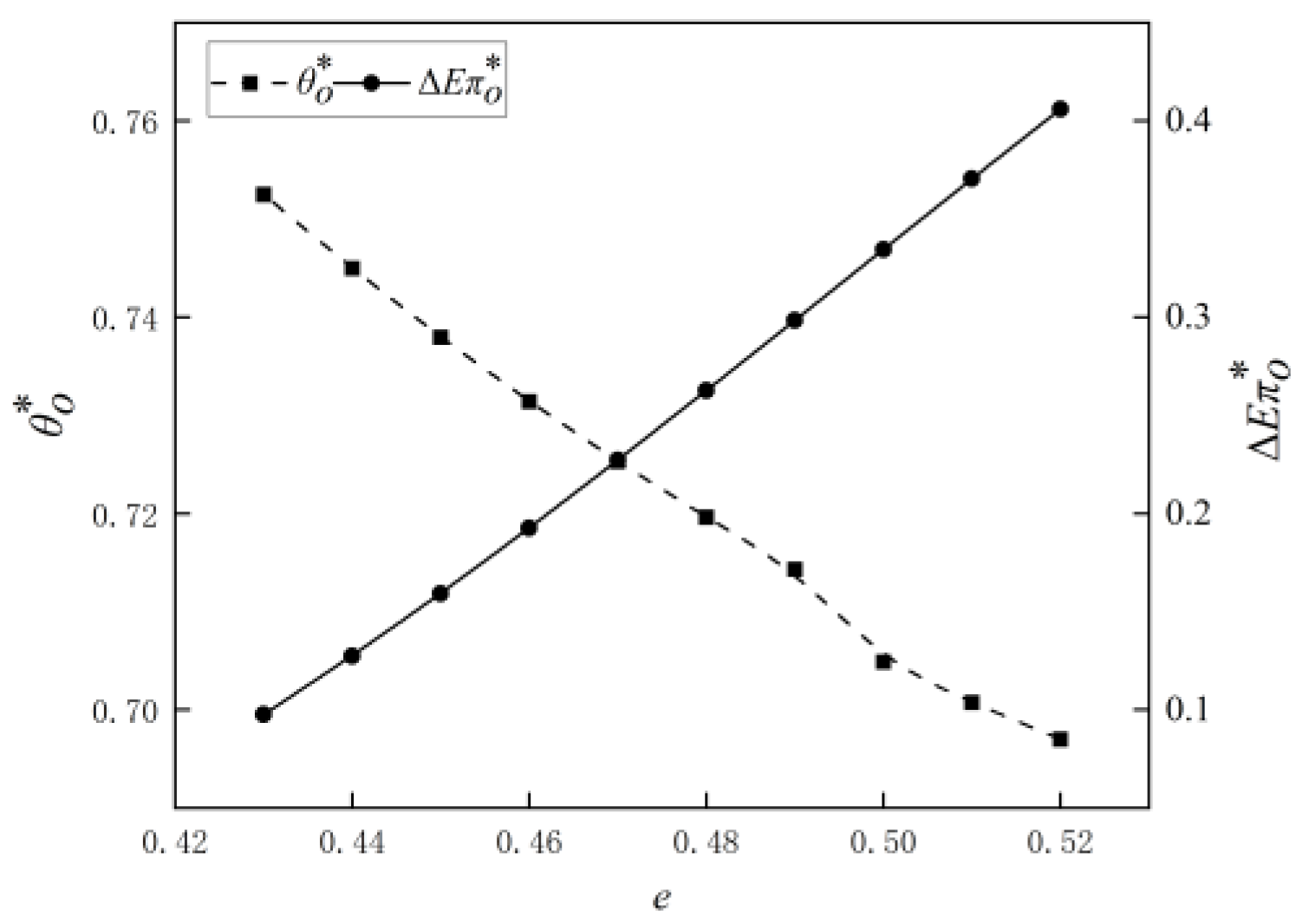
Figure 4 and Figure 5 show that the critical threshold and the expected profit from spot sales and from presales decrease as the option strike price increases, while the incremental profit increases with . Specifically, when increases from to , decreases by approximately (from to ), while increases by . Figure 5 shows that drops by over this range, whereas drops by only , indicating that the reduction in expected profit is more pronounced under spot sales. This occurs because an increase in the option strike price raises the cost of exercising the option, thereby reducing expected profits under both spot sales and presales. However, this reduction is more pronounced under spot sales, where retailers must rely solely on exercising options to address demand uncertainty. Therefore, the higher the , the more advantageous it becomes for retailers to lock in orders early through presales to avoid high option exercise replenishment costs.
Figure 4.
Variation of the retailer’s presale preference threshold and profit increment with the option strike price.
Figure 5.
The variation of the retailer’s expected profit with the option strike price.
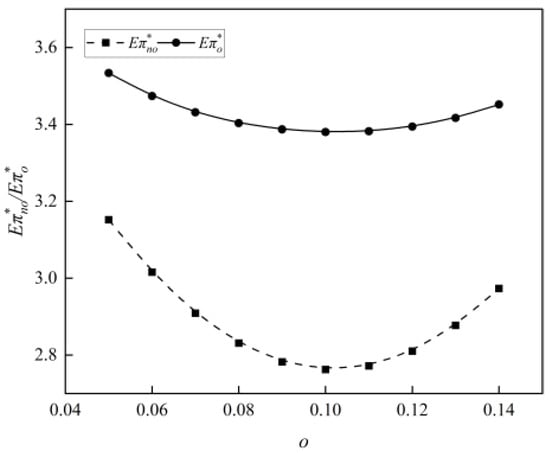
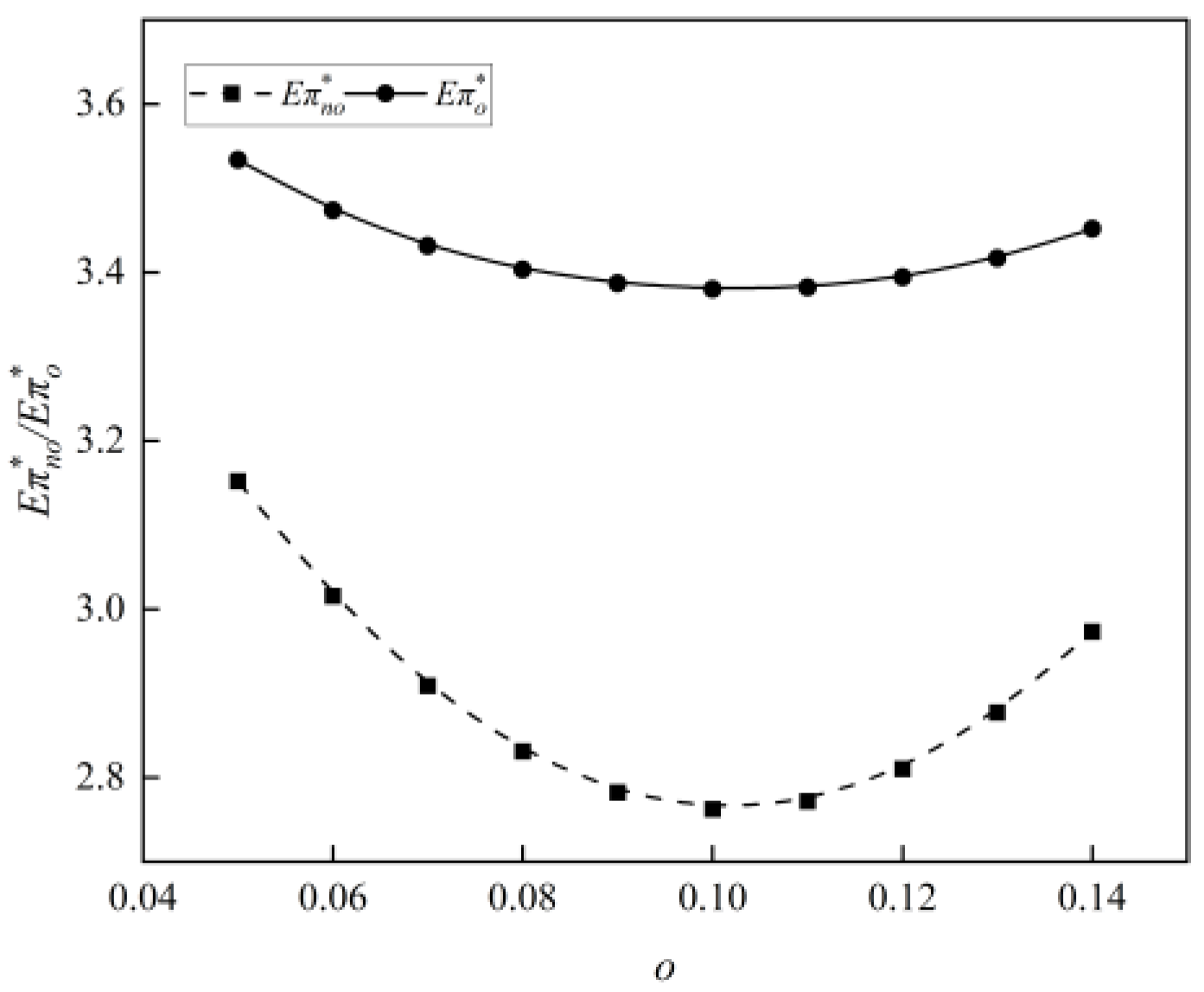
Figure 6 and Figure 7 examine the impact of the option purchase price . As increases from to , the critical threshold first decreases by (from to ) and then increases, exhibiting a U-shaped pattern. The profit increment follows an inverted U-shape, peaking at where it is higher than at . Meanwhile, both and reach their minima at , with declines of and , respectively, relative to . This pattern arises because when is low, retailers prefer to secure supply through options to reduce freshness-keeping costs; an increase in raises procurement costs, reducing profits. At intermediate , higher option costs prompt retailers to increase freshness-keeping investment while reducing option procurement, allowing presales to guide more precise allocation of these efforts, thereby boosting the profit increment. When becomes too high (above ), retailers rely more on freshness-keeping, diminishing the relative advantage of presales, causing to decline by from its peak as increases to , and to rise by .
Figure 6.
Variation of the retailer’s presale preference threshold and profit increment with the option purchase price.
Figure 7.
The variation of the retailer’s expected profit with the option purchase price.
Overall, compared to non-optimized scenarios (e.g., , ), jointly optimizing the option purchase price and strike price can lower the presale implementation threshold by approximately 12–18% and increase expected profits by 8–15%. These quantified benefits demonstrate that careful selection of option contract parameters can substantially improve retailer performance.
5.3. Impact of Consumer Presale Preference on Retailer Ordering Decisions
Figure 8 indicates that as the consumer presale preference factor increases, the spot purchase volume during the spot-sale period under wholesale ordering , the spot purchase volume during the spot-sale period under option ordering , and the option order volume all exhibit a downward trend. This occurs because an increase in enables retailers to lock in a greater share of demand in advance through presales. Consequently, the volume of uncertain demand faced during the actual sales period decreases, leading retailers to reduce the order quantities previously used to hedge against this uncertainty. Notably, the relationship between the actual spot procurement volume under wholesale and option ordering reverses around . When , consumer willingness to participate in presales remains limited, resulting in a relatively small volume of presale-locked demand. In this context, retailers prefer to observe market demand during the actual sales period and exercise options to address demand uncertainty. This reduces the need for spot procurement during the actual sales period . At this point, ; when , presales have locked in substantial demand, significantly improving retailers’ ability to forecast the remaining demand. As the total cost per unit of options () exceeds the unit purchase price (), retailers increase spot purchases to maximize the utilization of presale information and minimize future option exercises for cost control (). At this point, . Thus, retailers can optimize option and spot procurement costs by treating consumer presale preference factor () as a key signal for procurement decision optimization.
Figure 8.
Variation of the retailer’s spot order quantity under presale strategy with the consumer presale preference factor.
5.4. Impact of Presale Preference on Retailers’ Optimal Freshness-Keeping Effort
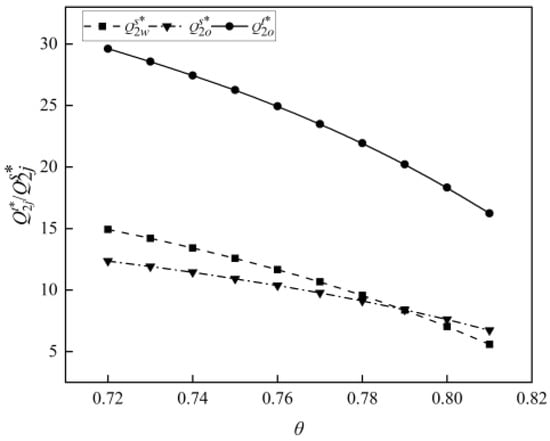
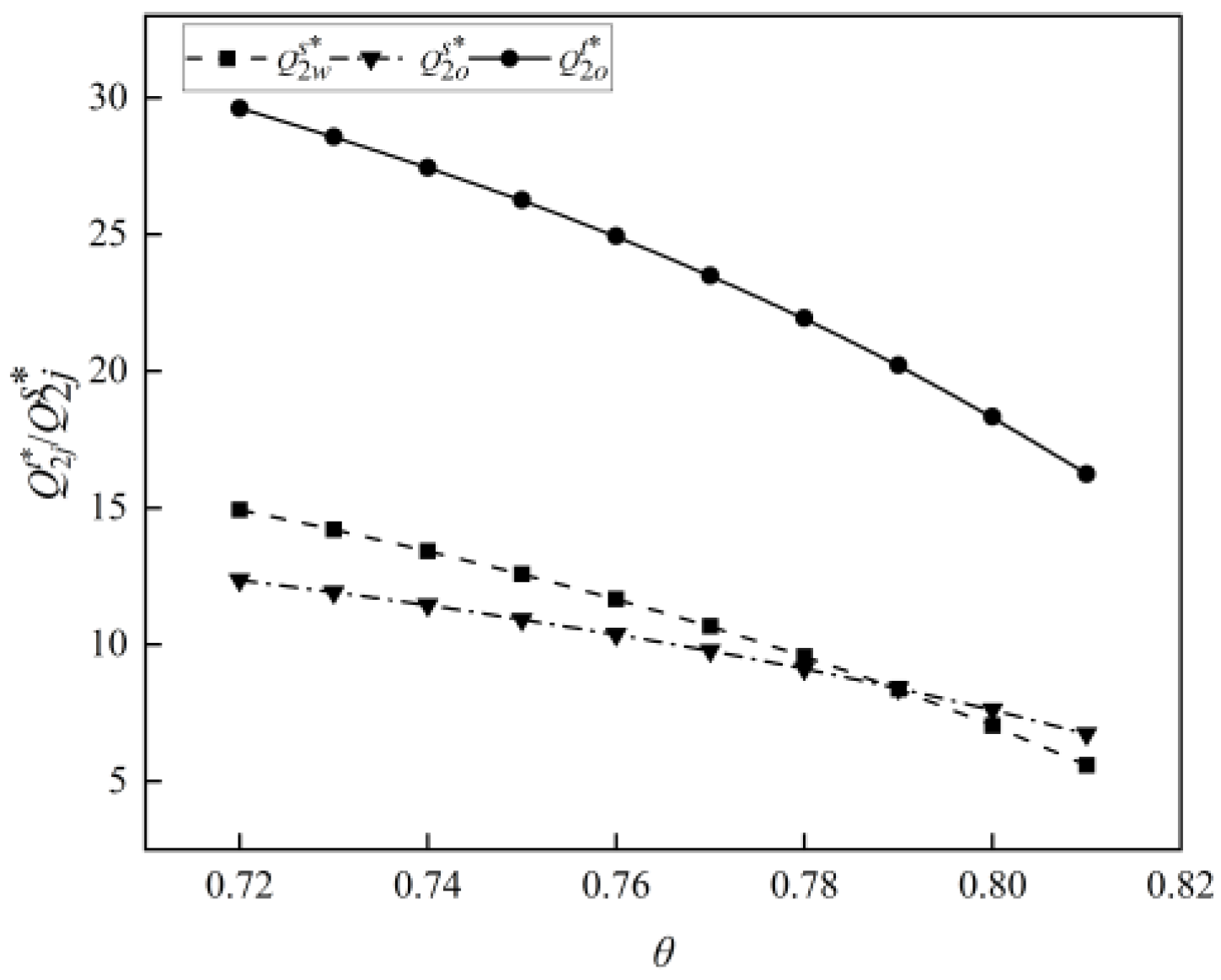
Figure 9 shows that the optimal freshness-keeping effort under retailer presales is lower than that under spot sales . Moreover, as the presale preference factor increases, the optimal freshness-keeping effort under presales declines. This occurs because presales reduce the level of freshness-keeping investment required to ensure supply by locking in a portion of the demand in advance. Furthermore, the larger , the greater the scale of demand locked in through presales, resulting in lower freshness-keeping effort . Under the same sales strategies, the optimal freshness-keeping effort under option ordering () () is lower than under wholesale ordering () (). This occurs because option ordering grants retailers the right to replenish inventory through option exercise, thereby reducing the need for retailers to maintain high freshness-keeping effort to ensure supply stability. Therefore, within fresh agricultural supply chains, retailers can effectively control freshness-keeping costs by reducing reliance on freshness-keeping investments through the adoption of presales or option ordering.
Figure 9.
Variation of the retailer’s optimal freshness-keeping effort under different ordering methods with the consumer presale preference factor.
6. Conclusions
6.1. Research Conclusions
The perishability of fresh agricultural products and demand uncertainty often place retailers in a dilemma, simultaneously risking market share and profit losses. To address this challenge, this study incorporates consumer presale preference into presale strategies and constructs retailer presale and spot-sale models under both wholesale and option ordering systems. Through model solution and comparison, it examines the critical conditions for implementing presales, the impact mechanism of option ordering on presale strategies, and how retailers can leverage both mechanisms to mitigate dual losses in market share and profits caused by product perishability and demand uncertainty. The key findings are as follows:
- (1)
- A critical threshold for consumer presale preference exists for implementing presale strategies under both wholesale and option ordering. Only when the consumer presale preference factor exceeds this threshold can retailers achieve higher market share and expected profits from presale strategies compared to spot-sale strategies, indicating that presale strategies can address the market share and profit losses driven by product perishability and demand uncertainty inherent in traditional spot-sale strategies. Additionally, this threshold is higher under option ordering, indicating that retailers face stricter conditions and greater implementation challenges when adopting presales under option ordering.
- (2)
- Compared to wholesale ordering, option ordering reduces the incremental market share and profits generated by presales. However, once consumer presale preference factors exceed a critical threshold, presales under option ordering yield higher expected profits. This suggests that while presales under option ordering may constrain market share expansion, they facilitate achieving higher expected profits.
- (3)
- Provided the critical threshold for implementing presales is met, the presale strategy under wholesale ordering better enables retailers to capture market share, indicating that the presale strategy under wholesale ordering is superior in addressing the market share losses caused by product perishability and demand uncertainty inherent in traditional spot-sale strategies. In this case, retailers should set lower presale prices to attract more low-valuation consumers. Conversely, the presale strategy under option ordering better enables retailers to achieve higher expected profits, indicating that the presale strategy under option ordering is superior in addressing the profit losses caused by product perishability and demand uncertainty inherent in traditional spot-sale strategies. In this scenario, retailers should set higher presale prices and target high-valuation core consumers. Simultaneously, retailers can effectively lower the critical threshold for presale implementation and broaden its applicability by optimizing freshness-keeping investments or adjusting option contract parameters.
- (4)
- Consumer presale preference (), as an exogenous parameter characterizing consumer behavior, is a key factor influencing the retailer’s optimal decisions. As increases, the retailer can set higher presale prices, capture a larger market share, and achieve higher expected profits, while reducing spot period procurement quantities. This underscores the importance for retailers to accurately assess consumer presale preferences—a parameter external to their control yet critical to their performance—when designing presale strategies.
6.2. Managerial Implications
This study’s findings offer the following managerial implications for fresh produce retailers:
- (1)
- Align ordering mode with strategic objectives. Retailers should first clarify their primary goal. If the objective is to rapidly expand market share, the “wholesale ordering + presale” strategy is recommended. By setting a lower presale price (e.g., 10–15% below the spot price), retailers can attract a broader consumer base, including those with lower valuations, thereby capturing a larger market share. Conversely, if the objective is profit maximization, the “option ordering + presale” strategy should be prioritized. Although this strategy requires a higher presale price (e.g., 5–10% below the spot price) and targets core consumers with stronger willingness to pay, it yields higher expected profits by leveraging the flexibility of options to adjust procurement after demand realization. (2) Optimize option contract parameters to proactively lower presale implementation thresholds: when selecting option contracts, retailers should prioritize options with lower strike prices and purchase prices within reasonable ranges. This approach reduces presale implementation barriers while maximizing expected profits.
- (2)
- Tailor strategies to retailer scale. For small and medium-sized retailers with limited bargaining power and data analytics capabilities, the wholesale ordering + presale strategy is more practical. This approach avoids the complexity of option contract management and allows retailers to use simple price discounts (e.g., “early bird” discounts) to quickly gauge market demand. For large cooperatives or e-commerce platforms with sophisticated risk management systems, the option ordering + presale strategy is preferable. These retailers can leverage demand information from presales to fine-tune option exercise decisions, optimizing the balance between procurement cost and inventory risk. Our numerical analysis shows that for a cooperative processing 2500 tons of Fuji apples annually, adopting the optimal “option ordering + presale” strategy can increase annual profit by approximately CNY 1.2–2.4 million (based on a procurement cost of CNY 7/kg and an 8–15% profit improvement).
- (3)
- Adapt strategies to product perishability. For highly perishable products (e.g., leafy greens, strawberries, fresh mushrooms) where the cost of overstock is extremely high, the “option ordering + presale” strategy is strongly recommended. The flexibility to replenish through option exercise after observing demand reduces the risk of catastrophic losses from unsold inventory. For less perishable items (e.g., apples, root vegetables, citrus) with longer shelf lives, the “wholesale ordering + presale” strategy can be more effective. Retailers can use higher presale discounts to maximize market penetration without the added cost of option premiums.
- (4)
- Quantify option contract optimization. Retailers should actively optimize option contract parameters based on their strategic objectives. Our numerical analysis, calibrated to real-world data from a fruit and vegetable cooperative in Yantai, provides specific guidance. If the goal is to maximize absolute profit, set the option purchase price () as low as possible (e.g., ) and negotiate a lower strike price (). Reducing from to can increase expected profit by . If the goal is to maximize the relative advantage of presales over spot sales (i.e., the profit increment ), set the purchase price around . At this optimal point, the profit increment is higher than at .
6.3. Limitations and Future Research
This study examines how retailers employ presales and option ordering to counteract market share and profit erosion arising from product perishability and demand uncertainty. First, to focus on the synergistic mechanism between presales and option ordering, this study assumes that spot prices are exogenously given. Future research could explore scenarios where spot prices are endogenous. Second, consumer valuations of products are assumed to follow a uniform distribution, which may not capture heterogeneity in consumer valuations for products of varying quality. Future research could consider product quality variations and examine their impact on retailer decision-making. Third, our model assumes stable and reliable upstream supply. However, in reality, fresh produce supply chains are susceptible to disruptions caused by factors such as natural disasters, diseases, or logistical failures. Future research could extend our model by incorporating supply disruption risks, examining how the combination of presale and option strategies performs in the presence of upstream supply disruptions.
Author Contributions
Conceptualization, Z.Z.; methodology, Z.Z.; investigation,: C.D.; data curation, C.D.; formal analysis, Z.Z. and C.D.; writing—original draft preparation, C.D.; writing—review and editing, Z.Z. and C.D.; supervision, Z.Z. All authors have read and agreed to the published version of the manuscript.
Funding
This research was supported by the Natural Science Foundation of Shandong Province. (Grant No. ZR2021MG023), and the National Natural Science Foundation of China: (Grant No. 72303201).
Data Availability Statement
Data are contained within the article.
Acknowledgments
The authors would like to express their sincere gratitude to the editors and anonymous reviewers for their valuable suggestions.
Conflicts of Interest
The authors declare no conflicts of interest.
Appendix A
Proof of Theorem 1.
Under the wholesale ordering-based spot-sale strategy:
Since the second derivative of with respect to is , is a concave function of . Therefore, there exists an optimal such that .
Where , solving yields the optimal spot procurement quantity . Substituting into gives the optimal expected profit .
Under the wholesale ordering-based presale strategy:
Since the second derivative of with respect to is , is a concave function of . Thus, there exists an optimal such that . Solving yields: . Substituting into and taking the second partial derivative of with respect to gives . Consequently, there exists an optimal such that . Solving yields the optimal presale price .
Substituting into , gives the optimal spot-period spot procurement quantity :
Substituting and into yields the optimal expected profit :
For the retailer to implement presales, positive presale demand must be guaranteed; otherwise, the presale degenerates into a spot sale, i.e., . When , . Substituting into yields the critical consumer presale preference threshold condition for implementing presales: , where .
The retailer’s presale market demand is , and the spot-sale market demand is . Their difference is . Since presales are successfully implemented when , we have and consequently .
Let be , be . Since during presale implementation, the presale period demand i.e., , it follows that . Given that: .
Substituting and into yields . Here,
. When , is minimized, at which point: . Since and , it follows that , i.e., holds. Furthermore: . Since the retailer implements presales when , we have . Consequently, , i.e., . □
Appendix B
Proof of Corollary 1.
Let ,. Then:
, let be and be , where , . Then . When , .
- (1)
- If , then , , , , and is monotonically increasing on .
- (2)
- If , then for , , , , , and is monotonically increasing on ; . For , , , , and is monotonically decreasing on .
- (3)
- When , , , , , and is monotonically decreasing on . □
Appendix C
Proof of Theorem 2.
Under the option ordering-based spot-sale strategy:
Since the second partial derivatives of with respect to and are and respectively, is a jointly concave function of and . Thus, there exist optimal and satisfying and respectively. Jointly solving and yields: , ,
Under the option ordering-based presale strategy:
Since the second partial derivatives of with respect to and are and respectively, is a jointly concave function of and . Therefore, there exist optimal and satisfying and , respectively. Jointly solving and yields: , ,
Substituting and into and taking the second partial derivative with respect to gives . Hence, there exists an optimal such that . Solving yields the optimal presale price , where .
Substituting into and gives the optimal spot-period spot order quantity and the optimal total spot-period order quantity:
Substituting , and into yields the optimal expected profit :
For the retailer to implement presales, positive presale demand must be ensured; otherwise, the presale degenerates into a spot sale, i.e., . When , . Substituting into yields the critical consumer presale preference threshold condition for implementing presales: , where: .
The retailer’s presale market demand is , and the spot-sale market demand is . Their difference is . Since presales are successfully implemented when , we have and consequently .
Let be , and be . Since during presale implementation, the presale period demand , i.e., , it follows that .
Given that:
substituting and into yields .
. Since the retailer implements presales when , we have . Consequently, , i.e., . □
Appendix D
The proof of Corollary 2 follows the same logic as Corollary 1 and is therefore omitted for brevity.
Appendix E
Proof of Proposition 1.
The critical threshold for implementing presales under wholesale ordering is:
. Under option ordering, the critical .
Since:
, it follows that . , , where:
Since
we have .
The market demand increment under wholesale ordering is , and under option ordering is . Since the presale price satisfies , the demand increment .
The profit increment under wholesale ordering is , and under option ordering is , where , and . Since the presale price satisfies , we have . Given that , , and , it follows that , i.e., . □
Appendix F
Proof of Proposition 2.
Under wholesale ordering, the market demand under presales is . Under option ordering, the market demand under presales is . Since the presale price satisfies , we have .
Under wholesale ordering, the expected profit under presales is: . Under option ordering, the expected profit under presales is: , where . Since , we have , i.e., . □
Appendix G
Proof of Corollary 3.
Since and , we have , i.e., the presale price increases with the consumer presale preference factor . Since
where: , because when presales are implemented, , i.e., , it follows that . Similarly, it can be shown that . Therefore, , i.e., the expected profit under the presale strategy increases with the consumer presale preference factor .
Since , it follows that . Similarly, it can be shown that . Therefore, , i.e., the market demand under the presale strategy increases with the consumer presale preference factor . Since
and , we have , i.e., the spot-period spot procurement quantity decreases with the consumer presale preference factor . □
References
- He, B.; Gan, X.; Yuan, K. Entry of online presale of fresh produce: A competitive analysis. Eur. J. Oper. Res. 2019, 272, 339–351. [Google Scholar] [CrossRef] [Scilit]
- Fay, S.; Xie, J. The Economics of Buyer Uncertainty: Advance Selling vs. Probabilistic Selling. Market. Sci. 2010, 29, 1040–1057. [Google Scholar] [CrossRef] [Scilit]
- Fan, J.; Zhang, X.; Dan, B.; Tian, Y.; Chen, Z. Advance selling of fresh produce e-tailer with uncertain demand and risk-averse consumers. Manag. Decis. Econ. 2024, 45, 1702–1717. [Google Scholar] [CrossRef] [Scilit]
- Wu, S.; Li, B.; Chen, W.; Wang, M. Advance selling strategy of fresh products under two contracts. Int. J. Retail. Distrib. 2024, 52, 892–909. [Google Scholar] [CrossRef] [Scilit]
- Wang, C.; Chen, X. Option pricing and coordination in the fresh produce supply chain with portfolio contracts. Ann. Oper. Res. 2017, 248, 471–491. [Google Scholar] [CrossRef] [Scilit]
- Yang, L.; Tang, R.; Chen, K. Call, put and bidirectional option contracts in agricultural supply chains with sales effort. Appl. Math. Model. 2017, 47, 1–16. [Google Scholar] [CrossRef] [Scilit]
- Tang, Z.; Luo, X.; Chen, X.; Liu, H. Research on Joint Strategy of Order and Pre-sale of Perishable Goods Based on Option. Chin. J. Manag. Sci. 2020, 28, 57–67. [Google Scholar]
- Xu, Q.; Dong, Q.; Shi, B. Joint Strategy of Option Order and Deposit Inflation Pre-sale with Considering Consumers’ Risk Aversion. Chin. J. Manag. Sci. 2023, 31, 193–202. [Google Scholar]
- Cai, X.; Chen, J.; Xiao, Y.; Xu, X. Optimization and Coordination of Fresh Product Supply Chains with Freshness-Keeping Effort. Prod. Oper. Manag. 2010, 19, 261–278. [Google Scholar] [CrossRef]
- Ma, X.; Wang, S.; Islam, S.M.; Liu, X. Coordinating a three-echelon fresh agricultural products supply chain considering freshness-keeping effort with asymmetric information. Appl. Math. Model. 2019, 67, 337–356. [Google Scholar] [CrossRef] [Scilit]
- Yang, L.; Tang, R. Comparisons of sales modes for a fresh product supply chain with freshness-keeping effort. Transport. Res. E-Log. 2019, 125, 425–448. [Google Scholar] [CrossRef] [Scilit]
- Zhang, R.; Huang, Z.; Liu, B.; Wang, J. Freshness-keeping efforts and value-added service choice in fresh food supply chain. Comput. Ind. Eng. 2024, 190, 110063. [Google Scholar] [CrossRef] [Scilit]
- Liu, Y.; Ma, D.; Hu, J.; Zhang, Z. Sales mode selection of fresh food supply chain based on blockchain technology under different channel competition. Comput. Ind. Eng. 2021, 162, 107730. [Google Scholar] [CrossRef] [Scilit]
- Liu, C.; Chen, W.; Zhou, Q.; Mu, J. Modelling dynamic freshness-keeping effort over a finite time horizon in a two-echelon online fresh product supply chain. Eur. J. Oper. Res. 2021, 293, 511–528. [Google Scholar] [CrossRef] [Scilit]
- Dan, B.; Tian, Y.; Zhang, X.; Liu, M.; Ma, S. Cooperation Mode Selection and Information Sharing in a Fresh Produce Supply Chain With Freshness-Keeping Effort. Int. J. Electron. Comm. 2023, 27, 270–294. [Google Scholar] [CrossRef] [Scilit]
- Liu, M.; Dan, B.; Zhang, S.; Ma, S. Information sharing in an E-tailing supply chain for fresh produce with freshness-keeping effort and value-added service. Eur. J. Oper. Res. 2021, 290, 572–584. [Google Scholar] [CrossRef] [Scilit]
- Liu, C.; Hou, P. Dynamic modelling of cold chain logistics services under budget constraints for the delivery of fresh products in an urban area. Appl. Math. Model. 2024, 125, 809–835. [Google Scholar] [CrossRef] [Scilit]
- Ma, X.; Wang, J.; Bai, Q.; Wang, S. Optimization of a three-echelon cold chain considering freshness-keeping efforts under cap-and-trade regulation in Industry 4.0. Int. J. Prod. Econ. 2020, 220, 107457. [Google Scholar] [CrossRef] [Scilit]
- Liu, C.; Lv, J.; Hou, P.; Lu, D. Disclosing products’ freshness level as a non-contractible quality: Optimal logistics service contracts in the fresh products supply chain. Eur. J. Oper. Res. 2023, 307, 1085–1102. [Google Scholar] [CrossRef] [Scilit]
- Li, Y.; Tan, C.; Ip, W.H.; Wu, C.H. Dynamic blockchain adoption for freshness-keeping in the fresh agricultural product supply chain. Expert Syst. Appl. 2023, 217, 119494. [Google Scholar] [CrossRef] [Scilit]
- Cho, S.-H.; Tang, C.S. Advance selling in a supply chain under uncertain supply and demand. M&Som-Manuf. Serv. Oper. 2013, 15, 305–319. [Google Scholar]
- Li, C.; Zhang, F. Advance demand information, price discrimination, and preorder strategies. M&Som-Manuf. Serv. Oper. 2013, 15, 57–71. [Google Scholar]
- Yu, M.; Ahn, H.-S.; Kapuscinski, R. Rationing capacity in advance selling to signal quality. Manag. Sci. 2014, 61, 560–577. [Google Scholar] [CrossRef] [Scilit]
- Yu, M.; Kapuscinski, R.; Ahn, H.-S. Advance Selling: Effects of Interdependent Consumer Valuations and Seller’s Capacity. Manag. Sci. 2015, 61, 2100–2117. [Google Scholar] [CrossRef] [Scilit]
- Zhang, Q.; Cheng, X.; Tsao, Y.-C.; Zhang, D. Advance selling under deposit expansion and consumer’s valuation change. Oper. Res.-Ger. 2021, 22, 3633–3661. [Google Scholar] [CrossRef] [Scilit]
- Zhang, W.; Yang, W. Optimal pre-order strategy with delay in payments. Ann. Oper. Res. 2021, 305, 347–374. [Google Scholar] [CrossRef] [Scilit]
- Nasiry, J.; Popescu, I. Advance Selling When Consumers Regret. Manag. Sci. 2012, 58, 1160–1177. [Google Scholar] [CrossRef] [Scilit]
- Zhang, G.; Li, G.; Shang, J. Optimizing mixed bundle pricing strategy: Advance selling and consumer regret. Omega 2023, 115, 102782. [Google Scholar] [CrossRef] [Scilit]
- Xu, C.; Zhang, B.; Yang, H. Premium pricing and capacity rationing for advance selling with consumers regret. J. Retail. Consum. Serv. 2024, 81, 104021. [Google Scholar] [CrossRef] [Scilit]
- Cheng, Y.; Li, H.; Thorstenson, A. Advance selling with double marketing efforts in a newsvendor framework. Comput. Ind. Eng. 2018, 118, 352–365. [Google Scholar] [CrossRef] [Scilit]
- McCardle, K.; Rajaram, K.; Tang, C.S. Advance booking discount programs under retail competition. Manag. Sci. 2004, 50, 701–708. [Google Scholar] [CrossRef] [Scilit]
- Khouja, M.; Zhou, J. Channel and pricing decisions in a supply chain with advance selling of gift cards. Eur. J. Oper. Res. 2015, 244, 471–489. [Google Scholar] [CrossRef] [Scilit]
- Cachon, G.P.; Feldman, P. Is advance selling desirable with competition? Market. Sci. 2017, 36, 214–231. [Google Scholar] [CrossRef] [Scilit]
- Lu, D.; Wang, P. Dynamic pricing for new experience products in pre-sale mode with social learning. J. Retail. Consum. Serv. 2024, 76, 103569. [Google Scholar] [CrossRef] [Scilit]
- Zhang, Z.; Lim, W.; Cui, H.; Wang, Z. Partial refunds as a strategic price commitment device in advance selling in a service industry. Eur. J. Oper. Res. 2021, 291, 1062–1074. [Google Scholar] [CrossRef] [Scilit]
- Peng, W.; Tian, Z.; Wang, Y. Price guarantee for advance selling in the presence of preorder-dependent social learning. Int. J. Prod. Econ. 2020, 219, 115–122. [Google Scholar] [CrossRef] [Scilit]
- Wang, X.; Tian, J.; Fan, Z.-P. Optimal presale strategy considering consumers’ preference reversal or inconsistency. Comput. Ind. Eng. 2020, 146, 106581. [Google Scholar] [CrossRef] [Scilit]
- Cachon, G.P. Supply chain coordination with contracts. Handb. Oper. Res. Manag. Sci. 2003, 11, 227–339. [Google Scholar]
- Wang, C.; Chen, X. Optimal ordering policy for a price-setting newsvendor with option contracts under demand uncertainty. Int. J. Prod. Res. 2015, 53, 6279–6293. [Google Scholar] [CrossRef] [Scilit]
- Wang, C.; Chen, J.; Chen, X. Pricing and order decisions with option contracts in the presence of customer returns. Int. J. Prod. Econ. 2017, 193, 422–436. [Google Scholar] [CrossRef] [Scilit]
- Chen, X.; Hao, G.; Li, L. Channel coordination with a loss-averse retailer and option contracts. Int. J. Prod. Econ. 2014, 150, 52–57. [Google Scholar] [CrossRef] [Scilit]
- Liu, Z.; Chen, L.; Li, L.; Zhai, X. Risk hedging in a supply chain: Option vs. price discount. Int. J. Prod. Econ. 2014, 151, 112–120. [Google Scholar] [CrossRef] [Scilit]
- Zhao, Y.; Ma, L.; Xie, G.; Cheng, T.E. Coordination of supply chains with bidirectional option contracts. Eur. J. Oper. Res. 2013, 229, 375–381. [Google Scholar] [CrossRef] [Scilit]
- Feng, S.; Liu, J.; Hu, X. Presale strategy for a dual-channel retailer considering sales effort. IEEE Access 2021, 9, 40318–40335. [Google Scholar] [CrossRef] [Scilit]
- Zhao, Z.; Cheng, Y. Two-stage decision model of fresh agricultural products supply chain based on option contract. IEEE Access 2022, 10, 119777–119795. [Google Scholar] [CrossRef] [Scilit]

Disclaimer/Publisher’s Note: The statements, opinions and data contained in all publications are solely those of the individual author(s) and contributor(s) and not of MDPI and/or the editor(s). MDPI and/or the editor(s) disclaim responsibility for any injury to people or property resulting from any ideas, methods, instructions or products referred to in the content. |
© 2026 by the authors. Licensee MDPI, Basel, Switzerland. This article is an open access article distributed under the terms and conditions of the Creative Commons Attribution (CC BY) license.