5.1. Research Conclusions
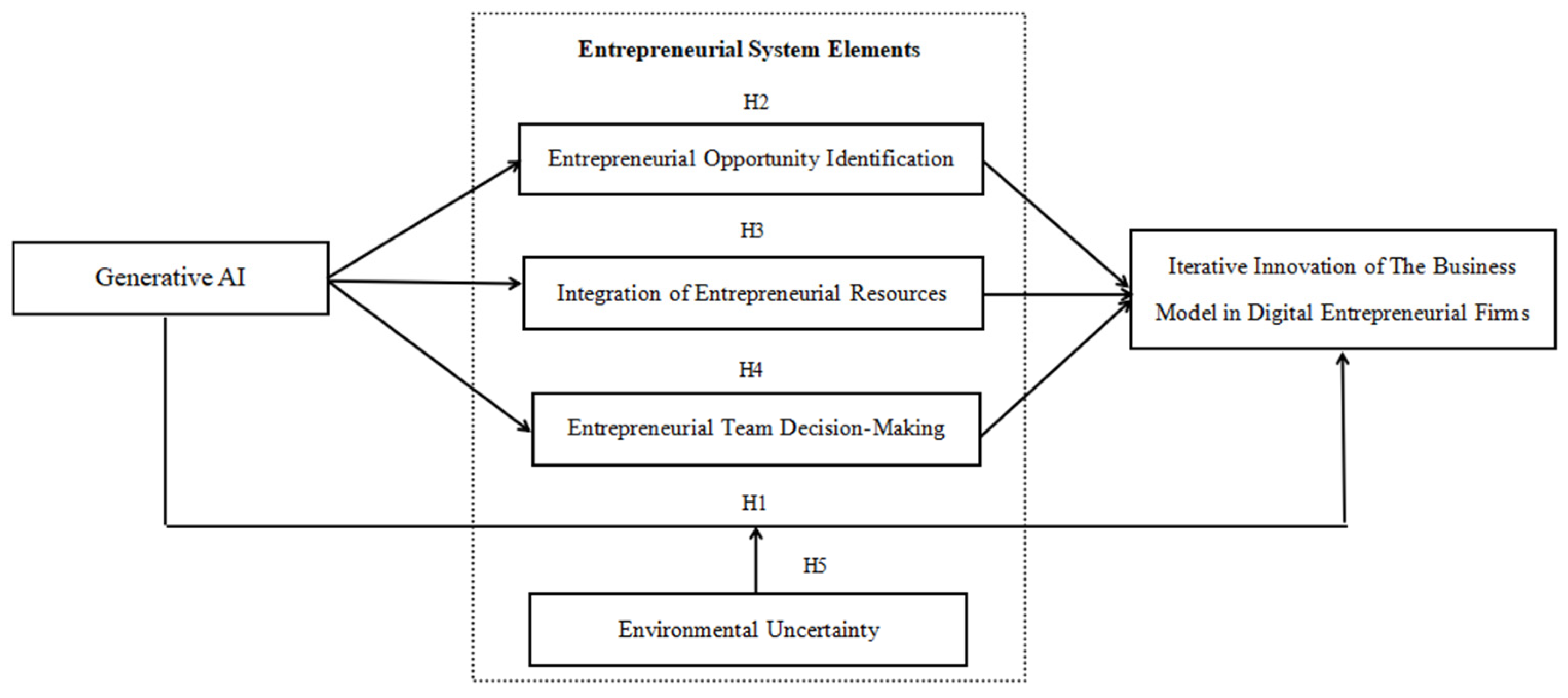
This study, from the perspective of entrepreneurial system elements, constructed and validated a driving mechanism model for the iterative innovation of business models in digital entrepreneurial enterprises driven by GenAI. The following conclusions were drawn:
Firstly, GenAI facilitates the iterative innovation of business models in digital entrepreneurial enterprises. During the process of data analysis and information generation, GenAI can construct data-driven business models, laying the foundation for the iterative innovation of business models. Secondly, entrepreneurial opportunities, entrepreneurial resources, and entrepreneurial teams (i.e., the core elements of the entrepreneurial system) partially mediate the process by which GenAI drives the iterative innovation of business models in digital entrepreneurial enterprises. Driven by GenAI, the entrepreneurial opportunity recognition process of digital entrepreneurs undergoes a paradigm shift from traditional demand insight to value co-creation. Meanwhile, through its capabilities of automation, intelligent analysis, and multi-modal content generation, GenAI can deeply empower digital entrepreneurial enterprises to achieve intelligent integration of entrepreneurial resources. Additionally, GenAI enhances the productivity and work efficiency of entrepreneurial teams in unprecedented ways. Therefore, in the process of GenAI facilitating the iterative innovation of business models, a “opportunity-resource-team” transmission pathway is experienced. Thirdly, environmental uncertainty (i.e., a contingency factor in the entrepreneurial system) positively moderates the process by which GenAI drives the iterative innovation of business models in digital entrepreneurial enterprises. Higher environmental uncertainty strengthens the positive impact of GenAI on business model innovation in digital entrepreneurial enterprises.
5.2. Practical Implications
This study focuses on the iterative innovation of business models in digital entrepreneurial enterprises enabled by GenAI. Based on Timmons’ entrepreneurial elements theory, it delves into the transmission pathway, providing digital entrepreneurial enterprises with several important practical implications:
Firstly, keep up with technological frontiers and incorporate GenAI into long-term strategies. Digital entrepreneurial enterprises should deeply integrate GenAI into their strategic planning, viewing it as a core engine driving the iterative innovation of business models. At the initial stage of strategy formulation, enterprises should establish professional technical evaluation teams to conduct comprehensive and in-depth research and analysis on the technological development trends, application scenarios, and potential impacts of GenAI. Based on this analysis, they should determine their strategic positioning in the field of this technology, clarifying whether to become technology leaders, fast followers, or differentiated adopters. Based on the strategic positioning, they should rationally plan resource allocation, including funds, talents, and time, to ensure sufficient resources support the development of GenAI-related projects. Meanwhile, they should closely integrate the application of GenAI with their overall business strategies, formulating specific strategic goals and action plans around core objectives such as enhancing customer value, optimizing operational efficiency, and exploring new markets. For example, they can achieve personalized product customization through GenAI to meet the unique needs of different customers, thereby improving customer satisfaction and loyalty. They can also utilize this technology to optimize supply chain management, achieving accurate forecasting and intelligent scheduling to reduce operational costs. Furthermore, enterprises should maintain strategic flexibility, promptly adjusting their strategic directions and priorities in response to the continuous development of GenAI technology and changes in the market environment, ensuring they remain at the forefront of business model innovation.
Secondly, integrate entrepreneurial system elements such as opportunities, resources, and teams to stimulate entrepreneurial innovation vitality. During the implementation of the entrepreneurial process, digital entrepreneurial enterprises should attach great importance to the organic integration of opportunities, resources, and teams, fully leveraging the empowering role of GenAI. For opportunity recognition, enterprises should utilize the powerful data collection and analysis capabilities of GenAI to extensively collect market information, industry trends, and consumer feedback, excavate potential market opportunities and commercial value points through algorithmic models. Meanwhile, they should encourage team members to actively participate in market research and brainstorming sessions, proposing innovative business model ideas based on the data insights provided by GenAI. In terms of resource integration, they should leverage GenAI to break through the temporal and spatial limitations of resource acquisition and expand resource channels. For example, they can find technology partners, investors, and suppliers worldwide through online platforms and social networks. They can also utilize GenAI to optimize the allocation of internal resources, improving resource utilization efficiency and ensuring that key resources are precisely invested in key links of business model innovation. Team integration is crucial. Enterprises should build a diversified team with the ability to apply GenAI technology and innovative thinking. Through training and talent recruitment, they should enhance team members’ understanding and application of GenAI. They should also establish effective communication mechanisms and collaboration platforms to promote information sharing and idea exchange among team members, stimulating innovation vitality. During the decision-making process, they should fully utilize the data support and simulation analysis provided by GenAI to improve the scientificity and accuracy of decisions, ensuring that the team can efficiently seize opportunities, integrate resources, and drive the iterative innovation of business models.
Thirdly, actively respond to policies and regulations to ensure the steady advancement of the innovation system. With the rapid development of GenAI, relevant policies and regulations are constantly being improved and adjusted. Digital entrepreneurial enterprises must actively adapt to these external environmental changes to ensure that their business model innovation activities are legal and compliant. Enterprises should establish dedicated policy research positions or teams to closely monitor national and local policy and regulatory dynamics regarding GenAI, promptly interpret policy content, and assess the impact of policies on the enterprise. They should actively participate in policy discussion activities organized by industry associations, maintaining good communication channels with government departments, and providing feedback on problems and suggestions encountered during policy implementation to contribute to policy formulation and improvement. During the process of business model innovation, enterprises should strictly comply with policy and regulatory requirements in areas such as data privacy protection, algorithm security, and intellectual property rights. For example, when collecting and using user data, they should ensure obtaining explicit authorization from users and take effective security measures to protect user data from leakage and abuse. When applying GenAI algorithms, they should conduct sufficient testing and verification to ensure the fairness and reliability of the algorithms, avoiding legal risks arising from issues such as algorithm discrimination. Additionally, enterprises can also transform policy and regulatory requirements into opportunities for business model innovation. For example, they can develop GenAI products and services that comply with data privacy protection standards to meet market demand for safe and reliable technologies, thereby achieving differentiated business model innovation while remaining compliant.
5.3. Research Limitations and Prospects
This study explored the process by which digital entrepreneurial enterprises achieve iterative innovation of business models through GenAI from the perspective of Timmons’ entrepreneurial process model. It opened up a new perspective for research in the field of digital entrepreneurship; however, it also has certain limitations. Firstly, this study focused on the roles played by the core elements of the entrepreneurial system (opportunities, resources, and teams) in the iterative innovation process of business models in digital entrepreneurial enterprises, as well as the contingent impact of environmental uncertainty (a contingency factor in the entrepreneurial system). However, the iterative innovation process of business models in enterprises is often influenced by numerous factors such as dynamic capabilities, organizational culture, and entrepreneurial learning. To ensure the unity of the research perspective based on Timmons’ entrepreneurial model, this study did not incorporate all these factors into the research model. Future research can be conducted from other perspectives to improve this research model while injecting new ideas into the study of iterative innovation of business models in digital entrepreneurial enterprises.
Secondly, to enhance the generalizability of the research results, this study surveyed digital entrepreneurial enterprises across multiple industries rather than limiting the research to the characteristics of a single industry. Based on the “Statistical Classification of the Digital Economy and Its Core Industries (2021),” this study selected digital product manufacturing, digital product services, digital technology application, digital factor-driven industries, and digital efficiency enhancement industries for investigation to enhance the generalizability of the results. However, this made it difficult to highlight the unique characteristics of business model iterative innovation in digital entrepreneurial enterprises within a specific industry. Future research can focus on specific industries to deeply explore the unique characteristics of business model iterative innovation and the application of GenAI technology in digital entrepreneurial enterprises within those industries.