2.1. Regulatory and Technical Foundations
Cyber resilience in CI has evolved from voluntary guidance to binding regulatory frameworks in many industries. For example, the International Maritime Organization (IMO) was among the first to formalize this link between cyber risk and safety management, through Resolution MSC.428 (98) and its revised guidelines MSC-FAL.1/Circ. 3/Rev.2 [
11,
12], which explicitly recognize the strategic importance of integrating cyber risk management into existing safety systems. The International Association of Classification Societies (IACS) followed with Recommendation No.166, embedding cyber-resilience requirements directly into vessel certification [
13]. At the technical level, the IEC 61162-450 standard introduced Ethernet-based interoperability for navigation and communication systems [
14], ensuring connectivity but also amplifying exposure to cascading failures. Complementary guidance by the European Maritime Safety Agency (EMSA) [
15] and the European Union Agency for Cybersecurity (ENISA) [
16,
17] expanded this agenda at the EU level. However, ENISA’s analyses repeatedly underscore fragmentation of roles between private operators and national authorities, leaving the forensic dimension largely unaccounted for.
Industry and research contributions further reflect this gap. Kessler and Shepard [
18] offer managerial guidance for maritime cybersecurity, while Longo et al. [
19] expose vulnerabilities across ships and ports, highlighting how interdependence magnifies systemic risk. Tam and Jones [
20,
21] developed the MaCRA framework to quantify maritime cyber risks, and later studies demonstrated how adversarial attacks on maritime microgrids could compromise vessel safety [
22]. From a broader security perspective, Europol’s Serious and Organized Crime Threat Assessment (SOCTA) [
20] and the UNODC’s Global Cybercrime Trends [
23] identify cyber-enabled attacks on CI as a growing transnational concern, echoed by Eurostat’s statistics showing a steady rise in ICT incidents across the EU [
24]. While these initiatives diagnose the systemic nature of cyber threats, they stop short of providing operational mechanisms for embedding forensic intelligence into resilience practice.
Current frameworks prioritize compliance and incident response, prescribing what must be secured but not how infrastructures can learn from forensic evidence. They elevated cyber resilience from advisory to mandatory practice but remain predominantly compliance-driven, lacking adaptive or forensic readiness components. This reactive stance underscores the need for the proposed Forensic-Resilience Operational Model (FROM), which unifies digital forensic readiness, anomaly detection, and adaptive learning within a continuous resilience cycle.
2.2. Practical Challenges and Gaps
Regulatory and technical frameworks provide essential baselines, yet several challenges hinder the operationalization of resilience CI across sectors, including the maritime sector. A central issue is that digital forensic readiness is rarely built into systems by design. A structured ten-step process for forensic readiness was proposed in [
25], but its adoption in real-world infrastructures remains limited. Likewise, systematic collection and retention of security events are emphasized in [
26], though many operators still lack the capacity to ensure data completeness and integrity. Even when forensic data are available, their practical use is constrained by methodological and organizational gaps. Studies indicate that forensic readiness practices are often fragmented, reactive, or confined to isolated security operations rather than embedded within resilience cycles [
27]. This limits the ability of forensic traces to inform proactive defense and system adaptation. In parallel, the growing volume and heterogeneity of logs and events continue to challenge existing analytical capacities. Classical anomaly detection methods provide solid foundations [
28], but often struggle to separate benign irregularities from actual compromises in complex cyber-physical systems.
Integrating forensic readiness into resilience requires a shift from detection toward systemic learning. Structured analytic techniques for crime data mining [
29] and broader knowledge-discovery frameworks [
30] emphasize iterative modelling and pattern recognition, yet adoption within maritime and critical-infrastructure domains remains slow. Finally, advances in machine learning and deep learning open new opportunities for anomaly detection and predictive resilience [
31], but raise unresolved issues of explainability, trust, and computational cost. These gaps demonstrate that current frameworks stop short of positioning forensics as a core enabler of resilience. Without systematic forensic readiness, scalable anomaly detection, and evidence-based learning, infrastructures remain bound to compliance-driven safeguards that cannot keep pace with adaptive adversaries. This motivates the Forensic-Resilience Operational Model (FROM), designed to embed forensic intelligence directly into resilience architectures.
2.3. The Forensic-Resilience Operational Model (FROM)
Unlike existing approaches that codify security requirements, FROM embeds digital forensics as an active enabler, transforming incident traces into predictive and adaptive resources within critical infrastructure cycles. At its core, FROM integrates four mutually reinforcing pillars: forensic readiness, advanced anomaly detection, governance and privacy safeguards, and structured intelligence integration. Together, these pillars provide a systemic pathway for converting forensic artefacts into resilience outcomes.
First, forensic readiness anchors the model. Building on the structured process in [
25] and subsequent operational guidelines [
26], as well as the maturity assessment proposed in [
27], FROM requires infrastructures to implement proactive logging, evidence preservation, and cross-layer traceability as baseline capacities, unlike earlier guidelines that stop at evidence preservation. FROM embeds readiness directly into operational pipelines. This ensures that incident data are systematically available for analysis rather than emerging only after catastrophic failures.
Second, advanced anomaly detection translates raw traces into operational signals. Classical anomaly detection and crime-data-mining approaches provide an essential foundation [
28,
29], while broader knowledge-discovery methodologies deepen the analytical dimension [
30]. Recent advances in deep learning extend these methods to high-dimensional and dynamic environments [
31,
32]. The novelty lies in coupling classical methods with the forensic signal scoring mechanism to generate adaptive risk indicators. By fusing statistical methods with machine learning, FROM strengthens the ability to distinguish genuine compromise indicators from benign irregularities.
Third, governance and privacy safeguards guarantee that forensic integration does not undermine legal or ethical boundaries. Privacy is both a regulatory requirement and a constitutive dimension of resilience [
33,
34]. Empirical studies confirm its role in shaping compliance and trust [
35,
36], while risks such as de-anonymization and manipulative interfaces demand accountability [
37,
38]. The EU’s emerging framework on algorithmic accountability reinforces this by requiring transparency in automated systems. FROM therefore treats governance not just as compliance but as an operational safeguard across all forensic processes. Foundational work on intrusion detection [
39], recent deep-learning approaches for adaptive detection [
38], and the use of machine learning in network forensics [
39] highlight the technical layer of this integration, while GDPR-oriented readiness frameworks [
40] stress organizational accountability. Recent research in intelligence further emphasizes how forensic data can inform systemic learning and adaptation.
Fourth, structured intelligence integration transforms forensic findings into a systemic learning process. Established intelligence tradecraft emphasizes structured analytic techniques to reduce bias and extract actionable patterns [
41]. Applied to critical infrastructure, these techniques enable forensic data to inform resilience beyond detection—supporting predictive adaptation, cross-sectoral coordination, and evidence-based governance. The innovative step here is to treat forensic artefacts as continuous-learning assets rather than as post-event documentation.
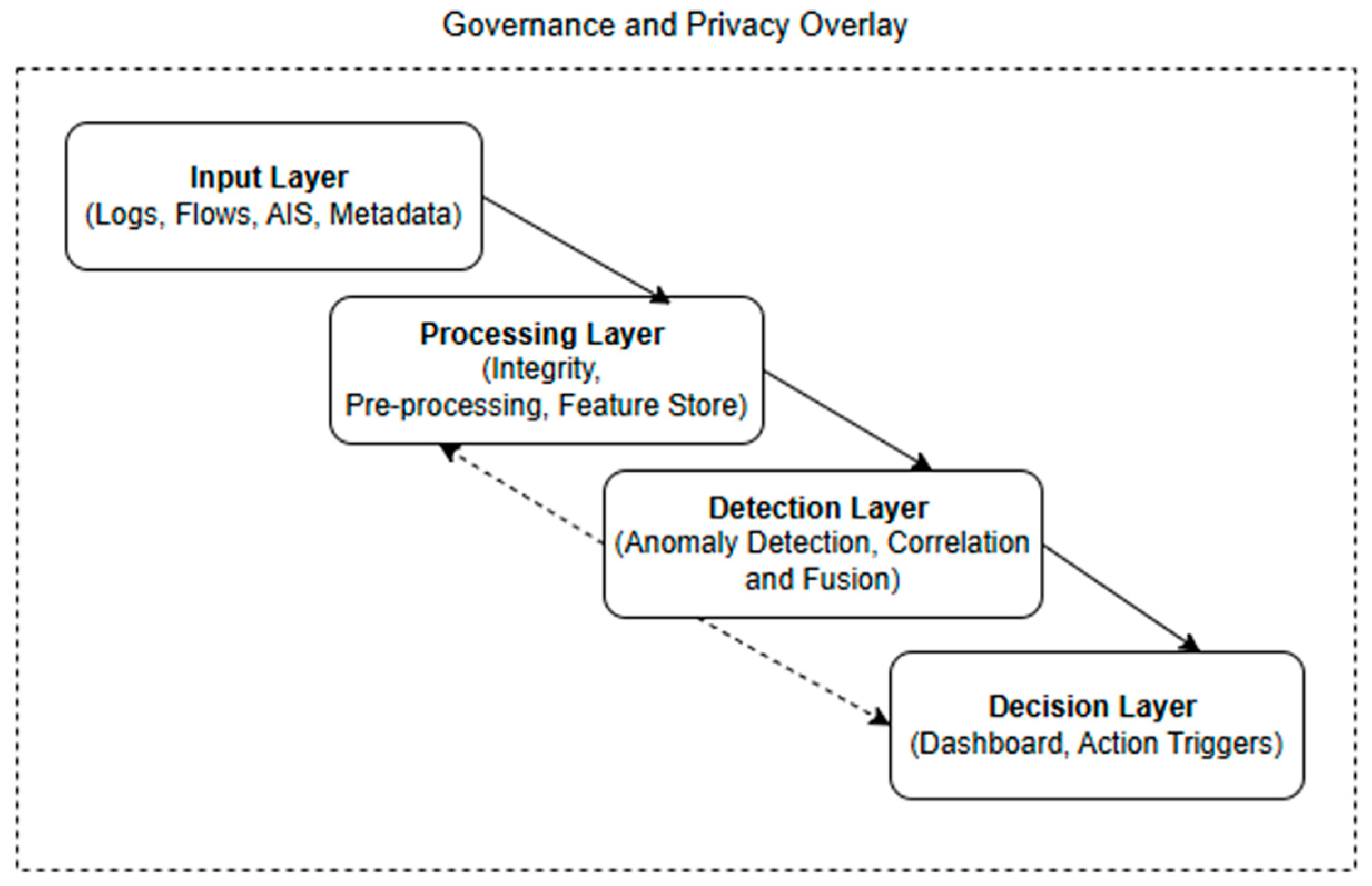
These four pillars create a closed operational loop: forensic readiness generates data; anomaly detection interprets signals; governance safeguards legitimate use; and structured intelligence transforms findings into systemic adaptation. This cycle ensures that forensic capabilities are embedded not as peripheral add-ons but as central drivers of resilience. This closed loop enables adaptive response during incidents and adaptive recovery after disruptions, ensuring that forensic intelligence continuously informs both immediate action and long-term resilience enhancement. Each pillar maps to concrete indicators (
Table 1) and pipelines (collection → integrity → analytics → decision → feedback).
Figure 1 illustrates the conceptual flow;
Table 1 lists the primary indicators used to quantify FROM’s contribution to resilience.
Building on prior work in resilience frameworks that emphasize adaptive system recovery and operational continuity [
4,
5,
6]. On the tradition of digital forensic readiness, which stresses the systematic preparation of data and processes for potential investigations [
23,
24,
25], this paper introduces the
forensic resilience score as an original contribution. Forensic resilience is defined as the capacity of digital infrastructures to integrate forensic readiness with resilience mechanisms to ensure both anomaly detection and adaptive recovery. In this context, adaptive recovery refers to the capability of an infrastructure not only to restore functionality after disruption, but to iteratively improve recovery strategies based on forensic learning from prior incidents. Unlike static recovery mechanisms, adaptive recovery is evidence-informed and feeds back into detection thresholds, response prioritization, and resilience planning. Therefore, the adaptive aims to operationalize resilience through forensic capacities that directly support critical detection and recovery functions, as broader security concepts. The notion of
adaptive recovery, as used here, draws on existing paradigms such as resilient recovery and cyber resiliency engineering, which emphasize dynamic, evidence-informed system restoration in complex environments [
42,
43]. By anchoring anomaly detection and adaptive response in forensic workflows, the model emphasizes their evidentiary and adaptive value—bridging the gap between reactive investigation and proactive resilience engineering.
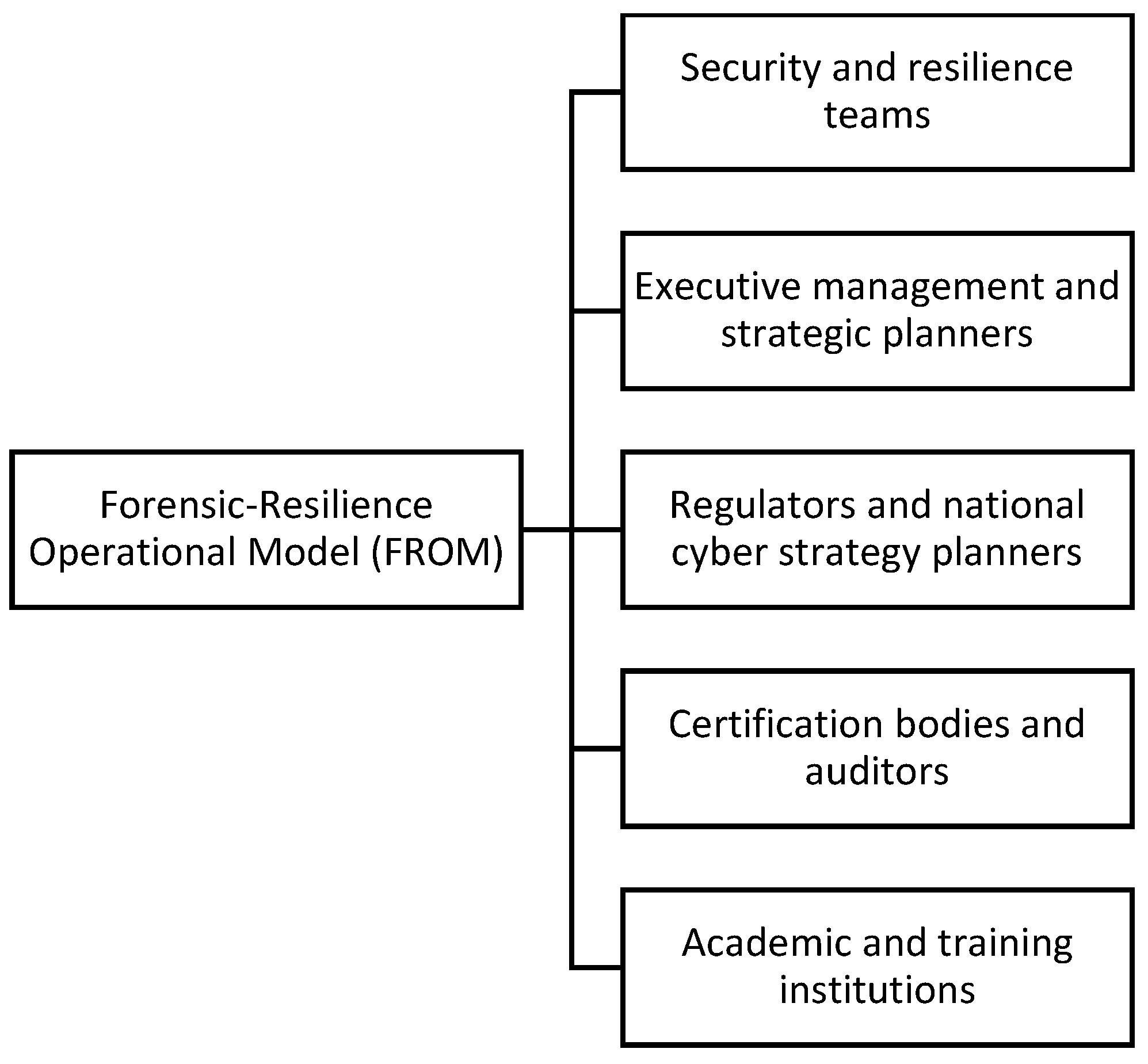
In operational terms, this is articulated through the Forensic-Resilience Operational Model (FROM), shown in
Figure 1. The empirical validation of the FROM and the development of the FRS are outlined in the following section.
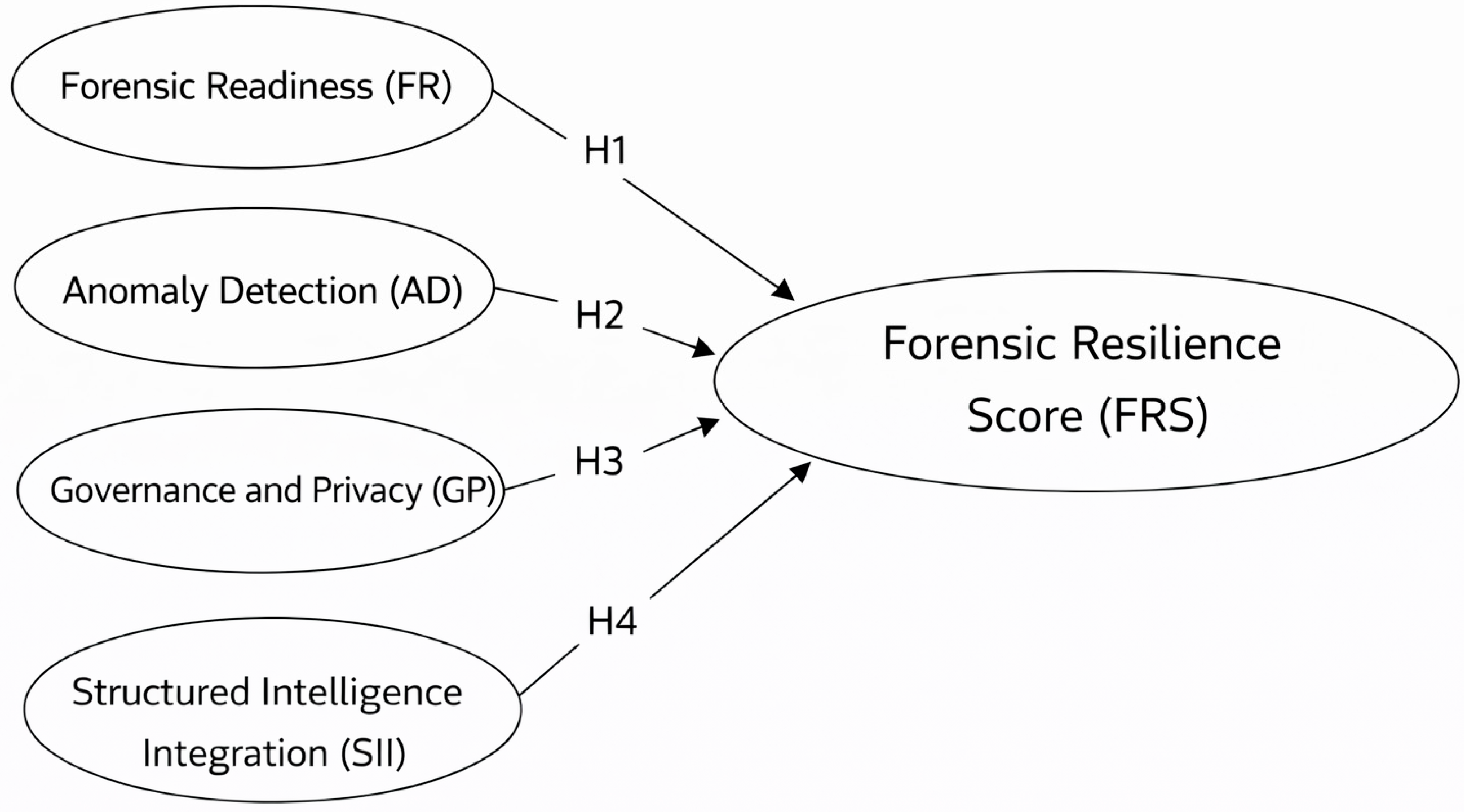
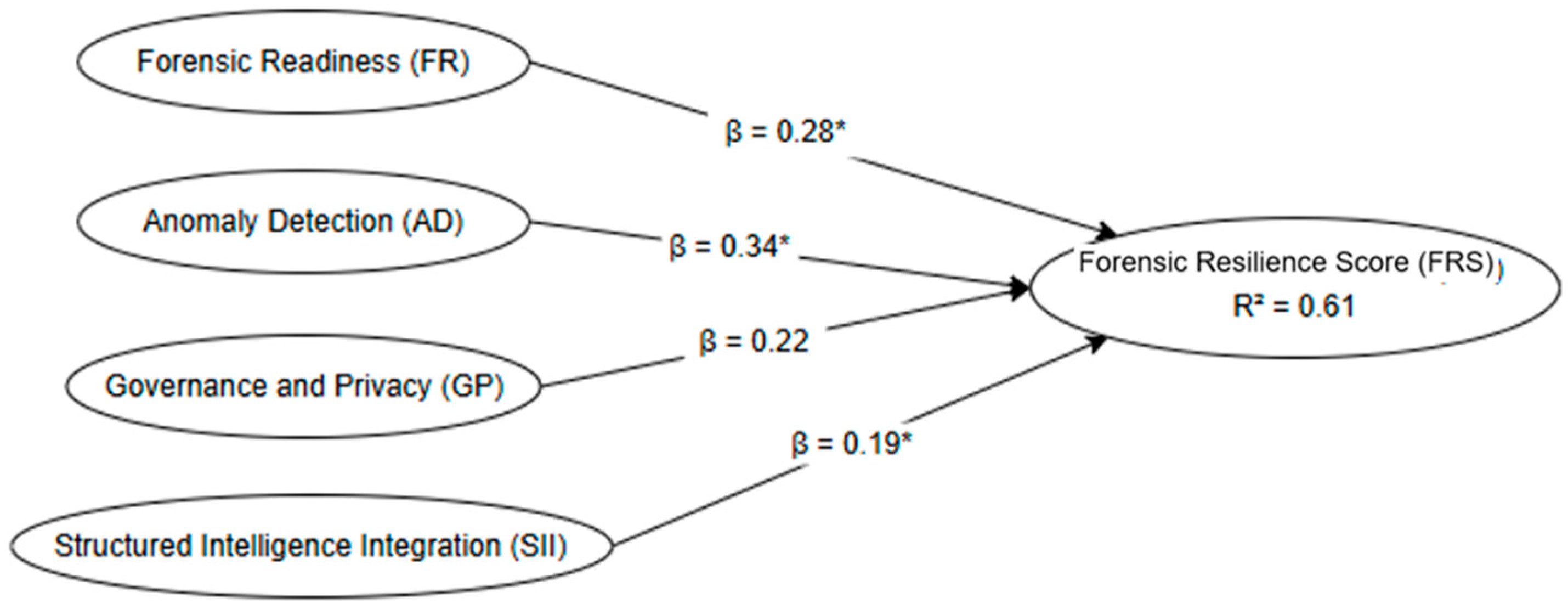
Each pillar—Forensic Readiness (FR), Anomaly Detection (AD), Governance and Privacy (GP), and Structured Intelligence Integration (SII)—is hypothesized to positively contribute to the composite Forensic Resilience Index (FRS). The dashed boxes (FSS and FL) represent theoretical extensions of the model. Accordingly, the following hypotheses are proposed for empirical validation:
H1: Forensic Readiness (FR) positively contributes to the Forensic Resilience Score (FRS).
H2: Advanced Anomaly Detection (AD) positively contributes to the Forensic Resilience Score (FRS).
H3: Governance and Privacy safeguards (GP) positively contribute to the Forensic Resilience Score (FRS).
H4: Structured Intelligence Integration (SII) positively contributes to the Forensic Resilience Score (FRS).
These hypotheses directly reflect the theoretical logic of FROM and provide the foundation for the subsequent empirical analysis.
Figure 2 presents the conceptual structure of the Forensic-Resilience Operational Model (FROM), highlighting the four hypothesized relationships (H1–H4) that form the basis for empirical validation.