Article

How Does Generative AI Drive Business Models’ Iterative Innovation of Digital Entrepreneurial Enterprises? From the Perspective of Entrepreneurial System Elements

1
School of Economics and Management, Beihua University, Jilin 132013, China
2
School of Business Administration, Nanjing University of Finance and Economics, Nanjing 210023, China
*
Author to whom correspondence should be addressed.
Systems 2026, 14(2), 212; https://doi.org/10.3390/systems14020212
Submission received: 27 January 2026 / Revised: 12 February 2026 / Accepted: 15 February 2026 / Published: 17 February 2026

Abstract

The rapid development of generative AI technology has provided new pathways for iterative innovation in the business models of digital entrepreneurial enterprises. Based on the entrepreneurial system elements theory, this study constructs a theoretical model of generative AI-empowered iterative innovation in the business models of digital entrepreneurial enterprises and aims to explore the roles of core entrepreneurial system elements (entrepreneurial opportunities, entrepreneurial resources, entrepreneurial teams) and contingency elements (environmental uncertainty) therein. Through empirical analysis of 279 questionnaires, the results show the following: First, generative AI can effectively drive iterative innovation in the business models of digital entrepreneurial enterprises; second, entrepreneurial opportunity identification, entrepreneurial resource integration, and entrepreneurial team decision-making all play partial mediating roles in the process of generative AI-driven iterative innovation in the business models of digital entrepreneurial enterprises; third, environmental uncertainty positively moderates the process of generative AI-driven iterative innovation in the business models of digital entrepreneurial enterprises. The research findings contribute to enriching and expanding digital entrepreneurship theory and provide practical guidance for digital entrepreneurial enterprises to achieve iterative innovation in their business models.

1. Introduction

Digital entrepreneurship has emerged as the core engine driving the growth of the digital economy. Numerous digital entrepreneurial enterprises have successfully broken free from the constraints of traditional entrepreneurial models in terms of time and space, scripting a new chapter in entrepreneurship and achieving remarkable entrepreneurial feats. For instance, Alibaba Cloud has integrated emerging digital technologies into its entrepreneurial products and services, establishing itself as a successful benchmark in the realm of “all-encompassing digital entrepreneurship.” The report to the 20th National Congress of the Communist Party of China emphasized the need to “accelerate the development of the digital economy, promote its deep integration with the real economy, and foster internationally competitive digital industry clusters.” The resilience of digital entrepreneurial enterprises stems from their unwavering commitment to business model innovation. In the era of the digital economy, the “newcomer disadvantage” and “scale disadvantage” of entrepreneurial enterprises are amplified, rendering the process of exploring business model innovation more complex. Compared to mature enterprises, digital entrepreneurial enterprises have yet to establish a solid market position and a comprehensive commercial system, necessitating an iterative and innovative mindset characterized by “user-driven, rapid iteration, and continuous evolution” to seek business model upgrades. Under traditional unidirectional and linear business models, products are downgraded after their creation and value capture, leading to the loss of embedded value. In contrast, iterative business model innovation enables enterprises to continuously retain embedded value [1], thereby ensuring the sustainability of value creation [2]. According to research by [3], circular iterative business model innovation advocates the concept of “rapid iteration and continuous improvement.” This innovative approach not only demonstrates flexibility but also yields positive outcomes in terms of efficiency. The “breakthrough-iteration” circular mechanism ensures the long-term effectiveness and continuous innovation of business models [4]. Therefore, delving into the implementation paths for iterative business model innovation in digital entrepreneurial enterprises is both a necessary and pivotal step in exploring high-quality development pathways for the digital economy.
The rapid advancement of AI technologies has provided new avenues for iterative business model innovation in digital entrepreneurial enterprises. Against the backdrop of unprecedented global changes, the emergence and rapid development of generative AI models such as ERNIE Bot, QianWen, and DeepSeek herald a phase of accelerated growth for digital entrepreneurship. GenAI, which relies on algorithms and models to generate text, images, audio, video, and other content, represents a category of models and related technological systems that exert disruptive influence across content creation, enterprise empowerment, and industry transformation. However, the question of how digital entrepreneurial enterprises can leverage this disruptive technology to achieve iterative business model innovation remains unclear, necessitating theoretical exploration for resolution. While existing research has conducted preliminary explorations into GenAI and iterative business model innovation, several issues remain to be addressed: First, most existing studies focus on the characteristics [5], driving forces [6], and ecosystems [7] of digital entrepreneurship. The question of whether GenAI can promote iterative business model innovation in digital entrepreneurial enterprises has been overlooked in current research, leaving the dynamic mechanisms driving such innovation in the context of rapid GenAI development unanswered. Second, while existing research has acknowledged the role of technology in iterative business model innovation [8] and conducted contextual case analyses [9], it has not addressed the transmission pathways for iterative business model innovation in digital entrepreneurial enterprises empowered by GenAI. Therefore, there is an urgent need to elucidate the theoretical mechanism through which GenAI bridges the digital divide for digital entrepreneurial enterprises and enables iterative business model innovation. Third, according to Timmons’ entrepreneurial element theory [10], the entrepreneurial system is a complex whole composed of multiple interrelated and interacting elements that jointly support entrepreneurial activities and influence entrepreneurial outcomes. Digital entrepreneurship is a process of achieving dynamic balance among opportunities, resources, and teams, and the realization of iterative business model innovation also necessitates balancing these three elements. GenAI drives the transmission of iterative business model innovation through three pathways: “opportunities-resources-teams.” However, whether contingency factors exist in this process remains largely unexplored in existing research on digital entrepreneurship from this perspective.
In light of these considerations, this study constructs a transmission mechanism model of GenAI’s impact on iterative business model innovation in digital entrepreneurial enterprises based on Timmons’ entrepreneurial element theory. From the perspective of entrepreneurial system elements, this model elucidates the complex transmission pathways and contingency factors, expands the empowerment pathways through which generative AI facilitates enterprises, and deepens the understanding of how generative AI drives iterative innovation in the business models of digital entrepreneurial firms. It explores multiple transmission pathways centered on “opportunities-resources-teams” and the contingency factors involved in this process, aiming to uncover the “black box” of GenAI-empowered iterative business model innovation in digital entrepreneurial enterprises, and to investigate the roles of core entrepreneurial system elements (entrepreneurial opportunities, entrepreneurial resources, entrepreneurial teams) and contingency elements (environmental uncertainty) in this process of opening the black box from the perspective of entrepreneurial system elements. This endeavor contributes to expanding the empowerment domains of GenAI empowerment theory, providing practical guidance for promoting high-quality development among digital entrepreneurial enterprises in China, and offering effective guidance for assisting digital entrepreneurs in achieving sustainable innovation and entrepreneurship.

2. Theoretical Foundations and Research Hypotheses

2.1. Entrepreneurial System Elements Theory

Timmons’ entrepreneurial theory constructs a dynamic equilibrium framework centered on three core elements—business opportunities, entrepreneurial teams, and resources—from a systems perspective. According to this theory, the entrepreneurial process is an organic whole where these three elements interact and influence each other, jointly forming the cornerstone of entrepreneurial activities. Business opportunities, as the core driving force of entrepreneurship, serve as the starting point for system operation. They originate from various factors such as market changes, technological advancements, and shifts in consumer demand. Entrepreneurs need to possess keen market insight to promptly identify and seize these opportunities. The entrepreneurial team acts as the leader and executor of the system. They must not only demonstrate leadership, innovative thinking, and team collaboration capabilities but also effectively integrate and allocate resources according to the needs of business opportunities. Resources, as the material foundation for system operation, encompass various elements such as capital, technology, and talent, providing crucial support for entrepreneurs to realize business opportunities. In Timmons’ theory, these three elements undergo a dynamic matching process of adaptation and adjustment. Entrepreneurs must continuously adjust and optimize the relationships among these elements based on market changes and resource conditions to maintain the system’s dynamic equilibrium. This equilibrium is not absolute but relative and dynamic, constantly evolving with the progress of the entrepreneurial process. Entrepreneurs need to exhibit a high degree of flexibility and adaptability, enabling them to respond swiftly in uncertain environments (fully variable factors within the entrepreneurial system), seize new business opportunities, integrate new resources, and build new teams to drive the sustained development of entrepreneurial projects.
From a systems perspective, this study delves into the transmission pathways through which GenAI empowers digital entrepreneurial enterprises to achieve iterative business model innovation, relying on the “opportunities-resources-teams” core framework constructed based on Timmons’ entrepreneurial element theory. Within this dynamic system, GenAI, as a key driving force, is reshaping the system’s structure and operational logic through three core pathways: First, it reconstructs the logic of value creation, breaking free from the limitations of traditional linear value chains and propelling the system towards an intelligent value network. Second, it optimizes resource allocation efficiency, enabling precise matching and efficient flow of resource elements within the system. Third, it reshapes team collaboration paradigms, enhancing the overall innovation capacity of the system through human–machine collaboration mechanisms. These three pathways intertwine and synergize, jointly driving the systematic leap of digital entrepreneurial enterprises’ business models from a single value chain to a complex value network. Notably, this innovation process does not operate in isolation but is embedded within a dynamically changing environmental system. Environmental uncertainty, as a significant contingency factor, may exert a moderating effect on the system’s evolutionary pathways by influencing key aspects such as opportunity identification, resource acquisition, and team adaptation. This necessitates that digital entrepreneurial enterprises possess systemic thinking capabilities for environmental perception and dynamic adjustment when leveraging GenAI to drive business model innovation.

2.2. Research Hypotheses

2.2.1. GenAI and Iterative Business Model Innovation in Digital Entrepreneurial Enterprises

Against the backdrop of the rapid advancement of GenAI, digital entrepreneurial enterprises are confronted with multiple challenges, including a highly uncertain market environment, the complexity of the innovation process, and the ambiguity of target orientation. In light of this, business model innovation urgently needs to strengthen its incremental characteristics, enhance dynamic responsiveness, bolster environmental adaptability, and maintain innovation sustainability, thereby giving rise to the innovative path of iterative business model evolution. In contrast to traditional linear innovation models, which struggle to address the continuously emerging issues during the innovation process, this “small-scale yet rapid” iterative innovation approach can effectively tackle complex strategic and operational decisions, thereby achieving transformation objectives and enabling long-term development. In the era of digital economy, “business model iterative innovation” constitutes an innovation paradigm for manufacturing enterprises that combines flexibility and efficiency. This paradigm emphasizes that enterprises should adapt to the continuous evolution of digital technologies, conduct gradual optimization and adaptive adjustments to existing business models, and achieve the sustained emergence and breakthrough development of deep-level innovation outcomes through periodic updates of value propositions. Compared with the limitations of traditional linear innovation paths in addressing dynamic issues during the innovation process, this business model innovation path, characterized by “agile iteration” at its core, can more effectively handle complex strategic decisions and operational challenges, thereby driving digital entrepreneurial enterprises to achieve systemic transformation and attain sustainable growth objectives. Liu and Zhang [9] compared business model innovation with iterative innovation models from five aspects: core logic, implementation process, resource investment and risks, innovation direction, and applicable scenarios, aiming to distinguish between the two: First, in terms of core logic, traditional business model innovation belongs to “big-leap” disruptive innovation, while business model iterative innovation represents “small-step, fast-run” incremental innovation, involving the decomposition of multiple innovation objective stages. Second, regarding the implementation process, traditional business model innovation follows a linear path, whereas business model iterative innovation entails a non-linear leap. Third, concerning resource investment and risks, traditional business model innovation requires high levels of risk and resource investment, while business model iterative innovation demands fewer resources and short-term inputs, thus carrying lower risks. Fourth, with respect to innovation direction, traditional business model innovation is internally closed, while business model iterative innovation involves top-down, inward-to-outward collaboration. Fifth, in terms of applicable scenarios, traditional business model innovation is suitable for corporate strategic choices in the traditional era, while business model iterative innovation is tailored to strategic choices for enterprises in the digital economy era.
GenAI is reshaping the business models of digital entrepreneurial enterprises with disruptive force, influencing core aspects such as value creation and customer interaction [11], and driving the business models of these enterprises towards intelligence, personalization, and agility. GenAI possesses the capability to intelligently analyze the value propositions of startups, capture market opportunities, assist enterprises in market segmentation and target market positioning, thereby promoting continuous business model transformation [12]. Existing research indicates that AI-empowered business models in digital entrepreneurial enterprises undergo three progressive developmental stages: AI-assisted, AI-enhanced, and AI-integrated stages [13]. In the early stages of digital entrepreneurship, GenAI can facilitate automated market development and order collection based on its generated content, providing ideas, information, and resources for the construction and innovation of business models. Meanwhile, during the data analysis and information generation processes, GenAI can construct data-driven business models, laying the foundation for iterative business model innovation [14]. Focusing on computing power, algorithms, and big data analysis, GenAI enables enterprises to identify emerging market trends, understand customer needs more effectively, and predict future demands more accurately by analyzing vast and complex datasets using advanced data processing techniques, thereby providing information support for iterative business model innovation [15]. Therefore, GenAI has the potential to reshape strategies, operations, and value creation across industries, effectively driving business model iteration and continuous innovation [16]. Based on the above analysis, this study proposes the following hypothesis:
H1: 
GenAI can positively promote iterative business model innovation in digital entrepreneurial enterprises.

2.2.2. Entrepreneurial Opportunity Identification: The Starting Point of Entrepreneurial System Operation

In the context of widespread digital development, AI, with its unique advantages, can open up more entrepreneurial opportunities in cutting-edge fields for entrepreneurs [17]. AI can leverage existing cognitive systems to keenly detect the underlying connections hidden behind seemingly unrelated events or trends in the external environment, thereby assisting in the discovery of entrepreneurial opportunities [18]. GenAI has reconstructed the opportunity identification logic of digital entrepreneurial enterprises by dynamically perceiving user needs, generating personalized value propositions, and incubating emerging business ecosystems. Driven by GenAI, the entrepreneurial opportunity identification process of digital entrepreneurs has undergone a paradigm shift from traditional demand insight to value co-creation. Brown [19] found that crowdsourcing technologies marked by AI would become a significant influencing factor in changing the rules of entrepreneurial opportunities, leading the transformation from traditional entrepreneurial opportunities to digital ones. In the field of empirical research, Prüfer and Prüfer [20] pointed out that AI, through machine learning, algorithmic prediction, and other means, can successfully overcome uncertain factors and provide data-driven entrepreneurs with deeper insights into business opportunities.
On this basis, entrepreneurial opportunity identification is an important prerequisite for enterprises to carry out business model innovation [21]. GenAI can enhance the efficiency and effectiveness of opportunity identification in digital entrepreneurial enterprises and innovate transaction methods based on identified entrepreneurial opportunities, thereby achieving iterative business model innovation. When enterprises identify new market opportunities, they continuously create unique value propositions according to the characteristics of the opportunities and the needs of target customers. With precise identification of entrepreneurial opportunities, startups can efficiently explore entrepreneurial opportunities with development potential and use them as the foundation for iterative business model development [22]. GenAI can accurately capture entrepreneurial opportunities from vast amounts of information and further refine specific entrepreneurial fields or market segments with development potential, promoting iterative business model innovation in digital entrepreneurial enterprises. Based on the above analysis, this study proposes the following hypothesis:
H2: 
GenAI can promote iterative business model innovation in digital entrepreneurial enterprises by facilitating entrepreneurial opportunity identification.

2.2.3. Entrepreneurial Resource Integration: The Material Foundation of Entrepreneurial System Operation

GenAI can break down information silos, construct dynamic resource networks, and enable the resource allocation process of digital entrepreneurial enterprises to achieve an efficiency leap from traditional resource integration to intelligent empowerment. Existing research indicates that GenAI can integrate tangible, intangible, and human resources within entrepreneurial enterprises and promote collaboration between internal and external resources [23]. Through technological inclusiveness, computing power optimization, and compliant data utilization, GenAI breaks down traditional resource barriers and promotes efficient resource allocation in digital entrepreneurial enterprises. Akter et al. [24] found that GenAI can reshape enterprise resource management methods and deeply empower digital entrepreneurial enterprises to achieve intelligent resource integration through automation, intelligent analysis, and multimodal content generation capabilities.
Meanwhile, by integrating internal and external resources, digital entrepreneurial enterprises can effectively construct new business models and continuously achieve iterative innovation. For startups, emphasizing the intelligent integration and utilization of resources and focusing on building unique resource architectures can give rise to new transaction forms [25]. For example, Xiaomi Corporation has achieved iterative business model innovation by integrating supply chain resources, internet marketing resources, and talent resources. In entrepreneurial practice, the creative integration and application of existing resources can generate innovative resource connection channels, thereby stimulating the internal motivation of startups to develop new business models [26]. In addition, in the absence of innovative resources, entrepreneurs may adopt a resource bricolage strategy to creatively integrate and reasonably utilize available resources, thereby developing new resource utilization models to drive business model innovation [27]. Based on the above relevant analysis, this study proposes the following hypothesis:
H3: 
GenAI can promote iterative business model innovation in digital entrepreneurial enterprises by facilitating entrepreneurial resource integration.

2.2.4. Entrepreneurial Team Decision-Making: The Leader of the Entrepreneurial System

The utilization of GenAI has prompted entrepreneurial teams to evolve from professional division of labor to human–machine collaboration, sparking a wave of complementary innovation between AI and team members [28]. With its powerful machine learning algorithms, GenAI can deeply mine vast amounts of historical data, accurately extract patterns, and clearly identify trends to assist in intelligent decision-making. Townsend and Hunt [29] indicated that conducting entrepreneurial actions, making judgments, and decisions in uncertain environments are core aspects of entrepreneurial activities. AI has the ability to reduce uncertainty and optimize the judgment and decision-making processes in entrepreneurial activities. Research also suggests that AI can achieve human–machine complementarity in entrepreneurial decision-making in the fields of perception and cognition, significantly improving the work efficiency of entrepreneurial teams in a way that breaks through traditional paradigms [30]. Jarrahi [31] also proposed that combining humans’ intuitive judgment abilities with AI’s capabilities of rapidly collecting and analyzing information can achieve efficient human–machine collaboration.
Meanwhile, entrepreneurial teams are key drivers of business model innovation. Through resource integration, technology application, and dynamic adjustment of business strategies, they enable enterprises to gain a competitive edge through business model innovation in complex and dynamic markets [32]. By conducting in-depth market research and analysis, entrepreneurial teams make decisions regarding target market selection and accurately position target markets, thereby pointing the way for iterative business model innovation. Decision-makers can dynamically adjust business models using user data and market feedback. In a constantly changing environment, the decision-making ability of entrepreneurial teams helps new enterprises accurately grasp customer needs and analyze market development trends [33], thereby assisting enterprises in clarifying market positioning and determining iterative business model innovation goals. With the support of GenAI, entrepreneurial teams can collect and integrate vast amounts of data from multiple channels using big data analysis techniques. Through in-depth mining and analysis of this data, entrepreneurial teams can accurately understand consumers’ demand preferences, purchasing habits, and potential pain points, thereby adjusting business models. Based on the above analysis, this study proposes the following hypothesis:
H4: 
GenAI can promote iterative business model innovation in digital entrepreneurial enterprises by facilitating entrepreneurial team decision-making.

2.2.5. Environmental Uncertainty: The Contingency Factor of the Entrepreneurial System

The environment in which digital entrepreneurial enterprises operate is constantly changing, and existing business models may find it difficult to maintain a competitive advantage for a long time. Therefore, enterprises need to reform and innovate their business models according to environmental changes [34]. Environmental fluctuations open up new market opportunities for newly established digital enterprises. Based on this, these enterprises can continuously construct novel value creation models according to environmental trends, that is, carry out iterative business model innovation. Iterative business model innovation is a key factor in enabling enterprises to form competitive advantages and improve business performance. In this driving process, uncertain environments play a crucial role [35]. Relevant research indicates that iterative business model innovation gradually develops in the process of continuously responding to the impact of environmental uncertainty [36]. Under conditions of environmental uncertainty, GenAI can enhance the dynamic capabilities of digital entrepreneurial enterprises and promote their iterative business model innovation. Environmental uncertainty can be regarded as an external factor that stimulates the effects of GenAI. Conversely, when environmental uncertainty is low, enterprises face fewer challenges in innovating new business models. The data they obtain has good regularity, and managers themselves may also be able to extract valuable information for the enterprise from big data [37], and the promoting effect of GenAI on iterative business model innovation may be weakened. In summary, higher environmental uncertainty will enhance the positive impact of GenAI on iterative business model innovation in digital entrepreneurial enterprises. Based on the above analysis, this study proposes the following hypothesis:
H5: 
Environmental uncertainty plays a positive moderating role in the process of GenAI promoting iterative business model innovation in digital entrepreneurial enterprises.
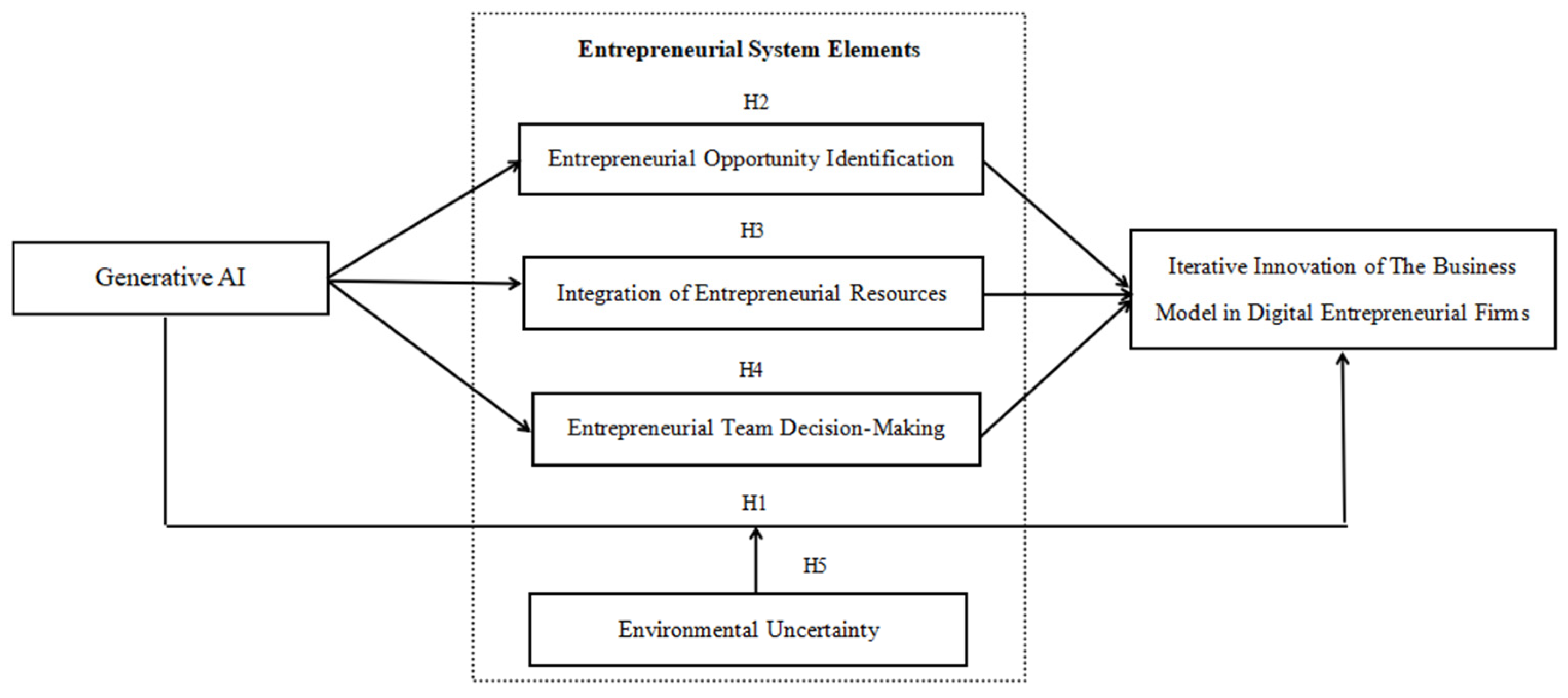
In conclusion, based on Timmons’ entrepreneurial elements theory, this study constructs a theoretical model of the transmission pathways between GenAI and iterative business model innovation, as shown in Figure 1.

3. Research Design

3.1. Sample Selection and Data Collection

This study identified the research subjects based on the Statistical Classification of Digital Economy and Its Core Industries (2021). It selected enterprises with a founding history of less than 8 years operating in the digital product manufacturing, digital product service, digital technology application, digital factor-driven, and digital efficiency enhancement industries as the research objects. Additionally, tools such as Qichacha (a Chinese business information search platform) were utilized to screen digital entrepreneurial firms. Prior to formally initiating the survey, this study conducted a pilot survey in Jilin Province. Based on the feedback from the pilot survey, the questionnaire underwent multiple revisions and improvements to ensure its reliable content validity. During the formal survey, referring to the three-tier development pattern outlined in the China Digital Economy Development Index Report (2024), this study selected representative regions from the first, second, and third tiers for the survey. The specific surveyed regions included Zhejiang Province, Jiangsu Province, Jilin Province, Shanxi Province, Yunnan Province, and Qinghai Province in China. The questionnaire collection commenced in June 2025 and concluded in October 2025, spanning a total of five months. A cumulative total of 600 questionnaires were distributed during this survey, with 307 ultimately collected. After excluding questionnaires that were incompletely filled out and those completed by enterprises outside the scope of this study’s investigation, a total of 279 valid questionnaires were obtained. The descriptive statistical analysis results of the study’s sample are detailed in Table 1.

3.2. Variable Measurement

This study employed well-established scales from previous scholars to measure the variables involved in the research. The use of GenAI was measured using the scale developed by [38], which comprises three items assessing the intensity, frequency, and modalities of GenAI adoption among digital entrepreneurial firms, the items explicitly mentioned GenAI (such as ChatGPT, ERNIE Bot, QianWen, DeepSeek, etc.) and distinguished it from traditional analytical AI. Drawing on the research by [39], there were a total of 8 items for measuring business model iterative innovation. For entrepreneurial opportunity identification, this study referenced the research by [40], with a total of 7 items. Regarding entrepreneurial resource integration, the measurement scale adopted by [41] was utilized, consisting of 8 items. For entrepreneurial team decision-making, following the research by [42], it was measured from three aspects: decision-making sensitivity, decisiveness, and accuracy, with a total of 8 items. For environmental uncertainty, referring to the study by [43], it was measured from three dimensions—complexity, dynamism, and hostility—encompassing 13 items.

4. Empirical Analysis

4.1. Reliability and Validity Tests

In this study, Cronbach’s alpha coefficient was selected as the criterion for evaluating the reliability of the measurement scales. Specific tests were conducted on constructs such as GenAI, entrepreneurial opportunity identification, entrepreneurial team decision-making, business model iterative innovation, and environmental uncertainty, with the results presented in Table 2. Upon reviewing the analysis results, it was found that among all the measured constructs in this study, the minimum Cronbach’s alpha value was 0.727, and the minimum factor loading was 0.719, both of which were higher than the corresponding critical values. This indicates that the scales as a whole exhibit high reliability and good internal consistency.
Next, this study carried out validity tests on the variable scales. As shown in the data presented in Table 2, there were certain differences in the KMO values corresponding to different variables, but all were above 0.7: the KMO value for GenAI was 0.732; for entrepreneurial opportunity identification, it reached 0.880; for entrepreneurial resource integration, it was 0.909; for entrepreneurial team decision-making, it was as high as 0.920; for business model iterative innovation, it was 0.910; and for environmental uncertainty, it was 0.956. Meanwhile, the results of Bartlett’s test of sphericity showed that the Sig values for all variables were 0.000. Based on the above test results, it was demonstrated that the data met the prerequisites for factor analysis, and thus factor analysis could be conducted. On this basis, this study utilized factor analysis to calculate the factor loadings and Average Variance Extracted (AVE) values for each variable. After analysis, it was found that the minimum factor loadings for all variables exceeded 0.6, and the AVE values were all greater than 0.5. Based on the comprehensive analysis results, it can be concluded that the scales adopted in this study exhibit good validity.

4.2. Common Method Bias Test

Prior to formally conducting the survey on the research subjects, this study first carried out a pilot survey in Jilin Province. During this process, the scales related to GenAI and other aspects involved in the research underwent multiple meticulous revisions and improvements, aiming to ensure the content validity of the scales used in this study. In terms of sample selection, this study focused primarily on digital entrepreneurial firms across different industries. Although these firms belong to different industries (with industry codes ranging from 01 to 05), the digital entrepreneurial contexts they face are largely similar. This similarity makes it difficult to completely eliminate potential issues related to the uniformity of data sources during the data collection process. Given the above circumstances, to effectively examine potential common method bias issues during the survey process, this study decided to adopt Harman’s single-factor method. In the specific implementation phase, this study incorporated all items related to the five variables (GenAI, entrepreneurial opportunity identification, entrepreneurial resource integration, entrepreneurial team decision-making, business model iterative innovation, and environmental uncertainty) into the scope of exploratory factor analysis. The analysis results indicated that, without rotation, all items could be aggregated into six factors. Moreover, the eigenvalues of these six factors were all greater than 1, and the cumulative variance contribution rate reached 58.197%. Additionally, this study also examined the issue of multicollinearity. The test results showed that the variance inflation factor (VIF) values for all variables were less than 2, and the tolerance values were all greater than 0.6. The results of multicollinearity checks are shown in Table 3. Based on the comprehensive results of these tests, it can be concluded that this study does not suffer from severe common method bias issues, nor does it exhibit significant multicollinearity problems.

4.3. Hypothesis Testing

4.3.1. Correlation Analysis

Table 4 presents the results of the correlation analysis among the six variables: GenAI, entrepreneurial opportunity identification, entrepreneurial resource integration, entrepreneurial team decision-making, business model iterative innovation, and environmental uncertainty. The analysis data indicate that all six variables involved in this study exhibit significant correlations with each other, and the correlations between the variables are all significant at the 0.01 level. However, based solely on these correlation results, it is not possible to determine whether the hypotheses proposed in this study hold true. Further analysis is required by constructing regression models to delve deeper into the matter.

4.3.2. Regression Analysis

Testing the Relationship Between GenAI and Business Model Iterative Innovation in Digital Entrepreneurial Firms
To validate the hypotheses proposed earlier, this study constructed a regression model and incorporated firm age, size, industry affiliation, and geographical location as control variables into the model. The model is presented as follows:
Yi = β0 + β1Xi + αiZij + εi
Here, Y represents business model iterative innovation, X denotes generative artificial intelligence, Z refers to control variables, and ε signifies the random disturbance term.
Model 1 in Table 5 presents the regression analysis results regarding the impact of GenAI on business model iterative innovation (BMII). The analysis reveals a significant positive correlation between the two variables (β = 0.426, p < 0.01), indicating that for every one-unit increase in GenAI, the speed of business model iteration and innovation rises by 0.426 units. Additionally, the adjusted R-squared (Adj-R2) value is 0.176, suggesting that GenAI explains 17.6% of the variance in business model iteration and innovation. This finding suggests a positive association between GenAI adoption and business model iteration/innovation among digital entrepreneurial firms, consistent with the possibility that firms utilizing GenAI tend to exhibit more frequent business model updates. Based on this, Hypothesis H1 of this study is supported. Previous research has primarily centered on conducting scenario-based case analyses of business model iterative innovation. While these case analyses offer valuable insights into specific instances and contexts, they lack the generalizability that comes with empirical research methods. In contrast, this study is the first to employ an empirical approach to explore and validate the role of GenAI in enabling BMII for digital entrepreneurial firms, thereby providing new perspectives for these firms to leverage GenAI for BMII in the digital age.
Testing the “Opportunity-Resource-Team” Transmission Mechanism from the Perspective of Entrepreneurial System Elements
This study employed a stepwise regression approach to verify the mediating roles of entrepreneurial opportunity identification (EOI), entrepreneurial resource integration (ERI), and entrepreneurial team decision-making (ETD). The results of the mediating effect analysis are presented in Table 6.
In Model 2, GenAI (GenAI) and EOI were treated as independent variables, business model iterative innovation (BMII) as the dependent variable, and control variables were included. The regression coefficient of GenAI on BMII remained significant, but it decreased from the original 0.426 to 0.102. This indicates that the inclusion of EOI weakens the direct impact of GenAI, yet the residual effect remains statistically significant. Therefore, EOI partially mediated the impact of GenAI on BMII, supporting Hypothesis H2 of this study.
In Model 3, GenAI and ERI were used as independent variables, BMII as the dependent variable, and control variables were incorporated. The regression coefficient of GenAI on BMII remained significant, but it dropped from 0.426 to 0.090, This suggests that incorporating ERI reduces the direct influence of GenAI, but the remaining effect continues to be significant. Thus, ERI partially mediated the influence of GENAI on BMII, validating Hypothesis H3.
In Model 4, GenAI and ETD were considered independent variables, BMII as the dependent variable, and control variables were included. The regression coefficient of GenAI on BMII remained significant, indicating a persistent positive correlation; however, it decreased from 0.426 to 0.305, This demonstrates that the introduction of ETD attenuates the direct effect of GenAI, while the leftover effect still holds statistical significance. Consequently, ETD played a partial mediating role, supporting Hypothesis H4 of this study.
Previous research often centered on the technological aspects of GenAI or the general impact of digital technologies on business models, without delving deeply into the underlying entrepreneurial mechanisms that drive such transformation. This study has uncovered the roles of core entrepreneurial elements (EOI, ERI, and ETD) in GenAI-empowered business model iterative innovation for digital entrepreneurial firms, addressing the gaps in existing research by offering a more comprehensive perspective on the interaction between technology and entrepreneurship in the digital age.
Testing the Moderating Role of Environmental Uncertainty (Contingency Factor in the Entrepreneurial System)
To examine the moderating effect of environmental uncertainty (EU) on the relationship between GenAI and BMII, this study used BMII as the dependent variable. Control variables were added sequentially, followed by the interaction term between GenAI and EU. To avoid multicollinearity, both GenAI and EU were centered before constructing their product term. The final results are presented in Model 5 of Table 7. The interaction term between GenAI and EU exhibited a significant positive impact on BMII (β = 0.590, p < 0.05). This indicates that as the level of environmental uncertainty increases, the influence of GenAI on BMII becomes stronger. Therefore, Hypothesis H5 of this study is supported. Although some prior studies have acknowledged the significance of the external environment, they seldom delve into the specific role of EU as a contingency factor in shaping the impact of GenAI on BMII. This study pioneers in uncovering the role of entrepreneurial contingency elements (environmental uncertainty) in GenAI-empowered BMII within digital entrepreneurial firms, thereby enriching theoretical understanding of business model innovation in the digital era and providing a more comprehensive perspective on how digital entrepreneurial firms can harness and leverage environmental uncertainty to drive BMII.

5. Research Conclusions and Prospects

5.1. Research Conclusions

This study, from the perspective of entrepreneurial system elements, constructed and validated a driving mechanism model for the iterative innovation of business models in digital entrepreneurial enterprises driven by GenAI. The following conclusions were drawn:
Firstly, GenAI facilitates the iterative innovation of business models in digital entrepreneurial enterprises. During the process of data analysis and information generation, GenAI can construct data-driven business models, laying the foundation for the iterative innovation of business models. Secondly, entrepreneurial opportunities, entrepreneurial resources, and entrepreneurial teams (i.e., the core elements of the entrepreneurial system) partially mediate the process by which GenAI drives the iterative innovation of business models in digital entrepreneurial enterprises. Driven by GenAI, the entrepreneurial opportunity recognition process of digital entrepreneurs undergoes a paradigm shift from traditional demand insight to value co-creation. Meanwhile, through its capabilities of automation, intelligent analysis, and multi-modal content generation, GenAI can deeply empower digital entrepreneurial enterprises to achieve intelligent integration of entrepreneurial resources. Additionally, GenAI enhances the productivity and work efficiency of entrepreneurial teams in unprecedented ways. Therefore, in the process of GenAI facilitating the iterative innovation of business models, a “opportunity-resource-team” transmission pathway is experienced. Thirdly, environmental uncertainty (i.e., a contingency factor in the entrepreneurial system) positively moderates the process by which GenAI drives the iterative innovation of business models in digital entrepreneurial enterprises. Higher environmental uncertainty strengthens the positive impact of GenAI on business model innovation in digital entrepreneurial enterprises.

5.2. Practical Implications

This study focuses on the iterative innovation of business models in digital entrepreneurial enterprises enabled by GenAI. Based on Timmons’ entrepreneurial elements theory, it delves into the transmission pathway, providing digital entrepreneurial enterprises with several important practical implications:
Firstly, keep up with technological frontiers and incorporate GenAI into long-term strategies. Digital entrepreneurial enterprises should deeply integrate GenAI into their strategic planning, viewing it as a core engine driving the iterative innovation of business models. At the initial stage of strategy formulation, enterprises should establish professional technical evaluation teams to conduct comprehensive and in-depth research and analysis on the technological development trends, application scenarios, and potential impacts of GenAI. Based on this analysis, they should determine their strategic positioning in the field of this technology, clarifying whether to become technology leaders, fast followers, or differentiated adopters. Based on the strategic positioning, they should rationally plan resource allocation, including funds, talents, and time, to ensure sufficient resources support the development of GenAI-related projects. Meanwhile, they should closely integrate the application of GenAI with their overall business strategies, formulating specific strategic goals and action plans around core objectives such as enhancing customer value, optimizing operational efficiency, and exploring new markets. For example, they can achieve personalized product customization through GenAI to meet the unique needs of different customers, thereby improving customer satisfaction and loyalty. They can also utilize this technology to optimize supply chain management, achieving accurate forecasting and intelligent scheduling to reduce operational costs. Furthermore, enterprises should maintain strategic flexibility, promptly adjusting their strategic directions and priorities in response to the continuous development of GenAI technology and changes in the market environment, ensuring they remain at the forefront of business model innovation.
Secondly, integrate entrepreneurial system elements such as opportunities, resources, and teams to stimulate entrepreneurial innovation vitality. During the implementation of the entrepreneurial process, digital entrepreneurial enterprises should attach great importance to the organic integration of opportunities, resources, and teams, fully leveraging the empowering role of GenAI. For opportunity recognition, enterprises should utilize the powerful data collection and analysis capabilities of GenAI to extensively collect market information, industry trends, and consumer feedback, excavate potential market opportunities and commercial value points through algorithmic models. Meanwhile, they should encourage team members to actively participate in market research and brainstorming sessions, proposing innovative business model ideas based on the data insights provided by GenAI. In terms of resource integration, they should leverage GenAI to break through the temporal and spatial limitations of resource acquisition and expand resource channels. For example, they can find technology partners, investors, and suppliers worldwide through online platforms and social networks. They can also utilize GenAI to optimize the allocation of internal resources, improving resource utilization efficiency and ensuring that key resources are precisely invested in key links of business model innovation. Team integration is crucial. Enterprises should build a diversified team with the ability to apply GenAI technology and innovative thinking. Through training and talent recruitment, they should enhance team members’ understanding and application of GenAI. They should also establish effective communication mechanisms and collaboration platforms to promote information sharing and idea exchange among team members, stimulating innovation vitality. During the decision-making process, they should fully utilize the data support and simulation analysis provided by GenAI to improve the scientificity and accuracy of decisions, ensuring that the team can efficiently seize opportunities, integrate resources, and drive the iterative innovation of business models.
Thirdly, actively respond to policies and regulations to ensure the steady advancement of the innovation system. With the rapid development of GenAI, relevant policies and regulations are constantly being improved and adjusted. Digital entrepreneurial enterprises must actively adapt to these external environmental changes to ensure that their business model innovation activities are legal and compliant. Enterprises should establish dedicated policy research positions or teams to closely monitor national and local policy and regulatory dynamics regarding GenAI, promptly interpret policy content, and assess the impact of policies on the enterprise. They should actively participate in policy discussion activities organized by industry associations, maintaining good communication channels with government departments, and providing feedback on problems and suggestions encountered during policy implementation to contribute to policy formulation and improvement. During the process of business model innovation, enterprises should strictly comply with policy and regulatory requirements in areas such as data privacy protection, algorithm security, and intellectual property rights. For example, when collecting and using user data, they should ensure obtaining explicit authorization from users and take effective security measures to protect user data from leakage and abuse. When applying GenAI algorithms, they should conduct sufficient testing and verification to ensure the fairness and reliability of the algorithms, avoiding legal risks arising from issues such as algorithm discrimination. Additionally, enterprises can also transform policy and regulatory requirements into opportunities for business model innovation. For example, they can develop GenAI products and services that comply with data privacy protection standards to meet market demand for safe and reliable technologies, thereby achieving differentiated business model innovation while remaining compliant.

5.3. Research Limitations and Prospects

This study explored the process by which digital entrepreneurial enterprises achieve iterative innovation of business models through GenAI from the perspective of Timmons’ entrepreneurial process model. It opened up a new perspective for research in the field of digital entrepreneurship; however, it also has certain limitations. Firstly, this study focused on the roles played by the core elements of the entrepreneurial system (opportunities, resources, and teams) in the iterative innovation process of business models in digital entrepreneurial enterprises, as well as the contingent impact of environmental uncertainty (a contingency factor in the entrepreneurial system). However, the iterative innovation process of business models in enterprises is often influenced by numerous factors such as dynamic capabilities, organizational culture, and entrepreneurial learning. To ensure the unity of the research perspective based on Timmons’ entrepreneurial model, this study did not incorporate all these factors into the research model. Future research can be conducted from other perspectives to improve this research model while injecting new ideas into the study of iterative innovation of business models in digital entrepreneurial enterprises.
Secondly, to enhance the generalizability of the research results, this study surveyed digital entrepreneurial enterprises across multiple industries rather than limiting the research to the characteristics of a single industry. Based on the “Statistical Classification of the Digital Economy and Its Core Industries (2021),” this study selected digital product manufacturing, digital product services, digital technology application, digital factor-driven industries, and digital efficiency enhancement industries for investigation to enhance the generalizability of the results. However, this made it difficult to highlight the unique characteristics of business model iterative innovation in digital entrepreneurial enterprises within a specific industry. Future research can focus on specific industries to deeply explore the unique characteristics of business model iterative innovation and the application of GenAI technology in digital entrepreneurial enterprises within those industries.


Author Contributions

Conceptualization, J.Z.; methodology, J.Z.; software, X.X.; validation, X.X.; formal analysis, K.Z.; investigation, K.Z.; resources, X.X.; data curation, K.Z.; writing—original draft preparation, X.X.; writing—review and editing, J.Z.; project administration, J.Z.; funding acquisition, X.X. All authors have read and agreed to the published version of this manuscript.

Funding

This research was funded by The Youth Fund Project for Humanities and Social Sciences Research of the Ministry of Education, grant number 25YJC630159, the Research Project on Teaching Reform in Vocational Education and Adult Education in Jilin Province, grant number 2025ZCY306, the Key Research Project on Teaching Reform in Higher Education in Jilin Province, grant number SJZD20260001, the 2025 Vocational Education Research Project in Jilin Province grant number 2025XHY180, the Key Research Project on Teaching Reform in Graduate Education in Jilin Province, grant number JJKH20260159JG, the Key Research Project on Teaching Reform in Graduate Education at Beihua University, grant number JG[2025]004, the Key Research Project on Teaching Reform in Education at Beihua University, grant number SJZD20260001, the 2025 Research Planning Project on Adult Continuing Education by the Jilin Province Adult Education Association, grant number 2025JCZ006, the Youth Fund Project for Humanities and Social Sciences Research of the Ministry of Education, grant number 24YJC630293.

Institutional Review Board Statement

This research meets the conditions for IRB exemption.

Informed Consent Statement

The respondents are fully aware of the objectives, procedures, privacy protection measures, as well as the potential risks and benefits of participating in this research. On this basis, they voluntarily participate in this research and consent to the researchers collecting, using, and protecting their personal information.

Data Availability Statement

The original contributions presented in this study are included in the article. Further inquiries can be directed to the corresponding author.

Acknowledgments

We are grateful to the anonymous reviewers for their thorough and insightful comments.

Conflicts of Interest

The authors declare no conflicts of interest.

References

  1. Liu, Z.Y.; Cao, S.P.; Wu, L.; Liao, S.Q. The evolutionary mechanism of circular iterative innovation in the business model of internet enterprises: An exploratory study based on a single case. J. Manag. Case Stud. Rev. 2019, 12, 335–348. [Google Scholar]
  2. Foss, N.J.; Saebi, T. Fifteen years of research on business model innovation: How far have we come, and where should we go? J. Manag. 2017, 43, 200–227. [Google Scholar] [CrossRef]
  3. Bei, L.X.; Jiao, G.L. Research on the iterative co-evolution of technological innovation and business model innovation in entrepreneurial enterprises under the internet business environment. J. Manag. 2021, 34, 89–104. [Google Scholar]
  4. Wu, X.B.; Zhu, P.Z.; Wu, D.; Yao, M.M. How can latecomers achieve rapid catch-up? A co-evolution model of secondary business model innovation and technological innovation. Stud. Sci. Sci. 2013, 31, 1726–1735. [Google Scholar]
  5. Zhu, X.M.; Liu, Y.; Chen, H.T. Digital entrepreneurship: Research on the elements and the generation mechanism of its core. Foreign Econ. Manag. 2020, 42, 19–35. [Google Scholar]
  6. Tsai, S.-B.; Cheng, X.; Yang, Y.; Xiong, J.; Zarifis, A. The social-technological ways to develop digital entrepreneurship: Targeting value creation and value capture. Inf. Process. Manag. 2024, 61, 103568. [Google Scholar] [CrossRef]
  7. Ali, J.; Jabeen, Z. Digital ecosystem, entrepreneurial ecosystem and economic development a senablers of digital technology entrepreneurship. Manag. Decis. Econ. 2024, 45, 3929–3941. [Google Scholar] [CrossRef]
  8. Bachmann, N.; Jodlbauer, H. Iterative business model innovation: A conceptual process model and tools for incumbents. J. Bus. Res. 2023, 168, 114177. [Google Scholar] [CrossRef]
  9. Liu, R.Z.; Zhang, X. Research on the iterative innovation of business models in manufacturing enterprises in the digital economy era: From the perspective of organizational routines. Sci. Manag. Res. 2025, 43, 81–91. [Google Scholar]
  10. Timmons, J.A. New Venture Creation: Entrepreneurship for the 21st Century; McGraw-Hill: Columbus, OH, USA, 2007. [Google Scholar]
  11. Sarwer, M.H.; Saha, T.R.; Hossain, D. Driving Business Innovation with AI, Machine Learning and Blockchain Technology. J. Bus. Manag. Stud. 2022, 4, 221–230. [Google Scholar] [CrossRef]
  12. Steiber, A.; Alvarez, D. AI-driven digital business ecosystems: A study of Haier’s EMCs. Eur. J. Innov. Manag. 2024, 28, 3966–3984. [Google Scholar] [CrossRef]
  13. Zhang, Z.; Kang, Y.; Lu, Y.; Li, P. The Role of AI in Business Model Innovation of Digital Platform Enterprises. Systems 2025, 13, 507. [Google Scholar] [CrossRef]
  14. Chen, C.-T.; Khan, A.; Chen, S.-C. Modeling the impact of BDA-AI on sustainable innovation ambidexterity and environmental performance. J. Big Data 2024, 11, 124. [Google Scholar] [CrossRef]
  15. Sjödin, D.; Parida, V.; Palmié, M.; Wincent, J. How AI capabilities enable business model innovation: Scaling AI through co-evolutionary processes and feedback loops. J. Bus. Res. 2021, 134, 574–587. [Google Scholar] [CrossRef]
  16. Machucho, R.; Ortiz, D. The Impacts of AI on Business Innovation: A Comprehensive Review of Applications, Organizational Challenges, and Ethical Considerations. Systems 2025, 13, 264. [Google Scholar] [CrossRef]
  17. Davidsson, P.; Recker, J.; Von Briel, F. External enablement of new venture creation: A framework. Acad. Manag. Perspect. 2020, 34, 311–332. [Google Scholar] [CrossRef]
  18. Liu, Z.Y.; Wang, Z.M. AI-empowered entrepreneurship: A comparative analysis of theoretical frameworks. Foreign Econ. Manag. 2020, 42, 3–16. [Google Scholar]
  19. Brown, T.E. Sensor-based entrepreneurship: A framework for developing new products and services. Bus. Horiz. 2017, 60, 819–830. [Google Scholar] [CrossRef]
  20. Prüfer, J.; Prüfer, P. Data science for entrepreneurship research: Studying demand dynamics for entrepreneurial skills in the Netherlands. Small Bus. Econ. 2020, 55, 651–672. [Google Scholar] [CrossRef]
  21. Guo, H.; Su, Z.; Ahlstrom, D. Business model innovation: The effects of exploratory orientation, opportunity recognition, and entrepreneurial bricolage in an emerging economy. Asia Pac. J. Manag. 2015, 33, 533–549. [Google Scholar] [CrossRef]
  22. Zhang, X.E.; Xu, X.J. Research on the impact mechanism of entrepreneurial learning on the growth of new ventures. J. Manag. Sci. 2019, 32, 86–97. [Google Scholar]
  23. Liu, A.; Wang, S. GenAI (GenAI) and entrepreneurial performance: Implications for entrepreneurs. J. Technol. Transf. 2024, 49, 2389–2412. [Google Scholar] [CrossRef]
  24. Akter, S.; Hossain, M.A.; Sajib, S.; Sultana, S.; Rahman, M.; Vrontis, D.; McCarthy, G. A framework for AI-powered service innovation capability: Review and agenda for future research. Technovation 2023, 125, 102768. [Google Scholar] [CrossRef]
  25. Obreja, D.M.; Rughiniș, R.; Rosner, D. Mapping the conceptual structure of innovation in AI research: A bibliometric analysis and systematic literature review. J. Innov. Amp; Knowl. 2024, 9, 100465. [Google Scholar] [CrossRef]
  26. Mehrizi, M.H.R.; Lashkarbolouki, M. Unlearning Troubled Business Models: From Realization to Marginalization. Long Range Plan. 2016, 49, 298–323. [Google Scholar] [CrossRef]
  27. Halme, M.; Lindeman, S.; Linna, P. Innovation for Inclusive Business: Intrapreneurial Bricolage in Multinational Corporations. J. Manag. Stud. 2012, 49, 743–784. [Google Scholar] [CrossRef]
  28. Brynjolfsson, E.; Mcafee, A. The business of AI what it can-and cannot-do for your organization. Harv. Bus. Rev. 2017, 7, 3–11. [Google Scholar]
  29. Townsend, D.M.; Hunt, R.A. Entrepreneurial action, creativity, & judgment in the age of AI. J. Bus. Ventur. Insights 2019, 11, e00126. [Google Scholar]
  30. Onomakpo, H.E.O. AI-Enhanced Mentoring for Social Entrepreneurship: Catalyzing Regenerative Finance and Sustainability Transitions. Int. J. Bank. Financ. Insur. Technol. 2025, 3, 63–78. [Google Scholar] [CrossRef]
  31. Jarrahi, M.H. AI and the future of work: Human-AI symbiosis in organizational decision making. Bus. Horiz. 2018, 61, 577–586. [Google Scholar] [CrossRef]
  32. Hou, D.; Xiong, A.; Lin, C. Executive cognitive ability and business model innovation in start-ups: The role of entrepreneurial bricolage and environmental dynamism. Front. Psychol. 2022, 13, 978543. [Google Scholar] [CrossRef] [PubMed]
  33. Zhao, W.; Yang, T.; Hughes, K.D.; Li, Y. Entrepreneurial alertness and business model innovation: The role of entrepreneurial learning and risk perception. Int. Entrep. Manag. J. 2020, 17, 839–864. [Google Scholar] [CrossRef]
  34. Dai, B.; Liang, W. The Impact of Big Data Technical Skills on Novel Business Model Innovation Based on the Role of Resource Integration and Environmental Uncertainty. Sustainability 2022, 14, 2670. [Google Scholar] [CrossRef]
  35. Abadzhiev, A.; Sukhov, A.; Johnson, M. Business model innovation for reducing uncertainty in sustainability transitions: A case study of the wood construction industry. Creat. Innov. Manag. 2024, 33, 818–838. [Google Scholar] [CrossRef]
  36. Casadesus-Masanell, R.; Ricart, J.E. From Strategy to Business Models and onto Tactics. Long Range Plan. 2010, 43, 195–215. [Google Scholar] [CrossRef]
  37. Sinkovics, N.; Gunaratne, D.; Sinkovics, R.R.; Molina-Castillo, F.-J. Sustainable Business Model Innovation: An Umbrella Review. Sustainability 2021, 13, 7266. [Google Scholar] [CrossRef]
  38. Tang, P.M.; Koopman, J.; Mai, K.M.; De Cremer, D.; Zhang, J.H.; Reynders, P.; Ng, C.T.S.; Chen, I.-H. No person is an island: Unpacking the work and after-work consequences of interacting with AI. J. Appl. Psychol. 2023, 108, 1766–1789. [Google Scholar] [CrossRef]
  39. Guo, H.; Shen, R. How to translate entrepreneurial opportunities into firm performance: The mediating role of business model innovation and the moderating role of market environment. Econ. Theory Bus. Manag. 2014, -3, 70–83. [Google Scholar]
  40. De Noni, I.; Apa, R. The moderating effect of exploitative and exploratory learning on internationalisation–performance relationship in SMEs. J. Int. Entrep. 2015, 13, 96–117. [Google Scholar] [CrossRef]
  41. Shan, B.A.; Cai, L.; Fei, Y.P.; Liu, Z. Research on the scale of resource development process in new ventures. J. Manag. Sci. 2013, 10, 81–94. [Google Scholar]
  42. Li, Y.F.; Chen, R.J.; Chen, Y. The impact of entrepreneurial failure recovery on entrepreneurial decision-making and actions: The moderating role of entrepreneurial passion. Southeast Acad. Res. 2021, 2, 155–164. [Google Scholar]
  43. Tan, J.; Tan, D. Environment–strategy co-evolution and co-alignment: A staged model of Chinese SOEs under transition. Strateg. Manag. J. 2004, 26, 141–157. [Google Scholar] [CrossRef]
Figure 1. Transmission Mechanism Model from the Perspective of Entrepreneurial System Elements.
Systems 14 00212 g001
Table 1. Composition and Distribution of the Sample (N = 279).
CategoryClassification IndicatorFrequencyFrequency (%)
Operating Duration of New VenturesLess than 1 year7326.16
1–3 years7928.32
4–6 years6623.66
7–8 years6121.86
Scale of New Ventures1–9 employees5218.69
10–49 employees5921.15
50–99 employees5620.07
100–249 employees6422.94
More than 250 employees4817.20
Industry of EnterprisesDigital Product Manufacturing5419.35
Digital Product Services5519.71
Digital Technology Application5419.35
Digital Factor-Driven6121.86
Digital Efficiency Enhancement5519.71
Geographical Location of EnterprisesZhejiang Province4114.70
Jiangsu Province4315.41
Jilin Province4817.20
Shanxi Province6422.94
Yunnan Province4315.51
Qinghai Province4014.34
Table 2. Results of Reliability and Validity Analysis.
VariableItemCronbachαMinimum Factor LoadingAVECRKMOSig.
GenAI30.7270.8620.8080.9270.7320.000
EOI70.8390.6850.5100.8790.8800.000
ERI80.8590.6940.5040.8910.9090.000
ETD90.9020.6540.5560.9180.9020.000
BMII80.8630.6730.5100.8930.9100.000
EU130.9130.7000.5410.9390.9560.000
Note: GenAI stands for generative AI, EOI for Entrepreneurial Opportunity Identification, ERI for Entrepreneurial Resource Integration, ETD for Entrepreneurial Team Decision-Making, BMII for Business Model Iterative Innovation, and EU for Environmental Uncertainty. The same abbreviations apply below.
Table 3. Results of Multicollinearity Checks.
VariablesTolerance ValuesVIF
GenAI0.9341.071
ECI0.9361.068
ERI0.9221.084
ETD0.9501.053
EU0.9431.061
Table 4. Correlation Coefficient Matrix of Variables.
VariableMeanSDOperating DurationOperating ScaleIndustry AffiliationGeographical LocationGenAIEOIERIETDBMII
Operating Duration2.4101.099
Operating Scale2.9901.3720.086
Industry Affiliation3.0301.4090.0990.004
Geographical Location3.5201.618−0.036−0.0170.009
GenAI2.3581.2950.0600.0830.046−0.017
EOI3.1771.025−0.0220.135 *0.016−0.0760.397 **
ERI3.1451.0190.0160.161 **−0.011−0.0470.418 **0.850 **
ETD3.6110.9660.0090.010−0.002−0.0600.437 **0.359 **0.358 **
BMII3.1881.0340.0200.118 *0.033−0.0280.437 **0.8590.850 **0.389 **
EU3.2571.0610.0100.125 *−0.011−0.0410.456 **0.815 **0.820 **0.469 **0.816 **
Note: ** indicates significance at the 0.01 level (p < 0.01). * indicates significance at the 0.05 level (p < 0.05). The same applies below.
Table 5. Regression Analysis Results (Dependent Variable: Business Model Iterative Innovation).
Model1
GENAI0.426 ***
Business Operating Duration (Reference: “Less than 1 year”)1–3 years0.008
4–6 years0.021
7–8 years−0.020
Business Size (Reference: “1–9 employees”)10–49 employees−0.054
50–99 employees0.066
100–249 employees0.058
Over 250 employees0.058
Industry Affiliation (Reference: “Digital Product Manufacturing”)Digital Product Services−0.012
Digital Technology Application0.060
Digital Factor-Driven Industry0.064
Digital Efficiency Enhancement Industry−0.005
Geographical Location (Reference: “Zhejiang Province”)Jiangsu Province−0.036
Jilin Province0.042
Shanxi Province−0.072
Yunnan Province−0.086
Qinghai Province0.028
R20.226
Adj-R20.176
F-value4.484 ***
Note: *** indicates significance at the 0.001 level (p < 0.001). The same applies below.
Table 6. Analysis of Mediating Effects.
Model2Model3Model4
GenAI0.102 **0.090 *0.305 ***
EOI0.825 ***————
ERI——0.819 ***——
ETD————0.275 ***
Business Operating Duration (Reference: “Less than 1 year”)1–3 years−0.015−0.0060.004
4–6 years0.0380.0240.012
7–8 years0.033−0.012−0.004
Business Size (Reference: “1–9 employees”)10–49 employees−0.043−0.035−0.077
50–99 employees0.033−0.0150.048
100–249 employees−0.040−0.0450.050
Over 250 employees−0.002−0.0220.053
Industry Affiliation (Reference: “Digital Product Manufacturing”)Digital Product Services0.021−0.028−0.010
Digital Technology Application0.056−0.0130.081
Digital Factor-Driven Industry0.0050.0180.087
Digital Efficiency Enhancement Industry0.0290.028−0.009
Geographical Location (Reference: “Zhejiang Province”)Jiangsu Province0.028−0.015−0.038
Jilin Province0.0910.0310.077
Shanxi Province0.047−0.001−0.063
Yunnan Province0.0650.044−0.055
Qinghai Province0.063−0.0040.035
R20.7640.7390.284
Adj-R20.7480.7210.234
F-value46.835 ***40.874 **5.727 ***
Note: *** indicates significance at the 0.001 level (p < 0.001). ** indicates significance at the 0.01 level (p < 0.01). * indicates significance at the 0.05 level (p < 0.05).
Table 7. Analysis of Moderating Effects (Dependent Variable: Business Model Iterative Innovation).
Model 5
GenAI×EU0.590 ***
Business Operating Duration (Reference: “Less than 1 year”)1–3 years−0.017
4–6 years0.006
7–8 years−0.022
Business Size (Reference: “1–9 employees”)10–49 employees−0.042
50–99 employees0.058
100–249 employees0.031
Over 250 employees0.049
Industry Affiliation (Reference: “Digital Product Manufacturing”)Digital Product Services−0.007
Digital Technology Application0.051
Digital Factor-Driven Industry0.060
Digital Efficiency Enhancement Industry−0.006
Geographical Location (Reference: “Zhejiang Province”)Jiangsu Province−0.010
Jilin Province0.048
Shanxi Province−0.038
Yunnan Province−0.055
Qinghai Province0.040
R20.385
Adj-R20.345
F-value9.619 ***
Note: *** indicates significance at the 0.001 level (p < 0.001).
Disclaimer/Publisher’s Note: The statements, opinions and data contained in all publications are solely those of the individual author(s) and contributor(s) and not of MDPI and/or the editor(s). MDPI and/or the editor(s) disclaim responsibility for any injury to people or property resulting from any ideas, methods, instructions or products referred to in the content.