Article

Stage-Aware Governance of Large Language Models: Managing Uncertainty and Human Oversight in AI-Assisted Literature Review Systems


1
School of Business, Konkuk University, 120 Neungdong-ro, Gwangjin-gu, Seoul 05029, Republic of Korea
2
Graduate School of Metaverse, Konkuk University, 120 Neungdong-ro, Gwangjin-gu, Seoul 05029, Republic of Korea
*
Author to whom correspondence should be addressed.
Systems 2026, 14(2), 153; https://doi.org/10.3390/systems14020153

Submission received: 29 December 2025 / Revised: 24 January 2026 / Accepted: 30 January 2026 / Published: 31 January 2026
(This article belongs to the Special Issue Ethics and Governance of Artificial Intelligence (AI) Systems)

Abstract

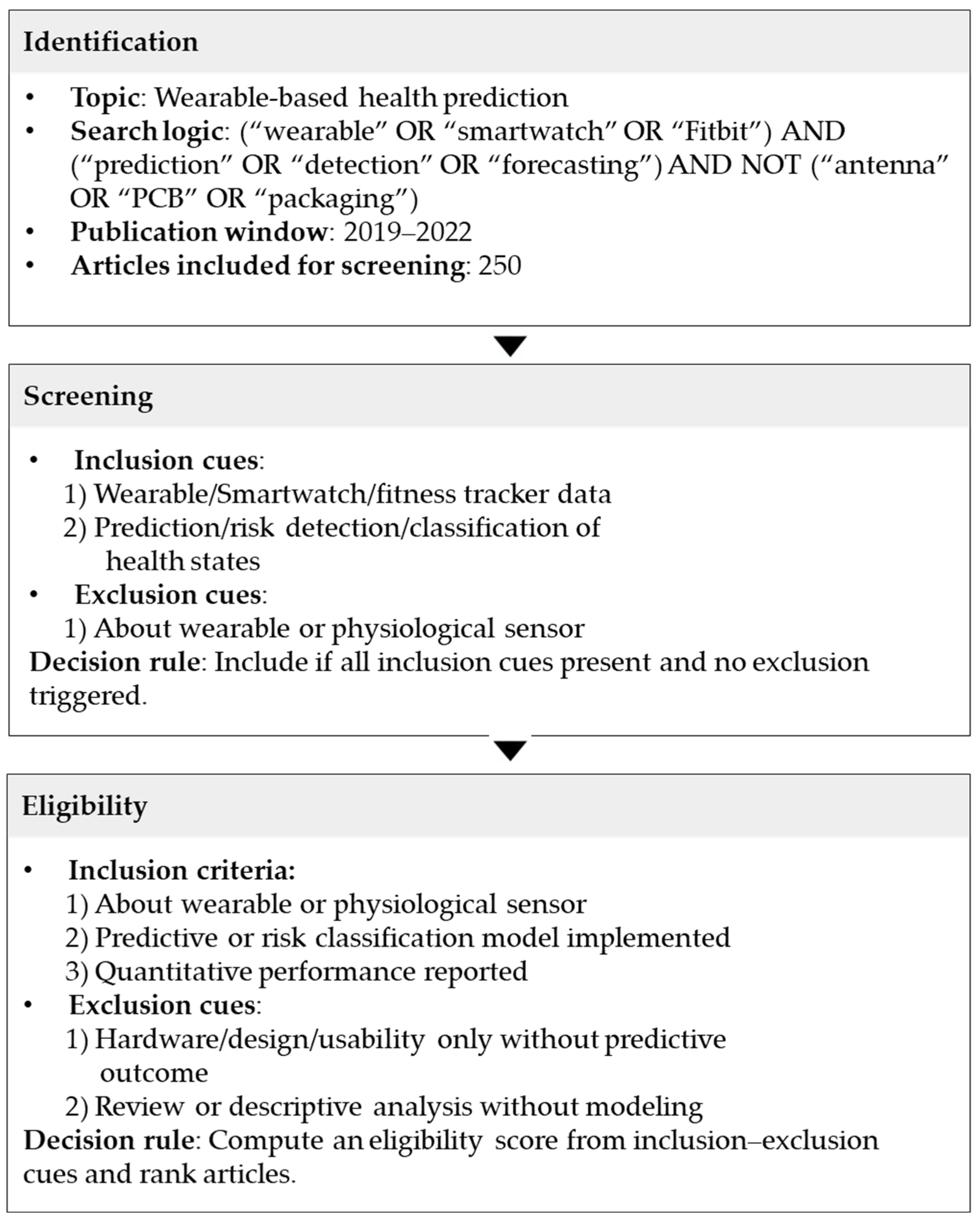
This study proposes a stage-aware governance framework for large language models (LLMs) that structures human oversight and accountability across different decision stages in AI-assisted literature review systems. Large language models (LLMs) are increasingly embedded in systematic review workflows, yet how human oversight and accountability should be structured across different decision stages remains unclear. This study evaluates three LLMs in a controlled two-stage literature review workflow—title-and-abstract screening and eligibility assessment—using identical evidence inputs and fixed inclusion criteria, with outputs benchmarked against expert consensus under fully reproducible conditions with standardized prompts and comprehensive logging. While LLMs closely matched expert decisions during screening (precision 0.83–0.91; F1 up to 0.89; Cohen’s κ 0.65–0.85), performance degraded substantially at the eligibility stage (F1 0.58–0.65; κ 0.52–0.62), indicating increased epistemic uncertainty when fine-grained criteria must be inferred from abstract-level information. Importantly, disagreements clustered in borderline cases rather than random error, supporting a stage-aware governance approach in which LLMs automate high-throughput screening while inter-model disagreement is operationalized as an actionable uncertainty signal that triggers human oversight in more consequential decision stages. These findings highlight the need for explicit oversight thresholds, responsibility allocation, and auditability in the responsible deployment of AI-assisted decision systems for evidence synthesis.
Keywords: large language models; AI governance; human oversight; literature screening; inter-model agreement large language models; AI governance; human oversight; literature screening; inter-model agreement