The Mechanism and Spatiotemporal Variations in Digital Economy in Enhancing Resilience of the Cotton Industry Chain

Abstract
1. Introduction
2. Theoretical Analysis and Research Hypotheses
2.1. The Impact of the Digital Economy on the Resilience of the Cotton Industrial Chain
2.1.1. Empowerment Mechanisms of the Digital Economy on the Resilience of the Cotton Industrial Chain
2.1.2. Nonlinear Constraints and Suppressive Effects in the Empowerment Process of the Digital Economy
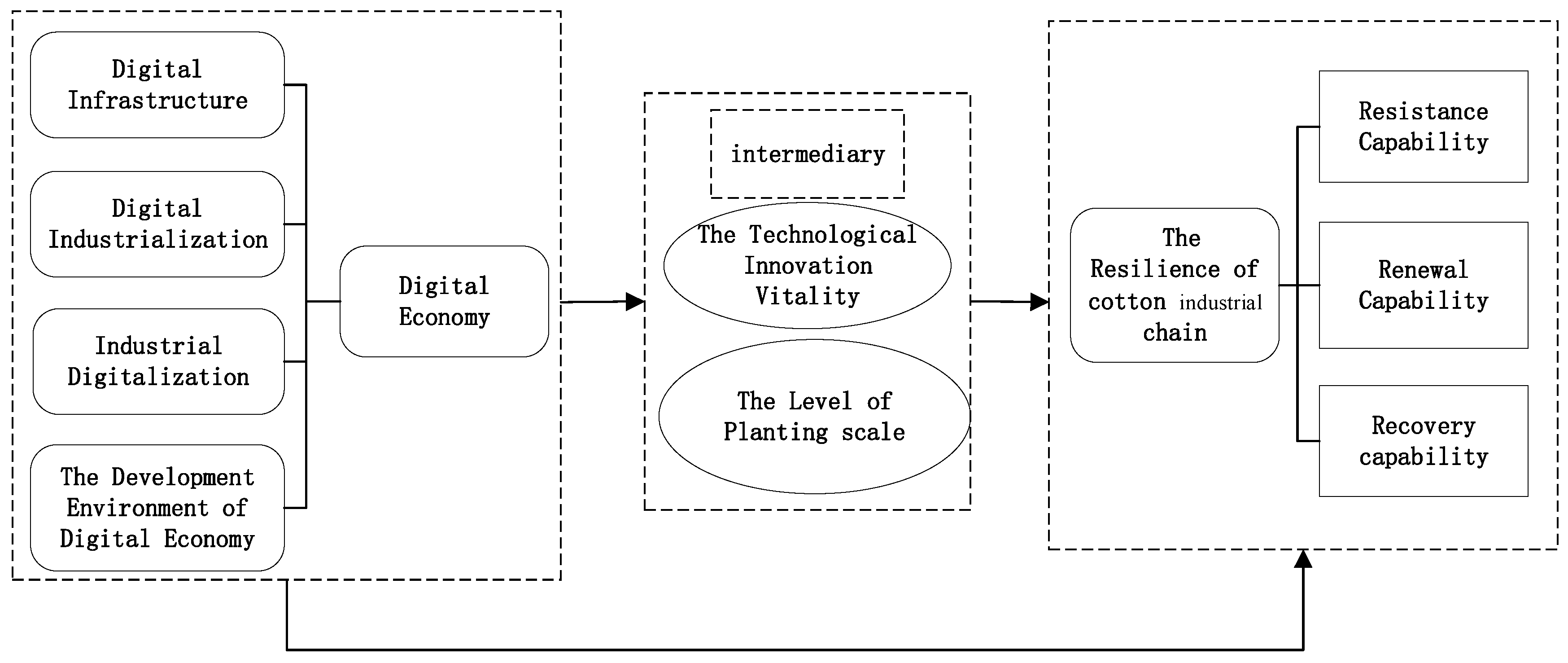
2.2. Mechanism Analysis of the Impact of the Digital Economy on Cotton Resilience
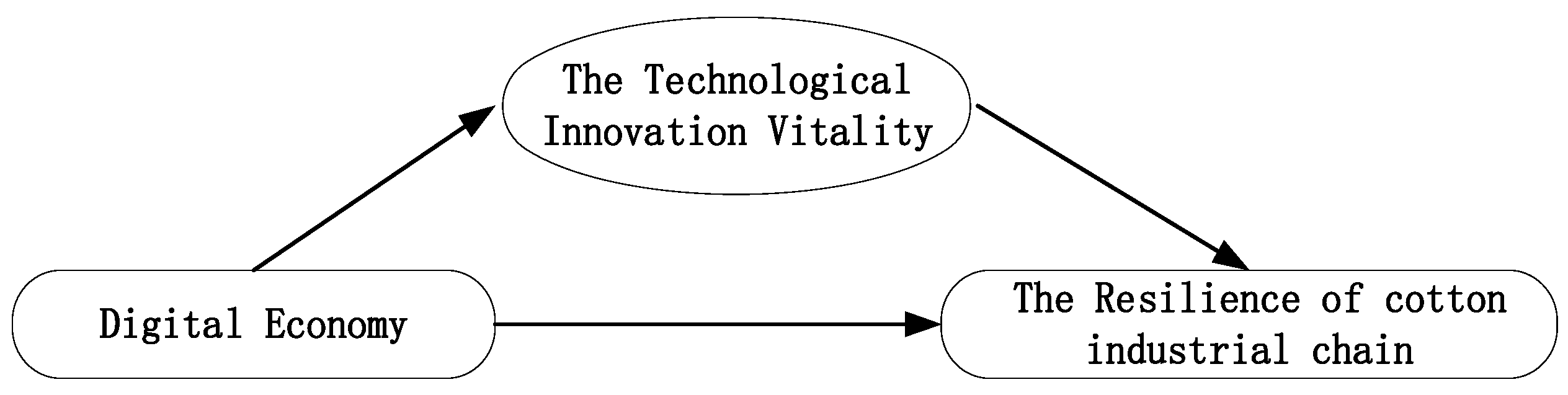
2.2.1. Technological Innovation Vitality
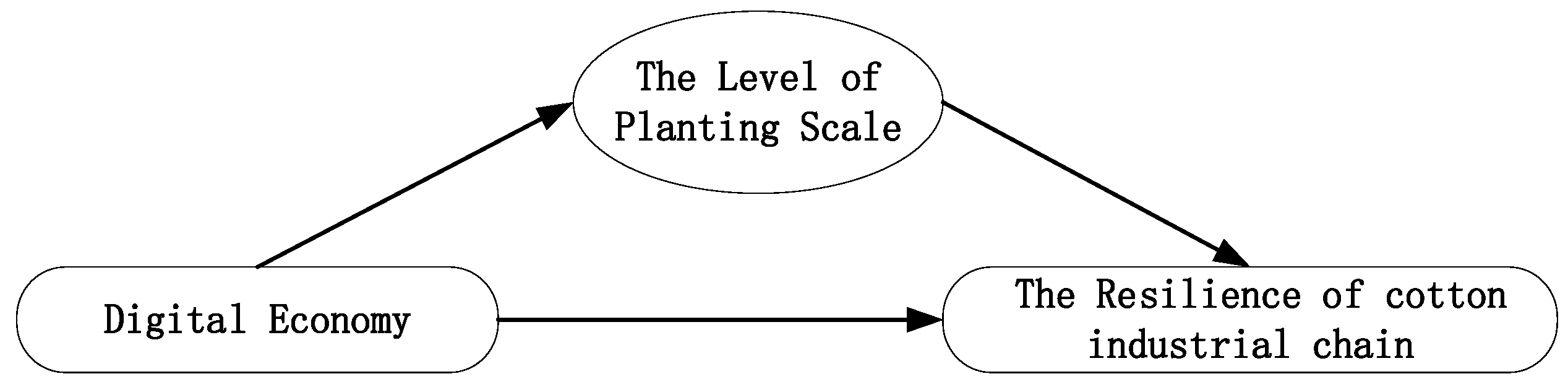
2.2.2. Level of Planting Scale
3. Results and Analysis
3.1. Measurement of the Digital Economy and the Resilience Level of the Cotton Industrial Chain
3.1.1. Data Sources and Data Processing
3.1.2. Variable Selection
- (1)
- Resistance capability
- (2)
- Renewal capability
- (3)
- Recovery capability
- (1)
- Digital infrastructure
- (2)
- Digital industrialization
- (3)
- Industrial digitalization
- (4)
- Digital economy development environment
3.1.3. Indicator Measurement
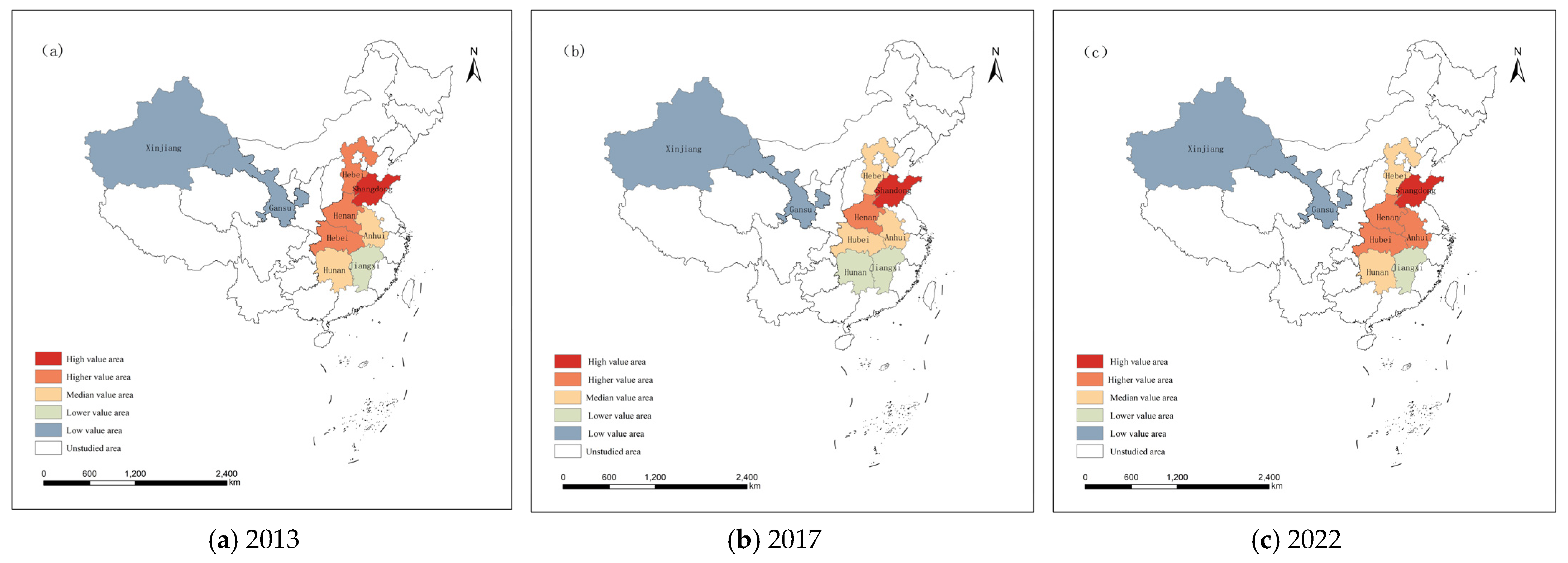
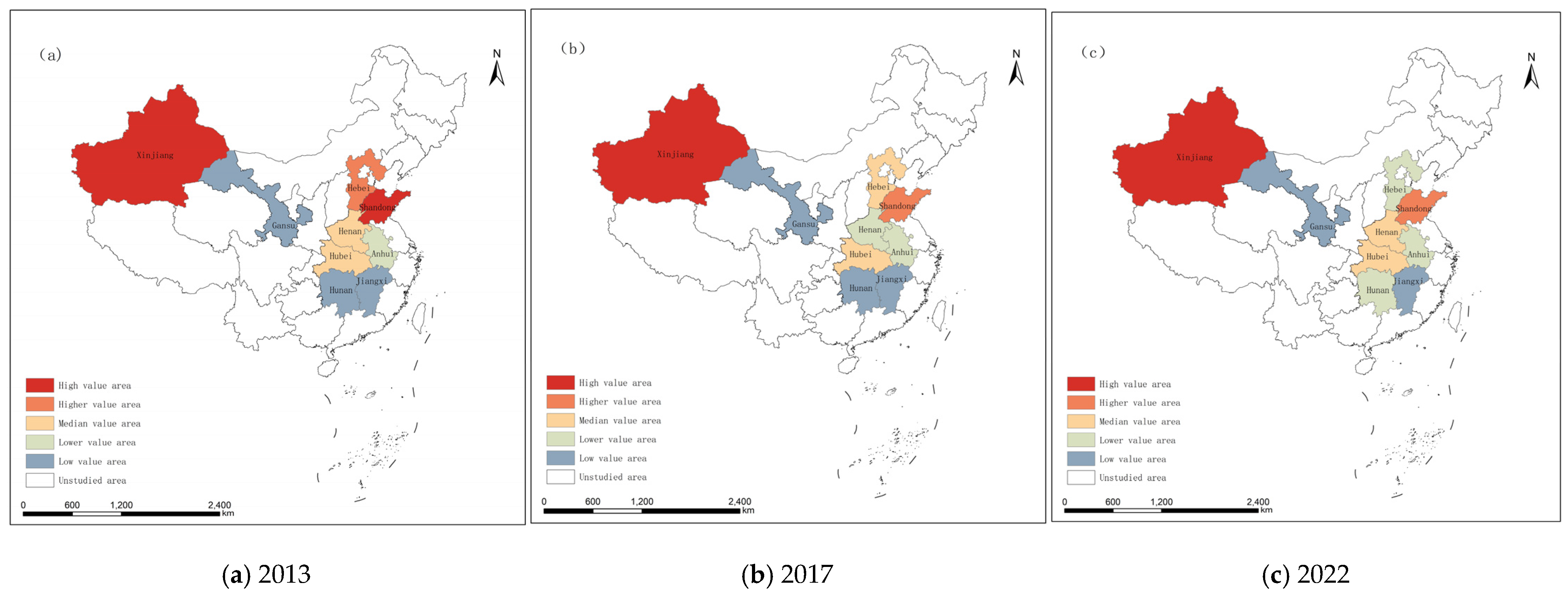
3.1.4. Analysis of the Measurement Results of Digital Economy Development Level
3.1.5. Analysis of the Measurement Results of Cotton Industrial Chain Resilience
3.2. Micro Cases
3.2.1. Case 1: Enhancing Industry Chain Resilience Through “Cotton Farmer Cooperatives + Digital Technology” in Aral City, Xinjiang
3.2.2. Case 2: Data-Driven Intelligent Transformation of the Entire Industry Chain by Shandong Weiqiao Entrepreneurship Group
3.3. Model Specification
3.3.1. Semi-Parametric Panel Data Model
3.3.2. Mediation Effect Model
3.4. Mechanisms and Spatiotemporal Differences in Digital Economy Driving the Resilience Improvement of the Cotton Industrial Chain
3.4.1. Multicollinearity Issues
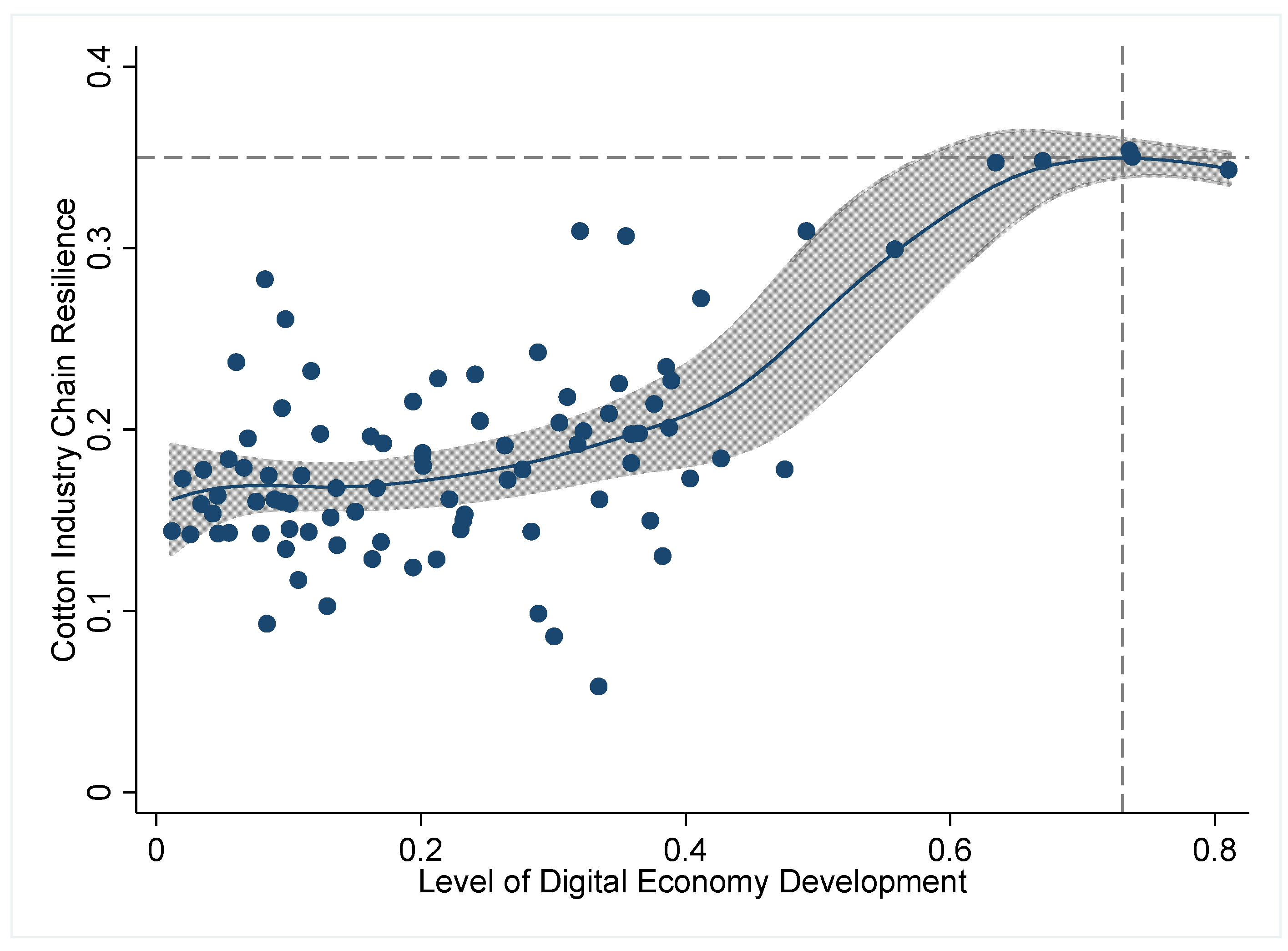
3.4.2. The Impact of the Digital Economy on the Resilience of the Cotton Industrial Chain
3.4.3. Robustness Testing
3.4.4. Endogeneity Testing
3.4.5. Exploration of Effect Pathways
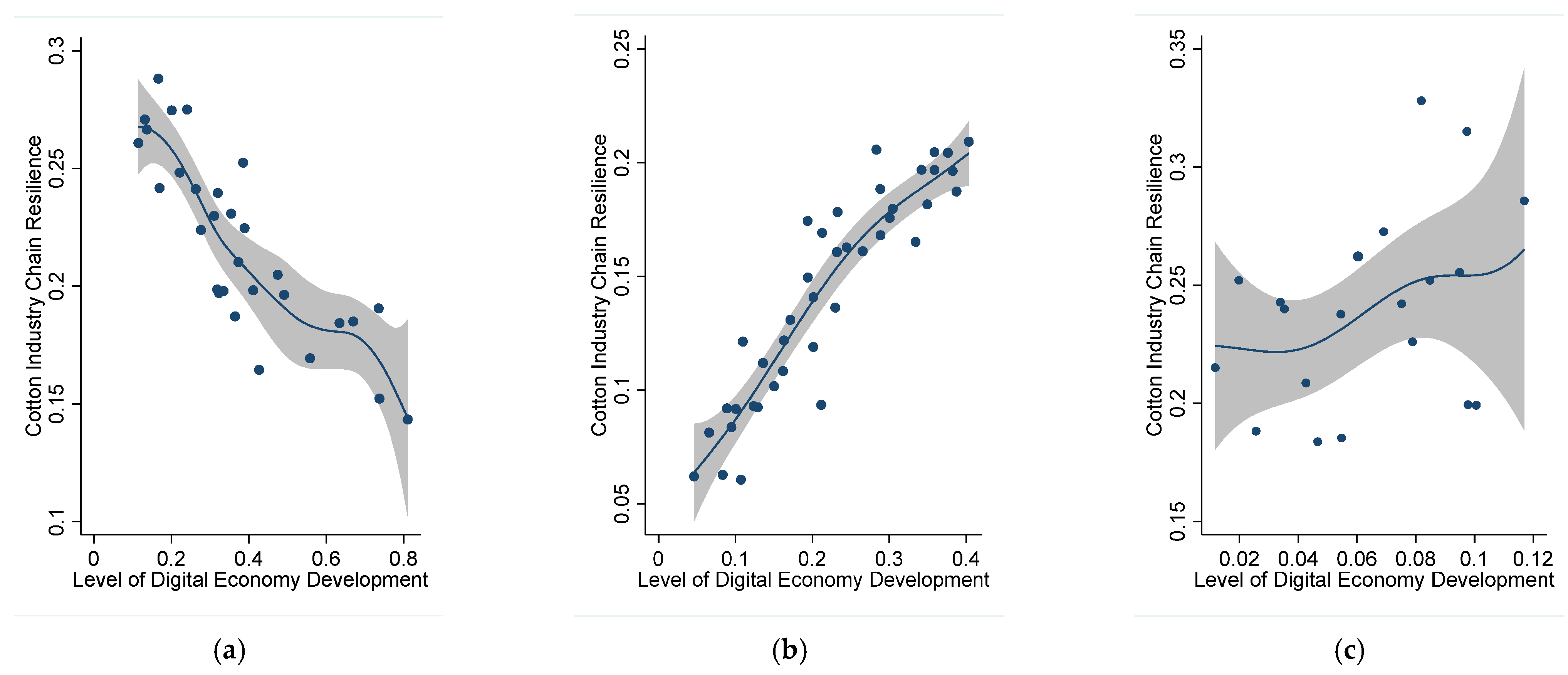
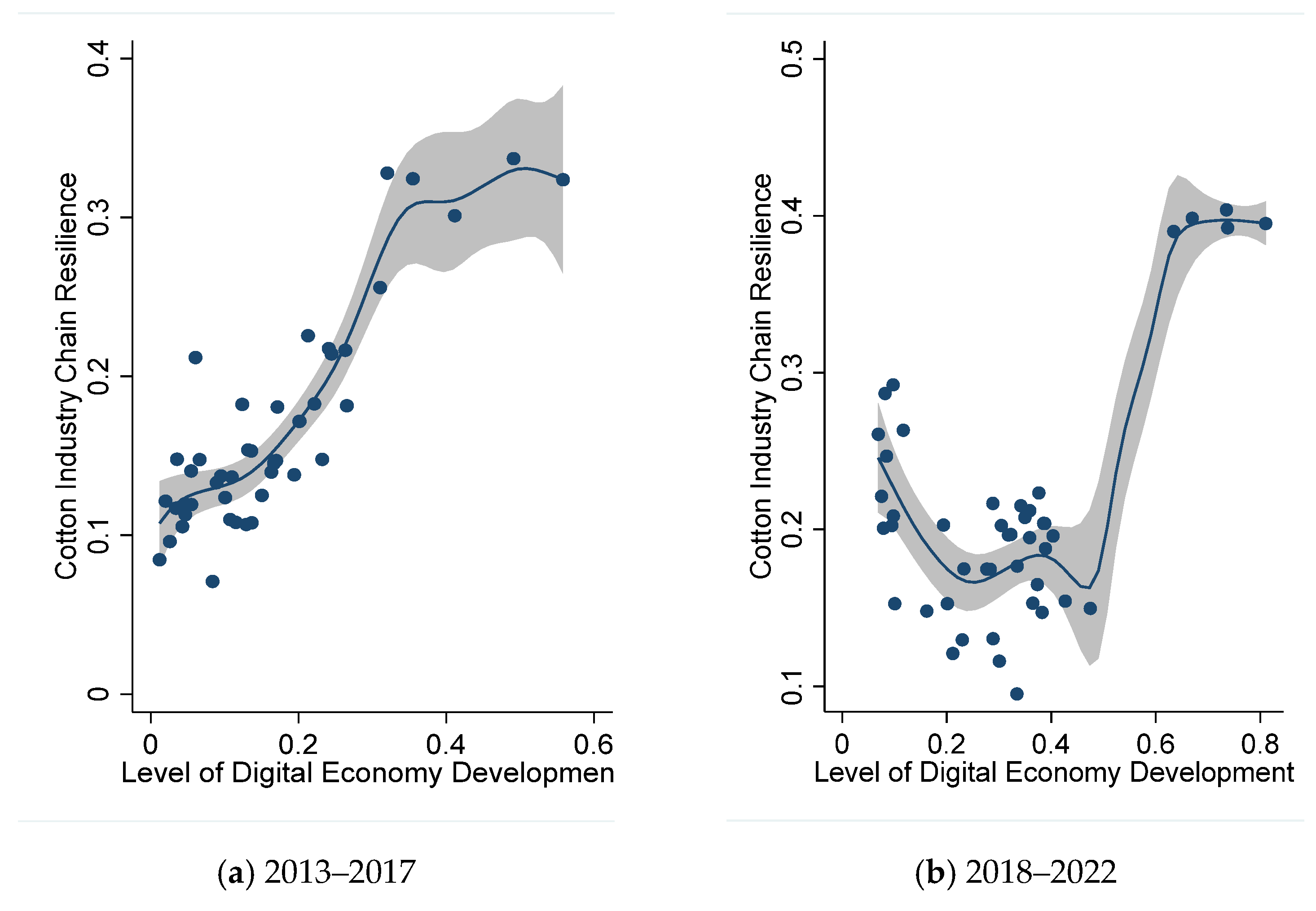
3.4.6. Heterogeneity Analysis
- Regional Heterogeneity
- Temporal Heterogeneity
4. Discussion
5. Conclusions
- (1)
- There exists a significant nonlinear relationship between the digital economy and the resilience of the cotton industry chain. As the level of digital economy development increases, its promoting effect on the resilience of the cotton industry chain does not remain at a fixed intensity but rather exhibits characteristics of phased changes.
- (2)
- The mediating effects demonstrate that the technological innovation vitality and planting scale significantly positively influence the digital economy at the 1% level, indicating that these factors are important mediating channels through which the digital economy affects the resilience of the cotton industrial chain.
- (3)
- There are spatial and temporal differences in the impact of the digital economy on the enhancement of the resilience of the cotton industrial chain. Spatially, the digital economy significantly positively influences the resilience of the cotton industrial chain in the Yangtze River Basin and Northwest Inland cotton regions but shows a negative impact on the resilience of the cotton industrial chain in the Yellow River Basin. Temporally, from 2013 to 2017, the rapid development of the digital economy concurrently propelled a continuous increase in the resilience of the cotton industrial chain; post 2017, the impact of the digital economy on enhancing the resilience of the cotton industrial chain exhibited a wave-like trend of decline followed by increase.
6. Implications
- (1)
- Build a regionally differentiated digital collaborative development mechanism.
- (2)
- Establish regionally precise collaborative innovation centers for the industry chain.
- (3)
- Implement differentiated incentive policies for large-scale planting and digital integration.
- (4)
- Carry out targeted digital literacy enhancement and talent cultivation projects.
Author Contributions
Funding
Data Availability Statement
Acknowledgments
Conflicts of Interest
References
- Huggins, R.; Thompson, P. Human Agency, Entrepreneurship and Regional Development: A Behavioural Perspective on Economic Evolution and Innovative Transformation. Entrep. Reg. Dev. 2020, 32, 573–589. [Google Scholar] [CrossRef] [Scilit]
- Long, M.; Xiong, X.; Lin, H. Spatiotemporal Analysis of Food Production–Demand Mismatch in China and Implications for Agricultural Structural Adjustment. Foods 2024, 13, 1990. [Google Scholar] [CrossRef] [Scilit] [PubMed]
- Liu, G. Understanding Cotton Cultivation Dynamics in Aksu Oases (NW China) by Reconstructing Change Trajectories Using Multi-Temporal Landsat and Sentinel-2 Data. Geocarto Int. 2022, 37, 4406–4424. [Google Scholar] [CrossRef] [Scilit]
- Setobayashi, M. Globalisation and the Development of Chinese Cotton Industry in Early 20th Century. Asia Pac. Econ. Hist. Rev. 2025, 65, 249–272. [Google Scholar] [CrossRef] [Scilit]
- Liu, S.; Zheng, X.; Liu, C. Rural Transactions and Industrial Transformation under the Background of Digital Economy. Chin. Rural. Econ. 2024, 40, 2–24. (In Chinese) [Google Scholar] [CrossRef]
- Jiang, Y.; Liu, H.; Wang, L. The Impacts of Digital Economy on the Industrial Chain Resilience: The Moderating Effect from Infrastructure Improvement and Factor Market Development. Sustain. Futures 2025, 10, 101242. [Google Scholar] [CrossRef] [Scilit]
- Jia, X.M. Digital economy, factor allocation, and sustainable agricultural development: The perspective of labor and capital misallocation. Sustainability 2023, 15, 4418. [Google Scholar] [CrossRef] [Scilit]
- Yin, F.; Lo, M.C.; Mohamad, A.A.; Sin, K.Y. The Impact of AI Applications, Information Sharing, and Supply Chain Resilience on Agricultural Supply Chain Performance. J. Data Inf. Manag. 2025, 7, 287–300. [Google Scholar] [CrossRef] [Scilit]
- Hellin, J.; Fisher, E. Building pathways out of poverty through climate smart agriculture and effective targeting. Dev. Pract. 2018, 28, 974–979. [Google Scholar] [CrossRef] [Scilit]
- Tulkinbekov, K.; Kim, D.-H. Doctrina: Blockchain 5.0 for Artificial Intelligence. Appl. Sci. 2025, 15, 5602. [Google Scholar] [CrossRef] [Scilit]
- Dong, Y.; Mun, S.K.; Wang, Y. A Blockchain-Enabled Sharing Platform for Personal Health Records. Heliyon 2023, 9, e18061. [Google Scholar] [CrossRef] [Scilit]
- Zhang, J.; Su, Y.; Liu, W.; Ayinaxi, J.; Xu, L.; Qin, S. Resilience assessment and influencing factor analysis of cotton industrial chain in China. Cotton Sci. 2024, 36, 408–419. (In Chinese) [Google Scholar]
- Chen, Y. Synergistic Development Strategy and Effectiveness Assessment of Agricultural Industry Chain Driven by Digital Economy. Appl. Math. Nonlinear Sci. 2024, 9, 20243229. [Google Scholar] [CrossRef] [Scilit]
- Wang, R.; Shi, J.; Hao, D.; Liu, W. Spatial–Temporal Characteristics and Driving Mechanisms of Rural Industrial Integration in China. Agriculture 2023, 13, 747. [Google Scholar] [CrossRef] [Scilit]
- Shang, Y. Research on Empowering High Quality Development of Xinjiang Cotton Textile Industry with New Quality Productivity. In Forum on Research and Innovation Management; Scineer Publishing: Singapore, 2024; Volume 2. [Google Scholar]
- Pal, P.; Landivar-Bowles, J.; Landivar-Scott, J.; Duffield, N.; Nowka, K.; Jung, J.; Chang, A.; Lee, K.; Zhao, L.; Bhandari, M. Unmanned Aerial System and Machine Learning Driven Digital-Twin Framework for in-Season Cotton Growth Forecasting. Comput. Electron. Agric. 2025, 228, 109589. [Google Scholar] [CrossRef] [Scilit]
- Bai, H.; Chen, Y.; Zhang, Z. Exploring the Mitigating Role of Sustainable Innovation in Supply Chain Disruption Risks under the Digital Economy. Int. Rev. Econ. Financ. 2025, 103, 104372. [Google Scholar] [CrossRef] [Scilit]
- Martín, A.; Capilla, R.M.; Anquela, A.B. Big Data Architecture and Data Mining Analysis for Market Segment Applications of Differential Global Navigation Satellite System (GNSS) Services: Case Study of the Analysis of the Demand for Navigation and Agriculture. J. Navig. 2022, 75, 421–436. [Google Scholar] [CrossRef] [Scilit]
- Fasano, F.; Bartoli, C.; Cappa, F.; Boccardelli, P. Exploring the Impact of AI on Web3 Decentralized Platform Business Model Innovation. J. Eng. Technol. Manag. 2025, 78, 101911. [Google Scholar] [CrossRef] [Scilit]
- Hu, L.; Chen, F.; Zhao, R. Does Digital Inclusive Finance Increase Industry Chain Resilience in China? Sustainability 2024, 16, 6028. [Google Scholar] [CrossRef] [Scilit]
- Zheng, J.; Guo, M.; Lo, K. Shaping Sustainability: Circular Economy Development through Digital Technology Innovation. J. Innov. Knowl. 2025, 10, 100784. [Google Scholar] [CrossRef] [Scilit]
- Jayalath, M.M.; Ratnayake, R.M.C.; Perera, H.N.; Thibbotuwawa, A. An Analytical Approach to Risk Assessment in Agri-Food Supply Chains Using Fuzzy Inference Systems. Supply Chain Anal. 2026, 13, 100179. [Google Scholar] [CrossRef] [Scilit]
- Sun, D.; Yu, B.; Ma, J. Research on the Impact of Digital Empowerment on China’s Human Capital Accumulation and Human Capital Gap between Urban and Rural Areas. Sustainability 2023, 15, 5458. [Google Scholar] [CrossRef] [Scilit]
- Liu, L.; Liu, K. Can digital technology promote sustainable agriculture? Empirical evidence from urban China. Cogent Food Agric. 2023, 9, 2282234. [Google Scholar] [CrossRef] [Scilit]
- Hu, Y.; Li, G.; Liu, M.; Qu, S. Information Sharing and Personalized Pricing in Online Platforms. Prod. Oper. Manag. 2025, 34, 3958–3977. [Google Scholar] [CrossRef] [Scilit]
- Bereznoy, A.; Meissner, D.; Scuotto, V. The Intertwining of Knowledge Sharing and Creation in the Digital Platform Based Ecosystem. A Conceptual Study on the Lens of the Open Innovation Approach. J. Knowl. Manag. 2021, 25, 2022–2042. [Google Scholar] [CrossRef] [Scilit]
- Xiao, W.; Fan, D. The “Simultaneous Development of Quantity and Quality”: Research on the Impact of the Digital Economy in Enabling Manufacturing Innovation. Systems 2024, 12, 470. [Google Scholar] [CrossRef] [Scilit]
- Guo, X.; Liu, X.; Lv, J.; Zhu, R. Impact of Digital Technology on Farmland Transfer and Food Security: An Empirical Study in Rural China. Front. Environ. Sci. 2025, 13, 1631305. [Google Scholar] [CrossRef] [Scilit]
- Zhao, C.; Zhao, D.; Chen, Y. Analysis of impact of target price policy on green total factor productivity of cotton: Based on the Malmquist-Tobit model of 12 major cotton-producing provinces’ panel data. J. Chin. Agric. Mech. 2023, 44, 258–264+280. (In Chinese) [Google Scholar] [CrossRef]
- Sun, K.; Wang, H.; Ye, S. How Does Digital Transformation Enhance Industrial Chain Resilience? Evidence from China. Financ. Res. Lett. 2025, 75, 106896. [Google Scholar] [CrossRef] [Scilit]
- Liu, Y. Coupling and Coordination Evaluation of Digital Economy and Green Development Efficiency in Eight Urban Agglomerations in China. Sci. Rep. 2025, 15, 26829. [Google Scholar] [CrossRef] [Scilit]
- Stoicea, P.; Chiurciu, I.-A.; Cofas, E. Territorial Disparities, Structural Imbalances and Economic Implications in the Potato Crop System in Romania. Agriculture 2025, 15, 2343. [Google Scholar] [CrossRef] [Scilit]
- Gao, R.; Li, W.; Zeng, Q. Synergistic Effects of New Energy and Low-Carbon Pilot Dual Policies on Pollution and Carbon Reduction: A Causal Analysis Based on Double Machine Learning. Energy Rep. 2025, 14, 2435–2450. [Google Scholar] [CrossRef] [Scilit]
- Suo, X.; Zhang, L.; Guo, R.; Lin, H.; Yu, M.; Du, X. The Inverted U-Shaped Association between Digital Economy and Corporate Total Factor Productivity: A Knowledge-Based Perspective. Technol. Forecast. Soc. Change 2024, 203, 123364. [Google Scholar] [CrossRef] [Scilit]
- Wang, S.; Teng, T.; Hu, S.; Pan, Y. Interplay of Digital Economy and Real Economy: How to Integrate and What Drives It? Appl. Spat. Anal. 2025, 18, 130. [Google Scholar] [CrossRef] [Scilit]
- Zhao, L.; Zhu, T.; Chen, J.; Zhao, L. Impact of Digital Economy on Upgrading of Industrial Structure: From the Financial Development Perspective. Financ. Res. Lett. 2025, 81, 107503. [Google Scholar] [CrossRef] [Scilit]
- Azhar, S.; Zhang, Z.; Lu, S. Empirical Analysis of the Solow Paradox in Artificial Intelligence. OJBM 2025, 13, 3716–3729. [Google Scholar] [CrossRef]
- Vo Thai, H.-C.; Thao, H.T.; Tran, M.-L. Propelling Sustainable Competitive Performance in the Digital Age: The Nexus of Dynamic Managerial Capabilities, Stakeholder Engagement, and Corporate Digital Responsibility. Manag. Res. Rev. 2025, 48, 1529–1559. [Google Scholar] [CrossRef] [Scilit]
- Zhang, H.; Wei, W. The Impact of Green Investment Policies on the Development of New Energy Enterprises: Analysis Based on Heterogeneity and Threshold Effects. Financ. Res. Lett. 2025, 83, 107703. [Google Scholar] [CrossRef] [Scilit]
- Meier, S. Path Departure or Path Dependency at a Critical Juncture? OECD between Resilience and Efficiency in the Health Policy Field. Glob. Soc. Policy 2025, 25, 512–534. [Google Scholar] [CrossRef] [Scilit]
- Hamada, T. Adaptation to Technological Innovation and Corporate Core-Rigidities. Int. J. Innov. Mgt. 2014, 18, 1450019. [Google Scholar] [CrossRef] [Scilit]
- He, X.; Yu, Y.; Jiang, S. City Centrality, Population Density and Energy Efficiency. Energy Econ. 2023, 117, 106436. [Google Scholar] [CrossRef] [Scilit]
- Jiang, T. Mediating Effects and Moderating Effects in Causal Inference. China Ind. Econ. 2022, 100–120. (In Chinese) [Google Scholar] [CrossRef]
- Ran, L.; Zhang, Q. Economic Dual Circulation Synergy and Industry Chain Resilience: Based on the GVC Perspective. Econ. Change Restruct. 2025, 58, 98. [Google Scholar] [CrossRef] [Scilit]
- Viera-Arroyo, W.; Binego, L.; Ryans, F.; López, D.; Moya, M.; Vera, L.; Caicedo, C. Systematic Review of Integrating Technology for Sustainable Agricultural Transitions: Ecuador, a Country with Agroecological Potential. Sustainability 2025, 17, 6053. [Google Scholar] [CrossRef] [Scilit]
- Mollel, M.; Quiroz, L.F.; Varley, C.; Firestine, A.; McLoughlin, M.-E.; Kafunah, J.; Kharkar, S.; O’Farrell, J.; Ndlovu, N.; Johnston, A.; et al. Digital Technologies to Accelerate the Impact of Climate Smart Agriculture by Next-Generation Farmers in Africa. Front. Sustain. Food Syst. 2025, 9, 1462328. [Google Scholar] [CrossRef] [Scilit]
- Tan, Y.; Wang, Y.; Duan, L.; Gu, Z. Analysis of Spatial-Temporal Evolution and Investment Model of Industrial Cross-Regional Investment Network-Taking the Pearl River Delta Urban Agglomeration as an Example. Heliyon 2024, 10, e37623. [Google Scholar] [CrossRef] [Scilit] [PubMed]
- Wang, W.; Huang, H.; Fu, X. Does Regional AI Development Improve Corporate Supply Chain Efficiency? Evidence from China. Int. Rev. Econ. Financ. 2025, 103, 104597. [Google Scholar] [CrossRef] [Scilit]
- Yu, R.; Yang, W.; Zhang, L. A Privacy Protection Method for Trustworthy Traceability of Rice Supply Chain Based on Blockchain and Multilayer Encryption. Concurr. Comput. 2025, 37, e70413. [Google Scholar] [CrossRef] [Scilit]
- Wang, R.; Song, Y. Research on the Evolution and Influencing Factors of China′s Cotton Production Layout from the Perspective of Industrial Chain. Resour. Dev. Mark. 2022, 38, 337–343+384. (In Chinese) [Google Scholar]
- Dittmer, K.M.; Burns, S.; Shelton, S.; Costa, C.; Wollenberg, E. Digital Tool Innovations for Smallholder Inclusion. Outlook Agric. 2025, 54, 212–221. [Google Scholar] [CrossRef] [Scilit]



| Dimension | Primary Indicators | Secondary Indicators | Unit | Definition | Attribute |
|---|---|---|---|---|---|
| Resistance capability | Foundational endowment | Sown area | 1000 hm2 | Cotton sowing area | + |
| Cotton production | 10,000 tons | The total amount of cotton obtained from planting cotton, including main products and by-products | + | ||
| Total power of agricultural machinery | 10,000 kWh | Diesel engine power, gasoline engine power, electric motor power, other mechanical power | + | ||
| Labor cost per mu | yuan | The labor cost of planting cotton | − | ||
| Fertilizer application rate per mu | kg | Amount of fertilizer used to plant cotton | − | ||
| Plastic film usage per mu | kg | Amount of agricultural film used to grow cotton | − | ||
| Cost of pesticide per mu | yuan | Cost of pesticides used in cotton cultivation | − | ||
| Cost of materials and services per mu | yuan | The cost of planting cotton, including both direct and indirect costs | − | ||
| Number of workers per mu | day | Amount of labor required in cotton cultivation | − | ||
| Buffer capacity | Yarn production | 100 million meters | Yarn includes cotton yarn, cotton blended yarn, purified fiber yarn; but does not include cotton thread, substitute fiber yarn, and hand spun yarn | + | |
| Fabric production | 100 million meters | Cloth includes cotton fabric, cotton blend fabric, purified fiber fabric; but does not include substitute fiber fabric or hand-woven fabric | + | ||
| Output value of the main products sold per mu | yuan | Revenue generated from the sale of cotton as main products per acre of land | + | ||
| Cotton yield per acre of main product | kg | Yield of cotton main product per acre of land | + | ||
| Renewal capability | Resource allocation | Per capita cotton possession | kg/people | The average amount of cotton per person after total production is distributed equally among everyone | + |
| Number of employees in the cotton industry chain | people | The sum of employees of listed companies in the cotton industry chain | + | ||
| R&D investment | Cotton industry chain listed companies R&D expenses | 10,000 yuan | The sum of research and development expenses of listed companies in the cotton industry chain | + | |
| Number of patents of listed companies in the cotton industry chain | pcs | The sum of patent applications for listed companies in the cotton industry chain | + | ||
| Recovery capability | Industrial Chain Integration Capability | Integration of the cotton industry with the secondary industry | 100 million yuan/1000 hm2 | The ratio of the output value of the textile and apparel industry to the cotton cultivation area. | + |
| Integration of the cotton industry with the tertiary industry | 100 million yuan/1000 hm2 | The ratio of service sector revenue to cotton cultivation area. | + | ||
| Government support | Government subsidies | 10,000 yuan | The sum of government subsidies for listed companies in the cotton industry chain | + |
| Dimension | Primary Indicators | Secondary Indicators | Unit | Definition | Attribute |
|---|---|---|---|---|---|
| Digital Infrastructure | Digital platform construction | Number of domain names | ten thousand | The total number of internet domain names that are officially registered and active under the ccTLD system at a specific point in time. | + |
| Number of websites | ten thousand | The total number of publicly accessible websites on the internet with independent content and unique domain names. | + | ||
| Optical fiber cable line length | 10,000 km | The total physical length of fiber optic communication cables that have been laid and are in service. | + | ||
| Mobile telephone switch capacity | ten thousand | The maximum number of simultaneous user calls or data sessions that the core switching equipment in a mobile communication network can handle per unit of time. | + | ||
| Digital Communication Services | Mobile phone penetration rate | % | The number of mobile telephone subscribers per hundred people in a given geographical area. | + | |
| Number of mobile phone base stations | ten thousand | Total number of mobile communication base station equipment deployed within a specific geographic area. | + | ||
| Number of internet broadband access ports | ten thousand | Total number of physical or logical ports available for users to access broadband Internet services. | + | ||
| Digital Industrialization | Telecommunications industry | Total volume of telecommunications services | 100 million yuan | The aggregate value generated by all telecommunications services (including fixed, mobile, data, etc.) | + |
| Total volume of postal services | 100 million yuan | The aggregate value output of various delivery, financial, and other services provided by postal enterprises. | + | ||
| Number of websites owned by companies | pcs | Number of official websites maintained by or representing the enterprise. | + | ||
| Software and Information Technology Services Industry | Software Business Revenue | 100 million yuan | The total revenue generated by software and information technology services enterprises through the sale of software products, the provision of information technology services, and the operation of embedded system software. | + | |
| Information Technology Services Revenue | 100 million yuan | Revenue earned by information technology service enterprises through the provision of various information technology services, including cloud services and big data services. | + | ||
| Industrial Digitalization | Digital Finance | Internet Property Insurance Premium Income | million yuan | The total premium income directly generated by property insurance business sold and underwritten by insurance companies through online channels within a specified period. | + |
| Internet life insurance premium income | million yuan | Total premiums earned by insurance companies through online channels for the sale of life insurance | + | ||
| Number of financial information service enterprises | pcs | Total number of legal entities engaged in the collection, processing, and dissemination of financial information and related services | + | ||
| E-commerce | The proportion of enterprises engaged in e-commerce transactions | % | The percentage of enterprises in the region that conduct transactions for goods or services via electronic networks such as the internet, relative to the total number of enterprises in the region. | + | |
| E-commerce sales revenue | 100 million yuan | The total revenue generated by a business through the sale of goods and services via the internet or other online transaction methods. | + | ||
| E-commerce purchase amount | 100 million yuan | The total amount paid by an enterprise for goods and services procured through the internet or other online transaction methods. | + | ||
| Digital Economy Development Environment | Digital talent | Information transmission, software, and information technology service industry urban unit employment personnel | 10,000 people | The number of all employees engaged in information transmission, software, and information technology services within urban units and receiving remuneration from their employers at the end of the period. | + |
| Innovative environment | Fiscal expenditure on science and technology | 100 million yuan | The total amount of funds allocated by government departments at all levels through fiscal budgets for scientific and technological activities. | + |
| Variable | Variable Name | N | Mean | SD | Min | Max |
|---|---|---|---|---|---|---|
| Dependent Variable | Cotton Industry Chain Resilience | 90 | 0.190 | 0.104 | 0.067 | 0.468 |
| Independent Variable | Level of Digital Economy Development | 90 | 0.270 | 0.176 | 0.0339 | 0.810 |
| Mediating Variables | Technological innovation vitality | 90 | 10.649 | 1.012 | 8.463 | 12.743 |
| Planting scale level | 90 | 0.121 | 0.288 | 0.001 | 0.993 | |
| Control Variables | Level of economic development | 90 | 10.795 | 0.299 | 10.071 | 11.412 |
| Urbanization level | 90 | 0.548 | 0.056 | 0.400 | 0.650 | |
| Urban–rural income disparity | 90 | 2.511 | 0.343 | 2.060 | 3.560 | |
| Government support strength | 90 | 0.196 | 0.020 | 0.164 | 0.242 | |
| Level of openness to the outside world | 90 | 0.130 | 0.079 | 0.001 | 0.373 |
| Cotton-Growing Area | Region | 2013 | 2014 | 2015 | 2016 | 2017 | 2018 | 2019 | 2020 | 2021 | 2022 | Average |
|---|---|---|---|---|---|---|---|---|---|---|---|---|
| the Yellow River Basin | Hubei | 0.110 | 0.150 | 0.201 | 0.232 | 0.265 | 0.305 | 0.376 | 0.383 | 0.359 | 0.403 | 0.278 |
| Anhui | 0.089 | 0.124 | 0.171 | 0.213 | 0.245 | 0.288 | 0.350 | 0.388 | 0.342 | 0.359 | 0.257 | |
| Hunan | 0.084 | 0.107 | 0.129 | 0.163 | 0.194 | 0.233 | 0.289 | 0.334 | 0.283 | 0.301 | 0.212 | |
| Jiangxi | 0.046 | 0.066 | 0.095 | 0.101 | 0.136 | 0.162 | 0.201 | 0.230 | 0.194 | 0.212 | 0.144 | |
| the Yangtze River Basin | Shandong | 0.320 | 0.355 | 0.412 | 0.491 | 0.558 | 0.634 | 0.670 | 0.735 | 0.738 | 0.810 | 0.572 |
| Henan | 0.132 | 0.170 | 0.221 | 0.263 | 0.311 | 0.365 | 0.427 | 0.475 | 0.389 | 0.385 | 0.314 | |
| Hebei | 0.115 | 0.137 | 0.167 | 0.201 | 0.241 | 0.277 | 0.335 | 0.373 | 0.318 | 0.323 | 0.249 | |
| Northwest Inland | Xinjiang | 0.026 | 0.035 | 0.047 | 0.055 | 0.060 | 0.082 | 0.097 | 0.117 | 0.095 | 0.101 | 0.071 |
| Gansu | 0.012 | 0.020 | 0.034 | 0.043 | 0.055 | 0.069 | 0.085 | 0.098 | 0.075 | 0.079 | 0.057 |
| Cotton-Growing Area | Region | 2013 | 2014 | 2015 | 2016 | 2017 | 2018 | 2019 | 2020 | 2021 | 2022 | Average |
|---|---|---|---|---|---|---|---|---|---|---|---|---|
| the Yellow River Basin | Hubei | 0.160 | 0.163 | 0.169 | 0.166 | 0.170 | 0.189 | 0.218 | 0.211 | 0.252 | 0.253 | 0.195 |
| Anhui | 0.117 | 0.126 | 0.137 | 0.152 | 0.160 | 0.183 | 0.184 | 0.172 | 0.204 | 0.203 | 0.164 | |
| Hunan | 0.070 | 0.071 | 0.085 | 0.086 | 0.103 | 0.111 | 0.124 | 0.130 | 0.187 | 0.185 | 0.115 | |
| Jiangxi | 0.084 | 0.078 | 0.078 | 0.083 | 0.082 | 0.091 | 0.098 | 0.116 | 0.175 | 0.096 | 0.098 | |
| the Yangtze River Basin | Shandong | 0.272 | 0.279 | 0.270 | 0.271 | 0.272 | 0.290 | 0.303 | 0.310 | 0.329 | 0.336 | 0.293 |
| Henan | 0.153 | 0.158 | 0.156 | 0.155 | 0.164 | 0.171 | 0.171 | 0.206 | 0.262 | 0.269 | 0.187 | |
| Hebei | 0.173 | 0.175 | 0.176 | 0.169 | 0.182 | 0.148 | 0.147 | 0.181 | 0.197 | 0.206 | 0.175 | |
| Northwest Inland | Xinjiang | 0.343 | 0.359 | 0.336 | 0.347 | 0.416 | 0.450 | 0.441 | 0.451 | 0.453 | 0.468 | 0.406 |
| Gansu | 0.074 | 0.072 | 0.068 | 0.073 | 0.072 | 0.071 | 0.067 | 0.075 | 0.079 | 0.077 | 0.073 |
| Variable | VIF | 1/VIF |
|---|---|---|
| Level of Digital Economy Development | 3.88 | 0.257906 |
| Level of economic development | 7.66 | 0.130498 |
| Urbanization level | 6.77 | 0.147634 |
| Urban–rural income disparity | 2.23 | 0.447768 |
| Government support strength | 3.29 | 0.303810 |
| Level of openness to the outside world | 2.90 | 0.344531 |
| Variable | Coefficient |
|---|---|
| Level of economic development | 0.254 *** (6.46) |
| Urbanization level | −0.203 (−1.01) |
| Urban–rural income disparity | 0.070 * (2.50) |
| Government support strength | 0.049 (1.39) |
| Level of openness to the outside world | 1.147 *** (8.32) |
| N | 90 |
| R2 | 0.7924 |
| Provinces fixed | Yes |
| Years fixed | Yes |
| Variable | Tobit Model | Lagged Core Explanatory Variable |
|---|---|---|
| Level of Digital Economy Development | 0.341 *** (6.39) | 0.375 *** (5.88) |
| Constant term | 1.733 *** (3.21) | 1.954 *** (3.18) |
| N | 90 | 90 |
| Control variables | Controlled. | Controlled. |
| Provinces fixed | Yes | Yes |
| Years fixed | Yes | Yes |
| Variable | (1) | (2) | (3) | (4) |
|---|---|---|---|---|
| First Stage | Second Stage | First Stage | Second Stage | |
| Level of Digital Economy Development | 0.233 *** (0.0802) | 0.208 *** (0.0423) | ||
| IV1 | 0.126 *** (0.0181) | |||
| IV2 | −0.106 *** (0.0114) | |||
| Control variables | Controlled | Controlled | Controlled | Controlled |
| Provinces fixed | Yes | Yes | Yes | Yes |
| Years fixed | Yes | Yes | Yes | Yes |
| K-P rk LM | 19.742 [0.000] | 26.112 [0.000] | ||
| C-D Wald F | 99.272 {16.38} | 52.708 {16.38} | ||
| N | 90 | 90 | 90 | 90 |
| R2 | 0.530 | 0.375 | ||
| (1) | (2) | (3) | |
|---|---|---|---|
| Cotton Industry Chain Resilience | Technological Innovation Vitality | Planting Scale Level | |
| Level of Digonomy Development | 0.169 *** | 4.995 *** | 2.938 *** |
| (3.41) | (5.92) | (6.627) | |
| _cons | 0.184 *** | 9.454 *** | 4.855 *** |
| (15.51) | (46.78) | (45.770) | |
| Control variables | Controlled | Controlled | Controlled |
| Sobel test | 0.049, p = 0.000 | 0.102, p = 0.000 | |
| Bootstrap test | [0.0141, 0.085] | [0.0516, 0.1532] | |
| Provinces fixed | Yes | Yes | Yes |
| Years fixed | Yes | Yes | Yes |
| N | 90 | 90 | 90 |
| r2 | 0.280 | 0.667 | 0.126 |
| Variable | Regional Heterogeneity | Time Heterogeneity | |||
|---|---|---|---|---|---|
| Yellow River Basin | Yangtze River Basin | Northwest Inland | 2013–2017 | 2018–2022 | |
| Level of economic development | 0.613 *** (4.32) | 0.323 *** (4.03) | 0.190 (0.34) | 0.154 ** (2.97) | 0.276 *** (6.71) |
| Urbanization level | −0.300 (−1.68) | −1.588 ***(−4.01) | 1.225 (0.51) | 0.310 (1.74) | −1.033 *** (−3.72) |
| Urban–rural income disparity | 0.264 ** (3.19) | −0.179 ** (−3.10) | 0.175 (0.57) | 0.086 *** (4.41) | −0.071 (−1.20) |
| Government support strength | −0.061 (−0.71) | −0.108 ** (−3.19) | −0.044 (−0.34) | −0.011 (−0.33) | −0.051 (0.70) |
| Level of openness to the outside world | −2.488 * (−2.20) | −1.378 ***(−3.78) | −6.129 *** (−4.14) | −4.976 *** (−13.53) | −4.491 *** (−6.08) |
| Provinces fixed | Yes | Yes | Yes | Yes | Yes |
| Years fixed | Yes | Yes | Yes | Yes | Yes |
Disclaimer/Publisher’s Note: The statements, opinions and data contained in all publications are solely those of the individual author(s) and contributor(s) and not of MDPI and/or the editor(s). MDPI and/or the editor(s) disclaim responsibility for any injury to people or property resulting from any ideas, methods, instructions or products referred to in the content. |
© 2026 by the authors. Licensee MDPI, Basel, Switzerland. This article is an open access article distributed under the terms and conditions of the Creative Commons Attribution (CC BY) license.
Share and Cite
Pareti, M.; Qin, S.; Su, Y.; Zhang, J.; Zhang, J. The Mechanism and Spatiotemporal Variations in Digital Economy in Enhancing Resilience of the Cotton Industry Chain. Systems 2026, 14, 152. https://doi.org/10.3390/systems14020152
Pareti M, Qin S, Su Y, Zhang J, Zhang J. The Mechanism and Spatiotemporal Variations in Digital Economy in Enhancing Resilience of the Cotton Industry Chain. Systems. 2026; 14(2):152. https://doi.org/10.3390/systems14020152
Chicago/Turabian StylePareti, Muhabaiti, Sixue Qin, Yang Su, Jiao Zhang, and Jiangtao Zhang. 2026. "The Mechanism and Spatiotemporal Variations in Digital Economy in Enhancing Resilience of the Cotton Industry Chain" Systems 14, no. 2: 152. https://doi.org/10.3390/systems14020152
APA StylePareti, M., Qin, S., Su, Y., Zhang, J., & Zhang, J. (2026). The Mechanism and Spatiotemporal Variations in Digital Economy in Enhancing Resilience of the Cotton Industry Chain. Systems, 14(2), 152. https://doi.org/10.3390/systems14020152