Article

A Digital Engineering Framework for Piston Pin Bearings via Multi-Physics Thermo-Elasto-Hydrodynamic Modeling

Department of Mechanical Engineering, Massachusetts Institute of Technology, Cambridge, MA 02139, USA
*
Author to whom correspondence should be addressed.
Systems 2026, 14(1), 77; https://doi.org/10.3390/systems14010077
Submission received: 15 December 2025 / Revised: 6 January 2026 / Accepted: 9 January 2026 / Published: 11 January 2026
(This article belongs to the Special Issue Digital Engineering: Transformational Tools and Strategies)

Abstract

The piston pin operates under severe mechanical and thermal conditions, making accurate lubrication prediction essential for engine durability. This study presents a comprehensive digital engineering framework for piston pin bearings, built upon a fully coupled thermo-elasto-hydrodynamic (TEHD) formulation. The framework integrates: (1) a Reynolds-equation hydrodynamic solver with temperature-/pressure-dependent viscosity and cavitation; (2) elastic deformation obtained from FEA (finite element analysis)-based compliance matrices; (3) a break-in module that iteratively adjusts surface profiles before steady-state simulation; (4) a three-body heat transfer model resolving heat conduction, convection, and solid–liquid interfacial heat exchange. Applied to a heavy-duty diesel engine, the framework reproduces experimentally observed behaviors, including bottom-edge rounding at the small end and the slow unidirectional drift of the floating pin. By integrating multi-physics modeling with design-level flexibility, this work aims to provide a robust digital twin for the piston-pin system, enabling virtual diagnostics, early-stage failure prediction, and data-driven design optimization for engine development.

1. Introduction

The reciprocating internal combustion (IC) engine, invented over a century ago, remains a critical power source for transportation and industrial applications [1]. Modern engines, however, face increasing pressure to improve efficiency, durability, and emission control [2,3]. Within this highly integrated mechanical system, the piston assembly, composed of the piston, rings, and piston pin, contributes 40∼55% of the total mechanical friction [4]. Among these components, the piston pin–small end interface is of particular importance. The piston pin transmits high transient loads between the piston and connecting rod, while the small end undergoes high-speed reciprocating motion and sliding, forming one of the most critical friction pairs within the assembly. Its lubrication performance is influenced by a complex interplay of factors, including clearance, surface roughness, oil supply, and deformation [5,6]. Under severe operating conditions, particularly high loads with insufficient oil supply, lubrication becomes inadequate. This causes local oil film rupture and surface scuffing, which significantly increases the risk of seizure [7]. These issues typically emerge during the early stages of engine development [8] and, as a result, it is necessary to develop high-fidelity numerical models capable of supporting design evaluation, risk assessment, and early corrective actions. While extensive experimental studies [9,10,11,12] have characterized piston-pin clearances, frictional behavior, stress response, noise, vibration and harshness (NVH), and failure modes, simulation-based investigations have also become increasingly sophisticated in recent years. However, a comprehensive framework detailing the multi-domain coupling, numerical workflow, and boundary condition handling remains limited.
Research on journal bearing lubrication has a long history, pioneered by early thermo-hydrodynamic (THD) analyses that coupled the Reynolds equation with heat conduction to account for thermal effects in the oil film [13,14,15]. Subsequent developments incorporated elastic deformation and finite-element-based structural compliance to capture elasto-hydrodynamic interactions [16,17]. With the recognition that cavitation influences load capacity and film stability, mass-conserving cavitation models, which are derived from the Elrod algorithm [18], were later introduced to ensure physically consistent phase transitions and lubricant transport [19,20,21]. Knight et al. [22] developed a thermal model for cavitated journal-bearing regions by approximating the oil film temperature profile as a second-order polynomial. Comprehensive reviews by Khonsari [23,24] summarize these contributions and highlight how modern THD and (elasto-hydrodynamic) EHD formulations have evolved into multi-physics frameworks capable of capturing thermal, structural, and fluid interactions. However, most existing models were developed for conventional journal bearings. Extending these approaches to piston-pin bearings requires a robust coupling strategy to handle transient multi-domain interactions and rapidly evolving film geometries.
Earlier models generally relied on simplified strategies for multi-physics coupling, particularly in how they handled elasto-hydrodynamic interactions or treated boundary contact and heat. Ligier and Ragot [8] developed a simple hydrodynamic lubricaion model with a refined contact model to identify critical scuffing at early-stage engine development. Fridman et al. [25] combined spectral EHD with the nonlinear Greenwood–Trip formulation to capture simultaneous hydrodynamic and boundary contact behaviors under heavy-duty conditions as well as friction-induced heat generation under extreme operating loads. Wang et al. [26] integrated pressure- and thermal-viscosity effects within a coupled EHD solver despite using an overall isothermal framework, and Knoll et al. [27] embedded an EHD module into an engine simulation platform, supported by in situ validation. Mixed-EHD floating-pin behavior was later investigated by Shi [28] using a mass-conserving cavitation formulation.
As computational resources have improved, research focus has shifted toward elastic deformation and structural dynamics. Ba et al. [5] introduced a multi-body dynamic lubrication framework using the Craig–Bampton component mode synthesis method. This approach allowed for the efficient inclusion of pin and bore elastic compliance while evaluating the influence of pin stiffness, bore profiles, and thermal deformation. A pivotal study under the FVV project [29] developed one of the first mixed-lubrication EHD models capable of simultaneously resolving piston/pin and pin/rod contacts. Building on the framework established by Meng et al. [30,31]—which employed the mass-conserving cavitation scheme of Biboulet and Lubrecht [32]—Shu et al. [33,34] extended the model to incorporate elastic deformation and thermal deformation, and real pin-bore profiles. This enhanced model was subsequently applied to a large-bore gas engine and validated against measured pin rotational kinematics. More recently, Gao et al. [35] proposed a fully coupled multi-physics model for the pin–bore oscillating pair that integrates lubrication, dynamics, and heat transfer, treating all components as full 3D bodies.
Recent research by Yin et al. [36,37] has substantially advanced the understanding of small-end bearings by integrating rigorous tribo-dynamic modeling with experimental thermal characterization. In their first work [36], the authors established a comprehensive framework that couples structural deformation with thermal effects. A subsequent study [37] introduced an in-situ wireless temperature-measurement system, enabling direct acquisition of transient small-end bearing temperatures under real engine operating conditions. By incorporating these experimental data into their numerical model, they provided critical insights into how thermal boundary conditions, temperature-dependent oil properties, frictional heating, and transient deformation collectively govern lubrication performance and contact severity.
In this work, we build upon the effective and physically consistent assumptions from prior models [30,31,33,34] and integrate them into a robust TEHD piston-pin lubrication framework that remains computationally efficient. In addition, this study extends the framework to address several practical issues that have not been adequately treated in previous research. First, this work provides a complete and reproducible workflow for generating FEA-based compliance matrices and for implementing the elasto-hydrodynamic coupling within the solver. Second, an Archard-type wear model and plastic deformation are incorporated to simulate the break-in process. Comparison with experiments conducted on the same engine model demonstrates that the predicted early-stage profile evolution aligns well with test observations. Third, most existing studies impose fully flooded film boundary conditions. In contrast, our model allows users to specify fully customized, element-wise, and crank-angle-dependent boundary conditions, enabling the investigation of various oil supply scenarios, which prove to be very important to lubrication and temperature fields. Fourth, by modeling the coupled temperature fields of both the lubricant and the three solid components, this work reveals how thermal behavior varies under different supply scenarios and explains the experimentally observed scuffing and seizure locations based on localized heat accumulation.
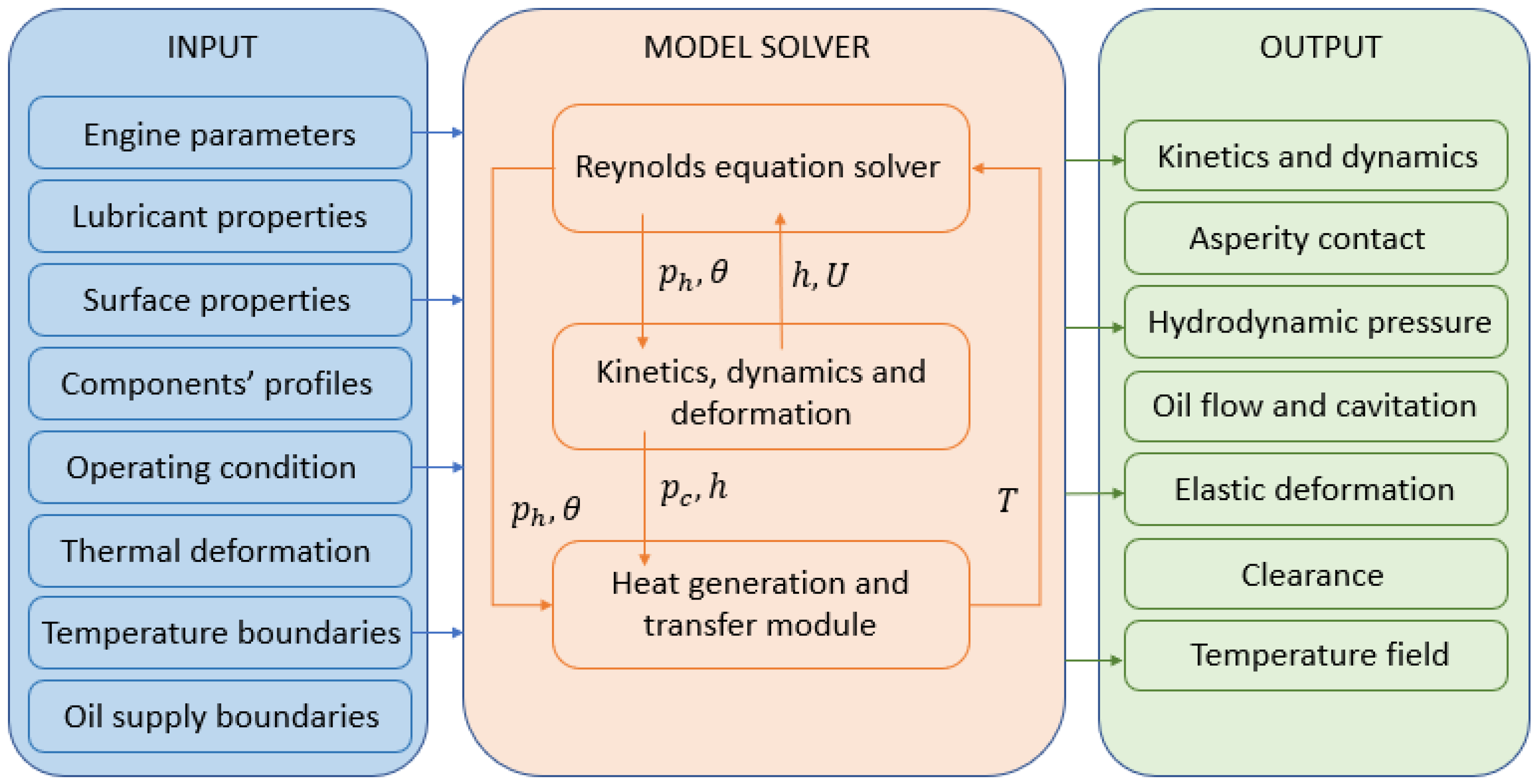
Figure 1 provides an overview of the digital model. The inputs include the full set of geometric, material, thermal, and operating parameters required to characterize the piston-pin system and its lubrication environment. The multi-physics solution is obtained through an iterative coupling of governing equations, the details of which are described in the subsequent modeling sections. The outputs on the right summarize the critical performance metrics, including pin dynamics, hydrodynamic and asperity pressures, oil flow and cavitation, elastic deformation, local clearance, and the temperature field.

2. Modeling Methods

2.1. Kinetics and Dynamics

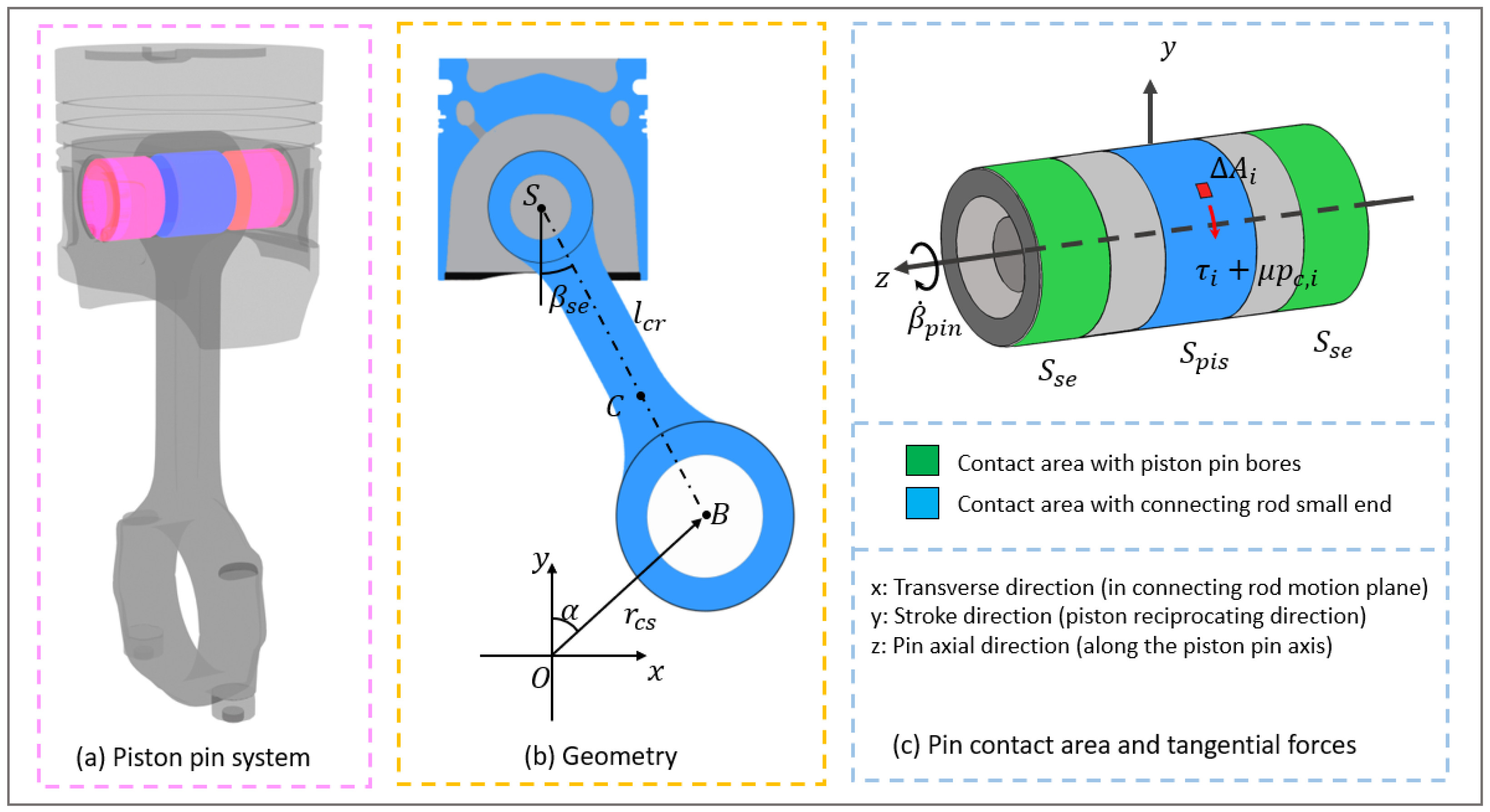
Figure 2 gives an illustration of the piston pin assembly. (a) provides a perspective view, where the contact region with the small end of the connecting rod is marked in blue, while the contact region with the piston pin bores is marked in red. Figure 2b defines the geometric configuration, where S and B denote the small-end and big-end centers of the connecting rod, and O denotes the crankshaft center. Point C denotes the mass center of the connecting rod. The tilting and secondary motion of the piston are neglected. The connecting rod ends positions are given by
x be = r cs sin α , y be = r cs cos α ,
x se = r cs sin α l cr sin β se , y se = r cs cos α + l cr cos β se .
Figure 2c illustrates how the tangential forces acting on the pin surface produce a net torque from both the small-end and bore contacts, which in turn drives the pin’s rotation about the z-axis. Here and throughout the paper, all key symbols are summarized in Table 1.
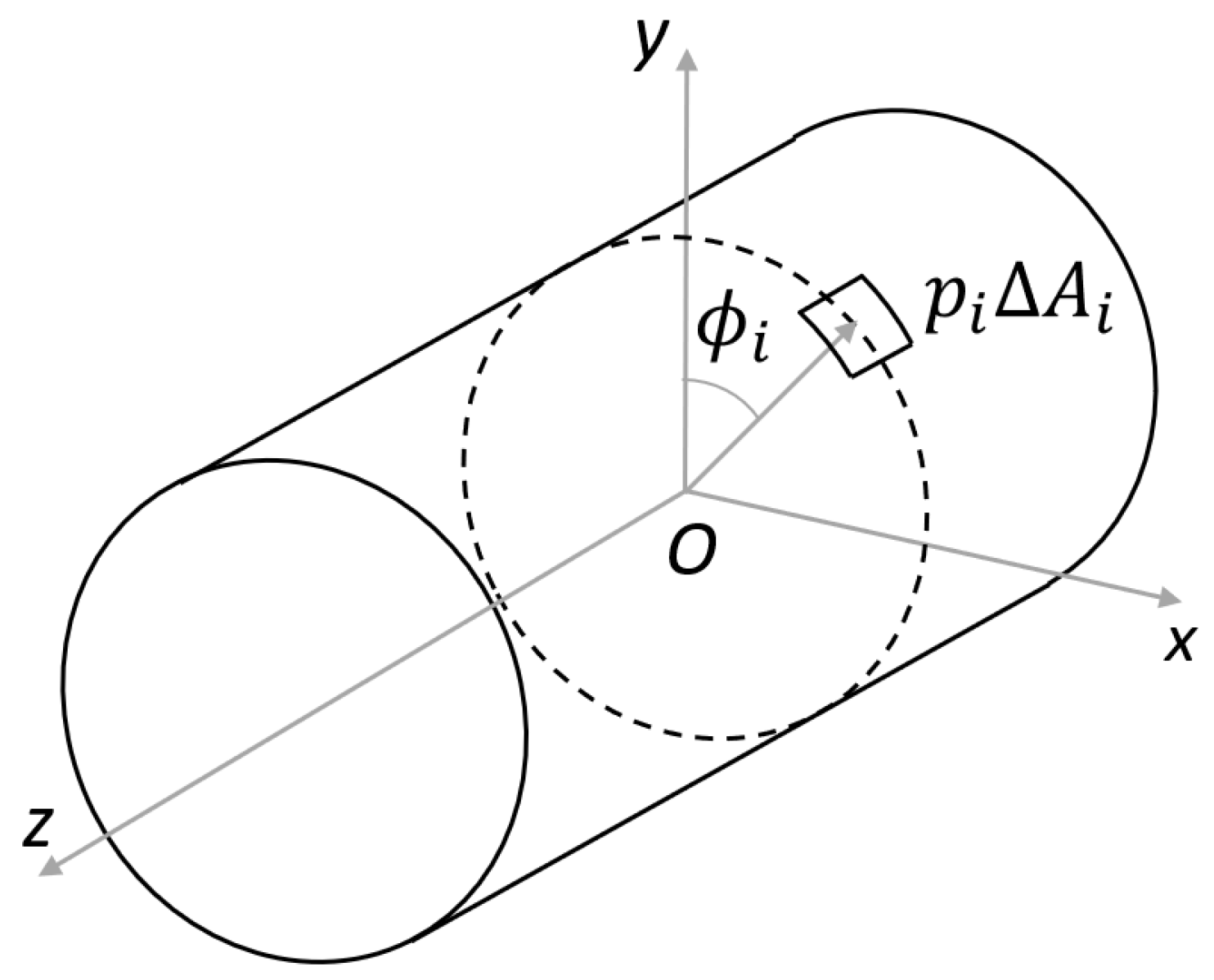
S pis denotes the interface between the pin and the piston pin bore, and S se denotes the interface between the pin and the small end (see Figure 2c). On these interfaces, the contacting regions are discretized into surface elements. Each element i is identified by an angular coordinate ϕ i (see Figure 3) in a cylindrical coordinate system. The corresponding element area is denoted by Δ A i . Based on these definitions, the translational dynamics are expressed as:
Pin motion in x-direction:
m pin x ¨ pin = i S se S pis p i Δ A i sin ϕ i
Pin and piston motion in y-direction:
m pin y ¨ pin = i S se S pis p i Δ A i cos ϕ i
m pis y ¨ pis = i S pis p i Δ A i cos ϕ i π r pis 2 p comb
p i = p h , i + p c , i is the total pressure.
Notice that the mass center C of the connecting rod does not necessarily lie on the line S B (as in Figure 2b). Taking the big end as the rotation center, the angular acceleration of the connecting rod β ¨ se is determined by:
I cr β ¨ se = m cr α ˙ 2 B C × O B i S se p i sin ( ϕ i + β se ) B S × Δ A i
where Δ A i denotes the oriented area vector of surface element i with magnitude Δ A i pointing outwards normal to the contact surface. The geometric lengths satisfy | O B | = r cs and | B S | = l cr .
The total torque and resulting angular acceleration of the piston pin arise from the combined contributions of hydrodynamic shear stress and boundary friction, as illustrated in Figure 2c. The governing rotational dynamics are given by:
I pin β ¨ pin = r pin i S se S pis τ i + μ p c , i δ ( β ˜ i ) Δ A i ,
where I pin is the moment of inertia of the piston pin. The relative angular velocity β ˜ i depends on the interface location:
β ˜ i = β ˙ pin , i β ˙ se , i , i S se , β ˙ pin , i , i S pis .
To capture the smooth transition of boundary friction when the relative sliding direction changes, a smoothed stick–slip relationship is introduced by [38,39] and simplified in [30] in pin model application:
δ ( β ˜ ) = 1 2 1 + e k β ˜ ,
where β ˜ is the relative angular velocity defined above, and k is a constant controlling the steepness of the transition.

2.2. Lubrication

Hydrodynamic pressure generated by the relative motion and squeezing effect of the lubricant can separate the journal and bearing surfaces, thereby preventing direct asperity contact. In this study, a mixed elasto-hydrodynamic lubrication (EHL) model is applied to the piston pin system. The model employs a two-dimensional Reynolds equation that incorporates cavitation effects as well as pressure- and temperature-dependent oil viscosity.
To characterize the influence of surface roughness on fluid flow, the Average Reynolds Equation proposed by Patir and Cheng [40] is adopted. This formulation incorporates pressure flow factors ( ϕ x , ϕ y ) and a shear flow factor ( ϕ s ) to modify the average flow within the mesh. Physically, roughness significantly alters the hydrodynamic behavior only when the oil film thickness is comparable in magnitude to the roughness height. Consequently, in regimes where the film thickness ratio h / σ is sufficiently large, roughness effects become negligible, and the flow factors ϕ x and ϕ y asymptotically approach unity, recovering the standard Reynolds equation.
x ϕ x h 3 12 η p h x + y ϕ y h 3 12 η p h y = U 2 ( h θ h ) x U 2 σ ϕ s x + ( h θ h ) t ,
In this study, considering the cylindrical geometry of the system, the Reynolds Equation is implemented in polar coordinates as follows:
1 r 2 ϕ h 3 12 η p h ϕ + z h 3 12 η p h z = U 2 ( h θ h ) r ϕ + ( h θ h ) t ,
To properly account for partial-film regions, where the available lubricant is insufficient to fill the entire clearance, the present model incorporates the mass-conserving cavitation algorithm proposed by [32]. The complementarity condition p h · θ = 0 is modeled as
p h + θ p h 2 + θ 2 = 0
which enforces zero pressure in cavitation regions.
For the boundary conditions, two types of boundaries are considered depending on the availability of lubricant supply. When the bearing operates under a fully flooded configuration, the lubricant supply is abundant and all inlet boundaries are exposed to the ambient reservoir pressure, so that
p = p 0 , θ = 0
is prescribed along the oil-supply boundaries. This corresponds to a situation where the clearance is continuously replenished and remains immersed in lubricant.
In contrast, at boundaries where no external lubricant supply is available, a starved inlet condition is applied. In this case the boundary behaves as one-way: lubricant is allowed to leave the domain, but it cannot be drawn in from an external reservoir. Numerically, this is implemented in a directional manner. If the local pressure gradient drives flow outward, the boundary is treated as being exposed to the ambient reservoir and the pressure is set to
p = p 0 .
If the surrounding pressure gradient tends to induce inflow of fluid from the outside into the clearance (i.e., P n < 0 at the boundary), this influx is numerically suppressed by enforcing a zero-flux condition:
Q normal = 0
This simplification indeed introduces an approximation. In reality, when the cavitation zone reaches the boundary, the large pressure difference between the ambient air ( P amb ) and the cavitated film ( P cav ) would allow air to penetrate into the clearance. The intruding air mixes with the vapor–oil region and effectively creates a transient three-phase environment (air, vapor, and oil), which our numerical model does not explicitly capture. Although the air would eventually be displaced, their temporary presence would alter the local film behavior, a phenomenon not represented in the present formulation.
Despite these simplifications, the zero-flux treatment remains a valid approximation. Regions susceptible to cavitation or air ingestion typically operate near ambient pressure and contribute negligibly to the overall load-carrying capacity. Consequently, the complex gas–liquid dynamics at the boundary do not significantly affect the primary pressure-generating zones. Furthermore, explicitly resolving air entrainment would require a multiphase formulation, which would impose a prohibitive computational burden. The zero-flux condition therefore offers a stable and efficient alternative.
The lubricant viscosity is modeled as a function of pressure and temperature using the combined Vogel–Roelands expression [41,42]:
η ( T ) exp T 1 T + T 0
log η η 0 = log η 0 η r 1 + p p r z R 1 ,
The viscosity-temperature relationship is calibrated against measurement and viscosity-pressure relationship refers to experimental data in [43]. The following quantities are adopted (Table 2):
For each control volume centered at ( i , j ) , the Reynolds equation is written in a conservative finite-volume form using the fluxes through the east, west, north, and south faces. Let
K i , j = h i , j 3 12 η i , j , K i ± 1 2 , j = K i ± 1 , j + K i , j 2 , K i , j ± 1 2 = K i , j ± 1 + K i , j 2 ,
and define
f i , j = h i , j θ i , j h i , j .
The discretized fluxes across the four faces of the control volume are given below. Net outflow is defined as a positive value.
  • East face flux ( i + 1 2 , j ) .
Q ϕ , i + 1 2 , j = K i + 1 2 , j r p i , j p i + 1 , j Δ ϕ Δ z + U Δ z 2 f i , j , U > 0 , U Δ z 2 f i + 1 , j , U < 0 .
  • West face flux ( i 1 2 , j ) .
Q ϕ , i 1 2 , j = K i 1 2 , j r p i , j p i 1 , j Δ ϕ Δ z U Δ z 2 f i 1 , j , U > 0 , U Δ z 2 f i , j , U < 0 .
  • North face flux ( i , j + 1 2 ) .
Q z , i , j + 1 2 = K i , j + 1 2 p i , j p i , j + 1 Δ z r Δ ϕ .
  • South face flux ( i , j 1 2 ) .
Q z , i , j 1 2 = K i , j 1 2 p i , j p i , j 1 Δ z r Δ ϕ .
Using these four fluxes, the discretized Reynolds equation at node ( i , j ) becomes
Q ϕ , i + 1 2 , j + Q ϕ , i 1 2 , j + Q z , i , j + 1 2 + Q z , i , j 1 2 r Δ ϕ Δ z = t h i , j θ i , j h i , j .

2.3. Elastic Deformation

Accurate modeling of elastic deformation is crucial in elasto-hydrodynamic lubrication (EHL), as it directly affects local film thickness and pressure distribution. To incorporate structural compliance efficiently into the coupled EHL framework, an elastic deformation model is constructed using finite element analysis (FEA), and the results are condensed into a precomputed compliance matrix to avoid repeatedly solving this system.
δ h = C · p
with p the element-wise pressure vector and δ h the corresponding normal displacements. Each column of C corresponds to the deformation field when applying a unit load to the respective element. By applying deformable rather than rigid surfaces, the model captures more realistic contact patterns and provides more reliable estimates of film thickness under high-pressure conditions.
The compliance matrices are generated through the following steps:
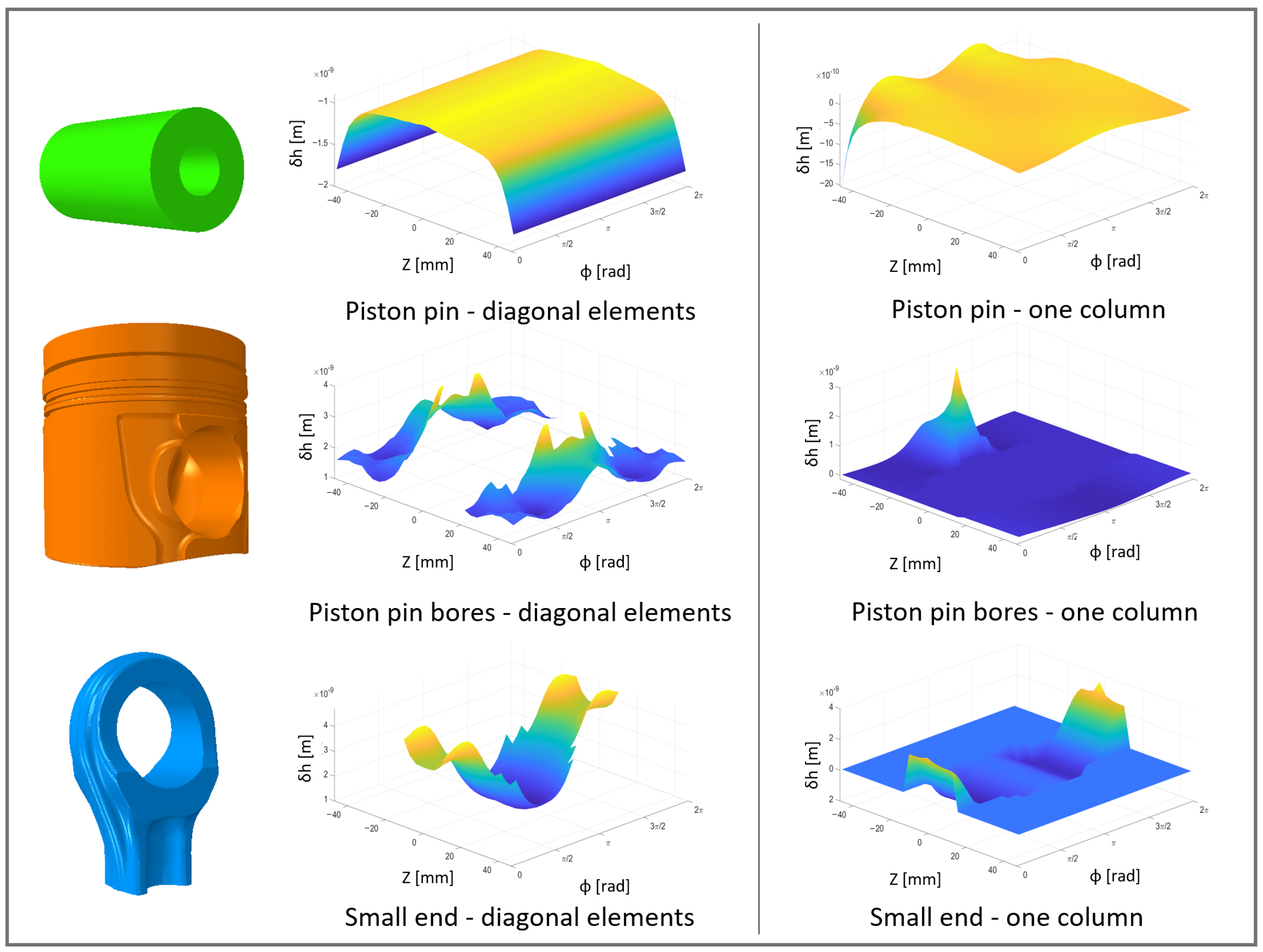
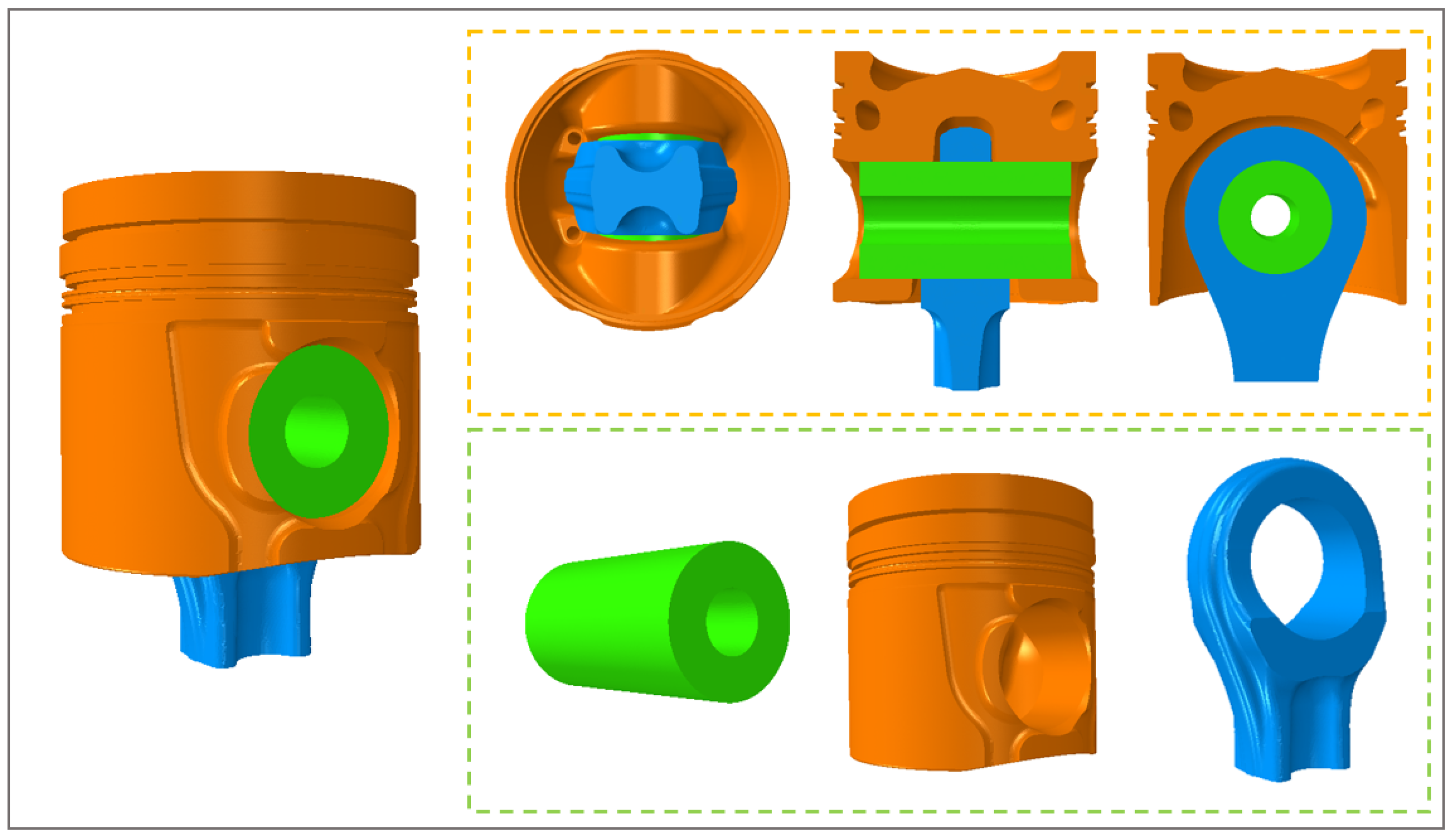
  • Finite element models are created for all three components (as in Figure 4), including the piston pin, piston, and connecting rod.
  • A unit normal pressure is applied to each element of the contact surface.
  • The resulting normal displacements are extracted at all surface nodes.
  • These displacement fields are assembled column-wise to form the complete compliance matrix.
Through iterative unit loads applied on the corresponding contact interfaces, the compliance matrices C pin , C pb , and C se are obtained. Additionally, a unit combustion pressure on the piston crown yields the deformation field δ h p . The total change in clearance is expressed as the superposition of contributions from the interacting solid bodies. Adopting the sign convention where positive values denote outward radial deformation, the clearance variation is defined as:
δ h = δ h pb δ h pin for the pin pin bore interface δ h se δ h pin for the pin small end interface
Each contribution is obtained via its corresponding compliance matrix:
δ h pin = C pin · p
δ h se = C se · p
δ h pb = C pb · p + δ h p · p comb
Here, p = p h + p c denotes the total pressure. The additional term δ h p · p comb accounts for pin bore deformation caused by the applied combustion pressure p comb .
The raw compliance matrix C is post-processed to ensure physical consistency. Its key properties, illustrated in Figure 5, are as follows:
  • Geometric symmetry: For components with geometric symmetry (e.g., mirror or rotational), the compliance matrix must preserve this property. If nodes i and k are symmetric to nodes j and l respectively, then
    C i k = C j l .
    In particular, C i i = C j j for symmetric nodes i and j.
  • Diagonal dominance: The matrix exhibits diagonal dominance,
    C i i > C i j , C i i > C j i i j ,
    reflecting that a unit pressure applied at node i must produce the largest deformation at i, while effects on neighboring nodes are smaller.
  • Smoothness: The distributions of deformation and stiffness are expected to vary smoothly across the surface, reflecting the continuous nature of elastic behavior. If this smoothness condition is not met, the finite element mesh should be refined. Alternatively, denoising techniques may be applied as a compromise, though at the cost of reduced accuracy.

2.4. Asperity Contact

When the oil film breaks or becomes extremely thin, direct surface contact occurs. The asperity contact pressure p c is computed using a statistical Greenwood–Tripp model [44]:
p c = 16 2 π 15 σ β η 2 σ β E F 2.5 ( H σ )
where H σ = h / σ is the normalized clearance, σ is the variance of surface roughness, β is the radius of curvature at asperity peaks, η is the density of asperity peaks and E is the composite elastic modulus:
1 E = 1 ν 1 2 E 1 + 1 ν 2 2 E 2
The function F 2.5 ( H σ ) is approximated as [45]:
F 2.5 ( H σ ) = A · ( Ω H σ ) Z , H σ Ω 0 , H σ > Ω
The values are adopted: A = 4.4068 × 10 5 , Ω = 4.0 , Z = 6.804 based on multiple studies [45,46,47].
While the modeling of rough surface contact has advanced significantly from the classical statistical framework of Greenwood and Williamson [48] to rigorous elastic-plastic models [49,50], fractal multiscale approaches [51,52], FFT and multigrid techniques [53,54], the simplified model is employed here in this study. This approach remains widely utilized as a standard submodel in mixed lubrication simulations and was selected here to ensure the computational efficiency required for solving the fully coupled TEHD system over many engine cycles.

2.5. Component Profiles and Film Thickness Calculation

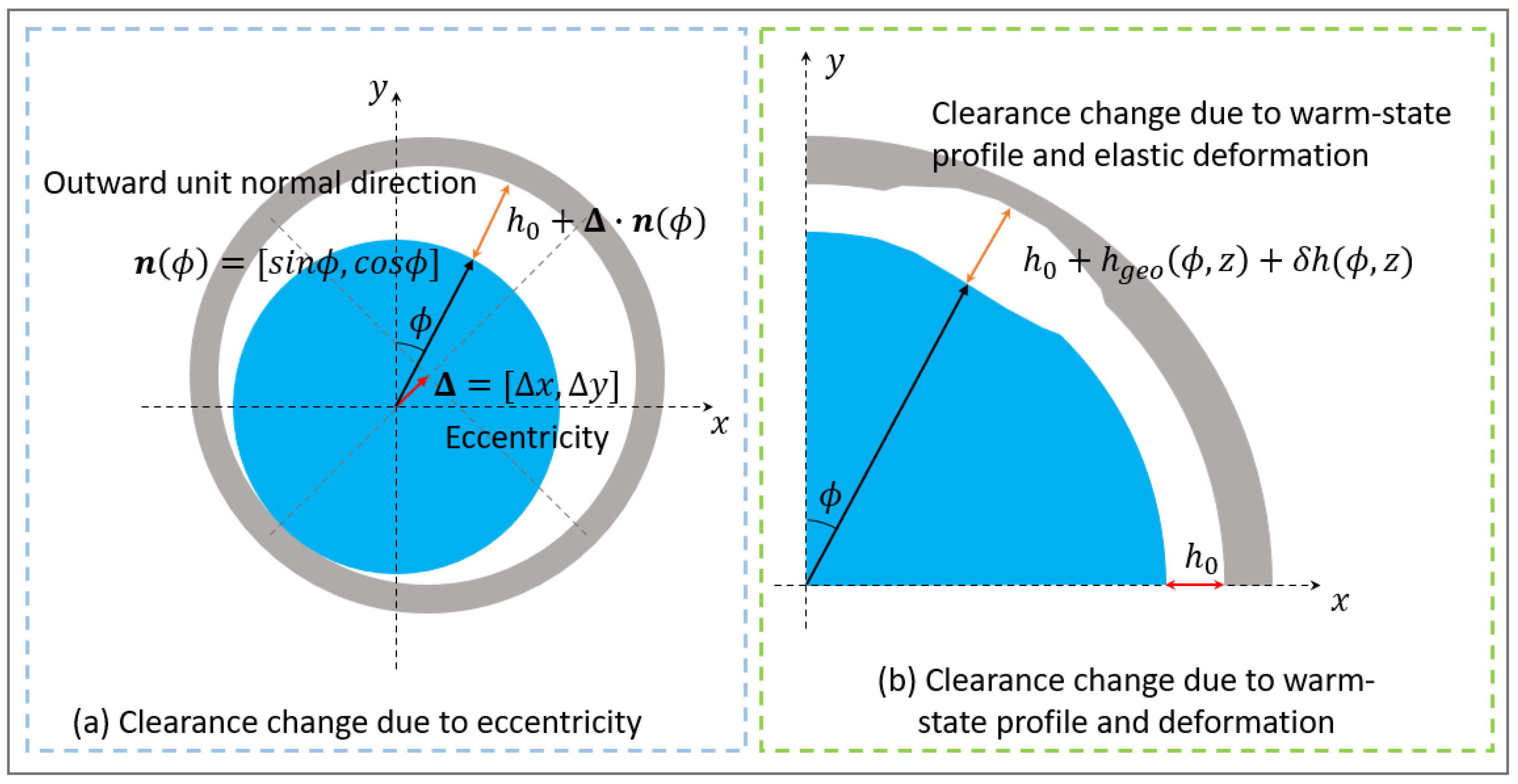
As shown in Figure 6, the local oil film thickness h ( ϕ , z ) is expressed as:
h ( ϕ , z ) = h 0 + h geo ( ϕ , z ) + δ h ( ϕ , z ) + Δ · n ( ϕ )
where:
  • h 0 : nominal clearance between the undeformed surfaces (installation clearance).
  • h geo ( ϕ , z ) : geometric deviation due to warm-state profiles (in Figure 7).
  • δ h ( ϕ , z ) : clearance variation due to elastic deformation.
  • Δ = [ Δ x , Δ y ] : eccentricity vector of the mating bore center relative to the piston pin center.
  • n ( ϕ ) = [ sin ϕ , cos ϕ ] : outward unit normal vector at circumferential position ϕ on the pin surface.
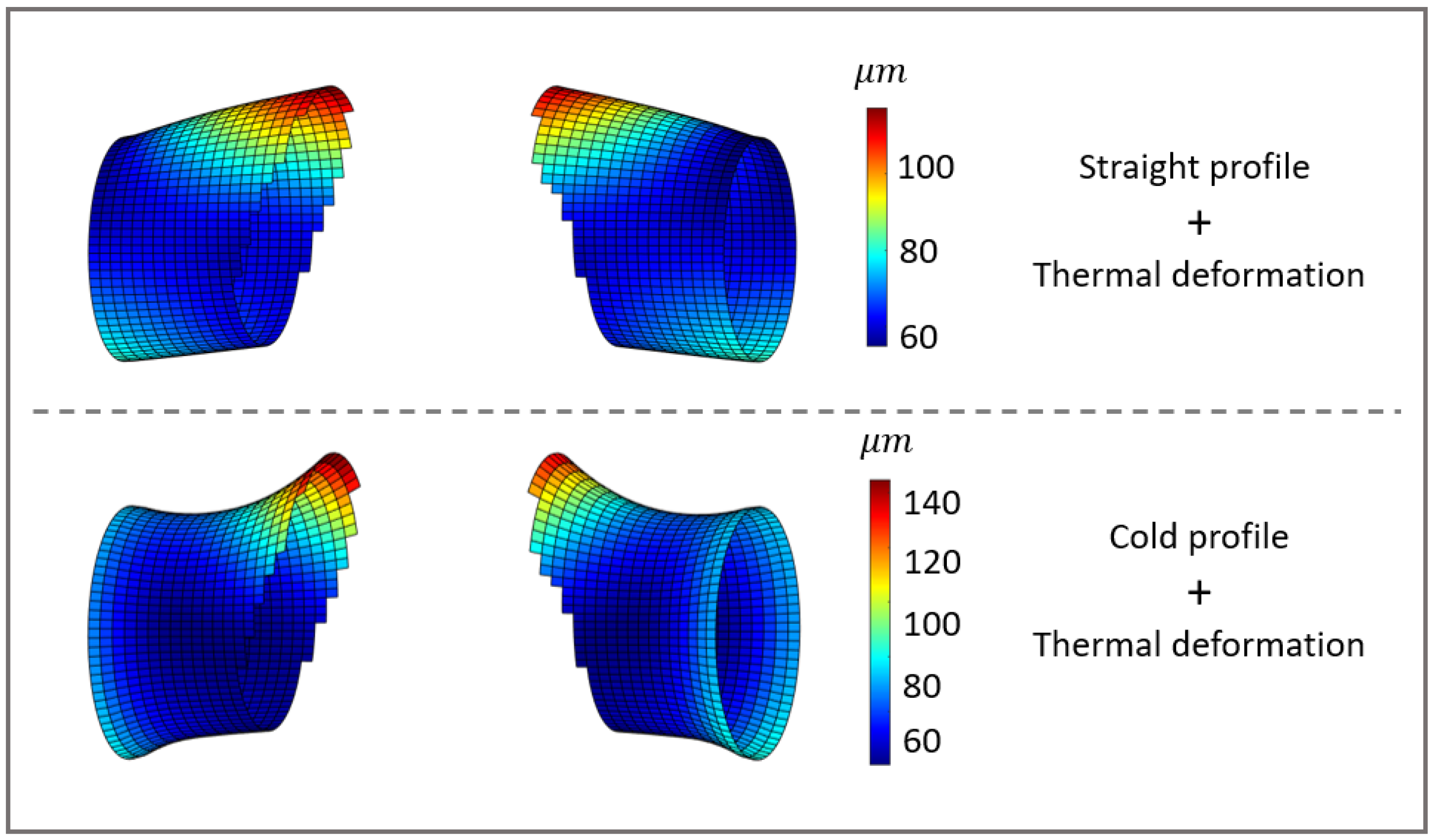
Figure 7 compares the nominal straight profile and the measured cold profile of the piston pin bores, with the superimposition of thermal deformation. Due to the complex geometry of the piston, the thermal deformation is not uniform along the axial direction, exhibiting a characteristic downward inclination at the outer edges of both bores. It is important to note that this thermal deformation is derived from a pre-calculated thermal simulation based on the specific piston temperature gradients under the defined operating conditions. In the present TEHD framework, this deformation is treated as a static global input. It is not iteratively updated based on the instantaneous temperature field simulation discussed later, as the bulk thermal deformation of the piston is assumed to be stable and dominated by the overall engine thermal state rather than local transient fluctuations.

2.6. Heat Generation and Transfer

In the lubricant film, the temperature field is governed by the convection–diffusion equation:
( ρ c p T ) t + · ρ c p T u = · k T
To close the film-normal variation, a quadratic temperature profile is assumed within the lubricant layer of thickness h (similar to [22]):
T ( z ) = a z 2 + b z + c , T z = 2 a z + b , 2 T z 2 = 2 a .
The thickness-averaged temperature is defined by
T ¯ = 1 h 0 h T ( z ) d z = a h 2 3 + b h 2 + c .
Integrating (34) across the film thickness and approximating the cross-film variation of the convective terms by the film averages ( T ¯ , u ¯ )
ρ c p h T ¯ t + s · ρ c p h T ¯ u ¯ = k T z z = 0 z = h
To ensure that the convective transport in the film-averaged energy equation is fully consistent with the mass fluxes used in the Reynolds equation, the in-plane convective term in Equation (37) is written directly in terms of the volumetric fluxes Q ϕ and Q z defined in Equations (18)–(21). In finite-volume form, the divergence of the convective flux becomes
s · ( ρ c p h T ¯ u ¯ ) i , j 1 r Δ ϕ Δ z F i + 1 2 , j + F i 1 2 , j + F i , j + 1 2 + F i , j 1 2
where F i ± 1 2 , j and F i , j ± 1 2 denote the energy fluxes through the east, west, north, and south faces of the control volume, respectively. These are obtained by combining the volumetric fluxes from Equations (18)–(21) with an upwind selection of the convected thermal energy ( ρ c p h T ¯ ) ,
F i + 1 2 , j = Q ϕ , i + 1 2 , j ( ρ c p h T ¯ ) i , j , Q ϕ , i + 1 2 , j > 0 , Q ϕ , i + 1 2 , j ( ρ c p h T ¯ ) i + 1 , j , Q ϕ , i + 1 2 , j 0 ,
F i 1 2 , j = Q ϕ , i 1 2 , j ( ρ c p h T ¯ ) i , j , Q ϕ , i 1 2 , j > 0 , Q ϕ , i 1 2 , j ( ρ c p h T ¯ ) i 1 , j , Q ϕ , i 1 2 , j 0 ,
F i , j + 1 2 = Q z , i , j + 1 2 ( ρ c p h T ¯ ) i , j , Q z , i , j + 1 2 > 0 , Q z , i , j + 1 2 ( ρ c p h T ¯ ) i , j + 1 , Q z , i , j + 1 2 0 ,
F i , j 1 2 = Q z , i , j 1 2 ( ρ c p h T ¯ ) i , j , Q z , i , j 1 2 > 0 , Q z , i , j 1 2 ( ρ c p h T ¯ ) i , j 1 , Q z , i , j 1 2 0 .
This flux-based upwind discretization maintains numerical stability and ensures that the convective transport in the thermal equation is strictly consistent with the mass fluxes used in the Reynolds solver.
At the lubricant–solid interfaces ( z = 0 and z = h ), the conductive heat flux is required to be continuous between the lubricant film and the surrounding solid bodies. Denoting by k the effective thermal conductivity of the lubricant and by k s that of the solid, the heat-flux continuity conditions become
k T z z = 0 = k s T s z z = 0 , k T z z = h = k s T s z z = h ,
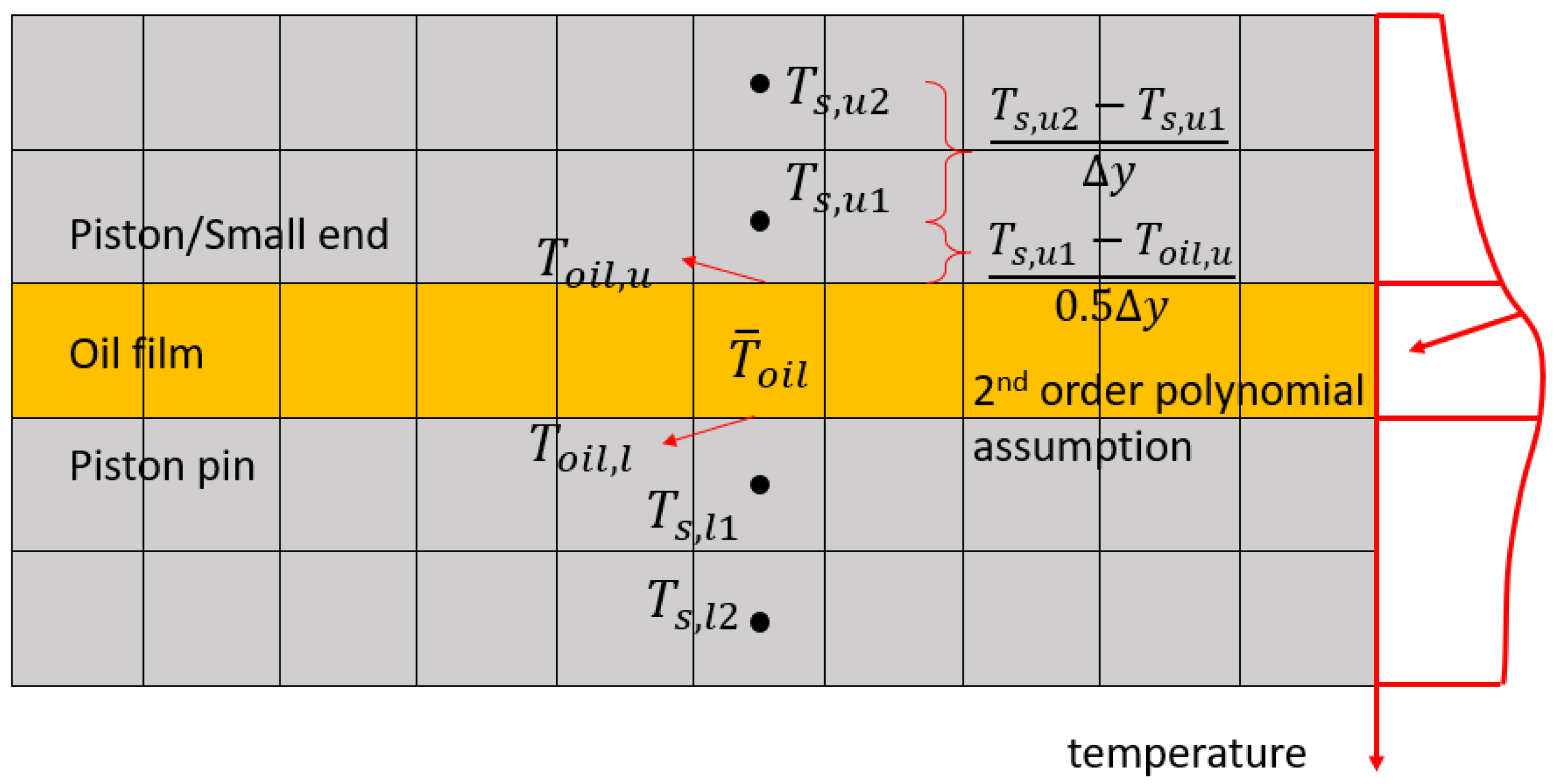
In the numerical implementation, the solid temperatures at the lubricant–solid boundary are obtained from Equation (35), while the temperature within each solid control volume is defined at its geometric center. This allows the temperature gradients normal to the solid–lubricant interface (required in Equation (43)) to be evaluated using a half-grid finite-difference approximation between the interface and the adjacent cell center (see Figure 8).
In the solid components (piston pin, small end, and pin bores), heat transfer is described by the transient conduction equation
ρ s c p , s T s t = · k s T s .
Applying the finite-volume method and treating material properties as uniform within each control volume, the integral form over a solid control volume V s reduces to
ρ s c p , s V s d T s d t = f V s k s T s f · n f A f ,
where the normal temperature gradient at each face, ( T s ) f · n f , is evaluated using a central-difference approximation between neighboring cell temperatures.
Shear-induced viscous dissipation Φ v i s c in the lubricant film generates thermal energy:
Φ v i s c = 2 η γ ˙ : γ ˙
Under the lubrication (thin film) approximation ( w 0 and h r pin ), the dominant gradients are across the film thickness direction, giving
Φ v i s c η u z 2 + η v z 2
The velocity field within the thin film is
u = 1 2 η p x ( z 2 z h ) + U z h , v = 1 2 η p y ( z 2 z h )
The shear-induced viscous dissipation averaged across the film thickness is (in cavitation regions, the Poiseuille term should be zero)
Φ ¯ visc = 0 h 1 h η u z 2 + η v z 2 d z = η U 2 h 2 + h 2 12 η p x 2 + p y 2 .
In cavitation regions, the liquid and vapor are treated as a homogenized mixture characterized by the vapor volume fraction θ . Under this mixture assumption, all effective material properties are computed using simple linear averaging. In particular, because the viscosity of the vapor phase is several orders of magnitude smaller than that of the liquid, its contribution to shear resistance is negligible, and the effective viscosity is approximated as
η ( 1 θ ) η l + θ η v ( 1 θ ) η l , 0 θ 1 .
The density and volumetric heat capacity follow the same mixture rule:
ρ = ( 1 θ ) ρ l + θ ρ v , ρ c p = ( 1 θ ) ρ l c p , l + θ ρ v c p , v .
Similarly, the effective thermal conductivity is written as
k = ( 1 θ ) k l + θ k v .
Under this formulation, all thermophysical properties appearing in Equation (34) represent vapor-fraction–dependent mixture quantities.
At the solid–solid contact interface, the local frictional heat generation rate per unit area is
Φ fric = μ p c | U | ,
The generated heat is approximately partitioned among the two solids (indexed by s , 1 and s , 2 ) and the lubricant film based on the proportionality of transient heat flux to thermal effusivity, an approach derived from the classical transient conduction theory of Carslaw and Jaeger [55].
e s , 1 = k s , 1 ρ s , 1 c p , s 1 , e s , 2 = k s , 2 ρ s , 2 c p , s 2 , e f = k ρ c p ,
where k , ρ , c p for the film denote the effective (cavitation-modified) properties defined previously. The three partition ratios are
χ s 1 = e s , 1 e s , 1 + e s , 2 + e f , χ s 2 = e s , 2 e s , 1 + e s , 2 + e f , χ f = e f e s , 1 + e s , 2 + e f ,
Accordingly, the frictional heat fluxes assigned to each medium are
Φ fric , s 1 = χ s 1 Φ fric , Φ fric , s 2 = χ s 2 Φ fric , Φ fric , o i l = χ f Φ fric .
In this thermal submodel, material properties are simplified as constants to reduce computational cost. The liquid lubricant properties correspond to a characteristic operating temperature of 393.15 K. Vapor-phase properties are approximated due to data scarcity, and the solid domain is uniformly characterized as alloy steel. These parameters are detailed in Table 3.

2.7. Break-In Simulation

In real engine operation, especially for heavy-duty and large-bore applications, engines undergo a break-in process before delivery. During this period, surface profiles evolve through plastic deformation and asperity smoothing, which alleviate excessive contact pressure and promote a more stable, conformal load-carrying area. To capture this effect, a numerical break-in simulation module is incorporated. Surface profiles and roughness are iteratively updated over multiple cycles until the pressure distribution and oil film thickness reach a converged state.
It is important to clarify the specific objective of the break-in module within the present framework. The implementation utilizes the fundamental proportionality between wear rate and asperity contact pressure, relative sliding velocity inherent in Archard’s model. However, the wear coefficient was not determined experimentally, as calibrating quantitative wear rates for such complex contacts remains a significant challenge. Consequently, the primary goal of this module is not to predict absolute wear life or to reproduce the time-resolved break-in process, as the solver operates on a crank-angle timescale that is distinct from the minutes- or hours-long duration of break-in. Instead, the module is designed to provide the final, post-break-in surface state.
From a numerical simulation perspective, incorporating this process is critical as it addresses the high sensitivity of contact pressure to surface imperfections or poor conformity. In the absence of such evolution, minor initial geometric inconformity can manifest as unrealistic pressure spikes. By employing this wear-based evolution, the simulation progressively relieves these localized peaks, thereby guiding the surface geometry towards a stable, conformal working state.
In the present break-in simulation, the surface profile is updated through two key mechanisms:
Plastic Deformation: Occurs when the combined pressure ( p c + p h ) exceeds the material yield strength θ p . The excess pressure generates a permanent profile change, proportional to max { 0 , ( p c + p h θ p ) } in each iteration.
Wear: Follows an Archard-type law, where the local wear depth is proportional to the product of asperity contact pressure and sliding distance.
In the present break-in model, the surface profile is updated by combining plastic deformation and wear. A physically motivated form for the per-cycle profile change is
Δ h 0 ( ϕ , z ) = k plastic max 0 , ( p c + p h ) θ p + k wear p c | U | ,
where the first term represents plastic flattening once the combined pressure exceeds the yield strength θ p , and the second term follows an Archard-type wear law. Fixed coefficients k plastic and k wear could be used for the whole process, but as the contact pressure decreases toward the end of break-in, Δ h 0 becomes very small, causing the numerical evolution to proceed extremely slowly on the simulated time scale.
A stopping criterion is required for the wear process. Here, break-in is considered complete once the per-cycle profile change Δ h 0 becomes negligible. The update is terminated when the maximum change per cycle falls below a prescribed tolerance.
Since the objective is to obtain the post-break-in profile, a capped-update strategy is introduced to reduce the required number of computational cycles and accelerate convergence toward the final geometry. The actual per-cycle update is written as
Δ h ( ϕ , z ) = s Δ h 0 ( ϕ , z ) , s = min 1 , Δ h max max ϕ , z | Δ h 0 ( ϕ , z ) | ,
where the scaling factor s adjusts the step size such that the maximum profile change per iteration is limited to a prescribed cap Δ h max . This adaptive strategy accelerates the simulation while preserving the relative spatial distribution of the predicted wear (or material removal). Consequently, the solver converges more efficiently towards the final post-break-in geometry without numerical instability.”
The surface roughness σ is also updated in each cycle using a multiplicative rule.
σ new ( ϕ , z ) = 1 α σ ( ϕ , z ) σ prev ( ϕ , z ) ,
where the local attenuation factor α σ is modeled as proportional to the frictional power density p c | U | , capped by a prescribed roughness decay limit per iteration. As with the profile update, the goal is to accelerate convergence to the steady-state roughness field rather than to simulate the precise physical timeline of surface smoothing.

2.8. Numerical Solver

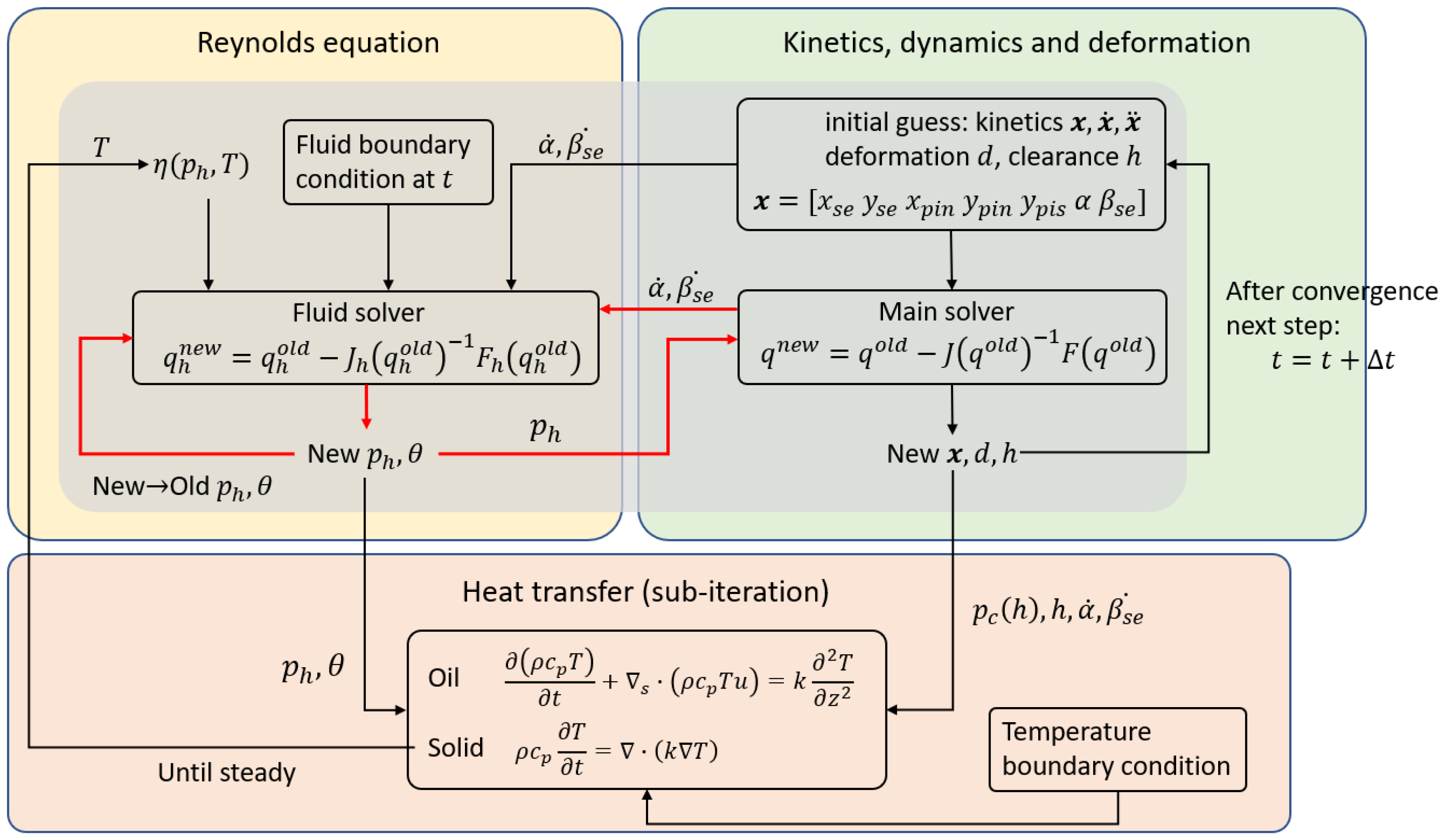
The numerical framework consists of three coupled modules (Figure 9): (1) the Reynolds equation solver, (2) the kinetics, dynamics, and deformation solver (hereafter referred to as the main solver), and (3) the heat transfer solver.
The Reynolds solver and the main solver constitute the core EHL solver, which can operate independently without the thermal solver. The role of the heat transfer module is to compute the lubricant temperature field, which subsequently provides the temperature-dependent viscosity input for the Reynolds equation.
At the beginning of each time step, initial guesses are assigned to the kinetic degrees of freedom x , elastic deformations d, and the resulting clearance h of all components. Based on the instantaneous kinematic state, the Reynolds solver evaluates the lubricant viscosity and boundary conditions to compute the hydrodynamic pressure p h and cavitation ratio θ . These fields then serve as inputs to the main solver, which updates the rigid-body kinetics and elastic deformations. The Reynolds solver and the main solver interact iteratively in a partitioned manner within each time step until convergence criteria are met.
To bridge the disparate time scales, the heat transfer module is activated only after the mechanical system (EHD module) has reached a periodic steady state (typically requiring 5–10 engine cycles). Utilizing the history of pressure, cavitation, and clearance generated by the EHD module, the thermal solver advances the temperature field over hundreds of cycles until a quasi-steady thermal state is established. The resulting temperature field is then used to update the temperature-dependent viscosity in the Reynolds equation, thereby closing the loop for a fully coupled TEHD analysis.
All numerical simulations were performed on a desktop equipped with an Intel Core i7-14700K processor. A dual-grid strategy was adopted to balance computational accuracy and efficiency: a coarse mesh ( 40 × 40 ) is employed for computing surface elastic deformation, while a fine mesh ( 80 × 80 ) is utilized for the flow field. The governing equations are solved using a fully implicit Newton-Raphson scheme, with bilinear interpolation adopted for mesh transformation. With this configuration, the average computation time is approximately 12 min per engine cycle. In this approach, the Jacobian matrix for the hydrodynamic pressure is treated in a sparse format and solved using MATLAB R2024b’s efficient direct solver. Consequently, the computational complexity on the fine mesh is significantly reduced, scaling approximately as O ( N 1.5 ) or ( O ( n 3 ) ), where N is the total number of grid nodes and n is the number of grid nodes along each dimension ( N = n 2 ) . In contrast, the elastic deformation involves a dense compliance matrix, leading to a dense Jacobian block. Solving this dense system entails a cubic complexity ( O ( N 3 ) ). This dramatic difference in computational cost justifies the use of a coarser resolution for the elasticity calculation.

3. Results

The model is applied to a Heavy-Duty (HD) diesel engine using real operating conditions taken from the engine test process. The simulation tracks the progressive evolution of the small-end surface during break-in, and the results are compared with measured profiles.

3.1. Progressive Escalation of Operating Conditions and Break-In Process

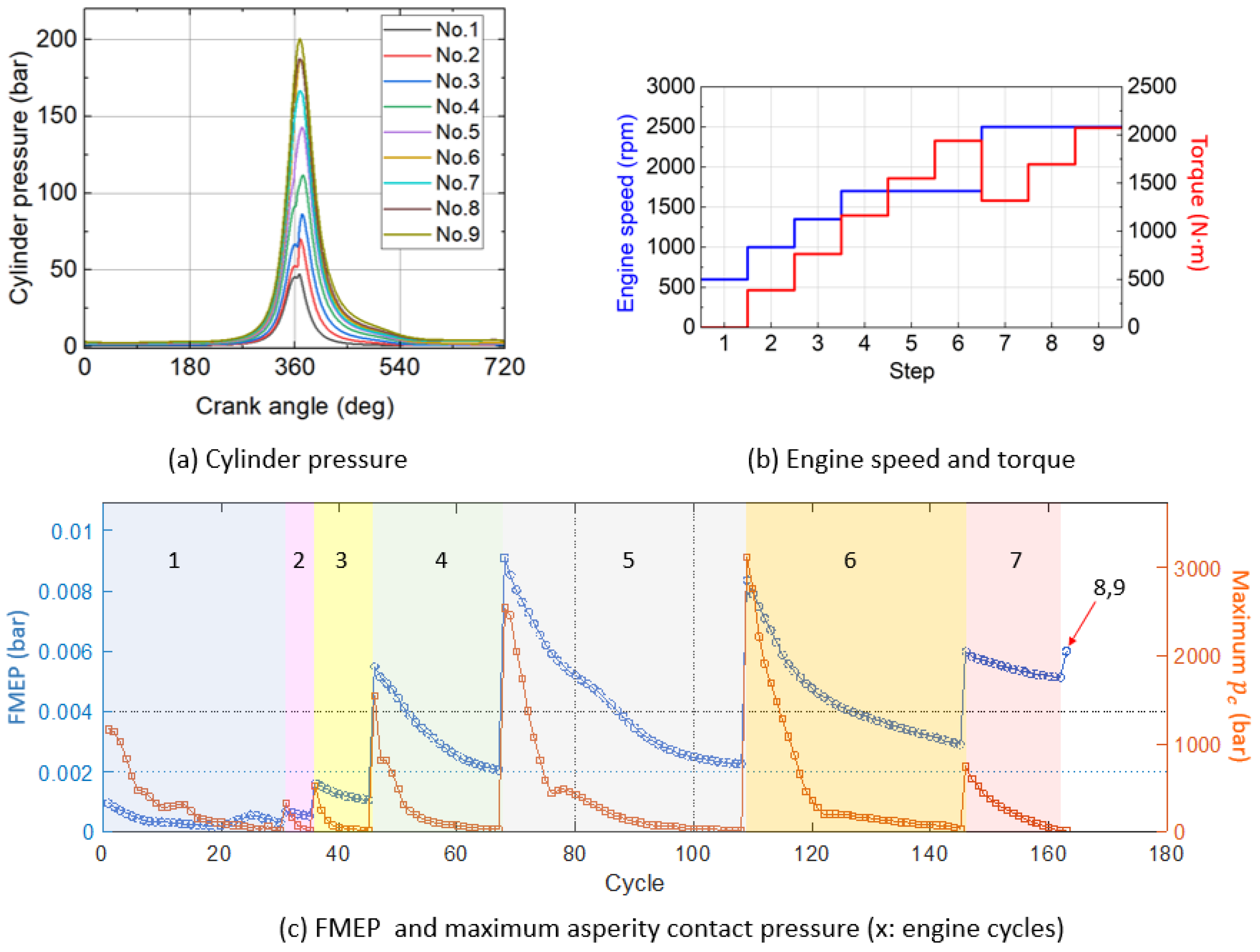
To simulate the break-in of the small-end bearing under realistic engine conditions, the engine power is gradually increased by changing engine speed and load, starting from idling, as shown in Figure 10a,b. The cylinder pressure and engine speed, which serve as key inputs to the model, are directly obtained from real engine test. Each loading step lasts for a different duration during the experiment, ranging from 1 to 3 min, with a total of 14 min. This stepwise loading procedure enables the bearing surfaces to evolve naturally during the break-in process prior to engine delivery.
Throughout the whole simulated break-in process in Figure 10c, asperity contact remains well controlled under each condition. Abrupt rises in both FMEP and asperity contact occur at the transitions from steps 3→4, 4→5, and 5→6. Within each individual step, however, FMEP gradually decreases as break-in proceeds and the surface evolves. The end-of-step FMEP values show a steady upward trend, indicating that the interface is progressively adapting to increasingly severe engine conditions.
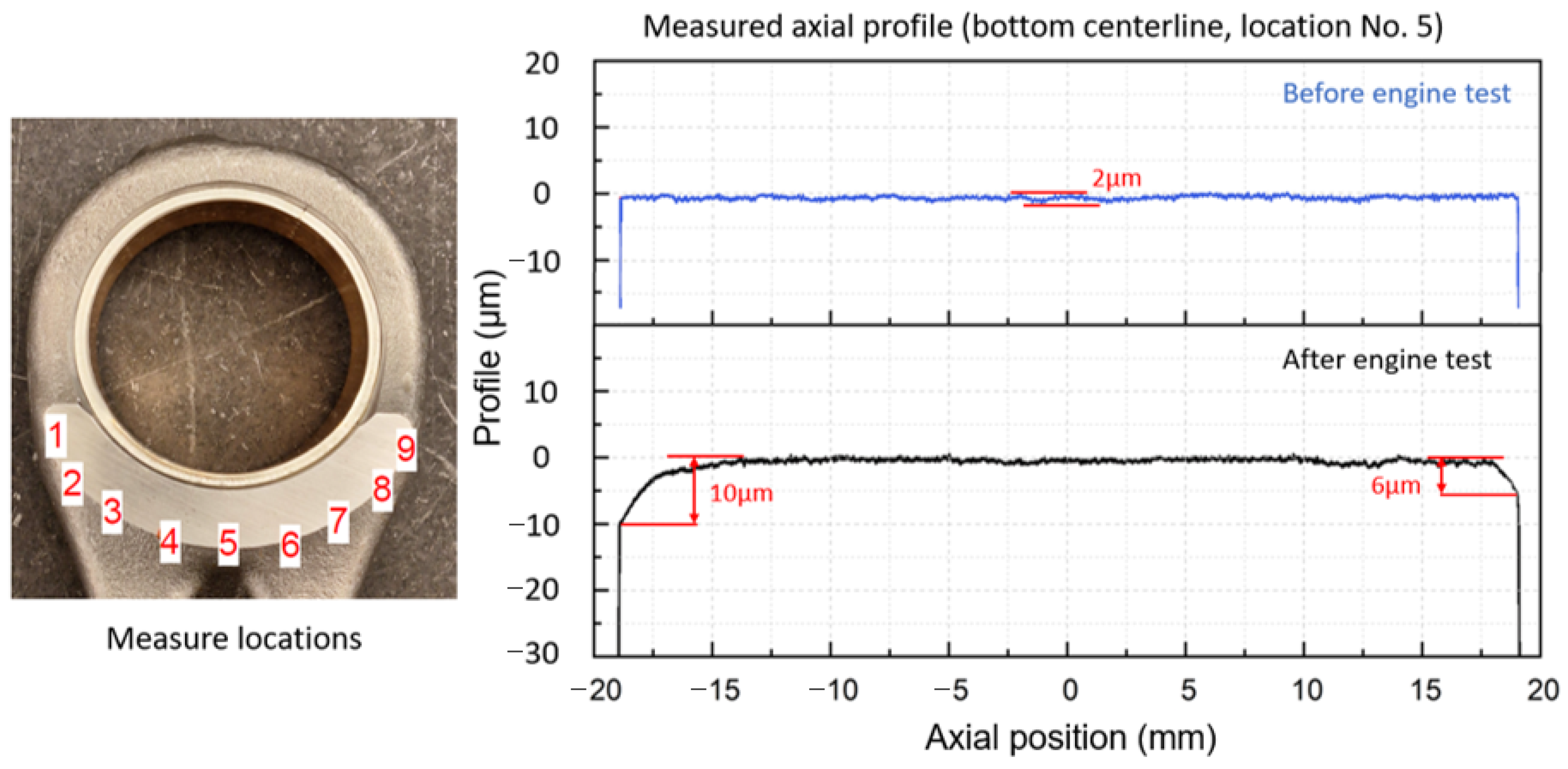
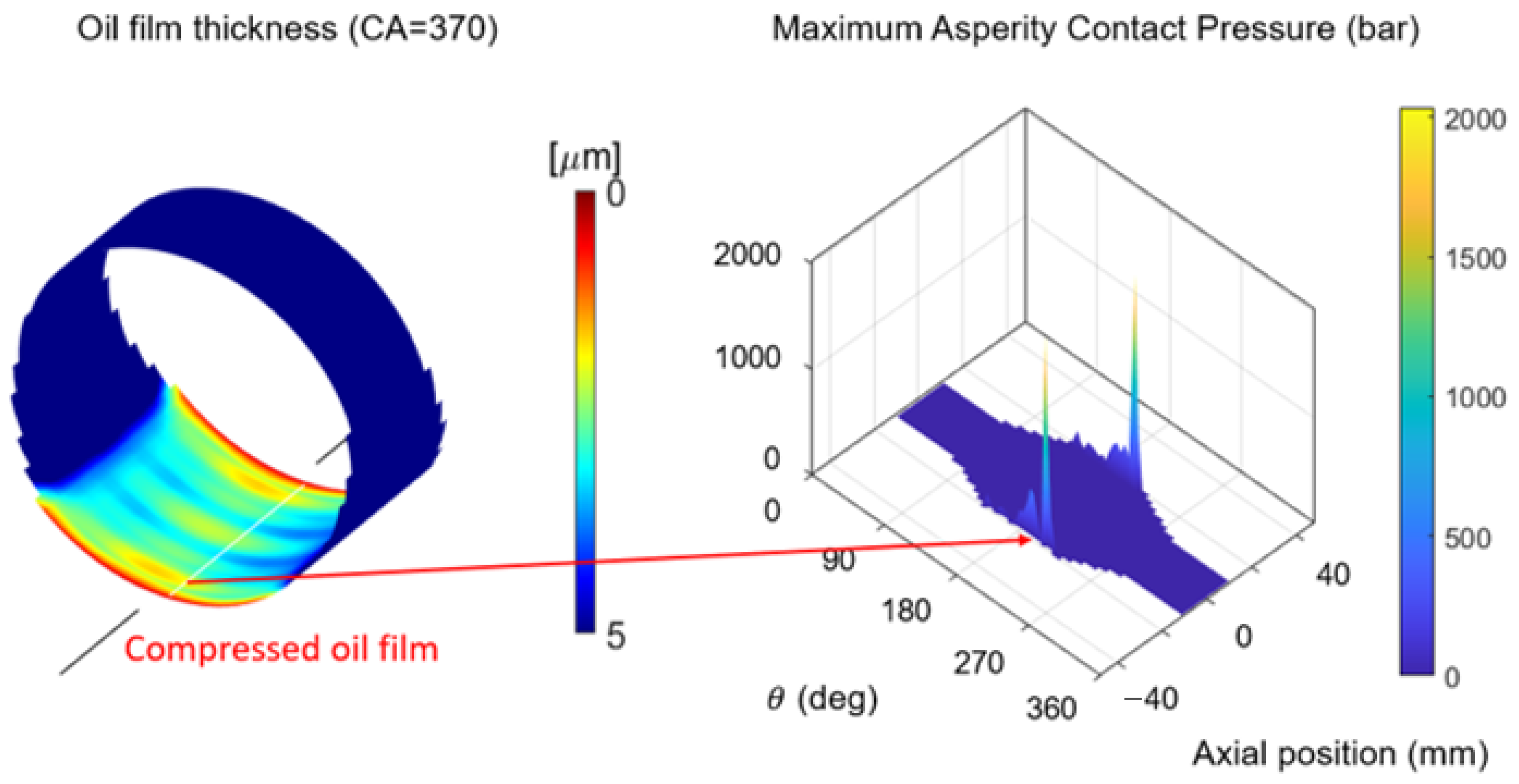
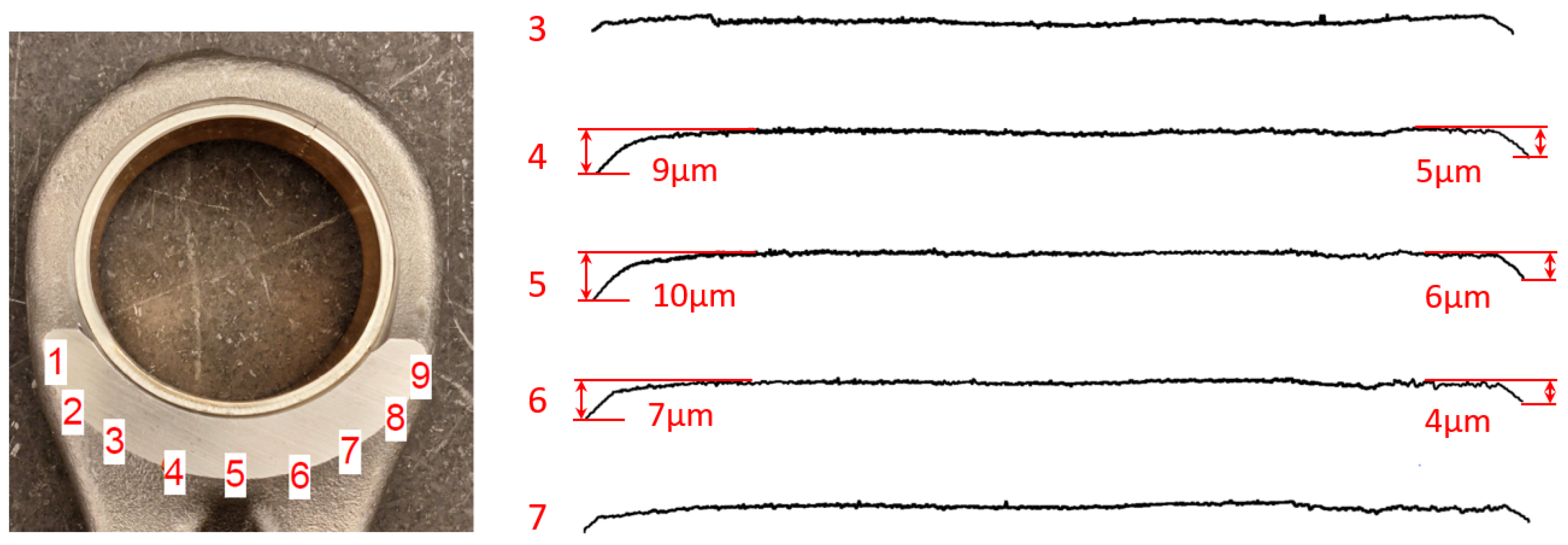
In a new connecting rod, the small-end bushing typically starts with a straight profile, without any intentional edge rounding. Figure 11 compares the measured geometry before and after engine testing. The original surface shows about 2 µm of unevenness, and the initially sharp edge has been reshaped into a rounded corner with a depth of 6–10 µm. This edge rounding is a direct outcome of concentrated loading near the lower edge at ignition top dead center (TDC), where the bent piston pin compresses the oil film and intensifies local asperity contact (Figure 12). The gradual reshaping of the edge alleviates these high-pressure zones, redistributes friction.
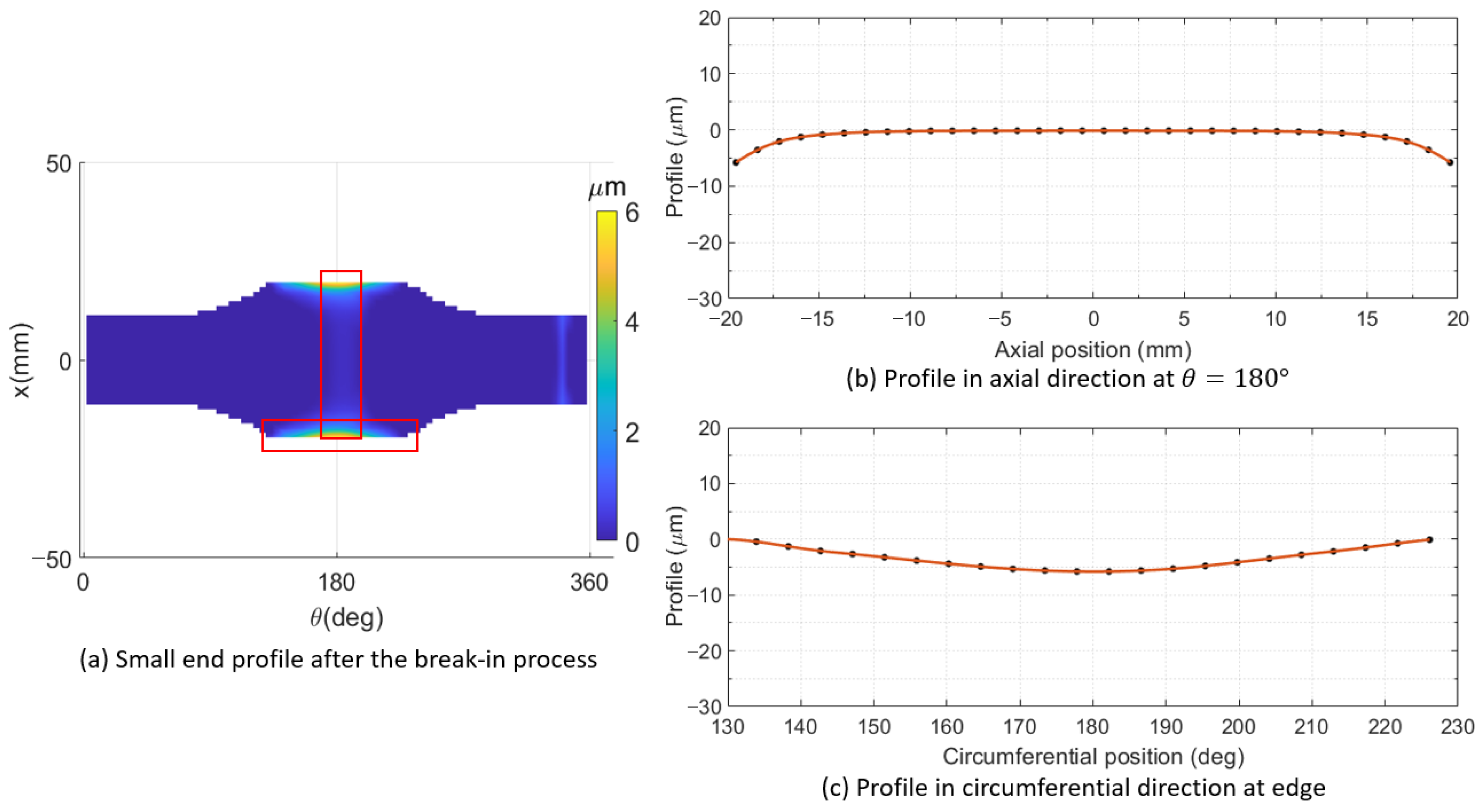
Figure 13 illustrates how the small-end profile evolves from its initial straight configuration after the simulated break-in process. Figure 13a shows the profile over the entire small end surface, which is the change in profile relative to the pre-break-in state. Figure 13b presents the profile along the central axial line at the bottom of the small end. Figure 13c shows the profile along the bottom edge of the small end. Because the profile, governing equations, and boundary conditions are all symmetric in the axial direction throughout the simulation, the profile in Figure 13b is also symmetric. It is important to note, however, that the profile in Figure 13c is not symmetric due to the difference between the thrust and anti-thrust sides.
In this study, both the surface profile and the asperity roughness are updated each cycle under prescribed caps ( δ h max = 0.05 μm for profile evolution and α max = 0.05 for roughness adaptation) to ensure a stable and gradual evolution rate. The minimum roughness level is set to σ min = 0.16 μm, while the plasticity threshold is θ p = 3000 bar. This configuration is estimated based on material properties and preliminary measurements, though the parameters have not yet been rigorously calibrated.
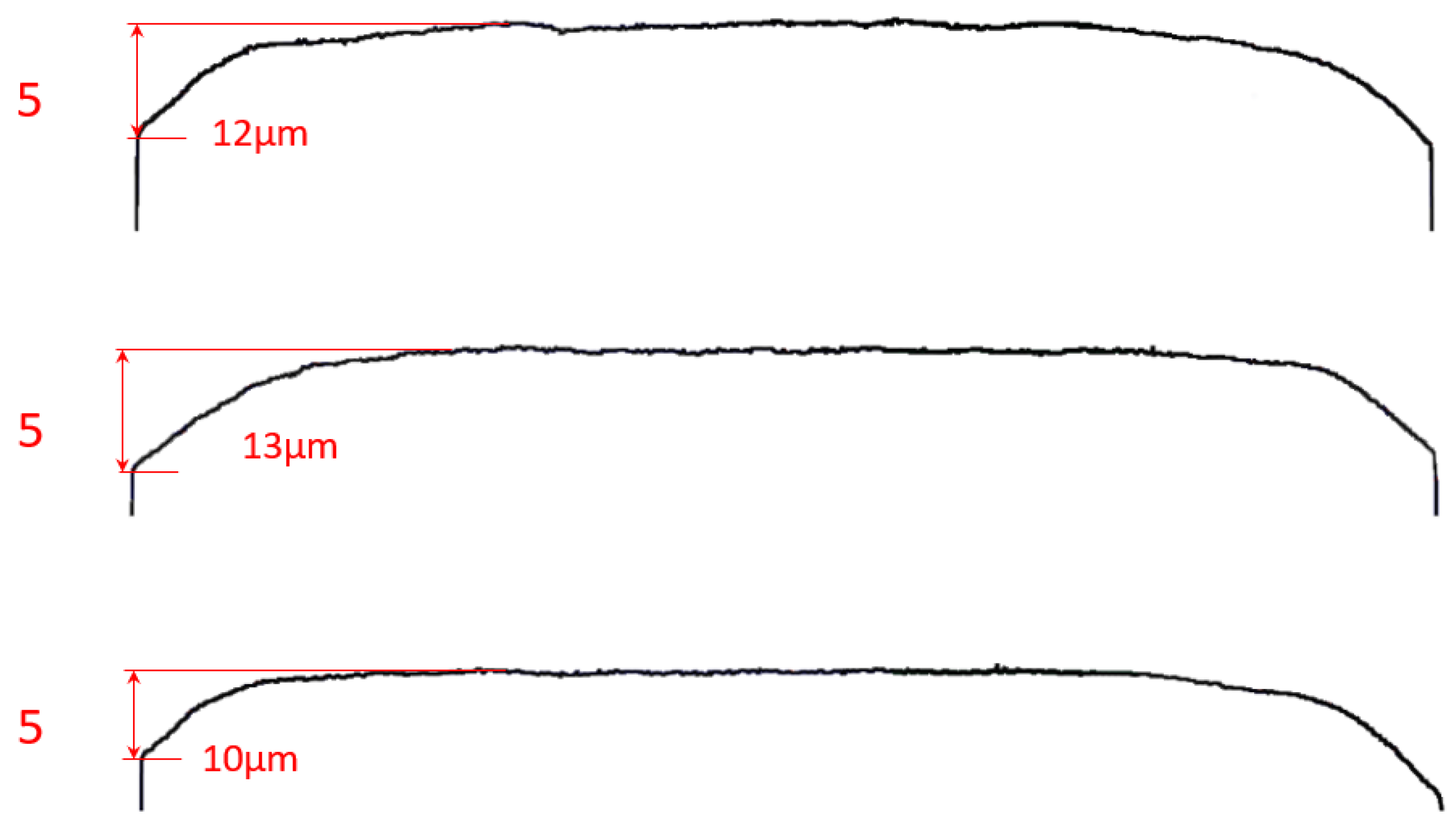
A comparison with the experimental measurements in Figure 14 reveals that while the numerical model predicts a perfectly axially symmetric profile, the experimental results exhibit distinct asymmetry. This discrepancy is likely attributable to asymmetries in the actual operating environment, such as connecting rod misalignment and non-uniform oil supply, which lead to asymmetric boundary conditions. Consequently, the post-break-in profiles on the two sides of the small end differ in practice. Figure 15 provides additional measurements obtained after extended testing durations. The general profile shapes are consistent with the simulation, although the wear magnitudes differ. Further quantitative calibration of the wear coefficients is required to achieve closer agreement.

3.2. Piston Pin Dynamics

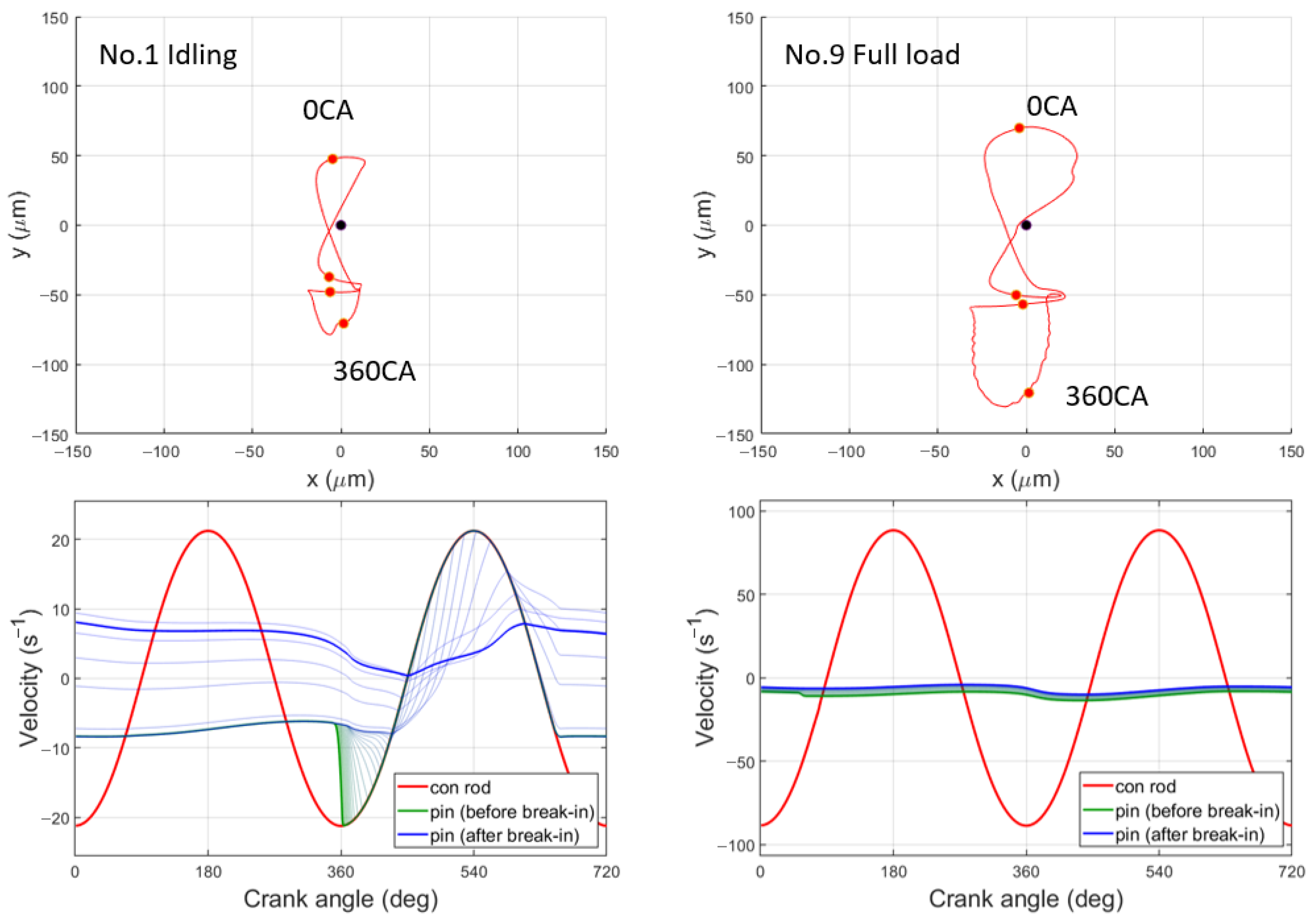
The motion of the piston pin in the small end and the piston pin bores directly affects the lubricant flow and is therefore essential for the proper operation of the piston system. The pin’s translational and rotational motion also provides a valuable means of verifying whether the simulation is functioning as expected. Figure 16 shows the pin trajectory relative to the small end center (top) and the pin’s rotation (bottom). Within one engine cycle, the combined effects of inertia and cylinder pressure determine the direction of the force transmitted between the piston and the connecting rod. At the beginning of the intake stroke ( 0 ° CA), the inertia force dominates, placing the piston pin near the top of the small end and the bottom of the piston pin bores. By the end of the intake stroke ( 180 ° CA), the inertia force reverses direction, pushing the pin against the oil film at the bottom of the small end and the top of the piston pin bores, thereby flipping its relative position. Subsequently, as the cylinder pressure increases due to compression and combustion, the cylinder pressure becomes dominant, and the pin remains near the bottom of the small end and the top of the pin bores. This continues until the end of the exhaust stroke ( 650 ° CA), when the inertia force reverses once again and the combustion-chamber pressure decreases to a low level, causing the pin to return to the relative position at the beginning of the intake stroke.
Between the pin/pin bore and pin/small end interfaces, the pin tends to rotate against the better lubricated one and stays together with the other. More specifically, if the friction (the combined effect of oil shear and boundary friction) at the pin bores dominates over that at the small end, the pin tends to remain nearly stationary relative to the piston. Otherwise, the pin tends to rotate with the small end, resulting in relative motion against the piston bores. The rotational dynamics of the piston pin are closely linked to the evolving contact and lubrication conditions. As the break-in process progresses, changes in surface geometry and roughness affect the balance of frictions acting on the pin. These effects govern whether the pin tends to rotate with the small end, remain constrained by the pin bores, or drift slowly in an intermediate state.
Prior studies [8,33,56,57] have shown that the pin exhibits a slow rotational drift during operation, typically in the same direction as connecting rod at ignition TDC. The simulation results in this study confirm this in Figure 16, where the rotational behavior of the piston pin changes slowly during the break-in. A clear trend is that the pin generally does not follow the rotation of the small end but instead exhibits a much slower drift. This may represents progressively improved lubrication and conformity at the interface of the small end and pin. Near ignition TDC, the small end imparts a rotational moment to the piston pin through tangential shear forces. As break-in progresses, these shear-driven forces diminish, leading to a gradual decrease in the pin’s rotation speed and angular acceleration.

3.3. Simulated Temperature Field Under Various Oil Supply Conditions

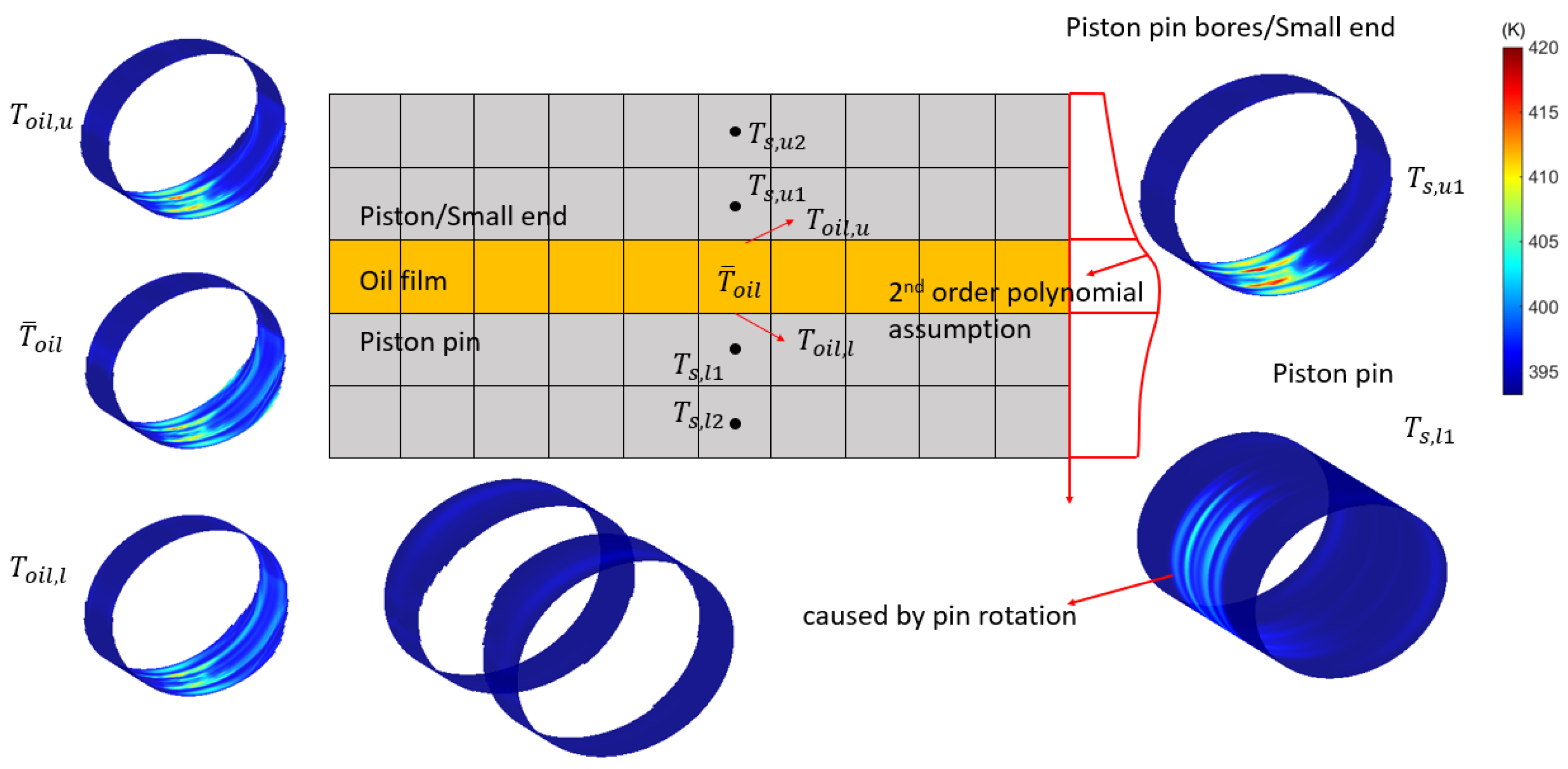
Next, the simulation of the temperature field is presented. The thermal module in our framework can resolve multiple representations of the temperature distribution, including the average lubricant temperature T ¯ o i l , the interfacial temperatures at the solid–oil boundaries T o i l , u , T o i l , l , and the temperature within the solid components T s , as illustrated in Figure 17. In this study, a simplified approximation is adopted where the boundary temperatures of the solid components are assumed to be 393.15 K everywhere, and the oil-supply temperature is also assumed to be 393.15 K. This assumption is not the real case, as the temperature within the piston generally increases toward the crown. However, adopting an isothermal assumption removes the effects of nonuniform temperature fields within the structures, allowing us to focus on the heat generation from boundary friction and its subsequent transport and dissipation.
Within the clearance, thermal energy is removed through two mechanisms: conduction in the surrounding solid structures and convection by the circulating lubricant, whereby hot oil is continuously replaced by cooler incoming oil. Consequently, the lubricant supply not only reduces asperity contact but also plays a direct role in dissipating the generated heat.
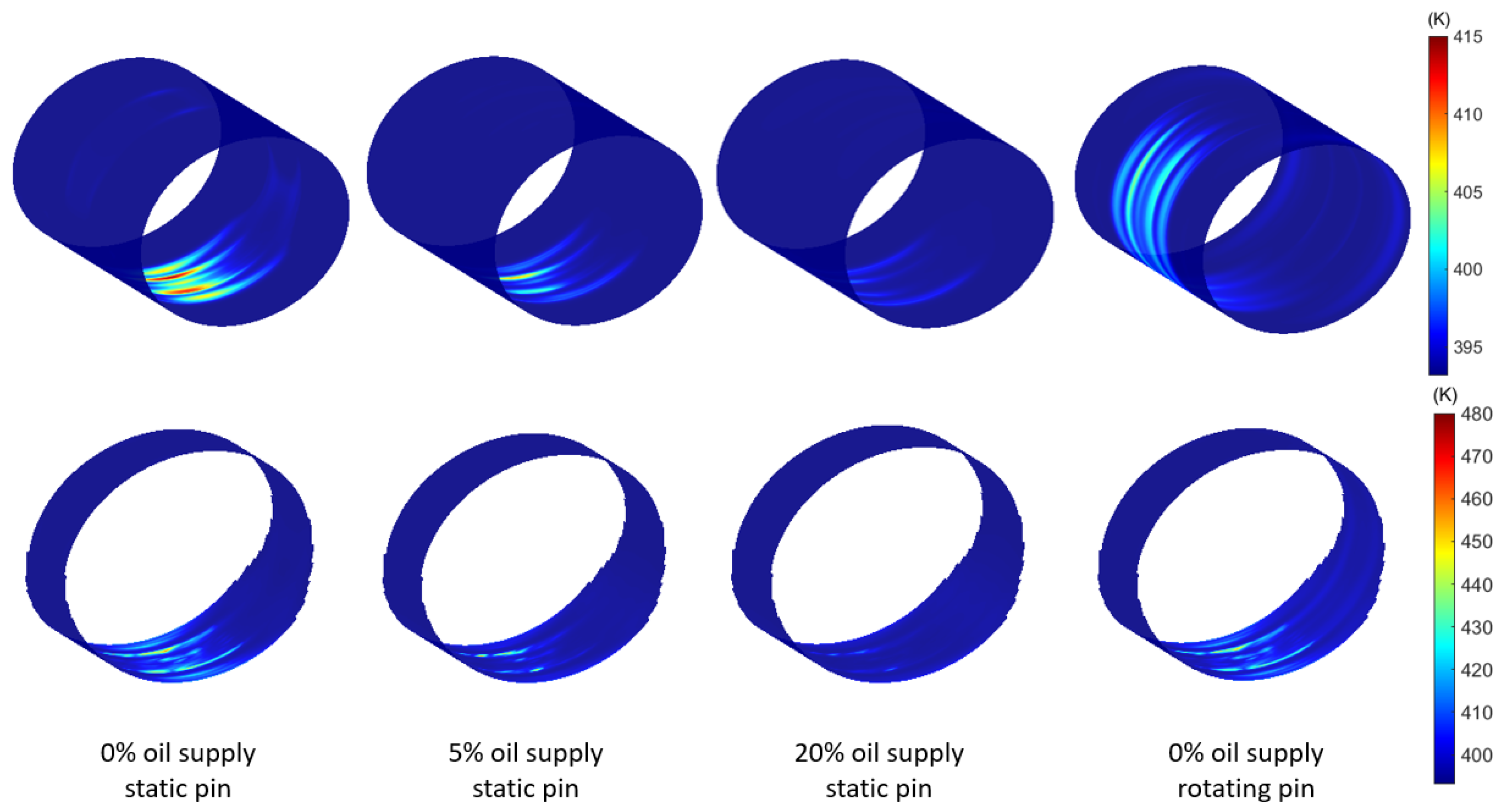
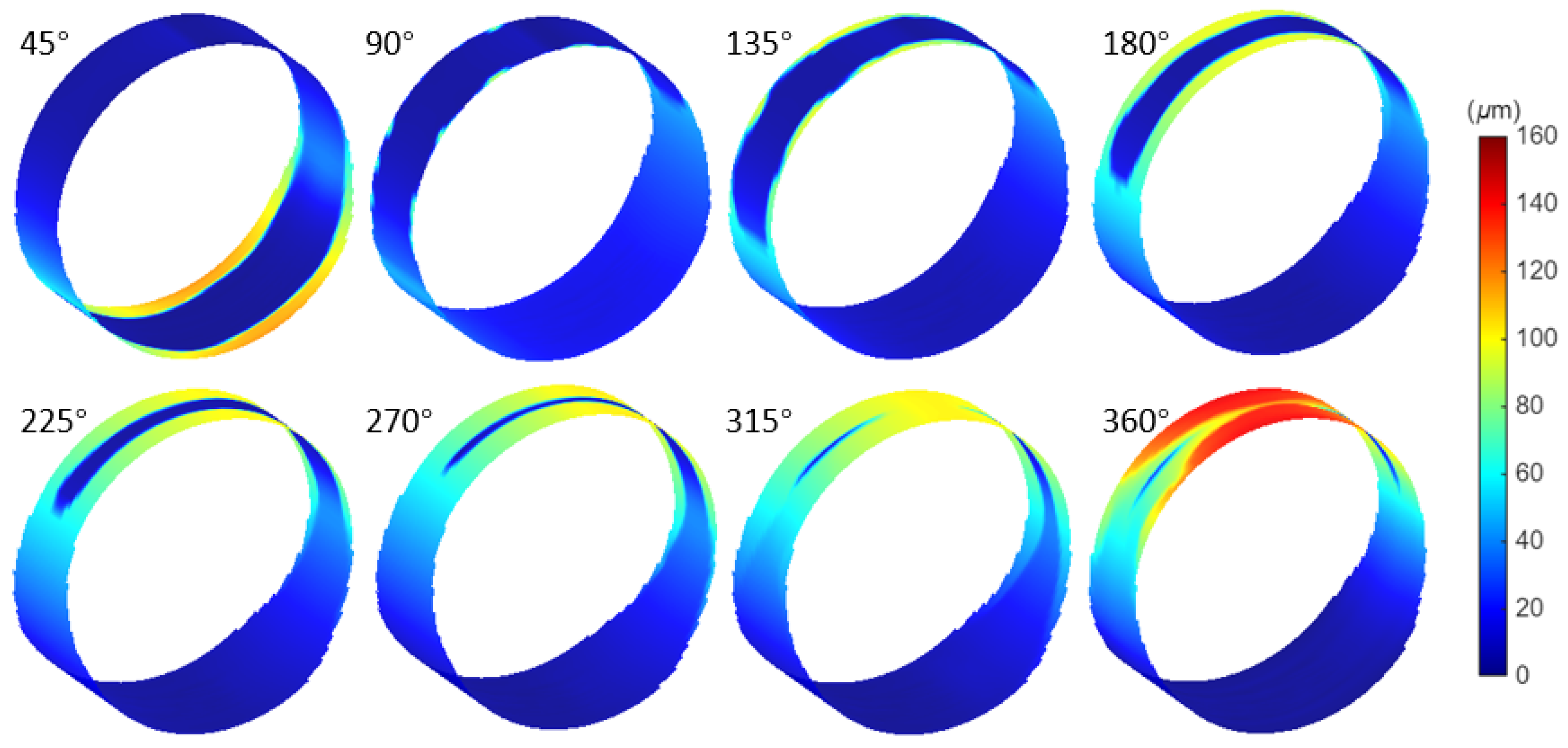
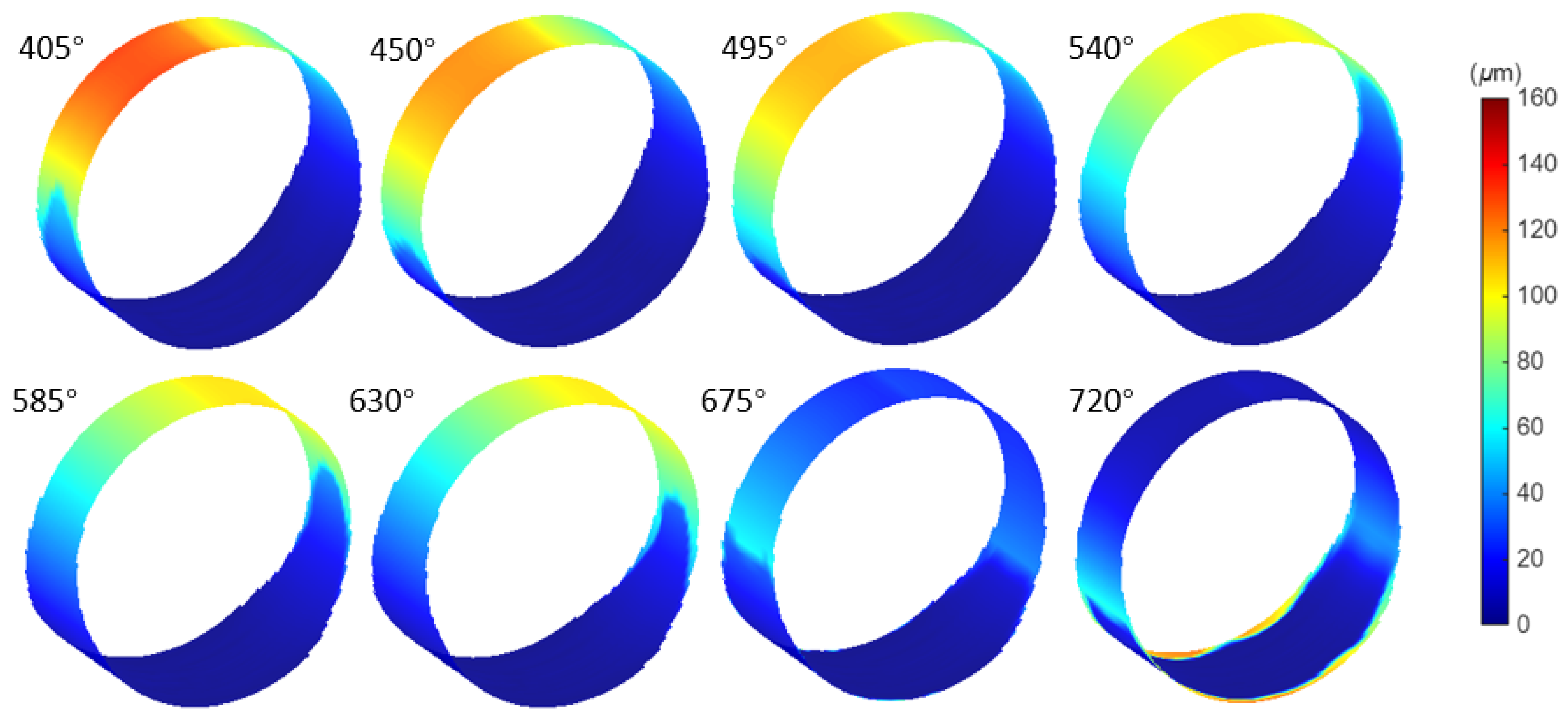
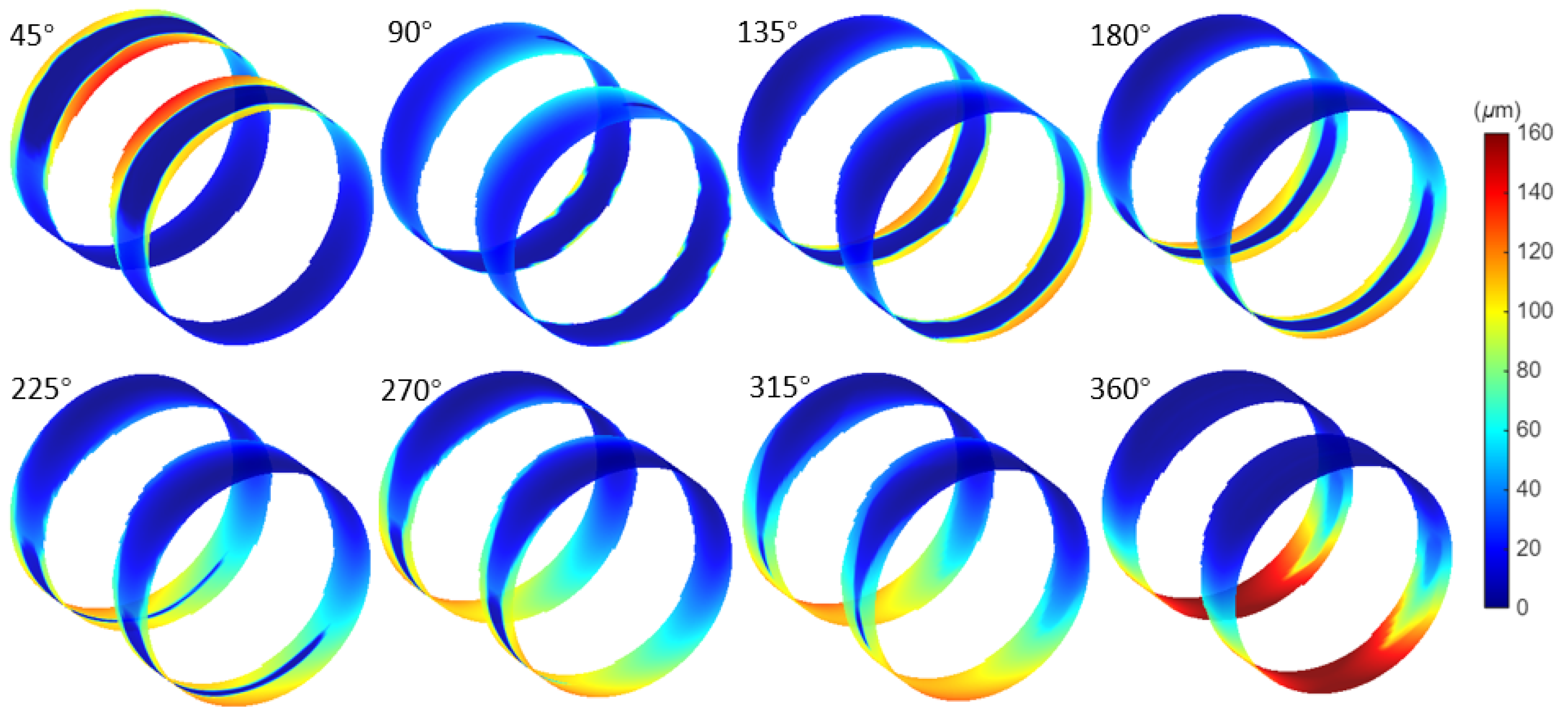
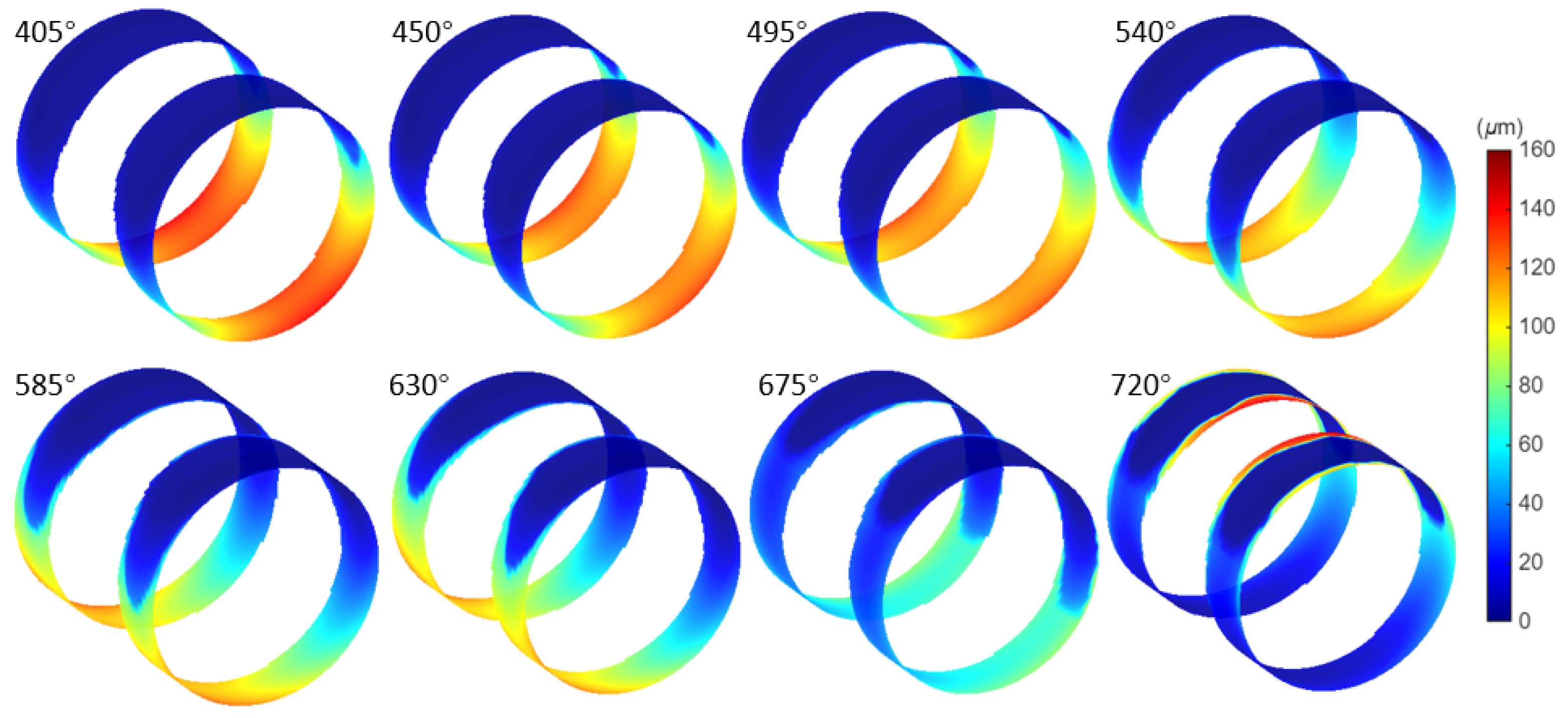
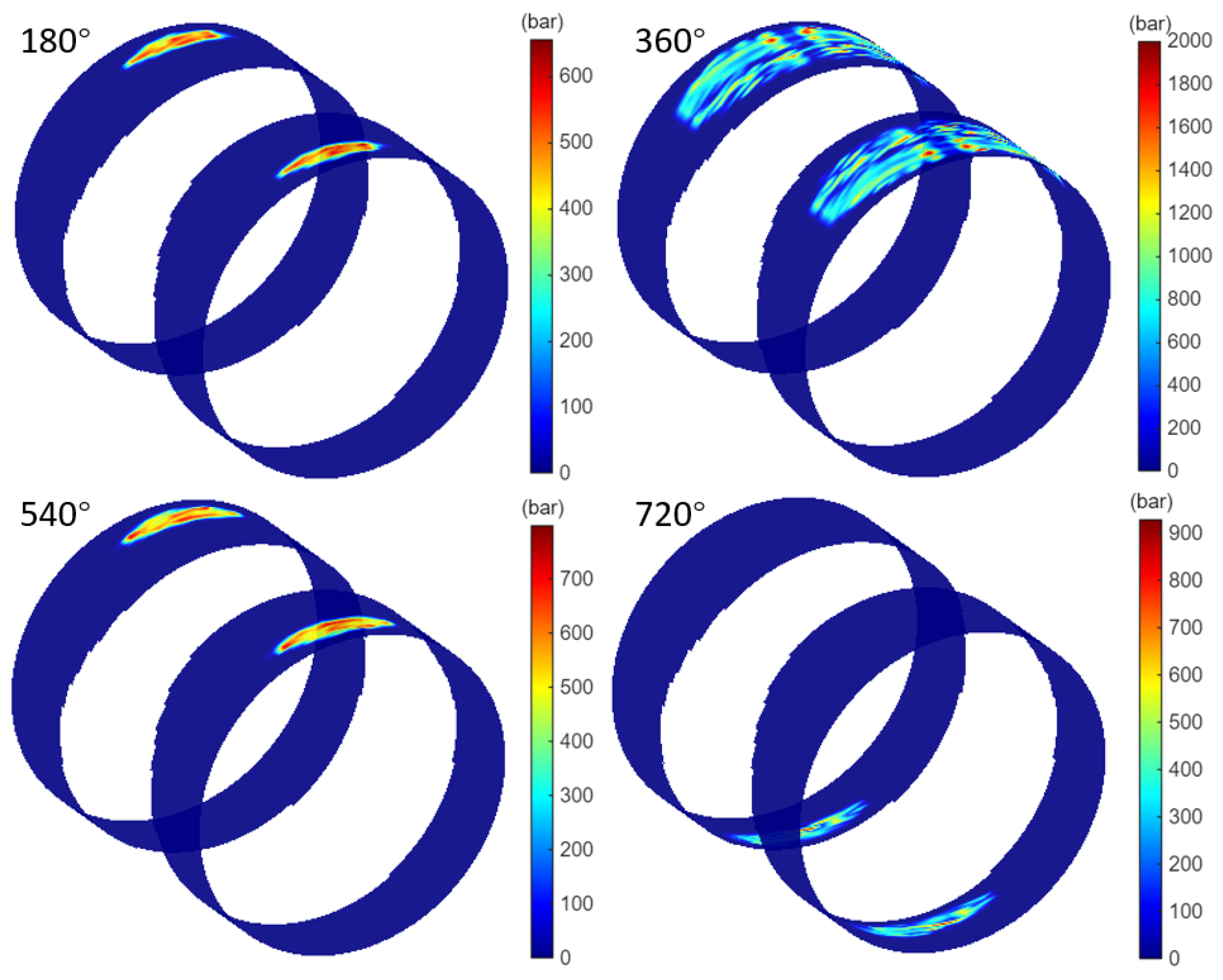
Figure 18 illustrates this effect by comparing the temperature field at the element centers of the first layer of the piston pin and the mean oil-film temperature on the small-end surface at a crank angle of 370 ° , under three levels of restricted oil supply ( 0 % , 5 % , and 20 % ). An uneven surface with a peak-to-valley amplitude of 2 μm is imposed at the bottom of the small end to accentuate localized heating. The results indicate that increasing the oil-supply probability from 0 % to even 5 % is highly effective in suppressing the temperatures associated with boundary friction. Furthermore, the rotation of the piston pin continuously redistributes the heated regions on its surface, reducing long-term heat accumulation. Together, these mechanisms highlight the importance of maintaining even a minimal level of lubricant circulation within the clearance. (Supplementary results detailing the associated oil film thickness, hydrodynamic pressure, and asperity contact pressure are presented in Appendix A).
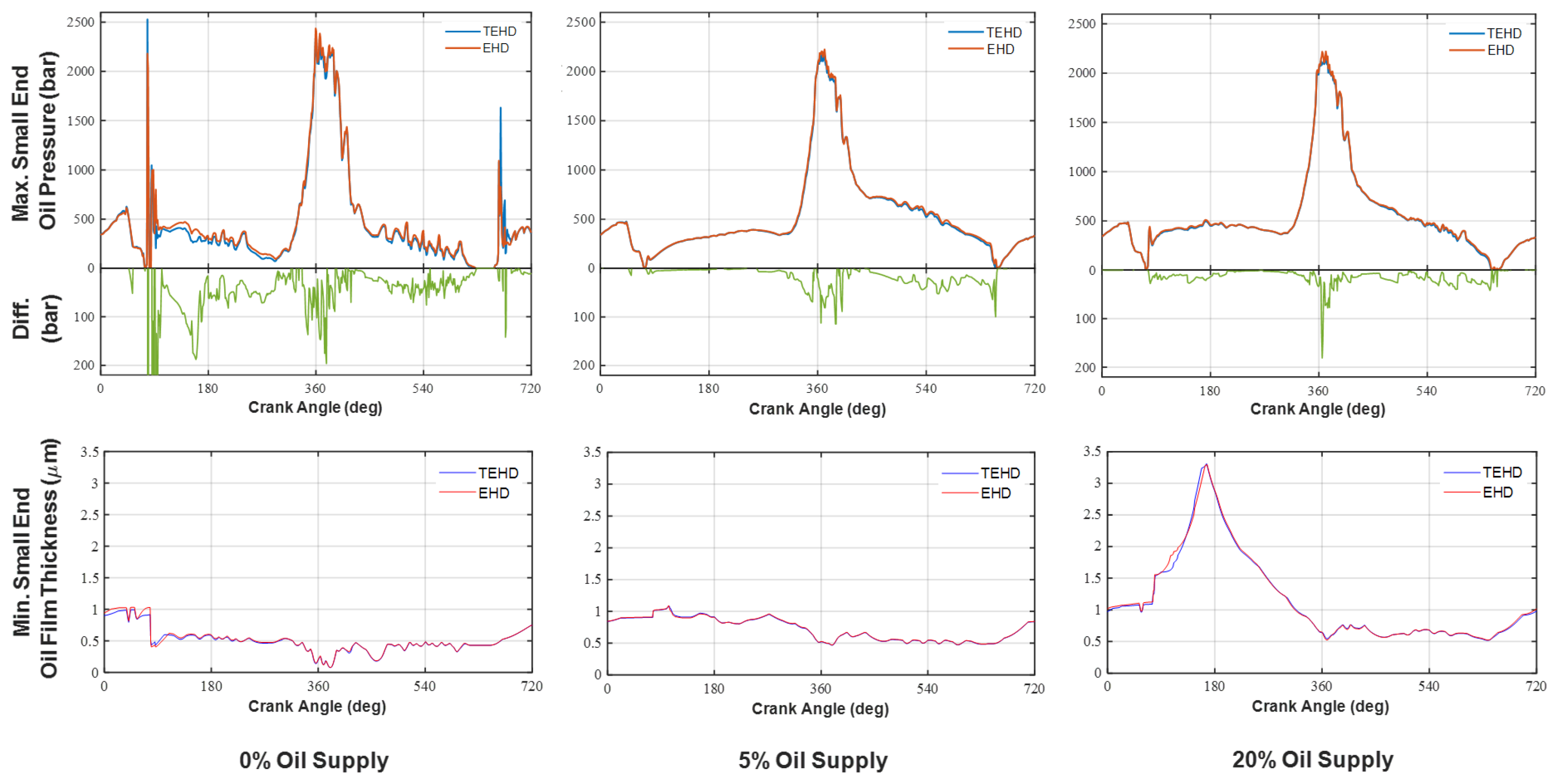
To quantify the extent to which thermal effects influence the hydrodynamic lubrication mechanism, Figure 19 presents a comparison between the TEHD and EHD model results regarding the maximum oil film pressure and minimum oil film thickness at the small end over an engine cycle. Given that high-load regions undergo alternating oil squeezing and reflow processes, a sufficient oil supply is critical for replenishing the lubricant film, thus preventing boundary friction and solid contact. In the TEHD model, the incorporation of viscosity fluctuations inevitably induces slight perturbations in the oil flow, subsequently affecting the pressure generation that resists squeezing. The comparison reveals that the isothermal EHD model tends to overestimate the oil film pressure in these high-load regions, a discrepancy that is markedly more significant under starved conditions. Specifically, in the 0% oil supply condition the EHD model overestimates the oil film pressure in high-load regions by approximately 3% to 8% compared to the TEHD model.
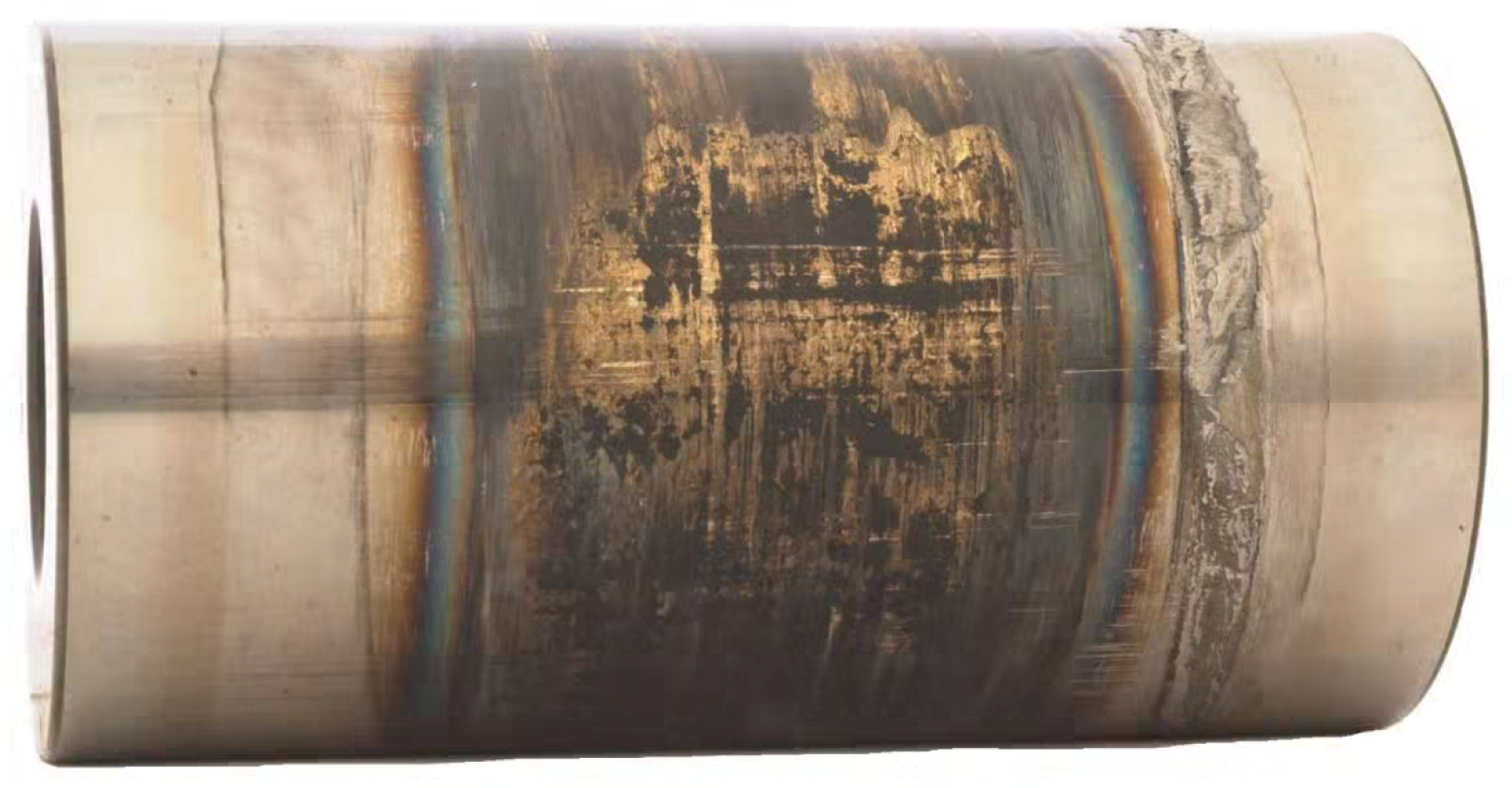
Beyond quantifying hydrodynamic discrepancies, a primary motivation for employing the TEHD model is to evaluate thermal risks and the corresponding susceptibility to scuffing and seizure. For example, a stationary pin results in persistent rubbing between fixed contact regions of the small end and the pin, leading to severe localized thermal buildup. In contrast, a healthy system maintains a slow but continuous rotation of the pin, which distributes frictional heat over a wider area and mitigates local temperature spikes. If excessive heating occurs before the completion of the break-in process, the risk of pin seizure increases substantially. Elevated temperatures degrade lubricant performance by accelerating oxidation and thermal degradation, potentially causing carbonization and a loss of load-carrying capability. Under severe boundary friction and starved lubrication, the extremely high local temperatures may also promote micro-welding of asperities, leading to metallic adhesion at the interface, one of the most detrimental failure modes. Figure 20 illustrates these typical wear and scuffing patterns, alongside the distribution of deposits from lubricant oxidation in a heavy-duty diesel engine. The observed lacquer ’glazing’ and bluish temper colors indicate local temperatures in the range of 200–300 °C—levels significantly higher than the temperature rise induced by the introduced 2 µm surface unevenness. Effective heat dissipation enhances the system’s tolerance to uneven surface profiles and geometric nonconformity during early operation. If the generated heat can be adequately removed during break-in, the system is far more likely to remain stable in the long term, adhering to the notion, “survive the beginning, survive forever.

4. Conclusions

This work presents a fully coupled thermo-elasto-hydrodynamic (TEHD) framework for piston pin systems, integrating hydrodynamics, multi-body dynamics, structural compliance, and heat transfer. By resolving the complex interactions between profile evolution, oil supply, and thermal behavior, the study yields the following key conclusions:
  • Break-in and Profile Evolution: The integration of an Archard-type wear model with plastic deformation successfully reproduces the early-stage geometric evolution of the piston pin interface. The predicted transition from localized asperity contact to a conforming post-break-in profile shows qualitative agreement with surface measurements from engine experiments. However, the deterministic selection and quantitative calibration of these simulation parameters remain an open challenge for future research.
  • Importance of Oil Supply: The flexible treatment of boundary conditions reveals that the lubrication state is highly sensitive to oil availability. Sensitivity analysis demonstrates that even a marginal oil supply is sufficient to sustain flow circulation and heat dissipation, indicating that a fully flooded condition is not strictly necessary for thermal stability adequate lubrication. Conversely, a complete loss of supply triggers rapid thermal accumulation, leading to temperature spikes that significantly elevate the risk of scuffing and seizure.
  • Thermo-Mechanical Coupling: The thermal module elucidates the link between kinematic behavior and localized heat buildup. Regions characterized by poor conformity, insufficient pin rotation, or restricted lubricant flow are identified as being particularly prone to thermal accumulation. The model ensures strict energy conservation, providing a physical explanation for experimentally observed scuffing or seizure locations.
  • Dynamic Behavior: The coupled simulation captures essential features of piston-pin motion, including its relative vertical oscillation and the gradual evolution of pin rotation speed as the break-in process modifies the contact geometry.
Overall, the proposed framework serves as a robust digital tool for the design and root-cause analysis of piston pin systems. It enables a systematic exploration of how clearance, profile design, and oil supply strategies jointly influence mechanical efficiency and reliability.
Future investigations will aim to address current limitations and enhance model fidelity through the following directions: (1) Experimental calibration of wear coefficients to enable quantitative life prediction beyond the current analysis; (2) coupling with system-level thermal and hydraulic models to replace simplified boundary conditions with dynamic real-time inputs; (3) incorporating lubricant degradation and material fatigue to assess long-term durability; (4) extending the validation to diverse engine architectures and operating conditions; and (5) transitioning from simplified statistical contact model to deterministic approaches to investigate the specific influence of detailed surface textures and roughness patterns on lubrication performance and asperity interaction.

Author Contributions

Conceptualization, Z.S. and T.T.; methodology, Z.S.; software, Z.S.; validation, Z.S.; formal analysis, Z.S.; investigation, Z.S.; resources, T.T.; data curation, Z.S.; writing—original draft preparation, Z.S.; writing—review and editing, T.T.; visualization, Z.S.; supervision, T.T.; project administration, T.T.; funding acquisition, T.T. All authors have read and agreed to the published version of the manuscript.

Funding

This research was funded by the Consortium on Lubrication in IC Engines at MIT.

Institutional Review Board Statement

Not applicable.

Informed Consent Statement

Not applicable.

Data Availability Statement

The original contributions presented in this study are included in the article. Further inquiries can be directed to the corresponding author.

Acknowledgments

The authors would like to acknowledge the Consortium on Lubrication in IC Engines at MIT for supporting this work. Current consortium members include Everlence, Mahle GmbH, Rolls-Royce Solutions, Scania, Shell, Volvo Truck, and Weichai Power. The authors also would like to extend gratitude to Rolf-Gerhard Fiedler at Mahle and Per Liljeros at Volvo Penta for their valuable support, professional guidance, and constructive feedback that greatly contributed to this work.

Conflicts of Interest

The authors declare no conflicts of interest.

Appendix A

Appendix A.1. Oil Supply Ratio 20%: 2 µm Unevenness Introduced to Small End Bottom

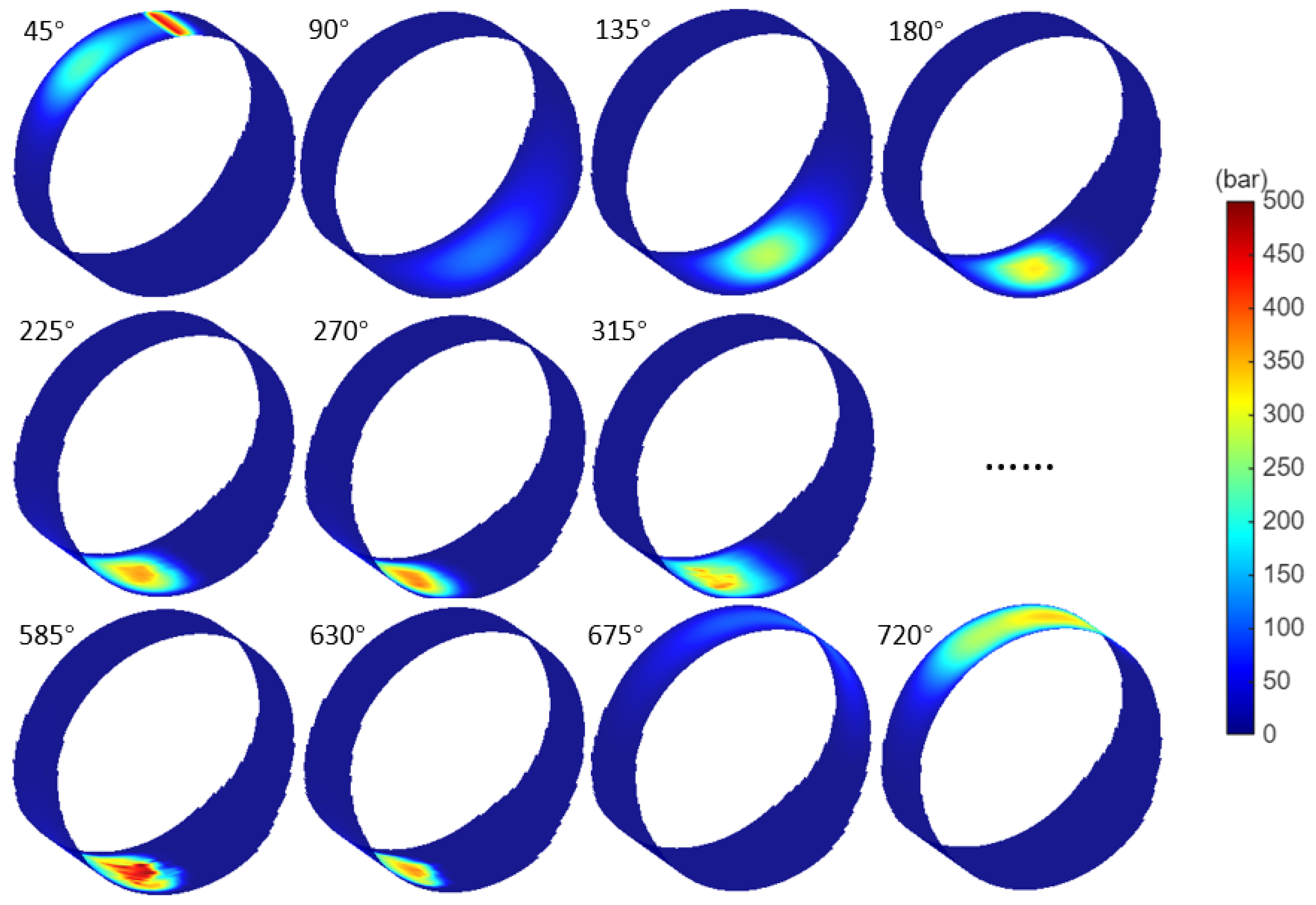
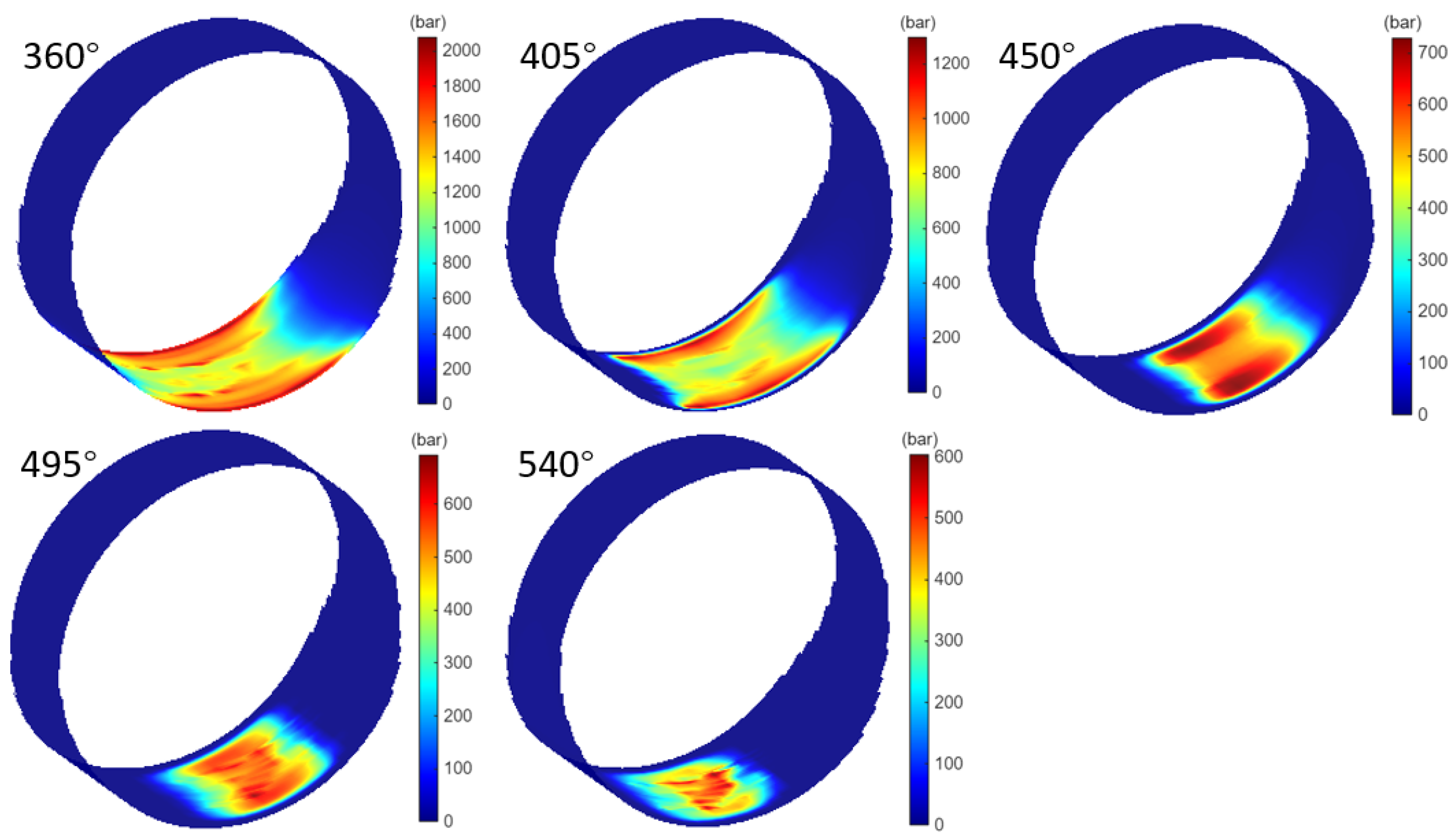
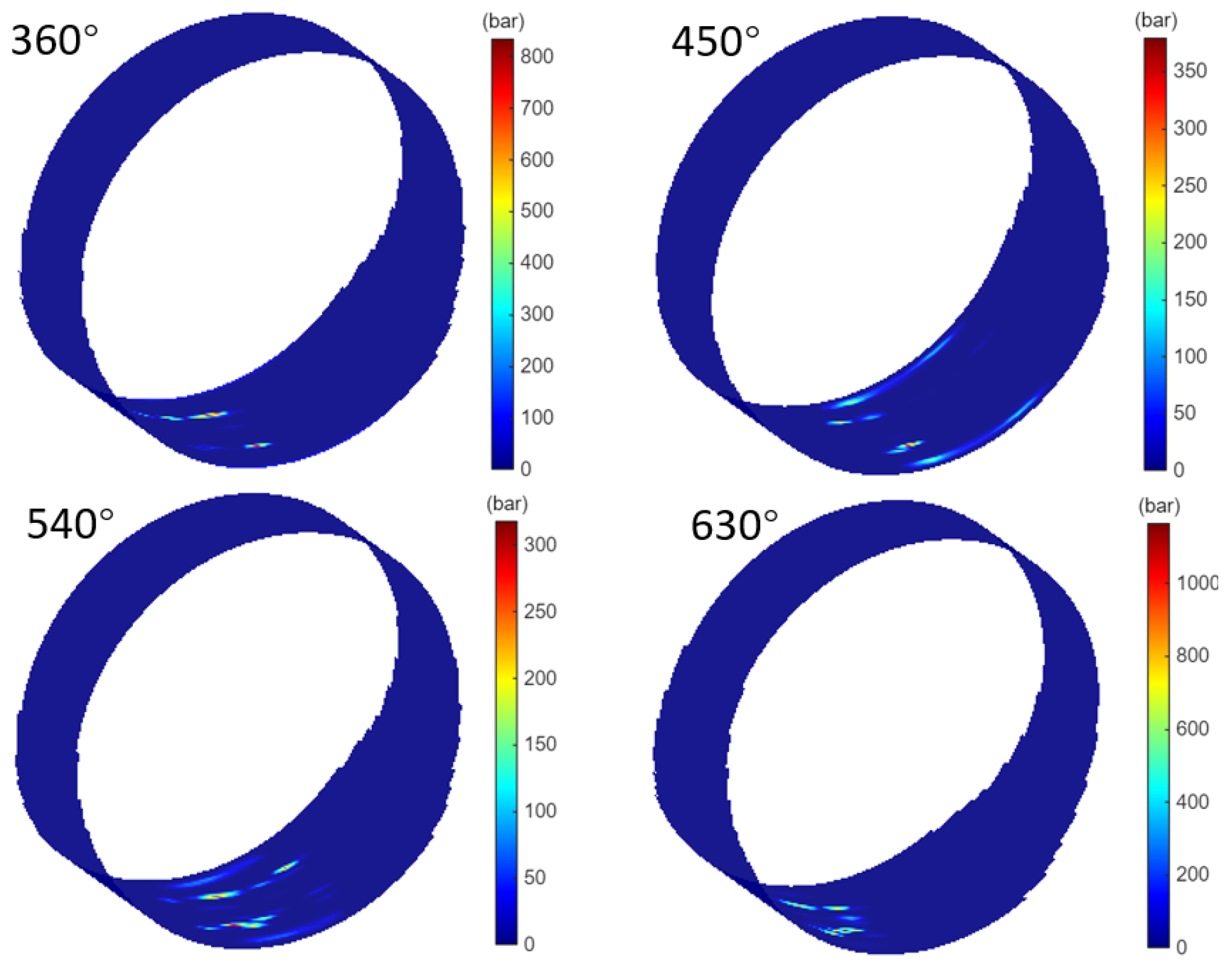
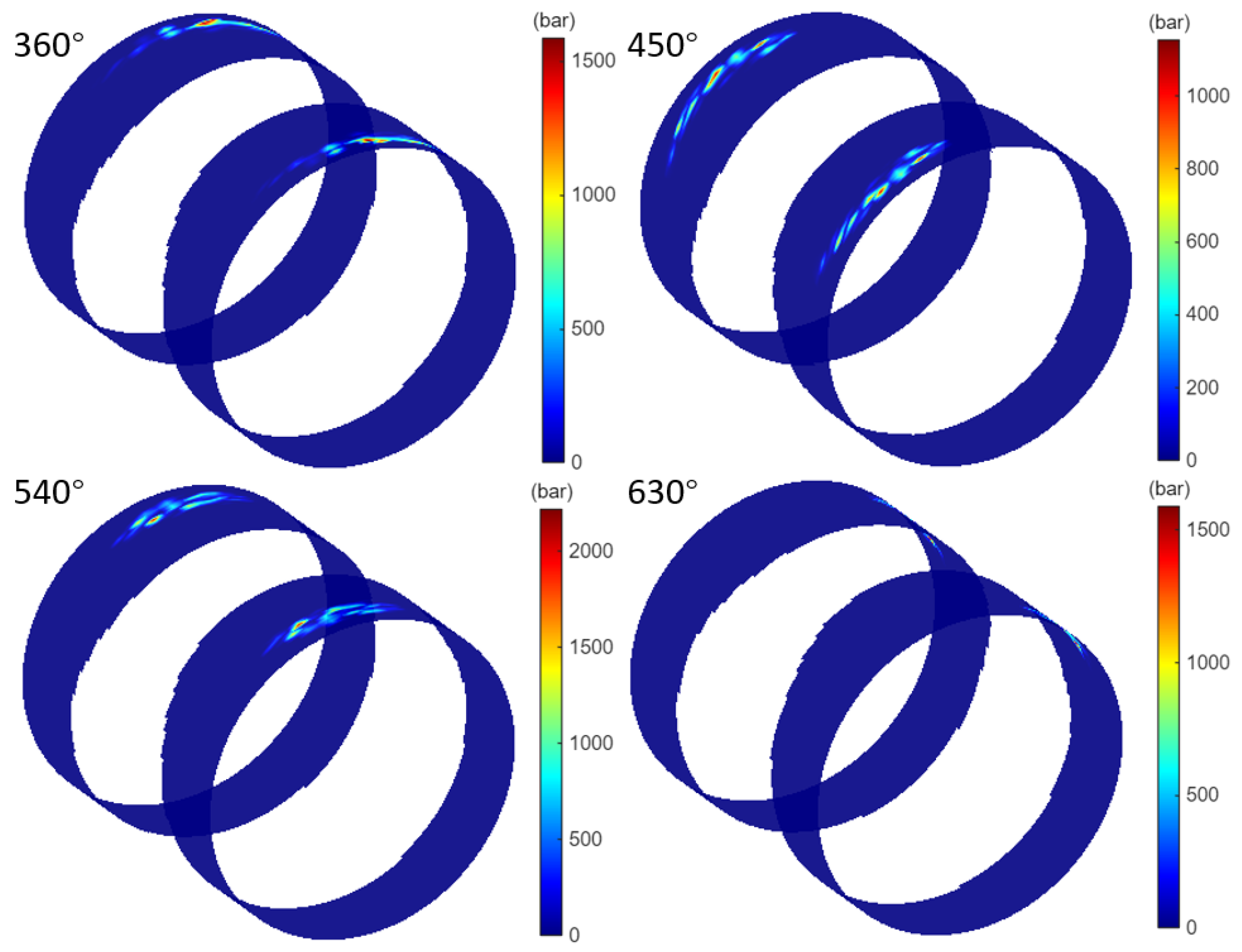
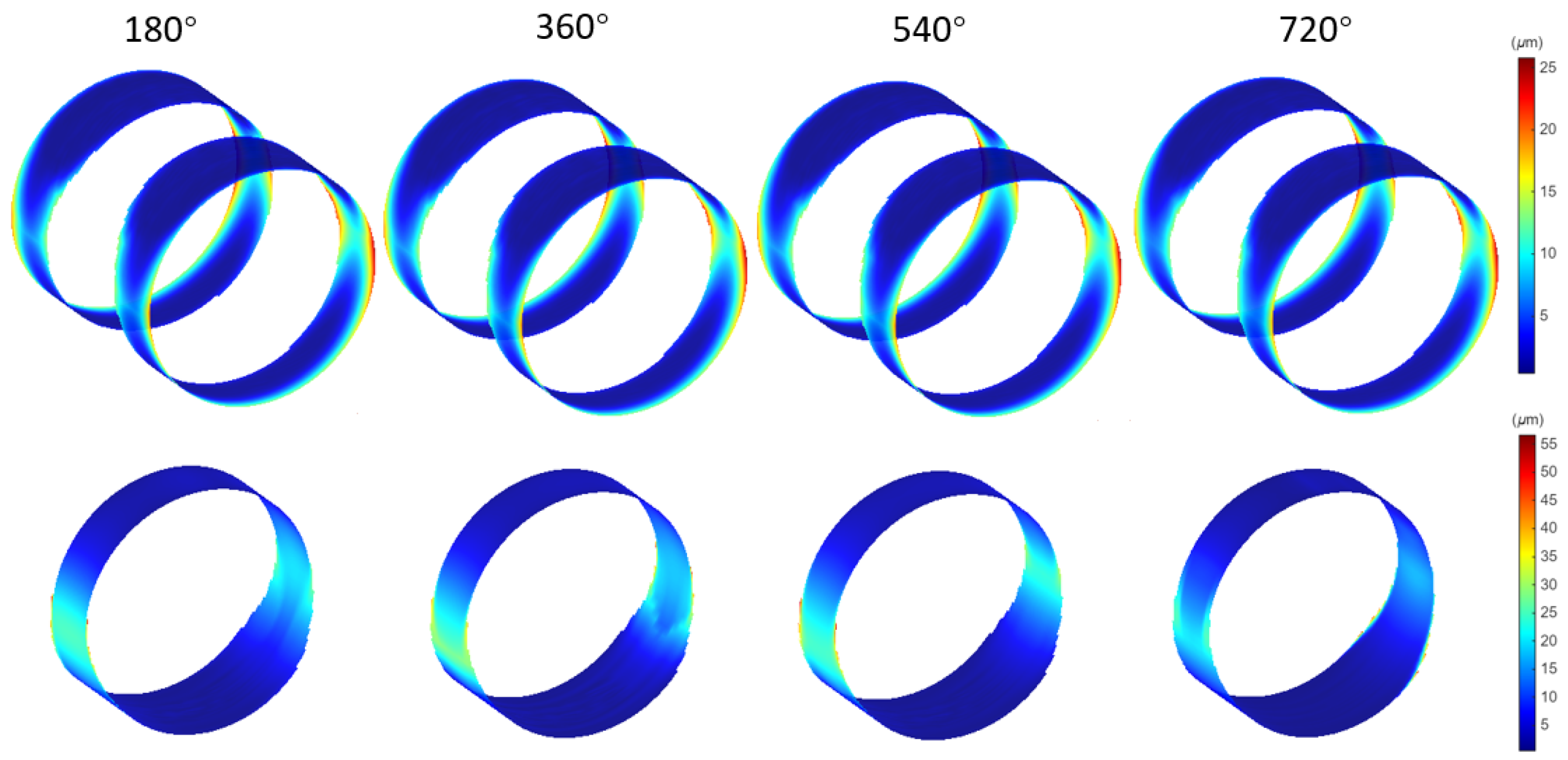
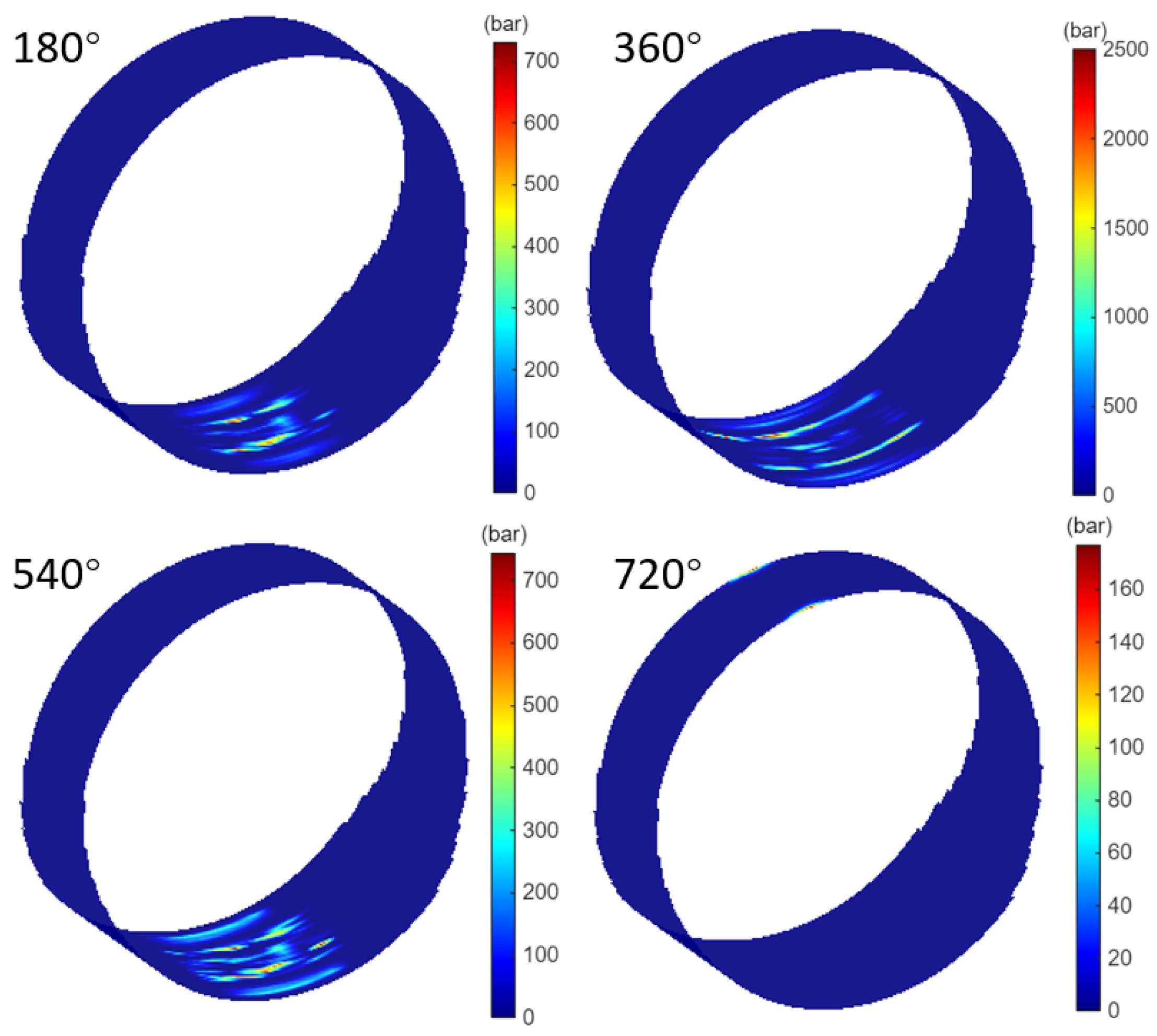
Figure A1. Small end oil film thickness distribution. 45–360 CA (Oil Supply Ratio 20%).
Systems 14 00077 g0a1
Figure A2. Small end oil film thickness distribution. 405–720 CA (Oil Supply Ratio 20%).
Systems 14 00077 g0a2
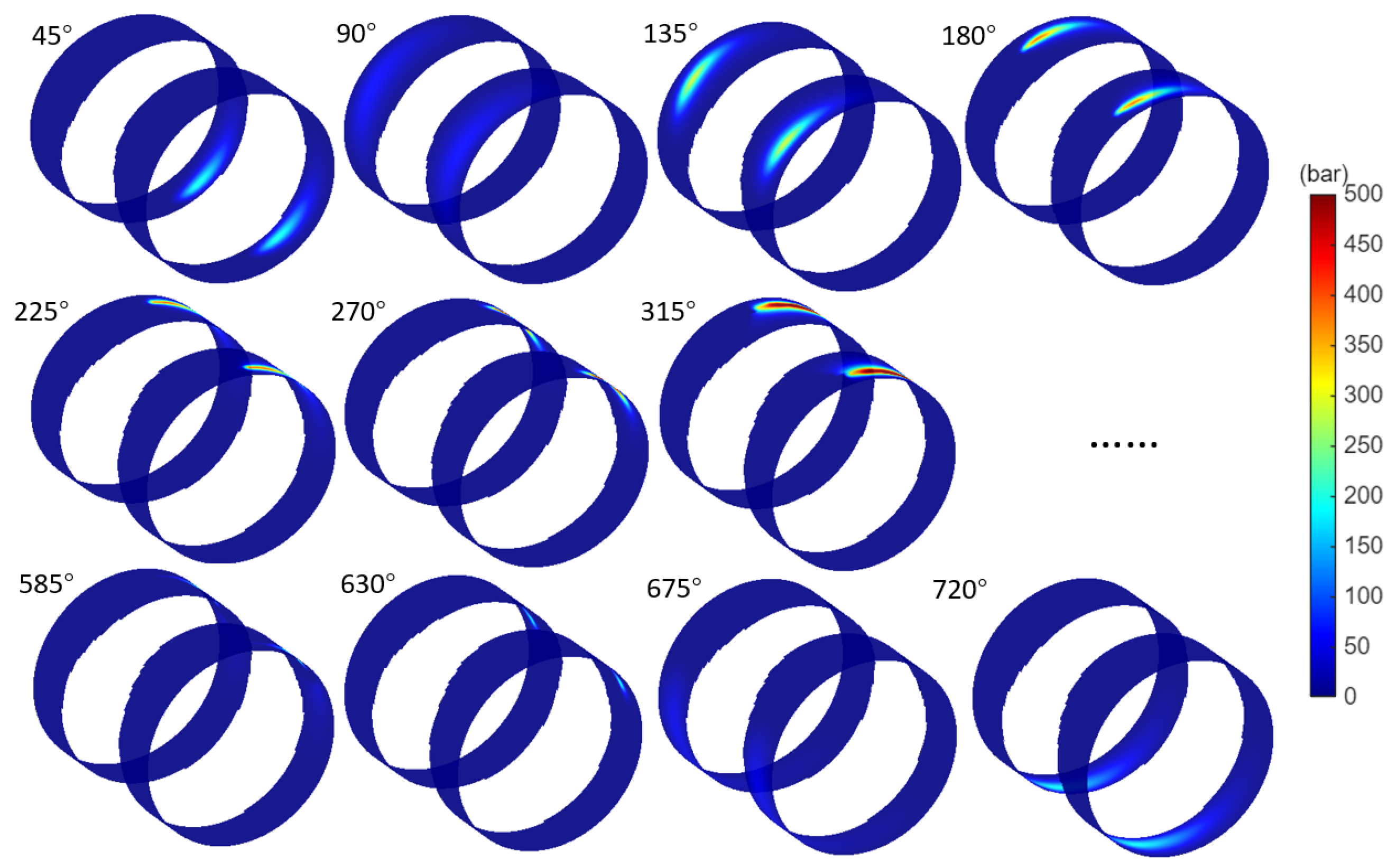
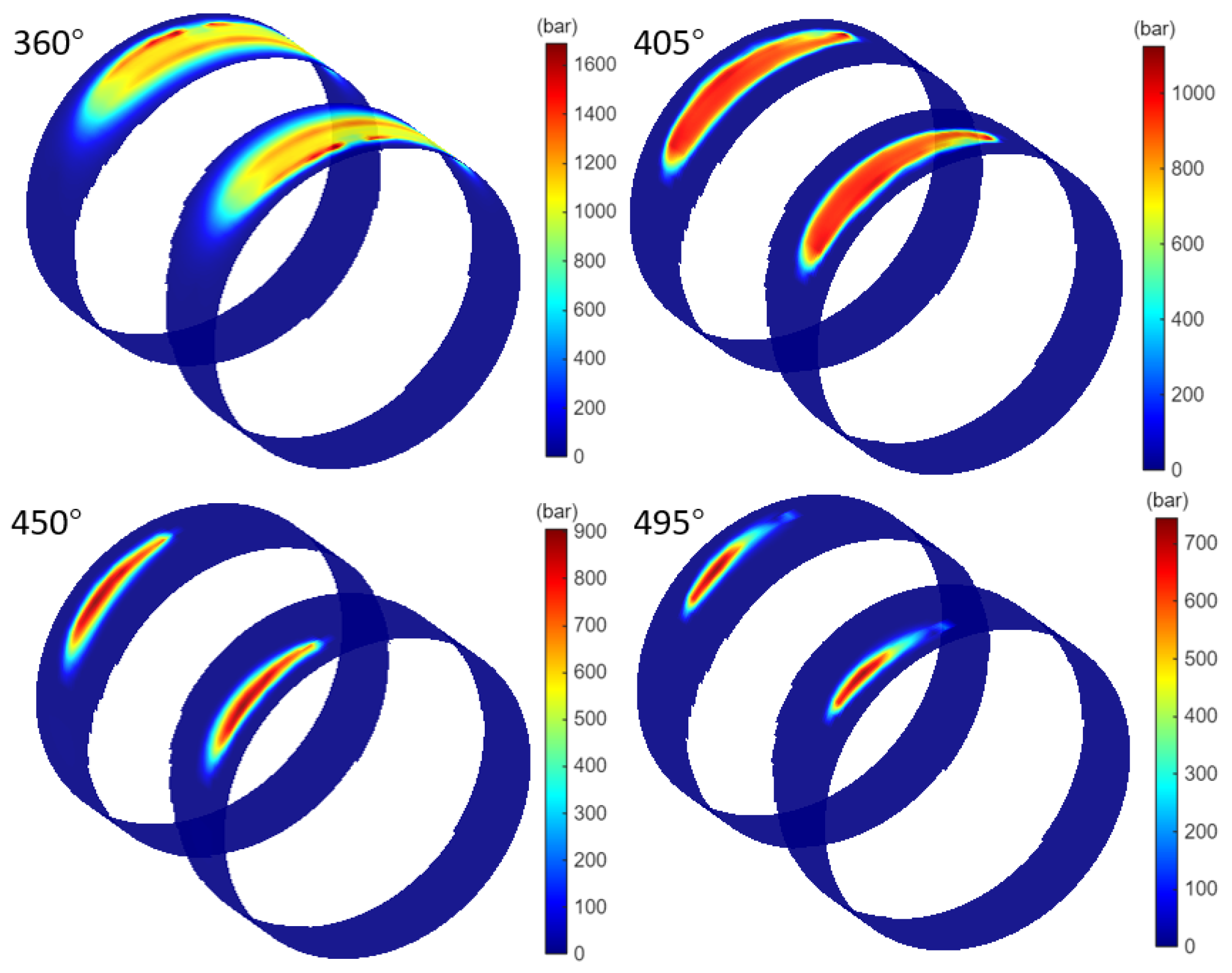
Figure A3. Piston pin bores oil film thickness distribution. 45–360 CA (Oil Supply Ratio 20%).
Systems 14 00077 g0a3
Figure A4. Piston pin bores oil film thickness distribution. 405–720 CA (Oil Supply Ratio 20%).
Systems 14 00077 g0a4
Figure A5. Small end hydrodynamic pressure. High load period is displayed in Figure A6 (Oil Supply Ratio 20%).
Systems 14 00077 g0a5
Figure A6. Small end hydrodynamic pressure. High load period (Oil Supply Ratio 20%).
Systems 14 00077 g0a6
Figure A7. Piston pin bores hydrodynamic pressure. High load period is displayed in Figure A8 (Oil Supply Ratio 20%).
Systems 14 00077 g0a7
Figure A8. Piston pin bores hydrodynamic pressure. High load period (Oil Supply Ratio 20%).
Systems 14 00077 g0a8
Figure A9. Small end asperity contact pressure (Oil Supply Ratio 20%).
Systems 14 00077 g0a9
Figure A10. Piston pin bores asperity contact pressure (Oil Supply Ratio 20%).
Systems 14 00077 g0a10

Appendix A.2. Oil Supply Ratio 0%: 2 µm Unevenness Introduced to Small End Bottom

Figure A11. Piston pin bores and small end oil film thickness distribution (Oil Supply Ratio 0%).
Systems 14 00077 g0a11
Figure A12. Small end asperity contact pressure (Oil Supply Ratio 0%).
Systems 14 00077 g0a12
Figure A13. Piston pin bores asperity contact pressure (Oil Supply Ratio 0%).
Systems 14 00077 g0a13

References

  1. Alagumalai, A. Internal combustion engines: Progress and prospects. Renew. Sustain. Energy Rev. 2014, 38, 561–571. [Google Scholar] [CrossRef]
  2. Payri, F.; Luján, J.M.; Guardiola, C.; Pla, B. A Challenging Future for the IC Engine: New Technologies and the Control Role. Oil Gas Sci. Technol. 2015, 70, 15–30. [Google Scholar] [CrossRef]
  3. Arole, K.; Velhal, M.; Tajedini, M.; Xavier, P.G.; Bardasz, E.; Green, M.J.; Liang, H. Impacts of particles released from vehicles on environment and health. Tribol. Int. 2023, 184, 108417. [Google Scholar] [CrossRef]
  4. Richardson, D.E. Review of Power Cylinder Friction for Diesel Engines. J. Eng. Gas Turbines Power 2000, 122, 506–519. [Google Scholar] [CrossRef]
  5. Ba, L.; He, Z.P.; Liu, Y.H.; Zhang, G.C. Analysis of piston-pin lubrication considering the effects of structure deformation and cavitation. J. Zhejiang Univ.-Sci. A 2015, 16, 443–463. [Google Scholar] [CrossRef]
  6. Schmidt, M.; Reinke, P.; Rabanizada, A.; Umbach, S.; Rienäcker, A.; Branciforti, D.; Matz, G. Numerical Study of the Three-Dimensional Oil Flow Inside a Wrist Pin Journal. Tribol. Trans. 2020, 63, 415–424. [Google Scholar] [CrossRef]
  7. Sławomir, K.; Bogusław, C.; Dalibor, B.; Ján, D.; Aleš, D. Analysis of the Operational Wear of the Combustion Engine Piston Pin. Lubricants 2023, 11, 100. [Google Scholar] [CrossRef]
  8. Ligier, J.; Ragot, P. Piston Pin: Wear and Rotating Motion. SAE Trans. 2005, 114, 760–768. [Google Scholar]
  9. Suhara, T.; Ato, S.; Takiguchi, M.; Furuhama, S. Friction and Lubrication Characteristics of Piston Pin Boss Bearings of an Automotive Engine. SAE Technical Paper 970840. 1997. Available online: https://www.sae.org/papers/friction-lubrication-characteristics-piston-pin-boss-bearings-automotive-engine-970840 (accessed on 31 December 2025).
  10. Strozzi, A.; Baldini, A.; Giacopini, M.; Bertocchi, E.; Mantovani, S. A repertoire of failures in gudgeon pins for internal combustion engines, and a critical assessment of the design formulae. Eng. Fail. Anal. 2018, 87, 22–48. [Google Scholar] [CrossRef]
  11. Abed, G.; Zou, Q.; Barber, G.; Zhou, B.; Wang, Y.; Liu, Y.; Shi, F. Study of the Motion of Floating Piston Pin against Pin Bore. SAE Int. J. Engines 2013, 6, 990–998. [Google Scholar] [CrossRef]
  12. Li, Z.; He, X.; Yang, Y.; Liu, Q. Investigation and control of the ticking noise of the full floating piston pin. Adv. Mech. Eng. 2023, 15. [Google Scholar] [CrossRef]
  13. Khonsari, M.M.; Beaman, J.J. Thermohydrodynamic Analysis of Laminar Incompressible Journal Bearings. ASLE Trans. 1986, 29, 141–150. [Google Scholar] [CrossRef]
  14. Boncompain, R.; Fillon, M.; Frene, J. Analysis of Thermal Effects in Hydrodynamic Bearings. ASME J. Tribol. 1986, 108, 219–224. [Google Scholar] [CrossRef]
  15. Ott, H.H.; Paradissiadis, G. Thermohydrodynamic Analysis of Journal Bearings Considering Cavitation and Reverse Flow. ASME J. Tribol. 1988, 110, 439–447. [Google Scholar] [CrossRef]
  16. Paranjpe, R.S.; Han, T. A Study of the Thermohydrodynamic Performance of Steadily Loaded Journal Bearings. Tribol. Trans. 1994, 37, 679–690. [Google Scholar] [CrossRef]
  17. Goenka, P.K. Dynamically Loaded Journal Bearings: Finite Element Method Analysis. ASME J. Tribol. 1984, 106, 429–437. [Google Scholar] [CrossRef]
  18. Elrod, H.G. A Cavitation Algorithm. ASME J. Lubr. Technol. 1981, 103, 350–354. [Google Scholar] [CrossRef]
  19. Khonsari, M.M.; Wang, S.H. On The Fluid-Solid Interaction in Reference to Thermoelastohydrodynamic Analysis of Journal Bearings. ASME J. Tribol. 1991, 113, 398–404. [Google Scholar] [CrossRef]
  20. Paranjpe, R.S.; Han, T. A Transient Thermohydrodynamic Analysis Including Mass Conserving Cavitation for Dynamically Loaded Journal Bearings. ASME J. Tribol. 1995, 117, 369–378. [Google Scholar] [CrossRef]
  21. Paranjpe, R.S.; Goenka, P.K. Analysis of Crankshaft Bearings Using a Mass Conserving Algorithm. Tribol. Trans. 1990, 33, 333–344. [Google Scholar] [CrossRef]
  22. Knight, J.D.; Niewiarowski, A.J. Effects of Two Film Rupture Models on the Thermal Analysis of a Journal Bearing. ASME J. Tribol. 1990, 112, 183–188. [Google Scholar] [CrossRef]
  23. Khonsari, M.M. A Review of Thermal Effects in Hydrodynamic Bearings Part I: Slider and Thrust Bearings. ASLE Trans. 1987, 30, 19–25. [Google Scholar] [CrossRef]
  24. Khonsari, M.M. A Review of Thermal Effects in Hydrodynamic Bearings. Part II: Journal Bearings. ASLE Trans. 1987, 30, 26–33. [Google Scholar] [CrossRef]
  25. Fridman, V.; Piraner, I.; Clark, K. Modeling of Mixed Lubrication Conditions in a Heavy Duty Piston Pin Joint. In Proceedings of the ASME 2006 Internal Combustion Engine Division Spring Technical Conference (ICES2006), Aachen, Germany, 7–10 May 2006; ASME: New York, NY, USA, 2006; pp. 741–748. [Google Scholar]
  26. Wang, D.; Mian, O.; Merritt, D.; Zhu, G. Elasto-Hydrodynamic Lubrication Analysis and Wear Prediction of Connecting Rod Small-End Bush and Piston Pin Interface. SAE Technical Paper 2008-36-0068. 2008. Available online: https://www.sae.org/papers/elasto-hydrodynamic-lubrication-analysis-wear-prediction-connecting-rod-small-end-bush-piston-pin-interface-2008-36-0068 (accessed on 31 December 2025).
  27. Knoll, G.; Lang, J.; Lazzara, M.; Bargende, M. Elasto-Hydrodynamic Simulation Procedure for the Piston Pin Support in Mixed Friction Contact. In Proceedings of the 9th Stuttgart International Symposium Automotive and Engine Technology, Stuttgart, Germany, 24–25 March 2009; Volume 2, pp. 1–18. [Google Scholar]
  28. Shi, F. An Analysis of Floating Piston Pin. SAE Int. J. Engines 2011, 4, 2100–2105. [Google Scholar] [CrossRef]
  29. Bargende, M.; Lazzara, M.; Knoll, G.; Lang, J. Elastohydrodynamisches Simulationsverfahren für die Kolbenbolzenlagerung bei Mischreibungskontakt (Elasto-Hydrodynamic Simulation Procedure for the Piston Pin Support in Mixed Friction Contact); FVV Abschlussbericht, Vorhaben Nr. 868, Heft 874; Forschungsvereinigung Verbrennungskraftmaschinen e.V.: Frankfurt am Main, Germany, 2009. [Google Scholar]
  30. Meng, Z.; Tian, T.; Lubrecht, T. A Numerical Model for Piston Pin Lubrication in Internal Combustion Engines. SAE Technical Paper 2020-01-2228. 2020. Available online: https://saemobilus.sae.org/papers/a-numerical-model-piston-pin-lubrication-internal-combustion-engines-2020-01-2228 (accessed on 31 December 2025).
  31. Meng, Z. Modeling of Piston Pin Lubrication in Internal Combustion Engines. Doctoral Dissertation, Massachusetts Institute of Technology, Cambridge, MA, USA, 2020. [Google Scholar]
  32. Biboulet, N.; Lubrecht, A.A. Efficient solver implementation for reynolds equation with mass-conserving cavitation. Tribol. Int. 2018, 118, 295–300. [Google Scholar] [CrossRef]
  33. Shu, Z.; Tian, T.; Meng, Z.; Fiedler, R.; Berbig, F. Modeling of Piston pin Rotation in a Large Bore Gas Engine. SAE Technical Paper 2023-32-0161. 2023. Available online: https://www.sae.org/papers/modeling-piston-pin-rotation-a-large-bore-gas-engine-2023-32-0161 (accessed on 31 December 2025).
  34. Shu, Z. Development and Application of Elastohydrodynamic Lubrication Model for Piston Pin. Master’s Thesis, Massachusetts Institute of Technology, Cambridge, MA, USA, 2023. [Google Scholar]
  35. Gao, L.; Liu, S.; Fu, Y.; Xu, Z.; Cui, Y.; Meng, X. A New Method to Establish Coupled Multi-Physics Model of Lubricated Pin-Hole Oscillating Pair. Int. J. Mech. Sci. 2024, 264, 108818. [Google Scholar] [CrossRef]
  36. Yin, J.; Liu, R.; Zhang, R.; Lv, B.; Meng, X. A New Tribo-Dynamics Model for Engine Connecting Rod Small-End Bearing Considering Elastic Deformation and Thermal Effects. Tribol. Int. 2023, 188, 108831. [Google Scholar] [CrossRef]
  37. Yin, J.; Cheng, S.; Fang, C.; Meng, X.; Zhang, R.; Lyu, B. Tribo-Dynamics Analysis of Engine Small-End Bearing under Real Temperature Boundary Conditions by a Wireless In-Situ Measuring Technology. Tribol. Int. 2024, 192, 109217. [Google Scholar] [CrossRef]
  38. Rabinowicz, E. The Intrinsic Variables Affecting the Stick-Slip Process. Proc. Phys. Soc. 2002, 71, 668. [Google Scholar] [CrossRef]
  39. Karnopp, D. Computer Simulation of Stick-Slip Friction in Mechanical Dynamic Systems. ASME J. Dyn. Syst. Meas. Control 1985, 107, 100–103. [Google Scholar] [CrossRef]
  40. Patir, N.; Cheng, H.S. An Average Flow Model for Determining Effects of Three-Dimensional Roughness on Partial Hydrodynamic Lubrication. ASME J. Lubr. Technol. 1978, 100, 12–17. [Google Scholar] [CrossRef]
  41. Vogel, H. The Law of the Relation Between the Viscosity of Liquids and the Temperature. Phys. Z. 1921, 22, 645–646. [Google Scholar]
  42. Roelands, C.J.A.; Vlugter, J.C.; Waterman, H.I. The Viscosity–Temperature–Pressure Relationship of Lubricating Oils and Its Correlation with Chemical Constitution. J. Basic Eng. 1963, 85, 601–607. [Google Scholar] [CrossRef]
  43. Bair, S. A Note on the Use of Roelands Equation to Describe Viscosity for EHD Hertzian Zone Calculations. ASME J. Tribol. 1993, 115, 333–334. [Google Scholar] [CrossRef]
  44. Greenwood, J.A.; Tripp, J.H. The Contact of Two Nominally Flat Rough Surfaces. Proc. Inst. Mech. Eng. 1970, 185, 625–633. [Google Scholar] [CrossRef]
  45. Hu, Y.; Cheng, H.S.; Arai, T.; Kobayashi, Y.; Aoyama, S. Numerical Simulation of Piston Ring in Mixed Lubrication—A Nonaxisymmetrical Analysis. ASME J. Tribol. 1994, 116, 470–478. [Google Scholar] [CrossRef]
  46. Ding, N.; Yan, S.; Ma, G.; Li, H.; Jiang, D. Mixed Thermo-Elasto-Hydrodynamic Lubrication and Wear Coupling Simulation Analysis for Dynamical Load Journal Bearings. Proc. Inst. Mech. Eng. Part C J. Mech. Eng. Sci. 2023, 237, 6020–6041. [Google Scholar] [CrossRef]
  47. Niu, P.; Zhang, H.; Fu, H.; Fan, Z.; Yang, X.; Stelmakh, O. Study on Splash Oil Supply and Lubrication Characteristics of Conrod Small End Bearing with C-Shaped Oil Collection Structure. Tribol. Int. 2025, 210, 110768. [Google Scholar] [CrossRef]
  48. Greenwood, J.A.; Williamson, J.B.P. Contact of Nominally Flat Surfaces. Proc. R. Soc. Lond. Ser. A Math. Phys. Sci. 1966, 295, 300–319. [Google Scholar] [CrossRef]
  49. Chang, W.R.; Etsion, I.; Bogy, D.B. An Elastic-Plastic Model for the Contact of Rough Surfaces. ASME J. Tribol. 1987, 109, 257–263. [Google Scholar] [CrossRef]
  50. Jackson, R.L.; Green, I. A Statistical Model of Elasto-Plastic Asperity Contact Between Rough Surfaces. Tribol. Int. 2006, 39, 906–914. [Google Scholar] [CrossRef]
  51. Majumdar, A.; Bhushan, B. Fractal Model of Elastic-Plastic Contact Between Rough Surfaces. ASME J. Tribol. 1991, 113, 1–11. [Google Scholar] [CrossRef]
  52. Jackson, R.L.; Streator, J.L. A Multi-Scale Model for Contact Between Rough Surfaces. Wear 2006, 261, 1337–1347. [Google Scholar] [CrossRef]
  53. Bugnicourt, R.; Sainsot, P.; Dureisseix, D.; Gauthier, C.; Lubrecht, A.A. FFT-Based Methods for Solving a Rough Adhesive Contact: Description and Convergence Study. Tribol. Lett. 2018, 66, 29. [Google Scholar] [CrossRef]
  54. Sainsot, P.; Lubrecht, A.A. Efficient Solution of the Dry Contact of Rough Surfaces: A Comparison of Fast Fourier Transform and Multigrid Methods. Proc. Inst. Mech. Eng. Part J J. Eng. Tribol. 2011, 225, 441–448. [Google Scholar] [CrossRef]
  55. Carslaw, H.S.; Jaeger, J.C. Conduction of Heat in Solids, 2nd ed.; Clarendon Press: Oxford, UK, 1959; p. 88. [Google Scholar]
  56. Branciforti, M.D.; Bargende, M. Investigation of the Piston Pin Movement, Rotation and Oil Filling Ratio of the Piston Boss. SAE Technical Paper 2021-01-0646. 2021. Available online: https://saemobilus.sae.org/papers/investigation-piston-pin-movement-rotation-oil-filling-ratio-piston-boss-2021-01-0646 (accessed on 31 December 2025).
  57. Allmaier, H.; Sander, D.E. Piston-Pin Rotation and Lubrication. Lubricants 2020, 8, 30. [Google Scholar] [CrossRef]
Figure 1. Overall structure of the thermo-elasto-hydrodynamic (TEHD) piston-pin lubrication model, including input parameters, coupled multi-physics solver, and model outputs.
Systems 14 00077 g001
Figure 2. Assembly of the piston pin system.
Systems 14 00077 g002
Figure 3. Coordinate system on piston pin’s surface.
Systems 14 00077 g003
Figure 4. FEA models for all components: the piston (orange), the connecting rod small end (blue), and the piston pin (green).
Systems 14 00077 g004
Figure 5. Compliance matrices visualization. Left: diagonal elements. Right: deformation field induced by a unit load at a selected node (selected column).
Systems 14 00077 g005
Figure 6. The clearance determined by journal eccentricity, warm-state profile and elastic deformation.
Systems 14 00077 g006
Figure 7. Warm profile of piston pin bores. Top: Warm profile of straight pin bores. Bottom: Measured warm profile with thermal deformation.
Systems 14 00077 g007
Figure 8. Discretization of the lubricant–solid temperature field.
Systems 14 00077 g008
Figure 9. Flowchart of the multi-physics coupling strategy. The calculation process features a hierarchical structure: an inner iteration loop (indicated by red arrows) tightly couples the Reynolds equation with the kinetics, dynamics, and deformation solvers within each time step, while an sub-iteration updates the temperature field via the heat transfer module until a steady state is reached.
Systems 14 00077 g009
Figure 10. Simulated engine break-in process (a) Cylinder pressure (b) Engine speed and torque (c) FMEP and maximum asperity contact pressure.
Systems 14 00077 g010
Figure 11. Small-end bushing comparison between new and tested samples. The numbers 1–9 denote different circumferential locations along the bottom region.
Systems 14 00077 g011
Figure 12. Compressed oil film and the maximum asperity contact pressure within one engine cycle.
Systems 14 00077 g012
Figure 13. Small end profile after the simulated break-in process. (a) Small end profile (b) Profile in axial direction at θ = 180 ° (c) Profile in circumferential direction at edge. The red boxes in (a) indicate the locations corresponding to the profiles in (b,c).
Systems 14 00077 g013
Figure 14. Measured profile in axial direction at different circumferential positions. Test length: 14 min. The numbers 1–9 denote different circumferential locations along the bottom region.
Systems 14 00077 g014
Figure 15. More measured worn small end profile at bottom center (position 5). Test length: 2.5 h.
Systems 14 00077 g015
Figure 16. Piston pin trajectories (relative to small end center) and rotation patterns. Left: Condition No. 1 (idling) representing the early stage of break-in. Right: Condition No. 9 (full load) representing the final stage of break-in.
Systems 14 00077 g016
Figure 17. Temperature-field outputs. The oil-film average temperature, the temperatures at the upper and lower boundaries, and the temperatures in the first solid-element layer are displayed.
Systems 14 00077 g017
Figure 18. Temperature field (K) at CA = 370°. Top row shows the outermost pin-element layer; The bottom row shows the average oil-film temperature. Two cases are compared: a static pin (zero rotational velocity relative to the piston) and a slowly rotating pin (1 rev/50 engine cycles).
Systems 14 00077 g018
Figure 19. Minimum small end oil film thickness and maximum small end oil pressure comparison between TEHD and EHD model. (0%, 5% and 20% oil supply, same condition as Figure 18).
Systems 14 00077 g019
Figure 20. Typical failure patterns on a piston pin surface: adhesive wear, lubricant degradation, and heat tinting.
Systems 14 00077 g020
Table 1. List of Symbols.
SymbolDescription
α Crank angle
β se Rotation angle of connecting rod
β pin Rotation angle of piston pin
r cs Crankshaft radius
l cr Connecting rod length
r pin Piston pin radius
r pis Piston crown radius
x be , y be Coordinates of big end center
x se , y se Coordinates of small end center
x pin , y pin Coordinates of piston pin center
y pis y-coordinate of piston mass center
ϕ i Angular position of element i
Δ A i Area of surface element i
Δ = [ Δ x , Δ y ] Eccentric displacement vector of the mating bore center relative to the pin center
m pin Mass of the piston pin
m pis Mass of the piston
m cr Mass of the connecting rod
S pis Interface between the pin and the piston pin bores
S se Interface between the pin and the small end
I cr Moment of inertia of the connecting rod
I pin Moment of inertia of the piston pin
h ( ϕ , z ) Local oil film thickness
h 0 Nominal (installation) clearance
h geo ( ϕ , z ) Cold-state geometric deviation of profiles
δ h ( ϕ , z ) Clearance variation due to elastic deformation
p h Hydrodynamic pressure. p h , i is at element i
p c Asperity contact pressure. p c , i is at element i
p comb Cylinder combustion pressure
θ Void ratio in cavitated regions
η Dynamic viscosity of lubricant
USliding velocity
u = [ u , v , w ] Oil flow velocity
τ Hydrodynamic shear stress
μ Boundary friction coefficient
C Compliance matrices
δ h pin Pin surface deformation from C pin
δ h se Small end deformation from C se
δ h pb Pin bore deformation from C pb
δ h p Pin bore deformation per unit combustion pressure
σ Surface roughness (RMS)
Table 2. Vogel-Roelands parameters adopted in the viscosity model.
SymbolValue
η 0 6.765 × 10 3 Pa · s
η r 6.3 × 10 5 Pa · s
z R 0.445
p r 1.962 × 10 8 Pa
T 1 869.72 K
T 0 104.4 K
Table 3. Thermophysical properties used in the thermal submodel.
PropertyValue
Lubricant (393.15 K)Thermal conductivity k l 0.225 W / ( m · K )
Specific heat c p , l 2360 J / ( kg · K )
Dynamic viscosity μ l viscosity model (see Table 2)
Density ρ l 806.48 kg / m 3
Oil vapor (approx.)Thermal conductivity k v 0.03 W / ( m · K )
Specific heat c p , v 2000 J / ( kg · K )
Dynamic viscosity μ v 0.01 mPa · s
Density ρ v 1 kg / m 3
Solid (alloy steel)Thermal conductivity k s 60 W / ( m · K )
Density ρ s 7800 kg / m 3
Specific heat c p , s 434 J / ( kg · K )
Note: All properties are treated as constants in the present work. Viscosity is temperature- and pressure-dependent and follows Equations (14) and (15).
Disclaimer/Publisher’s Note: The statements, opinions and data contained in all publications are solely those of the individual author(s) and contributor(s) and not of MDPI and/or the editor(s). MDPI and/or the editor(s) disclaim responsibility for any injury to people or property resulting from any ideas, methods, instructions or products referred to in the content.