Article

Green Finance and High-Quality Economic Development: Spatial Correlation, Technology Spillover, and Pollution Haven

School of Statistics and Data Science, Jiangxi University of Finance and Economics, Nanchang 330013, China
*
Author to whom correspondence should be addressed.
Systems 2026, 14(1), 72; https://doi.org/10.3390/systems14010072
Submission received: 27 November 2025 / Revised: 30 December 2025 / Accepted: 7 January 2026 / Published: 9 January 2026

Abstract

This study examines how green finance influences high-quality economic development, with a particular focus on its spatial spillover mechanisms. Specifically, we investigate the competing roles of technology spillover and the pollution haven effect. Using provincial panel data from China (2010–2021) and applying a Spatial Durbin Model (SDM), we deconstruct the total effect of green finance into three distinct components: the local technological progress effect, the positive technology spillover effect, and the negative pollution haven effect. While acknowledging limitations related to the macro-level data granularity and the indirect nature of the mechanism tests, our analysis yields three main findings. First, green finance development shows significant regional disparities. It has progressed most rapidly in the eastern region, remained relatively stable in the central region, and declined in the western region. Second, green finance exerts a strong positive direct effect on local high-quality economic development. This promoting effect becomes even stronger in more developed regions. Third, green finance generates significant negative spatial spillovers on neighboring regions. These are primarily driven by the pollution haven effect, which involves the cross-regional relocation of polluting industries. However, local technological progress partially mitigates these adverse externalities. Overall, our findings reveal the dual nature of the spatial externalities associated with green finance. They also highlight the urgency of coordinated regional environmental governance to prevent “green leakage” and to promote balanced, high-quality economic development.

1. Introduction

The global imperative for sustainable development, underscored by climate change and the United Nations’ Sustainable Development Goals (SDGs), has positioned green finance as a critical policy instrument worldwide. As the world’s second-largest economy, China’s transition from high-speed to high-quality development aligns with these global objectives, with green finance designated as a core lever to catalyze a green, low-carbon transition and support emerging green industries. Nevertheless, the effectiveness and spatial consequences of green finance are subjects of intense academic and policy debate. While existing literature confirms its positive local impact, the nature and channels of its cross-regional spillovers remain poorly understood and contradictory. A key ambiguity is whether they foster collaborative advancement or induce unintended negative externalities. This study aims to shed new light on this ambiguity by decomposing the spatial spillover effects of green finance into competing channels: technology spillovers and the pollution haven effect.
A growing body of research has empirically investigated the relationship between green finance and high-quality economic development. First, a portion of the literature focuses on its direct impact and local mediation mechanisms, identifying technological innovation [1], green innovation [2], and industrial structure upgrading [3] as key transmission channels. Some studies further reveal nonlinear characteristics, such as threshold effects dependent on the development level of green finance itself [4] or the level of industrial structure upgrading [5]. However, this line of research typically relies on the assumption of regional independence, failing to fully account for inter-regional economic linkages and interactions.
Second, acknowledging this limitation, another group of scholars has begun employing spatial econometric models, confirming the existence of spatial spillover effects from green finance [6,7,8]. These studies represent a significant methodological advancement. Yet, a crucial and unresolved question emerges: the extant literature has primarily focused on verifying the existence of spillovers, while paying insufficient attention to their underlying channels and precise mechanisms. Specifically, it remains unclear whether these spatial spillovers operate as a positive technology spillover effect, driven by knowledge diffusion; or as a negative pollution haven effect, driven by the cross-regional relocation of polluting industries. This mechanistic “black box” has led to ambiguous understanding of the net spatial impact of green finance and constrained our ability to formulate precise policies for coordinated regional development.
Building upon yet departing from the existing literature that confirms spillover existence, this study formulates and tests competing hypotheses to open this black box. Specifically, we posit that green finance influences neighboring regions through two opposing channels: a positive technology spillover effect and a negative pollution haven effect. The relative dominance of these channels remains an empirical question.
To address this empirical question, this study poses the following core research question: What are the specific mechanisms, and their relative magnitudes, through which green finance generates spatial spillovers affecting high-quality economic development in neighboring regions? Correspondingly, our objectives are to: (1) empirically isolate and quantify the technology spillover and pollution haven effects embedded within the overall spatial spillover of green finance; and (2) assess the extent to which local technological progress mitigates any adverse cross-regional externalities.
This study offers three distinct contributions to the literature. First, theoretically, it constructs an integrated framework that decomposes the impact of green finance into technological progress (direct local effect), technology spillover (positive spatial effect), and pollution haven (negative spatial effect) components. This framework moves beyond siloed discussions and sheds new light on the dual nature of green finance’s spatial externalities. Second, methodologically, it employs a systematic approach combining the Spatial Durbin Model (SDM), spatial effect decomposition, and mechanism analysis to disentangle and quantify these competing channels, offering a replicable template for similar research. Third, in terms of policy insight, the findings provide nuanced evidence on the dominance of the pollution haven effect in China’s inter-regional interactions. This highlights the urgent need for coordinated environmental governance alongside green finance promotion to prevent “green leakage” and achieve truly coordinated regional development.
The remainder of this paper is structured as follows: Section 2 elaborates on the theoretical foundation and develops research hypotheses. Section 3 describes the measurement of key variables and tests for spatial autocorrelation. Section 4 presents the baseline regression results and robustness tests. Section 5 delves into spatial econometric analysis and mechanism tests. Section 6 concludes with key findings and policy implications.

2. Theoretical Framework and Research Hypotheses

2.1. Theoretical Framework

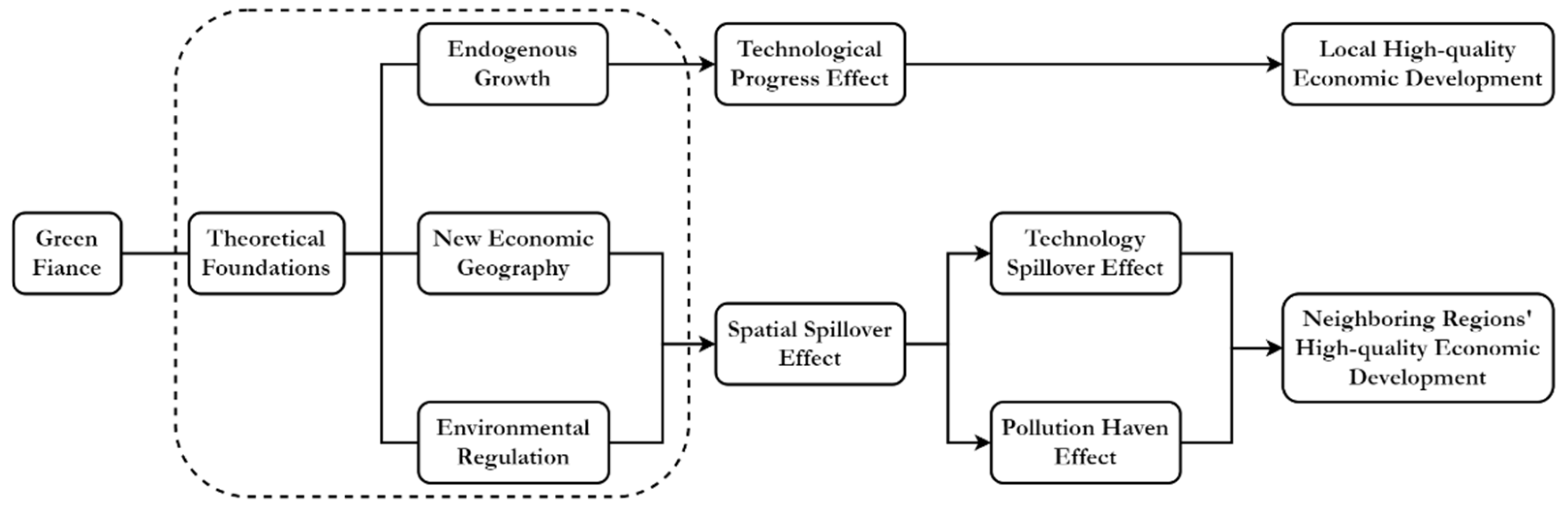
To systematically deconstruct the complex impact of green finance on high-quality economic development, particularly its spatial dimension, this study constructs an integrated theoretical analytical framework. This framework aims to move beyond isolated discussions of single mechanisms by synthesizing core insights from Endogenous Growth Theory [9], New Economic Geography [10], and Environmental Regulation Theory [11]. It delineates the impact of green finance into three pathways (Figure 1). The theoretical contribution of this framework lies in its explicit integration of the local technological progress effect of green finance with the technology spillover effect and the pollution haven effect within its spatial externalities into a unified analytical model. This provides a systematic theoretical lens for understanding its dual role in coordinated regional development.
Green finance directly impacts the local economy through its core functions of capital pooling and directed resource allocation. According to Endogenous Growth Theory, the fundamental driver of economic growth stems from endogenous innovation and knowledge accumulation [9]. By providing risk pricing and financing for green technology R&D, green finance alleviates firms’ financing constraints and reduces innovation costs, thereby directly incentivizing local green technological innovation and adoption [1]. This process enhances resource efficiency and total factor productivity, constituting the direct local impact of green finance on high-quality development, namely the “technological progress effect”. Existing research has provided preliminary evidence for this local effect, showing that green finance drives high-quality economic development by promoting green innovation [2].
However, economic activities are intrinsically spatially interconnected. The influence of green finance transcends administrative boundaries, affecting neighboring regions through spatial externalities. This spatial spillover is not unidirectional but is shaped by two opposing theoretical mechanisms, rendering its net effect theoretically ambiguous.
On one hand, based on the knowledge and technology diffusion models in New Economic Geography, geographical proximity significantly facilitates the flow of information and technology [10]. Innovations induced by green finance in one region, such as clean production technologies, can spill over to neighboring regions through supply chain collaboration, mobility of technical personnel, and inter-firm learning and imitation, leading to knowledge sharing and collaborative upgrading [12]. This “technology spillover effect” represents a positive spatial externality, fostering green transformation across the broader region. Recent studies have also confirmed the role of knowledge spillovers in the diffusion of environmental technologies [13].
On the other hand, the “Pollution Haven Hypothesis” from Environmental Regulation Theory offers a contrasting logic. This hypothesis posits that in an open economy, stringent environmental regulations increase compliance costs for pollution-intensive industries, potentially triggering the relocation of polluting industries to regions with laxer standards [11]. As a market-based and financial extension of environmental regulation [14], the development of green finance alters the relative cost of doing business across regions. This may incentivize polluting firms to relocate production from regions with advanced green finance to neighboring regions with relatively laxer environmental standards and weaker green finance constraints, leading to the transboundary displacement of pollution. This “pollution haven effect” constitutes a negative spatial externality, potentially undermining the overall sustainability of regional development. Studies have observed similar industrial relocation triggered by environmental regulations in the Chinese context [15].
Consequently, the net spatial impact of green finance on high-quality economic development is an empirical question awaiting testing, the answer to which hinges on the contest between the “technology spillover effect” and the “pollution haven effect”. Although existing spatial econometric studies have confirmed the existence of green finance spillovers [6,7,8], decomposing and quantifying their intrinsic mechanisms represents a logical and necessary next step in this research stream. This framework operationalizes this theoretical debate into a testable analytical model.

2.2. Research Hypotheses

Based on the integrated framework above and a critical synthesis of existing literature, we derive a set of empirically testable research hypotheses.

2.2.1. Technological Progress Effect: The Direct Promotion Hypothesis

Green finance empowers local technological progress and industrial upgrading by alleviating financing constraints for green innovation, representing its foundational channel for influencing high-quality economic development. According to Endogenous Growth Theory, this process is endogenous to the financial system’s function of serving the real economy. Several empirical studies support the promoting effect of green finance on local technological innovation and industrial upgrading [1,3]. Therefore, we propose:
H1. 
The development of green finance has a significant direct promoting effect on local high-quality economic development.

2.2.2. Spatial Spillover Effects: Competing Hypotheses

The framework and literature indicate that the spatial impact of green finance involves two opposing mechanisms, making its net effect theoretically ambiguous. This constitutes the core scientific question this study aims to address. Although spatial effects have been confirmed, their transmission channels remain a black box.
If the Technology Spillover Effect Dominates (H2): This implies that the knowledge creation and diffusion function of green finance outweighs its cost-induced constraint effect. The green finance practices of one region can enhance the knowledge stock and technological capability of the entire regional cluster through demonstration, learning, and industrial chain synergy, leading to a “win-win” pattern of coordinated regional development. This aligns with the theoretical expectation of positive knowledge spillovers [10].
If the Pollution Haven Effect Dominates (H3): This suggests that, under real-world conditions, firms’, especially polluting firms’, sensitivity to cost changes may exceed their capacity to absorb knowledge spillovers. The regional disparities in environmental regulation intensity induced by green finance may trigger a pollution displacement, thereby harming the equity and sustainability of coordinated regional development. This is consistent with the predictions of the “Pollution Haven Hypothesis” [11] and has been observed in China’s regional development [15,16].
To empirically test which mechanism dominates in China’s regional interactions and to advance the inquiry from verifying spillover ‘existence’ to identifying their ‘channels’, we propose a pair of competing hypotheses:
H2 (Positive Spillover Hypothesis).
The development of green finance has a significant promoting effect on the high-quality economic development of neighboring regions.
H3 (Negative Spillover Hypothesis).
The development of green finance has a significant inhibiting effect on the high-quality economic development of neighboring regions.

3. Variable Measurement and Spatial Autocorrelation Test

3.1. Measuring Green Finance Development

3.1.1. Theoretical Basis and Indicator System Construction

Guided by the theory of financial structure, which conceptualizes financial development as the evolution of a financial structure comprising various instruments and institutions, this study focuses on the development of green finance. Given the relative stability of China’s financial institutions, the evolution of its green financial structure is primarily captured by the changing scale and composition of green financial instruments.
To comprehensively measure the development level of green finance, this study constructs a multi-dimensional evaluation index system based on established practices in the literature. The system encompasses four key components: Green Credit, Green Securities, Green Investments, and Green Insurance, operationalized through nine specific indicators, as detailed in Table 1. Data for these indicators are sourced from authoritative publications, including the China Statistical Yearbook, China Industrial Statistical Yearbook, China Insurance Statistical Yearbook, China Environmental Statistical Yearbook, and the CSMAR database. The panel dataset covers 30 provincial-level regions in China (excluding Tibet, Hong Kong, Macao, and Taiwan) from 2010 to 2021.

3.1.2. Operational Definitions

To ensure the transparency and replicability of our measurement, this section clarifies the operational definitions of key concepts.
(1) High-Energy-Consuming Industries and Enterprises: This study defines high-energy-consuming industries according to the categorization in the 2010 National Economic and Social Development Statistical Report. This category encompasses the manufacturing of chemical raw materials and products, non-metallic mineral products, smelting and rolling of ferrous and non-ferrous metals, petroleum processing and coking, and the production and supply of power and heat. A publicly listed enterprise is classified as a high-energy-consuming enterprise if its primary business falls within these sectors.
(2) Environmentally Friendly Enterprises and Environmental Investments: Adopting the methodology of Zhang et al. (2019) [17], we identify environmentally friendly listed companies based on their investment projects disclosed in the “Basic Situation of Construction Projects.” We retain projects explicitly related to pollution prevention, ecological governance, and green production—such as desulfurization, denitrification, wastewater treatment, energy conservation, and clean production. A listed company is classified as environmentally friendly if it has such ongoing projects, and the corresponding investment amounts are used as a proxy for corporate environmental investment.

3.1.3. Weighting Methodology: The Entropy Method

To aggregate the individual indicators into a composite index, it is critical to assign weights objectively, thereby mitigating the potential biases inherent in subjective weighting methods. Consequently, this study employs the entropy method [18], an objective technique that determines weights based on the information content (degree of variation) of each indicator across the sample. This ensures that indicators with greater discriminating power contribute more significantly to the final index score.
The indicators in Table 1 exhibit substantial variation in both scale and order of magnitude. To facilitate a meaningful comparison of development levels, a normalization procedure is applied, treating positive and negative indicators as follows:
Positive   indicators :   z i j t = x i j t min x i j t max x i j t min x i j t
Negative   indicators :   z i j t = max x i j t x i j t max x i j t min x i j t
where max x i j t , min x i j t represent the maximum and minimum values, respectively, of indicator i observed across all provinces and years in the sample. The subscripts denote: i = 1, 2, …, M for the M evaluation indicators; j = 1, 2, …, N for the N provinces; and t = 1, 2, …, T for the T-year time span.
The proportion of the standardized metrics is calculated as:
φ i j t = z i j t j = 1 N t = 1 T z i j t
The information content value of index i is calculated as:
e i = 1 ln N × T j = 1 N t = 1 T φ i j t × ln φ i j t
The information content value redundancy of index i is calculated as:
d i = 1 e i
The weight of the indicators i are calculated as:
w i = d i i = 1 M d i
Finally, the level of green finance development for each province for each year is calculated as:
G F j t = i = 1 M j = 1 N t = 1 T z i j t × w i

3.1.4. Regional Disparities and Provincial Dynamics in Green Finance Development

Based on the aforementioned measurement method, this study evaluates the development level of green finance in 30 Chinese provinces (excluding Hong Kong, Macao, Taiwan and Tibet) from 2010 to 2021. At the national level, the development level of green finance in China has shown an overall upward trend. The national average level of green finance development in 2021 reached 0.192, an increase of 0.08 compared with 2010, with an average annual growth rate of 0.64%. From the perspective of the eastern, central and western regions, the eastern region recorded the highest average annual growth rate of green finance development at 2.57%, showing a significant improvement. The central region followed with a modest average annual growth rate of only 0.12%, while the western region experienced a negative average annual growth rate of −1.07%. At the provincial level, there are distinct disparities in the development of green finance across different provinces. In 2010, most western provinces such as Gansu, Xinjiang and Inner Mongolia took the lead in green finance development. However, over time, eastern provinces including Zhejiang, Shanghai, Beijing, Hainan and Tianjin have witnessed rapid growth in green finance, with their average annual growth rates all exceeding 4%, demonstrating a strong momentum of development. In contrast, most western provinces such as Shaanxi, Chongqing and Yunnan have suffered negative growth in green finance, with negative average annual growth rates.

3.2. Measuring High-Quality Economic Development

3.2.1. Theoretical Framework and Indicator System Construction

The concept of high-quality development has emerged from China’s current developmental stage and intrinsic economic requirements. Existing literature generally approaches its connotation from three perspectives: embodiment through the new development concepts of innovation, coordination, green development, openness, and sharing [19]; assessment based on the capacity to meet the people’s growing needs for a better life [20]; and evaluation from macro-, meso- (regional), and micro- (enterprise) economic levels [21].
Synthesizing these views, this study posits that high-quality economic development transcends mere economic growth. It should incorporate the principles of innovation, coordination, green development, openness, and sharing, while effectively fulfilling the populace’s aspirations for an improved standard of living. Accordingly, the evaluation of high-quality economic development should encompass the following dimensions:
(1) Economic Vitality: High-quality economic development should demonstrate vibrant and sustained growth, with stable output, continuous optimization of internal structures (such as industrial and import-export structures), and a coordinated development of various ratios.
(2) Efficiency Based on Innovation: High-quality economic development should be characterized by high-efficiency growth based on innovation, with continuous improvement in economic benefits, high total factor productivity, low energy consumption per unit of GDP, and high land productivity.
(3) Green Development: High-quality economic development should emphasize environmental sustainability, with continuous improvement in environmental protection indicators and a reduction in pollution metrics, adhering to the development philosophy that “lucid waters and lush mountains are invaluable assets.”
(4) Shared Development: High-quality economic development should promote shared prosperity, where the quality of life for the people continuously improves, and the benefits of development in areas such as income, consumption, healthcare, education, and social security are equitably shared.
Based on these principles, this study constructs a comprehensive evaluation system for high-quality economic development. The system comprises 22 indicators across four components: Economic Vitality, Innovation Efficiency, Green Development, and People’s Well-being, as detailed in Table 2. Data are sourced from the China Statistical Yearbook, covering a sample of 30 provinces excluding Tibet, Hong Kong, and Macao, for the period from 2010 to 2021. All price-related values are deflated to constant 2010 prices using the GDP deflator. Consistent with the approach for the green finance index, the entropy method is employed to determine indicator weights.

3.2.2. Spatial Autocorrelation Test

To examine the spatial dependence of high-quality economic development levels, we employ the Global Moran’s I statistic. A positive Moran’s I value indicates positive spatial autocorrelation, with larger values signifying stronger clustering intensity. The calculation formula is as follows:
I = i = 1 n j = 1 n w i j x i x ¯ x j x ¯ i = 1 n x i x ¯ 2
where w i j is the spatial weight matrix.
We utilize three fundamental spatial weight matrices:
(1) Geographical Contiguity Matrix: w i j = 1 if provinces i and j share a border, and 0 otherwise.
(2) Geographical Distance Matrix: w i j d = 1 / d i j , where d i j is the geographical distance between the capitals of provinces i and j, calculated based on their longitude and latitude.
(3) Economic Distance Matrix: w i j e = 1 / | P G D P i P G D P j | , where PGDP is the average per capita GDP of a province from 2010 to 2021.
The Global Moran’s I values and corresponding p-values for the high-quality economic development levels from 2010 to 2021 are presented in Table 3. The results show that all Moran’s I values are positive and statistically significant at the 1% level, confirming the presence of significant positive spatial autocorrelation in regional high-quality economic development.
Notably, the Moran’s I values exhibit an increasing trend when using the geographical contiguity and geographical distance matrices. In contrast, a decreasing trend is observed when employing the economic distance matrix. This pattern suggests that the clustering intensity of high-quality economic development is becoming more pronounced based on geographical proximity, while the clustering intensity related to economic similarity is gradually weakening.

4. Empirical Analysis

4.1. Model Specification

Building upon the theoretical framework and spatial correlation identified previously, this section establishes the empirical model to investigate the impact of green finance on high-quality economic development. The baseline specification employs a provincial fixed effects panel model to control for unobserved time-invariant provincial characteristics:
H Q E i t = α + β G F i t + γ C o n t r o l i t + u i + ε i t
where i and t denote province and year, respectively; HQE is the high-quality economic development index; GF is the green finance development index; Control represents a vector of control variables; u captures province fixed effects; and ε i t is the idiosyncratic error term.

4.2. Data and Variable Measurement

This study utilizes a balanced panel dataset of 30 Chinese provincial-level administrative regions from 2010 to 2021. The sample encompasses all provinces except Tibet, Hong Kong, Macao, and Taiwan. This selection is primarily based on data completeness and institutional comparability: Tibet suffers from systematic unavailability of some key indicators, while data for Hong Kong, Macao, and Taiwan are not directly comparable due to their different socio-economic systems. The year 2010 is chosen as the starting point because China’s green finance policy framework entered a period of rapid development around that time, with pre-2010 data being relatively fragmented. The endpoint of 2021 is determined by the availability of the latest official statistical data at the time of this research. Data are primarily sourced from the China Statistical Yearbook, China Industrial Statistical Yearbook, China Environmental Statistical Yearbook, China Insurance Statistical Yearbook, and the CSMAR database.
(1) High-Quality Economic Development (HQE): As constructed in Section 3.2.
(2) Green Finance (GF): As constructed in Section 3.1.
(3) Control Variables: To isolate the net effect of green finance, we include a set of time-varying provincial characteristics that may confound the relationship: urbanization rate, government intervention, foreign investment level, industrialization development level, educational investment, and innovation input. The urbanization rate is represented by the proportion of the urban population to the total resident population at year-end. Government intervention is depicted by the ratio of local fiscal general budget expenditures to GDP. The foreign investment level is measured by the proportion of total investment from foreign-invested enterprises to GDP. The industrialization development level is assessed using the logarithmic value of the number of enterprises above a designated size in the industrial sector. Educational investment is characterized by the ratio of educational expenditure to GDP, while innovation input is represented by the proportion of R&D expenditure to GDP. All monetary variables are deflated to constant 2010 prices using the corresponding provincial GDP deflators to eliminate the impact of inflation. The final dataset forms a balanced panel.

4.3. Baseline Regression

Table 4 presents the baseline estimation results for Model (9), employing various standard error specifications to ensure statistical robustness. Classical regression assumptions of homoscedastic and uncorrelated errors are often violated in practice. Following Bertrand et al. (2004) [22], we prioritize cluster-robust standard errors to account for potential within-group correlation. Given that our observational unit is the province, we cluster standard errors at the provincial level (30 clusters) as our most conservative and preferred specification. For comparison, we also report results with heteroscedasticity-robust standard errors and standard errors clustered at a broader regional level (Eastern, Central, Western; 3 clusters).
The results across all specifications consistently show a positive and statistically significant coefficient for the green finance variable (GF). Column (I) presents a simple bivariate regression without controls, showing a strong positive correlation. After incorporating control variables in Column (II), the coefficient remains positive and significant.
Crucially, the positive effect of green finance persists when addressing potential heteroscedasticity (Column III) and when using cluster-robust standard errors at both the provincial (Column IV) and regional levels (Column V). The provincial-level clustered standard errors (Column IV) are the largest among the robust specifications, providing the most conservative inference. Therefore, we adopt this as our benchmark for subsequent analysis. The stable, positive coefficient across all model variations provides strong initial evidence that green finance development actively promotes high-quality economic development, thus supporting Hypothesis 1, which is grounded in Endogenous Growth Theory.
This finding confirms that green finance, by performing its core functions of capital pooling and directed resource allocation, successfully fosters local high-quality development. Our result aligns with and reinforces a growing strand of empirical literature documenting the positive local impact of green finance, typically mediated through channels such as green innovation [2] and industrial structure advancement [3]. Within the specific institutional context of China’s economic transition, this finding underscores the initial effectiveness of the national strategy that positions green finance as a “core lever” for achieving high-quality economic development. It suggests that the top-down promotion of green finance instruments, despite observable regional disparities, has begun to systematically redirect capital flows toward more sustainable economic activities at the provincial level, thereby translating a key policy intent into a measurable developmental outcome.

4.4. Robustness and Endogeneity Test

To validate the reliability of the baseline findings, we conduct comprehensive robustness checks addressing potential endogeneity concerns and employing alternative estimation approaches.

4.4.1. Addressing Endogeneity Concerns

We focus on mitigating two major sources of endogeneity: reverse causality and omitted variable bias.
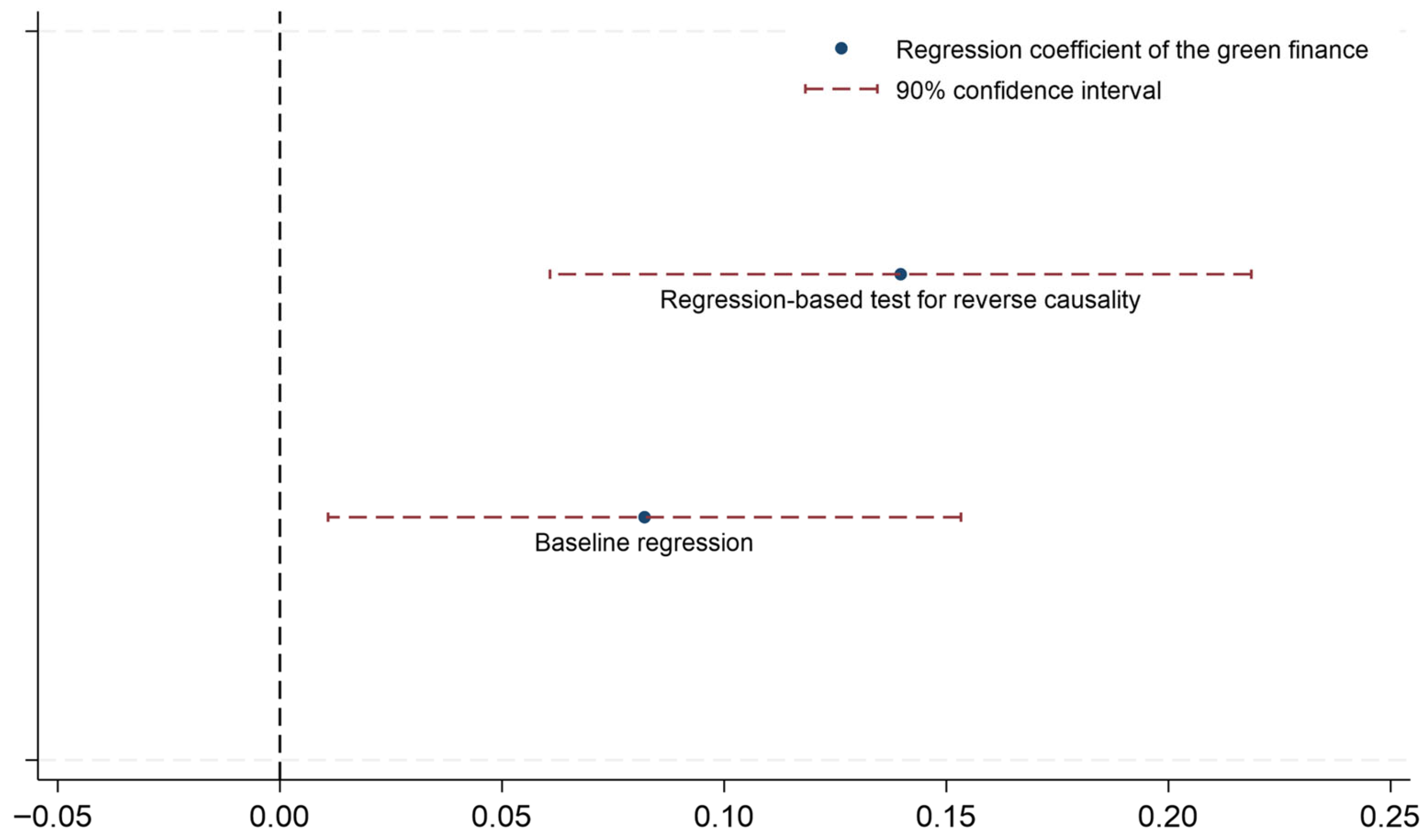
(1) Instrumental Variable Approach for Reverse Causality: To address potential bidirectional causality between green finance and high-quality economic development, we employ an instrumental variable strategy using the one-period lagged green finance index ( G F i , t 1 ) as an instrument, following Bellemare et al. (2017) [23]. The results presented in Figure 2 demonstrate that the coefficient of the instrumented green finance variable remains positive and statistically significant at the 10% level. Compared to the baseline regression results, although the reverse causality issue introduces some bias, the promoting effect of green finance development remains unchanged and may even be strengthened. Therefore, we can conclude that the baseline regression results are robust.
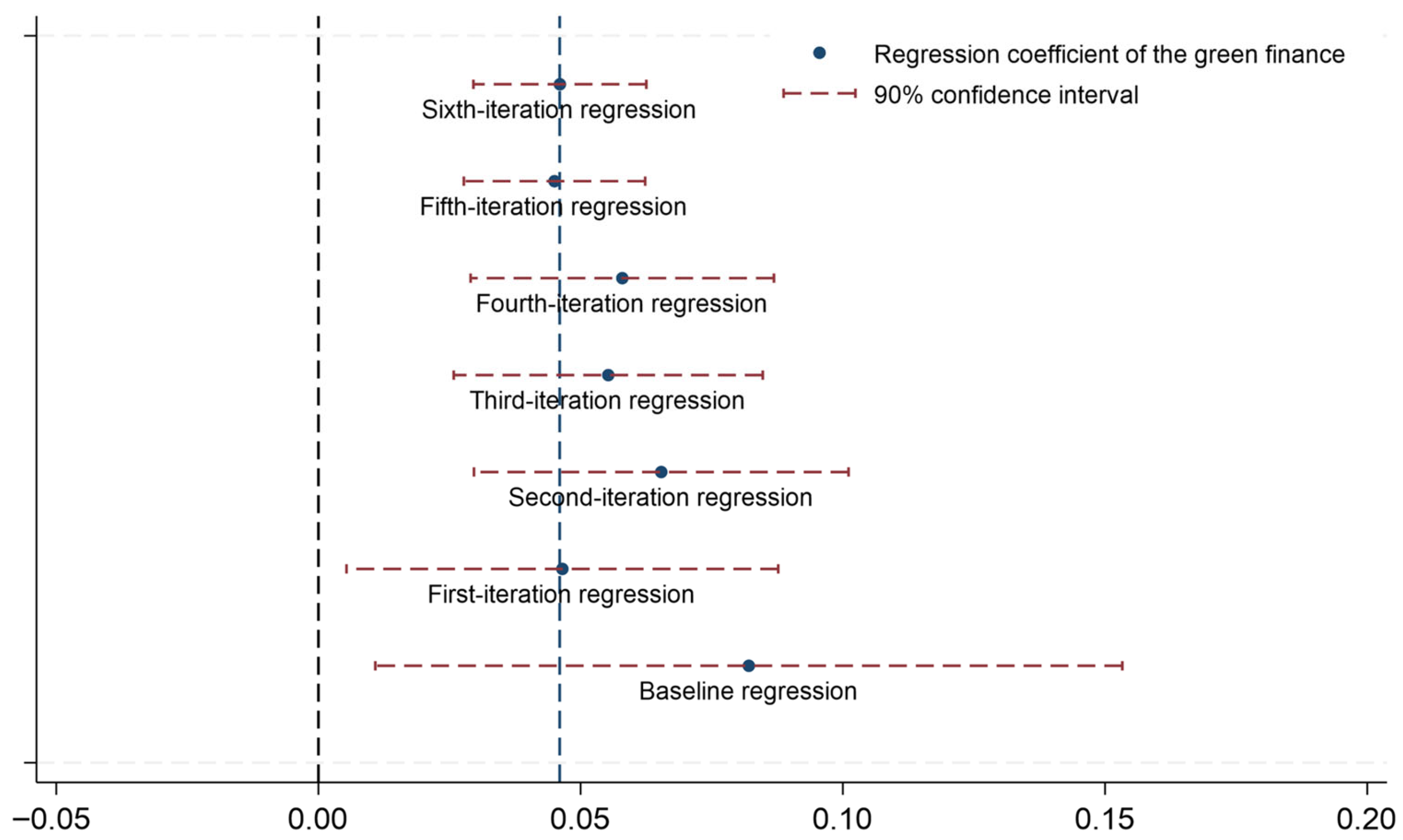
(2) Controlling for Unobserved Confounders: Although we have controlled for several variables in Model (2), it is still challenging to ensure that the model is free from omitted variable issues. To address this concern, we implement the principal component iterative method proposed by Bai (2009) [24]. This approach extracts common factors from the baseline model’s residuals and incorporates them as additional controls. This process can be represented by the following model:
H Q E i t = α + β G F i t + γ C o n t r o l i t + u i + ε i t ,   ε i t = λ i f t + v i t
where f t is the common factor, λ t is the corresponding factor loading coefficient, and the residual variables are consistent with those in Model (9). Due to the specific form of Model (10), static panel estimation methods typically cannot yield consistent estimates. Therefore, we employ a principal component iterative method to estimate Model (10).
Step 1: After estimating Model (9), we conduct principal component analysis on the error term to obtain the common factors and the corresponding factor loadings.
Step 2: We multiply the first common factor by the factor loadings to create a newly added control variable, and include this variable in Model (9). Then, estimate Model (9) to obtain the revised error term.
Step 3: Iterate through Steps 1 and 2 until the regression coefficient for green finance development converges. The results of the iterative regression are presented in Figure 3.

4.4.2. Alternative Estimation Approach

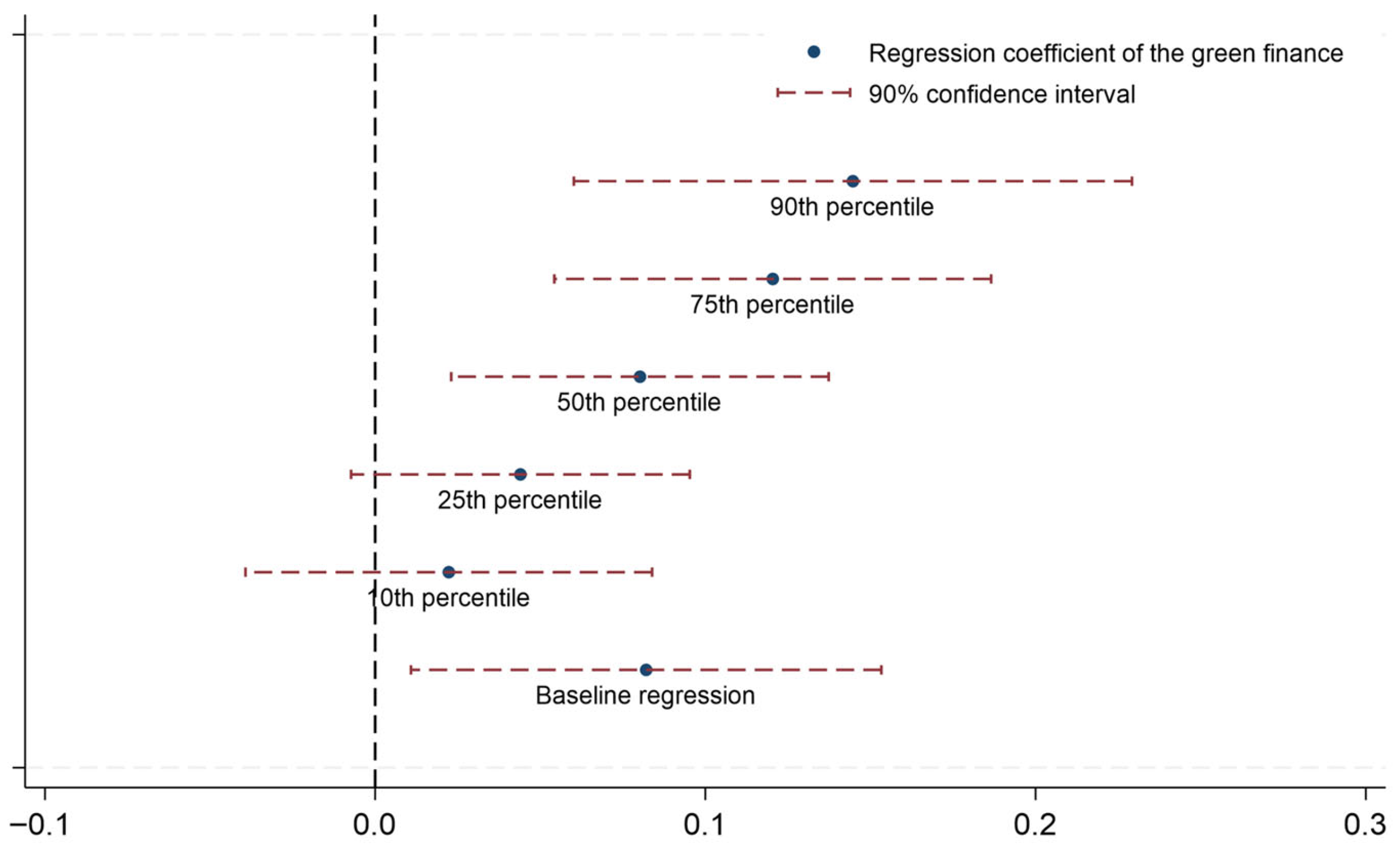
In the baseline regression, the results investigate the relationship between the development of green finance and high-quality economic development based on the average impact effect. To assess the reliability of the baseline regression results, we explore the impact effect of green finance development on high-quality economic development across different quantiles. Following the fixed effects panel quantile regression model established by Machado and Santos Silva (2019) [25], we consider the following panel quantile model:
Q H Q E i t τ | G F i t , C o n t r o l i t = u i + β τ G F i t + γ τ C o n t r o l i t
where τ represents the quantile index, specifically the 10th, 25th, 50th, 75th, and 90th. The residual variables are consistent with those in Model (9). The regression results are shown in Figure 4.
The results reveal a consistently positive coefficient for green finance across all quantiles (10th, 25th, 50th, 75th, and 90th). The effect is statistically significant at the 50th, 75th, and 90th quantiles (10% level), with coefficient magnitudes exhibiting a monotonic increasing pattern across the distribution. This indicates that the promoting effect of green finance intensifies in provinces that have achieved higher levels of high-quality economic development, while remaining positive throughout the distribution.
Collectively, these tests demonstrate that the core finding that green finance significantly promotes high-quality economic development is robust across alternative identification strategies and estimation methods, which substantially enhances the credibility of our conclusions.

4.5. Heterogeneity Analysis

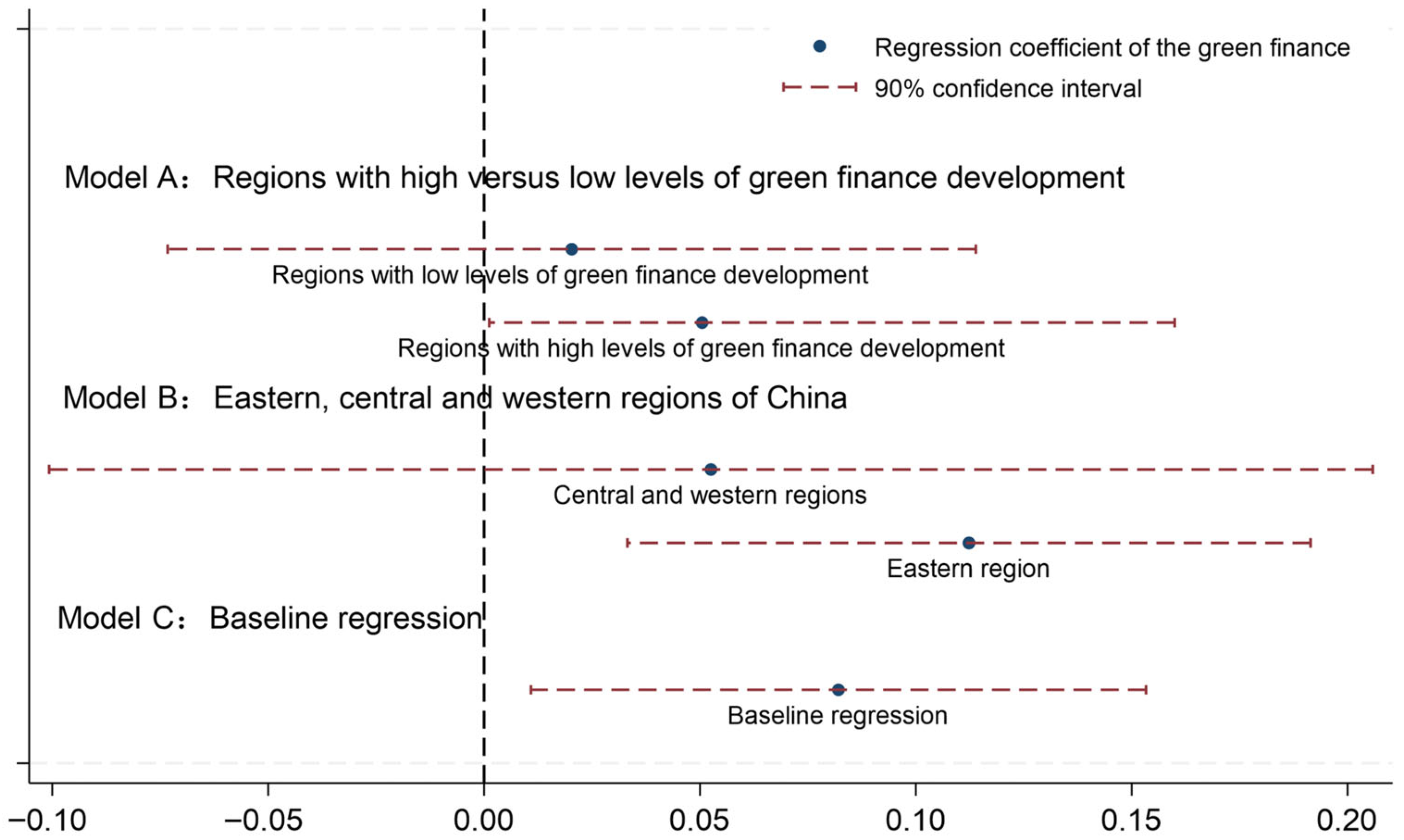
Building upon the observed regional disparities in development levels, this study further examines whether the impact of green finance on high-quality economic development varies across regions with different characteristics. We conduct heterogeneity tests using two grouping criteria: geographical location and level of green finance development.

4.5.1. Regional Heterogeneity: Eastern vs. Central-Western China

We divide the sample into the eastern region and a combined central-western region. This grouping strategy is motivated by two considerations: first, the central and western regions exhibit relatively similar development levels compared to the more advanced eastern region; second, combining these regions addresses sample size limitations, particularly for the central region which contains only six provinces, thereby enhancing estimation reliability.
The results presented in Figure 5 show that the green finance coefficient is positive and statistically significant in the eastern region, indicating its effective role in promoting high-quality development. In contrast, while the coefficient remains positive in the central-western region, it is statistically insignificant, suggesting that green finance has not yet fully realized its potential in these areas.

4.5.2. Development-Level Heterogeneity: High vs. Low Green Finance Regions

To further investigate how the maturity of green finance affects its efficacy, we classify provinces into high and low development groups based on the median value of the green finance index. The results in Figure 4 confirm the heterogeneous pattern: provinces with more developed green finance systems show a significant positive coefficient, while those with less developed systems display an insignificant relationship.
The results indicate that the regression coefficient for the green finance variable in the eastern region is significantly positive, suggesting that the development of green finance can effectively enhance the level of high-quality economic development in this region. In contrast, while the regression coefficient for the green finance variable in the central-western region is positive, it is not significant, indicating that the development of green finance has not effectively promoted high-quality economic development there. Similarly, it can be observed that in the regions with high-level green finance development, the regression coefficient for the green finance variable is significantly positive, whereas in the low-level green finance development regions, the coefficient, despite being positive, is not significant.

4.5.3. Interpretation of Heterogeneous Effects

These findings align with the quantile regression results reported in Section 4.4.2, where we documented an increasing marginal effect of green finance across the development distribution. The eastern region and high-level development groups, with their better financial infrastructure, stronger institutional support, and more advanced technological capacity, are better positioned to transform green finance resources into quality development outcomes. Conversely, the central-western regions and low-level groups may face constraints such as less developed financial markets and weaker technological absorption capacity, limiting the effectiveness of green finance policies.
This heterogeneity analysis demonstrates that the promoting effect of green finance on high-quality economic development varies significantly across regions and development levels, with its effectiveness contingent on local economic and financial foundations and institutional environments.

5. Further Analysis: Spatial Correlation, Technological Spillover, and Pollution Haven

While the baseline regression employs province-clustered standard errors under the assumption of inter-provincial independence, the evolving regional patterns of green finance development observed in Section 3, characterized by rapid growth in the eastern region, stability in the central region, and decline in the western region, suggest potential strategic interactions and spatial dependence among provincial units. To formally account for such spatial linkages, this section introduces a spatial econometric framework to examine both the direct and indirect channels through which green finance influences economic development.

5.1. Spatial Econometric Model Specification

We begin with a spatial Durbin model (SDM) specification. Both Wald test and Likelihood Ratio test results (p-values of 0.0000/0.0001 and 0.0001/0.0000, respectively) reject the null hypothesis that the SDM simplifies to either a spatial lag or spatial error model, confirming the SDM’s superior fit. Furthermore, given the spatial autocorrelation identified in the high-quality economic development measures in Section 3, the empirical specification is as follows:
H Q E i t = ρ W H Q E i t + β G F i t + λ W G F i t + γ C o n t r o l i t + u i + ε i t
where W is the spatial weight matrix. Following common practice in the literature, we construct a nested matrix combining geographical and economic distance matrices to capture both physical proximity and economic similarity. WHQE and WGF represent the spatial lags of high-quality economic development and green finance, respectively. Other variables maintain their definitions from Model (9).
Parameter estimates obtained using the Yu et al. (2008) [26] method are presented in Table 5. The green finance coefficient remains positive and significant at the 5% level, reinforcing the baseline findings. The significantly positive spatial lag of HQE (WHQE) confirms positive spatial autocorrelation in economic development patterns. However, the significantly negative coefficient on the spatial lag of green finance (WGF) suggests potential competitive dynamics in green finance development across provinces.

5.2. Spatial Effect Decomposition

The coefficients of green finance (GF) and its spatial lag (WGF) in Model (12) do not directly represent the marginal effects of high-quality economic development on green finance development. Therefore, it is necessary to further decompose them into direct and indirect effects.
Rearranging Model (12) yields the following expression:
H Q E i t = I ρ W 1 β I + λ W G F i t + I ρ W 1 γ C o n t r o l i t + u i + ε i t
Following Elhorst et al. (2020) [27], for each time period t, we can write the model in matrix form as:
H Q E t = I ρ W 1 β I + λ W G F t + I ρ W 1 γ C o n t r o l t + u + ε t
where H Q E t = H Q E 1 t , , H Q E n t T is an n × 1 vector, G F t = G F 1 t , , G F n t T is an n × 1 vector, u = u 1 , , u n T is an n × 1 vector of individual effects.
Now, considering the partial derivative of HQEt with respect to GFt, we have:
𝜕 H Q E t 𝜕 G F t = S W = I ρ W 1 β I + λ W = I ρ W 1 × β λ w 12 λ w 1 n λ w 21 β λ w 2 n λ w n 1 λ w n 2 β
This n × n matrix, denoted as S(W), is the partial derivative matrix for time t. Importantly, it does not depend on t because the parameters ρ , β , λ and the weight matrix W are assumed constant over time in the model. The diagonal elements of this matrix represent direct effects (within-province impacts), while the off-diagonal column sums capture indirect effects (cross-province spillovers).
As shown in Table 6, the direct effect of green finance is positive and significant, further supporting H1 (the local technological progress hypothesis). In stark contrast, the significantly negative indirect effect indicates adverse spatial spillovers to neighbors, aligning with H3 (the pollution haven hypothesis) rather than H2 (the technology spillover hypothesis). This reveals a critical duality: green finance fosters local development as predicted by Endogenous Growth Theory, yet it concurrently generates negative cross-regional externalities. The dominance of the negative spillover suggests that, in China’s context, the “pollution haven” mechanism currently outweighs the positive knowledge diffusion mechanism. This finding helps reconcile the mixed evidence in prior spatial studies that confirmed spillover existence but could not identify their net direction.
This pattern can be understood through China’s distinctive institutional landscape. Decentralized environmental governance, intense regional growth competition, and high inter-provincial factor mobility collectively incentivize polluting firms to relocate from green-finance-leading regions to neighboring areas with lighter regulation, thereby operationalizing the pollution haven effect in practice.

5.3. Mechanism Analysis

The above decomposition of spatial effects indicates that green finance has generated a significant net negative spillover on neighboring regions. To uncover the specific transmission channels underlying this net effect, we subsequently conduct an empirical test of the two competing mechanisms proposed in the theoretical section, namely the technology spillover effect and the pollution haven effect.
Using green patent applications to proxy for green technology innovation and the secondary industry share to capture industrial structure, we find supporting evidence for both channels (Table 7). Green finance simultaneously stimulates local green technology innovation and drives local industrial restructuring. The former confirms the “technological progress effect,” while the latter reveals the micro-foundation of the “pollution haven effect”. Specifically, the potential out-migration of pollution-intensive segments due to increased costs. This result illuminates the dual nature of green finance’s spatial externalities: it successfully guides a local green transition, yet part of the cost may be partially externalized to neighboring regions.
The dominance of the pollution haven effect in the current Chinese context can be understood through a realistic regional development trade-off. On one hand, the decision cycle and execution of industrial relocation are typically faster than the absorption of knowledge and technology. Faced with cost pressures from green finance, firms may perceive relocation as a more immediate solution than complex technological upgrading. On the other hand, regional development competition may motivate some areas to relax environmental oversight to attract investment, creating a “safe haven” for polluting industries. Consequently, while green finance creates potential for positive knowledge diffusion, the stronger and more immediate incentive for industrial relocation dominates inter-regional dynamics, resulting in the observed net negative spillover.

5.4. Synthesis and Interpretation

This study yields a nuanced understanding of green finance’s impact through the integration of baseline, spatial, and mechanism analyses. The spatial econometric analysis reveals a dual character to this influence: green finance exerts positive effects within provincial boundaries but generates negative spillovers to neighboring regions. Mechanism tests further confirm the coexistence of two opposing forces: technology spillovers and the pollution haven effect. Collectively, these findings provide empirical support for H3 (the Negative Spillover Hypothesis), indicating that the pollution haven effect currently dominates the inter-regional dynamics over the technology spillover effect (H2).
Building upon these findings, we propose the following interpretive framework to reconcile the apparent contradictions:
The direct effect of green finance on intra-provincial development (0.0496478) primarily captures the technological progress effect—the positive influence of green finance on local innovation and productivity improvements.
The indirect (spatial spillover) effect (−0.3137375) represents the net outcome of two countervailing forces: positive technology diffusion across borders and negative industrial relocation (the pollution haven effect). Drawing on the methodological approach of Jia et al. (2023) [16], assume the Technological Progress Effect  ×   θ = Technology Spillover Effect, where 0 < θ 1 , we can quantify these components:
When θ = 1 : Technology Spillover Effect = Technological Progress Effect = 0.0496478, Pollution Haven Effect = −0.3633853.
When 0 < θ < 1 : Technology Spillover Effect = Technological Progress Effect ×   θ <   0.0496478, Pollution Haven Effect = −0.3137375 − 0.0496478 ×   θ >   −0.3633853.
These calculations reveal that the magnitude of the pollution haven effect exceeds the net negative indirect effect (spatial spillover effect) identified by the model. This implies that the technological progress brought about by green finance has partially offset the pollution haven effect, mitigating between 15.8% and 27.3% of its adverse impacts, where the exact proportion is calculated as ( 0.0496478 + 0.0496478 θ ) / ( 0.313735 + 0.0496478 θ ) .

6. Conclusions, Policy Implications, and Future Research

6.1. Main Findings

This study constructs an evaluation index system for green finance and high-quality economic development, measuring their levels across Chinese provinces from 2010 to 2021. Employing a comprehensive analytical framework that integrates baseline, spatial econometric, and mechanism analyses, this research systematically examines the impact of green finance and its transmission channels. The main conclusions are as follows:
(1) Significant regional disparities characterize green finance development across China. The eastern region demonstrates the most rapid growth, while the central region maintains relative stability. Conversely, the western region exhibits a declining trajectory in green finance development.
(2) Green finance exerts a statistically significant positive effect on high-quality economic development. This fundamental relationship remains robust to multiple identification strategies and estimation methods.
(3) The impact of green finance displays considerable heterogeneity, being stronger in regions with more advanced green finance systems and economic foundations.
(4) Spatial econometric analysis reveals a dual character to this impact: while beneficial locally, green finance generates significant negative spillovers on neighboring regions’ development. Mechanism tests and effect decomposition confirm that these negative spillovers are primarily driven by the “pollution haven effect,” wherein stringent green finance policies displace pollution-intensive industries across provincial borders. This result empirically validates H3 (the Negative Spillover Hypothesis). The positive “technology spillover effect” (associated with H2) is present but insufficient to offset this displacement in the current inter-regional dynamics.

6.2. Theoretical Contributions

This study contributes to the literature by constructing and empirically validating an integrated theoretical framework that decomposes the spatial externalities of green finance into competing channels. This framework not only moves beyond the siloed discussions of single mechanisms but also provides a coherent lens to advance the understanding of the ambiguous net direction of spatial spillovers documented in prior literature, thereby offering a systematic explanation for the dual role of green finance in regional development.

6.3. Policy Implications

Based on the core findings of dominant pollution haven effects, we derive the following targeted policy implications:
(1) Implement Mandatory Cross-Regional Environmental Compensation and Coordination Mechanisms. To mitigate the negative externalities of industrial displacement, policy must transcend provincial boundaries. We recommend establishing a nationally supervised “Inter-Provincial Ecological Compensation Fund.” Regions with advanced green finance (primarily eastern provinces) that benefit from industrial restructuring should contribute to this fund, which directly finances environmental remediation and green technology adoption in neighboring receiving regions (often central and western provinces). This internalizes the cost of the pollution haven effect and aligns incentives for collective green development.
(2) Tier Green Finance Standards and Link Them to Industrial Transfer Whitelists. Rather than a one-size-fits-all approach, green finance guidelines should be differentiated into “leadership” tiers (for eastern innovators) and “foundational” tiers (for central/western regions). Crucially, a “Negative List for Inter-Provincial Industrial Transfer” should be codified, prohibiting the relocation of the most polluting facilities under any financial scheme. Concurrently, financial incentives must be amplified for genuine green technology diffusion, such as through subsidies for joint R&D projects between firms in eastern and central/western regions.
(3) Create a Certified “Green Upgrade Transfer” Fund and Incentive Scheme. Instead of merely restricting polluting moves, policy should actively incentivize relocations that represent genuine environmental upgrades. We propose establishing a central government-matched fund that offers concessional loans or grants to firms that relocate production facilities only when the move is coupled with verifiable technological upgrades that significantly reduce environmental footprints below a benchmark. An independent, third-party “Green Upgrade Transfer” certification would be required to access these benefits. This approach channels the inevitable dynamics of industrial relocation—driven in part by green finance—toward a positive outcome. It ensures that green finance in leading regions not only pushes out old capacity but also financially pulls the entire value chain toward higher standards wherever it moves, turning a potential negative spillover into a lever for nationwide technological diffusion.

6.4. Limitations and Future Research

This study acknowledges several constraints that point to valuable avenues for future inquiry. First, regarding data granularity, the use of provincial-level data may mask significant within-province heterogeneity and firm-level micro-behaviors. Future research employing city-level or firm-level microdata could yield more granular insights. Second, the measurement of green finance, while comprehensive, may not capture all facets of market innovation. Future studies could refine the index by incorporating data from a wider array of financial instruments. Third, and relatedly, the mechanism tests are indirect. Our inference of industrial relocation relies on provincial industrial structure shares. A more direct approach would involve tracking firm-level data on cross-provincial investment and physical relocations to explicitly verify and quantify the “pollution haven” effect. Addressing these limitations would further sharpen the analysis of green finance’s complex spatial dynamics.


Author Contributions

Conceptualization, Z.Z. and X.L.; methodology, Z.Z. and X.L.; software, Z.Z.; validation, Z.Z. and X.L.; formal analysis, Z.Z. and X.L.; investigation, Z.Z. and X.L.; resources, Z.Z.; data curation, Z.Z. and X.L.; writing—original draft preparation, Z.Z. and X.L.; writing—review and editing, Z.Z. and X.L.; visualization, Z.Z. and X.L.; supervision, Z.Z.; project administration, Z.Z.; funding acquisition, Z.Z. All authors have read and agreed to the published version of the manuscript.

Funding

This work was supported in part by the Early-Career Young Scientists and Technologists Project of Jiangxi Province under Grant 20252BEJ730110 and 20252BEJ730111; and the Key Project of Jiangxi Provincial Philosophy and Social Sciences under Grant 25YJ02; and the Science and Technology Youth Project of the Education Department of Jiangxi Province under Grant GJJ2500405.

Institutional Review Board Statement

Not applicable.

Informed Consent Statement

Not applicable.

Data Availability Statement

The raw data supporting the conclusions of this article will be made available by the authors upon request.

Conflicts of Interest

The authors declare no conflicts of interest regarding the publication of this paper.

References

  1. Yu, B.; Fan, C.L. Green Finance, Technical Innovation and High-quality Economic Development. Nanjing J. Soc. Sci. 2022, 9, 31–43. [Google Scholar]
  2. Wen, S.Y.; Liu, H.; Wang, H. Green Finance, Green Innovation, and High-quality Economic Development. J. Financ. Res. 2022, 8, 1–17. [Google Scholar]
  3. Meng, W.F.; Liu, J.H. Effect and Heterogeneity of Green Finance in Promoting High-Quality Economic Development: From the Perspectives of Technological Innovation and Industrial Structure Upgrading. Econ. Rev. J. 2023, 7, 100–110. [Google Scholar]
  4. Shi, D.M.; Shi, X.Y. Green Finance and High-quality Economic Development: Mechanism, Characteristics and Empirical Study. Stat. Res. 2022, 39, 31–48. [Google Scholar]
  5. Li, C.G. The Impact of Green Finance on High-Quality Economic Development. J. Zhongnan Univ. Econ. 2023, 2, 65–77. [Google Scholar]
  6. Cai, Q.; Wang, X.X. Green Finance Have an Effect on the Economic High-Quality Development from the Perspective of Space. Jianghan Trib. 2022, 6, 21–28. [Google Scholar]
  7. Qi, F.M.; Pei, X.; Ye, Y. An Empirical Analysis of the Impact of Environmental Protection and Green Finance on High-Quality Economic Development. Stat. Decis. 2022, 38, 160–164. [Google Scholar]
  8. Lin, M.X.; Xiao, Y.B. The Impact of Green Finance on High-quality Development: A Quasi Natural Experiment from the Green Finance Reform and Innovation Pilot Zone. Reform 2023, 12, 78–94. [Google Scholar]
  9. Romer, P.M. Endogenous Technological Change. J. Political Econ. 1990, 98, S71–S102. [Google Scholar] [CrossRef]
  10. Krugman, P. Increasing Returns and Economic Geography. J. Political Econ. 1991, 99, 483–499. [Google Scholar] [CrossRef]
  11. Copeland, B.R.; Taylor, M.S. Trade, Growth, and the Environment. J. Econ. Lit. 2004, 42, 7–71. [Google Scholar] [CrossRef] [PubMed]
  12. Jaffe, A.B.; Trajtenberg, M.; Henderson, R. Geographic Localization of Knowledge Spillovers as Evidenced by Patent Citations. Q. J. Econ. 1993, 108, 577–598. [Google Scholar] [CrossRef]
  13. Dechezleprêtre, A.; Martin, R.; Mohnen, M. Knowledge Spillovers from Clean and Dirty Technologies; Centre for Economic Performance: London, UK, 2014; pp. 2042–2695. [Google Scholar]
  14. Wang, X.H.; Liu, J.H.; Zhao, Y.X. Effectiveness Measurement of Green Finance Reform and Innovation Pilot Zone. J. Quant. Technol. Econ. 2021, 38, 107–127. [Google Scholar]
  15. Zheng, D.; Shi, M. Multiple Environmental Policies and Pollution Haven Hypothesis: Evidence from China’s Polluting Industries. J. Clean. Prod. 2017, 141, 295–304. [Google Scholar] [CrossRef]
  16. Jia, Z.J.; Lin, B.Q.; Wen, S.Y. Carbon Trading Pilots and Total Factor Productivity—With Discussions on Porter Hypothesis, Technology Diffusion and Pollution Paradise. Econ. Perspect. 2023, 3, 66–86. [Google Scholar]
  17. Zhang, Q.; Zheng, Y.; Kong, D.M. Local Environmental Governance Pressure, Executive’s Working Experience and Enterprise Investment in Environmental Protection: A Quasi-natural Experiment Based on China’s “Ambient Air Quality Standards 2012”. Econ. Res. J. 2019, 54, 183–198. [Google Scholar]
  18. Ge, X.Y.; Zhou, Z.R.; Zhu, X.; Wu, Y.H.; Zhou, Y.L. The Impacts of Digital Economy on Balanced and Sufficient Development in China: A Regression and Spatial Panel Data Approach. Axioms 2023, 12, 113. [Google Scholar] [CrossRef]
  19. Hong, Y.X. The Evolution of Development Concepts and Theories Since the Reform and Opening-up: A Con-currently Discussion of Theoretical Origin of High-Quality Development. Econ. Perspect. 2019, 9, 10–20. [Google Scholar]
  20. Zhang, J.K.; Hou, Y.Z.; Liu, P.L.; He, J.W.; Zhuo, X. The Goals and Strategy Path of High-quality Development. J. Manag. World 2019, 35, 1–7. [Google Scholar]
  21. Huang, S.J.; Xiao, H.J.; Wang, X. Study on High-Quality Development of the State-Owned Enterprises. China Ind. Econ. 2018, 10, 19–41. [Google Scholar]
  22. Bertrand, M.; Duflo, E.; Mullainathan, S. How Much Should We Trust Differences-In-Differences Estimates? Q. J. Econ. 2004, 119, 249–275. [Google Scholar] [CrossRef]
  23. Bellemare, M.F.; Masaki, T.; Pepinsky, T.B. Lagged Explanatory Variables and the Estimation of Causal Effect. J. Politics 2017, 79, 949–963. [Google Scholar] [CrossRef]
  24. Bai, J.S. Panel Data Models with Interactive Fixed Effects. Econometrica 2009, 77, 1229–1279. [Google Scholar] [CrossRef]
  25. Machado, J.A.F.; Santos Silva, J.M.C. Quantiles Via Moments. J. Econom. 2019, 213, 145–173. [Google Scholar] [CrossRef]
  26. Yu, J.; de Jong, R.; Lee, L.F. Quasi-maximum Likelihood Estimators for Spatial Dynamic Panel Data with Fixed Effects When Both N and T Are Large. J. Econom. 2008, 146, 118–134. [Google Scholar] [CrossRef]
  27. Elhorst, J.P.; Madre, J.L.; Pirotte, A. Car Traffic, Habit Persistence, Cross-sectional Dependence, And Spatial Heterogeneity: New Insights Using French Departmental Data. Transp. Res. Part A Policy Pract. 2020, 132, 614–632. [Google Scholar] [CrossRef]
Figure 1. The theoretical framework diagram.
Systems 14 00072 g001
Figure 2. Regression results of the reverse causality endogeneity test.
Systems 14 00072 g002
Figure 3. Results of the iterative regression.
Systems 14 00072 g003
Figure 4. Results of quantile regression.
Systems 14 00072 g004
Figure 5. Results of heterogeneity regression.
Systems 14 00072 g005
Table 1. Evaluation index system for the development level of green finance.
Level 1 IndicatorLevel 2 IndicatorBasic Indicator ApproachProperty
Green
Credit
Interest expenses in high energy-consuming industries.The ratio of interest expenses in high energy-consuming industries to the total interest expenses in industry.N
Loans for listed environmental protection enterprises.The ratio of borrowings of listed environmental protection enterprises to the total borrowings of listed enterprises.P
Green
Securities
Market value of listed high energy-consuming enterprises.The ratio of the total market value of listed high energy-consuming enterprises to that of listed enterprises.N
Market value of listed environmental protection enterprises.The ratio of the total market value of listed environmental protection enterprises to the total market value of listed enterprises.P
Green
Investments
Public expenditure on energy conservation and environmental protection.The ratio of fiscal expenditure on energy conservation and environmental protection to the total fiscal expenditure.P
Investment in environmental pollution control.The ratio of investment in environmental pollution control to regional GDP.P
Environmental protection investment of listed enterprises.The ratio of environmental protection investment of listed enterprises to the total assets of listed enterprises.P
Green
Insurance
The scale of environmental pollution insurance.The ratio of agricultural insurance income to agricultural output value.P
Compensation for environmental pollution insurance.The ratio of agricultural insurance expenditure to agricultural insurance expenditure.P
Note: “Property” column: “P” denotes a positive indicator, “N” denotes a negative indicator.
Table 2. Evaluation index system for the level of high-quality economic development.
Level 1
Indicator
Level 2 IndicatorLevel 3 IndicatorBasic Indicator ApproachProperty
Economic
Vitality
Economic growthGDP growth speedThe ratio of GDP in the reporting period to GDP in the base period.P
Industry optimizationIndustrial structureThe ratio of the added value of the tertiary industry to that of the secondary industry.P
Opening degreeForeign trade dependenceThe ratio of total import and export volume to GDP.P
Regional coordinationRegional development ratioThe ratio of regional per capita GDP to the national per capita GDP.P
Urban-rural coordinationUrban-rural income ratioThe ratio of per capita income of urban and rural residents.N
Urban-rural consumption ratioThe ratio of consumption levels between urban and rural areas.N
Innovative
Development
Efficiency promotionTotal factor productivityThe calculation is obtained by DEAP
Energy production efficiencyEnergy consumption per unit of GDPN
Land production efficiencyGrain output/cultivated land area.P
Innovation contributionContribution of High and New technologiesMain business income of high-tech industries/GDP.P
Contribution of innovative productsThe ratio of new product sales revenue to GDP.P
Green
Development
Environment protectingForest coverage rateForest coverage rate.P
Green coverage ratioGreen coverage rate of the built-up area.P
Pollutant dischargeExhaust emissionThe ratio of sulfur dioxide emissions to GDP.N
Wastewater dischargeThe ratio of chemical oxygen demand emissions to GDP.N
particulate matter emissionThe ratio of particulate matter emissions to GDP.N
Deliver
Benefits
Income distributionDisposable income of residentsPer capita disposable income.P
Consumer expenditureResidents’ consumption expenditurePer capita consumption expenditure.P
Medical treatment and healthThe number of beds in medical institutionsThe number of beds in medical and health institutions per 10,000 people.P
The number of health techniciansThe number of health technicians per 10,000 people.P
Educational statusPer capita educational attainmentPer capita educational attainment.P
Old-age securityCoverage rate of endowment insuranceCoverage rate of endowment insurance.P
Note: “Property” column: “P” denotes a positive indicator, “N” denotes a negative indicator.
Table 3. The calculated results of Moran’s I.
YearGeographical Contiguity MatrixGeographical Distance MatrixEconomic Distance Matrix
Value of Moran’s IValue of pValue of Moran’s IValue of pValue of Moran’s IValue of p
20100.4420.0000.0600.0030.3700.000
20110.4490.0000.0610.0030.3670.000
20120.4670.0000.0640.0030.3560.000
20130.4660.0000.0610.0040.3640.000
20140.4700.0000.0610.0040.3480.000
20150.4840.0000.0640.0030.3460.000
20160.4790.0000.0640.0030.3280.000
20170.4590.0000.0590.0040.3300.000
20180.4580.0000.0560.0060.3330.000
20190.4530.0000.0550.0060.3180.000
20200.4900.0000.0630.0030.3050.000
20210.5110.0000.0670.0020.2920.001
Table 4. Benchmark regression results.
VariableHQE
(I)(II)(III)(IV)(V)
GF0.264747 ***0.082071 ***0.082071 ***0.082071 *0.082071 **
Classical standard errors0.0796970.0208336
Heteroscedasticity-robust standard errors 0.0243278
Cluster standard errors at the provincial level 0.0419169
Cluster standard errors at the regional level 0.0187657
Number of Clusters 303
Control VariableNoYesYesYesYes
Fixed EffectYesYesYesYesYes
Sample Size360360360360360
R20.81650.98810.98810.98810.9881
Note: Column specifications: (I) baseline (GF only); (II) full model (Model (9)); (III) heteroskedasticity-robust SE; (IV) province-clustered SE; (V) region-clustered SE. * p < 0.1, ** p < 0.05, *** p < 0.01.
Table 5. Regression results of the spatial model.
VariableCoefficientStandard DeviationValue of p
GF0.05681610.01932470.003 ***
WGF−0.2013120.04951620.000 ***
WHQE0.44865110.03898490.000 ***
Control VariableYes
Fixed EffectYes
Sample Size360
R20.9513
Note: * p < 0.1, ** p < 0.05, *** p < 0.01.
Table 6. Decomposition of spatial effects.
VariableDirect EffectIndirect EffectGross Effect
GF0.0496478 **−0.3137375 ***−0.2640897 ***
Control VariableYYY
Fixed EffectYYY
Sample Size360360360
Note: * p < 0.1, ** p < 0.05, *** p < 0.01.
Table 7. Potential mechanism: Green finance’s impact on innovation and structure.
VariableGreen Patent InventionGreen Patent Utility ModelIndustrial Structure
GF32,905.91 ***32,463.86 ***−0.104036 *
Control VariableYesYesYes
Fixed EffectYesYesYes
Sample Size360360360
R20.79750.73720.9307
Note: * p < 0.1, ** p < 0.05, *** p < 0.01.
Disclaimer/Publisher’s Note: The statements, opinions and data contained in all publications are solely those of the individual author(s) and contributor(s) and not of MDPI and/or the editor(s). MDPI and/or the editor(s) disclaim responsibility for any injury to people or property resulting from any ideas, methods, instructions or products referred to in the content.