


Abstract
The integration of complex system concepts and sustainability in chemical engineering education is often limited to elective or separate courses rather than their integration into the core curriculum. This pedagogical gap can lead to graduates who lack a holistic understanding of the intricate interplay between industrial processes and the Earth’s ecological limits, and the feedback loops required to address complex global challenges. This paper presents a transformative approach to close this gap by embedding the Planetary Boundaries framework and system thinking across core chemical engineering courses, such as Material and Energy Balances, Reaction Engineering, and Process Design, and extending this integration to capstone projects. The framework treats the curriculum itself as an interconnected learning system in which key systems concepts are revisited and deepened through contextualized examples and digital modeling tools, including process simulators and life-cycle assessment. We map each boundary to illustrative process examples and learning activities and discuss practical implementation issues such as curriculum crowding, educator readiness, and data availability. This approach aligns with outcome-based education goals by making system thinking and absolute sustainability explicit learning outcomes, preparing future chemical engineers to design processes that respect planetary limits while balancing technical performance, economic feasibility, and societal needs.
1. Introduction
In response to growing environmental challenges, chemical engineering education has increasingly attempted to integrate sustainability into its curriculum. The most common approaches have involved the adoption of specific tools and methodologies, such as Life Cycle Assessment (LCA) and the principles of Green Chemistry and Green Engineering [1,2,3,4]. LCA provides a systematic evaluation of the environmental impact of a product or process throughout its entire life cycle, from raw material extraction to end-of-life disposal [5], while green chemistry focuses on designing chemical products and processes that reduce the use and generation of hazardous substances [6]. While these tools have been instrumental in incorporating sustainability into the chemical engineering curriculum, their application has been limited. They are frequently taught as separate or elective topics rather than being integrated into core courses [7,8]. As a result, students may view sustainability as an external constraint rather than as a systems-level design principle that shapes how processes are created, modeled, and evaluated [9,10].
This pedagogical gap is critical given how foundational the chemical engineering discipline is to modern societies. While the discipline excels at optimizing unit operations, it often overlooks the emergent properties that appear when these units interact with the natural environment. It has enabled advancements in large-scale energy production, the manufacturing of materials and chemicals, and improvements in food systems, fertilizers, pharmaceuticals, and water treatment. These contributions have driven economic development, enhanced public health, and supported technological progress. However, when considered without systems-level integration, these developments have also come with significant environmental costs, including the degradation of ecological systems [11]. Many large-scale industrial processes, particularly those related to energy generation, contribute substantially to air pollution, greenhouse gas emissions, and resource depletion. As global demand continues to rise, the discipline has a growing responsibility to re-evaluate how it can help resolve these environmental impacts in pursuit of a sustainable future. This calls for a transformation in how chemical engineers are educated and trained, through an approach that integrates system thinking and environmental sustainability alongside economic and technical performance.
A core challenge lies in the discipline’s traditional reliance on reductionist thinking [12], which breaks complex systems into their individual parts and analyzes them in isolation. It assumes that the behavior of the whole system can be understood by understanding its components [13]. This approach contrasts with system thinking, which underpins sustainability science and emphasizes the study of relationships, feedback loops, and causality. System thinking is essential for understanding the dynamic behavior of complex systems arising from interactions among their components [14]. Many chemical engineering educators are unfamiliar with system thinking concepts or tools, which leads to a disconnect between conventional course structures and the complex realities graduates will encounter. As a result, students may develop strong analytical skills for individual operations but finish the program with only a limited understanding of how their work fits into the broader Earth system and of the need to design processes that respect finite planetary limits.
A growing body of work has explored how systems concepts and sustainability can be incorporated in education. Prior studies have introduced life cycle assessment into chemical engineering curricula in the form of separate or elective courses rather than through systematic integration across the program [3]. Other contributions have examined system thinking and sustainability in chemistry education [15,16,17]. More broadly, many papers have highlighted the progress and ongoing challenges in embedding sustainability, and system thinking into engineering education [10,18,19]. These studies provide an important foundation for advancing sustainability in education, but they typically focus on individual courses or isolated tools. To our knowledge, no work has yet used the planetary boundaries framework as a guiding structure to map core chemical engineering courses to specific planetary boundaries and system thinking competencies.
Systems Thinking as a Pedagogical Framework
The shift from traditional reductionist engineering education to one that incorporates system thinking is a necessary pedagogical change to address the growing complexity and unpredictability of modern sociotechnical systems. This approach challenges problem-solving methodologies that focus mainly on the technical domain, and instead positions the learner at the core of a system that integrates disciplinary knowledge, design, and professional skills [20]. By fostering an interdisciplinary mindset, system thinking helps students build the competencies needed to understand how components interact within a larger system and to consider the full impact of engineering work.
System thinking enables graduates and practitioners to manage interconnected components and to move problem-solving toward innovation, including concepts such as the circular economy. In addition, this pedagogy strengthens skills beyond technical knowledge, such as stakeholder engagement and systems mapping [20]. These abilities support a more holistic perspective and a systemic understanding of how engineers can contribute to a sustainable and resilient future. The framework proposed in this article uses planetary boundaries (PB) as an organizing structure to make systems concepts explicit across multiple courses and to help students develop systems literacy for their future roles as engineers.
The Planetary Boundaries framework provides a quantitative description of how human activities influence key Earth system processes, explains their interdependence, and identifies limits that, if surpassed, will destabilize the planet and its sustainability [21]. When combined with system thinking in chemical engineering education, the PB framework offers a structured way to connect process-level decisions to global environmental dynamics. It also helps make the feedback and trade-offs between the different boundaries clear. Beyond its scientific foundation, the PB framework serves as a powerful pedagogical tool that helps students connect core chemical engineering concepts to global sustainability thresholds and understand the systemic nature of environmental challenges. This connection should lead to more sustainable and informed decision-making in both industrial practice and educational settings. Equipping future chemical engineers with the ability to integrate PB and system thinking into their professional practice is therefore not merely an academic exercise but a prerequisite for aligning academia and industry around reducing environmental burdens and operating within a safe and just space.
This paper proposes a practical approach for embedding the Planetary Boundaries framework and system thinking into chemical engineering education, rather than offering them as separate elective courses. We outline how these ideas can be integrated through core theoretical courses and reinforced in capstone design projects, treating the curriculum itself as an interconnected learning system. The work is guided by two research questions: (1) How can planetary boundaries and system-thinking competencies be integrated into core chemical engineering courses in a way that is actionable for educators? (2) How can these course-level integrations be arranged into a curriculum-wide framework that makes the progression of system thinking and the role of supporting digital tools explicit? This is primarily a conceptual and design-oriented contribution, which also identifies opportunities for future empirical evaluation of student learning.
To address these questions, the paper adopts a design-oriented approach in engineering education. The paper also aims to support chemical engineering educators in adopting new teaching practices by providing holistic case studies, example learning activities, and assessment strategies that emphasize system thinking. By outlining these objectives, we seek to enable students to understand the relationship between chemical engineering decisions and Earth-system dynamics, and to make these relationships visible through qualitative reasoning and quantitative modeling tools. Ultimately, the proposed approach is intended to strengthen students’ systems-level decision-making skills for ecological and social challenges and to help cultivate engineers committed to planetary stewardship.
The remainder of this paper is organized as follows: Section 2 reviews the planetary boundaries framework and its relevance to chemical engineering. Section 3 presents the proposed curriculum framework, including the mapping between PB and core courses, and highlights the associated system-thinking competencies and supporting digital tools. Section 4 discusses the challenges and opportunities for implementation, and Section 5 concludes by summarizing the main contributions and outlining the directions for future research.
2. Planetary Boundaries as a Framework for Chemical Engineering Education
The Planetary Boundaries framework quantifies the environmental thresholds within which societies can safely develop without causing irreversible damage to Earth-system processes. The framework was first introduced by Rockström et al. [21], who identified nine critical processes that govern the stability and resilience of our planet. These include climate change, biosphere integrity, land-system change, freshwater use, biogeochemical flows, ocean acidification, atmospheric aerosol loading, stratospheric ozone depletion, and novel entities. In the early stages of this framework, scientists were able to assess only seven of these systems using control variables such as mean atmospheric carbon dioxide concentration and nitrogen fixation rate. They reported that the boundaries for climate change, biosphere integrity, and biogeochemical flows had already been crossed.
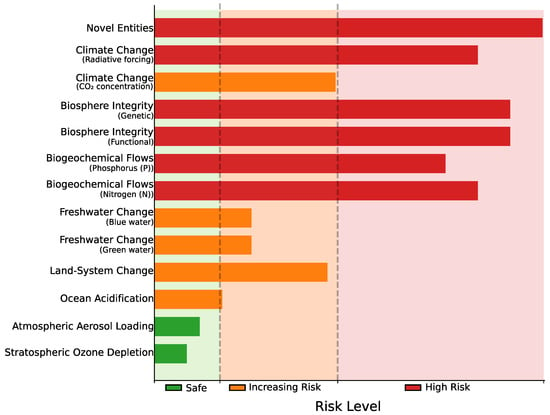
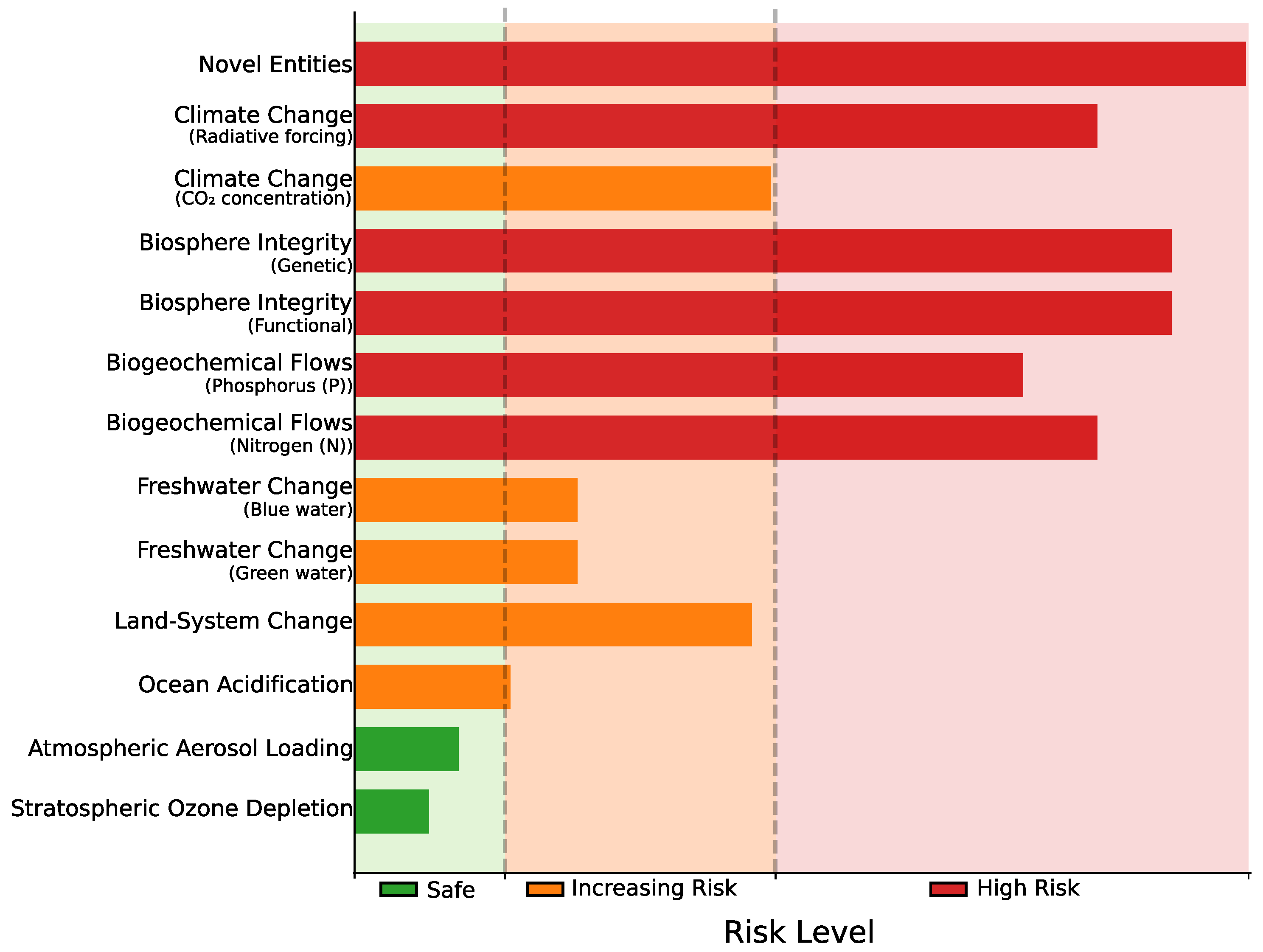
Significant efforts and advancements have been made in recent years to refine the PB framework, leading to updated assessments of all nine boundaries with scientifically based thresholds [22,23,24]. Unfortunately, according to the 2025 Planetary Health Check [24], seven of these thresholds have now been crossed, as shown in Figure 1. This alarming progression reflects the cumulative impact of human activities that exceed the regenerative capacity of Earth systems. Understanding the status and implications of each planetary boundary is foundational for chemical engineers, enabling them to contextualize their work within global environmental limits and recognize when local improvements may still be incompatible with absolute sustainability.
Figure 1.
Current status of the Planetary Boundaries. Illustration created by the author, based on data and analysis from Sakschewski and Caesar et al. [24].
This study utilizes a conceptual design-based framework, synthesizing the AIChE Body of Knowledge [25] with the Planetary Boundaries framework. We combine existing literature on planetary boundaries, system thinking, and sustainability in engineering curricula with representative chemical engineering program structures and the author’s teaching experience. The resulting framework is structured to align with outcome-based education principles, ensuring that system thinking is developed as a cumulative competency rather than an isolated topic. This design-based methodology underpins the course-level mapping and curriculum representation developed in the following sections.
From a teaching perspective, chemical engineering offers direct and tangible connections to each planetary boundary. These links enable educators to relate core concepts and case studies to real-world environmental systems, as summarized in Table 1. The mapping in Table 1 represents the author’s synthesis of typical relationships between industrial sectors and planetary-boundary processes, informed by the planetary-boundaries literature and representative chemical engineering applications. It is intended as an illustrative starting point that instructors can adapt to their own context. The specific examples in Table 1 draw on sectoral cases that are widely used in standard chemical engineering teaching and planetary-boundaries resources, and they are not intended to constitute a new empirical dataset but to serve as pedagogical prompts.
Table 1.
Mapping the connections between planetary boundaries and selected chemical engineering processes.
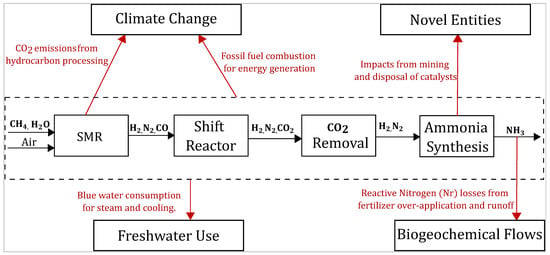
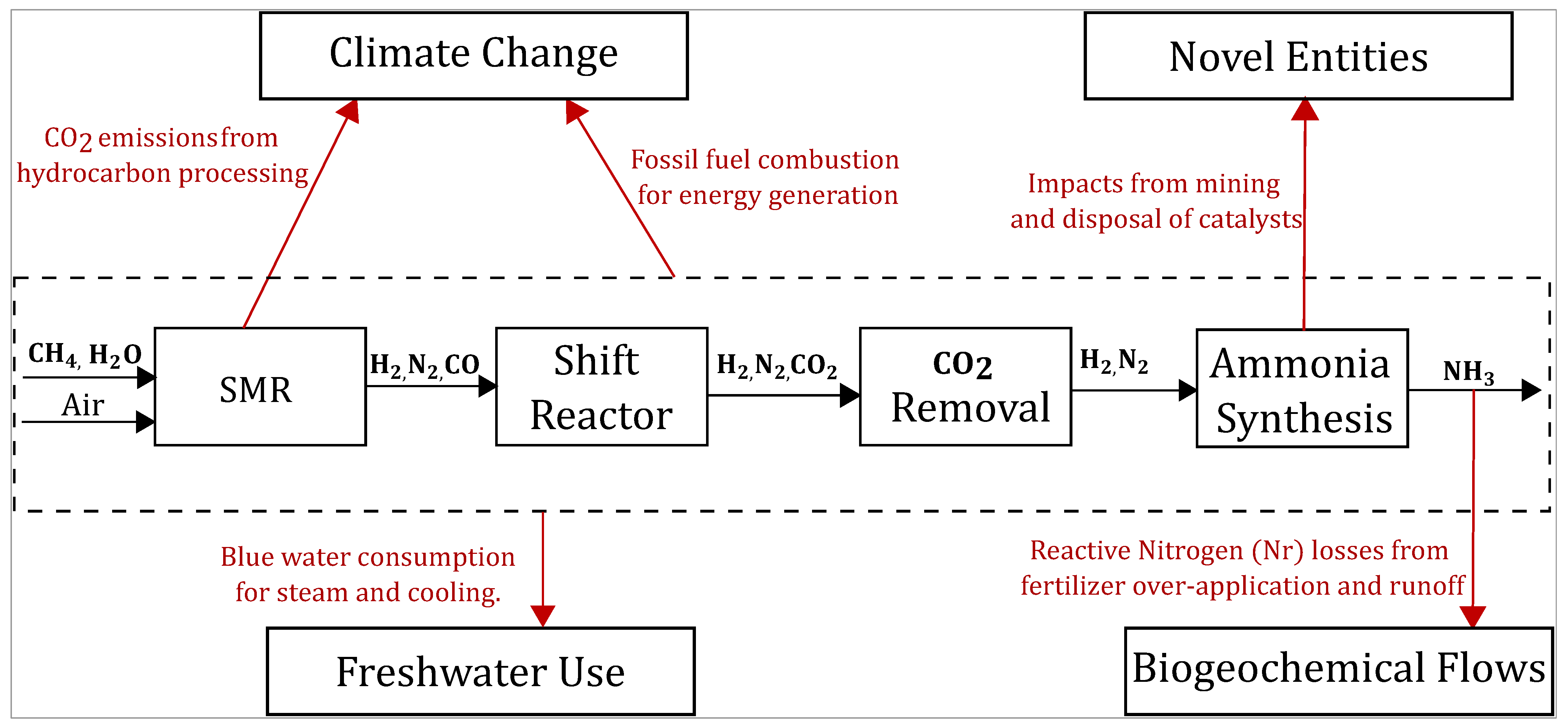
A classic example is the Haber-Bosch process for synthesizing ammonia, which enabled the large-scale production of fertilizers and significantly increased crop yields. This process directly impacts the biogeochemical flows boundary through increased nitrogen fixation and the associated nutrient runoff contributes to water pollution. It also affects the freshwater boundary through the consumption of blue water for steam and cooling. The Haber-Bosch process is energy-intensive and contributes directly to the climate change boundary when powered by fossil fuels [26]. Additionally, the mining, manufacturing, and disposal of the catalysts used in this process are linked to the novel entities boundary, as shown in Figure 2. These connections provide a rich context for introducing students to system thinking about industrial processes and Earth-system feedback.
Figure 2.
Schematic showing the potential connections between the Haber-Bosch process and planetary boundaries, highlighting impacts on climate, freshwater use, nutrient cycles, and novel entities, and illustrating how a single process can interact with multiple planetary boundaries.
Other examples that fall within the boundary of novel entities include the production of polymers, pharmaceuticals, and pesticides, which can cause chemical pollution due to the toxicity and persistence of many of these products [23,27]. Furthermore, combustion processes release particulates and sulfur oxides that simultaneously affect the atmospheric aerosol loading and ocean acidification boundaries. These cases help students see that a single technology can interact with multiple Earth-system processes at once, reinforcing the need for a system-thinking perspective.
A critical pedagogical value of the PB framework is its inherent promotion of system thinking, which encourages a holistic evaluation of interdependencies and the potential for burden-shifting between boundaries. In systems terms, the boundaries are coupled variables. For example, producing biofuels to reduce reliance on fossil fuels addresses the climate change boundary [28,29]. However, a systems perspective reveals that this optimization in one domain creates a negative causal impact on land-system change and freshwater use. Similarly, carbon capture technologies are often presented as climate solutions, but a full life cycle analysis is required to determine whether they provide a net environmental benefit once energy use, material requirements, and waste management systems are considered [30]. These examples show students how interventions that appear beneficial in one dimension may create new pressures elsewhere in the Earth system.
Therefore, chemical engineers must be equipped with a system thinking approach to assess these complex interactions and interdependencies. Educators can challenge students to tackle such system-level problems through the lens of the PB framework, explicitly asking them to trace feedback, identify trade-offs, and consider multiple scales. This prepares students to handle multi-objective challenges that involve environmental, economic, and social considerations [31]. Such skills are critical for designing truly sustainable processes that avoid burden-shifting and remain within Earth’s ecological limits. Building on this foundation, the next section demonstrates how PB-informed system thinking can be embedded within chemical engineering courses to translate planetary limits into practical learning experiences.
3. Incorporating Planetary Boundaries and Systems Thinking into the Curriculum
The framework presented in this section was developed through a design-based process informed by the author’s experience teaching in an accredited chemical engineering program, a review of representative curricula from several universities, and consideration of AIChE Chemical Engineering Body of Knowledge descriptions [25]. Based on this analysis, a set of widely shared core courses was identified with the associated learning objectives. Planetary boundaries and system-thinking competencies were then mapped onto these courses to create an illustrative, rather than exhaustive, integration scheme.
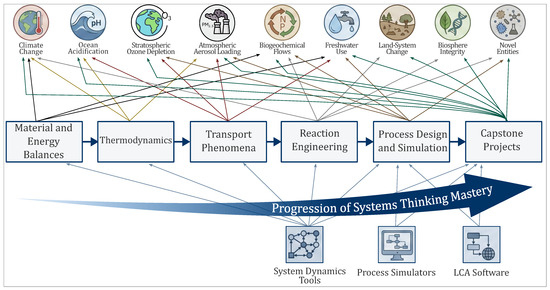
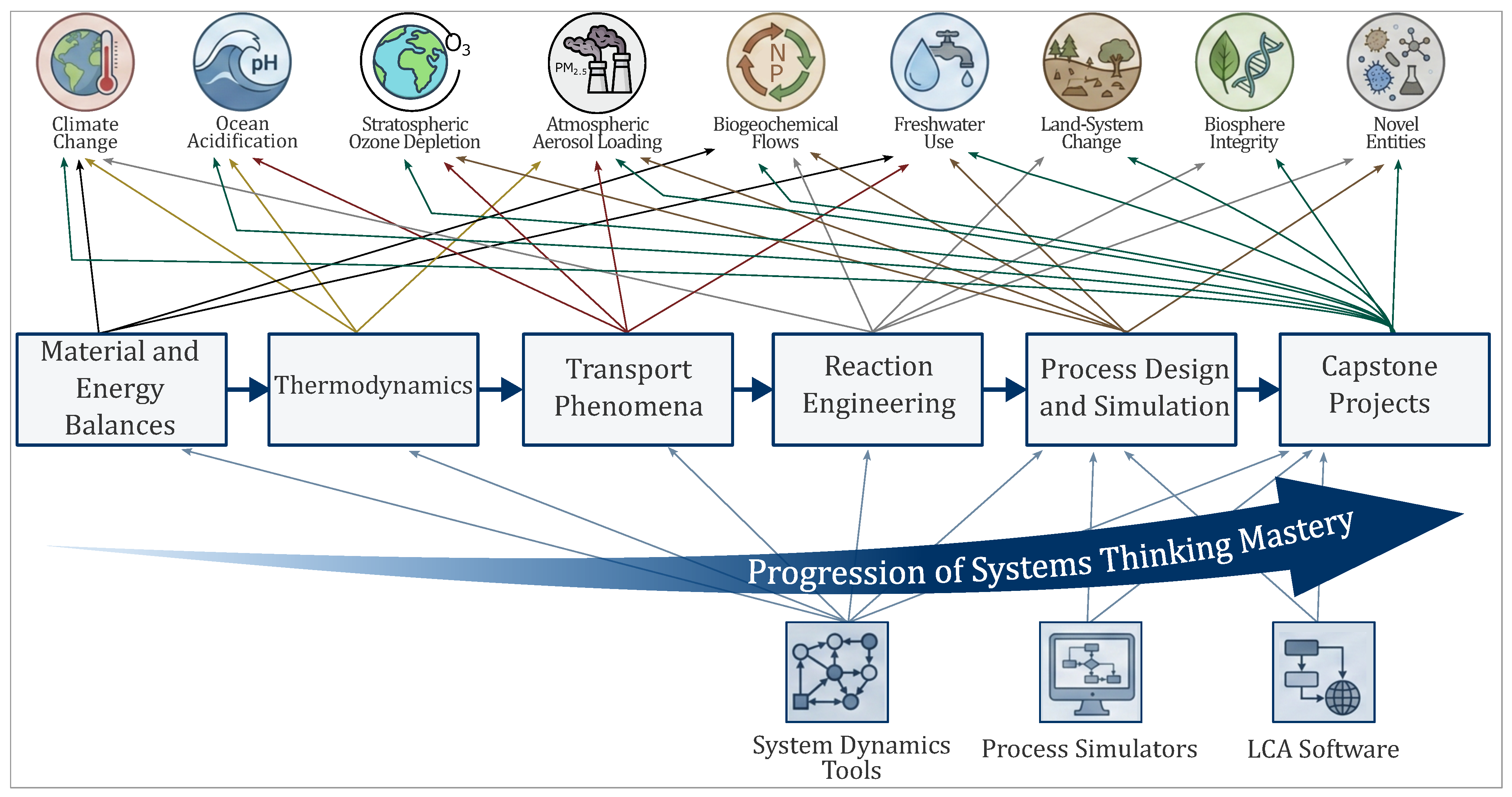
The integration of the Planetary Boundaries framework and system thinking into core chemical engineering courses, rather than relegating them to a single elective, is essential for guiding the curriculum toward sustainability. This approach ensures that students encounter systems concepts and planetary limits early and revisit them consistently throughout their education. Their integration should span lecture-based courses, laboratory experiences, and capstone design projects. Implementation should also include digital and computational tools that allow students to model complex systems and visualize how design choices affect planetary boundary indicators, helping them develop a sustainability-driven mindset from basic principles to advanced applications. Core chemical engineering courses therefore offer unique opportunities to introduce PB-related concepts and transform traditional topics into platforms for teaching sustainability and system-thinking competencies, as summarized in Table 2 and illustrated at the curriculum level in Figure 3. In Figure 3, planetary boundaries appear as cross-cutting contexts for all core courses, and the lower arrow depicts the progression of system-thinking mastery from introductory topics to capstone projects, supported by process simulators, LCA software, and system-dynamics tools.
Table 2.
Linking Chemical Engineering Topics to Planetary Boundaries with Example Educational Contexts.
Figure 3.
System-thinking view of the chemical engineering curriculum as an integrated learning system. Planetary boundaries are connected to core courses, and the lower arrow indicates the progression of system-thinking mastery. Digital tools such as process simulators, LCA software, and system-dynamics tools support modeling of complex systems, with introductory stock-and-flow representations in early core courses and more advanced dynamic modeling in later ones.
3.1. Core Courses
In Material and Energy Balances, students typically quantify inputs and outputs for an individual unit operation or process network. Educators can extend these exercises by explicitly framing them as systems diagrams in which boundaries, stocks, and flows are identified and linked to specific planetary boundaries. For instance, students might perform a mass balance on the phosphorus cycle and directly connect it to the biogeochemical flows boundary, or analyze nitrogen balances in fertilizer production relative to a downscaled local boundary for reactive nitrogen. This supports system thinking by introducing system dynamics tools to help students visualize how material inventories change over time and prepare them for more advanced dynamic modeling later in the curriculum. Students can also compare alternative process designs by evaluating differences in water consumption, which directly relates to the freshwater use boundary, thereby practicing how changes in process configuration propagate through resource stocks and emissions.
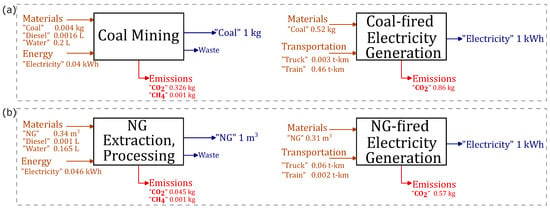
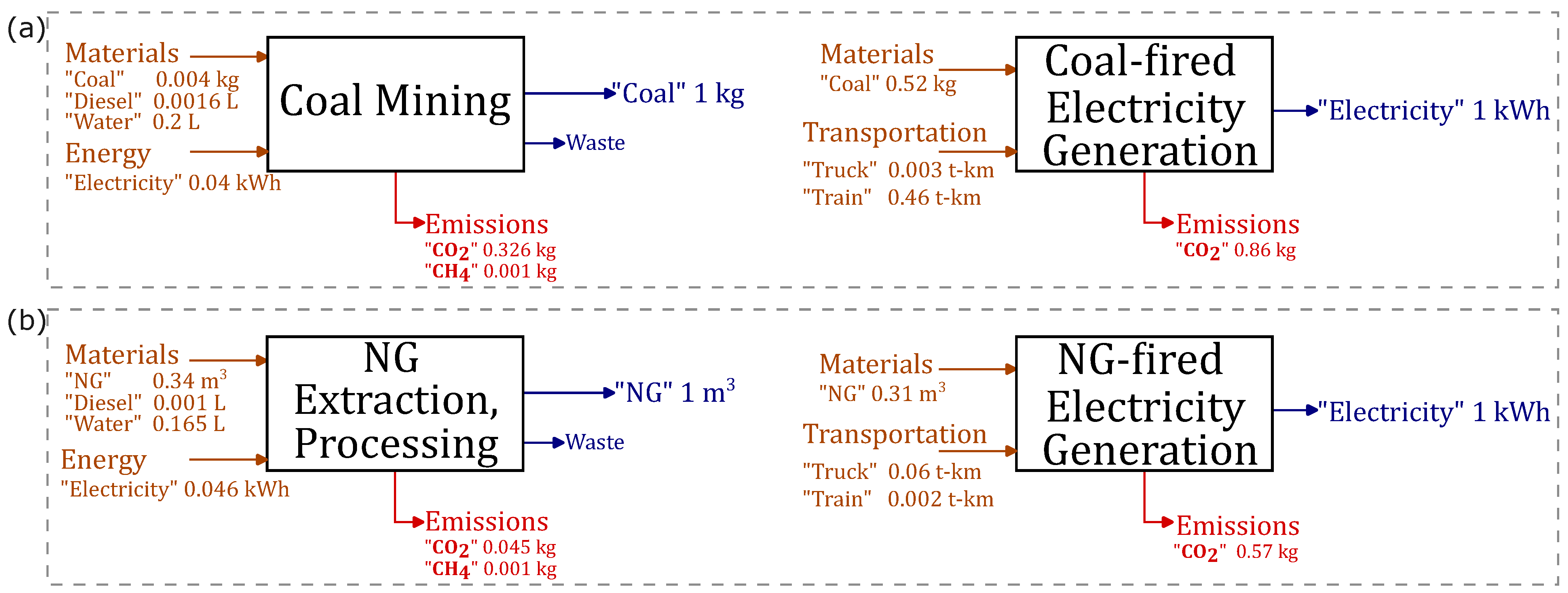
Educators may further incorporate simplified, process-based life cycle assessments into the course. For example, students can calculate the environmental impact of producing 1 kWh of electricity using coal or natural gas [32]. Instructors can provide life-cycle inventory data for key stages such as coal mining, natural gas extraction, and transportation, as shown in the illustrative example in Figure 4. Students then use these data to calculate and compare total CO2 emissions, water footprints, and other metrics linked to relevant planetary boundaries. This activity helps students trace how decisions at one stage of the life cycle influence impacts elsewhere, and how different technologies create distinct patterns of boundary transgression. These system-thinking exercises promote an early appreciation of absolute sustainability and encourage students to consider PB constraints in later courses and professional careers.
Figure 4.
Process-based LCA schematic illustrating material flows, energy use, transportation, and emissions for (a) coal-fired and (b) natural gas-fired electricity generation producing 1 kWh. This illustrative example highlights selected life-cycle stages for educational purposes.
Thermodynamics courses can incorporate sustainability principles into traditional topics by using exergy analysis to assess the efficiency of industrial systems [33], calculating the carbon footprint of energy processes, and exploring the integration of renewable energy sources. These applications relate directly to the planetary boundaries for climate change and atmospheric aerosol loading. Additionally, topics such as the solubility of carbon dioxide in ocean water can be linked to the ocean acidification boundary, helping students connect thermodynamic principles to global environmental challenges [15]. By asking students to compare scenarios for different configurations or fuel types in terms of exergy efficiency and boundary indicators, instructors can foster system-thinking skills through reinforcing the idea of stocks and flows, feedbacks, trade-offs, and cross-scale energy flows.
Connections between Transport Phenomena and planetary boundaries arise from fundamental processes such as diffusion, heat transfer, and fluid dynamics. For example, students can model the atmospheric diffusion of aerosol particles, linking transport coefficients and boundary layer behavior to the atmospheric aerosol loading boundary. They can also analyze the efficiency of mass and heat transfer in industrial cooling systems, which impact freshwater use through water consumption and contribute to climate change through associated energy use. In addition, understanding the transport of ozone-depleting substances through the atmosphere applies fluid dynamics concepts and can be conceptually linked to the stratospheric ozone depletion boundary. In each of these examples, the goal is not only to solve transport equations, but also to reinforce system thinking tools such as behavior over time and causal loop diagrams in order to better understand the implications of dynamic system behavior and boundary crossing at regional and global scales.
Many reaction-engineered processes, such as petrochemical production, plastics manufacturing, and fertilizer synthesis, are core contributors to sectors that have transgressed multiple planetary boundaries. Reaction engineering courses therefore provide a natural platform for addressing sustainability challenges, particularly those related to the climate change, biogeochemical flows, freshwater use, and novel entities boundaries. Positioning these topics explicitly as system-level case studies allows students to connect reaction kinetics and reactor design to broader questions about resource use, emissions, and environmental resilience.
Students can apply their knowledge of reaction kinetics to emerging solutions such as carbon capture and utilization, thereby engaging with mitigation strategies for the climate change boundary. Traditional examples such as combustion reactions and fossil-fuel-based energy generation illustrate how reaction pathways can contribute significantly to both climate change and air pollution. Reaction engineering educators can use stocks and flows and system dynamics representations for reactants and products to help students link rate expressions and reactor design to time-dependent changes in inventories and emission levels.
Catalysts are widely used in these processes to increase efficiency and selectivity. However, many industrial catalysts rely on rare earth metals such as cerium and lanthanum. The extraction and refining of these metals are highly water-intensive, putting pressure on the freshwater use boundary [34]. Rare earth mining also contributes to land-system change through deforestation, soil erosion, and habitat destruction while processing and disposal generate toxic waste, including heavy metals, that falls under the novel entities boundary. While catalysts can help reduce emissions during plant operation, a full life-cycle assessment often reveals hidden environmental costs associated with catalyst manufacture and end-of-life management. These complex trade-offs create valuable opportunities for integrating the PB framework into reaction engineering education. Educators can ask students to compare alternative reaction pathways and catalyst formulations based on emissions, material availability, and impacts on water use, land-system change, and pollution, explicitly discussing how design choices shift pressure among different planetary boundaries.
Process design courses are pivotal in integrating knowledge from various disciplines and applying it to real-world engineering challenges. In this context, students can be encouraged to evaluate process designs not only for economic viability and efficiency, but also against planetary boundary thresholds using tools such as Life Cycle Assessment and Techno-Economic Analysis (TEA) [35]. This includes comparing alternative energy sources, raw materials, and production pathways to understand their environmental implications and their compatibility with absolute sustainability targets. This introduces the concept of constrained multi-objective optimization, where ecological limits act as hard system constraints rather than externalities.
Students can also assess the impacts of their designs at global, regional, and local scales, allowing them to consider how process location affects specific planetary boundaries and local ecosystems. Because process design integrates all core chemical engineering topics, it offers flexibility to engage with all nine planetary boundaries and to make trade-offs between them explicit. For example, students might evaluate both the economic and environmental impacts, such as greenhouse gas emissions, freshwater use, and novel entity releases of competing process options. A more advanced assignment could involve performing a multi-objective optimization to minimize cost while staying within one or more planetary boundary limits. In simulation-based courses, educators can assign projects where students estimate CO2 intensity or water consumption for a traditional process and compare it to a greener alternative, explicitly linking the results to relevant planetary boundaries and asking students to reflect on system feedback and rebound effects. At this stage, system thinking is strongly supported by process simulators, life cycle assessment software, and system dynamics tools, which can be combined to explore how alternative flowsheets, operating conditions, and control strategies affect energy use, water withdrawal, emissions, and other planetary-boundary indicators across scenarios.
Through these course-level integrations, students develop key learning outcomes, including:
- The ability to define system boundaries, identify key stocks and flows, and quantify connections between chemical processes and planetary boundary indicators.
- The capacity to apply system-thinking tools (such as scenario analysis and life-cycle modeling) to evaluate feedback, trade-offs, and potential burden-shifting between different boundaries.
- The competency to propose and justify process improvements that are consistent with absolute sustainability principles while also considering technical feasibility and economic performance.
3.2. Capstone Projects
Capstone projects represent the culmination of the skills and knowledge gained throughout chemical engineering education, where students are expected to address complex and open-ended problems. Integrating planetary boundaries explicitly into capstone projects adds depth and challenge for students to reconcile technical performance, economics, and absolute sustainability constraints. Armed with system-thinking and PB knowledge from earlier courses, students can now apply these concepts to real-world problems that demand interdisciplinary problem solving. Examples of PB-informed projects include the optimization of hydrogen supply chains, the design of net-zero or nature-positive chemical plants, or the evaluation of circular economy strategies for key products, all within the context of planetary boundary limits [36].
Using system thinking in capstone design allows students to engage with PB-constrained design, requiring them to consider the full life cycle of their proposed solutions, including raw-material extraction, processing, manufacturing, use, and end-of-life. For instance, when designing or optimizing the supply chain of hydrogen, students need to assess the carbon footprint of the chosen production method, whether it is green hydrogen from electrolysis or blue hydrogen with carbon capture [37], and evaluate whether the resulting system is compatible with the climate boundary threshold. They must also consider land-system changes associated with renewable energy infrastructure, the impact on local freshwater sources, and potential novel entity releases, all within the PB framework.
This comprehensive approach encourages students to think beyond traditional engineering design and be more innovative in exploring or testing alternative solutions. By aligning their work with the PB framework and explicitly applying system-thinking tools, students develop a deeper understanding of the environmental trade-offs associated with chemical processes and infrastructure choices. They are therefore better prepared to design systems that support global sustainability goals and communicate the systemic implications of their design decisions to diverse stakeholders.
4. Discussion: Challenges and Opportunities
One of the main challenges in integrating the PB framework and system thinking into chemical engineering education is translating global-scale concepts into classroom-scale examples that resonate with students and align with course content. Since the PB framework is defined at the global level, downscaling these limits to regional, local, or process-specific levels is essential but complex. Various efforts in the research community have proposed and compared different downscaling approaches [38,39,40,41,42,43,44], highlighting how the choice of method can significantly affect the interpretation of results [45]. A further challenge involves the availability and quality of data for certain regions of the world, and how these data are applied to specific processes and products, which complicates the translation of global boundaries into actionable insights within engineering education [46]. Within the educational context, instructors can select or define an appropriate downscaling approach based on the nature of the course, for example, while clearly stating the assumptions involved. One of the goals of integrating PBs into engineering courses is to expose students to system thinking and to broaden their perspective on how engineered processes interact with Earth systems. Thus, the downscaling challenge also presents an educational opportunity to introduce students to uncertainty analysis, scenario exploration, and critical evaluation of sustainability data.
Another key challenge for educators is resource limitations and curriculum crowding [18]. Most chemical engineering programs are already dense with foundational science, general engineering, and core disciplinary courses, leaving little room for additional standalone content. However, as demonstrated in this paper, it is possible to embed the PB concepts and system-thinking activities within existing exercises rather than adding new modules. Re-envisioning these courses to include PBs and system thinking will require time and effort from educators, including faculty development, the creation of new lecture materials and illustrative examples, and access to appropriate analytical and digital tools. Institutional support and long-term strategic planning will be critical to ensure effective implementation [3,10].
Despite these challenges, integrating planetary boundaries and system thinking into chemical engineering education presents significant opportunities to redefine the role of engineers in society and accelerate the transition towards a sustainable future. By equipping graduates with a deep understanding of ecological limits and systemic interdependencies, programs can position chemical engineers as leaders in the global movement towards net-zero and nature-positive transitions. This involves not only mitigating negative impacts but also designing processes, products, and infrastructures that regenerate natural systems and contribute positively to planetary health. Engineers trained with this perspective, and with experience using digital tools to model complex systems, will be uniquely qualified to innovate solutions for decarbonization, circular-economy models [47], and sustainable resource management, thereby driving the necessary industrial transformation.
Although the examples in this paper are focused on chemical engineering, the underlying logic of the framework is transferable to other engineering disciplines. The curriculum-level representation in Figure 3 can serve as a template for this broader adaptation in several engineering programs, such as mechanical, civil, environmental, and materials engineering. In each case, educators can map planetary boundaries to their own core courses and identify discipline-specific system-thinking competencies for related contexts such as energy systems, infrastructure design, water resources, and materials selection.
5. Conclusions
The imperative to integrate the Planetary Boundaries framework and system thinking into chemical engineering education is more critical than ever. With seven out of nine boundaries already transgressed, the need for sustainability-driven engineers is urgent. This paper proposes a reorientation of the chemical engineering curriculum, moving beyond the traditional emphasis on efficiency and economic optimization to embrace system modeling and absolute environmental sustainability as core pedagogical principles. By embedding the PB framework into core courses and capstone projects, and by using it as a scaffold for explicit system-thinking learning outcomes, educators can equip future chemical engineers with the holistic understanding and practical skills necessary to operate within Earth’s ecological limits.
The main contributions of this paper are threefold. First, it proposes a system-thinking-based framework that uses the Planetary Boundaries concept as a unifying scaffold across the chemical engineering curriculum. Second, it offers an actionable guide for educators through a structured mapping between planetary boundaries, representative core courses, and system-thinking competencies. Third, it discusses key challenges and opportunities associated with implementation, including issues of downscaling planetary boundaries, data availability, curriculum crowding, and institutional support.
This transformative approach to education is essential for fostering a new generation of chemical engineers who are not only problem solvers but also proactive planetary stewards. These engineers will be prepared to tackle increasingly complex challenges involving environmental degradation, resource constraints, and social justice, and they will be equipped to understand the emergence, causality, and complex interdependencies within Earth systems. This systems-level understanding will enable them to design innovative solutions that prevent burden-shifting and promote long-term sustainability. The examples provided in this paper illustrate both the feasibility and the educational value of integrating PB-informed teaching across the curriculum, showing how theoretical concepts can be translated into practical applications supported by digital modeling, life-cycle approaches, and system-thinking tools.
Future work will focus on empirically evaluating the impact of the proposed framework on student learning and professional identity formation. This includes developing and applying assessment instruments to measure system-thinking competencies, piloting PB-informed learning activities across multiple course offerings, and collecting qualitative feedback from students and instructors.
Finally, the changes proposed in this paper cannot be achieved without institutional support. Curriculum developers, academic institutions, and quality-assurance bodies must work together to support educators and address challenges such as curriculum crowding and the complexities of downscaling global PBs to regional or process-specific levels. A collaborative effort is required to realize this shift and to ensure system thinking and planetary boundary literacy are recognized as core graduate attributes. By embracing this educational evolution, chemical engineering can strengthen its leadership role in the transition to a net-zero, nature-positive, and socially just future. Educating engineers as planetary stewards through system thinking is not merely an academic aspiration; instead, it is a societal necessity for safeguarding the well-being of current and future generations.
Funding
This research received no external funding.
Data Availability Statement
The data presented in this study regarding the curriculum framework and course-boundary mappings are contained within this article. The data used to construct Figure 1 (planetary-boundary status) are available in publicly accessible sources as cited in the figure caption and references.
Conflicts of Interest
The author declares no conflicts of interest.
References
- Allen, D.T.; Shonnard, D.R. Sustainable Engineering; Prentice Hall: Philadelphia, PA, USA, 2012. [Google Scholar]
- Azapagic, A. Life cycle assessment as an environmental sustainability tool. In Renewables-Based Technology; John Wiley & Sons, Ltd.: Chichester, UK, 2006; pp. 87–110. [Google Scholar]
- Gallego-Schmid, A.; Schmidt Rivera, X.C.; Stamford, L. Introduction of life cycle assessment and sustainability concepts in chemical engineering curricula. Int. J. Sustain. High. Educ. 2018, 19, 442–458. [Google Scholar] [CrossRef] [Scilit]
- Hesketh, R.P.; Slater, C.S.; Savelski, M.J.; Hollar, K.; Farrell, S. A Program to Help in Designing Courses to Integrate Green Engineering Subjects. Int. J. Eng. Educ. 2004, 20, 113–123. [Google Scholar]
- ISO 14040:2006/Amd 1:2020; Environmental Management—Life Cycle Assessment Principles and Framework, Amendment 1. International Organization for Standardization: Geneva, Switzerland, 2020. Available online: https://www.iso.org/standard/76121.html (accessed on 11 December 2025).
- Anastas, P.T.; Warner, J. Green Chemistry: Theory and Practice; Oxford University Press: New York, NY, USA, 2000. [Google Scholar]
- Glassey, J.; Haile, S. Sustainability in chemical engineering curriculum. Int. J. Sustain. High. Educ. 2012, 13, 354–364. [Google Scholar] [CrossRef] [Scilit]
- Walker, H.L.; Kim, D.; Clausen, E.C. Chemical Engineering Courses in Sustainability and Life Cycle Assessment. In Proceedings of the 2024 ASEE Midwest Section Conference Proceedings, ASEE Conferences, Lawrence, Kansas, 8–10 September 2024. [Google Scholar] [CrossRef] [Scilit]
- Beagon, U.; Kövesi, K.; Tabas, B.; Nørgaard, B.; Lehtinen, R.; Bowe, B.; Gillet, C.; Spliid, C.M. Preparing engineering students for the challenges of the SDGs: What competences are required? Eur. J. Eng. Educ. 2023, 48, 1–23. [Google Scholar] [CrossRef] [Scilit]
- Sabri, O.K. Rethinking sustainability in engineering education: A call for systemic change. Front. Educ. 2025, 10, 1587430. [Google Scholar] [CrossRef] [Scilit]
- Lee, H.; Romero, J. (Eds.) Climate Change 2023: Synthesis Report. Contribution of Working Groups I, II and III to the Sixth Assessment Report of the Intergovernmental Panel on Climate Change; IPCC: Geneva, Switzerland, 2023. [Google Scholar] [CrossRef] [Scilit]
- Kleine, M.S.; Wigner, A.; Nieusma, D.; Salinas, C. Addressing Engineering Reductionism by Reimagining ABET Outcomes. In Proceedings of the 2023 ASEE Annual Conference & Exposition Proceedings, ASEE Conferences, Baltimore, MD, USA, 25–28 June 2023. [Google Scholar]
- Meadows, D.H. Thinking in Systems: A Primer; Earthscan: London, UK, 2009. [Google Scholar]
- Sterman, J. Business Dynamics: Systems Thinking and Modeling for a Complex World; McGraw-Hill Professional: New York, NY, USA, 2000. [Google Scholar]
- MacDonald, R.P.; Pattison, A.N.; Cornell, S.E.; Elgersma, A.K.; Greidanus, S.N.; Visser, S.N.; Hoffman, M.; Mahaffy, P.G. An interactive planetary boundaries systems thinking learning tool to integrate sustainability into the chemistry curriculum. J. Chem. Educ. 2022, 99, 3530–3539. [Google Scholar] [CrossRef] [Scilit]
- Krab-Hüsken, L.E.; Pei, L.; de Vries, P.G.; Lindhoud, S.; Paulusse, J.M.J.; Jonkheijm, P.; Wong, A.S.Y. Conceptual Modeling Enables Systems Thinking in Sustainable Chemistry and Chemical Engineering. J. Chem. Educ. 2023, 100, 4577–4584. [Google Scholar] [CrossRef] [Scilit]
- Tümay, H. Systems Thinking in Chemistry and Chemical Education: A Framework for Meaningful Conceptual Learning and Competence in Chemistry. J. Chem. Educ. 2023, 100, 3925–3933. [Google Scholar] [CrossRef] [Scilit]
- Thürer, M.; Tomašević, I.; Stevenson, M.; Qu, T.; Huisingh, D. A systematic review of the literature on integrating sustainability into engineering curricula. J. Clean. Prod. 2018, 181, 608–617. [Google Scholar] [CrossRef] [Scilit]
- Inguva, P.K.; Chadha, D.; Brechtelsbauer, C.; Heng, J.Y.; Matar, O.K.; Shah, U. Integrating sustainability into chemical engineering Education: Experiences from imperial college London. Clean. Responsible Consum. 2025, 18, 100303. [Google Scholar] [CrossRef] [Scilit]
- Habbal, F.; Kolmos, A.; Hadgraft, R.G.; Holgaard, J.E.; Reda, K. Reshaping Engineering Education: Addressing Complex Human Challenges; Springer Nature: Singapore, 2024. [Google Scholar] [CrossRef] [Scilit]
- Rockström, J.; Steffen, W.; Noone, K.; Persson, A.; Chapin, F.S., 3rd; Lambin, E.F.; Lenton, T.M.; Scheffer, M.; Folke, C.; Schellnhuber, H.J.; et al. A safe operating space for humanity. Nature 2009, 461, 472–475. [Google Scholar] [CrossRef] [Scilit]
- Steffen, W.; Richardson, K.; Rockström, J.; Cornell, S.E.; Fetzer, I.; Bennett, E.M.; Biggs, R.; Carpenter, S.R.; de Vries, W.; de Wit, C.A.; et al. Sustainability. Planetary boundaries: Guiding human development on a changing planet. Science 2015, 347, 1259855. [Google Scholar] [CrossRef] [Scilit]
- Richardson, K.; Steffen, W.; Lucht, W.; Bendtsen, J.; Cornell, S.E.; Donges, J.F.; Drüke, M.; Fetzer, I.; Bala, G.; von Bloh, W.; et al. Earth beyond six of nine planetary boundaries. Sci. Adv. 2023, 9, eadh2458. [Google Scholar] [CrossRef] [Scilit] [PubMed]
- Sakschewski, B.; Caesar, L.; Andersen, L.; Bechthold, M.; Bergfeld, L.; Beusen, A.; Billing, M.; Bodirsky, B.L.; Botsyun, S.; Dennis, D.P.; et al. Planetary Health Check 2025; Technical Report; Potsdam Institute for Climate Impact Research (PIK): Potsdam, Germany, 2025.
- American Institute of Chemical Engineers (AIChE). Body of Knowledge for Chemical Engineers; Technical Report; AIChE: New York, NY, USA, 2015. [Google Scholar]
- Rafiqul, I.; Weber, C.; Lehmann, B.; Voss, A. Energy efficiency improvements in ammonia production—Perspectives and uncertainties. Energy 2005, 30, 2487–2504. [Google Scholar] [CrossRef] [Scilit]
- Persson, L.; Carney Almroth, B.M.; Collins, C.D.; Cornell, S.; de Wit, C.A.; Diamond, M.L.; Fantke, P.; Hassellöv, M.; MacLeod, M.; Ryberg, M.W.; et al. Outside the safe operating space of the planetary boundary for novel entities. Environ. Sci. Technol. 2022, 56, 1510–1521. [Google Scholar] [CrossRef] [Scilit] [PubMed]
- Searchinger, T.; Heimlich, R.; Houghton, R.A.; Dong, F.; Elobeid, A.; Fabiosa, J.; Tokgoz, S.; Hayes, D.; Yu, T.H. Use of U.S. Croplands for Biofuels Increases Greenhouse Gases Through Emissions from Land-Use Change. Science 2008, 319, 1238–1240. [Google Scholar] [CrossRef] [Scilit]
- Tilman, D.; Socolow, R.; Foley, J.A.; Hill, J.; Larson, E.; Lynd, L.; Pacala, S.; Reilly, J.; Searchinger, T.; Somerville, C.; et al. Beneficial Biofuels—The Food, Energy, and Environment Trilemma. Science 2009, 325, 270–271. [Google Scholar] [CrossRef] [Scilit]
- von der Assen, N.; Jung, J.; Bardow, A. Life-cycle assessment of carbon dioxide capture and utilization: Avoiding the pitfalls. Energy Environ. Sci. 2013, 6, 2721. [Google Scholar] [CrossRef] [Scilit]
- Argoti, A.; Orjuela, A.; Narváez, P.C. Challenges and opportunities in assessing sustainability during chemical process design. Curr. Opin. Chem. Eng. 2019, 26, 96–103. [Google Scholar] [CrossRef] [Scilit]
- Bakshi, B.R. (Ed.) Engineering and Ecosystems: Seeking Synergies Toward a Nature-Positive World; Springer International Publishing: Cham, Switzerland, 2023. [Google Scholar]
- Bakshi, B.R. Sustainable Engineering; Cambridge University Press: Cambridge, UK, 2019. [Google Scholar]
- Haque, N.; Hughes, A.; Lim, S.; Vernon, C. Rare Earth Elements: Overview of Mining, Mineralogy, Uses, Sustainability and Environmental Impact. Resources 2014, 3, 614–635. [Google Scholar] [CrossRef] [Scilit]
- Vázquez, D.; Guillén-Gosálbez, G. Process design within planetary boundaries: Application to CO2 based methanol production. Chem. Eng. Sci. 2021, 246, 116891. [Google Scholar] [CrossRef] [Scilit]
- Davis, S.J.; Lewis, N.S.; Shaner, M.; Aggarwal, S.; Arent, D.; Azevedo, I.L.; Benson, S.M.; Bradley, T.; Brouwer, J.; Chiang, Y.M.; et al. Net-zero emissions energy systems. Science 2018, 360, 6396. [Google Scholar] [CrossRef] [Scilit]
- Cetinkaya, E.; Dincer, I.; Naterer, G. Life cycle assessment of various hydrogen production methods. Int. J. Hydrogen Energy 2012, 37, 2071–2080. [Google Scholar] [CrossRef] [Scilit]
- Hoekstra, A.; Chapagain, A.K.; Aldaya, M.M.; Mekonnen, M.M. The Water Footprint Assessment Manual; Routledge: London, UK, 2011. [Google Scholar]
- Nykvist, B.; Persson, A.; Moberg, F.; Persson, L.; Cornell, S.; Rockstrøm, J. National Environmental Performance on Planetary Boundaries: A Study for the Swedish Environmental Protection Agency; Swedish Environmental Protection Agency: Stockholm, Sweden, 2013.
- Sandin, G.; Peters, G.M.; Svanström, M. Using the planetary boundaries framework for setting impact-reduction targets in LCA contexts. Int. J. Life Cycle Assess. 2015, 20, 1684–1700. [Google Scholar] [CrossRef] [Scilit]
- Roos, S.; Zamani, B.; Sandin, G.; Peters, G.M.; Svanström, M. A life cycle assessment (LCA)-based approach to guiding an industry sector towards sustainability: The case of the Swedish apparel sector. J. Clean. Prod. 2016, 133, 691–700. [Google Scholar] [CrossRef] [Scilit]
- Ryberg, M.W.; Owsianiak, M.; Clavreul, J.; Mueller, C.; Sim, S.; King, H.; Hauschild, M.Z. How to bring absolute sustainability into decision-making: An industry case study using a Planetary Boundary-based methodology. Sci. Total Environ. 2018, 634, 1406–1416. [Google Scholar] [CrossRef] [Scilit]
- Bjørn, A.; Richardson, K.; Hauschild, M.Z. A framework for development and communication of absolute environmental sustainability assessment methods. J. Ind. Ecol. 2019, 23, 838–854. [Google Scholar] [CrossRef] [Scilit]
- Huang, L.H.; Hu, A.H.; Kuo, C.H. Planetary boundary downscaling for absolute environmental sustainability assessment—Case study of Taiwan. Ecol. Indic. 2020, 114, 106339. [Google Scholar] [CrossRef] [Scilit]
- Xue, Y.; Bakshi, B.R. Metrics for a nature-positive world: A multiscale approach for absolute environmental sustainability assessment. Sci. Total Environ. 2022, 846, 157373. [Google Scholar] [CrossRef] [Scilit]
- Xue, Y.; Bakshi, B.R. Ecosystem Science-Based Absolute Environmental Sustainability Assessment of Chemical Products with and without Climate Justice. ACS Sustain. Chem. Eng. 2024, 12, 13452–13463. [Google Scholar] [CrossRef] [Scilit]
- Geissdoerfer, M.; Savaget, P.; Bocken, N.M.; Hultink, E.J. The Circular Economy—A new sustainability paradigm? J. Clean. Prod. 2017, 143, 757–768. [Google Scholar] [CrossRef] [Scilit]

Disclaimer/Publisher’s Note: The statements, opinions and data contained in all publications are solely those of the individual author(s) and contributor(s) and not of MDPI and/or the editor(s). MDPI and/or the editor(s) disclaim responsibility for any injury to people or property resulting from any ideas, methods, instructions or products referred to in the content. |
© 2026 by the author. Licensee MDPI, Basel, Switzerland. This article is an open access article distributed under the terms and conditions of the Creative Commons Attribution (CC BY) license.