
Article

Cultivating Risk-Response Capability: The Impact of Partner Compatibility and Supply Chain Collaboration

1
Graduate School of Service Business, Kyonggi University, Seoul 03746, Republic of Korea
2
Division of Business Administration, Kyonggi University, Suwon 16227, Republic of Korea
3
Graduate School of Logistics, Inha University, Incheon 22212, Republic of Korea
*
Author to whom correspondence should be addressed.
Systems 2025, 13(12), 1130; https://doi.org/10.3390/systems13121130
Submission received: 11 November 2025 / Revised: 9 December 2025 / Accepted: 11 December 2025 / Published: 18 December 2025

Abstract

Supply chains operate in increasingly volatile environments, making it essential to understand the mechanisms through which partner characteristics shape risk-response capability. This study examines how compatibility between supply chain partners promotes collaboration and, in turn, strengthens robustness and resilience. Using survey data from 219 managers in South Korea, the study develops a conceptual model grounded in congruence theory and the dynamic capability view, and tests it through partial least squares path modeling. The results show that compatibility enhances collaboration, which subsequently improves risk-response capability and mediates the effect of compatibility on robustness and resilience. These findings provide empirical support for a capability-building mechanism in which inter-organizational compatibility enables more effective collaborative practices that enhance a supply chain’s ability to withstand and recover from disruptions. The study extends prior research by shifting the discussion of compatibility from interpersonal or person–organization settings to the inter-organizational domain and by demonstrating its critical role in cultivating dynamic capabilities in supply chain risk management.

1. Introduction

Global supply chains have experienced significant disruptions arising from a variety of sources. The COVID-19 pandemic, for example, led governments to adopt containment measures that—while effective in limiting transmission—also impeded the movement of goods and materials across borders [1]. Beyond the pandemic, natural disasters, economic shocks, and other systemic risks continue to destabilize supply chain operations. These disruptions often generate ripple effects that extend well beyond their points of origin, reflecting the increasingly interconnected nature of global production and distribution networks. Consequently, firms now operate in an environment where they must respond swiftly to volatile demand while managing persistent uncertainties throughout the supply chain.
Supply chain risks are generally categorized into operational and disruption risks [2]. Operational risks relate to inherent uncertainties, such as variations in lead time, demand, and supply, which pose a threat to the supply chain. Disruption risks refer to major interruptions originating from externally imposed and uncontrollable sources, such as natural disasters (e.g., floods, earthquakes, hurricanes) and human-induced disasters (e.g., pandemics, economic crises, and terrorist attacks). Among these risks, disruption risks are considered more dangerous, as they have larger ripple effects and longer lasting [3]. A growing body of research has demonstrated the severity of supply chain disruption impacts.
With regard to the long-term negative impacts of supply chain disruptions, recent research emphasizes the importance of risk response capabilities that mitigate threats to supply chain performance—namely, supply chain resilience (the ability to recover from disruptions) and robustness (the ability to maintain operational performance). In the supply chain management literature, these risk response capabilities (robustness and resilience) are regarded as dynamic capabilities, as they enable firms to effectively adapt and respond to unexpected events (e.g., [4,5]). Recently, there has been growing scholarly interest in these capabilities, which enable firms to achieve and sustain competitive advantages in rapidly changing environments. However, while many academic efforts have focused on examining the effects of risk-response capabilities, empirical studies exploring their antecedents remain in their infancy [6]. Given these gaps in the literature, this study seeks to conceptualize a comprehensive mechanism to enhance the supply chain’s risk-response capabilities.
While a firm’s independent actions cause demand fluctuation and deteriorate forecasting accuracy, such uncertainties and supply chain instability can be controlled through collaboration. Furthermore, collaboration enhances the supply chain performance by facilitating the integration of each member’s dispersed efforts and resources [7]. Supply chain partners naturally share the necessary information, useful know-how and skills, and resources, and of course through collaborative interactions, and such endeavors create valuable knowledge and capabilities that lead to superior performance [8,9]. Practically, supply chain collaboration not only enhances the performance of each supply chain member but also becomes a steppingstone for the continuous improvement of the entire supply chain [8,10]. Toyota and its supplier association well present the most desirable example of such supply chain collaboration. Toyota’s supply chain collaboration dates back to the 1950s and plays a vital part even in the recent transition towards eco-friendly vehicle innovation [11].
Meanwhile, heterogeneity between partners, such as differences in culture, norms, organizational goals, way of processing, and operational activities, impedes collaborative interactions and, thus, negative impacts supply chain integration [12]. On the contrary, measures resulting in greater homogeneity and better coordination can strengthen the beneficial outcomes of supply chain collaboration [13], and congruence capital theory supports this perspective. In the literature, organizational compatibility is structured as a multidimensional concept relates to technical, cultural, operational, strategic, and goal aspects [12,14,15], and a firm is more likely to have a positive attitude toward others when it perceives significant level of organizational compatibility [16]. For example, firms that show similarities in cultures or operational processes can strengthen their relational capital aspects of collaboration, such as mutual trust, bilateral information exchange, and reciprocal commitment, which positively impacts organizational performance [17]. That is, when the partners have compatible organizational backgrounds, supply chain collaboration becomes easier to facilitate, and eventually, its beneficial outcomes of collaboration can also be amplified.
Accordingly, this study considers compatibility and collaboration between supply chain partners as key mechanisms for cultivating capabilities to respond to supply chain disruption risks. Specifically, the key research questions of this study become the following:
RQ1. 
Does compatibility between partners positively affect supply chain collaboration?
RQ2. 
Does supply chain collaboration improve capabilities for responding to crises?
RQ3. 
Does compatibility between partners eventually grow capabilities for responding to crises?
The rest of the article is organized as follows: Section 2 illustrates the congruence theory and the dynamic capability view as the underlying theory and provides a brief literature review for the hypothesis development. Section 3 describes the empirical methodology, sample, and variables; Section 4 presents the results. Section 5 concludes with the implication of research findings and contributions.

2. Theoretical Background and Hypothesis Development

To theoretically explore the role of supply chain compatibility and collaboration in reducing the disruptive impact on supply chain capabilities, we draw on the congruence theory and the dynamic capability view.

2.1. Theoretical Background

This study examines how supply chain compatibility and collaboration reduce the disruptive impacts on supply chain capabilities by integrating the perspectives of congruence theory and the dynamic capability view. These theories together provide a comprehensive framework for understanding how organizations develop essential risk-response capabilities in complex and uncertain environments. Congruence theory posits that individuals or organizations tend to have a more favorable perception of phenomena that are consistent with their existing characteristics, including their objectives, strategies, and organizational structures [18]. In the supply chain context, compatibility—defined as the alignment across technical, cultural, and operational dimensions—is a key driver of effective collaboration and performance. Compatibility promotes organizational interactions, enhances synergies, and sustains partnerships [13,15,19]. Technical compatibility, such as shared information networks and standardized software platforms, ensures alignment in systems and processes [20]. Cultural compatibility, reflecting shared norms, values, and communication styles, promotes trust and mutual understanding [16]. Operational compatibility, characterized by harmonized work processes and procedures, enables seamless coordination [12]. Together, these dimensions facilitate collaboration, which strengthens the supply chain’s ability to respond to disruptions. The dynamic capability view extends the resource-based view by emphasizing an organization’s ability to integrate, build, and reconfigure resources to address rapidly changing environment [5,21]. Unlike static resources, dynamic capabilities allow firms to maintain competitiveness by adapting to external shocks and uncertainties, making this perspective particularly relevant for supply chain management. In the context of risk response, dynamic capabilities manifest as robustness—the ability to maintain operational performance during disruptions—and resilience—the ability to recover quickly and restore operations after disruptions [22,23]. Collaboration plays a pivotal role in enabling these capabilities by facilitating resource pooling, enhancing flexibility, and promoting innovative problem-solving [24]. Strong collaborative relationships improve visibility across the supply chain, enabling quicker risk identification and more coordinated responses [10].
Compatibility across technical, cultural, and operational dimensions provides the foundation for collaborative behaviors, which in turn serve as a key mechanism for strengthening a supply chain’s dynamic capabilities, namely robustness and resilience. To more rigorously explain these relationships, this study integrates congruence theory and the dynamic capability view to illuminate the antecedents and mechanisms underlying supply chain risk-response capabilities. This integrated framework offers a structured and theoretically grounded perspective on how compatibility shapes collaborative behaviors and how such collaboration subsequently enhances dynamic capabilities. In doing so, it addresses important gaps in the existing literature and advances a more comprehensive understanding of the capability-building processes that enable supply chains to navigate an increasingly uncertain environment.
At the same time, the relationships proposed in this framework may vary across different contexts. Prior research suggests that the relationship between compatibility and collaboration depends on boundary conditions such as environmental uncertainty, IOS design characteristics, governance mechanisms, and differences in partner roles. For example, ref. [23] show that environmental uncertainty can condition how IOS characteristics translate into agility through collaboration, indicating that contextual factors may strengthen or weaken the impact of inter-organizational alignment. However, because our study focuses on uncovering the core mechanism through which inter-organizational alignment influences risk-response capability via behavioral collaboration, we do not incorporate such contextual moderators into the model. We instead identify these boundary conditions as valuable directions for future research and encourage further examination of how they may shape the relationships outlined in our framework.

2.2. Compatibility and Supply Chain Collaboration

As supply chain collaboration relies heavily on resource sharing controlled by partners, firms should focus their collaborative efforts on building productive supply chain relationships [24]. Forging effective relationships for collaboration can be difficult for any organization; this is especially true when organizations have incompatible interests [25]. Therefore, it is necessary to understand the characteristics of partners determining the resources and competencies to share and their impact on supply chain collaboration.
While supply chain collaboration requires coordination and harmony between organizations with different agendas [25], not all firms possess the knowledge and skills needed to identify, develop, and manage constructive relationships with partners. Moreover, sustaining such relationships becomes increasingly difficult when substantial differences exist between partners [26,27]. According to [28], differences in missions, strategies, values, cultures, competencies, resources, governance structures, and administrative procedures can impede inter-organizational collaboration. Compatibility helps overcome these barriers by facilitating the accumulation of relational capital—such as trust and commitment—which enables partners to set and pursue joint goals more effectively [29].
In this sense, compatibility differs from integration: whereas integration reflects the realized merging of systems or processes, compatibility captures the technical, operational, and cultural conditions that make such integration or collaboration possible. As a foundational prerequisite for effective inter-organizational collaboration, compatibility shapes how partners coordinate, communicate, and interact through multiple underlying mechanisms.
These mechanisms, however, operate through distinct channels, which underscores the need to conceptualize compatibility as a multidimensional construct. Prior supply chain and interorganizational research highlights that partner alignment may take the form of technical interoperability, operational synchronization, or cultural congruence [12]. Recognizing these differences provides a clearer theoretical basis for understanding how various forms of alignment influence collaborative behaviors. Consistent with recent work synthesizing compatibility research, we therefore distinguish among technical, operational, and cultural dimensions of compatibility in this study.
According to the literature, the greater the heterogeneity of technical characteristics among partners, the more difficulty the supply chain may have with collaboration [12,16]. Especially, as the rapid development of information and communication technologies (ICT) can deepen technical gaps, the software, hardware, and network systems must be compatible between collaborating partners [12,16]. In other words, incompatible technical systems hinder smooth, active interactions and the development of sustaining relationships for mature collaboration [14,15,19]. Therefore, it is important to ensure technical compatibility in advance for successful supply chain collaboration [12].
The supply chain literature emphasizes the significance of compatibility also in the operating processes among supply chain partners [12,16]. Operational complexity often affects the exchange of important information and data [30], which further highlights the need for operational compatibility between supply chain partners [16]. When supply chain partners’ operating requirements and procedures do not match each other, this makes it difficult to achieve collaboration to realize a high level of strategic goal [31]. On the other hand, by helping partners work together more effectively, operational compatibility contributes to forming a better-performing collaboration. In this regard, ref. [29] argue that operational compatibility positively affects supply chain collaboration by increasing partners’ trust and commitment. In sum, operational compatibility can be seen as a crucial factor for supply chain collaboration.
Organizational culture shapes employees’ desirable attitude toward business activities as well as their perception of how to communicate with other organizations, which significantly impacts relationship commitment and collaboration [32]. Further, according to ref. [33], organizational culture facilitates communication within the organization and among supply chain partners by ensuring the continuity of norms, values, and goals. Therefore, significant levels of stress result when firms having essentially incompatible organizational cultures strive to build collaborative relationships. In other words, differences in supply chain partners’ business norms, values, and cultures undermine supply chain relationships and collaboration [12,16,32]. Conversely, sharing similar organizational cultures becomes a steppingstone for stronger supply chain collaboration and better performance [16].
Based on the above discussion, we assert that supply chain collaboration is facilitated when supply chain partners are more compatible. Therefore, we hypothesize:
H1. 
Technical compatibility of supply chain partners has a positive effect on supply chain collaboration.
H2. 
Operational compatibility of supply chain partners has a positive effect on supply chain collaboration.
H3. 
Cultural compatibility of supply chain partners has a positive effect on supply chain collaboration.

2.3. Supply Chain Collaboration and Risk Response Capability

A number of studies consistently support that supply chain collaboration can nourish a firm’s efforts to gain and maintain competitive advantage [34]. However, it is indeed difficult for firms to realize all the expected benefits of supply chain collaboration in the real business world because merely engaging in collaborative relationships with partners does not guarantee meaningful outcomes. Researchers identify insufficient understanding and utilization of collaboration as a primary reason that its expected benefits are often not realized [35]. Thus, further investigation is needed to properly leverage collaboration for supply chain capability-building [36]. In line with ref. [37], we conceptualize collaboration as behavioral cooperation, reflected in partners’ joint planning, co-development, coordinated execution, and frequent interaction during problem solving. Accordingly, the construct captures observable collaborative behaviors rather than governance-oriented or purely strategic forms of collaboration.
Occasionally, collaboration is viewed as a concept that can be used interchangeably with integration because both imply a process of close coupling between supply chain partners. However, supply chain integration refers to the integrated control and management of multiple processes that previously were performed independently [38]. Integration, therefore, is more related to ownership, centralized control, and unification of supply chain processes—primarily by contract. Ref. [39] explains that, unlike collaboration, integration involves restructuring the organization’s processes to better distribute, coordinate, and utilize internal and external resources. In sum, supply chain integration can be summarized as a concept focusing on process reconstruction as an integration of contract-based resources. Contrary to integration, which relates to system configuration based on contract, collaboration emphasizes relationship-oriented operations [40]. In [41], two concepts, integration and collaboration, are contemplated separately as factors affecting supply chain performance. While [15] investigates the relationship between compatibility and supply chain integration and analyze their impacts on operational performance, the present study pays attention to partner compatibility and supply chain collaboration instead of integration to understand how a supply chain can develop and improve its ability to meet the crisis.
Recently, ref. [20] notes the positive impact of collaboration on resilience in a supply chain. Ref. [15] addresses that supply chain resilience needs to be understood from the perspective of the supply chain as a whole and requires collaboration because it is unlikely to achieve sufficient levels of flexibility, speed, and visibility of the entire supply chain with the efforts of a single firm. In a similar vein, the case study conducted by [42] claims that the enhancement of collaboration improves supply chain resilience by having a parachute effect, which dampens the negative impact of disruptive events on each individual firm. This study also suggests that tight collaboration between partners helps maintain smooth supply chain functioning even in a crisis. That is, collaboration leads not only to resilience but also to robustness. According to [24], collaboration facilitates anticipation and better alignment with the needs of supply chain partners. Thus, to strengthen the capability to respond to risk, all partners need to establish a collaborative relationship in which they understand each other’s needs and act upon them.
The discussion of these previous studies indicates that it is worth investigating by empirically embodying the influence of collaboration on robustness and resilience that show supply chain risk response capability. Therefore, we hypothesize:
H4a. 
Supply chain collaboration has a positive effect on supply chain robustness.
H4b. 
Supply chain collaboration has a positive effect on supply chain resilience.
Through H1 and H4, we hypothesize the direct impact compatibility between partners and supply chain collaboration on risk response capability (i.e., robustness and resilience), respectively. In accordance with those two hypotheses, it can be inferred that supply chain collaboration acts as an intermediary in the relationship between supply chain compatibility and risk response capability. With partners showing a high level of compatibility, the supply chain collaboration can be more effectively invigorated, which cultivates risk response capability. Thus, we hypothesize:
H5a–c. 
Supply chain collaboration mediates the relationship between (a) technical, (b) operational, and (c) cultural compatibility and supply chain robustness.
H6a–c. 
Supply chain collaboration mediates the relationship between (a) technical, (b) operational, (c) cultural compatibility and supply chain resilience.

2.4. Research Gaps in Literature

Prior research has offered valuable theoretical and empirical insights into the relationship between inter-organizational alignment and supply chain performance, and the major themes of this literature are summarized in Table 1.
Nevertheless, several important research gaps remain. First, although previous studies recognize the relevance of partner compatibility for effective collaboration, existing research has not yet sufficiently examined how its distinct dimensions—technical, operational, and cultural—jointly shape collaborative behaviors within a multidimensional framework. Second, while collaboration is widely viewed as a critical determinant of supply chain effectiveness, its role as a behavioral mechanism that enables dynamic capabilities such as robustness and resilience has received only limited empirical scrutiny. Third, prior work often treats collaboration and process integration as conceptually interchangeable or places predominant emphasis on external contextual factors, leaving the core mechanism through which compatibility influences capability development via collaboration insufficiently explored.
To address these research gaps, the present study develops and empirically tests a theoretical framework that explains how partner compatibility strengthens collaborative behaviors and, in turn, enhances a supply chain’s risk-response capabilities. Through this approach, the study integrates prior streams of research that have examined compatibility, collaboration, and dynamic capabilities separately, and clarifies the antecedents and underlying mechanisms through which supply chains build and improve their ability to respond to risks.

3. Methods

3.1. Data Collection and Sample

Data collection was conducted targeting managers of companies performing core supply chain activities. Respondents were regarded as key sources of information on organizational capabilities, business environment, expertise and accessibility to critical resources, and decision-making rights on corporate supply chain operations.
To construct the initial sampling frame, a number of companies (650) were randomly selected from the Korea Chamber of Commerce and Industry (KCCI) database, which provides comprehensive nationwide coverage of organizations engaged in manufacturing, logistics, distribution, and service operations. For each firm, we verified that the designated contact person held a managerial position within a function relevant to supply chain decision making—such as procurement, logistics, production and quality management, or information systems—to ensure the respondent’s familiarity with partnering practices.
In October 2021, we contacted the person in charge of each company in the sample frame through email or phone to obtain permission while encouraging participation in the survey with the cooperation of KCCI. In the first week of October 2021, we sent the questionnaire to 200 companies that agreed to participate via email. The survey took two months to complete, and further contacts were made for more responses. During the two-month data collection period, repeated reminders were issued to improve response rates. This stage yielded 86 returned questionnaires, of which 78 contained usable data. Then, to broaden the sample and access additional managerial experts who might not respond to unsolicited surveys—particularly given the strategic sensitivity of inter-organizational issues—a snowball sampling procedure was implemented. Snowball sampling is widely recommended for reaching specialized or hard-to-access populations, especially when domain-specific expertise and contextual knowledge are critical [43].
The final sample characteristics indicate a strong fit with the study’s design requirements. Specifically, 95.5% of respondents occupied managerial positions (top-level, middle-level, or frontline), and 94.1% worked in supply chain–related functional areas, indicating that the dataset captures informed managerial evaluations of inter-organizational compatibility and collaboration. Moreover, the sectoral distribution of participating firms—summarized in Table 1—shows coverage of major Korean industries, including manufacturing, logistics, retail/wholesale, IT services, and others, rather than being concentrated in a single sector. This distribution broadly reflects the industrial composition of mid-sized firms commonly listed in the KCCI registry, thereby supporting the external validity and contextual representativeness of the sample.
The adequacy of the sample size was further assessed using established guidelines for Partial Least Squares Structural Equation Modeling (PLS-SEM). Contemporary recommendations indicate that PLS-SEM produces stable parameter estimates and sufficient statistical power with samples exceeding approximately 100–150 cases for models of moderate complexity [44]. To provide a model-specific evaluation, we additionally applied advanced nonlinear assessment methods—namely the inverse square root and the gamma–exponential approaches—which explicitly account for the number of predictors associated with each endogenous construct. In our model, the largest number of predictors was three, and the minimum sample-size requirements derived from both procedures were substantially lower than our actual sample of 219 observations. These assessments collectively confirm that the study’s sample size is more than adequate for producing reliable and statistically robust PLS-SEM estimates.

3.2. Measures

All measurement items were adapted from established scales validated in prior supply chain and organizational research. Because the survey was administered in Korean, we implemented a rigorous multi-stage procedure to ensure linguistic, semantic, and conceptual equivalence. Following widely accepted guidelines for cross-cultural instrument development [45,46], two bilingual researchers first translated the original English items into Korean, and an independent bilingual scholar conducted a back-translation into English. Discrepancies between the original and back-translated versions were resolved through iterative discussion.
In addition to securing linguistic equivalence, we undertook a three-step process to review and refine the measurement instrument and strengthen its content validity and practical clarity. First, three bilingual faculty members with expertise in questionnaire development examined the translated instrument. Second, four practitioners in the field of supply chain management reviewed the items to further enhance clarity and applicability. Third, a pilot test involving 30 MBA graduates who had completed supply chain management courses was conducted. The pilot data were used to preliminarily assess convergent and discriminant validity, and the questionnaire was revised accordingly. These pilot cases were excluded from the main analysis to ensure the generalizability of the study’s findings.
The final measurement scales consisted of nine items for organizational compatibility—three each for technical, operational, and cultural compatibility—five items for supply chain collaboration, and eight items for risk-response capability (four items each for robustness and resilience). All constructs were measured using a five-point Likert scale. The full set of measurement items and original sources is provided in Appendix A.
In addition, we incorporated annual sales and the number of employees as firm-level control variables. Prior supply chain research consistently identifies firm size as an important structural factor that may influence a company’s capacity to establish coordination routines, engage in collaborative behaviors, or invest in resilience-building practices. Larger firms often possess greater slack resources and more formalized processes, while smaller firms may face operational constraints that affect their ability to respond to disruptions. By controlling for these two widely used size-related indicators, we reduce potential omitted-variable bias and ensure that the estimated effects of organizational compatibility and collaboration reflect relationships beyond general firm-scale heterogeneity.
Several procedural remedies were implemented to mitigate potential common method bias (CMB), including respondent anonymity, randomized item ordering, scale format separation, and minimizing evaluative wording in the questionnaire. In addition to these ex-ante techniques, we conducted multiple statistical diagnostics. Harman’s one-factor test indicated that no single factor dominated the variance, and the full collinearity variance inflation factors (VIFs) for all latent variables ranged from 1.79 to 2.41—well below commonly accepted conservative thresholds used to detect vertical and lateral collinearity as well as potential CMB. These results collectively suggest that neither common method bias nor multicollinearity posed a threat to construct validity in this study.

4. Data Analysis and Results

We estimated the proposed research model using PLS-SEM, a variance-based analytical technique that has become increasingly prominent in operations and supply chain research. Unlike covariance-based SEM, which requires strict distributional assumptions and is primarily suited for confirmatory model testing, PLS-SEM emphasizes prediction and variance explanation, supports component-based modeling, and accommodates structural relationships even when data depart from multivariate normality [44]. Although our sample size of 219 would be sufficient for CB-SEM, preliminary assessments indicated non-normality in several indicators and heterogeneity in indicator reliabilities—conditions under which CB-SEM can yield unstable or biased estimates. Because the goal of this study is to assess explanatory and predictive relationships rather than reproducing a covariance matrix, PLS-SEM provides a more appropriate and robust estimation framework.
Furthermore, PLS-SEM is particularly advantageous when models include multiple reflectively measured constructs, when theoretical frameworks are still evolving, and when the primary objective is to assess the magnitude and relevance of hypothesized relationships. These characteristics align closely with the methodological requirements of this study, which examines how different dimensions of organizational compatibility and collaboration jointly shape risk-response capabilities. Recent methodological guidelines similarly emphasize that PLS-SEM is well suited for exploratory capability-building research and complex models in which theoretical development remains ongoing [44].
All analyses were conducted using SmartPLS 4.0, which provides advanced estimation algorithms and improved diagnostic capabilities, including comprehensive assessments of indicator reliability, convergent and discriminant validity, bootstrapping with 10,000 subsamples, full collinearity VIF diagnostics, and PLS-predict for evaluating out-of-sample predictive performance. Consistent with best practices for PLS-SEM, we first assessed the measurement model to ensure satisfactory reliability and validity of all constructs. We then evaluated the structural model, examining the significance of path coefficients, effect sizes, multicollinearity, explained variance (R2), and predictive relevance (Q2) to determine the empirical adequacy of the proposed relationships. Robustness checks were additionally conducted to confirm the stability of the findings.

4.1. Measurement Model

The reflective measurement model was assessed by examining indicator reliability, internal consistency reliability, convergent validity, and discriminant validity. As reported in Table 2, all indicators showed substantial standardized loadings between 0.739 and 0.922, exceeding the recommended cutoff of 0.70. This indicates that each indicator adequately reflects its corresponding construct.
Internal consistency reliability was supported across all constructs. Cronbach’s α ranged from 0.792 to 0.904, and composite reliability (ρC) values ranged from 0.878 to 0.932, all of which exceed established thresholds. The ρA values (0.797–0.917) also fell within acceptable ranges, further confirming reliability.
Convergent validity was established through the average variance extracted (AVE), with all constructs exceeding the recommended level of 0.50. The AVE values ranged from 0.636 to 0.776, indicating that each construct accounts for more than half of the variance in its reflective indicators.
Discriminant validity was evaluated using two complementary criteria: the Fornell–Larcker criterion and the heterotrait–monotrait ratio (HTMT). As shown in Table 3, the square root of each construct’s AVE was greater than its correlations with other constructs, and all HTMT values remained below the conservative threshold of 0.85. The combined evidence supports the empirical distinctiveness of the constructs.
To further examine the robustness of the measurement model, full collinearity VIFs were assessed for all latent variables. The values ranged from 1.83 to 2.62—well below the recommended cutoff of 3.3—indicating the absence of multicollinearity issues and supporting the stability of the model. Indicator-level VIFs (1.50–3.87) also remained within acceptable limits.
As a whole, these results confirm that the measurement model demonstrates strong reliability and validity, providing a solid basis for the assessment of the structural model.

4.2. Structural Model Assessment

The structural model demonstrates strong explanatory and predictive performance across all endogenous constructs. As shown in Table 4, the model explains a meaningful proportion of variance in Collaboration (R2 = 0.382), Robustness (R2 = 0.306), and Resilience (R2 = 0.365), reflecting moderate explanatory power consistent with recommended PLS-SEM guidelines. The incremental effects (f2) further indicate that cultural compatibility provides the strongest unique contribution to collaboration, while collaboration itself exerts substantial influence on both robustness and resilience.
Model fit was evaluated using the SRMR of the saturated model (0.064), which falls below the conventional 0.08 threshold. Although SRMR is not a definitive fit index in variance-based SEM, this value indicates that the overall model does not exhibit problematic misfit. The model’s predictive relevance was also assessed using PLSpredict with a 10-fold, 10-repetition setting. All endogenous constructs yielded positive Q2_predict values (CO = 0.358; RO = 0.211; RE = 0.239), demonstrating non-trivial out-of-sample predictive capability. Moreover, the RMSE and MAE values were comparable to or lower than those of the naïve linear benchmark, further supporting the conclusion that the model provides meaningful predictive accuracy without signs of overfitting.
Because robustness and resilience are conceptually related, an additional analysis compared the proposed first-order specification with a second-order model in which both constructs load onto a higher-order risk response capability factor. The second-order configuration produced a nearly identical SRMR (0.063) and comparable predictive performance relative to the first-order model. Although the alternative structure yielded a unified R2 (0.385), the first-order specification preserves greater theoretical clarity by distinguishing resistance to disruption (robustness) from recovery and restoration capabilities (resilience). Given the similar empirical performance and the conceptual importance of maintaining this distinction, the first-order structure is retained for hypothesis testing.
To account for potential heterogeneity arising from firm size, annual sales and the number of employees were included as control variables. Neither variable exerted a substantive influence on robustness (sales: β = −0.054, p = 0.573; employees: β = 0.183, p = 0.048) or resilience (sales: β = −0.067, p = 0.504; employees: β = 0.191, p = 0.059). These results indicate that organizational scale does not materially affect focal relationships, reinforcing the interpretation that inter-organizational compatibility and collaboration—rather than firm size—are the primary drivers of risk-response capabilities in this context.

4.3. Hypotheses Testing

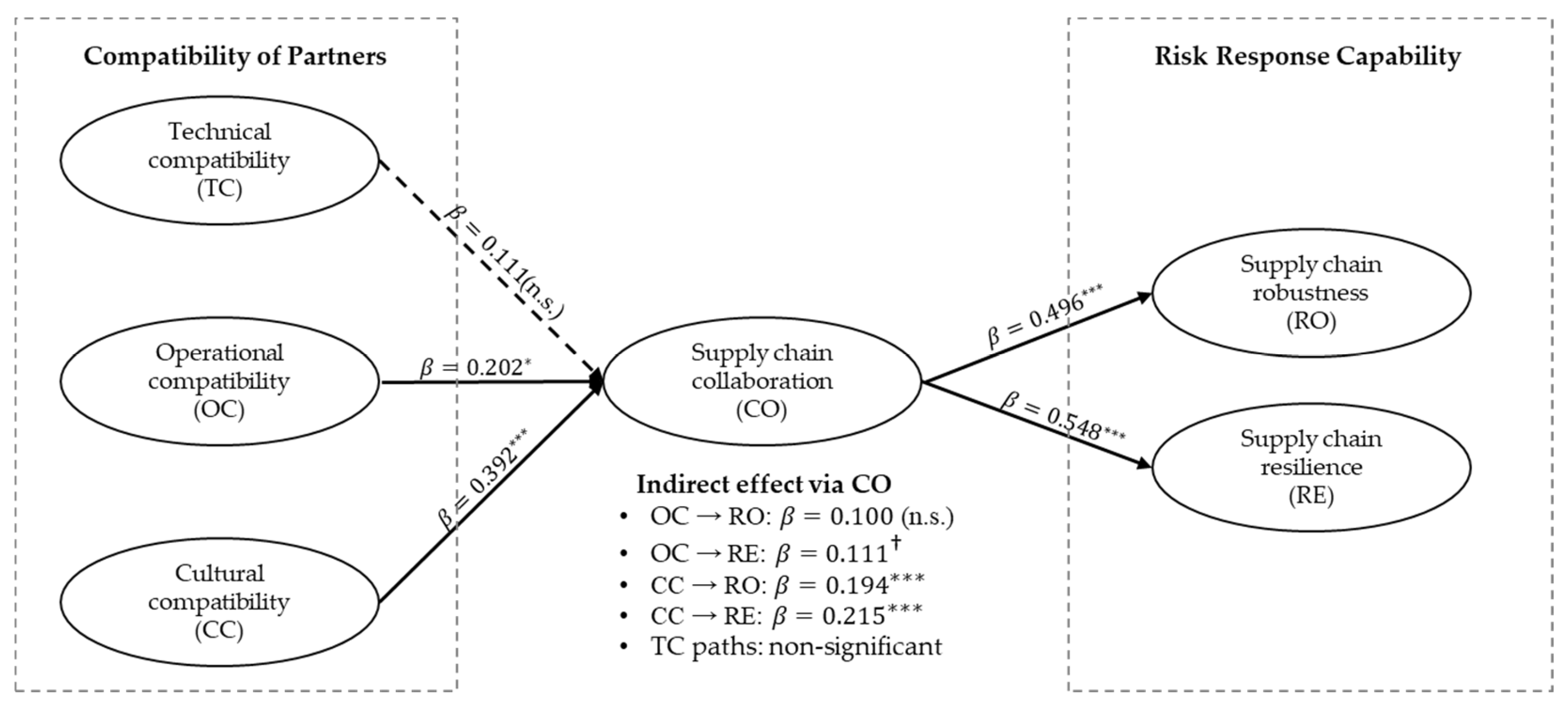
Hypothesis testing results, presented in Table 4 and Table 5, reveal distinct patterns in how compatibility facets influence collaboration and subsequent risk-response capabilities. Technical compatibility showed no significant direct effect on collaboration (H1: β = 0.111, p = 0.203), while operational compatibility exhibited a marginally significant impact (H2: β = 0.202, p = 0.048). Cultural compatibility proved the strongest predictor (H3: β = 0.392, p < 0.001), underscoring the pivotal role of aligned values, norms, and relational expectations in driving inter-organizational cooperation. As hypothesized (H4a, H4b), collaboration significantly enhances both robustness (β = 0.496, p < 0.001) and resilience (β = 0.548, p < 0.001). These findings support the view that collaboration functions as a critical behavioral mechanism enabling organizations to jointly absorb disruptions and facilitate recovery.
Mediation analyses confirm patterns consistent with the direct effects, as shown in Table 6. Technical compatibility exhibits nonsignificant indirect effects on both robustness (H5a: β = 0.055, p = 0.192) and resilience (H6a: β = 0.061, p = 0.183), as it does not influence collaboration. Operational compatibility yields small indirect effects. While H5b does not reach statistical significance (β = 0.100, p = 0.108), H6b shows a marginally significant association at the 10% level (β = 0.111, p = 0.097). Taken together, the evidence suggests only limited indirect influence on risk-response capabilities. In contrast, cultural compatibility produces strong, significant indirect effects on robustness (H5c: β = 0.194, p < 0.001) and resilience (H6c: β = 0.215, p < 0.001), establishing collaboration as the key mechanism by which cultural alignment bolsters disruption absorption and recovery.
Collectively, these findings reveal a coherent pattern: operational compatibility offers limited contributions, technical compatibility none, while cultural compatibility consistently drives collaboration and—through it—enhances both robustness and resilience dimensions of risk-response capability.
Figure 1 graphically summarizes these results by presenting the final structural model with standardized path coefficients and significance notations, enabling a clear visualization of the direct and indirect effects identified in the analysis.

5. Discussion

This research provides various implications and insights, which extend from discussions of theoretical perspectives to managerial issues.

5.1. Theoretical Contribution

We first present a theoretical contribution by conceptualizing compatibility as a multidimensional construct. This study empirically differentiates three meaningful dimensions—technical, operational, and cultural compatibility—thereby addressing inconsistencies in prior research where compatibility was often treated as a single, undifferentiated concept. By distinguishing these dimensions, we identify missing or redundant variables that may have led to confusing or inaccurate conclusions in earlier studies and integrate sporadic insights from research on similarity, congruence, consistency, and compatibility within supply chain management. This perspective aligns with recent arguments that partner alignment comprises heterogeneous mechanisms rather than a uniform structural condition [19].
Consistent with congruence theory, our findings reveal that, overall, compatibility fosters collaborative activities that can be leveraged for organizational purposes. Partners who share similar goals, values, norms, and work practices are more likely to coordinate smoothly, exchange necessary information and ideas, and engage in desirable collaborative behaviors that strengthen the partnership, even though not all dimensions of compatibility contribute equally. Recent work emphasizing the role of shared interpretive frames in enabling cooperative action supports this relational view [47].
Specifically, building on these insights, our findings also refine the understanding of how different dimensions of compatibility contribute to collaboration. While similarities in goals, values, and work practices facilitate the relational foundations necessary for collaborative behavior, our analysis shows that technical compatibility alone does not significantly promote collaboration. This aligns with recent research indicating that system-level alignment may support interoperability or process integration but does not necessarily generate the trust, shared understanding, or joint sensemaking required for behavioral cooperation. In contrast, operational and cultural compatibility—both relational in nature—more effectively stimulate collaborative activities that can be leveraged for organizational purposes. This clarification strengthens the theoretical argument that compatibility operates as a precursor to collaboration by shaping the relational and behavioral conditions under which partners work together effectively. The differentiation between relational and structural alignment is consistent with emerging supply chain perspectives highlighting that not all forms of congruence translate into behavioral cooperation [47].
Next, our contribution extends to the discussion on the impact of collaboration. Based on the dynamic capability view, we clearly suggest that risk response capability refers to the supply chain’s ability to sustain the current status as well as to recover from unexpected disturbances. More specifically, robustness helps a firm maintain regular operations not only under both normal circumstances but also during the occurrence of disruptive events [El Baz Mackey Cohen]; resilience relates to absorbing and overcoming the negative impacts of supply chain disruption and enabling the regain of performance. Given that such abilities, i.e., robustness and resilience, form the risk response capability, our empirical results support that risk response capability can vary depending on how tightly the partners are engaged in collaboration. Better collaboration leads to a more robust and resilient the supply chain. This is consistent with recent findings that collaborative routines enhance adaptability and strengthen firms’ responses to volatile conditions [23].
Further, our work contributes to tying the congruence theory with the dynamic capability view. Our study results support the assertion that collaboration plays an important mediating role between compatibility and risk response capabilities. While the direct effect of compatibility on risk response capability is not derived, higher levels of compatibility help the supply chain become more capable of managing uncertain risks eventually through the enhancement of collaboration between partners. In other words, relational potentials inherent in partnership can be turned into the capability necessary for maintaining dynamic equilibrium, and collaboration plays an important mediating role in such processes. The results are particularly clear in the influence of operational and cultural aspects. This reinforces recent arguments that collaborative behavior serves as a microfoundation of dynamic capabilities in complex operational environments [23].
Finally, most previous research focuses on explaining operational performance with a central emphasis on supply chain integration [48,49], the current study pays attention to the relationship between organizational characteristics (compatibility), resulting supply chain collaboration, and the dynamic capability underlying performance. Unlike integration, which implies structural and contractual concepts, collaboration entails more behavior- and relationship-oriented aspects. In this vein, our study complements and broadens prior achievement, which provides empirical support for the relationship between compatibility and integration [15] by reflecting a behavioral perspective. By articulating how specific dimensions of compatibility inform collaboration—rather than assuming uniform effects—our findings extend recent calls to more precisely theorize the behavioral underpinnings of partner alignment [47,50].

5.2. Managerial Implication

Our results show that operational and cultural compatibility plays a positive role in enhancing supply chain collaboration. In other words, supply chain collaboration becomes easier to facilitate when the partners share organizational values, goals, norms, work procedures, and operational processes. Thus, it can be helpful for building a collaborative supply chain to find partners with similar cultural and operational backgrounds. In addition to operational excellence, which has traditionally been the dominant logic of supplier development and selection, managers should consider which partners’ way of thinking and working can blend with ours quickly and smoothly. Of course, ow to induce cultural and operational transformation of partner organizations from the long-term perspective; however, such consideration is beyond the scope of our research.
While “United we stand, divided we fall” is a phrase often used to inspire collaboration, guarantee whether it will practically work or be a simple cliche when facing a crisis. Although our study does not focus on the direct solution to respond to supply chain risks, it clearly demonstrates that compatibility between partners facilitates collaboration, and relational capital condensed through collaboration makes the supply chain more robust and resilient to threats. Thus, managers should pay attention to enhancing collaboration with partners, which predictably improves the risk response capability of the supply chain. Moreover, it is necessary to share this implication among managers to preemptively build long-term, sustainable supply chains.
Meanwhile, compatibility does not necessarily enhance risk response capability but indirectly impacts it. Organizations that are compatible tend to bring about collaboration, enabling a more robust and resilient supply chain. Cultural compatibility is the most significant attribute for strengthening collaboration and ensuring robustness and resilience; operational compatibility also elicits resilience through collaboration. Therefore, we reiterate the need to (1) consider whether organizations have compatible cultures or operating systems when selecting supply chain partners and (2) deliberate the ways to induce quality supply chain collaboration.
Last, firms should recognize potential trade-offs associated with excessive compatibility. While alignment increases collaborative efficiency, homogeneous partners may limit the supply chain’s ability to recombine diverse knowledge when facing novel disruptions. Ref. [51] demonstrates that strong symmetry in knowledge structures can constrain exploratory problem-solving under conditions requiring high combinability. In practice, this suggests that managers should seek an optimal balance: sufficient compatibility to enable routine coordination, coupled with constructive heterogeneity that preserves adaptive flexibility. Where compatibility is low but strategic collaboration is necessary, targeted interventions—such as joint training programs, boundary-spanning roles, or shared process design—can help bridge differences without sacrificing innovation potential.

6. Conclusions

This study is conducted to analyze understand the mechanism of cultivating the capability necessary for responding to supply chain risks and to provide practical implications to establish a sustainable supply chain strategy. Based on a research model designed through the connection between the congruence theory and the dynamic capability view, our findings broaden the research horizons by paying attention to the concept of compatibility. Through empirical analysis, hat compatibility between partners and supply chain collaboration can be key to effectively growing the risk-response capability of the supply chain. The results of this study suggest that firms can minimize the negative impact of supply chain risks by collaborating with partners who have similarities in cultural and operational aspects and, eventually, enable resilient supply chain operations, even when facing a disruptive event. Through a comprehensive understanding of this risk-response capability, practitioners can find a significant clue for seeking stability and maintaining a high level of performance in the recent uncertain and dynamic supply chain environment.
Despite its contributions, this study has several limitations that offer opportunities for future research. First, the study does not explicitly distinguish between buyer and supplier roles, even though the mechanisms linking compatibility, collaboration, and capability development may vary across governance positions. Because the dataset reflects respondents’ perceptions of their “principal partners” rather than clearly separating upstream and downstream relationships, the findings represent an aggregated pattern. Future research could employ dyadic or multi-respondent designs to compare how compatibility operates across partner roles.
Second, although the empirical model identifies average effects across firms, the strength of these relationships may vary depending on contextual factors such as environmental uncertainty, information system characteristics, governance structures, or trust. Prior work (e.g., ref. [23]) shows that such contingencies can shape how compatibility translates into collaborative behavior. Incorporating these boundary conditions would refine theoretical precision and broaden applicability.
Third, potential endogeneity remains a consideration. Collaboration may also influence perceived compatibility over time, creating reciprocal dynamics. Given the cross-sectional nature of the data, causal inferences should be interpreted cautiously. Longitudinal, dyadic, or experimental designs—and econometric approaches such as the Gaussian copula technique—would help clarify causal directions in future studies.
Fourth, collaboration is conceptualized here as a relational construct distinct from process integration. While this distinction is theoretically meaningful, it also means that structural integration mechanisms were not incorporated into the model. Prior research (e.g., ref. [15]) indicates that technical compatibility can strongly predict process integration even when its link to relational collaboration is weaker. Future work could explore how relational and structural mechanisms jointly shape capability development, drawing on insights from [40].
Finally, recent studies (e.g., ref. [52]) highlight that the influence of inter-organizational alignment may depend on contextual conditions such as environmental turbulence, technological design, and governance mechanisms. Although these moderators were beyond the scope of our data, they represent promising directions for extending the framework.
Overall, this study enhances supply chain research by clarifying the relational foundations of dynamic risk-response capabilities and demonstrating that alignment in operational and cultural dimensions—beyond mere technical compatibility—forms a crucial basis for collaboration. By articulating these mechanisms and suggesting promising avenues for future research, the study lays groundwork for advancing both theory and practice in supply chain resilience.

Author Contributions

Conceptualization, S.K.C. and P.L.; methodology, P.L.; validation, P.L.; formal analysis, S.K.C. and P.L.; investigation, S.K.C.; data curation, S.K.C.; writing—original draft preparation, S.K.C., P.L. and D.J.; writing—review and editing, D.J.; visualization, D.J.; supervision, P.L. and D.J.; project administration, P.L. and D.J. All authors have read and agreed to the published version of the manuscript.

Funding

This research received no external funding.

Institutional Review Board Statement

The survey in this paper was non-interventional, anonymous, and focused on exploring impulses, attitudes, etc. The research was not conducted on patients, nor did it involve human material or human tissues. All respondents had the right not to participate in the survey and by filling out the questionnaire, they expressed their consent to participate in the research. Ethical clearance from our home institutions is not required for this type of research.

Informed Consent Statement

Informed consent for participation was obtained from all subjects involved in the study.

Data Availability Statement

The data supporting the findings of this study are not publicly available due to privacy and ethical restrictions but are available from the corresponding author upon reasonable request.

Acknowledgments

During the preparation of this manuscript, the authors used ChatGPT (OpenAI, GPT-5.1) for minor language polishing and proofreading only. All substantive content was developed independently by the authors. The authors reviewed all AI-assisted edits and take full responsibility for the final manuscript.

Conflicts of Interest

The authors declare no conflict of interest.

Appendix A. Constructs and Sources of Measurement Items

Technical compatibility (TC) adapted from [15]
TC1Our firm’s software is compatible with supply chain partners’ software.
TC2Our supply chain partners’ information systems are technically compatible with those of our firm.
TC3Technical capabilities of our firm and supply chain partners are compatible.
Operational compatibility (OC) adapted from [15]
OC1Our firm’s procedures are compatible with our supply chain partners’ business procedures.
OC2Managers from our firm and supply chain partners firms have similar professional skills.
OC3Our firm’s operational processes are compatible with supply chain partners’ operational processes.
Cultural compatibility (CC) adapted from [15]
CC1Managers from our firm and those of our supply chain partners have compatible philosophies in business dealings.
CC2The organizational values and social norms prevalent between our firm and our supply chain partners are congruent.
CC3The goals and objectives of our firm are compatible with those of our supply chain partners.
Collaboration (CO) adapted from [37]
CO1Supply chain partners set up a communication plan for action.
CO2Supply chain partners collaborate in developing new markets and customer response.
CO3Supply chain partners collaborate in designing their processes or products.
CO4Supply chain partners collaborate in implementing their operational activities.
CO5Supply chain partners have frequent interaction while problems occur.
Resilience (RE) adapted from [22]
RE1Our supply chain can cope with changes caused by supply chain disruptions.
RE2Our supply chain can adapt to supply chain disruptions easily.
RE3Our supply chain can provide rapid responses to supply chain disruptions.
RE4Our supply chain can always maintain high situational awareness.
Robustness (RO) adapted from [22]
RO1For a long time, our supply chain retains the same stable situation as it had before some changes occurred.
RO2When changes occur, our supply chain grants us much time to consider a reasonable reaction.
RO3Without adaptations being necessary, our supply chain performs well over a wide variety of possible scenarios.
RO4For a long time, our supply chain is able to carry out its functions despite some damage done to it.

References

  1. Hedwall, M. The Ongoing Impact of COVID-19 on Global Supply Chains. World Economic Forum COVID Action Platform, 22 June 2020. Available online: https://www.weforum.org/agenda/2020/06/ongoing-impact-covid-19-global-supply-chains/ (accessed on 11 October 2025).
  2. Tang, C.S. Perspectives in supply chain risk management. Int. J. Prod. Econ. 2006, 103, 451–488. [Google Scholar] [CrossRef]
  3. Ivanov, D. Viable supply chain model: Integrating agility, resilience and sustainability perspectives—Lessons from and thinking beyond the COVID-19 pandemic. Ann. Oper. Res. 2020, 319, 1411–1431. [Google Scholar] [CrossRef]
  4. Aslam, H.; Khan, A.Q.; Rashid, K.; Rehman, S.U. Achieving supply chain resilience: The role of supply chain ambidexterity and supply chain agility. J. Manuf. Technol. Manag. 2020, 31, 1185–1204. [Google Scholar] [CrossRef]
  5. Yu, W.; Jacobs, M.A.; Chavez, R.; Yang, J. Dynamism, disruption orientation, and resilience in the supply chain and the impacts on financial performance: A dynamic capabilities perspective. Int. J. Prod. Econ. 2019, 218, 352–362. [Google Scholar] [CrossRef]
  6. Ali, I.; Golgeci, I.; Arslan, A. Achieving resilience through knowledge management practices and risk management culture in agri-food supply chains. Supply Chain Manag. Int. J. 2023, 28, 284–299. [Google Scholar] [CrossRef]
  7. Jung, D.; Kim, B.; Yoo, S.H. How to facilitate supplier-supplier collaboration: The impact of a manufacturer’s order allocation policy and subsidy offering. Ann. Oper. Res. 2023, 323, 79–107. [Google Scholar] [CrossRef]
  8. Soosay, C.A.; Hyland, P. A decade of supply chain collaboration and directions for future research. Supply Chain Manag. Int. J. 2015, 20, 613–630. [Google Scholar] [CrossRef]
  9. Wu, F.; Yeniyurt, S.; Kim, D.; Cavusgil, S.T. The impact of information technology on supply chain capabilities and firm performance: A resource-based view. Ind. Mark. Manag. 2006, 35, 493–504. [Google Scholar] [CrossRef]
  10. Simatupang, T.M.; Sridharan, R. The collaborative supply chain. Int. J. Logist. Manag. 2002, 13, 15–30. [Google Scholar] [CrossRef]
  11. Potter, A.; Graham, S. Supplier involvement in eco-innovation: The co-development of electric, hybrid and fuel cell technologies within the Japanese automotive industry. J. Clean. Prod. 2019, 210, 1216–1228. [Google Scholar] [CrossRef]
  12. Claycomb, C.; Iyer, K.; Germain, R. Predicting the level of B2B e-commerce in industrial organisations. Ind. Mark. Manag. 2005, 34, 221–234. [Google Scholar] [CrossRef]
  13. Mitsuhashi, H.; Greve, H.R. A matching theory of alliance formation and organizational success: Complementarity and compatibility. Acad. Manag. J. 2009, 52, 975–995. [Google Scholar] [CrossRef]
  14. Rajaguru, R.; Matanda, M.J. Effects of inter-organizational compatibility on supply chain capabilities: Exploring the mediating role of inter-organizational information systems (IOIS) integration. Ind. Mark. Manag. 2013, 42, 620–632. [Google Scholar] [CrossRef]
  15. Rajaguru, R.; Matanda, M.J. Role of compatibility and supply chain process integration in facilitating supply chain capabilities and organizational performance. Supply Chain Manag. Int. J. 2019, 24, 301–316. [Google Scholar] [CrossRef]
  16. Sarkar, M.B.; Echambadi, R.; Cavusgil, S.T.; Aulakh, P.S. The influence of complementarity, compatibility, and relationship capital on alliance performance. J. Acad. Mark. Sci. 2001, 29, 358–373. [Google Scholar] [CrossRef]
  17. Shamdasani, P.N.; Sheth, J.N. An experimental approach to investigating satisfaction and continuity in marketing alliances. Eur. J. Mark. 1995, 29, 6–23. [Google Scholar] [CrossRef]
  18. O’Toole, J.L. Interorganizational relations in implementation. In Handbook of Public Administration; Peters, G.B., Pierre, J., Eds.; Sage: London, UK, 2003; pp. 234–243. [Google Scholar]
  19. Angeles, R.; Nath, R. Partner congruence in electronic data interchange (EDI)-enabled relationships. J. Bus. Logist. 2001, 22, 109–127. [Google Scholar] [CrossRef]
  20. Zhang, Q.; Cao, M. Exploring antecedents of supply chain collaboration: Effects of culture and interorganizational system appropriation. Int. J. Prod. Econ. 2018, 195, 146–157. [Google Scholar] [CrossRef]
  21. Teece, D.J.; Pisano, G.; Shuen, A. Dynamic capabilities and strategic management. Strateg. Manag. J. 1997, 18, 509–533. [Google Scholar] [CrossRef]
  22. Ambulkar, S.; Blackhurst, J.; Grawe, S. Firm’s resilience to supply chain disruptions: Scale development and empirical examination. J. Oper. Manag. 2015, 33–34, 111–122. [Google Scholar] [CrossRef]
  23. Zhou, J.; Xu, T.; Chiao, Y.; Fang, Y. Interorganizational systems and supply chain agility in uncertain environments: The mediation role of supply chain collaboration. Inf. Syst. Res. 2024, 35, 184–202. [Google Scholar] [CrossRef]
  24. Fawcett, S.E.; Wallin, C.; Allred, C.; Fawcett, A.M.; Magnan, G.M. Information technology as an enabler of supply chain collaboration: A dynamic-capabilities perspective. J. Supply Chain Manag. 2011, 47, 38–59. [Google Scholar] [CrossRef]
  25. Brown, M.E.; Rizzuto, T.; Singh, P. Strategic compatibility, collaboration and collective impact for community change. Leadersh. Organ. Dev. J. 2019, 40, 421–434. [Google Scholar] [CrossRef]
  26. Bryson, J.M.; Crosby, B.C.; Stone, M.M. The design and implementation of cross-sector collaborations: Propositions from the literature. Public Adm. Rev. 2006, 66, 44–55. [Google Scholar] [CrossRef]
  27. Cadden, T.; Marshall, D.; Cao, G. Opposites attract: Organisational culture and supply chain performance. Supply Chain Manag. Int. J. 2013, 18, 86–103. [Google Scholar] [CrossRef]
  28. Austin, J.E. From organization to organization: On creating value. J. Bus. Ethics 2010, 94, 13–15. [Google Scholar] [CrossRef]
  29. Ryu, I.; So, S.; Koo, C. The role of partnership in supply chain performance. Ind. Manag. Data Syst. 2009, 109, 496–514. [Google Scholar] [CrossRef]
  30. Wu, Y.R.; Huatuco, L.H.; Frizelle, G.; Smart, J. A method for analysing operational complexity in supply chains. J. Oper. Res. Soc. 2013, 64, 654–667. [Google Scholar] [CrossRef]
  31. Niederkofler, M. The evolution of strategic alliances: Opportunities for managerial influence. J. Bus. Ventur. 1991, 6, 237–257. [Google Scholar] [CrossRef]
  32. Jarratt, D.; O’Neil, G. The effect of organisational culture on business-to-business relationship management practice and performance. Australas. J. Mark. 2002, 10, 21–40. [Google Scholar] [CrossRef]
  33. McAfee, R.B.; Glassman, M.; Honeycutt, E.D., Jr. The effects of culture and human resource management policies on supply chain management strategy. J. Bus. Logist. 2002, 23, 1–18. [Google Scholar] [CrossRef]
  34. Terpend, R.; Tyler, B.B.; Krause, D.R.; Handfield, R.B. Buyer-supplier relationships: Derived value over two decades. J. Supply Chain Manag. 2008, 44, 28–55. [Google Scholar] [CrossRef]
  35. Cao, M.; Zhang, Q. Supply chain collaboration: Impact on collaborative advantage and firm performance. J. Oper. Manag. 2011, 29, 163–180. [Google Scholar] [CrossRef]
  36. Goffin, K.; Lemke, F.; Szwejczewski, M. An exploratory study of ‘close’ supplier-manufacturer relationships. J. Oper. Manag. 2006, 24, 189–209. [Google Scholar] [CrossRef]
  37. Wu, L.; Chuang, C.H.; Hsu, C.H. Information sharing and collaborative behaviors in enabling supply chain performance: A social exchange perspective. Int. J. Prod. Econ. 2014, 148, 122–132. [Google Scholar] [CrossRef]
  38. Flynn, B.B.; Huo, B.; Zhao, X. The impact of supply chain integration on performance: A contingency and configuration approach. J. Oper. Manag. 2010, 28, 58–71. [Google Scholar] [CrossRef]
  39. Chen, H.; Daugherty, P.J.; Landry, T.D. Supply chain process integration: A theoretical framework. J. Bus. Logist. 2009, 30, 27–46. [Google Scholar] [CrossRef]
  40. Adams, F.G.; Richey, R.G., Jr.; Autry, C.W.; Morgan, T.R.; Gabler, C.B. Supply chain collaboration, integration, and relational technology: How complex operant resources increase performance outcomes. J. Bus. Logist. 2014, 35, 299–317. [Google Scholar] [CrossRef]
  41. Mofokeng, T.M.; Chinomona, R. Supply chain partnership, supply chain collaboration and supply chain integration as the antecedents of supply chain performance. S. Afr. J. Bus. Manag. 2019, 50, 1–10. [Google Scholar] [CrossRef]
  42. Jüttner, U.; Maklan, S. Supply chain resilience in the global financial crisis: An empirical study. Supply Chain Manag. Int. J. 2011, 16, 246–259. [Google Scholar] [CrossRef]
  43. Heckathorn, D.D. Comment: Snowball versus respondent-driven sampling. Sociol. Methodol. 2011, 41, 355–366. [Google Scholar] [CrossRef]
  44. Sarstedt, M.; Ringle, C.M.; Hair, J.F. Partial least squares structural equation modeling. In Handbook of Market Research; Springer: Cham, Switzerland, 2021; pp. 587–632. [Google Scholar]
  45. Brislin, R.W. Back-translation for cross-cultural research. J. Cross-Cult. Psychol. 1970, 1, 185–216. [Google Scholar] [CrossRef]
  46. Douglas, S.P.; Craig, C.S. Collaborative and iterative translation: An alternative approach to back translation. J. Int. Mark. 2007, 15, 30–43. [Google Scholar] [CrossRef]
  47. Cepa, K.; Schildt, H. Data-induced rationality and unitary spaces in interfirm collaboration. Organ. Sci. 2023, 34, 129–155. [Google Scholar] [CrossRef]
  48. Jacobs, M.A.; Yu, W.; Chavez, R. The effect of internal communication and employee satisfaction on supply chain integration. Int. J. Prod. Econ. 2016, 171, 60–70. [Google Scholar] [CrossRef]
  49. Yang, J.; Xie, H.; Yu, G.; Liu, M. Antecedents and consequences of supply chain risk management capabilities: An investigation in the post-coronavirus crisis. Int. J. Prod. Res. 2021, 59, 1573–1585. [Google Scholar] [CrossRef]
  50. Andrade-Rojas, M.G.; Kathuria, A.; Konsynski, B.R. Competitive brokerage: How information management capability and collaboration networks act as substitutes. J. Manag. Inf. Syst. 2021, 38, 667–703. [Google Scholar] [CrossRef]
  51. Kohli, A.S.; Jensen, J. Assessing effectiveness of supply chain collaboration: An empirical study. Supply Chain Forum Int. J. 2010, 11, 2–16. [Google Scholar] [CrossRef]
  52. Wieland, A.; Wallenburg, M.C. The influence of relational competencies on supply chain resilience: A relational view. Int. J. Phys. Distrib. Logist. Manag. 2013, 43, 300–320. [Google Scholar] [CrossRef]
Figure 1. Empirical results of the PLS-SEM model showing direct paths and mediation effects via collaboration. Note: Path coefficients (β) are reported. *** p < 0.001; * p < 0.05;  p < 0.10; n.s. = non-significant. Solid arrows represent significant paths; dashed arrows indicate non-significant paths.
Systems 13 01130 g001
Table 1. Summary of literature reviewed.
CategoryKey InsightsDetailed SummaryPapers
Theoretical BackgroundCongruence Theory: Definition and its role in the Supply Chain Management Context
  • Provides the theoretical basis for why individuals or organizations exhibit favorable perceptions and attitudes toward partners or situations that align with their existing characteristics.
  • By facilitating effective inter-organizational interaction, compatibility improves partnership performance and fosters greater synergy.
[12,13,14,15,17,18]
Dynamic Capability View: Definition and its role in the Supply Chain Management Context
  • Highlights the critical role of an organization’s capability to develop, integrate, and reconfigure resources to cope with turbulent and rapidly evolving environments.
  • Provides an in-depth exposition of resilience and robustness as complementary dynamic capabilities that enable organizations to withstand, absorb, and recover from disruptive events.
[4,5,20,21,22,23]
Compatibility and collaborationDetrimental impact of heterogeneity on collaborative relationships and strategies to alleviate or overcome these challenges
  • Differences in partners’ missions, values, cultures, and procedural practices can impede relational interactions and undermine effective collaboration.
  • Compatibility facilitates the accumulation of relational capital—such as trust and commitment—thereby enabling more effective collaboration.
[15,16,24,25,26,27,28]
In-depth explanation of the multidimensional structure of compatibility and the pathways through which it enhances inter-organizational collaboration
  • Provides an explanation of the multidimensional structure of compatibility, which includes technical, cultural, and operational dimensions.
  • Technical compatibility (system/platform alignment) enables system and process interoperability.
  • Operational compatibility (alignment of processes and procedures) facilitates smooth coordination and interaction.
  • Cultural compatibility (shared norms and values) fosters trust and mutual understanding, forming the foundation for strong collaboration.
[13,14,18,19,29,30,31,32]
Collaboration and Risk Response CapabilityThe advantages of collaboration and the organizational challenges involved in realizing it in practice
  • Collaboration strengthens competitive advantage and generates valuable knowledge and capabilities.
  • The expected benefits of collaboration are often not realized due to insufficient understanding and inadequate utilization.
[8,33,34,35]
Conceptual distinction between collaboration and integration
  • Integration emphasizes centralized control, process restructuring, and contract-based system configuration.
  • Collaboration highlights relationship-oriented operations, behavioral cooperation, and interactive problem-solving processes
[14,36,38,39,40]
Effects of collaboration on risk-response capabilities (robustness and resilience)
  • Collaboration enhances resilience by enabling resource integration, increasing flexibility, and improving visibility.
  • Collaboration helps maintain operational continuity during crises and enhances resilience by buffering the adverse effects of disruptions.
  • Although compatibility may not exert a direct influence, it indirectly enhances resilience by fostering collaboration.
[4,21,22,23,41]
Table 2. Demographic characteristics of the sample.
VariableCategoryFrequencyPercentage
GenderMale17981.7
Female4018.3
Age40 and lower8036.6
40–497735.2
50–595424.7
60 and upper83.7
Respondent titlesAssociate125.5
First-level managers5123.3
Middle-level managers13159.8
Top-level managers2511.4
Level of educationHigh school73.2
Associate146.4
Bachelor16274.0
Master & Doctorate3616.4
Respondent titlesManagement4821.9
Purchasing/Sales6831.1
Production/Quality management7132.4
Information system198.7
Others135.9
Industry sectorManufacturing11251.1
Logistics & Transportation3415.5
Wholesale & Retail2913.2
Service Industries (IT, Business Services, Others)3114.2
Others135.9
Firm sales<50 billion KRW3917.8
50–100 billion KRW4621
100–500 billion KRW4319.6
More than 500 billion KRW9141.6
Number of employees<5009643.8
500–1000209.1
1000~50005927
More than 50004420.1
Total219100.0
Table 3. The confirmatory factor analysis results.
ConstructIndicatorLoadingsVIFCronbach’s αρAρCAVE
Technical
compatibility
(TC)
TC10.8772.6140.8480.8780.9060.763
TC20.8702.530
TC30.8721.673
Operational
compatibility
(OC)
OC10.8742.0970.8110.8110.8880.726
OC20.8071.500
OC30.8742.121
Cultural
compatibility
(CC)
CC10.8311.6650.7920.7970.8780.705
CC20.8381.753
CC30.8501.613
Collaboration
(CO)
CO10.7391.6750.8570.8610.8970.636
CO20.8222.024
CO30.7981.916
CO40.7992.094
CO50.8272.214
Robustness
(RO)
RO10.8822.6870.9040.9170.9320.776
RO20.8572.966
RO30.9223.866
RO40.8612.197
Resilience
(RE)
RE10.7921.5820.8380.8520.8910.671
RE20.7861.943
RE30.8302.378
RE40.8652.165
Table 4. Discriminant validity, inter-construct correlations, and HTMT ratios.
TCOCCCCORORE
TC0.8730.7640.6410.5170.4590.451
OC0.6490.8520.8510.6460.4970.547
CC0.5430.6790.840.7060.4610.523
CO0.4550.540.5890.7980.6070.686
RO0.40.4310.3990.5450.8810.863
RE0.3910.450.4340.5960.7520.819
Note: Diagonal values represent the square root of AVE, while the lower and upper triangular values present inter-construct correlations and HTMT ratios, respectively.
Table 5. Total effect of constructs on endogenous variables.
HypothesisPathwayβp-Value95% BCa CI
LowerUpper
H1TC → CO0.1110.203−0.0620.28
H2OC → CO0.2020.048−0.0040.398
H3CC → CO0.392<0.0010.2240.555
H4aCO → RO0.496<0.0010.3610.615
H4bCO → RE0.548<0.0010.4240.667
Table 6. Mediating effect.
HypothesisMediation Pathβp-Value95% BCa CI
LowerUpper
H5aTC → CO → RO0.0550.192−0.0180.139
H5bOC → CO → RO0.1000.108−0.0090.218
H5cCC → CO → RO0.1940.0000.1120.288
H6aTC → CO → RE0.0610.183−0.0160.154
H6bOC → CO → RE0.1110.097−0.0070.235
H6cCC → CO → RE0.2150.0000.1240.323
Disclaimer/Publisher’s Note: The statements, opinions and data contained in all publications are solely those of the individual author(s) and contributor(s) and not of MDPI and/or the editor(s). MDPI and/or the editor(s) disclaim responsibility for any injury to people or property resulting from any ideas, methods, instructions or products referred to in the content.