
A Systems Perspective on Sustainable Leadership and Innovation Capability: Building Organizational Resilience in a High-Tech Company


Abstract
1. Introduction
2. Theoretical Background
2.1. Innovation Capability
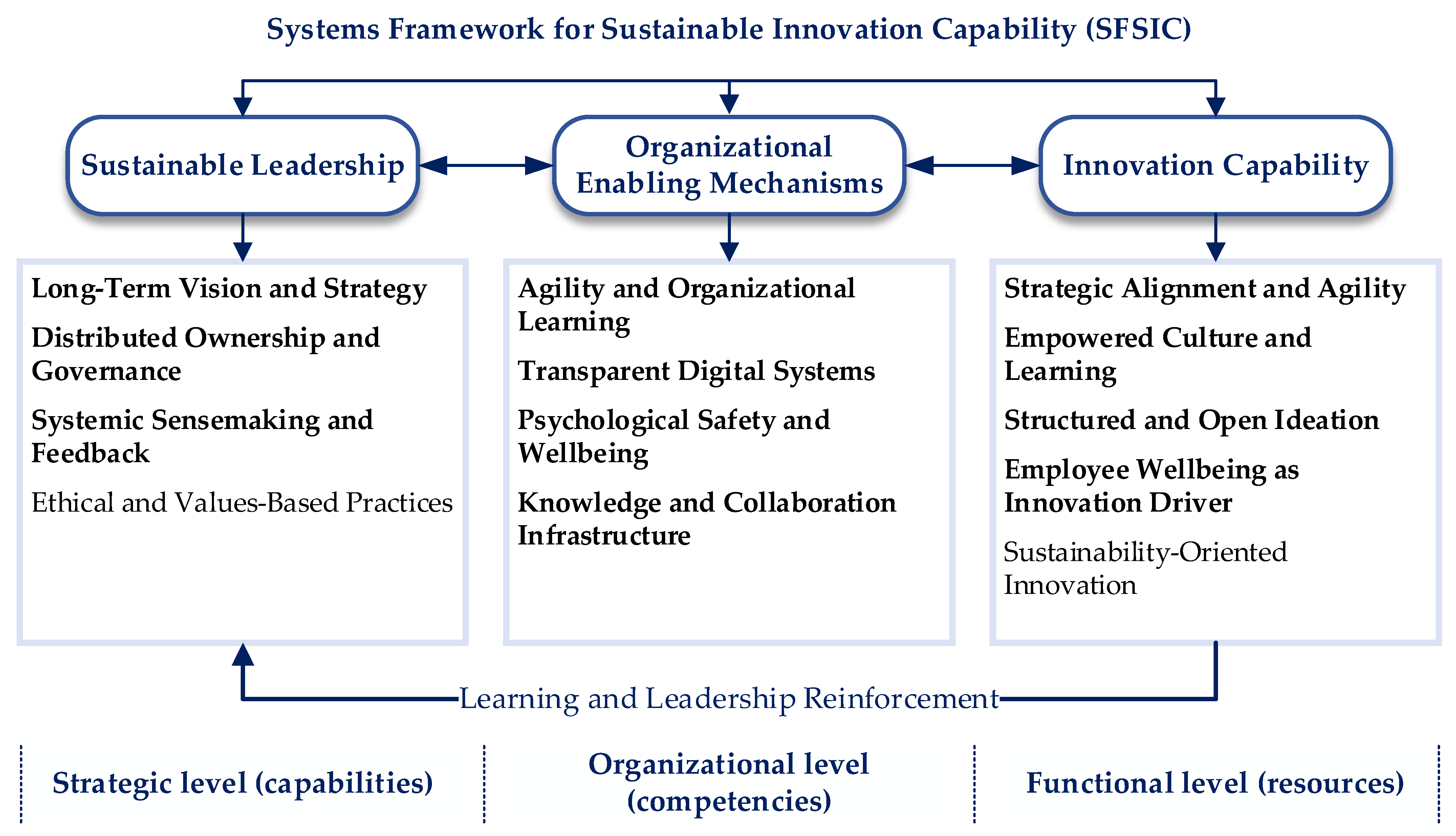
2.2. Conceptual Framework: Linking Sustainable Leadership and Innovation Capability
- Strategic level: establishes and embeds a long-term, sustainability-oriented vision into core values and strategic direction. Leadership aligns purpose, culture, and strategic priorities to steer innovation toward environmental and social goals.
- Organizational level: involves designing structures, processes, and technology systems that support idea generation, evaluation, and implementation. Leadership shapes organizational routines that integrate sustainability into the innovation pipeline.
- Functional level: focuses on the empowerment of individuals and teams through skill development, well-being, and knowledge sharing. Leadership enhances access to information and fosters a learning climate that strengthens everyday innovation capability.
- RQ1: What are the key dimensions of innovation capability as perceived and enacted within a high-tech company?
- RQ2: How does sustainable leadership contribute to developing and strengthening innovation capability in a high-tech company?
3. Research Methods
3.1. Case Selection
Brief Introduction of Case Company
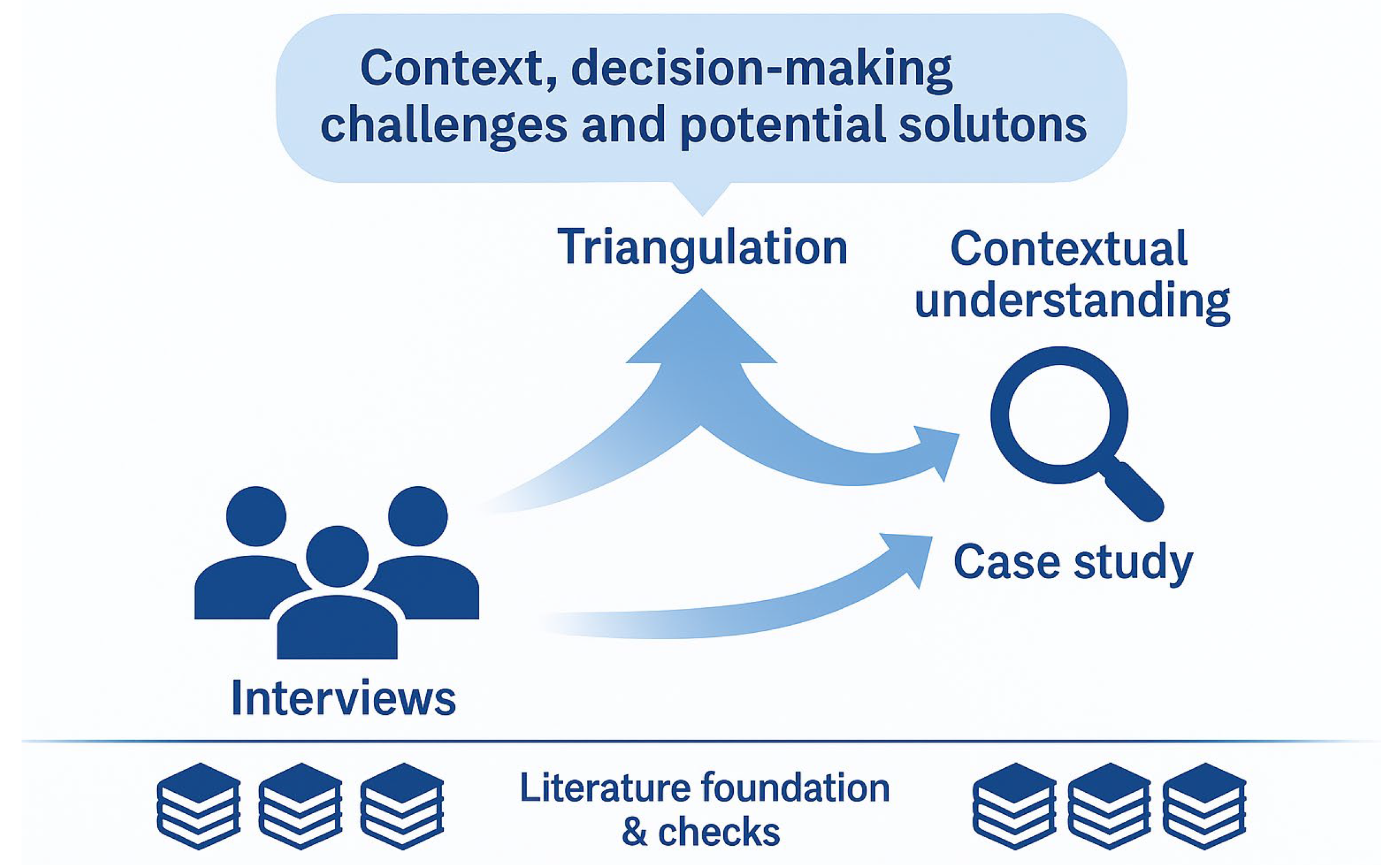
3.2. Data Collection
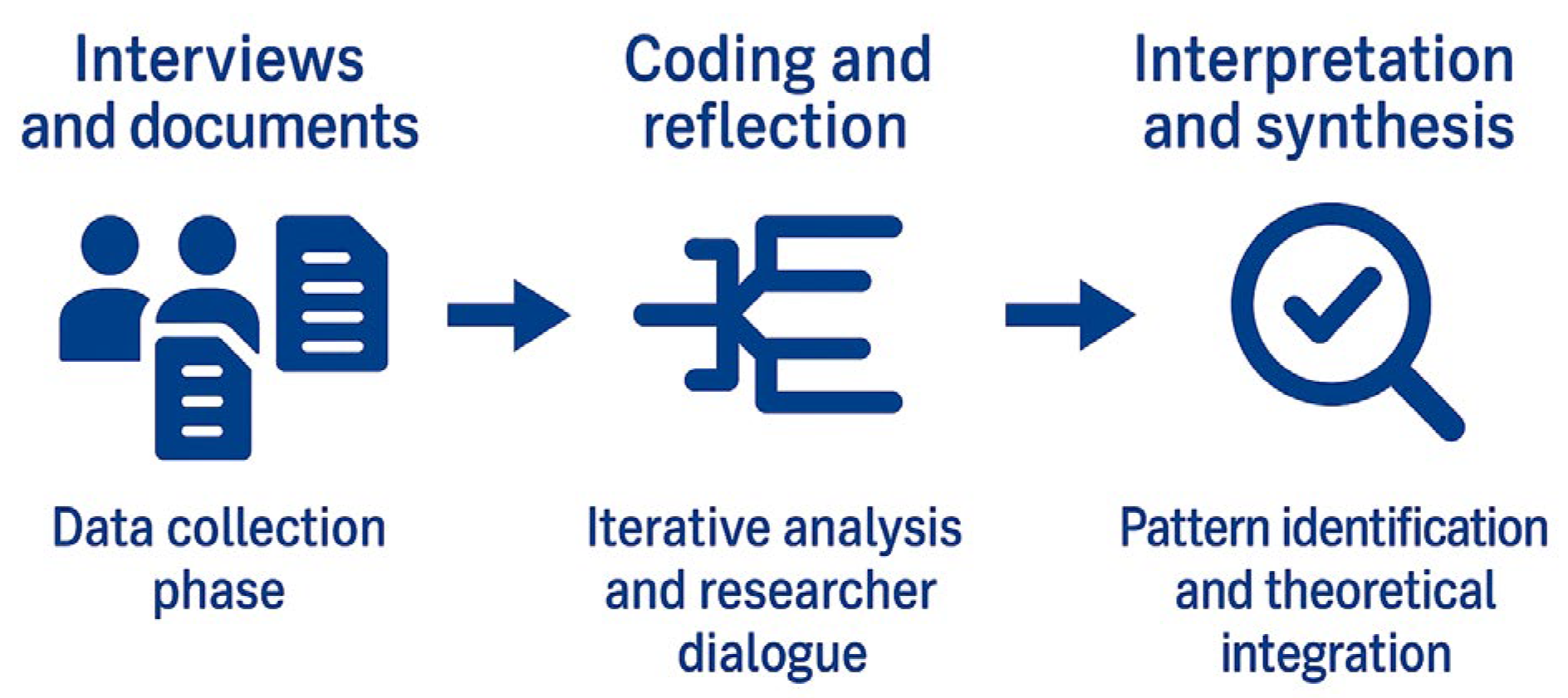
3.3. Data Analysis
4. Case Analysis and Findings
4.1. Key Findings on Innovation Capability and Sustainable Leadership
4.1.1. Strategic Level
4.1.2. Organizational Level
4.1.3. Functional Level
4.2. Conceptual Framework of Findings
5. Discussion
5.1. Theoretical Implications
5.2. Practical Implications
5.3. Limitations and Future Research Directions
6. Conclusions
Author Contributions
Funding
Informed Consent Statement
Data Availability Statement
Acknowledgments
Conflicts of Interest
Appendix A. Semi-Structured Interview Guide
- How do you encourage employees to try new ideas and take the initiative in innovation?
- How do you develop new skills to transform existing products into new ones? Do you rely on (a) existing personnel, (b) new employees, (c) universities (d) business partners)?
- How is a new product created and who all participates in the development process?
- How do you align short-term results with long-term sustainability goals in your leadership approach?
- How does your leader foster a culture of sustainability in the organization?
- How do you recognize and develop the creative and innovative potential of your employees?
Appendix B. Illustrative Coding Overview

| Raw Data Extract (Verbatim Quote) | Initial Code | Subtheme | Theme |
|---|---|---|---|
| Strategic level | |||
| “Our sustainability strategy is based on a clearly formulated long-term vision of the future… Employees understand where the company is heading.” | Long-term vision clarity | Strategic orientation | Long-term stewardship |
| “The 100-Year Plan symbolizes our long-term vision… It helps reduce employee turnover and strengthens commitment.” | Intergenerational vision | Legacy thinking | Purpose-driven vision |
| “Twice a year employees can buy a share of the company…” | Employee ownership | Shared responsibility | Collective commitment |
| “The president prepares the vision together with all stakeholders… feedback from every level matters.” | Participatory sensemaking | Inclusive planning | Distributed vision-building |
| “The president holds responsibility for 60–70% of the company’s vision.” | Central leadership role | Vision anchoring | Leadership stewardship |
| Organizational level | |||
| “Most communication takes place through the ERP system… all information needed to solve problems is shared there.” | ERP communication | Real-time data flow | Open information infrastructure |
| “Information about plans, vision and projects is available through the ERP system.” | Transparency | Department-wide access | Systemic transparency |
| “Communication takes place on several levels… any employee can join the meeting.” | Multi-level communication | Accessibility | Inclusive communication structures |
| “Employees are encouraged to be innovative… for larger improvements we have a formal process for proposing solutions.” | Structured innovation process | Improvement routines | Embedded continuous improvement |
| “SAFe enables transparency and collaboration between management and development teams.” | Agile alignment | Strategy-execution linkage | Adaptive operational coordination |
| Functional level | |||
| “The most important thing is that a person fits into our culture… character matters more than formal education.” | Cultural fit | Values-driven selection | Values-based development |
| “Departments coordinate continuously and solve challenges together… collaboration is essential.” | Cross-functional coordination | Joint problem solving | Collaborative work practices |
| “If a solution does not work, the problem returns… until it is solved properly.” | Iterative resolution | Feedback loops | Adaptive problem solving |
| “The nature of work is different here… tasks constantly change, so the team must constantly upgrade itself.” | Continuous learning | Skill adaptation | Ongoing experiential learning |
| “All ideas are accepted and discussed… there is no bad idea, only timing.” | Idea openness | Psychological safety | Inclusive idea climate |
References
- Adams, R.; Jeanrenaud, S.; Bessant, J.; Denyer, D.; Overy, P. Sustainability-Oriented Innovation: A Systematic Review. Inter-Natl. J. Manag. Rev. 2016, 18, 180–205. [Google Scholar] [CrossRef]
- Moreira, A.; Navaia, E.; Ribau, C. Innovation Capabilities and Their Dimensions: A Systematic Literature Review. Int. J. Innov. Stud. 2024, 8, 313–333. [Google Scholar] [CrossRef]
- Saunila, M. Innovation Capability in SMEs: A Systematic Review of the Literature. J. Innov. Knowl. 2020, 5, 260–265. [Google Scholar] [CrossRef]
- Asif, M.; Searcy, C.; Garvare, R.; Ahmad, N. Including Sustainability in Business Excellence Models. Total Qual. Manag. Bus. Excell. 2011, 22, 773–786. [Google Scholar] [CrossRef]
- Varadarajan, R. Innovating for Sustainability: A Framework for Sustainable Innovations and a Model of Sustainable Inno-Vations Orientation. J. Acad. Mark. Sci. 2017, 45, 14–36. [Google Scholar] [CrossRef]
- Fitz-Oliveira, M.; Wasgen, A.M. Innovation Capability and Sustainability: A Bibliometric Analysis. Technol. Sustain. 2023, 2, 156–176. [Google Scholar] [CrossRef]
- Lozano, R. Towards Better Embedding Sustainability into Companies’ Systems: An Analysis of Voluntary Corporate Initia-Tives. J. Clean. Prod. 2012, 25, 14–26. [Google Scholar] [CrossRef]
- Dyllick, T.; Hockerts, K. Beyond the Business Case for Corporate Sustainability. Bus. Strategy Environ. 2002, 11, 130–141. [Google Scholar] [CrossRef]
- Liao, Y. Sustainable Leadership: A Literature Review and Prospects for Future Research. Front. Psychol. 2022, 13, 1045570. [Google Scholar] [CrossRef]
- Haroon, A.; Sami, A.; Rehman, S.; Fahad, H.; Irfan, A. Sustainable Leadership Enhances Innovation: A Systematic Review of the Past Decade. J. Public Value Adm. Insight 2019, 2, 1–5. [Google Scholar] [CrossRef]
- Gerard, J.A.; McMillan, M.S.; D’Annunzio-Green, N. Conceptualising Sustainable Leadership. Ind. Commer. Train. 2017, 49, 116–126. [Google Scholar] [CrossRef]
- Saunila, M. Innovation Capability in Achieving Higher Performance: Perspectives of Management and Employees. Technol. Anal. Strateg. Manag. 2017, 29, 903–916. [Google Scholar] [CrossRef]
- Crossan, M.M.; Apaydin, M. A Multi-Dimensional Framework of Organizational Innovation: A Systematic Review of the Literature. J. Manag. Stud. 2010, 47, 1154–1191. [Google Scholar] [CrossRef]
- Nair, A.K.; Bhattacharyya, S.S. Sustainability Competencies and Their Link to Innovation Capabilities. Eur. Bus. Rev. 2022, 34, 819–836. [Google Scholar] [CrossRef]
- Avery, G.C.; Bergsteiner, H. Sustainable Leadership: Honeybee and Locust Approaches; Routledge: Abingdon, UK, 2011. [Google Scholar]
- Garrido-Moreno, A.; Martín-Rojas, R.; García-Morales, V.J. The Key Role of Innovation and Organizational Resilience in Improving Business Performance: A Mixed-Methods Approach. Int. J. Inf. Manag. 2024, 77, 102777. [Google Scholar] [CrossRef]
- Le, P.B.; Lei, H. Determinants of Innovation Capability: The Roles of Transformational Leadership, Knowledge Sharing and Perceived Organizational Support. J. Knowl. Manag. 2019, 23, 527–547. [Google Scholar] [CrossRef]
- Teece, D.J. Business Models and Dynamic Capabilities. Long Range Plan. 2018, 51, 40–49. [Google Scholar] [CrossRef]
- Ribeiro, G.K.A.; Leitão, J. Sustainable Leadership and Sustainable Entrepreneurship: A Systematic Literature Review. Discov. Sustain. 2024, 5, 188. [Google Scholar] [CrossRef]
- Sajjad, A.; Eweje, G.; Tappin, D. Sustainability Leadership: An Integrative Review and Conceptual Synthesis. Bus. Strategy Environ. 2024, 33, 123–144. [Google Scholar] [CrossRef]
- Saunila, M. Innovation Capability for SME Success: Perspectives of Financial and Operational Performance. J. Adv. Manag. Res. 2014, 11, 163–175. [Google Scholar] [CrossRef]
- Tidd, J.; Bessant, J. Managing Innovation: Integrating Technological, Market and Organizational Change, 4th ed.; John Wiley & Sons: Chichester, UK, 2009. [Google Scholar]
- Lawson, B.; Samson, D. Developing Innovation Capability in Organisations: A Dynamic Capabilities Approach. Int. J. Innov. Manag. 2001, 5, 377–400. [Google Scholar] [CrossRef]
- Romijn, H.; Albaladejo, M. Determinants of Innovation Capability in Small Electronics and Software Firms in Southeast England. Res. Policy 2002, 31, 1053–1067. [Google Scholar] [CrossRef]
- Calantone, R.J.; Cavusgil, S.T.; Zhao, Y. Learning Orientation, Firm Innovation Capability, and Firm Performance. Ind. Mark. Manag. 2002, 31, 515–524. [Google Scholar] [CrossRef]
- Perdomo-Ortiz, J.; González-Benito, J.; Galende, J. Total Quality Management as a Forerunner of Business Innovation Capability. Technovation 2006, 26, 1170–1185. [Google Scholar] [CrossRef]
- Akman, G.; Yilmaz, C. Innovative Capability, Innovation Strategy and Market Orientation: An Empirical Analysis in Turkish Software Industry. Int. J. Innov. Manag. 2008, 12, 69–111. [Google Scholar] [CrossRef]
- Smith, M.; Busi, M.; Ball, P.; Meer, R. Factors Influencing an Organisation’s Ability to Manage Innovation: A Structured Literature Review and Conceptual Model. Int. J. Innov. Manag. 2008, 12, 655–676. [Google Scholar] [CrossRef]
- Martínez-Román, J.A.; Gamero, J.; Tamayo, J.A. Analysis of Innovation in SMEs Using an Innovative Capability-Based Non-Linear Model: A Study in the Province of Seville (Spain). Technovation 2011, 31, 459–475. [Google Scholar] [CrossRef]
- Björkdahl, J.; Börjesson, S. Assessing Firm Capabilities for Innovation. Int. J. Knowl. Manag. Stud. 2012, 5, 171–184. [Google Scholar] [CrossRef]
- Saunila, M.; Ukko, J. Intangible Aspects of Innovation Capability in SMEs: Impacts of Size and Industry. J. Eng. Technol. Manag. 2014, 33, 32–46. [Google Scholar] [CrossRef]
- Tandon, L.; Bhatnagar, T.; Sharma, T. Leadership Agility in the Context of Organisational Agility: A Systematic Literature Review. Manag. Rev. Q. 2024, 75, 1839–1909. [Google Scholar] [CrossRef]
- Škerlavaj, M. Sustainable Post-Heroic Leadership Practices. In Post-Heroic Leadership: Context; Process and Outcomes; Springer International Publishing: Cham, Switzerland, 2022; pp. 123–131. [Google Scholar]
- Iqbal, Q.; Piwowar-Sulej, K. Sustainable Leadership and Heterogeneous Knowledge Sharing: The Model for Frugal Innova-Tion. Eur. J. Innov. Manag. 2023, 26, 655–673. [Google Scholar] [CrossRef]
- Portuguez-Castro, M.; Castillo-Martínez, I.M. Leadership Competencies for Innovability: Bridging Theory and Practice for Sustainable Development. J. Entrep. Manag. Innov. 2025, 21, 15–32. [Google Scholar] [CrossRef]
- Senge, P.M. The Fifth Discipline: The Art and Practice of the Learning Organization; Doubleday/Currency: New York, NY, USA, 1990. [Google Scholar]
- Meadows, D.H. Thinking in Systems: A Primer; Chelsea Green Publishing: White River Junction, VT, USA, 2008. [Google Scholar]
- Peppard, J.; Ward, J. Beyond Strategic Information Systems: Towards an IS Capability. J. Strateg. Inf. Syst. 2004, 13, 167–194. [Google Scholar] [CrossRef]
- Kans, M.; Campos, J. Digital Capabilities Driving Industry 4.0 and 5.0 Transformation: Insights from an Interview Study in the Maintenance Domain. J. Open Innov. Technol. Mark. Complex. 2024, 10, 100384. [Google Scholar] [CrossRef]
- Kowal, J.; Mäkiö, J.; Jasińska-Biliczak, A. Business Competencies and Innovation Capability in Cross-Border Small Regional Enterprises. In Proceedings of the 2017 IEEE 15th International Conference on Industrial Informatics (INDIN), Emden, Germany, 24–26 July 2017; IEEE: Piscataway, NJ, USA, 2017; pp. 905–910. [Google Scholar]
- Zawislak, P.A.; Fracasso, E.M.; Tello-Gamarra, J. Technological Intensity and Innovation Capability in Industrial Firms. Innov. Manag. Rev. 2018, 15, 189–207. [Google Scholar] [CrossRef]
- Hwang, W.S.; Choi, H.; Shin, J. A Mediating Role of Innovation Capability between Entrepreneurial Competencies and Competitive Advantage. Technol. Anal. Strateg. Manag. 2020, 32, 1–14. [Google Scholar] [CrossRef]
- Teece, D.J. Explicating Dynamic Capabilities: The Nature and Microfoundations of (Sustainable) Enterprise Performance. Strateg. Manag. J. 2007, 28, 1319–1350. [Google Scholar] [CrossRef]
- Eisenhardt, K.M.; Martin, J.A. Dynamic Capabilities: What Are They? Strat. Manag. J. 2000, 21, 1105–1121. Available online: https://www.jstor.org/stable/3094429 (accessed on 24 November 2025).
- Blumer, H. What Is Wrong with Social Theory? Am. Sociol. Rev. 1954, 19, 3. [Google Scholar] [CrossRef]
- Yin, R.K. Case Study Research and Applications: Design and Methods, 6th ed.; SAGE Publications: Thousand Oaks, CA, USA, 2018. [Google Scholar]
- Khalili, A. Linking Transformational Leadership, Creativity, Innovation, and Innovation-Supportive Climate. Manag. Decis. 2016, 54, 2277–2293. [Google Scholar] [CrossRef]
- Moleka, P. The Role of Leadership in Fostering Innovation: A Qualitative Study in Organizational Settings. Adv. Res. Econ. Bus. Strategy J. 2024, 5, 48–53. [Google Scholar] [CrossRef]
- Huang, Z.; Sindakis, S.; Aggarwal, S.; Thomas, L. The Role of Leadership in Collective Creativity and Innovation: Examining Academic Research and Development Environments. Front. Psychol. 2022, 13, 1060412. [Google Scholar] [CrossRef] [PubMed]
- Eisenhardt, K.M.; Graebner, M.E. Theory Building from Cases: Opportunities and Challenges. Acad. Manag. J. 2007, 50, 25–32. [Google Scholar] [CrossRef]
- Patton, M.Q. (Ed.) Qualitative Research and Evaluation Methods, 4th ed.; Sage Publications: Thousand Oaks, CA, USA, 2015. [Google Scholar]
- Mariotto, F.L.; Zanni, P.P.; Moraes, G.H.S. What Is the Use of a Single-Case Study in Management Research? Rev. Admi-Nistração Empresas 2014, 54, 358–369. [Google Scholar] [CrossRef]
- Barratt, M.; Choi, T.Y.; Li, M. Qualitative Case Studies in Operations Management: Trends, Research Outcomes, and Future Research Implications. J. Oper. Manag. 2011, 29, 329–342. [Google Scholar] [CrossRef]
- Nelson, J. Using Conceptual Depth Criteria: Addressing the Challenge of Reaching Saturation in Qualitative Research. Qual. Res. 2017, 17, 554–570. [Google Scholar] [CrossRef]
- Sim, J.; Saunders, B.; Waterfield, J.; Kingstone, T. Can Sample Size in Qualitative Research Be Determined a Priori? Int. J. Soc. Res. Methodol. 2018, 21, 619–634. [Google Scholar] [CrossRef]
- Braun, V.; Clarke, V. Reflecting on Reflexive Thematic Analysis. Qual. Res. Sport Exerc. Health 2019, 11, 589–597. [Google Scholar] [CrossRef]
- Duchek, S. Organizational Resilience: A Capability-Based Conceptualization. Bus. Res. 2020, 13, 215–246. [Google Scholar] [CrossRef]
- Hillmann, J. Disciplines of Organizational Resilience: Contributions, Critiques, and Future Research Avenues. Rev. Manag. Sci. 2021, 15, 879–936. [Google Scholar] [CrossRef]
- Nonaka, I. A Firm as a Dialectical Being: Towards a Dynamic Theory of a Firm. Ind. Corp. Change 2002, 11, 995–1009. [Google Scholar] [CrossRef]
- Zhang, X. Employee Stock Ownership Plans and Corporate Innovation. Acad. J. Manag. Soc. Sci. 2023, 2, 54–59. [Google Scholar] [CrossRef]
- Kane, G.C.; Palmer, D.; Phillips, A.N.; Kiron, D.; Buckley, N. The Technology Fallacy: How People Are the Real Key to Digital Transformation; MIT Press: Cambridge, MA, USA, 2019. [Google Scholar]
- Jaganjac, B.; Hansen, K.W.; Lunde, H.; Hunnes, J.A. The Role of Organizational Culture and Structure in Implementing Sustainability Initiatives. Bus. Ethics Environ. Responsib. 2025, 34, 1239–1254. [Google Scholar] [CrossRef]
- Zhao, Y.; Li, Q.; Lyu, J.; Du, H.; Brem, A. External Collaboration Network Knowledge Relatedness and Firm Innovation Capability: The Moderating Effect of the Internal Inventor Collaboration Network. J. Eng. Technol. Ma-Nagement 2025, 78, 101918. [Google Scholar] [CrossRef]
- Chesbrough, H.W. Open Innovation: The New Imperative for Creating and Profiting from Technology; Harvard Business School Press: Boston, MA, USA, 2003. [Google Scholar]


| Innovation Capability Dimension 1,2,3 | [23] | [24] | [25] | [26] | [27] | [28] | [22] | [29] | [30] | [31] |
|---|---|---|---|---|---|---|---|---|---|---|
| Strategy and Vision | ✓ | ✓ | – | – | – | – | ✓ | – | – | ✓ |
| Leadership Practices | ✓ | – | – | – | ✓ | – | ✓ | – | – | ✓ |
| Employees’ Skills and Innovativeness | ✓ | ✓ | ✓ | – | – | ✓ | ✓ | ✓ | ✓ | ✓ |
| Idea Management Processes | ✓ | – | – | ✓ | – | – | ✓ | – | – | ✓ |
| Innovation-Supporting Culture | ✓ | – | – | ✓ | ✓ | ✓ | ✓ | ✓ | – | ✓ |
| Knowledge Development and Learning | ✓ | ✓ | ✓ | – | – | ✓ | ✓ | ✓ | ✓ | ✓ |
| External Sources of Information | – | ✓ | – | – | – | – | ✓ | – | – | ✓ |
| Technology Management | – | – | – | ✓ | – | – | ✓ | – | ✓ | ✓ |
| Organizational Resources | – | – | – | – | ✓ | ✓ | ✓ | ✓ | ✓ | ✓ |
| Employee Welfare | – | – | – | – | – | – | – | – | – | ✓ |
| Concept | Definition/Scope | Role in Framework |
|---|---|---|
| Sustainable Leadership | Strategic leadership approach focused on long-term value creation through ethical decisions, responsible resource use, and a commitment to employee, societal, and environmental well-being [9,15,20]. | Systemic enabler that aligns strategy, culture, and learning processes by initiating feedback loops that embed sustainability principles into everyday decision-making and innovation routines. |
| Innovation Capability | Organizational ability to sustain innovation by executing processes that generate outcomes in the form of new products, services, or processes [3,10]. Operationalized through multiple dimensions across strategic, organizational, and functional levels (see Section 2.1). | Emergent outcome driven by sustainable leadership manifested through adaptive structures, knowledge sharing, and continuous renewal that reinforce long-term organizational resilience. |
| Respondent | Role | Level of Education (EQF) | Age | Experience | Interview Mode | Interview Duration (min) |
|---|---|---|---|---|---|---|
| R1 | CEO | 7 | 44 | 20 | remote | 67 |
| R2 | Head of production | 6 | 39 | 3 | remote | 57 |
| R3 | Head of quality | 7 | 42 | 2 | remote | 44 |
| R4 | Head of development | 8 | 41 | 17 | remote | 41 |
| R5 | Head of HR and Compliance | 7 | 33 | 1 | remote | 36 |
| R6 | Head of logistics | 7 | 46 | 7 | remote | 41 |
| R7 | Instrument Assembly Manager | 5 | 31 | 8 | remote | 57 |
| R8 | Senior Development Engineer for Mechanical Systems | 6 | 36 | 12 | remote | 41 |
| R9 | Senior Software Development Engineer | 6 | 27 | 4 | remote | 46 |
| R10 | Investment Specialist | 7 | 55 | 1 | remote | 74 |
| R11 | Senior Associate for Strategic Procurement | 7 | 36 | 1 | remote | 50 |
| IC | Category | Underlying Mechanism | Explanation |
|---|---|---|---|
| Strategy and Vision | Long-Term Strategic Planning | “100-Year Plan” emphasizing sustainability and legacy | It represents a long-term vision that encompasses future generations and reflects a commitment to sustainability through knowledge preservation and continuous development. |
| Employee Ownership | 100% employee ownership model for engagement | The model involves all employees, from executives to operational staff, while the distribution of shares reflects factors such as tenure and organizational role. It promotes loyalty and aligns personal interests with long-term company goals. | |
| Business Model | A Hybrid Business Model that fosters collaboration and co-creation | The company applies the Vested model in external partnerships to foster mutual value, leveraging external expertise and resources to complement internal R&D activities. Built on trust and shared innovation goals, these alliances enable access to advanced technologies and joint market opportunities. | |
| High Reinvestment in Development | 80% profit reinvestment in R&D | The company reinvests 80% of its profits into development, thus maintaining competitiveness in the long term and creating new opportunities without increasing financial risk. | |
| Goal Alignment and Progress Tracking | OPR (Objectives, Plan, Review) System | It is a three-stage system for setting objectives and planning activities based on a previously adopted strategy, ensuring progress monitoring, transparency and measurability. | |
| Leadership Practices | Accessible Management | Open-Door Policy | Employees can approach their superiors at any time with ideas, concerns or questions, which contributes to mutual trust, knowledge and experience sharing, and professional growth. |
| Inclusive Strategic Planning | Annual Company Meetings | This event serves as a platform where management presents objectives, plans, and market dynamics while using employee feedback to clarify ambiguities and ensure that roles, tasks, and their purposes are clearly understood. | |
| Accessible Leadership and Continuous Feedback Loop | The ability of leadership to communicate openly on a day-to-day basis. | Managers interact with employees daily to build relationships, enhance efficiency and gather feedback to improve products and prevent errors. The accessible leadership of the CTO strongly drives the realization of the company’s technological vision. | |
| Supporting culture | Supportive Experimentation | Learning from Failure Philosophy Discovery-driven innovation | The fundamental principle of the organizational culture is psychological safety, which enables calculated risk-taking and frames mistakes as opportunities for learning and improvement. |
| Open Communication | Transparent Communication Practices | A fundamental driver of organizational culture vitality is transparent communication, which prevents silo formation, fosters teamwork, and strengthens innovation. | |
| Strong Identification with Values | Core Values Alignment | Core values are a living thing because they are reflected in the daily activities of management and employees, thus ensuring a consistent culture that promotes long-term sustainability and continuous development. | |
| Recognition and Motivation | Reward Innovation Program | Employees who propose process or product improvements are rewarded for their contributions. |
| IC | Category | Underlying Mechanism | Explanation |
|---|---|---|---|
| Processes and Tools for Idea Management | Business Agility | SAFe (Scaled Agile Framework) | SAFe provides a structured framework for organizational improvement by promoting lean and agile decision-making. It aligns departmental activities with strategic objectives, enabling continuous development and greater organizational flexibility. |
| Teamwork and Problem Solving | Structured and unstructured innovation process setup | The structured approach is goal-oriented, whereas the unstructured approach fosters interpersonal dynamics and experimentation. Agile, Lean, and Scrum methodologies are commonly applied, with team formation also considering personal interests and life experiences. | |
| Idea Management | Idea Management System | The company uses an idea management system to systematically track, evaluate, prioritize, and implement employee suggestions. | |
| Idea Council | Forum for employees to present and refine ideas | Weekly 30 min sessions address challenges, share ideas and propose solutions to encourage collaborative improvement of products and processes. Short daily meetings further promote collective reflection and team alignment. | |
| Technology Management | Integrated ERP System | Real-time data sharing and process integration | The ERP system enhances operational efficiency and transparency by integrating data and processes across departments. |
| Automation and Productivity | Automation Tools | Automation is a continuous process aimed at streamlining and simplifying work processes to free up more energy and time for employees to focus on creativity and innovation. |
| IC | Category | Underlying Mechanism | Explanation |
|---|---|---|---|
| Employees’ Skills and Innovativeness | Foundational Training | Entry-Level Training | This 14-day training program aims to equip employees with the ability to perform specific tasks independently and to facilitate their integration into the company’s organizational culture. |
| Professional Growth and Support | Ongoing Mentorship | Each new employee is assigned a mentor who, over a three-month period, familiarizes them with the work system, materials, and business processes. | |
| Collaborative Practices | Cross-Departmental Teamwork | Departments communicate continuously to monitor workflows, coordinate activities, overcome challenges, and develop solutions. | |
| Knowledge accumulation | Internal Knowledge Sharing; Collaborative R&D and Strategic Alliances | Technological capabilities are developed through the integration of internal knowledge sources and the organization’s absorptive capacity. | |
| Development of Individual Knowledge | Personalized Career Development | Roles Matched to Individual Strengths Employee autonomy at work | During recruitment and employee development, the focus is not on formal education but on individual potential and talents with long-term relevance for the company. |
| Internal Mobility Opportunities | Support for Cross-Department Transfers | When management or an employee identifies that their competencies and interests are better suited to a position in another department, a transfer is arranged in consultation with the HR department. | |
| Unlimited Education Budget | Continuous learning without budget restrictions | The company aligned its business objectives with employee development, enabling the establishment of an unlimited training budget aimed at building a highly skilled and committed workforce. Employees typically participate in five to ten days of training per year. | |
| External Sources of Information | Academic Partnerships | Collaborations with universities | This ensures continuous interaction with academic knowledge, creating a fertile environment for fresh ideas and diverse perspectives |
| Customer Engagement | Regular customer visits for real-time market insights | This represents the most effective form of experiential learning, as it provides real-time insights into market needs and supports the identification of future directions in product development. | |
| Employees’ Welfare | Work–Life Balance | Flexible Schedules | Employees adapt their working hours to their individual biorhythms and life circumstances, fostering greater commitment and creativity. |
| Health and Welfare | Strategy and long-term commitment to well-being | The company’s health and well-being initiatives are aligned with the ESG framework and corresponding management systems. These efforts extend beyond the physical workplace to encompass sports, social activities, and other forms of engagement, with an emphasis on personalized programs. |
| Level | Practical Implications |
|---|---|
| Strategic level | • Embed a shared long-term vision that guides operational and daily decisions. • Use participative strategy processes involving employees in priority-setting. • Reinforce commitment through employee ownership or shared-goal systems. • Balance exploration and exploitation by selectively scaling and using external partners. • Develop structured partnership portfolios (startups, academia, customers). |
| Organizational level | • Implement agile planning cycles (10–12 weeks) with stable priorities. • Use integrated information systems to reduce silos and align functions. • Institutionalize idea-management routines (weekly forums, digital pipelines). • Apply dual structures (stable leadership + rotating agile teams) to maintain responsiveness. • Strengthen learning infrastructures via cross-functional meetings and feedback loops. |
| Functional level | • Personalize development pathways based on strengths and values. • Use structured onboarding and mentorship for rapid learning and assimilation. • Encourage daily collaboration through stand-ups and joint problem-solving. • Reinforce intrinsic motivation through productivity-based shared rewards. • Support employee well-being (flexibility, autonomy, supportive climate) to foster creativity. |
| Innovation Capability Category | Short-Term Interventions | Long-Term Strategies |
|---|---|---|
| Strategy and Vision | • Facilitate inclusive vision workshops. • Pilot employee-ownership mechanisms. • Introduce focused R&D budgeting. • Align partnerships for co-creation with key stakeholders. • Adopt objective-driven planning cycles. | • Institutionalize a long-term, sustainability-driven strategic vision (e.g., a “100-Year Plan”). • Strategically leverage employee ownership structures. • Sustain high levels of R&D investment. • Scale hybrid business models supported by transparent performance metrics. • Maintain organizational agility while strengthening ecosystem partnerships. |
| Leadership Practices | • Promote open and accessible leadership with continuous feedback. • Embed employee voices in strategic discussions. • Use recognized compliance and quality frameworks as learning tools. • Train leaders in authentic and empathetic communication. | • Develop leadership paradigms centred on trust, accessibility, and values-based improvement. • Institutionalize inclusive, values-based strategy formulation across organizational levels. |
| Supporting Culture | • Encourage experimentation through discovery-driven innovation. • Implement transparent communication practices. • Recognize meaningful innovation contributions. • Reinforce autonomy and psychological safety. | • Cultivate a resilient innovation culture embracing failure, psychological safety, and transparency. • Align values, behaviours, and incentives across levels. • Embed well-being indicators into performance systems. • Establish structured innovation recognition programs. |
| Processes and Tools for Idea Management | • Deploy digital systems for capturing and evaluating ideas. • Foster collaborative forums for joint problem-solving. • Combine structured and emergent innovation approaches. • Offer training in agile scaling practices. • Promote cross-sector learning through startup collaborations and accelerators. | • Institutionalize organization-wide idea-management routines. • Formalize Agile/Lean innovation frameworks. • Leverage cross-disciplinary teams to integrate in-house knowledge. • Build an open-innovation ecosystem connecting internal capabilities with external innovators. |
| Technology Management | • Roll out modular digital systems. • Integrate R&D, manufacturing, and quality functions. • Assess opportunities for automation. • Implement feedback-driven product development. | • Fully integrate design-to-delivery operations supported by advanced digital systems. • Embed automation and real-time data analytics into decision-making. • Institutionalize quality management as a driver of early-stage innovation and continuous improvement. |
| Employees | • Implement structured onboarding and mentorship programs. • Match roles to individual strengths and values. • Expand flexible work arrangements. • Foster cross-departmental teamwork. • Pilot well-being surveys linked to creativity and innovation. • Promote academic and customer co-learning. | • Institutionalize personalized career pathways and internal mobility. • Provide continuous, open access to learning budgets aligned with strategic needs. • Embed ESG-aligned well-being programs into HR systems. • Link well-being and innovation indicators within performance management. • Formalize ongoing academic, customer, and ecosystem collaborations as innovation inputs. |
Disclaimer/Publisher’s Note: The statements, opinions and data contained in all publications are solely those of the individual author(s) and contributor(s) and not of MDPI and/or the editor(s). MDPI and/or the editor(s) disclaim responsibility for any injury to people or property resulting from any ideas, methods, instructions or products referred to in the content. |
© 2025 by the authors. Licensee MDPI, Basel, Switzerland. This article is an open access article distributed under the terms and conditions of the Creative Commons Attribution (CC BY) license (https://creativecommons.org/licenses/by/4.0/).
Share and Cite
Vladić, N.; Maletič, D.; Maletič, M. A Systems Perspective on Sustainable Leadership and Innovation Capability: Building Organizational Resilience in a High-Tech Company. Systems 2025, 13, 1075. https://doi.org/10.3390/systems13121075
Vladić N, Maletič D, Maletič M. A Systems Perspective on Sustainable Leadership and Innovation Capability: Building Organizational Resilience in a High-Tech Company. Systems. 2025; 13(12):1075. https://doi.org/10.3390/systems13121075
Chicago/Turabian StyleVladić, Nenad, Damjan Maletič, and Matjaž Maletič. 2025. "A Systems Perspective on Sustainable Leadership and Innovation Capability: Building Organizational Resilience in a High-Tech Company" Systems 13, no. 12: 1075. https://doi.org/10.3390/systems13121075
APA StyleVladić, N., Maletič, D., & Maletič, M. (2025). A Systems Perspective on Sustainable Leadership and Innovation Capability: Building Organizational Resilience in a High-Tech Company. Systems, 13(12), 1075. https://doi.org/10.3390/systems13121075