

Article

How Does Smart Logistics Influence Enterprise Innovation? Evidence from China

School of Economics and Management, Beijing Jiaotong University, Beijing 100044, China
*
Author to whom correspondence should be addressed.
Systems 2025, 13(12), 1076; https://doi.org/10.3390/systems13121076
Submission received: 11 October 2025 / Revised: 21 November 2025 / Accepted: 26 November 2025 / Published: 28 November 2025
(This article belongs to the Section Supply Chain Management)

Abstract

In the current external environment characterized by intensified supply chain uncertainties, promoting supply chain digitalization has become a critical pathway for enterprises to enhance their innovation capabilities. As a core component of digital supply chains, studying the role of smart logistics in enterprise innovation holds significant theoretical value and practical importance. Based on the government work reports of prefecture-level cities in China from 2013 to 2022, this study employs a keyword frequency statistics approach to construct a city-level indicator for the development level of smart logistics. It examines the effect of smart logistics on innovation in China’s A-share listed companies, along with its underlying mechanisms and heterogeneity. The empirical results show that smart logistics can significantly promote enterprise innovation capability. The mechanism analysis indicates that smart logistics drives enterprise innovation by leveraging the talent effect, the organizational slack optimization effect, and the data element multiplier effect. Further heterogeneity analysis reveals that the innovation-promoting effect of smart logistics is more significant for enterprises in industries with high competition intensity. Moreover, in enterprises with high information transparency, the promoting effect of smart logistics on innovation is more pronounced. The research conclusions provide theoretical support and policy implications for integrating smart logistics into regional innovation ecosystems and for designing differentiated policies.

1. Introduction

In the current era of deepening global economic integration, enterprise innovation has become the cornerstone for driving sustainable development and building core competitiveness. In an increasingly complex, volatile, and uncertain market environment, innovation is not only a vital quality for enterprises to adapt to external challenges but also an essential factor for ensuring survival and achieving breakthroughs in competition [1]. Specifically, this innovation manifests across multiple dimensions, including product and service upgrades, process optimization, technological iteration, and business model innovation [2]. Innovation is widely regarded as the core driving force for enterprises to explore new markets, enhance operational performance, and maintain competitive advantage [3]. Therefore, whether in developed nations or emerging economies, stimulating enterprise innovation has become a critical strategic priority. However, despite its vital importance, corporate innovation faces numerous challenges and pressures from the external environment during its practical implementation. In recent years, a series of external shocks has frequently disrupted supply chain stability, directly or indirectly impacting corporate innovation activities. Take the COVID-19 pandemic as an example: its global spread led to factory shutdowns in multiple countries, disrupted logistics and transportation, restricted cross-border trade, and caused shortages in raw material supplies. Many enterprises were forced to delay or halt R&D projects due to supply chain disruptions, significantly hindering their innovation processes. Furthermore, unforeseen events such as geopolitical conflicts and natural disasters often trigger severe supply chain volatility. This makes it difficult for enterprises to ensure stable supplies of critical resources and intermediate goods required for R&D. Such disruptions not only increase the time and financial costs of innovation but also undermine enterprises’ confidence and willingness to commit to long-term R&D investments.
In addressing the aforementioned innovation dilemmas, the inherent deficiencies of traditional logistics models have become increasingly evident. Traditional logistics, which relies on manual scheduling and experience-based decision-making, demonstrates significant weaknesses in its core processes. On one hand, its transportation segment lacks dynamic optimization capabilities, making it susceptible to unexpected factors such as road conditions that lead to shipping delays. This directly affects the punctual supply of R&D materials [4]. On the other hand, the information flow within traditional logistics demonstrates fragmented characteristics, with disjointed logistics data between upstream and downstream enterprises and asymmetric supply-demand information [5]. Consequently, enterprises cannot promptly adapt their innovation strategies and resource allocation according to market changes. These deficiencies result in traditional logistics not only failing to alleviate the impact of external shocks on supply chains but also intensifying resource misallocation, ultimately making it inadequate to support enterprises’ sustained innovation activities in complex environments.
In this context, as an indispensable core component of the digital supply chain, smart logistics may provide a new pathway to resolve the aforementioned dilemmas. Smart logistics is a modern integrated logistics system constructed based on new-generation information technologies such as the Internet of Things, big data, artificial intelligence, and 5G/6G. It deeply integrates into all stages of the logistics process, including transportation, warehousing, distribution, and information processing. Equipped with capabilities for systematic perception, real-time analysis, intelligent decision-making, and automated regulation, it enables precise management, resource optimization, and efficiency improvement throughout the entire logistics process [5]. Through technologies such as the Internet of Things, it optimizes inventory and warehouse management, reducing operational costs to free up capital and human resources for investment in research and development [6,7]. Simultaneously, it can clarify innovation directions by capturing demand signals through real-time data, while also breaking geographical constraints to expand market reach and collaboration opportunities. Ultimately, it promotes and supports enterprise innovation by ensuring input, providing directional guidance, and establishing external support [8,9,10,11].
As the world’s largest manufacturing and e-commerce market, China’s vast industrial scale and intricate supply chain networks provide extensive application scenarios for smart logistics. Concurrently, the state continues to introduce policies promoting the development of related new infrastructure. This creates a favorable policy and market environment for smart logistics advancement. For example, the Action Plan for Deepening Smart City Development and Promoting All-Domain Digital Transformation, jointly issued by the National Development and Reform Commission and the National Data Administration, explicitly calls for the establishment of a smart and efficient urban governance system and supports low-altitude application scenarios, including logistics distribution. The convergence of this industrial foundation and policy support positions China as a prime empirical case study for examining how smart logistics drives enterprise innovation. Therefore, this study takes China as its research subject. It establishes a relatively comprehensive smart logistics lexicon by referencing core journal literature related to smart logistics, key Chinese policy documents, and the semantic content of Chinese government work reports. Furthermore, utilizing the 2013–2022 government work reports from prefecture-level cities across China and the word frequency analysis method, this study constructs a robust indicator that reflects the level of smart logistics development in these cities. Finally, a fixed-effects model is employed to examine the impact of city-level smart logistics on enterprise innovation and its underlying mechanisms. The study finds that smart logistics promotes enterprise innovation through underlying mechanisms that include a talent effect, an organizational slack optimization effect, and a data element multiplier effect. In further analysis, this study examines the heterogeneous effects of internal and external factors from the perspectives of industry competition intensity and corporate information transparency.
The marginal contributions of this study are as follows: First, by concentrating on the micro-level of firms, this paper supplements the current lack of attention on the micro-effects of smart logistics in existing research. Previous research has predominantly examined the macro-level impacts of smart logistics, while paying relatively scant attention to how it operates at the micro level, specifically in fostering enterprise innovation. By rigorously investigating the intrinsic relationship between smart logistics and enterprise innovation, this study enriches the micro-level body of knowledge on smart logistics. Consequently, it provides a more targeted theoretical foundation for enterprises in their application of smart logistics and the formulation of innovation strategies. Second, this study systematically identifies and validates the multiple mechanisms through which smart logistics influences enterprise innovation, which contributes to a more holistic understanding of the complex process whereby smart logistics enables enterprise innovation. By investigating these mechanisms, the study elucidates how smart logistics facilitates enterprise innovation by leveraging a talent effect, an organizational slack optimization effect, and a data element multiplier effect. These findings provide a new perspective for the development of smart logistics and novel insights for enterprise innovation. Third, this study innovatively employs a keyword frequency statistics method to construct smart logistics indicators with urban-level measurement capabilities, based on the work reports of prefecture-level city governments. Existing research on measuring the development level of smart logistics predominantly uses methods such as the combination of principal component analysis and data envelopment analysis, hybrid numerical decision-making, and ETDK. These methods measure the smart logistics level of specific logistics enterprises, logistics parks, or provincial levels by establishing a multi-dimensional comprehensive evaluation system [12,13,14]. Although these methods can achieve systematic measurement at specific research levels, they are generally plagued by complex data collection procedures and high acquisition costs. Furthermore, their measurement scope is mostly concentrated at the provincial or individual enterprise dimension, making it difficult to cover the critical city level with precision. Consequently, the effective measurement of urban smart logistics development levels has become a weak link in existing research. This study employs keyword frequency statistics to extract characteristic vocabulary related to smart logistics from the government work reports of Chinese prefecture-level cities, using these as indicators to measure the urban smart logistics level. This improvement significantly reduces the difficulty and cost of data acquisition and, by leveraging the authority of government work reports, ensures the reliability of the measurement basis. Simultaneously, this also provides a city-level measurement tool for subsequent micro-level research on smart logistics, possessing methodological reference significance.

2. Literature Review

Research on smart logistics and enterprise innovation in the existing literature comprises two strands. The first examines the drivers of enterprise innovation from a supply chain perspective. By examining the impact of supply chain stability on enterprise innovation from the perspectives of both upstream suppliers and downstream customers, Hong [15] found that both exhibit a U-shaped relationship with enterprise innovation capability. Wang et al. [16] analyze data from 267 manufacturing enterprises in China’s ChiNext market, finding that supply chain finance can significantly promote the comprehensive innovation efficiency, technological innovation efficiency, and organizational innovation efficiency of small and medium-sized manufacturing enterprises. From the perspective of the supply chain’s external environment, Liu et al. [17] posits that market access enhances supply chain resilience through improved efficiency and adaptability, which in turn fosters enterprise innovation performance. Logistics, as a critical link in the supply chain, directly influences the overall synergy capability and response speed of the supply chain. However, compared to other links of the supply chain, the impact of the logistics industry on enterprise innovation has not been systematically studied. Although existing studies have attempted to examine the role of logistics service standardization in promoting enterprise innovation from a logistics service perspective [18] or have used questionnaire surveys to explore the impact of green logistics on the green innovation of manufacturing enterprises [19], such studies are mostly confined to a single dimension or specific industries. They have thus failed to adequately reveal the systematic effects of digital and intelligent logistics models on enterprise innovation.
It is noteworthy that, in the field of traditional logistics research, scholars have already focused on the impact of logistics performance or logistics efficiency on firm-level performance. This provides an important theoretical background for understanding how smart logistics can further empower corporate innovation. For instance, based on data from Turkish firms, Karaman [20] found that logistics performance, represented by transportation costs, not only significantly promotes firm R&D investment but also positively affects various innovation outputs, including product, process, and organizational innovation. Wang et al. [21], within the Chinese context, validated the enhancing effect of logistics efficiency on corporate competitiveness and emphasized that it indirectly releases firms’ innovation resources through paths such as reducing operational costs and optimizing supply chain coordination. These studies reveal the relationship between traditional logistics and corporate innovation from different perspectives, laying the foundation for the research leap from “traditional logistics” to “smart logistics.” They also highlight the necessity of deeply investigating the impact of smart logistics on corporate innovation amidst the trends of digitalization and intellectualization.
The second strand pertains to the examination of smart logistics itself. Current research on smart logistics is still in its infancy, predominantly focusing on the practical application of smart logistics technologies, smart logistics evaluation, and studies on the impact of smart logistics. It should be noted that “smart logistics” is also referred to as “intelligent logistics” [22]. In the realm of smart logistics technology, Alshdadi et al. [23] proposed PUF-enabled PDAC-SL drone access control technology to safeguard delivery security in smart logistics operations. In a separate study, Ramirez-Asis et al. [24] explored IoT and AI-based logistics support solutions for the agricultural sector, aiming to improve supply chain channels between farmers and customers, ensure crop quality, and enhance farmers’ incomes. In the measurement of smart logistics development levels, Tao et al. [13] took smart logistics parks as the research object and used a method combining principal component analysis and data envelopment analysis to construct an evaluation index system from the three dimensions of intelligence level, collaborative capability, and innovation capacity. Liu et al. [14], based on hybrid numerical decision-making, constructed an evaluation system to assess the smart logistics ecological chain of logistics enterprises. Liu et al. [12] established a comprehensive evaluation system and adopted the ETDK method to construct a smart logistics development index at the Chinese provincial level. While existing methods can assess smart logistics at specific levels, they generally suffer from complex data collection procedures and high costs. More importantly, their measurement scope is predominantly confined to the provincial or single-enterprise level, which hampers the precise quantification of smart logistics development at the city level. This specific limitation in measuring the city level constitutes an ideal starting point for our study to explore a novel measurement method based on keyword frequency statistics. In the area of research on the impact of smart logistics, a considerable number of studies have discussed its mechanisms of action on macro-level aspects such as the industry chain resilience [25] and urban sustainable performance [26]. At the micro-level, however, only a few studies have explored its relationship with corporate sustainable development or logistics performance. For example, Ye et al. [27] found a significant spatial interaction effect between smart logistics and logistics performance, demonstrating that it can markedly enhance an enterprise’s logistics performance. Soledispa-Canarte et al. [28] collected data from South African automotive parts and related manufacturing enterprises via questionnaire surveys and performed structural equation modeling analysis, finding that smart logistics makes a significant contribution to the overall sustainable development of enterprises. Therefore, there remains a deficiency in current academic research regarding the impact of smart logistics at the micro-level.
Building upon existing research, this study uses the municipal government work reports from Chinese prefecture-level cities from 2013 to 2022 as its research sample. Applying text analysis methods, it conducts keyword frequency statistics concerning smart logistics in the government work reports, attempts to identify the development level of smart logistics at the city level, and examines the impact and mechanisms of city-level smart logistics on enterprise innovation, thereby providing a basis for enterprise innovation and government decision-making.

3. Research Hypothesis

3.1. Smart Logistics and Enterprise Innovation

Enterprise innovation, as the core competitiveness of enterprises, faces numerous obstacles in practice. Among these, funding shortages [29] and risk-return asymmetry [30] are particularly prominent, as they diminish enterprises’ enthusiasm and initiative in conducting innovation activities. Traditional logistics exhibits significant deficiencies in addressing these obstacles to enterprise innovation. Inefficiencies in the transportation phase prolong capital turnover cycles, extensive warehouse management increases inventory costs, and delays in information transmission hinder accurate responses to market demands. These issues render enterprises unable to effectively alleviate the financial pressures associated with innovation, and also make it difficult to facilitate the management of innovation risks and the realization of returns. In contrast, smart logistics, leveraging advanced technologies such as the Internet of Things, big data, and artificial intelligence, achieves intelligent, digital, and networked logistics systems. At the funding dimension, smart logistics utilizes real-time data analysis and automated scheduling to foster information sharing among manufacturers, wholesalers, and retailers in the supply chain [5]. This effectively lowers enterprises’ transportation and inventory costs, reduces unnecessary capital occupation, and thereby releases more working capital for investment in research, development, and innovation. Regarding risk control, smart logistics implements integrated monitoring of the commercial, logistical, and information flows within the supply chain [5], which establishes full-linkage visibility and a corresponding intelligent early-warning mechanism. This fortifies an enterprise’s capacity to identify and address uncertainties in its operations, significantly diminishing the risk of innovation disruption stemming from external interference or internal misalignment, and thereby improves its capacity to manage innovation risks. In terms of risk-return matching, smart logistics breaks geographical constraints, promotes cross-regional market integration, and expands the radiation scope and potential returns of innovative products. This, in turn, helps improve the symmetry between innovation returns and investment [10]. Therefore, this study proposes the following:
H1. 
Smart logistics helps enhance enterprise innovation.

3.2. Smart Logistics, Talent Effect, and Enterprise Innovation

The talent effect originates from the deepening and expansion of human capital theory. According to traditional human capital theory, the knowledge, skills, and health status formed through individual education and training represent a form of capital capable of generating economic returns. This theory primarily focuses on the accumulation of individual capabilities and their enhancement of productivity [31]. The talent effect more strongly emphasizes the series of influences and effects that talent, through the actions of individuals or groups, generates on the surrounding environment, organizations, or society within social, economic, and organizational contexts. High-skilled talent serves as the most immediate executors and the source of enterprises’ innovation activities. On the one hand, they directly create new technologies, products, and processes through R&D activities. On the other hand, the knowledge spillovers generated by their agglomeration enhance the enterprise’s knowledge base and technology absorption capacity, stimulate the innovation vitality of teams, and thereby elevate the enterprise’s innovation level [32].
As the urban smart logistics system progressively matures, the advantages of technologies like real-time cargo tracking, automated warehouse management, and dynamic optimal route planning are becoming increasingly evident. To connect to the urban smart logistics system and capitalize on its technical conveniences, enterprises are actively introducing and cultivating new talent possessing skills in data analysis, algorithmic modeling, and IoT operation. Simultaneously, technological iteration and cross-enterprise collaboration in smart logistics scenarios further promote the enhancement of knowledge and skills among talents, accelerating the speed at which enterprises absorb and cultivate talent. In the end, through their specialized knowledge and technical abilities, these talents provide the necessary support for innovation to enterprises, thereby promoting the improvement of their innovation capability. Therefore, this study proposes the following:
H2. 
Smart logistics can foster enterprise innovation through the talent effect.

3.3. Smart Logistics, Organizational Slack Optimization Effect, and Enterprise Innovation

Zona and Fabio [33] posit that organizational slack constitutes an accumulation of resources beyond the minimum inputs necessary to achieve predetermined outputs. Scholars have proposed various classifications for organizational slack based on different criteria. In terms of resource recoverability, it can be categorized into three types: unabsorbed, absorbed, and potential slack [34]. From the perspective of flexibility, organizational slack can be classified into two types: discretionary and non-discretionary [35]. From the perspective of organizational management, the promoting effect of organizational slack optimization on enterprise innovation is evident in the reconfiguration of absorbed slack. This form of organizational slack presents itself as inefficient links and rigid processes within the organizational structure. It not only fails to provide support for enterprise innovation but also increases internal coordination costs and impedes the flow of resources toward innovation activities. By optimizing internal organizational slack, enterprises can streamline redundant functions, improve the efficiency of resource allocation, and redirect the liberated resources to innovation-related areas such as R&D investment, technological upgrading, and talent development, thereby effectively enhancing the enterprise’s innovation capacity.
Smart logistics can effectively bring into full play the organizational slack optimization effect within enterprises, thus promoting enterprise innovation. The implementation of smart logistics promotes tighter coordination across all segments of the enterprise supply chain. This external change compels enterprises to implement corresponding adjustments to their internal management structures and business processes. Specifically, smart logistics requires enterprises to establish lean management models that are aligned with highly efficient supply chains. This requires the restructuring of organizational slack present within management processes. By reducing unnecessary coordination hierarchies and simplifying cross-departmental business processes, smart logistics promotes a flatter organizational structure. This helps enterprises reduce internal friction costs and management rigidity [36], releases more resources from the state of organizational slack, and reallocates them to innovation activities, ultimately enhancing the enterprise’s innovation capability effectively. Therefore, this study proposes the following:
H3. 
Smart logistics can facilitate enterprise innovation through the organizational slack optimization effect.

3.4. Smart Logistics, the Data Element Multiplier Effect, and Enterprise Innovation

According to the “Data Element ×” Three-Year Action Plan (2024–2026) jointly released by 17 departments, including China’s National Data Administration, the data element multiplier effect refers to the expansionary effect that occurs when data integrate into every segment, including production, distribution, circulation, consumption, and social service management. By combining with different elements, it exerts an amplifying impact on other factors of production, service efficiency, and total economic output, thereby achieving efficiency enhancement, value release, and innovation-driven development. Data assetization is a process of transforming data into tangible assets. It transcends the scope of traditional information technology operations and becomes a completely new form of economic activity. This process includes not only the collection and storage of data but also involves the management, analysis, and application of data, ultimately realizing the maximization of data value [37]. Based on the data element multiplier effect, the assetization of enterprise data can facilitate enterprise innovation. This is because data assetization enables enterprises to better utilize data resources and alleviate financing constraints to obtain capital resources, thereby promoting the innovation of enterprises [38]. Simultaneously, to achieve the maximization of data asset value, enterprises must invest in cross-domain technological innovation, which further enhances their innovation capability [39].
Smart logistics provides foundational support for the assetization of enterprise data. This is because smart logistics, leveraging technologies such as the Internet of Things and big data, enables the real-time collection and integration of data from all links in the supply chain. The massive data generated in processes such as transportation route optimization and intelligent warehouse management—including cargo trajectories and storage requirements—can be transformed into economically valuable data assets through standardization and value mining. For example, Suning Logistics, by constructing a smart logistics cloud platform, accumulated massive supply chain data during its processes of warehouse automation and intelligent distribution. The enterprise manages this data as an asset to optimize inventory scheduling strategies and forecast market demand, thereby driving innovation in the integrated online-to-offline retail model and effectively enhancing the enterprise’s innovation efficacy. Therefore, this study proposes the following:
H4. 
Smart logistics can facilitate enterprise innovation through the data element multiplier effect.
The theoretical derivation and hypothetical relationships of this study are summarized in Figure 1.

4. Materials and Methods

4.1. Data Sources and Samples

This study selects municipal government work reports from Chinese prefecture-level cities and A-share listed companies from 2013 to 2022 as the initial research sample. The sample excludes Xinjiang, Tibet, Inner Mongolia, Hong Kong, Macao, and Taiwan. In the field of smart logistics, 2013 was a critical turning point for China’s smart logistics, shifting from conceptual exploration to large-scale practice. From the perspective of industry practice, Alibaba’s Cainiao Network was formally established in 2013, with its core objective being to build the “China Intelligent Logistics Backbone Network”. From the perspective of industry consensus, the China Logistics Entrepreneurs Annual Conference, hosted that same year by the China Federation of Logistics & Purchasing, focused on the application of technologies such as big data, cloud computing, and the Internet of Things in the logistics field, and deeply discussed the pathways for the intelligent transformation of the logistics industry. The conference clarified that the logistics industry was in a critical stage of transition from growth to maturity, and that the massive demand brought by e-commerce made industry transformation inevitable. It identified innovation-driven development and the enhancement of service quality as the core breakthrough directions, while also conducting a systematic analysis of the practical case of Cainiao Network. The aforementioned industry practices and consensus laid a solid foundation for the scaled development of smart logistics in 2014 and beyond, and the introduction of the national “Internet + Efficient Logistics” strategy in 2015 further strengthened this development trend. At the data level, the promulgation and implementation of the “2012 Key Points for Government Information Disclosure” significantly enhanced the proactive disclosure and content standardization of government work reports at all levels. At the micro-enterprise level, the China Securities Regulatory Commission (CSRC) released the revised “Guidelines for the Preparation of Annual Reports by Listed Companies” in 2012, which took effect in 2013. This revision notably improved the quality and depth of information disclosure by listed companies. Therefore, this study establishes 2013 as the commencement year, and, due to constraints on data availability, sets 2022 as the concluding year.
Patent data for the listed companies were obtained from the China National Research Data Service Platform (CNRDS). Other data were sourced from the China Center for Economic Research Database (CCER) and the China Stock Market & Accounting Research Database (CSMAR). This study applied the following procedures to the raw data: prefecture-level cities with severely missing data during the sample period were excluded; enterprises classified as ST, *ST, or PT, financial enterprises, and enterprises with severely missing data for key variables during the sample period were excluded; enterprises without at least five consecutive years of observations were excluded; to minimize the influence of outliers, the main continuous variables were winsorized at the top and bottom 1%.

4.2. Variable Definitions

4.2.1. Dependent Variable: Enterprise Innovation (Innov)

Referencing existing literature [40,41], this study employs the natural logarithm of the number of enterprise invention patent applications in the two prior periods plus one to measure enterprise innovation level. First, the use of patent data as a proxy variable for enterprise innovation capability has been extensively adopted in academia. Patents represent core technological achievements resulting from enterprises’ R&D and innovation activities [42]. The process of obtaining patents is directly linked to an enterprise’s technological breakthrough capability, R&D resource investment efficiency, and innovation commercialization capacity, thereby objectively reflecting enterprise innovation capability. Furthermore, from the perspective of patent types, China’s patent system includes three categories: invention patents, utility model patents, and design patents. Among these, utility model patents often address partial improvements in product shape or structure, while design patents focus on aesthetic aspects of product appearance; both demonstrate relatively low levels of technological originality. In contrast, invention patents generally embody an enterprise’s core technological breakthroughs, require higher levels of R&D investment and technical R&D capability, and represent the most original and technologically advanced type among the three patent categories. Thus, they more accurately reflect an enterprise’s profound innovation level [43]. This study also considers that, as enterprise innovation typically entails a certain time lag from input to output, the impact of smart logistics on enterprise innovation behaviour is not instantaneous. To mitigate potential reverse causality in the temporal dimension, the natural logarithm of the number of enterprise invention patent applications (from the period led by two periods) plus one is adopted as the primary measure for enterprise innovation (Innov). To assess enterprise innovation levels more comprehensively, with reference to relevant studies by Li et al. [44] and Liu et al. [45], this study utilizes the natural logarithm of the number of invention patents granted to the enterprise in the two prior periods plus one (Innov_grant), as well as the natural logarithm of the enterprise’s R&D expenditure in the two prior periods (Innov_invest), to replace the original explained variable for robustness tests.

4.2.2. Independent Variable: Smart Logistics (SL)

This study adopts the word frequency analysis method. Based on the government work reports of Chinese prefecture-level cities from 2013 to 2022, it constructs a city-level smart logistics index through keyword frequency counting. These reports serve the dual purpose of summarization and guidance, and the terminology used within them can reflect the strategic features and future prospects of a city’s smart logistics. Therefore, utilizing the word frequency of “smart logistics” in prefecture-level city government work reports to characterize its level is scientifically grounded and highly feasible.
Specifically, the procedure for constructing the city-level smart logistics index through keyword frequency statistics is as follows: (1) Manually collect the government work reports from 2013 to 2022 from the official websites of various prefecture-level cities and save them as plain text files. (2) Due to the lack of a dedicated terminology dictionary for the field of smart logistics, this study synthesized insights from multiple sources. With respect to academic literature, this study referenced a series of important studies focusing on smart logistics [12,25]. Regarding key policy documents, this study consulted the Guidelines for Establishing the Standard System for Smart Logistics in Transportation issued by the Ministry of Transport, the 14th Five-Year Plan for Modern Logistics Development promulgated by the State Council, and the recent government work reports from prefecture-level cities. Finally, from the perspective of practical application in smart logistics, and based on the six key processes of logistics (storing, transporting, packaging, loading and unloading, distributing, and information processing) [5], this study constructed a dedicated smart logistics lexicon comprising 74 keywords, as presented in Table 1. (3) This study integrated the aforementioned smart logistics lexicon into the “Jieba” Chinese word segmentation library within the Python 3.10.13 software package. It then performed word segmentation on the manually collected plain-text government work reports from prefecture-level cities. The frequency of keywords related to smart logistics appearing in these reports was counted. Subsequently, the frequencies of all individual keywords were summed to obtain the total smart logistics word frequency. Since this type of data typically exhibits a right-skewed distribution, this study applied a logarithmic transformation by taking the natural logarithm of the total word frequency plus one.

4.2.3. Control Variables

This study introduces nine control variables that may influence enterprise innovation. At the city level, this study employs the following control variables: (1) City openness level: This variable accounts for the influence of a city’s external economic ties on firm innovation, as it can exert complex effects on domestic firms’ innovative activities via channels like technology spillovers and market stealing [46]. (2) Fiscal education expenditure: This variable captures the government’s investment in education, which is closely associated with enterprise innovation [47]. Including it as a control variable helps avoid biases arising from disparities in educational inputs. At the enterprise level, this study employs the following control variables: (1) The nature of property rights: This variable reflects the property rights structure of an enterprise. Firms with different property rights differ in their innovation motivations, risk preferences, and resource allocation [48]. (2) The proportion of management shareholding: This ratio captures the alignment of interests between management and the enterprise. A higher ratio may enhance management’s incentive to innovate, as their personal interests become closely tied to firm performance [49]. (3) Remuneration incentives: This variable reflects the employee incentive mechanisms of an enterprise. Well-designed remuneration incentives can boost employee motivation and creativity, thereby fostering enterprise innovation capacity [50]. (4) Dual role of management: The Dual role of management reflects a characteristic of the firm’s governance structure. This specific governance structure may influence the efficiency of corporate decision-making and the implementation outcomes of innovation strategies [51]. (5) Corporate tax burden: As a major component of a firm’s tax burden, the corporate income tax directly influences the company’s profits and its R&D investment [52]. (6) Market share: Market share reflects an enterprise’s market position and its competitive strategy orientation, and directly affects its motivation for innovation [53]. (7) The effectiveness of internal control: Internal control refers to the internal management, supervision, and risk control mechanisms of an enterprise. It, to a certain extent, represents the level of the enterprise’s internal management. Whether internal controls are effective may exert a potential influence on the enterprise’s decisions regarding innovation investment and the process of its innovation activities [54]. The definitions of the relevant variables are provided in Table 2.

4.3. Model Specification

To examine the impact of smart logistics on enterprise innovation, this study uses a panel data regression model to empirically test the proposed hypotheses. The process is divided into two stages: (1) testing the effect of smart logistics on enterprise innovation (H1); (2) and (3) examining the underlying mechanisms between smart logistics and enterprise innovation (H2, H3, and H4). All models include firm, city, and year fixed effects, with standard errors clustered at the industry level to address autocorrelation and heteroskedasticity.

4.3.1. Main Effect (H1)

To empirically investigate whether smart logistics can promote enterprise innovation, this study establishes the following baseline regression model:
I n n o v c , i , t + 2 = α 0 + α 1 S L c , t + β 0 X c , i , t + β 1 Z c , i , t + φ i + θ c + μ t + ε c , i , t
In the model, I n n o v c , i , t + 2 represents the corporate innovation level of firm i in city c for year t + 2 . S L c , t is the smart logistics level of city c in year t . X represents a set of firm-level control variables, and Z represents a set of city-level control variables. φ i , θ c , and μ t denote the fixed effects at the firm, city, and year levels, respectively, to control for potential influences of unobservable factors; ε c , i , t is the random disturbance term; α 1 is the coefficient value of the primary focus in this study. Based on the preceding theoretical analysis, its estimated coefficient is expected to be significantly positive.

4.3.2. Mechanism Analysis (H2, 3 and 4)

Based on the mechanism analysis in the previous research hypotheses section, this study adopts the stepwise regression method to test the mediating channels through three aspects: the talent effect, the organizational slack optimization effect, and the data element multiplier effect.
M c , i , t = b 0 + b 1 S L c , t + η 0 X c , i , t + η 1 Z c , i , t + φ i + θ c + μ t + ε c , i , t
I n n o v c , i , t + 2 = d 0 + d 1 S L c , t + d 2 M c , i , t + ξ 0 X c , i , t + ξ 1 Z c , i , t + φ i + θ c + μ t + ε c , i , t
In this model, M c , i , t   is the mechanism variable, while all other variables follow the same definitions as in the baseline regression Equation (1).

5. Empirical Results

5.1. Descriptive Statistics and Correlation Analysis

The descriptive statistics of the main variables in this study are presented in Table 3. The standard deviation of the enterprise innovation level is 1.623. Coupled with the substantial span between the minimum value of 0.000 and the maximum value of 7.179, it reflects considerable disparities in innovation capabilities among enterprises across different Chinese cities. These differences may originate from the combined effects of factors such as industry attributes, resource investment, technological endowments, and government policies. The standard deviation of the smart logistics level is 0.515, with minimum and maximum values of 0.000 and 1.792, respectively. This highlights the uneven development of smart logistics among Chinese prefecture-level cities—there are cities with mature smart logistics systems and a high degree of digitalization, as well as cities still in the early stages of development with relatively lagging infrastructure and technology application. This finding is largely consistent with the conclusions of existing research [12].
Table 4 presents the correlation analysis among the variables. The results show that smart logistics and enterprise innovation are positively correlated at the 1% significance level, which provides preliminary support for the hypothesis of this study that smart logistics can promote enterprise innovation. Furthermore, Table 5 presents the variance inflation factors (VIFs) for the variables, with a maximum value of 1.73 and a mean of 1.40, all of which are below the threshold of 5. This indicates that there is no severe multicollinearity among the variables.

5.2. Baseline Regression Results

The baseline regression results are presented in Table 6. Column (1) reports the results of adding only smart logistics to the regression equation, while controlling for firm, city, and year fixed effects, but without adding any control variables. It can be observed that the estimated coefficient for smart logistics is positive but not statistically significant. Column (2) introduces city-level and firm-level control variables based on this specification. At this point, the impact of smart logistics on enterprise innovation is significantly positive at the 1% level. These results demonstrate that smart logistics can indeed enhance the innovation level of enterprises, thus supporting H1. Table A1 in Appendix A presents more detailed information regarding the baseline regression.
The conclusions of this study are derived from the Chinese context, yet they engage in a fruitful dialogue with empirical studies from different national contexts. Although empirical studies on smart logistics in other countries remain relatively scarce, the findings of this study can still be preliminarily compared with existing international studies on other logistics dimensions. For instance, Kabadurmuş [20] investigated enterprises in diverse sectors such as manufacturing and services in Turkey, finding that improved logistics performance had a significant positive effect on both corporate R&D investment and product innovation. Similarly, the study by Wang et al. [19] on manufacturing firms in Bangladesh pointed out that green logistics directly promotes green innovation and also indirectly enhances corporate innovation performance through the mediation of green technology. Although the studies from all three countries support the positive effect of logistics optimization on corporate innovation, the strength of this effect, the dominant mechanisms, and industrial heterogeneity differ due to variations in national market structures, policy environments, and technological foundations. Therefore, leaders must develop differentiated strategies that are integrated with their national realities when formulating relevant programs.

5.3. Endogeneity Test

Although the Baseline regressions in this study demonstrate a significant promoting effect of smart logistics on enterprise innovation, these estimates may be influenced by endogeneity concerns. Specifically, reverse causality may exist between the independent variable and the dependent variable: highly innovative enterprises may have a stronger demand for efficient and intelligent logistics systems, which in turn prompts local governments to improve the construction of smart logistics infrastructure. To rigorously test for and mitigate the estimation bias resulting from such reverse causality, this study establishes the following simultaneous equation model:
I n n o v c , i , t + 2 = α 0 + α 1 S L c , t + β 0 X c , i , t + β 1 Z c , i , t + φ i + θ c + μ t + ε c , i , t
S L c , t = c 0 + c 1 I n n o v c , i , t 1 + λ 0 X c , i , t + λ 1 Z c , i , t + λ 2 C c , i , t + φ i + θ c + μ t + ε c , i , t
Model (4) maintains the same variable definitions as Model (1). Model (5) is specified to identify the potential reverse causality of enterprise innovation on urban smart logistics, with Smart Logistics as the dependent variable and the one-period lag of enterprise innovation as the independent variable. This lag establishes temporal precedence, thereby bolstering the causal claim. Additionally, Model (5) incorporates further control variables C c , i , t   beyond those in Model (1) that may affect urban smart logistics development, namely, urban economic development level (GDP) and urban population density (Population). The estimation results of the simultaneous equations are presented in Table 7. First, in column (2), the coefficient of enterprise innovation is significantly positive at the 1% level. This finding confirms that the bidirectional causal relationship posited in this study indeed exists. Second, in column (1), after controlling for this reverse causal path, the coefficient for the level of urban smart logistics remains significantly positive at the 1% statistical level. This result indicates that, even after considering the reverse driving effect of enterprise innovation on smart logistics, the positive promoting effect of smart logistics on enterprise innovation remains robust and valid. The simultaneous equations model provides a preliminary solution for addressing the issue of bidirectional causality. However, to further alleviate potential deeper endogeneity concerns, such as omitted variables, and to provide more compelling causal evidence for the impact of smart logistics on enterprise innovation, this study will next employ the instrumental variables approach for a more rigorous examination.
Drawing on the approach of Qian et al. [55], this study selects the topographic relief degree of Chinese prefecture-level cities as the instrumental variable for smart logistics. This variable satisfies the conditions for both relevance and exogeneity. In terms of relevance, topographic relief is a crucial factor influencing the development of regional communication and transportation infrastructure. Areas with flatter terrain are more conducive to the laying of fiber-optic networks, the construction of logistics hubs, and the deployment of Internet of Things equipment, thereby being more favorable to the development of smart logistics systems. Conversely, regions with greater topographic relief face higher costs for infrastructure construction and maintenance. Therefore, a correlation exists between topographic relief and smart logistics, fulfilling the relevance condition. In terms of exogeneity, as a natural geographical feature formed over a long history, topographic relief is unlikely to exert any direct influence on contemporary corporate innovation decisions. Furthermore, it does not affect firms’ innovation capacity through channels other than infrastructure conditions, resulting in a weak correlation with enterprise innovation. Consequently, it also satisfies the exogeneity requirement.
Since the sample lacks a time dimension, this study further uses the interaction term between the topographic relief of each prefecture-level city and the number of internet broadband access ports in the province from the previous year as the final instrumental variable (IV) for smart logistics. Table 8 reports the instrumental variable estimation results. Column (1) presents the first-stage regression results, where the coefficient of the instrumental variable is significantly positive at the 1% level. Column (2) presents the second-stage regression results, where the estimated coefficient for smart logistics is positive and statistically significant at the 5% level. Meanwhile, the K-P rk LM statistic and the K-P rk Wald F statistic significantly reject the hypotheses of under-identification and of a weak instrument, respectively. This demonstrates that after processing the endogeneity issue with instrumental variables, smart logistics can still significantly enhance enterprise innovation levels.

5.4. Robustness Tests

5.4.1. Replace the Dependent Variable

Considering potential omitted variables and measurement errors, this study also adopts alternative dependent variables: the natural logarithm of the enterprise’s number of invention patents granted in the two prior periods plus one (Innov_grant), and the natural logarithm of its R&D investment amount in the two prior periods (Innov_invest), to replace the original dependent variable. Columns (1) and (2) of Table 9 report the regression results after replacing the dependent variables, which are largely consistent with the estimates from the original model, indicating the robustness of the initial findings.

5.4.2. Change the Level of Clustering

In the baseline regression, standard errors are clustered at the industry level to account for within-group correlation across this dimension. However, we consider that firms within the same city may exhibit correlated innovation behaviors due to shared regional infrastructure, policy environments, or factor markets. Relying solely on one-way clustering at the industry level may therefore lead to overstated significance levels. Therefore, following the method of Cameron et al. [56], this study further employs two-way clustering of standard errors at both the industry and city levels. The results, presented in Column (3) of Table 9, show that the coefficient on smart logistics remains positive and statistically significant at the 5% level. This finding indicates that the promoting effect of smart logistics on enterprise innovation remains robust after the two-way clustering adjustment, with its direction and economic meaning unchanged.

5.4.3. Change Estimation Method

To ensure the robustness of the baseline regression findings, this study further addresses the potential estimation bias introduced by the excessive number of zeros in the dependent variable. A high proportion of zeros may prevent conventional linear models from adequately capturing the data distribution characteristics, making the results sensitive to functional form and potentially leading to biased inferences. To overcome this limitation, this study follows the approach of Chen and Roth [57] and employs the Poisson Pseudo-Maximum Likelihood (PPML) model for robustness checks. The PPML model does not require logarithmic transformation and can directly handle dependent variables with zero values and non-negative integers, thus effectively alleviating the estimation bias caused by the prevalence of zeros. As shown in Column (4) of Table 9, the coefficient for the dependent variable remains significantly positive, which is consistent with the baseline regression findings. This demonstrates that the positive effect of smart logistics on corporate innovation is robust across different model specifications, thereby further enhancing the credibility of this study’s conclusions.

5.4.4. Restricted Firm Sample Estimation

As direct applicators and deep participants in smart logistics technology, enterprises within the logistics industry may have their innovation activities significantly influenced by the industry’s inherent characteristics, such as greater access to relevant technologies and more direct benefits from improvements in logistics efficiency. If the sample characteristics of logistics industry enterprises introduce structural disturbance into the baseline regression results, the estimated coefficients may become biased, consequently failing to accurately reflect the universal mechanism of smart logistics’ impact on enterprises in other industries. Therefore, this study refers to China’s National Economic Industry Classification to exclude from the sample those enterprises that are assigned logistics-related industry codes. The results, presented in Column (5) of Table 9, show that the model estimates remain consistent with the earlier findings, demonstrating the robustness of this study’s conclusions.

5.4.5. Excluding Policy Effects

As a crucial strategic measure for China to promote urban digital transformation, the Smart City Pilot Program, since its inception in 2012, has established a pilot framework characterized by multiple batches and broad coverage across the nation. Its policy dividends not only directly contribute to the construction of urban smart logistics infrastructure but also exert a direct impact on corporate innovation behaviors through supporting incentives for enterprise innovation, such as funding support and project prioritization. The National Innovative City Pilot policy, with its core objective of enhancing the overall innovation capacity of regions, drives the deep integration of multiple fields—including smart logistics—with technological innovation. Its policy dividends may both benefit the modernization of the logistics system and directly stimulate firms to undertake R&D and innovation activities. In other words, both policies are likely to simultaneously influence China’s urban-level smart logistics development and corporate innovation.
To further bolster the reliability of the baseline regression findings and mitigate potential confounding effects from policy factors, this study, following the approach of Zhang et al. [58], generates dummy variables for the Smart City Pilot Policy (Policy1) and the National Innovative City Pilot Policy (Policy2). These variables are individually incorporated into the regression model for control. As shown in columns (6) and (7), after re-estimating the regression, the coefficient for smart logistics on enterprise innovation remains significantly positive, with no alteration in the significance level, which is consistent with the baseline regression results.

6. Analysis of Mechanisms and Heterogeneity

6.1. Mechanism Analysis

6.1.1. The Talent Effect Mechanism

The development and application of smart logistics have generated corporate demand for high-skilled talent, driving enterprises to optimize their human capital structure through the absorption and cultivation of such personnel. These technical professionals not only directly engage in R&D activities to create new technologies, processes, and products but also strengthen the enterprise’s overall innovation capacity by stimulating team innovation vitality. To quantify the talent effect, this study, with reference to the research of Liu et al. [59], employs the proportion of technical employees within the enterprise (Tech) as a proxy variable. The calculation of this metric is based on the detailed personnel structure disclosed in the listed companies’ periodic reports. Employees whose job descriptions contain keywords such as “professional”, “technical”, “scientific research”, “R&D”, “skilled”, “IT”, “research”, “technology”, “technician”, “development”, or “craftsmanship” are classified as professional and technical personnel. The level of the talent effect is then measured by the ratio of such personnel to the enterprise’s total workforce. The test results are shown in columns (1) and (2) of Table 10. Specifically, smart logistics has a significantly positive effect on the proportion of enterprise technical personnel. Furthermore, in the third-step test, both smart logistics and the proportion of technical personnel show significant effects on enterprise innovation. This indicates that the talent effect plays a partial mediating role in the path through which smart logistics influences enterprise innovation. The Sobel test is significant at the 5% level. This result demonstrates that the development of smart logistics can effectively promote an increase in the share of technical talent within enterprises, thereby fueling enterprise innovation by strengthening the talent effect. Thus, Hypothesis 2 is verified.

6.1.2. The Organizational Slack Optimization Effect

The implementation of smart logistics promotes tight collaboration among all segments of the supply chain, thereby driving enterprises to adjust their internal management structures and business processes to build a lean management model. By streamlining processes and flattening the organization, enterprises ultimately release organizational slack to innovation activities, thereby enhancing their innovation capability. To measure the effect of organizational slack optimization, this study, drawing on the research of Jin et al. [60], selects the administrative expense ratio (Adm) as a proxy variable. This is because lower organizational slack signifies efficient organizational efficiency, and the administrative expense ratio can relatively directly reflect an enterprise’s operational efficiency. The administrative expense ratio is calculated as administrative expenses divided by operating revenue. A lower administrative expense ratio indicates lower management costs, meaning a lower degree of organizational slack. The mechanism is presented in columns (3) and (4) of Table 10, and the result demonstrates that the organizational slack optimization effect plays a partial mediating role in the process through which smart logistics influences enterprise innovation. Furthermore, the Sobel test indicates that the mediation effect is statistically significant at the 5% level. This indicates that smart logistics can reduce the degree of organizational slack within enterprises, thereby promoting enterprise innovation. Thus, Hypothesis 3 is verified.

6.1.3. The Data Element Multiplier Effect

Smart logistics utilizes technologies such as the Internet of Things and big data to collect and integrate real-time data from the entire logistics chain, thereby forming standardized and analyzable data assets. These assets can be used not only to drive business model innovation but also to spur enterprises to invest in cross-domain technological innovation, ultimately enhancing their innovation capability. The current mainstream approaches for measuring the degree of enterprise data assetization primarily include financial-data-based calculations and text analysis. Drawing on the approach of He et al. [61], this study employs text analysis to measure the degree of enterprise data assetization (DA). Specifically, the data assetization metric is constructed based on the annual reports of China’s A-share listed companies. This process involves loading a professional dictionary and a stop-word list, using the jieba word segmentation tool to extract valid Chinese words, and then matching keywords related to both self-use and transaction-oriented data assets. The metric is calculated as the logarithm of the ratio of the total frequency of data asset keywords to the total word count in the annual report. To ensure the coefficients are intuitively interpretable during analysis, this study further standardized the corporate data assetization (DA) based on this approach. The test results are presented in columns (5) and (6) of Table 10. Column (5) demonstrates that the regression coefficient of smart logistics on the mediating variable is significantly positive at the 5% level. Column (6) presents the regression results after including both smart logistics and corporate data capitalization. These results indicate a significantly positive coefficient for data capitalization, alongside a decrease in both the significance and magnitude of the smart logistics coefficient relative to the baseline regression. This evidence implies that the data element multiplier effect partially mediates the impact of smart logistics on corporate innovation. Furthermore, the Sobel test is significant at the 5% level. Thus, Hypothesis 4 is verified.

6.2. Heterogeneity Analysis

This study conducts heterogeneity tests based on the degree of industry competition and the level of corporate information transparency. It employs a grouped regression approach to examine the factors affecting the impact of smart logistics on enterprise innovation.

6.2.1. Level of Industry Competition

According to Porter’s theory of competitive strategy, a firm’s competitive environment directly shapes its survival pressure and strategic direction. In highly competitive markets, firms must engage in continuous innovation to build a differentiated competitive advantage and mitigate the risk of homogeneization [62]. In such contexts, smart logistics—by enhancing supply chain efficiency [63] and reducing operating costs [8]—is more likely to act as a catalyst for innovation. Conversely, in industries with lower competition, firms face less external pressure, which weakens their intrinsic motivation for technological innovation and business model transformation. Consequently, the innovation-promoting effect of smart logistics is likely to be less pronounced. This study adopts the Herfindahl–Hirschman Index (HHI) to measure the degree of industry competition. Owing to its precise characterization of market concentration, the HHI is extensively applied in industrial organization research. It is computed as the sum of the squares of the market shares of all firms in an industry, with values ranging from 0 to 1. In line with the Guidelines for Reviewing Horizontal Concentrations of Undertakings issued by China’s State Administration for Market Regulation, an HHI below 0.1 signifies a low-concentration market, whereas an HHI of 0.1 or above denotes a medium- to high-concentration market. Consequently, this study establishes 0.1 as the threshold, assigning industries with an HHI below 0.1 to the high-competition group and those with an HHI of 0.1 or above to the low-competition group. The results presented in columns (1) and (2) of Table 11 demonstrate that the impact of smart logistics on fostering enterprise innovation is significantly positive at the 1% level within the high-competition group. In contrast, the effect is statistically insignificant in the low-competition group. These findings suggest that the innovation-promoting role of smart logistics is more salient in highly competitive industries.

6.2.2. Information Transparency

Corporate information transparency is critical for both internal and external investors and stakeholders to comprehend a company’s operational status and assess its value and risks. High information transparency can reduce internal agency problems, restraining management from diverting the benefits derived from smart logistics to non-innovative areas for opportunistic gains. This ensures that resources are allocated to innovation activities such as research and development (R&D) and patent portfolio planning. Conversely, low information transparency may intensify information asymmetries between internal and external parties. This makes it difficult to accurately channel the efficiency dividends of smart logistics into innovation incentives, thereby weakening its role in promoting enterprise innovation. In measuring corporate information transparency, this study utilizes the information disclosure assessment results for listed companies published by the Shenzhen Stock Exchange and the Shanghai Stock Exchange. The assessment results are categorized into four grades: A (Excellent), B (Good), C (Satisfactory), and D (Unsatisfactory). The evaluation system comprehensively covers the authenticity, accuracy, completeness, timeliness, and fairness of information disclosure, making it an authoritative and direct official measure of listed companies’ information transparency. Based on this metric, this study classifies firms with grades A and B into the high information transparency group and those with grades C and D into the low information transparency group. The results, presented in columns (3) and (4) of Table 11, show that the promoting effect of smart logistics on enterprise innovation is statistically significant at the 5% level in the high transparency group, but not significant in the low transparency group. This indicates that the promoting effect of smart logistics on enterprise innovation is more pronounced in firms with higher information transparency.

7. Discussion

Against the backdrop of an evolving global economic landscape and intensifying technological competition, enterprise innovation has become a core driver of economic growth and a pivotal element in enhancing national competitiveness. As an outcome of the deep integration between modern logistics systems and cutting-edge technologies, the development of smart logistics exerts a profound impact on enterprise innovation. Based on municipal government work reports from Chinese prefecture-level cities and data from A-share listed companies for the period 2013–2022, this study systematically investigates the impact of smart logistics on enterprise innovation and its underlying mechanisms. The findings indicate that smart logistics significantly promotes enterprise innovation. This conclusion remains robust after addressing endogeneity using the instrumental variable approach and conducting a series of robustness tests. Regarding the mechanisms, smart logistics fosters enterprise innovation through the talent effect, the organizational slack optimization effect, and the data element multiplier effect. Furthermore, heterogeneity analysis reveals that the innovation-promoting effect of smart logistics is more pronounced for enterprises facing a high degree of industry competition. Similarly, the effect is stronger for enterprises with high information transparency.
This study’s conclusions form a beneficial dialogue and supplement the existing literature. First, our findings align with the mainstream view that digital supply chains can enhance enterprise innovation performance [64,65], and this study extends this logic to the dimension of smart logistics, providing new empirical evidence on “how smart logistics creates value”. Second, the three mechanisms identified by this study—talent, organizational slack, and data—not only confirm the applicability of the Resource-Based View and Dynamic Capabilities Theory in the digital transformation but also expand the theoretical framework for understanding the micro-level effects of smart logistics. In particular, the verification of the data element multiplier effect mechanism echoes the national strategic deployment regarding data as a new factor of production, indicating that smart logistics is a crucial practical scenario for activating the value of corporate data and driving innovation. In a broader context, the significance of this study lies in revealing that smart logistics serves not only as a stabilizer coping with supply chain uncertainties but also as an incubator fostering firms’ innovation capabilities. In today’s context of global economic integration and intensifying technological competition, promoting the development of smart logistics holds significance that extends far beyond efficiency improvements within the industry itself; more profoundly, it provides critical infrastructure and factor support for technological innovation and business model transformation in the real economy sector.
Based on the above findings, this study derives the following policy implications: First, the role of smart logistics in enterprise innovation needs to be realized through rational resource layout and coordinated advancement. From a regional perspective, there currently exist significant disparities in the development level of smart logistics across different prefecture-level cities in China. To bridge the regional development gap in smart logistics and fully leverage its role as an innovation driver, the policy layout should be more targeted. The central government could establish a Regional Coordinated Development Fund for Smart Logistics, focusing on supporting the development of specialized infrastructure such as smart logistics hubs, public information platforms, and cold chain facilities in the central, western, and less developed regions. Simultaneously, core hub cities should be encouraged to establish cross-administrative coordination mechanisms with their surrounding cities. Through models like networked warehouse sharing, the technology, management, and market resources from developed regions can be extended to peripheral areas, thereby effectively breaking the digital divide and logistics barriers. This ensures that enterprises in different regions can equitably access efficient digital supply chain networks and share the innovation dividends brought by smart logistics. From an enterprise perspective, the first step is to break the cognitive limitation of “emphasizing production over logistics” and integrate smart logistics into innovation strategy planning. For example, manufacturing enterprises can connect to urban smart logistics platforms. By utilizing functions such as real-time cargo tracking and dynamic route optimization, they can simplify supply chain processes and free up production resources for investment in R&D. Service enterprises can rely on technologies such as intelligent delivery and forward warehouse management to reduce end-point operational consumption, thereby freeing up capital and manpower for innovation activities.
Second, to fully realize the driving effect of smart logistics on corporate innovation, a safeguard system must be constructed from three dimensions: talent, organizational slack, and data elements. These three dimensions not only echo the resource-based view but also correspond to the logic of resource integration and environmental adaptation in dynamic capability theory. At the talent level, the government should build a solid talent support system for smart logistics by introducing specialized talent policies and promoting educational reforms. Specifically, the government can launch targeted support policies for high-end talent in the smart logistics field, providing incentives such as research funding to enterprises that hire high-level professionals like algorithm engineers and logistics system architects, thereby enhancing talent retention. Furthermore, the government should encourage higher education institutions to create new academic programs and courses in smart logistics and facilitate the establishment of practical training bases through university-enterprise collaborations. This aims to cultivate interdisciplinary talents who possess both logistics operational knowledge and digital technology competency. With professional skills in data analysis, algorithmic modeling, and IoT operations, these highly skilled talents enable enterprises to rapidly assimilate the advantages of smart logistics technologies and transform technical resources into innovative momentum that adapts to market changes. This exemplifies the integration and utilization of resources through dynamic capabilities [66]. At the level of organizational slack optimization, enterprises should be prompted to leverage smart logistics applications as a catalyst for management innovation and process re-engineering, thereby proactively adapting to the operational model transformations it brings. The government can provide reference models for organizational and managerial transformation by disseminating industry benchmark cases and publishing best practice guides, thus mitigating trial-and-error costs for enterprises. Concurrently, support should be given to third-party professional institutions to offer services in smart logistics compatibility assessment and organizational structure optimization consulting. This guides enterprises in scientifically designing internal processes, streamlining redundant management layers, simplifying cross-departmental collaboration procedures, and building flatter, more flexible organizational forms. This process of organizational slack optimization essentially embodies organizational adaptation and resource allocation underpinned by dynamic capabilities. By liberating redundant resources and efficiently allocating them to innovation activities such as R&D investment and technological upgrading, it breaks the rigid constraints of traditional management models. This enhances the enterprise’s innovative resilience in coping with supply chain uncertainties and aligns with the Resource-Based View’s requirement for efficient resource utilization [67]. At the data element level, the government should accelerate the cultivation of the data factor market. The government needs to take the lead in clarifying the rules for defining rights, pricing, and trading of logistics data. It can prioritize exploring the establishment of logistics data exchanges in selected pilot cities, encouraging enterprises to bring desensitized data elements such as logistics trajectory data, inventory information, and demand forecasts into the market for trading. Simultaneously, efforts should be made to promote the establishment of industry-level public data resource libraries and collaborative innovation platforms to facilitate compliant data circulation and joint research among upstream and downstream enterprises in the supply chain, under the premise of ensuring security. By transforming data elements from internal corporate resources into assets that can be allocated and appreciate in value within the market, their multiplier effect can be activated, providing sustained momentum for corporate innovation. The process of data assetization is a crucial manifestation of enterprise dynamic capabilities. By integrating full-chain data resources via smart logistics, and under the assurance of standardized market mechanisms, enterprises transform fragmented data into tradable and value-appreciating strategic assets. This breaks through the constraints of traditional production factors and facilitates the synergistic evolution of business models and technological innovation through data-driven approaches. This process not only echoes the strategic resource logic of the resource-based view but also aligns with the core proposition of dynamic capability theory regarding the exploration of new resource value, thereby infusing sustained momentum into enterprise innovation [68].
Finally, Policies and guidance should be precisely tailored and categorized for enterprises with different characteristics to enhance the suitability and effectiveness of smart logistics policies. Regarding differences in industry competitive environments, focus should be placed on less competitive industries. The government can set up special incentive funds to provide tax reductions or R&D subsidies to enterprises in these industries that actively deploy smart logistics systems, thereby reducing their technology application costs. Regarding differences in corporate information transparency, the government needs to strengthen the supervision of information disclosure. Specialized training should be conducted for enterprises with lower information disclosure assessment ratings to guide them in improving their internal control and information disclosure mechanisms. Concurrently, enterprises themselves should proactively enhance transparency by regularly issuing announcements on the application progress and innovation outcomes of smart logistics. This will reduce internal and external information asymmetry, ensuring that the dividends of smart logistics accurately flow to innovation segments.
This study has several limitations that point to valuable directions for future research. First, the empirical analysis primarily focuses on the impact of city-level smart logistics development on the innovation of local firms. However, smart logistics networks inherently possess characteristics of connectivity and externality; the smart logistics level of one city may generate spillover effects on enterprise innovation in geographically adjacent or supply chain-linked cities. This study has not explored such cross-regional externalities, which undoubtedly constitute an important direction for future research. Employing spatial econometric models could be considered for in-depth analysis in this regard. Second, regarding sample selection, based on considerations of data standardization and availability, this study limited its analysis to A-share listed companies. Although this sample is highly representative, it does not include the much larger number of unlisted firms that play a critical role in the economy. These firms may differ from listed companies in terms of risk tolerance and innovation patterns. Therefore, the generalizability of this study’s findings needs to be tested across a broader range of firms. Future data collection efforts should aim to cover these more diverse types of enterprises. Finally, as this study is primarily situated within the Chinese context, the applicability of its conclusions to other countries or institutional environments remains to be verified. Cross-country comparative research will help reveal both the universal and context-specific aspects of the relationship between smart logistics and enterprise innovation, thereby providing a richer theoretical basis and practical insights for corporate innovation and supply chain digital transformation on a global scale.

Author Contributions

Conceptualization, S.X. and Y.Z.; methodology, S.X. and Y.W.; software, S.X.; validation, S.X.; formal analysis, S.X.; investigation, S.X.; resources, S.X.; data curation, S.X. and Y.Z.; writing—original draft preparation, S.X.; writing—review and editing, S.X., Y.Z. and Y.W.; visualization, S.X.; supervision, Y.Z. and Y.W.; project administration, S.X. All authors have read and agreed to the published version of the manuscript.

Funding

This research is supported by “Research on Patent Transformation and New Quality Productivity Formation Mechanism” (24BJY018), the National Social Science Fund of China.

Data Availability Statement

The original contributions presented in this study are included in the article. Further inquiries can be directed to the corresponding author.

Conflicts of Interest

The authors declare no conflicts of interest.

Appendix A

Table A1. Full results of main regression.
Variables(1)
Innov
(2)
Innov
(3)
Innov
(4)
Innov
(5)
Innov
(6)
Innov
(7)
Innov
(8)
Innov
(9)
Innov
(1)
Innov
SL0.028
(0.020)
0.023
(0.021)
0.038 *
(0.020)
0.039 *
(0.020)
0.039 *
(0.020)
0.040 **
(0.020)
0.041 **
(0.020)
0.042 **
(0.020)
0.053 **
(0.021)
0.055 ***
(0.020)
Control −0.038
(0.212)
−0.051
(0.164)
−0.050
(0.164)
−0.050
(0.164)
−0.052
(0.164)
−0.052
(0.164)
−0.051
(0.166)
−0.050
(0.166)
−0.038
(0.168)
Tax 0.059 ***
(0.011)
0.061 ***
(0.011)
0.061 ***
(0.011)
0.059 ***
(0.011)
0.055 ***
(0.012)
0.051 ***
(0.011)
0.052 ***
(0.012)
0.060 ***
(0.012)
Property 0.154 *
(0.082)
0.156 *
(0.084)
0.202 **
(0.084)
0.203 **
(0.084)
0.205 **
(0.083)
0.207 **
(0.086)
0.231 **
(0.102)
Duality 0.012
(0.036)
0.013
(0.036)
0.011
(0.036)
0.014
(0.037)
0.006
(0.040)
0.013
(0.040)
Shareholding 0.005 ***
(0.002)
0.005 ***
(0.002)
0.005 ***
(0.002)
0.005 **
(0.002)
0.004 *
(0.002)
Salary 0.050 *
(0.026)
0.043
(0.026)
0.053 **
(0.024)
0.057 **
(0.025)
Market 0.015 *
(0.008)
0.017 *
(0.008)
0.014 *
(0.008)
FDI2 0.002
(0.005)
−0.000
(0.006)
EduExpend −0.016
(0.106)
_cons2.525 ***
(0.011)
2.596 ***
(0.210)
1.588 ***
(0.221)
1.516 ***
(0.217)
1.514 ***
(0.216)
1.432 ***
(0.207)
0.7214 *
(0.4319)
0.871 *
(0.438)
0.676
(0.408)
0.656
(1.207)
Firm FEYesYesYesYesYesYesYesYesYesYes
City FEYesYesYesYesYesYesYesYesYesYes
Year FEYesYesYesYesYesYesYesYesYesYes
N13,91312,80212,23812,23812,23812,23812,22412,22311,44610,080
R20.8360.8410.8460.8460.8460.8460.8470.8470.8450.852
adj. R20.8070.8130.8180.8180.8180.8180.8180.8180.8160.823
Note: Robust standard errors in parentheses, *** p < 0.01, ** p < 0.05, and * p < 0.1.

References

  1. Cefis, E.; Marsili, O. Survivor: The role of innovation in firms’ survival. Res. Policy 2006, 35, 626–641. [Google Scholar] [CrossRef]
  2. Lago, N.C.; Marcon, A.; Ribeiro, J.L.D.; Olteanu, Y.; Fichter, K. The role of cooperation and technological orientation on startups’ innovativeness: An analysis based on the microfoundations of innovation. Technol. Forecast. Soc. Change 2023, 192, 122604. [Google Scholar] [CrossRef]
  3. Hu, C.; Xu, Y.; Gao, P. Leveraging Big Data Analytics Capability for Firm Innovativeness: The Role of Sustained Innovation and Organizational Slack. Systems 2025, 13, 730. [Google Scholar] [CrossRef]
  4. Danchuk, V.; Comi, A.; Weiß, C.; Svatko, V. The optimization of cargo delivery processes with dynamic route updates in smart logistics. East.-Eur. J. Enterp. Technol. 2023, 2, 64–73. [Google Scholar]
  5. Wu, X.; Mai, J.; Zhou, J.; Jiang, M.; Wang, K. Concept and key technologies of intelligent logistics. J. Phys. Conf. Ser. 2020, 1646, 012092. [Google Scholar] [CrossRef]
  6. Song, Y.; Yu, F.R.; Zhou, L.; Yang, X.; He, Z. Applications of the Internet of Things (IoT) in smart logistics: A comprehensive survey. IEEE Internet Things J. 2020, 8, 4250–4274. [Google Scholar] [CrossRef]
  7. Liu, J.; Chang, H.; Forrest, J.Y.-L.; Yang, B. Influence of artificial intelligence on technological innovation: Evidence from the panel data of China’s manufacturing sectors. Technol. Forecast. Soc. Change 2020, 158, 120142. [Google Scholar] [CrossRef]
  8. Cimini, C.; Lagorio, A.; Romero, D.; Cavalieri, S.; Stahre, J. Smart logistics and the logistics operator 4.0. IFAC-PapersOnLine 2020, 53, 10615–10620. [Google Scholar] [CrossRef]
  9. Mowery, D.; Rosenberg, N. The influence of market demand upon innovation: A critical review of some recent empirical studies. Res. Policy 1979, 8, 102–153. [Google Scholar] [CrossRef]
  10. Stanisławski, R.; Szymonik, A. Impact of selected intelligent systems in logistics on the creation of a sustainable market position of manufacturing companies in Poland in the context of Industry 4.0. Sustainability 2021, 13, 3996. [Google Scholar] [CrossRef]
  11. Ietto-Gillies, G. Innovation, internationalization, and the transnational corporation. In The Handbook of Global Science, Technology, and Innovation; John Wiley & Sons, Inc.: Hoboken, NJ, USA, 2015; pp. 125–143. [Google Scholar]
  12. Liu, Y.; Zhao, J. Evaluation of the Smart Logistics Based on the SLDI Model: Evidence from China. Systems 2024, 12, 405. [Google Scholar] [CrossRef]
  13. Tao, J.; Ni, S.; Ding, T. Research on collaborative innovation evaluation of intelligent logistics park. IEEE Trans. Eng. Manag. 2021, 70, 4048–4061. [Google Scholar] [CrossRef]
  14. Liu, W.; Wang, S.; Dong, D.; Wang, J. Evaluation of the intelligent logistics eco-index: Evidence from China. J. Clean. Prod. 2020, 274, 123127. [Google Scholar] [CrossRef]
  15. Hong, Z. Research on the influence of supply chain stability on the innovation ability of enterprises. Econ. Bus. Manag. 2025, 2, 138–155. [Google Scholar] [CrossRef]
  16. Wang, Q.; Yuan, S.; Ostic, D.; Pan, L. Supply chain finance and innovation efficiency: An empirical analysis based on manufacturing SMEs. PLoS ONE 2023, 18, e0286068. [Google Scholar] [CrossRef] [PubMed]
  17. Liu, P.; Liu, J.; Tao, C. Market access, supply chain resilience and enterprise innovation. J. Innov. Knowl. 2024, 9, 100576. [Google Scholar] [CrossRef]
  18. Tan, J.; Wang, X.; Zhang, P. Logistics service standardization and corporate innovation: Evidence from a natural experiment. Int. Rev. Econ. Financ. 2022, 77, 549–565. [Google Scholar] [CrossRef]
  19. Wang, C.; Rahman, M.M.; Siddik, A.B.; Wen, Z.G.; Sobhani, F.A. Exploring the synergy of logistics, finance, and technology on innovation. Sci. Rep. 2024, 14, 21918. [Google Scholar] [CrossRef]
  20. Kabadurmuş, F.N.K. The relationship between logistics performance and innovation: An empirical study of Turkish Firms. Alphanumeric J. 2019, 7, 157–172. [Google Scholar] [CrossRef]
  21. Wang, G.; Mansor, Z.D.; Leong, Y.C. Linking digital leadership and employee digital performance in SMEs in China: The chain-mediating role of high-involvement human resource management practice and employee dynamic capability. Heliyon 2024, 10, e36026. [Google Scholar] [CrossRef]
  22. Feng, B.; Ye, Q. Operations management of smart logistics: A literature review and future research. Front. Eng. Manag. 2021, 8, 344–355. [Google Scholar] [CrossRef]
  23. Alshdadi, A.A.; Irshad, A. PDAC-SL: A PUF-enabled drone access control technique for smart logistics. Alex. Eng. J. 2024, 107, 747–756. [Google Scholar] [CrossRef]
  24. Ramirez-Asis, E.; Bhanot, A.; Jagota, V.; Chandra, B.; Hossain, M.S.; Pant, K.; Almashaqbeh, H.A. Smart Logistic System for Enhancing the Farmer-Customer Corridor in Smart Agriculture Sector Using Artificial Intelligence. J. Food Qual. 2022, 2022, 7486974. [Google Scholar] [CrossRef]
  25. Du, J.; Wang, J.; Liang, J.; Liang, R. Research on the impact of smart logistics on the the manufacturing industry chain resilience. Sci. Rep. 2025, 15, 9052. [Google Scholar] [CrossRef]
  26. Shee, H.K.; Miah, S.J.; De Vass, T. Impact of smart logistics on smart city sustainable performance: An empirical investigation. Int. J. Logist. Manag. 2021, 32, 821–845. [Google Scholar] [CrossRef]
  27. Ye, A.; Cai, J.; Yang, Z.; Deng, Y.; Li, X. The Impact of Intelligent Logistics on Logistics Performance Improvement. Sustainability 2025, 17, 659. [Google Scholar] [CrossRef]
  28. Soledispa-Canarte, B.; Pibaque-Pionce, M.; Merchan-Ponce, N.; Mex Alvarez, D.; Tovar-Quintero, J.; Escobar-Molina, D.; Cedeno-Ramirez, J.; Rincon-Guio, C. The role of logistics 4.0 in agribusiness sustainability and competitiveness, a bibliometric and systematic literature review. Oper. Supply Chain. Manag. Int. J. 2023, 16, 109–120. [Google Scholar] [CrossRef]
  29. Beyer, K. Barriers to innovative activity of enterprises in the sustain development in times of crisis. Procedia Comput. Sci. 2022, 207, 3140–3148. [Google Scholar] [CrossRef]
  30. Biais, B.; Rochet, J.-C.; Woolley, P. Dynamics of innovation and risk. Rev. Financ. Stud. 2015, 28, 1353–1380. [Google Scholar] [CrossRef]
  31. Mincer, J. Human capital and economic growth. Econ. Educ. Rev. 1984, 3, 195–205. [Google Scholar] [CrossRef]
  32. Trachuk, A.; Linder, N. Knowledge spillover effects: Impact of export learning effects on companies’ innovative activities. In Current Issues in Knowledge Management; IntechOpen: London, UK, 2019. [Google Scholar]
  33. Zona, F. Corporate investing as a response to economic downturn: Prospect theory, the behavioural agency model and the role of financial slack. Br. J. Manag. 2012, 23, S42–S57. [Google Scholar] [CrossRef]
  34. Singh, J.V. Performance, slack, and risk taking in organizational decision making. Acad. Manag. J. 1986, 29, 562–585. [Google Scholar] [CrossRef]
  35. Sharfman, M.P.; Wolf, G.; Chase, R.B.; Tansik, D.A. Antecedents of organizational slack. Acad. Manag. Rev. 1988, 13, 601–614. [Google Scholar] [CrossRef]
  36. Mazzanti, M.; Pini, P.; Tortia, E. Organizational innovations, human resources and firm performance: The Emilia-Romagna food sector. J. Socio-Econ. 2006, 35, 123–141. [Google Scholar] [CrossRef]
  37. Chen, L. Data assetization and capital market information efficiency: Evidence from Hidden Champion SMEs in China. Future Bus. J. 2024, 10, 110. [Google Scholar] [CrossRef]
  38. Zhang, J.; Xie, T.; Kong, X.; Liu, B.; Zhang, W. Can data assets promote green innovation in enterprises? Financ. Res. Lett. 2025, 72, 106554. [Google Scholar] [CrossRef]
  39. Birch, K.; Chiappetta, M.; Artyushina, A. The problem of innovation in technoscientific capitalism: Data rentiership and the policy implications of turning personal digital data into a private asset. Policy Stud. 2020, 41, 468–487. [Google Scholar] [CrossRef]
  40. Li, Z.; Liao, G.; Albitar, K. Does corporate environmental responsibility engagement affect firm value? The mediating role of corporate innovation. Bus. Strategy Environ. 2020, 29, 1045–1055. [Google Scholar] [CrossRef]
  41. Cao, X.; Wang, Z.; Li, G.; Zheng, Y. The impact of chief executive officers’(CEOs’) overseas experience on the corporate innovation performance of enterprises in China. J. Innov. Knowl. 2022, 7, 100268. [Google Scholar] [CrossRef]
  42. Acs, Z.J.; Anselin, L.; Varga, A. Patents and innovation counts as measures of regional production of new knowledge. Res. Policy 2002, 31, 1069–1085. [Google Scholar] [CrossRef]
  43. Jiang, Z.; Ma, G.; Zhu, W. Research on the impact of digital finance on the innovation performance of enterprises. Eur. J. Innov. Manag. 2022, 25, 804–820. [Google Scholar] [CrossRef]
  44. Li, R.; Cui, Y.; Zheng, Y. The impact of corporate strategy on enterprise innovation based on the mediating effect of corporate risk-taking. Sustainability 2021, 13, 1023. [Google Scholar] [CrossRef]
  45. Liu, M.; Liu, Y.; Zhao, Y. Environmental compliance and enterprise innovation: Empirical evidence from Chinese manufacturing enterprises. Int. J. Environ. Res. Public Health 2021, 18, 1924. [Google Scholar] [CrossRef]
  46. Asunka, B.A.; Ma, Z.; Li, M.; Anaba, O.A.; Amowine, N.; Hu, W. Assessing the asymmetric linkages between foreign direct investments and indigenous innovation in developing countries: A non-linear panel auto-regressive distributed lag approach. S. Afr. J. Econ. Manag. Sci. 2020, 23, 1–11. [Google Scholar] [CrossRef]
  47. Tan, Q.; Li, C.; Qin, Z.; Yu, S.; Pan, Y.; Andrianarimanana, M.H. Impact of fiscal education expenditure on innovation of local listed enterprises: Evidence from China. Financ. Res. Lett. 2023, 57, 104192. [Google Scholar] [CrossRef]
  48. Fang, L.H.; Lerner, J.; Wu, C. Intellectual property rights protection, ownership, and innovation: Evidence from China. Rev. Financ. Studies 2017, 30, 2446–2477. [Google Scholar] [CrossRef]
  49. Pu, T.; Zulkafli, A.H. Managerial ownership and corporate innovation: Evidence of patenting activity from Chinese listed manufacturing firms. Cogent Bus. Manag. 2024, 11, 2289202. [Google Scholar] [CrossRef]
  50. Shang, Y.; Xu, J.; Li, J. The impact of executive compensation incentive on corporate innovation capability: Evidence from agro-based companies in China. PLoS ONE 2023, 18, e0291517. [Google Scholar] [CrossRef]
  51. Zheng, J.; Zhu, Y. Chair–CEO trust and firm performance. Aust. J. Manag. 2022, 47, 163–198. [Google Scholar] [CrossRef]
  52. Mukherjee, A.; Singh, M.; Žaldokas, A. Do corporate taxes hinder innovation? J. Financ. Econ. 2017, 124, 195–221. [Google Scholar] [CrossRef]
  53. Kwasnicki, W.; Kwasnicka, H. Market, innovation, competition: An evolutionary model of industrial dynamics. J. Econ. Behav. Organ. 1992, 19, 343–368. [Google Scholar] [CrossRef]
  54. Li, P.; Shu, W.; Tang, Q.; Zheng, Y. Internal control and corporate innovation: Evidence from China. Asia-Pac. J. Account. Econ. 2019, 26, 622–642. [Google Scholar] [CrossRef]
  55. Qian, Y.; Liu, J.; Cheng, Z.; Forrest, J.Y.-L. Does the smart city policy promote the green growth of the urban economy? Evidence from China. Environ. Sci. Pollut. Res. 2021, 28, 66709–66723. [Google Scholar] [CrossRef] [PubMed]
  56. Cameron, A.C.; Gelbach, J.B.; Miller, D.L. Robust inference with multiway clustering. J. Bus. Econ. Stat. 2011, 29, 238–249. [Google Scholar] [CrossRef]
  57. Chen, J.; Roth, J. Logs with zeros? Some problems and solutions. Q. J. Econ. 2024, 139, 891–936. [Google Scholar] [CrossRef]
  58. Zhang, Y.; Zhang, Y.; Sun, Z. The impact of carbon emission trading policy on enterprise ESG performance: Evidence from China. Sustainability 2023, 15, 8279. [Google Scholar] [CrossRef]
  59. Liu, Y.; Zhao, F.-Y.; Jia, S.-Q.; Qiu, L.-R. The relationship between enterprise human capital structure and international M&A performance based on cultural differences in China. PLoS ONE 2025, 20, e0289270. [Google Scholar]
  60. Jin, G.; Yang, Y.; Pan, Y. The impact of artificial intelligence on enterprises’ new quality productive forces—An analysis of mediation effects based on Technological Innovation Theory. World Surv. Res. 2025, 3–16. [Google Scholar] [CrossRef]
  61. He, Y.; Chen, L.; Du, Y. Does Data Assetization Alleviate Financing Constraints of SRDI SMEs. China Ind. Econ. 2024, 8, 154–173. [Google Scholar] [CrossRef]
  62. Stonehouse, G.; Snowdon, B. Competitive advantage revisited: Michael Porter on strategy and competitiveness. J. Manag. Inq. 2007, 16, 256–273. [Google Scholar] [CrossRef]
  63. Korczak, J.; Kijewska, K. Smart Logistics in the development of Smart Cities. Transp. Res. Procedia 2019, 39, 201–211. [Google Scholar] [CrossRef]
  64. Wei, J.; Zhang, X.; Tamamine, T. Digital transformation in supply chains: Assessing the spillover effects on midstream firm innovation. J. Innov. Knowl. 2024, 9, 100483. [Google Scholar] [CrossRef]
  65. Wang, M.; Hill, A.; Liu, Y.; Hwang, K.S.; Lim, M.K. Supply chain digitalization and agility: How does firm innovation matter in companies? J. Bus. Logist. 2025, 46, e70007. [Google Scholar] [CrossRef]
  66. Teece, D.J.; Pisano, G.; Shuen, A. Dynamic capabilities and strategic management. Strateg. Manag. J. 1997, 18, 509–533. [Google Scholar] [CrossRef]
  67. Barney, J.B.; Arikan, A.M. The resource-based view: Origins and implications. In The Blackwell Handbook of Strategic Management; John Wiley & Sons, Inc.: Hoboken, NJ, USA, 2005; pp. 123–182. [Google Scholar] [CrossRef]
  68. Helfat, C.E.; Peteraf, M.A. The dynamic resource-based view: Capability lifecycles. Strategic management journal 2003, 24, 997–1010. [Google Scholar] [CrossRef]
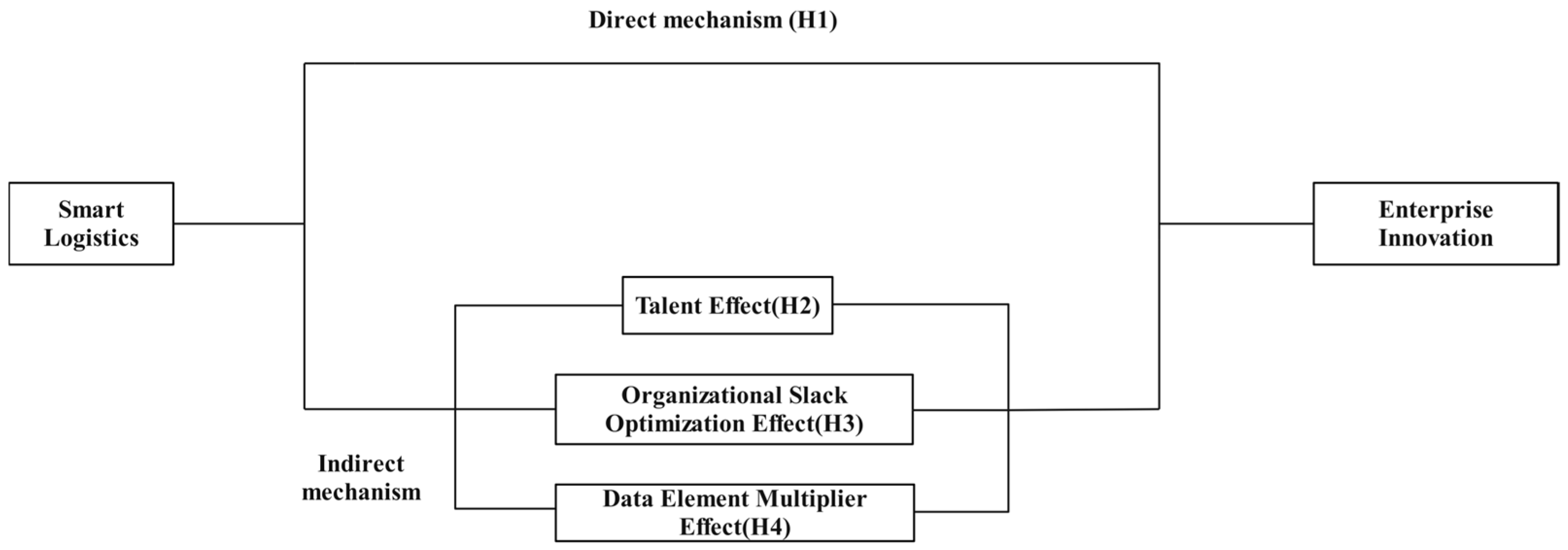
Figure 1. The research framework.
Systems 13 01076 g001
Table 1. Smart Logistics Word Frequency.
Key ProcessesLexicon
TransportationSmart Logistics, Intelligent Transportation, Unmanned Transport, Intermodal Transport, Railway Freight Digitalization, Road Freight Digitalization, Virtual Truck Operator, Transport Route Optimization, Vehicle Satellite Positioning, Intelligent Transport Equipment, Intelligent Logistics, Smart Port, Smart Shipping, Smart Railway, Smart Highway, Vehicle-to-Everything, Intelligent Shipping, Intelligent Railway, Intelligent Dispatch, Autonomous Driving, Smart Freight, Transport Digitalization
StorageIntelligent Warehousing, Smart Warehousing, Intelligent Warehouse, Smart Warehouse, Unmanned Warehouse, Automated Storage and Retrieval System, Automated Warehousing, Warehouse Digitalization, Intelligent Sorting, Smart Shelving, Warehouse Robot, Cold Chain Warehousing, Digital Warehouse, Inventory Turnover Optimization, Digital Twin Warehouse, Intelligent Storage Location, Warehouse Automation, Smart Interconnection
PackagingElectronic Shipping Label, Packaging Digitalization, Packaging Robot, Automatic Unpacking, Automatic Stretch Wrapping, Automatic Case Packing, In-line Weighing, Automatic Labeling, Automatic Case Sealing, Automatic Bundling, Smart Returnable Logistics Container
Loading and UnloadingAutomated Loading and Unloading, Intelligent Loading and Unloading, Intelligent Handling, Palletizing Robot, Automated Sorting, Loading and Unloading Robot, Unmanned Handling, Loading and Unloading Automation
DistributionIntelligent Delivery, Smart Delivery, Delivery Digitalization, Unmanned Delivery, Smart Parcel Locker, Front Warehouse Delivery, Last-mile Facility Digitalization, Intelligent Loading
Logistics InformationLogistics Information, Electronic Waybill, Logistics Data, Logistics Tracking, Digitalization of Waybills, Logistics Status Monitoring, Big Data in Logistics
Table 2. Variable Definitions and Measurement.
TypeVariableAbbreviationDescription
Dependent VariableEnterprise innovation InnovLn(1 + the number of corporate invention patent applications in year + 2)
Independent VariableThe level of smart logistics in citiesSLThe index of city-level smart logistics, constructed based on keyword frequency statistics for the current year.
Control VariablesCity openness levelFDIRatio of total urban import and export value to GDP
Fiscal education expenditureEduExpendLn(Current-year fiscal education expenditure)
Control VariablesThe nature of property rightsPropertyState-owned enterprise, yes = 1; no = 0
The proportion of management shareholdingShareholdingRatio of shares held by directors, supervisors, and senior management to total outstanding shares in the current year
Remuneration incentivesSalaryLn(Current-year total annual compensation of directors, supervisors, and senior management)
Dual role of managementDualityWhether the chairman and the general manager are the same person in the current year, yes = 1; no = 0
Corporate tax burdenTaxLn(Current-year corporate income tax expense)
Market shareMarketRatio of the corporation’s current-year operating revenue to the aggregate operating revenue of its industry
The effectiveness of internal controlControlWhether the firm’s internal control is effective in the current year, yes = 1; no = 0
Table 3. Descriptive Statistics of the Main Variables.
VariableNMeanSDMinp50Max
Innov14,1452.5311.6230.0002.4857.179
SL14,1880.5080.5150.0000.6931.792
FDI13,3175.6734.9780.0574.63620.239
EduExpend12,45110.0531.0287.7939.88211.651
Property13,6260.3030.460001
Shareholding13,62617.00020.7190.0005.00069.028
Salary13,60815.7970.69314.22515.75917.776
Duality13,6260.3210.467001
Tax13,39917.1791.80612.80317.07022.136
Market13,6401.9534.8830.0090.34533.325
Control13,0460.9980.047011
Table 4. Correlation Analysis Results.
VariablesInnovSLFDIEduExpendPropertyShareholdingSalaryDualityTaxMarketControl
Innov1
SL0.059 ***1
FDI0.080 ***−0.108 ***1
EduExpend0.119 ***0.204 ***0.569 ***1
Property0.141 ***0.007−0.057 ***0.032 ***1
Shareholding−0.098 ***−0.021 **0.113 ***0.078 ***−0.506 ***1
Salary0.296 ***0.138 ***0.189 ***0.236 ***0.012−0.105 ***1
Duality−0.043 ***0.024 ***0.102 ***0.075 ***−0.328 ***0.259 ***−0.0081
Tax0.303 ***0.005−0.0020.055 ***0.263 ***−0.271 ***0.447 ***−0.157 ***1
Market0.181 ***−0.018 **0.032 ***0.082 ***0.221 ***−0.191 ***0.189 ***−0.099 ***0.405 ***1
Control0.018 **−0.0060.020 **0.0030.0000.0100.017 *0.0040.002−0.0031
Note: *** p < 0.01, ** p < 0.05, * p < 0.1.
Table 5. Variance Inflation Factors.
VariableVIF1/VIF
SL1.730.577
FDI1.690.593
EduExpend1.630.615
Property1.520.658
Shareholding1.440.696
Salary1.430.698
Duality1.250.801
Tax1.170.852
Market1.140.877
Control1.000.999
Mean VIF1.400.0
Table 6. Baseline Regression Test.
Variable(1)
Innov
(2)
Innov
SL0.0280.055 ***
(0.020)(0.020)
ControlsNoYes
Firm FEYesYes
City FEYesYes
Year FEYesYes
Observations13,91310,080
R20.8360.852
Adjusted R20.8070.823
Note: Robust standard errors in parentheses, *** p < 0.01.
Table 7. Endogeneity Test: Simultaneous Equations Model.
Variable(1)
Innov
(2)
SL
SL0.217 ***
(0.030)
Innov 0.024 ***
(0.003)
ControlsYesYes
Observations10,30110,301
R20.1430.178
Note: Robust standard errors in parentheses, *** p < 0.01.
Table 8. Endogeneity Test: Instrumental Variable Approach.
Variable(1) First-Stage
SL
(2) Second-Stage
Innov
SL 0.126 **
(0.059)
IV0.159 ***
(0.013)
ControlsYesYes
Firm FEYesYes
City FEYesYes
Year FEYesYes
Observations10,07810,078
R20.5830.011
The K-P rk LM statistic19.968 ***
The K-P rk Wald F statistic156.602
[16.38]
Note: Robust standard errors in parentheses, *** p < 0.01, ** p < 0.05.
Table 9. Robustness Tests.
Variable(1)
Innov_grant
(2)
Innov_invest
(3)
Innov
(4)
Innov
(5)
Innov
(6)
Innov
(7)
Innov
SL0.034 *0.035 **0.054 **0.015 **0.056 ***0.053 **0.045 **
(0.019)(0.018)(0.025)(0.008)(0.021)(0.020)(0.019)
ControlsYesYesYesYesYesYesYes
Policy1NoNoNoNoNoYesNo
Policy2NoNoNoNoNoNoYes
Firm FEYesYesYesYesYesYesYes
City FEYesYesYesYesYesYesYes
Year FEYesYesYesYesYesYesYes
Observations9132909610,0809742975210,08010,080
R20.8390.9180.8520.2280.8510.8520.852
Adjusted R20.8060.9000.820 0.8220.8230.823
Note: Robust standard errors in parentheses, *** p < 0.01, ** p < 0.05, and * p < 0.1.
Table 10. Mechanism Analysis.
Variable(1)
Tech
(2)
Innov
(3)
Adm
(4)
Innov
(5)
DA
(6)
Innov
SL0.005 **0.040 *−0.027 **0.049 ***0.043 **0.033 *
(0.002)(0.020)(0.012)(0.010)(0.019)(0.020)
Tech 2.800 ***
(0.051)
Adm −0.201 ***
(0.045)
DA 0.502 ***
(0.103)
ControlsYesYesYesYesYesYes
Firm FEYesYesYesYesYesYes
City FEYesYesYesYesYesYes
Year FEYesYesYesYesYesYes
Observations10,09410,06810,010998459955976
R20.8780.8570.6630.8610.8630.859
Sobel Z2.260 **1.971 **2.005 **
Note: Robust standard errors in parentheses, *** p < 0.01, ** p < 0.05, and * p < 0.1.
Table 11. Heterogeneity Analysis.
VariableInnov
(1) High-Competition (2) Low-Competition (3) High Transparency (4) Low Transparency
SL0.075 ***0.0030.049 **0.038
(0.020)(0.048)(0.022)(0.083)
ControlsYesYesYesYes
Firm FEYesYesYesYes
City FEYesYesYesYes
Year FEYesYesYesYes
Observations706226368334632
R20.8480.8810.8590.863
Note: Robust standard errors in parentheses, *** p < 0.01, ** p < 0.05.
Disclaimer/Publisher’s Note: The statements, opinions and data contained in all publications are solely those of the individual author(s) and contributor(s) and not of MDPI and/or the editor(s). MDPI and/or the editor(s) disclaim responsibility for any injury to people or property resulting from any ideas, methods, instructions or products referred to in the content.



