Green Management Strategies for Cochliomyia hominivorax Myiasis: Potential of Essential Oils and Nanodelivery Systems

 ,
,  , ,
, ,  , and
, and
Simple Summary
Abstract
1. Introduction
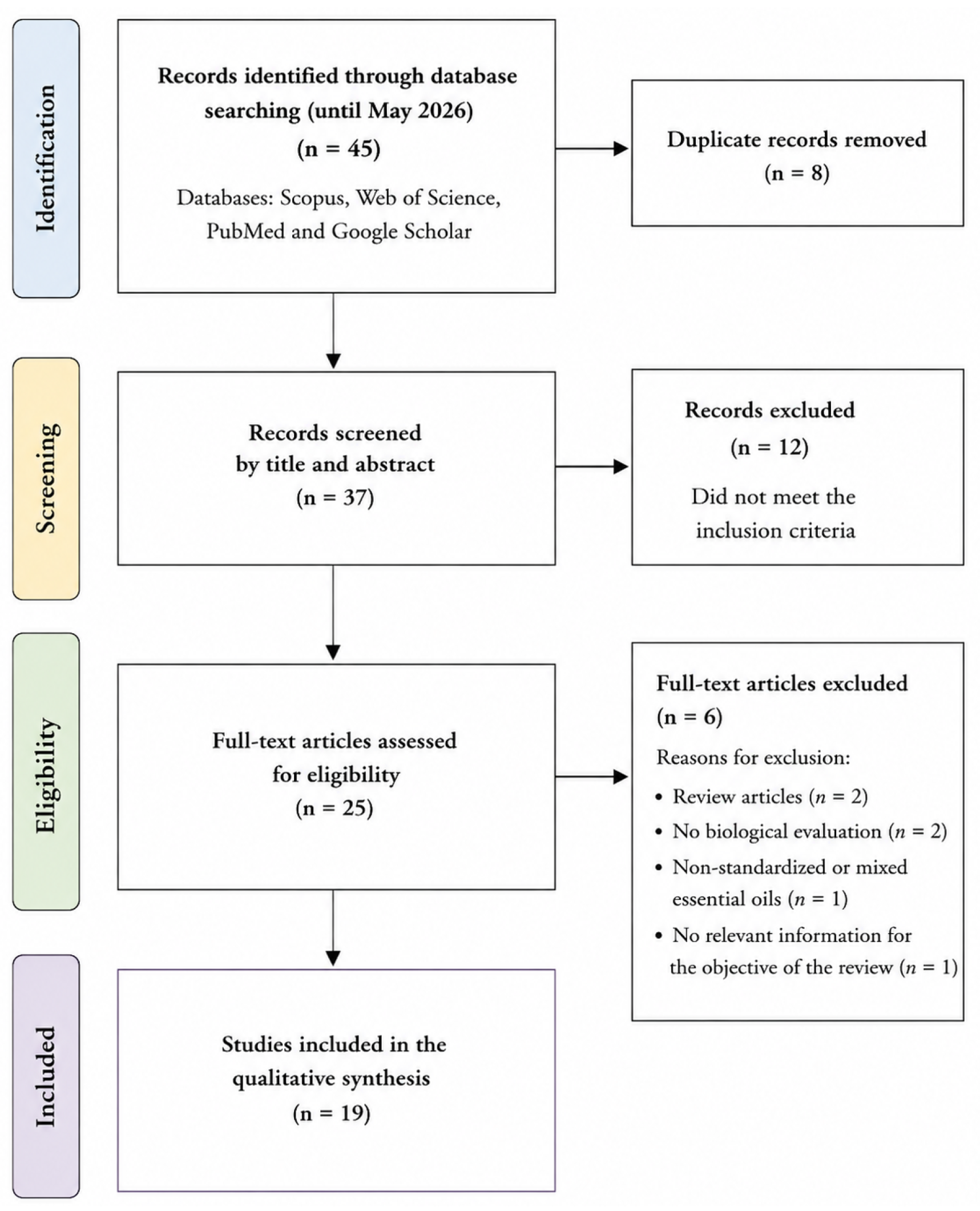
2. Literature Search Strategy
3. Biology and Pathogenesis of Cochliomyia hominivorax
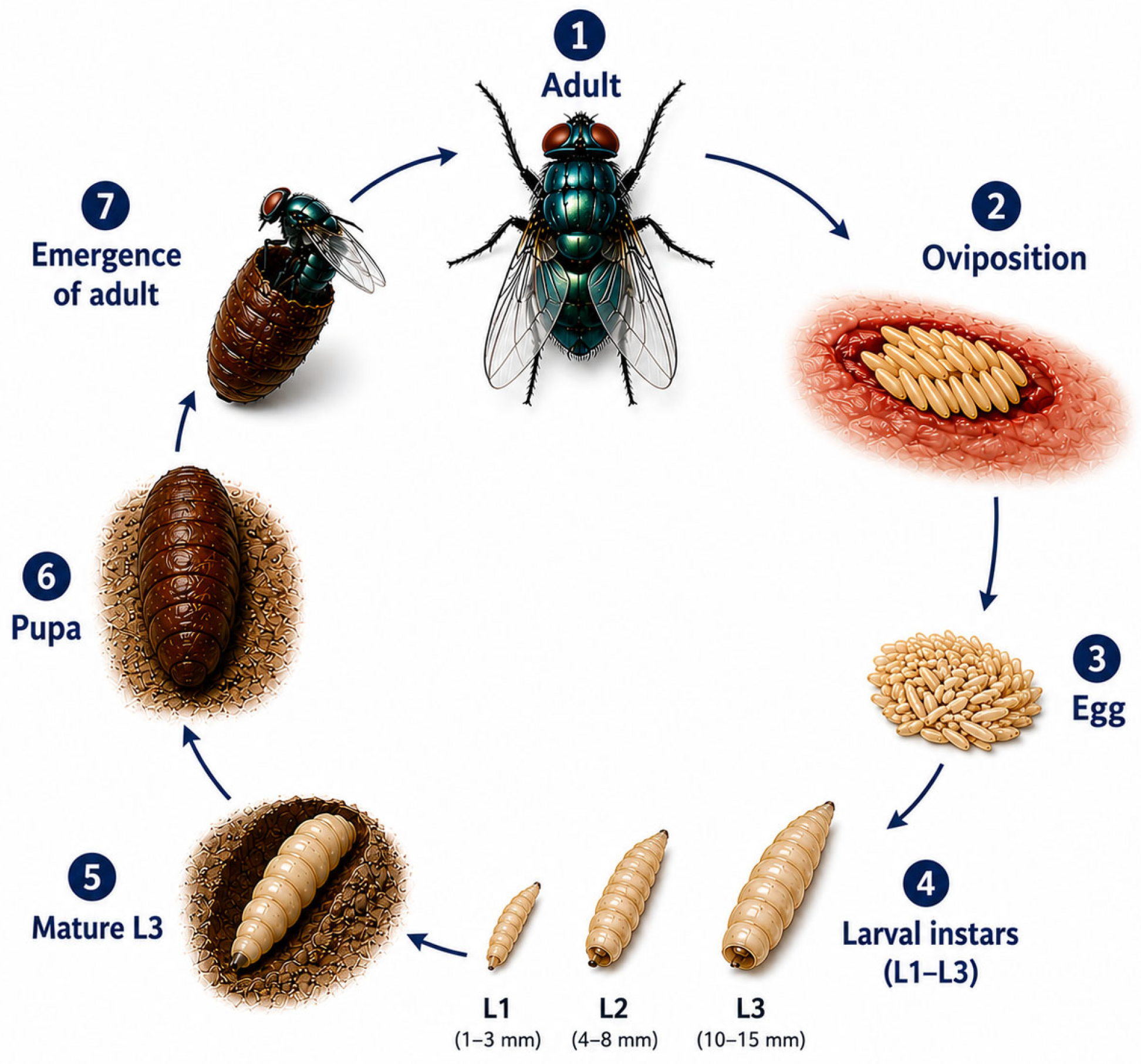
3.1. Biological Cycle of C. hominivorax
3.2. Pathogenesis of Myiasis
4. Conventional Treatments for Myiasis
5. Essential Oils as Botanical Insecticides
5.1. Insecticidal Mechanisms of EOs
5.2. EOs Against Flies That Cause Myiasis

| Plant Species | Major Components | Species | Test | Summary of Results | Ref |
|---|---|---|---|---|---|
| Tagetes minuta | Dihydrotagetone, trans-beta-ocimene, trans-tagetone | Cochliomyia macellaria | LCT | LC50 (24–48 h): ethanol = 0.678–0.580 μL cm−2. Mortality: 93.33% at 1.59 μL cm−2. Emergence inhibition: 87.27% at 0.7961 μL cm−2. | [90] |
| Curcuma longa | α-phellandrene, α-pinene, β-pinene | Cochliomyia macellaria | LCT | Mortality at 48 h at 1.27 μL cm−2: 96.66% (ethanol). | [100] |
| Baccharis dracunculifolia | β-pinene, D-limonene, β-nerolidol | Cochliomyia macellaria | LCT | LC50 (24–48 h): ethanol = 2.63–2.47 μL cm−2 | [101] |
| Clinopodium nubigenum | Carvacrol, Pulegone | Lucilia sericata | ODT, ECT, ACT, FT, TAT | Oviposition deterrence: 100% at 0.8 μL cm−2. Toxicity in eggs: LC50 = 0.07 μL cm−2. Adults: LC50 = 0.278 μL insect−1. | [94] |
| Lavandula angustifolia | Linalool Linalyl acetate | Lucilia sericata | ODT, ECT, ACT | Deterrence: 100% at 0.8 μL cm−2 (3 h); 82.7% at 24 h. Toxicity in eggs: LC50 = 0.48 μL cm−2. Adults: LC50 = 0.393 μL insect−1. | [94] |
| Chrysopogon zizanioides | Not specified | Lucilia sericata | ODT, RT, ACT | At 0.2% → 100% mortality in 5 min. Strong oviposition deterrent effect. | [96] |
| Cinnamomum zeylanicum | Not specified | Lucilia sericata | ODT, RT, ACT | At 0.2% → 100% mortality in 5 min. Significant insecticidal and repellent activity. | [96] |
| Lavandula angustifolia | Not specified | Lucilia sericata | ODT, RT, ACT | At 0.2% → 100% mortality in 5 min. Repellent effect and reduction in longevity. | [96] |
| Cinnamomum camphora | Camphor, 1,8-cineole, safrole | Lucilia sericata | LIT | Mortality: 93.3% to 32%. It caused swelling and cuticular distortion. | [102] |
| Lavandula angustifolia | Linalool, linalyl acetate | Lucilia sericata | LIT | Mortality: 100% to 32%. Induced cuticular damage (swelling, deformation). | [102] |
| Lactuca sativa | Not specified | Lucilia sericata | LIT | LC50 = 0.57% (more potent). Marked decrease in pupation to 8%. Suppression of adult emergence to 2%. | [103] |
| Matricaria chamomilla | Not specified | Lucilia sericata | LIT | LC50 = 0.85%. Suppression of adult emergence at 2%. | [103] |
| Pimpinella anisum | Not specified | Lucilia sericata | LIT | LC50 = 2.74%. Lower relative toxicity. Induced morphological abnormalities. | [103] |
| Rosmarinus officinalis | Not specified | Lucilia sericata | LIT | LC50 = 6.77%. Induced deformities. | [103] |
| Chrysopogon zizanioides | Not specified | Lucilia sericata | LIT | High toxicity in L3: mortality = 93.33%. Negatively affected larval development. | [97] |
| Cinnamomum zeylanicum | Not specified | Lucilia sericata | LIT | Very high toxicity in L3: mortality = 95.56%. Significant effect on development. | [97] |
| Curcuma longa | α-phellandrene | Lucilia cuprina | LCT | High larvicidal activity and inhibition of adult emergence (96.22–100%). | [100] |
| Tagetes minuta | Dihydrotagetone, trans-ocimene, trans-tagetone | Lucilia cuprina | LCT | LC50 (24–48 h): acetone 1.02–0.73 μL cm−2; ethanol 3.37–1.75 μL cm−2; Tween 20 7.46–6.11 μL cm−2. Maximum mortality ~96.6% (48 h, acetone). | [91] |
| Piper gaudichaudianum | Germacrene B, δ-cadinene, γ-elemene | Lucilia cuprina | LCT | LC50 (24–48 h): ethanol = 3.69–2.19 μL cm−2; acetone = 9.14–6.05 μL cm−2. | [92] |
| Piper betle | Not specified | Chrysomya bezziana | LCT | 4% induced 100% mortality in L1 and L2; 3% caused 100% mortality in L1 and 74% in L2; 2% resulted in 100% mortality of L1. | [89] |
| Lippia sidoides | Thymol | Chrysomya megacephala | LCT | Mortality ~90%. High insecticidal activity. | [99] |
| Laurus nobilis | 1,8-cineole, linalool | Chrysomya megacephala | LCT | Mortality ~63.7%. Moderate activity. | [99] |
| Lantana camara | α-pinene, caryophyllene, geranyl acetate, eucalyptol | Chrysomya megacephala | ECT, PDT | High ovicidal activity, reduced pupation and adult emergence, with developmental abnormalities. | [95] |
| Artemisia annua | Artemisia ketone, 1,8-cineole | Calliphora vomitoria | ACT, FT | Contact toxicity: LC50 = 0.79 μL insect−1. Fumigation: LC50 = 88.09 μL L−1 of air. | [104] |
| Artemisia dracunculus | methyl chavicol, limonene | Calliphora vomitoria | ODT, ACT, FT | Oviposition: 100% inhibition at 0.05 μL cm−2. Contact toxicity: LC50 = 0.49 μL insect−1. Fumigation: LC50 = 49.55 μL L−1 of air. | [104] |
| Allium sativum | Allicin, diallyl disulfide, diallyl trisulfide | Calliphora vomitoria | EAG, ODT, ACT, FT | Strong repellent activity; complete inhibition of oviposition at ≥2.5 μL cm−2 for 24 h. Toxicity: LC50 = 0.44–1.97 μL insect−1; LC50 = 1.76–31.52 μL L−1. | [93] |
| Rosmarinus officinalis | 1,8-cineole, camphor, α-pinene | Calliphora vomitoria | EAG, ODT, ACT, FT | Significant repellent activity; oviposition inhibition at ≥2.5 μL cm−2. Moderate toxicity in adults. | [93] |
| Salvia officinalis | Thujone, camphor, 1,8-cineole | Calliphora vomitoria | EAG, ODT, ACT, FT | Effective repellency and oviposition deterrence at ≥2.5 μL cm−2. Contact and fumigation toxicity. | [93] |
| Origanum vulgare (CC) | Carvacrol | Calliphora vomitoria | ACT, OCT | Toxicity in adults: LC50 = 0.14–0.31 μL insect−1. Toxicity in eggs: LC50 = 0.008–0.038 μL cm−2. | [98] |
| Origanum vulgare (TCC) | Thymol, p-cymene | Calliphora vomitoria | ACT, OCT | Toxicity in adults: LC50 = 0.14–0.31 μL insect−1. Ovicidal: LC50 = 0.008–0.038 μL cm−2. | [98] |
| Origanum vulgare (TTC) | Thymol, γ-terpinene | Calliphora vomitoria | ACT, OCT | Toxicity in adults and eggs within reported ranges: LC50 = 0.14–0.31 μL insect−1, LC50 = 0.008–0.038 μL cm−2. | [98] |
| Cucurbita maxima | Not specified | Cephalopina titillator | LIT | 100% mortality at 2% (24 h). LC50 = 0.20%. Total inhibition of pupation and emergence. | [105] |
| Lupinus luteus | Not specified | Cephalopina titillator | LIT | 100% mortality to 30%. LC50 = 0.47%. | [105] |
| Allium sativum | Not specified | Cephalopina titillator | LIT | 100% mortality at 7.5%. LC50 = 0.44%. | [105] |
| Mentha piperita | Not specified | Cephalopina titillator | LIT | 100% mortality at 7.5%. LC50 = 0.42%. Greater incidence of deformities: 44% larvae (7.5%) and 40% pupae (2%). | [105] |
5.3. Effects of EOs and Their Components Against C. hominivorax
| Treatments | Plant Species | Major Components | Summary of Results | Ref. |
|---|---|---|---|---|
| Essential oils | Salvia sclarea | Linalyl acetate, linalool | Mortality of 3.3% at 25,000 μg mL−1 | [70] |
| Rosmarinus officinalis | Eucalyptol, Camphor | Mortality of 33.6% at 100,000 μg mL−1 | ||
| Lavandula hybrida | Linalool, Linalyl acetate | Mortality of 16.7% at 50,000 μg mL−1 | ||
| Citrus bergamia | Linalyl acetate, limonene | Mortality of 43.3% at 100,000 μg mL−1 | ||
| Citrus paradisi | Linalyl acetate | Mortality of 38.4% at 100,000 μg mL−1 | ||
| Juniperus virginiana | α-cedrene, cedrol | Mortality of 6.7% at 50,000 μg mL−1 | ||
| Copaifera reticulata | β-caryophyllene | Mortality of 20.0% at 50,000 μg mL−1 | ||
| Cymbopogon flexuosus | Geranial, geraniol | Mortality of 46.7% at 100,000 μg mL−1 | ||
| Eugenia caryophyllus | Eugenol | Mortality of 53.3% at 100,000 μg mL−1 | ||
| Cinnamomum cassia | Cinnamaldehyde | Mortality of 53.3% at 100,000 μg mL−1 | ||
| Pelargonium roseum | Citronelol, geraniol | Mortality of 23.3% at 75,000 μg mL−1 | ||
| Cymbopogon winterianus | Citronellal, geraniol | Mortality of 33.3% at 75,000 μg mL−1 | ||
| Illicium verum | (E)-anethole | 100% mortality at 100,000 μg mL−1. LC50: 418.1 µg cm−2 (48 h) | ||
| Thymus vulgaris | Thymol, Ocimene | 100% mortality at 50,000 μg mL−1. LC50: 407.1 µg/cm2 (24 h) and 314.2 µg cm−2 (48 h) | ||
| Origanum vulgare | Carvacrol | 100% mortality at 75,000 μg mL−1. LC50: 540.9 µg/cm2 (24 h) and 253.8 µg cm−2 (48 h) | ||
| Components | - | Trans-anethole | 100% mortality at 100,000 μg mL−1. LC50: 559.4 µg cm−2 (48 h) | |
| - | Thymol | Mortality of 98.3% at 80,000 μg mL−1. LC50: 255.6 µg/cm2 (24 h) and 102.3 µg cm−2 (48 h) | ||
| - | Carvacrol | 95% mortality at 100,000 μg mL−1. LC50: 970.5 µg/cm2 (24 h) and 931.1 µg cm−2 (48 h) |
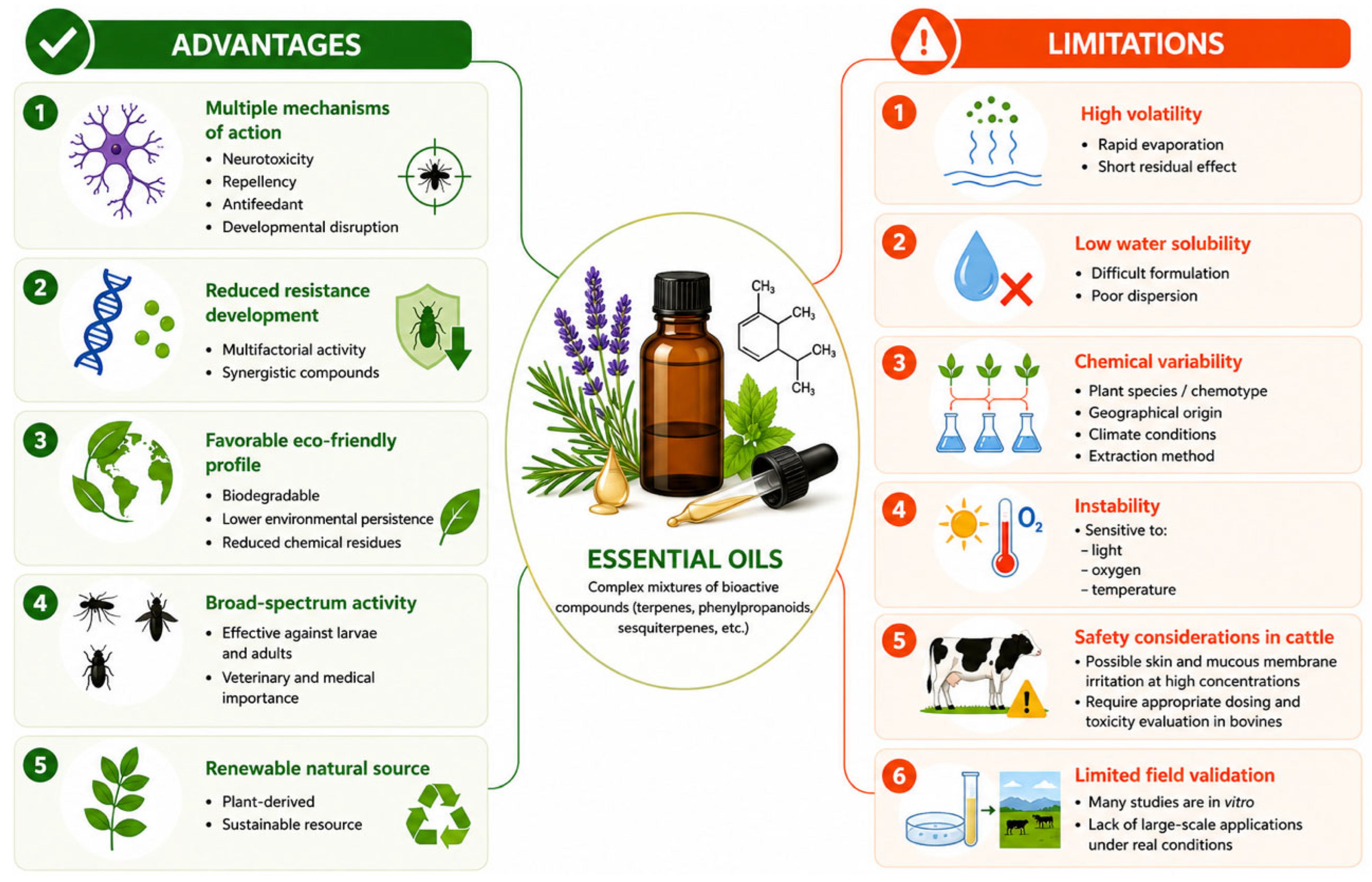
5.4. Advantages and Limitations of Essential Oils as Insecticides
6. Nano-Enabled Plant-Derived Insect Control Strategies
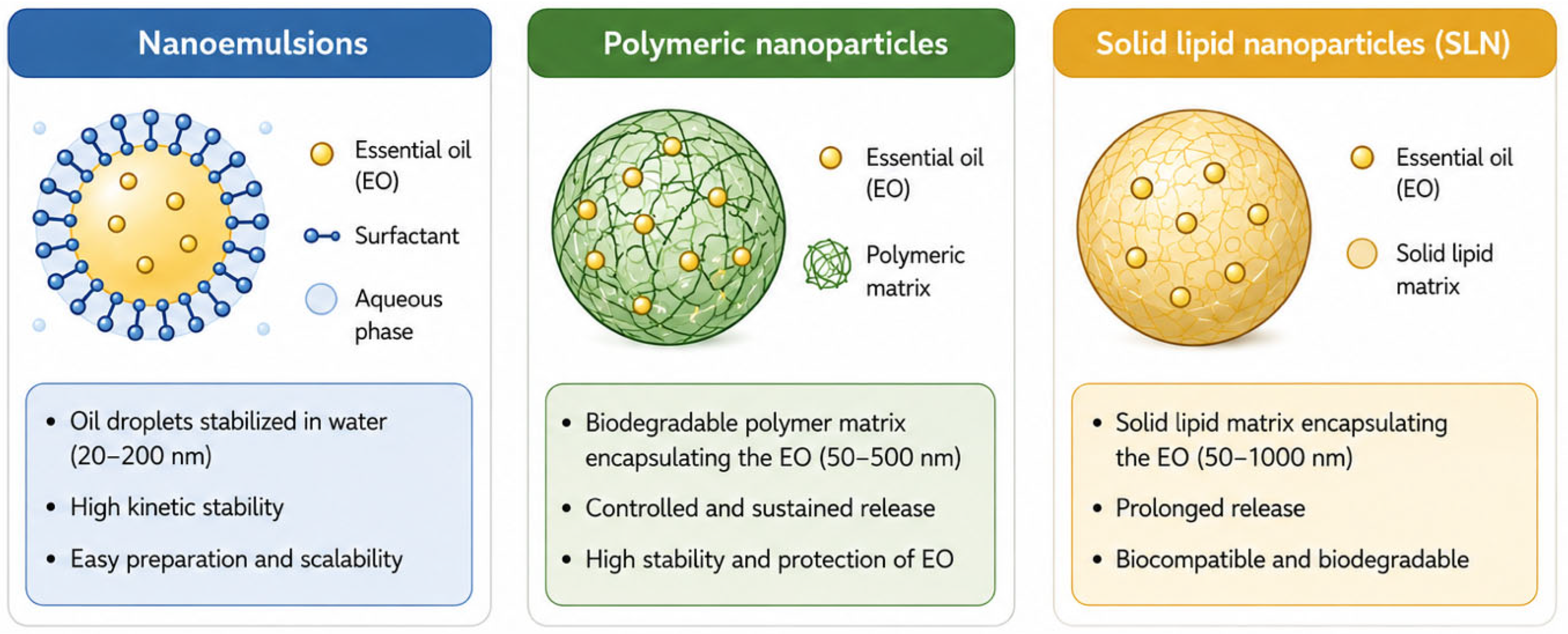
6.1. Nanocarrier Systems for EOs
6.2. Effects on Flies That Cause Myiasis and Other Insects
6.3. Innovative Approaches for Managing C. hominivorax
7. Conclusions
Author Contributions
Funding
Institutional Review Board Statement
Informed Consent Statement
Data Availability Statement
Acknowledgments
Conflicts of Interest
References
- Altuna, M.; Hickner, P.V.; Castro, G.; Mirazo, S.; Pérez de León, A.A.; Arp, A.P. New World Screwworm (Cochliomyia hominivorax) Myiasis in Feral Swine of Uruguay: One Health and Transboundary Disease Implications. Parasites Vectors 2021, 14, 26. [Google Scholar] [CrossRef] [Scilit] [PubMed]
- Rodríguez-Hidalgo, R.; Tapia-Chiriboga, A.; Arciniegas, S.; Vanwambeke, S.O.; Benítez-Ortiz, W. Epidemiological Analysis of the New World Screwworm (Cochliomyia hominivorax) in Ecuador. Transbound. Emerg. Dis. 2019, 66, 968–977. [Google Scholar] [CrossRef] [Scilit] [PubMed]
- Scott, M.J.; Concha, C.; Welch, J.B.; Phillips, P.L.; Skoda, S.R. Review of Research Advances in the Screwworm Eradication Program over the Past 25 Years. Entomol. Exp. Appl. 2017, 164, 226–236. [Google Scholar] [CrossRef] [Scilit]
- Pezzi, M.; Scapoli, C.; Chicca, M.; Leis, M.; Marchetti, M.G.; Del Zingaro, C.N.F.; Vicentini, C.B.; Mamolini, E.; Giangaspero, A.; Bonacci, T. Cutaneous Myiasis in Cats and Dogs: Cases, Predisposing Conditions and Risk Factors. Vet. Med. Sci. 2021, 7, 378–384. [Google Scholar] [CrossRef] [Scilit] [PubMed]
- Zaldivar-Gomez, A.; Gomez-Vazquez, J.P.; Iniesta-Valencia, A.J.; Figueroa-Martínez, L.G.; Rico-Chávez, O. Estimation the Reinvasion of New World Screwworm (Cochliomyia hominivorax) in Central America: The Role of Animal Movement in Disease Dispersal and Control Measures. Vet. Parasitol. Reg. Stud. Rep. 2025, 59, 101220. [Google Scholar] [CrossRef] [Scilit] [PubMed]
- Vargas-Terán, M.; Spradbery, J.P.; Hofmann, H.C.; Tweddle, N.E. Impact of Screwworm Eradication Programmes Using the Sterile Insect Technique. In Sterile Insect Tech; CRC Press: New York, NY, USA, 2020; pp. 949–978. [Google Scholar] [CrossRef] [Scilit]
- Fresia, P.; Pimentel, S.; Iriarte, V.; Marques, L.; Durán, V.; Saravia, A.; Novas, R.; Basika, T.; Ferenczi, A.; Castells, D.; et al. Historical Perspective and New Avenues to Control the Myiasis-Causing Cochliomyia hominivorax Fly in Uruguay. Agrociencia Urug. 2021, 25, e974. [Google Scholar] [CrossRef] [Scilit]
- Signorini, P.M.; Anziani, O.; Rossner, M.V.; Gamietea, I.; Micheloud, J.; Lloberas, M.; Martinez, N.; Olmos, L.; Sarmiento, N.; Abdala, A. Insectos y Ácaros de Mayor Importancia en la Producción Bovina Nacional. Análisis del Impacto de la Miasis Por Cochliomyia hominivorax Sobre la Producción Ganadera en Argentina. Rev. IDIA 2022, 2, 92–102. [Google Scholar]
- Grisi, L.; Leite, R.C.; de Martins, J.R.; de Barros, A.T.M.; Andreotti, R.; Cançado, P.H.D.; de León, A.A.P.; Pereira, J.B.; Villela, H.S. Reavaliação do Potencial Impacto Econômico de Parasitos de Bovinos No Brasil. Rev. Bras. Parasitol. Vet. 2014, 23, 150–156. [Google Scholar] [CrossRef] [Scilit] [PubMed]
- Rodriguez-Vivas, R.I.; Cutolo, A.A.; Barros, A.T.M.d.; Cuore, U.D.; Molento, M.B.; López-Osorio, S.; Rodrigues, D.S.; Spina, M.; Borges, F.A.; Lopes, W.D.Z.; et al. Management Practices for the Control of Haematobia irritans, Dermatobia hominis, and Cochliomyia hominivorax in Cattle Across Latin America: A Sustainable, Collective Approach. Pathogens 2026, 15, 177. [Google Scholar] [CrossRef] [Scilit] [PubMed]
- Wyss, J.H. Screwworm Eradication in the Americas. Ann. N. Y. Acad. Sci. 2000, 916, 186–193. [Google Scholar] [CrossRef] [Scilit] [PubMed]
- Hailu, K.T.; Kasagga, A.; Haddad, R.R.; Hailu, K.T.; Kasagga, A.; Haddad, R.R. The New World Screwworm in the United States: A Narrative Review Anchored to the 2025 Travel-Associated Human Case. Cureus 2025, 17, e94039. [Google Scholar] [CrossRef] [Scilit] [PubMed]
- Carvalho, R.A.; Torres, T.T.; Paniago, M.G.; Azeredo-Espin, A.M.L. Molecular Characterization of Esterase E3 Gene Associated with Organophosphorus Insecticide Resistance in the New World Screwworm Fly, Cochliomyia hominivorax. Med. Vet. Entomol. 2009, 23, 86–91. [Google Scholar] [CrossRef] [Scilit] [PubMed]
- de Carvalho, R.A.; Limia, C.E.G.; Bass, C.; de Azeredo-Espin, A.M.L. Changes in the Frequency of the G137D and W251S Mutations in the Carboxylesterase E3 Gene of Cochliomyia hominivorax (Diptera: Calliphoridae) Populations from Uruguay. Vet. Parasitol. 2010, 170, 297–301. [Google Scholar] [CrossRef] [Scilit] [PubMed]
- Da Silva, N.M.; De Carvalho, R.A.; De Azeredo-Espin, A.M.L. Acetylcholinesterase CDNA Sequencing and Identification of Mutations Associated with Organophosphate Resistance in Cochliomyia hominivorax (Diptera: Calliphoridae). Vet. Parasitol. 2011, 177, 190–195. [Google Scholar] [CrossRef] [Scilit] [PubMed]
- Muchiut, S.; Miró, M.V.; Anziani, O.; Nava, S.; Lifschitz, A. Failure of Doramectin and Ivermectin in Preventing Cochliomyia hominivorax Myiasis in a Subtropical Region: A Pharmacokinetic-Pharmacodynamic Study. Vet. Parasitol. 2025, 334, 110384. [Google Scholar] [CrossRef] [Scilit] [PubMed]
- Zhou, W.; Li, M.; Achal, V. A Comprehensive Review on Environmental and Human Health Impacts of Chemical Pesticide Usage. Emerg. Contam. 2025, 11, 100410. [Google Scholar] [CrossRef] [Scilit]
- Barathi, S.; Sabapathi, N.; Kandasamy, S.; Lee, J. Present Status of Insecticide Impacts and Eco-Friendly Approaches for Remediation—A Review. Environ. Res. 2024, 240, 117432. [Google Scholar] [CrossRef] [Scilit] [PubMed]
- Ansari, M.S.; Moraiet, M.A.; Ahmad, S. Insecticides: Impact on the Environment and Human Health. In Environmental Deterioration and Human Health; Springer: Dordrecht, The Netherlands, 2014; pp. 99–123. [Google Scholar] [CrossRef] [Scilit]
- Mann, S.; Kaufman, E. Natural Product Pesticides: Their Development, Delivery and Use Against Insect Vectors. Mini. Rev. Org. Chem. 2012, 9, 185–202. [Google Scholar] [CrossRef] [Scilit]
- Jahanian, H.; Kahkeshani, N.; Sanei-Dehkordi, A.; Isman, M.B.; Saeedi, M.; Khanavi, M. Rosmarinus officinalis as a Natural Insecticide: A Review. Int. J. Pest Manag. 2024, 70, 818–863. [Google Scholar] [CrossRef] [Scilit]
- Koul, O. Phytochemicals and Insect Control: An Antifeedant Approach. Crit. Rev. Plant Sci. 2008, 27, 1–24. [Google Scholar] [CrossRef] [Scilit]
- Adenubi, O.T.; Fasina, F.O.; McGaw, L.J.; Eloff, J.N.; Naidoo, V. Plant Extracts to Control Ticks of Veterinary and Medical Importance: A Review. S. Afr. J. Bot. 2016, 105, 178–193. [Google Scholar] [CrossRef] [Scilit]
- Gutierrez-Rodriguez, S.M.; Cordova-Guerreo, I.; Diaz-Rubio, L.; Davila-Barboza, J.A.; Rodriguez-Sanchez, I.P.; Lopez-Monroy, B.; Galindo-Rodriguez, S.A.; Flores, A.E. Oviposition Deterrent and Larvicidal Activity of Salvia munzii Essential Oil Against Susceptible and Insecticide-Resistant Aedes aegypti. Trop. Med. Infect. Dis. 2026, 11, 134. [Google Scholar] [CrossRef] [Scilit] [PubMed]
- Senthil-Nathan, S. A Review of Resistance Mechanisms of Synthetic Insecticides and Botanicals, Phytochemicals, and Essential Oils as Alternative Larvicidal Agents Against Mosquitoes. Front. Physiol. 2020, 10, 473482. [Google Scholar] [CrossRef] [Scilit] [PubMed]
- Farag, S.M.; Moustafa, M.A.M.; Fónagy, A.; Kamel, O.M.H.M.; Abdel-Haleem, D.R. Chemical Composition of Four Essential Oils and Their Adulticidal, Repellence, and Field Oviposition Deterrence Activities against Culex pipiens L. (Diptera: Culicidae). Parasitol. Res. 2024, 123, 110. [Google Scholar] [CrossRef] [Scilit] [PubMed]
- Sousa, R.M.O.F.; Rosa, J.S.; Oliveira, L.; Cunha, A.; Fernandes-Ferreira, M. Activities of Apiaceae Essential Oils and Volatile Compounds on Hatchability, Development, Reproduction and Nutrition of Pseudaletia unipuncta (Lepidoptera: Noctuidae). Ind. Crops Prod. 2015, 63, 226–237. [Google Scholar] [CrossRef] [Scilit]
- de Castro, K.N.; Canuto, K.M.; de Brito, E.S.; Costa-Júnior, L.M.; De Andrade, I.M.; Magalhães, J.A.; Barros, D.M.A. In Vitro Efficacy of Essential Oils with Different Concentrations of 1,8-Cineole against Rhipicephalus (Boophilus) microplus. Rev. Bras. Parasitol. Veterinária 2018, 27, 203–210. [Google Scholar] [CrossRef] [Scilit] [PubMed]
- Harun-Ur-Rashid, M.; Imran, A. Bin Biomimetic and Synthetic Advances in Natural Pesticides: Balancing Efficiency and Environmental Safety. J. Chem. 2025, 2025, 1510186. [Google Scholar] [CrossRef] [Scilit]
- Vlaiculescu, A.; Varrone, C. Sustainable and Eco-Friendly Alternatives to Reduce the Use of Pesticides. In Pesticides in the Natural Environment; Elsevier: Amsterdam, The Netherlands, 2022; pp. 329–364. [Google Scholar] [CrossRef] [Scilit]
- Huang, X.; Zhao, J.; Zhou, X.; Han, Y.; Zhang, J.; Cai, Z. How Green Alternatives to Chemical Pesticides Are Environmentally Friendly and More Efficient. Eur. J. Soil Sci. 2019, 70, 518–529. [Google Scholar] [CrossRef] [Scilit]
- Souto, A.L.; Sylvestre, M.; Tölke, E.D.; Tavares, J.F.; Barbosa-Filho, J.M.; Cebrián-Torrejón, G. Plant-Derived Pesticides as an Alternative to Pest Management and Sustainable Agricultural Production: Prospects, Applications and Challenges. Molecules 2021, 26, 4835. [Google Scholar] [CrossRef] [Scilit] [PubMed]
- Kaspute, G.; Ivaskiene, T.; Ramanavicius, A.; Ramanavicius, S.; Prentice, U. Terpenes and Essential Oils in Pharmaceutics: Applications as Therapeutic Agents and Penetration Enhancers with Advanced Delivery Systems for Improved Stability and Bioavailability. Pharmaceutics 2025, 17, 793. [Google Scholar] [CrossRef] [Scilit] [PubMed]
- Barradas, T.N.; de Holanda e Silva, K.G. Nanoemulsions of Essential Oils to Improve Solubility, Stability and Permeability: A Review. Environ. Chem. Lett. 2020, 19, 1153–1171. [Google Scholar] [CrossRef] [Scilit]
- Kaspute, G.; Ivaskiene, T.; Mobasheri, A.; Viter, R.; Ramanavicius, A.; Prentice, U. Enhancing Essential Oils: Advanced Extraction, Sustainability, and Nanotechnology for Optimal Use. Planta 2025, 262, 71. [Google Scholar] [CrossRef] [Scilit] [PubMed]
- García-Ponce, R.; Villarreal-Villarreal, J.P.; Suárez, A.E.F.; Vidal, G.H.; García-Hernández, D.G.; Hernández-Escareño, J.J.; Heya, M.S. Nanocarriers of Natural and Synthetic Ixodicides, New Alternatives against Rhipicephalus microplus (Acari: Ixodidae): A Review. Vet. Parasitol. 2025, 337, 110506. [Google Scholar] [CrossRef] [Scilit] [PubMed]
- Kumar, A.; Singh, P.; Gupta, V.; Prakash, B. Application of Nanotechnology to Boost the Functional and Preservative Properties of Essential Oils. In Functional and Preservative Properties of Phytochemicals; Academic Press: Cambridge, MA, USA, 2020; pp. 241–267. [Google Scholar] [CrossRef] [Scilit]
- Zhang, L.; Lin, J.; Zhang, C.; Hu, S.; Dong, Y.; Fan, G.; He, F. Recent Advances in the Nanotechnology-Based Applications of Essential Oils. Curr. Nanosci. 2023, 20, 630–643. [Google Scholar] [CrossRef] [Scilit]
- Armendáriz-Barragán, B.; Zafar, N.; Badri, W.; Galindo-Rodríguez, S.A.; Kabbaj, D.; Fessi, H.; Elaissari, A. Plant Extracts: From Encapsulation to Application. Expert Opin. Drug Deliv. 2016, 13, 1165–1175. [Google Scholar] [CrossRef] [Scilit] [PubMed]
- Lammari, N.; Louaer, O.; Meniai, A.H.; Elaissari, A. Encapsulation of Essential Oils via Nanoprecipitation Process: Overview, Progress, Challenges and Prospects. Pharmaceutics 2020, 12, 431. [Google Scholar] [CrossRef] [Scilit] [PubMed]
- Bayraktar, O.; Erdogan, I.; Köse, M.D.; Kalmaz, G. Nanocarriers for Plant-Derived Natural Compounds. In Nanostructures for Antimicrobial Therapy; Elsevier: Amsterdam, The Netherlands, 2017; pp. 395–412. [Google Scholar] [CrossRef] [Scilit]
- Dias, G.F.; Vieira, A.C.F.; Paiva-Santos, A.C.; Veiga, F.; Costa, G. Plant-Derived Bioactive Compounds in Nanocarrier Systems for Dermatological Applications. Phytochem. Rev. 2026; in press. [CrossRef] [Scilit]
- Hashempur, M.H.; Ghorat, F.; Karami, F.; Jahanbin, A.; Nouraei, H.; Abbasi, M.; Jafari, M.; Zare, A.; Barzegar, S.; Zareshahrabadi, Z. Topical Delivery Systems for Plant-Derived Antimicrobial Agents: A Review of Current Advances. Int. J. Biomater. 2025, 2025, 4251091. [Google Scholar] [CrossRef] [Scilit] [PubMed]
- Kothapalli, P.; Vasanthan, M. Lipid-Based Nanocarriers for Enhanced Delivery of Plant-Derived Bioactive Molecules: A Comprehensive Review. Ther. Deliv. 2024, 15, 135–155. [Google Scholar] [CrossRef] [Scilit]
- Ranjbar, S.; Emamjomeh, A.; Sharifi, F.; Zarepour, A.; Aghaabbasi, K.; Dehshahri, A.; Sepahvand, A.M.; Zarrabi, A.; Beyzaei, H.; Zahedi, M.M.; et al. Lipid-Based Delivery Systems for Flavonoids and Flavonolignans: Liposomes, Nanoemulsions, and Solid Lipid Nanoparticles. Pharmaceutics 2023, 15, 1944. [Google Scholar] [CrossRef] [Scilit] [PubMed]
- Bidyarani, N.; Jaiswal, J.; Kumar, U. Botanicals-Based Nanoformulations for the Management of Insect-Pests. In Nanophytopathology; CRC Press: Boca Raton, FL, USA, 2023; pp. 173–184. [Google Scholar] [CrossRef] [Scilit]
- García-Ponce, R.; Flores-Suarez, A.E.; Hernández-Escareño, J.J.; Vidal, G.H.; Villarreal, J.P.V.; García, L.H.D. Phytotherapeutic Alternatives: New Nanotechnology-Based Approaches to Tick Control. In Natural Alternatives and Nanotechnology Applied to the One Health Approach; Springer: Cham, Switzerland, 2025; pp. 163–178. [Google Scholar] [CrossRef] [Scilit]
- Luneja, R.L.; Mkindi, A.G. Advances in Botanical-Based Nanoformulations for Sustainable Cotton Insect Pest Management in Developing Countries. Front. Agron. 2025, 7, 1558395. [Google Scholar] [CrossRef] [Scilit]
- Sarmah, K.; Anbalagan, T.; Marimuthu, M.; Mariappan, P.; Angappan, S.; Vaithiyanathan, S. Innovative Formulation Strategies for Botanical- and Essential Oil-Based Insecticides. J. Pest Sci. 2024, 98, 1–30. [Google Scholar] [CrossRef] [Scilit]
- Page, M.J.; McKenzie, J.E.; Bossuyt, P.M.; Boutron, I.; Hoffmann, T.C.; Mulrow, C.D.; Shamseer, L.; Tetzlaff, J.M.; Akl, E.A.; Brennan, S.E.; et al. The PRISMA 2020 Statement: An Updated Guideline for Reporting Systematic Reviews. PLoS Med. 2021, 18, e1003583. [Google Scholar] [CrossRef] [PubMed]
- Forero, E.; Cortés, J.; Villamil, L. Problemática del gusano barrenador del ganado, Cochliomyia hominivorax (Coquerel, 1858) en Colombia. Rev. MVZ Cordoba 2008, 13, 1400–1414. [Google Scholar] [CrossRef] [Scilit]
- Castells, D.; Iriarte, M.V.; Saporiti, T.; Pimentel, S.; Marques, L. Miasis Por Cochliomyia hominivorax. XLVI Jorn. Urug. Buiat. 2018, 2018, 69–78. [Google Scholar]
- World Organisation for Animal Health. Miasis Por Cochliomyia hominvorax y Miasis por Chrysomya bezziana. In Manual Terrestre de la OIE 2019; World Organisation for Animal Health: Paris, France, 2019. [Google Scholar]
- World Organisation for Animal Health. Miasis por Cochliomyia hominivorax—OMSA—Organización Mundial de Sanidad Animal. Available online: https://www.woah.org/es/enfermedad/miasis-por-cochliomyia-hominivorax/ (accessed on 16 June 2026).
- World Health Organization (WHO). Miasis por Larvas de Cochliomyia hominivorax—OPS/OMS, Organización Panamericana de La Salud. Available online: https://www.paho.org/es/temas/miasis-por-larvas-cochliomyia-hominivorax (accessed on 16 June 2026).
- Servicio Nacional de Sanidad, Inocuidad y Calidad Agroalimentaria (SENASICA). Miasis por Gusano Barrenador. Available online: https://www.gob.mx/senasica/documentos/miasis-por-gusano-barrenador?state=published (accessed on 16 June 2026).
- Akhoundi, M.; Mathieu, A.; Hannachi, W.; Nasrallah, J.; Quezel, G.; Blaizot, R.; Blanchet, D.; Ben Romdhane, H.; Epelboin, L.; Izri, A. Morphological and Molecular Characterizations of Cochliomyia hominivorax (Diptera: Calliphoridae) Larvae Responsible for Wound Myiasis in French Guiana. Diagnostics 2023, 13, 2575. [Google Scholar] [CrossRef] [Scilit] [PubMed]
- Center for Food Security & Public Health. Myiasis Caused by Old and New World Screwworms. 2025. Available online: https://www.cfsph.iastate.edu/Factsheets/pdfs/screwworm_myiasis.pdf (accessed on 16 June 2026).
- García-Coronado, P.L.; Rosales Martínez, F.; Zarate Triviño, D.; Monroy Hernandez, R.; Torres Ramírez, J.C.; Mendez-Zamora, G.; Hernández Martínez, S.P.; Kawas, J.R.; Rodríguez Padilla, C.; Ramos Zayas, Y.; et al. Natural Occurrence of Cochliomyia hominivorax Myiasis in Surgically Treated Cattle under Different Macrocyclic Lactone Regimens: Implications for Animal Welfare and Surveillance. Front. Anim. Sci. 2026, 7, 1839332. [Google Scholar] [CrossRef] [Scilit]
- de Carvalho, R.A.; Torres, T.T.; de Azeredo-Espin, A.M.L. A Survey of Mutations in the Cochliomyia hominivorax (Diptera: Calliphoridae) Esterase E3 Gene Associated with Organophosphate Resistance and the Molecular Identification of Mutant Alleles. Vet. Parasitol. 2006, 140, 344–351. [Google Scholar] [CrossRef] [Scilit] [PubMed]
- Food and Drug Administration Resistencia Antiparasitaria. FDA. Available online: https://www.fda.gov/animal-veterinary/safety-health/resistencia-antiparasitaria (accessed on 16 June 2026).
- Rants’o, T.A.; Koekemoer, L.L.; Panayides, J.L.; van Zyl, R.L. Potential of Essential Oil-Based Anticholinesterase Insecticides against Anopheles Vectors: A Review. Molecules 2022, 27, 7026. [Google Scholar] [CrossRef] [Scilit] [PubMed]
- Dhifi, W.; Bellili, S.; Jazi, S.; Bahloul, N.; Mnif, W. Essential Oils’ Chemical Characterization and Investigation of Some Biological Activities: A Critical Review. Medicines 2016, 3, 25. [Google Scholar] [CrossRef] [Scilit] [PubMed]
- Abbas, M.G.; Haris, A.; Binyameen, M.; Nazir, A.; Mozūratis, R.; Azeem, M. Chemical Composition, Larvicidal and Repellent Activities of Wild Plant Essential Oils against Aedes aegypti. Biology 2022, 12, 8. [Google Scholar] [CrossRef] [Scilit] [PubMed]
- de Sousa dos Santos, E.L.V.; Cruz, J.N.; da Costa, G.V.; de Sá, E.M.F.; da Silva, A.K.P.; Fernandes, C.P.; de Faria Mota Oliveira, A.E.M.; Duarte, J.L.; Bezerra, R.M.; Tavares, J.F.; et al. Essential Oil of Ocimum basilicum against Aedes aegypti and Culex quinquefasciatus: Larvicidal Activity of a Nanoemulsion and In Silico Study. Separations 2024, 11, 97. [Google Scholar] [CrossRef] [Scilit]
- Hernández-Domínguez, J.M.; González-Garduño, R.; Castro-Saines, E.; Lagunes-Quintanilla, R.; Rodríguez-Vivas, R.I.; Olmedo-Juárez, A.; Cortes-Morales, J.A.; León-González, C.Y. Acaricidal Effect of Essential Oils in the Control of Rhipicephalus microplus and Amblyomma mixtum Larvae in Mexico. Pathogens 2026, 15, 403. [Google Scholar] [CrossRef] [Scilit] [PubMed]
- Selles, S.M.A.; Kouidri, M.; González, M.G.; González, J.; Sánchez, M.; González-Coloma, A.; Sanchis, J.; Elhachimi, L.; Sonia Olmeda, A.; Tercero, J.M.; et al. Acaricidal and Repellent Effects of Essential Oils against Ticks: A Review. Pathogens 2021, 10, 1379. [Google Scholar] [CrossRef] [Scilit] [PubMed]
- Jankowska, M.; Rogalska, J.; Wyszkowska, J.; Stankiewicz, M. Molecular Targets for Components of Essential Oils in the Insect Nervous System—A Review. Molecules 2017, 23, 34. [Google Scholar] [CrossRef] [Scilit] [PubMed]
- Popescu, I.E.; Gostin, I.N.; Blidar, C.F. An Overview of the Mechanisms of Action and Administration Technologies of the Essential Oils Used as Green Insecticides. AgriEngineering 2024, 6, 1195–1217. [Google Scholar] [CrossRef] [Scilit]
- Medeiros, M.T.; Campos, D.R.; Soares, E.F.M.S.; de Assis, J.D.; de Oliveira, G.F.; de Oliveira Santos, L.; e Silva, T.M.; da Silva, M.P.; Cid, Y.P.; Scott, F.B.; et al. Larvicidal Activity in Vitro of Essential Oils against Cochliomyia hominivorax. Vet. Parasitol. 2023, 322, 110020. [Google Scholar] [CrossRef] [Scilit] [PubMed]
- Pavela, R.; Benelli, G. Ethnobotanical Knowledge on Botanical Repellents Employed in the African Region against Mosquito Vectors—A Review. Exp. Parasitol. 2016, 167, 103–108. [Google Scholar] [CrossRef] [Scilit] [PubMed]
- Rosado-Aguilar, J.A.; Aguilar-Caballero, A.; Rodriguez-Vivas, R.I.; Borges-Argaez, R.; Garcia-Vazquez, Z.; Mendez-Gonzalez, M. Acaricidal Activity of Extracts from Petiveria alliacea (Phytolaccaceae) against the Cattle Tick, Rhipicephalus (Boophilus) microplus (Acari: Ixodidae). Vet. Parasitol. 2010, 168, 299–303. [Google Scholar] [CrossRef] [Scilit] [PubMed]
- Chaudhari, A.K.; Singh, V.K.; Kedia, A.; Das, S.; Dubey, N.K. Essential Oils and Their Bioactive Compounds as Eco-Friendly Novel Green Pesticides for Management of Storage Insect Pests: Prospects and Retrospects. Environ. Sci. Pollut. Res. 2021, 28, 18918–18940. [Google Scholar] [CrossRef] [Scilit] [PubMed]
- Gupta, I.; Singh, R.; Muthusamy, S.; Sharma, M.; Grewal, K.; Singh, H.P.; Batish, D.R. Plant Essential Oils as Biopesticides: Applications, Mechanisms, Innovations, and Constraints. Plants 2023, 12, 2916. [Google Scholar] [CrossRef] [Scilit] [PubMed]
- Abdelgaleil, S.A.M.; Gad, H.A.; Ramadan, G.R.M.; El-Bakry, A.M.; El-Sabrout, A.M. Monoterpenes: Chemistry, Insecticidal Activity against Stored Product Insects and Modes of Action—A Review. Int. J. Pest Manag. 2024, 70, 267–289. [Google Scholar] [CrossRef] [Scilit]
- Yap, P.S.X.; Yusoff, K.; Lim, S.H.E.; Chong, C.M.; Lai, K.S. Membrane Disruption Properties of Essential Oils—A Double-Edged Sword? Processes 2021, 9, 595. [Google Scholar] [CrossRef] [Scilit]
- Chintalchere, J.M.; Dar, M.A.; Shaha, C.; Pandit, R.S. Impact of Essential Oils on Musca domestica Larvae: Oxidative Stress and Antioxidant Responses. Int. J. Trop. Insect Sci. 2020, 41, 821–830. [Google Scholar] [CrossRef] [Scilit]
- Lee, M.Y. Essential Oils as Repellents against Arthropods. BioMed Res. Int. 2018, 2018, 6860271. [Google Scholar] [CrossRef] [Scilit] [PubMed]
- Nerio, L.S.; Olivero-Verbel, J.; Stashenko, E. Repellent Activity of Essential Oils: A Review. Bioresour. Technol. 2010, 101, 372–378. [Google Scholar] [CrossRef] [Scilit] [PubMed]
- Ayllón-Gutiérrez, R.; Díaz-Rubio, L.; Montaño-Soto, M.; Haro-Vázquez Mdel, P.; Córdova-Guerrero, I. Applications of Plant Essential Oils in Pest Control and Their Encapsulation for Controlled Release: A Review. Agriculture 2024, 14, 1766. [Google Scholar] [CrossRef] [Scilit]
- Costa, L.T.M.; Smagghe, G.; Viteri Jumbo, L.O.; Santos, G.R.; Aguiar, R.W.S.; Oliveira, E.E. Selective Actions of Plant-Based Biorational Insecticides: Molecular Mechanisms and Reduced Risks to Non-Target Organisms. Curr. Opin. Environ. Sci. Health 2025, 44, 100601. [Google Scholar] [CrossRef] [Scilit]
- Zhu, Y.; Wu, T.; Hu, Q.; He, W.; Zheng, Y.; Xie, Y.; Rao, Q.; Liu, X. Plant Essential Oils: Dual Action of Toxicity and Egg-Laying Inhibition on Tetranychus urticae (Acari: Tetranychidae), Unveiling Their Potential as Botanical Pesticides. Plants 2024, 13, 763. [Google Scholar] [CrossRef] [Scilit] [PubMed]
- Afiunizadeh, M.; Karimzadeh, J.; Imani, S.; Moharramipour, S. Insecticidal and Oviposition Deterrent Effects of Five Medicinal Plant Extracts on the Diamondback Moth. J. Plant Dis. Prot. 2022, 129, 805–817. [Google Scholar] [CrossRef] [Scilit]
- Sahu, D.M.; Singh, K.P. Developmental Inhibitory Effect of the Syzygium aromaticum Essential Oil on the Postembryonic Stages of a Polyphagous Pest, Pericallia ricini (Lepidoptera: Arctiidae). Invertebr. Reprod. Dev. 2022, 66, 147–156. [Google Scholar] [CrossRef] [Scilit]
- Castillo-Morales, R.M.; Serrano, S.O.; Villamizar, A.L.R.; Mendez-Sanchez, S.C.; Duque, J.E. Impact of Cymbopogon flexuosus (Poaceae) Essential Oil and Primary Components on the Eclosion and Larval Development of Aedes aegypti. Sci. Rep. 2021, 11, 24291. [Google Scholar] [CrossRef] [Scilit] [PubMed]
- Chaaban, A.; Richardi, V.S.; Carrer, A.R.; Brum, J.S.; Cipriano, R.R.; Martins, C.E.N.; Silva, M.A.N.; Deschamps, C.; Molento, M.B. Insecticide Activity of Curcuma longa (Leaves) Essential Oil and Its Major Compound α-Phellandrene against Lucilia cuprina Larvae (Diptera: Calliphoridae): Histological and Ultrastructural Biomarkers Assessment. Pestic. Biochem. Physiol. 2019, 153, 17–27. [Google Scholar] [CrossRef] [Scilit] [PubMed]
- Agwunobi, D.O.; Hu, Y.; Yu, Z.; Liu, J. Cymbopogon citratus Essential Oil-Induced Ultrastructural & Morphological Changes in the Midgut, Cuticle & Haller’s Organ of the Tick Haemaphysalis longicornis (Acari: Ixodidae). Syst. Appl. Acarol. 2020, 25, 2047–2062. [Google Scholar] [CrossRef] [Scilit]
- Azmy, R.M.; El Gohary, E.G.E.; Salem, D.A.M.; Abdou, M.A.; Salama, M.S.; Mahmoud, D.M. Biochemical and Histopathological Effect of the Essential Oil of Citrus sinensis (L.) Osbeck on Larvae of Culex pipiens Linnaeus, 1758 (Diptera: Culicidae). Aquat. Insects 2021, 42, 78–90. [Google Scholar] [CrossRef] [Scilit]
- Wardhana, A.; Kumarasinghe, S.P.; Arawwawala, L.D.A.M.; Arambewela, L. Larvicidal Efficacy of Essential Oil of Betel Leaf (Piper Betle) on the Larvae of the Old World Screwworm Fly, Chrysomya bezziana in Vitro. Indian J. Dermatol. 2007, 52, 43–47. [Google Scholar] [CrossRef] [Scilit]
- Chaaban, A.; de Souza, A.L.F.; Martins, C.E.N.; Bertoldi, F.C.; Molento, M.B. Chemical Composition of the Essential Oil of Tagetes minuta and Its Activity against Cochliomyia macellaria (Diptera: Calliphoridae). Eur. J. Med. Plants 2017, 18, 1–10. [Google Scholar] [CrossRef] [Scilit]
- Chaaban, A.; Santos, V.M.C.S.; Martins, C.E.N.; Brum, J.S.; Bertoldi, F.C.; Molento, M.B. Tissue Damage and Cytotoxic Effects of Tagetes minuta Essential Oil against Lucilia cuprina. Exp. Parasitol. 2019, 198, 46–52. [Google Scholar] [CrossRef] [Scilit] [PubMed]
- Chaaban, A.; Santos, V.M.C.S.; Gomes, E.N.; Martins, C.E.N.; do Amaral, W.; Deschamps, C.; Molento, M.B. Chemical Composition of Piper gaudichaudianum Essential Oil and Its Bioactivity against Lucilia cuprina (Diptera: Calliphoridae). J. Essent. Oil Res. 2018, 30, 159–166. [Google Scholar] [CrossRef] [Scilit]
- Bedini, S.; Guarino, S.; Echeverria, M.C.; Flamini, G.; Ascrizzi, R.; Loni, A.; Conti, B. Allium sativum, Rosmarinus officinalis, and Salvia officinalis Essential Oils: A Spiced Shield against Blowflies. Insects 2020, 11, 143. [Google Scholar] [CrossRef] [Scilit] [PubMed]
- Bedini, S.; Flamini, G.; Cosci, F.; Ascrizzi, R.; Echeverria, M.C.; Gomez, E.V.; Guidi, L.; Landi, M.; Lucchi, A.; Conti, B. Toxicity and Oviposition Deterrence of Essential Oils of Clinopodium nubigenum and Lavandula angustifolia against the Myiasis-Inducing Blowfly Lucilia sericata. PLoS ONE 2019, 14, e0212576. [Google Scholar] [CrossRef] [Scilit] [PubMed]
- Maddheshiya, R.; Singh, K.P. Effect of Lantana camara Essential Oil on Embryogenesis and Postembryonic Development of the Blowfly, Chrysomya megacephala (Diptera: Calliphoridae) Following Egg Treatment. Invertebr. Reprod. Dev. 2022, 66, 16–22. [Google Scholar] [CrossRef] [Scilit]
- Khater, H.F.; Geden, C.J. Potential of Essential Oils to Prevent Fly Strike and Their Effects on the Longevity of Adult Lucilia sericata. J. Vector Ecol. 2018, 43, 261–270. [Google Scholar] [CrossRef] [Scilit] [PubMed]
- Khater, H.F.; Ali, A.M.; Abouelella, G.A.; Marawan, M.A.; Govindarajan, M.; Murugan, K.; Abbas, R.Z.; Vaz, N.P.; Benelli, G. Toxicity and Growth Inhibition Potential of Vetiver, Cinnamon, and Lavender Essential Oils and Their Blends against Larvae of the Sheep Blowfly, Lucilia sericata. Int. J. Dermatol. 2018, 57, 449–457. [Google Scholar] [CrossRef] [Scilit] [PubMed]
- Bedini, S.; Farina, P.; Napoli, E.; Flamini, G.; Ascrizzi, R.; Verzera, A.; Conti, B.; Zappalà, L. Bioactivity of Different Chemotypes of Oregano Essential Oil against the Blowfly Calliphora vomitoria Vector of Foodborne Pathogens. Insects 2021, 12, 52. [Google Scholar] [CrossRef] [Scilit] [PubMed]
- dos Santos, A.R.; do Nascimento, R.F.S.C.; da Cruz, J.D.; da Silva Xavier, A.; Ramos, A.d.S.; Ferreira, J.L.P.; Maria, A.C.B.; de Almeida, M.M.H.; da Silva, M.A.M.; Correa, P.G.; et al. Evaluation of Essential Oils and Diluents against Chrysomya megacephala, an Important Mechanical Vector. J. Nat. Pestic. Res. 2023, 3, 100024. [Google Scholar] [CrossRef] [Scilit]
- Chaaban, A.; Gomes, E.N.; Richardi, V.S.; Martins, C.E.N.; Brum, J.S.; Navarro-Silva, M.A.; Deschamps, C.; Molento, M.B. Essential Oil from Curcuma longa Leaves: Can an Overlooked by-Product from Turmeric Industry Be Effective for Myiasis Control? Ind. Crops Prod. 2019, 132, 352–364. [Google Scholar] [CrossRef] [Scilit]
- Chaaban, A.; Martins, C.E.N.; Bretanha, L.C.; Micke, G.A.; Carrer, A.R.; Rosa, N.F.; Ferreira, L.; Molento, M.B. Insecticide Activity of Baccharis dracunculifolia Essential Oil against Cochliomyia macellaria (Diptera: Calliphoridae). Nat. Prod. Res. 2018, 32, 2954–2958. [Google Scholar] [CrossRef] [Scilit] [PubMed]
- Shalaby, H.A.; El Khateeb, R.M.; El Namaky, A.H.; Ashry, H.M.; Kandil, O.M.; Abou El Dobal, S.K.A. Larvicidal Activity of Camphor and Lavender Oils against Sheep Blowfly, Lucilia sericata (Diptera: Calliphoridae). J. Parasit. Dis. 2015, 40, 1475–1482. [Google Scholar] [CrossRef] [Scilit] [PubMed]
- Khater, H.F.; Hanafy, A.; Abdel-Mageed, A.D.; Ramadan, M.Y.; El-Madawy, R.S. Control of the Myiasis-Producing Fly, Lucilia sericata, with Egyptian Essential Oils. Int. J. Dermatol. 2011, 50, 187–194. [Google Scholar] [CrossRef] [Scilit] [PubMed]
- Bedini, S.; Flamini, G.; Cosci, F.; Ascrizzi, R.; Echeverria, M.C.; Guidi, L.; Landi, M.; Lucchi, A.; Conti, B. Artemisia Spp. Essential Oils against the Disease-Carrying Blowfly Calliphora vomitoria. Parasites Vectors 2017, 10, 80. [Google Scholar] [CrossRef] [Scilit] [PubMed]
- Khater, H.F. Bioactivities of Some Essential Oils against the Camel Nasal Botfly, Cephalopina titillator. Parasitol. Res. 2014, 113, 593–605. [Google Scholar] [CrossRef] [Scilit] [PubMed]
- Essiedu, J.A.; Adepoju, F.O.; Ivantsova, M.N. Benefits and Limitations in Using Biopesticides: A Review. AIP Conf. Proc. 2020, 2313, 080002. [Google Scholar] [CrossRef] [Scilit]
- Devrnja, N.; Milutinović, M.; Savić, J. When Scent Becomes a Weapon—Plant Essential Oils as Potent Bioinsecticides. Sustainability 2022, 14, 6847. [Google Scholar] [CrossRef] [Scilit]
- Pavela, R.; Benelli, G. Essential Oils as Ecofriendly Biopesticides? Challenges and Constraints. Trends Plant Sci. 2016, 21, 1000–1007. [Google Scholar] [CrossRef] [Scilit] [PubMed]
- Toan, D.H.; Van Hoang, D.; Hoang, V.D.; Quang, L.D.; Lam, T.D. Application of Botanical Pesticides in Organic Agriculture Production: Potential and Challenges. Vietnam J. Sci. Technol. 2021, 59, 679–701. [Google Scholar] [CrossRef] [Scilit]
- Riehemann, K.; Schneider, S.W.; Luger, T.A.; Godin, B.; Ferrari, M.; Fuchs, H. Nanomedicine—Challenge and Perspectives. Angew. Chem. Int. Ed. 2009, 48, 872–897. [Google Scholar] [CrossRef] [Scilit] [PubMed]
- Yusuf, A.; Almotairy, A.R.Z.; Henidi, H.; Alshehri, O.Y.; Aldughaim, M.S. Nanoparticles as Drug Delivery Systems: A Review of the Implication of Nanoparticles’ Physicochemical Properties on Responses in Biological Systems. Polymers 2023, 15, 1596. [Google Scholar] [CrossRef] [Scilit] [PubMed]
- Lagarrigue, P.; Moncalvo, F.; Cellesi, F. Non-Spherical Polymeric Nanocarriers for Therapeutics: The Effect of Shape on Biological Systems and Drug Delivery Properties. Pharmaceutics 2022, 15, 32. [Google Scholar] [CrossRef] [Scilit] [PubMed]
- Zainab, R.; Hasnain, M.; Ali, F.; Abideen, Z.; Siddiqui, Z.S.; Jamil, F.; Hussain, M.; Park, Y.K. Prospects and Challenges of Nanopesticides in Advancing Pest Management for Sustainable Agricultural and Environmental Service. Environ. Res. 2024, 261, 119722. [Google Scholar] [CrossRef] [Scilit] [PubMed]
- Duan, Y.; Dhar, A.; Patel, C.; Khimani, M.; Neogi, S.; Sharma, P.; Siva Kumar, N.; Vekariya, R.L. A Brief Review on Solid Lipid Nanoparticles: Part and Parcel of Contemporary Drug Delivery Systems. RSC Adv. 2020, 10, 26777–26791. [Google Scholar] [CrossRef] [Scilit] [PubMed]
- Gupta, P.K.; Bhandari, N.; Shah, H.; Khanchandani, V.; Keerthana, R.; Nagarajan, V.; Hiremath, L. An Update on Nanoemulsions Using Nanosized Liquid in Liquid Colloidal Systems. In Nanoemulsions, Properties, Fabrications and Applications; IntechOpen: London, UK, 2019; Volume 1, pp. 1–14. [Google Scholar]
- Kreuter, J. Nanoparticles—A Historical Perspective. Int. J. Pharm. 2007, 331, 1–10. [Google Scholar] [CrossRef] [Scilit] [PubMed]
- Pardeike, J.; Hommoss, A.; Müller, R.H. Lipid Nanoparticles (SLN, NLC) in Cosmetic and Pharmaceutical Dermal Products. Int. J. Pharm. 2009, 366, 170–184. [Google Scholar] [CrossRef] [Scilit] [PubMed]
- Salvia-Trujillo, L.; Soliva-Fortuny, R.; Rojas-Graü, M.A.; McClements, D.J.; Martín-Belloso, O. Edible Nanoemulsions as Carriers of Active Ingredients: A Review. Annu. Rev. Food Sci. Technol. 2017, 8, 439–466. [Google Scholar] [CrossRef] [Scilit] [PubMed]
- Albuquerque, P.M.; Azevedo, S.G.; de Andrade, C.P.; D’Ambros, N.C.d.S.; Pérez, M.T.M.; Manzato, L. Biotechnological Applications of Nanoencapsulated Essential Oils: A Review. Polymers 2022, 14, 5495. [Google Scholar] [CrossRef] [Scilit] [PubMed]
- Weisany, W.; Yousefi, S.; Tahir, N.A.-r.; Golestanehzadeh, N.; McClements, D.J.; Adhikari, B.; Ghasemlou, M. Targeted Delivery and Controlled Released of Essential Oils Using Nanoencapsulation: A Review. Adv. Colloid Interface Sci. 2022, 303, 102655. [Google Scholar] [CrossRef] [Scilit] [PubMed]
- Ojeda-Piedra, S.A.; Zambrano-Zaragoza, M.L.; González-Reza, R.M.; García-Betanzos, C.I.; Real-Sandoval, S.A.; Quintanar-Guerrero, D. Nano-Encapsulated Essential Oils as a Preservation Strategy for Meat and Meat Products Storage. Molecules 2022, 27, 8187. [Google Scholar] [CrossRef] [Scilit] [PubMed]
- Villarreal-Villarreal, J.P.; García-Pérez, J.N.; Hernández Escareño, J.J.; Galindo Rodríguez, S.A.; Heya, M.S.; Hernández Vidal, G.; García-Ponce, R. In Vitro Larvicidal Efficacy of a Fipronil-Based Nanoixodicide Against Rhipicephalus microplus. Trop. Med. Infect. Dis. 2025, 10, 284. [Google Scholar] [CrossRef] [Scilit] [PubMed]
- Irache, J.M.; Esparza, I.; Gamazo, C.; Agüeros, M.; Espuelas, S. Nanomedicine: Novel Approaches in Human and Veterinary Therapeutics. Vet. Parasitol. 2011, 180, 47–71. [Google Scholar] [CrossRef] [Scilit] [PubMed]
- Couvreur, P.; Vauthier, C. Nanotechnology: Intelligent Design to Treat Complex Disease. Pharm. Res. 2006, 23, 1417–1450. [Google Scholar] [CrossRef] [Scilit] [PubMed]
- Carvalho, S.G.; Araujo, V.H.S.; dos Santos, A.M.; Duarte, J.L.; Silvestre, A.L.P.; Fonseca-Santos, B.; Villanova, J.C.O.; Gremião, M.P.D.; Chorilli, M. Advances and Challenges in Nanocarriers and Nanomedicines for Veterinary Application. Int. J. Pharm. 2020, 580, 119214. [Google Scholar] [CrossRef] [Scilit] [PubMed]
- Iacob, A.T.; Lupascu, F.G.; Apotrosoaei, M.; Vasincu, I.M.; Tauser, R.G.; Lupascu, D.; Giusca, S.E.; Caruntu, I.D.; Profire, L. Recent Biomedical Approaches for Chitosan Based Materials as Drug Delivery Nanocarriers. Pharmaceutics 2021, 13, 587. [Google Scholar] [CrossRef] [Scilit] [PubMed]
- Jawadi, Z.; Yang, C.; Haidar, Z.S.; Santa Maria, P.L.; Massa, S. Bio-Inspired Muco-Adhesive Polymers for Drug Delivery Applications. Polymers 2022, 14, 5459. [Google Scholar] [CrossRef] [Scilit] [PubMed]
- Rençber, S.; Bülbül, E.Ö.; Senyigit, Z.A.; Okur, N.Ü.; Siafaka, P.I. Bioadhesive Nanoparticles as Potent Drug Delivery Carriers. Curr. Med. Chem. 2022, 30, 2604–2637. [Google Scholar] [CrossRef] [Scilit] [PubMed]
- Bilia, A.R.; Piazzini, V.; Risaliti, L.; Vanti, G.; Casamonti, M.; Wang, M.; Bergonzi, M.C. Nanocarriers: A Successful Tool to Increase Solubility, Stability and Optimise Bioefficacy of Natural Constituents. Curr. Med. Chem. 2018, 26, 4631–4656. [Google Scholar] [CrossRef] [Scilit] [PubMed]
- Kumar, R.; Kaur, R.; Ranout, A.S.; Nadda, G. A Review on Novel Formulations and Delivery Systems of Botanical Insecticides for Enhanced Efficacy. Neotrop. Entomol. 2025, 54, 81. [Google Scholar] [CrossRef] [Scilit] [PubMed]
- de Oliveira, J.L.; Campos, E.V.R.; Bakshi, M.; Abhilash, P.C.; Fraceto, L.F. Application of Nanotechnology for the Encapsulation of Botanical Insecticides for Sustainable Agriculture: Prospects and Promises. Biotechnol. Adv. 2014, 32, 1550–1561. [Google Scholar] [CrossRef] [Scilit] [PubMed]
- Shahzad, K.; Manzoor, F. Nanoformulations and Their Mode of Action in Insects: A Review of Biological Interactions. Drug Chem. Toxicol. 2019, 44, 1–11. [Google Scholar] [CrossRef] [Scilit] [PubMed]
- Bricarello, P.A.; de Barros, G.P.; Seugling, J.; Podestá, R.; Velerinho, M.B.; Mazzarino, L. Ovicidal, Larvicidal and Oviposition Repelling Action of a Nanoemulsion of Citronella Essential Oil (Cymbopogon winterianus) on Cochliomyia hominivorax (Diptera: Calliphoridae). J. Asia. Pac. Entomol. 2021, 24, 724–730. [Google Scholar] [CrossRef] [Scilit]
- Seugling, J.; Kuhnen, S.; de Barros, G.P.; Velerinho, M.B.; Mazzarino, L.; Bricarello, P.A. Development of Baccharis dracunculifolia (Asteraceae) Essential Oil Nanoemulsion and Its Biological Activity on Pre-Pupae of Cochliomyia hominivorax (Diptera: Calliphoridae). J. Pharm. Pharmacol. 2019, 7, 293–308. [Google Scholar] [CrossRef] [Scilit] [PubMed]
- Velho, M.C.; Cossetin, L.F.; de Godoi, S.N.; Santos, R.C.V.; Gündel, A.; Monteiro, S.G.; Ourique, A.F. Nanobiopesticides: Development and Inseticidal Activity of Nanoemulsions Containing Lemongrass or Eucalyptus Oils. Nat. Prod. Res. 2021, 35, 6210–6215. [Google Scholar] [CrossRef] [Scilit] [PubMed]
- Aboelhadid, S.M.; Abdel-Baki, A.A.S.; Hassan, K.M.; Ibrahium, S.M.; Al-Quraishy, S.; Hassan, A.O.; Kamel, A.A. Insecticidal Efficacy of Geranium Oil Nanoemulsion and Synergism with Sesame Oil and Their Acetylcholinesterase Inhibition. Pak. J. Zool. 2024, 56, 2067–2083. [Google Scholar] [CrossRef] [Scilit]
- Galli, G.M.; Roza, L.F.; Santos, R.C.V.; Quatrin, P.M.; Ourique, A.F.; Klein, B.; Wagner, R.; Baldissera, M.D.; Volpato, A.; Campigotto, G.; et al. Low Dose of Nanocapsules Containing Eucalyptus Oil Has Beneficial Repellent Effect Against Horn Fly (Diptera: Muscidae). J. Econ. Entomol. 2018, 111, 2983–2987. [Google Scholar] [CrossRef] [Scilit] [PubMed]
- Caetano, A.R.S.; das Graças Cardoso, M.; Haddi, K.; Campolina, G.A.; de Souza, B.M.; da Silva Lunguinho, A.; de Souza, L.; Nelson, D.L.; de Oliveira, J.E. Rosmarinus officinalis Essential Oil Incorporated into Nanoparticles as an Efficient Insecticide against Drosophila suzukii (Diptera: Drosophilidae). Aust. Entomol. 2022, 61, 265–272. [Google Scholar] [CrossRef] [Scilit]
- de Souza, L.; das Graças Cardoso, M.; de Souza, S.P.; Oliveira, C.D.; Marucci, R.C.; de Oliveira, J.E.; Calado, H.D.R.; Garcia-Souza, E.; Konig, I.; Haddi, K. Insecticidal Activity and Morphophysiological Disturbances of Terpenes and Phenylpropanoids Poly(ε-Caprolactone) Nanoparticles in Drosophila suzukii and Selectivity to Palmistichus elaeisis. J. Pest Sci. 2025, 98, 2287–2305. [Google Scholar] [CrossRef] [Scilit]
- Arcot, Y.; Iepure, M.; Hao, L.; Min, Y.; Behmer, S.T.; Akbulut, M. Interactions of Foliar Nanopesticides with Insect Cuticle Facilitated through Plant Cuticle: Effects of Surface Chemistry and Roughness-Topography-Texture. Plant Nano Biol. 2024, 7, 100062. [Google Scholar] [CrossRef] [Scilit]
- Shang, L.; Nienhaus, K.; Nienhaus, G.U. Engineered Nanoparticles Interacting with Cells: Size Matters. J. Nanobiotechnol. 2014, 12, 5. [Google Scholar] [CrossRef] [Scilit] [PubMed]
- Albanese, A.; Tang, P.S.; Chan, W.C.W. The Effect of Nanoparticle Size, Shape, and Surface Chemistry on Biological Systems. Annu. Rev. Biomed. Eng. 2012, 14, 1–16. [Google Scholar] [CrossRef] [Scilit] [PubMed]
- Valdivieso-Ugarte, M.; Gomez-Llorente, C.; Plaza-Díaz, J.; Gil, Á. Antimicrobial, Antioxidant, and Immunomodulatory Properties of Essential Oils: A Systematic Review. Nutrients 2019, 11, 2786. [Google Scholar] [CrossRef] [Scilit] [PubMed]
- de Sousa, D.P.; Damasceno, R.O.S.; Amorati, R.; Elshabrawy, H.A.; de Castro, R.D.; Bezerra, D.P.; Nunes, V.R.V.; Gomes, R.C.; Lima, T.C. Essential Oils: Chemistry and Pharmacological Activities. Biomolecules 2023, 13, 1144. [Google Scholar] [CrossRef] [Scilit] [PubMed]
- Avola, R.; Granata, G.; Geraci, C.; Napoli, E.; Graziano, A.C.E.; Cardile, V. Oregano (Origanum vulgare L.) Essential Oil Provides Anti-Inflammatory Activity and Facilitates Wound Healing in a Human Keratinocytes Cell Model. Food Chem. Toxicol. 2020, 144, 111586. [Google Scholar] [CrossRef] [Scilit] [PubMed]
- Hallan, S.S.; Ferrara, F.; Cortesi, R.; Sguizzato, M. Potential of the Nano-Encapsulation of Antioxidant Molecules in Wound Healing Applications: An Innovative Strategy to Enhance the Bio-Profile. Molecules 2025, 30, 641. [Google Scholar] [CrossRef] [Scilit] [PubMed]
- Osorio-Pinzon, J.; Palencia, A.; Cruz-Calderon, S.; Rodriguez-Morales, A.J. Myiasis and Tungiasis. Curr. Trop. Med. Rep. 2021, 8, 112–120. [Google Scholar] [CrossRef] [Scilit]
- Cuestas, D.; Pedraza, J.; Herrera, H.; Motta, A.; Cuestas, A.; Forero, Y.; Porras, R.; Urrea, F.; Galvis, D.; Galvis, I.; et al. Cutaneous Myiasis in Skin Cancer and Malignant Wounds: A Systematic Review. Int. J. Dermatol. 2021, 60, 1529–1546. [Google Scholar] [CrossRef] [Scilit] [PubMed]
- Peltonen, L. Practical Guidelines for the Characterization and Quality Control of Pure Drug Nanoparticles and Nano-Cocrystals in the Pharmaceutical Industry. Adv. Drug Deliv. Rev. 2018, 131, 101–115. [Google Scholar] [CrossRef] [Scilit] [PubMed]
- Farjadian, F.; Ghasemi, A.; Gohari, O.; Roointan, A.; Karimi, M.; Hamblin, M.R. Nanopharmaceuticals and Nanomedicines Currently on the Market: Challenges and Opportunities. Nanomedicine 2019, 14, 93–126. [Google Scholar] [CrossRef] [Scilit] [PubMed]
- Paradise, J.J. Regulating Nanomedicine at the Food and Drung Administration. AMA J. Ethics 2019, 21, 347–355. [Google Scholar] [CrossRef] [Scilit] [PubMed]


| Mechanism | Overview | Biological Effects | Physiological Targets | Ref |
|---|---|---|---|---|
| Neurotoxicity | Disruption of nerve transmission through interactions with neurotransmitters and ion channels | Hyperactivity, incoordination, paralysis, and death | Acetylcholinesterase, octopamine receptors, and GABA receptors. | [68,73,75] |
| Alteration of cell membranes | Disruption of the integrity and permeability of cell membranes | Loss of homeostasis, leakage of cellular contents, and necrosis | Plasma membranes and cell organelles | [69,76] |
| Oxidative stress | Excessive production of reactive oxygen species | Oxidative damage, apoptosis, and tissue degeneration | Cellular antioxidant systems | [73,76,77] |
| Repellency | Alteration of the insect’s chemical perception and orientation | Avoidance of host approach, feeding, and oviposition. | Olfactory and sensory receptors | [78,79,80] |
| Antifeeding activity | Inhibition or reduction in feeding | Reduced food intake and stunted growth | Gustatory receptors and the digestive system | [80,81] |
| Inhibition of oviposition | Alteration of chemical signals related to reproduction | Reduced oviposition | Reproductive system and ovipositor behavior | [82,83] |
| Interference with development and metamorphosis | Alteration of hormonal and growth processes | Disruption of molting, pupation, and adult emergence | Juvenile hormone and ecdysone | [84,85] |
| Cuticle alteration and dehydration | Dissolution or alteration of cuticular lipids | Water loss and reduced barrier protection | Cuticle and lipid layer | [86,87,88] |
Disclaimer/Publisher’s Note: The statements, opinions and data contained in all publications are solely those of the individual author(s) and contributor(s) and not of MDPI and/or the editor(s). MDPI and/or the editor(s) disclaim responsibility for any injury to people or property resulting from any ideas, methods, instructions or products referred to in the content. |
© 2026 by the authors. Licensee MDPI, Basel, Switzerland. This article is an open access article distributed under the terms and conditions of the Creative Commons Attribution (CC BY) license.
Share and Cite
García-Ponce, R.; Villarreal-Villarreal, J.P.; Hernández Escareño, J.J.; Espinosa-Carranza, N.N.; Heya, M.S.; Silva-Martínez, K.L.; Rosado-Aguilar, J.A.; Hernández-Vidal, G. Green Management Strategies for Cochliomyia hominivorax Myiasis: Potential of Essential Oils and Nanodelivery Systems. Biology 2026, 15, 1654. https://doi.org/10.3390/biology15181654
García-Ponce R, Villarreal-Villarreal JP, Hernández Escareño JJ, Espinosa-Carranza NN, Heya MS, Silva-Martínez KL, Rosado-Aguilar JA, Hernández-Vidal G. Green Management Strategies for Cochliomyia hominivorax Myiasis: Potential of Essential Oils and Nanodelivery Systems. Biology. 2026; 15(18):1654. https://doi.org/10.3390/biology15181654
Chicago/Turabian StyleGarcía-Ponce, Romario, José P. Villarreal-Villarreal, Jesús J. Hernández Escareño, Nancy N. Espinosa-Carranza, Michel Stéphane Heya, Karla L. Silva-Martínez, José A. Rosado-Aguilar, and Gustavo Hernández-Vidal. 2026. "Green Management Strategies for Cochliomyia hominivorax Myiasis: Potential of Essential Oils and Nanodelivery Systems" Biology 15, no. 18: 1654. https://doi.org/10.3390/biology15181654
APA StyleGarcía-Ponce, R., Villarreal-Villarreal, J. P., Hernández Escareño, J. J., Espinosa-Carranza, N. N., Heya, M. S., Silva-Martínez, K. L., Rosado-Aguilar, J. A., & Hernández-Vidal, G. (2026). Green Management Strategies for Cochliomyia hominivorax Myiasis: Potential of Essential Oils and Nanodelivery Systems. Biology, 15(18), 1654. https://doi.org/10.3390/biology15181654