1. Introduction
Rice paddies constitute one of the world’s most extensive agricultural ecosystems, covering approximately 168.4 million hectares globally [
1], and they function as surrogate freshwater habitats in many regions where natural wetlands have been lost [
2,
3]. Beyond producing a staple food for much of humanity, they deliver a broad suite of ecosystem services—including biodiversity conservation, water regulation, and habitat provisioning for aquatic organisms [
4]—and agricultural wetlands are increasingly recognized as providing consistently high ecosystem-service value worldwide [
5]. This role is especially pronounced in Asia, which produces roughly 90% of the world’s rice and where paddies act as expansive artificial wetlands that sustain diverse aquatic communities. Among these, fish occupy a pivotal position: they contribute to nutrient cycling and food-web maintenance, serve as principal prey for waterbirds and other higher-order predators, and integrate environmental conditions across space and time [
6,
7,
8]. Although rice is predominantly cultivated in tropical and subtropical Asia, extensive temperate rice production also occurs in East Asia.
Since the 1960s, the intensification of rice farming—propelled by the widespread use of synthetic pesticides and chemical fertilizers—has raised sustained concerns about its consequences for aquatic biodiversity and freshwater ecosystem integrity [
9]. Pesticides can be directly toxic to non-target aquatic organisms, including fish, whereas nutrient loading from chemical fertilizers promotes eutrophication and habitat degradation in paddy-associated waters [
10], and adverse effects of insecticide and fungicide use on farmland biodiversity have been documented across multiple trophic levels [
11]. In response, eco-friendly farming—here encompassing organic and pesticide-free systems that minimize or eliminate chemical inputs—has been widely promoted as a means of reconciling production with ecological sustainability [
12]. Determining whether such practices deliver measurable ecological benefits, however, requires biological indicators and quantitative metrics that can reliably detect management-driven change and provide an evidence base for agricultural policy.
Fish assemblages are strong candidate indicators in agricultural wetlands because they are sensitive to environmental changes, possess diverse life-history strategies, and occupy diverse positions in food webs [
13,
14]. Unlike short-lived invertebrates, fish communities integrate environmental conditions over longer temporal and spatial scales, making them well-suited to detecting chronic agricultural impacts [
15]. The metrics used to summarize such assemblages, however, are decisive. Traditional α-diversity indices—species richness, Shannon, Simpson, and evenness—implicitly assume assemblages rich enough for compositional turnover to register. In species-poor, dominance-skewed systems such as temperate rice paddies, where a few tolerant taxa numerically dominate [
16,
17], these indices may remain insensitive to management effects even when populations respond strongly. Consistent with these findings, meta-analyses of organic farming report that biodiversity recovers mainly through increases in organism abundance rather than through large gains in species richness [
12,
18]. Abundance-based and species-specific metrics may therefore capture management signals that α-diversity indices overlook—an expectation seldom-tested for fish in rice paddies. Contrasts between abundance-based and diversity-based responses have previously been noted in studies of agricultural biodiversity, aquatic macroinvertebrates, and organic farming; the present study extends this line of work to paddy fish assemblages under contrasting management rather than addressing a wholly overlooked question.
Farming practices are known to shape aquatic communities in rice paddies, yet the evidence remains uneven. Most studies have targeted aquatic invertebrates, which frequently respond positively to organic management [
19,
20,
21,
22], although responses can differ markedly even among invertebrate groups [
23]. In Korea, nationwide surveys reported higher benthic-invertebrate diversity and abundance in organic than in conventional paddies [
24], whereas comparisons involving vertebrates are scarce and often address only a single species or a single phase of cultivation—for example, prey availability for great egrets during the transplanting season [
25]—rather than whole fish communities across the growing season. Elsewhere in East Asia, a large-scale Japanese study found that organic farming benefited multiple taxa, including loaches (Cobitidae), but that loach abundance was governed more by hydrological management than by farming-system category per se [
26], and vertebrate responses have proven more context-dependent than those of invertebrates [
27]. Because paddies are periodically inundated and drained, community assembly is further filtered by seasonal hydrology, so that observations at a single time point may misrepresent system differences. Comprehensive, season-long assessments of paddy fish communities—resolving both which taxa colonize and how their populations respond to management—therefore remain a notable gap.
South Korea provides a well-suited setting for addressing this gap. National policies promoting sustainable agriculture have expanded certified eco-friendly rice paddies to approximately 36,837 ha in 2025 (20,691 ha organic and 16,146 ha pesticide-free) [
28], corresponding to 4.9% of the country’s 755,952 ha of rice paddies [
29]. This policy-driven mosaic of eco-friendly and conventional fields, embedded within intensive production systems, offers a natural contrast for quantifying the ecological effects of farming practice. Fish are a particularly informative target in this context, both because they are primary prey for waterbirds and other predators and because quantitative data on paddy fish communities—and on whether, and through which metrics, they can distinguish farming systems—remain limited.
Accordingly, we compared fish assemblages between eco-friendly and conventional rice paddies in South Korea across an entire growing season (May–September). Our objectives were to (1) quantify differences in fish abundance, biomass, and community composition between the two systems and characterize their seasonal dynamics; (2) identify species-specific and indicator-species responses to farming practice; and (3) compare the sensitivity of abundance-based metrics with that of α-diversity indices for detecting management effects in this species-poor assemblage. Because reliable quantification of abundance and biomass still depends on standardized, effort-based capture rather than emerging molecular surveys [
30], we paired fyke-net sampling with population- and community-level analyses. In doing so, the study aims to clarify which biomonitoring metrics best capture the ecological outcomes of eco-friendly farming and to provide an evidence base for sustainable rice-paddy management across Asian agricultural landscapes.
4. Discussion
4.1. Fish Communities as Ecological Indicators
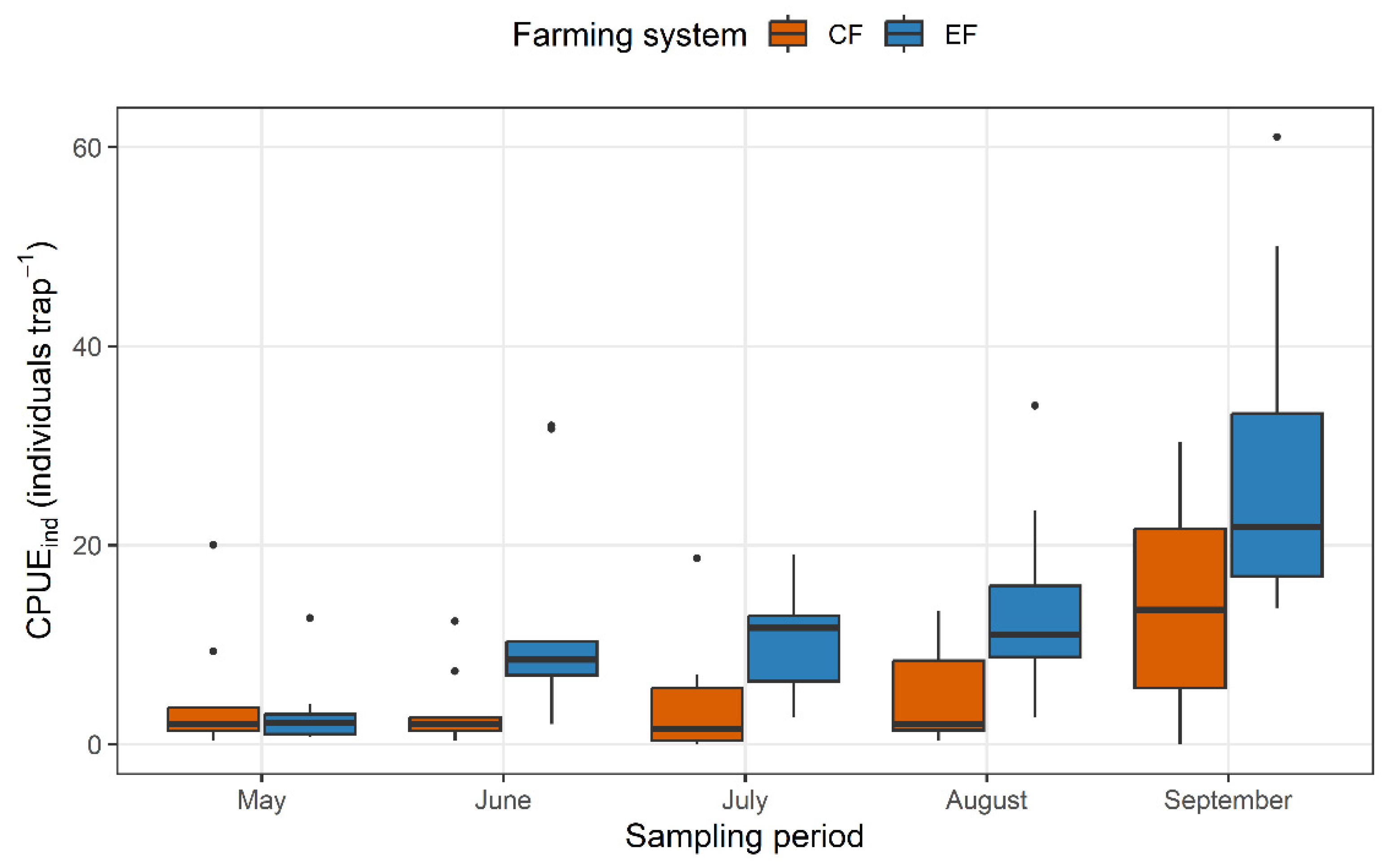
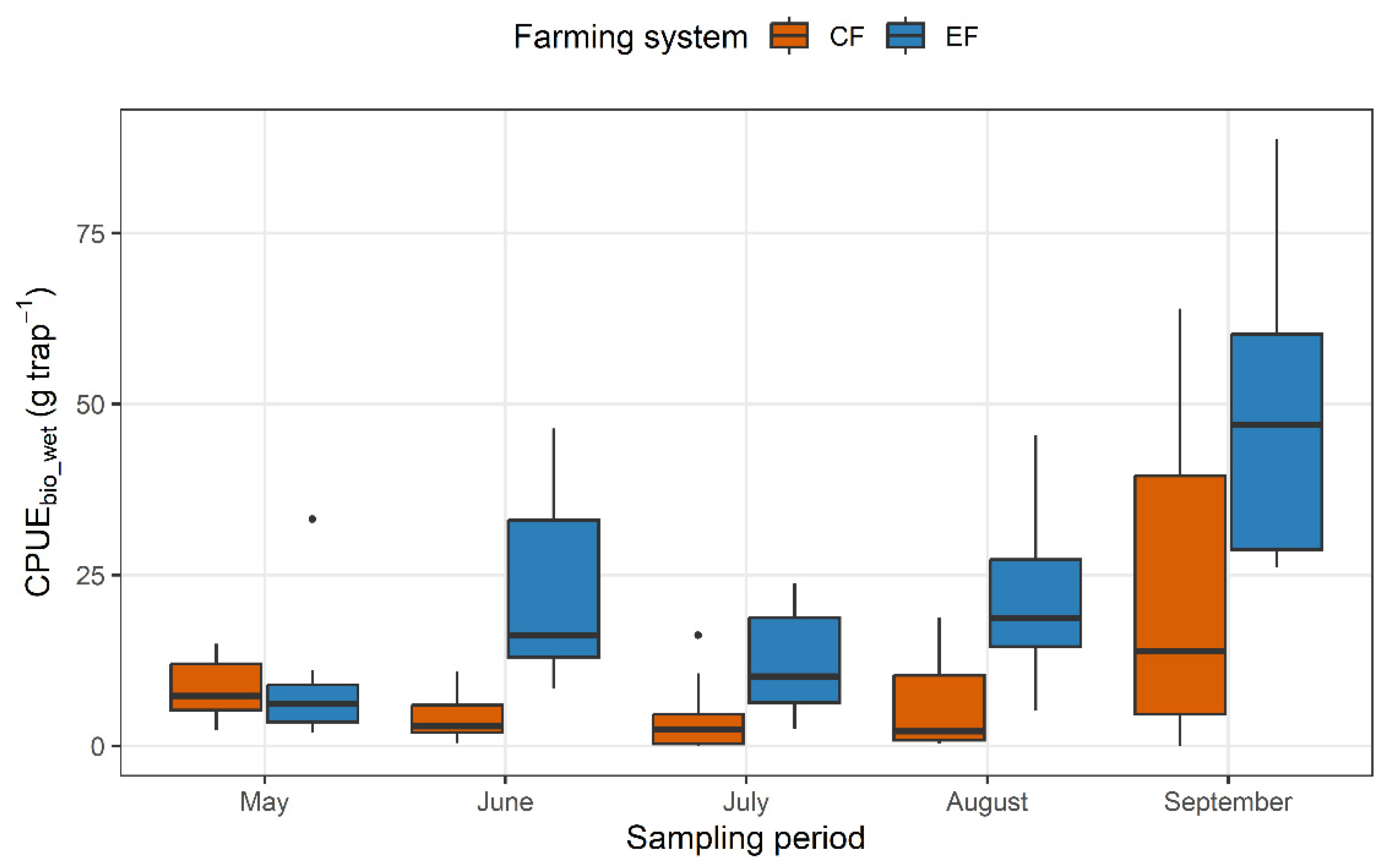
Eco-friendly paddies supported 2.3-fold higher fish abundance and 2.6-fold greater biomass than conventional paddies, providing clear biological evidence that farming practices strongly influence aquatic communities in rice paddy ecosystems. Because fish integrate multiple environmental factors—including water quality, habitat structure, and food availability—their population responses provide a reliable signal of ecosystem condition under different farming regimes.
Although no biologically meaningful difference was detected in May (Cohen’s
d ≈ 0), a marked and sustained divergence emerged from June onwards, with effect sizes consistently exceeding
d = 1.0 across all abundance and biomass metrics throughout the remainder of the cultivation period (June–September;
Table 2,
Table 3 and
Table S3). This temporal pattern suggests that the ecological benefits of eco-friendly management accumulate progressively over the growing season, rather than manifesting as an immediate response to differences in farming inputs, and that these differences reflect persistent environmental conditions rather than short-term fluctuations. Similar effects of agricultural management on aquatic invertebrate communities have been reported from rice-growing regions elsewhere [
19], suggesting that farming practices broadly influence aquatic biodiversity across paddy ecosystems.
4.2. Environmental and Biological Drivers of Community Shifts
The contrasting responses of
C. auratus,
M. anguillicaudatus, and
O. latipes illustrate how species with divergent body sizes and life-history strategies respond to farming practices. Large-bodied species tend to be more sensitive to environmental degradation and may have experienced more favorable environmental conditions often associated with eco-friendly management, although habitat structure was not quantitatively measured in the present study. In contrast, smaller, short-lived species are often more tolerant of anthropogenic disturbances and can persist—or even thrive—under the simplified conditions typical of conventional paddies. These body-size- and life-history-dependent responses are consistent with established ecological theory, which suggests that larger-bodied fishes generally require more stable and complex habitats, while smaller, short-lived species can exploit disturbed, resource-poor, and frequently drained, hydrologically fluctuating habitats such as managed paddies [
43].
Several interactive mechanisms likely underpin these observed community shifts. First, reduced pesticide exposure may represent one plausible mechanism contributing to the lower abundance of some species in conventional systems [
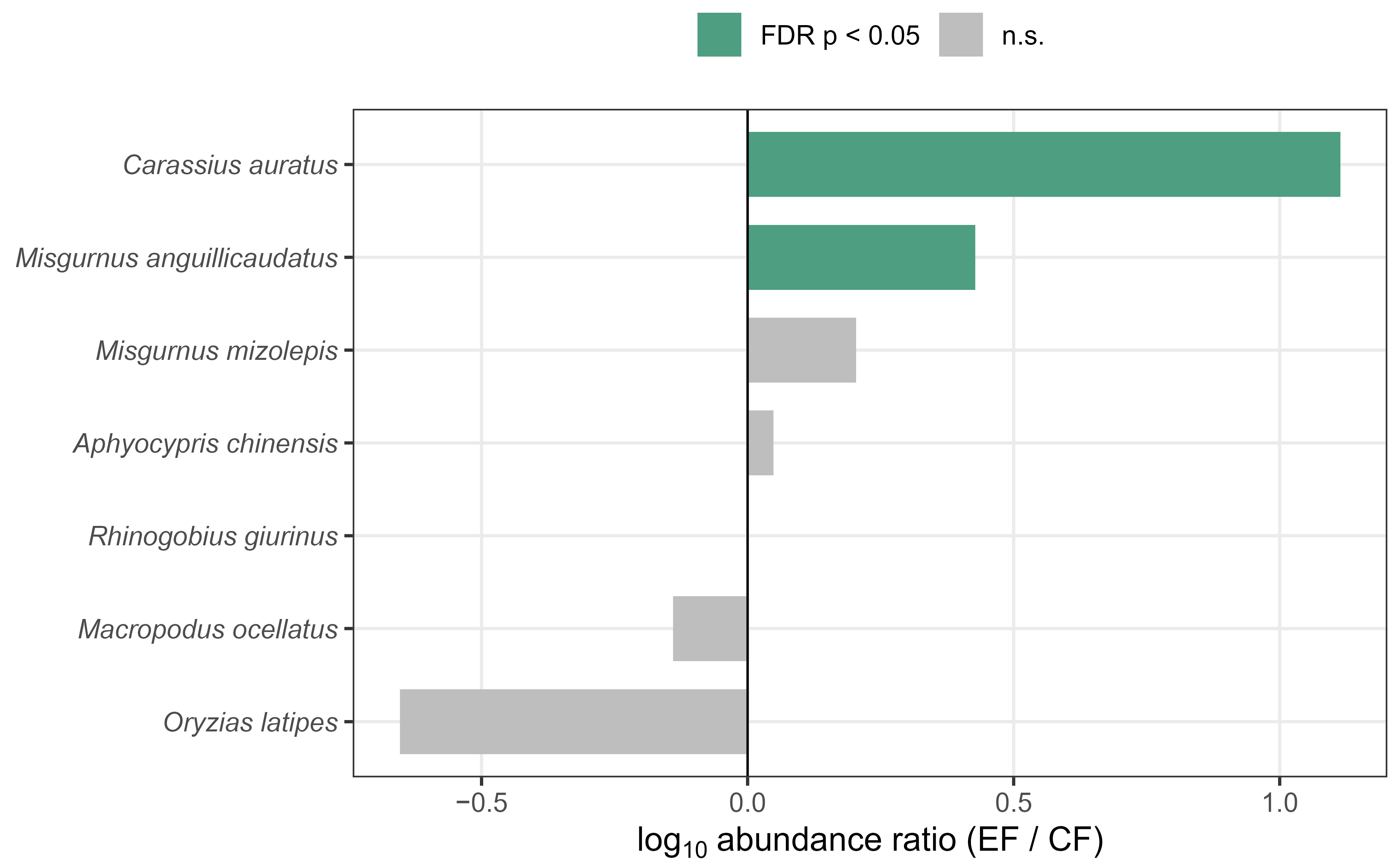
11], although pesticide residues were not directly measured in this study. The dramatic 10.8-fold increase in
C. auratus abundance in eco-friendly paddies (CPUE_ind.: 2.38 ± 6.30 vs. 0.22 ± 1.12 individuals trap
−1,
p = 0.004;
Table S1) is consistent with this species’ documented sensitivity to synthetic pesticides, particularly neonicotinoids, which can induce physiological disorders, behavioral impairments, and increased mortality in fish [
44,
45]. The reduction or exclusion of such chemicals under eco-friendly management may lessen this direct toxicity pathway and could facilitate the recovery of sensitive taxa, although this mechanism was not directly tested in the present study.
In addition to chemical safety, enhanced habitat quality and food resource availability further distinguish eco-friendly paddies. The application of organic fertilizers has been shown to boost benthic invertebrate communities, which serve as essential prey for various fish species [
22,
24]. Reduced nutrient loading from the avoidance of synthetic fertilizers also helps maintain stable water quality and prevents eutrophication [
46], creating a more heterogeneous and hospitable environment. These conditions may also explain the observed shifts in community structure through competitive release. While large-bodied species thrive under chemical safety and habitat complexity, small, rapidly reproducing species like medaka (
O. latipes) showed a numerical tendency toward conventional paddies (CPUE_ind.: 0.11 ± 0.65 vs. 0.38 ± 1.70 individuals trap
−1,
p = 0.702;
Table S1). This difference was not statistically significant and should therefore be interpreted cautiously, although the observed numerical tendency is consistent with previous reports that this species can persist under relatively disturbed conditions.
Finally, these community-level changes have significant implications for higher trophic levels within the rice paddy food web. The higher fish density (2.3-fold higher CPUE_ind) and larger biomass (2.6-fold higher CPUE_bio_wet) observed in eco-friendly systems directly enhance foraging quality for avian predators. For instance, in the same study area, eco-friendly farming has been demonstrated to provide larger loaches (
M. anguillicaudatus), which reduces hunting effort and increases net energy gain for great egrets (
Ardea alba), potentially boosting their reproductive success [
25].
4.3. Temporal Dynamics and Diversity Index Sensitivity
The monthly diversity analysis revealed that both farming systems followed similar seasonal trajectories, with diversity indices increasing gradually from May to September. However, a temporal shift was observed: in early months (May–June), conventional paddies showed slightly higher or comparable H’ and S values, whereas eco-friendly paddies tended toward higher values from July onwards. Despite this trend, no significant differences were detected in any month or index (
p > 0.05;
Table 4 and
Table S2). Similar limitations of diversity metrics have been documented in other aquatic bioindicator groups: in a trait-based assessment of benthic macroinvertebrate communities in Korean rice paddies, conventional paddies showed higher species diversity and evenness than organic paddies despite lower ecosystem health scores, while functional diversity indices remained similar between farming systems, demonstrating that traditional diversity metrics can fail to capture—or even misrepresent—the ecological status of rice paddy wetlands [
47]. Comparable temporal patterns have been reported in Australian rice fields, where morphospecies richness and Shannon diversity differed significantly between organic and conventional management regimes early in the growing season but converged as cultivation progressed, whereas community composition remained distinct throughout [
19]. These patterns collectively suggest that community assembly in rice paddies is primarily governed by seasonal hydrological cycles acting as a dominant ecological filter, determining which species from the regional pool can colonize the fields, while farming practices strongly influence the survival and population density of those species.
This phenomenon is further explained by the constrained regional species pool typical of Korean rice paddies. The modest increase in species richness (S)—from approximately 2 species in May to 3–4 species by September, with eco-friendly paddies showing slightly higher richness than conventional ones in later months (
Table S2)—reflects the cumulative colonization of species from adjacent water sources through shared irrigation canals, rather than improved habitat conditions per se. As the paddies remain inundated from spring transplanting until pre-harvest drainage in autumn, species present in the local water supply network gradually accumulate over the growing season. This is consistent with previous findings demonstrating that the type and connectivity of local water sources—such as adjacent reservoirs and irrigation canals—are primary determinants of fish assemblage composition in rice paddies [
16,
17], suggesting that the regional aquatic species pool, rather than farming practice, governs the initial species composition of paddy fish communities. This pattern is further supported by findings from Japanese rice paddies, where the abundance of cobitid loaches was more strongly associated with specific hydrological management practices—particularly the absence of crop rotation and earlier flood-irrigation dates—than with the farming system category itself [
26], suggesting that water management conditions governing fish access and overwintering survival are more proximate determinants of fish population size than farming system classification per se. Our results therefore indicate that farming practices primarily influence the population sizes of these established species rather than facilitating the colonization of new taxa.
Population abundance often responds more rapidly than species richness because demographic processes such as survival, recruitment, and reproductive success can change within a single growing season, whereas colonization by additional species depends on dispersal, regional species pools, and habitat connectivity. This pattern is consistent with ecological theory that demographic responses generally precede changes in community richness [
12,
18]. In species-poor rice paddy ecosystems, these regional constraints may limit changes in richness even when local environmental quality improves. Consequently, abundance-based metrics may provide earlier and more sensitive indications of ecological recovery than traditional diversity indices.
To evaluate the relative sensitivity of these monitoring metrics, we compared the magnitude of change in fish abundance against various community-level indices. While all traditional diversity metrics—including Shannon’s (H’), Pielou’s (J’), and Simpson’s (D)—failed to show significant differences between the two farming systems (
p > 0.05;
Table 4 and
Table S2), the contrast was most evident when comparing abundance with species richness (S). Specifically, the abundance ratios exhibited a substantial and statistically significant increase from June to September in eco-friendly paddies (2- to 3.6-fold;
p < 0.001;
Table 2), whereas the differences in S remained statistically non-significant (
p = 0.206;
Table 4), ranging from 0.8 to 1.7-fold with no consistent directional pattern. This contrast indicates that in such simplified aquatic ecosystems, population-level responses can be more reliable than community-level metrics for detecting environmental shifts. Monitoring programs in agricultural wetlands should therefore include abundance-based metrics alongside traditional diversity indices, particularly where a few dominant taxa limit the sensitivity of richness-based measures. More broadly, recent ecological work increasingly recommends complementing α-diversity with taxonomic, functional, and phylogenetic diversity, a valuable direction for future biomonitoring in such systems.
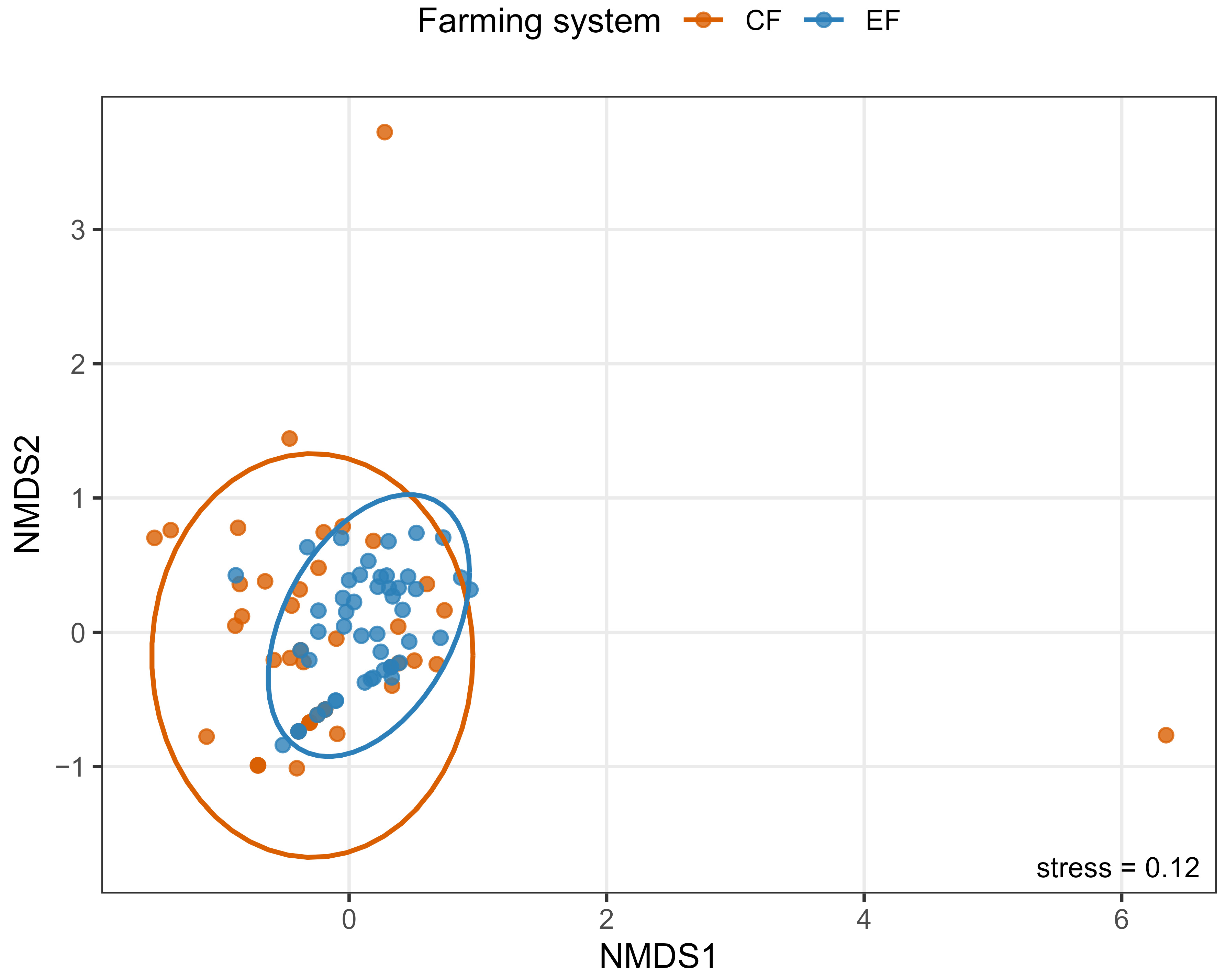
Beyond these univariate patterns, the multivariate analyses reinforced that management effects were expressed through community structure rather than α-diversity. Although diversity indices were statistically indistinguishable, event-level assemblage composition differed significantly between systems (PERMANOVA,
p < 0.001), and conventional paddies exhibited greater among-event heterogeneity (PERMDISP; mean distance to centroid 0.52 vs. 0.40). This higher dispersion suggests that conventional management produces more stochastic, less predictable assemblages—potentially reflecting greater environmental variability among fields rather than a single specific disturbance mechanism—whereas eco-friendly paddies converged on a more consistent community state. Indicator species analysis further identified
C. auratus as the sole significant indicator of eco-friendly paddies (IndVal = 0.65), corroborating its role as the taxon most responsive to management and reinforcing that compositional shifts, though invisible to diversity indices, carry a clear and interpretable ecological signal (
Figure 4).
4.4. Regional and Global Context
The findings of this study are broadly consistent with patterns reported from other rice-growing regions of East Asia. A large-scale field study across Japanese rice paddies demonstrated that organic farming enhanced the richness and abundance of multiple taxonomic groups—including plants, spiders, dragonflies, and frogs—relative to conventional farming, confirming that eco-friendly management broadly promotes biodiversity in Asian rice agroecosystems [
26]. Research conducted in Taiwanese rice fields similarly reported significantly higher macroinvertebrate abundance in organic paddies during the cultivation period compared with conventional systems [
20,
21,
27]. However, fish assemblages in the Taiwanese study did not differ significantly between farming systems, in contrast to the pronounced differences observed in the present study. This discrepancy may reflect differences in the scale and duration of eco-friendly management between the two studies, as well as differences in the regional species pool and connectivity of irrigation networks. The present study monitored fish communities across a full growing season using standardized CPUE-based sampling, which may have provided greater statistical power to detect population-level responses than the shorter sampling periods employed in some previous studies.
At the global scale, meta-analyses of organic farming effects have consistently demonstrated that biodiversity recovery in managed agricultural landscapes occurs primarily through increases in organism abundance rather than large shifts in species composition. Bengtsson et al. [
18] reported that organic farming increased species richness by approximately 30% on average, whereas organism abundance increased by nearly 50%—a pattern that closely mirrors the contrasting responses of abundance and species richness observed in the present study. An updated hierarchical meta-analysis further confirmed that organic farming increases species richness by approximately 34% on average across multiple taxonomic groups, with larger effects observed in intensively managed agricultural landscapes [
12]. These findings suggest that the quantitative population increases documented in the present study are part of a broader and consistent pattern of biodiversity recovery under reduced-input farming systems, and that abundance-based metrics are likely to provide a more sensitive signal of ecological improvement than species richness alone across a wide range of agricultural systems.
Collectively, these regional and global comparisons confirm that the ecological responses documented in the present study—characterized by substantial increases in fish abundance and biomass under eco-friendly farming, without corresponding changes in species richness—are not idiosyncratic to Korean rice paddies but reflect a broader pattern of abundance-driven biodiversity recovery in simplified agricultural wetlands. These findings reinforce the value of abundance-based fish metrics as ecologically meaningful and practically applicable indicators for biomonitoring programs in rice agroecosystems across East Asia.
4.5. Management Implications and Ecosystem Services
Building on the regional and global comparisons presented above, the abundance-based analytical framework developed in this study provides a reliable basis for evaluating the ecological effectiveness of eco-friendly agricultural policies. Although species richness remained relatively stable due to regional biogeographic constraints, the 2.3-fold increase in CPUE_ind and 2.6-fold increase in biomass under eco-friendly farming provide clear biological evidence of improved ecological conditions at the field scale. These population-level metrics offer a quantitative and scientifically robust basis for policymakers to justify the continued support and potential expansion of eco-friendly farming subsidy programs.
Beyond field-scale responses, these differences have broader implications for ecosystem functioning in agricultural wetlands. Fish and other aquatic organisms in rice paddy ecosystems contribute to fundamental ecological processes, including nutrient cycling and organic matter processing [
8], as well as prey provisioning for higher trophic organisms such as waterbirds [
6]. The greater fish abundance observed in eco-friendly paddies therefore suggests not only improved habitat conditions but also enhanced ecosystem functioning across multiple trophic pathways within these agroecosystems.
In addition, increased fish availability generates cascading benefits for higher trophic organisms within the agricultural food web. Choi et al. [
25] demonstrated that great egrets (
Ardea alba) foraging in eco-friendly rice fields exhibited fewer hunting attempts and less active movement compared with those in conventional fields, attributable to the higher availability of larger-bodied loaches in eco-friendly paddies. Although overall feeding efficiency did not differ significantly between field types, eco-friendly paddies enabled egrets to acquire larger, more energy-rich prey with lower foraging costs, suggesting that the benefits of eco-friendly farming extend beyond fish assemblages to support broader food web dynamics and avian predator fitness.
Collectively, these findings indicate that eco-friendly rice farming enhances aquatic organism abundance while simultaneously supporting broader ecosystem processes and trophic interactions. Monitoring frameworks that prioritize abundance-based indicators of key taxa are therefore likely to provide a more sensitive and policy-relevant approach for evaluating the ecological outcomes of sustainable agriculture programs than frameworks relying solely on traditional diversity indices [
13,
14,
15].
4.6. Study Limitations and Future Directions
This study provides a valuable field-scale assessment of fish community responses to eco-friendly and conventional farming practices across a full growing season. However, several limitations should be acknowledged. In addition, because this was an observational field study rather than a controlled experiment, causal relationships between specific farming practices and fish community responses cannot be established directly. As a single-year study, it cannot fully address long-term ecological dynamics or interannual variability in fish community responses. Multi-year monitoring is needed to confirm whether the abundance differences observed here represent stable, sustained ecological improvements under eco-friendly management, and to strengthen the evidence base for using fish communities as reliable ecological indicators in agricultural landscapes. In particular, the recorded assemblage was dominated by pollution-tolerant generalist species with broad adaptive capacity; together with the limited temporal and spatial extent, this constrains interpretation of the management effect and its generalization.
The spatial scope of this study was also limited to a single rice-farming region in Korea. Expanding comparable research to diverse geographical and climatic contexts across East Asia would enhance the generalizability of the findings and help determine whether the abundance-based monitoring framework developed here is broadly applicable across different regional species pools and irrigation systems.
Regarding sampling methodology, fyke net sampling effectively captures the small-bodied fish assemblages characteristic of Korean rice paddies. However, this method may inherently underestimate larger or more mobile species. Future studies incorporating complementary sampling approaches, including non-invasive environmental DNA (eDNA) metabarcoding, could provide a more comprehensive assessment of fish assemblages by improving the detection of rare or elusive species. Recent work has also demonstrated that standardized eDNA sampling protocols can effectively complement conventional field surveys in rice paddies, thereby enhancing biodiversity monitoring [
30].
Finally, while this study documents clear differences in fish abundance and biomass between farming systems, the underlying causal mechanisms warrant further investigation. Detailed quantification of pesticide residues in paddy water, analysis of benthic invertebrate prey communities, and fine-scale assessment of habitat structure would help clarify the relative contributions of chemical, trophic, and physical pathways to the observed fish community responses. Such mechanistic investigations would further strengthen the theoretical and empirical foundation for using fish assemblages as primary indicators of agricultural ecosystem health in rice paddy landscapes.
5. Conclusions
This study demonstrates that abundance-based fish community metrics serve as sensitive and reliable ecological indicators of farming practice impacts in rice paddy ecosystems. Eco-friendly paddies consistently supported 2.3-fold higher fish abundance and 2.6-fold greater biomass than conventional paddies across the growing season. Although no difference was detected in May, effect sizes exceeded d = 1.0 across all abundance and biomass metrics from June through September, providing robust empirical evidence that eco-friendly management substantially improves aquatic ecological conditions at the field scale.
Species-specific responses further revealed the ecological mechanisms underlying these farming system effects. C. auratus was markedly more abundant in eco-friendly paddies, and M. anguillicaudatus was about 2.7-fold, indicating strong positive responses to eco-friendly farming practices for larger-bodied species sensitive to pesticide exposure and habitat degradation. In contrast, O. latipes showed a numerical tendency toward higher abundance in conventional paddies, though this difference was not statistically significant, consistent with this species’ known tolerance of disturbed environments.
Traditional diversity indices—including Shannon’s diversity (H’), Simpson’s dominance (D), Pielou’s evenness (J’), and species richness (S)—failed to detect significant differences between farming systems throughout the growing season. This insensitivity reflects the inherent structural constraints of simplified rice paddy fish communities, where a small number of highly dominant species inherently constrain the discriminatory power of community-level diversity metrics. In such ecologically simplified systems, abundance-based and species-specific indicators provide greater diagnostic power and ecological relevance for detecting management-driven environmental change.
Collectively, these findings indicate that in species-poor, dominance-skewed rice paddy systems, abundance-based and species-specific metrics provide a more sensitive signal of management effects than α-diversity indices, and should therefore be considered a valuable complement to, rather than a replacement for, traditional diversity-based biomonitoring. The substantial increases in fish abundance and biomass under eco-friendly farming also reflect enhanced ecosystem functioning across multiple trophic pathways within agricultural landscape. Because these inferences derive from a single growing season in one region, however, they should be regarded as specific to comparable systems and require multi-year, multi-region validation before generalization to Asian rice landscapes; within that scope, they offer a quantitative basis to help inform eco-friendly farming subsidy programs in Korea and across East Asia.
Future research should expand both temporal and spatial scales of investigation to confirm the long-term stability of abundance-based indicators and to assess their generalizability across diverse regional species pools and irrigation systems. Further mechanistic studies quantifying pesticide residues, benthic invertebrate prey communities, and fine-scale habitat structure will help clarify the causal pathways linking farming practices to fish community responses. Integrating abundance-based metrics with species-specific indicators and non-invasive approaches such as eDNA metabarcoding will provide a robust and comprehensive framework for tracking progress toward biodiversity conservation and sustainable agriculture goals across Asian rice landscapes.