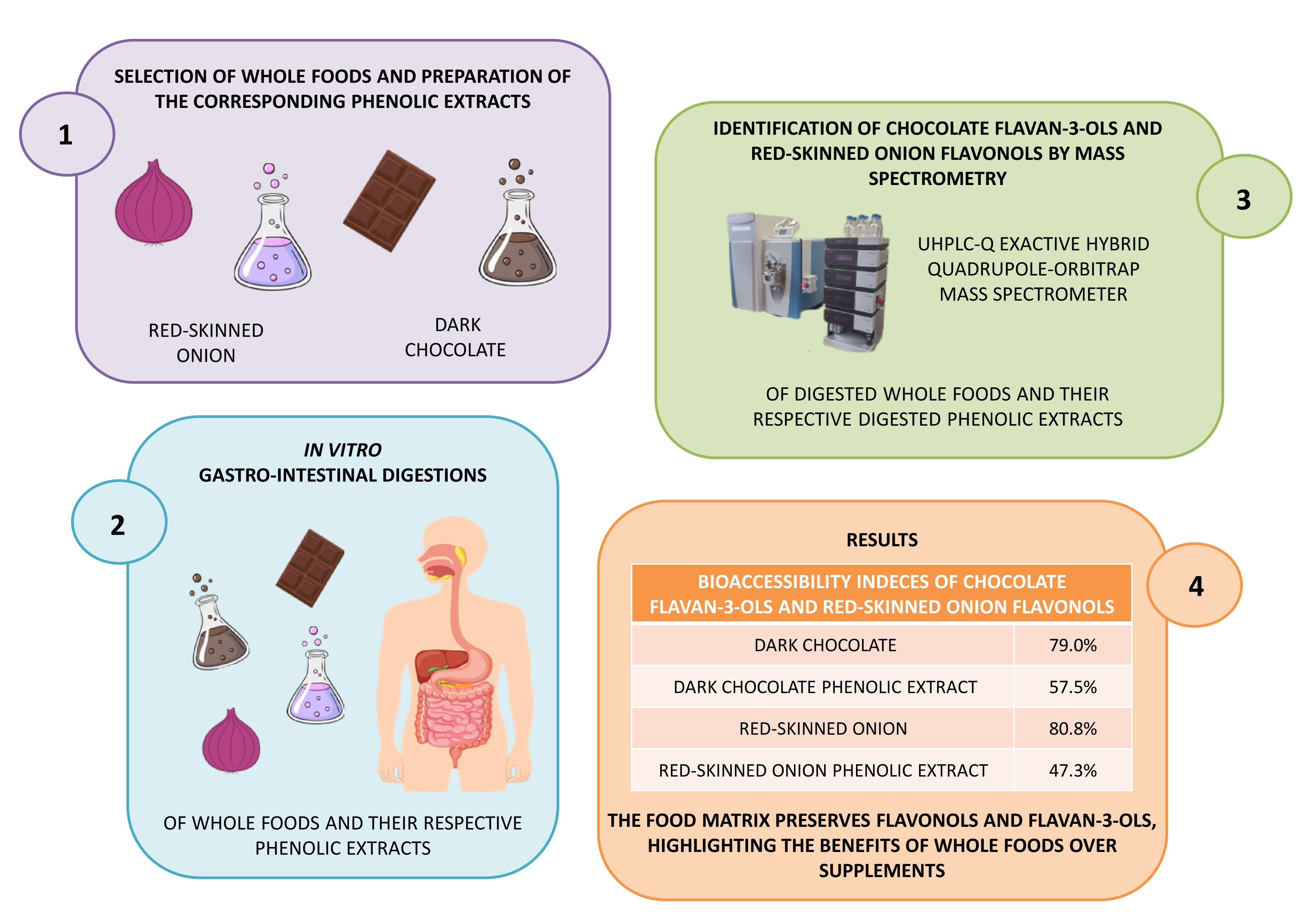
The Food Matrix Protects Dark Chocolate Flavan-3-Ols and Onion Flavonols from Degradation During In Vitro Gastrointestinal Digestion

 ,
, 
 and
and 
Simple Summary
Abstract
1. Introduction
2. Materials and Methods
2.1. Materials and Sample Preparation
2.2. Preparation of the Phenolic Compounds Chemical Extract from Red-Skinned Onion and Dark Chocolate
2.3. In Vitro Gastro-Intestinal Digestion
2.4. Total Phenolic Compounds Quantification and Antioxidant Activity Assays
2.4.1. Quantification of Total Phenolic Compounds
2.4.2. Determination of the Radical Scavenging Activity by ABTS Assay
2.4.3. Assessment of Fe3+ Reducing Ability
2.5. High-Resolution Mass Spectrometry Analysis of Flavan-3-Ols and Flavonols
2.6. Statistics
3. Results and Discussion
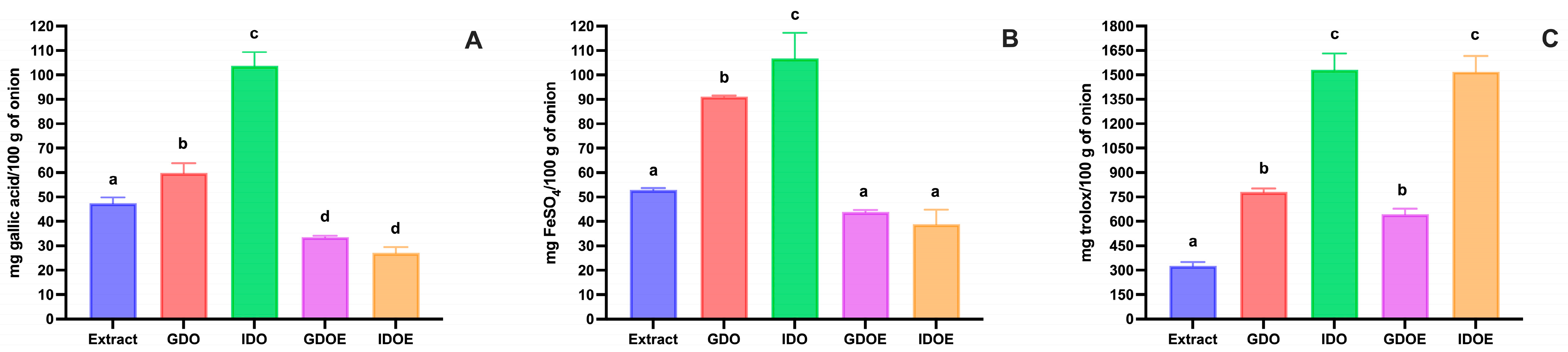
3.1. Effect of In Vitro Gastrointestinal Digestion on Total Phenolic Compounds and Antioxidant Activity in Red-Skinned Onion and Red-Skinned Onion Phenolic Compounds Extract
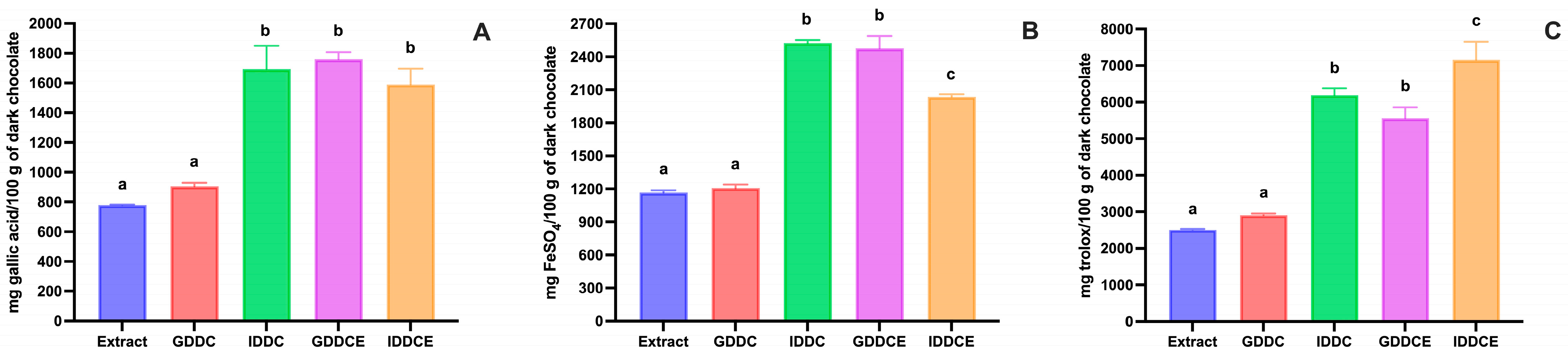
3.2. Effect of In Vitro Gastrointestinal Digestion on Total Phenolic Compounds and Antioxidant Activity in Dark Chocolate and Dark Chocolate Phenolic Compounds Extract
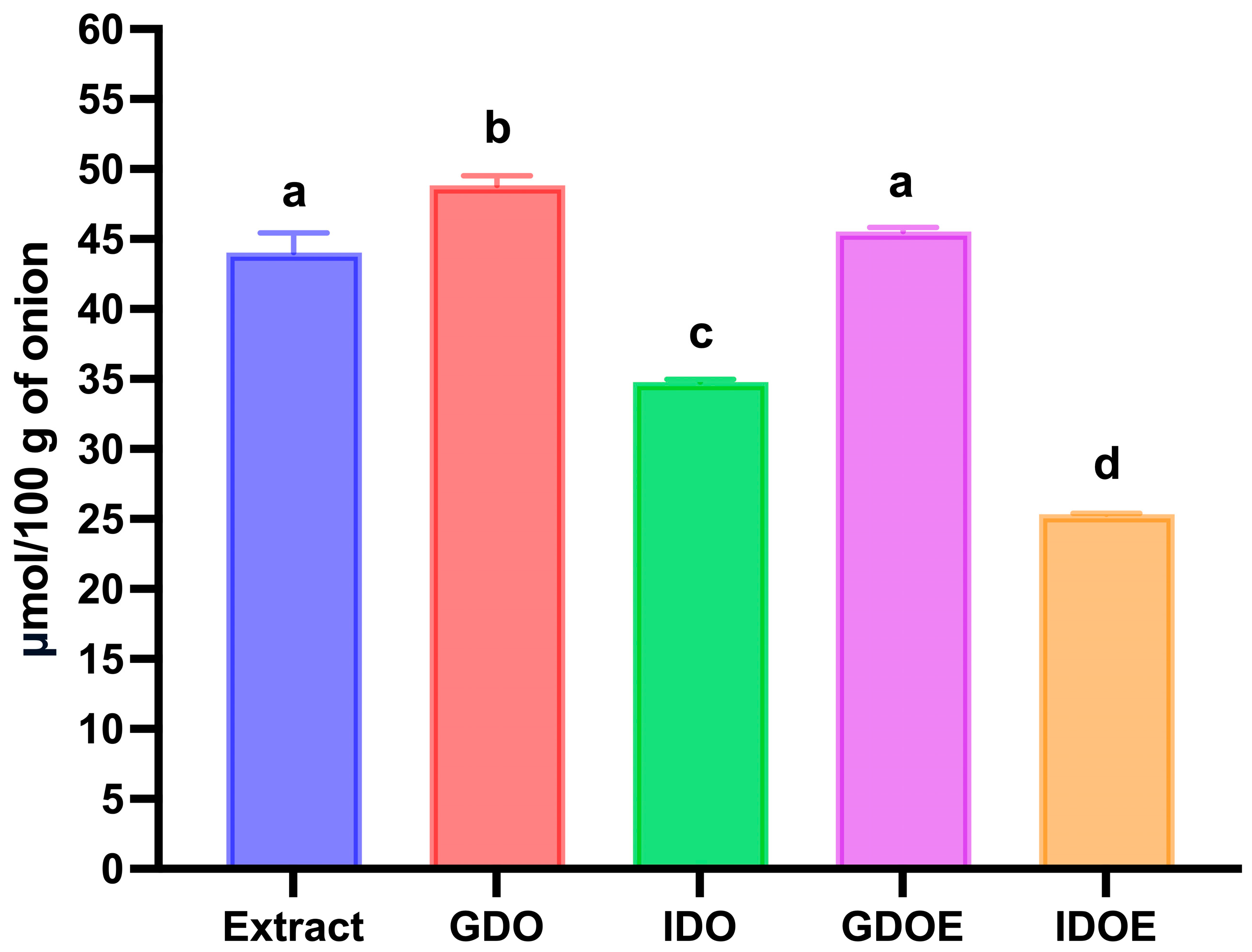
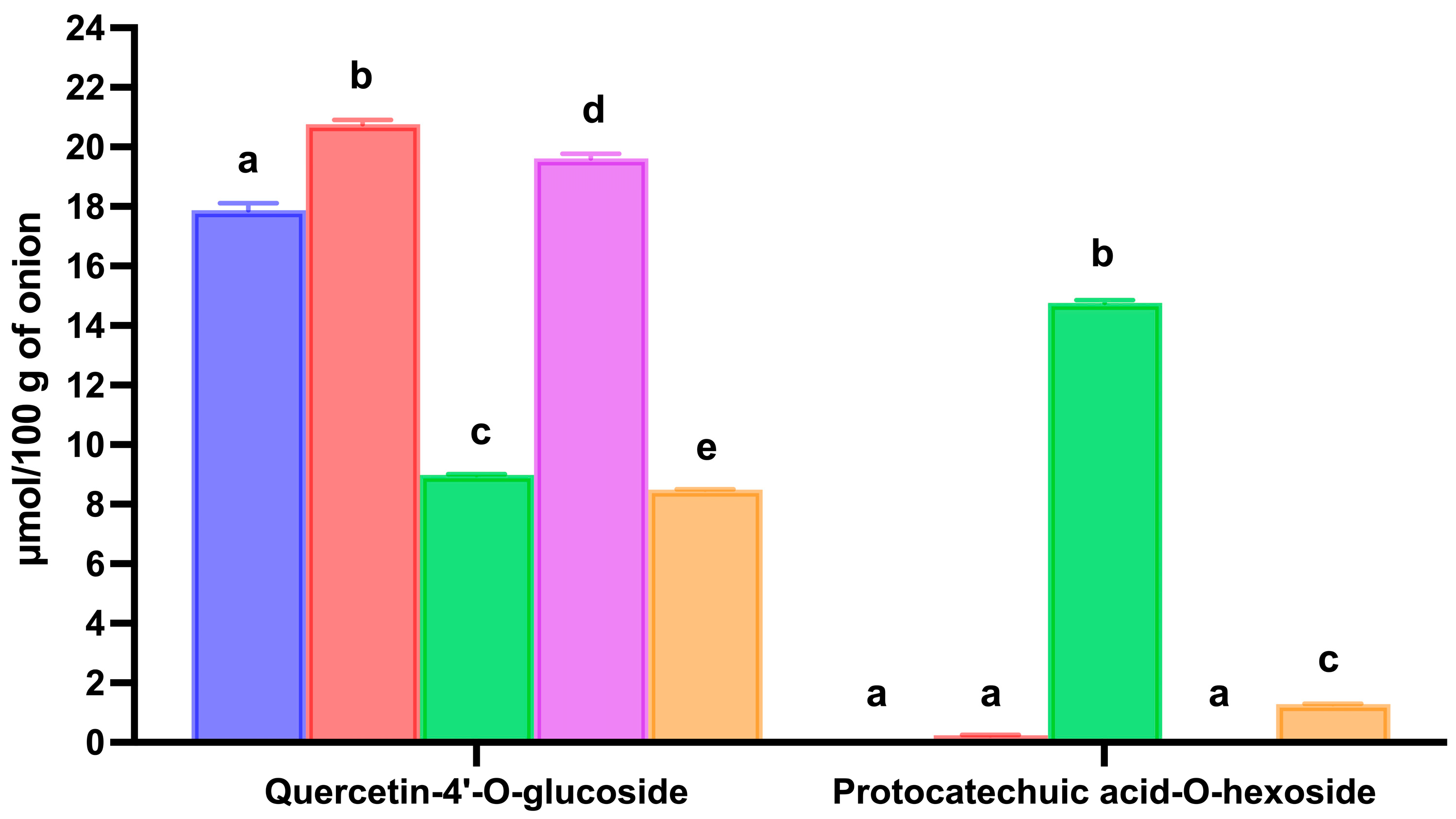
3.3. Identification and In Vitro Bioaccessibility of Individual Flavonols in Red-Skinned Onion and Red-Skinned Onion Phenolic Compounds Extract
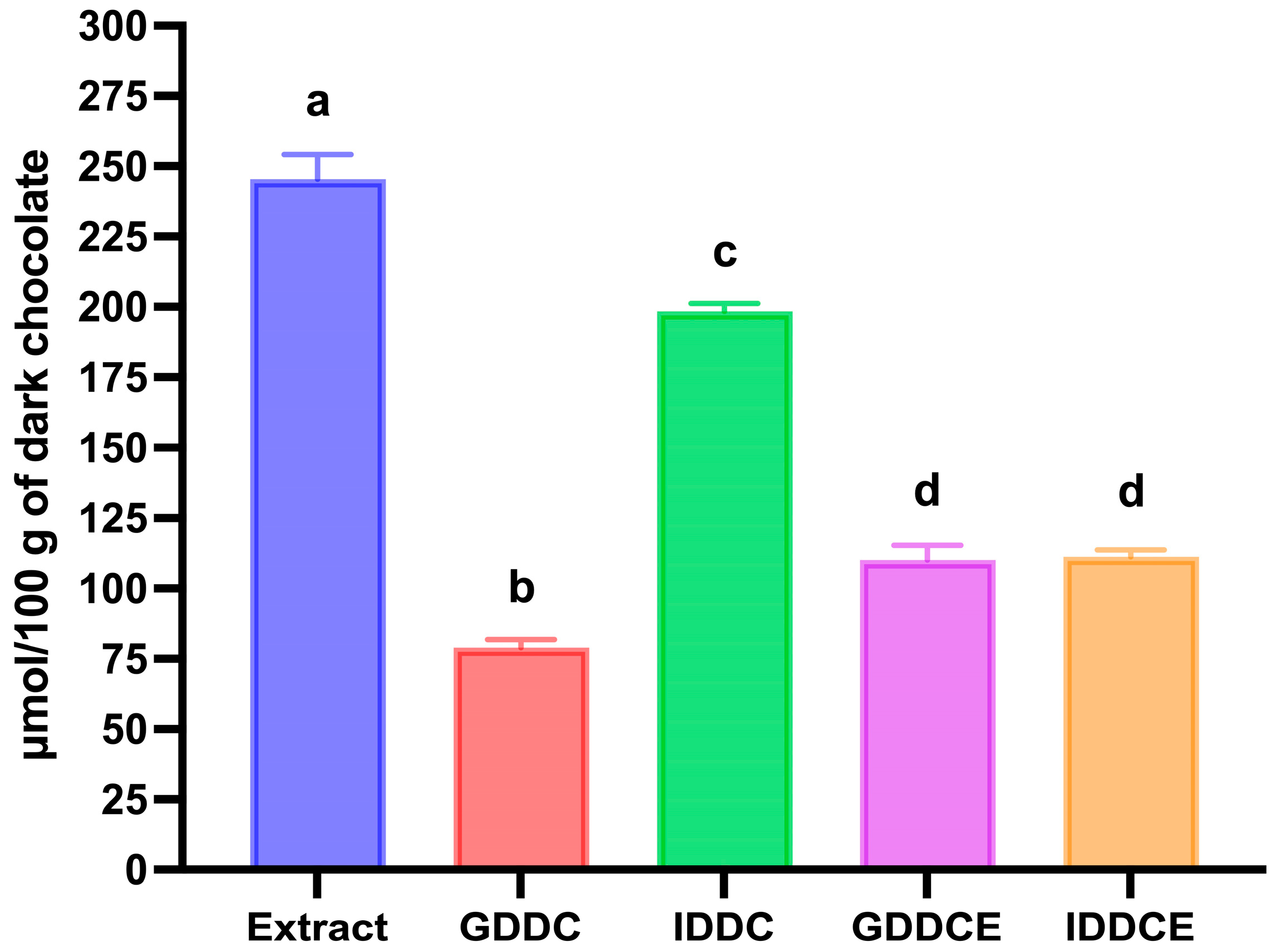
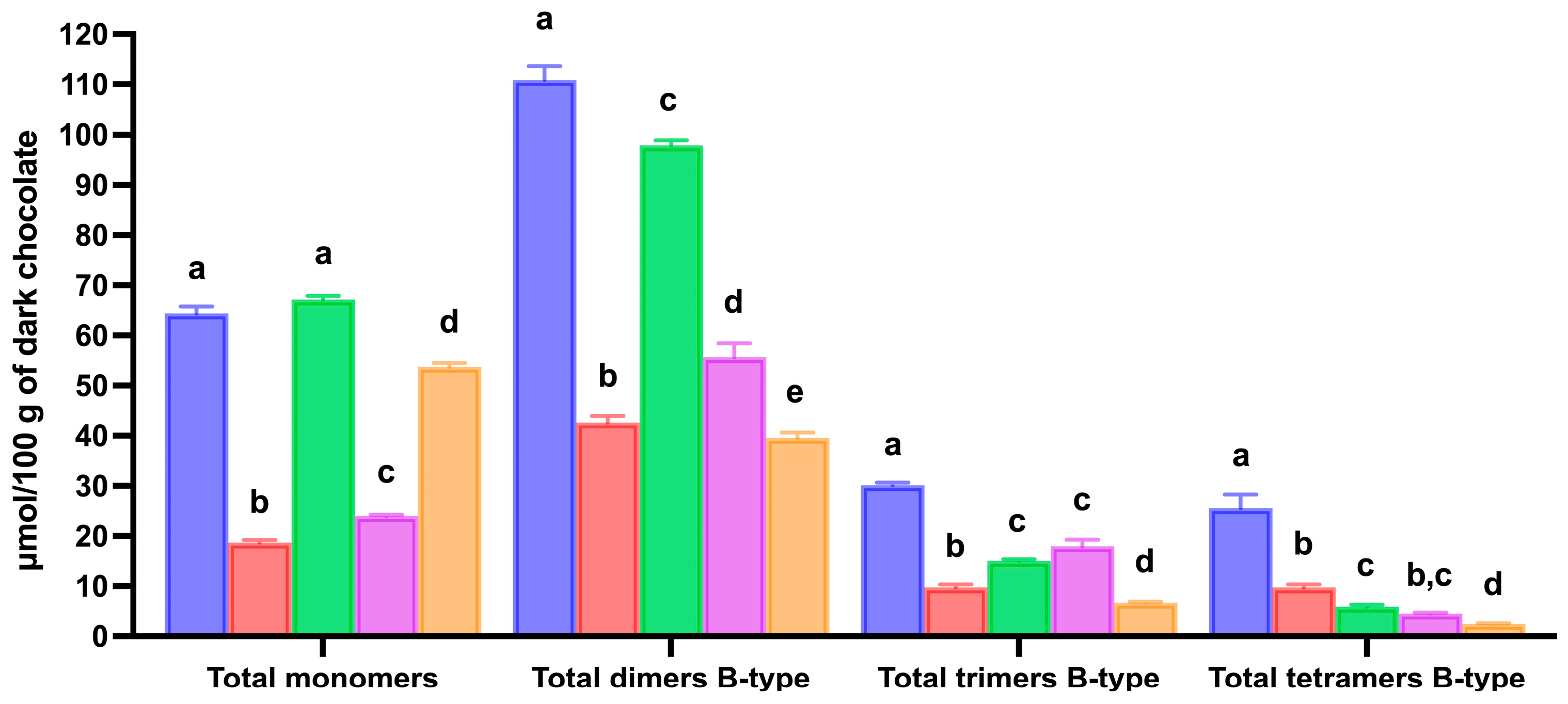
3.4. Identification and In Vitro Bioaccessibility of Individual Flavan-3-Ols in Dark Chocolate and Dark Chocolate Phenolic Compounds Extract
4. Conclusions
Supplementary Materials
Author Contributions
Funding
Institutional Review Board Statement
Data Availability Statement
Acknowledgments
Conflicts of Interest
References
- Del Rio, D.; Rodriguez-Mateos, A.; Spencer, J.P.; Tognolini, M.; Borges, G.; Crozier, A. Dietary (poly)phenolics in human health: Structures, bioavailability, and evidence of protective effects against chronic diseases. Antioxid. Redox Signal. 2013, 18, 1818–1892. [Google Scholar] [CrossRef]
- Zannini, M.; De Angeli, M.; Conte, A.; Minischetti, V.; D’Arca, D.; Tagliazucchi, D.; Cattivelli, A. Gut microbial metabolites of phenolic compounds inhibit colon cancer cell proliferation by triggering apoptosis and cell cycle arrest. Food Funct. 2025, 16, 5836–5849. [Google Scholar] [CrossRef]
- Rubert, J.; Gatto, P.; Pancher, M.; Sidarovich, V.; Curti, C.; Mena, P.; Del Rio, D.; Quattrone, A.; Mattivi, F. A Screening of Native (Poly)phenols and Gut-Related Metabolites on 3D HCT116 Spheroids Reveals Gut Health Benefits of a Flavan-3-ol Metabolite. Mol. Nutr. Food Res. 2022, 66, e2101043. [Google Scholar] [CrossRef]
- Heiss, C.; Istas, G.; Feliciano, R.P.; Weber, T.; Wang, B.; Favari, C.; Mena, P.; Del Rio, D.; Rodriguez-Mateos, A. Daily consumption of cranberry improves endothelial function in healthy adults: A double blind randomized controlled trial. Food Funct. 2022, 13, 3812–3824. [Google Scholar] [CrossRef]
- Parmenter, B.H.; Thompson, A.S.; Bondonno, N.P.; Jennings, A.; Murray, K.; Perez-Cornago, A.; Hodgson, J.M.; Tresserra-Rimbau, A.; Kühn, T.; Cassidy, A. High diversity of dietary flavonoid intake is associated with a lower risk of all-cause mortality and major chronic diseases. Nat. Food 2025, 6, 668–680. [Google Scholar] [CrossRef] [PubMed]
- Vázquez-Ruiz, Z.; Toledo, E.; Vitelli-Storelli, F.; Goni, L.; de la O, V.; Bes-Rastrollo, M.; Martínez-González, M.Á. Effect of Dietary Phenolic Compounds on Incidence of Cardiovascular Disease in the SUN Project; 10 Years of Follow-Up. Antioxidants 2022, 11, 783. [Google Scholar] [CrossRef] [PubMed]
- Scalbert, A.; Williamson, G. Dietary intake and bioavailability of polyphenols. J. Nutr. 2000, 130, 2073S–2085S. [Google Scholar] [CrossRef]
- Vázquez-Ruiz, Z.; Toledo, E.; Vitelli-Storelli, F.; Bes-Rastrollo, M.; Martínez-González, M.Á. Effect of dietary phenolic compounds intake on mortality in the “Seguimiento Universidad De Navarra” (SUN) Mediterranean cohort. Eur. J. Nutr. 2025, 64, 70. [Google Scholar] [CrossRef]
- Gao, Q.; Yuan, X.; Yang, J.; Fu, X. Dietary profile and phenolics consumption in university students from the Ningxia Hui Autonomous Region of China. BMC Nutr. 2020, 6, 58. [Google Scholar] [CrossRef]
- Rosi, A.; Mena, P.; Castello, F.; Del Rio, D.; Scazzina, F. Comprehensive dietary evaluation of Italian primary school children: Food consumption and intake of energy, nutrients and phenolic compounds. Int. J. Food Sci. Nutr. 2021, 72, 70–81. [Google Scholar] [CrossRef] [PubMed]
- Zamora-Ros, R.; Knaze, V.; Luján-Barroso, L.; Slimani, N.; Romieu, I.; Fedirko, V.; de Magistris, M.S.; Ericson, U.; Amiano, P.; Trichopoulou, A.; et al. Estimated dietary intakes of flavonols, flavanones and flavones in the European Prospective Investigation into Cancer and Nutrition (EPIC) 24 hour dietary recall cohort. Br. J. Nutr. 2011, 106, 1915–1925. [Google Scholar] [CrossRef] [PubMed]
- Zong, Z.; Cheng, X.; Yang, Y.; Qiao, J.; Hao, J.; Li, F. Association between dietary flavonol intake and mortality risk in the U.S. adults from NHANES database. Sci. Rep. 2024, 14, 4572. [Google Scholar] [CrossRef] [PubMed]
- Cheng, X.; Peng, T.; Han, L. The relationship between flavonols intake and stroke in the elderly: A cross-sectional study from NHANES (2007–2010 and 2017–2018). J. Stroke Cerebrovasc. Dis. 2025, 34, 108373. [Google Scholar] [CrossRef]
- Hua, X.; Yu, L.; You, R.; Yang, Y.; Liao, J.; Chen, D.; Yu, L. Association among Dietary Flavonoids, Flavonoid Subclasses and Ovarian Cancer Risk: A Meta-Analysis. PLoS ONE 2016, 11, e0151134. [Google Scholar] [CrossRef]
- Esfandiar, Z.; Hosseini-Esfahani, F.; Mirmiran, P.; Azizi, F. Higher dietary flavonol and isoflavonoid intakes are associated with lower incidence of type 2 diabetes. Int. J. Vitam. Nutr. Res. 2024, 94, 163–170. [Google Scholar] [CrossRef]
- Marranzano, M.; Ray, S.; Godos, J.; Galvano, F. Association between dietary flavonoids intake and obesity in a cohort of adults living in the Mediterranean area. Int. J. Food Sci. Nutr. 2018, 69, 1020–1029. [Google Scholar] [CrossRef]
- Holland, T.M.; Agarwal, P.; Wang, Y.; Dhana, K.; Leurgans, S.E.; Shea, K.; Booth, S.L.; Rajan, K.B.; Schneider, J.A.; Barnes, L.L. Association of Dietary Intake of Flavonols With Changes in Global Cognition and Several Cognitive Abilities. Neurology 2023, 100, e694–e702. [Google Scholar] [CrossRef]
- Hu, Q.; Ma, X.; Cai, T.; Li, Y. Flavonoid intake, inflammation, and atherosclerotic cardiovascular disease risk in U.S. adults: A cross-sectional study. Nutr. Metab. 2025, 22, 24. [Google Scholar] [CrossRef] [PubMed]
- Sloan, R.P.; Wall, M.; Yeung, L.K.; Feng, T.; Feng, X.; Provenzano, F.; Schroeter, H.; Lauriola, V.; Brickman, A.M.; Small, S.A. Insights into the role of diet and dietary flavanols in cognitive aging: Results of a randomized controlled trial. Sci. Rep. 2021, 11, 3837. [Google Scholar] [CrossRef]
- Corti, R.; Flammer, A.J.; Hollenberg, N.K.; Lüscher, T.F. Cocoa and Cardiovascular Health. Circulation 2009, 119, 1433–1441. [Google Scholar] [CrossRef]
- Rasera, G.B.; de Camargo, A.C.; de Castro, R.J.S. Bioaccessibility of phenolic compounds using the standardized INFOGEST protocol: A narrative review. Compr. Rev. Food Sci. Food Saf. 2023, 22, 260–286. [Google Scholar] [CrossRef] [PubMed]
- Velderrain-Rodríguez, G.R.; Palafox-Carlos, H.; Wall-Medrano, A.; Ayala-Zavala, J.F.; Chen, C.Y.; Robles-Sánchez, M.; Astiazaran-García, H.; Alvarez-Parrilla, E.; González-Aguilar, G.A. Phenolic compounds: Their journey after intake. Food Funct. 2014, 5, 189–197. [Google Scholar] [CrossRef]
- Cattivelli, A.; Zannini, M.; De Angeli, M.; D’Arca, D.; Minischetti, V.; Conte, A.; Tagliazucchi, D. Bioaccessibility of Flavones, Flavanones, and Flavonols from Vegetable Foods and Beverages. Biology 2024, 13, 1081. [Google Scholar] [CrossRef]
- Pais, A.C.; Coscueta, E.R.; Pintado, M.M.; Silvestre, A.J.; Santos, S.A. Exploring the bioaccessibility and intestinal absorption of major classes of pure phenolic compounds using in vitro simulated gastrointestinal digestion. Heliyon 2024, 10, e28894. [Google Scholar] [CrossRef]
- Tarko, T.; Duda-Chodak, A. Influence of food matrix on the bioaccessibility of fruit polyphenolic compounds. J. Agric. Food Chem. 2020, 68, 1315–1325. [Google Scholar] [CrossRef]
- Oliveira, A.; Amaro, A.L.; Pintado, M. Impact of food matrix components on nutritional and functional properties of fruit-based products. Curr. Opin. Food Sci. 2018, 22, 153–159. [Google Scholar] [CrossRef]
- Pinarli, B.; Karliga, E.S.; Ozkan, G.; Capanoglu, E. Interaction of phenolics with food matrix: In vitro and in vivo approaches. Med. J. Nutr. Metab. 2020, 13, 63–74. [Google Scholar] [CrossRef]
- Ogawa, Y.; Donlao, N.; Thuengtung, S.; Tian, J.; Cai, Y.; Reginio, F.C., Jr.; Ketnava, S.; Yamamoto, N.; Tamura, M. Impact of food structure and cell matrix on digestibility of plant-based food. Curr. Opin. Food Sci. 2018, 19, 36–41. [Google Scholar] [CrossRef]
- Singh, H.; Ye, A.; Ferrua, M.J. Aspects of food structures in the digestive tract. Curr. Opin. Food Sci. 2015, 3, 85–93. [Google Scholar] [CrossRef]
- Dufour, C.; Loonis, M.; Delosière, M.; Buffière, C.; Hafnaoui, N.; Santé-Lhoutellier, V.; Rémond, D. The matrix of fruit & vegetables modulates the gastrointestinal bioaccessibility of polyphenols and their impact on dietary protein digestibility. Food Chem. 2018, 240, 314–322. [Google Scholar] [CrossRef] [PubMed]
- Fiorentino, M.; Piccolella, S.; Gravina, C.; Stinca, A.; Esposito, A.; Catauro, M.; Pacifico, S. Encapsulating Calendula arvensis (Vaill.) L. Florets: UHPLC-HRMS Insights into Bioactive Compounds Preservation and Oral Bioaccessibility. Molecules 2023, 28, 199. [Google Scholar] [CrossRef]
- Neilson, A.P.; George, J.C.; Janle, E.M.; Mattes, R.D.; Rudolph, R.; Matusheski, N.V.; Ferruzzi, M.G. Influence of chocolate matrix composition on cocoa flavan-3-ol bioaccessibility in vitro and bioavailability in humans. J. Agric. Food Chem. 2009, 57, 9418–9426. [Google Scholar] [CrossRef] [PubMed]
- Cattivelli, A.; Nissen, L.; Casciano, F.; Tagliazucchi, D.; Gianotti, A. Impact of cooking methods of red-skinned onion on metabolic transformation of phenolic compounds and gut microbiota changes. Food Funct. 2023, 14, 3509–3525. [Google Scholar] [CrossRef]
- Martini, S.; Conte, A.; Tagliazucchi, D. Comprehensive evaluation of phenolic profile in dark chocolate and dark chocolate enriched with Sakura green tea leaves or turmeric powder. Food Res. Int. 2018, 112, 1–16. [Google Scholar] [CrossRef]
- Brodkorb, A.; Egger, L.; Alminger, M.; Alvito, P.; Assunção, R.; Ballance, S.; Bohn, T.; Bourlieu-Lacanal, C.; Boutrou, R.; Carrière, F.; et al. INFOGEST static in vitro simulation of gastrointestinal food digestion. Nat. Protoc. 2019, 14, 991–1014. [Google Scholar] [CrossRef] [PubMed]
- Singleton, V.L.; Orthofer, R.; Lamuela-Raventós, R.M. Analysis of total phenols and other oxidation substrates and antioxidants by means of Folin-Ciocalteu reagent. Methods Enzymol. 1999, 299, 152–178. [Google Scholar]
- Re, R.; Pellegrini, N.; Proteggente, A.; Pannala, A.; Yang, M.; Rice-Evans, C. Antioxidant activity applying an improved ABTS radical cation decolorization assay. Free Radic. Biol. Med. 1999, 26, 1231–1237. [Google Scholar] [CrossRef]
- Benzie, I.F.F.; Strain, J.J. Ferric reducing/antioxidant power assay: Direct measure of total antioxidant activity of biological fluids and modified version for simultaneous measurement of total antioxidant power and ascorbic acid concentration. Methods Enzymol. 1999, 299, 15–27. [Google Scholar]
- Martini, S.; Tagliazucchi, D.; Minelli, G.; Lo Fiego, D.P. Influence of linseed and antioxidant-rich diets in pig nutrition on lipid oxidation during cooking and in vitro digestion of pork. Food Res. Int. 2020, 137, 109528. [Google Scholar] [CrossRef]
- Cattivelli, A.; Di Lorenzo, A.; Conte, A.; Martini, S.; Tagliazucchi, D. Red-skinned onion phenolic compounds stability and bioaccessibility: A comparative study between deep-frying and air-frying. J. Food Compos. Anal. 2023, 115, 105024. [Google Scholar] [CrossRef]
- Cioni, E.; Apel, C.; Olivon, F.; Camangi, F.; Cacciola, A.; Germanò, M.P.; D’Angelo, V.; Litaudon, M.; Braca, A.; De Leo, M. Exploring the chemical composition, the antioxidant, and the antiangiogenic potential of ancient onion (Allium cepa L.) varieties through molecular networks and chemometric tools. Food Res. Int. 2025, 215, 116692. [Google Scholar] [CrossRef]
- Cattivelli, A.; Conte, A.; Martini, S.; Tagliazucchi, D. Influence of Cooking Methods on Onion Phenolic Compounds Bioaccessibility. Foods 2021, 10, 1023. [Google Scholar] [CrossRef]
- Vinson, J.A.; Proch, J.; Zubik, L. Phenol antioxidant quantity and quality in foods: Cocoa, dark chocolate, and milk chocolate. J. Agric. Food Chem. 1999, 47, 4821–4824. [Google Scholar] [CrossRef]
- Jaćimović, S.; Popović-Djordjević, J.; Sarić, B.; Krstić, A.; Mickovski-Stefanović, V.; Pantelić, N.Đ. Antioxidant Activity and Multi-Elemental Analysis of Dark Chocolate. Foods 2022, 11, 1445. [Google Scholar] [CrossRef] [PubMed]
- Peña-Correa, R.F.; Wang, Z.; Mesa, V.; Mogol, B.A.; Martínez-Galán, J.P.; Fogliano, V. Digestion and gut-microbiota fermentation of cocoa melanoidins: An in vitro study. J. Funct. Foods 2023, 109, 105814. [Google Scholar] [CrossRef]
- Oracz, J.; Nebesny, E.; Żyżelewicz, D. Identification and quantification of free and bound phenolic compounds contained in the high-molecular weight melanoidin fractions derived from two different types of cocoa beans by UHPLC-DAD-ESI-HR-MSn. Food Res. Int. 2019, 115, 135–149. [Google Scholar] [CrossRef]
- Marotti, M.; Piccaglia, R. Characterization of flavonoids in different cultivars of onion (Allium cepa L.). J. Food Sci. 2002, 67, 1229–1232. [Google Scholar] [CrossRef]
- Rohn, S.; Buchner, N.; Driemel, G.; Rauser, M.; Kroh, L.W. Thermal degradation of onion quercetin glucosides under roasting conditions. J. Agric. Food Chem. 2007, 55, 1568–1573. [Google Scholar] [CrossRef]
- Xie, L.; Deng, Z.; Zhang, J.; Dong, H.; Wang, W.; Xing, B.; Liu, X. Comparison of flavonoid O-glycoside, C-glycoside and their aglycones on antioxidant capacity and metabolism during in vitro digestion and in vivo. Foods 2022, 11, 882. [Google Scholar] [CrossRef] [PubMed]
- Fernández-Jalao, I.; Balderas, C.; Sánchez-Moreno, C.; De Ancos, B. Impact of an in vitro dynamic gastrointestinal digestion on phenolic compounds and antioxidant capacity of apple treated by high-pressure processing. Innov. Food Sci. Emerg. Technol. 2020, 66, 102486. [Google Scholar] [CrossRef]
- Fernández-Jalao, I.; Balderas, C.; Calvo, M.V.; Fontecha, J.; Sánchez-Moreno, C.; De Ancos, B. Impact of high-pressure processed onion on colonic metabolism using a dynamic gastrointestinal digestion simulator. Metabolites 2021, 11, 262. [Google Scholar] [CrossRef] [PubMed]
- Fuentes, J.; Atala, E.; Pastene, E.; Carrasco-Pozo, C.; Speisky, H. Quercetin oxidation paradoxically enhances its antioxidant and cytoprotective properties. J. Agric. Food Chem. 2017, 65, 11002–11010. [Google Scholar] [CrossRef]
- Rogozinska, M.; Biesaga, M. Decomposition of flavonols in the presence of saliva. Appl. Sci. 2020, 10, 7511. [Google Scholar] [CrossRef]
- Ortega, N.; Macià, A.; Romero, M.P.; Reguant, J.; Motilva, M.J. Matrix composition effect on the digestibility of carob flour phenols by an in-vitro digestion model. Food Chem. 2011, 124, 65–71. [Google Scholar] [CrossRef]
- Alongi, M.; Lanza, U.; Gorassini, A.; Verardo, G.; Comuzzi, C.; Anese, M.; Manzocco, L.; Nicoli, M.C. The role of processing on phenolic bioaccessibility and antioxidant capacity of apple derivatives. Food Chem. 2025, 463, 141402. [Google Scholar] [CrossRef]
- Gupta, A.J.; Kaldate, S.; Volaguthala, S.; Mahajan, V. Onion nutritional and nutraceutical composition and therapeutic potential of its phytochemicals assessed through preclinical and clinical studies. J. Funct. Foods 2025, 129, 106889. [Google Scholar] [CrossRef]
- Gu, L.; House, S.E.; Wu, X.; Ou, B.; Prior, R.L. Procyanidin and catechin contents and antioxidant capacity of cocoa and chocolate products. J. Agric. Food Chem. 2006, 54, 4057–4061. [Google Scholar] [CrossRef] [PubMed]
- Spencer, J.P.E.; Schroeter, H.; Rechner, A.R.; Rice-Evans, C. Bioavailability of flavan-3-ols and procyanidins: Gastrointestinal tract influences and their relevance to bioactive forms in vivo. Antioxid. Redox Signal. 2001, 3, 1023–1039. [Google Scholar] [CrossRef]
- Spencer, J.P.E.; Chaudry, F.; Pannala, A.S.; Srai, S.K.; Debnam, E.; Rice-Evans, C. Decomposition of cocoa procyanidins in the gastric milieu. Biochem. Biophys. Res. Commun. 2000, 272, 236–241. [Google Scholar] [CrossRef]
- Tao, W.; Wei, C.; Shen, S.; Wang, M.; Chen, S.; Ye, X.; Cao, Y. Mainly Dimers and Trimers of Chinese Bayberry Leaves Proanthocyanidins (BLPs) are Utilized by Gut Microbiota: In Vitro Digestion and Fermentation Coupled with Caco-2 Transportation. Molecules 2020, 25, 184. [Google Scholar] [CrossRef]
- Li, X.; Geng, M. Probing the binding of procyanidin B3 to trypsin and pepsin: A multi-technique approach. Int. J. Biol. Macromol. 2016, 85, 168–178. [Google Scholar] [CrossRef]
- Xu, Z.; Wei, L.H.; Ge, Z.Z.; Zhu, W.; Li, C.M. Comparison of the degradation kinetics of A-type and B-type proanthocyanidins dimers as a function of pH and temperature. Eur. Food Res. Technol. 2015, 240, 707–717. [Google Scholar] [CrossRef]
- Raeessi-babaheydari, E.; Farhadian, S.; Sharegh, B. The interaction of the green tea polyphenol (catechin) with pepsin: Insights from spectroscopic to molecular dynamics studies. J. Mol. Liq. 2021, 326, 115196. [Google Scholar] [CrossRef]
- Martinez-Gonzalez, A.I.; Díaz-Sánchez, Á.G.; Rosa, L.A.; Vargas-Requena, C.L.; Bustos-Jaimes, I.; Alvarez-Parrilla, A.E. Polyphenolic Compounds and Digestive Enzymes: In Vitro Non-Covalent Interactions. Molecules 2017, 22, 669. [Google Scholar] [CrossRef]
- Yan, F.; Zhao, L.; Chen, W.; Lu, Q.; Tang, C.; Wang, C.; Liu, R. Comparison of the inhibitory effects of procyanidins with different structures and their digestion products against acrylamide-induced cytotoxicity in IPEC-J2 cells. J. Funct. Foods 2020, 72, 104073. [Google Scholar] [CrossRef]
- Han, X.; Zhou, Q.; Gao, Z.; Xu, B.G.; Chen, H.; Chitrakar, B.; Sun, Y.; Zhao, W.; Lin, X.; Zhou, K.; et al. Characterization of procyanidin extracts from hawthorn (Crataegus pinnatifida) in human colorectal adenocarcinoma cell line Caco-2, simulated Digestion, and fermentation identified unique and novel prebiotic properties. Food Res. Int. 2023, 165, 112393. [Google Scholar] [CrossRef]
- Melo, P.S.; Massarioli, A.P.; Lazarini, J.G.; Soares, J.C.; Franchin, M.; Rosalen, P.L.; Alencar, S.M. Simulated gastrointestinal digestion of Brazilian açaí seeds affects the content of flavan-3-ol derivatives, and their antioxidant and anti-inflammatory activities. Heliyon 2020, 6, e05214. [Google Scholar] [CrossRef] [PubMed]
- Jorgensen, E.M.; Marin, A.B.; Kennedy, J.A. Analysis of the oxidative degradation of proanthocyanidins under basic conditions. J. Agric. Food Chem. 2004, 52, 2292–2296. [Google Scholar] [CrossRef]
- Quiroz-Reyes, C.N.; Fogliano, V. Design cocoa processing towards healthy cocoa products: The role of phenolics and melanoidins. J. Funct. Foods 2018, 45, 480–490. [Google Scholar] [CrossRef]
- Ortega, N.; Reguant, J.; Romero, M.P.; Macià, A.; Motilva, M.J. Effect of fat content on the digestibility and bioaccessibility of cocoa polyphenol by an in vitro digestion model. J. Agric. Food Chem. 2009, 57, 5743–5749. [Google Scholar] [CrossRef] [PubMed]



| Compound | Red-Skinned Onion Flavonols | ||||||||
|---|---|---|---|---|---|---|---|---|---|
| Extract | GDO | BI (%) | IDO | BI (%) | GDOE | BI (%) | IDOE | BI (%) | |
| Morin | 0.38 ± 0.01 a | 0.84 ± 0.03 b | 218.1 | 0.40 ± 0.00 a | 102.8 | 0.43± 0.01 a | 111.8 | 0.36 ± 0.00 a | 92.4 |
| Quercetin | 0.44 ± 0.01 a | 0.95 ± 0.02 b | 215.4 | 0.01 ± 0.00 c | 2.2 | 0.43 ± 0.00 a | 97.3 | 0.01 ± 0.00 c | 3.3 |
| Isorhamnetin | 0.11 ± 0.00 | n.d. | 0.0 | n.d. | 0.0 | n.d. | 0.0 | n.d. | 0.0 |
| Quercetin-3-O-glucoside | 0.49 ± 0.00 a | 0.84 ± 0.00 b | 170.4 | 0.46 ± 0.00 a | 92.6 | 0.77 ± 0.00 b | 155.4 | 0.78 ± 0.01 b | 159.1 |
| Quercetin-4′-O-glucoside | 17.87 ± 0.24 a | 20.76 ± 0.15 b | 116.2 | 8.99 ± 0.02 c | 50.3 | 19.61 ± 0.16 d | 109.8 | 8.49 ± 0.01 e | 47.5 |
| Isorhamnetin-3-O-hexoside | 0.09 ± 0.00 a | 0.14 ± 0.00 a | 159.2 | 0.20 ± 0.00 b | 229.7 | 0.13 ± 0.00 a | 147.2 | 0.12 ± 0.00 a | 133.7 |
| Isorhamnetin-4′-O-hexoside | 2.53 ± 0.01 a | 4.35 ± 0.15 b | 172.1 | 3.40 ± 0.04 c | 134.5 | 3.25 ± 0.06 d | 128.5 | 2.49 ± 0.04 a | 98.5 |
| Kaempferol-O-acetylhexoside | 1.17 ± 0.02 a | 1.50 ± 0.01 b | 128.4 | 0.01 ± 0.01 c | 0.8 | 1.42 ± 0.02 d | 122.1 | 0.17 ± 0.03 e | 14.7 |
| Quercetin-O-acetylhexoside isomer 1 | n.d. | 0.01 ± 0.00 a | 173.2 | n.d. | 0.0 | 0.01 ± 0.00 a | 163.4 | 0.03 ± 0.00 a | 936.6 |
| Quercetin-O-acetylhexoside isomer 2 | 0.04 ± 0.00 a | 0.06 ± 0.00 a | 138.0 | n.d. | 0.0 | 0.05 ± 0.00 a | 124.3 | 0.03 ± 0.00 a | 79.4 |
| Kaempferol-O-hexoside-hexoside | 0.40 ± 0.00 a | 0.44 ± 0.00 a | 108.9 | n.d. | 0.0 | 0.54 ± 0.00 b | 135.1 | n.d. | 0.0 |
| Quercetin-3-O-glucoside-4′-O-glucoside | 19.50 ± 1.10 a | 16.86 ± 0.28 b | 86.5 | 19.29 ± 0.09 a | 98.9 | 17.57 ± 0.02 c | 90.1 | 11.83 ± 0.00 d | 60.7 |
| Isorhamnetin-3-O-hexoside-4′-O-hexoside | 0.86 ± 0.02 a | 1.87 ± 0.01 b | 218.9 | 1.80 ± 0.02 b | 210.4 | 1.17 ± 0.01 c | 136.8 | 0.86 ± 0.00 a | 100.2 |
| Quercetin-O-hexoside-O-malonylhexoside isomer 1 | 0.03 ± 0.00 a | 0.06 ± 0.00 a | 203.6 | 0.06 ± 0.00 a | 195.8 | 0.01 ± 0.00 a | 22.9 | 0.03 ± 0.00 a | 118.0 |
| Quercetin-O-hexoside-O-malonylhexoside isomer 2 | 0.04 ± 0.00 a | 0.06 ± 0.01 a | 155.3 | 0.06 ± 0.00 a | 169.7 | 0.05 ± 0.00 a | 132.4 | 0.03 ± 0.00 a | 96.6 |
| Quercetin-tri-O-hexoside | 0.09 ± 0.00 a | 0.12 ± 0.00 a | 138.6 | 0.14 ± 0.00 a | 153.9 | 0.11 ± 0.00 a | 125.1 | 0.10 ± 0.00 a | 111.0 |
| Total flavonols | 44.03 ± 1.41 a | 48.85 ± 0.67 b | 111.00 | 34.80 ± 0.19 c | 79.00 | 45.55 ± 0.28 a | 103.4 | 25.34 ± 0.08 d | 57.5 |
| Compound | Dark Chocolate Flavan-3-Ols | ||||||||
|---|---|---|---|---|---|---|---|---|---|
| Extract | GDDC | BI (%) | IDDC | BI (%) | GDDCE | BI (%) | IDDCE | BI (%) | |
| Catechin | 14.69 ± 0.24 a | 4.85 ± 0.03 b | 33.0 | 15.65 ± 0.10 c | 106.5 | 6.97 ± 0.09 d | 47.4 | 12.74 ± 0.22 e | 86.7 |
| Epicatechin | 49.73 ± 1.09 a | 13.83 ± 0.50 b | 27.8 | 51.55 ± 0.59 a | 103.6 | 17.01 ± 0.19 c | 34.2 | 41.02 ± 0.54 d | 82.5 |
| Gallocatechin | 0.08 ± 0.00 a | 0.06 ± 0.00 a | 76.6 | 0.08 ± 0.01 a | 104.9 | 0.10 ± 0.00 a | 127.2 | 0.04 ± 0.00 a | 58.6 |
| (Epi)catechin-O-hexoside isomer 1 | 0.68 ± 0.00 a | 0.26 ± 0.02 b | 37.6 | 0.72 ± 0.00 a | 104.9 | 0.41 ± 0.14 c | 60.7 | 0.67 ± 0.01 a | 98.3 |
| (Epi)catechin-O-hexoside isomer 2 | 1.00 ± 0.02 a | 0.28 ± 0.03 b | 27.8 | 1.18 ± 0.39 a | 117.6 | 0.30 ± 0.01 b | 30.0 | 0.71 ± 0.02 c | 70.7 |
| (Epi)catechin-O-hexoside isomer 3 | 1.27 ± 0.02 a | 0.84 ± 0.00 b | 65.9 | 1.99 ± 0.01 c | 156.3 | 0.77 ± 0.11 b | 60.3 | 1.52 ± 0.04 d | 120.0 |
| (Epi)catechin-C-hexoside isomer 1 | 1.57 ± 0.04 a | 1.09 ± 0.02 b | 69.2 | 2.91 ± 0.09 c | 185.1 | 1.08 ± 0.01 b | 68.5 | 2.14 ± 0.04 d | 136.0 |
| (Epi)catechin-C-hexoside isomer 2 | 0.28 ± 0.02 a | 1.59 ± 0.05 b | 569.2 | 3.45 ± 0.05 c | 1231.2 | 1.62 ± 0.02 b | 578.5 | 2.52 ± 0.06 d | 898.6 |
| (Epi)catechin-C-hexoside isomer 3 | 0.21 ± 0.00 a | 0.22 ± 0.01 a | 102.5 | 0.39 ± 0.00 b | 182.0 | 0.23 ± 0.01 a | 108.9 | 0.32 ± 0.02 b | 148.7 |
| Procyanidin-type A dimer isomer 1 | 0.59 ± 0.04 a | 0.10 ± 0.02 b | 17.2 | n.d. | 0.0 | 0.48 ± 0.01 c | 82.5 | n.d. | 0.0 |
| Procyanidin-type A dimer isomer 2 | 0.51 ± 0.01 a | 0.12 ± 0.01 b | 22.7 | n.d. | 0.0 | 0.48 ± 0.02 a | 93.9 | n.d. | 0.0 |
| Procyanidin-type A dimer isomer 3 | 0.35 ± 0.02 a | 0.09 ± 0.01 b | 26.7 | n.d. | 0.0 | 0.49 ± 0.01 c | 138.1 | n.d. | 0.0 |
| Procyanidin-type B tetramer isomer 1 | 1.99 ± 0.44 a | 0.21 ± 0.08 b | 10.6 | 0.56 ± 0.07 c | 28.1 | 0.59 ± 0.11 c | 29.5 | 0.43 ± 0.02 c | 21.4 |
| Procyanidin-type B tetramer isomer 2 | 8.90 ± 1.37 a | 1.15 ± 0.14 b | 12.9 | 2.43 ± 0.13 c | 27.4 | 1.79 ± 0.04 d | 20.1 | 0.72 ± 0.09 e | 8.1 |
| Procyanidin-type B tetramer isomer 3 | 14.70 ± 0.89 a | 1.21 ± 0.01 b | 8.2 | 2.96 ± 0.15 c | 20.1 | 2.17 ± 0.04 d | 14.8 | 1.32 ± 0.06 b | 9.0 |
| Procyanidin B2 | 7.41 ± 0.51 a | 2.82 ± 0.28 b | 38.1 | 9.12 ± 0.26 c | 123.1 | 3.64 ± 0.55 b | 49.1 | 6.47 ± 0.22 d | 87.2 |
| Procyanidin-type B dimer isomer 1 | 4.70 ± 0.19 a | 1.86 ± 0.10 b | 39.5 | 4.57 ± 0.13 a | 97.3 | 1.94 ± 0.79 b | 41.3 | 1.75 ± 0.13 b | 37.2 |
| Procyanidin B1 | 87.08 ± 1.90 a | 33.82 ± 0.88 b | 38.8 | 79.97 ± 0.49 c | 91.8 | 41.59 ± 1.24 d | 47.8 | 30.10 ± 0.67 e | 34.6 |
| Procyanidin-type B dimer isomer 2 | 11.66 ± 0.16 a | 4.17 ± 0.06 b | 35.7 | 4.27 ± 0.10 b | 36.6 | 8.48 ± 0.23 c | 72.7 | 1.24 ± 0.04 d | 10.6 |
| Procyanidin-type B pentamer | 8.01 ± 1.04 a | 0.60 ± 0.03 b | 7.5 | 1.57 ± 0.04 c | 19.6 | 1.80 ± 0.22 c | 22.4 | 0.80 ± 0.04 d | 10.0 |
| Procyanidin-type B trimer isomer 1 | 1.67 ± 0.06 a | 0.66 ± 0.23 b | 39.2 | 1.29 ± 0.03 c | 77.1 | 1.84 ± 0.73 a,c | 109.8 | 1.09 ± 0.05 c | 65.2 |
| Procyanidin-type B trimer isomer 2 | 5.75 ± 0.13 a | 1.99 ± 0.15 b | 34.6 | 2.03 ± 0.07 b | 35.3 | 3.62 ± 0.37 c | 62.9 | 0.51 ± 0.03 d | 8.9 |
| Procyanidin-type B trimer isomer 3 | 18.41 ± 0.27 a | 6.59 ± 0.14 b | 35.8 | 10.37 ± 0.13 c | 56.3 | 10.33 ± 0.18 c | 56.1 | 4.62 ± 0.10 d | 25.1 |
| Procyanidin-type B trimer isomer 4 | 4.27 ± 0.11 a | 0.55 ± 0.04 b | 13.0 | 1.36 ± 0.06 c | 31.9 | 2.16 ± 0.07 d | 50.6 | 0.50 ± 0.02 b | 11.7 |
| Total flavan-3-ols | 245.53 ± 8.56 a | 78.94 ± 2.83 b | 32.1 | 198.41 ± 2.89 c | 80.80 | 109.87 ± 5.19 d | 44.70 | 111.22 ± 2.43 d | 45.30 |
Disclaimer/Publisher’s Note: The statements, opinions and data contained in all publications are solely those of the individual author(s) and contributor(s) and not of MDPI and/or the editor(s). MDPI and/or the editor(s) disclaim responsibility for any injury to people or property resulting from any ideas, methods, instructions or products referred to in the content. |
© 2025 by the authors. Licensee MDPI, Basel, Switzerland. This article is an open access article distributed under the terms and conditions of the Creative Commons Attribution (CC BY) license.
Share and Cite
Cattivelli, A.; Zannini, M.; De Angeli, M.; Trovato, R.; Conte, A.; Tagliazucchi, D. The Food Matrix Protects Dark Chocolate Flavan-3-Ols and Onion Flavonols from Degradation During In Vitro Gastrointestinal Digestion. Biology 2026, 15, 88. https://doi.org/10.3390/biology15010088
Cattivelli A, Zannini M, De Angeli M, Trovato R, Conte A, Tagliazucchi D. The Food Matrix Protects Dark Chocolate Flavan-3-Ols and Onion Flavonols from Degradation During In Vitro Gastrointestinal Digestion. Biology. 2026; 15(1):88. https://doi.org/10.3390/biology15010088
Chicago/Turabian StyleCattivelli, Alice, Melissa Zannini, Maddalena De Angeli, Roberta Trovato, Angela Conte, and Davide Tagliazucchi. 2026. "The Food Matrix Protects Dark Chocolate Flavan-3-Ols and Onion Flavonols from Degradation During In Vitro Gastrointestinal Digestion" Biology 15, no. 1: 88. https://doi.org/10.3390/biology15010088
APA StyleCattivelli, A., Zannini, M., De Angeli, M., Trovato, R., Conte, A., & Tagliazucchi, D. (2026). The Food Matrix Protects Dark Chocolate Flavan-3-Ols and Onion Flavonols from Degradation During In Vitro Gastrointestinal Digestion. Biology, 15(1), 88. https://doi.org/10.3390/biology15010088