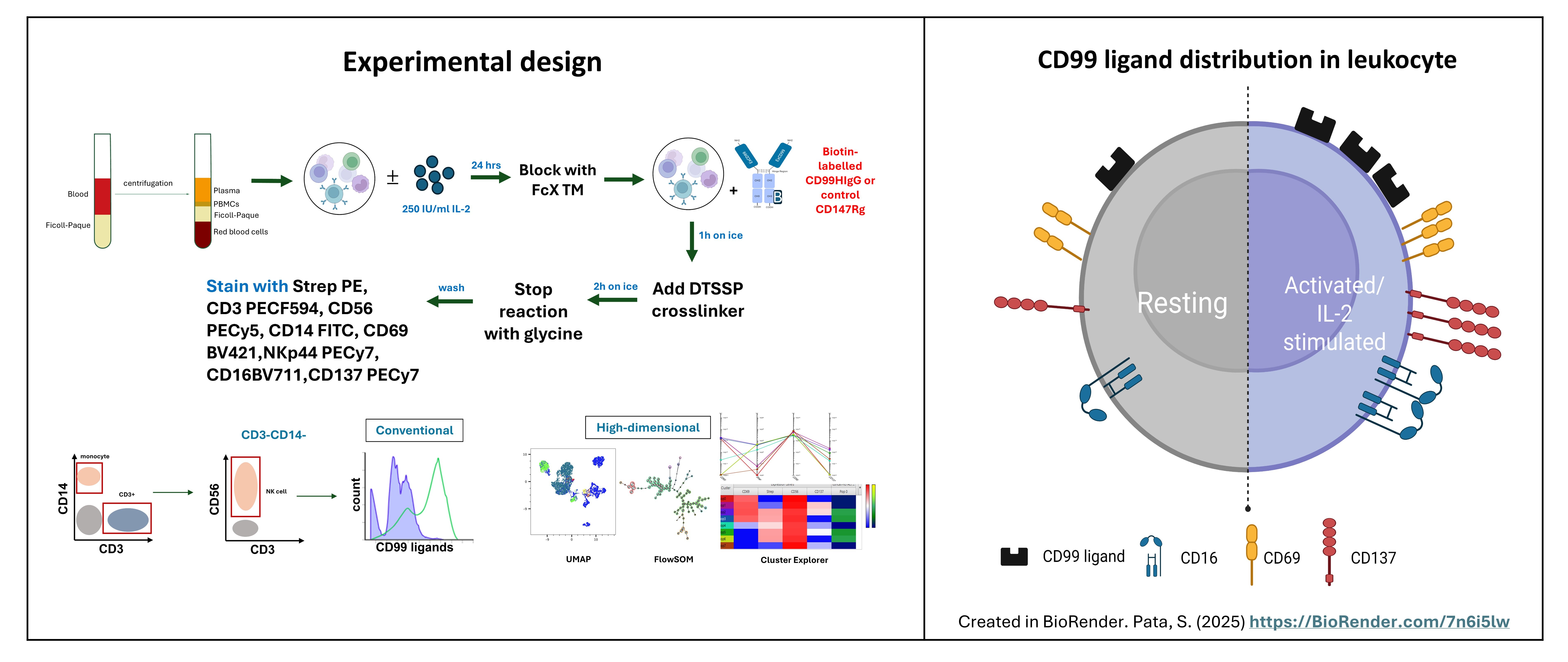

This is an early access version, the complete PDF, HTML, and XML versions will be available soon.
Phenotypic Profiling and Activation-Associated Expression of CD99 Ligands on Human Leukocytes
by
 , ,
, ,
Myint Myat Thu
1,2,
Nuchjira Takheaw
1,2,
Witida Laopajon
1,2,
Watchara Kasinrerk
1,2 and
Supansa Pata
1,2,* 1
Division of Clinical Immunology, Department of Medical Technology, Faculty of Associated Medical Sciences, Chiang Mai University, Chiang Mai 50200, Thailand
2
Biomedical Technology Research Center, National Center for Genetic Engineering and Biotechnology, National Science and Technology Development Agency at Faculty of Associated Medical Sciences, Chiang Mai University, Chiang Mai 50200, Thailand
*
Author to whom correspondence should be addressed.
Biology 2026, 15(1), 86; https://doi.org/10.3390/biology15010086
Submission received: 15 October 2025
/
Revised: 24 November 2025
/
Accepted: 30 December 2025
/
Published: 31 December 2025
Simple Summary
Protein–ligand interactions are ubiquitous in biological cells. Transmembrane protein CD99 is expressed on all leukocytes, but information on the distribution and behavior of its ligands is still lacking. Here, we report the distribution of CD99 ligands across various immune cell types and examine how their levels vary upon immune cell activation. Our findings indicate that CD99 ligands are predominantly expressed on natural killer (NK) cells and monocytes, with their expression further increasing after interleukin (IL)-2 stimulation. These data suggest that CD99 expression is associated with immune activation and may serve as a marker for activated immune cells.
Abstract
The immune system comprises a complex network of cells that continuously change during activation, infection, and the maintenance of balance. Immunophenotyping offers valuable insights into the regulation of immune responses. We systematically characterized the expression profile of CD99 ligands across distinct immune cell subsets using both conventional and high-dimensional flow cytometry. CD99 ligands were detected on NK cells and monocytes under both resting and IL-2-activated conditions, with non-classical monocytes and CD56 Dim NK cells exhibiting the highest expression levels. Notably, ligand expression in these subsets was further enhanced following IL-2 activation. In contrast, T lymphocytes (CD3+) displayed low basal levels of CD99 ligand expression, which increased modestly upon activation. Cellular activation was accompanied by an expansion of specific immune phenotypes characterized by elevated CD99 ligand expression alongside the upregulation of activation markers such as CD69 and CD137. Collectively, these findings suggest that the expression of the CD99 ligands may serve as an indicator of immune activation and demonstrate subset-specific regulation, particularly in response to IL-2 stimulation. These findings have revealed the distinct expression patterns of CD99 ligands, emphasizing their crucial role in modulating immune responses.