Utilization of Wild Edible Plants by the Tai Yoy Ethnic Group in Akat Amnuai District, Sakon Nakhon Province, Thailand

 ,
,  , ,
, , 

Simple Summary
Abstract
1. Introduction
2. Materials and Methods
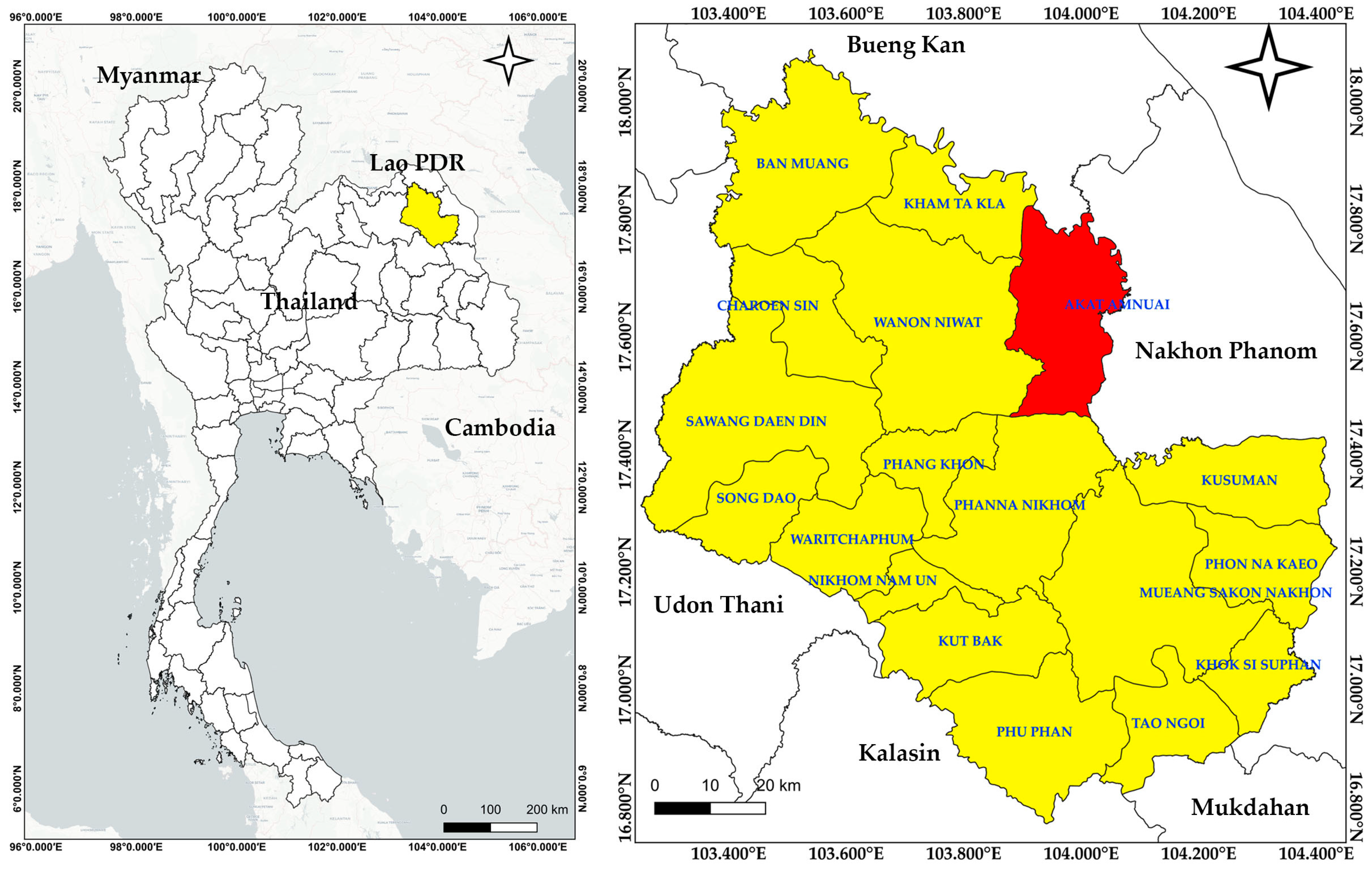
2.1. Study Area Description
2.2. Plant Collection and Identification
2.3. Local Market Survey
2.4. Ethnobotanical Data Collection
2.5. Categorization of Plant Uses
2.6. Data Analysis
2.6.1. Cultural Food Significance Index (CFSI)
2.6.2. Cluster Analysis
2.6.3. Informant Consensus Factor (Fic)
2.6.4. Fidelity Level (%FL)
2.6.5. WEPs Comparison with Surrounding Areas (Jaccard Index)
2.6.6. Economic Value Assessment
3. Results
3.1. Diversity of WEPs
3.2. Utilization of WEPs
3.2.1. WEPs Used as Condiments and Flavoring
3.2.2. WEPs Used as Fruits
3.2.3. WEPs Used as Staple Food
3.2.4. WEPs Used as Sweets/Desserts/Snacks
3.2.5. WEPs Used as Vegetables
3.2.6. WEPs Used as Medicinal Edible Plants
3.3. Toxic or Potentially Harmful WEPs
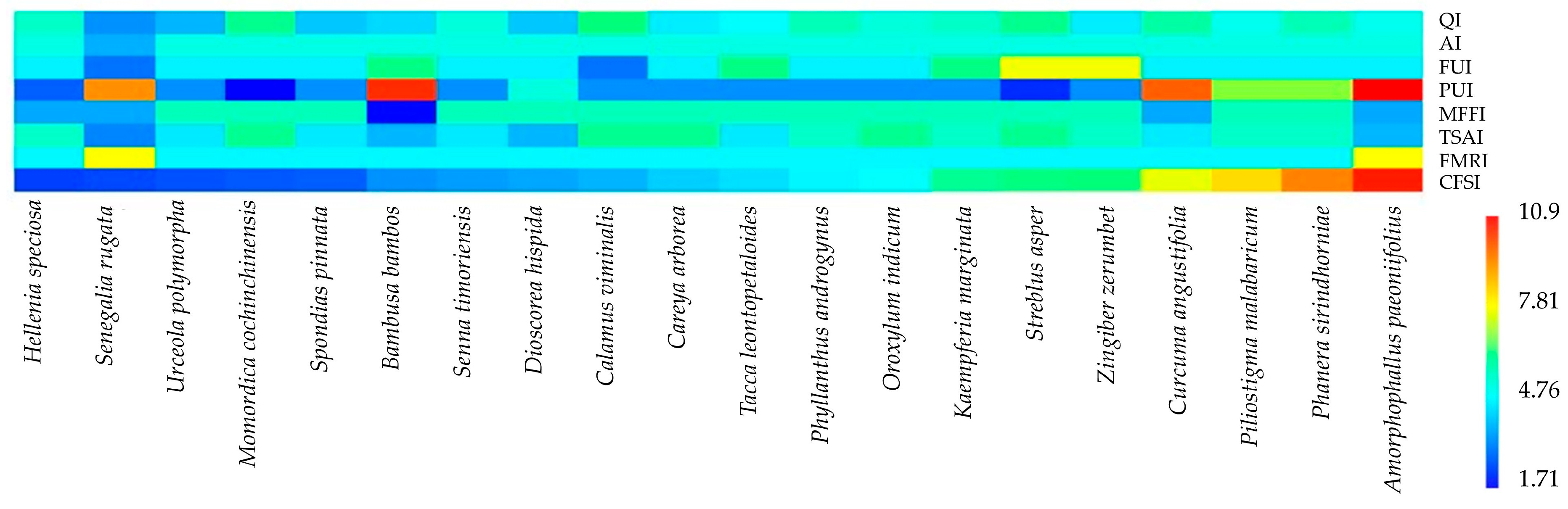
3.4. Cultural Food Significance Index (CFSI) of WEPs
3.5. Ethnomedicinal of WEPs
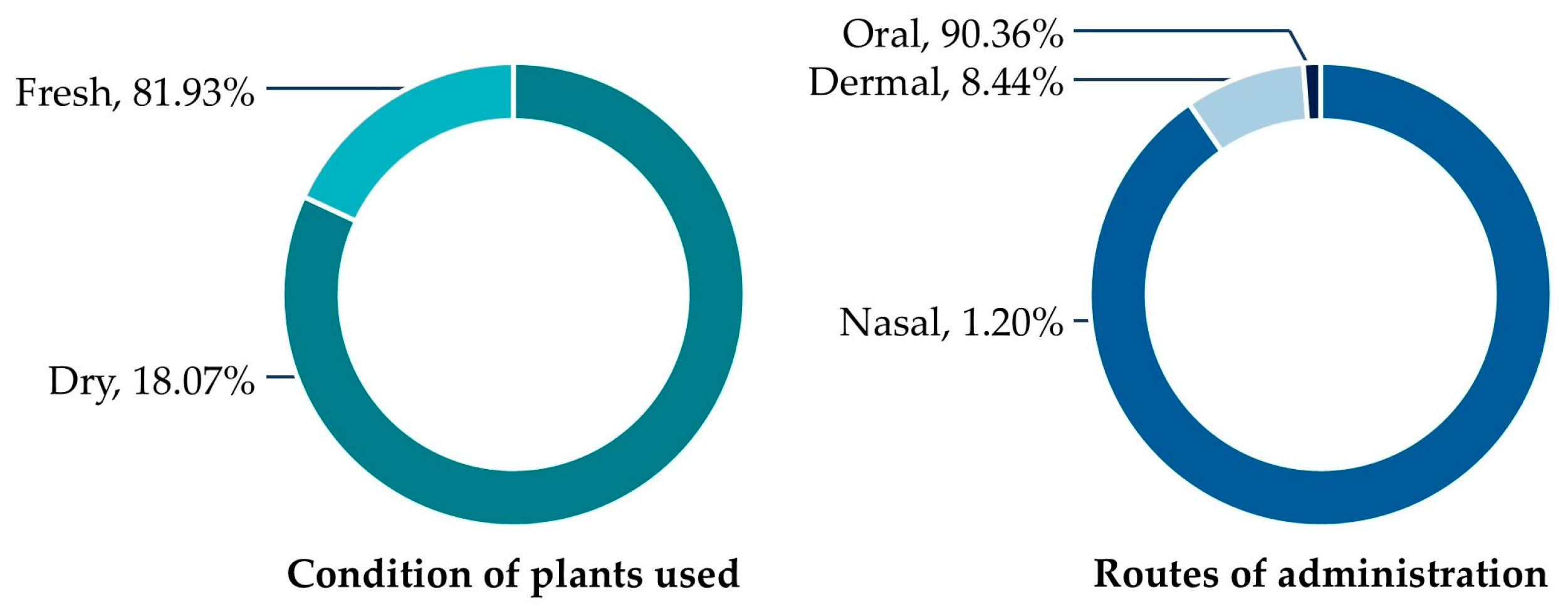
3.5.1. Condition of Plants Used and Routes of Administration
3.5.2. Fidelity Level (%FL) of WEPs
3.5.3. Informant Consensus Factor (Fic) of WEPS
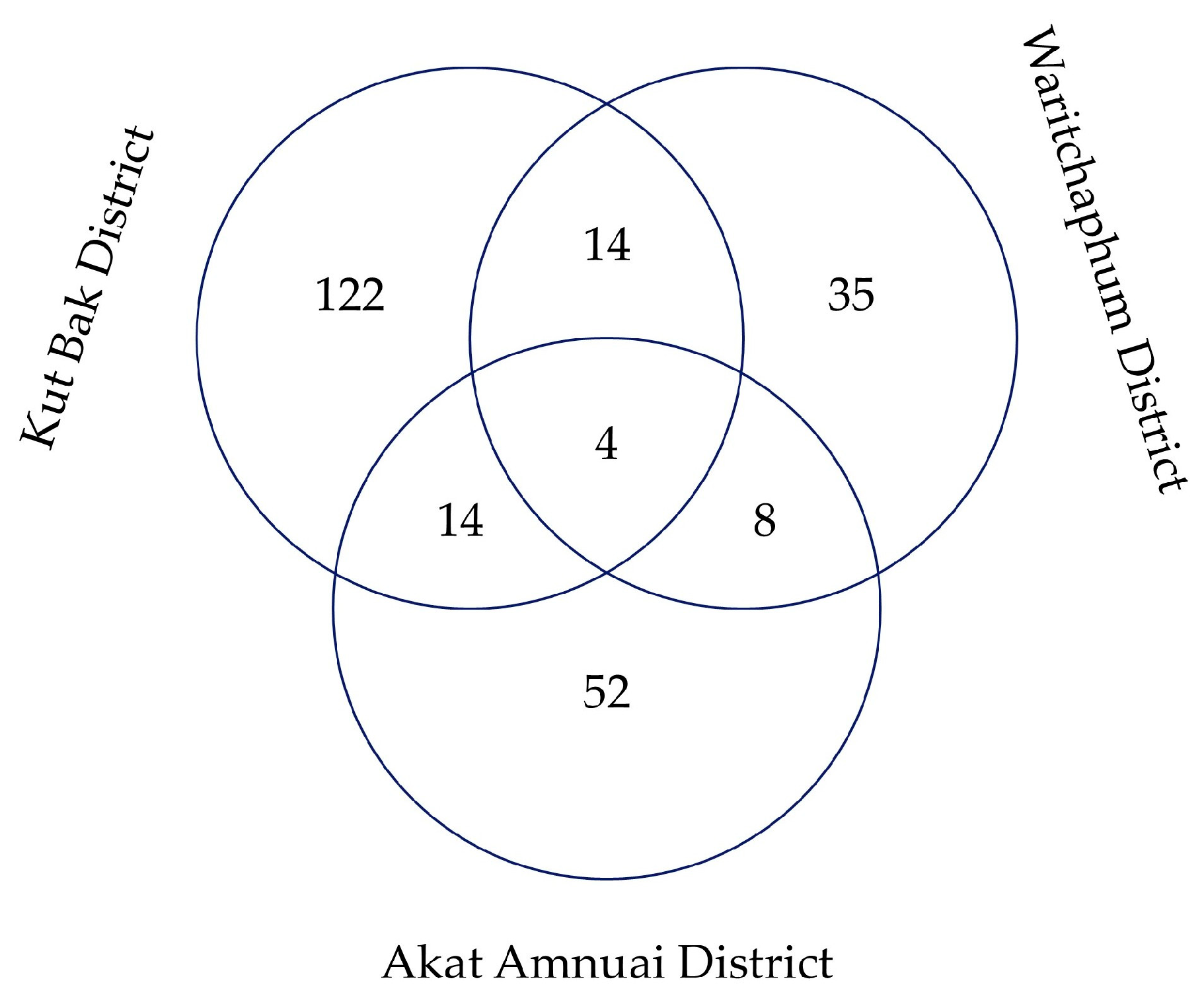
3.6. Comparative of WEPs from AAD and Surrounding Regions
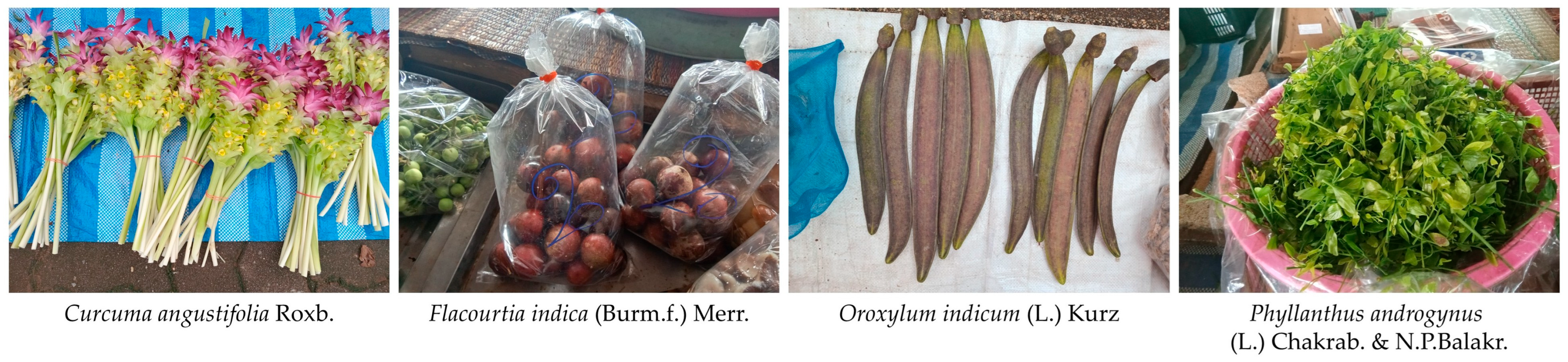
3.7. Economic Value of WEPs
4. Discussion
4.1. Diversity of WEPs and Implications for Food Sustainability and Conservation
4.2. Utilization Patterns of WEPs: Food, Medicine, and Culinary Practices
4.3. Cultural Food Significance and Implications for Sustainability
4.4. Medicinal Significance of WEPs
4.5. Regional Similarity and Ethnobotanical Diversity of WEPs
4.6. Economic Value of WEPs and Implications for Sustainable Use
4.7. Novelty of the Study
4.8. Suggestions for Future Research
5. Conclusions
Supplementary Materials
Author Contributions
Funding
Institutional Review Board Statement
Informed Consent Statement
Data Availability Statement
Acknowledgments
Conflicts of Interest
References
- Oduor, F.O.; Kaindi, D.W.M.; Abong, G.O.; Thuita, F.; Termote, C. Diversity and utilization of indigenous wild edible plants and their contribution to food security in Turkana County, Kenya. Front. Sustain. Food Syst. 2023, 7, 1113771. [Google Scholar] [CrossRef]
- Sinthumule, N.I. Traditional ecological knowledge and its role in biodiversity conservation: A systematic review. Front. Environ. Sci. 2023, 11, 1164900. [Google Scholar] [CrossRef]
- Zouraris, D.; Graikou, K.; Vasileiou, P.; Dimitrov, V.; Stevanovic, Z.D.; Bilia, A.R.; Zivkovic, J.; Dias, A.; Kasiotis, K.; Gardikis, K.; et al. EthnoHERBS: Harnessing traditional herbal knowledge for biodiversity conservation and innovative health solutions. Comput. Struct. Biotechnol. J. 2025, 29, 85–94. [Google Scholar] [CrossRef] [PubMed]
- Triyanto, A.; Purnamasari, F.; Paramita, F.; Wicaksono, F.; Ramadhan, F.; Budiharta, S.; Saensouk, S.; Setyawan, A. Ethnobotany of wild edible plants used by local communities in three districts along the upper Bengawan Solo River, Central Java, Indonesia. Biodiversitas 2024, 25, 428. [Google Scholar] [CrossRef]
- Thant Shin, T.; Fujikawa, K.; Aung Zaw Moe, A.; Uchiyama, H. Traditional knowledge of wild edible plants with special emphasis on medicinal uses in Southern Shan State, Myanmar. J. Ethnobiol. Ethnomed. 2018, 14, 48. [Google Scholar] [CrossRef] [PubMed]
- Thorng, R.; Makara, O.; Vaughan, D.A.; Vathany, T. Roles of wild food plants in ethnic group communities in Mondulkiri Province, Northeastern Cambodia. J. Mekong Soc. 2015, 11, 1–17. [Google Scholar]
- Turreira-García, N.; Vilkamaa, A.M.; Byg, A.; Theilade, I. Diversity, knowledge and use of leafy vegetables in northern Thailand—Maintenance and transmission of ethnobotanical knowledge during urbanisation. Nat. Hist. Bull. Siam Soc. 2017, 62, 85–105. [Google Scholar]
- Phatlamphu, N.; Saensouk, S.; Saensouk, P.; Jungsongduang, A. Ethnobotany of edible plants in Muang District, Kalasin Province, Thailand. Biodiversitas 2021, 22, 5425–5431. [Google Scholar] [CrossRef]
- Yarnvudhi, A.; Sungkaew, S.; Hermhuk, S.; Sunthornhao, P.; Onprom, S. Plant Diversity and Utilization on Ethnobotany of Local People at Hmong Doi Pui Village in Doi Suthep-Pui National Park, Chiang Mai Province. Thai J. For. 2016, 35, 136–146. [Google Scholar]
- Saensouk, S.; Saensouk, P.; Ragsasilp, A.; Senakun, C.; Daovisan, H.; Setyawan, A.D.; Niamngon, T.; Niamngon, P.; Appamaraka, S. Medical ethnobotany and utilization of medicinal plants in the Don Pu Ta Forest Thai Yoi ethnic groups, Sakon Nakhon Province, Thailand. Biodiversitas 2024, 25, 3014–3031. [Google Scholar] [CrossRef]
- Chinnabutr, S. Ethnic Consciousness of Kaloeng Baan Phachong, Amphoe Nakae, Nakhon Phanom Province, Thailand Through Yao Liang Phi Ritual. Tạp Chí Khoa Học Đại Học Tân Trào 2020, 19, 57–63. [Google Scholar]
- Saenchat, P.; Udomkijmongkol, C.; Swasthaisong, S.; Phosing, P. Community-based natural resource and environmental management in Songkram River Basin, Tha Kon Community, Sakon Nakhon Province, Thailand. Asian Political Sci. Rev. 2019, 3, 89–97. [Google Scholar] [CrossRef]
- McCarthy, C.; Phillips, S.; Nergui, K.; Adiya, T.; Yadamsuren, A.; Sternberg, T.; Hoshino, B.; Nasanbat, B.; Enkhjargal, E. Will Indigenous Plant Knowledge Survive? Documenting Ethnobotany Among Mongolia’s Nomadic Communities in the Gobi Desert. J. Ethnobiol. 2025, 45, 239–260. [Google Scholar] [CrossRef]
- Kapelari, S.; Alexopoulos, G.; Moussouri, T.; Sagmeister, K.J.; Stampfer, F. Food Heritage Makes a Difference: The Importance of Cultural Knowledge for Improving Education for Sustainable Food Choices. Sustainability 2020, 12, 1509. [Google Scholar] [CrossRef]
- QGIS Development Team. QGIS Geographic Information System. Open Source Geospatial Foundation Project. 2023. Available online: https://qgis.org (accessed on 10 November 2025).
- Weatherspark. Average Weather in Akat Amnuai, Thailand—Year-Round. 2024. Available online: https://weatherspark.com/y/114794/Average-Weather-in-Akat-Amnuai-Thailand-Year-Round (accessed on 3 November 2025).
- Plant of the World Online. Facilitated by the Royal Botanic Gardens, Kew. Available online: https://powo.science.kew.org (accessed on 21 October 2025).
- Goodman, L.A. Snowball Sampling. Ann. Math. Stat. 1961, 32, 148–170. [Google Scholar] [CrossRef]
- Tajik, O.; Golzar, J.; Noor, S. Purposive Sampling. Int. J. Educ. Lang. Stud. 2025, 1–9. [Google Scholar] [CrossRef]
- International Society of Ethnobiology (ISE). International Society of Ethnobiology Code of Ethics (with 2008 Additions). 2006. Available online: http://ethnobiology.net/code-of-ethics/ (accessed on 20 September 2025).
- Secretariat of the Convention on Biological Diversity. Nagoya Protocol on Access to Genetic Resources and the Fair and Equitable Sharing of Benefits Arising from Their Utilization to the Convention on Biological Diversity. United Nations, Montreal. 2011. Available online: https://www.cbd.int/abs/ (accessed on 20 September 2025).
- Saensouk, P.; Saensouk, S.; Boonma, T.; Zhang, Y.; Lv, L.; Jitpromma, T. Ethnobotanical Heritage of Edible Plant Species in Mueang District, Yasothon Province, Northeastern Thailand. Biology 2025, 14, 1264. [Google Scholar] [CrossRef] [PubMed]
- Pieroni, A. Evaluation of the cultural significance of wild food botanicals traditionally consumed in northwestern Tuscany, Italy. J. Ethnobiol. 2001, 21, 89–104. [Google Scholar]
- Sneath, P.H.A.; Sokal, R.R. Numerical Taxonomy; W.H. Freeman: San Francisco, CA, USA, 1973. [Google Scholar]
- Heinrich, M.; Ankli, A.; Frei, B.; Weimann, C.; Sticher, O. Medicinal plants in Mexico: Healers’ consensus and cultural importance. Soc. Sci. Med. 1998, 47, 1859–1871. [Google Scholar] [CrossRef] [PubMed]
- Friedman, J.; Yaniv, Z.; Dafni, A.; Palewitch, D. A preliminary classification of the healing potential of medicinal plants, based on a rational analysis of an ethnopharmacological field survey among Bedouins in the Negev Desert, Israel. J. Ethnopharmacol. 1986, 16, 275–286. [Google Scholar] [CrossRef]
- Hammer, Ø.; Harper, D.A.T.; Ryan, P.D. PAST: Paleontological Statistics Software Package for Education and Data Analysis. Palaeontol. Electron. 2001, 4, 1. [Google Scholar]
- Phatlamphu, N.; Saensouk, S.; Saensouk, P.; Junsongduang, A.; Setyawan, A.D. Economic value assessment of edible plants in Muang District, Kalasin Province, Thailand. Biodiversitas 2023, 24, 3960–3967. [Google Scholar] [CrossRef]
- Jadhao, A.; Sreedevi, A.; Sable, P.; Mishra, S. A comprehensive review of Cryptolepis buchananii R.Br. ex Roem. & Schult. In Proceedings of the International Conference on Recent Advances in Pharmaceutical Sciences (ICRAPS 2025), Singapore, 14 February 2025. [Google Scholar] [CrossRef]
- Sangkanu, S.; Khanansuk, J.; Phoopha, S.; Udomuksorn, W.; Phupan, T.; Puntarat, J.; Tungsukruthai, S.; Dej-adisai, S. Utility Assessment of Isolated Starch and Extract from Thai Yam (Dioscorea hispida Dennst.) for Cosmetic via In Vitro and In Vivo Studies. Life 2025, 15, 151. [Google Scholar] [CrossRef] [PubMed]
- Lee, Y.; Lee, J.; Lee, K.-B.; Lee, W.-Y.; Lee, Y. Quantitative Detection of Thitsiol and Urushiol as Markers from the Gluta usitata Lacquer Tree Using HPLC. Molecules 2024, 29, 149. [Google Scholar] [CrossRef]
- Appamaraka, S.; Saensouk, S.; Saensouk, P.; Junsongduang, A.; Setyawan, A.D. Ethnobotanical knowledge of medicinal plants in the Don Pu Ta Forest by Kaloeng ethnic group, Sakon Nakhon Province, Northeastern Thailand. Biodiversitas 2023, 24, 4617–4635. [Google Scholar] [CrossRef]
- Wannakham, S.; Saensouk, S.; Saensouk, P.; Junsongduang, A. Diversity and ethnobotanical study of medicinal plants in Thai Phuan ethnic group in Ban Phue District, Udon Thani Province, Thailand. Trop. J. Nat. Prod. Res. 2024, 8, 8716–8740. [Google Scholar] [CrossRef]
- Thongpukdee, A.; Thepsithar, C.; Thammaso, C. Ethnobotanical survey of vegetable plants traditionally used in Kalasin, Thailand. Int. J. Biol. Life Agric. Sci. 2014, 8, 717–720. [Google Scholar] [CrossRef]
- Niamngon, P.; Saensouk, S.; Saensouk, P.; Junsongduang, A. Ethnobotanical knowledge of Isaan Laos tribe in Khong Chai District, Kalasin Province, Thailand with particular focus on medicinal uses. Biodiversitas 2023, 24, 6793–6824. [Google Scholar] [CrossRef]
- Saengsanga, T.; Kaewthani, S.; Rattana, T. Plant diversity, traditional utilization, and community-based conservation of the small-scale Nong Sakae Community Forest in Nakhon Ratchasima, Thailand. For. Soc. 2024, 8, 179–194. [Google Scholar] [CrossRef]
- Khuankaew, S.; Srithi, K.; Tiansawat, P.; Jampeetong, A.; Inta, A.; Wangpakapattanawong, P. Ethnobotanical study of medicinal plants used by Tai Yai in Northern Thailand. J. Ethnopharmacol. 2014, 151, 829–838. [Google Scholar] [CrossRef] [PubMed]
- Shavanov, M. The role of food crops within the Poaceae and Fabaceae families as nutritional plants. IOP Conf. Ser. Earth Environ. Sci. 2021, 624, 012111. [Google Scholar] [CrossRef]
- Yuyama, K.; Silva, M.; Schmidt, T.; Pupo, M. Pharmacological potential of Apocynaceae plants and associated endophytes in Brazil. Rev. Bras. Farmacogn. 2025, 35, 643. [Google Scholar] [CrossRef]
- Sharifi-Rad, M.; Varoni, E.M.; Salehi, B.; Sharifi-Rad, J.; Matthews, K.R.; Ayatollahi, S.A.; Kobarfard, F.; Ibrahim, S.A.; Mnayer, D.; Zakaria, Z.A.; et al. Plants of the genus Zingiber as a source of bioactive phytochemicals: From tradition to pharmacy. Molecules 2017, 22, 2145. [Google Scholar] [CrossRef] [PubMed]
- Borelli, T.; Hunter, D.; Powell, B.; Ulian, T.; Mattana, E.; Termote, C.; Pawera, L.; Beltrame, D.; Penafiel, D.; Tan, A.; et al. Born to Eat Wild: An Integrated Conservation Approach to Secure Wild Food Plants for Food Security and Nutrition. Plants 2020, 9, 1299. [Google Scholar] [CrossRef]
- Thammanu, S.; Marod, D.; Han, H.; Bhusal, N.; Asanok, L.; Ketdee, P.; Gaewsingha, N.; Lee, S.; Chung, J. The influence of environmental factors on species composition and distribution in a community forest in Northern Thailand. J. For. Res. 2021, 32, 649–662. [Google Scholar] [CrossRef]
- Saupi, N.; Saidin, A.A.; Zakaria, M.H.; Sarbini, S.R.; Yusli, N.A. An ethnobotanical study of indigenous leafy vegetables among local communities in Bintulu, Sarawak, Malaysia. Borneo J. Resour. Sci. Technol. 2020, 10, 155–165. [Google Scholar] [CrossRef]
- Mouillac, C.; Besnard, A.; Papuga, G. Are commercial wild-harvested plants just ordinary? Traits, harvesting patterns and conservation implications in France. Biol. Conserv. 2025, 312, 111480. [Google Scholar] [CrossRef]
- Edyvean, R.G.; Apiwatanapiwat, W.; Vaithanomsat, P.; Boondaeng, A.; Janchai, P.; Sophonthammaphat, S. The Bio-Circular Green Economy model in Thailand—A comparative review. Agr. Nat. Resour. 2023, 57, 51–64. [Google Scholar]
- Igwe, O.; Okeke, I. Leaf and flower extracts of Piliostigma malabaricum: Phytochemistry and antibacterial application. J. Appl. Chem. Sci. Int. 2017, 8, 89–94. [Google Scholar]
- Punchay, K.; Inta, A.; Tiansawat, P.; Balslev, H.; Wangpakapattanawong, P. Traditional knowledge of wild food plants of Thai Karen and Lawa (Thailand). Genet. Resour. Crop Evol. 2020, 67, 1277–1299. [Google Scholar] [CrossRef]
- Nugroho, D.; Surya, R.; Janshongsawang, J.; Thinthasit, A.; Benchawattananon, R. Som tum, the famous ethnic food of Thailand: Its benefit and innovations. J. Ethn. Food 2023, 10, 37. [Google Scholar] [CrossRef]
- Williams, L.B.; Jones, M.; Wright, P.F. Decolonising food regulatory frameworks: Importance of recognising traditional culture when assessing dietary safety of traditional foods. Proc. Nutr. Soc. 2023, 82, 454–467. [Google Scholar] [CrossRef]
- Kindie, B.; Mengistu, S. Ethnobotanical study of medicinal plants and traditional knowledge used. J. Tradit. Med. Clin. Natur. 2022, 11, 361. [Google Scholar] [CrossRef]
- Rahman, M.S.; Hossain, M.S.; Pulok, M.F.H. Analysis of food safety knowledge and practices among food handlers in restaurants and street food markets in Dhaka, Bangladesh: A cross-sectional study. Int. J. Food Sci. 2025, 2025, 5369920. [Google Scholar] [CrossRef]
- Mbelebele, Z.; Mdoda, L.; Ntlanga, S.S.; Nontu, Y.; Gidi, L.S. Harmonizing Traditional Knowledge with Environmental Preservation: Sustainable Strategies for the Conservation of Indigenous Medicinal Plants (IMPs) and Their Implications for Economic Well-Being. Sustainability 2024, 16, 5841. [Google Scholar] [CrossRef]
- Khoury, C.K.; Amariles, D.; Soto, J.S.; Diaz, M.V.; Sotelo, S.; Sosa, C.C.; Ramírez-Villegas, J.; Achicanoy, H.A.; Velásquez-Tibatá, J.; Guarino, L.; et al. Comprehensiveness of conservation of useful wild plants: An operational indicator for biodiversity and sustainable development targets. Ecol. Indic. 2019, 98, 420–429. [Google Scholar] [CrossRef]
- Ossowska, L.; Janiszewska, D.; Kwiatkowski, G.; Oklevik, O. Local Food Production Based on Culinary Heritage—A Way to Local Sustainability. Sustainability 2024, 16, 11310. [Google Scholar] [CrossRef]
- Chukwurah, G.O.; Okeke, F.O.; Isimah, M.O.; Enoguanbhor, E.C.; Awe, F.C.; Nnaemeka-Okeke, R.C.; Guo, S.; Nwafor, I.V.; Okeke, C.A. Cultural Influence of Local Food Heritage on Sustainable Development. World 2025, 6, 10. [Google Scholar] [CrossRef]
- Cheng, Z.; Lin, S.; Wu, Z.; Lin, C.; Zhang, Q.; Xu, C.; Li, J.; Long, C. Study on medicinal food plants in the Gaoligongshan Biosphere Reserve, the richest biocultural diversity center in China. J. Ethnobiol. Ethnomed. 2024, 20, 10. [Google Scholar] [CrossRef]
- Luo, B.; Li, F.; Ahmed, S.; Long, C. Diversity and use of medicinal plants for soup making in traditional diets of the Hakka in West Fujian, China. J. Ethnobiol. Ethnomed. 2019, 15, 60. [Google Scholar] [CrossRef] [PubMed]
- Yifru, M.; Tilahun, A.; Awoke, A.; Kassa, Z. Traditional medicinal plant based remedies for common ailments in Menz Keya Gebreal District, North Shewa Zone, Ethiopia. BMC Complement. Med. Ther. 2025, 25, 411. [Google Scholar] [CrossRef]
- Asrawijaya, E. Traditional Ecological Wisdom for the Resilience of Indigenous Peoples in Indonesia. Besari J. Soc. Cult. Stud. 2024, 1, 59–77. [Google Scholar] [CrossRef]
- Nakra, S.; Tripathy, S.; Srivastav, P.P. Drying as a preservation strategy for medicinal plants: Physicochemical and functional outcomes for food and human health. Phytomed. Plus 2025, 5, 100762. [Google Scholar] [CrossRef]
- Gebre, A.; Gitima, G.; Berhanu, Y. Ethnobotanical study of wild edible plants in Goba District Southwest Ethiopia. Sci. Rep. 2025, 15, 27689. [Google Scholar] [CrossRef]
- Kassa, Z.; Asfaw, Z.; Demissew, S. An ethnobotanical study of medicinal plants in Sheka Zone of Southern Nations Nationalities and Peoples Regional State, Ethiopia. J. Ethnobiol. Ethnomed. 2020, 16, 7. [Google Scholar] [CrossRef] [PubMed]
- Tadesse, T.; Teka, A. Ethnobotanical study on medicinal plants used by the local communities of Ameya District, Oromia Regional State, Ethiopia. Evid.-Based Complement. Altern. Med. 2023, 2023, 5961067. [Google Scholar] [CrossRef]
- Junsongduang, A.; Kasemwan, W.; Lumjoomjung, S.; Sabprachai, W.; Tanming, W.; Balslev, H. Ethnomedicinal Knowledge of Traditional Healers in Roi Et, Thailand. Plants 2020, 9, 1177. [Google Scholar] [CrossRef] [PubMed]
- Wani, Z.A.; Shreekar, P.; Bikarma, S. Descriptive study of plant resources in the context of the ethnomedicinal relevance of indigenous flora; a case study from Rajouri-Poonch region of Himalaya. Ethnobot. Res. Appl. 2021, 21, 1–22. [Google Scholar] [CrossRef]
- Abebe, B.A.; Teferi, S.C. Ethnobotanical Study of Medicinal Plants Used to Treat Human and Livestock Ailments in Hulet Eju Enese Woreda, East Gojjam Zone of Amhara Region, Ethiopia. Evid. Based Complement. Alternat. Med. 2021, 2021, 6668541. [Google Scholar] [CrossRef]
- Cabrera-Meléndez, J.; Iparraguirre-León, D.; Way, M.; Valenzuela Oré, F.; Montesinos-Tubée, D.B. The Applicability of Similarity Indices in an Ethnobotanical Study of Medicinal Plants from Three Localities of the Yunga District, Moquegua Region, Peru. Ethnobot. Res. Appl. 2022, 24, 16. [Google Scholar] [CrossRef]
- Majeed, M.; Bhatti, K.H.; Amjad, M.S.; Abbasi, A.M.; Bussmann, R.W.; Nawaz, F.; Rashid, A.; Mehmood, A.; Mahmood, M.; Khan, W.M.; et al. Ethno-Veterinary Uses of Poaceae in Punjab, Pakistan. PLoS ONE 2020, 15, e0241705. [Google Scholar] [CrossRef]
- Mulyoutami, E.; Tata, H.L.; Silvianingsih, Y.A.; van Noordwijk, M. Agroforests as the Intersection of Instrumental and Relational Values of Nature: Gendered, Culture-Dependent Perspectives. Curr. Opin. Environ. Sustain. 2023, 62, 101293. [Google Scholar] [CrossRef]
- Witharana, L.; Chen, D.; Curio, J.; Burman, A. Traditional Ecological Knowledge in High Mountain Asia: A Pathway to Climate Resilience in Agriculture Amidst Changing Climates. Adv. Clim. Chang. Res. 2025, 16, 167–182. [Google Scholar] [CrossRef]
- Fernández-Llamazares, Á.; Teixidor-Toneu, I.; Armstrong, C.G.; Caviedes, J.; Ibarra, J.T.; Lepofsky, D.; McAlvay, A.C.; Molnár, Z.; Moraes, R.M.; Odonne, G.; et al. The Global Relevance of Locally Grounded Ethnobiology. J. Ethnobiol. Ethnomed. 2024, 20, 53. [Google Scholar] [CrossRef] [PubMed]
- Alemu, M.; Asfaw, Z.; Lulekal, E.; Warkineh, B.; Debella, A.; Sisay, B.; Debebe, E. Ethnobotanical Study of Traditional Medicinal Plants Used by the Local People in Habru District, North Wollo Zone, Ethiopia. J. Ethnobiol. Ethnomed. 2024, 20, 4. [Google Scholar] [CrossRef] [PubMed]
- Oduor, F.; Kaindi, D.M.; Abong, G.; Thuita, F.; Termote, C. Community-Based Conservation Strategies for Wild Edible Plants in Turkana County, Kenya. Conservation 2025, 5, 1. [Google Scholar] [CrossRef]
- Rathoure, A.K. Cultural practices to protecting biodiversity through cultural heritage: Preserving nature, preserving culture. Biodivers. Int. J. 2024, 7, 71–75. [Google Scholar] [CrossRef]
- Tensen, L. Under what circumstances can wildlife farming benefit species conservation? Glob. Ecol. Conserv. 2016, 6, 286–298. [Google Scholar] [CrossRef]
- Abdulai, I.A.; Osei-Amponsah, C.; Ahmed, A. Urban agriculture-climate change-food security nexus: Does climate-smart agriculture offer hope? SN Soc. Sci. 2025, 5, 91. [Google Scholar] [CrossRef]
- Yusriadi, Y. Sustaining food security through social capital in agroforestry: A qualitative study from North Luwu, Indonesia. Front. Sustain. Food Syst. 2025, 9, 1580017. [Google Scholar] [CrossRef]



| Family | NoP | % | Family | NoP | % | Family | NoP | % |
|---|---|---|---|---|---|---|---|---|
| Fabaceae | 7 | 8.97 | Euphorbiaceae | 2 | 2.56 | Costaceae | 1 | 1.28 |
| Apocynaceae | 5 | 6.41 | Hypericaceae | 2 | 2.56 | Cucurbitaceae | 1 | 1.28 |
| Zingiberaceae | 4 | 5.13 | Lauraceae | 2 | 2.56 | Dilleniaceae | 1 | 1.28 |
| Anacardiaceae | 3 | 3.85 | Phyllanthaceae | 2 | 2.56 | Erythroxylaceae | 1 | 1.28 |
| Bignoniaceae | 3 | 3.85 | Salicaceae | 2 | 2.56 | Gnetaceae | 1 | 1.28 |
| Moraceae | 3 | 3.85 | Sapindaceae | 2 | 2.56 | Hypoxidaceae | 1 | 1.28 |
| Rubiaceae | 3 | 3.85 | Vitaceae | 2 | 2.56 | Lecythidaceae | 1 | 1.28 |
| Rutaceae | 3 | 3.85 | Amaranthaceae | 1 | 1.28 | Melastomataceae | 1 | 1.28 |
| Arecaceae | 2 | 2.56 | Annonaceae | 1 | 1.28 | Ochnaceae | 1 | 1.28 |
| Combretaceae | 2 | 2.56 | Asteraceae | 1 | 1.28 | Poaceae | 1 | 1.28 |
| Connaraceae | 2 | 2.56 | Burseraceae | 1 | 1.28 | Primulaceae | 1 | 1.28 |
| Dioscoreaceae | 2 | 2.56 | Capparaceae | 1 | 1.28 | Rhamnaceae | 1 | 1.28 |
| Dipterocarpaceae | 2 | 2.56 | Celastraceae | 1 | 1.28 | Smilacaceae | 1 | 1.28 |
| Ebenaceae | 2 | 2.56 | Clusiaceae | 1 | 1.28 | Stemonaceae | 1 | 1.28 |
| No. | Family | Scientific Name | VE | DiT | GH | Utilization | Used Parts | Method of Utilization | TiM | VN |
|---|---|---|---|---|---|---|---|---|---|---|
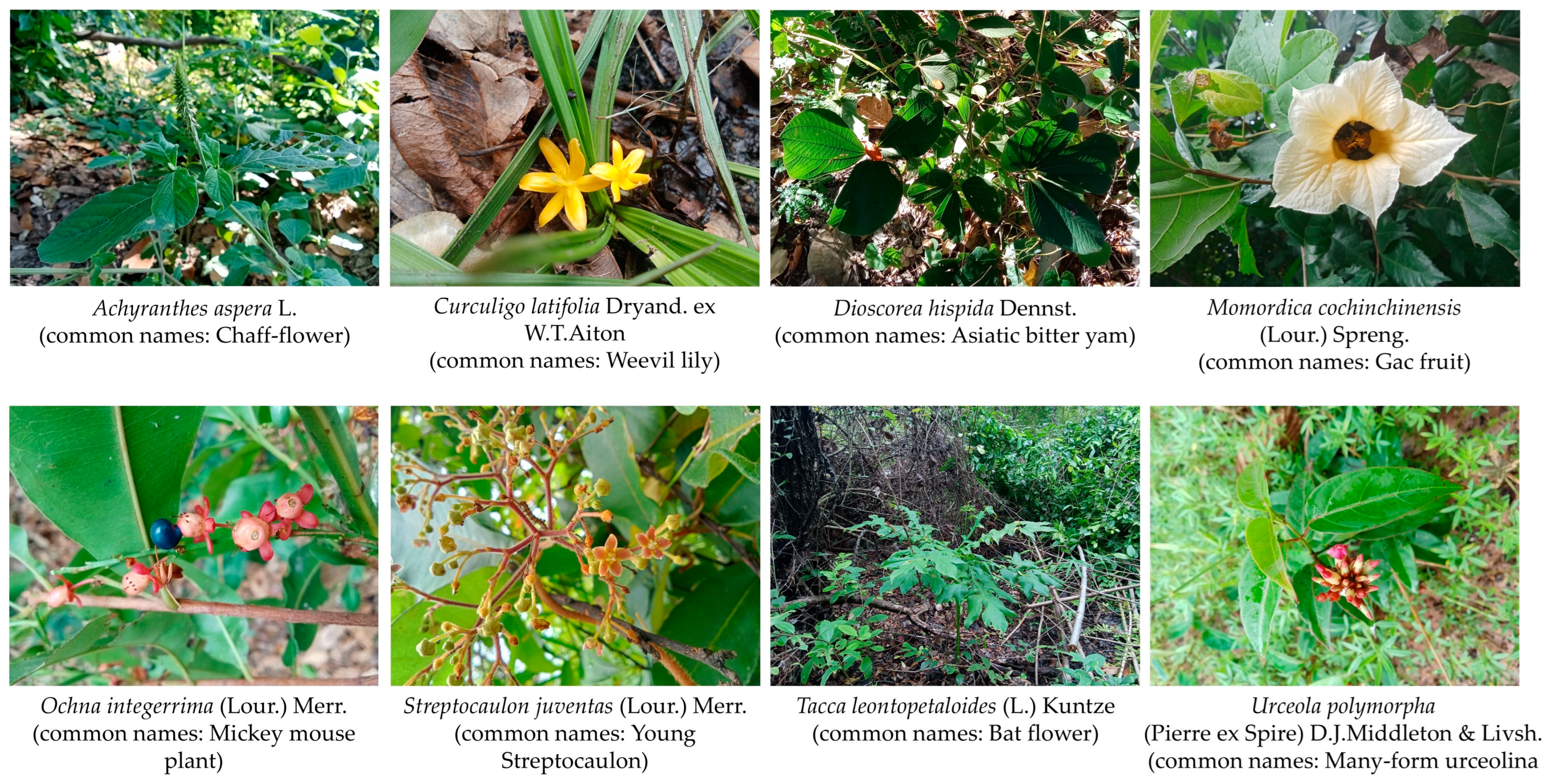
| 1. | Amaranthaceae | Achyranthes aspera L. | Ya Phan Ngu | Native | Herb | MP | Lv, St, Wp | Medicinal uses detailed in Table S1 | No | TJ589 |
| 2. | Anacardiaceae | Gluta usitata (Will.) Ding Hou | Nam Kliang | Native | Tree | MP | Bk, La, St | Latex: Used to produce natural varnish. The clear latex turns black and glossy upon exposure to air and is applied as a priming lacquer on wooden surfaces in the traditional “Long Rak–Pid Thong” (lacquer and gold gilding) process for making lacquerware; Medicinal uses detailed in Table S1 | No | TJ628 |
| 3. | Anacardiaceae | Mangifera caloneura Kurz | Ma Muang Ka So | Native | Tree | FT | Ft | Fruit: The fruits are edible both raw and ripe and commonly consumed as fruits | No | TJ637 |
| 4. | Anacardiaceae | Spondias pinnata (L.f.) Kurz | Ma Kok | Native | Tree | CF | Ft | Fruit: The sour–sweet fruits are used as a flavoring ingredient in various dishes to enhance taste | Yes | TJ655 |
| 5. | Annonaceae | Huberantha cerasoides (Roxb.) Chaowasku | Sai Den | Native | Tree | MP, FT | Ft, Lv, Rt | Fruit: The ripe fruits are eaten fresh as seasonal fruits; Medicinal uses detailed in Table S1 | No | TJ632 |
| 6. | Apocynaceae | Amphineurion marginatum (Roxb.) D.J.Middleton | Khreu Sai Tan | Native | Climber | MP | Rt, St | Medicinal uses detailed in Table S1 | No | TJ592 |
| 7. | Apocynaceae | Cryptolepis buchananii R.Br. ex Roem. & Schult. | En On | Native | Climber | MP | Lv, St | Medicinal uses detailed in Table S1 | No | TJ611 |
| 8. | Apocynaceae | Cynanchum pulchellum (Wall.) Liede & Khanum | Ton Khao San | Native | Climber | MP | Rt | Medicinal uses detailed in Table S1 | No | TJ614 |
| 9. | Apocynaceae | Streptocaulon juventas (Lour.) Merr. | Khreu Pra Song | Native | Climber | MP | Rt | Medicinal uses detailed in Table S1 | No | TJ658 |
| 10. | Apocynaceae | Urceola polymorpha (Pierre ex Spire) D.J.Middleton & Livsh. | Som Lom | Native | Climber | CF | Ft, Lv | Fruit, Leaf: Used in cooking to impart a sour flavor | No | TJ664 |
| 11. | Araceae | Amorphophallus paeoniifolius (Dennst.) Nicolson | I Rok | Native | Herb | VG | St | Shoot: Boiled to remove acridity before being cooked as a vegetable dish | Yes | TJ590 |
| 12. | Arecaceae | Calamus viminalis Willd. | Wai | Native | Climber | FT | Ft, St | Fruit: The ripe fruits are eaten as fruits; Shoot: young shoots are used as a vegetable ingredient | Yes | TJ598 |
| 13. | Asteraceae | Elephantopus scaber L. | King Fai Nok Khum | Native | Herb | MP | Lv, Rt | Medicinal uses detailed in Table S1 | No | TJ621 |
| 14. | Bignoniaceae | Fernandoa adenophylla (Wall. ex G.Don) Steenis | Kha Rao | Native | Tree | VG | Ic | Inflorescence: Boiled and eaten as a blanched vegetable with chili paste or cooked as part of various dishes | No | TJ624 |
| 15. | Bignoniaceae | Markhamia stipulata (Wall.) Seem. | Khae Hua Mu | Native | Tree | VG | Ic | Inflorescence: Boiled and eaten as a blanched vegetable with chili paste or added to curries | No | TJ638 |
| 16. | Bignoniaceae | Oroxylum indicum (L.) Kurz | Lin Fa | Native | Tree | VG | Ft, Ic | Fruit: Fresh or roasted fruits are eaten with chili paste or used in local dishes; Inflorescence: Eaten raw or boiled as a side vegetable with chili paste or cooked in traditional recipes | Yes | TJ644 |
| 17. | Burseraceae | Canarium subulatum Guillaumin | Bak Liam | Native | Tree | SW | Ft | Fruit: The fruit is halved, and the seeds inside are eaten as a snack using a small stick | No | TJ599 |
| 18. | Capparaceae | Capparis flavicans Kurz | Ngua Lia | Native | Shrub | MP | Hw, Lv, Wp | Whole Plant: Cultivated as an ornamental plant; Medicinal uses detailed in Table S1 | No | TJ601 |
| 19. | Celastraceae | Celastrus paniculatus Willd. | Khreu Mak Taek | Native | Climber | MP | Hw, Lv | Medicinal uses detailed in Table S1 | No | TJ606 |
| 20. | Clusiaceae | Garcinia cowa Roxb. Ex Choisy | Mak Mong | Native | Tree | MP, VG | Bk, Ft, La, Lv, Rt | Bark, Latex: The yellow bark and latex are used for dyeing fabrics; Fruit, Leaf: The sour parts are used as flavoring ingredients in curries or eaten fresh as vegetables; Medicinal uses detailed in Table S1 | No | TJ627 |
| 21. | Combretaceae | Terminalia chebula Retz. | Som Mo | Native | Tree | MP, FT, VG | Ft | Fruit: The astringent-sour fruits are eaten fresh or processed into pickles; Medicinal uses detailed in Table S1 | Yes | TJ662 |
| 22. | Combretaceae | Terminalia elliptica Willd. | Chuak | Native | Tree | MP | Bk, Hw | Bark provides tannins for leather tanning; Wood: The hardwood is highly durable and polished, used in flooring, beams, furniture, and tool handles, especially for tools used in water; Medicinal uses detailed in Table S1 | No | TJ663 |
| 23. | Connaraceae | Connarus semidecandrus Jack | Khreu Thop Thaeb | Native | Climber | MP | Bk, Rt, Wp | Medicinal uses detailed in Table S1 | No | TJ608 |
| 24. | Connaraceae | Rourea stenopetala (Griff.) Hook.f. | Ma Kham Khreu | Native | Climber | MP | Ft | Medicinal uses detailed in Table S1 | No | TJ651 |
| 25. | Costaceae | Hellenia speciosa (J.Koenig) S.R.Dutta | Ueang Mai Na | Native | Herb | MP, VG | St, Wp, Rz | Shoot: Young shoots are used as a vegetable; Whole Plant: Grown as an ornamental species; Medicinal uses detailed in Table S1 | Yes | TJ631 |
| 26. | Cucurbitaceae | Momordica cochinchinensis (Lour.) Spreng. | Fak Khao | Native | Climber | SW, VG | Ft, Lv, St | Fruit: Used as an ingredient in traditional desserts; Leaf, Shoot: Boiled or steamed and eaten as vegetables with chili paste | Yes | TJ641 |
| 27. | Dilleniaceae | Dillenia hookeri Pierre | San Din | Native | Herb | FT | Wp | Whole Plant: Cultivated for shade and garden decoration; the durable wood is used in house construction and furniture making | No | TJ615 |
| 28. | Dioscoreaceae | Dioscorea hispida Dennst. | Kloy | Native | Herb | SF, SW | Tb | Tuber: Steamed and eaten as a staple food or made into traditional sweets | Yes | TJ616 |
| 29. | Dioscoreaceae | Tacca leontopetaloides (L.) Kuntze | Thao Yai Mom | Native | Herb | SF | Tb | Tuber: Processed into starch powder by peeling, slicing, grinding, filtering through cloth, and drying the sediment; the starch is used in food preparation | Yes | TJ661 |
| 30. | Dipterocarpaceae | Dipterocarpus obtusifolius Teijsm. ex Miq. | Chad | Native | Tree | MP | Bk, Lv, St | Bark: Used as a natural dye yielding a dull yellow color; Shoot: Used as building material such as posts or firewood; Medicinal uses detailed in Table S1 | No | TJ619 |
| 31. | Dipterocarpaceae | Dipterocarpus tuberculatus Roxb. | Kung | Native | Tree | MP | Lv, St | Leaf: Used for thatching huts or roofing; Shoot: Utilized for making furniture and building structures; Medicinal uses detailed in Table S1 | No | TJ620 |
| 32. | Ebenaceae | Diospyros ehretioides Wall. ex G.Don | Tab Tao Ton | Native | Tree | MP | Rt | Medicinal uses detailed in Table S1 | No | TJ617 |
| 33. | Ebenaceae | Diospyros mollis Griff. | Khuea Ka | Native | Tree | MP | Bk, Ft | Medicinal uses detailed in Table S1 | No | TJ618 |
| 34. | Erythroxylaceae | Erythroxylum cuneatum (Miq.) Kurz | Krai Thong | Native | Shrub | MP | Bk, Rt | Medicinal uses detailed in Table S1 | No | TJ623 |
| 35. | Euphorbiaceae | Strophioblachia fimbricalyx Boerl. | Ba Sad | Native | Shrub | VG | Ic, Lv | Inflorescence, Leaf: Blanched and eaten as vegetables with chili paste | No | TJ659 |
| 36. | Euphorbiaceae | Suregada multiflora (A.Juss.) Baill. | Duk Sai | Native | Shrub | MP | Bk, Rt | Medicinal uses detailed in Table S1 | No | TJ660 |
| 37. | Fabaceae | Biancaea sappan (L.) Tod. | Sa Fang | Native | Tree | MP | Hw, St | Shoot: Used to produce red dye and for tanning animal hides; Medicinal uses detailed in Table S1 | No | TJ596 |
| 38. | Fabaceae | Peltophorum dasyrhachis (Miq.) Kurz | A Rang | Native | Tree | MP | Bk, Wp | Bark: Used as a natural dye to yield a reddish-brown color; Whole Plant: Grown as an ornamental species; Medicinal uses detailed in Table S1 | No | TJ646 |
| 39. | Fabaceae | Phanera sirindhorniae (K.Larsen & S.S.Larsen) Mackinder & R.Clark | Pra Dong | Native | Tree | MP | St, Wp | Whole Plant: Grown as an ornamental species; Medicinal uses detailed in Table S1 | No | TJ647 |
| 40. | Fabaceae | Piliostigma malabaricum (Roxb.) Benth. | Som Siao | Native | Tree | CF | Lv | Leaf: Used in cooking to impart sour flavor | No | TJ649 |
| 41. | Fabaceae | Pueraria mirifica Airy Shaw & Suvat. | Khreu Kraw | Native | Climber | MP | Tb | Medicinal uses detailed in Table S1 | No | TJ650 |
| 42. | Fabaceae | Senegalia rugata (Lam.) Britton & Rose | Som Poi | Introduced | Climber | MP, CF | Ft, Lv | Fruit, Leaf: Sour fruits and leaves are used as flavoring in various dishes; Fruit: Mature fruits are sun-dried and boiled with turmeric to prepare a traditional hair-washing solution; Medicinal uses detailed in Table S1 | Yes | TJ652 |
| 43. | Fabaceae | Senna timoriensis (DC.) H.S.Irwin & Barneby | Khi Lek Pa | Native | Tree | VG | Lv | Leaf: Boiled to reduce bitterness before consumption as a vegetable | No | TJ653 |
| 44. | Gnetaceae | Gnetum gnemon L. | Liang | Native | Climber | VG | Ft | Fruit, Leaf, Shoot: Consumed raw as fresh vegetables or cooked in local dishes | No | TJ629 |
| 45. | Hypericaceae | Cratoxylum cochinchinense (Lour.) Blume | Tiu Som | Native | Tree | CF | Ic | Inflorescence, Leaf: Used in cooking to enhance sourness or flavor | Yes | TJ609 |
| 46. | Hypericaceae | Cratoxylum formosum (Jack) Benth. & Hook.f. ex Dyer | Tiu Nam | Native | Tree | CF | Ic | Inflorescence, Leaf: Used in cooking to enhance sourness or flavor | Yes | TJ610 |
| 47. | Hypoxidaceae | Curculigo latifolia Dryand. ex W.T.Aiton | Wan Sak Lek | Native | Herb | MP | Lv, Rt | Medicinal uses detailed in Table S1 | No | TJ612 |
| 48. | Lauraceae | Cassytha filiformis L. | Sangwan Phra In | Native | Climber | MP | St | Medicinal uses detailed in Table S1 | No | TJ604 |
| 49. | Lauraceae | Litsea glutinosa (Lour.) C.B.Rob. | Mi Men | Native | Tree | FT | Ft | Fruit: Eaten ripe as fruits | No | TJ636 |
| 50. | Lecythidaceae | Careya arborea Roxb. | Kra Don | Native | Tree | VG | Lv | Leaf: Consumed raw as a fresh vegetable | No | TJ602 |
| 51. | Melastomataceae | Memecylon edule Roxb. | Muead Ae | Native | Tree | FT, VG | Ft, St, Wp | Fruit: Ripe fruits are eaten; young shoots are eaten as fresh vegetables; Shoot: young shoot eaten as fresh vegetables; Whole Plant: Grown as an ornamental plant | No | TJ639 |
| 52. | Moraceae | Artocarpus lacucha Buch.-Ham. | Ma Hat | Native | Tree | FT | Ft | Fruit: Ripe fruits eaten fresh | Yes | TJ594 |
| 53. | Moraceae | Ficus racemosa L. | Ma Duea | Native | Tree | FT, VG | Ft | Fruit: Ripe fruits eaten fresh; unripe fruits consumed as fresh vegetables | Yes | TJ625 |
| 54. | Moraceae | Streblus asper Lour. | Khoi | Native | Tree | FT | Ft, Wp | Fruit: Ripe fruits eaten fresh; Whole Plant: Grown as an ornamental species | No | TJ657 |
| 55. | Ochnaceae | Ochna integerrima (Lour.) Merr. | Chang Nao | Native | Tree | MP | Rt, Wp | Whole plant: Grown as an ornamental species; Medicinal uses detailed in Table S1 | No | TJ643 |
| 56. | Phyllanthaceae | Antidesma puncticulatum Miq. | Ma Mao | Native | Tree | FT | Ft | Fruit: Ripe fruits are consumed as fruit | Yes | TJ593 |
| 57. | Phyllanthaceae | Phyllanthus androgynus (L.) Chakrab. & N.P.Balakr. | Phak Wan | Native | Shrub | VG | Lv | Leaf: Used as an ingredient in culinary preparations | Yes | TJ648 |
| 58. | Poaceae | Bambusa bambos (L.) Voss | Phai | Native | Herb | VG | St | Shoot: Young shoots or bamboo shoots are used in cooking; commonly roasted or fermented for preservation | Yes | TJ595 |
| 59. | Primulaceae | Embelia subcoriacea (C.B.Clarke) Mez | Som Khi Mot | Native | Shrub | FT, VG | Ft, Lv | Fruit: Ripe fruits eaten fresh; Leaf: Consumed as fresh vegetables | No | TJ622 |
| 60. | Rhamnaceae | Ziziphus oenopolia (L.) Mill. | Nam Lep Maeo | Native | Shrub | FT | Ft | Fruit: Ripe fruits eaten fresh | No | TJ666 |
| 61. | Rubiaceae | Canthium berberidifolium E.T.Geddes | Ngiang Duk | Native | Shrub | FT | Ft | Fruit: Ripe fruits eaten fresh | No | TJ600 |
| 62. | Rubiaceae | Hymenodictyon orixense (Roxb.) Mabb. | Som Kob | Native | Tree | VG | Lv, St | Leaf, Shoot: Consumed as fresh vegetables or used as ingredients in cooking | No | TJ633 |
| 63. | Rubiaceae | Paederia linearis Hook.f. | Tod Mu Tod Ma | Native | Climber | VG | Lv | Leaf: Consumed raw as a fresh vegetable | No | TJ645 |
| 64. | Rutaceae | Clausena wallichii Oliv. | Song Fa | Native | Tree | MP | Rt | Medicinal uses detailed in Table S1 | No | TJ607 |
| 65. | Rutaceae | Harrisonia perforata (Blanco) Merr. | Si Fan Khon Tha | Native | Shrub | MP | Rt | Medicinal uses detailed in Table S1 | No | TJ630 |
| 66. | Rutaceae | Micromelum minutum (G.Forst.) Wight & Arn. | Sa Mat | Native | Tree | MP | Lv, Rt | Medicinal uses detailed in Table S1 | No | TJ640 |
| 67. | Salicaceae | Casearia grewiifolia Vent. | Pha Sam | Native | Shrub | MP | Lv, Rt | Medicinal uses detailed in Table S1 | No | TJ603 |
| 68. | Salicaceae | Flacourtia indica (Burm.f.) Merr. | Mak Ben | Native | Tree | FT | Ft | Fruit: Ripe fruits eaten fresh | Yes | TJ626 |
| 69. | Sapindaceae | Lepisanthes rubiginosa (Roxb.) Leenh. | Ma Huat Pa | Native | Shrub | FT | Ft | Fruit: Ripe fruits eaten fresh | No | TJ635 |
| 70. | Sapindaceae | Nephelium hypoleucum Kurz | Kho Laen | Native | Tree | FT | Ft | Fruit: Ripe fruits eaten fresh | Yes | TJ642 |
| 71. | Smilacaceae | Smilax perfoliata Lour. | Khreu Khueang | Native | Climber | VG | St | Shoot: Used as a vegetable ingredient in local dishes | Yes | TJ654 |
| 72. | Stemonaceae | Stemona collinsiae Craib | Non Tai Yak | Native | Herb | MP | Rt | Medicinal uses detailed in Table S1 | No | TJ656 |
| 73. | Vitaceae | Ampelocissus martini Planch. | Mak I Koi | Native | Climber | FT | Ft | Fruit: Eaten fresh; sometimes pounded with unripe banana to reduce irritation | Yes | TJ591 |
| 74. | Vitaceae | Causonis trifolia (L.) Mabb. & J.Wen | Khreu Hun Pae | Native | Climber | VG | Ft | Fruit: Used as a cooking ingredient in savory dishes | No | TJ605 |
| 75. | Zingiberaceae | Boesenbergia rotunda (L.) Mansf. | Kra Chai Pa | Native | Herb | CF | Rz | Rhizome: Used as a spice and component of curry paste, adding aroma and pungency | Yes | TJ597 |
| 76. | Zingiberaceae | Curcuma angustifolia Roxb. | Kra Chiao Daeng | Native | Herb | VG | Ic | Inflorescence: Boiled and eaten as a side vegetable with chili paste | Yes | TJ613 |
| 77. | Zingiberaceae | Kaempferia marginata Carey ex Roscoe | Tub Mup | Native | Herb | VG | Lv | Leaf: Consumed raw or cooked as a vegetable | No | TJ634 |
| 78. | Zingiberaceae | Zingiber zerumbet (L.) Roscoe ex Sm. | Ka Thue | Native | Herb | VG | Lv | Leaf: Eaten raw or cooked as part of local cuisine | Yes | TJ665 |
| Scientific Name | Toxic Parts/Compounds | Effects/Precautions |
|---|---|---|
| Ampelocissus martini Planch. | Fruit | Excessive intake may irritate the throat |
| Celastrus paniculatus Willd. | Seeds | Inedible; causes throat irritation when consumed |
| Cryptolepis buchananii R.Br. ex Roem. & Schult. | Bioactive cardiac compounds | Stimulates cardiac function; should not be taken in high doses or for extended periods [29] |
| Dioscorea hispida Dennst. | Tuber containing dioscorine | Toxic if raw, depresses central nervous system; must be processed to remove toxin before consumption [30] |
| Diospyros mollis Griff. | Ripe fruit | Not suitable for children, pregnant women, or patients; may cause diarrhea, blurred vision, or blindness if overconsumed |
| Gluta usitata (Will.) Ding Hou | Latex containing urushiol | Causes severe skin irritation, itching, and blistering; can penetrate clothing; may lead to infection if scratched [31] |
| Therapeutic Categories | Number of Use Report (Nur) | Number of Taxa (Nt) | Fic |
|---|---|---|---|
| Poisoning/Toxicology | 23 | 1 | 1.000 |
| Central Nervous System Disorders | 56 | 2 | 0.982 |
| Eye Disorders | 32 | 2 | 0.968 |
| Musculoskeletal Disorders | 186 | 7 | 0.968 |
| Gastrointestinal Disorders | 379 | 18 | 0.955 |
| Reproductive Disorders | 85 | 5 | 0.952 |
| Skin Disorders | 140 | 8 | 0.950 |
| Obstetrics, Gynaecology and Urinary Disorders | 78 | 5 | 0.948 |
| Infection/Immune Disorders | 238 | 14 | 0.945 |
| Blood Disorders | 73 | 5 | 0.944 |
| Respiratory Disorders | 90 | 6 | 0.944 |
| Study Area | SN | CS | JI | SM | References |
|---|---|---|---|---|---|
| Akat Amnuai District, Sakon Nakhon Province | 78 | - | - | - | Present study |
| Don Pu Ta Forest, Phak Tob Village, Pla Lo Sub-district, Waritchaphum District, Sakon Nakhon Province | 61 | 12 | 0.094 | 9.40 | [10] |
| Don Pu Ta Forest, Ban Kut Haet, Kut Bak Sub-district, Kut Bak District, Sakon Nakhon Province | 154 | 18 | 0.084 | 8.40 | [32] |
| Ban Phue District, Udon Thani Province | 243 | 12 | 0.039 | 3.90 | [33] |
| Muang District, Kalasin Province | 140 | 4 | 0.019 | 1.90 | [8] |
| Huai Mek District, Kalasin Province | 55 | 1 | 0.008 | 8.00 | [34] |
| Khong Chai District, Kalasin Province | 291 | 26 | 0.076 | 7.60 | [35] |
| Scientific Name | PPT | Price (THB/kg) * | MSV | AVL | AYI | |
|---|---|---|---|---|---|---|
| Max | Min | |||||
| Amorphophallus paeoniifolius (Dennst.) Nicolson | Tuber | 40 | 30 | 16.5 | 2 | 1155.00 |
| Ampelocissus martini Planch. | Fruit | 40 | 20 | 12.3 | 3 | 1107.00 |
| Antidesma puncticulatum Miq. | Fruit | 35 | 25 | 20.1 | 4 | 2412.00 |
| Artocarpus lacucha Buch.-Ham. | Fruit | 50 | 45 | 13.6 | 3 | 1938.00 |
| Bambusa bambos (L.) Voss | Young shoot | 35 | 30 | 21.3 | 4 | 2769.00 |
| Boesenbergia rotunda (L.) Mansf. | Rhizome | 50 | 40 | 15.5 | 4 | 2790.00 |
| Calamus viminalis Willd. | Young shoot | 100 | 80 | 8.9 | 3 | 2403.00 |
| Cratoxylum cochinchinense (Lour.) Blume | Inflorescence | 55 | 40 | 14.6 | 4 | 2774.00 |
| Cratoxylum formosum (Jack) Benth. & Hook.f. ex Dyer | Inflorescence | 55 | 40 | 14.5 | 4 | 2755.00 |
| Curcuma angustifolia Roxb. | Inflorescence | 100 | 80 | 16.3 | 3 | 4401.00 |
| Dioscorea hispida Dennst. | Tuber | 90 | 50 | 10.4 | 2 | 1456.00 |
| Ficus racemosa L. | Fruit | 30 | 20 | 5.6 | 3 | 420.00 |
| Flacourtia indica (Burm.f.) Merr. | Fruit | 80 | 60 | 10 | 3 | 2100.00 |
| Hellenia speciosa (J.Koenig) S.R.Dutta | Inflorescence | 40 | 35 | 11.8 | 4 | 1770.00 |
| Momordica cochinchinensis (Lour.) Spreng. | Fruit | 15 | 10 | 15.3 | 5 | 956.25 |
| Nephelium hypoleucum Kurz | Fruit | 30 | 20 | 17.2 | 4 | 1720.00 |
| Oroxylum indicum (L.) Kurz | Fruit | 35 | 25 | 18.4 | 3 | 1656.00 |
| Phyllanthus androgynus (L.) Chakrab. & N.P.Balakr. | Leaf | 160 | 140 | 22.6 | 3 | 10,170.00 |
| Senegalia rugata (Lam.) Britton & Rose | Leaf | 80 | 50 | 10.6 | 4 | 2756.00 |
| Smilax perfoliata Lour. | Young shoot | 50 | 40 | 10.1 | 4 | 1818.00 |
| Spondias pinnata (L.f.) Kurz | Fruit | 60 | 40 | 14.2 | 6 | 4260.00 |
| Tacca leontopetaloides (L.) Kuntze | Tuber | 150 | 100 | 9.8 | 3 | 3675.00 |
| Terminalia chebula Retz. | Fruit | 20 | 15 | 7.5 | 4 | 525.00 |
| Zingiber zerumbet (L.) Roscoe ex Sm. | Inflorescence | 40 | 30 | 8.6 | 4 | 1204.00 |
Disclaimer/Publisher’s Note: The statements, opinions and data contained in all publications are solely those of the individual author(s) and contributor(s) and not of MDPI and/or the editor(s). MDPI and/or the editor(s) disclaim responsibility for any injury to people or property resulting from any ideas, methods, instructions or products referred to in the content. |
© 2025 by the authors. Licensee MDPI, Basel, Switzerland. This article is an open access article distributed under the terms and conditions of the Creative Commons Attribution (CC BY) license.
Share and Cite
Saensouk, P.; Saensouk, S.; Appamaraka, S.; Koompoot, K.; Sengthong, A.; Phengmala, K.; Jitpromma, T. Utilization of Wild Edible Plants by the Tai Yoy Ethnic Group in Akat Amnuai District, Sakon Nakhon Province, Thailand. Biology 2026, 15, 15. https://doi.org/10.3390/biology15010015
Saensouk P, Saensouk S, Appamaraka S, Koompoot K, Sengthong A, Phengmala K, Jitpromma T. Utilization of Wild Edible Plants by the Tai Yoy Ethnic Group in Akat Amnuai District, Sakon Nakhon Province, Thailand. Biology. 2026; 15(1):15. https://doi.org/10.3390/biology15010015
Chicago/Turabian StyleSaensouk, Piyaporn, Surapon Saensouk, Sombat Appamaraka, Kamonwan Koompoot, Anousone Sengthong, Kajonesuk Phengmala, and Tammanoon Jitpromma. 2026. "Utilization of Wild Edible Plants by the Tai Yoy Ethnic Group in Akat Amnuai District, Sakon Nakhon Province, Thailand" Biology 15, no. 1: 15. https://doi.org/10.3390/biology15010015
APA StyleSaensouk, P., Saensouk, S., Appamaraka, S., Koompoot, K., Sengthong, A., Phengmala, K., & Jitpromma, T. (2026). Utilization of Wild Edible Plants by the Tai Yoy Ethnic Group in Akat Amnuai District, Sakon Nakhon Province, Thailand. Biology, 15(1), 15. https://doi.org/10.3390/biology15010015