
Review

Heat Shock Transcription Factors as Central Integrators of Plant Stress Responses: From Thermotolerance to Multi-Stress Resilience

College of Agriculture and Biology, Liaocheng University, Liaocheng 252000, China
*
Authors to whom correspondence should be addressed.
Biology 2025, 14(12), 1800; https://doi.org/10.3390/biology14121800
Submission received: 17 November 2025 / Revised: 11 December 2025 / Accepted: 17 December 2025 / Published: 18 December 2025
(This article belongs to the Special Issue Molecular Mechanisms of Plant Stress Adaptation)

Simple Summary

Plants are constantly faced with environmental challenges like extreme heat, drought, and diseases, which threaten their growth and our food supply. This review explores a special family of plant proteins, known as heat shock transcription factors, which act as master switches inside plant cells. While they were first known for helping plants survive heat by activating protective molecules, we now know their role is much broader. This article summarizes recent discoveries showing that these master switches are central to plant resilience against a wide variety of stresses, including drought, salinity, cold, and pathogen attacks. They achieve this by coordinating complex communication networks with the plant’s internal hormone and antioxidant systems. We conclude that understanding and harnessing the power of these proteins offers a promising biotechnology strategy to engineer crops that can better withstand the multiple challenges posed by a changing climate, ultimately contributing to future global food security.

Abstract

Heat shock transcription factors (HSFs) have long been recognized for their essential role in mediating thermotolerance via the activation of heat shock proteins (HSPs). Recent studies, however, have significantly broadened this view, revealing that HSFs function as versatile transcriptional regulators orchestrating plant adaptation to a wide range of abiotic and biotic stresses. This review synthesizes current knowledge of HSF structure, activation, and canonical roles in the heat shock response, while emphasizing emerging insights into their diverse functions beyond heat stress. Evidence from both model and crop species demonstrates that many HSFs confer tolerance to a broad range of stresses, including drought, cold, salinity, oxidative stress, and pathogen attack, through intricate crosstalk with hormonal (e.g., ABA, SA, JA) and redox signaling pathways, as well as MAPK-mediated phosphorylation. We also discuss biotechnological strategies such as CRISPR/Cas-mediated genome editing, stress-inducible promoter engineering, and synthetic transcriptional circuits that offer promising avenues for fine-tuning HSF expression and enhancing multi-stress resilience in crops. A deeper understanding of HSF multifunctionality not only advances our comprehension of plant stress biology but also provides a foundation for engineering resilient crops in the context of global climate change.

1. Introduction

Plants are continuously exposed to a fluctuating environment that imposes multiple types of abiotic and biotic stresses, such as high temperature, drought, salinity, cold, and pathogen attack [1,2,3,4,5,6]. These stresses often occur simultaneously or sequentially, leading to complex physiological and molecular responses that ultimately determine plant growth, productivity, and survival. Understanding how plants sense, integrate, and respond to these diverse stresses is a central question in plant biology. This is particularly relevant in the context of global climate change, which is predicted to intensify temperature extremes and water deficits worldwide [7,8].
Heat shock transcription factors (HSFs) represent one of the most evolutionarily conserved and functionally versatile transcription factor families in plants. Initially discovered for their role in the heat shock response (HSR), HSFs activate the transcription of heat shock proteins (HSPs) that function as molecular chaperones to maintain protein homeostasis under elevated temperatures [9,10]. However, accumulating evidence reveals that HSFs are not confined to thermal stress; rather, they participate in a wide spectrum of physiological processes, including responses to drought, cold, salinity, oxidative stress, heavy metal toxicity, and pathogen attack, as well as developmental regulation and hormone signaling [11,12,13].
The diversification and expansion of the HSF gene family across plant species have enabled a sophisticated transcriptional network that orchestrates cellular defense, growth, and metabolic adaptation. For example, Arabidopsis thaliana contains 21 HSF genes classified into three major classes, including A, B, and C, each with distinct structural motifs and regulatory functions [14,15]. Crop species such as maize, soybean, and wheat harbor even larger HSF families, reflecting adaptive specialization in response to ecological and evolutionary pressures [16,17,18].
The functional plasticity of HSFs arises from several unique features: (i) modular domain architecture that allows DNA-binding, oligomerization, and regulatory control; (ii) multilayered regulation at transcriptional, post-transcriptional, and post-translational levels; and (iii) cross-talk with diverse signaling pathways, including reactive oxygen species (ROS), abscisic acid (ABA), salicylic acid (SA), ethylene, and brassinosteroids [15,19,20,21]. Furthermore, the hierarchical and cooperative action of multiple HSFs, where master regulators such as HSFA1 activate downstream HSFs and stress-responsive genes, illustrates a complex regulatory cascade that fine-tunes stress adaptation [22,23]. Recent advances in transcriptomics, proteomics, and systems biology have expanded our understanding of HSF-mediated networks, revealing their involvement in stress memory, epigenetic regulation, and developmental plasticity [24,25,26]. These findings highlight that HSFs function as central nodes integrating environmental and developmental signals to balance stress protection with growth optimization.
This review provides a comprehensive overview of the molecular architecture, regulatory mechanisms, and functional diversity of plant HSFs, emphasizing their roles beyond thermotolerance. We first summarize their structural organization and modes of regulation, followed by their canonical function in the heat stress response. We then discuss their emerging functions in other abiotic and biotic stresses. We also explore their potential applications in crop improvement. Emerging research on HSF-mediated stress memory, epigenetic regulation, and synthetic biology approaches opens new frontiers for engineering climate-resilient crops. Finally, we conclude with perspectives on future research directions and the broader implications of HSFs as central integrators of plant resilience. Deciphering how HSFs integrate multi-stress signals provides not only mechanistic insights but also a roadmap for engineering sustainable crop resilience.

2. Molecular Architecture and Regulation of Plant HSFs

2.1. Structural Organization, Classification and Evolutionary Diversification

2.1.1. Structural Domains

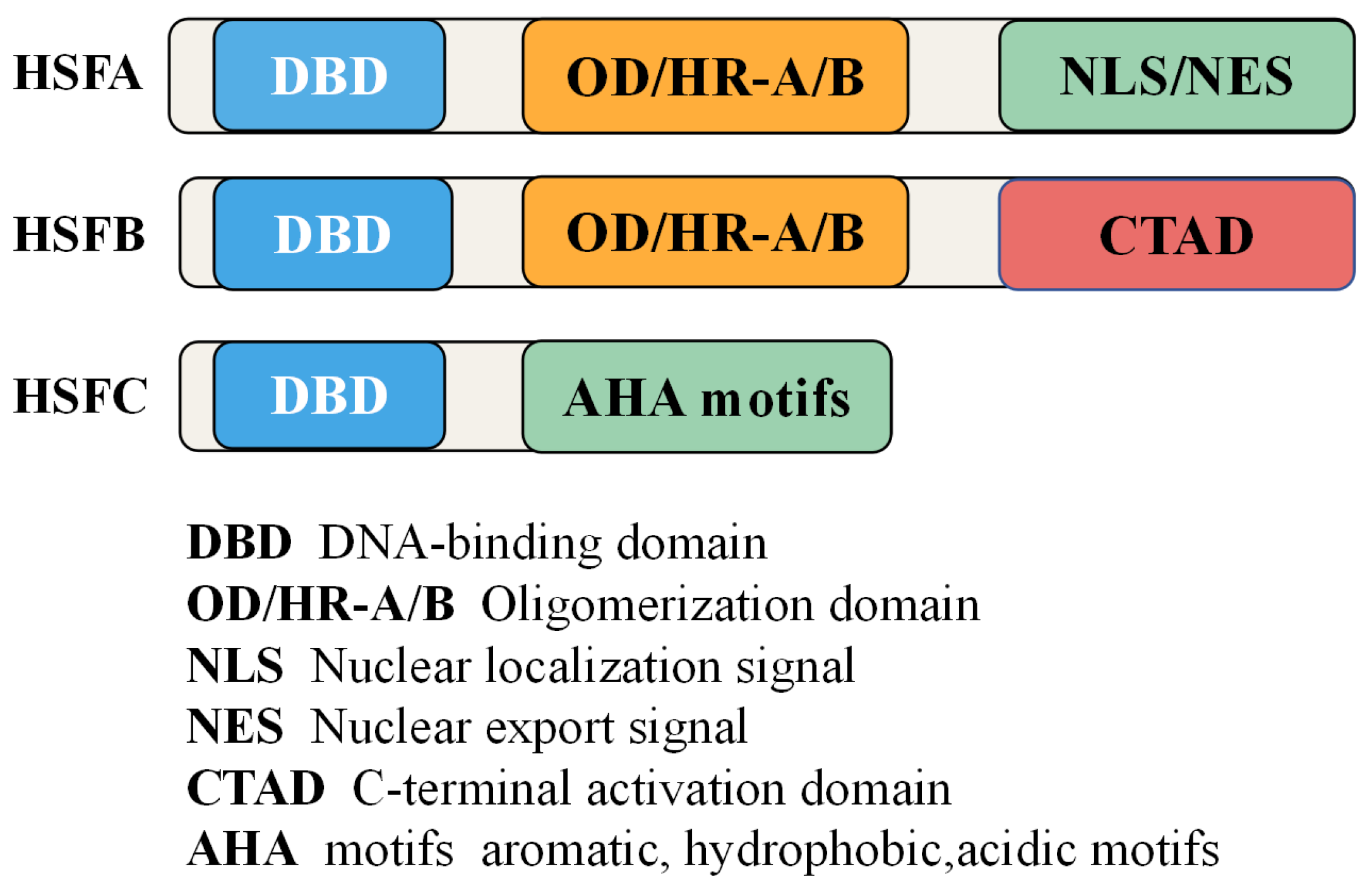
Heat shock transcription factors (HSFs) are defined by a highly conserved modular structure that underpins their function as transcriptional regulators. The core structural organization includes five principal domains: the DNA-binding domain (DBD), the oligomerization domain (OD) or heptad repeat region (HR-A/B), the nuclear localization signal (NLS), the nuclear export signal (NES), and the C-terminal activation domain (CTAD) (Figure 1) [13,15].
The DBD, typically located at the N-terminus, is characterized by a helix-turn-helix motif and a β-sheet wing, enabling specific recognition of heat shock elements (HSEs) in target promoters. HSEs consist of inverted repeats of the 5′-nGAAn-3′ motif, often organized as contiguous or gapped trimeric arrays [27]. This domain shows remarkable conservation across eukaryotes, underscoring its fundamental role in DNA binding and promoter specificity.
Adjacent to the DBD lies the OD (HR-A/B), which mediates trimerization, a prerequisite for HSF activation. The OD contains hydrophobic heptad repeats that form a coiled-coil structure, enabling both homo- and hetero-oligomerization among HSF family members [15,28]. The central HR-A/B domain is separated by variable-length insertions that define the three major classes of plant HSFs (A, B, and C). HSFA proteins typically contain longer linkers between HR-A and HR-B, while HSFBs possess shorter ones, influencing their regulatory behavior and interaction dynamics [14].

2.1.2. Functional Distinctions of HSF Classes

The C-terminal region harbors regulatory motifs essential for transactivation and signal integration. In HSFA members, this region typically contains AHA motifs (aromatic, hydrophobic, acidic amino acids), which function as activation domains by recruiting transcriptional machinery and co-activators [29]. In contrast, HSFB members generally lack AHA motifs and may act as co-repressors, modulating transcriptional activity through protein–protein interactions or competition for HSE binding [30]. Class C HSFs, less well-characterized, often exhibit hybrid or intermediate properties, potentially participating in specialized stress responses or developmental regulation [31,32].

2.1.3. Evolutionary Diversification

Phylogenetic analyses across plant lineages, ranging from algae to angiosperms, indicate that the HSF gene family has undergone extensive duplication, subfunctionalization, and neofunctionalization during evolution [33,34]. For example, Arabidopsis thaliana contains 21 HSF genes, while rice (Oryza sativa) and Sorghum (Sorghum bicolor) possess 25 members [15,35]. Large gene families are also observed in soybean (52 HSFs) and wheat (56 HSFs), reflecting the evolutionary complexity and adaptive flexibility of HSF networks in polyploid crops [15,36]. Evolutionary expansion is closely tied to genome duplication events and environmental adaptation. Comparative genomic studies reveal that HSF clusters often align with loci under positive selection in response to thermal or drought stress [37,38]. Certain subfamilies, such as HSFA1 and HSFA2, are widely conserved as core regulators across species, while others exhibit lineage-specific diversification linked to unique ecological pressures. This evolutionary plasticity underlies the capacity of HSFs to orchestrate complex stress regulatory networks fine-tuned to diverse plant habitats.

2.2. Transcriptional, Post-Transcriptional, Translational and Post-Translational Regulation

The expression of HSF genes themselves is regulated at multiple levels and tightly controlled by developmental cues and environmental signals [13,39]. Many HSFs are induced transcriptionally upon heat, drought, oxidative, or hormonal stimuli, often mediated by upstream transcription factors such as DREB2A, WRKY, or bZIP proteins [40,41,42]. HSFA1 proteins, considered master regulators, can activate downstream HSFs like HSFA2, HSFA3, and HSFB1, forming a hierarchical cascade that amplifies stress responses [19,22,43]. The post-transcriptional regulation of plant HSFs is complex and involves alternative splicing [39,44]. For example, in Arabidopsis, a heat stress-induced HSFA2 variant, HSFA2-III, encodes a truncated isoform (S-HSFA2) that auto-activates its transcription via exon skipping in the DNA-binding domain (DBD) intron [45]. In rice, OsHSFA2d produces two variants: the inactive OsHSFA2dII (dominant under normal conditions, nuclear/cytoplasmic) and the active OsHSFA2dI (nuclear, heat stress-induced), which regulates heat stress response [46]. These examples highlight diversified post-transcriptional HSF regulation in plants.
The activity of HSFs is tightly regulated by post-translational modifications (PTMs), including phosphorylation, SUMOylation, acetylation, and ubiquitination, which collectively fine-tune their stability, localization, and transcriptional capacity [13,15,47,48]. Phosphorylation is the most extensively characterized PTM and often serves as an activating switch. For instance, MAPK-mediated phosphorylation of HSFA2 regulates its nuclear shuttling and transcriptional activity during heat and oxidative stress [49,50]. In contrast, SUMOylation generally acts as a repressive modification that limits HSF transcriptional activity or promotes interaction with negative regulators, ensuring attenuation of the stress response once stress subsides [51]. Notably, some cases, such as SUMOylation of TaHsfA1 in wheat, can enhance transcriptional activation, indicating functional diversity across species [52].
Acetylation and ubiquitination provide additional layers of control that balance HSF activation and turnover. Acetylation of lysine residues, catalyzed by histone acetyltransferases like HAC1, enhances HSF DNA-binding affinity and transactivation potential, reinforcing strong transcriptional responses and contributing to epigenetic memory through histone acetylation at HSP promoters [53,54]. Conversely, ubiquitination targets inactive or excess HSFs for degradation via the 26S proteasome, preventing sustained activation and restoring homeostasis after stress [55]. Together, these PTMs interact in a sequential or antagonistic manner, with phosphorylation and acetylation activating, SUMOylation repressing, and ubiquitination terminating, to ensure precise temporal and spatial regulation of HSF function within the broader plant stress signaling network.
Notably, the expression of HSFs is also modulated through liquid–liquid phase separation (LLPS). Stress granules (SGs), a major type of biomolecular condensate formed under heat stress, are conserved cytoplasmic messenger ribonucleoprotein assemblies that arise from pools of mRNAs stalled at translation initiation and incorporate translation initiation factors along with diverse RBPs and non-RBPs [56]. Because HSF expression is rapidly induced during heat stress to promote thermotolerance, maintaining the stability of their transcripts is crucial. In Arabidopsis thaliana, heat stress triggers the LLPS-driven condensation of ALBA4/5/6 proteins into SGs, where they protect HSF mRNAs from degradation by the exoribonuclease XRN4. Likewise, the glycine-rich RNA-binding proteins RBGD2 and RBGD4 undergo LLPS to form SGs that safeguard key heat-responsive transcripts, including HSFA2 and HSP70, thereby enhancing thermotolerance [56].

2.3. Subcellular Localization and Oligomerization Dynamics

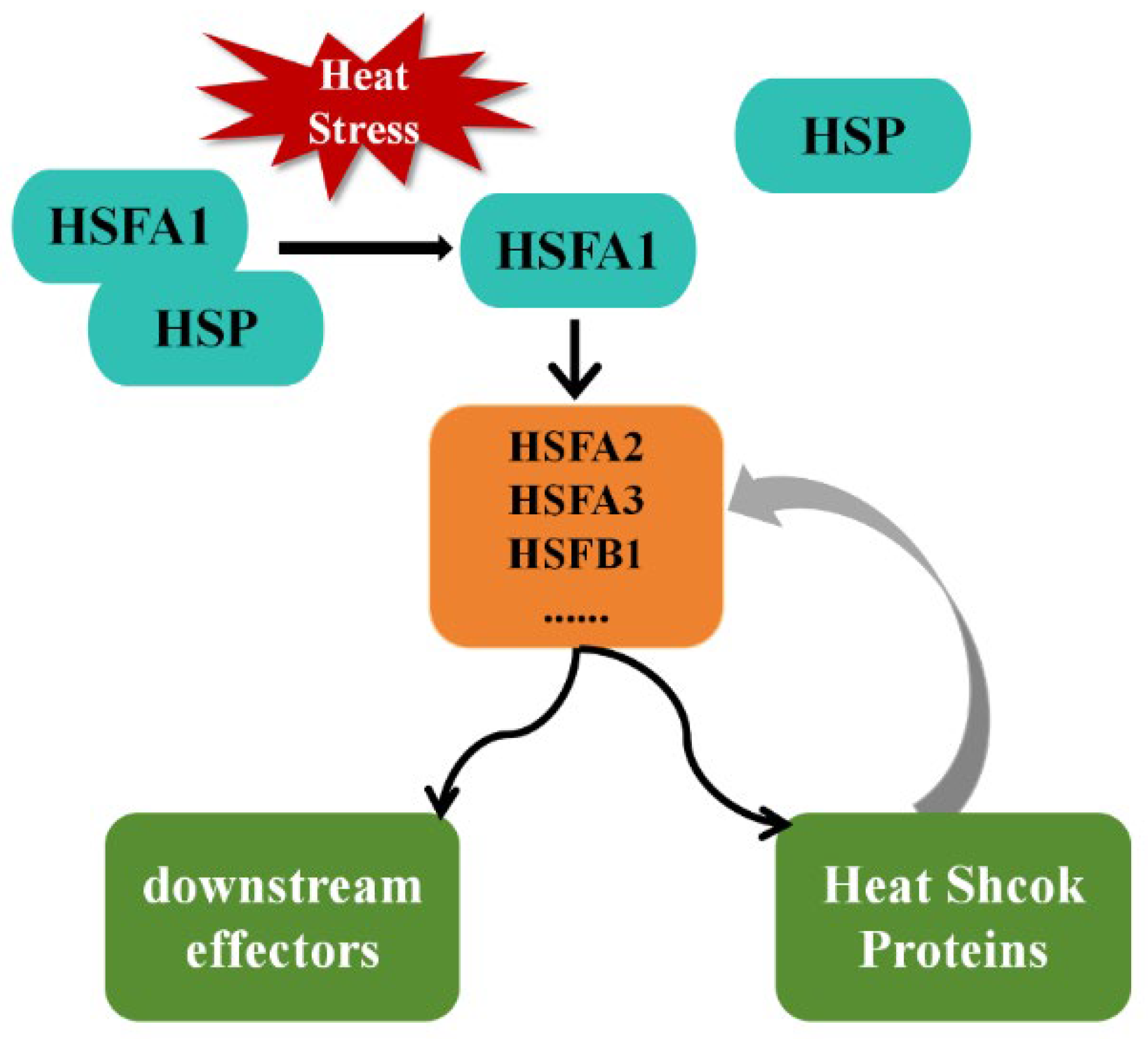
HSFs are synthesized as inactive monomers that shuttle between the cytoplasm and nucleus. Under non-stress conditions, they are maintained in an inactive state through interactions with HSP70/HSP90 chaperone complexes. Upon stress exposure, unfolded proteins accumulate and titrate away these chaperones, releasing HSFs to trimerize, translocate to the nucleus, and bind HSEs [43,57]. After stress relief, feedback mechanisms mediated by HSPs reestablish homeostasis by promoting HSF monomerization and cytoplasmic sequestration. This dynamic nucleocytoplasmic cycling ensures that HSF activation is transient and tightly controlled, preventing unnecessary metabolic costs during normal growth. Importantly, differences in nuclear localization signals (NLS) and nuclear export signals (NES) among HSF classes contribute to functional specialization and temporal regulation of gene expression during successive stress phases [12,19].
In summary, the structural modularity and multilayered regulation of HSFs confer remarkable flexibility and specificity, enabling them to act as both general and specialized regulators of plant stress responses. The integration of transcriptional, post-transcriptional, and post-translational control allows plants to rapidly fine-tune HSF activity in response to environmental fluctuations. These foundational mechanisms underpin the canonical and non-canonical roles of HSFs discussed in subsequent sections.

3. Canonical Function of HSFs in Heat Stress Response

Heat stress is one of the most pervasive environmental threats affecting plant survival, growth, and productivity [2,58]. Elevated temperatures disrupt protein folding, destabilize membranes, and impair photosynthetic machinery, leading to the accumulation of misfolded or denatured proteins and reactive oxygen species (ROS) [59,60]. To counter these effects, plants have evolved a well-orchestrated heat stress response (HSR), a complex regulatory network that restores cellular homeostasis through the induction of heat shock proteins (HSPs) and other protective molecules [61]. At the transcriptional level, the HSR is primarily governed by heat shock transcription factors (HSFs), which act as the master regulators of heat-induced gene expression [15,62]. Activation of HSFs triggers a rapid and massive transcriptional reprogramming, ensuring timely expression of HSPs, antioxidant enzymes, and signaling mediators that collectively confer thermotolerance.

3.1. Activation and Dynamics of HSFs During Heat Stress

Under normal conditions, HSFs exist in the cytoplasm as inactive monomers, repressed by direct association with HSP70 and HSP90 chaperone complexes [39,63,64]. Heat-induced protein unfolding sequesters these chaperones, freeing HSF monomers to undergo trimerization via their HR-A/B domains, a critical step for activation [15]. The resulting HSF trimers translocate to the nucleus, where they bind specifically to heat shock elements (HSEs) in promoter regions of target genes, initiating transcription [19]. This activation is rapid and reversible, reflecting an efficient feedback system that balances protective gene expression with energy conservation. Once cellular proteostasis is restored, newly synthesized HSPs rebind to active HSFs, promoting their monomerization and cytoplasmic sequestration, thereby terminating the heat response. Such autoregulatory loops ensure that thermotolerance mechanisms are transient and tightly modulated.

3.2. HSFA1 as the Master Regulator

Among plant HSFs, HSFA1 is widely recognized as the master regulator of the heat stress response [22,52]. Arabidopsis mutants lacking HSFA1 isoforms (HSFA1a, HSFA1b, HSFA1d, HSFA1e) exhibit dramatically reduced thermotolerance and fail to activate downstream HSFs and HSPs. HSFA1 directly binds to HSEs in promoters of HSFA2, HSFA3, HSFB1, and MBF1C, initiating a hierarchical transcriptional cascade that amplifies and sustains the heat response (Figure 2) [22].
HSFA1 also interacts with signaling proteins such as DEHYDRATION-RESPONSIVE ELEMENT BINDING PROTEIN 2A (DREB2A) and NAC transcription factors, forming regulatory hubs that link heat stress perception to broader transcriptional reprogramming [13,62]. Furthermore, HSFA1 is modulated by post-translational modifications such as phosphorylation and sumoylation, which fine-tune its activity in response to the intensity and duration of heat stress [13,65].

3.3. HSFA2 as the Amplifier of Sustained Thermotolerance

While HSFA1 triggers the initial HSR, HSFA2 functions as a potent amplifier of sustained thermotolerance. HSFA2 expression is strongly induced by heat, oxidative stress, and certain phytohormones, and its protein accumulates rapidly during prolonged or repeated stress exposure [66]. Acting downstream of HSFA1, HSFA2 activates a large subset of heat-responsive genes, which encode HSPs, chaperonins, and redox-regulating enzymes such as ascorbate peroxidases (APXs) and glutathione S-transferases (GSTs) [57,67,68].
HSFA2 also contributes to transcriptional memory, the phenomenon whereby plants exhibit enhanced tolerance to recurring heat stress. Upon a second heat episode, previously activated HSFA2 rebinds rapidly to HSEs, often in cooperation with histone modifications (e.g., H3K4me3) that maintain chromatin in a primed state [24,26]. This molecular memory allows plants to recall previous stress encounters and mount faster, stronger responses, a key feature of adaptive thermotolerance.

3.4. Roles of Other HSF Classes in Heat Response

In addition to HSFA1 and HSFA2, several other HSFs participate in fine-tuning the HSR. HSFA3 is induced by the DREB2A-dependent pathway and contributes to the long-term acclimation phase of heat stress by regulating genes involved in osmoprotection and metabolism [42]. HSFA6b mediates ABA-responsive transcriptional activation under heat and drought stress, integrating hormonal and thermal cues [69,70]. HSFB1 and HSFB2b, though lacking classical activation domains, act as co-regulators, serving as either repressors or activators, depending on their interaction partners. HSFB1, for instance, interacts with and represses HSFA1 activity to modulate gene expression. Interestingly, in tomato, HSFB1 exhibits dual functions, serving as both a transcriptional repressor and a co-activator [15,71,72]. Such hierarchical and cooperative regulation allows plants to orchestrate a temporally layered HSR. Early-acting HSFs (e.g., HSFA1) initiate rapid protective gene expression, while late-acting ones (e.g., HSFA2, HSFA3) sustain or modulate responses according to stress duration and severity.

3.5. Heat Shock Proteins (HSPs) as Downstream Targets of HSFs

The principal downstream targets of HSFs are heat shock proteins (HSPs), a diverse family of molecular chaperones categorized into major classes, consisting of HSP100, HSP90, HSP70, HSP60, and small HSPs (sHSPs), based on molecular weight and function [73]. HSPs prevent protein aggregation, refold denatured proteins, and facilitate the degradation of irreversibly damaged polypeptides [74]. For instance, HSP70 and HSP90 act as central hubs of proteostasis, directly interacting with signaling proteins and HSFs to regulate activity and recovery phases. sHSPs, localized in various organelles (chloroplasts, mitochondria, peroxisomes), stabilize thylakoid membranes and photosystem II during heat stress, thereby maintaining photosynthetic efficiency [75]. HSP100 (ClpB) family members, such as HSP101, are required for thermotolerance by resolubilizing aggregated proteins, a process essential for post-stress recovery [76]. The tight feedback between HSFs and HSPs ensures a dynamic equilibrium. HSFs activate HSP expression, while HSPs, in turn, repress excessive HSF activity, constituting a self-regulating chaperone circuit critical for cellular balance.

3.6. Coordination with ROS and Antioxidant Systems

Heat stress invariably perturbs redox homeostasis, leading to elevated ROS production. HSFs play a pivotal role in linking ROS signaling with transcriptional regulation. For example, HSFA2 and HSFA4a activate genes encoding ascorbate peroxidase (APX), superoxide dismutase (SOD), and thioredoxin enzymes that detoxify ROS and mitigate oxidative damage [77,78,79]. Moreover, ROS themselves can act as secondary messengers that modulate HSF activation through redox-sensitive cysteine residues, establishing a feedback mechanism that couples oxidative status with transcriptional control [13,80].

3.7. Heat Stress Memory and Epigenetic Regulation

Recent studies have shown that plants possess a form of heat stress memory, whereby exposure to a mild heat stress primes the genome for quicker reactivation upon subsequent stress [81]. HSFs, particularly HSFA2, are central to this process. After initial activation, HSFA2 associates with chromatin remodelers and histone modifiers, maintaining a histone methylation landscape (H3K4me3, H3K9ac) at promoters of heat-responsive genes [53,82]. This epigenetic imprinting ensures transcriptional readiness and contributes to acquired thermotolerance, a hallmark of plant stress adaptation.
In summary, the canonical role of HSFs in the heat stress response exemplifies a highly organized regulatory hierarchy. HSFA1 functions as the master switch initiating the response, HSFA2 sustains and amplifies it, and other HSFs modulate fine-tuning, integration, and feedback. Together, these factors orchestrate a comprehensive protective system encompassing chaperone induction, redox regulation, and epigenetic memory formation. The mechanistic complexity and versatility of HSFs in thermotolerance provide the foundation for their extended roles in other environmental stress contexts, as explored in the next section.

4. Multifunctional Roles of HSFs in Other Abiotic Stresses

Although initially identified as key regulators of thermotolerance, accumulating evidence reveals that HSFs are versatile players in plant adaptation to a wide spectrum of abiotic stresses, including drought, salinity, cold, oxidative stress, and heavy metal toxicity [10,11,12,13]. This multifunctionality arises from the broad activation mechanisms of HSFs and their integration with hormonal and redox signaling pathways that respond to diverse stress cues. The ability of HSFs to sense and interpret multiple stress signals makes them central integrators within the broader plant stress regulatory network. In many cases, distinct HSF isoforms are activated not only by heat but also by drought, high salinity, or cold exposure, leading to overlapping transcriptional outputs that promote cross-tolerance, a phenomenon where exposure to one stress enhances resistance to another.

4.1. HSFs in Drought Stress Tolerance

Drought stress induces cellular dehydration, osmotic imbalance, and oxidative damage, activating transcriptional programs that overlap substantially with the heat stress response. Several HSF genes are upregulated under water deficit and play crucial roles in enhancing drought tolerance through coordination with the abscisic acid signaling pathway. In Arabidopsis, HSFA6a and HSFA6b function as ABA-dependent transcriptional activators. HSFA6a expression is rapidly induced by ABA and dehydration, and its overexpression enhances drought tolerance via upregulation of LEA proteins, HSPs, and ROS-scavenging enzymes [69]. HSFA6 binds directly to ABA-responsive elements (ABREs) in target gene promoters and cooperates with bZIP transcription factors such as ABF3/4, integrating HSF and ABA signaling [22]. Homologous genes in wheat (TaHSFA6f) and maize (ZmHSFA6b) exhibit similar regulatory patterns, suggesting evolutionary conservation across plant lineages [36].
Beyond its classical role in thermotolerance, HSFA2 contributes to drought resilience by maintaining protein homeostasis and redox balance. It activates cytosolic and chloroplastic HSPs, APX1, and GSTU17, thereby reducing oxidative damage associated with water deficit [83,84]. Overexpression of HSFA2 in tomato and rice enhances drought recovery and preserves photosynthetic efficiency [39]. Other HSF family members also participate in drought adaptation. HSFA1a and HSFA1b overexpression improves water utilization and drought resistance in tomato and Arabidopsis [85,86], while HaHSFA4a and HaHSFA9 from sunflower confer enhanced tolerance in transgenic tobacco [87]. Members of the HSFB and HSFC classes serve as fine-tuners of drought response. HSFB1 interacts with HSFA1 and MBF1C to regulate drought-inducible chaperones [15], whereas HSFC1 adjusts stress gene expression in rice and maize. Interestingly, HSFBs can exert both positive and negative regulatory effects. ZmHSF08 and OsHSFB2b act as repressors of drought tolerance in maize and rice [88], while HvHSFB2c enhances tolerance in barley [89]. Likewise, wheat TaHSFC2a-B mediates combined drought and heat resilience during grain filling through ABA-dependent mechanisms. Collectively, these studies demonstrate that HSFs act as central integrators of drought signaling, functioning in concert with ABA and redox networks to preserve cellular homeostasis and sustain growth under dehydration stress.

4.2. HSFs in Salinity Stress Adaptation

High salinity imposes osmotic and ionic stress, disrupting homeostasis and redox balance. HSFs enhance salt tolerance by activating osmoprotectant biosynthesis, ion transport, and antioxidant defense. In Arabidopsis, HSFA1a and HSFA2 are upregulated under salt stress, inducing HSP70, HSP101, and APX1 to mitigate oxidative damage [23,90]. hsfa1 mutants exhibit NaCl hypersensitivity and ROS accumulation, whereas HSFA1 overexpression restores redox balance and ion selectivity [22]. HSFs also intersect with the SOS and ABA signaling pathways. HSFA6a interacts with ABF/AREB transcription factors to activate SOS1, NHX1, and P5CS, linking ion homeostasis and osmotic protection [36,69]. In rice, OsHSFA2e and OsHSFA4d mediate salt-induced transcriptional memory via persistent histone acetylation, facilitating rapid gene reactivation during recurrent stress [91].
Diverse HSF family members contribute differentially to salinity tolerance. Overexpression of OsHSFA7 enhances salt resistance in rice [92], whereas tomato SlHSFA3 increases Arabidopsis salt sensitivity [93]. A wheat HSF TaHSFA2d improves germination and tolerance in Arabidopsis under salt stress [94], and HSFA4a deficiency heightens salt sensitivity [95]. Among Arabidopsis HSFs, HSFA6b shows particularly strong induction under salinity [96]. HSFB and HSFC members also participate in salt regulation. GmHSFB2b in soybean promotes flavonoid synthesis and ROS detoxification, thereby enhancing salt tolerance [97], while ZmHSF08 in maize and OsHSFB2b in rice act as negative regulators, with overexpressing lines exhibiting increased salt sensitivity [88,98]. Collectively, HSFs integrate ionic, osmotic, and oxidative stress responses, functioning as central transcriptional and epigenetic regulators that shape plant resilience under salinity.

4.3. HSFs in Cold Stress Tolerance

Cold stress disrupts membrane fluidity and cellular metabolism, triggering extensive transcriptional reprogramming [99,100]. Although primarily associated with thermotolerance, some HSFs have emerged as crucial mediators of cold acclimation and chilling tolerance. HSFA1 not only governs heat stress responses but also modulates cold signaling by activating CBF/DREB1 transcription factors, central regulators of cold-responsive genes [69,101]. Transcriptome analyses have revealed significant upregulation of several HSFs in forage crops exposed to cold stress, including MsHSF04, MsHSF11, and MsHSF13 in alfalfa (Medicago sativa) [102], as well as BdHSF09, BdHSF14, BdHSF20, and BdHSF22 in Brachypodium distachyon [103]. In maize (Zea mays), HSF21 enhances cold tolerance by regulating lipid metabolism genes such as GPATs and SADs, while knockout mutants exhibit reduced tolerance [104]. In rice (Oryza sativa), OsHSFA3, OsHSFA4d, and OsHSFA9 are induced by cold stress, whereas most HSFB-like genes are repressed except OsHSFB4a and OsHSFB4b. Members of the HSFC family, especially OsHSFC1, are strongly activated, suggesting a role in low-temperature sensing [105]. Similar induction occurs in carrot (Daucus carota), where DcHSF16, belonging to HSFC family, responds to cold stress [106]. In banana (Musa acuminata), MaHSF24 acts as a negative regulator of chilling tolerance by repressing MaHSP23.6/70 and antioxidant genes (MaAPX1, MaGSTZ1) [107]. Together, these findings highlight HSFs as key integrators of cold stress responses, coordinating transcriptional, metabolic, and redox adjustments for improved plant resilience.

4.4. HSFs in Heavy Metal Stress Tolerance

HSFs are also involved in plant defense against heavy metal stress (e.g., Cd), mainly by activating detoxification and antioxidant pathways. In wheat, HsfA4a confers Cd tolerance by upregulating metallothionein gene expression [108]. In the Cd/Zn/Pb hyperaccumulator Sedum alfredii, 22 HSF genes were identified, with 18 members showing Cd-responsive expression [109]. Among them, SaHSFA4c transcripts and proteins were strongly induced by Cd in all tissues, leading to the activation of ROS-related genes and HSPs, which in turn reduced ROS accumulation in transgenic Arabidopsis and in the non-hyperaccumulating ecotype of S. alfredii [110]. Transcriptomic studies in Cd-treated switchgrass roots further revealed that HSF/HSP modules contribute to maintaining protein homeostasis and proper folding under Cd stress, while overexpression of an HSP gene in Arabidopsis markedly improved Cd tolerance [111]. In tomato, HsfA1a promotes Cd tolerance by inducing melatonin biosynthesis [112]. Likewise, PuHSFA4a from Populus ussuriensis activates target genes PuGSTU17 and PuPLA, enhancing antioxidant defenses and root development to support Zn tolerance [113]. Collectively, class A HSFs enhance heavy metal tolerance by regulating genes associated with metal chelation, ROS scavenging, and cellular homeostasis.
In summary, HSFs constitute a multifunctional transcription factor family that transcends their classical role in thermotolerance. Through diverse isoforms, post-translational modifications, and signaling crosstalk, they orchestrate complex defense networks against drought, salinity, cold, oxidative, and toxic stresses (Table 1). The evolutionary expansion and diversification of HSFs have allowed plants to build robust and flexible stress response systems, underpinning the concept of HSFs as universal stress integrators.

5. HSFs in Biotic Stress Responses

5.1. Expanding the Functional Landscape: From Abiotic to Biotic Stress

While HSFs are best known for their roles in abiotic stress responses, mounting evidence indicates their significant contribution to biotic stress resistance [19]. Biotic and abiotic stress signaling pathways often converge at the transcriptional level, with HSFs acting as key integrators of these combined responses.
Pathogen infection triggers massive transcriptional reprogramming, activating defense-related genes, secondary metabolism, and hormone signaling pathways [123]. Intriguingly, several HSFs are induced not only by temperature or drought but also by bacterial, fungal, and viral attacks, indicating a shared regulatory framework between thermal and immune responses [11,124,125,126]. This dual functionality suggests that HSFs evolved as versatile regulatory hubs that link abiotic and biotic responses.

5.2. Role of HSFs in Plant Pathogen Defense

Plants rely on a multilayered immune system, comprising pattern-triggered immunity (PTI) and effector-triggered immunity (ETI), to defend against pathogen invasion. Recent studies have demonstrated that HSFs actively participate in these immune processes by modulating defense-related transcriptional networks, reactive oxygen species (ROS) homeostasis, and hormone-mediated signaling pathways. In Arabidopsis thaliana, several HSFs are rapidly induced upon pathogen attack. HSFA1a, HSFA2, and HSFA4a are activated following infection by Pseudomonas syringae, contributing to disease resistance through the upregulation of pathogenesis-related (PR) genes [85,127]. Overexpression of HSFA1a enhances salicylic acid (SA)-dependent defense and systemic acquired resistance (SAR), whereas AtHSFA2 functions in the full activation of SA-mediated immune responses [128,129]. In contrast, HSFB1 and HSFB2b, typically acting as repressors of the heat shock response, exert complex regulatory roles in immunity [23]. HSFB1 negatively modulates jasmonic acid (JA)- and ethylene-responsive defensin genes, which affects resistance against the necrotrophic fungus Alternaria brassicicola [124]. Moreover, HSFB1 expression is induced by SA and mediates the balance between growth and defense [130], suggesting its involvement in resource allocation under biotic stress.
Functional studies in other plant species further highlight the conserved and diversified roles of HSFs in pathogen defense. In pepper (Capsicum annuum), silencing of CaHSFB2a compromises resistance to Ralstonia solanacearum, while its overexpression triggers hypersensitive response (HR)-like cell death, H2O2 accumulation, and activation of defense marker genes, establishing a positive feedback loop with CaWRKY6 and CaWRKY40 [131]. Similarly, overexpression of OsHSFB4d in rice enhances resistance to Xanthomonas oryzae pathovars, accompanied by elevated expression of OsHsp18.0-CI and multiple PR genes [121].
HSFs also contribute to pathogen resistance through integration with hormone signaling and redox regulation. In rice, OsHSFA2d activates JASMONATE ZIM-DOMAIN (JAZ) genes under heat stress, linking the HSF pathway to JA-mediated defense, while AtHSFA1b in Arabidopsis promotes JA biosynthesis via activation of AtOPR3 [132,133]. In barley, overexpression of HvHSFA2e confers broad-spectrum stress tolerance through modulation of hormone balance and secondary metabolism [134]. In cassava (Manihot esculenta), MeHSF3 directly binds to the promoters of EDS1 and PR4, reinforcing defense against Xanthomonas axonopodis pv. Manihotis [135]. Likewise, in tomato, HSFA1a regulates RBOH-dependent ROS production through the HSFA1a–Wfi1 signaling cascade, initiating an early oxidative burst during infection by Meloidogyne incognita [136].
Collectively, these findings establish HSFs as integral regulators of plant immunity that interface with classical defense hormones, redox signaling, and transcriptional control. By orchestrating the expression of defense-related genes and mediating crosstalk among SA, JA, and ROS pathways, HSFs function not only as stress-responsive transcription factors but also as key modulators linking environmental and biotic stress resilience.

6. Crosstalk Between HSFs and Phytohormones

Plant stress responses are not isolated linear pathways but interconnected signaling networks integrating hormonal, metabolic, and redox cues [137,138,139]. Heat shock transcription factors (HSFs) lie at the intersection of these networks, translating upstream signals into precise transcriptional outputs that promote stress adaptation. Recent studies demonstrate that HSFs interact with phytohormone pathways such as abscisic acid (ABA), ethylene (ET), salicylic acid (SA), jasmonic acid (JA), and auxin [12,19]. This crosstalk allows plants to coordinate local and systemic responses, balance growth and defense, and fine-tune stress tolerance depending on developmental stage and stress duration.

6.1. Crosstalk Between HSFs and Abscisic Acid (ABA) Signaling

ABA is a pivotal hormone coordinating plant adaptation to abiotic stresses such as drought, salinity, and temperature extremes. Increasing evidence demonstrates that heat shock transcription factors (HSFs) are deeply integrated into ABA-mediated stress signaling networks, forming reciprocal regulatory loops that enhance plant resilience.
In Arabidopsis, the expression of HSFA6b is induced by ABA through the action of ABA-RESPONSIVE ELEMENT-BINDING PROTEIN1 (AREB1), a key transcriptional activator in ABA signaling [69]. Once activated, HSFA6b promotes the transcription of DREB2A (DEHYDRATION-RESPONSIVE ELEMENT-BINDING PROTEIN2A), thereby bridging the ABA and heat shock regulatory pathways. Thus, HSFA6b functions as a positive regulator not only of thermotolerance but also of drought and salinity tolerance. Moreover, HSFA6b participates in multiple ABA-dependent developmental and physiological processes, including seed germination, cotyledon greening, and root growth, highlighting its broad regulatory scope. Other HSF members are similarly integrated within the ABA network. During seed maturation, the ABA pathway component ABI3 regulates HSFA9 expression in Arabidopsis, linking HSF activity to desiccation tolerance during seed development [40]. In crops, this crosstalk is evolutionarily conserved. For instance, in wheat (Triticum aestivum), three homologs of TaHSFC2a are induced by ABA, heat, and drought stress, with TaHSFC2a-B enhancing heat tolerance during grain filling through an ABA-mediated pathway [122]. Likewise, in rice (Oryza sativa), OsHSFA3 enhances drought tolerance by elevating endogenous ABA levels and boosting antioxidant capacity [140]. Collectively, these findings underscore the close interplay between HSFs and ABA signaling. Through mutual regulation, ABA-responsive HSFs serve as crucial integrators of hormonal and environmental signals, fine-tuning transcriptional networks that govern plant stress tolerance and developmental plasticity.

6.2. Crosstalk Between HSFs and Ethylene Signaling

Ethylene signaling plays a vital role in plant thermotolerance by mitigating heat-induced oxidative damage [141]. Recent studies reveal that HSFs and ethylene signaling components are functionally interconnected through a shared transcriptional network. In Arabidopsis, activation of the ethylene pathway triggers a cascade mediated by ethylene response factor (ERF) transcription factors. Notably, ERF95 and ERF97 directly bind to the promoter of HSFA2, thereby inducing its expression and establishing a mechanistic link between ethylene signaling and the heat shock response [142]. Furthermore, HSFA7b functions as a key regulator of thermomemory in the Arabidopsis shoot apical meristem by modulating the expression of ethylene biosynthesis and signaling genes, including ETHYLENE INSENSITIVE 3 (EIN3) [143]. This reciprocal regulation underscores the bidirectional nature of HSF–ethylene interactions, where ethylene signaling activates specific HSFs, and in turn, HSFs fine-tune ethylene-mediated responses.
The relevance of this crosstalk extends beyond Arabidopsis. The root endophyte Enterobacter sp. SA187 enhances thermotolerance in both Arabidopsis and wheat through ethylene-mediated signaling and by inducing thermomemory-associated histone modifications [144]. In rice (Oryza sativa), multiple HSFs, including OsHSFA1a, OsHSFA2a, OsHSFA2c, OsHSFA2d, OsHSFA2e, and OsHSFA2f, contribute to heat tolerance by integrating into the ethylene signaling pathway, further supporting the conserved role of HSF–ethylene interplay in orchestrating heat resilience across plant species [145]. Together, these findings highlight ethylene as a key hormonal partner of HSFs in coordinating thermotolerance and thermomemory through transcriptional and epigenetic mechanisms.

6.3. Crosstalk Between HSFs and Brassinosteroid Signaling

Brassinosteroids (BRs) are essential plant steroid hormones best known for promoting growth, development, and stress adaptation through a phosphorylation-dependent signaling cascade. Upon BR perception by the receptor complex containing BRASSINOSTEROID INSENSITIVE 1 (BRI1), a signaling module involving BR INSENSITIVE 2 (BIN2) kinase and BRI1 SUPPRESSOR 1 (BSU1) phosphatase regulates the activation of the transcription factors BRI1-EMS-SUPPRESSOR 1/BRASSINAZOLE-RESISTANT 2 (BES1/BZR2) and BZR1 via dephosphorylation [146]. Beyond their developmental roles, BRs play a crucial part in thermotolerance. Recent advances have clarified the molecular mechanisms linking BR signaling to the heat shock response via direct interaction with HSFs [61]. Heat stress induces dephosphorylation and nuclear accumulation of BES1, which cooperates with HSFA1a at heat shock elements to activate HSP70 and HSP90 gene expression [147,148]. Functional analyses further confirm this regulatory role. BES1 gain-of-function mutants display enhanced heat tolerance, whereas BES1 loss-of-function mutants exhibit reduced thermotolerance [149,150]. Similarly, a dominant mutation in BZR1 (bzr1-D) confers elevated heat stress resistance [151], suggesting a conserved role for BZR-like proteins in BR–HSF crosstalk.
The interplay between BR signaling components and HSFs appears to involve multiple regulatory layers. For example, heat-induced BES1 activation occurs independently of BRI1, as demonstrated in the bri1-1 mutant [150]. However, a different bri1 allele (bri1-116) shows decreased survival under heat stress [152], indicating potential context-dependent contributions of BRI1 to thermotolerance. In contrast, BIN2 that represses BES1 also phosphorylates HSFA1d, preventing its nuclear localization and transcriptional activity during the HSR [153]. Intriguingly, both BES1 and BIN2 are clients of HSP90, which regulates their nuclear translocation and stability [154,155]. This points to a potential feedback loop wherein the HSR modulates BR signaling components to fine-tune stress recovery and post-stress growth. Collectively, these findings highlight a sophisticated network of HSF–BR interactions, where BR-responsive transcription factors such as BES1 and BZR1 cooperate with HSFs to activate HSP expression, while kinases like BIN2 dynamically balance stress signaling and developmental growth.

6.4. Crosstalk Between HSFs and Auxin, Jasmonic Acid, and Salicylic Acid Signaling

Emerging evidence reveals multifaceted crosstalk between HSFs and phytohormones such as auxin, jasmonic acid (JA), and salicylic acid (SA), highlighting their roles as central integrators of stress and hormonal responses [19]. Auxin signaling modulates root architecture and stress adaptation, in part through interactions with HSFs. In poplar (Populus trichocarpa), the auxin repressor IAA17.1 physically interacts with HSFA5a, a root-enriched and salt-inducible transcription factor [156]. Overexpression of HSFA5a enhances flavonol accumulation, reduces reactive oxygen species (ROS) buildup, and promotes lateral root growth and salt tolerance, suggesting that auxin–HSF interplay fine-tunes redox balance and developmental plasticity under stress. Similarly, in sunflower (Helianthus annuus), HaIAA27 interacts with HaHSFA9, repressing its transcriptional activity [157]. These findings indicate that Aux/IAA proteins can directly modulate HSF function, linking auxin homeostasis with HSF-mediated stress regulation.
The interaction between HSFs and JA signaling contributes to both thermotolerance and defense responses. In Arabidopsis, HSFB1 and HSFB2b act as repressors of the heat shock response but positively regulate acquired thermotolerance [158]. Intriguingly, HSFB1 also functions as a negative regulator of PDF1.2a and PDF1.2b, two JA-responsive defensin genes, thereby modulating innate immunity against necrotrophic pathogens such as Alternaria brassicicola [124]. Beyond Arabidopsis, TaHSFA1b in wheat enhances heat tolerance through JA-mediated signaling pathways [133], while in rice (Oryza sativa), HTG3/OsHSFA2d activates JASMONATE ZIM-DOMAIN (JAZ) genes under heat stress, reinforcing the connection between HSF activity and JA-responsive transcription [159]. Similarly, HSFA1b in Arabidopsis induces AtOPR3, a key enzyme in JA biosynthesis, establishing a positive regulatory loop between JA production and HSF activity [133]. In barley (Hordeum vulgare), HvHSFA2e has been shown to confer multi-stress tolerance by modulating hormonal signaling and secondary metabolism [134].
HSFs also participate in SA-dependent defense and thermotolerance mechanisms. In Arabidopsis, HSFB1 is induced by SA and mediates trade-offs between growth and defense, with reduced expression of HSFB1 in F1 hybrids correlating with enhanced biomass accumulation [130]. In pepper (Capsicum annuum), silencing of CaHSFB2a compromises resistance to Ralstonia solanacearum, whereas its overexpression triggers hypersensitive response (HR)-like cell death, H2O2 accumulation, and activation of SA-related defense genes [131]. Furthermore, in tomato (Solanum lycopersicum), SA treatment under heat stress enhances HSF expression and DNA-binding activity, upregulating HSP70 and improving thermotolerance [128].
In summary, HSFs occupy a central regulatory position at the crossroads of phytohormones. They are simultaneously activated by and regulate hormones such as ABA, ET, BR, SA, JA, and auxin. Through these interactions, HSFs orchestrate dynamic feedback loops that harmonize growth, defense, and metabolic stability. This intricate crosstalk underscores the conceptual shift from viewing HSFs as mere heat-response regulators to recognizing them as core integrators of plant stress signaling networks.

7. Applications

The growing understanding of heat shock transcription factors (HSFs) as central integrators of plant stress responses has opened new opportunities for biotechnological innovation and crop improvement. By manipulating HSF regulatory networks, we can potentially enhance multi-stress resilience, yield stability, and stress memory in plants, which are critical goals in the face of accelerating climate change and resource scarcity. This section discusses current translational applications, biotechnological strategies, and emerging research directions that could harness HSFs for agricultural and ecological benefits.

7.1. Engineering HSFs for Multi-Stress Tolerance

Early attempts to engineer thermotolerance focused on overexpressing single HSF genes, often resulting in enhanced heat tolerance. For example, overexpression of HSFA1a or HSFA2 in Arabidopsis confers improved survival under heat stress by upregulating chaperone and antioxidant genes [79]. Similarly, transgenic tomato plants overexpressing SlHSFA1a or SlHSFA2 exhibit increased tolerance not only to heat but also to drought and oxidative stress [39]. These results highlight the pleiotropic effects of HSFs that extend beyond their canonical thermo-protective role.
In rice (Oryza sativa), overexpression of OsHSFA2e and OsHSFA3 enhances both heat and salt tolerance, accompanied by increased accumulation of osmoprotectants, such as proline and soluble sugars [92]. Similarly, maize (Zea mays) lines expressing ZmHSFA2 or ZmHSFB2b show improved photosynthetic performance and yield stability under combined heat and drought stress. These studies demonstrate that HSFs represent valuable genetic targets for developing crops with broad-spectrum stress tolerance.
However, constitutive overexpression of HSFs may lead to growth penalties or altered developmental phenotypes due to the metabolic costs associated with persistent stress responses [62]. Therefore, fine-tuned expression systems using stress-inducible promoters (e.g., RD29A) or tissue-specific expression are recommended to minimize negative trade-offs. Synthetic biology approaches combining promoter engineering, inducible gene switches, and transcriptional feedback loops hold promise for achieving precision control of HSF activity.

7.2. Manipulating Downstream HSF Pathways

Beyond direct modification of HSF genes, engineering their downstream pathways offers another strategic route for enhancing resilience. Many HSFs regulate overlapping sets of heat shock proteins (HSPs), ROS scavengers, and osmoprotective enzymes, which act as effector modules of stress protection [15]. For example, manipulation of HSP70 or HSP101 under HSF promoter control has successfully improved thermotolerance in wheat and maize [94,116].
Recent advances in gene stacking and multiplex CRISPR editing enable simultaneous targeting of multiple HSF–HSP nodes, allowing synergistic enhancement of stress resistance without major yield penalties. Moreover, network-guided engineering based on transcriptomic co-expression data can identify key regulatory hubs within the HSF-centered interactome, guiding rational design of resilient genotypes.
In parallel, modulating HSF post-translational regulation represents an underexplored avenue. Small molecules or peptides that stabilize HSF–HSP interactions or alter HSF SUMOylation/ubiquitination status could offer chemical tools for stress management. For example, inhibition of specific E3 ubiquitin ligases that target HSFA2 increases thermotolerance in Arabidopsis. Future development of HSF-targeted regulators might thus complement genetic engineering for precise stress control.

7.3. Integrating HSF Networks with Hormonal and Epigenetic Engineering

Given that HSFs act at the crossroads of hormone signaling and epigenetic memory, their manipulation could be combined with broader network engineering approaches. ABA-inducible HSFs such as HSFA6A and HSFA6B are ideal entry points for enhancing drought and salinity tolerance through improved ABA responsiveness. Similarly, cross-regulation between HSFs and salicylic acid signaling components (e.g., NPR1) offers a route to integrate abiotic and biotic stress tolerance.
Recent findings that HSFs participate in chromatin remodeling and transgenerational stress memory raise exciting possibilities for epigenetic breeding. Plants exposed to repeated stress often display inherited tolerance traits associated with sustained HSF activity and histone modifications at HSF target genes [24]. Harnessing such stable epigenetic marks either through mild priming treatments or targeted epigenome editing (e.g., CRISPR-dCas9–TET/HAT fusions) could complement conventional breeding programs for climate-resilient crops.

7.4. HSFs as Biomarkers and Selection Tools in Breeding

Because HSFs are among the earliest and most responsive transcription factors induced under stress, they serve as reliable molecular biomarkers for screening stress-resilient genotypes. Transcript abundance of key HSFs such as HSFA1, HSFA2, and HSFB2b correlates strongly with thermotolerance and drought recovery in tomato, maize, and soybean [39]. High-throughput qPCR and RNA-seq profiling of HSF expression signatures can thus aid in marker-assisted selection (MAS) and genomic selection (GS) pipelines for breeding programs.
Furthermore, advances in machine learning and network inference allow predictive modeling of stress tolerance based on HSF-centered transcriptional modules. By integrating multi-omics datasets (transcriptomics, proteomics, metabolomics), breeders can identify robust biomarkers representing systems-level resilience rather than single-gene responses. Such integrative frameworks bridge molecular biology with quantitative genetics, accelerating the translation of HSF biology into field performance.

7.5. Limitations for Translational Use of HSFs

Despite promising results in greenhouses and controlled environments, several key bottlenecks impede the direct translation of heat shock factor (HSF) overexpression into field-level yield stability. Strong phenotypes observed in laboratory settings often diminish under complex field conditions, as HSF effects are highly context-dependent and generate substantial genotype × environment interactions. Constitutive or poorly regulated HSF overexpression frequently imposes growth and yield penalties due to metabolic burdens and resource reallocation, such as persistent chaperone synthesis and altered hormone balances, or by tilting the growth–defense equilibrium toward defense, thereby reducing biomass accumulation. Pleiotropy and redundancy within the HSF family further complicate predictable outcomes, as overexpressing one HSF may induce compensatory changes in other family members, hormone networks, or secondary metabolism, potentially heightening pathogen susceptibility or altering ecological interactions (e.g., with pollinators or soil microbes). Moreover, the epigenetic and transgenerational stability of engineered HSF states remains uncertain, with beneficial priming in one generation possibly resetting or leading to unintended carry-over effects in subsequent ones. Regulatory, biosafety, and public acceptance challenges also pose significant constraints, particularly for transgenic approaches in diverse agroecosystems.
Addressing these limitations will necessitate a multifaceted approach. Strategies include employing stress-inducible or tissue-specific promoters to prevent chronic activation; stacking complementary HSF/HSP and metabolic effector modules instead of relying on single-gene overexpression; conducting extensive multi-location and multi-year field trials to assess genotype × environment effects; integrating HSF modules into breeding pipelines via marker-assisted selection or genomic selection for adaptation to local backgrounds; and performing thorough ecological risk assessments. Prioritizing precision regulation and systems-level evaluation will be crucial to advance HSF engineering from promising proof-of-concept studies to robust, yield-stable agricultural applications.

8. Conclusions

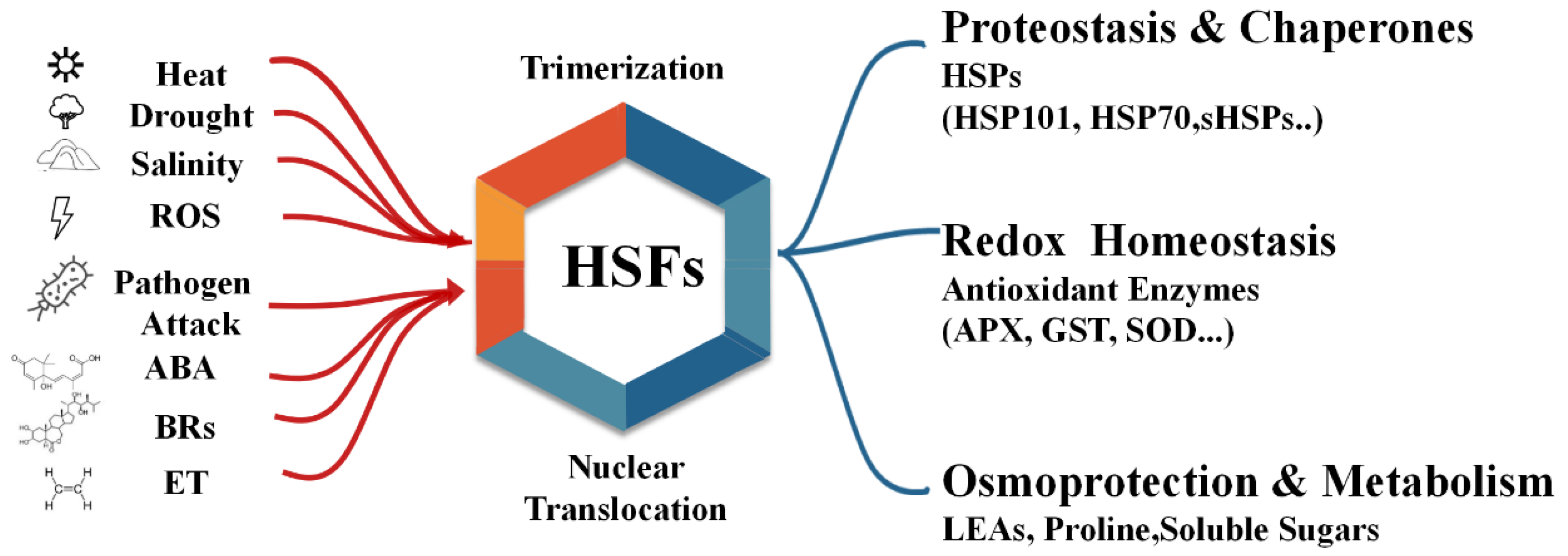
The accumulated body of evidence over the past decades has transformed our understanding of HSFs from specialized mediators of heat stress to global integrators of plant stress adaptation and resilience. Once regarded merely as activators of heat shock proteins, HSFs are now recognized as master regulators coordinating diverse molecular, physiological, and developmental processes in response to both abiotic and biotic cues (Figure 3). Their ability to sense perturbations in cellular proteostasis, integrate hormonal and redox signals, and imprint transcriptional memory positions them at the core of the plant’s adaptive network.
At the molecular level, HSFs exhibit remarkable versatility, shaped by domain modularity, post-translational modifications, and dynamic protein–protein interactions. These properties allow them to act as fine-tuned sensors and signal processors, linking external stress perception to genome-wide transcriptional reprogramming. Beyond thermotolerance, HSFs now stand at the crossroads of multi-stress responses, participating in the regulation of drought, salinity, cold, oxidative, and pathogen stresses through interconnected networks that confer robustness and plasticity.
From an evolutionary perspective, the expansion and diversification of HSF gene families across plant lineages illustrate adaptive innovation in the face of environmental complexity. Comparative genomics has revealed lineage-specific expansions in monocots and dicots, suggesting that HSF diversification parallels the ecological adaptation of plant species to distinct climates and habitats. Future exploration of these evolutionary trajectories could provide invaluable insights into the molecular basis of environmental resilience.
At the systems level, HSFs exemplify the principles of hierarchical regulation and network resilience. The HSF–HSP–proteostasis feedback loop functions as a molecular thermostat, maintaining cellular equilibrium under fluctuating conditions. Crosstalk between HSFs and hormonal, ROS, and epigenetic pathways forms a multilayered communication system that allows plants to integrate information across temporal and spatial scales. This capacity to balance immediate stress defense with long-term developmental priorities underpins the concept of multi-stress resilience, in which plants coordinate complex trade-offs to ensure survival and productivity.
The emerging frontiers of synthetic biology, genome editing, and systems modeling now offer unprecedented opportunities to harness HSF networks for sustainable agriculture. Through precision engineering, it is conceivable to construct plants with programmable stress responses, capable of dynamically adjusting to temperature fluctuations, drought, or salinity without compromising yield. The development of synthetic HSF circuits, stress-inducible promoters, and CRISPR-based regulatory modules can transform HSF biology into tangible agricultural technologies. Moreover, integrating epigenetic memory engineering with HSF manipulation may enable the design of crops capable of retaining adaptive “memories” across generations, opening new avenues for durable stress tolerance.
Nevertheless, several challenges persist. Unraveling the context dependency, redundancy, and cross-family interactions among HSFs remains an ongoing task. Future research must also consider the ecological and evolutionary implications of manipulating such central regulators, as excessive or mis-regulated activation could disrupt plant homeostasis and ecosystem balance. Therefore, multidisciplinary approaches combining molecular biology, physiology, ecology, and computational modeling will be essential to translate HSF research into real-world impact.
In summary, HSFs are not merely heat-responsive transcription factors but dynamic integrators of environmental and developmental information. They represent a paradigm for how plants orchestrate complex networks to survive in challenging environments. As we continue to decode the systems biology of HSFs, we are also learning fundamental lessons about resilience, adaptability, and life’s capacity to thrive under stress. Harnessing these insights for agriculture will not only enhance food security but also deepen our understanding of biological robustness in the face of a rapidly changing planet.

Author Contributions

Conceptualization, F.D. and Z.S.; software, Y.L. and K.G.; formal analysis, Y.L., K.G. and X.W.; writing—original draft preparation, Y.L., K.G. and X.W.; writing—review and editing, F.D. and Z.S.; visualization, Y.L.; supervision, F.D. and Z.S.; funding acquisition, F.D. All authors have read and agreed to the published version of the manuscript.

Funding

This work was supported by Shandong Provincial Natural Science Foundation (ZR2025MS427), National Natural Science Foundation of China (32472724) and Liaocheng University (318042402).

Data Availability Statement

No new data were created or analyzed in this study.

Conflicts of Interest

The authors declare no conflicts of interest.

References

  1. Pereira, A. Plant Abiotic Stress Challenges from the Changing Environment. Front. Plant Sci. 2016, 7, 1123. [Google Scholar] [CrossRef]
  2. Liang, K.; Fan, X.; Liu, Y.; Tian, R.; Wang, M.; Sun, Z.; Ding, F. ABA Positively Regulates SlAPX2-Mediated Tolerance to Heat and Cold in Tomato Plants. Agronomy 2025, 15, 1206. [Google Scholar] [CrossRef]
  3. Dang, F.; Lin, J.; Li, Y.; Jiang, R.; Fang, Y.; Ding, F.; He, S.; Wang, Y. SlWRKY30 and SlWRKY81 Synergistically Modulate Tomato Immunity to Ralstonia Solanacearum by Directly Regulating SlPR-STH2. Hortic. Res. 2023, 10, uhad050. [Google Scholar] [CrossRef]
  4. Wang, M.; Zhang, S.; Ding, F. Melatonin Mitigates Chilling-Induced Oxidative Stress and Photosynthesis Inhibition in Tomato Plants. Antioxidants 2020, 9, 218. [Google Scholar] [CrossRef]
  5. Xie, G.; Xu, R.; Chong, L.; Zhu, Y. Understanding Drought Stress Response Mechanisms in Tomato. Veg. Res. 2024, 4, e001. [Google Scholar] [CrossRef]
  6. Pasion-Uy, E.A.; Uy, L.Y.C.; Kavi Kishor, P.B.; Fernie, A.R.; Sreenivasulu, N. Sustained Cereal Bowl amidst Global Warming. Trends Plant Sci. 2025. [Google Scholar] [CrossRef] [PubMed]
  7. Jung, J.H.; Seo, P.J.; Oh, E.; Kim, J. Temperature Perception by Plants. Trends Plant Sci. 2023, 28, 924–940. [Google Scholar] [CrossRef] [PubMed]
  8. Wang, M.; Fan, X.; Ding, F. Jasmonate: A Hormone of Primary Importance for Temperature Stress Response in Plants. Plants 2023, 12, 4080. [Google Scholar] [CrossRef]
  9. Rehman, A.; Atif, R.M.; Azhar, M.T.; Peng, Z.; Li, H.; Qin, G.; Jia, Y.; Pan, Z.; He, S.; Qayyum, A.; et al. Genome Wide Identification, Classification and Functional Characterization of Heat Shock Transcription Factors in Cultivated and Ancestral Cottons (Gossypium spp.). Int. J. Biol. Macromol. 2021, 182, 1507–1527. [Google Scholar] [CrossRef]
  10. Wang, Y.X.; Xu, J.H. The Heat Shock Transcription Factors Regulate Response Mechanisms to Abiotic Stresses in Plants. Crop Des. 2025, 4, 100109. [Google Scholar] [CrossRef]
  11. Gomez-Pastor, R.; Burchfiel, E.T.; Thiele, D.J. Regulation of Heat Shock Transcription Factors and Their Roles in Physiology and Disease. Nat. Rev. Mol. Cell Biol. 2018, 19, 4–19. [Google Scholar] [CrossRef]
  12. Feng, Y.; Xia, P. Heat Shock Transcription Factors as Integrative Hubs for Plant Stress Adaptation: Decoding Regulatory Networks Toward Climate-Resilient Crop Design. Plant Cell Environ. 2025, 48, 8985–9001. [Google Scholar] [CrossRef]
  13. Guo, M.; Liu, J.H.; Ma, X.; Luo, D.X.; Gong, Z.H.; Lu, M.H. The Plant Heat Stress Transcription Factors (HSFS): Structure, Regulation, and Function in Response to Abiotic Stresses. Front. Plant Sci. 2016, 7, 114. [Google Scholar] [CrossRef]
  14. Nover, L.; Bharti, K.; Döring, P.; Mishra, S.K.; Ganguli, A.; Scharf, K.D. Arabidopsis and the Heat Stress Transcription Factor World: How Many Heat Stress Transcription Factors Do We Need? Cell Stress Chaperones 2001, 6, 177–189. [Google Scholar] [CrossRef]
  15. Scharf, K.D.; Berberich, T.; Ebersberger, I.; Nover, L. The Plant Heat Stress Transcription Factor (Hsf) Family: Structure, Function and Evolution. Biochim. Biophys. Acta Gene Regul. Mech. 2012, 1819, 104–119. [Google Scholar] [CrossRef]
  16. Zhou, M.; Zheng, S.; Liu, R.; Lu, J.; Lu, L.; Zhang, C.; Liu, Z.; Luo, C.; Zhang, L.; Yant, L.; et al. Genome-Wide Identification, Phylogenetic and Expression Analysis of the Heat Shock Transcription Factor Family in Bread Wheat (Triticum aestivum L.). BMC Genom. 2019, 20, 505. [Google Scholar] [CrossRef] [PubMed]
  17. Guo, J.; Wu, J.; Ji, Q.; Wang, C.; Luo, L.; Yuan, Y.; Wang, Y.; Wang, J. Genome-Wide Analysis of Heat Shock Transcription Factor Families in Rice and Arabidopsis. J. Genet. Genom. 2008, 35, 105–118. [Google Scholar] [CrossRef] [PubMed]
  18. Lin, Y.X.; Jiang, H.Y.; Chu, Z.X.; Tang, X.L.; Zhu, S.W.; Cheng, B.J. Genome-Wide Identification, Classification and Analysis of Heat Shock Transcription Factor Family in Maize. BMC Genom. 2011, 12, 76. [Google Scholar] [CrossRef] [PubMed]
  19. Bakery, A.; Vraggalas, S.; Shalha, B.; Chauhan, H.; Benhamed, M.; Fragkostefanakis, S. Heat Stress Transcription Factors as the Central Molecular Rheostat to Optimize Plant Survival and Recovery from Heat Stress. New Phytol. 2024, 244, 51–64. [Google Scholar] [CrossRef]
  20. Naik, J.; Rajput, R.; Singh, S.; Stracke, R.; Pandey, A. Heat-Responsive MaHSF11 Transcriptional Activator Positively Regulates Flavonol Biosynthesis and Flavonoid B-Ring Hydroxylation in Banana (Musa acuminata). Plant J. 2025, 121, e70084. [Google Scholar] [CrossRef]
  21. Rudić, J.; Pantelić, D.; Oljača, J.; Momčilović, I. Effects of Elevated Temperature and Salicylic Acid on Heat Shock Response and Growth of Potato Microplants. Horticulturae 2022, 8, 372. [Google Scholar] [CrossRef]
  22. Yoshida, T.; Ohama, N.; Nakajima, J.; Kidokoro, S.; Mizoi, J.; Nakashima, K.; Maruyama, K.; Kim, J.M.; Seki, M.; Todaka, D.; et al. Arabidopsis HsfA1 Transcription Factors Function as the Main Positive Regulators in Heat Shock-Responsive Gene Expression. Mol. Genet. Genom. 2011, 286, 321–332. [Google Scholar] [CrossRef]
  23. Nishizawa-Yokoi, A.; Nosaka, R.; Hayashi, H.; Tainaka, H.; Maruta, T.; Tamoi, M.; Ikeda, M.; Ohme-Takagi, M.; Yoshimura, K.; Yabuta, Y.; et al. HsfA1d and HsfA1e Involved in the Transcriptional Regulation of Hsfa2 Function as Key Regulators for the Hsf Signaling Network in Response to Environmental Stress. Plant Cell Physiol. 2011, 52, 933–945. [Google Scholar] [CrossRef] [PubMed]
  24. Staacke, T.; Mueller-Roeber, B.; Balazadeh, S. Stress Resilience in Plants: The Complex Interplay between Heat Stress Memory and Resetting. New Phytol. 2025, 245, 2402–2421. [Google Scholar] [CrossRef] [PubMed]
  25. Zheng, L.; Zhang, Q.; Wang, C.; Wang, Z.; Gao, J.; Zhang, R.; Shi, Y.; Zheng, X. The Heat Shock Factor HSFB1 Coordinates Plant Growth and Drought Tolerance in Arabidopsis. Plant J. 2025, 121, e17258. [Google Scholar] [CrossRef]
  26. Nishio, H.; Kawakatsu, T.; Yamaguchi, N. Beyond Heat Waves: Unlocking Epigenetic Heat Stress Memory in Arabidopsis. Plant Physiol. 2024, 194, 1934–1951. [Google Scholar] [CrossRef]
  27. Andrási, N.; Pettkó-Szandtner, A.; Szabados, L. Diversity of Plant Heat Shock Factors: Regulation, Interactions, and Functions. J. Exp. Bot. 2021, 72, 1558–1575. [Google Scholar]
  28. Peteranderl, R.; Rabenstein, M.; Shin, Y.K.; Liu, C.W.; Wemmer, D.E.; King, D.S.; Nelson, H.C.M. Biochemical and Biophysical Characterization of the Trimerization Domain from the Heat Shock Transcription Factor. Biochemistry 1999, 38, 3559–3569. [Google Scholar] [CrossRef]
  29. von Koskull-Döring, P.; Scharf, K.D.; Nover, L. The Diversity of Plant Heat Stress Transcription Factors. Trends Plant Sci. 2007, 12, 452–457. [Google Scholar] [CrossRef]
  30. Ikeda, M.; Ohme-Takagi, M. A Novel Group of Transcriptional Repressors in Arabidopsis. Plant Cell Physiol. 2009, 50, 970–975. [Google Scholar] [CrossRef]
  31. Lu, J.; Wu, T.; Zhang, B.; Liu, S.; Song, W.; Qiao, J.; Ruan, H. Types of Nuclear Localization Signals and Mechanisms of Protein Import into the Nucleus. Cell Commun. Signal. 2021, 19, 60. [Google Scholar] [CrossRef]
  32. Yun, L.; Zhang, Y.; Li, S.; Yang, J.; Wang, C.; Zheng, L.; Ji, L.; Yang, J.; Song, L.; Shi, Y.; et al. Phylogenetic and Expression Analyses of HSF Gene Families in Wheat (Triticum aestivum L.) and Characterization of TaHSFB4-2B under Abiotic Stress. Front. Plant Sci. 2023, 13, 1047400. [Google Scholar] [CrossRef]
  33. Pei, Q.; Yu, T.; Wu, T.; Yang, Q.; Gong, K.; Zhou, R.; Cui, C.; Yu, Y.; Zhao, W.; Kang, X.; et al. Comprehensive Identification and Analyses of the Hsf Gene Family in the Whole-Genome of Three Apiaceae Species. Hortic. Plant J. 2021, 7, 457–468. [Google Scholar] [CrossRef]
  34. Li, X.T.; Feng, X.Y.; Zeng, Z.; Liu, Y.; Shao, Z.Q. Comparative Analysis of HSF Genes from Secale Cereale and Its Triticeae Relatives Reveal Ancient and Recent Gene Expansions. Front. Genet. 2021, 12, 801218. [Google Scholar] [CrossRef] [PubMed]
  35. Nagaraju, M.; Sudhakar Reddy, P.; Anil Kumar, S.; Srivastava, R.K.; Kavi Kishor, P.B.; Rao, D.M. Genome-Wide Scanning and Characterization of Sorghum Bicolor L. Heat Shock Transcription Factors. Curr. Genom. 2015, 16, 279–291. [Google Scholar] [CrossRef]
  36. Xue, G.P.; Sadat, S.; Drenth, J.; McIntyre, C.L. The Heat Shock Factor Family from Triticum aestivum in Response to Heat and Other Major Abiotic Stresses and Their Role in Regulation of Heat Shock Protein Genes. J. Exp. Bot. 2014, 65, 539–557. [Google Scholar] [CrossRef]
  37. Saha, D.; Mukherjee, P.; Dutta, S.; Meena, K.; Sarkar, S.K.; Mandal, A.B.; Dasgupta, T.; Mitra, J. Genomic Insights into HSFs as Candidate Genes for High-Temperature Stress Adaptation and Gene Editing with Minimal off-Target Effects in Flax. Sci. Rep. 2019, 9, 5581. [Google Scholar] [CrossRef]
  38. Li, Z.; Zheng, Q.; Feng, L.; Lv, F.; Xiao, Y.; Liu, Z.; Wan, F.; Zhou, T.; Ma, Y.; Xu, B. Evolutionary and Functional Insights into HSF Gene Family Underpin Thermal Adaptation in the Plateau Plant Anisodus Tanguticus. BMC Plant Biol. 2025, 25, 1452. [Google Scholar] [CrossRef]
  39. Fragkostefanakis, S.; Röth, S.; Schleiff, E.; Scharf, K.D. Prospects of Engineering Thermotolerance in Crops through Modulation of Heat Stress Transcription Factor and Heat Shock Protein Networks. Plant Cell Environ. 2015, 38, 1881–1895. [Google Scholar] [PubMed]
  40. Kotak, S.; Vierling, E.; Bäumlein, H.; Von Koskull-Dörlng, P. A Novel Transcriptional Cascade Regulating Expression of Heat Stress Proteins during Seed Development of Arabidopsis. Plant Cell 2007, 19, 182–195. [Google Scholar] [CrossRef]
  41. Li, S.; Khoso, M.A.; Xu, H.; Zhang, C.; Liu, Z.; Wagan, S.; Dinislam, K.; Liu, L. WRKY Transcription Factors (TFs) as Key Regulators of Plant Resilience to Environmental Stresses: Current Perspective. Agronomy 2024, 14, 2421. [Google Scholar] [CrossRef]
  42. Yoshida, T.; Sakuma, Y.; Todaka, D.; Maruyama, K.; Qin, F.; Mizoi, J.; Kidokoro, S.; Fujita, Y.; Shinozaki, K.; Yamaguchi-Shinozaki, K. Functional Analysis of an Arabidopsis Heat-Shock Transcription Factor HsfA3 in the Transcriptional Cascade Downstream of the DREB2A Stress-Regulatory System. Biochem. Biophys. Res. Commun. 2008, 368, 515–521. [Google Scholar] [CrossRef]
  43. Haider, S.; Iqbal, J.; Naseer, S.; Shaukat, M.; Abbasi, B.A.; Yaseen, T.; Zahra, S.A.; Mahmood, T. Unfolding Molecular Switches in Plant Heat Stress Resistance: A Comprehensive Review. Plant Cell Rep. 2022, 41, 775–798. [Google Scholar]
  44. Wen, J.; Qin, Z.; Sun, L.; Zhang, Y.; Wang, D.; Peng, H.; Yao, Y.; Hu, Z.; Ni, Z.; Sun, Q.; et al. Alternative Splicing of TaHSFA6e Modulates Heat Shock Protein–Mediated Translational Regulation in Response to Heat Stress in Wheat. New Phytol. 2023, 239, 2235–2247. [Google Scholar] [CrossRef]
  45. Liu, J.; Sun, N.; Liu, M.; Liu, J.; Du, B.; Wang, X.; Qi, X. An Autoregulatory Loop Controlling Arabidopsis HsfA2 Expression: Role of Heat Shock-Induced Alternative Splicing. Plant Physiol. 2013, 162, 512–521. [Google Scholar] [CrossRef] [PubMed]
  46. Cheng, Q.; Zhou, Y.; Liu, Z.; Zhang, L.; Song, G.; Guo, Z.; Wang, W.; Qu, X.; Zhu, Y.; Yang, D. An Alternatively Spliced Heat Shock Transcription Factor, OsHSFA2dI, Functions in the Heat Stress-Induced Unfolded Protein Response in Rice. Plant Biol. 2015, 17, 419–429. [Google Scholar] [CrossRef] [PubMed]
  47. Song, L.; Jiang, Y.; Zhao, H.; Hou, M. Acquired Thermotolerance in Plants. Plant Cell Tissue Organ Cult. 2012, 111, 265–276. [Google Scholar] [CrossRef]
  48. Liu, J.; Wen, D.; Song, X.; Su, P.; Lou, J.; Yao, D.; Zhang, C. Evolution and Natural Selection of Ribosome-Inactivating Proteins in Bacteria, Fungi, and Plants. Int. J. Biol. Macromol. 2023, 248, 125929. [Google Scholar] [CrossRef]
  49. Evrard, A.; Kumar, M.; Lecourieux, D.; Lucks, J.; von Koskull-Döring, P.; Hirt, H. Regulation of the Heat Stress Response in Arabidopsis by MPK6-Targeted Phosphorylation of the Heat Stress Factor HsfA2. PeerJ 2013, 2013, e59. [Google Scholar] [CrossRef]
  50. Mo, S.; Qian, Y.; Zhang, W.; Qian, L.; Wang, Y.; Cailin, G.; Ding, H. Mitogen-Activated Protein Kinase Action in Plant Response to High-Temperature Stress: A Mini Review. Protoplasma 2021, 258, 477–482. [Google Scholar]
  51. Augustine, R.C.; York, S.L.; Rytz, T.C.; Vierstra, R.D. Defining the SUMO System in Maize: SUMOylation Is up-Regulated during Endosperm Development and Rapidly Induced by Stress. Plant Physiol. 2016, 171, 2191–2210. [Google Scholar] [CrossRef]
  52. Wang, H.; Feng, M.; Jiang, Y.; Du, D.; Dong, C.; Zhang, Z.; Wang, W.; Liu, J.; Liu, X.; Li, S.; et al. Thermosensitive SUMOylation of TaHsfA1 Defines a Dynamic ON/OFF Molecular Switch for the Heat Stress Response in Wheat. Plant Cell 2023, 35, 3889–3910. [Google Scholar] [CrossRef]
  53. Friedrich, T.; Oberkofler, V.; Trindade, I.; Altmann, S.; Brzezinka, K.; Lämke, J.; Gorka, M.; Kappel, C.; Sokolowska, E.; Skirycz, A.; et al. Heteromeric HSFA2/HSFA3 Complexes Drive Transcriptional Memory after Heat Stress in Arabidopsis. Nat. Commun. 2021, 12, 3426. [Google Scholar] [CrossRef] [PubMed]
  54. Srivastava, A.K.; Lu, Y.; Zinta, G.; Lang, Z.; Zhu, J.K. UTR-Dependent Control of Gene Expression in Plants. Trends Plant Sci. 2018, 23, 248–259. [Google Scholar] [CrossRef] [PubMed]
  55. Liu, H.C.; Liao, H.T.; Charng, Y.Y. The Role of Class A1 Heat Shock Factors (HSFA1s) in Response to Heat and Other Stresses in Arabidopsis. Plant Cell Environ. 2011, 34, 738–751. [Google Scholar] [CrossRef] [PubMed]
  56. Liu, Q.; Liu, W.; Niu, Y.; Wang, T.; Dong, J. Liquid–Liquid Phase Separation in Plants: Advances and Perspectives from Model Species to Crops. Plant Commun. 2024, 5, 100663. [Google Scholar] [CrossRef]
  57. Tian, F.; Hu, X.L.; Yao, T.; Yang, X.; Chen, J.G.; Lu, M.Z.; Zhang, J. Recent Advances in the Roles of HSFs and HSPs in Heat Stress Response in Woody Plants. Front. Plant Sci. 2021, 12, 704905. [Google Scholar] [CrossRef]
  58. Xiong, J.; Wang, H.; Zhong, Z.; Li, S.; Qin, P. Emerging Strategies to Improve Heat Stress Tolerance in Crops. Abiotech 2025, 6, 97–115. [Google Scholar] [CrossRef]
  59. Apel, K.; Hirt, H. Reactive Oxygen Species: Metabolism, Oxidative Stress, and Signal Transduction. Annu. Rev. Plant Biol. 2004, 55, 373–399. [Google Scholar] [CrossRef]
  60. Suzuki, N.; Mittler, R. Reactive Oxygen Species and Temperature Stresses: A Delicate Balance between Signaling and Destruction. Physiol. Plant 2006, 126, 45–51. [Google Scholar] [CrossRef]
  61. Dündar, G.; Ramirez, V.E.; Poppenberger, B. The Heat Shock Response in Plants: New Insights into Modes of Perception, Signaling, and the Contribution of Hormones. J. Exp. Bot. 2025, 76, 1970–1977. [Google Scholar] [CrossRef]
  62. Ohama, N.; Sato, H.; Shinozaki, K.; Yamaguchi-Shinozaki, K. Transcriptional Regulatory Network of Plant Heat Stress Response. Trends Plant Sci. 2017, 22, 53–65. [Google Scholar] [CrossRef] [PubMed]
  63. Hahn, A.; Bublak, D.; Schleiff, E.; Scharf, K.D. Crosstalk between Hsp90 and Hsp70 Chaperones and Heat Stress Transcription Factors in Tomato. Plant Cell 2011, 23, 741–755. [Google Scholar] [CrossRef] [PubMed]
  64. Gemperline, D.C.; Marshall, R.S.; Lee, K.H.; Zhao, Q.; Hu, W.; McLoughlin, F.; Scalf, M.; Smith, L.M.; Vierstra, R.D. Proteomic Analysis of Affinity-Purified 26S Proteasomes Identifies a Suite of Assembly Chaperones in Arabidopsis. J. Biol. Chem. 2019, 294, 17570–17592. [Google Scholar] [CrossRef]
  65. Zhang, S.; Wang, S.; Lv, J.; Liu, Z.; Wang, Y.; Ma, N.; Meng, Q. SUMO E3 Ligase SlSIZ1 Facilitates Heat Tolerance in Tomato. Plant Cell Physiol. 2018, 59, 58–71. [Google Scholar] [CrossRef]
  66. Haider, S.; Raza, A.; Iqbal, J.; Shaukat, M.; Mahmood, T. Analyzing the Regulatory Role of Heat Shock Transcription Factors in Plant Heat Stress Tolerance: A Brief Appraisal. Mol. Biol. Rep. 2022, 49, 5771–5785. [Google Scholar] [CrossRef] [PubMed]
  67. Yurina, N.P. Heat Shock Proteins in Plant Protection from Oxidative Stress. Mol. Biol. 2023, 57, 951–964. [Google Scholar] [CrossRef]
  68. Cheng, S.; Zhang, X.; Mu, H.; Wang, J.; Jiang, Y.; Li, X.; Wen, Y.; Ma, Q.; Guo, S. Transcriptome Analysis Unravels Differential Genes Involved in Essential Oil Content in Callus and Tissue Culture Seedlings of Lavandula angustifolia. Biotechnol. Biotechnol. Equip. 2024, 38, 2367097. [Google Scholar] [CrossRef]
  69. Huang, Y.C.; Niu, C.Y.; Yang, C.R.; Jinn, T.L. The Heat Stress Factor HSFA6b Connects ABA Signaling and ABA-Mediated Heat Responses. Plant Physiol. 2016, 172, 1182–1199. [Google Scholar] [CrossRef]
  70. Poonia, A.K.; Mishra, S.K.; Sirohi, P.; Chaudhary, R.; Kanwar, M.; Germain, H.; Chauhan, H. Overexpression of Wheat Transcription Factor (TaHsfA6b) Provides Thermotolerance in Barley. Planta 2020, 252, 53. [Google Scholar] [CrossRef]
  71. Haider, S.; Iqbal, J.; Naseer, S.; Yaseen, T.; Shaukat, M.; Bibi, H.; Ahmad, Y.; Daud, H.; Abbasi, N.L.; Mahmood, T. Molecular Mechanisms of Plant Tolerance to Heat Stress: Current Landscape and Future Perspectives. Plant Cell Rep. 2021, 40, 2247–2271. [Google Scholar] [CrossRef] [PubMed]
  72. Fragkostefanakis, S.; Simm, S.; El-Shershaby, A.; Hu, Y.; Bublak, D.; Mesihovic, A.; Darm, K.; Mishra, S.K.; Tschiersch, B.; Theres, K.; et al. The Repressor and Co-Activator HsfB1 Regulates the Major Heat Stress Transcription Factors in Tomato. Plant Cell Environ. 2019, 42, 874–890. [Google Scholar] [CrossRef]
  73. Ul Haq, S.; Khan, A.; Ali, M.; Khattak, A.M.; Gai, W.X.; Zhang, H.X.; Wei, A.M.; Gong, Z.H. Heat Shock Proteins: Dynamic Biomolecules to Counter Plant Biotic and Abiotic Stresses. Int. J. Mol. Sci. 2019, 20, 5321. [Google Scholar] [CrossRef]
  74. Wang, W.; Vinocur, B.; Shoseyov, O.; Altman, A. Role of Plant Heat-Shock Proteins and Molecular Chaperones in the Abiotic Stress Response. Trends Plant Sci. 2004, 9, 244–252. [Google Scholar] [CrossRef]
  75. Bourgine, B.; Guihur, A. Heat Shock Signaling in Land Plants: From Plasma Membrane Sensing to the Transcription of Small Heat Shock Proteins. Front. Plant Sci. 2021, 12, 710801. [Google Scholar] [CrossRef]
  76. Mondal, S.; Karmakar, S.; Panda, D.; Pramanik, K.; Bose, B.; Singhal, R.K. Crucial Plant Processes under Heat Stress and Tolerance through Heat Shock Proteins. Plant Stress 2023, 10, 100227. [Google Scholar] [CrossRef]
  77. Wang, C.; Zhou, Y.; Yang, X.; Zhang, B.; Xu, F.; Wang, Y.; Song, C.; Yi, M.; Ma, N.; Zhou, X.; et al. The Heat Stress Transcription Factor LlHsfA4 Enhanced Basic Thermotolerance through Regulating ROS Metabolism in Lilies (Lilium longiflorum). Int. J. Mol. Sci. 2022, 23, 572. [Google Scholar] [CrossRef]
  78. Shah, Z.; Iqbal, A.; Khan, F.U.; Khan, H.U.; Durrani, F.; Ahmad, M.Z. Genetic Manipulation of Pea (Pisum sativum L.) with Arabidopsis’s Heat Shock Factor HsfA1d Improves ROS Scavenging System to Confront Thermal Stress. Genet. Resour. Crop Evol. 2020, 67, 2119–2127. [Google Scholar] [CrossRef]
  79. Schramm, F.; Ganguli, A.; Kiehlmann, E.; Englich, G.; Walch, D.; Von Koskull-Döring, P. The Heat Stress Transcription Factor HsfA2 Serves as a Regulatory Amplifier of a Subset of Genes in the Heat Stress Response in Arabidopsis. Plant Mol. Biol. 2006, 60, 759–772. [Google Scholar] [CrossRef] [PubMed]
  80. Zhou, Y.; Xu, F.; Shao, Y.; He, J. Regulatory Mechanisms of Heat Stress Response and Thermomorphogenesis in Plants. Plants 2022, 11, 3410. [Google Scholar] [CrossRef] [PubMed]
  81. Bäurle, I.; Trindade, I. Chromatin Regulation of Somatic Abiotic Stress Memory. J. Exp. Bot. 2020, 71, 5269–5279. [Google Scholar] [CrossRef] [PubMed]
  82. Lämke, J.; Brzezinka, K.; Altmann, S.; Bäurle, I. A Hit-and-run Heat Shock Factor Governs Sustained Histone Methylation and Transcriptional Stress Memory. EMBO J. 2016, 35, 162–175. [Google Scholar] [CrossRef]
  83. Suzuki, N.; Miller, G.; Sejima, H.; Harper, J.; Mittler, R. Enhanced Seed Production under Prolonged Heat Stress Conditions in Arabidopsis Thaliana Plants Deficient in Cytosolic Ascorbate Peroxidase 2. J. Exp. Bot. 2013, 64, 253–263. [Google Scholar] [CrossRef]
  84. Wang, D.; Du, M.; Li, J.; Yin, S.; Sun, Y.; Guo, S. Overexpression of GhSWEET42, a SWEET-like Gene from Cotton, Enhances the Oil Content and Seed Size. Biotechnol. Biotechnol. Equip. 2023, 37, 2266529. [Google Scholar] [CrossRef]
  85. Bechtold, U.; Albihlal, W.S.; Lawson, T.; Fryer, M.J.; Sparrow, P.A.C.; Richard, F.; Persad, R.; Bowden, L.; Hickman, R.; Martin, C.; et al. Arabidopsis HEAT SHOCK TRANSCRIPTION FACTORA1b Overexpression Enhances Water Productivity, Resistance to Drought, and Infection. J. Exp. Bot. 2013, 64, 3467–3481. [Google Scholar] [CrossRef]
  86. Wang, Y.; Cai, S.; Yin, L.; Shi, K.; Xia, X.; Zhou, Y.; Yu, J.; Zhou, J. Tomato HsfA1a Plays a Critical Role in Plant Drought Tolerance by Activating ATG Genes and Inducing Autophagy. Autophagy 2015, 11, 2033–2047. [Google Scholar] [CrossRef] [PubMed]
  87. Personat, J.M.; Tejedor-Cano, J.; Prieto-Dapena, P.; Almoguera, C.; Jordano, J. Co-Overexpression of Two Heat Shock Factors Results in Enhanced Seed Longevity and in Synergistic Effects on Seedling Tolerance to Severe Dehydration and Oxidative Stress. BMC Plant Biol. 2014, 14, 56. [Google Scholar] [CrossRef]
  88. Xiang, J.; Ran, J.; Zou, J.; Zhou, X.; Liu, A.; Zhang, X.; Peng, Y.; Tang, N.; Luo, G.; Chen, X. Heat Shock Factor OsHsfB2b Negatively Regulates Drought and Salt Tolerance in Rice. Plant Cell Rep. 2013, 32, 1795–1806. [Google Scholar] [CrossRef]
  89. Reddy, P.S.; Kavi Kishor, P.B.; Seiler, C.; Kuhlmann, M.; Eschen-Lippold, L.; Lee, J.; Reddy, M.K.; Sreenivasulu, N. Unraveling Regulation of the Small Heat Shock Proteins by the Heat Shock Factor HvHsfB2c in Barley: Its Implications in Drought Stress Response and Seed Development. PLoS ONE 2014, 9, e89125. [Google Scholar] [CrossRef]
  90. Ogawa, D.; Yamaguchi, K.; Nishiuchi, T. High-Level Overexpression of the Arabidopsis HsfA2 Gene Confers Not Only Increased Themotolerance but Also Salt/Osmotic Stress Tolerance and Enhanced Callus Growth. J. Exp. Bot. 2007, 58, 3373–3383. [Google Scholar] [CrossRef] [PubMed]
  91. Yokotani, N.; Ichikawa, T.; Kondou, Y.; Matsui, M.; Hirochika, H.; Iwabuchi, M.; Oda, K. Expression of Rice Heat Stress Transcription Factor OsHsfA2e Enhances Tolerance to Environmental Stresses in Transgenic Arabidopsis. Planta 2008, 227, 957–967. [Google Scholar] [CrossRef]
  92. Liu, A.L.; Zou, J.; Liu, C.F.; Zhou, X.Y.; Zhang, X.W.; Luo, G.Y.; Chen, X.B. Over-Expression of OsHsfA7 Enhanced Salt and Drought Tolerance in Transgenic Rice. BMB Rep. 2013, 46, 31–36. [Google Scholar] [CrossRef] [PubMed]
  93. Li, Z.; Zhang, L.; Wang, A.; Xu, X.; Li, J. Ectopic Overexpression of SlHsfA3, a Heat Stress Transcription Factor from Tomato, Confers Increased Thermotolerance and Salt Hypersensitivity in Germination in Transgenic Arabidopsis. PLoS ONE 2013, 8, e54880. [Google Scholar] [CrossRef]
  94. Chauhan, H.; Khurana, N.; Agarwal, P.; Khurana, J.P.; Khurana, P. A Seed Preferential Heat Shock Transcription Factor from Wheat Provides Abiotic Stress Tolerance and Yield Enhancement in Transgenic Arabidopsis under Heat Stress Environment. PLoS ONE 2013, 8, e79577. [Google Scholar] [CrossRef]
  95. Pérez-Salamó, I.; Papdi, C.; Rigó, G.; Zsigmond, L.; Vilela, B.; Lumbreras, V.; Nagy, I.; Horváth, B.; Domoki, M.; Darula, Z.; et al. The Heat Shock Factor A4A Confers Salt Tolerance and Is Regulated by Oxidative Stress and the Mitogen-Activated Protein Kinases MPK3 and MPK6. Plant Physiol. 2014, 165, 319–334. [Google Scholar] [CrossRef] [PubMed]
  96. Miller, G.; Mittler, R. Could Heat Shock Transcription Factors Function as Hydrogen Peroxide Sensors in Plants? Ann. Bot. 2006, 98, 279–288. [Google Scholar] [CrossRef] [PubMed]
  97. Bian, X.H.; Li, W.; Niu, C.F.; Wei, W.; Hu, Y.; Han, J.Q.; Lu, X.; Tao, J.J.; Jin, M.; Qin, H.; et al. A Class B Heat Shock Factor Selected for during Soybean Domestication Contributes to Salt Tolerance by Promoting Flavonoid Biosynthesis. New Phytol. 2020, 225, 268–283. [Google Scholar] [CrossRef]
  98. Wang, J.; Chen, L.; Long, Y.; Si, W.; Cheng, B.; Jiang, H. A Novel Heat Shock Transcription Factor (Zmhsf08) Negatively Regulates Salt and Drought Stress Responses in Maize. Int. J. Mol. Sci. 2021, 22, 11922. [Google Scholar] [CrossRef]
  99. Ding, F.; Fan, X.; Tian, R.; Wang, M.; Sun, Z. Crosstalk of Abscisic Acid with Other Hormones and Signaling Molecules in Tomato Cold Stress Tolerance. Horticulturae 2025, 11, 647. [Google Scholar] [CrossRef]
  100. Fan, X.; Lin, H.; Ding, F.; Wang, M. Jasmonates Promote β-Amylase-Mediated Starch Degradation to Confer Cold Tolerance in Tomato Plants. Plants 2024, 13, 1055. [Google Scholar] [CrossRef]
  101. Olate, E.; Jiménez-Gómez, J.M.; Holuigue, L.; Salinas, J. NPR1 Mediates a Novel Regulatory Pathway in Cold Acclimation by Interacting with HSFA1 Factors. Nat. Plants 2018, 4, 811–823. [Google Scholar] [CrossRef] [PubMed]
  102. Ma, J.; Zhang, G.; Ye, Y.; Shang, L.; Hong, S.; Ma, Q.; Zhao, Y.; Gu, C. Genome-Wide Identification and Expression Analysis of HSF Transcription Factors in Alfalfa (Medicago sativa) under Abiotic Stress. Plants 2022, 11, 2763. [Google Scholar] [CrossRef]
  103. Wen, F.; Wu, X.; Li, T.; Jia, M.; Liu, X.; Li, P.; Zhou, X.; Ji, X.; Yue, X. Genome-Wide Survey of Heat Shock Factors and Heat Shock Protein 70s and Their Regulatory Network under Abiotic Stresses in Brachypodium Distachyon. PLoS ONE 2017, 12, e0180352. [Google Scholar] [CrossRef]
  104. Gao, L.; Pan, L.; Shi, Y.; Zeng, R.; Li, M.; Li, Z.; Zhang, X.; Zhao, X.; Gong, X.; Huang, W.; et al. Genetic Variation in a Heat Shock Transcription Factor Modulates Cold Tolerance in Maize. Mol. Plant 2024, 17, 1423–1438. [Google Scholar] [CrossRef]
  105. Mittal, D.; Chakrabarti, S.; Sarkar, A.; Singh, A.; Grover, A. Heat Shock Factor Gene Family in Rice: Genomic Organization and Transcript Expression Profiling in Response to High Temperature, Low Temperature and Oxidative Stresses. Plant Physiol. Biochem. 2009, 47, 785–795. [Google Scholar] [CrossRef]
  106. Huang, Y.; Li, M.Y.; Wang, F.; Xu, Z.S.; Huang, W.; Wang, G.L.; Ma, J.; Xiong, A.S. Heat Shock Factors in Carrot: Genome-Wide Identification, Classification, and Expression Profiles Response to Abiotic Stress. Mol. Biol. Rep. 2015, 42, 893–905. [Google Scholar] [CrossRef]
  107. Si, J.; Fan, Z.Q.; Wu, C.J.; Yang, Y.Y.; Shan, W.; Kuang, J.F.; Lu, W.J.; Wei, W.; Chen, J.Y. MaHsf24, a Novel Negative Modulator, Regulates Cold Tolerance in Banana Fruits by Repressing the Expression of HSPs and Antioxidant Enzyme Genes. Plant Biotechnol. J. 2024, 22, 2873–2886. [Google Scholar] [CrossRef]
  108. Shim, D.; Hwang, J.U.; Lee, J.; Lee, S.; Choi, Y.; An, G.; Martinoia, E.; Lee, Y. Orthologs of the Class A4 Heat Shock Transcription Factor HsfA4a Confer Cadmium Tolerance in Wheat and Rice. Plant Cell 2009, 21, 4031–4043. [Google Scholar] [CrossRef]
  109. Chen, S.S.; Jiang, J.; Han, X.J.; Zhang, Y.X.; Zhuo, R.Y. Identification, Expression Analysis of the Hsf Family, and Characterization of Class A4 in Sedum Alfredii Hance under Cadmium Stress. Int. J. Mol. Sci. 2018, 19, 1216. [Google Scholar] [CrossRef] [PubMed]
  110. Chen, S.; Yu, M.; Li, H.; Wang, Y.; Lu, Z.; Zhang, Y.; Liu, M.; Qiao, G.; Wu, L.; Han, X.; et al. SaHsfA4c from Sedum Alfredii Hance Enhances Cadmium Tolerance by Regulating ROS-Scavenger Activities and Heat Shock Proteins Expression. Front. Plant Sci. 2020, 11, 142. [Google Scholar] [CrossRef]
  111. Song, G.; Yuan, S.; Wen, X.; Xie, Z.; Lou, L.; Hu, B.; Cai, Q.; Xu, B. Transcriptome Analysis of Cd-Treated Switchgrass Root Revealed Novel Transcripts and the Importance of HSF/HSP Network in Switchgrass Cd Tolerance. Plant Cell Rep. 2018, 37, 1485–1497. [Google Scholar] [CrossRef] [PubMed]
  112. Cai, S.Y.; Zhang, Y.; Xu, Y.P.; Qi, Z.Y.; Li, M.Q.; Ahammed, G.J.; Xia, X.J.; Shi, K.; Zhou, Y.H.; Reiter, R.J.; et al. HsfA1a Upregulates Melatonin Biosynthesis to Confer Cadmium Tolerance in Tomato Plants. J. Pineal Res. 2017, 62, e12387. [Google Scholar] [CrossRef]
  113. Zhang, H.; Yang, J.; Li, W.; Chen, Y.; Lu, H.; Zhao, S.; Li, D.; Wei, M.; Li, C. PuHSFA4a Enhances Tolerance to Excess Zinc by Regulating Reactive Oxygen Species Production and Root Development in Populus. Plant Physiol. 2019, 180, 2254–2271. [Google Scholar] [CrossRef] [PubMed]
  114. Busch, W.; Wunderlich, M.; Schöffl, F. Identification of Novel Heat Shock Factor-Dependent Genes and Biochemical Pathways in Arabidopsis thaliana. Plant J. 2005, 41, 1–14. [Google Scholar] [CrossRef]
  115. Pick, T.; Jaskiewicz, M.; Peterhänsel, C.; Conrath, U. Heat Shock Factor HsfB1 Primes Gene Transcription and Systemic Acquired Resistance in Arabidopsis. Plant Physiol. 2012, 159, 52–55. [Google Scholar] [CrossRef]
  116. Queitsch, C.; Hong, S.W.; Vierling, E.; Lindquist, S. Heat Shock Protein 101 Plays a Crucial Role in Thermotolerance in Arabidopsis. Plant Cell 2000, 12, 479–492. [Google Scholar] [CrossRef]
  117. Giesguth, M.; Sahm, A.; Simon, S.; Dietz, K.J. Redox-Dependent Translocation of the Heat Shock Transcription Factor AtHSFA8 from the Cytosol to the Nucleus in Arabidopsis Thaliana. FEBS Lett. 2015, 589, 718–725. [Google Scholar] [CrossRef]
  118. Mishra, S.K.; Tripp, J.; Winkelhaus, S.; Tschiersch, B.; Theres, K.; Nover, L.; Scharf, K.D. In the Complex Family of Heat Stress Transcription Factors, HsfA1 Has a Unique Role as Master Regulator of Thermotolerance in Tomato. Genes. Dev. 2002, 16, 1555–1567. [Google Scholar] [CrossRef]
  119. Rao, S.; Gupta, A.; Bansal, C.; Sorin, C.; Crespi, M.; Mathur, S. A Conserved HSF:MiR169:NF-YA Loop Involved in Tomato and Arabidopsis Heat Stress Tolerance. Plant J. 2022, 112, 7–26. [Google Scholar] [CrossRef]
  120. Li, Z.; Li, Z.; Ji, Y.; Wang, C.; Wang, S.; Shi, Y.; Le, J.; Zhang, M. The Heat Shock Factor 20-HSF4-Cellulose Synthase A2 Module Regulates Heat Stress Tolerance in Maize. Plant Cell 2024, 36, 2652–2667. [Google Scholar] [CrossRef] [PubMed]
  121. Yang, W.; Ju, Y.; Zuo, L.; Shang, L.; Li, X.; Li, X.; Feng, S.; Ding, X.; Chu, Z. OsHsfB4d Binds the Promoter and Regulates the Expression of OsHsp18.0-CI to Resistant Against Xanthomonas Oryzae. Rice 2020, 13, 28. [Google Scholar] [CrossRef] [PubMed]
  122. Hu, X.J.; Chen, D.; Lynne Mclntyre, C.; Fernanda Dreccer, M.; Zhang, Z.B.; Drenth, J.; Kalaipandian, S.; Chang, H.; Xue, G.P. Heat Shock Factor C2a Serves as a Proactive Mechanism for Heat Protection in Developing Grains in Wheat via an ABA-Mediated Regulatory Pathway. Plant Cell Environ. 2018, 41, 79–98. [Google Scholar] [CrossRef]
  123. Yang, Y.; Li, Y.; Guang, Y.; Lin, J.; Zhou, Y.; Yu, T.; Ding, F.; Wang, Y.; Chen, J.; Zhou, Y.; et al. Red Light Induces Salicylic Acid Accumulation by Activating CaHY5 to Enhance Pepper Resistance against Phytophthora Capsici. Hortic. Res. 2023, 10, uhad213. [Google Scholar] [CrossRef] [PubMed]
  124. Kumar, M.; Busch, W.; Birke, H.; Kemmerling, B.; Nürnberger, T.; Schöffl, F. Heat Shock Factors HsfB1 and HsfB2b Are Involved in the Regulation of Pdf1.2 Expression and Pathogen Resistance in Arabidopsis. Mol. Plant 2009, 2, 152–165. [Google Scholar] [CrossRef] [PubMed]
  125. Alvi, A.K.; Iqbal, J. Identification and In-Vitro Assessment of a Glycoprotein Elicitor Isolated from Colletotrichum Falcatum: The Causal Agent of Red Rot in Sugarcane. Pak. J. Bot. 2021, 53, 1901–1908. [Google Scholar] [CrossRef]
  126. Zhu, X.; Wang, W.; Gao, H.; Liu, R.; Geng, Y.; Zhu, Y.; Liu, G.; Yu, Q.; Wang, S.; Li, C.; et al. Evaluation of Soybean Germplasms for Resistance to Stay-Green Syndrome. Sci. Rep. 2025, 15, 8164. [Google Scholar] [CrossRef]
  127. Sui, C.; Cheng, S.; Wang, D.; Lv, L.; Meng, H.; Du, M.; Li, J.; Su, P.; Guo, S. Systematic Identification and Characterization of the Soybean (Glycine max) B-Box Transcription Factor Family. Biotechnol. Biotechnol. Equip. 2023, 37, 104–116. [Google Scholar] [CrossRef]
  128. Snyman, M.; Cronjé, M.J. Modulation of Heat Shock Factors Accompanies Salicylic Acid-Mediated Potentiation of Hsp70 in Tomato Seedlings. J. Exp. Bot. 2008, 59, 2125–2132. [Google Scholar] [CrossRef]
  129. Nishad, A.; Gautam, J.K.; Agarwal, I.; Nandi, A.K. Immune Priming Promotes Thermotolerance, Whereas Thermopriming Suppresses Systemic Acquired Resistance in Arabidopsis. Plant Cell Environ. 2025, 48, 3352–3363. [Google Scholar] [CrossRef]
  130. Pajerowska-Mukhtar, K.M.; Wang, W.; Tada, Y.; Oka, N.; Tucker, C.L.; Fonseca, J.P.; Dong, X. The HSF-like Transcription Factor TBF1 Is a Major Molecular Switch for Plant Growth-to-Defense Transition. Current Biology 2012, 22, 103–112. [Google Scholar] [CrossRef]
  131. Ashraf, M.F.; Yang, S.; Wu, R.; Wang, Y.; Hussain, A.; Noman, A.; Khan, M.I.; Liu, Z.; Qiu, A.; Guan, D.; et al. Capsicum Annuum Hsfb2a Positively Regulates the Response to Ralstonia Solanacearum Infection or High Temperature and High Humidity Forming Transcriptional Cascade with Cawrky6 and Cawrky40. Plant Cell Physiol. 2018, 59, 2608–2623. [Google Scholar] [CrossRef] [PubMed]
  132. Wu, T.Y.; Hoh, K.L.; Boonyaves, K.; Krishnamoorthi, S.; Urano, D. Diversification of Heat Shock Transcription Factors Expanded Thermal Stress Responses during Early Plant Evolution. Plant Cell 2022, 34, 3557–3576. [Google Scholar] [CrossRef] [PubMed]
  133. Tian, X.; Wang, F.; Zhao, Y.; Lan, T.; Yu, K.; Zhang, L.; Qin, Z.; Hu, Z.; Yao, Y.; Ni, Z.; et al. Heat Shock Transcription Factor A1b Regulates Heat Tolerance in Wheat and Arabidopsis through OPR3 and Jasmonate Signalling Pathway. Plant Biotechnol. J. 2020, 18, 1109–1111. [Google Scholar] [CrossRef]
  134. Mishra, S.K.; Chaudhary, C.; Baliyan, S.; Poonia, A.K.; Sirohi, P.; Kanwar, M.; Gazal, S.; Kumari, A.; Sircar, D.; Germain, H.; et al. Heat-Stress-Responsive HvHSFA2e Gene Regulates the Heat and Drought Tolerance in Barley through Modulation of Phytohormone and Secondary Metabolic Pathways. Plant Cell Rep. 2024, 43, 172. [Google Scholar] [CrossRef]
  135. Wei, Y.; Liu, G.; Chang, Y.; He, C.; Shi, H. Heat Shock Transcription Factor 3 Regulates Plant Immune Response through Modulation of Salicylic Acid Accumulation and Signalling in Cassava. Mol. Plant Pathol. 2018, 19, 2209–2220. [Google Scholar] [CrossRef] [PubMed]
  136. Zhou, J.; Xu, X.C.; Cao, J.J.; Yin, L.L.; Xia, X.J.; Shi, K.; Zhou, Y.H.; Yu, J.Q. Heat Shock Factor HsfA1a Is Essential for R Gene-Mediated Nematode Resistance and Triggers H2O2 Production. Plant Physiol. 2018, 176, 2456–2471. [Google Scholar] [CrossRef]
  137. Ding, F.; Ren, L.; Xie, F.; Wang, M.; Zhang, S. Jasmonate and Melatonin Act Synergistically to Potentiate Cold Tolerance in Tomato Plants. Front. Plant Sci. 2022, 12, 763284. [Google Scholar] [CrossRef]
  138. Ding, F.; Wang, C.; Xu, N.; Wang, M. The Ethylene Response Factor SlERF.B8 Triggers Jasmonate Biosynthesis to Promote Cold Tolerance in Tomato. Environ. Exp. Bot. 2022, 203, 105073. [Google Scholar] [CrossRef]
  139. Ding, F.; Wang, X.; Li, Z.; Wang, M. Jasmonate Positively Regulates Cold Tolerance by Promoting ABA Biosynthesis in Tomato. Plants 2023, 12, 60. [Google Scholar] [CrossRef]
  140. Zhu, M.D.; Zhang, M.; Gao, D.J.; Zhou, K.; Tang, S.J.; Zhou, B.; Lv, Y.M. Rice OsHSFA3 Gene Improves Drought Tolerance by Modulating Polyamine Biosynthesis Depending on Abscisic Acid and ROS Levels. Int. J. Mol. Sci. 2020, 21, 1857. [Google Scholar] [CrossRef]
  141. Huang, J.; Zhao, X.; Bürger, M.; Chory, J.; Wang, X. The Role of Ethylene in Plant Temperature Stress Response. Trends Plant Sci. 2023, 28, 808–824. [Google Scholar] [CrossRef]
  142. Huang, J.; Zhao, X.; Bürger, M.; Wang, Y.; Chory, J. Two Interacting Ethylene Response Factors Regulate Heat Stress Response. Plant Cell 2021, 33, 338–357. [Google Scholar] [CrossRef]
  143. John, S.; Apelt, F.; Kumar, A.; Acosta, I.F.; Bents, D.; Annunziata, M.G.; Fichtner, F.; Gutjahr, C.; Mueller-Roeber, B.; Olas, J.J. The Transcription Factor HSFA7b Controls Thermomemory at the Shoot Apical Meristem by Regulating Ethylene Biosynthesis and Signaling in Arabidopsis. Plant Commun. 2024, 5, 100743. [Google Scholar] [CrossRef]
  144. Shekhawat, K.; Saad, M.M.; Sheikh, A.; Mariappan, K.; Al-Mahmoudi, H.; Abdulhakim, F.; Eida, A.A.; Jalal, R.; Masmoudi, K.; Hirt, H. Root Endophyte Induced Plant Thermotolerance by Constitutive Chromatin Modification at Heat Stress Memory Gene Loci. EMBO Rep. 2021, 22, e51049. [Google Scholar] [CrossRef] [PubMed]
  145. Wu, Y.S.; Yang, C.Y. Ethylene-Mediated Signaling Confers Thermotolerance and Regulates Transcript Levels of Heat Shock Factors in Rice Seedlings under Heat Stress. Bot. Stud. 2019, 60, 23. [Google Scholar] [CrossRef] [PubMed]
  146. Kim, T.W.; Guan, S.; Sun, Y.; Deng, Z.; Tang, W.; Shang, J.X.; Sun, Y.; Burlingame, A.L.; Wang, Z.Y. Brassinosteroid Signal Transduction from Cell-Surface Receptor Kinases to Nuclear Transcription Factors. Nat. Cell Biol. 2009, 11, 1254–1260. [Google Scholar] [CrossRef]
  147. Yao, X.; Li, Y.; Chen, J.; Zhou, Z.; Wen, Y.; Fang, K.; Yang, F.; Li, T.; Zhang, D.; Lin, H. Brassinosteroids Enhance BES1-Required Thermomemory in Arabidopsis thaliana. Plant Cell Environ. 2022, 45, 3492–3504. [Google Scholar] [CrossRef]
  148. Ibañez, C.; Delker, C.; Martinez, C.; Bürstenbinder, K.; Janitza, P.; Lippmann, R.; Ludwig, W.; Sun, H.; James, G.V.; Klecker, M.; et al. Brassinosteroids Dominate Hormonal Regulation of Plant Thermomorphogenesis via BZR1. Curr. Biol. 2018, 28, 303–310.e3. [Google Scholar] [CrossRef]
  149. Setsungnern, A.; Muñoz, P.; Pérez-Llorca, M.; Müller, M.; Thiravetyan, P.; Munné-Bosch, S. A Defect in BRI1-EMS-SUPPRESSOR 1 (Bes1)-Mediated Brassinosteroid Signaling Increases Photoinhibition and Photo-Oxidative Stress during Heat Stress in Arabidopsis. Plant Sci. 2020, 296, 110470. [Google Scholar] [CrossRef]
  150. Albertos, P.; Dündar, G.; Schenk, P.; Carrera, S.; Cavelius, P.; Sieberer, T.; Poppenberger, B. Transcription Factor BES1 Interacts with HSFA1 to Promote Heat Stress Resistance of Plants. EMBO J. 2022, 41, e108664. [Google Scholar] [CrossRef] [PubMed]
  151. Chen, X.; Xue, H.; Zhu, L.; Wang, H.; Long, H.; Zhao, J.; Meng, F.; Liu, Y.; Ye, Y.; Luo, X.; et al. ERF49 Mediates Brassinosteroid Regulation of Heat Stress Tolerance in Arabidopsis Thaliana. BMC Biol. 2022, 20, 254. [Google Scholar] [CrossRef]
  152. Luo, J.; Jiang, J.; Sun, S.; Wang, X. Brassinosteroids Promote Thermotolerance through Releasing BIN2-Mediated Phosphorylation and Suppression of HsfA1 Transcription Factors in Arabidopsis. Plant Commun. 2022, 3, 100419. [Google Scholar] [CrossRef] [PubMed]
  153. Tan, W.; Chen, J.; Yue, X.; Chai, S.; Liu, W.; Li, C.; Yang, F.; Gao, Y.; Rodríguez, L.G.; de Dios, V.R.; et al. The Heat Response Regulators HSFA1s Promote Arabidopsis Thermomorphogenesis via Stabilizing PIF4 during the Day. Sci. Adv. 2023, 9, eadh1738. [Google Scholar] [CrossRef]
  154. Shigeta, T.; Zaizen, Y.; Sugimoto, Y.; Nakamura, Y.; Matsuo, T.; Okamoto, S. Heat Shock Protein 90 Acts in Brassinosteroid Signaling through Interaction with BES1/BZR1 Transcription Factor. J. Plant Physiol. 2015, 178, 69–73. [Google Scholar] [CrossRef]
  155. Lachowiec, J.; Mason, G.A.; Schultz, K.; Queitsch, C. Redundancy, Feedback, and Robustness in the Arabidopsis Thaliana BZR/BEH Gene Family. Front. Genet. 2018, 9, 523. [Google Scholar] [CrossRef]
  156. Song, Q.; He, F.; Kong, L.; Yang, J.; Wang, X.; Zhao, Z.; Zhang, Y.; Xu, C.; Fan, C.; Luo, K. The IAA17.1/HSFA5a Module Enhances Salt Tolerance in Populus Tomentosa by Regulating Flavonol Biosynthesis and ROS Levels in Lateral Roots. New Phytol. 2024, 241, 592–606. [Google Scholar] [CrossRef] [PubMed]
  157. Carranco, R.; Espinosa, J.M.; Prieto-Dapena, P.; Almoguera, C.; Jordano, J. Repression by an Auxin/Indole Acetic Acid Protein Connects Auxin Signaling with Heat Shock Factormediated Seed Longevity. Proc. Natl. Acad. Sci. USA 2010, 107, 21908–21913. [Google Scholar] [CrossRef]
  158. Ikeda, M.; Mitsuda, N.; Ohme-Takagi, M. Arabidopsis HsfB1 and HsfB2b Act as Repressors of the Expression of Heat-Inducible Hsfs but Positively Regulate the Acquired Thermotolerance. Plant Physiol. 2011, 157, 1243–1254. [Google Scholar] [CrossRef]
  159. Wu, N.; Yao, Y.; Xiang, D.; Du, H.; Geng, Z.; Yang, W.; Li, X.; Xie, T.; Dong, F.; Xiong, L. A MITE Variation-Associated Heat-Inducible Isoform of a Heat-Shock Factor Confers Heat Tolerance through Regulation of JASMONATE ZIM-DOMAIN Genes in Rice. New Phytol. 2022, 234, 1315–1331. [Google Scholar] [CrossRef] [PubMed]
Figure 1. Structural organization of HSFs. HSFs share a conserved modular architecture comprising (1) an N-terminal DNA-binding domain (DBD) for recognition of heat shock elements (HSEs), (2) an oligomerization domain (HR-A/B) responsible for trimer formation, (3) nuclear localization (NLS) and export signals (NES) for nucleocytoplasmic shuttling, and (4) a C-terminal activation domain (CTAD) containing aromatic, hydrophobic, and acidic (AHA) motifs in HSFA-type HSFs. HSFBs typically lack AHA motifs and act as co-regulators, while HSFCs display intermediate features. The domain arrangement underlies functional specialization and regulatory diversity across plant species.
Biology 14 01800 g001
Figure 2. Hierarchical activation cascade of HSFs during heat stress response. Under non-stress conditions, HSFs are repressed by HSP70/HSP90 complexes. Heat-induced protein unfolding releases HSFA1, which trimerizes, translocates to the nucleus, and activates secondary HSFs (HSFA2, HSFA3, HSFB1) and downstream effectors such as HSPs and antioxidant enzymes. Newly synthesized HSPs feed back to repress HSFs, maintaining proteostasis.
Biology 14 01800 g002
Figure 3. Schematic model illustrating the central role of HSFs in integrating a multitude of environmental and cellular signals to orchestrate broad-spectrum stress resilience in plants.
Biology 14 01800 g003
Table 1. Representative HSFs and Their Known Functions Across Plant Species.
SpeciesHSF GeneStress TypeReferences
Arabidopsis thalianaAtHSFA1aHeat[96,114,115,116,117]
AtHSFA1bHeat, Drought, Salinity
AtHSFA2Heat, Salinity
AtHSFA7aHeat, Salinity
AtHSFA8Oxidative stress
AtHSFB1Heat, Salinity
AtHSFC1Salinity
Solanum lycopersicumSlHSFA1Heat[86,118,119]
SlHSFA1aDrought
SlHSFA2Heat
SlHSFA3Salinity
SlHSFA7Pathogen
SlHSFB4aPathogen
Zea maysZmHSF08Drought, Salinity[98,104,120]
ZmHSF20Heat
ZmHSF21Cold
Oryza sativaOsHSFA3Cold[88,92,105,121]
OsHSFA4dCold
OsHSFA9Cold
OsHSFA7Salinity
OsHSFB4aCold
OsHSFB4bCold
OsHSFB2bSalinity, drought
OsHSFB4dPathogen
OsHSFC1Cold
Triticum aestivumTaHSFA2dSalinity[94,122]
TaHSFC2aHeat, Drought
Disclaimer/Publisher’s Note: The statements, opinions and data contained in all publications are solely those of the individual author(s) and contributor(s) and not of MDPI and/or the editor(s). MDPI and/or the editor(s) disclaim responsibility for any injury to people or property resulting from any ideas, methods, instructions or products referred to in the content.