Colostrum Quality Assessment in Dairy Goats: Use of an On-Farm Optical Refractometer
by
 , , , and
Carlos C. Pérez-Marín
1,* ,
,
David Cano
1,
Francisco A. Arrebola
2,
Valerii H. Petrusha
3,
Pavlo M. Skliarov
3 ,
,
José A. Entrenas
4 and
Dolores C. Pérez-Marín
4 1
Department of Animal Medicine and Surgery, Campus of Rabanales, University of Cordoba, 14071 Cordoba, Spain
2
Instituto de Investigación y Formación Agraria y Pesquera (IFAPA), Carretera el Viso km 2, Hinojosa del Duque, 14270 Cordoba, Spain
3
Dnipro State Agrarian and Economic University, Serhii Yefremov Str. 25, 49600 Dnipro, Ukraine
4
Department of Animal Production, Campus of Rabanales, University of Cordoba, 14071 Cordoba, Spain
*
Author to whom correspondence should be addressed.
Biology 2023, 12(4), 626; https://doi.org/10.3390/biology12040626
Submission received: 3 March 2023
/
Revised: 9 April 2023
/
Accepted: 19 April 2023
/
Published: 20 April 2023
Simple Summary
Newborn goat kids need to consume high-quality colostrum in the first hours after birth to ensure adequate transfer of passive immunity, through the absorption of immunoglobulins. However, some goats fail to produce high-quality colostrum, and tools for on-farm assessment of colostrum quality are needed. This work evaluated the quality of colostrum in Malagueña dairy goats, through measurement of immunoglobulin G (IgG), fat and protein concentrations in colostrum during the first 3 days after parturition. A handheld optical Brix refractometer, an instrument that is easy to use on the farm, was evaluated for accuracy to estimate colostrum quality. The optical Brix refractometer was found to be suitable for on-farm use to estimate the IgG content in the goat colostrum.
Abstract
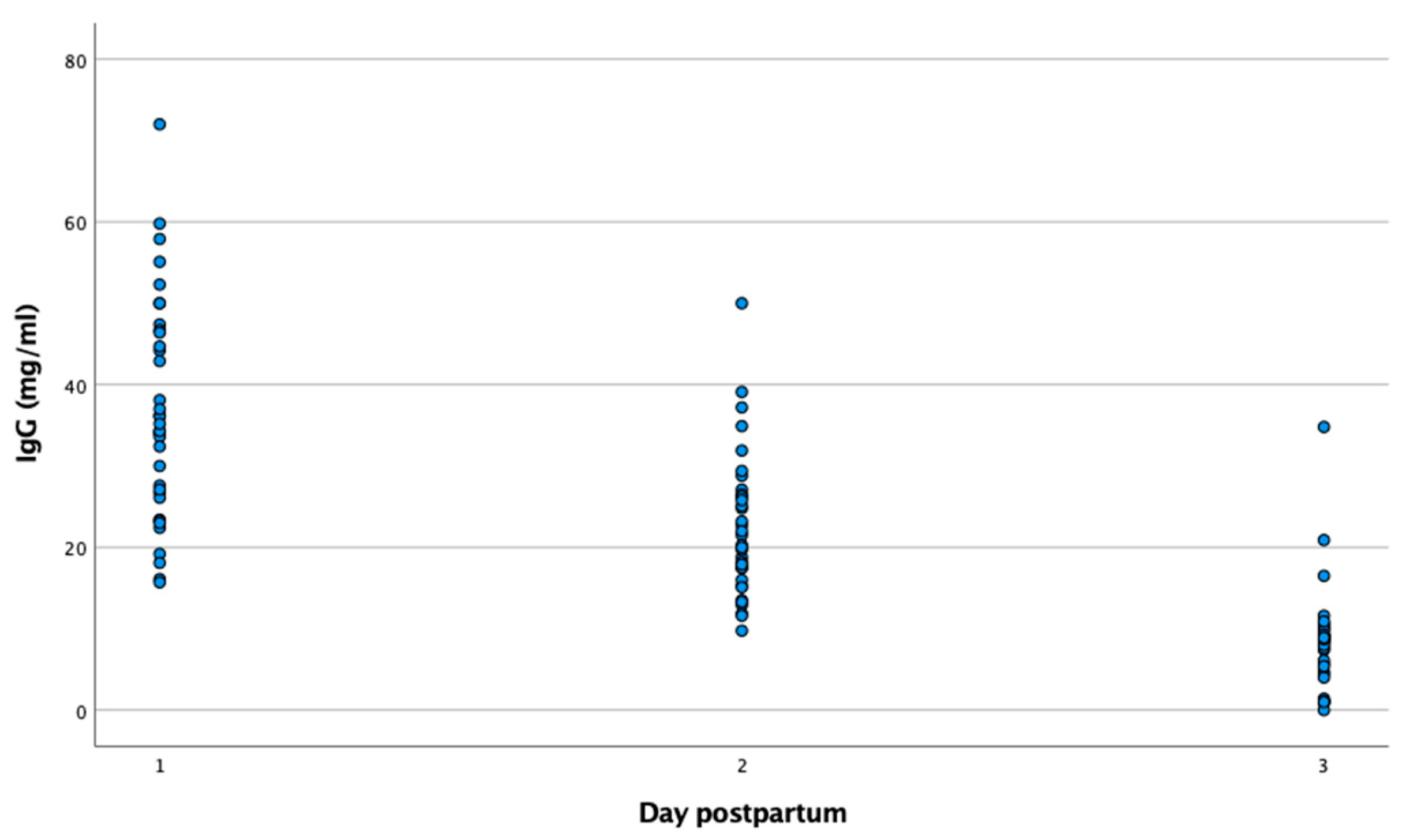
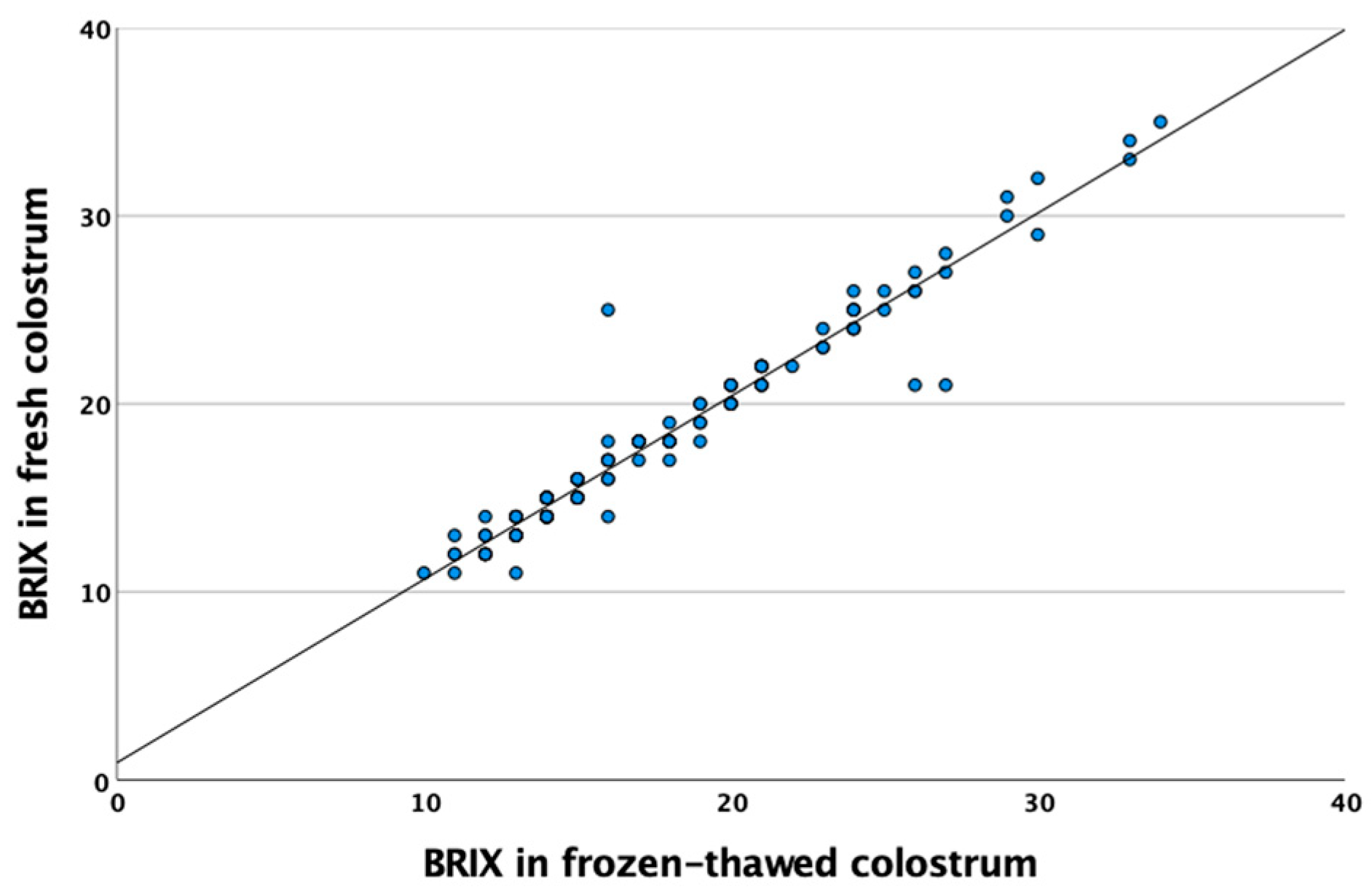
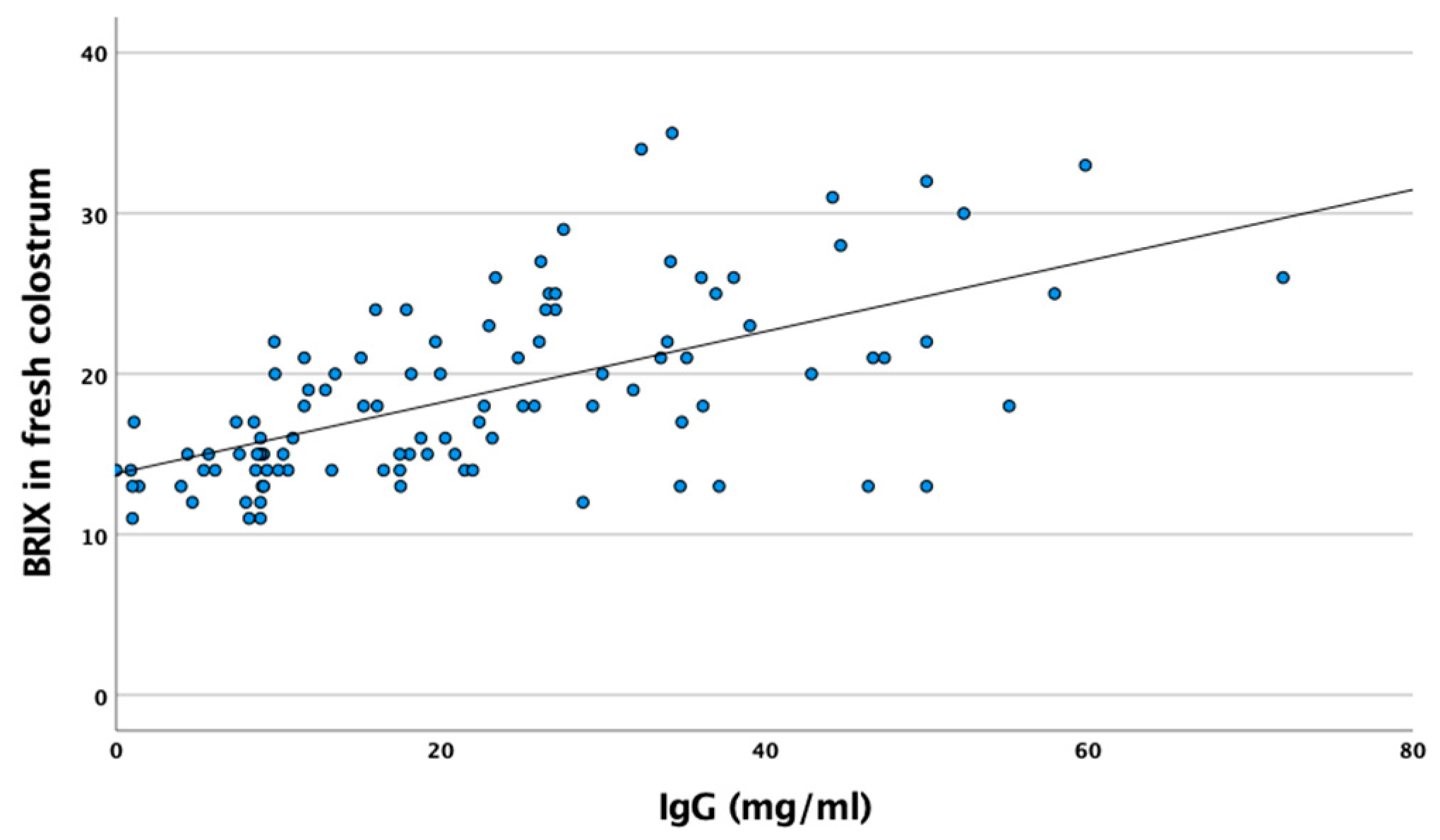
Failure of passive immunity transfer is one of the main causes of increased susceptibility to infectious agents in newborn kids. To ensure successful transfer of passive immunity, kids need to be fed high-quality colostrum, containing an adequate concentration of IgG. This work evaluated the quality of colostrum obtained in the first 3 days postpartum from Malagueña dairy goats. The IgG concentration in colostrum was measured using an ELISA as a reference method, and it was estimated by optical refractometer. Colostrum composition in terms of fat and protein was also determined. The mean concentration of IgG was 36.6 ± 2.3 mg/mL, 22.4 ± 1.5 mg/mL and 8.4 ± 1.0 mg/mL on days 1, 2 and 3 after parturition, respectively. Brix values obtained using the optical refractometer were 23.2%, 18.6% and 14.1% for days 1, 2 and 3, respectively. In this population, 89% of goats produced high-quality colostrum with IgG concentrations of >20 mg/mL on the day of parturition, but this percentage declined dramatically over the following 2 days. The quality of the fresh colostrum estimated with the optical refractometer was positively correlated with those obtained using ELISA (r = 0.607, p = 0.001). This study highlights the importance of feeding first-day colostrum to newborn kids and demonstrates that the optical Brix refractometer is suitable for the on-farm estimation of IgG content in colostrum.
Keywords:
colostrum; goat; immunoglobulin G; refractometer; Brix