Simple Summary
Overweight and obesity are associated with accumulation of abdominal fat, increasing chronic diseases, cardiovascular risk and mortality. Although the evaluation of body composition and fat distribution are highly relevant, the high cost of the gold standard techniques limits their wide utilization. Therefore, the aim of this work was to explore the relationships between simple anthropometric measures and bioelectrical impedance analyzes (BIA) variables using multivariate linear regression models to estimate body composition and fat distribution in adults. In this cross-sectional study, sixty-eight adult individuals performed BIA, anthropometric measurements [waist circumference (WC), neck circumference (NC), mid-arm circumference (MAC)], conicity index (C-index), fat mass/fat-free mass (FM/FFM) ratios, body mass index (BMI) and body shape index (ABSI). Statistical analyzes were performed with the R program, considering p ≤ 0.05 as significant. BIA variables with the highest correlations with anthropometric measures were total body water (TBW), body fat percentage (BFP), FM, FFM and FM/FFM. The multiple linear regression analysis showed, in general, that the same variables can be estimated through simple anthropometric measures. This highlights the relevance of the findings of the current study, since simple anthropometric variables can be used to estimate important BIA variables that are related to fat distribution and body composition.
Abstract
Background: Overweight and obesity are conditions associated with sedentary lifestyle and accumulation of abdominal fat, determining increased mortality, favoring chronic diseases, and increasing cardiovascular risk. Although the evaluation of body composition and fat distribution are highly relevant, the high cost of the gold standard techniques limits their wide utilization. Therefore, the aim of this work was to explore the relationships between simple anthropometric measures and BIA variables using multivariate linear regression models to estimate body composition and fat distribution in adults. Methods: In this cross-sectional study, sixty-eight adult individuals (20 males and 48 females) were subjected to bioelectrical impedance analysis (BIA), anthropometric measurements (waist circumference (WC), neck circumference (NC), mid-arm circumference (MAC)), allowing the calculation of conicity index (C-index), fat mass/fat-free mass (FM/FFM) ratios, body mass index (BMI) and body shape index (ABSI). Statistical analyzes were performed with the R program. Nonparametric Statistical tests were applied to compare the characteristics of participants of the groups (normal weight, overweight and obese). For qualitative variables, the Fisher’s exact test was applied, and for quantitative variables, the paired Wilcoxon signed-rank test. To evaluate the linear association between each pair of variables, the Pearson correlation coefficient was calculated, and Multivariate linear regression models were adjusted using the stepwise variable selection method, with Akaike Information Criterion (p ≤ 0.05). Results: BIA variables with the highest correlations with anthropometric measures were total body water (TBW), body fat percentage (BFP), FM, FFM and FM/FFM. The multiple linear regression analysis showed, in general, that the same variables can be estimated through simple anthropometric measures. Conclusions: The assessment of fat distribution in the body is desirable for the diagnosis and definition of obesity severity. However, the high cost of the instruments (dual energy X-ray absorptiometry, hydrostatic weighing, air displacement plethysmography, computed tomography, magnetic resonance) to assess it, favors the use of BMI in the clinical practice. Nevertheless, BMI does not represent a real fat distribution and body fat percentage. This highlights the relevance of the findings of the current study, since simple anthropometric variables can be used to estimate important BIA variables that are related to fat distribution and body composition.
1. Introduction
According to the World Health Organization (WHO), obesity and overweight are defined as an abnormal or excessive accumulation of fat, with negative impact to human health [1]. In 2016, more than 1.9 billion overweight adults were identified, of which 650 million were obese. Overall, about 13% of the world’s adult population were considered obese in the same year. Regarding the global prevalence, the cases of obesity tripled between the years 1975 and 2016. This number is also alarming in children and, in 2019, about 38.2 million children under 5 years identified as overweight or obese. Analyzing the data, the profile of these populations has gradually changed. Before, obesity and overweight were considered a problem in high-income countries, but there was an increasing number of cases in low-income and middle-income countries, especially in urban areas [1]. Nowadays, the prevalence of obesity probably increased due the strategies to avoid contamination during the Coronavirus-19 disease pandemic, as social isolation [2].
The body mass index (BMI) is a simple index used to classify overweight and obesity in adults. It is defined as the body mass in kilograms divided by the height in meters squared (kg/m2). It is considered easy to apply, as the values are used for the same sex and for all ages in adults, but the results may not reflect the different degrees of fat in individuals with the same BMI [1,3]. It is important to note that the relationship between BMI and body fat mass is not ideal for accurately estimating the adiposity of the single individual. Body composition is mainly composed of water, fat, proteins, and minerals. Fat is a component that has attracted more attention due to the negative consequences of its accumulation. It is important to distinguish fat from adipose tissue (AT). Most body fat is stored in the AT, but fat can be present in organs, such as the liver and skeletal muscle. The metabolic risk related to the accumulation of fat is strongly dependent on the distribution of fat. Thus, central obesity is a concern in the context of body composition and fat distribution [4], where individuals with greater central obesity are at higher risk of developing cardiometabolic diseases, independently of BMI [5].
The fat distribution occurs mainly in subcutaneous and visceral regions in the body. Studies indicated that the location and distribution of adipose tissue is related to an increased risk of developing diseases than adiposity in general [6,7]. The reduction in muscle mass may favor the development of insulin resistance and cardiovascular diseases [8,9]. Moreover, the total body water (TBW) is generally reduced, and extracellular body water increased in obese women and individuals with sarcopenic obesity [10,11]. This finding would be justified by an edema related to obesity and hormonal responses due to the adipose tissue [11].
Several techniques have been used to assess body composition, such as hydrostatic weighing (densitometry), air displacement plethysmography, dual energy X-ray absorptiometry (DEXA), computed tomography, magnetic resonance, and bioelectrical impedance analysis (BIA), as well anthropometric measures. Among these techniques, anthropometric measures are simple with a low cost associated. However, the best anthropometric measures to assess risks associated with adiposity has not been established so far [12].
Considering the assessment of fat distribution in the body using cheap, easy to use and reliable measures, some studies have proposed the use of BMI, waist circumference (WC), waist-hip ratio (WHR), neck circumference (NC), mid arm circumference (MAC), conicity index (C-index) and A body shape index (ABSI). Some publications have pointed out doubts about the validity of BMI as an indicator of obesity severity, as the BMI does not distinguish between the accumulation of muscle and fat [13]. WC and WHR have been used as complementary measures to BMI to indicate the risk of obesity and, also to predict the risk of mortality more accurately than BMI. Therefore, the use of WC to assess the distribution of abdominal fat is questionable because it is sensitive to body shape (height and body mass), as well as the percentage of fat and its distribution [14].
NC has been used to estimate the accumulation of fat in the upper body segment that may be associated with more lipolytic activity than lower body fat [15]. Other anthropometric parameters have been used to estimate the risk related to obesity and nutritional status, such as MAC, hip circumference (HC) and skinfolds [16]. The C-index has been used to assess obesity and fat distribution. It is based on the idea that (i) the individual accumulates fat around the central region of the trunk, and (ii) the shape of the body resembles a double cone based on ordinary. When the individual has less fat in the central region, the shape of the body resembles a cylinder [17]. Regarding to body composition and fat distribution, changes in fat mass (FM) and free-fat mass (FFM) can be determined by BIA. This model may describe the effects of body composition, as well as the distribution of FM and FFM within the individual variation. In addition, studies also propose the use of an index that presents a relationship between BMI and WC, which is the ABSI [18]. This anthropometric parameter is based on the WC adjusted for height and body mass. ABSI has been used to express excess risk of elevated WC in a convenient and complementary way to BMI and other known risk factors [19].
Since the number of obese people in the world is alarming, it is essential to assess body fat distribution. Although BMI has been used to define obesity, this parameter does not reflect the fat distribution and body fat percentage [20]. Considering the statements about the relevance of the proper evaluation of the body composition with low cost, easy, and effective procedures; the aim of this work was to explore the relationships between simple anthropometric measures and BIA variables using a multivariate linear regression model to estimate body composition and fat distribution in adults.
The hypothesis of this study was that simple anthropometric and BIA measures of body composition and fat distribution would be comparable.
2. Methods
2.1. Subjects
In this cross-sectional study, 91 individuals were recruited, from May 2018 to October 2019, through a screening performed by the medical staff of Hospital Universitário Pedro Ernesto (HUPE), Universidade do Estado do Rio de Janeiro (UERJ), Brazil. The analysis were performed in the Laboratório de Vibrações Mecânicas e Práticas Integrativas (LAVIMPI), Policlínica Piquet Carneiro, UERJ. This study was approved by the Research Ethics Committee of the HUPE, UERJ with the number CAAE 54981315.6.0000.5259, and registered in the Registro Brasileiro de Ensaios Clínicos (ReBEC) with the number RBR 2bghmh and UTN: U1111-1181-1177. The principles from the Declaration of Helsinki were followed.
The Strengthening the Reporting of Observational studies in Epidemiology (STROBE) statements were used to report all the different steps of this study [21,22].
The inclusion criteria were: outpatients of both genders, aged over 18 years old. The exclusion criteria were individuals over 60 years old refusing to sign the consent form.
The sample size was calculated considering a regression model with five degrees of freedom for numerator (number of independent variables), with effect size 0.8, significance level 0.01 and power 0.99, the estimated total sample was 50 individuals [23].
2.2. Measurements
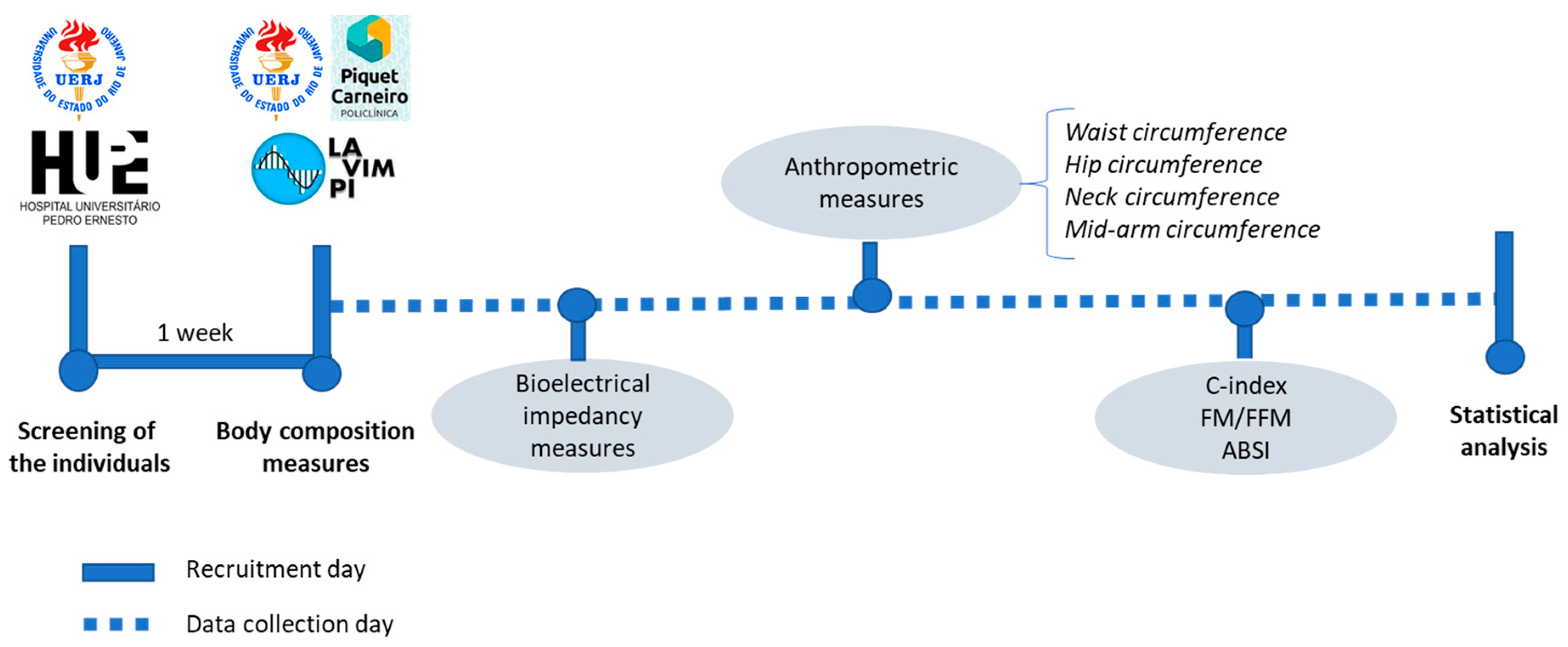
Measurements were performed in the individuals according to the presented sequence. A timeline of the steps of the study is presented in the Figure 1.
Figure 1.
Timeline of the steps of the study. C-index—Onicity index; FM/FFM—Fat mass/fat free mass; ABSI—A body shape index.
2.3. Bioelectrical Impedance Analysis
TBW (kg), FM (kg) and FFM (kg) were estimated by BIA (In Body 370, BIOSPACE, Korea). The individuals were instructed: to remain at rest for at least 10 min before taking the measurements; to remove metal objects attached to the body (such as rings and earrings); to discontinue the use of diuretic medications for 24 h prior to the measurements; to avoid consumption of food and drink 4 h before the measurements; to avoid practicing physical exercise for 24 h before the measurements; to avoid medicines that promote water retention for 24 h before the measures and to avoid drinking alcohol, coffees and teas for 48 h before the measurements. The subjects were asked to inform about fever in the last days. The measurement procedures were performed according to the manufacturer and other studies [24,25,26,27]. The overweight was considered with BMI ≥ 25 kg/m2 and obesity with BMI ≥ 30 kg/m2 [1].
2.4. Anthropometric Measures: Waist Circumference, Hip Circumference, Neck Circumference, the Mid-Arm Circumference
One trained researcher (anthropometrist accredited by International Society for the Advancement of Kinanthropometry) collected all the anthropometric measures of the individuals. The stature and body mass were measured on a digital balance (MIC 200 PPA, Micheletti, São Paulo, Brazil) and the BMI was calculated as body mass (kg) divided by squared height (m2) [1,28].
The measurement of the WC was performed with non-stretchable flexible tapes. The measurement considered the midpoint between the last rib and the iliac crest [1]. The normal WC value of men was considered as ≤94 cm and as ≤80 cm for women [29].
The HC was measured using a non-stretchable tape at the height of the widest point of the hip and was used to calculate the WHR. The individuals were classified as abdominal obesity with WHR values > 0.9 for men and >0.85 for women) [30,31].
The NC was obtained with the individual standing, head in the Frankfurt position, with an inelastic tape measure just below the prominence of the larynx. The mean of three measures was calculated [32]. NC ≥ 35.5 cm for men and ≥32 cm for women was defined as condition of overweight/obesity [33].
To measure the MAC, the individual was instructed to stand upright with the shoulder relaxed and right arm pending, and the instructor stood behind to locate the midpoint between the tip of the olecranon and the acromion. After that, the instructor placed measuring tape around the marked point [34,35].
2.5. The C-Index, the FM/FFM Ratios and ABSI
The C-index was calculated from WC (m), body mass (kg) and height (m) using Valdez’s formula: C-index = .
The C-index ranges from 1.0 (a perfect cylinder) to 1.73 (a perfect double cone), and values increase according to the accumulation of fat in the central region of the body. Thus, the closer to 1.73, the greater the accumulation of abdominal fat [17].
FM and FFM were determined by bioelectrical impedance and the cutoff values were [36]: FM/FFM ratios < 0.40 metabolically healthy obese individuals in whom the increase in FM is minor compared to that in FFM; FM/FFM ratios between 0.40 and 0.80 for obese phenotypes in which FM increases more than FFM, but the FFM is still adequately maintained; FM/FFM ratios > 0.80 for sarcopenic obese phenotypes, in which FM is widely increased and FFM is reduced [37].
The ABSI was calculated according to the following formula WC/(BMI2/3.height1/2), with WC and height expressed in meters and weight in kilograms [38,39]. The measures have threshold value 0.805 m11/6 kg−2/3 in women and 0.0828 m11/6 kg−2/3 in men. The lower value was considered as “lower-ABSI” and the higher was considered as “higher-ABSI” [40].
3. Statistical Analysis
Statistical analyzes were performed with the R program [41] and with the R packages: MASS [42], exactRankTests [43], tableone [44], pwr [23]. Nomparametric Statistical tests were applied to compare the characteristics of participants of the groups (normal body mass, overweight and obese individuals). For qualitative variables, expressed in terms of absolute values and percentage, the Fisher’s exact test was applied. For quantitative variables, expressed in terms of median, first and third quartiles, the Kruskal-Wallis test was applied to compare the three groups and for each combination of two groups was applied the Mann-Whitney test. To evaluate the linear association between each pair of variables the Pearson correlation coefficient was calculated, also for each pair are presented the scatter plot. Multivariate linear regression models were adjusted using the stepwise variable selection method, with Akaike Information Criterion. The stepwise variable selection method seeks to select the best subset of variables for composing the independent variables in each regression model. Results were considered statistically significant if the p-value is under 0.05 (p < 0.05).
4. Results
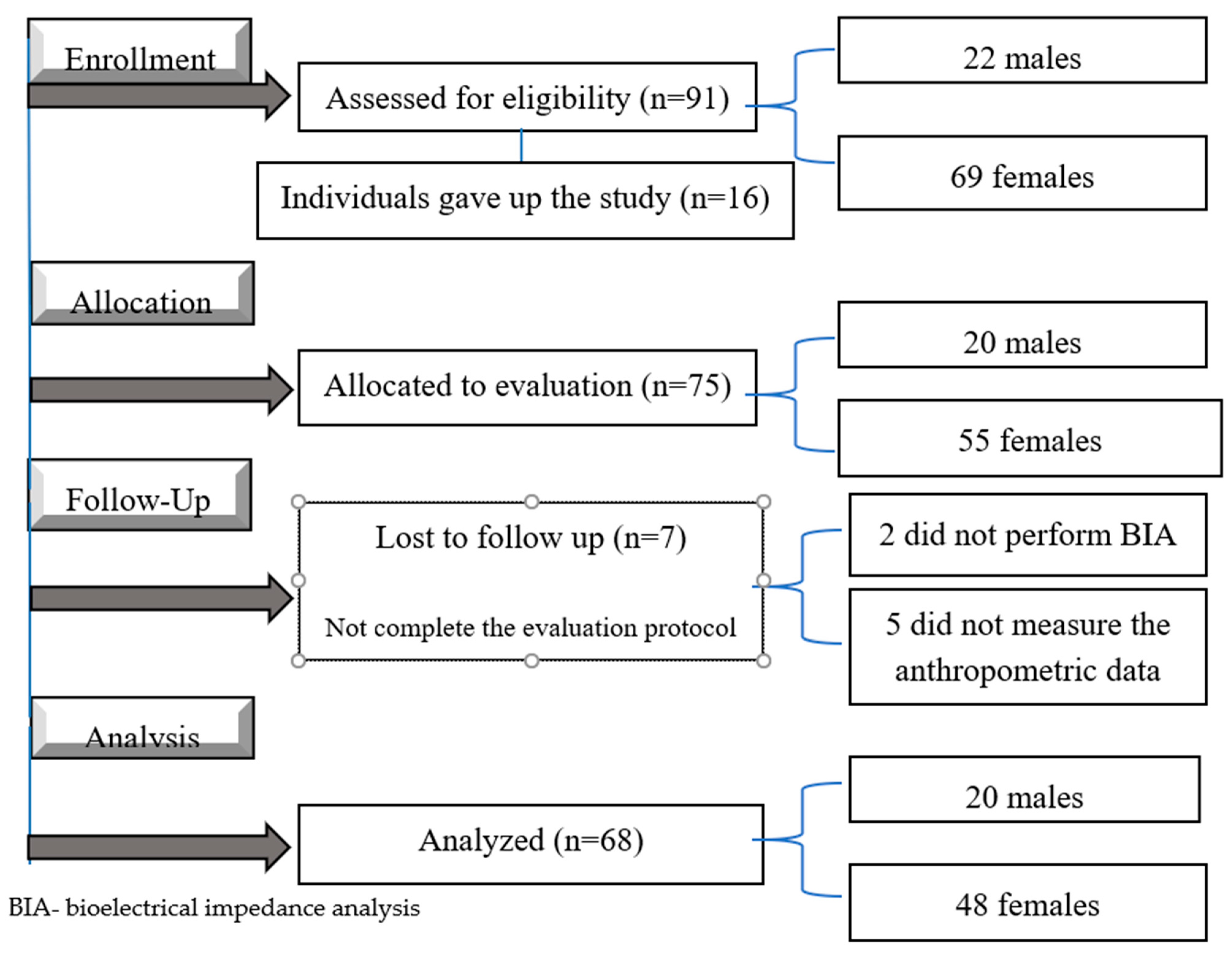
The flow diagram of the study is shown in Figure 2. Ninety-one individuals were recruited according to the eligibility criteria, and sixteen individuals declined to participate. Seventy-five individuals were allocated to perform the evaluations and seven of them, performing partially the evaluations, were excluded. Thus, sixty-eight individuals (20 males and 48 females) concluded all the steps of the study.
Figure 2.
Flow diagram according to the STrengthening the Reporting of OBservational studies in Epidemiology (STROBE) criteria.
General characteristics of the participants that concluded all the steps of the study are presented in Table 1. As far as the gender distribution is concerned, the table shows the total number of men and the percentage, while for all other variables are reported the median, first and third quartiles. Considering the three subgroups (normal weight, overweight and obese individuals) no statistical difference was found, except, for the dependent variables involving body composition.
Table 1.
General characteristics of the individuals.
The Pearson’s correlation coefficient ranges from −1 to 1. An absolute value of exactly 1 implies that a linear equation describes the relationship between the variables perfectly. The correlation equal zero indicates that the variables are not correlated. For two variables with positive correlation is expected that if one variable increases the other will also increases, when the signal is negative it is expected that if one variable increases the other will decrease [45].
Table 2 shows the Pearson’s correlation and the associated significant levels (two-tailed t-test) for each correlation among anthropometric and bioimpedance variables.
Table 2.
Pearson’s correlations of the studied variables.
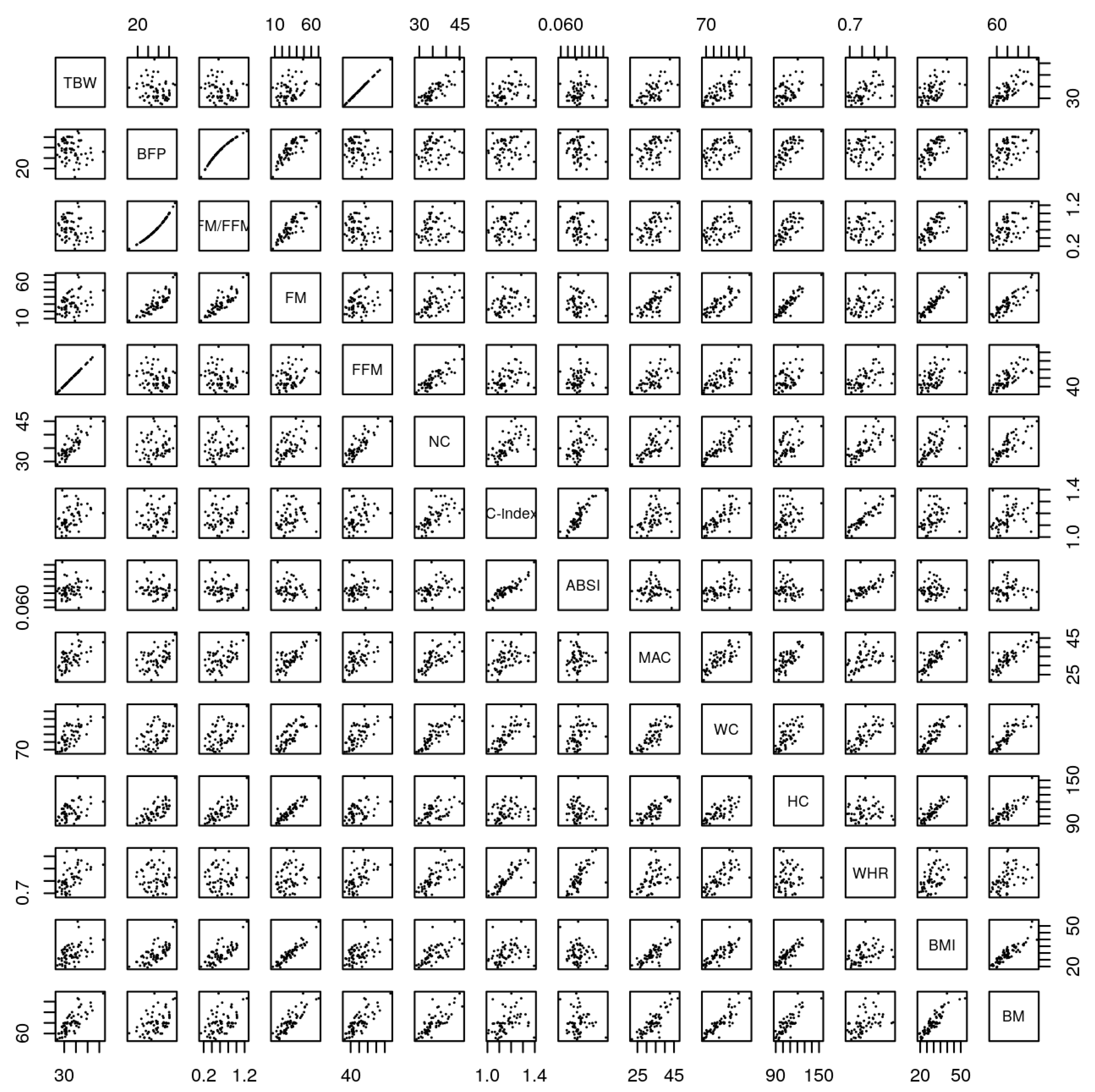
Figure 3 shows the scatter plot of anthropometric and BIA variables (TBW, BM; BFP; WHR; NC; MAC; WC; HC; C; ABSI; FM/FFM), presented in Table 2. The following correlations were found: (i) TBW with FM, FFM, NC, C-index, MAC, WC, HC, BMI, BM and WHR, (ii) BFP with FM/FFM, FM, ABSI, MAC, WC, HC, BMI and BM, (iii) FM/FFM with FM, ABSI, MAC, WC, HC, BMI and BM, (iv) FM with FFM, NC, MAC, WC, HC, BMI and BM, (v) FFM with NC, C-index, MAC, WC, HC, BMI, BM and WHR, (vi) NC with C-index, MAC, WC, HC, BMI, BM and WHR, (vii) C-index with ABSI, MAC, WC, BMI, BM and WHR, (viii) ABSI with WC and WHR, (ix) MAC with WC, HC, BMI, BM and WHR, (x) WC with HC, BMI, BM and WHR, (xi) HC with BMI and BM, (xi) BMI with BM and (xii) BM has correlation with WHR.
Figure 3.
Scatter plot of the variables of the study. TBW—Total body water; FM—Fat mass; BFP—Body fat percentage; FFM—Fat-free mass; BM—Body mass; BMI—Body max index; WHR—Waist-hip ratio; NC—Neck circumference; MAC—Mid-arm circumference; WC—Waist circumference; HC—Hip circumference; C-index—Conicity index; ABSI—A body shape index; FM/FFM—Fat mass/fat-free mass.
Table 3 shows the results for Multiple Linear regression analysis, whose coefficients represent the mean change in the response variable for one unit of change in the predictor variable, holding all other predictors constant. Table 3 contains five regressions models, each one has a dependent variable from BIA and a set of independent variables from anthropometric measures.
Table 3.
Multiple Linear regression analysis.
Related to TBW, the aim of the regression model was to consider the variable TBW as a function of all other anthropometric variables. The stepwise method selected the following independent variables: NC, C-index, ABSI, WHR and BM. The variables NC, ABSI, WHR and BM presented positive coefficients, while the C-index presented negative coefficients.
Related to FM, the aim of the regression model was to model the variable FM as a function of all other anthropometric variables. The stepwise method selected the following independent variables: NC, C-index, ABSI, WHR and BM. The variables C-index and BM presented positive coefficients, while all other variables presented negative coefficients.
Related to BFP, the aim of the regression model was to model the variable BFP as a function of all other anthropometric variables. The stepwise method selected the following independent variables: NC, C-index, ABSI, WHR and BMI. The variable C-index presented positive coefficients, while all other variables presented negative coefficients.
Related to FFM, the aim of the regression model was to model the variable FFM as a function of all other anthropometric variables. The stepwise method selected the following independent variables: NC, C-index, ABSI, WHR and BM. The variable C-index presented a negative coefficient, while all other variables presented positive coefficients.
Related to FM/FFM, the aim of the regression model was to model the variable FM/FFM as a function of all other anthropometric variables. The stepwise method selected the following independent variables: NC, C-index, ABSI and WHR. The variable C-index presented positive coefficients, while all other variables presented negative coefficients.
5. Discussion
As it was hypothesized, using a multivariate linear regression model, simple anthropometric measures and BIA measures are comparable to estimate body composition and fat distribution. These findings are highly relevant due to the lack of statistical differences related to the general characteristics of the individuals of the three subgroups (Table 1), with the expected exception of the variables related to body composition.
Several authors have demonstrated the interest in estimating the body composition and fat distribution in adults using anthropometric measures [46,47,48,49], however few studies explored the relation between TBW and obesity. In the current study, TBW (a) correlated with the following anthropometric measures NC, C-index, MAC, WC, HC, BMI, BM and WHR (Table 2 and Figure 3) and (b) with Multiple linear regression analysis, presented positive coefficients to NC, ABSI, WHR and BM, and negative coefficient to C-index (Table 3). These findings are in accordance with those reported by Kuźnar-Kamińska et al., 2017 [50] evaluating the TBW index and anthropometric values such as NC, WC, and abdominal circumference in obese individuals with obstructive sleep apnea. These authors observed an increase in the TBW and anthropometric parameters, but the correlation between these variables was not analyzed. Moreover, the correlation between HC and TBW was considered low, although significant. Mattoo et al., 2020 [51] also suggested that there is a BM decrease related to TBW, which results from a lower % BF. KASHIWAZAKI et al., 1996 [52] studied the prediction equations for total body water and concluded that was necessary to include skinfold measurements together the equation to obtain a valid evaluation for males and females (RAISON et al., 1988).
The current study showed a correlation between the BFP and anthropometric measures, NC, C-index, ABSI, WHR and BM (Table 2 and Figure 3), and with Multiple Linear regression analysis, positive coefficients to C-index, and negative coefficient to NC, ABSI, WHR and BM (Table 3). These findings agree with MATERKO, 2020 [53] that compared the estimate of the BFP by the methods of anthropometry, skinfolds and bioimpedance, demonstrating significant differences between the methods of BIA and skinfolds and between the methods of BIA and anthropometry. Moreover, it is reported that the BIA overestimated the value of BF, thus suggesting that it is not recommended to estimate this variable in obese adult individuals. With respect to linear regression, the BFP showed a significant result when compared to all anthropometric variables that are derived from calculations (C-index, ABSI, BMI and WHR), however it did not present a significant result in relation to NC. Using anthropometric alternatives to estimate BFP is of fundamental importance, as it is widely used to predict the risk of developing diseases such as obesity, diabetes and hypertension, and the reduction of inflammatory factors in the body [54].
The current study showed a correlation between the FM and anthropometric measures C-index, BM (positive correlation), NC, ABSI, WHR and BM (negative correlation) (Table 2 and Figure 3), and with Multiple linear regression analysis, positive coefficients to C-index and BM and negative coefficients to NC, ABSI and WHR (Table 3). These findings agree with a cross-sectional epidemiological study [49,55] describing that all anthropometric indicators were able to diagnose excess FM, as they presented a minimum limit of 95% of the area under the receiver operating characteristic curve (ROC) curve up to 0.50. However, BMI, WHR and WC were more capable of discriminating FM in both sexes compared to the C-Index. Moreover, these results partially corroborate those reported in the current study, where a correlation was found between the FM and C-index. Regarding linear regression, it was possible to identify that FM and WHR were significant, while FM and C-index were not. However, it is reinforced that the use of anthropometric indicators of obesity are relatively simple methods to be evaluated, that can be used as FM discriminators. Among the different methods capable of estimating body composition, they differ in relation to the levels of precision, costs, and difficulty of application. The techniques most used to determine the components of body composition are anthropometry and BIA. Pereira et al. (2015) [56] observed that WC and HC showed a high correlation with BMI and FM [57], these results corroborating those the results of our study. These findings seem to demonstrate that both WC and HC might represent a good option for identifying increases in adiposity. WHR is related to different aspects of body composition and Pereira et al., 2015 showed that WHR had a correlation lower than WC to estimate %BF, but HC showed a similar correlation with WC.
The current study shows that FMM was positively correlated to NC, ABSI, WHR, and BM, while it is negatively correlated to C index. With the regression model, the variable C-index presented a negative coefficient, while NC, C-index, ABSI, WHR and BM presented positive coefficients. Furthermore, FM/FFM ratio was positively correlated to C-index, while negative correlations were observed to NC, ABSI and WHR. Using the regression model, the variable C-index presented positive coefficients, while NC, C-index, ABSI and WHR presented negative coefficients.
Recognizing aspects of body composition is still of great clinical and public health relevance because excess FM and inadequate FFM represent important risk factors for the development of major chronic diseases and mortality, being essential for the development of targeted interventions and effectiveness. However, there is a gap in the literature regarding the relationships between FM/FFM ratio and anthropometric variables [57], and it is suggested that the main limitation of BMI as a predictor of mortality is that it cannot differentiate between FM and FFM.
In the current study a correlation between BMI and FM, FFM and FM/FFM ratio was found, in addition to a correlation of FM/FFM with the anthropometric variables ABSI, WC, MAC and HC. The linear regression analysis showed significance only for the FM/FFM variable with the anthropometric variable WHR, thus suggesting that the aforementioned anthropometric variables are able to predict these BIA variables.
The strength of this study is represented by the observation that simple anthropometric variables can be used to estimate important anthropometric variables that are related to fat distribution and body composition. The major contribution of this study is the proposal to try to “validate” certain anthropometric measurements not related to skinfolds (WC, HC, NC, MAC) with body composition variables monitored by BIA (TBW, FM, FFM).
Considering the limitations of this current work, the anthropometric measurements are compared with a doubly indirect method of body composition that cannot be considered as a reference or gold standard, so the significance of the findings should be taken with caution. Although BIA has actually evolved over the years to include the use of multiple frequencies to improve the accuracy and reliability of body composition estimates, DEXA represents the gold standard test, but this method is expensive and rarely available, thus making its use infeasible in the clinical practice. Although there are no significant differences between the three subgroups analyzed, may be significant differences between men and women. Finally, the small number of the study group and to the disproportion as regards the ratio between the two genders (males were less than females) can be considered as a limitation of this study.
The perspectives of this study are related to development of other studies consid-ering: (i) only analyzes about female individuals (due to the fact that there are few studies involving this specific population); (ii) stratification between female and male individuals; and (iii) analyzes involving individuals with different clinical conditions where the analyze of their body composition can contribute to the management of them.
6. Conclusions
Body fat assessment is considered the gold standard for the diagnosis of obesity, however, the high cost of the instruments requested to be used to assess this variable makes the use of BMI the main and most used variable for overweight and obesity. Although all the anthropometric variables considered in the present study correlated with BIA variables, however, when analyzing each variable specifically, discrepancies between the calculations of correlation and linear regression were detected. However, the current study, that presents preliminary results, suggests that linear regression models are useful for estimating dependent variables as a function of independent variables. Nevertheless, further additional studies on huge study populations are requested to confirm these preliminary observations.
Author Contributions
Conceptualization, D.d.C.d.S.-C., A.S. (Anelise Sonza) and A.d.S.F.; Data curation, D.d.C.d.S.-C., A.F.-S., E.M.d.A. and A.d.S.F.; Formal analysis, A.S. (Anelise Sonza), A.C.C.-O., A.S.R., A.d.S.F. and A.d.R.P.M.; Investigation, D.d.C.d.S.-C., A.S. (Anelise Sonza), J.P.-F., E.M.d.A., T.d.R.B.G., V.L.X., C.J.B.eS. and A.d.R.P.M.; Methodology, A.C.C.-O., A.S. (Anelise Sonza), A.S.R., L.L.P.-D., V.L.X. and M.C.M.-F.; Project administration, L.L.P.-D., T.d.R.B.G., V.L.X. and M.C.M.-F.; Resources, J.P.-F. and A.F.-S.; Supervision, A.C.R.L., R.T. and M.B.-F.; Validation, C.J.B.eS., V.A.M., A.C.R.L., A.S. (Aderito Seixas) and A.S. (Alessandro Sartorio); Visualization, V.A.M., A.S. (Aderito Seixas), A.S. (Alessandro Sartorio), R.T. and M.B.-F.; Writing—Original draft, D.d.C.d.S.-C., A.S. (Anelise Sonza) and A.C.C.-O. All authors have read and agreed to the published version of the manuscript.
Funding
Conselho Nacional de Desenvolvimento Científico e Tecnológico (CNPq), and Fundação de Amparo à Pesquisa do Estado do Rio de Janeiro (FAPERJ) for support during the execution of this work. This study was also supported in part by the Coordenação de Aperfeiçoamento de Pessoal de Nível Superior—Brazil (CAPES)—Finance Code 001.
Institutional Review Board Statement
The study was conducted according to the guidelines of the Declaration of Helsinki, and approved by the Ethics Committee of Hospital Universitário Pedro Ernesto, UERJ with the number CAAE 54981315.6.0000.5259, and registered in the Registro Brasileiro de Ensaios Clínicos (ReBEC) with the number RBR 2bghmh and UTN: U1111-1181-1177.
Informed Consent Statement
Informed consent was obtained from all subjects involved in the study.
Data Availability Statement
The datasets used and/or analyzed during the current study are available from the corresponding author on reasonable request.
Acknowledgments
The authors thank Rodrigo Jorge de Alcantara Guerra, Gessica de Araújo Rocha e Roges Alvim de Oliveira for the collaboration during the data collection. These cited individuals agree with this acknowledgment.
Conflicts of Interest
The authors declare that they have no competing interests.
References
- WHO. Obesity and Overweight. Available online: https://www.who.int/news-room/fact-sheets/detail/obesity-and-overweight (accessed on 6 November 2021).
- Bennett, G.; Young, E.; Butler, I.; Coe, S. The Impact of Lockdown during the COVID-19 Outbreak on Dietary Habits in Various Population Groups: A Scoping Review. Front. Nutr. 2021, 8, 1–10. [Google Scholar] [CrossRef]
- Simmonds, M.; Llewellyn, A.; Owen, C.G.; Woolacott, N. Predicting adult obesity from childhood obesity: A systematic review and meta-analysis. Obes. Rev. 2016, 17, 95–107. [Google Scholar] [CrossRef] [PubMed] [Green Version]
- Goossens, G.H. The Metabolic Phenotype in Obesity: Fat Mass, Body Fat Distribution, and Adipose Tissue Function. Obes. Facts 2017, 10, 207–215. [Google Scholar] [CrossRef]
- FCFP, N.J.B.M.C. Normal-weight central obesity. Can. Fam. Physician 2019, 65, 399–408. [Google Scholar]
- Carey, V.J.; Walters, E.E.; Colditz, G.A.; Solomon, C.G.; Willett, W.C.; Rosner, B.A.; Speizer, F.E.; Manson, J.E. Body fat distribution and risk of non-insulin-dependent diabetes mellitus in women: The nurses’ health study. Am. J. Epidemiol. 1997, 145, 614–619. [Google Scholar] [CrossRef] [PubMed] [Green Version]
- Shuster, A.; Patlas, M.; Pinthus, J.H.; Mourtzakis, M. The clinical importance of visceral adiposity: A critical review of methods for visceral adipose tissue analysis. Br. J. Radiol. 2012, 85, 1–10. [Google Scholar] [CrossRef] [PubMed] [Green Version]
- Peppa, M.; Stefanaki, C.; Papaefstathiou, A.; Boschiero, D.; Dimitriadis, G.; Chrousos, G.P. Bioimpedance analysis vs. DEXA as a screening tool for osteosarcopenia in lean, overweight and obese Caucasian postmenopausal females. Hormones 2017, 16, 181–193. [Google Scholar] [CrossRef] [PubMed] [Green Version]
- Srikanthan, P.; Karlamangla, A.S. Relative muscle mass is inversely associated with insulin resistance and prediabetes. Findings from the Third National Health and Nutrition Examination Survey. J. Clin. Endocrinol. Metab. 2011, 96, 2898–2903. [Google Scholar] [CrossRef] [Green Version]
- Van Marken Lichtenbelt, W.D.; Fogelholm, M. Increased extracellular water compartment, relative to intracellular water compartment, after weight reduction. J. Appl. Physiol. 1999, 87, 294–298. [Google Scholar] [CrossRef] [PubMed] [Green Version]
- Kreidieh, D.; Itani, L.; El Masri, D.; Tannir, H.; Citarella, R.; El Ghoch, M. Association between Sarcopenic Obesity, Type 2 Diabetes, and Hypertension in Overweight and Obese Treatment-Seeking Adult Women. J. Cardiovasc. Dev. Dis. 2018, 5, 51. [Google Scholar] [CrossRef] [Green Version]
- Adedia, D.; Boakye, A.A.; Mensah, D.; Lokpo, S.Y.; Afeke, I.; Duedu, K.O. Comparative assessment of anthropometric and bioimpedence methods for determining adiposity. Heliyon 2020, 6, e05740. [Google Scholar] [CrossRef] [PubMed]
- Lin, T.Y.; Lim, P.S.; Hung, S.C. Impact of Misclassification of Obesity by Body Mass Index on Mortality in Patients with CKD. Kidney Int. Reports 2018, 3, 447–455. [Google Scholar] [CrossRef] [PubMed] [Green Version]
- Bacopoulou, F.; Efthymiou, V.; Landis, G.; Rentoumis, A.; Chrousos, G.P. Waist circumference, waist-to-hip ratio and waist-to-height ratio reference percentiles for abdominal obesity among Greek adolescents. BMC Pediatr. 2015, 15, 1–9. [Google Scholar] [CrossRef] [Green Version]
- Patnaik, L.; Pattnaik, S.; Rao, E.V.; Sahu, T. Validating neck circumference and waist circumference as anthropometric measures of overweight/obesity in adolescents. Indian Pediatr. 2017, 54, 377–380. [Google Scholar] [CrossRef]
- Madden, A.M.; Smith, S. Body composition and morphological assessment of nutritional status in adults: A review of anthropometric variables. J. Hum. Nutr. Diet. 2016, 29, 7–25. [Google Scholar] [CrossRef] [PubMed]
- Andrade, M.D.; de Freitas, M.C.P.; Sakumoto, A.M.; Pappiani, C.; de Andrade, S.C.; Vieira, V.L.; Damasceno, N.R.T. Association of the conicity index with diabetes and hypertension in Brazilian women. Arch. Endocrinol. Metab. 2016, 60, 436–442. [Google Scholar] [CrossRef] [Green Version]
- Ling, C.H.Y.; de Craen, A.J.M.; Slagboom, P.E.; Gunn, D.A.; Stokkel, M.P.M.; Westendorp, R.G.J.; Maier, A.B. Accuracy of direct segmental multi-frequency bioimpedance analysis in the assessment of total body and segmental body composition in middle-aged adult population. Clin. Nutr. 2011, 30, 610–615. [Google Scholar] [CrossRef] [Green Version]
- Wei, J.; Liu, X.; Xue, H.; Wang, Y.; Shi, Z. Comparisons of Visceral Adiposity Index, Body Shape Index, Body Mass Index and Waist Circumference and Their Associations with Diabetes Mellitus in Adults. Nutrients 2019, 11, 1580. [Google Scholar] [CrossRef] [Green Version]
- Vecchié, A.; Dallegri, F.; Carbone, F.; Bonaventura, A.; Liberale, L.; Portincasa, P.; Frühbeck, G.; Montecucco, F. Obesity phenotypes and their paradoxical association with cardiovascular diseases. Eur. J. Intern. Med. 2018, 48, 6–17. [Google Scholar] [CrossRef]
- Vandenbroucke, J.P.; Von Elm, E.; Altman, D.G.; Gøtzsche, P.C.; Mulrow, C.D.; Pocock, S.J.; Poole, C.; Schlesselman, J.J.; Egger, M. Strengthening the Reporting of Observational Studies in Epidemiology (STROBE): Explanation and elaboration. PLoS Med. 2007, 4, 1628–1654. [Google Scholar] [CrossRef] [PubMed] [Green Version]
- Sharp, S.J.; Poulaliou, M.; Thompson, S.G.; White, I.R.; Wood, A.M. A review of published analyses of case-cohort studies and recommendations for future reporting. PLoS ONE 2014, 9, e101176. [Google Scholar] [CrossRef]
- Champely, S. Basic Functions for Power Analysis. R Package. 2020. Available online: https://cran.r-project.org/web/packages/pwr/index.html (accessed on 6 November 2021).
- Kyle, U.G.; Bosaeus, I.; De Lorenzo, A.D.; Deurenberg, P.; Elia, M.; Gómez, J.M.; Heitmann, B.L.; Kent-Smith, L.; Melchior, J.C.; Pirlich, M.; et al. Bioelectrical impedance analysis—Part II: Utilization in clinical practice. Clin. Nutr. 2004, 23, 1430–1453. [Google Scholar] [CrossRef]
- Mulasi, U.; Kuchnia, A.J.; Cole, A.J.; Earthman, C.P. Bioimpedance at the bedside: Current applications, limitations, and opportunities. Nutr. Clin. Pract. 2015, 30, 180–193. [Google Scholar] [CrossRef] [Green Version]
- Ugras, S. Evaluating of altered hydration status on effectiveness of body composition analysis using bioelectric impedance analysis. Libyan J. Med. 2020, 15, 1741904. [Google Scholar] [CrossRef] [PubMed] [Green Version]
- The American Journal of Clinical Nutrition Page. Available online: https://academic.oup.com/ajcn/article/64/3/524S/4651674 (accessed on 6 November 2021).
- Weir, C.B.; Jan, A. BMI Classification Percentile and Cut off Points; StatPearls Publishing: Treasure Island, FL, USA, 2021. Available online: https://pubmed.ncbi.nlm.nih.gov/31082114/ (accessed on 6 November 2021).
- Ostchega, Y.; Zhang, G.; Gu, Q.; Isfahani, N.S.; Hughes, J.P.; Schall, J. Developing equations to predict waist circumference measurements based on the National Heart, Lung, and Blood Institute method from the World Health Organization method. Ann. Epidemiol. 2021, 53, 21–26.e1. [Google Scholar] [CrossRef]
- Browning, L.M.; Hsieh, S.D.; Ashwell, M. A systematic review of waist-to-height ratio as a screening tool for the prediction of cardiovascular disease and diabetes: 05 could be a suitable global boundary value. Nutr. Res. Rev. 2010, 23, 247–269. [Google Scholar] [CrossRef] [Green Version]
- Ashwell, M.; Hsieh, S.D. Six reasons why the waist-to-height ratio is a rapid and effective global indicator for health risks of obesity and how its use could simplify the international public health message on obesity. Int. J. Food Sci. Nutr. 2005, 56, 303–307. [Google Scholar] [CrossRef] [PubMed]
- Ferreira, F.G.; Juvanhol, L.L.; Da Silva, D.C.G.; Longo, G.Z. Visceral adiposity index is a better predictor of unhealthy metabolic phenotype than traditional adiposity measures: Results from a population-based study. Public Health Nutr. 2019, 22, 1545–1554. [Google Scholar] [CrossRef] [Green Version]
- Hingorjo, M.R.; Qureshi, M.A.; Mehdi, A. Neck circumference as a useful marker of obesity: A comparison with body mass index and waist circumference. J. Pak. Med. Assoc. 2012, 62, 36–40. [Google Scholar] [PubMed]
- Opdam, M.H.; Koekkoek, K.W.A.C.; Boeije, T.; Mullaart, N.; Van Zanten, A.R.H.; Bellou, A. Mid-arm circumference method is invalid to estimate the body weight of elderly Emergency Department patients in the Netherlands. Medicine 2019, 98, 1–5. [Google Scholar] [CrossRef]
- Tang, A.M.; Chung, M.; Dong, K.R.; Bahwere, P.; Bose, K.; Chakraborty, R.; Charlton, K.; Das, P.; Ghosh, M.; Hossain, M.I.; et al. Determining a global mid-upper arm circumference cut-off to assess underweight in adults (men and non-pregnant women). Public Health Nutr. 2020, 23, 3104–3113. [Google Scholar] [CrossRef]
- Franssen, F.M.E.; Rutten, E.P.A.; Groenen, M.T.J.; Vanfleteren, L.E.; Wouters, E.F.M.; Spruit, M.A. New reference values for body composition by bioelectrical impedance analysis in the general population: Results from the UK biobank. J. Am. Med. Dir. Assoc. 2014, 15, 448.e1–448.e6. [Google Scholar] [CrossRef] [PubMed]
- Prado, C.M.M.; Wells, J.C.K.; Smith, S.R.; Stephan, B.C.M.; Siervo, M. Sarcopenic obesity: A Critical appraisal of the current evidence. Clin. Nutr. 2012, 31, 583–601. [Google Scholar] [CrossRef] [PubMed]
- Krakauer, N.Y.; Krakauer, J.C. A new body shape index predicts mortality hazard independently of body mass index. PLoS ONE 2012, 7, e39504. [Google Scholar] [CrossRef]
- Gomez-Peralta, F.; Abreu, C.; Cruz-Bravo, M.; Alcarria, E.; Gutierrez-Buey, G.; Krakauer, N.Y.; Krakauer, J.C. Relationship between “a body shape index (ABSI)” and body composition in obese patients with type 2 diabetes. Diabetol. Metab. Syndr. 2018, 10, 1–8. [Google Scholar] [CrossRef]
- Hoermann, R.; Fui, M.N.T.; Krakauer, J.C.; Krakauer, N.Y.; Grossmann, M. A body shape index (ABSI) reflects body composition changes in response to testosterone treatment in obese men. Int. J. Obes. 2019, 43, 2210–2216. [Google Scholar] [CrossRef] [PubMed]
- R Core Team a Language and Environment for Statistical Computing; R Foundation for Statistical Computing: Vienna, Austria, 2020.
- Venables, W.N.; Ripley, B.D. NoModern Applied Statistics with S, 4th ed.; Springer: New York, NY, USA, 2002. [Google Scholar]
- Hornik, T.; Hornik, K. Exact Distributions for Rank and Permutation Tests. R Package Version. 2021. Available online: https://cran.r-project.org/web/packages/exactRankTests/index.html (accessed on 6 November 2021).
- Yoshida, K.; Bartel, A.; Chipman, J.J.; Bohn, J.; McGowan, L.D.; Barrett, M.; Christensen, R.H.B. Tableone: Create “Table 1” to Describe Baseline Characteristics. R Package Version. 2020. Available online: https://cran.r-project.org/web/packages/tableone/index.html (accessed on 6 November 2021).
- Mukaka, M.M. Statistics corner: A guide to appropriate use of correlation coefficient in medical research. Malawi Med. J. 2012, 24, 69–71. [Google Scholar] [PubMed]
- Radetti, G.; Fanolla, A.; Grugni, G.; Lupi, F.; Tamini, S.; Cicolini, S.; Sartorio, A. The role of different indexes of adiposity and body composition for the identification of metabolic syndrome in women with obesity. J. Clin. Med. 2021, 10, 1975. [Google Scholar] [CrossRef]
- Radetti, G.; Fanolla, A.; Lupi, F.; Sartorio, A.; Grugni, G. Accuracy of different indexes of body composition and adiposity in identifying metabolic syndrome in adult subjects with Prader-Willi syndrome. J. Clin. Med. 2020, 9, 1646. [Google Scholar] [CrossRef]
- Radetti, G.; Fanolla, A.; Grugni, G.; Lupi, F.; Sartorio, A. Indexes of adiposity and body composition in the prediction of metabolic syndrome in obese children and adolescents: Which is the best? Nutr. Metab. Cardiovasc. Dis. 2019, 29, 1189–1196. [Google Scholar] [CrossRef] [PubMed]
- Piqueras, P.; Ballester, A.; Durá-Gil, J.V.; Martinez-Hervas, S.; Redón, J.; Real, J.T. Anthropometric Indicators as a Tool for Diagnosis of Obesity and Other Health Risk Factors: A Literature Review. Front. Psychology 2021, 12, 631179. [Google Scholar] [CrossRef] [PubMed]
- Kuźnar-Kamińska, B.; Grabicki, M.; Trafas, T.; Szulińska, M.; Cofta, S.; Piorunek, T.; Brajer-Luftmann, B.; Nowicka, A.; Bromińska, B.; Batura-Gabryel, H. Body composition, anthropometric indices and hydration status of obstructive sleep apnea patients: Can cachexia coexist with obesity? Adv. Exp. Med. Biol. 2017, 1020, 43–51. [Google Scholar] [CrossRef] [PubMed]
- Mattoo, T.K.; Lu, H.; Ayers, E.; Thomas, R. Total body water by BIA in children and young adults with normal and excessive weight. PLoS ONE 2020, 15, e0239212. [Google Scholar] [CrossRef] [PubMed]
- Kashiwazaki, H.; Dejima, Y.; Orias-Rivera, J.; Coward, W.A. Prediction of total body water and fatness from anthropometry: Importance of skinfold measurements. Am. J. Hum. Biol. 1996, 8, 331–340. [Google Scholar] [CrossRef]
- Raison, J.; Achimastos, A.; Simon, A.; Safar, M. Extracellular and ltiterstitial Fluid Volume in Obesity With atid Without Associated Systemic Hypertension A lteration in partition of fluid volumes in overweight. Am. J. Cardiol. 1988, 57, 223–228. [Google Scholar] [CrossRef]
- Vilhena, D.S.; Fernandes, D.F.; Santos, R.C.; Azevedo Albuquerque, A.P.; Materko, W. Comparison of the Relative Body Fat By Anthropometry, Skin Fold and Bioimpedance in University Students Living in Macapá/Ap. Coleção Pesquisa em Educação Física 2020, 18, 17–24. [Google Scholar]
- Pelegrini, A.; Silva, D.A.S.; de Lima Silva, J.M.F.; Grigollo, L.; Petroski, E.L. Anthropometric indicators of obesity in the prediction of high body fat in adolescents. Rev. Paul. Pediatr. 2015, 33, 56–62. [Google Scholar] [CrossRef] [Green Version]
- Pereira, P.F.; Serrano, H.M.S.; Carvalho, G.Q.; Ribeiro, S.M.R.; Peluzio, M.D.C.G.; Franceschini, S.D.C.C.; Priore, S.E. Medidas de localização da gordura corporal: Uma avaliação da colinearidade com massa corporal, adiposidade e estatura em adolescentes do sexo feminino. Rev. Paul. Pediatr. 2015, 33, 63–71. [Google Scholar] [CrossRef] [Green Version]
- Sedlmeier, A.M.; Baumeister, S.E.; Weber, A.; Fischer, B.; Thorand, B.; Ittermann, T.; Dörr, M.; Felix, S.B.; Völzke, H.; Peters, A.; et al. Relation of body fat mass and fat-free mass to total mortality: Results from 7 prospective cohort studies. Am. J. Clin. Nutr. 2021, 113, 639–646. [Google Scholar] [CrossRef] [PubMed]
Publisher’s Note: MDPI stays neutral with regard to jurisdictional claims in published maps and institutional affiliations. |
© 2021 by the authors. Licensee MDPI, Basel, Switzerland. This article is an open access article distributed under the terms and conditions of the Creative Commons Attribution (CC BY) license (https://creativecommons.org/licenses/by/4.0/).