Article

Damage Monitoring in Recycled Aggregate Concrete Reinforced with Hybrid Steel–Polyolefin Fibers Using Acoustic Emission Technique


by
Safaa Kh Al-Jumaili
1,
Zahraa T. S. Al-Salih
2,*,
Abdullah A. Al-Hussein
2,
Sundus Khaleel Alfaiz
1,
Ibtisam A. Jarih
2 and
Fareed H. Majeed
2
1
Department of Materials Engineering, College of Engineering, University of Basrah, Basrah 61004, Iraq
2
Department of Civil Engineering, College of Engineering, University of Basrah, Basrah 61004, Iraq
*
Author to whom correspondence should be addressed.
Fibers 2026, 14(6), 76; https://doi.org/10.3390/fib14060076
Submission received: 23 March 2026 / Revised: 20 May 2026 / Accepted: 8 June 2026 / Published: 21 June 2026

Highlights

What are the main findings?
  • The low-cost acoustic emission technique has been shown to be an effective non-destructive method for monitoring damage progression.
  • The hybrid (steel and polyolefin) fiber reinforcement enhanced the mechanical properties and crack resistance of recycled aggregate concrete.
What are the implications of the main findings?
  • The composite mixture consisting of 50% steel and 50% polyolefin fibers achieved the highest tensile and flexural strength of recycled aggregate concrete.
  • The b-value analysis was a sensitive indicator of damage evolution and failure behavior.

Abstract

The mechanical properties and real-time damage evolution of sustainable concrete (SC) containing 100% recycled concrete aggregate (RCA) under the combined action of hybrid steel and polyolefin fibers were studied. Inspired by solving the massive effects on the environment from construction waste, as well as to improve the lower mechanical performance of lower-grade RCA, the effect of combining high-stiffness hooked-end steel fibers and flexible macro-polyolefin fibers within RCA was investigated. Six different mix designs were considered: plain, single-fiber (100% steel and 100% polyolefin) and three hybrid composites with varying fractions of the steel/polyolefin fibers (25/75, 50/50, and 75/25). Compressive, tensile and flexural strengths were determined by mechanical testing. During compressive testing, the damage evolution was monitored using low-cost acoustic emission (AE) as a non-destructive technique. Cumulative hits analysis, amplitude distributions, and the statistical b-value parameter were used for damage characterization. The results show that steel fiber significantly increased compressive strength (an increase of up to 13.8%), and the 50/50 hybrid mix showed a high synergistic effect, yielding the highest tensile (4.86 MPa) and flexural (25.54 MPa) strengths. AE analysis identified different damage fingerprints: Based on amplitude analysis, steel-fiber composites exhibited high-amplitude events (which may be attributable to fiber pull-out); polyolefin-fiber composites generated medium-amplitude events (may have resulted from distributed microcracking); and hybrid mixes displayed a mixed amplitude distribution. The b-value analysis provided insight into progressive damage and revealed that the hybrid fibers induce stable, diffuse damage that prevents the brittle failure of plain recycled aggregate concrete (RAC). The results show that hybrid fiber reinforcement can be a reliable approach to enhance the mechanical performance and crack resistance of RAC. Furthermore, low-cost acoustic emission (AE) serves as an effective non-destructive method for monitoring damage progression within the material.

1. Introduction

The fast pace of urbanization and the overhaul of outdated buildings have overexploited limited natural resources, fostering a significant concern about sustainability. This rapid expansion necessitates a paradigm shift towards innovative approaches in urban planning and development that prioritize resource efficiency and ecological resilience [1]. In this context, concrete derived from construction and demolition waste (CDW) is recycled and employed as a substitute for natural aggregate [2]. The use of CDW in producing recycled aggregate concrete (RAC) not only significantly alleviates the utilization pressure on natural aggregate resources, but also solves environmental problems such as pollution and landfill outflow, waste management and reducing CO2 emissions based on lower embodied carbon [3,4].
Meanwhile, studies on the application of recycled aggregate concrete (RAC) for high-grade uses are infrequently published due to its lower compressive strength and high scatter in mechanical properties [5]. The poor quality of RAC can be ascribed to the old, adhered mortar on recycled aggregates, which results in poor concrete properties, such as high porosity and water absorption and low density when compared with natural aggregates. This leads to decreased mechanical properties and worse durability. The presence of microcracks and several weak interfaces further deteriorates the behavior of RAC by decreasing compressive strength and tensile strength, increasing shrinkage and creep. As a result, the use of RAC is typically restricted, particularly for high-strength concrete, wherein only partial replacement in combination with other reduction techniques is considered to mitigate strength loss [5,6,7,8,9,10].
To improve the strength of RAC and mitigate the durability problems, several methods were developed. These methods primarily encompass pretreatment of a recycled aggregate (RA) such as mechanical, thermal and chemical treatment, addition of supplementary cementitious materials, and inclusion of fibers to increase the RAC’s flexural and tensile strength properties [11]. The addition of various fibers, including steel, glass, polypropylene, and basalt, enhances the mechanical properties of RAC [12,13,14,15]. Steel fibers show the most positive impact on RAC properties [12,16], with concern for corrosion issues in aggressive environments [17,18].
Studies showed that due to the addition of fibers, compressive strength decreased negligibly for RAC. Meanwhile, steel fiber contributed mainly to enhancing compressive and flexural ductility, as well as impact resistance, particularly in hybrid steel and polypropylene fiber concretes. Hybrid combinations of steel and polypropylene fibers had a good coupling influence on the mechanical properties of RAC compared with a single application of steel fiber or polypropylene fiber [13,19]. Scanning Electron Microscopy (SEM) studies indicated that adding fibers to RAC could not only improve the density and uniformity of cement paste generally but also enhance the microstructural characteristics in the interfacial transition zone (ITZ). The steel fibers and the cement paste were also observed to bond tightly, and the interfacial zone was integrated and dense [19].
Although RAC reinforced with fibers offers significant performance benefits, it is not without imperfections. The material’s complex microstructure, combined with its fiber reinforcement, makes conventional damage detection methods, such as visual inspection and strain gauges, insufficient for detecting damage progression under various loading regimes [20,21]. These techniques lack the sensitivity required to detect the complex microcracking and evolution of internal damage within the specimens [22,23,24].
The acoustic emission (AE) method represents an effective non-destructive technique for damage assessment. The underlying principle of AE testing involves the non-destructive monitoring and detection of damage mechanisms and failure progression within materials subjected to mechanical loading [25]. It works by identifying the elastic waves generated by the rapid release of energy within the structure when it is initially stressed or has internal damage, such as crack initiation and growth [26].
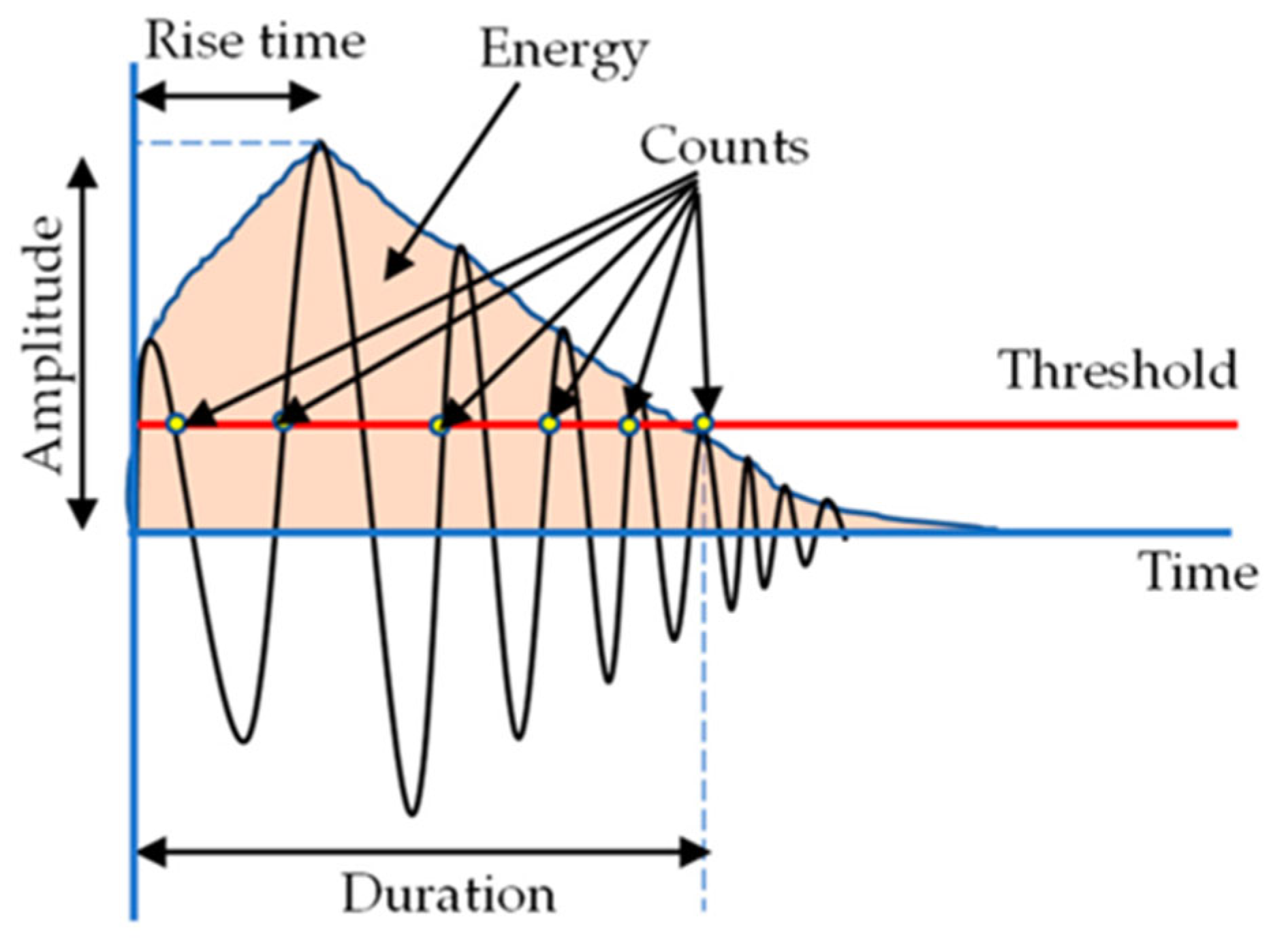
AE is capable of detecting damage initiation with higher precision and monitoring its evolution [27,28]. Furthermore, the source localization can be found by determining the arrival times of elastic waves at different sensors in multiple locations on the component [29,30,31]. An additional advantage is that failure modes can be identified. This is achievable due to the relationship between AE waveform parameters and specific failure mechanisms [32,33,34]. Each AE signal is captured as a waveform, and the primary parameters of the AE signal are shown in Figure 1 [35].
The AE parameters are used to characterize failure processes in concrete [36,37]. For example, the AE parameters recorded at low load levels can help predict the final mechanical properties of steel-fiber-reinforced concrete and demonstrate the sensitivity of acoustic emission to activities occurring within the microstructure [38]. Initial cracking demonstrates a low rise time (RT) and high frequency values, while the fiber pull-out mechanism shows lower frequencies and an extended rise time. This change is very distinct, as the frequency reduces to about half of its previous value with the increase in the rise time [39].
In addition, the fiber alignment has an effect on the recorded acoustic emission waveforms. Specimens with more fibers aligned to the direction of the load presented better mechanical properties and enhanced shear characteristics of acoustic emission that could be observed from the average frequency (AF) (duration/count) and rise time/amplitude (RA) [40]. Comparison shows that fiber bridging by pullout is the dominant energy-dissipating process rather than matrix failure in this case [41]. Related studies also showed that the fracture mode changed to shear by inclusion of fibers, which was shown in the AE parameters recorded [42].
Using a single acoustic emission (AE) parameter may be insufficient for reliably assessing material damage, structural integrity, or crack mechanisms; it is essential to adopt AE parameter analysis techniques, including statistical analysis and b-values [43,44]. Also, the AE system is sensitive to high-frequency sounds and is capable of receiving lower-frequency ranges according to demand [45]. The parameter-based analysis system is commonly adopted for monitoring the structural health of structures in different applications for its simplicity and clarity [46]. The changes in AE amplitude, the count and the number of events are related to AE activity and fracture growth rate [47].
In general, the acquisition of acoustic emission (AE) signals has been performed using high-cost AE sensors. These AE sensors are composed of piezoelectric crystals that serve as sensing elements; these crystals are encapsulated for protective purposes and bonded to a wear plate to ensure adequate acoustic transmission. The frequency content and sensitivity of the sensor are determined by the geometric configuration and material properties of the piezoelectric crystal [48]. In this work, piezoelectric wafer active sensors (PWASs) were adapted for capturing acoustic emission activity in RAC under the combined action of hybrid steel and polyolefin fibers. The PWASs operate as active sensing devices on the basis of piezoelectric principles. These sensors have been widely adopted for ultrasonic-guided wave excitation and detection in the domains of non-destructive evaluation (NDE) and structural health monitoring (SHM) [49,50].
The integration of piezoelectric wafer active sensors for acoustic emission monitoring presents a promising avenue for assessing the structural integrity and early-age strength development of fiber-reinforced RAC [51]. This approach enables the real-time detection of fracture behavior, microcracking, and main crack propagation within these complex composite materials under various loading conditions [52]. This is particularly relevant for fiber-reinforced concrete members, where damage diagnosis, especially in the presence of synthetic fibers, remains a challenging task [53]. The use of such advanced structural health-monitoring techniques is crucial for improving the durability and safety of civil engineering infrastructure, particularly given the inherent difficulties in detecting internal damage in fiber-reinforced concrete, where dispersed fibers lead to the formation of small, thin cracks [54]. This monitoring is capable of detecting damage initiation and propagation in fiber-reinforced concrete structures, especially in critical areas of structural members [55]. To that end, the use of piezoelectric wafer active sensors (PWASs) within the concrete matrix offers a non-destructive and real-time method for identifying and localizing internal damage through the analysis of stress wave propagation characteristics.
In the context of concrete recycling, six series of specimens made from recycled concrete aggregate (RCA) and reinforced with steel fibers and/or polyolefin fibers were prepared and subjected to compressive load testing. To assess the progression of damage and failure in these specimens, a low-cost monitoring technique utilizing piezoelectric wafer active sensors (PWASs) was implemented. The loading tests were performed in conjunction with acoustic emission (AE) monitoring, a non-destructive method capable of real-time internal damage detection. In addition to traditional and statistical interpretations of the AE data, the development of fracture behavior was analyzed, focusing on a refined distinction between the influence of polyolefin fibers versus steel fibers on the structural performance of the recycled material.

2. Materials and Tests

The experimental study focused on studying the effect of using two fiber types, hooked-end steel fibers and macro-polyolefin fibers, in concrete mixes with recycled coarse aggregates. The volume fractions of fibers in all mixes used in this study were fixed (Vf = 1%). The proportions of the fibers were precisely controlled in the concrete mix by varying their ratios from 0% to 100% for each type of fiber (including hybrids, such as a 75% steel + 25% polyolefin ratio) to explore their respective and combined influences on the mechanical properties of the composite material. The main mechanical properties considered in the analysis were compressive, tensile, and flexural strength, as it was meant for investigating the existence relationship between fiber type and fiber ratio controlling the overall mechanical performance of the modified concrete produced. The use of recycled coarse aggregates in this study contributes to mitigating environmental pollution by enabling the recycling of construction waste.

2.1. Experimental Materials

2.1.1. Fibers

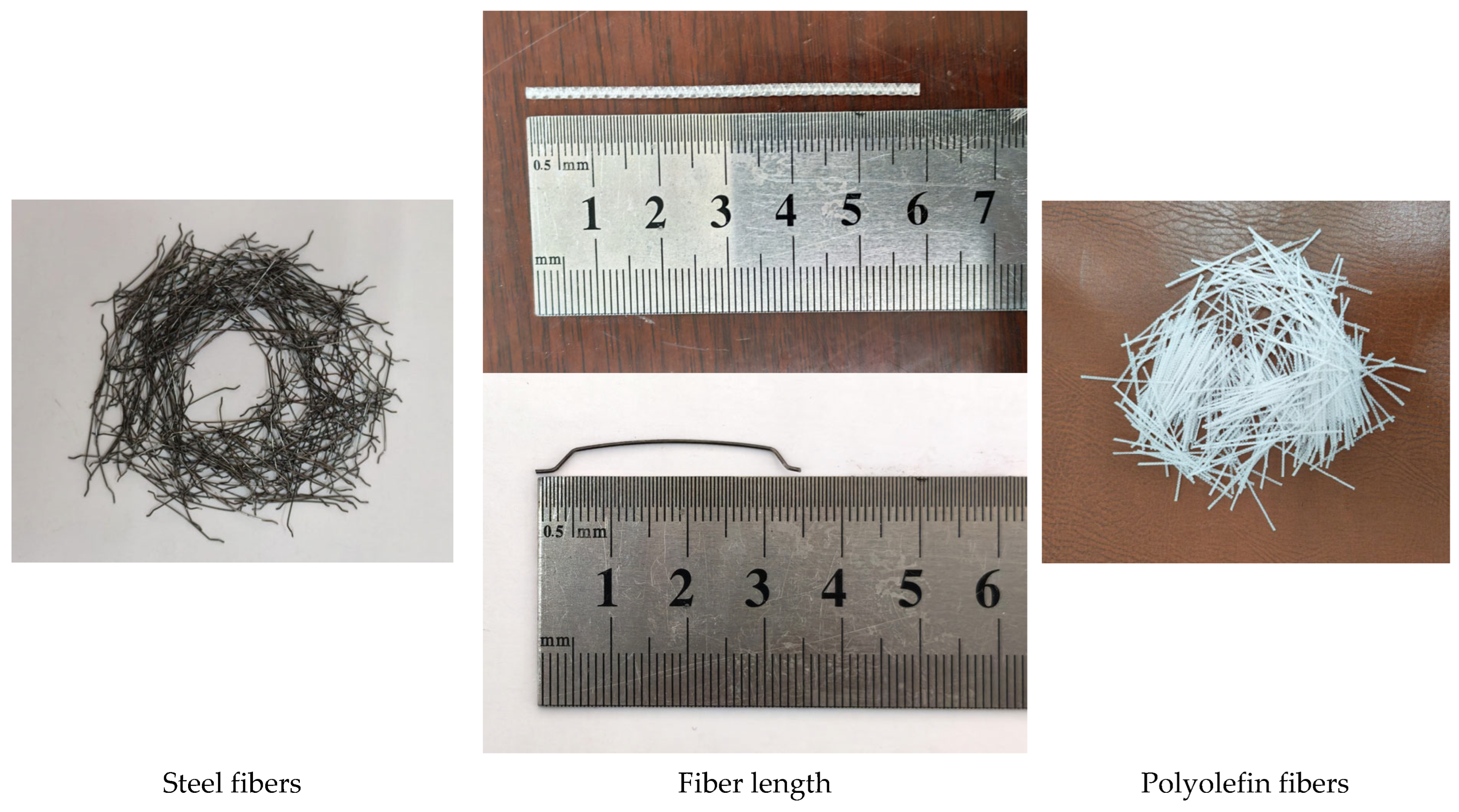
This study evaluated two types of fiber, namely, hooked-end steel and macro-polyolefin fibers. Steel fibers are available in various shapes, like straight, hooked, and corrugated forms; the present investigation employed hooked-end steel fibers, consistent with the methodology of previous work [56], which indicated that the use of hooked-end steel fibers results in a significant improvement in bond behavior in comparison with straight ones. The used fibers are presented in Figure 2. The properties are listed in Table 1.

2.1.2. Concrete

For this study, the concrete mixtures were targeted to develop a 28-day compressive strength of 30 MPa, as measured on standard cylinders. This value of compressive strength was considered because most of the available studies on coarse recycled aggregate adopted strengths between 25 and 35 MPa. In addition, it can be obtained without the excessive treatment that is needed because of the mechanical limitations of RCA. The mixture contained potable water, recycled concrete aggregate (RCA), ordinary Portland cement type I, sand, macro-polyolefin and/or steel fibers, and superplasticizer ingredients, as summarized in Table 2. The physical and chemical properties are indicated in Table 3 and Table 4.
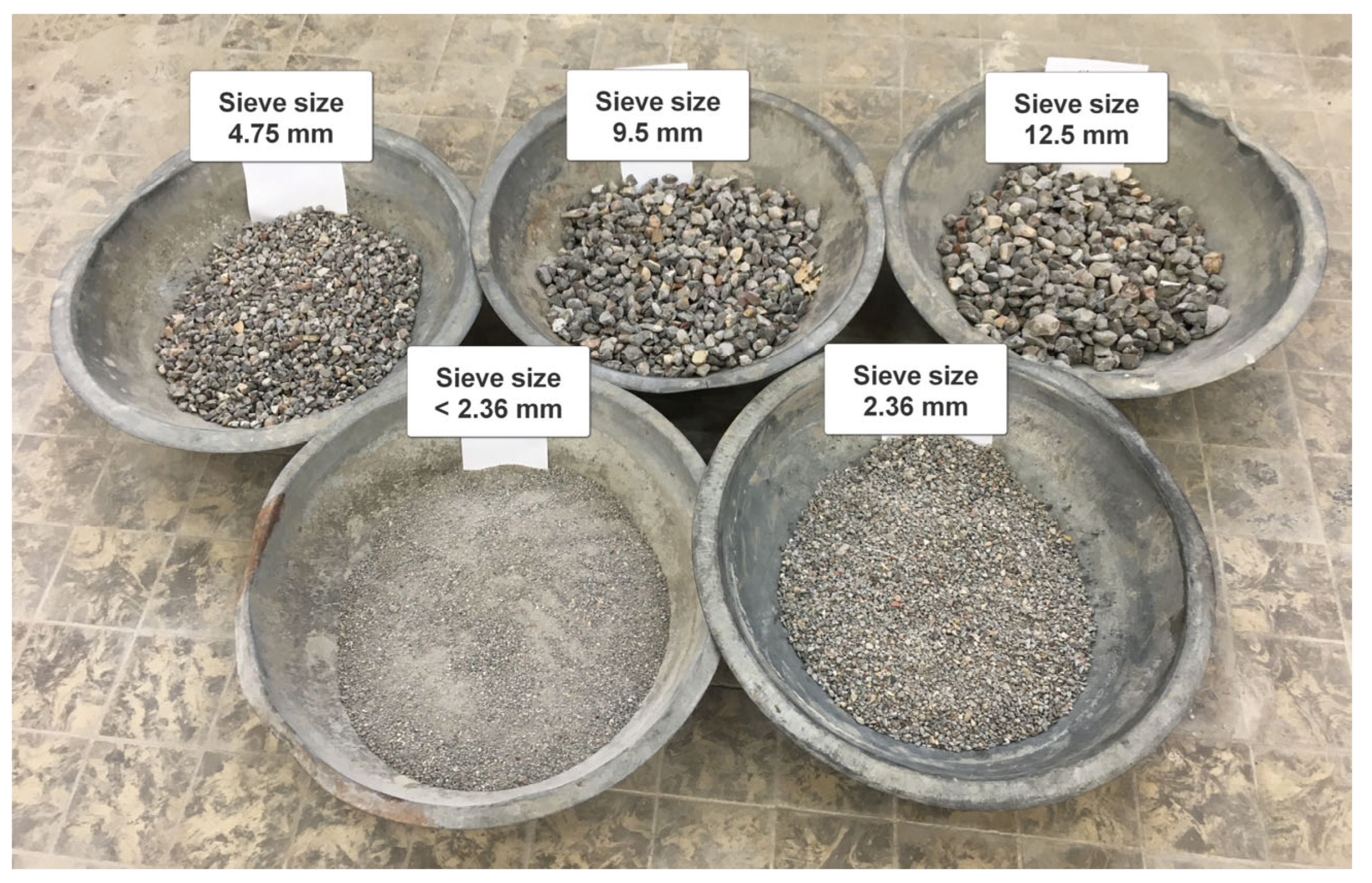
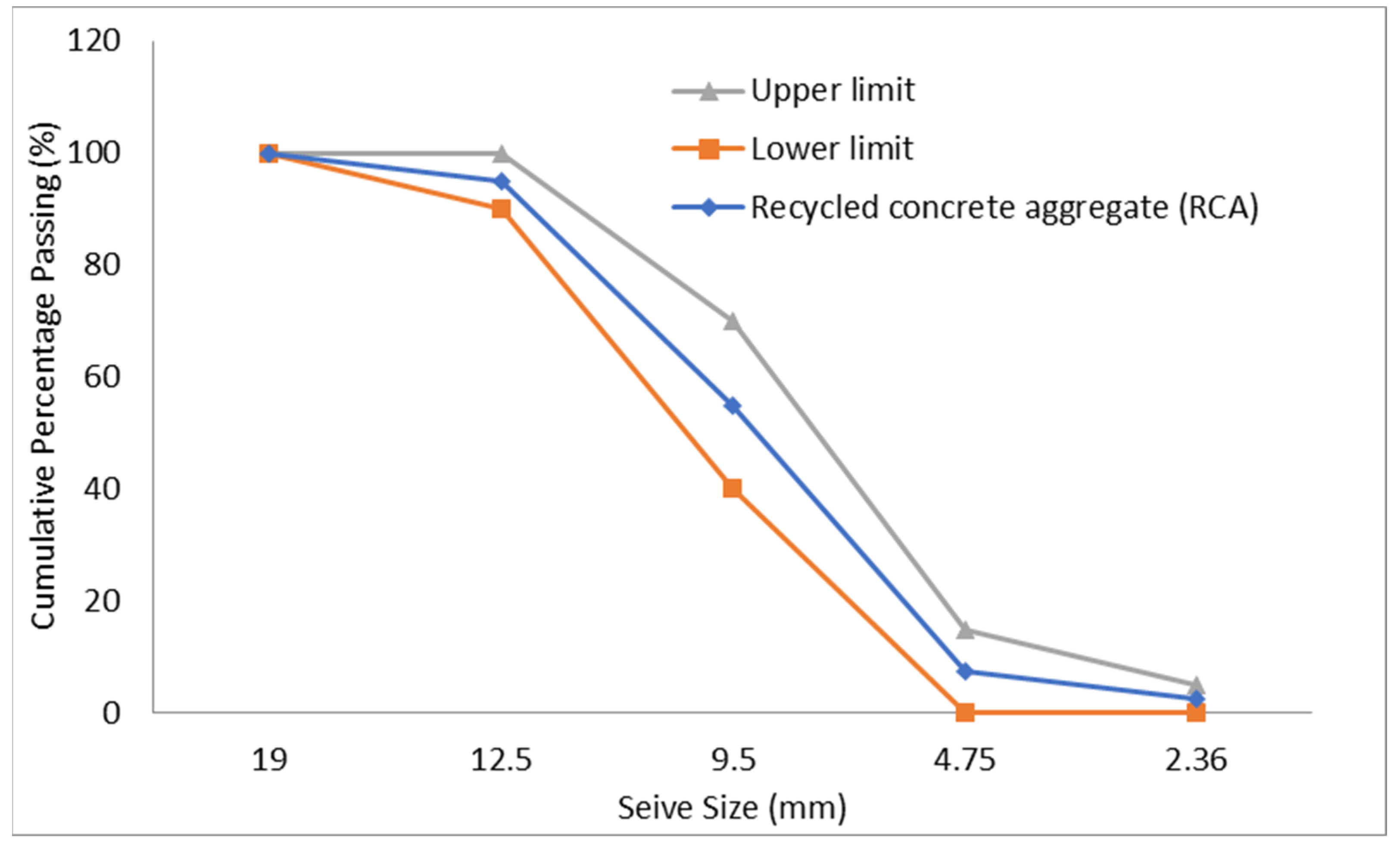
The coarse recycled aggregates were obtained from previously tested concrete cubes, which were found at the Construction Material Laboratory, the Civil Engineering Department, University of Basrah. The compressive strengths of these cubes ranged between 25 MPa and 35 MPa. A jaw crusher for waste was used to crush the RCA for use as needed. RCA with a particle size ranging from 12.5 to 4.75 mm was employed. The coarse recycled concrete aggregate was graded according to ASTM C33–18 [58]. For each particle size fraction, the percent passing was chosen as the midpoint between the lower and upper limits of the specified size range. The particle size distributions of the coarse RCA and its grading are illustrated in Figure 3 and Figure 4, respectively. The level of replacement of RCA was defined as the weight ratio of the RCA to the total coarse aggregate content in concrete. In the present study, the replacement was done as 100%. The properties of the RCA are summarized in Table 5.
The use of recycled aggregate has disadvantages, which include higher water absorption; this was overcome by using saturated and dry surfaces, where the recycled aggregate quantity was submerged in a tank of water a day before casting the specimens. After the duration of the soaking period ended, the recycled aggregate was spread out on a clean surface in the lab, and then any water adhering to the surface was dried with a soft cloth.
The polyolefin and/or steel fibers were then manually dispersed over the dry ingredients of the concrete. The materials were homogeneously dry-mixed in the mixer machine to prevent fiber balling at one point. The superplasticizer was then mixed with the potable water in the mixture machine.

2.2. Experimental Procedure and Method

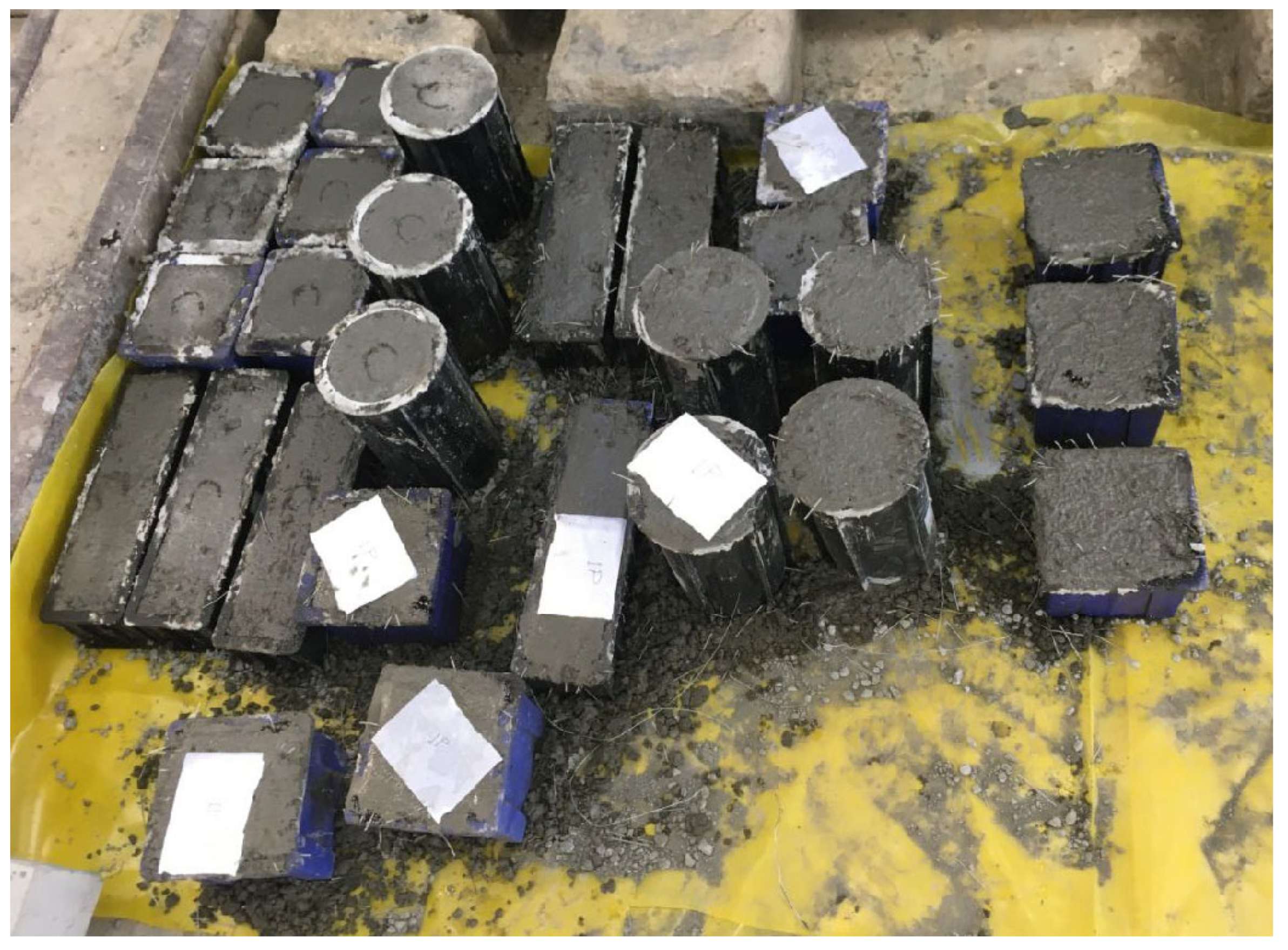
For each concrete mixture, cube specimens (150 × 150 × 150 mm), cylindrical specimens (150 × 300 mm), and prismatic beam specimens (100 × 100 × 350 mm) were made to measure the compressive, splitting tensile and flexural strength. The specimens are presented in Figure 5. The minimum average strength of the specimens was based on at least three specimens. The test began following the completion of a 28-day curing age for the specimens.
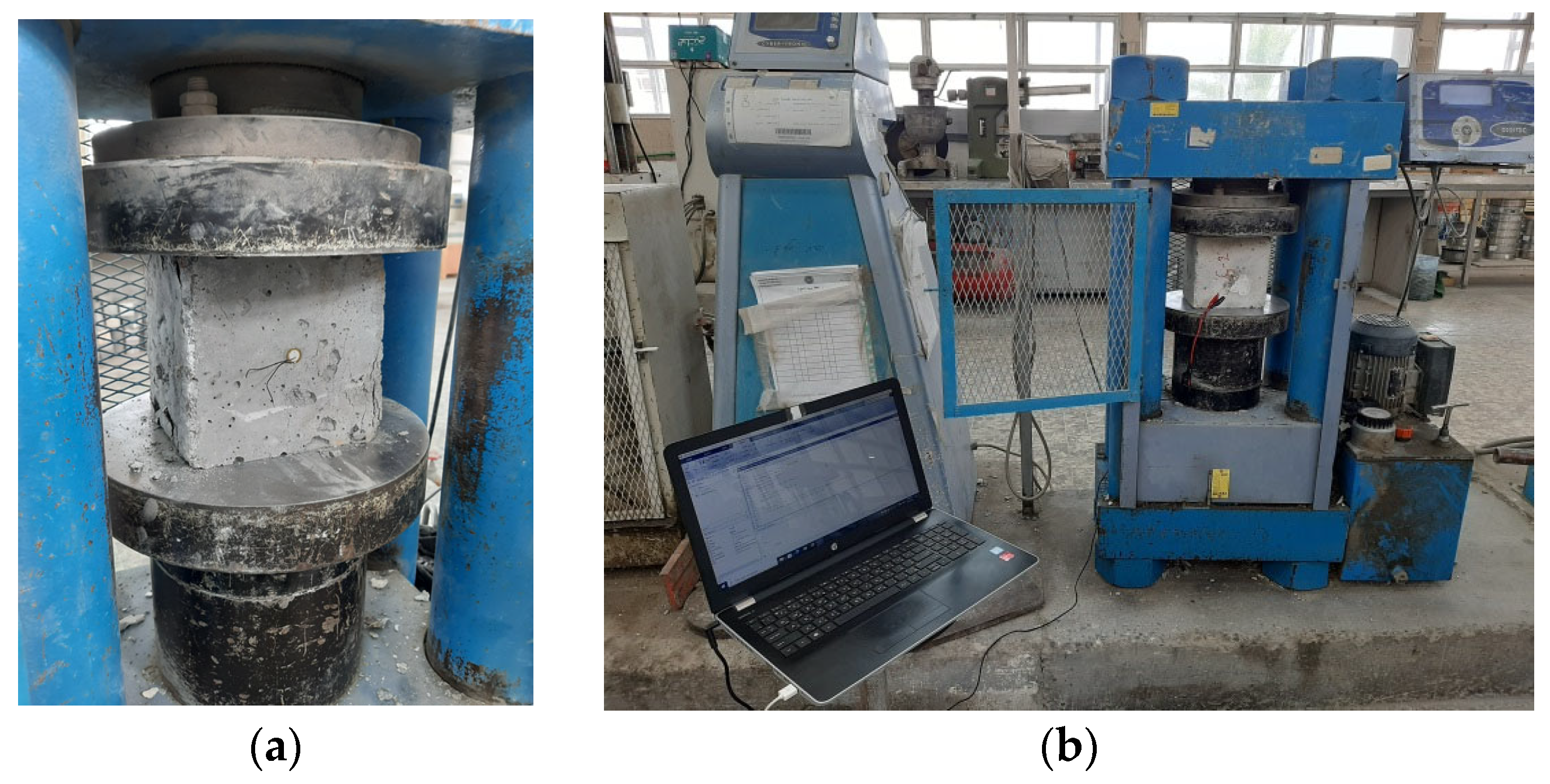
A single sensor (Piezoelectric Wafer Active Sensor-PWAS) was centrally affixed to one lateral surface of each specimen to monitor damage accumulation during compressive loading, as illustrated in Figure 6a. The specimens were positioned with their top and bottom surfaces engaged between the stationary and movable platens of the testing machine (Figure 6b). To ensure optimal acoustic coupling and mechanical fixation, the sensor was bonded to the concrete surface using a cyanoacrylate-based adhesive.
Acoustic emission (AE) data were collected during all tests with a laptop computer with a built-in sound interface and 3.5 mm analog audio jack [59,60]. The sensor wires were soldered directly to the coaxial conductor to minimize signal loss and electrical noise. The sampling frequency of the acoustic emission data was set at 48 kHz. A trigger threshold of 0.005 V was used to filter out low-voltage background and electromagnetic noise.
A calibration of the sensor according to the Hsu–Nielsen (H-N) fracture source procedure [61] was performed before each test. This calibration required a controlled breaking of several pencil leads on the surface of the sample near the sensor, producing uniform, high-amplitude AE signals to check system sensitivity and response. A full experimental setup is shown in Figure 6b.

3. Results and Discussion

This section includes the test results of the mechanical and acoustic emission (AE) tests and a comprehensive discussion of the test data, which includes the observed behaviors, the mechanisms involved in the specimens’ failure, and the effect of using hybrid steel–polyolefin fibers together with recycled aggregate (RA). The models are combined using data from both mechanical testing and non-destructive testing to capture a complete picture of the material response, degradation, and damage progression under different loading conditions.

3.1. Mechanical Properties Analysis

The obtained values of compressive, tensile and flexural strength, as reported in Table 6, are depicted in this sub-section, constituting the fundamental steps for determining the macroscopic behavior of the material. The steel and polyolefin fibers, along with recycled aggregates, with different potentials in terms of properties, considering the proportion of these components, were investigated. The porous structure and remanent mortar of recycled aggregates make them contain many microcracks, leading to insufficient bonding with the cement matrix at the interface, thus decreasing their strength. Hence, the addition of fibers helps to overcome these problems by impeding crack growth and increasing overall strength.

3.1.1. Compressive Strength

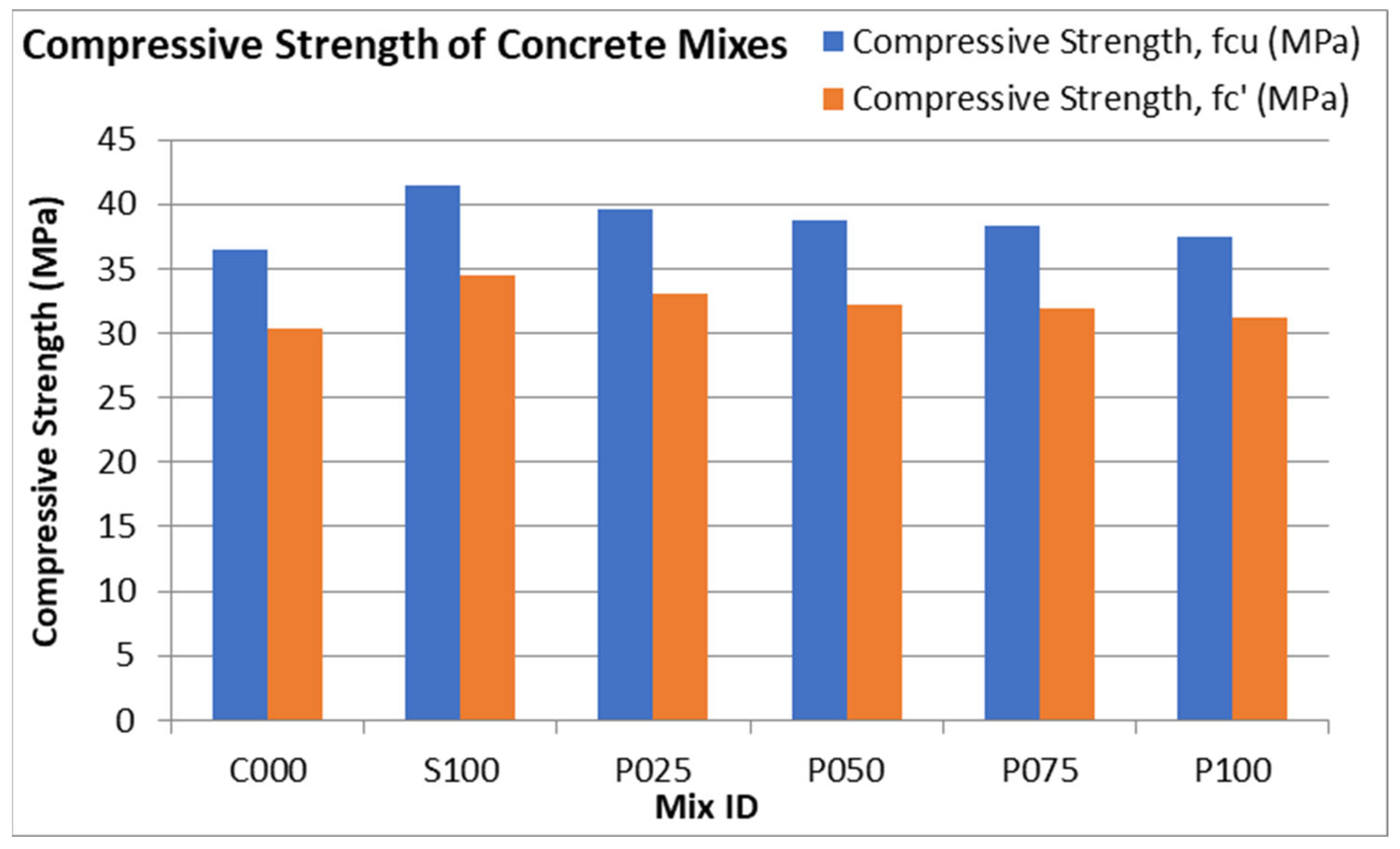
Both cubic (fcu) and cylindrical (f’c) strengths showed different performance trends for the concrete mixes (Figure 7). The values of compressive strength for the control mix, which did not have any fibers, were found to be 36.41 MPa (fcu) and 30.34 MPa (f’c). S100 (100% by vol hooked-end steel fibers), meanwhile, had the maximum compressive strength, with the compressive strengths of fcu and f’c reaching 41.45 MPa and 34.54 MPa, respectively. This was a significant improvement over the control mix. However, P100, having 100% macro-polyolefin fiber, demonstrated compressive strengths of 37.48 MPa (fcu) and 31.23 MPa (f’c), indicating a slight improvement when compared with the control specimen.
A reduction in compressive strength was found with increasing gradual replacement of steel fibers with polyolefin fibers in the hybrid mixes (P025, P050, and P075). This tendency reflects that the enhancement of the contribution of steel fibers to the compressive load resistance is better than that of polyolefin fibers. Steel fibers’ contribution to the enhancement in compressive strength can be due to the interfacial bond strength. Steel fibers typically develop a stronger bond with the cementitious matrix, thereby more effectively bridging and restraining crack propagation, whereas polyolefin fibers exhibit comparatively weaker interfacial adhesion, rendering them more susceptible to pull-out and slip from the matrix.
The behavior suggests that the hybrid action between steel and polyolefin fibers is less effective in enhancing compressive strength than steel fibers used alone. As steel fibers provide enhanced axial strength due to the formation of robust internal networks, their replacement with softer polyolefin fibers naturally reduces the compressive performance of the composite. The data also indicate that the dense network of steel fibers is very effective at conveying and spreading compressive stresses. In the presence of polyolefin fibers, the relatively lower stiffness of these fibers could interfere with this efficient load transfer path and can result in localized stress concentrations or premature failure of the matrix surrounding the softer fibers. This implies that any positive synergy between the contribution from hybrid fibers in compression is, if at all, limited and indicates that compressive performance is, to a large extent, dominated by the stiffer steel, along with its formation of continuous load-carrying networks.

3.1.2. Tensile Strength

The splitting tensile strength (fct) showed a remarkable increase when fibers were incorporated. While the tensile strength of the control mix was 2.68 MPa, both fiber types (steel and polyolefin) increased this property remarkably, and S100 (100% steel) showed a value of 4.30 MPa, and P100’s (100% polyolefin) value reached 3.47 MPa. One of the notable results is that P050, a composite mixture consisting of 50% steel and 50% polyolefin fibers, achieved the highest tensile strength of 4.86 MPa.
This maximum hybrid mix performance suggests that there was a tensile-level proto-synergetic effect in the hybrid mix, where the combined properties of both fiber types were more efficient in improving bond strength than individual types alone. The behavior of the composite material under tension was such that fibers acted essentially as crack-bridging elements that prevented or retarded their opening and propagation. The advantages of steel fibers in this material were also due to their high characteristic tensile strength and stiffness, which significantly increase the resistance to initial cracking and the load-carrying capacity. Lower stiffness, however, was also contributed by the polyolefin fibers, whilst microcracking had already taken place, believed to give ductility and absorb a considerable amount of energy. This “hybrid effect” seems to indicate that the steel fibers mainly increased the peak tensile load, whereas the polyolefin fibers were introduced to improve the toughness and strain-hardening capacity of the material, resulting in an increased ultimate tensile capacity by promoting more distributed damage rather than catastrophic failure. This behavior is in contrast with the results found in compression, where the flexibility of polyolefin was not an advantage.

3.1.3. Flexural Strength

Similar to the tensile strength, the flexural strength (ft) was greatly increased because of the fiber addition. The flexural strength of the control mix was 16.13 MPa. For S100 (100% steel), it increased significantly to 23.80 MPa, whereas for P100 (100% polyolefin), it reached up to 17.93 MPa. Similar to the tensile findings, P050 (50% steel; 50% polyolefin) also had the highest flexural strength, which reached 25.54 MPa, indicating an increase of 58.3 compared with the control specimen.
The flexural strength is the tensile behavior of a material, since failure occurs by yielding in bending at the extreme fiber. The uniform improvement in both tensile and flexural strengths indicates that the interaction combination of hybrid fibers has a good performance property that enhances the tensile properties and post-cracking ductility of concrete. This means that polyolefin fibers contribute to bridging the cracks and redistributing stress in the tensile zone, even when they are less stiff than steel fibers. This is in contrast with the case of compressive load, where the dominant failure mechanism is crushing and buckling, resulting in little benefit from being a polyolefin fiber.

3.2. Acoustic Emission

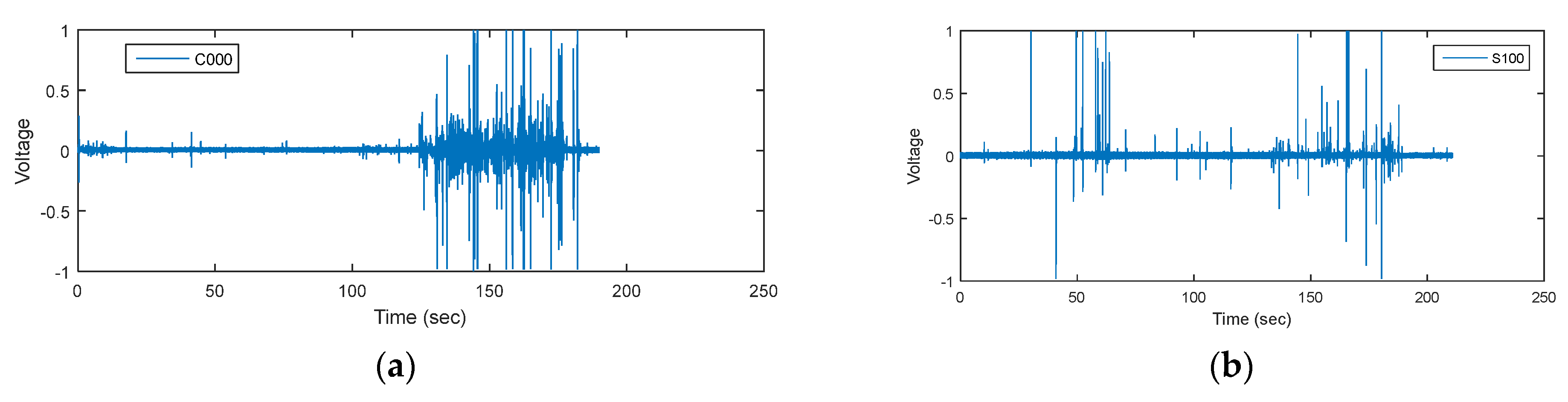
The continuous acoustic emission stream of the tested specimens under compression load is shown in Figure 8. The acquired AE data for the C000 specimen are presented in Figure 8a. During the early phase of testing, some low-amplitude AE activity was obtained that indicated there were no significant or noticeable cracks occurring within the specimen. After that, there was a quiet period of unimportance. From the onset of the final third of the testing period, AE events were detected at a fast rate, with some high-amplitude signals. This may indicate a burst region if a large number of cumulative events is found at a high event rate. This behavior continued until a final failure took place at the end of the test.
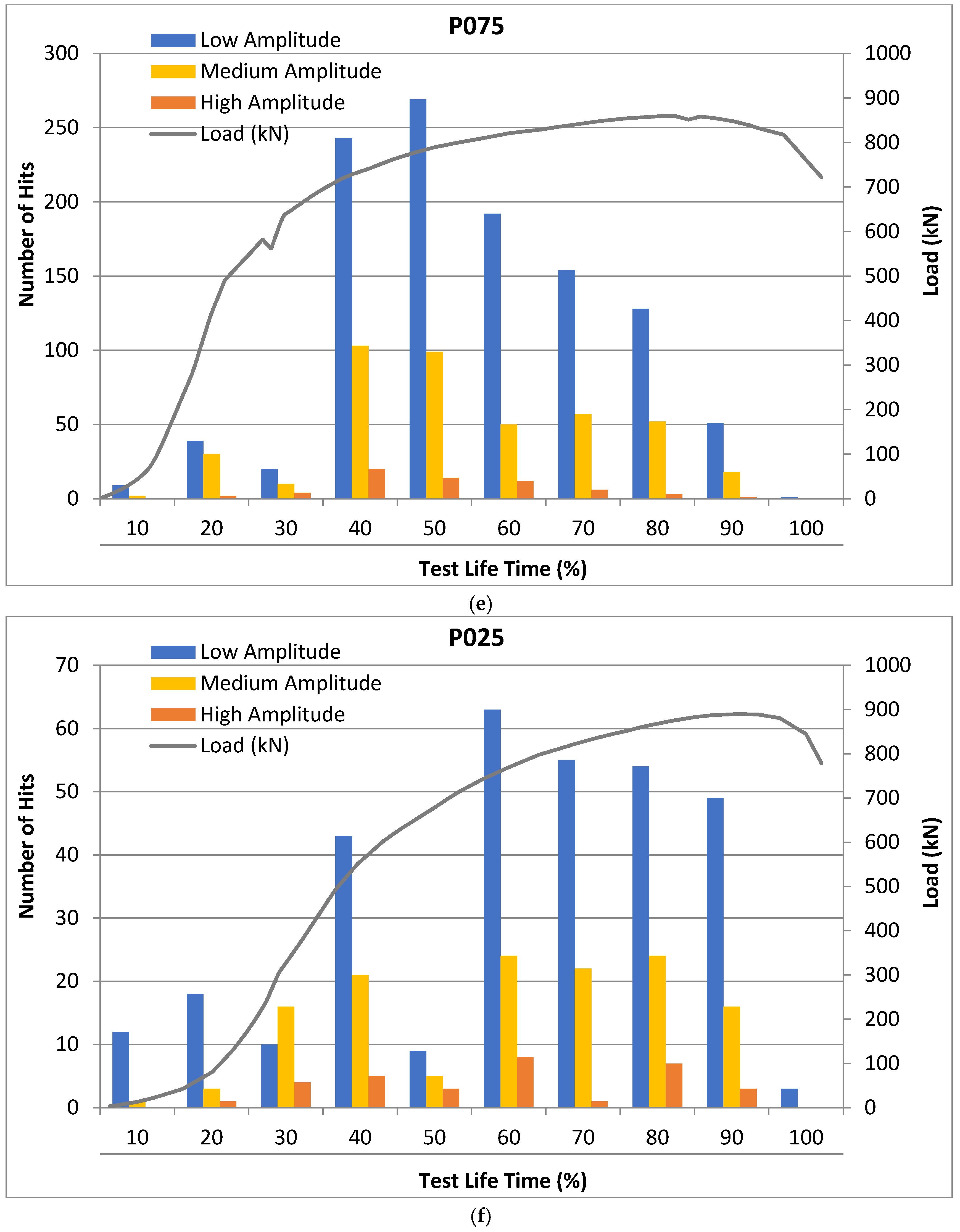
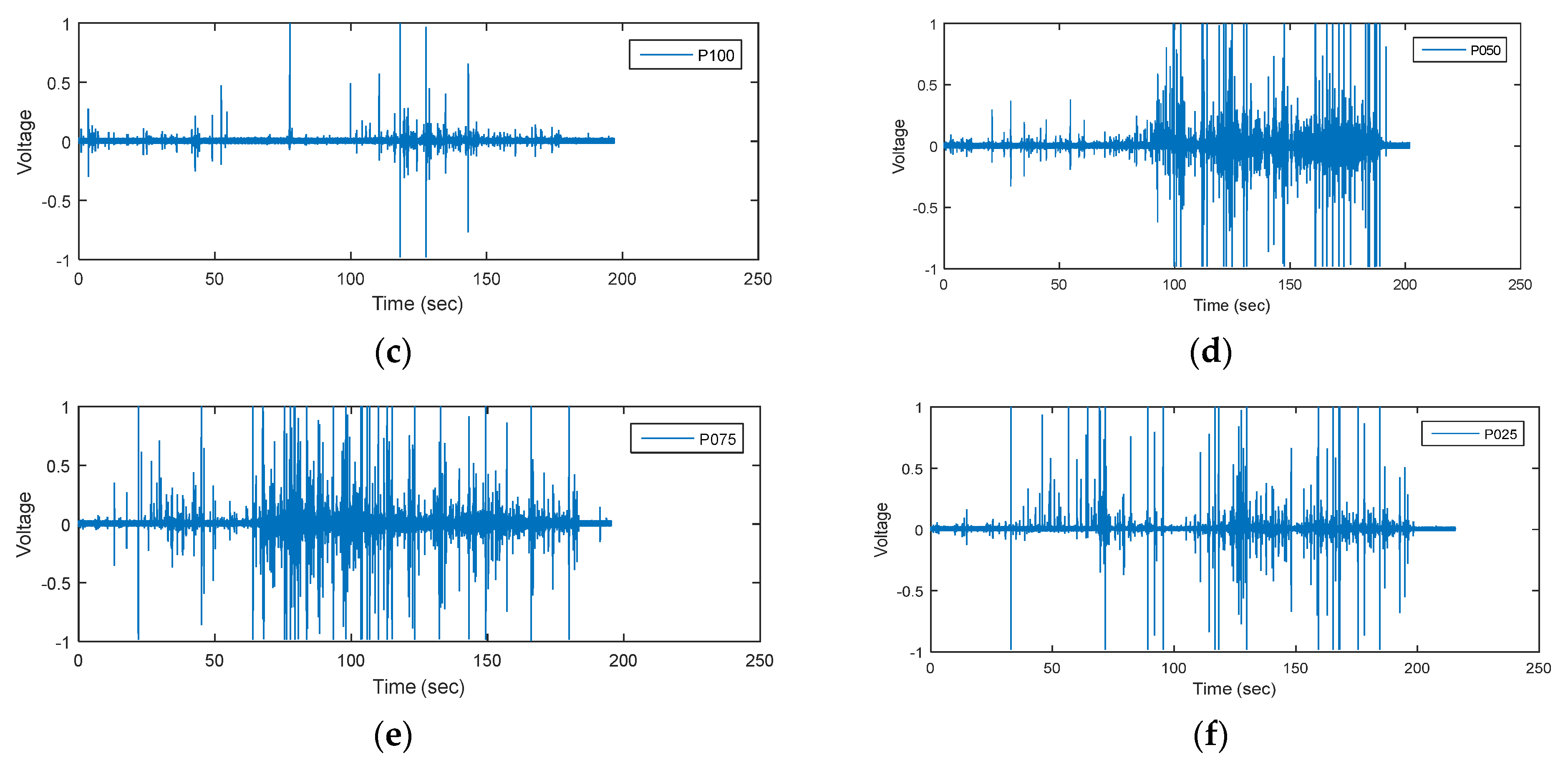
The data acquired for specimen S100 (Figure 8b) exhibited distinct behavior. The predominant behavior consisted of a sequence of active regions followed by regions of inactivity, continuing until around 140 s into the test. The same pattern was observed in the obtained data of specimen P100 (Figure 8c). The AE activity of specimen P050 is illustrated in Figure 8d. The initial phase of the test life exhibited minimal activity of moderate-amplitude signals. Afterwards, the AE event rate increased suddenly, and high-amplitude signals were recorded. This behavior was maintained up to the test end, which corresponded in time to fracture propagation leading to ultimate failure. The AE data recorded for specimen P075 (Figure 8e) showed high-amplitude activity early in the test life. The same high-amplitude activity was observed in specimen P025 (Figure 8f), but at a lower rate in comparison with specimen P075.
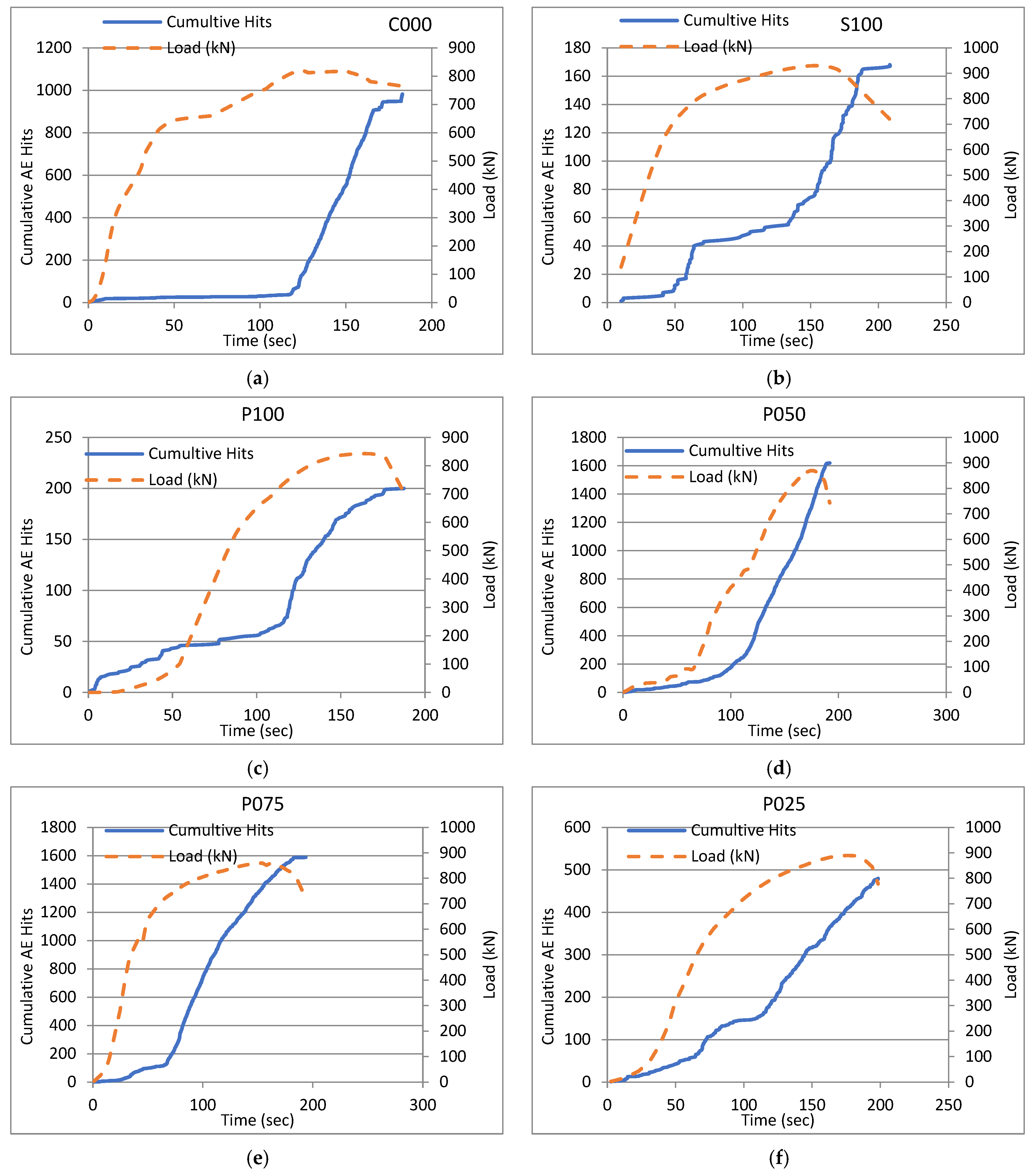
Figure 9a–f show the relationship between the applied compressive load and the corresponding AE activity for six different concrete mixes. The cumulative curve of AE hits serves as a diagnostic tool that may offer a means of monitoring in real time, allowing for the detection of damage initiation, stable propagation, and, ultimately, failure mechanisms [62,63]. Changes in this slope mark important transitions in the fracture behavior of the material, providing a quantitative approach for structural integrity evaluation, life prediction [64], and failure prediction [65].
A general damage progression model that can be applicable for quasi-brittle fiber-reinforced composites is detailed as follows [25]:
  • Initial stage—elastic: Low AE activity only, corresponding to elastic deformation and pore collapse.
  • Hardening stage—stable crack growth: Shows increments in AE hit rate, suggesting distributed microcracking.
  • Critical transition stage: Features a sudden rise in AE activity and the coalescence of microcracks into dominant macrocracks.
  • Pull-out stage: Indicates a sharp, sustained increase in hits associated with fiber debonding and pull-out mechanisms.
  • Failure stage: Saturations or abrupt increments for the cumulative hits; a sign of catastrophic damage.
The response of specimen C000 was brittle in the classical sense (Figure 9a). An elongated flat AE curve was then observed in the linear elastic loading, and a sudden burst of hits occurred exponentially above an applied load greater than 819 kN. This corresponded to a shift from a partial elastic response toward unstable microcrack coalescence, and eventually led to the rapid propagation of a macrocrack to failure. This brittle transformation was promoted by the poor pre-existing cracks of RCA, especially in the weaker interfacial transition zone (ITZ) [66].
The ductility was higher for the S100 sample (Figure 9b). AE responses increased steadily after an initial period of a few AE hits, which was associated with distributed matrix microcracking. It was characterized by a rapid rise in the AE rate during and after the peak load (933 kN), together with a slight decrease in the load. This AE burst corresponded to the critical crack-bridging action of the steel fibers, including matrix breaking, fiber–matrix debonding, and high-energy hook cleaning and frictional pull-out [67,68].
For P100 (100% polyolefin fibers), the behavior indicated pseudo-ductility controlled by distributed cracking (Figure 9c). Considerable AE activity started earlier than in the other mixes and was related to the fracture of a weak RCA matrix. The integrated AE curve showed a very smooth, almost linear slope during the entire loading process. This pattern indicated distributed, steady-state microcracking bridged by flexible fibers, and the main source of AE events was the frictional pull-out applied to the smooth polyolefin fibers instead of concentrated macro-fracture [69,70,71]. This led to a steady decline in the load and a high total number of hits, which implies enhanced toughness.
The hybrid specimens (Figure 9d–f), P050, P075 and P025, exhibited a combined effect. The stable cracking phase (Stage II) was augmented for all the hybrids compared with plain concrete. The post-peak behavior was, however, controlled by the particular fiber proportion. The activity of P050 (50/50 hybrid) was characterized by a coexistence of heavy and light mechanisms. The AE count increased in a linear behavior, demonstrated efficient control of microcracks; meanwhile, the high peak load and considerable AE burst showed important steel fiber bridging. The post-peak phase showed sustained activity from combined fiber pull-out [72,73,74]. Furthermore, P075 (25% steel/75% polyolefin) was dominated by the polyolefin majority. It exhibited accumulations of AE hits at a high level and a constant accumulation rate typical of distributed damage (only a less pronounced peak-load AE spike), which suggested reduced involvement of separate steel fiber bridging so that the failure was more gradual [73,75]. The steel-dominant hybrid of P025 (75% steel/25% polyolefin) also exhibited a dramatic increase in AEs around the peak load, similar to S100 but without the relatively rapid decay following the peak. The presence of polyolefin fibers also worked to enhance microcrack distribution, and the cumulative AE count of S100 [76,77] was higher due to this reason.
Figure 9 effectively shows the damage chronology of the sustainable fiber-reinforced concrete and how the use of 100% recycled aggregate influenced the early-stage microcracking, while the hybrid fiber system significantly enhanced the material’s performance by promoting stable cracking and providing substantial post-peak ductility.
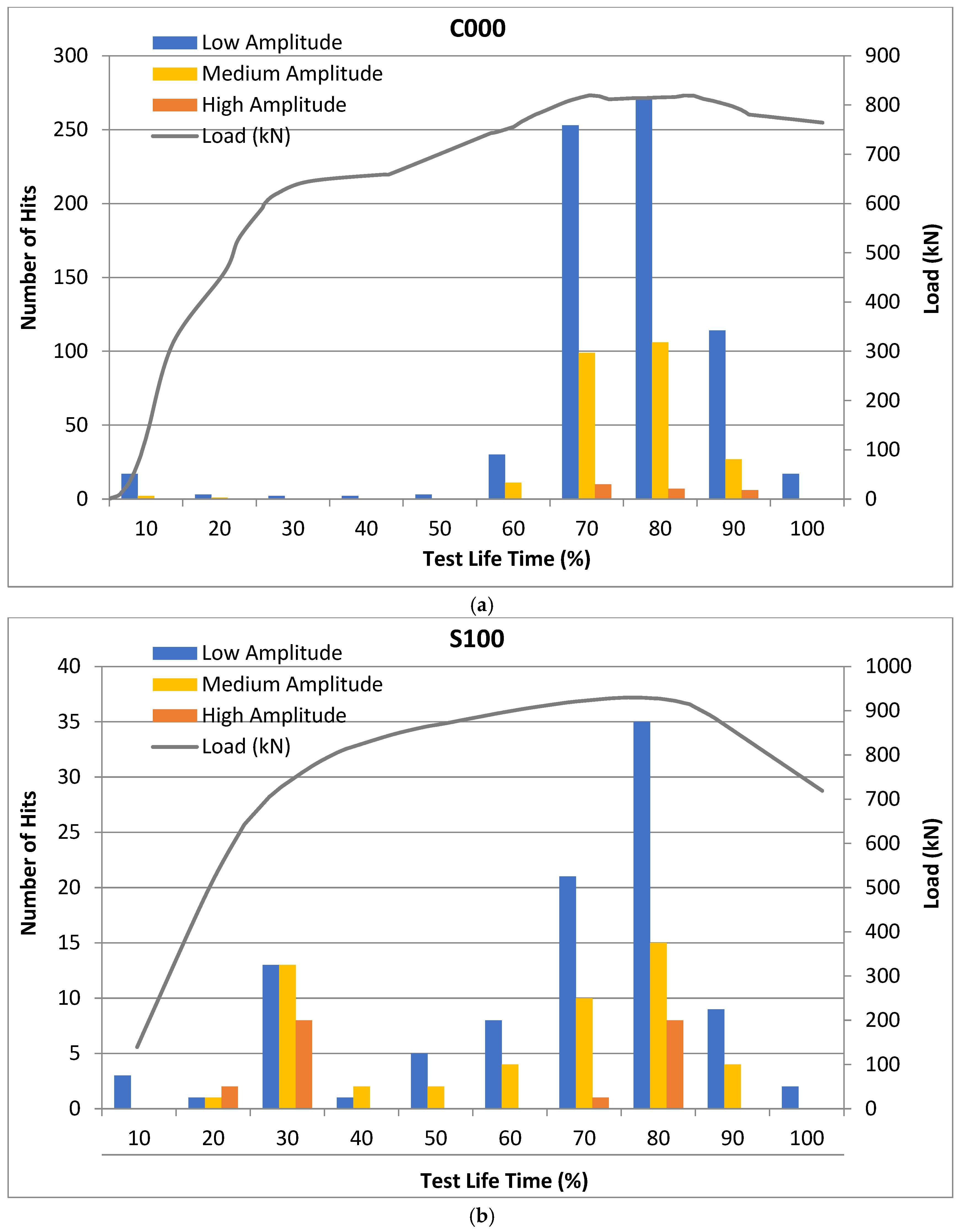
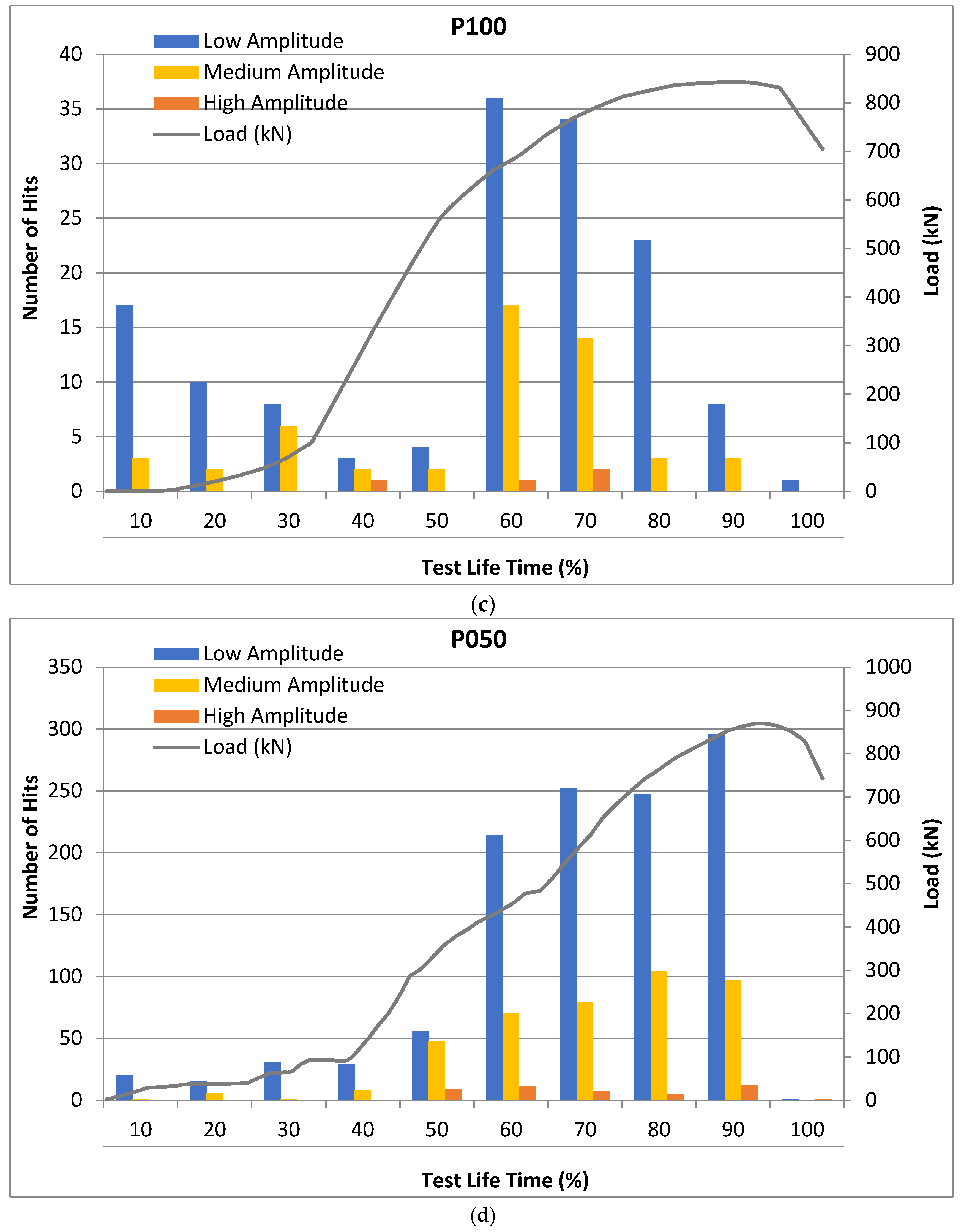
The signal amplitude is directly related to the energy released by a fracture event, allowing the differentiation of damage mechanisms [78]. A low amplitude is characteristic of subcritical, low-energy events, such as micro-void collapse, friction at interfaces, and the nucleation of microcracks within the porous RCA or its weak, pre-existing interfacial transition zones (ITZs) [79]. Meanwhile, medium-amplitude events correspond to stable matrix crack propagation and the primary energy-dissipating processes in fiber-reinforced concrete: the debonding and frictional pull-out of fibers, particularly polyolefin types [80]. A high amplitude signifies critical, high-energy fracture events, such as the fracture of RCA particles, the formation of macrocracks, and the plastic yielding, hook straightening, and final pull-out of hooked-end steel fibers [81]. The obtained AE activity was categorized into three classes: low (amplitudes of less than 0.1 V), moderate (amplitudes greater than 0.1 V and less than 0.6 V), and high (amplitudes greater than 0.6 V) signals. Each test life was divided into ten segments, and the number of hits for each class is presented in Figure 10.
In Figure 10a, initial segments are dominated by low- and medium-amplitude activity from pore closure and microcracking. The defining feature is an exponential, concentrated surge of high-amplitude hits in the final segments. This corresponds to the unstable propagation of a critical macrocrack leading to immediate failure. The high cumulative hit count, dominated by these late-stage, high-energy events, quantitatively reflects the low fracture energy and high brittleness of concrete with 100% RCA replacement, a direct consequence of its high porosity and inferior ITZs [66].
Figure 10b shows a significant and sustained presence of high-amplitude hits commencing in the mid-load segments and continuing through the post-peak phase. This is the direct acoustic evidence of the dominant energy dissipation mechanism: the sequential plastic deformation and pull-out of the steel fibers [82]. Medium-amplitude activity from matrix cracking is present but secondary. The extended duration of AE activity, even as the load decreases, visually quantifies the high fracture toughness imparted by the fibers.
The AE profile in Figure 10c is fundamentally different from both the control and steel-fiber specimens. It is overwhelmingly dominated by a massive and continuous accumulation of medium-amplitude hits across almost all segments. This is the characteristic acoustic of the primary failure mechanism: the widespread, progressive, and frictional pull-out of thousands of flexible polyolefin fibers [83]. These high-amplitude events are relatively infrequent, suggesting that fiber breakage and cluster fragmentation are negligible. This phenomenon is indicative of a breakdown failure by diffuse multi-cracking with good crack deflection and high total energy absorption over many small events.
The hybrid acoustic signature is shown in Figure 10d. This sustained level of high medium-amplitude activity is related to a process that has been previously observed as the continuous pull-out of polyolefin fibers and distributed microcracking. Overlaid with it are numerous high-amplitude events, representing the distinct and discrete high-energy steel fiber contributions. This combination of acoustical characteristics shows the synergy between the two types of fibers: the polyolefin fibers disperse damage and control the width opening of cracks, allowing for their more efficient use by steel fibers as high-strength bridges at localized cracks, maximizing both strength and fracture energy [84].
The AE distribution (Figure 10e) is very twisted towards numerous medium-amplitude events, such as P100, which attests to a marked predominance of the polyolefin fiber pull-out mechanism. Nevertheless, the steel fibers have an acoustic signature with occasional powerful high-amplitude hits. The observation indicates that a relatively small percentage of steel fibers was responsible for stopping the macro-crack and avoiding brittle failure, which was assisted by the fact that the ductile network of polyolefin was reinforced as a “backbone”.
In Figure 10f, the AE signature is very similar to that of S100, since the high-amplitude hits due to steel fiber action are easily identified. The key difference is an elevated baseline of medium-amplitude activity compared with S100. This is the acoustic contribution of the polyolefin fibers, which help to initiate and distribute microcracking more uniformly, preventing excessive localization and potentially leading to a more gradual and higher total energy absorption during the steel fiber pull-out process.

3.3. Crack Evolution

Investigating the evolution of cracks in concrete materials subjected to compressive damage facilitates the effective detection of, and provides valuable feedback on, the actual damage process occurring within the concrete. Elastic waves propagate through damaged concrete materials in a manner similar to seismic waves. b-value analysis, originally developed in the seismic field, was applied to evaluate the progression of cracking in compression-damaged concrete. The method of maximum likelihood estimation (MLE) [85] was used for the b-value calculation, which can be expressed as shown in Equation (1).
b = n l g e 1 n l g A i n l g A m i n
where A: the AE signal amplitude, Amin: the minimum AE amplitude at each time, n: the event count per discrete time interval, and e: the natural constant.
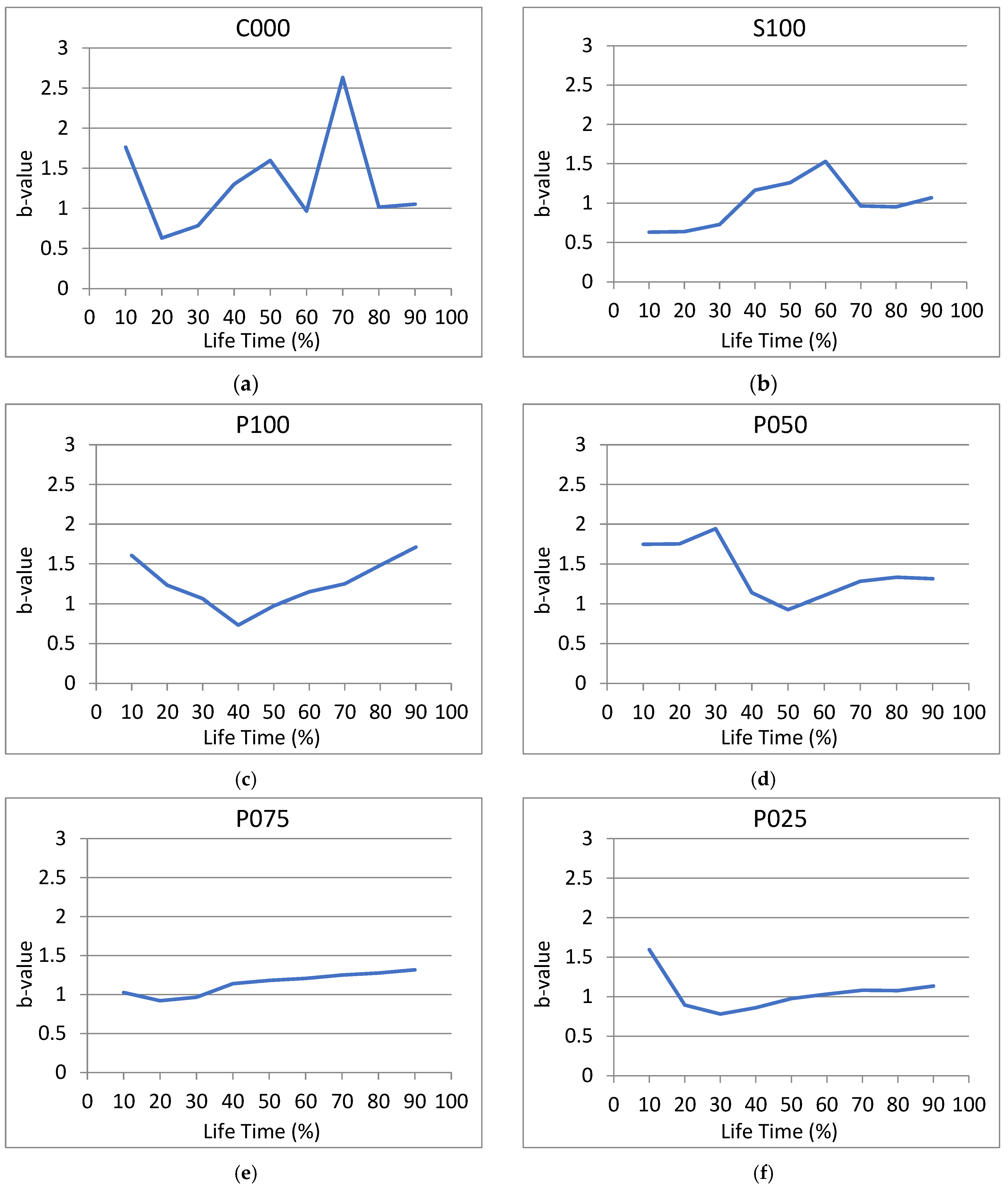
Figure 11 presents a comparative analysis of damage evolution in concrete cubes using the AE b-value, a statistical parameter derived from the amplitude distribution of acoustic emission (AE) hits, plotted versus the normalized test lifetime. According to the literature, a high b-value (>1.5) indicates a preponderance of low-energy events, characteristic of homogeneous, distributed micro-damage, such as diffuse microcracking, friction, and fiber debonding [86,87]. Furthermore, a low b-value (<1.0) indicates a larger relative occurrence of high-energy events, representing damage localization along major fractures, such as macrocrack propagation or high-energy fiber pull-out [88]. A marked and consistent reduction in the b-value is already known as a precursor to impending catastrophic failure for quasi-brittle materials.
In the b-value trend shown in Figure 11a, it can be observed that a very high fluctuation is present, which is usually seen for brittle failure. It starts quite high (1.76) and falls to very low values (0.63) at 20–30% lifetime, indicating that significant cracks form early in the lifetime of the material. A sharp spike to 2.63 at 70% life may reflect transient clustered secondary cracking before a final decrease, including sudden failure. This behavior indicates the unstable crack growth and low damage tolerance of unreinforced RAC, where damage is localized in very unpredictable conditions quickly [89].
Figure 11b also indicates that the b-value remains consistently low (varying between 0.63 and 1.26). This is consistent with the discrete high-energy nature of the primary failure mechanism, which is dominated by localized plastic yielding and pull-out of hooked-end steel fibers that produce numerous high-amplitude AE hits. The lack of an extended load level with high and stable b-values suggests little to no distributed microcracking. The stable and low-b-value trend without a catastrophic drop was due to the ductile energy-absorbing failure mode provided by the steel fibers, in which damage was localized but controlled.
For the 100% polyolefin fibers (Figure 11c), the b-value starts high at 1.61, descends to a minimum = 0.73 at life = 40%, and then consistently rises monotonically back up to high again (1.71). The first drop is the initiation of matrix cracking. The subsequent gradual increase is essential; it denotes the phenomenon of the large, progressive pull-out of polyolefin fibers. This process generates an exponentially increasing number of low-to-medium-amplitude frictional events, shifting the amplitude distribution and raising the b-value. This behavior indicates the remarkable homogenization of damage and stable non-catastrophic failure [90].
The hybrid (50% steel; 50% polyolefin) has a complex synergistic b-value signature in Figure 11d. It starts high (1.75–1.94) to reflect the high initial activity of polyolefin fibers, and distributed cracking starts from an early stage. The region in which the mechanism of higher-energy steel fibers prevails is characterized by a sudden drop to around 0.93 at the 50% life stage. The b-value then increases and becomes stable at a moderate value (1.28–1.35), indicating the composite mechanism, where both fiber types are active in a stable life phase post-peak load-carrying capacity. This is an essential feature of hybrid synergy.
In the case of Figure 11e, which is under a dominant phase of polyolefin fibers, the b-value characteristic follows that seen for P100 but with a higher baseline value and a less significant initial fall. The values are generally stable and moderate to high (between 0.92 and 1.32). The linear rise after about 30% life most closely reflects the P100 data and, thus, validates the dominant nature of polyolefin fiber pull-out. This slight change is the acoustic signature of the steel fibers momentarily engaging.
Figure 11f shows that the steel-dominant hybrid yields a b-value opposite to that of P075. It begins at only moderately high (1.60) but falls quite sharply early (to 0.78 at 30% life) and then continues to recover fairly steadily right up to a final value of 1.14. The first drop indicates the early, local steel fiber participation and localized damage. The subsequent slow recovery, in contrast with the plain concrete, shows how minor polyolefin fibers contribute to distributed cracking and decrease brittleness to greater stability in the failure process compared with S100.
According to Figure 11, several points can be highlighted: First, polyolefin fibers increase the b-value (distributed damage), whereas steel fibers suppress it (localized damage). Second, the decreasing trend of C000 predicts brittle failure. The stabilizing or recuperative behaviors of the fiber-reinforced specimens, in particular, of P100 and the hybrids, indicate ductile and manageable failure. And, at last, the b-value curves for the hybrids (P050, P075 and P025) are not just simple averages. They can react dynamically to one another, wherein one will help suppress the brittle nature while progressing to stable, predictable damage, as seen in the recovery phases of P050 and P025.

4. Conclusions

This study demonstrates that a hybrid steel–polyolefin fiber combination offers an effective and sustainable solution for optimizing the mechanical performance of concrete, in which coarse aggregate is replaced with recycled concrete aggregate (RCA). The integration of low-cost PWAS-based acoustic emission monitoring with traditional mechanical testing provides deep insight into underlying damage mechanisms, failure modes, and damage evolution.
The testing results show that the hybrid fiber reinforcement improved the recycled aggregate concrete (RAC)’s performance. Steel fibers increased compressive strength, while a hybrid mix with 50% steel and 50% polyolefin fibers achieved the maximum tensile and flexural strengths.
The failure modes were identified with acoustic emission (AE) monitoring. The steel-fiber-reinforced mixes were characterized by high-amplitude AE signals associated with fiber debonding and pull-out mechanisms, whereas polyolefin fibers generated numerous medium-amplitude events related to distributed microcracking and interfacial frictional slip. Furthermore, b-value analysis is a sensitive indicator of damage evolution and failure behavior. The results of plain RAC presented brittle fracture. Compared with plain RAC, the fiber-reinforced mixtures exhibited improved b-value responses, reflecting a more stable damage evolution and enhanced ductile failure behavior, especially for the hybrid fiber systems.
This combined approach constitutes a powerful tool for the design, assessment, and structural health monitoring of high-performance, eco-sustainable concrete for modern construction applications.

Author Contributions

Conceptualization, S.K.A.-J., A.A.A.-H. and F.H.M.; Methodology, S.K.A.-J., A.A.A.-H. and F.H.M.; Software, S.K.A.-J. and S.K.A.; Validation, Z.T.S.A.-S., S.K.A. and I.A.J.; Formal Analysis, S.K.A.-J., A.A.A.-H. and I.A.J.; Investigation, S.K.A.-J., A.A.A.-H. and F.H.M.; Resources, S.K.A.-J., A.A.A.-H. and F.H.M.; Data Curation, S.K.A.-J., A.A.A.-H. and F.H.M.; Writing—Original Draft Preparation, S.K.A.-J. and Z.T.S.A.-S.; Writing—Review & Editing, S.K.A.-J., A.A.A.-H. and Z.T.S.A.-S.; Visualization, S.K.A. and I.A.J.; Project Administration, S.K.A.-J. and A.A.A.-H.; Funding Acquisition, S.K.A.-J., Z.T.S.A.-S., S.K.A., I.A.J., A.A.A.-H. and F.H.M. All authors have read and agreed to the published version of the manuscript.

Funding

This research received no external funding.

Data Availability Statement

The data presented in this study are available on request from the corresponding author.

Conflicts of Interest

The authors declare no conflict of interest.

References

  1. Kumar, M.V. A review on sustainable construction. Int. J. Res. Rev. 2024, 11, 251–258. [Google Scholar] [CrossRef] [Scilit]
  2. Gonçalves, P.; De Brito, J. Recycled aggregate concrete (RAC)—Comparative analysis of existing specifications. Mag. Concr. Res. 2010, 62, 339–346. [Google Scholar] [CrossRef] [Scilit]
  3. Oikonomou, N.D. Recycled concrete aggregates. Cem. Concr. Compos. 2005, 27, 315–318. [Google Scholar] [CrossRef] [Scilit]
  4. Behera, M.; Bhattacharyya, S.K.; Minocha, A.K.; Deoliya, R.; Maiti, S. Recycled aggregate from C&D waste & its use in concrete—A breakthrough towards sustainability in construction sector: A review. Constr. Build. Mater. 2014, 68, 501–516. [Google Scholar] [CrossRef] [Scilit]
  5. Tam, V.W.Y.; Gao, X.F.; Tam, C.M. Microstructural analysis of recycled aggregate concrete produced from two-stage mixing approach. Cem. Concr. Res. 2005, 35, 1195–1203. [Google Scholar] [CrossRef] [Scilit]
  6. Omary, S.; Ghorbel, E.; Wardeh, G. Relationships between recycled concrete aggregates characteristics and recycled aggregates concretes properties. Constr. Build. Mater. 2016, 108, 163–174. [Google Scholar] [CrossRef] [Scilit]
  7. Xuan, D.; Zhan, B.; Poon, C.S. Assessment of mechanical properties of concrete incorporating carbonated recycled concrete aggregates. Cem. Concr. Compos. 2016, 65, 67–74. [Google Scholar] [CrossRef] [Scilit]
  8. Silva, R.V.; De Brito, J.; Dhir, R.K. Properties and composition of recycled aggregates from construction and demolition waste suitable for concrete production. Constr. Build. Mater. 2014, 65, 201–217. [Google Scholar] [CrossRef] [Scilit]
  9. Kapoor, K.; Bohroo, A.U.R. Study on the Influence of Attached Mortar Content on the Properties of Recycled Concrete Aggregate. Lect. Notes Civ. Eng. 2019, 30, 337–347. [Google Scholar] [CrossRef] [Scilit]
  10. Vasanthalin, P.C.; Kavitha, N.C. Prediction of compressive strength of recycled aggregate concrete using artificial neural network and cuckoo search method. Mater. Today Proc. 2021, 46, 8480–8488. [Google Scholar] [CrossRef] [Scilit]
  11. Ahmed, W.; Lim, C.W. Production of sustainable and structural fiber reinforced recycled aggregate concrete with improved fracture properties: A review. J. Clean. Prod. 2021, 279, 123832. [Google Scholar] [CrossRef] [Scilit]
  12. Meesala, C.R. Influence of different types of fiber on the properties of recycled aggregate concrete. Struct. Concr. 2019, 20, 1656–1669. [Google Scholar] [CrossRef] [Scilit]
  13. Ismail, S.; Ramli, M. Effect of hybrid fiber on the mechanical properties of recycled aggregate concrete. J. Teknol. 2018, 80, 1–12. [Google Scholar] [CrossRef] [Scilit]
  14. Yao, X.; Pei, Z.; Zheng, H.; Guan, Q.; Wang, F.; Wang, S.; Ji, Y. Review of Mechanical and Temperature Properties of Fiber Reinforced Recycled Aggregate Concrete. Buildings 2022, 12, 1224. [Google Scholar] [CrossRef] [Scilit]
  15. Zhong, C.; Xiao, Q.; Fan, Z.; Mao, W.; Xing, S.; Chen, J.; Xiao, Y.; Zhou, J. Experimental investigation on flexural fatigue performance of recycled aggregate concrete hybrid with basalt-polyacrylonitrile fiber. Sci. Rep. 2025, 15, 5855. [Google Scholar] [CrossRef] [Scilit] [PubMed]
  16. Bhikshma, V.; Manipal, K. Study on mechanical properties of recycled aggregate concrete containing steel fibers. Asian J. Civ. Eng. 2012, 13, 155–164. [Google Scholar]
  17. Zeng, J.-J.; Zeng, W.-B.; Ye, Y.-Y.; Liao, J.; Zhuge, Y.; Fan, T.-H. Flexural behavior of FRP grid reinforced ultra-high-performance concrete composite plates with different types of fibers. Eng. Struct. 2022, 272, 115020. [Google Scholar] [CrossRef] [Scilit]
  18. Wei, J.; Ke, L.; Wang, P.; Li, W.; Leung, C.K.Y. Microstructure, mechanical properties and interaction mechanism of seawater sea-sand engineered cementitious composite (SS-ECC) with Glass Fiber Reinforced Polymer (GFRP) bar. Compos. Struct. 2024, 343, 118302. [Google Scholar] [CrossRef] [Scilit]
  19. Du, Q.; Cai, C.; Lv, J.; Wu, J.; Pan, T.; Zhou, J. Experimental investigation on the mechanical properties and microstructure of basalt fiber reinforced engineered cementitious composite. Materials 2020, 13, 3796. [Google Scholar] [CrossRef] [Scilit] [PubMed]
  20. Wang, C.; Du, Z.; Ma, Z. 4D CT–validated mesoscale finite-element modeling and coupled ITZ–fiber damage evolution in micro-steel-fiber-reinforced recycled aggregate concrete. Constr. Build. Mater. 2026, 513, 145443. [Google Scholar] [CrossRef] [Scilit]
  21. Zhang, H.; Ren, Y.H.; Ji, S.S.; Liu, X.Y.; Li, X.C.; Zheng, S.Z.; Cao, Z.X. Study of the Dynamic Splitting Tensile Mechanical Properties and Damage Evolution of Steel Fiber–Reinforced Recycled-Aggregate Concrete Based on Acoustic Emission Technology. J. Mater. Civ. Eng. 2024, 36, 4024373. [Google Scholar] [CrossRef] [Scilit]
  22. Yang, Z.J.; Qsymah, A.; Peng, Y.Z.; Margetts, L.; Sharma, R. 4D characterisation of damage and fracture mechanisms of ultra high performance fibre reinforced concrete by in-situ micro X-Ray computed tomography tests. Cem. Concr. Compos. 2020, 106, 103473. [Google Scholar] [CrossRef] [Scilit]
  23. Heng, L. Non-destructive testing method of concrete based on piezoelectric sensor. J. Phys. Conf. Ser. 2024, 2798, 012040. [Google Scholar] [CrossRef] [Scilit]
  24. Hu, X.; Chen, K.-W.; Zeng, J.-J.; Zhuge, Y.; Zheng, Y.; Ng, C.-T. Detection of debonding in asymmetric FRP-strengthened steel plates using fundamental nonsymmetrical guided waves. Thin-Walled Struct. 2025, 217, 113854. [Google Scholar] [CrossRef] [Scilit]
  25. Bourbour, C. Acoustic Emission Monitoring for Damage Assessment of a Magnetite Ultra-High-Performance Concrete (MUHPC) Block in a Bending Test. NDT 2024, 2, 87–107. [Google Scholar] [CrossRef] [Scilit]
  26. McCrory, J.P.; Al-Jumaili, S.K.; Crivelli, D.; Pearson, M.R.; Eaton, M.J.; Featherston, C.A.; Guagliano, M.; Holford, K.M.; Pullin, R. Damage classification in carbon fibre composites using acoustic emission: A comparison of three techniques. Compos. Part B Eng. 2015, 68, 424–430. [Google Scholar] [CrossRef] [Scilit]
  27. Schumacher, T.; Linzer, L.; Grosse, C.U. Signal-Based AE Analysis. In Springer Tracts in Civil Engineering; Springer: Berlin/Heidelberg, Germany, 2022; pp. 73–116. [Google Scholar] [CrossRef] [Scilit]
  28. Rather, A.I.; Mirgal, P.; Banerjee, S.; Laskar, A. Application of Acoustic Emission as Damage Assessment Technique for Performance Evaluation of Concrete Structures: A Review. Pract. Period. Struct. Des. Constr. 2023, 28, 3123003. [Google Scholar] [CrossRef] [Scilit]
  29. Domaneschi, M.; Niccolini, G.; Lacidogna, G.; Cimellaro, G.P. Nondestructive monitoring techniques for crack detection and localization in RC elements. Appl. Sci. 2020, 10, 3248. [Google Scholar] [CrossRef] [Scilit]
  30. Al-Jumaili, S.K.; Pearson, M.R.; Holford, K.M.; Eaton, M.J.; Pullin, R. Acoustic emission source location in complex structures using full automatic delta T mapping technique. Mech. Syst. Signal Process. 2016, 72–73, 513–524. [Google Scholar] [CrossRef] [Scilit]
  31. Jierula, A.; Wu, C.; Kali, A.; Fu, Z. A Review of Acoustic Emission Source Localization Techniques in Different Dimensions. Appl. Sci. 2024, 14, 8684. [Google Scholar] [CrossRef] [Scilit]
  32. Al-Jumaili, S.K.; Holford, K.M.; Eaton, M.J.; Pullin, R. Parameter Correction Technique (PCT): A novel method for acoustic emission characterisation in large-scale composites. Compos. Part B Eng. 2015, 75, 336–344. [Google Scholar] [CrossRef] [Scilit]
  33. Barbosh, M.; Sadhu, A. Damage identification in concrete structures using a hybrid time–frequency decomposition of acoustic emission responses. J. Civ. Struct. Health Monit. 2024, 14, 237–253. [Google Scholar] [CrossRef] [Scilit]
  34. Yu, B.; Liang, J.; Ju, J.W.W. Damage evolution analysis of concrete based on multi-feature acoustic emission and Gaussian mixture model clustering. Int. J. Damage Mech. 2024, 33, 474–494. [Google Scholar] [CrossRef] [Scilit]
  35. Osa-uwagboe, N.; Udu, A.G.; Silberschmidt, V.V.; Baxevanakis, K.P.; Demirci, E. Damage Assessment of Glass-Fibre-Reinforced Plastic Structures under Quasi-Static Indentation with Acoustic Emission. Materials 2023, 16, 5036. [Google Scholar] [CrossRef] [Scilit] [PubMed]
  36. Soulioti, D.; Barkoula, N.M.; Paipetis, A.; Matikas, T.E.; Shiotani, T.; Aggelis, D.G. Acoustic emission behavior of steel fibre reinforced concrete under bending. Constr. Build. Mater. 2009, 23, 3532–3536. [Google Scholar] [CrossRef] [Scilit]
  37. Kawasaki, Y.; Wakuda, T.; Kobarai, T.; Ohtsu, M. Corrosion mechanisms in reinforced concrete by acoustic emission. Constr. Build. Mater. 2013, 48, 1240–1247. [Google Scholar] [CrossRef] [Scilit]
  38. Mpalaskas, A.C.; Matikas, T.E.; Aggelis, D.G.; Alver, N. Acoustic emission for evaluating the reinforcement effectiveness in steel fiber reinforced concrete. Appl. Sci. 2021, 11, 3850. [Google Scholar] [CrossRef] [Scilit]
  39. Aggelis, D.G.; Soulioti, D.V.; Gatselou, E.A.; Barkoula, N.M.; Matikas, T.E. Monitoring of the mechanical behavior of concrete with chemically treated steel fibers by acoustic emission. Constr. Build. Mater. 2013, 48, 1255–1260. [Google Scholar] [CrossRef] [Scilit]
  40. Mu, R.; Xing, P.; Yu, J.; Wei, L.; Zhao, Q.; Qing, L.; Zhou, J.; Tian, W.; Gao, S.; Zhao, X.; et al. Investigation on reinforcement of aligned steel fiber on flexural behavior of cement-based composites using acoustic emission signal analysis. Constr. Build. Mater. 2019, 201, 42–50. [Google Scholar] [CrossRef] [Scilit]
  41. Landis, E.N.; Kravchuk, R.; Loshkov, D. Experimental investigations of internal energy dissipation during fracture of fiber-reinforced ultra-high-performance concrete. Front. Struct. Civ. Eng. 2019, 13, 190–200. [Google Scholar] [CrossRef] [Scilit]
  42. Bhosale, A.; Rasheed, M.A.; Prakash, S.S.; Raju, G. A study on the efficiency of steel vs. synthetic vs. hybrid fibers on fracture behavior of concrete in flexure using acoustic emission. Constr. Build. Mater. 2019, 199, 256–268. [Google Scholar] [CrossRef] [Scilit]
  43. Bahari, N.; Shahidan, S.; Shukri, M.F.M.; Zuki, S.S.M.; Norbazlan, M.Y.; Ibrahim, M.H.W.; Nazri, F.M. Identifying the crack nature using b-value acoustic emission signal analysis. In AWAM International Conference on Civil Engineering; Springer: Berlin/Heidelberg, Germany, 2019; pp. 1065–1076. [Google Scholar]
  44. Li, H.; Li, X.; Fu, J.; Gao, Z.; Chen, P.; Zhang, Z. Research on acoustic emission multi-parameter characteristics in the failure process of imitation steel fiber reinforced concrete. Phys. Fluids 2023, 35, 107109. [Google Scholar] [CrossRef] [Scilit]
  45. de Groot, P.J.; Wijnen, P.A.M.; Janssen, R.B.F. Real-time frequency determination of acoustic emission for different fracture mechanisms in carbon/epoxy composites. Compos. Sci. Technol. 1995, 55, 405–412. [Google Scholar] [CrossRef] [Scilit]
  46. Wu, Y.; Li, S. Damage degree evaluation of masonry using optimized SVM-based acoustic emission monitoring and rate process theory. Meas. J. Int. Meas. Confed. 2022, 190, 110729. [Google Scholar] [CrossRef] [Scilit]
  47. Li, G.; Zhang, L.; Zhao, F.; Tang, J. Acoustic emission characteristics and damage mechanisms investigation of basalt fiber concrete with recycled aggregate. Materials 2020, 13, 4009. [Google Scholar] [CrossRef] [Scilit] [PubMed]
  48. Ozevin, D. MEMS acoustic emission sensors. Appl. Sci. 2020, 10, 8966. [Google Scholar] [CrossRef] [Scilit]
  49. Giurgiutiu, V. Structural Health Monitoring with Piezoelectric Wafer Active Sensors; Academic Press: Cambridge, MA, USA, 2014. [Google Scholar]
  50. Thomas, G. Durability of Piezoelectric Wafer Active Sensors (PWAS) for Health Monitoring of Composite Structures; RMIT University: Melbourne, Australia, 2024. [Google Scholar]
  51. Li, Y.; Ma, Y.; Hu, X. Early-age strength monitoring of the recycled aggregate concrete using the EMI method. Smart Mater. Struct. 2021, 30, 55017. [Google Scholar] [CrossRef] [Scilit]
  52. Xu, J.; Chang, F.; Bai, J.; Liu, C. Statistical analysis on the fracture behavior of rubberized steel fiber reinforced recycled aggregate concrete based on acoustic emission. J. Mater. Res. Technol. 2023, 24, 8997–9014. [Google Scholar] [CrossRef] [Scilit]
  53. Voutetaki, M.E.; Naoum, M.C.; Papadopoulos, N.A.; Sapidis, G.; Chalioris, C.E. Cracking diagnosis in fibre reinforced concrete cubes and cylinders with synthetic fibres using a PZT-based health monitoring system. Sch. J. Eng. Technol. 2021, 9, 140–151. [Google Scholar] [CrossRef] [Scilit]
  54. Voutetaki, M.E.; Naoum, M.C.; Papadopoulos, N.A.; Chalioris, C.E. Cracking diagnosis in fiber-reinforced concrete with synthetic fibers using piezoelectric transducers. Fibers 2022, 10, 5. [Google Scholar] [CrossRef] [Scilit]
  55. Giurgiutiu, V.; Harries, K.; Petrou, M.; Bost, J.; Quattlebaum, J.B. Disbond detection with piezoelectric wafer active sensors in RC structures strengthened with FRP composite overlays. Earthq. Eng. Eng. Vib. 2003, 2, 213–223. [Google Scholar] [CrossRef] [Scilit]
  56. Laxmi, G.; Patil, S.; Hossiney, N.; Thejas, H.K. Effect of hooked end steel fibers on strength and durability properties of ambient cured geopolymer concrete. Case Stud. Constr. Mater. 2023, 18, e02122. [Google Scholar] [CrossRef] [Scilit]
  57. ASTM:C150/C150M-12; Standard Specification for Portland Cement. American Society for Testing and Materials: West Conshohocken, PA, USA, 2012. Available online: www.astm.org (accessed on 19 May 2026).
  58. ASTM C33/C33M-18; Standard Specification for Concrete Aggregates. American Society for Testing and Materials: West Conshohocken, PA, USA, 2023. [CrossRef] [Scilit]
  59. Negi, P.; Chakraborty, T. Acquisition of Acoustic Emission Signals from Rocks Using Directly Bonded PZT Patches. Indian Geotech. J. 2020, 50, 117–132. [Google Scholar] [CrossRef] [Scilit]
  60. Al-Jumaili, S.K.; Jassim, A.K.; Ali, D.C. Failure evaluation of composite concrete using an acoustic emissions technique. IOP Conf. Ser. Mater. Sci. Eng. 2021, 1067, 012071. [Google Scholar] [CrossRef] [Scilit]
  61. Hsu, N.N.; Breckenridge, F.R. Characterization and Calibration of Acoustic Emission Sensors. Mater. Eval. 1981, 39, 60–68. [Google Scholar]
  62. Men, J.; Wang, J.; Guo, L.; Wang, K. Acoustic emission behavior and damage evaluation of recycled aggregate concrete under compression. Struct. Control Health Monit. 2020, 27, e2612. [Google Scholar] [CrossRef] [Scilit]
  63. Hadjari, M.; Dahou, Z.; Marouf, H.; Ranaivomanana, N.; Balayssac, J.-P. Evaluation of the mechanical damage of recycled aggregate concrete by acoustic emission. Structures 2025, 76, 108948. [Google Scholar] [CrossRef] [Scilit]
  64. Kageyama, K.; Kojima, K.; Nakamura, T. AE measurement approach for activity monitoring of foliage plants. In 2017 IEEE 6th Global Conference on Consumer Electronics, GCCE 2017; IEEE: Piscataway, NJ, USA, 2017; pp. 1–2. [Google Scholar] [CrossRef] [Scilit]
  65. Li, S.; Liang, Z.; Zhang, L. Corrosion evaluation of prestressed high-strength steel wires with impressed current cathodic protection based on acoustic emission technique. Struct. Control Health Monit. 2022, 29, e2934. [Google Scholar] [CrossRef] [Scilit]
  66. Xiao, J.; Li, W.; Fan, Y.; Huang, X. An overview of study on recycled aggregate concrete in China (1996–2011). Constr. Build. Mater. 2012, 31, 364–383. [Google Scholar] [CrossRef] [Scilit]
  67. Faris, M.A.; Abdullah, M.M.A.B.; Muniandy, R.; Abu Hashim, M.F.; Błoch, K.; Jeż, B.; Garus, S.; Palutkiewicz, P.; Mortar, N.A.M.; Ghazali, M.F. Comparison of hook and straight steel fibers addition on malaysian fly ash-based geopolymer concrete on the slump, density, water absorption and mechanical properties. Materials 2021, 14, 1310. [Google Scholar] [CrossRef] [Scilit] [PubMed]
  68. Abdallah, S.; Fan, M.; Zhou, X. Pull-Out Behaviour of Hooked End Steel Fibres Embedded in Ultra-high Performance Mortar with Various W/B Ratios. Int. J. Concr. Struct. Mater. 2017, 11, 301–313. [Google Scholar] [CrossRef] [Scilit]
  69. Alberti, M.G.; Enfedaque, A.; Gálvez, J.C. Fibre reinforced concrete with a combination of polyolefin and steel-hooked fibres. Compos. Struct. 2017, 171, 317–325. [Google Scholar] [CrossRef] [Scilit]
  70. Afroughsabet, V.; Biolzi, L.; Ozbakkaloglu, T. High-performance fiber-reinforced concrete: A review. J. Mater. Sci. 2016, 51, 6517–6551. [Google Scholar] [CrossRef] [Scilit]
  71. Azandariani, M.G.; Vajdian, M.; Asghari, K.; Mehrabi, S. Mechanical properties of polyolefin and polypropylene fibers-reinforced concrete–An experimental study. Compos. Part C Open Access 2023, 12, 100410. [Google Scholar] [CrossRef] [Scilit]
  72. Kong, X.; Yao, Y.; Wu, B.; Zhang, W.; He, W.; Fu, Y. The Impact Resistance and Mechanical Properties of Recycled Aggregate Concrete with Hooked-End and Crimped Steel Fiber. Materials 2022, 15, 7029. [Google Scholar] [CrossRef] [Scilit] [PubMed]
  73. Huang, D.; Wang, X.; Tian, J.; Liu, Y. Effect of leaching on mechanical properties and durability of concrete: A review. J. Build. Eng. 2025, 100, 2426. [Google Scholar] [CrossRef] [Scilit]
  74. Alberti, M.G.; Enfedaque, A.; Gálvez, J.C.; Cánovas, M.F.; Osorio, I.R. Polyolefin fiber-reinforced concrete enhanced with steel-hooked fibers in low proportions. Mater. Des. 2014, 60, 57–65. [Google Scholar] [CrossRef] [Scilit]
  75. Alberti, M.G.; Enfedaque, A.; Gálvez, J.C. On the mechanical properties and fracture behavior of polyolefin fiber-reinforced self-compacting concrete. Constr. Build. Mater. 2014, 55, 274–288. [Google Scholar] [CrossRef] [Scilit]
  76. Banthia, N.; Nandakumar, N. Crack growth resistance of hybrid fiber reinforced cement composites. Cem. Concr. Compos. 2003, 25, 3–9. [Google Scholar] [CrossRef] [Scilit]
  77. Soranakom, C.; Mobasher, B. Closed-Form Solutions for Flexural Response of Fiber-Reinforced Concrete Beams. J. Eng. Mech. 2007, 133, 933–941. [Google Scholar] [CrossRef] [Scilit]
  78. Carpinteri, A.; Lacidogna, G.; Accornero, F.; Mpalaskas, A.C.; Matikas, T.E.; Aggelis, D.G. Influence of damage in the acoustic emission parameters. Cem. Concr. Compos. 2013, 44, 9–16. [Google Scholar] [CrossRef] [Scilit]
  79. Ohtsu, M. The history and development of acoustic emission in concrete engineering. Mag. Concr. Res. 1996, 48, 321–330. [Google Scholar] [CrossRef] [Scilit]
  80. Yin, S.; Tuladhar, R.; Shi, F.; Combe, M.; Collister, T.; Sivakugan, N. Use of macro plastic fibres in concrete: A review. Constr. Build. Mater. 2015, 93, 180–188. [Google Scholar] [CrossRef] [Scilit]
  81. Behnia, A.; Chai, H.K.; Shiotani, T. Advanced structural health monitoring of concrete structures with the aid of acoustic emission. Constr. Build. Mater. 2014, 65, 282–302. [Google Scholar] [CrossRef] [Scilit]
  82. Şahin, Y.; Köksal, F. The influences of matrix and steel fibre tensile strengths on the fracture energy of high-strength concrete. Constr. Build. Mater. 2011, 25, 1801–1806. [Google Scholar] [CrossRef] [Scilit]
  83. Zhou, D.; Yang, X.; Tang, Y.; Miao, Y. A Study of Acoustic Emission Based RA-AF Characteristics of Polypropylene Fiber-Reinforced Recycled Aggregate Concrete Under Uniaxial Compression. Arch. Acoust. 2024, 49, 601–612. [Google Scholar] [CrossRef] [Scilit]
  84. Afroughsabet, V.; Ozbakkaloglu, T. Mechanical and durability properties of high-strength concrete containing steel and polypropylene fibers. Constr. Build. Mater. 2015, 94, 73–82. [Google Scholar] [CrossRef] [Scilit]
  85. Amitrano, D. Brittle-ductile transition and associated seismicity: Experimental and numerical studies and relationship with the b value. J. Geophys. Res. Solid Earth 2003, 108, 2044. [Google Scholar] [CrossRef] [Scilit]
  86. Colombo, I.S.; Main, I.G.; Forde, M.C. Assessing Damage of Reinforced Concrete Beam Using ‘b-value’ Analysis of Acoustic Emission Signals. J. Mater. Civ. Eng. 2003, 15, 280–286. [Google Scholar] [CrossRef] [Scilit]
  87. Shiotani, T.; Fujii, K.; Aoki, T.; Amou, K. Evaluation of progressive failure using AE sources and improved b-value on slope model tests. Prog. Acoust. Emiss. VII 1994, 7, 529–534. [Google Scholar]
  88. Carpinteri, A.; Lacidogna, G.; Pugno, N. Structural damage diagnosis and life-time assessment by acoustic emission monitoring. Eng. Fract. Mech. 2007, 74, 273–289. [Google Scholar] [CrossRef] [Scilit]
  89. Shahidan, S.; Pulin, R.; Bunnori, N.M.; Holford, K.M. Damage classification in reinforced concrete beam by acoustic emission signal analysis. Constr. Build. Mater. 2013, 45, 78–86. [Google Scholar] [CrossRef] [Scilit]
  90. Zeng, H.; Hartell, J.A.; Soliman, M. Damage evaluation of prestressed beams under cyclic loading based on acoustic emission monitoring. Constr. Build. Mater. 2020, 255, 119235. [Google Scholar] [CrossRef] [Scilit]
Figure 1. The main parameters of the typical AE waveform [35].
Fibers 14 00076 g001
Figure 2. Steel and polyolefin fibers.
Fibers 14 00076 g002
Figure 3. Particle sizes of recycled concrete aggregate (RCA).
Fibers 14 00076 g003
Figure 4. Grading curve of the coarse recycled concrete aggregate (RCA).
Fibers 14 00076 g004
Figure 5. Concrete test specimens.
Fibers 14 00076 g005
Figure 6. Test configuration: (a) sensor positioning on the specimen; (b) testing machine.
Fibers 14 00076 g006
Figure 7. Compressive strengths of concrete mixes.
Fibers 14 00076 g007
Figure 8. Acquired AE signature of the tested specimens. (a) C000, (b) S100, (c) P100, (d) P050, (e) P075, and (f) P025.
Fibers 14 00076 g008aFibers 14 00076 g008b
Figure 9. The cumulative hits of the AE activity of the tested specimens. (a) C000, (b) S100, (c) P100, (d) P050, (e) P075, and (f) P025.
Fibers 14 00076 g009
Figure 10. The cumulative hits of the AE activity of the tested specimens. (a) C000, (b) S100, (c) P100, (d) P050, (e) P075, and (f) P025.
Fibers 14 00076 g010aFibers 14 00076 g010bFibers 14 00076 g010c
Figure 11. The b-value of the AE activity of the tested specimens. (a) C000, (b) S100, (c) P100, (d) P050, (e) P075, and (f) P025.
Fibers 14 00076 g011
Table 1. Used fiber properties.
Used FiberLength (mm)Diameter (mm)Aspect Ratio
Hooked-end steel350.5563.6
Macro-polyolefin600.8471.4
Table 2. Details of concrete mix materials.
Cement (kg/m3)Sand (kg/m3)RCA (kg/m3)Water (kg/m3)Superplasticizer (kg/m3)w/c
40560811351824.050.42
Table 3. Physical properties of the used cement.
Physical PropertiesTest ResultLimits According to ASTM C150-04 [57]
Specific surface area (Blaine method) (m2/kg)312Not less than 280
Setting time (Vicat method) (min)Initial setting126More than 45
Final setting321Less than 375
Compressive strength (MPa)3 days13.8More than 12
7 days23.4More than 19
Table 4. Chemical composition of the used cement and its main compounds.
Oxide Composition% by WeightLimits According to ASTM C150-04 [57]
Lime (CaO)62.3---
MgO2.046.0 (max.)
Fe2O34.09---
SO32.10---
C3A2.813.0 (max.)
C4AF14.225.0 (max.)
Loss on ignition2.423.0 (max.)
Insoluble residue0.590.75 (max.)
Table 5. Properties of RCA.
Specific GravitySulfate Content (%)Absorption (%)Loose Bulk Density (kg/m3)Aggregate Crushed Value * (%)
2.400.0726.55133030.2
* These values were evaluated according to BS 812-110: 1990.
Table 6. Mechanical properties of concrete.
Mix IDSteel Fiber Ratio (%)Polyolefin
Fiber
Ratio (%)
Compressive
Strength, fcu
(MPa)
Compressive
Strength, f’c (MPa)
Tensile Strength, fct (MPa)Flexural
Strength, ft (MPa)
C0000036.4130.342.685.62
S100100041.4534.544.308.29
P025752539.6633.053.898.11
P050505038.6932.244.868.90
P075257538.2631.883.757.55
P100010037.4831.233.476.24
Disclaimer/Publisher’s Note: The statements, opinions and data contained in all publications are solely those of the individual author(s) and contributor(s) and not of MDPI and/or the editor(s). MDPI and/or the editor(s) disclaim responsibility for any injury to people or property resulting from any ideas, methods, instructions or products referred to in the content.