
Article

Shear Interface Capacity of GFRP-Reinforced Concrete Joints

by
Mostafa M. Ahmed
1,
Mohammed G. El-Gendy
2 and
Ehab F. El-Salakawy
1,*
1
Department of Civil Engineering, University of Manitoba, 15 Gillson St., Winnipeg, MB R3T 5V6, Canada
2
Department of Civil Engineering, Lakehead University, 955 Oliver Rd., Thunder Bay, ON P7B 5E1, Canada
*
Author to whom correspondence should be addressed.
Fibers 2026, 14(5), 62; https://doi.org/10.3390/fib14050062 (registering DOI)
Submission received: 15 April 2026 / Revised: 3 May 2026 / Accepted: 12 May 2026 / Published: 19 May 2026

Highlights

What are the main findings?
  • Existing design provisions and analytical models for interface shear transfer (IST) in glass fiber-reinforced polymer reinforced concrete (GFRP-RC) systems showed inconsistent predictions, either underestimating or overestimating the experimental shear transfer capacity across different interface conditions.
  • A modified strain-based IST model incorporating a concrete-strength-dependent cohesion parameter and a GFRP strain limit of 0.003 provided accurate, yet conservative, predictions for 107 push-off specimens with different interface conditions.
What are the implications of these findings?
  • The proposed model establishes a more reliable and unified framework for evaluating IST resistance in GFRP-RC composite systems, improving consistency and IST predictions across various interface conditions.
  • The findings provide a basis for the future development and refinement of rational GFRP-RC IST design provisions, reducing uncertainty in current design approaches and supporting the broader adoption of GFRP reinforcement in durable, corrosion-resistant, and sustainable concrete infrastructure.

Abstract

Interface shear transfer (IST) is a critical mechanism governing composite action in reinforced concrete (RC) structures. While the IST behavior in steel-RC is well established, its application to glass fiber-reinforced polymer (GFRP)-RC remains uncertain due to the scatter of experimental data and the absence of a unified design model. This study assesses the accuracy of current IST design provisions and analytical models for GFRP-RC using a database of 107 push-off tests from the literature, including 56 specimens with an as-cast interface, 20 specimens with an intentionally roughened interface, 26 specimens with a monolithic interface, and five specimens with a smooth interface. Predictions of available models were compared with experimental peak loads. The results show that current provisions in design codes and standards either significantly underestimate or overestimate the IST capacity. The proposed analytical strain-based models in the literature improved predictions but exhibited inconsistencies across different interface conditions. Accordingly, a modified IST model is proposed based on regression analysis, incorporating a cohesion parameter as a function of the concrete strength with a GFRP strain limit of 0.003. The proposed model provides accurate, yet conservative, predictions across different interface conditions.

1. Introduction

Composite concrete construction is an approach that integrates precast and cast-in-place concrete, combining the continuity and performance of monolithic systems with the speed, efficiency, and cost-effectiveness of accelerated construction. This method is widely adopted in reinforced concrete (RC) bridges, where the structural behavior depends on the effective transfer of external loads across concrete-to-concrete joints through a mechanism known as interface shear transfer (IST). A prominent example of IST is the connection between precast concrete girders and cast-in-place bridge decks, which facilitates composite action between the girder and the deck, thereby improving the overall stiffness and strength of the structure [1]. Cold joints commonly occur in composite structures, where fresh concrete is poured on hardened concrete, forming a critical interface at the junction between the two components. These interfaces are inherently vulnerable to interface shear failure when the applied shear stresses exceed the IST capacity of the joint. To achieve a unified response and prevent interface separation under loading, IST reinforcement is commonly provided, ensuring the composite elements act as a single, efficient structural system [2].
Current design provisions for IST in steel-RC members are based on two models: the shear friction model and the cohesion-plus-friction model. The shear friction model, introduced by Birkeland and Birkeland [3] and Mast [4], operates on the principle that IST is entirely due to friction resulting from clamping force, ignoring the aspect of cohesion. This model considers that slip, when it occurs, generates tension in the perpendicular reinforcement, which in turn creates a clamping force across the joining surfaces. This clamping force is passive and requires crack opening to be activated. The model considers that the influences of both adhesion bonding and dowel action are minimal. According to this model, the interface shear strength primarily depends on the tensile strength of the reinforcement; therefore, without reinforcement, the interface cannot resist shear forces. Any compressive stress applied normal to the interface contributes an additional active clamping force that does not depend on crack opening. Differing from the shear friction model, the cohesion-plus-friction model proposed by Hofbeck et al. [5] and Mattock et al. [6] accounts for the cohesive bond between concrete surfaces. In this approach, shear stress is partially transferred through cohesion along the sliding plane, which includes both the adhesive bond between the surfaces and friction generated by their relative sliding, and it depends on the condition of the interface. This model also considers the clamping force from reinforcement crossing the interface and any external compressive force.
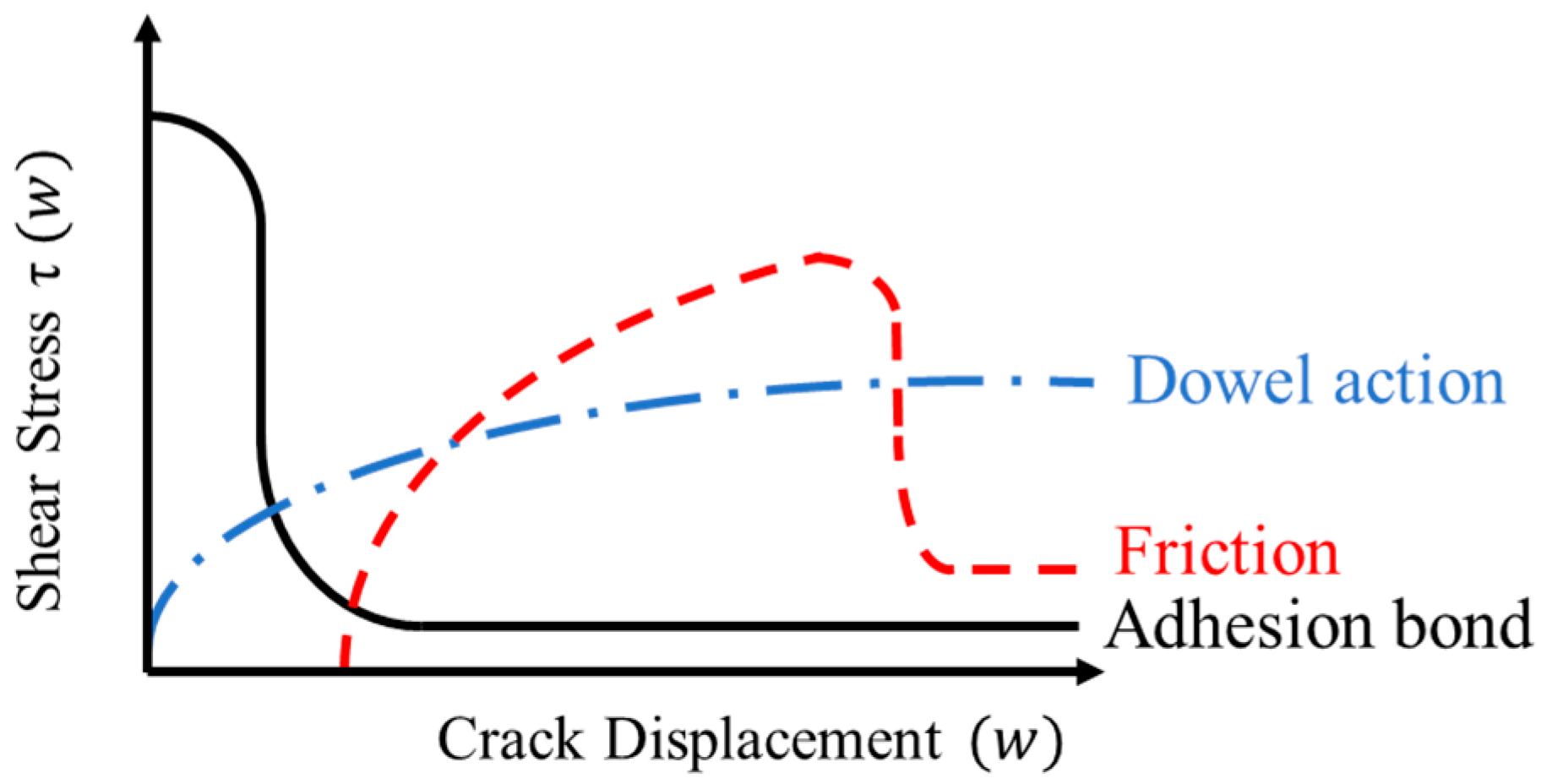
The IST across concrete interfaces is governed by the combined action of adhesive bonding, friction from aggregate interlock induced by reinforcement clamping, in addition to any generated friction by the external applied compressive stress normal to the interface, and the dowel action of reinforcement crossing the shear plane [7]. The first mechanism in the IST system is the adhesion bonding between the old and new concrete. Once this bond reaches its capacity, debonding occurs and a crack opens at the interface, shifting load transfer to friction generated by the aggregate interlock. As the shear load is further increased, relative sliding movement between two surfaces is induced, causing crack widening, and tension stresses in the reinforcement crossing the shear plane, which exerts compression (clamping) stresses normal to the interface, reducing the crack opening and providing frictional resistance along the interface to the slip movement. After the development of the full crack along the interface and complete degradation of the aggregate interlock, the IST is governed primarily by the dowel action of the reinforcement until failure. Figure 1 illustrates the contribution of each mechanism to the overall IST strength.
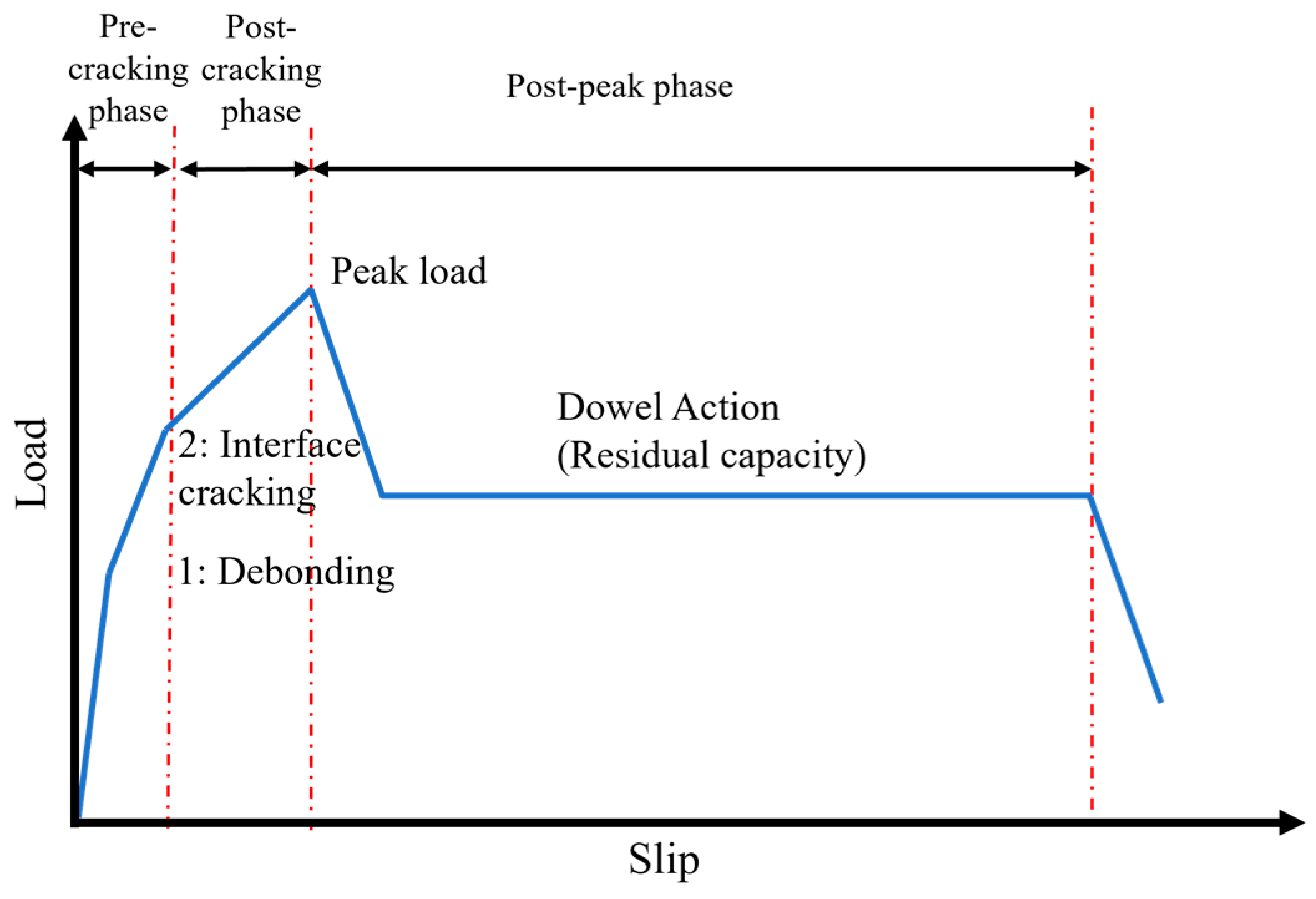
Harries et al. [2] provided a detailed explanation of the IST mechanism, dividing it into three distinct phases based on experimental observations, i.e., the pre-cracking phase, the post-cracking phases, and the post-peak phase, as shown in Figure 2. Initially, in the pre-cracking phase, the load is resisted by the shear strength of the concrete and the adhesion bond, with minimal displacement and negligible reinforcement contribution. As cracks develop in the post-cracking phase, the IST capacity depends on the friction from the aggregate interlock induced by the clamping force of the IST reinforcement crossing the interface. During this phase, both slip and crack width exhibit a relatively linear relationship with the applied shear load. The crack width significantly affects IST by increasing the clamping force in the reinforcement and reducing the cohesion of the shear plane. In the post-peak phase, the displacement, crack width, and reinforcement strain increase after the peak load, with no additional load-carrying capacity.
The utilization of steel reinforcement as IST connectors in composite concrete structures is well established and standardized in design codes and standards such as ACI CODE-318-25 [8], CSA S6-25 [9], CSA A23.3-24 [10], and AASHTO LFRD [11] where the IST strength is determined based on the yield strength of the IST reinforcement crossing the shear interface. However, steel-RC structures are susceptible to corrosion in aggressive environments, undermining both the service life and structural integrity of these structures. Over the past two decades, glass fiber-reinforced polymer (GFRP) reinforcement has been utilized as a viable, non-corrosive alternative to traditional steel reinforcement in concrete structures [12,13,14]. Although GFRP reinforcement provides high tensile strength and enhanced durability, it possesses a lower modulus of elasticity along with anisotropic properties compared to steel reinforcement. Consequently, GFRP-RC interfaces may experience wider shear cracks due to the reduced aggregate interlock, weaker dowel action, and lower clamping stresses compared to those reinforced with steel reinforcement.
The present study aims to review the existing experimental studies on the IST mechanism with GFRP reinforcement. The study evaluates the accuracy of existing GFRP-RC IST design provisions and analytical models through direct comparison with experimental results. Additionally, the study identifies the key limitations in the existing formulations, and their impact on IST predictions. Based on a comprehensive push-off test database, a modified strain-limited regression-based IST model accounting for concrete strength and GFRP strain is proposed to provide consistent and conservative predictions across different interface conditions.

2. Review of Experimental Studies on FRP-RC IST Systems

In the last few years, several studies have explored the use of GFRP as IST reinforcement. Alkatan [15] and Alruwaili [16] explored the use of GFRP as IST reinforcement across interfaces in cold joint IST systems incorporating three different shapes of GFRP reinforcement, i.e., stirrups, headed-end bars, and bent bars (angles). The study emphasized that the stiffness of the reinforcement is a key factor affecting the IST mechanism. A minimum reinforcement stiffness parameter (Kc), calculated as the product of the reinforcement modulus of elasticity (Ef) and the reinforcement ratio (ρv) of 203 MPa, was recommended to activate the role of GFRP reinforcement in providing shear frictional resistance after interface cracking. Below this value, the specimens failed suddenly after cracking, with only 9–14% higher interface shear capacity than those without connectors. Alkatan [15] reported that interfaces with a similar Kc of different types of GFRP connectors, i.e., headed bars and stirrups, achieved similar ultimate capacities within a difference of only 8–13%. However, the specimens reinforced with headed-end bars showed a remarkable post-peak performance, compared to those reinforced with stirrups. Additionally, it was observed that the impact of concrete strength on the shear capacity is more pronounced with a higher Kc. A recent study by El Ragaby et al. [17] introduced an IST model for predicting the capacity of IST cold joints reinforced with GFRP, based on the push-off tests conducted by Alkatan [15] and Alruwaili [16].
Al-Kaimakchi and Rambo-Roddenberry [18] investigated the shear performance of two full-scale AASHTO Type II girders reinforced with either GFRP or duplex stainless-steel stirrups. Both girders had similar transverse reinforcement crossing the girder-deck smooth interface. The GFRP-RC girder failed at the girder-deck interface due to the low transverse shear capacity of the GFRP bars, whereas the stainless-steel girder failed in flexural shear. Using GFRP stirrups resulted in approximately an 8% reduction in shear capacity and altered the failure mode, emphasizing the need for specialized design guidelines in GFRP-RC IST systems. Mahmoud et al. [19] examined the IST behavior of six full-scale T-beams with monolithic and intentionally roughened interface conditions, considering different shear interface reinforcement ratios (0.00, 0.32, 0.35 and 0.48%), reinforcement types (steel and GFRP), and GFRP interface reinforcement configurations (stirrups and bent bars). It was found that GFRP reinforcement significantly enhanced load transfer between the web and flange, improving composite action compared to the specimen without shear connectors. For comparable reinforcement ratios, the GFRP-RC specimen achieved about 75% of the shear capacity of its steel-RC counterpart.
Aljada et al. [20,21] studied the performance of GFRP closed stirrups as IST reinforcement in concrete joints under different interface conditions (i.e., as-cast, intentionally roughened, and monolithic) and varying reinforcement ratios (ranging from 0.24 to 0.47%) using two concrete strengths (35 and 70 MPa). The GFRP-RC specimens demonstrated a more brittle failure due to their lower stiffness compared to steel-RC specimens experiencing a sudden load drop with large slips and reinforcement strains after reaching the peak load, whereas steel-RC specimens displayed a gradual load reduction, maintaining structural integrity for longer due to their ductile yielding behavior. The study identified a critical Kc threshold of 176 MPa, below which the GFRP-RC specimens were prone to brittle failure. Vega et al. [22,23] conducted push-off tests on monolithic joints and roughened cold joints reinforced with steel and GFRP stirrups. The results revealed that, although the GFRP stirrups improved the interface shear capacity compared to specimens with no connectors, the steel-RC specimens showed 30% greater shear resistance than the GFRP-RC specimens, even with a 50% increase in GFRP quantity. This was attributed to the higher stiffness of the steel reinforcement, which provided superior resistance to crack opening. Montaser et al. [24] experimentally investigated the IST behavior in GFRP-RC cold joints that were either roughened or smooth. It was reported that, at similar reinforcement ratios, roughened interfaces achieved about 40–70% higher IST capacity than smooth interfaces.
In a recent study [25], the IST behavior of GFRP-RC systems reinforced with headed-end connectors was investigated, considering three interface conditions (i.e., as-cast, intentionally roughened, and monolithic) and two concrete strengths (35 and 55 MPa) at varying reinforcement ratios. The results showed that GFRP headed-end connectors provided a significant contribution to the IST mechanism, with specimens exhibiting the three characteristic phases identified in Figure 2 (i.e., cracking, post-cracking, and post-peak) when adequate reinforcement ratios were used. In contrast, when reinforcement ratios significantly below the CSA S6-25 [9] minimum of 0.45% were employed, the connectors offered little improvement in capacity, and the specimens failed immediately after cracking without any post-cracking load recovery. Interface roughening increased the IST capacity by up to 23% regardless of the reinforcement ratio, while monolithic specimens achieved the highest peak loads due to enhanced adhesion and aggregate interlock. Despite these improvements, the GFRP-RC specimens generally exhibited lower shear capacities and more brittle behavior than their steel-RC counterparts. In particular, specimens with higher concrete strength or roughened interfaces exhibited sharper post-peak load drops due to rapid crack propagation along the irregular interface. However, increasing the reinforcement ratio effectively mitigated the severity of this load drop.

3. Available GFRP-RC Models

Despite recent research efforts on utilizing FRP as IST reinforcement, the IST provisions in codes and standards for FRP-RC structures remain limited, mainly due to a lack and wide scatter of experimental data. North American codes and standards, such as CSA S806-12 [26] and ACI 440.11-22 [27] do not incorporate any provisions or guidelines for IST. On the other hand, while CSA S6-25 [9] and AASHTO LRFD [28] allow the use of FRP as IST reinforcement, they adapt two different approaches in estimating the IST capacity, resulting in extremely different estimations that will be discussed in this section.

3.1. Code Provisions

3.1.1. AASHTO LFRD Model [28]

This model is derived from the IST provisions outlined in the AASHTO LRFD 2024 [11], originally developed for steel-RC IST systems. The model considers the interface cohesion and the friction resistance induced by the reinforcement crossing the shear interface (Equation (1)). However, the steel yield stress (fy) is replaced by the FRP tensile strength (ffu), neglecting the significant difference in reinforcement stiffness between both materials:
v r = c + μ ( ρ v f f u + p c A c v ) ,
v r K 1   f c ,
v r K 2 ,
where vr is the nominal interface shear resistance (MPa), c is the cohesion stress (MPa); Acv is the shear plane area (mm2); μ is the friction coefficient; Pc is the unfactored permanent load normal to the shear plane (zero in this study); K1 is the fraction of concrete strength available to resist interface shear, and K2 is a limiting interface shear resistance factor. Values of c and µ K1, and K2, which depend on the interface condition, are given in Table 1.

3.1.2. CSA S6-25 Model [9]

The model in Chapter 16 of CSA S6-25 [9] is based on the formulation for steel connectors in steel-RC IST systems. The model has been adapted for FRP reinforcement by replacing the steel yield strength (fy) with an equivalent FRP stress term of 0.004 Ef, where Ef is the elastic modulus of FRP and 0.004 is a limiting strain value. Exceeding this limiting strain in FRP shear connectors is considered to initiate excessive crack widening at the interface, undermining aggregate interlock.
In the latest edition of the standard, the model was further updated by introducing and evaluating two design cases to account for the possibility of lower reinforcement clamping in the case of not intentionally roughened (as-cast) surfaces, with the lower value governing the design. The first case (Case 1) accounts only for the transverse shear capacity of FRP connectors, disregarding the interface cohesion and friction contribution considering the possibility of completely smooth surfaces. The second case (Case 2) adopts the conventional approach that combines cohesion and clamping friction. The revised model is outlined in Equations (4)–(9). It should be noted that the cohesion factors in this model are much lower than those adopted in the AASHTO LRFD model [28] as listed in Table 1.
v r = ϕ c ( c + σ ) 0.25 ϕ c f c   o r   6.5   M P a
where
σ = α v   ρ v   f d   s i n   α f + μ N A c v .
ρ v = A v f A c v 0.45 % ,
ρ v E f 225   MPa .
f d = transverse   shear   strength   of   FRP   dowel   bar   ( Case   1 ) f d = 0.004   E f   C a s e   2 ;
α v = ϕ c ϕ f = 1   ( C a s e   1 ) , α v = μ   ( C a s e   2 ) ,
where vr is the factored shear resistance of the plane (MPa); ϕc and ϕf are the material resistance factors (taken as 1 in this study); σ is the effective normal stress (MPa); fd is a factor that accounts for the contribution of the IST reinforcement to the shear plane (taken as the transverse shear strength of the bars in Case 1 and 0.004 Ef in Case 2), MPa; N is the unfactored permanent load normal to the shear plane (zero in this study), and αf is the angle between the IST reinforcement and the shear interface. Values of c and µ, which depend on the concrete interface condition, that are incorporated in the CSA S6-25 [9] model are given in Table 1.

3.2. Models Proposed in the Literature

3.2.1. Alkatan [15]

Alkatan [15] proposed an IST model (Equations (10) and (11)) based on push-off tests performed on as-cast cold joint specimens. Similar to the previous two models, this one incorporates both interface cohesion and friction generated by the clamping action of the interface shear reinforcement, considering a rough interface with a friction coefficient of 1.0. Interestingly, this is the value typically assigned for intentionally roughened interfaces in design codes and standards and much higher than the value assigned for not intentionally roughened (as-cast) interfaces, i.e., 0.6 as listed in Table 1 [9,28]. The cohesion contribution is expressed as a function of concrete strength (0.04 f′c). This model considers a higher interface shear reinforcement strain limit of 0.005:
v r = 0.04   f c + ε f   E f   ρ v   s i n   α f + ε f   E f   ρ v   c o s   α f ,
and
0.04   f c + ε f   E f   ρ v   s i n   α f < 0.25   f c .

3.2.2. Vega et al. [23]

This model is adapted from the IST provisions in the AASHTO LFRD 2018 model [28] for GFRP-RC IST systems based on regression analysis of the available experimental tests, and with the same cohesion and friction coefficients listed in Table 1. However, this model (Equation (12)) adopts a more realistic approach by imposing a strain limit of 0.002 on the GFRP reinforcement strain, rather than considering the full strength of the GFRP reinforcement:
v r = c + 0.002   μ   ρ v E f .

3.2.3. Montaser et al. [24]

This model entails two formulae for predicting the IST capacity of GFRP-RC cold joints. The first equation is for intentionally roughened interfaces (Equation (13)) based on the cohesion-plus-friction models proposed by Harries et al. [2] and Alkatan [15]. It adopts a limiting factor of 0.003 for the reinforcement contribution, which corresponds to the average reinforcement strain at peak load observed in the specimens tested in their study and other studies from the literature, multiplied by a friction coefficient of 1.0. In addition, the model adopts the same cohesion factor ( 0.04 f c ) proposed by Harries et al. [2] for cold joint interfaces:
v r = 0.04   f c + 0.003   ρ v   E f .
On the other hand, the second formula of the model (Equation (14)) is a friction-based model with no cohesion contribution, introduced for not intentionally roughened interfaces including both as-cast and smooth interfaces. It was determined that the capacity of not intentionally roughened interfaces would be governed by either the shear friction in as-cast specimens (i.e., 0.005   ρ v   E F R P ) or the dowel action in smooth interfaces (i.e., ρ v   f f t ), consistent with CSA S6-25 [9], where fft is the guaranteed transverse shear strength of the reinforcement. The formula adopts a friction coefficient (μ) of 1.0, not 0.6. Also, it adopts a GFRP strain limit of 0.005, which is higher than the 0.003 limit adopted for intentionally roughened interfaces:
v r = 0.005   ρ v   E f ρ v   f f t .

3.2.4. El Ragaby et al. [17]

This model was proposed based on push-off tests on specimens with not intentionally roughened (as-cast) surface conditions. Unlike the model proposed earlier by Alkatan [15], this model adopts a friction coefficient of 0.48 based on the best-fitting linear analysis of test specimens by Alkatan [15] and Alruwaili [14]. Additionally, the model adopts a strain factor of 0.005 based on experimental GFRP strain measurements at the peak loads resulting in a limiting factor of 0.0024. Furthermore, this model neglects the concrete contribution for more conservative predictions:
v r = 0.0024   ρ v   E f .

4. Database of Experimental Tests on GFRP-RC IST Systems

As mentioned earlier, either push-off or T-beam tests have been used to investigate the IST mechanism in GFRP-RC members. The T-beam tests capture composite action under combined shear and flexural effects, closely simulating bridge deck behavior, whereas push-off tests isolate pure IST under controlled conditions, eliminating flexural effects. The push-off test is a compression-based experiment in which relative displacement develops between two L-shaped blocks. This movement is facilitated by gaps intentionally introduced during specimen fabrication. As relative slip occurs, the reinforcement crossing the interface becomes engaged and contributes to the IST resistance.
A comprehensive database of 107 push-off tests on GFRP-RC specimens reported in the literature was assembled to assess the accuracy of existing IST design provisions and analytical models and to develop a unified regression-based equation. These specimens covered a range of concrete strengths ranging from 30 to 76 MPa, GFRP reinforcement ratios ranging between 0.17 and 1.58% with varying shear plane dimensions, and GFRP modulus of elasticity ranging between 49 and 68 Gpa. The database incorporates 56 specimens with as-cast (AC), 20 specimens with intentionally roughened (IR), 26 specimens with monolithic (M), and five specimens with smooth (S) interfaces, as listed in Table 2, Table 3, Table 4 and Table 5, respectively. In all specimens, the GFRP IST reinforcement was oriented perpendicular to the interface, ensuring consistent activation of the IST mechanism.
Table 2. Database of push-off tests with as-cast (AC) interfaces.
AuthorPlane
Dimension
(mm)
Connector
Type
Specimen
ID
f c  a
(MPa)
IST
Reinforcement
Results at Peak Load
ρv b
(%)
K c
(MPa)
Slip
(mm)
Connector
Strain
(με)
Load
(kN)
Ahmed [25]300 × 400NAXX-0-N38.0NANA0.15NA308
Headed-endGH2-16-N36.30.33212.80.17420321
GH4-13-N37.30.43294.30.463290377
GH2-19-N36.10.47295.70.422695384
GH4-16-N36.80.66425.60.432340428
GH6-16-N37.41.00644.80.562200522
Ahmed [25]300 × 400NAXX-0-H57.8NANA0.31NA550
Headed-endGH2-16-H54.60.33212.80.19290530
GH4-13-H56.10.43294.30.604250652
GH2-19-H56.50.47295.70.683530715
GH4-16-H55.30.66425.60.753840769
GH6-16-H55.31.00644.80.773770885
Aljada et al.
[20]
300 × 400NAX0-000-N36.0NANA0.18NA293
Z-shapedG1-15Z-N38.00.1791.80.1750298
G2-15Z-N38.00.33178.20.17190308
StirrupsG4-10C-N33.00.24117.60.20410399
G4-10C-N33.00.24117.60.20280387
G6-10C-N36.00.36176.40.21440439
G4-13C-N36.00.43227.90.20310419
G8-10C-N33.00.47249.10.22500451
G4-10C-H76.00.24117.60.493900668
G6-10C-H76.00.36176.40.663600890
G8-10C-H76.00.47230.30.745000897
Alkatan
[15]
250 × 500NAC0-3030.0NANA0.34NA332
StirrupsFS2-3030.00.41205.00.584466385
FS3-3030.00.61305.00.644847384
Headed-endFH3-3030.00.30180.00.441472362
FH5-3030.00.51306.00.944973433
AnglesFA3-3030.00.30150.00.24100342
NAC0-5050.0NANA0.66NA296
StirrupsFS1-5050.00.20100.00.3422334
FS2-5050.00.20100.00.483881402
FS3-5050.00.61305.00.37402617
Headed-endFH2-5050.00.20120.00.31389336
FH3-5050.00.30180.00.282260323
FH5-5050.00.51306.00.772953569
AnglesFA2-5050.00.30150.00.15NA255
FA3-5050.00.30150.00.664525540
Alruwaili
[16]
250 × 400NAC0-A135.0NANA0.41NA343
StirrupsFS2-A135.00.51255.00.342209268
FS3-A135.00.76380.00.725962490
FS4-A135.01.01505.00.113976428
Headed-endFH3-A135.00.38228.01.005993328
FH4-A135.00.51306.00.372383293
FH5-A135.00.61366.00.676988497
FH6-A135.00.76456.00.805752547
FH8-A135.01.01606.01.005889550
250 × 300NAC0-A235.0NANA0.28NA217
StirrupsFS2-A235.00.68340.00.413113172
FS3-A235.01.01505.00.928828275
FS4-A235.01.35675.00.943619484
Headed-endFH3-A235.00.51306.00.976563213
FH4-A235.00.68408.00.302308218
FH5-A235.00.84504.01.009010264
FH6-A235.01.01606.00.603543304
FH8-A235.01.35810.00.976081397
Note: NA = Not applicable. 1 MPa = 0.145 ksi. a Concrete strength. b IST reinforcement ratio: ratio of IST reinforcement area to interface area. c Reinforcement stiffness factor: product of modulus of elasticity (Ef) of the reinforcement and reinforcement ratio (ρv).
Table 3. Database of push-off tests with intentionally roughened (IR) interfaces.
AuthorPlane Dimensions (mm)Connector TypeSpecimen ID f c  a (MPa)IST ReinforcementResults at Peak Load
ρv b (%)K c (MPa)Slip (mm)Connector Strain (με)Load (kN)
Ahmed [25]300 × 400NAXX-0-IR-N37.8NANA0.23NA370
Headed-endGH2-16-IR37.80.33212.80.18220377
GH4-13-IR35.20.43294.30.463380406
GH2-19-IR35.20.47295.70.422570392
GH4-16-IR34.80.66425.60.462495528
GH6-16-IR36.41.00644.80.642600602
Aljada et al. [21]300 × 400StirrupsG4-10-CR40.00.24117.60.24410452
G4-10-CR40.00.24117.60.26260417
G4-13-CR35.00.43227.90.26230438
G8-10-CR35.00.47230.30.323300423
Vega et al. [22]165 × 330NAN-0-1-J38.0NANA0.35NA146
N-0-2-J d38.0NANA0.47NA174
N-0-3-J d38.0NANA0.50NA141
C-shapedF-3-1-J38.01.42883.25.492772228
F-3-2-J d38.01.42883.25.793180252
F-3-3-J d38.01.42883.25.863656245
Montaser et al. [24] e150 × 180NAR-0-057.3NANA0.22NA92
U-shapedR-GU-1-1059.30.26135.20.1518485
StirrupsR-GS-4-1059.31.05546.00.652460166
R-GS-6-1059.31.58821.60.852975181
Note: NA = Not applicable. 1 MPa = 0.145 ksi. a Concrete strength. b IST reinforcement ratio: ratio of IST reinforcement area to interface area. c Reinforcement stiffness factor: product of modulus of elasticity (Ef) of the reinforcement and reinforcement ratio (ρv). d Replicated specimen. e Only specimens with the first peak load reported by the authors are included.
Table 4. Database of push-off tests with monolithic (M) interfaces.
AuthorPlane Dimensions (mm)Connector TypeSpecimen ID f c  a (MPa)IST ReinforcementResults at Peak Load
ρv b (%)K c (MPa)Slip (mm)Connector Strain (με)Load (kN)
Ahmed [25]300 × 400NAXX-0-M-N39.9NANA0.46NA626
Headed-endGH2-16-M39.70.33212.80.714953700
GH4-13-M39.00.43294.30.924524724
GH2-19-M42.90.47295.70.843663775
GH4-16-M37.40.66425.60.963777837
GH6-16-M36.41.00644.81.3255081018
Aljada et al. [21]300 × 400StirrupsG4-10-M46.00.24117.60.785000624
G4-10-M40.00.24117.60.603300611
G6-10-M37.00.36176.40.823940694
G4-13-M34.00.43227.90.682950671
G8-10-M35.00.47230.30.844300719
Vega et al. [22]165 × 330NAN-0-138.0NANA0.48NA213
N-0-2 d38.0NANA0.57NA250
N-0-3 d38.0NANA0.61NA278
N-0-4 d38.0NANA0.52NA142
N-0-5 d38.0NANA0.64NA234
N-0-6 d38.0NANA0.31NA166
C-shapedF-1-138.00.47292.30.811670239
F-1-238.00.47292.30.931889236
F-1-338.00.47292.31.001565261
F-3-138.01.42883.21.631347308
F-3-238.01.42883.21.341400324
F-3-338.01.42883.21.431469299
F-3-438.01.42883.21.591697300
F-3-538.01.42883.21.741381350
F-3-638.01.42883.21.121619301
Note: NA = Not applicable. 1 MPa = 0.145 ksi. a Concrete strength. b IST reinforcement ratio: ratio of IST reinforcement area to interface area. c Reinforcement stiffness factor: product of modulus of elasticity (Ef) of the reinforcement and reinforcement ratio (ρv). d Replicated specimen.
Table 5. Database of push-off tests with smooth (S) interfaces.
AuthorPlane Dimensions (mm)Connector TypeSpecimen ID f c  a (MPa)IST ReinforcementResults at Peak Load
ρv b (%)K c (MPa)Slip (mm)Connector Strain (με)Load (kN)
Montaser et al. [24]150 × 180NAS-0-057.3NANA0.03NA1.5
U-shapeS-GU-1-1059.20.26135.29.50816049
StirrupsS-GS-2-1059.20.53275.68.93787053
S-GS-4-1059.21.05546.06.048943112
S-GS-6-1059.21.58821.63.884589127
Note: NA = Not applicable. 1 MPa = 0.145 ksi. a Concrete strength. b IST reinforcement ratio: ratio of IST reinforcement area to interface area. c Reinforcement stiffness factor: product of modulus of elasticity (Ef) of the reinforcement and reinforcement ratio (ρv).

5. Comparisons of Available GFRP-RC IST Models

Based on the compiled database in the previous section, this section encompasses detailed comparisons of the available analytical GFRP-RC IST models against the database. Table 6, Table 7, Table 8 and Table 9 compare experimental capacities with model predictions.
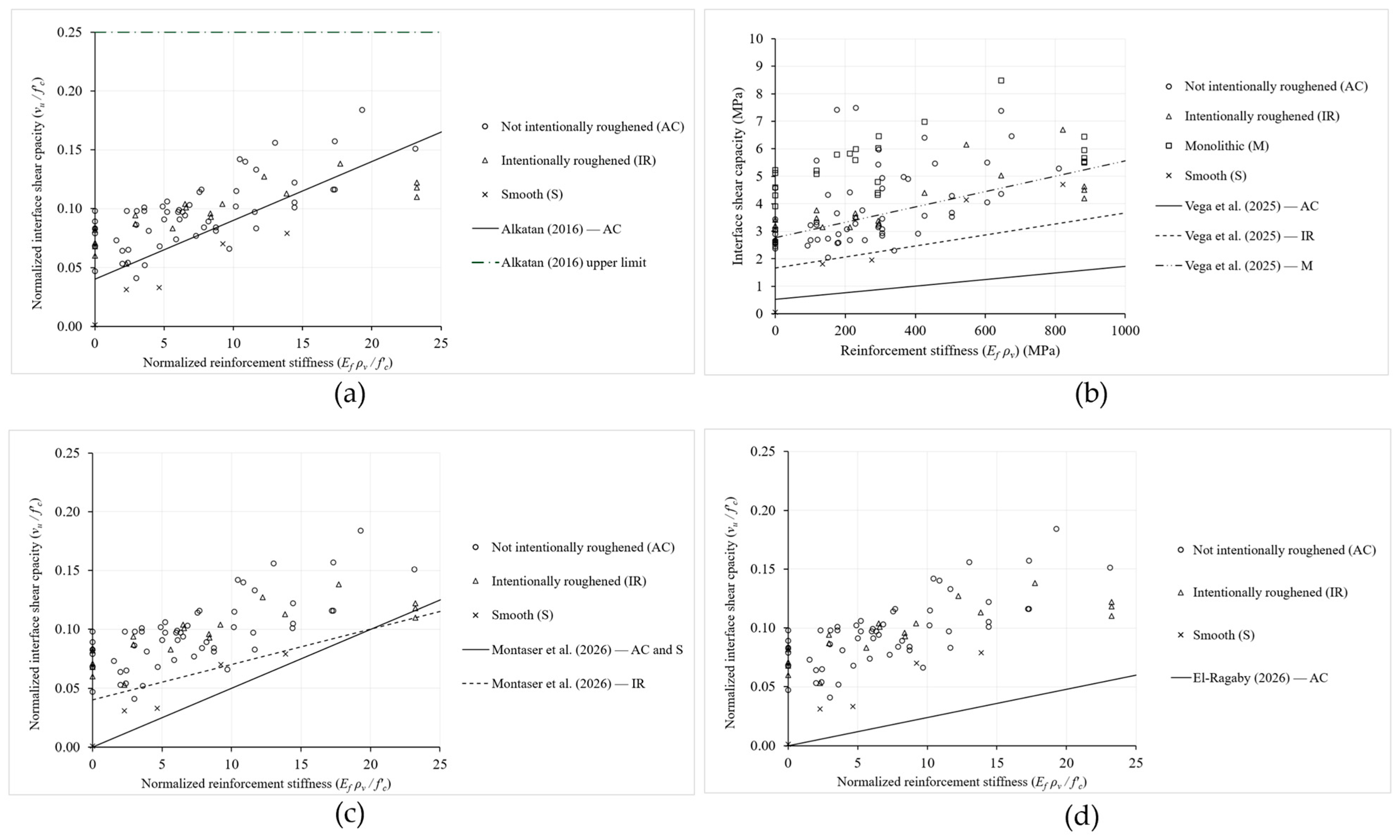
Figure 3, Figure 4 and Figure 5 compare the experimental IST capacities with the predictions of the aforementioned models. Normalization of concrete compressive strength was utilized in some instances to facilitate the direct comparison of nominal capacities and eliminate the effect of concrete strength variability among specimens in the models that consider the cohesion contribution as a function of concrete strength. In addition, all material and environmental reduction factors were set to unity for consistency of the predictive performance of the models.
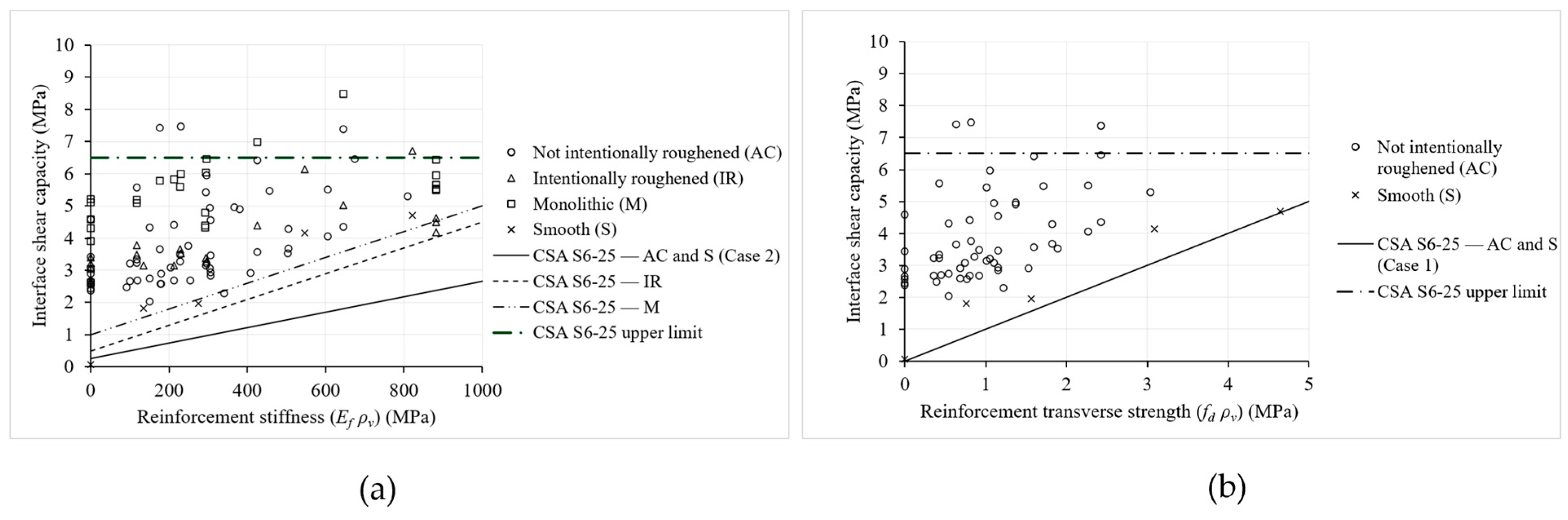
As shown in Figure 3, the predictions for specimens with not intentionally roughened interfaces (both AC and S specimens) were calculated using both prescribed cases in CSA S6-25 [9] to illustrate their differences. In the AC specimens, the newly introduced Case 1, which accounts for the transverse shear strength of the bars, yielded an experimental-to-predicted ratio of 5.54, which is close to the ratio of 5.40 resulting from Case 2 based on clamping friction. On the other hand, in the S specimens, Case 1 yielded considerably higher estimates than those of Case 2 with ratios of 1.49 and 2.04, respectively. Nonetheless, at reinforcement ratios equal to or higher than the 0.45% threshold prescribed in CSA S6-25 [9], Case 2 (clamping friction) was the governing case for both AC and S specimens. On the other hand, at much lower reinforcement ratios, the dowel action of the connectors was the governing parameter. Overall, CSA S6-25 [9] significantly underestimated the IST capacity of push-off specimens with GFRP shear connectors, regardless of the interface condition, with experimental-to-predicted ratios of 5.54, 3.14, and 2.51 for AC, IR, and M conditions, respectively. The accuracy improved slightly for S specimens with an experimental-to-predicted ratio of 2.04. This variability reflects the model’s limited ability to capture GFRP contributions, its neglect of concrete compressive strength effects, and its use of lower cohesion coefficients compared to the AASHTO LFRD model [28]. It should also be noted that the capacity threshold of 6.5 MPa was the governing upper limit specified in all specimens rather than the limit of 0.25 f c . For the range of specimens tested to date, this cap would not govern the design.
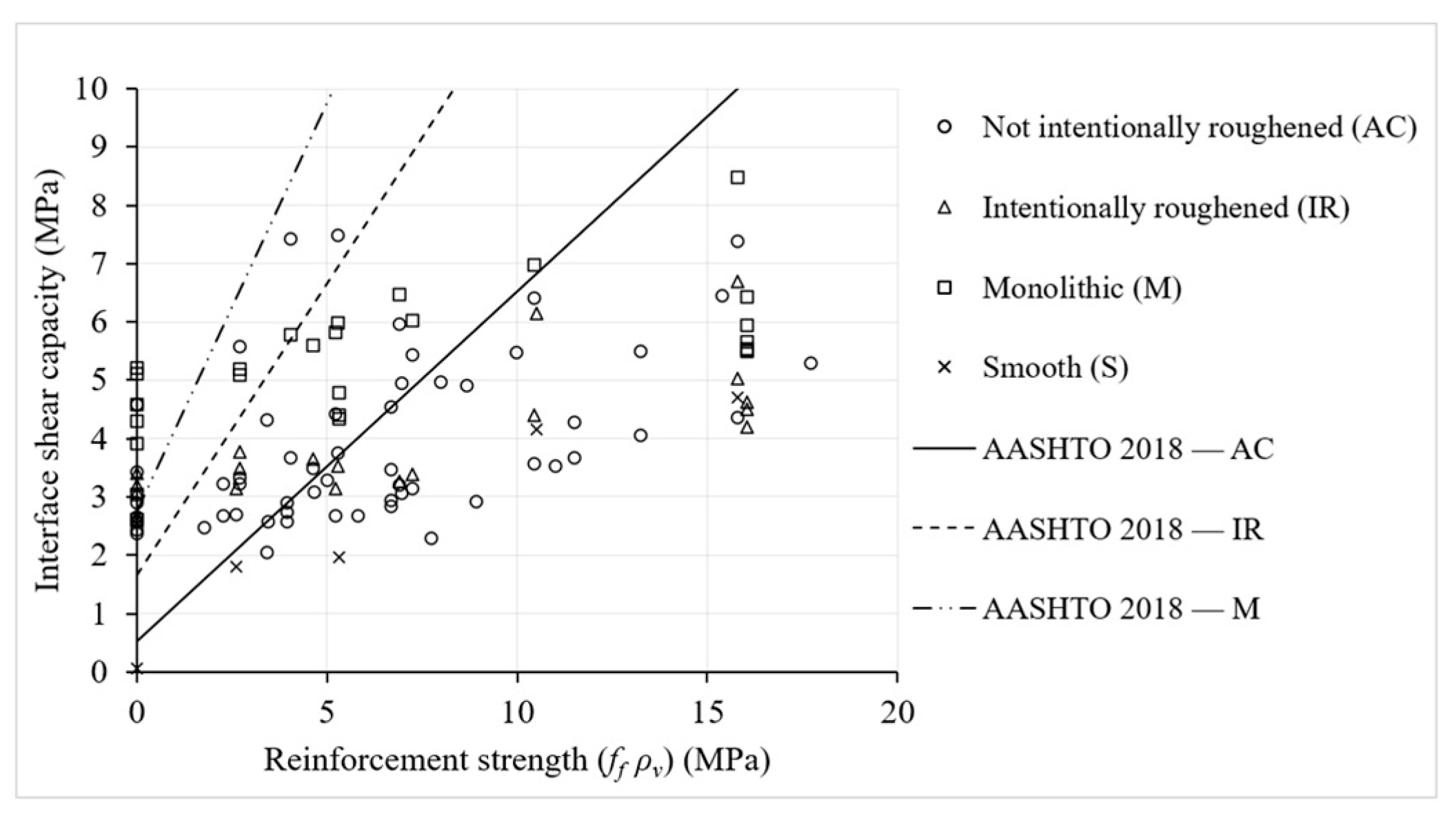
In contrast, the AASHTO LFRD model [28] provided widely scattered estimates, while markedly overestimating the IST capacity of several GFRP-RC specimens, as shown in Figure 4. This model yielded average experimental-to-predicted ratios of 1.65, 0.57, 0.87, and 0.62 for AC, IR, M, and S interface conditions, respectively, with significantly high COVs up to 103%. This overestimation and scatter become more pronounced at higher reinforcement ratios, and stems from the assumption that GFRP bars can develop their full tensile strength at the peak load. While this assumption may be applicable for steel reinforcement, given its high modulus of elasticity and low yield strain of 0.002, it is not applicable to GFRP reinforcement. Owing to its lower modulus of elasticity, GFRP bars require significantly larger strains to reach their tensile strength and would typically fail before reaching the ultimate tensile strength. Consequently, the effective contribution of GFRP reinforcement must be capped by an appropriate strain limit.
As shown in Figure 5, the equation proposed by Alkatan [15] with a strain limit of 0.005 showed improved predictive accuracy compared to the CSA S6-25 [9] and AASHTO LFRD [28] models, with an average experimental-to-predicted ratio of 1.33. However, this model overestimates the capacity of several AC specimens at reinforcement ratios of 0.6% and higher. By comparison, the model proposed by Vega et al. [23] provided conservative predictions, as it disregards the effect of the concrete strength and considers a lower strain limit of 0.002. This model provided conservative results for the AC specimens with an average ratio of 4.71, which suggests that refinement for the cohesion and friction factors for different shear interface conditions may be required. It is worth noting that neither model was originally developed for smooth IST surfaces, hence both models yielded either unconservative or very conservative predictions for that interface condition.
The model proposed by Montaser et al. [24] exhibited consistent predictions for IR specimens with experimental-to-predicted peak load values of 1.55, with a relatively low COV of 20%. However, not accounting for the cohesion contribution in the capacity prediction of the AC specimens led to an overconservative ratio of 3.85. Additionally, most of the tested AC specimens in the database did not record reinforcement strains of 0.005 at the peak load. On the other hand, the model yielded better predictions for the S specimens, with a ratio of 1.70 and a COV of 41%. The model proposed by El Ragaby et al. [17] resulted in overconservative predictions for AC specimens due to neglecting the cohesion parameter and adopting a lower limiting factor of frictional resistance of 0.0024, with a ratio of 6.76 and a very high COV at approximately 57%; this limit severely underestimates the capacity of specimens, with a low reinforcement ratio. This conservatism was less pronounced in the S specimens, with a ratio of 3.50 and a COV of 38%.

6. Proposed Model

Based on the previous discussions, the existing models and design provisions for GFRP-RC IST systems do not accurately represent the capacity of the push-off specimens, either fully or partially. This is attributed to adopting inaccurate GFRP reinforcement strain limits, assuming full utilization of the tensile strength of GFRP connectors, or by neglecting or underestimating the concrete contribution in the IST mechanisms. Additionally, the models available in the literature do not provide a unified equation capable of consistently capturing all investigated IST surface conditions. Therefore, a proposed regression-based model is formulated using a cohesion–friction framework. In this model, the concrete compressive strength (f′c) is used to characterize the cohesion component, while the stiffness of the GFRP reinforcement (Ef ρv) governs the reinforcement clamping contribution. The general form of the model is expressed as shown in Equation (16):
v r = α f c + μ   ε f   E f   ρ v .
Unlike the approach followed by CSA S6-25 [9] and AASHTO LFRD [28], the AC and IR surface specimens were grouped into a single regression analysis, supported by the marginal differences in the IST capacity between both conditions at the same reinforcement ratio and concrete strength, as reported by Aljada et al. [21] and Ahmed [25] (2–23% difference). Therefore, the friction coefficient (μ) for IR surface conditions (i.e., 1.0) was also used for not intentionally roughened (AC) surface conditions, instead of 0.6. Also, the analysis did not include the M and S specimens due to the scarcity of experimental data.
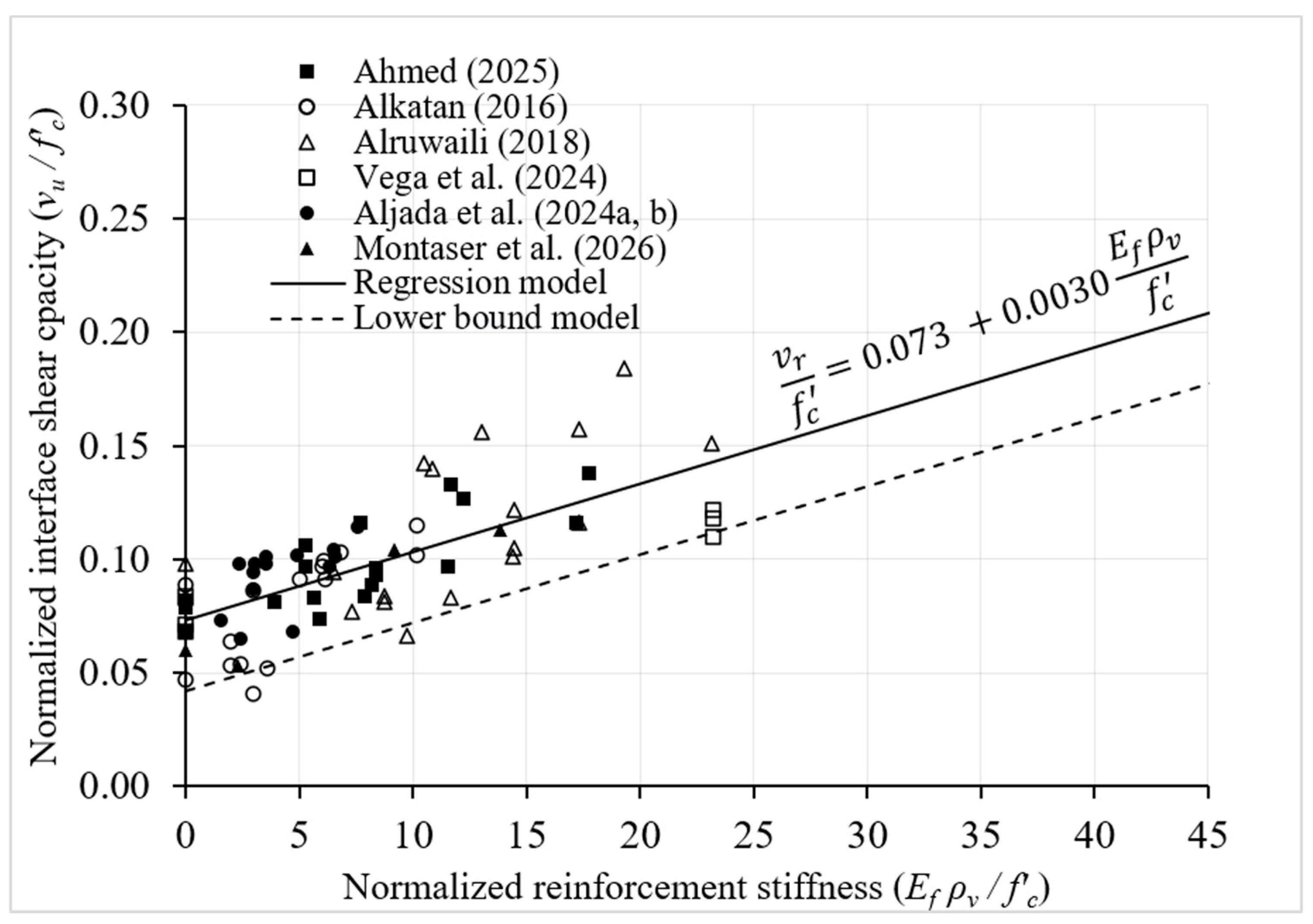
The regression analysis was performed using a normalized formulation with respect to the concrete compressive strength to improve correlation by eliminating the influence of concrete strength variability and to calibrate the concrete strength parameter (α) in addition to the GFRP reinforcement strain limit ( ε f ). Additionally, the conservative 5th percentile lower-bound model corresponding to a 95% confidence interval was used in the regression analysis to ensure reliability in the proposed formulation, as shown in Figure 6. This figure illustrates the relationship between the normalized IST capacity (vu/f′c) and the normalized GFRP reinforcement stiffness (Ef ρv/f′c). The model for AC and IR specimens yielded a cohesion parameter of 0.042, closely matching the value of 0.04 proposed by Harries et al. [2], with a slope of 0.003.
Based on the comprehensive review of existing models and the regression-based analysis, a new model is proposed. For AC, IR, and M interfaces, the proposed model (Equation (17)) adopts a cohesion coefficient of 0.04 (Table 10) for both IR and AC interfaces and a unified strain limit of 0.003. The latter value represents the average strains measured in GFRP shear connectors at peak load in the database in Table 2, Table 3, Table 4 and Table 5. This strain limit is lower than the limit proposed by Alkatan [15] (0.005) and CSA S6-25 [9] (0.004) as several specimens with sufficient reinforcement (ρv ≥ 0.45%) did not reach these values. Additionally, this value is higher than the limits of 0.002 and 0.0024 proposed by Vega et al. [23] and El Ragaby et al. [17], respectively. The lower limits would restrict the stress in GFRP bars to well below their effective capacity, evidenced by the higher recorded strain values at the peak load in most of the specimens. Even though regression analysis was not performed for M interfaces due to the scarcity of experimental data, the proposed model was extended to the M specimens based on the analogy in existing code provisions, with adjustments to the cohesion and friction coefficients. The higher friction coefficient of 1.4 utilized in CSA S6-25 [9] was adopted in the proposed model to reflect the enhanced reinforcement contribution and increased IST capacity in monolithic specimens, evidenced by the higher strains recorded at peak load in the M specimens. Additionally, the concrete strength coefficient of 0.075 was adopted as proposed by Harries et al. [2] to reflect the higher cohesion contribution in the monolithic interface compared to AC and IR specimens.
v r = α f c + 0.003   μ   ρ v   E f 0.20 f c .
For S interfaces, only five specimens have been tested [24]. Therefore, the conservative approach of the CSA S6-25 [9] model (Case 1) is adopted by disregarding the contribution of the interface cohesion and friction and relying on the transverse shear strength of the IST connectors (Equation (18)). The same approach is followed by Montaser et al. [24] (Equation (14)). Additional experimental data are required to further assess the IST performance at smooth interfaces.
v r = ρ v   f f t 0.20 f c .
The model adopts the 0.20fc upper limit from ACI 318-25 [8], which is more conservative than the 0.25fc limit in CSA S6-25 [9]. This limit reflects the behavior of over-reinforced interfaces, where increases in reinforcement result in diminishing gains in shear capacity [29]. Additionally, the model only considered GFRP IST reinforcement oriented perpendicular to the interface. Hence, more experimental results are required to study the effect of IST reinforcement orientation on GFRP-RC IST behavior.
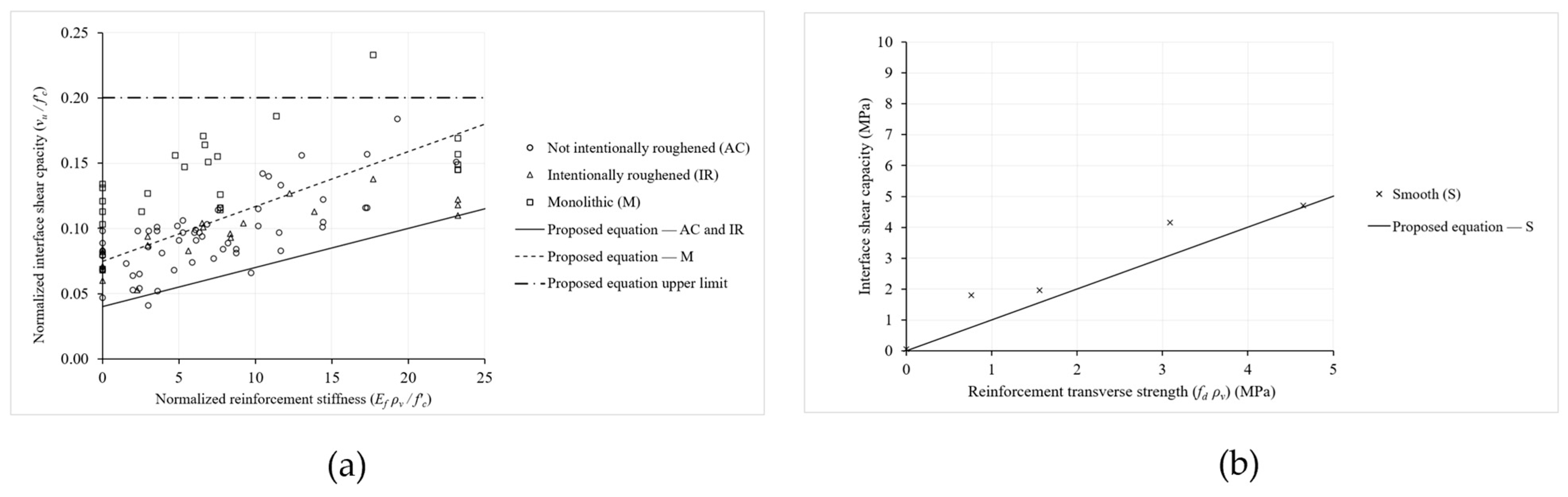
The predictions of the proposed model (Equations (17) and (18)) are listed in Table 6, Table 7, Table 8 and Table 9 and shown in Figure 7. The proposed model yielded more accurate, yet conservative, predictions for all surface conditions tested, with experimental-to-predicted ratios of 1.58, 1.55, 1.30 and 1.49 for AC, IR, M and S conditions, respectively.

7. Conclusions

This study assembled a comprehensive database of 107 push-off tests from the literature covering various parameters to evaluate the accuracy of existing IST design provisions and analytical models for GFRP-RC systems. The assessment revealed significant limitations in current formulations, leading to the development of a new regression-based model (Equation (17)). The new model more accurately captures the IST behavior by incorporating the effects of FRP reinforcement stiffness and concrete compressive strength. The following key conclusions can be drawn.
  • The CSA S6-25 model [9] was found to be highly conservative, underestimating experimental capacities with mean experimental-to-predicted ratios of 5.54, 3.14, 2.51, and 2.04 for specimens with as-cast, intentionally roughened, monolithic, and smooth interfaces, respectively. This model disregards the contribution of concrete strength and utilizes relatively low cohesion factors.
  • The AASHTO LRFD model [28] yielded mean experimental-to-predicted ratios of 1.65, 0.57, 0.87, and 0.62 for specimens with as-cast, intentionally roughened, monolithic, and smooth interfaces, respectively. The model consistently overestimated the IST capacity at higher reinforcement ratios across all interface conditions. This is attributed to the unrealistic assumption that FRP bars can develop their full tensile strength at peak load.
  • The model by Alkatan [15], which is applicable to as-cast and smooth interfaces, recorded a reasonable mean experimental-to-predicted ratio of 1.33 for as-cast specimens. However, this model tended to overestimate several AC specimens at higher reinforcement ratios due to the relatively high reinforcement strain limit of 0.005. On the other hand, the model by Vega et al. [23], which incorporates a lower reinforcement strain limit of 0.002 and disregards the effect of concrete strength, provided conservative estimates across the different interfaces, with ratios of 4.71, 1.70, 1.47, and 2.35 for specimens with as-cast, intentionally roughened, monolithic, and smooth interfaces, respectively.
  • The model by Montaser et al. [24] provided adequate predictions for specimens with intentionally roughened interfaces, with a test-to-predicted ratio of 1.55. However, it underestimated the capacities of specimens with as-cast interfaces, with a ratio of 3.85. The model by El Ragaby et al. [17] resulted in overconservative predictions, due to neglecting the cohesion parameter, with ratios of 6.76 and 3.50 for specimens with as-cast and smooth interfaces, respectively.
  • The proposed model incorporates a GFRP strain limit of 0.003 and a cohesion coefficient of 0.04 (for both as-cast and intentionally roughened interfaces) and 0.075 (for monolithic interfaces). In addition, it adopts the transverse shear capacity approach for smooth interfaces. The model achieved accurate and consistent predictions across all interface conditions, with mean ratios of 1.58, 1.55, 1.30 and 1.49 for specimens with as-cast, intentionally roughened, monolithic, and smooth interfaces, respectively.
  • For practical design provisions, Equation (17) is recommended for AC, IR and M interfaces, while Equation (18) is recommended for S interfaces, considering only the transverse shear strength of the IST connectors. However, additional experimental testing is recommended to further validate the applicability of the model to monolithic and smooth interfaces.

Author Contributions

Conceptualization, M.M.A., M.G.E.-G. and E.F.E.-S.; Methodology, M.M.A., M.G.E.-G. and E.F.E.-S.; Validation, M.M.A.; Formal analysis, M.M.A.; Investigation, M.M.A. and M.G.E.-G.; Resources, E.F.E.-S.; Data curation, M.M.A.; Writing—original draft, M.M.A.; Writing—review & editing, M.G.E.-G. and E.F.E.-S.; Visualization, M.M.A., M.G.E.-G. and E.F.E.-S.; Supervision, E.F.E.-S.; Project administration, E.F.E.-S.; Funding acquisition, E.F.E.-S. All authors have read and agreed to the published version of the manuscript.

Funding

Natural Sciences and Engineering Research Council of Canada.

Data Availability Statement

The original contributions presented in this study are included in the article. Further inquiries can be directed to the corresponding author.

Acknowledgments

The authors would like to acknowledge and express their sincere appreciation for the financial support received from the Natural Sciences and Engineering Research Council of Canada (NSERC).

Conflicts of Interest

The authors declare no conflicts of interest.

Abbreviations

The following symbols are used in this paper:
A c v area of concrete section resisting interface shear transfer (IST)
A v f area of IST reinforcement crossing the shear plane
c cohesion factor
Esmodulus of elasticity of steel reinforcement
Efmodulus of elasticity of GFRP reinforcement
fcspecified concrete compressive strength
fda factor that considers the contribution of the interface shear reinforcement to the shear strength of the plane
fftultimate transverse strength of GFRP reinforcement
ffuultimate tensile strength of GFRP reinforcement
f y yield strength of steel reinforcement
Kstiffness of IST reinforcement crossing the shear plane (ρvE)
K1fraction of concrete strength available to resist IST according to AASHTO 2018 [28]
K2limiting IST resistance according to AASHTO 2018 [28]
Nunfactored permanent load normal to shear plane; positive for compression and negative for tension according to CSA S6-25 [9]
Pcunfactored permanent load normal to shear plane; positive for compression and negative for tension according to AASHTO 2018 [28]
Vrnominal IST resistance
vrfactored shear resistance of the plane
α f angle between the shear plane and the IST reinforcement
α v dowel term factor for IST
α shear plane condition coefficient in Harries et al. model [2]
εfstrain in GFRP reinforcement at ultimate IST load
ρvreinforcement ratio of IST reinforcement crossing shear plane
σ total compressive stress to shear plane
μ friction coefficient at interface
ϕ c resistance factor for concrete
ϕ f resistance factor for FRP

References

  1. Loov, R.E.; Patnaik, A.K. Horizontal Shear Strength of Composite Concrete Beams with a Rough Interface. PCI J. 1994, 39, 48–69. [Google Scholar] [CrossRef]
  2. Harries, K.A.; Zeno, G.; Shahrooz, B.; Wang, D.; Lu, X. Toward an improved understanding of shear-friction behavior. ACI Struct. J. 2012, 110, 835–844. [Google Scholar] [CrossRef]
  3. Birkeland, P.W.; Birkeland, H.W. Connections in Precast Concrete Construction. ACI Struct. J. 1966, 63, 345–368. [Google Scholar]
  4. Mast, R.F. Auxiliary Reinforcement in Concrete Connections. J. Struct. Div. 1968, 94, 1485–1504. [Google Scholar] [CrossRef]
  5. Hofbeck, A.; Ibrahim, I.; Mattock, A.H. Shear Transfer in Reinforced Concrete. J. Proc. 1969, 66, 119–128. [Google Scholar]
  6. Mattock, A.H.; Hawkins, N.M. Shear Transfer in Reinforced Concrete—Recent Research. PCI J. 1972, 17, 55–75. [Google Scholar] [CrossRef]
  7. Zilch, K.; Reinecke, R. Capacity of shear joints between high-strength precast elements and normal-strength cast-inplace decks. PCI/FHWA/FIB Int. Symp. High Perform. Concr. 2000, 11, 1–14. [Google Scholar]
  8. ACI CODE-318. 25; Building Code Requirements for Structural Concrete—Code and Commentary. ACI: Farmington Hills, MI, USA, 2025.
  9. CSA S6-25; Canadian Highway Bridge Design Code. CSA: Toronto, ON, Canada, 2025.
  10. CSA A23.3-24; Design of Concrete Structures. CSA: Toronto, ON, Canada, 2024.
  11. AASHTO. AASHTO LRFD Bridge Design Specifications, 9th ed.; AASHTO: Washington, DC, USA, 2024. [Google Scholar]
  12. Kossakowski, P.G.; Wiktor, W. Fiber-Reinforced Polymer Composites in the Construction of Bridges: Opportunities, Problems and Challenges. Fibers 2022, 10, 37. [Google Scholar] [CrossRef]
  13. Qureshi, J. A Review of Fibre Reinforced Polymer Bridges. Fibers 2023, 11, 40. [Google Scholar] [CrossRef]
  14. Khalilabad, E.H.; Emparanza, A.R.; De Caso, F.; Roghani, H.; Nanni, A.; Khodadadi, N. Characterization Specifications for FRP Pultruded Materials: From Constituents to Pultruded Profiles. Fibers 2023, 11, 93. [Google Scholar] [CrossRef]
  15. Alkatan, J. FRP Shear Transfer Reinforcement for Composite Concrete Construction. Master’s Thesis, University of Windsor, Windsor, ON, USA, 2016. [Google Scholar]
  16. Alruwaili, M.S. Shear Transfer Mechanism in FRP Reinforced Composite Concrete Structures. Master’s Thesis, University of Windsor, Windsor, ON, USA, 2018. [Google Scholar]
  17. El Ragaby, A.; Alkatan, J.; Ghrib, F.; Alruwaili, M. Experimental and Analytical Investigations on Glass-FRP Shear Transfer Reinforcement for Composite Concrete Construction. Constr. Mater. 2026, 6, 5. [Google Scholar] [CrossRef]
  18. Al-Kaimakchi, A.; Rambo-Roddenberry, M. Structural Assessment of AASHTO Type II Prestressed Concrete Girder with GFRP or Stainless-Steel Shear Reinforcement. J. Bridg. Eng. 2022, 27, 04022056. [Google Scholar] [CrossRef]
  19. Mahmoud, M.; Eladawy, M.; Ibrahim, B.; Benmokrane, B. Horizontal Shear Capacity of Composite T-Beams Reinforced with Glass Fiber-Reinforced Polymer Interface Shear Reinforcement. ACI Struct. J. 2024, 121, 225–236. [Google Scholar] [CrossRef]
  20. Aljada, B.H.; El-Ragaby, A.; El-Salakawy, E.F. Glass Fiber-Reinforced Polymer Bars as Shear-Friction Reinforcement for Concrete Cold Joints. ACI Struct. J. 2024, 121, 47–60. [Google Scholar] [CrossRef]
  21. Aljada, B.H.; El-Ragaby, A.; El-Salakawy, E.F. GFRP Stirrups as Shear Friction Reinforcement for Different Concrete Interfaces. ASCE J. Compos. Constr. 2024, 28, 04024051. [Google Scholar] [CrossRef]
  22. Vega, C.; Belarbi, A.; Nanni, A. Experimental Assessment of Shear Transfer Capacity of GFRP Reinforcement Using the Push-Off Test. J. Compos. Constr. 2024, 28, 04024056. [Google Scholar] [CrossRef]
  23. Vega, C.; Belarbi, A.; Nanni, A. Estimating Shear-Transfer Resistance When Using Glass Fiber-Reinforced Polymer Reinforcement. ACI Struct. J. 2025, 122, 189–199. [Google Scholar] [CrossRef]
  24. Montaser, A.; Abdelrahman, B.; Galal, K. Interface Shear Capacity of Rough and Smooth Concrete Interfaces with GFRP Shear-Friction Reinforcement. J. Compos. Constr. ASCE 2026, 30, 04025050. [Google Scholar] [CrossRef]
  25. Ahmed, M.M. Performance of GFRP Headed-End Bars as Interface Shear Friction Reinforcement. Master’s Thesis, University of Manitoba, Winnipeg, MB, USA, 2025. [Google Scholar]
  26. CSA S806-12 (R2021); Design and Construction of Building Structures with Fibre-Reinforced Polymers. CSA: Toronto, ON, Canada, 2021.
  27. ACI CODE-440.11-22; Building Code Requirements for Structural Concrete Reinforced with Glass Fiber-Reinforced Polymer (GFRP) Bars. ACI: Farmington Hills, MI, USA, 2022.
  28. AASHTO. AASHTO LRFD Bridge Design Specifications for GFRP-Reinforced Concrete, 2nd ed.; AASHTO: Washington, DC, USA, 2018. [Google Scholar]
  29. Mattock, A.H. Shear friction and high-strength concrete. ACI Struct. J. 2001, 98, 50–59. [Google Scholar] [CrossRef] [PubMed]
Figure 1. IST mechanisms (reproduced from Zilch and Reinecke [7]).
Fibers 14 00062 g001
Figure 2. Phases of IST mechanisms (reproduced from Harries et al. [2]).
Fibers 14 00062 g002
Figure 3. Comparison of the experimental capacities with the CSA S6-25 model [9] predictions: (a) effect of reinforcement axial stiffness for AC, IR and M specimens, and (b) effect of reinforcement transverse strength for AC and S specimens.
Fibers 14 00062 g003
Figure 4. Comparison of the experimental capacities with the AASHTO LRFD 2018 model [28] predictions.
Fibers 14 00062 g004
Figure 5. Comparison of experimental capacities with different model predictions. (a) Alkatan model [15], (b) Vega et al. model [23], (c) Montaser et al. model [24], and (d) El Ragaby et al. model [17].
Fibers 14 00062 g005
Figure 6. Regression analysis results for the reported AC and IR specimens [15,16,20,21,22,24,25].
Fibers 14 00062 g006
Figure 7. Comparison of the experimental capacities with the proposed model predictions: (a) effect of reinforcement axial stiffness, and (b) effect of reinforcement transverse strength.
Fibers 14 00062 g007
Table 1. Different values of c and µ.
Surface ConditionCSA S6-25 [9] aAASHTO LFRD 2018 [28]
c
(MPa)
µc
(MPa)
µK1K2 (MPa)
Concrete placed against hardened concrete with the surface clean but not intentionally roughened (as-cast)0.25
[0.00]
0.60 [0.00]0.520.600.205.52
Concrete placed against hardened concrete with the surface clean and intentionally roughened to a full amplitude of at least 5 mm (6.4 mm for AASHTO LRFD 2018) and a spacing of about 15 mm0.501.001.661.000.2510.35
Concrete placed monolithically1.001.402.761.400.2510.35
Note: 1 MPa = 0.145 ksi. a Values between brackets are for the new Case 1 [9].
Table 6. Predictions of different models for specimens with AC interface.
AuthorSpecimen IDExperimental Peak LoadExperimental/Predicted
CSA S6-25 [9]AASHTO 2018 [28]Alkatan [15]Vega et al. [23]Montaser et al. [24]El Ragaby et al. [17]Equation (17)
Case 1Case 2
Ahmed [25]XX-0-N308NA10.274.971.694.97NANA1.69
GH2-16-N3213.343.530.731.063.453.345.261.28
GH4-13-N3773.093.280.651.063.593.094.441.32
GH2-19-N3843.053.340.681.093.663.054.521.37
GH4-16-N4282.232.800.650.993.452.233.481.29
GH6-16-N5221.792.420.790.923.391.792.811.27
XX-0-H550NA18.338.871.998.87NANA1.99
GH2-16-H5305.525.821.211.365.705.528.691.56
GH4-13-H6525.345.671.121.466.215.347.671.74
GH2-19-H7155.676.221.271.606.815.678.411.89
GH4-16-H7694.015.031.161.486.204.016.251.84
GH6-16-H8853.034.101.341.365.753.034.761.79
Aljada et al. [20]X0-000-N293NA9.774.731.694.73NANA1.69
G1-15Z-N2986.345.321.601.263.976.3411.461.39
G2-15Z-N3083.353.800.991.073.503.356.041.25
G4-10C-N3997.986.231.571.745.057.9811.742.00
G4-10C-N3877.746.051.521.694.907.7411.381.94
G6-10C-N4395.785.421.251.575.055.788.611.87
G4-13C-N4193.814.361.061.354.413.816.351.64
G8-10C-N4514.564.421.011.464.564.566.261.81
G4-10C-H66813.3610.442.631.548.4613.3619.651.64
G6-10C-H89011.7110.992.541.8910.2311.7117.452.08
G8-10C-H8979.069.342.011.789.349.0613.592.00
Alkatan [15] aC0-30332NA10.715.112.215.11NANA2.21
FS2-30385NA4.140.931.384.053.016.211.70
FS3-30384NA3.120.661.133.462.014.171.45
FH3-30362NA4.260.991.383.933.206.701.66
FH5-30433NA3.520.771.273.902.274.711.64
FA3-30342NA4.500.941.403.893.647.601.65
C0-50296NA9.554.551.184.55NANA1.18
FS1-50334NA5.481.401.074.185.3011.131.16
FS2-50402NA6.590.981.284.236.3813.401.23
FS3-50617NA5.021.051.405.563.236.711.70
FH2-50336NA5.011.271.034.054.489.331.14
FH3-50323NA3.800.890.893.512.865.981.02
FH5-50569NA4.631.011.295.132.986.181.56
FA2-50255NA3.361.070.743.192.715.670.89
FA3-50540NA7.111.661.576.145.7412.001.76
Alruwaili [16] aC0-A1343NA13.726.602.456.60NANA2.45
FS2-A1268NA3.120.671.003.272.094.391.24
FS3-A1490NA4.220.891.485.002.585.381.93
FS4-A1428NA2.930.781.093.791.693.541.47
FH3-A1328NA4.100.931.294.152.885.961.58
FH4-A1293NA2.990.651.003.291.924.011.27
FH5-A1497NA4.400.901.545.072.725.651.96
FH6-A1547NA4.080.991.495.112.405.021.97
FH8-A1550NA3.241.001.244.401.823.791.70
C0-A2217NA11.425.562.075.56NANA2.07
FS2-A2172NA2.150.450.742.491.342.820.95
FS3-A2275NA2.500.660.943.241.463.021.26
FS4-A2484NA3.461.171.354.841.913.971.88
FH3-A2213NA2.880.630.973.231.853.871.23
FH4-A2218NA2.370.530.842.871.422.991.11
FH5-A2264NA2.420.640.903.111.402.901.21
FH6-A2304NA2.380.730.923.231.342.791.26
FH8-A2397NA2.410.960.973.541.312.721.38
Mean5.545.401.651.334.713.856.761.58
SD3.103.271.700.371.622.623.840.35
COV %55.9860.45103.2827.6334.4067.9356.7622.04
Mean Error %81.9481.4939.3724.9378.7874.0385.2236.52
a The transverse shear strength of the GFRP connectors is not reported. Therefore, Case 1 of the CSA S6-25 model [9] and the upper limit of the Montaser et al. model [24] are not applicable. Note: SD: standard deviation and COV: coefficient of variance. Note: NA = Not applicable. Error % = [(Experimental − Predicted)/Experimental] × 100.
Table 7. Predictions of different models for specimens with IR interface.
AuthorSpecimen IDExperimental Peak LoadExperimental/Predicted
CSA S6-25 [9]AASHTO 2018 [28]Vega et al. [23]Montaser et al. [24]Equation (17)
Ahmed [25]XX-0-IR3706.171.861.862.042.04
GH2-16-IR3772.330.461.511.461.46
GH4-13-IR4062.020.381.501.481.48
GH2-19-IR3921.940.381.451.431.43
GH4-16-IR5282.000.511.751.651.65
GH6-16-IR6021.630.551.711.481.48
Aljada et al. [21]G4-10-CR4523.900.871.991.931.93
G4-10-CR4173.590.801.841.781.78
G4-13-CR4382.590.581.721.751.75
G8-10-CR4232.470.501.661.691.69
Vega et al. [22]N-0-1-J1465.411.621.621.761.76
N-0-2-J a1746.441.931.932.102.10
N-0-3-J a1415.221.571.571.701.70
F-3-1-J2281.040.441.221.001.00
F-3-2-J a2521.150.491.351.111.11
F-3-3-J a2451.110.471.311.081.08
Montaser et al. [24]R-0-0926.572.042.041.481.48
R-GU-1-10853.040.731.631.131.13
R-GS-4-101662.310.592.241.541.54
R-GS-6-101811.770.652.031.381.38
Mean3.140.871.701.551.55
SD1.850.570.270.310.31
COV %58.9365.9415.8520.0720.07
Mean Error %68.1014.8141.0635.4235.42
a Replicate specimens. Note: SD: standard deviation and COV: coefficient of variance. Note: Error % = [(Experimental − Predicted)/Experimental] × 100.
Table 8. Predictions of different models for specimens with M interface.
AuthorSpecimen IDExperimental Peak LoadExperimental/Predicted
CSA S6-25 [9]AASHTO 2018 [28]Vega et al. [23]Equation (17)
Ahmed [25]XX-0-M6265.221.891.891.74
GH2-16-M7002.660.591.741.51
GH4-13-M7242.280.621.681.45
GH2-19-M7752.430.621.801.45
GH4-16-M8372.060.751.761.51
GH6-16-M10181.840.931.861.57
Aljada et al. [21]G4-10-M6243.140.801.691.32
G4-10-M6113.070.781.651.46
G6-10-M6942.900.691.781.65
G4-13-M6712.460.661.641.59
G8-10-M7192.610.681.761.66
Vega et al. [22]N-0-12133.941.421.421.37
N-0-2 a2504.631.671.671.61
N-0-3 a2785.151.851.851.79
N-0-4 a1422.630.950.950.92
N-0-5 a2344.331.561.561.51
N-0-6 a1663.071.111.111.07
F-1-12391.660.461.231.07
F-1-22361.640.461.211.06
F-1-32611.810.501.341.17
F-3-13080.950.601.080.86
F-3-23241.000.631.140.91
F-3-32990.920.581.050.84
F-3-43000.930.581.050.84
F-3-53501.080.681.230.98
F-3-63010.930.581.060.84
Mean2.510.871.471.30
SD1.300.430.320.32
COV %51.7949.9121.5424.63
Mean Error %60.21−14.8431.9422.96
a Replicate specimens. Note: SD: standard deviation and COV: coefficient of variance. Note: Error % = [(Experimental − Predicted)/Experimental] × 100.
Table 9. Predictions of different models for specimens with S interface.
AuthorSpecimen IDExperimental Peak LoadExperimental/Predicted
CSA S6-25 [9]AASHTO 2018 [28]Alkatan [15]Vega et al. [23]Montaser et al. [24]El Ragaby et al. [17]Equation (18)
Case 1Case 2
Montaser et al. [24]S-0-01.5NA0.210.110.020.11NANANA
S-GU-1-10492.333.060.860.602.722.725.442.33
S-GS-2-10531.262.120.540.522.301.432.941.26
S-GS-4-101121.352.670.750.813.501.513.201.35
S-GS-6-101271.022.120.850.733.101.142.401.02
Mean1.492.040.620.542.351.703.501.49
SD0.581.100.310.311.330.701.340.58
COV %38.7353.8050.4557.7556.5641.0838.3138.73
Mean Error %32.8950.88−60.77−86.5757.3741.1871.3932.89
Note: SD: standard deviation, COV: coefficient of variance. Note: Error % = [(Experimental − Predicted)/Experimental] × 100.
Table 10. Values of α and µ in the proposed model.
Surface Conditionαµ
Cold joint as-cast and intentionally roughened interface (AC and IR)0.041.0
Monolithic interface (M)0.0751.4
Disclaimer/Publisher’s Note: The statements, opinions and data contained in all publications are solely those of the individual author(s) and contributor(s) and not of MDPI and/or the editor(s). MDPI and/or the editor(s) disclaim responsibility for any injury to people or property resulting from any ideas, methods, instructions or products referred to in the content.