



Experimental and Numerical Investigation of the Impact Resistance of Synthetic Fiber-Reinforced UHPC Thin Panels
 ,
,  , and
, and 
Highlights
- •
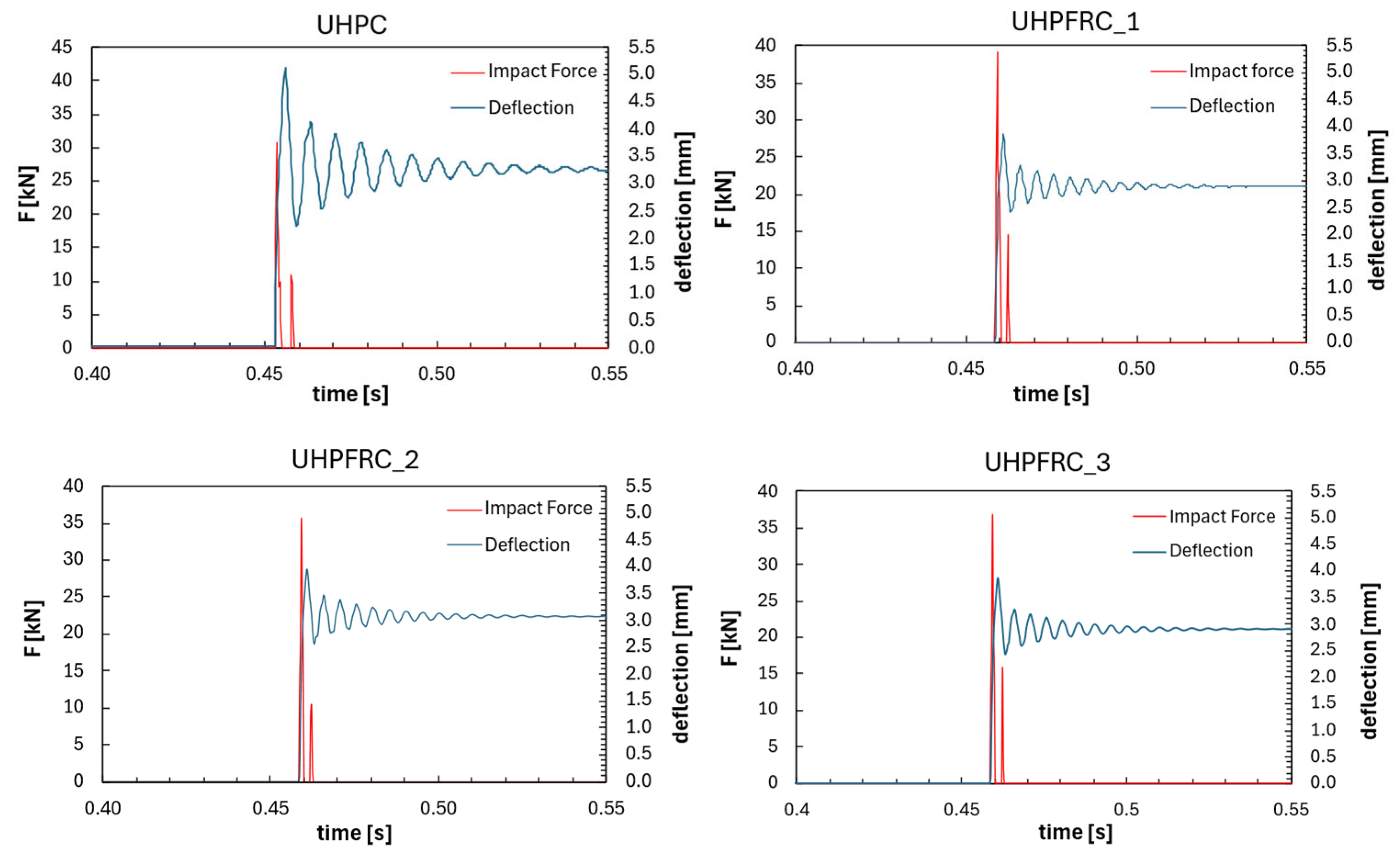
- Drop-weight impact tests on thin VHPC panels showed that synthetic fiber reinforcement significantly improves impact resistance: PVA microfibers reduced crack openings by more than 20 times compared to plain VHPC, while PP macrofibers were less effective at the tested energy level due to their greater efficiency at larger crack openings.
- •
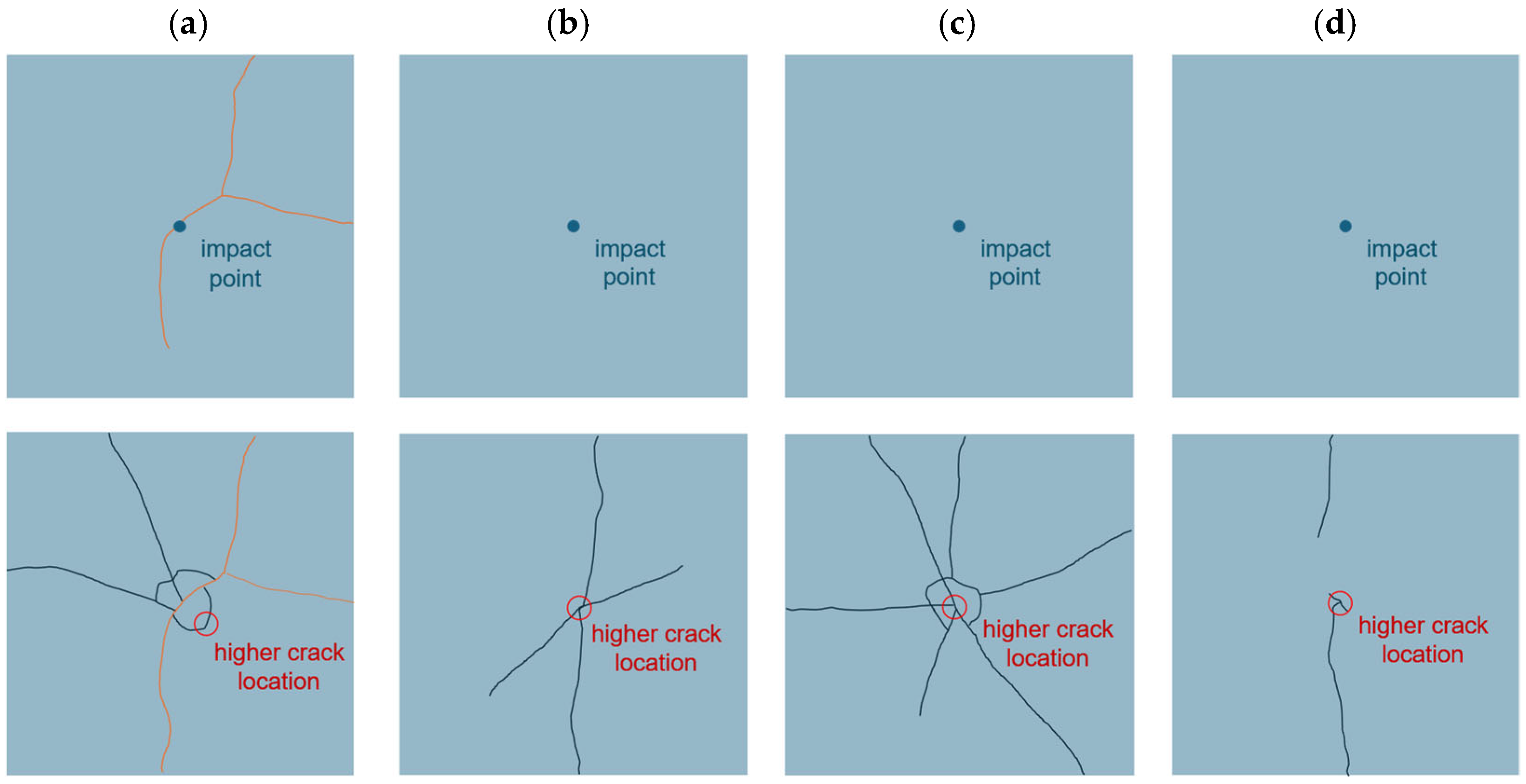
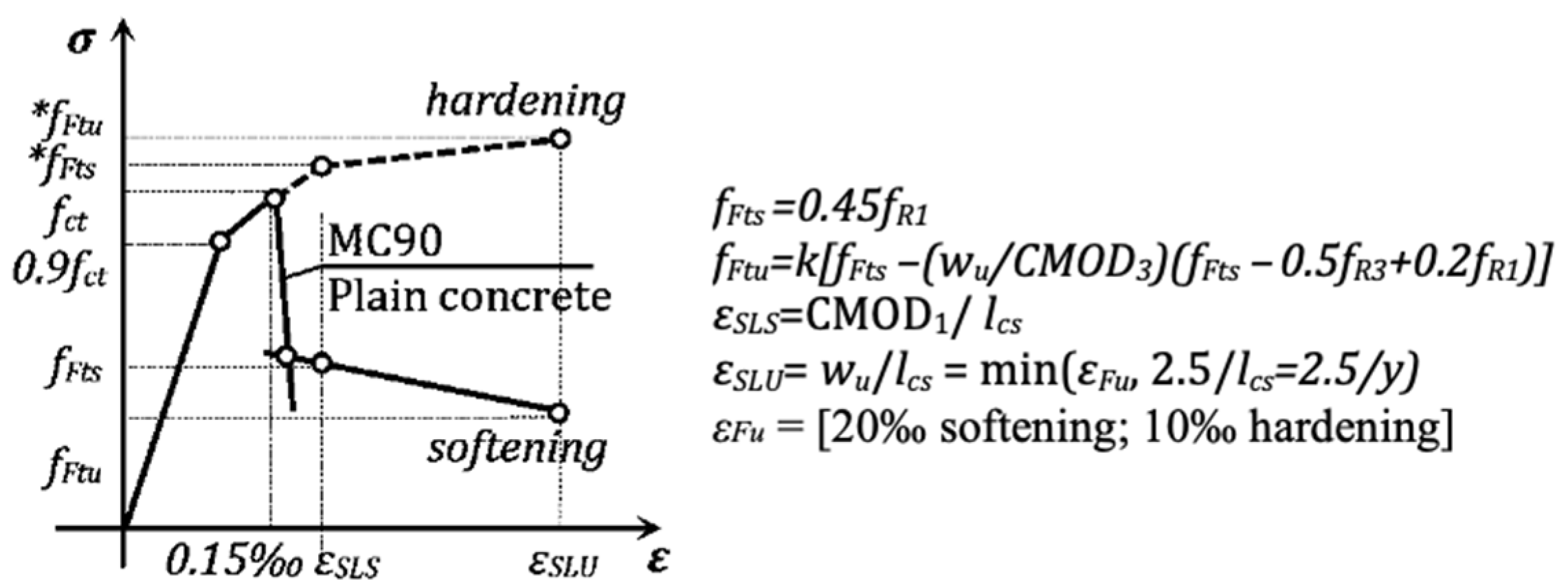
- A finite element model based on the fib Model Code 2010 inverse analysis and the Concrete Damaged Plasticity framework accurately reproduced the experimental crack patterns and deflections of all fiber-reinforced panels.
- •
- At low-to-medium impact energy levels, PVA microfibers provide the dominant contribution to impact resistance in thin VHPC panels, suggesting that fiber selection should account for the expected crack opening range under the design impact scenario.
- •
- The proposed numerical approach, calibrated on quasi-static bending tests, proves adequate for predicting the impact response of thin VHPC panels, offering a reliable and practical tool for structural design.
Abstract
1. Introduction
2. Materials and Methods
2.1. Methodology
2.2. Materials
- •
- PVA Microfibers (MasterFiber 401): These 12 mm-long fibers with a diameter of 0.2 mm were selected for their ability to control crack formation, particularly in reducing shrinkage cracks.
- •
- PP Macrofibers (MasterFiber 236 and 246): These fibers, 30 mm and 40 mm in length, respectively, have a waved shape, which enhances their bond with the concrete matrix, thereby improving toughness and ductility under impact loads.
2.3. Mechanical Properties of UHPFRC
3. Impact Tests
3.1. Tests Setup
3.2. Results
4. Numerical Analysis
4.1. Simulations Setup and Input Parameters
- •
- Dilation angle ψ in the p-q plane, in which p corresponds to the hydrostatic stress state and q represents the Von-Mises criterion, considered equal to 31°;
- •
- Flow potential eccentricity ϵ considered equal to 0.1;
- •
- The ratio fb0 / fc0 of biaxial compressive yield stress to uniaxial compressive yield stress considered equal to 1.16;
- •
- The ratio K of the second stress invariant on the tensile meridian to that on the compressive meridian for the yield function considered equal to 2/3;
- •
- The viscosity parameter μ (relaxation time) considered equal to 0.

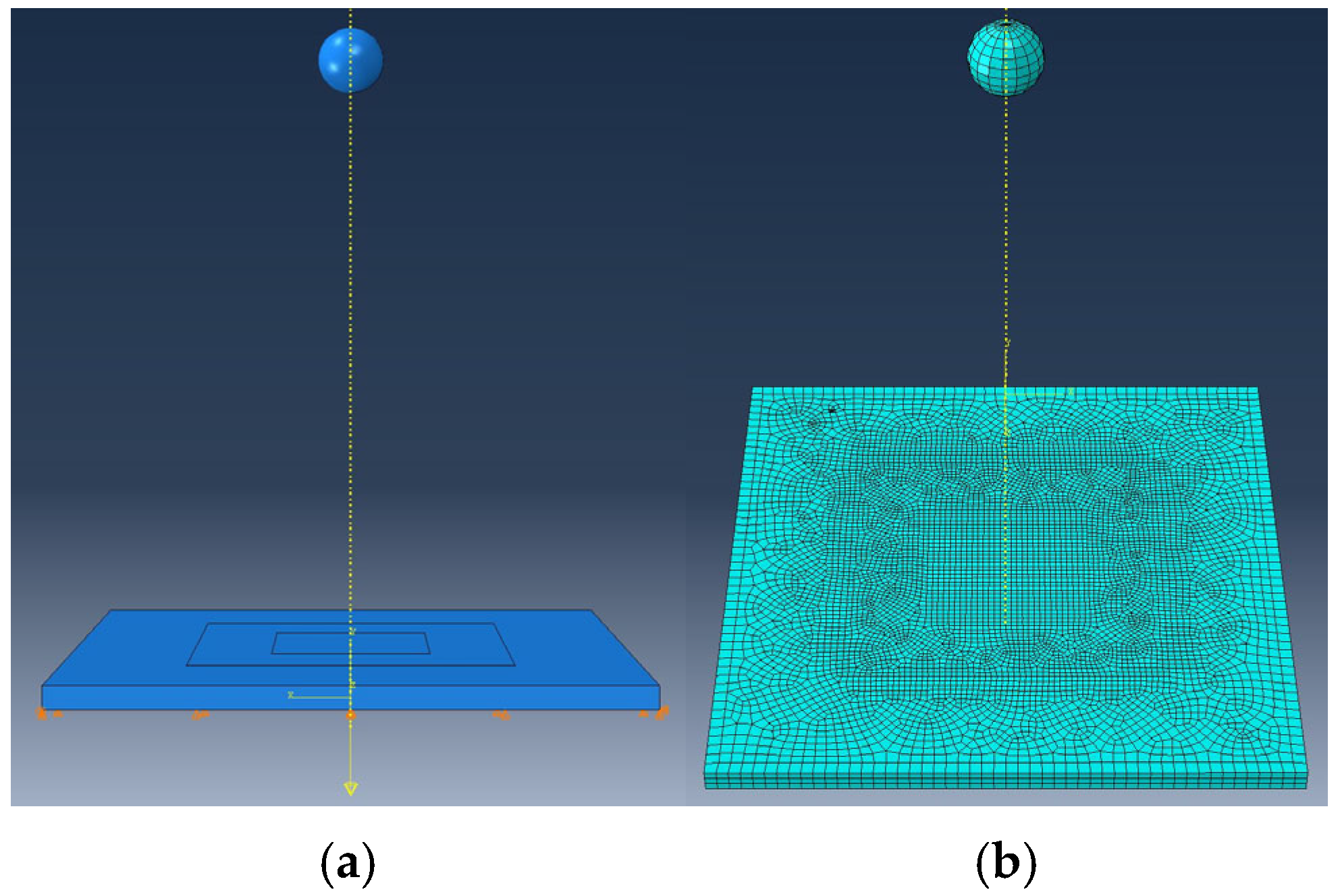
| Parameter | Value/Description |
|---|---|
| Software | ABAQUS™/Explicit v.2022 |
| Crack model | Concrete Damaged Plasticity (CDP) |
| Panel element type | Hex elements, structured technique |
| Steel ball element type | Hex-dominated elements, sweep technique |
| Mesh size (panel-impact zone) | 10 mm |
| Mesh size (panel-edges) | 20 mm |
| Mesh size (steel ball) | 5 mm |
| Contact formulation | General “hard” contact, friction coefficient = 0.2 |
| Buondary conditions | Simply supported on four edges (pinned) |
| Gravity | Included |
4.2. Results of FEM Analysis
5. Conclusions
- •
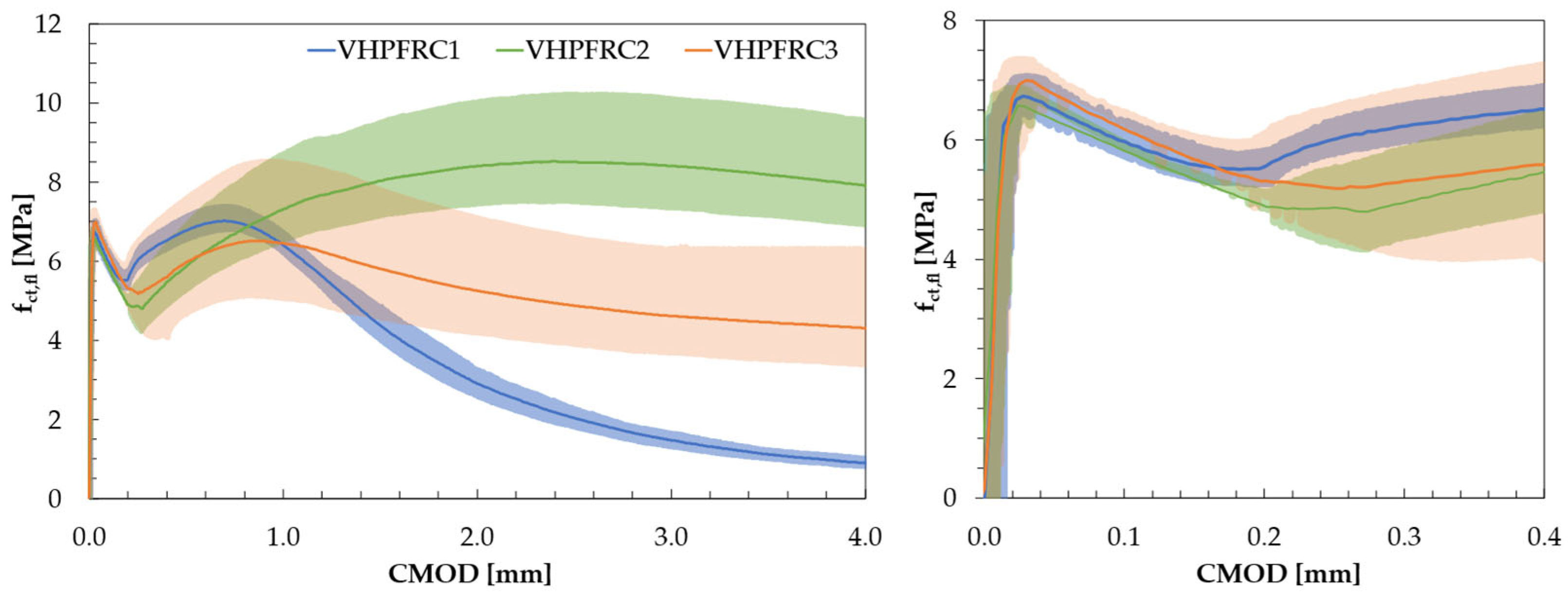
- The mechanical characterization previously reported in [61], including three-point bending tests on notched beams, is consistent with the behavior observed under impact loading.
- •
- Synthetic fibers significantly improve the impact resistance of thin panels without conventional bar reinforcement. Both PVA microfibers and PP macrofibers effectively reduce crack opening. PVA microfibers are particularly effective during crack initiation and early propagation stages. The use of MF 401 leads to a clear reduction in crack number and crack length.
- •
- Fiber reinforcement also reduces deflection under impact. Panels reinforced with PVA microfibers show better overall performance compared to those reinforced only with PP macrofibers, as highlighted by the differences between UHPFRC_1 and UHPFRC_2.
- •
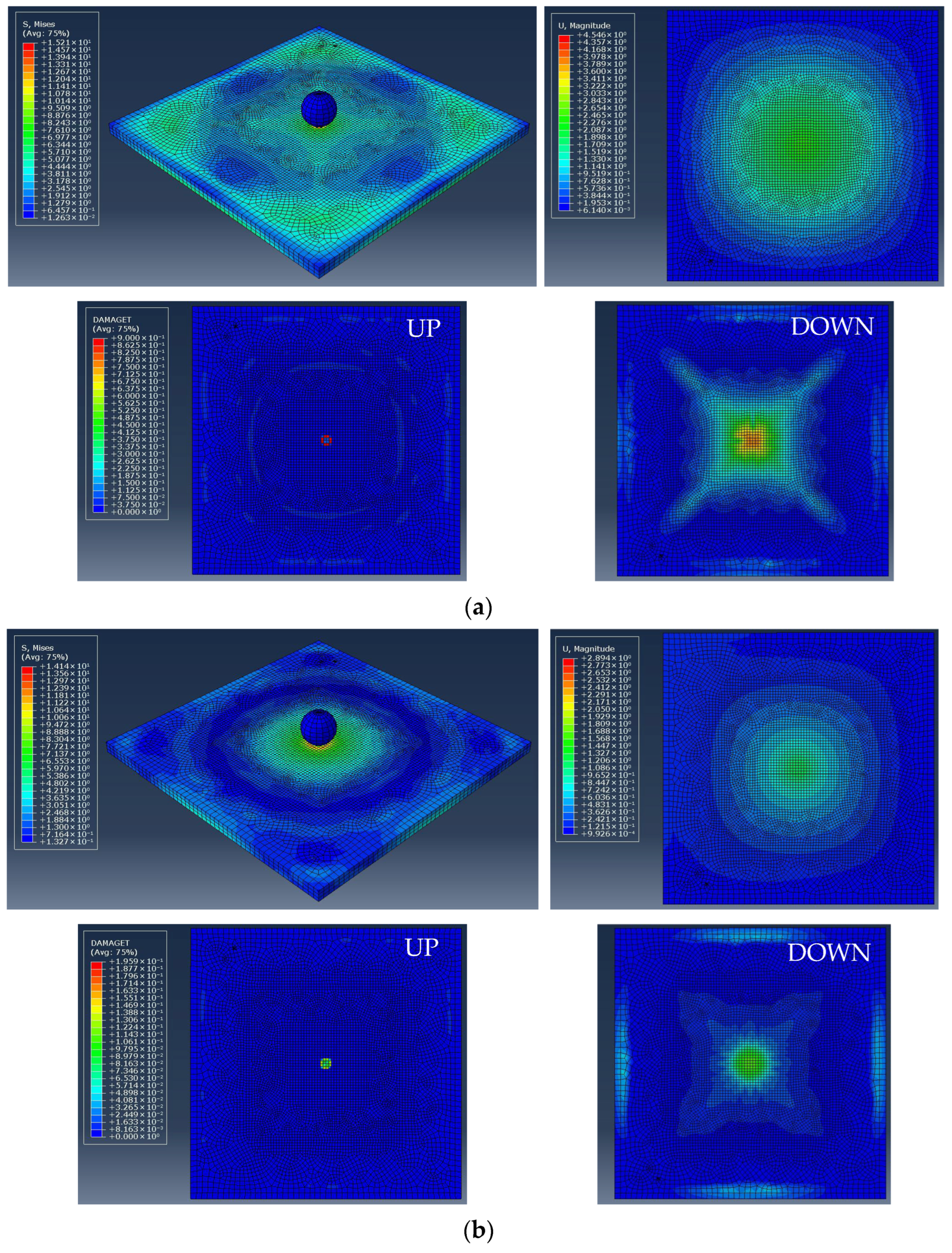
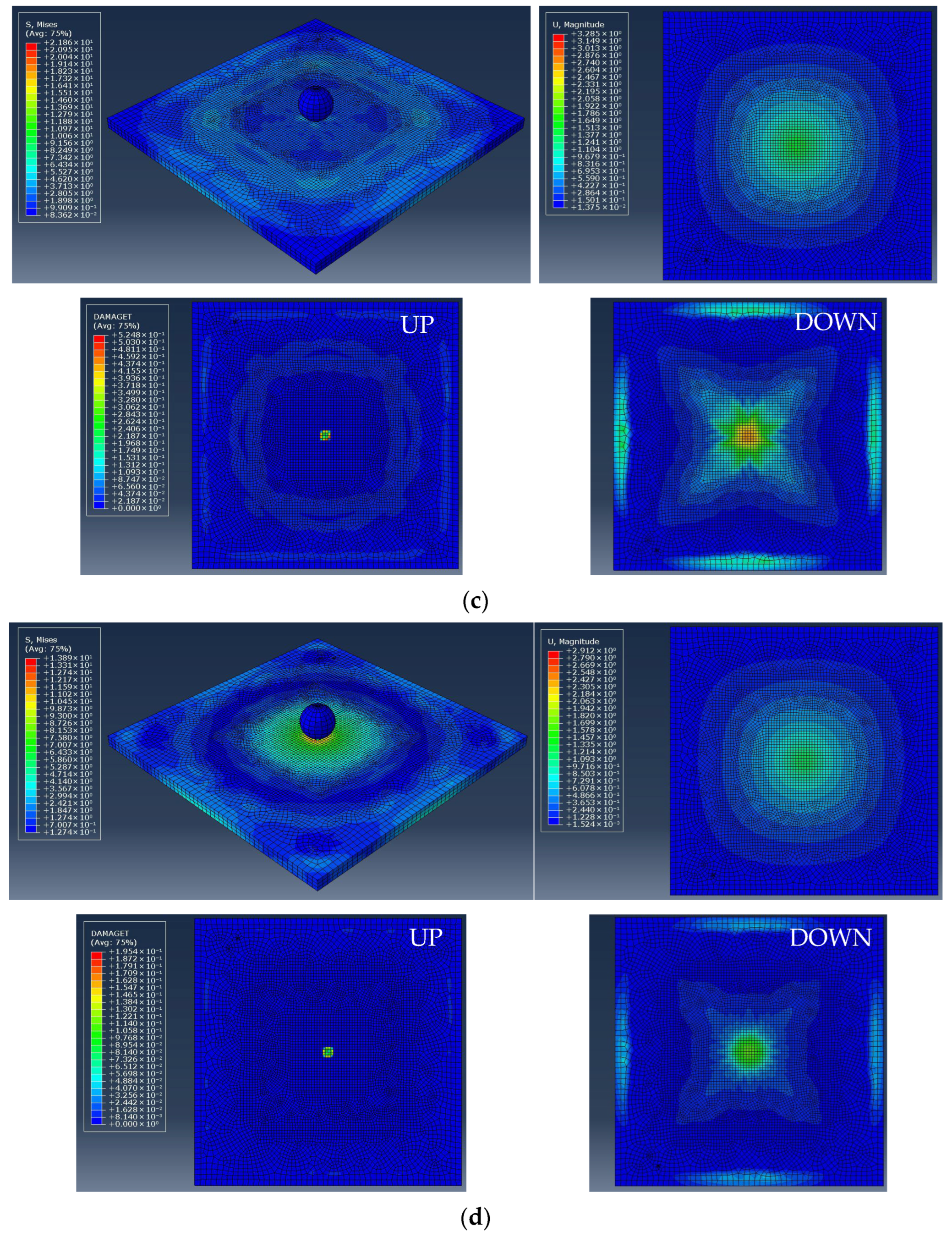
- The numerical simulations reproduce both the trends and the magnitude of the experimental results. The plain UHPC panel exhibits the largest crack openings and deflections, while all fiber-reinforced panels show improved behavior. Among them, UHPFRC_2 consistently presents larger crack openings compared to UHPFRC_1 and UHPFRC_3.
Author Contributions
Funding
Data Availability Statement
Conflicts of Interest
References
- ASTM C1856/C1856M; Standard Practice for Fabricating and Testing Specimens of Ultra-High Performance Concrete. ASTM: West Conshohocken, PA, USA, 2017.
- CEB-FIP. Fib Model Code for Concrete Structures; John Wiley & Sons: Hoboken, NJ, USA, 2010. [Google Scholar] [CrossRef]
- EN 1992-1-1; Eurocode 2: Design of Concrete Structures—Part 1-1: General Rules and Rules for Buildings. British Standard Institution: London, UK, 2004.
- Yi, F.; Kazmi, S.M.S.; Hu, B.; Wu, Y.-F. Mitigating the brittle behavior of compression cast concrete using polypropylene fibers. Constr. Build. Mater. 2024, 440, 137435. [Google Scholar] [CrossRef]
- Yoo, D.Y.; Banthia, N. Impact resistance of fiber-reinforced concrete—A review. Cem. Concr. Compos. 2019, 104, 103389. [Google Scholar] [CrossRef]
- Yoo, D.-Y.; Gohil, U.; Gries, T.; Yoon, Y.-S. Comparative low-velocity impact response of textile-reinforced concrete and steel-fiber-reinforced concrete beams. J. Compos. Mater. 2016, 50, 2421–2431. [Google Scholar] [CrossRef]
- Yoo, D.-Y.; Yoon, Y.-S. Influence of steel fibers and fiber-reinforced polymers on the impact resistance of one-way concrete slabs. J. Compos. Mater. 2014, 48, 695–706. [Google Scholar] [CrossRef]
- Ren, B.; Ma, G.; Wu, J.; Chang, R.; Hu, R. Stress-wave propagation and wave-induced damage patterns of filter concrete under blast loading. J. Build. Eng. 2026, 119, 115295. [Google Scholar] [CrossRef]
- Bentur, A.; Mindess, S. Fibre Reinforced Cementitious Composites; CRC Press: Boca Raton, FL, USA, 2006. [Google Scholar] [CrossRef]
- ACI 544.4R-18; Guide for Design with Fiber-Reinforced Concrete. ACI: Farmington Hills, MI, USA, 2018.
- Pakravan, H.R.; Ozbakkaloglu, T. Synthetic fibers for cementitious composites: A critical and in-depth review of recent advances. Constr. Build. Mater. 2019, 207, 491–518. [Google Scholar] [CrossRef]
- Ramezanianpour, A.A.; Esmaeili, M.; Ghahari, S.A.; Najafi, M.H. Laboratory study on the effect of polypropylene fiber on durability, and physical and mechanical characteristic of concrete for application in sleepers. Constr. Build. Mater. 2013, 44, 411–418. [Google Scholar] [CrossRef]
- Ahmed, S.F.U.; Mihashi, H. A review on durability properties of strain hardening fibre reinforced cementitious composites (SHFRCC). Cem. Concr. Compos. 2007, 29, 365–376. [Google Scholar] [CrossRef]
- Zhang, B.; Lin, X.; Zhang, Y.X.; Zhang, L. Microscale failure analysis of the ultra-high-performance polypropylene fibre reinforced concrete panel subjected to high thermal loading induced by fire exposure. Eng. Struct. 2023, 292, 116518. [Google Scholar] [CrossRef]
- Kalifa, P.; Chéné, G.; Gallé, C. High-temperature behaviour of HPC with polypropylene fibres. Cem. Concr. Res. 2001, 31, 1487–1499. [Google Scholar] [CrossRef]
- Serrano, R.; Cobo, A.; Prieto, M.I.; de las Nieves González, M. Analysis of fire resistance of concrete with polypropylene or steel fibers. Constr. Build. Mater. 2016, 122, 302–309. [Google Scholar] [CrossRef]
- Ríos, J.D.; Leiva, C.; Ariza, M.P.; Seitl, S.; Cifuentes, H. Analysis of the tensile fracture properties of ultra-high-strength fiber-reinforced concrete with different types of steel fibers by X-ray tomography. Mater. Des. 2019, 165, 107582. [Google Scholar] [CrossRef]
- Zhang, S.; Zhang, C.; Liao, L. Investigation on the relationship between the steel fibre distribution and the post-cracking behaviour of SFRC. Constr. Build. Mater. 2019, 200, 539–550. [Google Scholar] [CrossRef]
- Marcos-Meson, V.; Solgaard, A.; Fischer, G.; Edvardsen, C.; Michel, A. Pull-out behaviour of hooked-end steel fibres in cracked concrete exposed to wet-dry cycles of chlorides and carbon dioxide—Mechanical performance. Constr. Build. Mater. 2020, 240, 117764. [Google Scholar] [CrossRef]
- Yang, L.; Zhang, Z.; Gao, D.; Tang, J.; Chang, H.; Liu, G. Mechanical property evolution and chloride transport of steel fiber-reinforced concrete exposed to simulated marine environments. Mater. Struct. 2022, 55, 130. [Google Scholar] [CrossRef]
- Chen, G.; Hadi, M.N.S.; Gao, D.; Zhao, L. Experimental study on the properties of corroded steel fibres. Constr. Build. Mater. 2015, 79, 165–172. [Google Scholar] [CrossRef]
- Söylev, T.A.; Özturan, T. Durability, physical and mechanical properties of fiber-reinforced concretes at low-volume fraction. Constr. Build. Mater. 2014, 73, 67–75. [Google Scholar] [CrossRef]
- Anandan, S.; Manoharan, S.V.; Sengottian, T. Corrosion Effects on the Strength Properties of Steel Fibre Reinforced Concrete Containing Slag and Corrosion Inhibitor. Int. J. Corros. 2014, 2014, 595040. [Google Scholar] [CrossRef]
- Guerini, V.; Conforti, A.; Plizzari, G.; Kawashima, S. Influence of steel and macro-synthetic fibers on concrete properties. Fibers 2018, 6, 47. [Google Scholar] [CrossRef]
- Yin, S.; Tuladhar, R.; Shi, F.; Combe, M.; Collister, T.; Sivakugan, N. Use of macro plastic fibres in concrete: A review. Constr. Build. Mater. 2015, 93, 180–188. [Google Scholar] [CrossRef]
- Ahmad, J.; Zhou, Z. Mechanical Properties of Natural as well as Synthetic Fiber Reinforced Concrete: A Review. Constr. Build. Mater. 2022, 333, 127353. [Google Scholar] [CrossRef]
- Pakravan, H.R.; Memariyan, F. Modification of low-surface energy fibers used as reinforcement in cementitious composites: A review. Polym.-Plast. Technol. Eng. 2017, 56, 227–239. [Google Scholar] [CrossRef]
- Won, J.P.; Lim, D.H.; Park, C.G. Bond behaviour and flexural performance of structural synthetic fibre-reinforced concrete. Mag. Concr. Res. 2006, 58, 401–410. [Google Scholar] [CrossRef]
- Oh, B.H.; Kim, J.C.; Choi, Y.C. Fracture behavior of concrete members reinforced with structural synthetic fibers. Eng. Fract. Mech. 2007, 74, 243–257. [Google Scholar] [CrossRef]
- Behfarnia, K.; Behravan, A. Application of high performance polypropylene fibers in concrete lining of water tunnels. Mater. Des. 2014, 55, 274–279. [Google Scholar] [CrossRef]
- Aslani, F.; Nejadi, S. Self-compacting concrete incorporating steel and polypropylene fibers: Compressive and tensile strengths, moduli of elasticity and rupture, compressive stress–strain curve, and energy dissipated under compression. Compos. B Eng. 2013, 53, 121–133. [Google Scholar] [CrossRef]
- Sun, Z.; Xu, Q. Microscopic, physical and mechanical analysis of polypropylene fiber reinforced concrete. Mater. Sci. Eng. A 2009, 527, 198–204. [Google Scholar] [CrossRef]
- Medina, N.F.; Barluenga, G.; Hernández-Olivares, F. Enhancement of durability of concrete composites containing natural pozzolans blended cement through the use of Polypropylene fibers. Compos. B Eng. 2018, 61, 214–221. [Google Scholar] [CrossRef]
- Sadrinejad, I.; Madandoust, R.; Ranjbar, M.M. The mechanical and durability properties of concrete containing hybrid synthetic fibers. Constr. Build. Mater. 2018, 178, 72–82. [Google Scholar] [CrossRef]
- Kim, D.J.; Wille, K.; El-Tawil, S.; Naaman, A.E. Testing of Cementitious Materials under High-Strain-Rate Tensile Loading Using Elastic Strain Energy. J. Eng. Mech. 2011, 137, 268–275. [Google Scholar] [CrossRef]
- Gupta, P.; Banthia, N.; Yan, C. Fiber Reinforced Wet-Mix Shotcrete under Impact. J. Mater. Civ. Eng. 2000, 12, 81–90. [Google Scholar] [CrossRef]
- Murali, G.; Wong, L.S.; Abid, S.R. A comprehensive review of drop weight impact testing: Evaluating the Pros and Cons in fiber-reinforced concrete performance assessment. J. Build. Eng. 2024, 94, 109934. [Google Scholar] [CrossRef]
- Grote, D.L.; Park, S.W.; Zhou, M. Dynamic behavior of concrete at high strain rates and pressures: I. experimental characterization. Int. J. Impact Eng. 2001, 25, 869–886. [Google Scholar] [CrossRef]
- Feng, J.; Gao, X.; Li, J.; Dong, H.; He, Q.; Liang, J.; Sun, W. Penetration resistance of hybrid-fiber-reinforced high-strength concrete under projectile multi-impact. Constr. Build. Mater. 2019, 202, 341–352. [Google Scholar] [CrossRef]
- Kim, D.J.; El-Tawil, S.; Naaman, A.E. Rate-dependent tensile behavior of high performance fiber reinforced cementitious composites. Mater. Struct. 2009, 42, 399–414. [Google Scholar] [CrossRef]
- Abid, S.R.; Murali, G.; Ahmad, J.; Al-Ghasham, T.S.; Vatin, N.I. Repeated Drop-Weight Impact Testing of Fibrous Concrete: State-Of-The-Art Literature Review, Analysis of Results Variation and Test Improvement Suggestions. Materials 2022, 15, 3948. [Google Scholar] [CrossRef]
- Jacobsen, Ø.E.K.; Kristoffersen, M.; Dey, S.; Børvik, T. Projectile Impact on Plain and Reinforced Concrete Slabs. J. Dyn. Behav. Mater. 2024, 10, 137–159. [Google Scholar] [CrossRef]
- Guan, Z.; Li, Y.; Lai, Z.; Zhou, H.; Qin, J.; Wen, Y.; Chen, Y.; Huang, R. Size effect of concrete based on split Hopkinson pressure bar (SHPB) test. Constr. Build. Mater. 2024, 441, 137499. [Google Scholar] [CrossRef]
- Zhou, Y.; Yang, J.; Luo, X.; Hwang, H.J.; Chen, H.; Sun, J.; Yi, W.; Kang, S.M. Pendulum impact loading tests of precast concrete columns with various column base connections. Eng. Struct. 2022, 252, 113736. [Google Scholar] [CrossRef]
- Bentur, A.; Mindess, S.; Banthia, N. The behaviour of concrete under impact loading: Experimental procedures and method of analysis. Mater. Struct. 1986, 19, 371–378. [Google Scholar] [CrossRef]
- Murali, G.; Haridharan, M.K.; Abid, S.R.; Mohan, C.; Khera, G.S.; Bandhavi, C. Compressive strength and impact strength of preplaced aggregate fibre reinforced concrete. Mater. Today Proc. 2023. In press. [Google Scholar] [CrossRef]
- Zhang, Q.; Yuan, R.; Wang, D.; Feng, C.; Yue, J.; Sun, L. The impact fracture characteristics of concrete slabs under different hammerhead shapes, impact velocities and concrete strengths. Constr. Build. Mater. 2023, 392, 131919. [Google Scholar] [CrossRef]
- Mohammed, A.A.; Karim, S.H. Impact strength and mechanical properties of high strength concrete containing PET waste fiber. J. Build. Eng. 2023, 68, 106195. [Google Scholar] [CrossRef]
- El-Abbasy, A.A. Tensile, flexural, impact strength, and fracture properties of ultra-high-performance fiber-reinforced concrete—A compre-hensive review. Constr. Build. Mater. 2023, 408, 133621. [Google Scholar] [CrossRef]
- He, H.; Wu, L.; Zhi, X.; Fan, F.; Ma, G.; Zhang, R. Dynamic responses and failure modes of ultra-high strength alkali-activated concrete slab under impact load. Eng. Struct. 2026, 353, 122258. [Google Scholar] [CrossRef]
- Körmeling, H.A.; Reinhardt, H.W. Strain rate effects on steel fibre concrete in uniaxial tension. Int. J. Cem. Compos. Lightweight Concr. 1987, 9, 197–204. [Google Scholar] [CrossRef]
- Fujikake, K.; Senga, T.; Ueda, N.; Ohno, T.; Katagiri, M. Effects of Strain Rate on Tensile Behavior of Reactive Powder Concrete. J. Adv. Concr. Technol. 2006, 4, 79–84. [Google Scholar] [CrossRef]
- Wille, K.; El-Tawil, S.; Naaman, A.E. Strain Rate Dependent Tensile Behavior of Ultra-High Performance Fiber Reinforced Concrete. In High Performance Fiber Reinforced Cement Composites; Springer: Berlin/Heidelberg, Germany, 2012; pp. 381–387. [Google Scholar] [CrossRef]
- Pyo, S.; Wille, K.; El-Tawil, S.; Naaman, A.E. Strain rate dependent properties of ultra high performance fiber reinforced concrete (UHP-FRC) under tension. Cem. Concr. Compos. 2015, 56, 15–24. [Google Scholar] [CrossRef]
- Bindiganavile, V.; Banthia, N. Generating dynamic crack growth resistance curves for fiber-reinforced concrete. Exp. Mech. 2005, 45, 112–122. [Google Scholar] [CrossRef]
- Suaris, W.; Shah, S.P.; Asce, M. Properties of concrete subjected to impact. J. Struct. Eng. 1983, 109, 1727–1741. [Google Scholar] [CrossRef]
- Bindiganavile, V.; Banthia, N. Polymer and Steel Fiber-Reinforced Cementitious Composites under Impact Loading—Part 2: Flexural Toughness. ACI Mater. J. 2001, 98, 17–24. [Google Scholar]
- Bindiganavile, V.; Banthia, N.; Aarup, B. Impact Response of Ultra-High-Strength Fiber-Reinforced Cement Composite. ACI Mater. J. 2002, 99, 543–548. [Google Scholar]
- UNI EN 14651; Test Method for Metallic Fibered Concrete—Measuring the Flexural Tensile Strength. European Committee for Standardization: Brussels, Belgium, 2005.
- ASTM C1609/C 1609M—07; Standard Test Method for Flexural Performance of Fiber-Reinforced Concrete (Using Beam with Third-Point Loading). ASTM: West Conshohocken, PA, USA, 2009.
- Romanazzi, V.; Micelli, F.; Moro, S.; Ros, P.S.; Aiello, M.A. Experimental characterization of VHPC reinforced with short synthetic fibers. Mater. Struct. 2025, 58, 82. [Google Scholar] [CrossRef]
- Blasi, G.; Leone, M. Inverse analysis-based model for the tensile behaviour of fibre-reinforced concrete with manufactured and waste tyres recovered fibres. Case Stud. Constr. Mater. 2022, 17, e01297. [Google Scholar] [CrossRef]
- Fakeh, M.; Jawdhari, A.; Fam, A. Recommended concrete damage plasticity parameters and constitutive models for UHPC in ABAQUS. Eng. Struct. 2025, 333, 120154. [Google Scholar] [CrossRef]
- Wang, Z.; Yan, J.; Lin, Y.; Fan, F. Influence of shear connectors on the ultimate capacity of steel-UHPC-steel slabs subjected to concentrated loads. Eng. Struct. 2021, 231, 111763. [Google Scholar] [CrossRef]
- Romanazzi, V.; Micelli, F.; Moro, S.; Aiello, A.; Kandalaft, A.G. Very High-Performance Fiber Reinforced Concrete (VHPFRC) Testing and Finite Element Analysis. In Proceedings of the Recent Advances in Concrete Technology and Sustainability Issues—Conference Proceedings SP-355, Milan, Italy, 13–15 July 2022. [Google Scholar]




| Fiber Name | Material | Length [mm] | Equivalent Diameter [mm] | Aspect Ratio | Shape | Tensile Strength [MPa] | Elastic Modulus [MPa] |
|---|---|---|---|---|---|---|---|
| MasterFiber 401 | Polyvinyl alcohol | 12 | 0.20 | 60 | straight | 800 | 27,000 |
| MasterFiber 236 | Polypropylene | 29 | 0.75 | 38.6 | waved | 450 | 3250 |
| MasterFiber 246 | Polypropylene | 40 | 0.75 | 53.3 | waved | 450 | 3250 |
| Components | Quantity [kg/m3] | |||
|---|---|---|---|---|
| UHPC | UHPFRC_1 | UHPFRC_2 | UHPFRC_3 | |
| Fine Sand (<0.5) | 305 | 305 | 305 | 305 |
| Medium Sand (0.6 < d < 1.2) | 365 | 365 | 365 | 365 |
| Coarse Sand (>1.2) | 225 | 225 | 225 | 225 |
| Silica fume | 175 | 175 | 175 | 175 |
| Cement | 800 | 800 | 800 | 800 |
| Water | 170 | 170 | 170 | 170 |
| Superplasticizer | 31.8 | 31.8 | 31.8 | 31.8 |
| MF401 | - | 30 | - | 20 |
| MF236 | - | - | 30 | - |
| MF246 | - | - | - | 10 |
| MIX | Properties from Compression | Properties from Three Point Bending Test | ||||||
|---|---|---|---|---|---|---|---|---|
| Rc [MPa] | E [MPa] | LOP [MPa] | CMOD 0.5 mm | CMOD 1.5 mm | CMOD 2.5 mm | CMOD 3.5 mm | fr3/fr1 [-] | |
| fr1 [MPa] | fr2 [MPa] | fr3 [MPa] | fr4 [MPa] | |||||
| UHPC | 121.39 (4.1%) | 44234 (0.9%) | 6.71 (2.8%) | - | - | - | - | - |
| UHPFRC_1 | 119.9 (6.0%) | 41452 | 6.77 (2.4%) | 6.77 (3.8%) | 4.38 (7.5%) | 2.03 (10.2%) | 1.11 (10.9%) | 0.30 |
| UHPFRC_2 | 108.4 (1.2%) | 40407 (2.1%) | 6.54 (4.0%) | 5.83 (11.0%) | 7.97 (11.5%) | 8.43 (12.8%) | 8.13 (13.2%) | 1.45 |
| UHPFRC_3 | 111.0 (2.7%) | 42306 (2.0%) | 7.04 (4.8%) | 5.97 (20.8%) | 5.82 (24.0%) | 4.87 (24.4%) | 4.63 (31.6%) | 0.82 |
| Mix | Higher Crack Opening [mm] | Central Point Deflection [mm] | Average Impact Force [kN] |
|---|---|---|---|
| UHPC | 3.87 | 6.4 | 11.8 |
| UHPFRC_1 | 0.19 | 2.4 | 31.5 |
| UHPFRC_2 | 0.46 | 3.2 | 23.6 |
| UHPFRC_3 | 0.19 | 2.2 | 34.3 |
| Laboratory Tests | FEM Simulations | |||||
|---|---|---|---|---|---|---|
| Mix | Higher Crack Opening [mm] | Deflection [mm] | Average Impact Force [kN] | Higher Crack Opening [mm] | Deflection [mm] | Impact Force [kN] |
| UHPC | 3.87 | 6.4 | 11.8 | 0.45 | 5.1 | 30.6 |
| UHPFRC_1 | 0.19 | 2.4 | 31.5 | 0.24 | 3.5 | 39.1 |
| UHPFRC_2 | 0.46 | 3.2 | 23.6 | 0.28 | 3.9 | 35.6 |
| UHPFRC_3 | 0.19 | 2.2 | 34.3 | 0.24 | 3.7 | 37.7 |
Disclaimer/Publisher’s Note: The statements, opinions and data contained in all publications are solely those of the individual author(s) and contributor(s) and not of MDPI and/or the editor(s). MDPI and/or the editor(s) disclaim responsibility for any injury to people or property resulting from any ideas, methods, instructions or products referred to in the content. |
© 2026 by the authors. Licensee MDPI, Basel, Switzerland. This article is an open access article distributed under the terms and conditions of the Creative Commons Attribution (CC BY) license.
Share and Cite
Romanazzi, V.; Micelli, F.; Moro, S.; Serna Ros, P.; Aiello, M.A. Experimental and Numerical Investigation of the Impact Resistance of Synthetic Fiber-Reinforced UHPC Thin Panels. Fibers 2026, 14, 63. https://doi.org/10.3390/fib14050063
Romanazzi V, Micelli F, Moro S, Serna Ros P, Aiello MA. Experimental and Numerical Investigation of the Impact Resistance of Synthetic Fiber-Reinforced UHPC Thin Panels. Fibers. 2026; 14(5):63. https://doi.org/10.3390/fib14050063
Chicago/Turabian StyleRomanazzi, Vincenzo, Francesco Micelli, Sandro Moro, Pedro Serna Ros, and Maria Antonietta Aiello. 2026. "Experimental and Numerical Investigation of the Impact Resistance of Synthetic Fiber-Reinforced UHPC Thin Panels" Fibers 14, no. 5: 63. https://doi.org/10.3390/fib14050063
APA StyleRomanazzi, V., Micelli, F., Moro, S., Serna Ros, P., & Aiello, M. A. (2026). Experimental and Numerical Investigation of the Impact Resistance of Synthetic Fiber-Reinforced UHPC Thin Panels. Fibers, 14(5), 63. https://doi.org/10.3390/fib14050063