Exploring the Development Trajectory and Dynamic Frontiers of Numerical Simulation Method Applied in Thermal Protective Clothing Investigation




Abstract
1. Introduction
2. Methodology
2.1. Research Method
2.2. Data Collection and Screening
- (a)
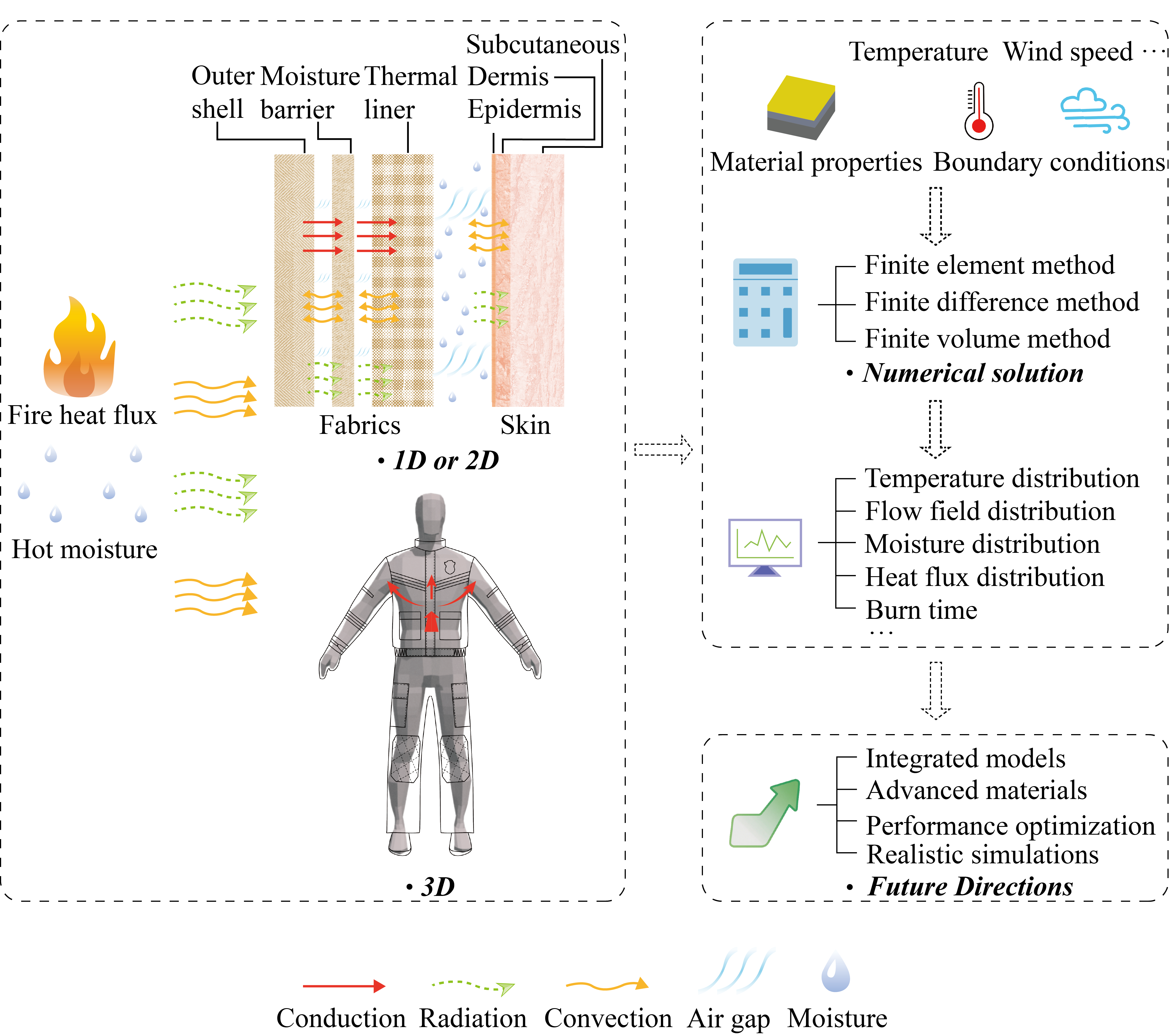
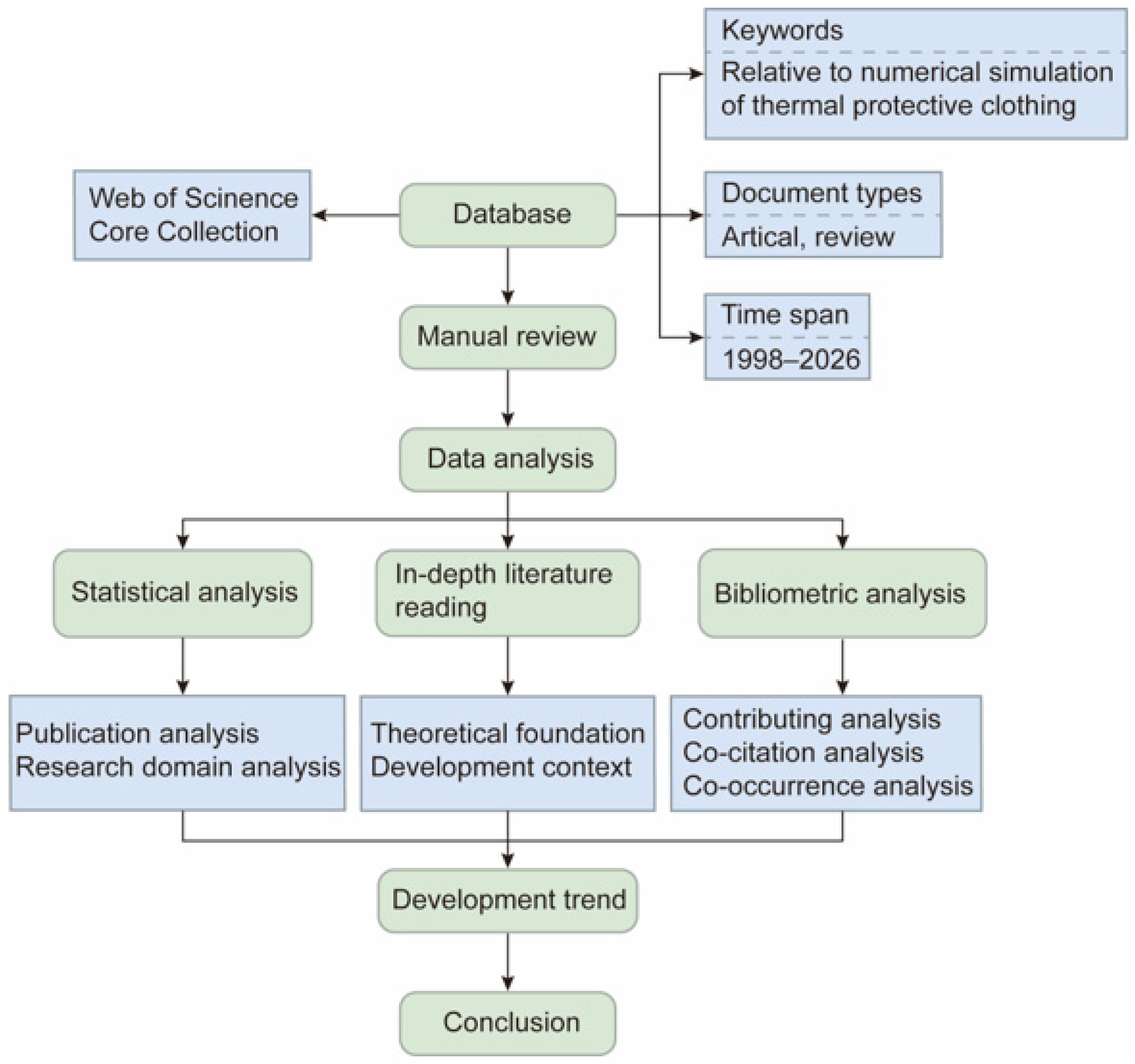
- Numerical simulation studies focusing on thermal protective clothing or protective textile systems exposed to high temperature, radiant heat, flame, or steam were retained.
- (b)
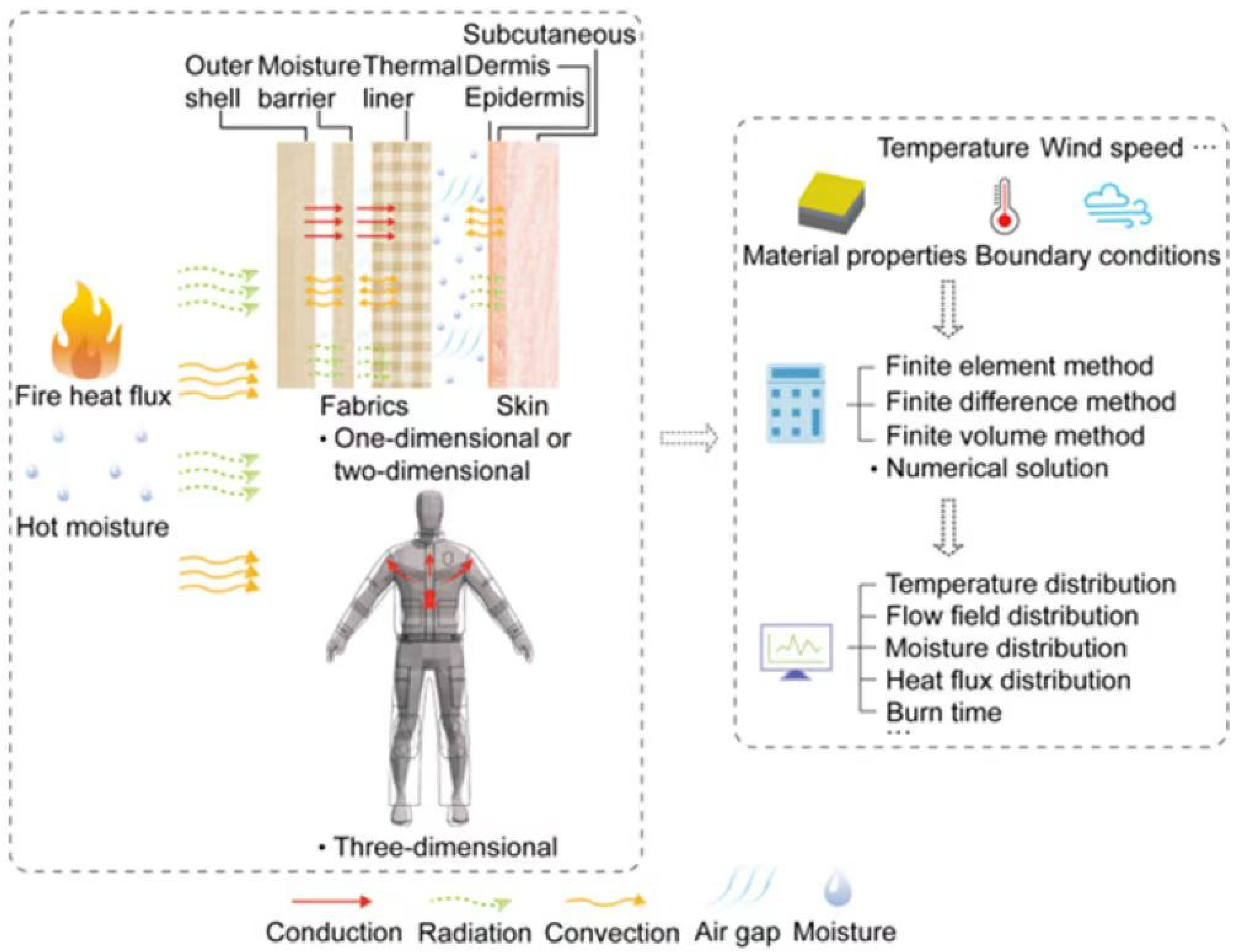
- Numerical simulation studies addressing thermal protection performance or related thermal responses of clothing systems, including temperature distribution, heat flux, heat transfer, moisture transfer, or skin burn prediction, were retained.
- (c)
- Studies focusing solely on materials, human thermophysiology, or other topics unrelated to the numerical modeling of thermal protective clothing or relevant textile systems were excluded.
3. Statistical Analysis
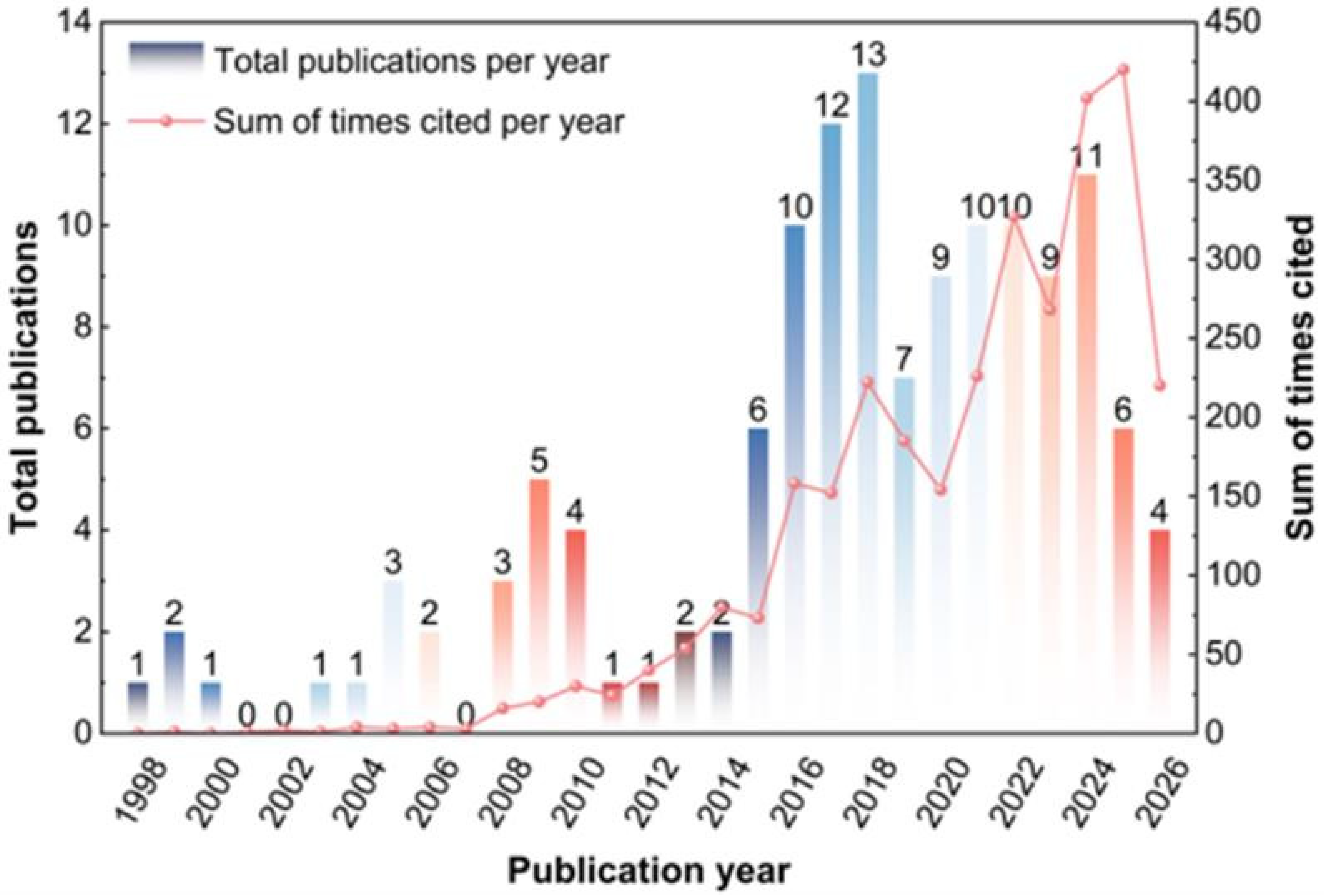
3.1. Publication Analysis
3.2. Research Domain and Journal Analysis
4. Theoretical Foundations
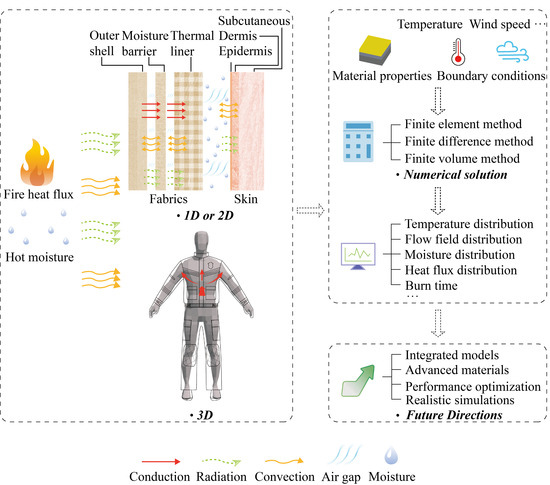
4.1. Model Construction
4.1.1. One-Dimensional Model
4.1.2. Two-Dimensional Model
4.1.3. Three-Dimensional Model
- (a)
- The continuity equation is used to describe the mass conservation relationship in the flow field (Equation (9)).where ρf is the fluid density, kg/m3; u, v, w are fluid velocity vector in x, y, z direction, m/s.
- (b)
- The momentum conservation equations (Equations (10)–(12)), derived from the Navier–Stokes equations, reflect the changes in the velocity field and account for the effects of viscosity in the fluid.where μ is dynamic viscosity, Pa·s; Su, Sv, Sw are source terms, N/m3; and p is pressure, Pa.
- (c)
- The energy conservation equation is utilized to characterize the heat transfer and temperature variations within the fabric, air, and skin tissue (Equation (13)).where ST is the source term, J.
4.1.4. Models Across Different Dimensions
5. Bibliometric Analysis
5.1. Contributing Countries and Institutions
5.2. Contributing Authors
5.3. Intellectual Basis Based on the Cited References
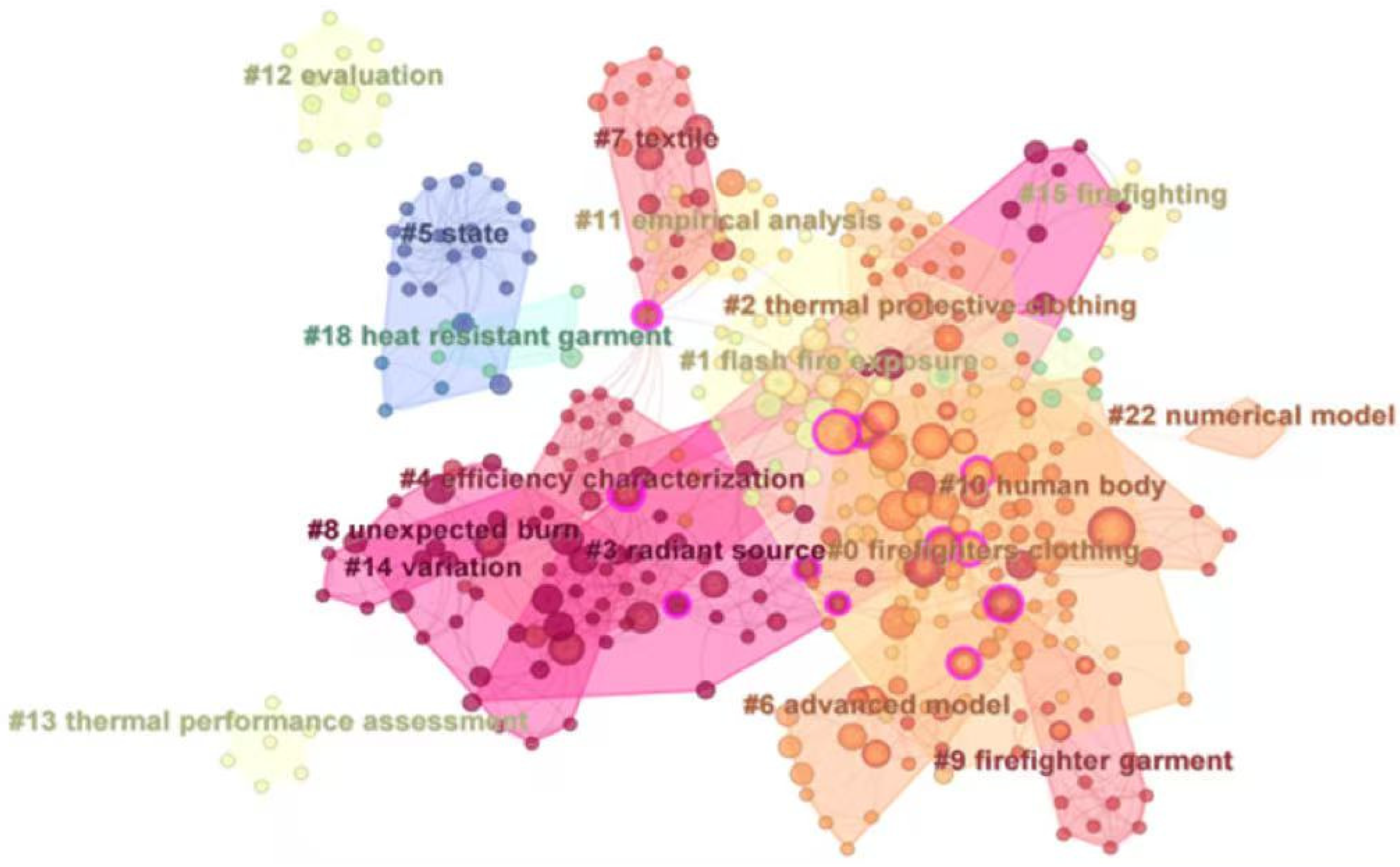
5.4. Keyword Co-Occurrence Analysis for Research Hotspots and Frontiers
5.4.1. Analysis of Critical Keywords
5.4.2. Temporal Distribution and Evolution of Keywords
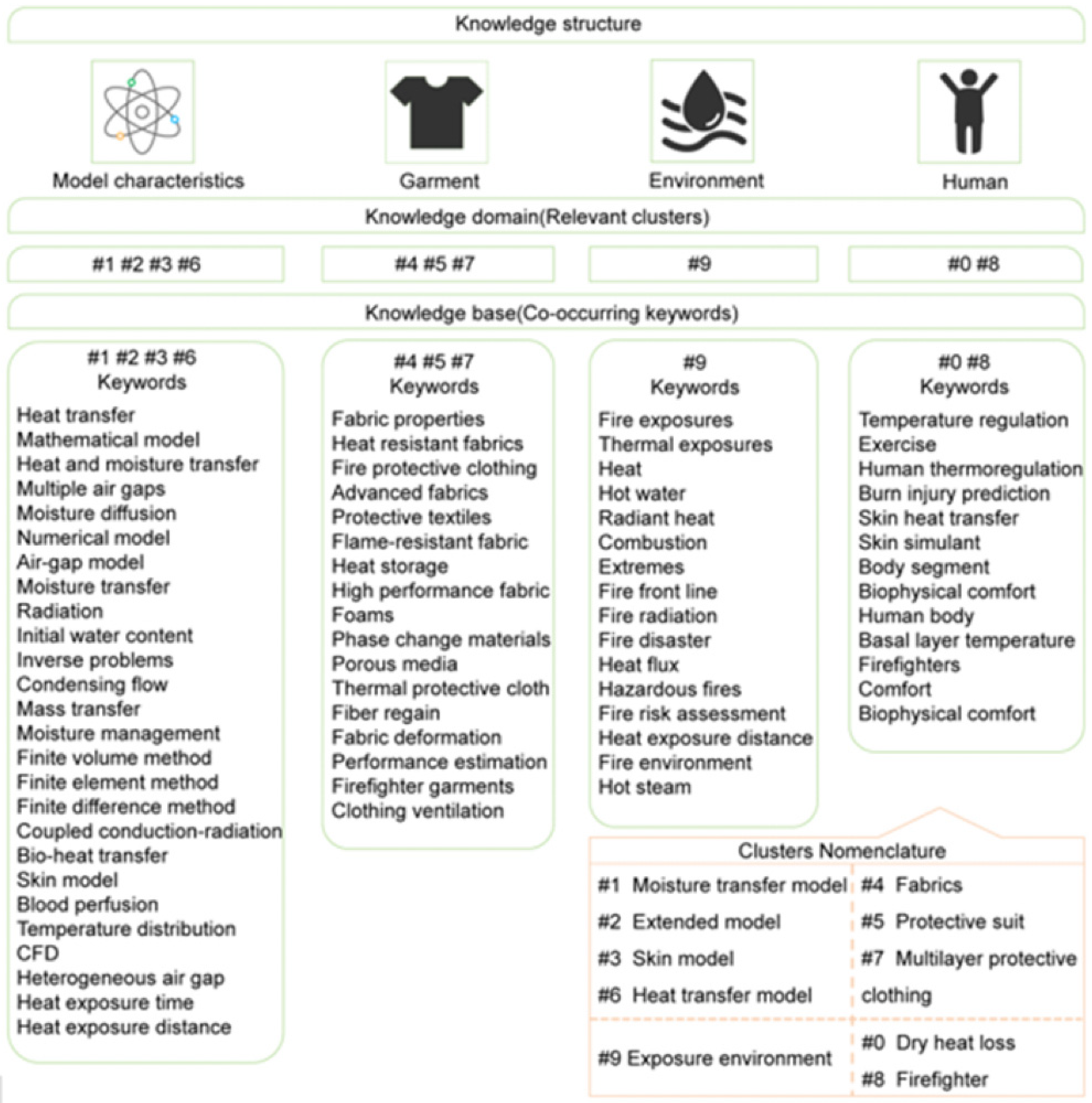
5.4.3. Knowledge Structuring of NSTPC Research
6. Development Trajectory of NSTPC
7. Future Development Directions
- (a)
- Integrated models consider a variety of factors. During the practical application of TPC, it needs to account for heat transfer under high-temperature exposure, moisture evaporation and absorption, mechanical interactions between the clothing and the body, and chemical erosion in certain specialized environments. In the future, greater emphasis will be placed on the coupled simulation of multiple physical fields, including heat, humidity, force, and chemical interactions. To gain a deeper comprehension of clothing performance under complex conditions, simulations can be used to investigate the effects of relevant physical and chemical factors and material properties on the thermal protective performance of clothing under high-temperature exposure. Additionally, the accuracy of models that account for the performance parameters of clothing materials and complex AGs requires enhancement, and the development of full-scale models that encompass these intricate factors is essential.
- (b)
- Realistic simulations of thermal exposure scenes and human movement. Thermal environments frequently undergo dynamic changes, such as the spread of fire at a fire scene and fluctuations in temperature. Real-time or transient simulations may provide a more realistic representation of the evolution of thermal exposure and clothing performance at different stages. Additionally, factors such as postural changes and muscle activities during movement significantly influence clothing performance. The consideration of thermal exposure scenarios alongside the dynamic changes of the human body may provide useful information for optimizing clothing structural design and evaluating clothing performance and comfort.
- (c)
- The optimization of TPC performance and the simulation of functional material integration. The continuous development of advanced thermal protective materials, including nanomaterials, PCMs, and smart temperature-regulating materials, requires enhanced numerical simulations to investigate their thermal transport characteristics and protective mechanisms. The integration of functional coatings and surface-modified layers into multilayer thermal protective systems provides new opportunities for improving thermal barrier performance and regulating interfacial heat transfer. By simulating thermal conduction, thermal radiation, moisture transport, and other relevant properties under high-temperature environments, researchers can establish a theoretical foundation for the application and optimization of these novel materials and coating systems in TPC. It is essential to explore innovative protective structures, such as multilayer composite architectures and modular designs, with particular attention to material interfaces and thermal resistance.
- (d)
- The integration of artificial intelligence and machine learning with numerical simulation. Artificial intelligence and machine learning can provide new approaches for improving the computational efficiency and optimization capability of NSTPC models. Recent studies have demonstrated that surrogate models can be constructed from numerical simulation data to rapidly predict the thermal protective performance of multilayer fabric systems and subsequently support multi-objective optimization of fabric parameters [69]. Physics-informed neural networks (PINNs) provide another potential approach by incorporating governing heat-transfer equations and boundary conditions into the learning process, which can improve physical consistency and reduce reliance on extensive training data [86].
8. Conclusions
Author Contributions
Funding
Institutional Review Board Statement
Informed Consent Statement
Data Availability Statement
Conflicts of Interest
Appendix A
References
- Acharya, J.; Bhanja, D.; Misra, R.D. A modified model to assess the thermal protective performance of fire-retardant clothing exposed to both flame and radiant source. Appl. Therm. Eng. 2024, 242, 122422. [Google Scholar] [CrossRef] [Scilit]
- Wang, M.; Li, X.; Li, J.; Xu, B. A new approach to quantify the thermal shrinkage of fire protective clothing after flash fire exposure. Text. Res. J. 2016, 86, 580–592. [Google Scholar] [CrossRef] [Scilit]
- Chen, C.-J.; Hsieh, W.-D.; Hu, W.-C.; Lai, C.-M.; Lin, T.-H. Experimental investigation and numerical simulation of a furnished office fire. Build. Environ. 2010, 45, 2735–2742. [Google Scholar] [CrossRef] [Scilit]
- Udayraj, T.P.; Das, A.; Alagirusamy, R. Heat and mass transfer through thermal protective clothing—A review. Int. J. Therm. Sci. 2016, 106, 32–56. [Google Scholar] [CrossRef] [Scilit]
- Deng, M.; Wang, Y.Y.; Li, P.J. Effect of air gaps characteristics on thermal protective performance of firefighters’ clothing A review. Int. J. Cloth. Sci. Technol. 2018, 30, 246–267. [Google Scholar] [CrossRef] [Scilit]
- Weng, W.G.; Yang, J.; Wu, J.L.; Fu, M.; He, Z.; Chen, W. Human thermoregulation and injury evaluation in fire environments: A review. Fire Technol. 2024, 60, 991–1025. [Google Scholar] [CrossRef] [Scilit]
- Shakeriaski, F.; Ghodrat, M.; Nelson, D.J. Experimental and numerical studies on efficiency characterization of firefighters’ protective clothing: A review. J. Text. Inst. 2022, 113, 2549–2568. [Google Scholar] [CrossRef] [Scilit]
- Chen, C.M. CiteSpace II: Detecting and visualizing emerging trends and transient patterns in scientific literature. J. Am. Soc. Inf. Sci. Technol. 2006, 57, 359–377. [Google Scholar] [CrossRef] [Scilit]
- Li, S.; Jiang, S.; Tian, M.; Su, Y.; Li, J. Mapping the research status and dynamic frontiers of functional clothing: A review via bibliometric and knowledge visualization. Int. J. Cloth. Sci. Technol. 2022, 34, 697–715. [Google Scholar] [CrossRef] [Scilit]
- Azam, A.; Ahmed, A.; Wang, H.; Wang, Y.; Zhang, Z. Knowledge structure and research progress in wind power generation (WPG) from 2005 to 2020 using CiteSpace based scientometric analysis. J. Clean. Prod. 2021, 295, 126496. [Google Scholar] [CrossRef] [Scilit]
- Li, Z.; Poon, H.; Chen, W.; Fan, J. A comparative analysis of textile schools by journal publications listed in Web of ScienceTM. J. Text. Inst. 2021, 112, 1472–1481. [Google Scholar] [CrossRef] [Scilit]
- Tian, M.; Li, J. Knowledge mapping of protective clothing research—A bibliometric analysis based on visualization methodology. Text. Res. J. 2019, 89, 3203–3220. [Google Scholar] [CrossRef] [Scilit]
- Chen, C.; Leydesdorff, L. Patterns of connections and movements in dual-map overlays: A new method of publication portfolio analysis. J. Assoc. Inf. Sci. Technol. 2014, 65, 334–351. [Google Scholar] [CrossRef] [Scilit]
- Su, Y.; Fan, Y.; Liu, G.; Tian, M.; Li, J. A review on sustainable method to evaluate heat and moisture transfer in clothing material. Sustainability 2023, 15, 2747. [Google Scholar] [CrossRef] [Scilit]
- Su, Y.; Tian, M.; Li, J.; Zhang, X. Development of heat and moisture transfer model for predicting skin burn of firefighter in fire environments. J. Text. Inst. 2022, 113, 1658–1665. [Google Scholar] [CrossRef] [Scilit]
- Wang, Y.R.; Xu, Y.H.; Xu, D.H.; Fan, J. The heat and moisture transfer model of firefighter protective clothing. Int. J. Therm. Sci. 2024, 197, 108854. [Google Scholar] [CrossRef] [Scilit]
- Kim, Y.; Lee, C.; Li, P.; Corner, B.D.; Paquette, S. Investigation of air gaps entrapped in protective clothing systems. Fire Mater. 2002, 26, 121–126. [Google Scholar] [CrossRef] [Scilit]
- Su, Y.; Li, R.; Song, G.W.; Li, J.; Xiang, C. Modeling steam heat transfer in thermal protective clothing under hot steam exposure. Int. J. Heat Mass Transf. 2018, 120, 818–829. [Google Scholar] [CrossRef] [Scilit]
- Kaminski, W. Hyperbolic heat conduction equation for materials with a nonhomogeneous inner structure. J. Heat Transf. 1990, 112, 555–560. [Google Scholar] [CrossRef] [Scilit]
- Mitra, K.; Kumar, S.; Vedevarz, A.; Moallemi, M.K. Experimental evidence of hyperbolic heat conduction in processed meat. J. Heat Transf. 1995, 117, 568–573. [Google Scholar] [CrossRef] [Scilit]
- Liu, J.; Chen, X.; Xu, L.X. New thermal wave aspects on burn evaluation of skin subjected to instantaneous heating. IEEE Trans. Biomed. Eng. 1999, 46, 420–428. [Google Scholar] [CrossRef] [Scilit]
- Tian, M.; Wang, Q.; Wang, Y.Y.; Ren, X.; Li, J. Effects of air gap under clothing on heat transfer from fire environment to human skin: An experimental and numerical study for firefighter safety. Int. J. Therm. Sci. 2024, 195, 108621. [Google Scholar] [CrossRef] [Scilit]
- Hang, X.; Sun, W.; Ye, C. Finite volume solution of heat and moisture transfer through three-dimensional textile materials. Comput. Fluids 2012, 57, 25–39. [Google Scholar] [CrossRef] [Scilit]
- Li, R.; Islam, M.R.; Xia, Y.; Huang, J.; Gholamreza, F.; Dolez, P.I.; Lai, A.; Gathercole, R.; Li, R. Heat and moisture transfer through skin-clothing microclimate. Int. J. Heat Mass Transf. 2024, 231, 125867. [Google Scholar] [CrossRef] [Scilit]
- Zhu, F.L.; Ma, S.Q.; Zhang, W.Y. Study of skin model and geometry effects on thermal performance of thermal protective fabrics. Heat Mass Transf. 2008, 45, 99–105. [Google Scholar] [CrossRef] [Scilit]
- Zhu, F.L.; Cheng, X.P.; Zhang, W.Y. Estimation of thermal performance of flame resistant clothing fabrics sheathing a cylinder with new skin model. Text. Res. J. 2009, 79, 205–212. [Google Scholar] [CrossRef] [Scilit]
- Zhai, L.N.; Spano, F.; Li, J.; Rossi, R.M. Development of a multi-layered skin simulant for burn injury evaluation of protective fabrics exposed to low radiant heat. Fire Mater. 2019, 43, 144–152. [Google Scholar] [CrossRef] [Scilit]
- Zhai, L.; Camenzind, M.; Li, J.; Rossi, R.M. Study on different finite difference methods at skin interface for burn prediction in protective clothing evaluation. Fire Mater. 2017, 41, 1027–1039. [Google Scholar] [CrossRef] [Scilit]
- Su, Y.; Yang, J.; Song, G.W.; Li, R.; Xiang, C.; Li, J. Development of a numerical model to predict physiological strain of firefighter in fire hazard. Sci. Rep. 2018, 8, 3628. [Google Scholar] [CrossRef] [Scilit]
- Mandal, S.; Song, G. An empirical analysis of thermal protective performance of fabrics used in protective clothing. Ann. Occup. Hyg. 2014, 58, 1065–1077. [Google Scholar] [CrossRef] [Scilit]
- Mandal, S.; Song, G.W. Characterizing thermal protective fabrics of firefighters’ clothing in hot surface contact. J. Ind. Text. 2018, 47, 622–639. [Google Scholar] [CrossRef] [Scilit]
- Elgafy, A.; Mishra, S. A heat transfer model for incorporating carbon foam fabrics in firefighter’s garment. Heat Mass Transf. 2014, 50, 545–557. [Google Scholar] [CrossRef] [Scilit]
- Lawson, J.R.; Mell, W.E.; Prasad, K. A heat transfer model for firefighters’ protective clothing, continued developments in protective clothing modeling. Fire Technol. 2010, 46, 833–841. [Google Scholar] [CrossRef] [Scilit]
- Chitrphiromsri, P.; Kuznetsov, A.V.; Song, G.; Barker, R.L. Investigation of feasibility of developing intelligent firefighter-protective garments based on the utilization of a water-injection system. Numer. Heat Transf. Part A-Appl. 2006, 49, 427–450. [Google Scholar] [CrossRef] [Scilit]
- Barry, J.; Hill, R.; Brasser, P.; Sobera, M.; Kleijn, C.; Gibson, P. Computational fluid dynamics modeling of fabric systems for intelligent garment design. Mrs Bull. 2003, 28, 568–573. [Google Scholar] [CrossRef] [Scilit]
- Su, Y.; He, J.Z.; Li, J. Modeling the transmitted and stored energy in multilayer protective clothing under low-level radiant exposure. Appl. Therm. Eng. 2016, 93, 1295–1303. [Google Scholar] [CrossRef] [Scilit]
- Fu, M.; Yuan, M.Q.; Weng, W.G. Modeling of heat and moisture transfer within firefighter protective clothing with the moisture absorption of thermal radiation. Int. J. Therm. Sci. 2015, 96, 201–210. [Google Scholar] [CrossRef] [Scilit]
- Hu, Y.; Huang, D.M.; Qi, Z.K.; He, S.; Yang, H.; Zhang, H. Modeling thermal insulation of firefighting protective clothing embedded with phase change material. Heat Mass Transf. 2013, 49, 567–573. [Google Scholar] [CrossRef] [Scilit]
- Torvi, D.A.; Dale, J.D. Neat transfer in thin fibrous materials under high heat flux. Fire Technol. 1999, 35, 210–231. [Google Scholar] [CrossRef] [Scilit]
- Ghazy, A.; Bergstrom, D.J. Numerical simulation of heat transfer in firefighters’ protective clothing with multiple air gaps during flash fire exposure. Numer. Heat Transf. Part A-Appl. 2012, 61, 569–593. [Google Scholar] [CrossRef] [Scilit]
- Ghazy, A.; Bergstrom, D.J. Influence of the air gap between protective clothing and skin on clothing performance during flash fire exposure. Heat Mass Transf. 2011, 47, 1275–1288. [Google Scholar] [CrossRef] [Scilit]
- Sawcyn, C.M.J.; Torvi, D.A. Improving heat transfer models of air gaps in bench top tests of thermal protective fabrics. Text. Res. J. 2009, 79, 632–644. [Google Scholar] [CrossRef] [Scilit]
- Branda, F.; Malucelli, G.; Durante, M.; Piccolo, A.; Mazzei, P.; Costantini, A.; Silvestri, B.; Pennetta, M.; Bifulco, A. Silica treatments: A fire retardant strategy for hemp fabric/epoxy composites. Polymers 2016, 8, 313. [Google Scholar] [CrossRef] [Scilit]
- Su, Y.; Tian, M.; Li, J.; Zhang, X.; Zhao, P. Numerical study of heat and moisture transfer in thermal protective clothing against a coupled thermal hazardous environment. Int. J. Heat Mass Transf. 2022, 194, 122989. [Google Scholar] [CrossRef] [Scilit]
- Song, G.W.; Chitrphiromsri, P.; Ding, D. Numerical simulations of heat and moisture transport in thermal protective clothing under flash fire conditions. Int. J. Occup. Saf. Ergon. 2008, 14, 89–106. [Google Scholar] [CrossRef] [Scilit]
- Chitrphiromsri, P.; Kuznetsov, A.V. Porous medium model for investigating transient heat and moisture transport in firefighter protective clothing under high-intensity thermal exposure. J. Porous Media 2005, 8, 511–528. [Google Scholar] [CrossRef] [Scilit]
- Song, G.W.; Barker, R.L.; Hamouda, H.; Kuznetsov, A.V.; Chitrphiromsri, P.; Grimes, R.V. Modeling the thermal protective performance of heat resistant garments in flash fire exposures. Text. Res. J. 2004, 74, 1033–1040. [Google Scholar] [CrossRef] [Scilit]
- Udayraj, T.P.; Das, A.; Alagirusamy, R. Numerical investigation of the effect of air gap orientations and heterogeneous air gap in thermal protective clothing on skin burn. Int. J. Therm. Sci. 2017, 121, 313–321. [Google Scholar] [CrossRef] [Scilit]
- Udayraj, T.P.; Das, A.; Alagirusamy, R. Numerical modeling of heat transfer and fluid motion in air gap between clothing and human body: Effect of air gap orientation and body movement. Int. J. Heat Mass Transf. 2017, 108, 271–291. [Google Scholar] [CrossRef] [Scilit]
- Udayraj, T.P.; Das, A.; Alagirusamy, R. Design and development of a test method for analyzing protective performance of gloves exposed to radiant heat based on computational fluid dynamics analysis. Heat Transf. Eng. 2019, 40, 95–108. [Google Scholar] [CrossRef] [Scilit]
- Rajput, B.; Mahesh, N.; Rathour, R.; Das, T.; Ray, B.; Das, A.; Talukdar, P. Performance analysis of multilayer flame-retardant fabric ensembles for different exposure conditions using numerical modeling. J. Text. Inst. 2024, 115, 218–227. [Google Scholar] [CrossRef] [Scilit]
- Rajput, B.; Dubey, R.; Ray, B.; Das, A.; Talukdar, P. Numerical modeling of simultaneous heat and moisture transport in fire protective suits under flash fire exposure and evaluation of second-degree burn time. J. Heat Transf.-Trans. ASME 2022, 144, 051201. [Google Scholar] [CrossRef] [Scilit]
- Li, J.; Tian, M. Personal thermal protection simulation under diverse wind speeds based on life-size manikin exposed to flash fire. Appl. Therm. Eng. 2016, 103, 1381–1389. [Google Scholar] [CrossRef] [Scilit]
- Li, Y.; Zhu, Q. A model of heat and moisture transfer in porous textiles with phase change materials. Text. Res. J. 2004, 74, 447–457. [Google Scholar] [CrossRef] [Scilit]
- Torvi, D.A.; Dale, J.D. Effects of variations in thermal properties on the performance of flame resistant fabrics for flash fires. Text. Res. J. 1998, 68, 787–796. [Google Scholar] [CrossRef] [Scilit]
- Jia, J.; Xie, J.P.; Li, J.Q.; Liu, H.; Li, H.; Yang, B. Thermal-fluid analysis of air gaps beneath thermal protective clothing through integrated CFD-thermophysiology modeling. Int. J. Therm. Sci. 2026, 222, 110520. [Google Scholar] [CrossRef] [Scilit]
- Chen, X.L.; Nie, C.Y. Design for multi-layer thermal protective clothing based on numerical simulation of heat transfer. Materials 2026, 19, 2478. [Google Scholar] [CrossRef] [Scilit]
- Su, Y.; Li, J.; Zhang, X.H. A coupled model for heat and moisture transport simulation in porous materials exposed to thermal radiation. Transp. Porous Media 2020, 131, 381–397. [Google Scholar] [CrossRef] [Scilit]
- Wang, Y.Y.; Ma, Y.L.; Chen, R.Y.; Su, Y. Thermal protective performance of firefighting protective clothing incorporated with phase change material in fire environments. Fire Mater. 2021, 45, 250–260. [Google Scholar] [CrossRef] [Scilit]
- Malaquias, A.F.; Campos, J.B.L.M. Influence of PCM incorporation on thermal performance of fire protective clothing subject to wet exposures. Int. Commun. Heat Mass Transf. 2026, 175, 111043. [Google Scholar] [CrossRef] [Scilit]
- Niu, N.; Fan, Y.; Su, Y.; Liu, S.; Gu, Z. Drip molding process of PCM for improving thermal and moisture comfort of thermal protective clothing. Int. J. Therm. Sci. 2024, 196, 108709. [Google Scholar] [CrossRef] [Scilit]
- Su, Y.; Fan, Y.; Ma, Y.; Wang, Y.; Liu, G. Flame-retardant phase change material (PCM) for thermal protective application in firefighting protective clothing. Int. J. Therm. Sci. 2023, 185, 108075. [Google Scholar] [CrossRef] [Scilit]
- Su, Y.; Zhang, J.F.; Xu, N.; Liu, S.; Li, J.; Zhang, X. Prediction model of safety thermal exposure distance for firefighters in fire environment. Int. J. Therm. Sci. 2024, 205, 109303. [Google Scholar] [CrossRef] [Scilit]
- Ghazy, A.; Bergstrom, D.J. Numerical simulation of the influence of fabric’s motion on protective clothing performance during flash fire exposure. Heat Mass Transf. 2013, 49, 775–788. [Google Scholar] [CrossRef] [Scilit]
- Lu, Y.R.; Zhang, S.S.; Lei, Y.; Yang, J. An improved multi-layer fabric heat transfer model to simulate firefighters’ skin burn under different thermal radiative exposures. Int. J. Heat Mass Transf. 2026, 256, 128036. [Google Scholar] [CrossRef] [Scilit]
- Chitrphiromsri, P.; Kuznetsov, A. Modeling heat and moisture transport in firefighter protective clothing during flash fire exposure. Heat Mass Transf. 2005, 41, 206–215. [Google Scholar]
- Ghazy, A.; Bergstrom, D.J. Numerical simulation of transient heat transfer in a protective clothing system during a flash fire exposure. Numer. Heat Transf. Part A-Appl. 2010, 58, 702–724. [Google Scholar] [CrossRef] [Scilit]
- Xin, M.Y.; He, J.Z.; Guo, J.; Chen, Y.; Wang, H. Numerical investigation of the influence of thermal protective fabric deformation on heat transfer from thermal radiant heat to human skin. Case Stud. Therm. Eng. 2024, 58, 104404. [Google Scholar] [CrossRef] [Scilit]
- Hu, B.B.; Xu, L.Y.; Zuo, Y.W.; Tang, C.; Li, X. Heat transfer simulation and parametric design for firefighter protective clothing under high heat exposure. J. Ind. Text. 2025, 55, 15280837251369753. [Google Scholar] [CrossRef] [Scilit]
- Acharya, J.; Bhanja, D.; Misra, R.D. Investigating the protective performance of turnout gears for firefighters under diverse exposure conditions: Effect of age and body segments. Therm. Sci. Eng. Prog. 2024, 50, 102543. [Google Scholar] [CrossRef] [Scilit]
- Puszkarz, A.K.; Machnowski, W.; Blasinska, A. Modeling of thermal performance of multilayer protective clothing exposed to radiant heat. Heat Mass Transf. 2020, 56, 1767–1775. [Google Scholar] [CrossRef] [Scilit]
- Mandal, S.; Annaheim, S.; Camenzind, M.; Rossi, R.M. Characterization and modelling of thermal protective performance of fabrics under different levels of radiant-heat exposuresyy. J. Ind. Text. 2019, 48, 1184–1205. [Google Scholar] [CrossRef] [Scilit]
- Fonseca, A.; Neves, S.F.; Campos, J. Thermal performance of a PCM firefighting suit considering transient periods of fire exposure, post—Fire exposure and resting phases. Appl. Therm. Eng. 2021, 182, 115769. [Google Scholar] [CrossRef] [Scilit]
- Kumar, V.; Bhanja, D. Impact of exposure intensity on thermal performance of protective clothing of firefighters of various age groups under diverse thermal environments. Int. J. Therm. Sci. 2026, 220, 110327. [Google Scholar] [CrossRef] [Scilit]
- Kumar, V.; Bhanja, D.; Acharya, J. Performance assessment of firefighter protective clothing under different thermal environments: Impact of the variation of thickness in inter-layer airgap and microclimate. Int. J. Therm. Sci. 2024, 205, 121813. [Google Scholar] [CrossRef] [Scilit]
- Deng, M.; Psikuta, A.; Wang, Y.Y.; Annaheim, S.; Rossi, R.M. Numerical investigation of the effects of heterogeneous air gaps during high heat exposure for application in firefighter clothing. Int. J. Heat Mass Transf. 2021, 181, 121813. [Google Scholar] [CrossRef] [Scilit]
- Tian, M.; Han, Y.; Zhang, Z.; Liu, S. 3D investigation of the thermal hazardous effects of heat storage in protective clothing and air gap during heating and cooling phases. Int. J. Therm. Sci. 2026, 219, 110266. [Google Scholar] [CrossRef] [Scilit]
- Malaquias, A.F.; Neves, S.F.; Campos, J. The impact of water on firefighter protective clothing thermal performance and steam burn occurrence in firefighters. Fire Saf. J. 2022, 127, 103506. [Google Scholar] [CrossRef] [Scilit]
- Pan, M.J.; Lu, Y.H.; Lu, X.Y.; Shen, J. Experimental and numerical study on thermal protective performance of weft-knitted spacer fabric system against hot pressurized steam. Int. J. Heat Mass Transf. 2024, 222, 125182. [Google Scholar] [CrossRef] [Scilit]
- Jiang, Y.Y.; Yanai, E.; Nishimura, K.; Zhang, H.; Abe, N.; Shinohara, M.; Wakatsuki, K. An integrated numerical simulator for thermal performance assessments of firefighters’ protective clothing. Fire Saf. J. 2010, 45, 314–326. [Google Scholar] [CrossRef] [Scilit]
- Wang, Y.Y.; Wang, Z.L.; Zhang, X.; Wang, M.; Li, J. CFD simulation of naked flame manikin tests of fire proof garments. Fire Saf. J. 2015, 71, 187–193. [Google Scholar] [CrossRef] [Scilit]
- Wang, Z.L.; Li, J.; Tian, M. Thermal protective performance evaluation of fire proof garment eliminating air gaps effect based on computational fluid dynamics simulation. J. Fire Sci. 2015, 33, 445–458. [Google Scholar] [CrossRef] [Scilit]
- Tian, M.; Wang, Z.L.; Li, J. 3D numerical simulation of heat transfer through simplified protective clothing during fire exposure by CFD. Int. J. Heat Mass Transf. 2016, 93, 314–321. [Google Scholar] [CrossRef] [Scilit]
- Tian, M.; Li, J. 3D heat transfer modeling and parametric study of a human body wearing thermal protective clothing exposed to flash fire. Fire Mater. 2018, 42, 657–667. [Google Scholar] [CrossRef] [Scilit]
- Tian, M.; Li, J. Heat transfer modeling within the microclimate between 3D human body and clothing: Effects of ventilation openings and fire intensity. Int. J. Cloth. Sci. Technol. 2021, 33, 542–561. [Google Scholar] [CrossRef] [Scilit]
- Zobeiry, N.; Humfeld, K.D. A physics-informed machine learning approach for solving heat transfer equation in advanced manufacturing and engineering applications. Eng. Appl. Artif. Intell. 2021, 101, 104232. [Google Scholar] [CrossRef] [Scilit]







| Model Dimension | General Assumptions | Governing Physics | Input Parameters | Typical Applications | Common Validation Methods | Computational Cost | Common Software |
|---|---|---|---|---|---|---|---|
| 1D | Planar; heat and mass transfer through the fabric thickness | One-dimensional heat and mass transfer equations; Fourier, Fick, Darcy, Pennes, etc. | Physical, geometric, and physiological parameters; initial and boundary conditions | Parameter studies; sensitivity analyses | Bench-scale tests; temperature and heat-flux measurements | Low | MATLAB |
| 2D | Heat and mass transfer in the thickness and one lateral direction | Two-dimensional heat and mass transfer equations, accounting for variations in the thickness and lateral directions | Above parameters + lateral geometric and physical parameters | Local non-uniformities, localized damage, and lateral heat transfer | Bench-scale tests; temperature and heat-flux measurements | Medium | MATLAB, ANSYS Fluent, etc. |
| 3D | Spatial variations in structure and boundary conditions are considered | Three-dimensional mass, momentum, and energy conservation equations; the Navier–Stokes equations can be used to describe airflow and its spatial distribution | Above parameters + 3D geometry, airflow and spatially varying exposure conditions | Complex garment structures, human-body curvature, and complex fire environments | Instrumented manikin tests; human subject tests | High | ANSYS Fluent, COMSOL, etc. |
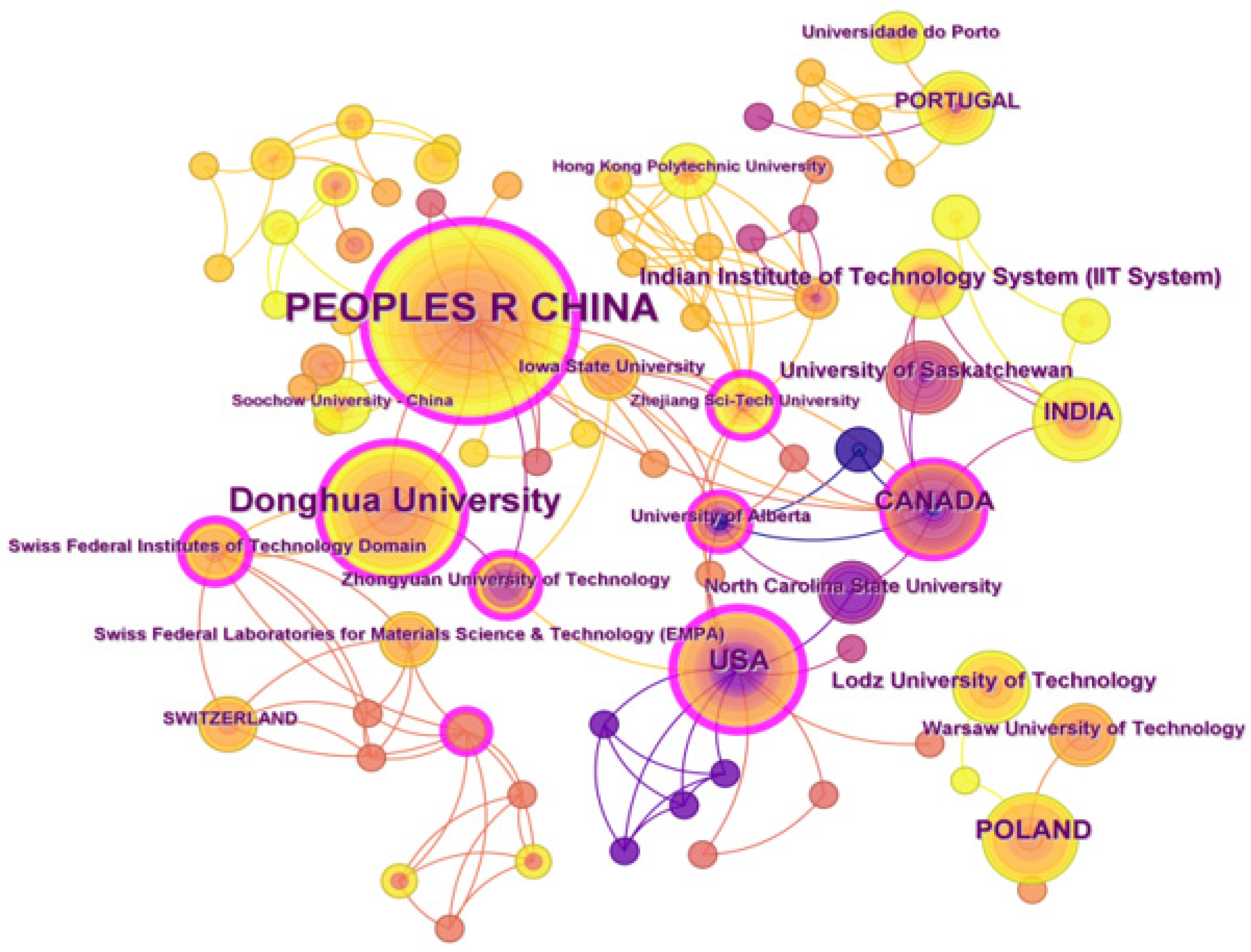
| Frequency | Countries | Centrality | Countries | Bursts | Countries |
|---|---|---|---|---|---|
| 61 | China | 0.33 | China | 3.94 | USA (2003–2006) |
| 15 | USA | 0.22 | USA | 3.82 | Canada (2008–2013) |
| 14 | India | 0.15 | Switzerland | 2 | Poland (2017–2018) |
| 13 | Poland | 0.09 | Canada | 1.49 | Saudi Arabia (2020–2022) |
| 13 | Canada | 0.09 | France | 1.3 | Slovenia (2008–2009) |
| 7 | Portugal | / | / | 1.06 | Portugal (2020–2023) |
| 5 | Switzerland | / | / | 0.98 | Australia (2021–2022) |
| Frequency | Institutions | Centrality | Institutions | Bursts | Institutions |
|---|---|---|---|---|---|
| 33 | Donghua University | 0.02 | Donghua University | 3.69 | University of Saskatchewan (2009–2013) |
| 9 | Indian Institute of Technology System | 0.02 | Soochow University | 3.44 | North Carolina State University (2004–2006) |
| 7 | University of Saskatchewan | 0.02 | Hong Kong Polytechnic University | 2.59 | Warsaw University of Technology (2017–2018) |
| 7 | Lodz University of Technology | 0.01 | Zhejiang Sci-Tech University | 2.21 | Donghua University (2015–2018) |
| 6 | North Carolina State University | 0.01 | Iowa State University | 2.05 | National Research Council Canada (1998–1999) |
| 6 | Warsaw University of Technology | 0.01 | University of Alberta | 2.02 | National Institute of Technology (2023–2024) |
| 5 | Swiss Federal Institutes of Technology | 0.01 | Qingdao University | 2.02 | Soochow University (2023–2024) |
| 5 | Soochow University | / | / | 2.02 | National Institute of Technology Silchar (2023–2024) |
| 5 | Zhejian Sci-Tech University | / | / | 1.87 | Zhongyuan University of Technology (2008–2009) |
| 5 | EMPA | / | / | 1.6 | Indian Institute of Technology System (2016–2017) |
| Freq | Author | Centrality | Author | Bursts | Author |
|---|---|---|---|---|---|
| 26 | Li, Jun | 0.03 | Su, Yun | 2.61 | Chitrphiromsri, P |
| 12 | Tian, Miao | 0.03 | Li, Jun | 2.53 | Bergstrom, Donald J |
| 11 | Su, Yun | 0.03 | Zhang, Xianghui | 2.37 | Furmanski, Piotr |
| 9 | Ghazy Ahmed | 0.02 | He, Jiazhen | 2.37 | Lapka, Piotr |
| 8 | Song, GW | 0.02 | Rossi, Rene M | 2.26 | Udayraj |
| 8 | Das, Apurba | 0.01 | Song, Guowen | 2.15 | Acharya, Jnanaranjan |
| 6 | Furmanski, Piotr | 0.01 | Udayraj | 2.05 | Torvi, DA |
| 6 | Torvi, DA | 0.01 | Wang, Faming | 2 | Bhanja, Dipankar |
| 6 | He, Jiazhen | 0.01 | Xiang, Chunhui | 1.95 | Kuznetsov, AV |
| 6 | Lapka, Piotr | 0.01 | Wang, Zhaoli | 1.73 | Talukdar, Prabal |
| Freq | Keywords | Centrality | Keywords | Bursts | Keywords |
|---|---|---|---|---|---|
| 55 | Heat transfer | 0.29 | Heat transfer | 3.89 | Flash fire exposure (2015–2018) |
| 42 | Numerical simulation | 0.27 | Model | 3.21 | Air gaps (2016–2018) |
| 33 | Performance | 0.19 | Protective clothing | 2.95 | Thermal protective performance (2023–2024) |
| 31 | Moisture transfer | 0.16 | Performance | 2.76 | Numerical simulation (2016–2017) |
| 28 | Firefighter protective clothing | 0.15 | Numerical simulation | 2.25 | Transport (2023–2024) |
| 27 | Model | 0.15 | Moisture transfer | 2.13 | Skin burn injury (2016–2017) |
| 25 | Air gaps | 0.14 | Fabrics | 1.99 | Moisture transfer (2015–2017) |
| 25 | Fabrics | 0.14 | Flash fire | 1.96 | System (2011–2013) |
| 24 | Flash fire | 0.11 | Flame resistant fabrics | 1.94 | Flash fire (2015–2016) |
| 22 | Protective clothing | 0.09 | Thermal protective performance | 1.71 | Natural convection (2017–2018) |
Disclaimer/Publisher’s Note: The statements, opinions and data contained in all publications are solely those of the individual author(s) and contributor(s) and not of MDPI and/or the editor(s). MDPI and/or the editor(s) disclaim responsibility for any injury to people or property resulting from any ideas, methods, instructions or products referred to in the content. |
© 2026 by the authors. Licensee MDPI, Basel, Switzerland. This article is an open access article distributed under the terms and conditions of the Creative Commons Attribution (CC BY) license.
Share and Cite
Guo, Y.; Tian, M.; Su, Y.; Li, J. Exploring the Development Trajectory and Dynamic Frontiers of Numerical Simulation Method Applied in Thermal Protective Clothing Investigation. Coatings 2026, 16, 1030. https://doi.org/10.3390/coatings16091030
Guo Y, Tian M, Su Y, Li J. Exploring the Development Trajectory and Dynamic Frontiers of Numerical Simulation Method Applied in Thermal Protective Clothing Investigation. Coatings. 2026; 16(9):1030. https://doi.org/10.3390/coatings16091030
Chicago/Turabian StyleGuo, Yiyi, Miao Tian, Yun Su, and Jun Li. 2026. "Exploring the Development Trajectory and Dynamic Frontiers of Numerical Simulation Method Applied in Thermal Protective Clothing Investigation" Coatings 16, no. 9: 1030. https://doi.org/10.3390/coatings16091030
APA StyleGuo, Y., Tian, M., Su, Y., & Li, J. (2026). Exploring the Development Trajectory and Dynamic Frontiers of Numerical Simulation Method Applied in Thermal Protective Clothing Investigation. Coatings, 16(9), 1030. https://doi.org/10.3390/coatings16091030