Article

Study on the Corrosion Behavior of YSZ Thermal Barrier Coatings by CMAS Composition

1
School of Materials Science and Engineering, Beihang University, Beijing 100191, China
2
Research Institute of Aero-Engine, Beihang University, Beijing 100191, China
3
Beihang Chengdu Aero Engine Innovation Research Institute Co. Ltd., Chengdu 611936, China
4
Tianmushan Laboratory, Hangzhou 311115, China
*
Author to whom correspondence should be addressed.
Coatings 2026, 16(7), 789; https://doi.org/10.3390/coatings16070789
Submission received: 11 June 2026 / Revised: 29 June 2026 / Accepted: 30 June 2026 / Published: 2 July 2026
(This article belongs to the Section Ceramic Coatings and Engineering Technology)

Abstract

Yttria-stabilized zirconia (YSZ) thermal barrier coatings (TBCs) were fabricated by atmospheric plasma spraying (APS). Three CMAS powders with different compositions (CMAS-1, CMAS-2, CMAS-3) were selected, and corrosion tests were carried out at 1200 °C, 1250 °C, and 1300 °C. The relationships among CMAS viscosity, melting point, and reaction tendency with YSZ coatings were investigated. The results show that CMAS-3 possesses the highest viscosity yet the lowest melting point, CMAS-1 has the lowest viscosity but the highest melting point, and CMAS-2 falls between the two. Quantitative penetration depth measurements reveal that higher viscosity leads to slower infiltration, while a lower melting point enables earlier infiltration onset. At elevated temperatures, all CMAS compositions achieve complete penetration, indicating that the differences in melting point and viscosity become less critical when the temperature is sufficiently high. Corrosion tests reveal that CMAS-3 exhibits the strongest reaction tendency with YSZ coatings, while CMAS-1 shows the weakest. This indicates that the infiltration behavior is governed by a dual control of melting point and viscosity—melting point determines the onset of infiltration, while viscosity controls the penetration rate. This study provides an experimental basis for the design of CMAS-resistant coatings and the evaluation of their environmental adaptability. The key finding is that the melting point plays a dominant role in initiating CMAS infiltration, while viscosity primarily regulates the penetration rate.

1. Introduction

Thermal barrier coatings (TBCs) serve as a critical technology for high-temperature protection of hot-section components in advanced aero-engines and gas turbines. Among relevant materials, yttria-stabilized zirconia (YSZ) stands out as the most widely adopted ceramic coating material owing to its low thermal conductivity, well-matched thermal expansion coefficient and excellent high-temperature phase stability [1,2]. Nevertheless, when engines ingest environmental particulate matter such as sand dust and volcanic ash, corrosion failure induced by calcium-magnesium-aluminum-silicate (CMAS) has emerged as one of the most severe challenges confronting YSZ coatings [3]. Once the service temperature exceeds the melting point of CMAS, melted CMAS rapidly infiltrates through the pores and microcracks of the coating. This process triggers Y3+ depletion, t→m phase transformation and volume expansion, ultimately resulting in spalling failure of the coating [4,5].
To tackle CMAS corrosion, researchers have not only modified YSZ but also actively explored new types of CMAS-resistant coating materials. Rare-earth silicates (such as RE2Si2O7 and RE2SiO5), as candidate materials for environmental barrier coatings, have attracted extensive research attention regarding their reaction behaviors with CMAS. Researchers from Pennsylvania State University and NASA investigated the CMAS corrosion behaviors of Yb2Si2O7 and Y2Si2O7 with three distinct Ca/Si ratios (0.635, 0.478, 0.096). The results revealed that the proportion of apatite phase rises with increasing CaO content, and Yb2Si2O7 facilitates the crystallization of apatite phase to a greater extent [6]. To further clarify the correlation between the types of RE3+ rare-earth cations and CMAS composition, additional studies were carried out to examine how four Ca/Si ratios (0.635, 0.478, 0.277, 0.096) affect the corrosion interactions between CMAS and RE2Si2O7 (RE = Gd, Dy, Er, Nd). The findings demonstrated that RE2Si2O7 dissolves into the melted CMAS, precipitating apatite phase (Ca2+yRE8+x(SiO4)6O2+3x/2+y) and RE2Si2O7 [2]. Scholars from the University of California explored the CMAS corrosion performance of bulk Y2Si2O7 against CMAS of varied compositions at 1300 °C and 1400 °C separately. It was found that elevated temperatures accelerate the reaction progress, while corrosion resistance is predominantly governed by CMAS composition, alongside an apatite formation threshold (Ca/Si ratio < 0.25) [7]. Researchers at the Shanghai Institute of Ceramics studied the CMAS corrosion characteristics of Yb2Si2O7 under four Ca/Si ratios (1.1, 0.75, 0.64, 0.42). The results indicated that CMAS with the highest Ca/Si ratio generates garnet (Ca3Yb2(SiO4)3) and two apatite phases (Ca2Yb8(SiO4)6O2 and Ca4Yb6(SiO4)60), whereas CMAS with the lowest Ca/Si ratio forms the Yb2Si2O7 phase. Moreover, higher Ca/Si ratios reduce CMAS viscosity and intensify the corrosive attack of CMAS on Yb2SiO5 coatings [4].
It should be acknowledged that in addition to YSZ, a variety of advanced coating materials—such as rare-earth zirconates, rare-earth tantalates, rare-earth silicates, and high-entropy ceramics—have been extensively investigated as potential TBC/EBC candidates [6,8,9]. However, YSZ remains the most widely used ceramic topcoat in commercial gas turbine engines due to its well-balanced properties. Although the above-mentioned studies have made important progress in the resistance of novel coating materials to CMAS corrosion, conventional YSZ coatings still face severe CMAS corrosion issues. For a long time, researchers have generally regarded the viscosity of CMAS as the key factor governing its corrosion behavior; the lower the viscosity, the higher the fluidity of the melt, the deeper the penetration, and the more severe the corrosion [10,11]. Nevertheless, viscosity itself is intricately affected by the chemical composition and temperature of CMAS, and the melting point determines the melting state and effective penetration duration of CMAS under a given service temperature [12,13,14]. Unfortunately, there remains a lack of systematic experimental research on the inherent correlation between the viscosity, melting point and corrosion tendency of CMAS.
For this purpose, typical YSZ coatings were fabricated in this study via atmospheric plasma spraying (APS) technology. Three types of CMAS powders with distinct chemical compositions (denoted as CMAS-1, CMAS-2 and CMAS-3, respectively) were selected; their viscosity and melting points were systematically measured and calculated, and isothermal corrosion tests were carried out at 1200 °C, 1250 °C and 1300 °C. The influence laws of CMAS viscosity and melting point on the corrosion behavior of YSZ were analyzed emphatically.

2. Materials and Methods

2.1. Coating Preparation

The nickel-based superalloys were made into Φ 12 mm × 3 mm samples. The samples were then washed, dried and sandblasted. The YSZ coating was prepared via APS (Oerlikon Metco, F4-MB, Wohlen, Switzerland). The composition of the YSZ coating is 8 wt.%Y2O3-ZrO2, and the thickness is 1000 μm. The preparation parameters are shown in Table 1. The prepared samples were treated at 1150 °C/5 min using a tube furnace (Hefei Kejing Materials Technology Co., Ltd., Hefei, China), and then water-quenched to obtain independent YSZ coatings.

2.2. Corrosion Tests

Based on previous research on engine deposits, CMAS with a Ca/Si ratio of 0.75 was designed [15,16]. However, in actual service, there are also differences in the sediment content of turbine engines, for example, the Ca/Si ratio in high-pressure turbine sediments is as high as about 1.5 [17]. Therefore, three different Ca/Si ratios of CMAS components (molar ratio) were designed, with 47CaO-9MgO-13AlO1.5-31SiO2 (CMAS-1, Ca/Si ratio of 1.5), 33CaO-9MgO-13AlO1.5-45SiO2 (CMAS-2, Ca/Si ratio of 0.73), 21CaO-9MgO-13AlO1.5-57SiO2 (CMAS-3, Ca/Si ratio of 0.36). The CMAS powders were prepared by using analytical reagents CaO, MgO, Al2O3, and SiO2 (Hebei Jincan Metal New Materials Co., Ltd., Hefei, China). The above three types of CMAS powders were mixed in proportion using a ball mill, and the mixed powders were treated in a high-temperature box resistance furnace (Hefei Kejing Materials Technology Co., Ltd., Hefei, China) at 1100 °C/4 h. The CMAS powder was mixed with ethanol to form a suspension, which was then sprayed uniformly onto the coating surface using a spray gun. After drying, the specimens were weighed to determine the CMAS loading, which was controlled at approximately 30 mg/cm2. After drying, the samples were placed in a high-temperature box resistance furnace for heat treatment. The heat treatment temperatures are 1200 °C, 1250 °C, and 1300 °C, and the time was 1 h and 10 h.
All corrosion tests were conducted at temperatures where the corresponding CMAS compositions were either fully or partially molten, ensuring that the melt was capable of infiltrating the coating. In addition, all specimens were taken from a single batch of APS-deposited YSZ coating, ensuring identical initial microstructure (including porosity, crack density, and phase composition) for all CMAS corrosion tests. Therefore, the observed differences in infiltration behavior between CMAS-1, CMAS-2, and CMAS-3 are primarily attributed to the variations in CMAS composition (melting point, viscosity, and reactivity) rather than to coating variability.

2.3. Experimental Characterizations

The melting points of three types of CMAS powders were measured via simultaneous thermal analysis (TGA-DSC, STA 449 F5, Netzsch, Selb, Germany) under flowing nitrogen protection. The samples were heated from ambient temperature to 1300 °C at a constant ramp rate of 10 K/min. After corrosion, cross-sectional microstructures of YSZ coatings were observed by scanning electron microscopy (SEM, Phenom XL G2, Phenom, Eindhoven, The Netherlands) coupled with energy-dispersive X-ray spectroscopy (EDS) for elemental analysis. Phase evolution along coating cross-sections was quantitatively identified using laser Raman spectroscopy (LRS, LabRAM HR Evolution, Horiba, Palaiseau, France) with a 532 nm excitation laser. Raman signals were collected in the wavenumber range of 100–3500 cm−1; the exposure time was 1 s, and laser power was fixed at 100%. Prior to peak fitting, a Shirley-type baseline correction was applied to each spectrum to remove the fluorescence background. The spectra were then fitted using a mixed Gaussian–Lorentzian (Voigt) function.

3. Results and Analysis

3.1. Corrosion Powders

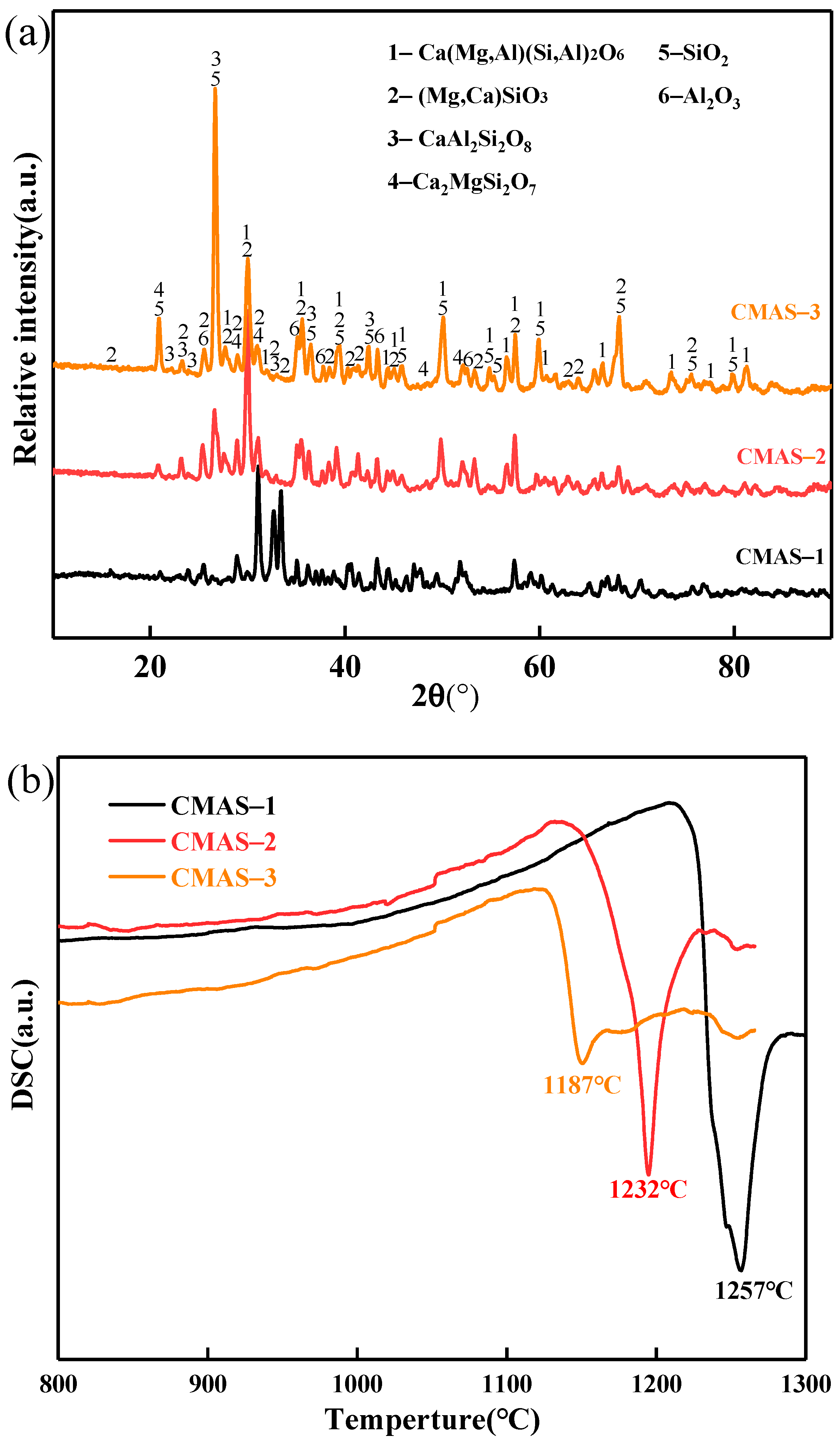
The XRD patterns and DSC curves of the three types of CMAS powders are shown in Figure 1. It can be seen from Figure 1a, the CMAS-1 powder contains a large amount of CaO and is mainly composed of high-melting-point silicate ((Mg,Ca)SiO3); the CMAS-2 powder is mainly composed of diopside (Ca(Mg,Al)(Si,Al)2O6) and (Mg,Ca)SiO3; the CMAS-3 powder is mainly composed of Ca(Mg,Al)(Si,Al)2O6, calcium feldspar (CaAl2Si2O8), corundum (Al2O3) and cristobalite (SiO2). At high temperatures, Ca(Mg,Al)(Si,Al)2O6 reacts with Al2O3 to form CaAl2Si2O8 and spinel (MgAl2O4). Meanwhile, an eutectic system of CaAl2Si2O8 + MgAl2O4 + SiO2 forms in the presence of abundant excess SiO2. The melting points of CMAS-1, CMAS-2, and CMAS-3 powders are 1257 °C, 1232 °C, and 1187 °C, respectively (Figure 1b), which is consistent with the compositions of the three types of CMAS powders (Figure 1a).
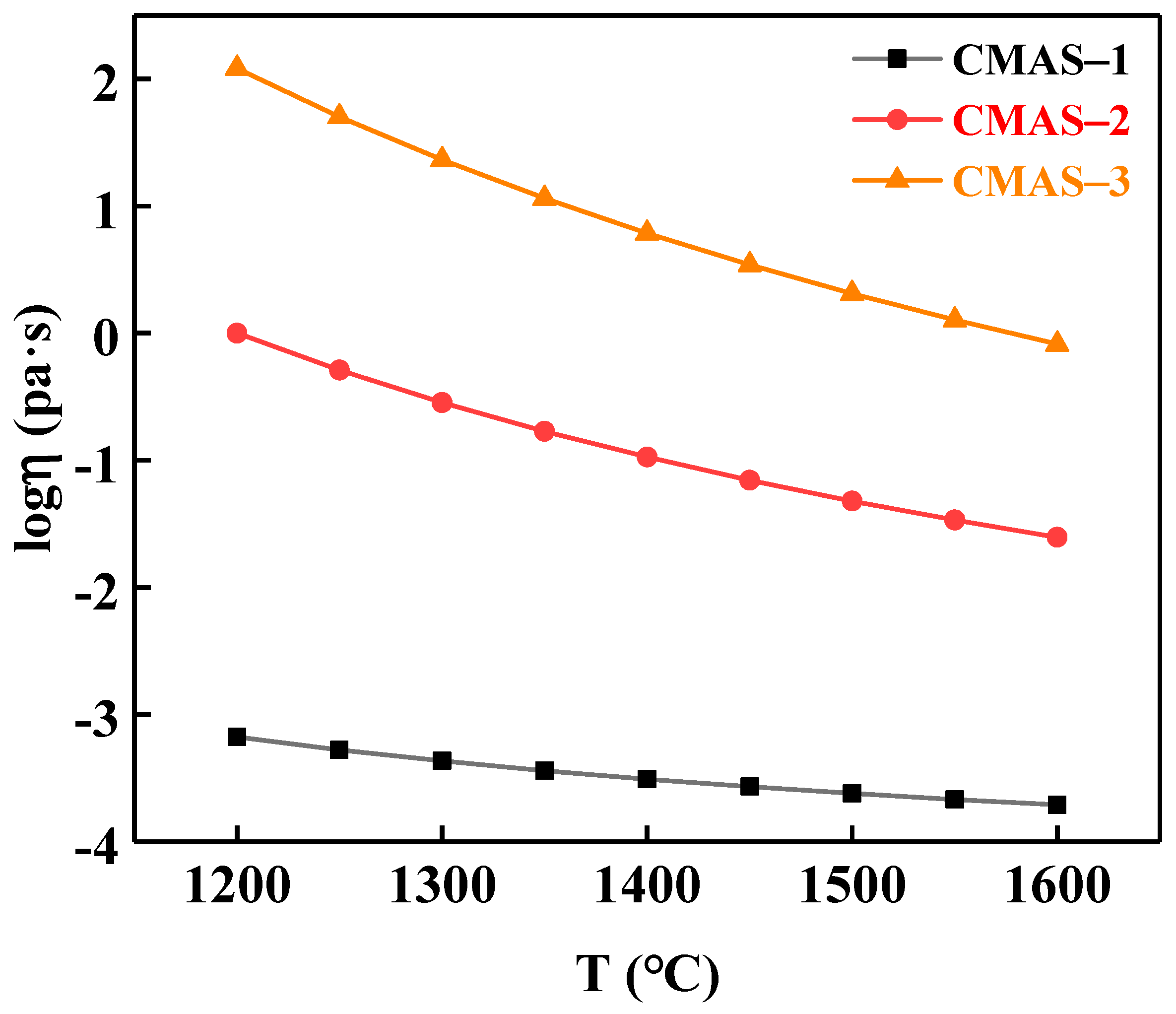
The viscosity of CMAS melt was calculated using the Giordano model (Equation (1)) [11]. Meanwhile, SiO2 serves as a network-forming agent, while CaO (and other alkali or alkaline earth oxides such as MgO) is considered a network modifier, resulting in a decrease in CMAS viscosity with increasing CaO/SiO2 ratio and MgO content. AlO1.5, as an amphoteric oxide, can serve as both a network-forming agent and a network modifier [10,14].
log η = A + B T K C
where η is viscosity, A is a constant, and B and C are related to the type and content of oxides.
B = i = 1 7 b i M i + j = 1 3 b 1 j M 1 1 j · M 2 1 j
C = i = 1 6 b i N i + C 11 N 1 11 · N 2 11
where Ms and Ns are the combination of the molar percentages of oxides of B and C, respectively. The specific data can be found in reference [11].
The B and C values of the CMAS-1, CMAS-2, and CMAS-3 powders were calculated to be 865.03 and 843.45, 3339.25 and 739.15, and 5460.01 and 649.75, respectively. The viscosity results of the three types of CMAS powders (Figure 2) were obtained by substituting the results into Equation (1). The viscosities of the three CMAS melts were estimated using the Giordano model for qualitative comparison only. It should be noted that the calculated values serve to illustrate the relative viscosity trend (CMAS-1 < CMAS-2 < CMAS-3), rather than to provide absolute predictions. Moreover, the overall infiltration behavior is governed by the combined effects of melting point, liquid fraction, and viscosity, rather than by viscosity alone.
Based on Seok et al. [10,18], Ndamka et al. introduced the basicity index (BI) of CMAS to account for its influence on melt viscosity. Here, the oxides in CMAS are categorized as alkaline (CaO, MgO), acidic (SiO2), and amphoteric (Al2O3), and BI is defined as [18,19]
B I = B a s i c   o x i d e s   ( m o l % ) A c i d i c   o x i d e s   ( m o l % )
Research has shown that the higher the BI of CMAS melt, the lower its melt viscosity [10,18,19]. Using Equation (4), the BI of three types of CMAS powders was calculated to be 1.27, 0.72, and 0.43, respectively. This is consistent with the results in Figure 2.

3.2. Macro Images

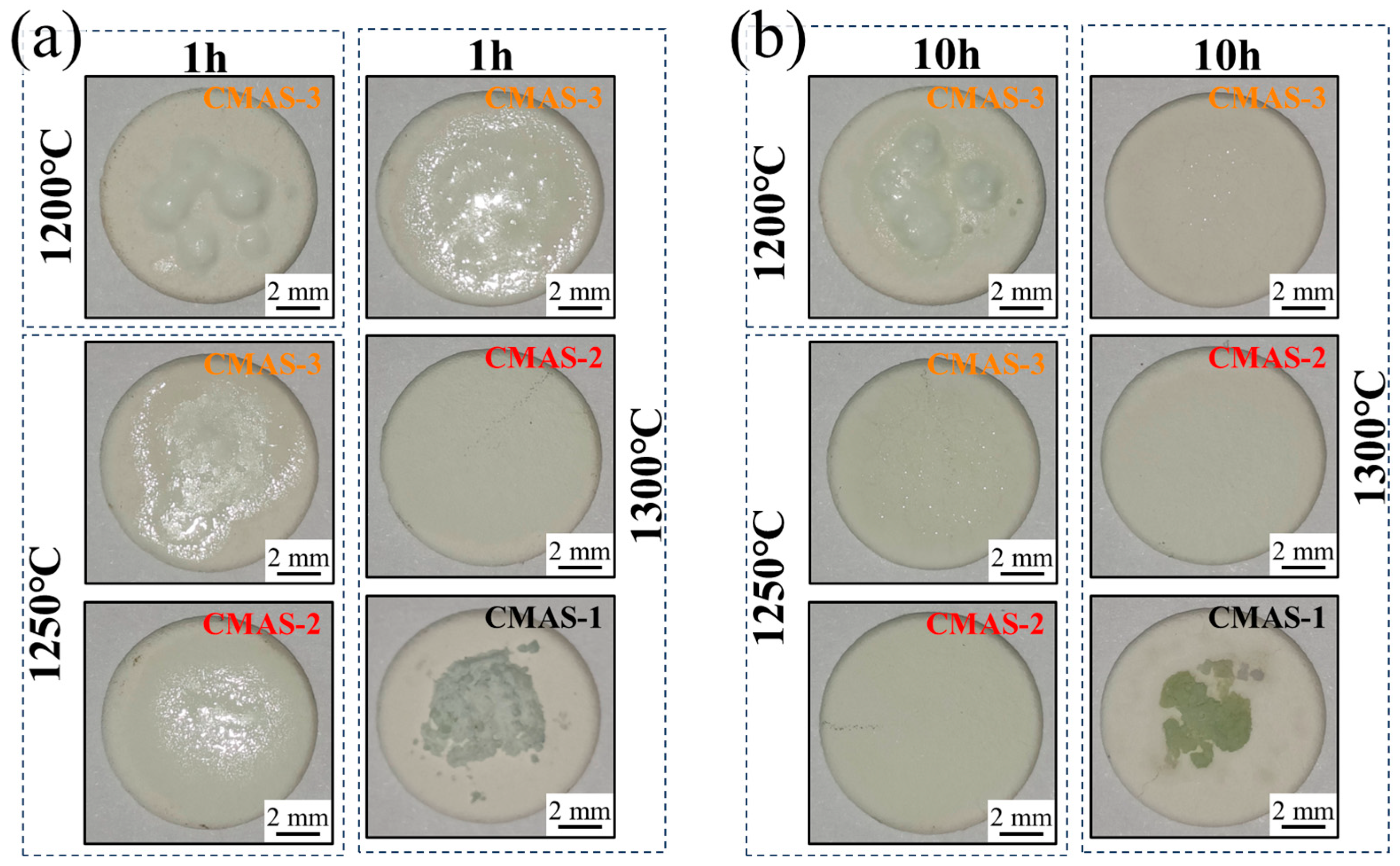
The macro images of the YSZ coating after corrosion are shown in Figure 3. It can be seen that the residual amount of CMAS gradually decreases with the increase in temperature. Meanwhile, at the same temperature, the residual amount of CMAS gradually rises as its viscosity increases. Due to the high melting point of CMAS-1, there is a large residual amount of CMAS. With the extension of time, almost all CMAS penetrates into the interior of the YSZ coating.

3.3. Morphology of Cross-Section

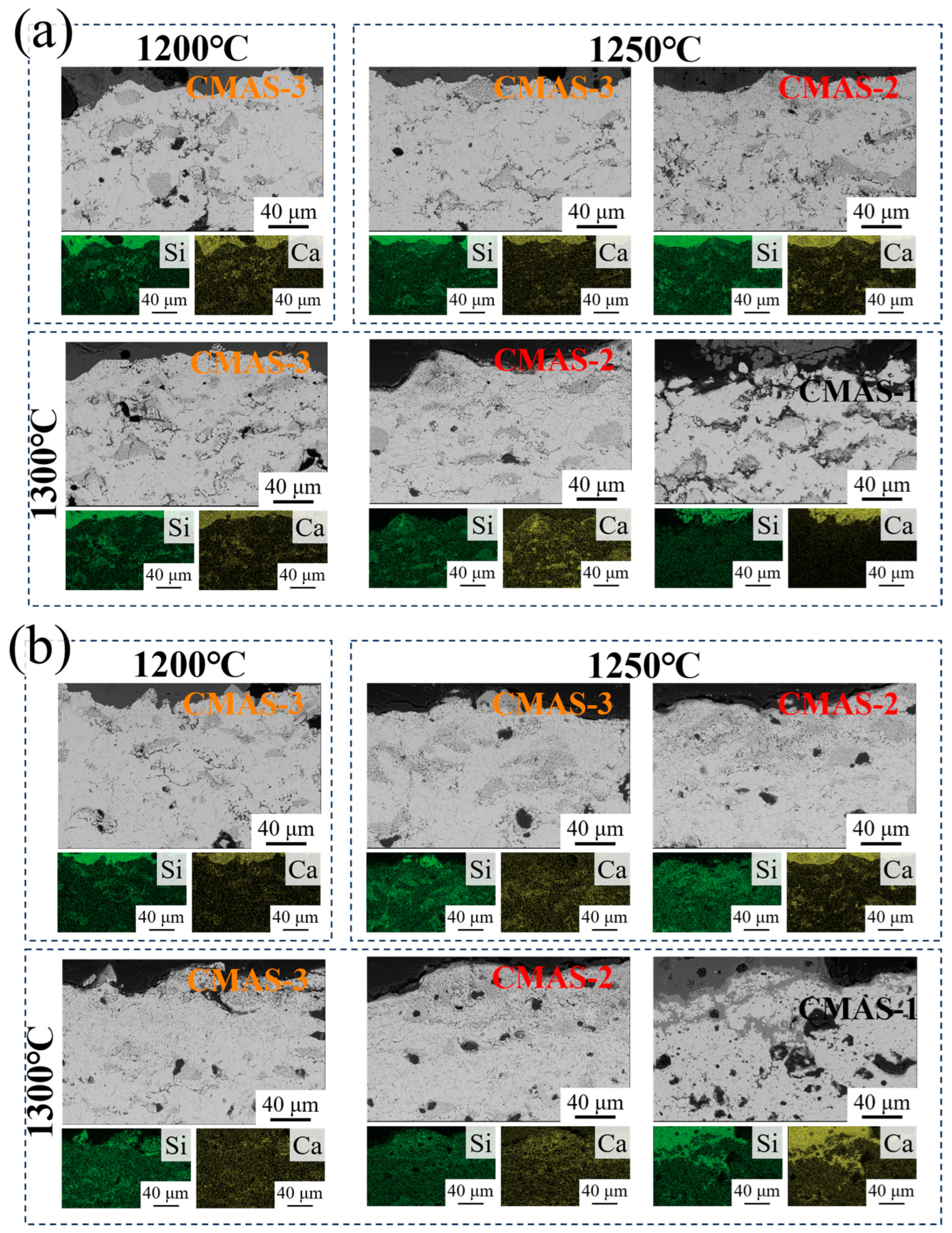
The cross-section morphology of the YSZ coating after corrosion is shown in Figure 4. It can be seen that except for CMAS-1 powder after heat treatment at 1300 °C/1 h, all other powders penetrated into the coating interior after heat treatment, filling pores and microcracks within the coating and resulting in a reduction in coating porosity.

4. Discussion

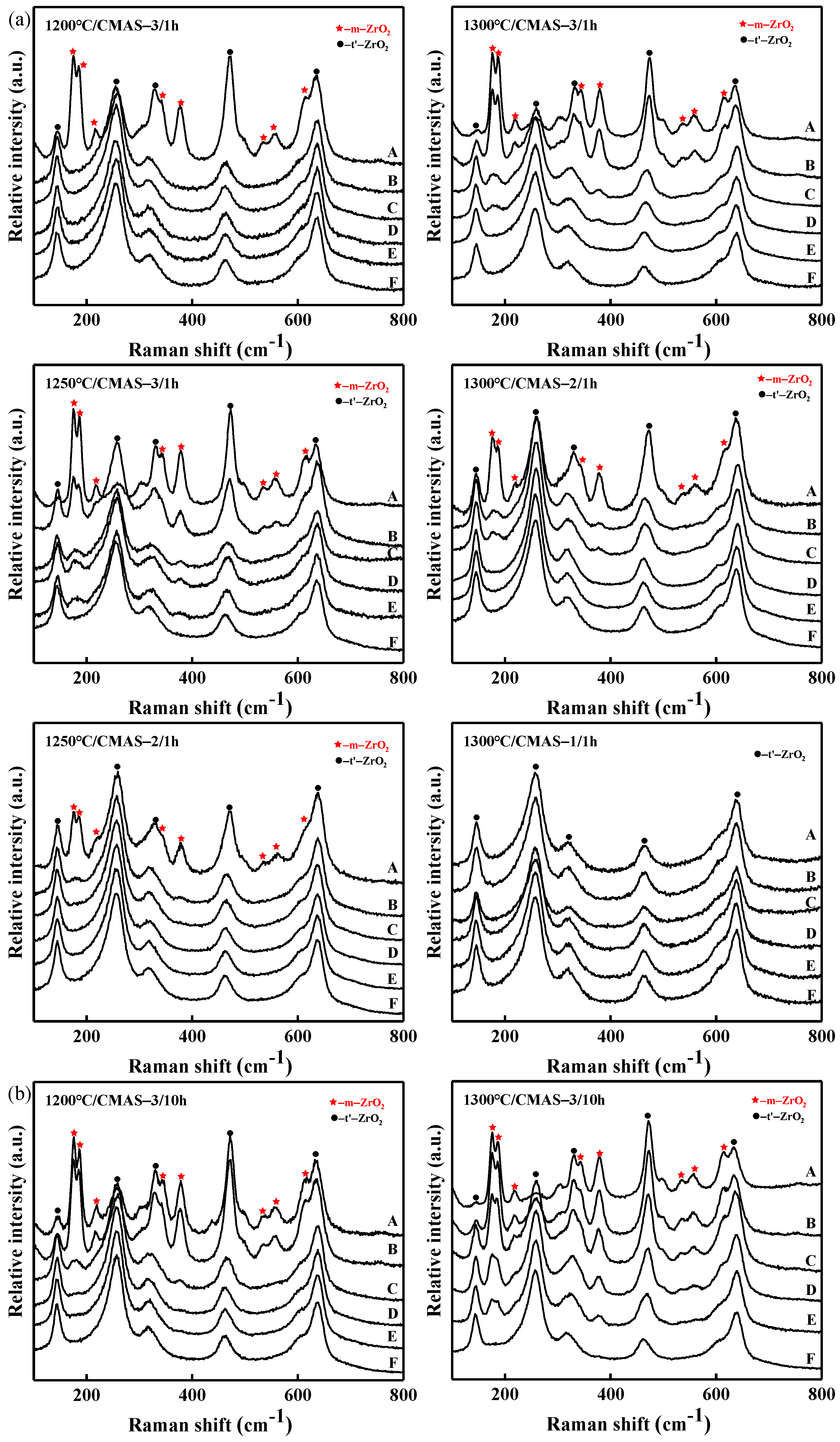
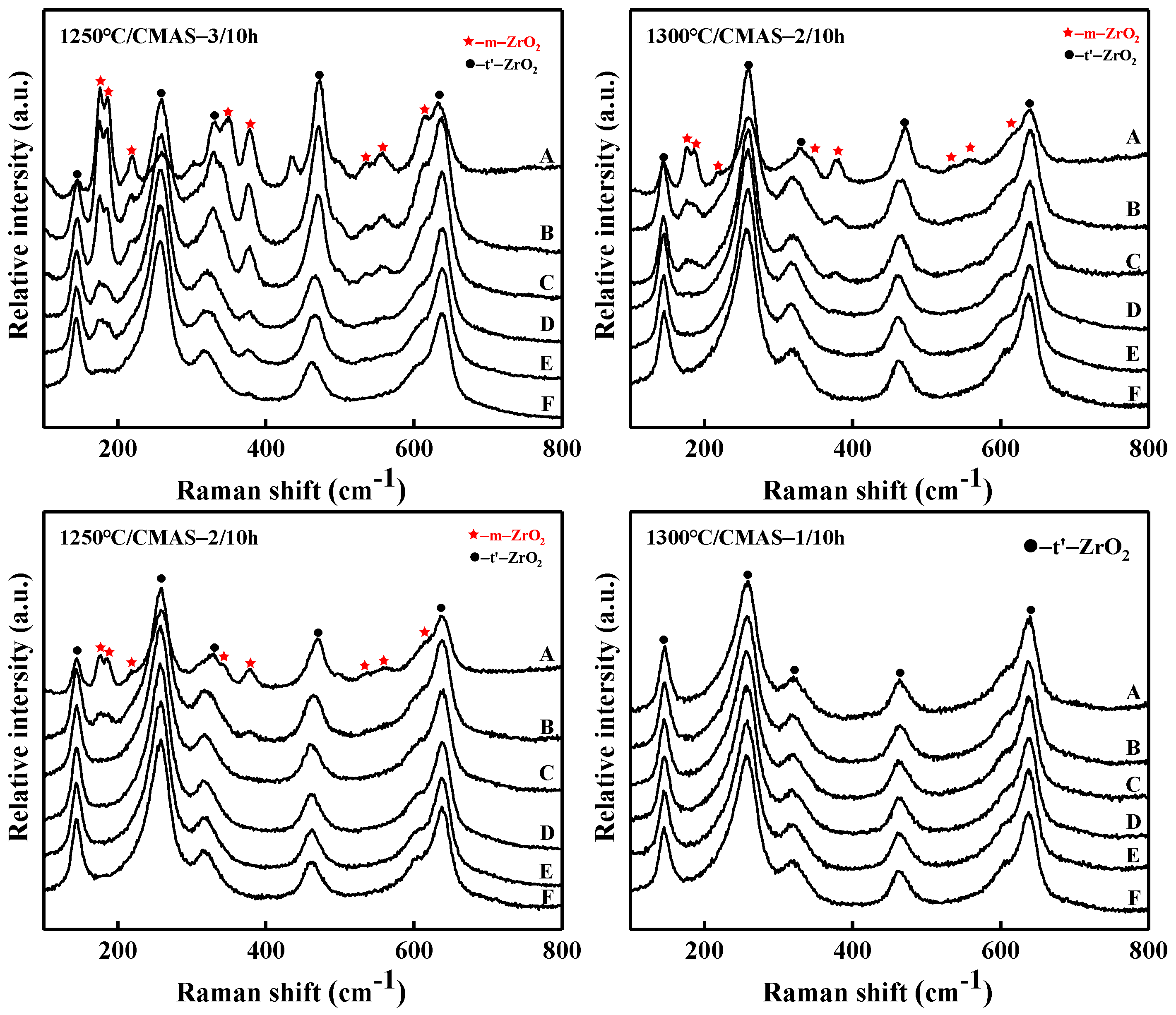
CMAS infiltration impairs the thermal insulation performance of coatings. Meanwhile, the phase transformation of t′-ZrO2 also raises the thermal conductivity of coatings [20,21]. Therefore, to reveal the influence of different CMAS compositions on the phase transformation of YSZ, the phase compositions of YSZ coating after heat treatment via Raman spectroscopy were characterized, and the results are shown in Figure 5. It can be observed that m-ZrO2 forms in all coatings corroded by powders except those exposed to CMAS-1 powder corrosion. This may be because CMAS-1 has the highest melting point despite its lowest viscosity.
The m-ZrO2 volume fraction can be estimated according to Equation (5) [22,23]:
V m = I m 178 + I m 189 0.33 · I t 145 + I t 256 + I m 178 + I m 189
where Im and It are the peak intensity of the m-ZrO2 and t-ZrO2, respectively, and the superscript is the corresponding wave number.
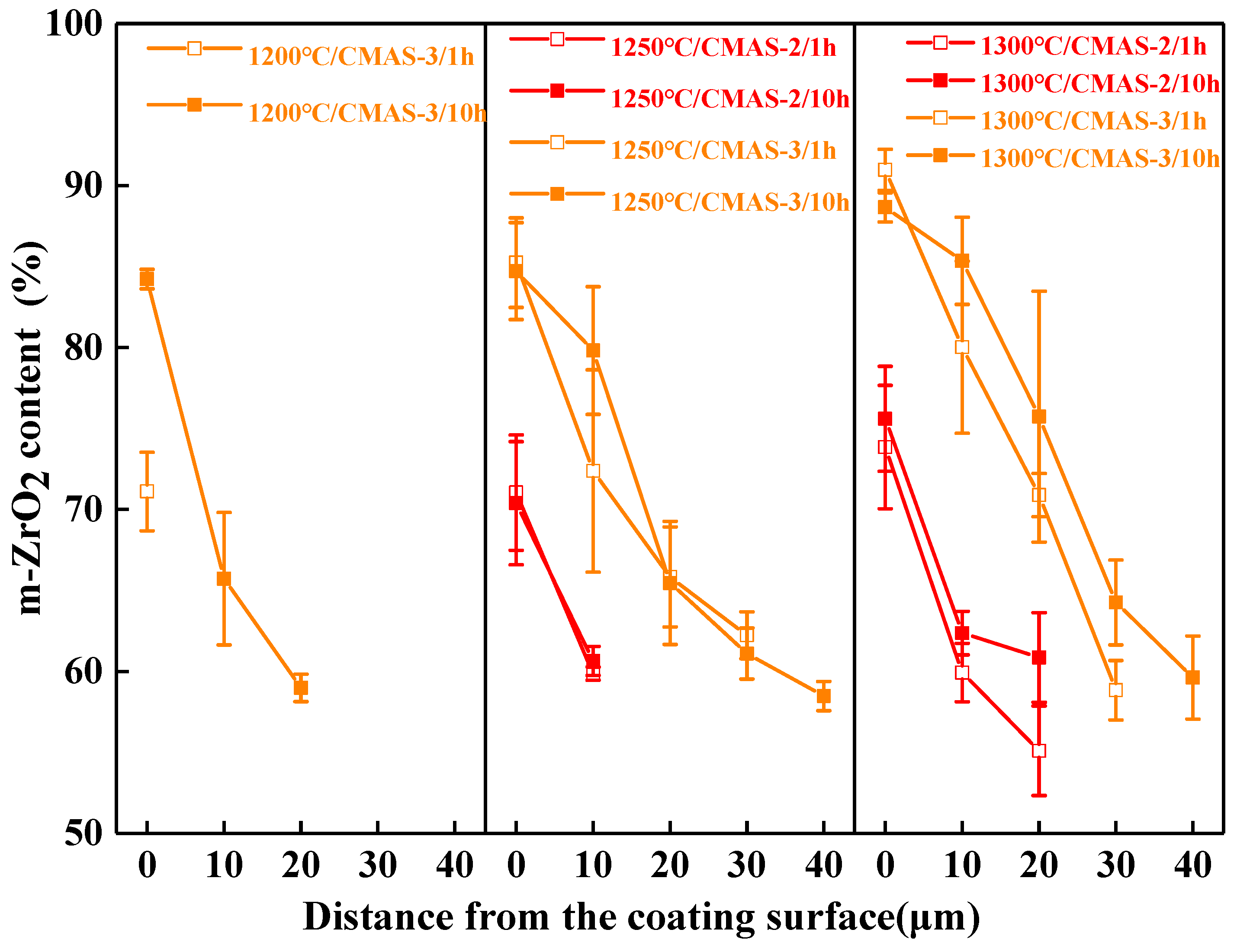
The results in Figure 5 were calculated using Equation (5), and the results are presented in Figure 6. It can be seen from that the content of m-ZrO2 rises gradually with the extension of holding time and the increase in temperature. Meanwhile, the content of m-ZrO2 decreases progressively as the coating depth increases. Under all tested conditions, the content of m-ZrO2 after CMAS-3 corrosion is higher than that after CMAS-2 corrosion.
The reactivity between molten CMAS and YSZ can be evaluated by the optical alkalinity (OB) difference based on Lewis acid–base theory. The theoretical OB values of the CMAS can be calculated by Equation (6) [8,24]:
Λ = X 1 · Λ C a O + X 2 · Λ M g O + X 3 · Λ A l O 1.5 + X 4 · Λ S i O 2
where Xi (i = 1, 2, 3……) stand for the oxide i mole fraction, and the corresponding Λ is its OB. The Λ values of the oxides are shown in Table 2.
The Λ values in Table 2 are substituted into Equation (6) to obtain the Λ values of the three types of CMAS powders, and the difference (ΔΛ) between YSZ and them, as shown in Table 3. It can be seen that CMAS-3 has the highest tendency to react with YSZ, while CMAS-1 has the lowest, which is consistent with the results shown in Figure 6.
Under capillary action, the penetration depth (L) of the CMAS melt into the coating has been found to vary with time (t) according to the Washburn equation [9,25]:
L = r σ L V cos θ 2 η t
where r represents the equivalent radius of the capillary; θ represents the equilibrium contact angle of the melt on the TC surface; and σLV and η are the surface tension and viscosity of the melt, respectively. According to Equation (7), within the same time (t), the penetration depth (L) is negatively correlated with the melt viscosity (η). Since CMAS-3 has the lowest melting point and the highest viscosity, it slows down the penetration rate of CMAS-3, extends its reaction time with YSZ, and generates more m-ZrO2. The apparent contradiction that CMAS-3 exhibits the highest viscosity yet the strongest reaction tendency is resolved by distinguishing physical infiltration (controlled by viscosity) from chemical degradation (controlled by melting point and optical basicity). Although CMAS-3 has the highest viscosity, its lowest melting point provides a longer effective reaction time, thereby promoting more severe chemical attack.
Quantitative penetration depth measurements reveal the following distinct infiltration behaviors. At 1250 °C, CMAS-3 reaches 497 ± 9 µm at 1 h (CMAS residual 161.3 ± 8.4 µm) and 913 ± 14 µm at 10 h (without CMAS residual), while CMAS-2 reaches 815 ± 12 µm at 1 h (CMAS residual 97.2 ± 7.4 µm) and achieves full penetration (without CMAS residual) at 10 h. This difference is consistent with the higher viscosity of CMAS-3, which retards the infiltration rate, and follows the Washburn-type relationship, where penetration depth increases with time and decreases with viscosity. At 1200 °C, CMAS-3 already penetrates to 389 ± 9 µm at 1 h (CMAS residual 182.5 ± 5.5 µm) and 555 ± 4 µm at 10 h (CMAS residual 151.5 ± 4.5 µm), confirming its early infiltration onset due to its lower melting point. At 1300 °C/1 h, CMAS-3 shows an average penetration of 893 ± 32 µm (CMAS residual 81.4 ± 12.0 µm), while CMAS-2 achieves full penetration (without CMAS residual). In contrast, CMAS-1 shows no penetration at 1300 °C/1 h (CMAS residual 260 µm) and only 105 ± 6 µm at 10 h (CMAS residual 239.3 ± 4.0 µm), despite having the lowest viscosity, confirming that its high melting point delays the initiation of infiltration. At 1300 °C/10 h, both CMAS-2 and CMAS-3 achieve full penetration (without CMAS residual), indicating that the differences in melting point and viscosity become less critical when the temperature is sufficiently high.

5. Conclusions

YSZ coating was prepared via APS, and the corrosion performance of the coating under three types of CMAS at 1200 °C, 1250 °C and 1300 °C was studied. The main conclusions are as follows:
(1)
CMAS melting point: CMAS-1 > CMAS-2 > CMAS-3; CMAS viscosity: CMAS-1 < CMAS-2 < CMAS-3; CMAS and YSZ reaction tendency: CMAS-1 < CMAS-2 < CMAS-3;
(2)
The reaction tendency between CMAS and YSZ is highly sensitive to temperature.
(3)
Based on the measured penetration depths, it is concluded that CMAS infiltration into YSZ coatings is governed by both melting point and viscosity—the melting point initiates infiltration, while the viscosity controls the penetration rate.
Therefore, when designing CMAS-resistant coatings, it is necessary to consider the impacts caused by varying CMAS compositions in different regions.

Author Contributions

Conceptualization, Y.F. and Y.S.; Data curation, Y.F. and Y.S.; Formal analysis, Y.F.; Funding acquisition, Y.S.; Investigation, Y.F. and Y.S.; Methodology, Y.F., J.Z., C.L. and Y.S.; Project administration, Y.P., S.G. and H.X.; Resources, Y.S., Y.P., S.G. and H.X.; Software, Y.F.; Supervision, Y.F., Y.P., S.G. and H.X.; Validation, Y.F. and Y.S.; Visualization, Y.S., Y.P., S.G. and H.X.; Writing—original draft, Y.F.; Writing—review and editing, Y.F., J.Z., C.L. and Y.S. All authors have read and agreed to the published version of the manuscript.

Funding

This research was funded by the Funds of the National Key R&D Program of China (No. 2024YFB3715200) and the Key R&D Program of Zhejiang (No. 2024SSYS0075).

Informed Consent Statement

Informed consent was obtained from all subjects involved in the study.

Data Availability Statement

The data presented in this study are available within the article. Additional information supporting the findings of this work are available from the corresponding author upon reasonable request.

Conflicts of Interest

Author Yong Shang was employed by the Beihang Chengdu Aero Engine Innovation Research Institute Co. Ltd. The remaining authors declare that the research was conducted in the absence of any commercial or financial relationships that could be construed as a potential conflict of interest.

References

  1. Feng, Y.; Dong, T.S.; Li, G.L.; Wang, R.; Zhao, X.W.; Liu, Q. High temperature oxidation resistance and TGO growth mechanism of laser remelted thermal barrier coatings. J. Alloys Compd. 2020, 828, 154266. [Google Scholar] [CrossRef]
  2. Bolcavage, A.; Feuerstein, A.; Foster, J.; Moore, P. Thermal shock testing of thermal barrier coating/bondcoat systems. J. Mater. Eng. Perform. 2004, 13, 389–397. [Google Scholar] [CrossRef]
  3. Li, L.; Hitchman, N.; Knapp, J. Failure of thermal barrier coatings subjected to CMAS attack. J. Therm. Spray Technol. 2010, 19, 148–155. [Google Scholar] [CrossRef]
  4. Wellman, R.; Whitman, G.; Nicholls, J.R. CMAS corrosion of EB PVD TBCs: Identifying the minimum level to initiate damage. Int. J. Refract. Met. Hard Mater. 2010, 28, 124–132. [Google Scholar] [CrossRef]
  5. He, Q.; Liu, X.J.; Liu, B.; Lv, Y.F.; Wang, R.J.; Wang, W.P. Influence of CMAS infiltration on microstructure of plasmasprayed YSZ thermal barrier coating. China Surf. Eng. 2012, 25, 42–48. [Google Scholar] [CrossRef]
  6. Stokes, J.L.; Harder, B.J.; Wiesner, V.L.; Wolfe, D.E. High-Temperature thermochemical interactions of molten silicates with Yb2Si2O7 and Y2Si2O7 environmental barrier coating materials. J. Eur. Ceram. Soc. 2019, 39, 5059–5067. [Google Scholar] [CrossRef]
  7. Summers, W.D.; Poerschke, D.L.; Park, D.; Shaw, J.H.; Zok, F.W.; Levi, C.G. Roles of composition and temperature in silicate deposit-induced recession of yttrium disilicate. Acta Mater. 2018, 160, 34–46. [Google Scholar] [CrossRef]
  8. Liao, Y.X.; Dai, Y.F.; Zhai, Y.F.; He, A.P.; He, H.; Liang, T.Q. The corrosion behavior of Sc2O3-Y2O3 co-doped ZrO2 influenced by Sc2O3 content in CMAS at 1300 °C. J. Eur. Ceram. Soc. 2023, 44, 1179–1187. [Google Scholar] [CrossRef]
  9. Yan, R.; Liang, W.; Miao, Q.; Zhao, H.; Liu, R.; Dong, M.; Zang, K.; Jia, F.; Chang, X.; He, X. Corrosion mechanisms of high-entropy rare earth zirconate (Gd0.2Y0.2Er0.2Tm0.2Yb0.2)2Zr2O7 exposed to CMAS and multi-medium (NaVO3+CMAS). J. Eur. Ceram. Soc. 2024, 44, 3277–3295. [Google Scholar] [CrossRef]
  10. Seok, S.H.; Jung, S.M.; Lee, Y.S.; Min, D.J. Viscosity of highly basic slags. ISIJ Int. 2007, 47, 1090–1096. [Google Scholar] [CrossRef]
  11. Giordano, D.; Russell, J.K.; Dingwell, D.B. Viscosity of magmatic liquids: A model. Earth Planet. Sci. Lett. 2008, 271, 123–134. [Google Scholar] [CrossRef]
  12. Dean, J.; Taltavull, C.; Clyne, T.W. Influence of the composition and viscosity of volcanic ashes on their adhesion within gas turbine aeroengines. Acta Mater. 2016, 109, 8–16. [Google Scholar] [CrossRef]
  13. Kumar, R.; Rommel, S.; Jiang, C.; Jordan, E.H. Effect of CMAS viscosity on the infiltration depth in thermal barrier coatings of different microstructures. Surf. Coat. Technol. 2022, 432, 128039. [Google Scholar] [CrossRef]
  14. Webster, R.I.; Opila, E.J. Viscosity of CaO-MgO-Al2O3-SiO2 (CMAS) melts: Experimental measurements and comparison to model calculations. J. Non-Cryst. Solids 2022, 584, 121508. [Google Scholar] [CrossRef]
  15. Borom, M.P.; Johnson, C.A.; Peluso, L.A. Role of environment deposits and operating surface temperature in spallation of air plasma sprayed thermal barrier coatings. Surf. Coat. Technol. 1996, 86–87, 116–126. [Google Scholar] [CrossRef]
  16. Levi, C.G.; Hutchinson, J.W.; Vidal-Sétif, M.H.; Johnson, C.A. Environmental degradation of thermal-barrier coatings by molten deposits. MRS Bull. 2012, 37, 932–941. [Google Scholar] [CrossRef]
  17. Braue, W.; Mechnich, P. Recession of an EB-PVD YSZ coated turbine blade by CaSO4 and Fe, Ti-Rich CMAS-Type Deposits. J. Am. Ceram. Soc. 2011, 94, 4483–4489. [Google Scholar] [CrossRef]
  18. Naraparaju, R.; Mechnich, P.; Schulz, U.; Rodriguez, G.C.M. The accelerating effect of CaSO4 within CMAS (CaO-MgO-Al2O3-SiO2) and its effect on the infiltration behavior in EB-PVD 7YSZ. J. Am. Ceram. Soc. 2016, 99, 1398–1403. [Google Scholar] [CrossRef]
  19. Craig, M.; Ndamka, N.L.; Wellman, R.G.; Nicholls, J.R. CMAS degradation of EB-PVD TBCs: The effect of basicity. Surf. Coat. Technol. 2015, 270, 145–153. [Google Scholar] [CrossRef]
  20. Boissonnet, G.; Chalk, C.; Nicholls, J.; Bonnet, G.; Pedraza, F. Thermal insulation of CMAS (Calcium-Magnesium-Alumino-Silicates)-attacked plasma-sprayed thermal barrier coatings. J. Eur. Ceram. Soc. 2020, 40, 2042–2049. [Google Scholar] [CrossRef]
  21. Bisson, J.F.; Fournier, D.; Poulain, M.; Lavigne, O.; Mevrel, R. Thermal conductivity of yttria-zirconia single crystals, determined with spatially resolved infrared thermography. J. Am. Ceram. Soc. 2000, 83, 1993–1998. [Google Scholar]
  22. Munoz Tabares, J.A.; Anglada, M.J. Quantitative analysis of monoclinic phase in 3Y-TZP by raman spectroscopy. J. Am. Ceram. Soc. 2010, 93, 1790–1795. [Google Scholar] [CrossRef]
  23. Cai, H.Y.; Shan, X.; Lu, J.; Luo, L.R.; Cai, Z.W.; Wang, W.Z.; Zhang, X.C.; Zhao, X.F. The crack behavior and delamination mechanisms of air plasma sprayed thermal barrier coatings under ultrasonic plasma jet at 1600 °C. J. Eur. Ceram. Soc. 2023, 43, 4136–4145. [Google Scholar] [CrossRef]
  24. John, A.D. Acid–base reactions of transition metal oxides in the solid state. J. Am. Ceram. Soc. 1997, 80, 1416–1420. [Google Scholar] [CrossRef]
  25. Qu, W.W.; Li, S.S.; Chen, Z.H.; Li, C.; Pei, Y.L.; Gong, S.K. Hot corrosion behavior and wettability of calcium-magnesium-alumina-silicate (CMAS) on LaTi2Al9O19 ceramic. Corros. Sci. 2020, 162, 108199. [Google Scholar] [CrossRef]
Figure 1. Three types of CMAS powders: (a) XRD patterns; (b) DSC curves.
Coatings 16 00789 g001
Figure 2. The viscosity results of three types of CMAS powders.
Coatings 16 00789 g002
Figure 3. Macro images of the YSZ coating after corrosion at different temperatures (1200 °C, 1250 °C, and 1300 °C): (a) 1 h; (b) 10 h.
Coatings 16 00789 g003
Figure 4. The cross-section morphology of the YSZ coating after CMAS corrosion at different temperatures (1200 °C, 1250 °C, and 1300 °C): (a) 1 h; (b) 10 h.
Coatings 16 00789 g004
Figure 5. Raman spectra of YSZ coating cross-sections after CMAS corrosion at different temperatures (1200 °C, 1250 °C, and 1300 °C): (a) 1 h; (b) 10 h (A refers to the near-surface of the coating, and A to F each extend downward by 10 μm).
Coatings 16 00789 g005aCoatings 16 00789 g005b
Figure 6. Depth-dependent m-ZrO2 phase content at different positions in Figure 5.
Coatings 16 00789 g006
Table 1. APS parameters.
Electric Current (A)Voltage
(V)
Spraying Distance (mm)Argon Flow Rates (L/min)Hydrogen Flow Rates (L/min)Powder Feed Air Flow Rates (L/min)Powder Feed Rates (g/min)
56059120356.53.540
Table 2. The Λ values of the oxides [24].
OxideCaOMgOAl2O3SiO2
Λ1.000.780.600.48
Table 3. The Λ and ΔΛ values of the YSZ and three types of CMAS.
YSZCMAS-1CMAS-2CMAS-3
Λ0.8505 [8]0.7670.69420.6318
ΔΛ-0.08350.16030.2187
Disclaimer/Publisher’s Note: The statements, opinions and data contained in all publications are solely those of the individual author(s) and contributor(s) and not of MDPI and/or the editor(s). MDPI and/or the editor(s) disclaim responsibility for any injury to people or property resulting from any ideas, methods, instructions or products referred to in the content.