
Article

Strength–Conductivity Synergy in LPBF-Fabricated CuCrZr Alloy: The Role of Nanoscale Semi-Coherent Precipitates and Retained Dislocations

1
Guangdong Provincial Key Laboratory of Intelligent Morphing Mechanisms and Adaptive Robots, Harbin Institute of Technology, Shenzhen 518052, China
2
Key University Laboratory of Mechanism and Machine Theory and Intelligent Unmanned Systems of Guangdong, Harbin Institute of Technology, Shenzhen 518052, China
3
School of Robotics and Advanced Manufacture, Harbin Institute of Technology, Shenzhen 518052, China
4
State Key Laboratory of Ultraprecision Machining Technology, Department of Industrial and Systems Engineering, The Hong Kong Polytechnic University, Hong Kong 999077, China
*
Authors to whom correspondence should be addressed.
Coatings 2026, 16(6), 705; https://doi.org/10.3390/coatings16060705 (registering DOI)
Submission received: 12 May 2026 / Revised: 6 June 2026 / Accepted: 10 June 2026 / Published: 12 June 2026

Highlights

What are the main findings?
RSM optimization yields a highly dense (99.25%) LPBF-fabricated CuCrZr alloy.
Direct ageing achieves 399 MPa UTS and 326 W/(m·K) thermal conductivity.
Solute precipitation reduces lattice distortion to restore thermal transport.
What are the implications of the main findings?
Provide an effective process for additively manufacturing high-quality copper alloys.
Promote the application potential of additive manufacturing of copper heat sinks.
Improve the thermal conductivity of additively manufactured copper alloys.

Abstract

Poor consolidations and the strength–conductivity trade-off limit the performance of copper alloys fabricated by laser powder bed fusion (LPBF). To address this, this study developed a strategy combining the response surface methodology (RSM) with direct ageing treatment (DAT) to achieve a favorable strength–conductivity synergy. The results showed that under the optimal process parameters, a high relative density of 99.25% (8.95 g/cm3 for theoretical density) was obtained. After direct ageing treatment at 490 °C for 60 min, the CuCrZr exhibited an ultimate tensile strength of 399.31 MPa and a thermal conductivity of 326.53 W/(m·K). To reveal the underlying mechanisms, this study employed a combination of systematic characterization via high-resolution transmission electron microscopy (HRTEM) and quantitative modeling. HRTEM characterized the uniformly dispersed nanoscale body-centered cubic (BCC) Cr precipitates that form semi-coherent interfaces with the face-centered cubic (FCC) Cu matrix, showing a crystallographic misorientation of approximately 10.5° intermediate between the classic Nishiyama–Wassermann and Kurdjumov–Sachs orientation relationships. Quantitative modeling indicates that the high strength arises from a synergistic effect: coherent strain fields exerted by the precipitates effectively pin retained dislocations, coupling Orowan and dislocation strengthening. Meanwhile, solute precipitation reduces lattice distortion, restoring notable thermal conductivity.

1. Introduction

Laser powder bed fusion (LPBF) is a metal additive manufacturing (AM) technology that employs a high-energy laser beam to rapidly melt and solidify layers of a metal powder bed. It offers advantages such as high material utilization and mold-free production [1]. Compared with other laser-based AM techniques, including laser directed energy deposition [2], LPBF provides higher forming accuracy and surface finish, making it suitable for fabricating complex precision components with demanding performance requirements. The high cooling rate (106–108 K/s) inherent to LPBF promotes the formation of unique microstructural features in the material, such as refined grains and extended solid solubility, thereby enhancing material properties relative to those obtained by conventional methods [3]. LPBF has been successfully applied to produce various alloys, including maraging steel [4], 316L stainless steel [5], titanium alloys [6], aluminum alloys [7], copper alloys [8], multi-materials [9], and tool steels [10].
Owing to their promising mechanical properties, thermal conductivity, and corrosion resistance, copper alloys are widely utilized in nuclear energy [11], electrical and electronic engineering [12], and thermal management applications [13]. Among them, CuCrZr stands out as a precipitation-hardened alloy that combines high strength with high thermal and electrical conductivity [14], finding significant application in aero-engine combustion chamber components [15], heat exchangers [11] and integrated circuit lead frames [16]. The design flexibility of LPBF technology provides broad prospects for fabricating CuCrZr alloys into complex, lightweight, and functionally integrated structural parts. However, the fabrication of copper alloy via the LPBF process still faces numerous inherent challenges, such as high reflectivity [17] and high thermal conductivity, which results in insufficient laser energy absorption and rapid heat dissipation during processing, thereby compromising the forming quality of components [18,19].
To address these inherent processing difficulties, researchers have extensively investigated the effects of LPBF process parameters on the microstructure and properties of copper alloys. Volumetric energy density (VED, which is influenced by factors including laser power, scanning speed, hatch spacing, and layer thickness) is commonly used to evaluate component quality. Dense copper alloys can be obtained when the VED falls in the range of 200–600 J/mm3 [20,21,22]. Salvan et al. [23] achieved a relative density exceeding 99.4% by optimizing VED, with a hardness of 101 HV, a tensile strength of 305 MPa, and an elongation of 26% in CuCrZr samples. Tang et al. [24] obtained a relative density of 98.07% and a tensile strength of 447 MPa by combining green laser (515 nm) absorption with VED optimization. Wang et al. [25] adjusted VED parameters, achieving a relative density of 99.15% and a tensile strength of 269 MPa with an excellent elongation (71.7%). These results suggest that further optimization of process parameters could unlock the full potential of LPBF for CuCrZr alloys. In additive manufacturing, Design of Experiments methods, including full factorial designs, the Taguchi method, and response surface methodology (RSM), have been widely adopted to plan experiments efficiently [26]. Compared with full factorial designs, RSM extracts more information from fewer samples, making it more cost-effective [27]. Moreover, the Taguchi method can only optimize responses within predefined levels and cannot identify the true optimum. RSM has been applied to optimize process parameters for improved relative density and surface finish in various alloys [28,29]. However, reports on RSM-based parameter optimization for CuCrZr alloy remain limited.
The applications of CuCrZr alloy are closely linked to its mechanical, thermal, and electrical properties. Notably, heat treatment can substantially enhance these properties. Wallis et al. [30] examined the effect of ageing treatment on the microstructure, the mechanical properties, and thermal conductivity of the CuCrZr alloy, noting that higher ageing temperatures promote over-ageing but also increase thermal conductivity. After direct ageing, tensile strength increased from 287 MPa to 466 MPa, although ductility decreased. Wang et al. [31] investigated the strengthening mechanisms of various heat treatments in CuCrZr and identified direct ageing at 480 °C for 2 h as an optimal process, yielding specimens with 72.82% IACS electrical conductivity and a tensile strength of 611 MPa, representing a remarkable combination of conductivity and strength. Tang et al. [24] reported thermal conductivities of 350 W/(m·K) and 346 W/(m·K) after solution annealing followed by ageing and direct ageing, respectively, and found that the heat-treatment conditions for optimal thermal and electrical properties were identical.
However, despite these advances, a systematic and quantitative understanding of how LPBF-induced microstructures interact with different heat treatment strategies to achieve optimal overall performance remains limited. In particular, the crystallographic interface characteristics of precipitates and the deconvolution of individual strengthening contributions have not been thoroughly investigated, especially the interactions between LPBF-induced dislocation networks and newly formed nanoscale precipitates.
To elucidate the mechanisms underlying the strength–conductivity synergy effect, this work integrates response surface methodology (RSM) with comparative heat treatment processes (solution treatment [ST], solution treatment followed by ageing treatment [SAT], and direct ageing treatment [DAT]). The specific heat-treatment temperatures and durations were selected based on the literature [23,32] and the process parameters developed by EOS. In addition to characterizing the macroscopic mechanical and thermal properties, this study employs high-resolution transmission electron microscopy (HRTEM) and X-ray diffraction (XRD) peak broadening analysis for in-depth nanoscale characterization. A comprehensive theoretical model is further established to quantitatively decouple the contributions of grain boundary strengthening, solid solution strengthening, dislocation strengthening, and precipitation strengthening. By correlating the semi-coherent interfaces of precipitates with the evolution of LPBF-induced dislocation networks, this study aims to uncover the underlying mechanisms of synergistic strengthening and thermal conduction, providing theoretical insight for the development of high-performance copper alloys via additive manufacturing.

2. Experiments and Calculations

2.1. Materials and Sample Preparation

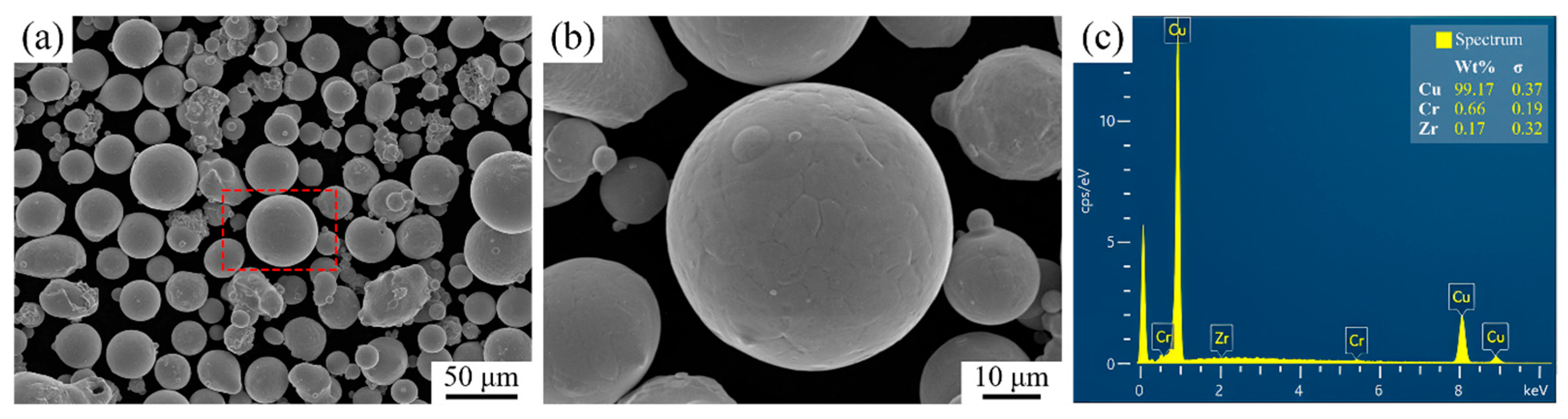
Commercial gas-atomized CuCrZr powders (GRINM Additive Manufacturing Technology Co., Ltd., Beijing, China) with a particle size range of 15–53 μm were used in this study. The actual particle size distribution (PSD) of the powder was characterized by D10 = 19.05 μm, D50 = 33.25 μm, and D90 = 48.02 μm. Based on the manufacturer’s quality certificate, the chemical composition of the powder consists of 0.62 wt.% Cr, 0.17 wt.% Zr, and an oxygen impurity content of 0.02 wt.%, with the balance being Cu. Other impurities such as Fe, Si, and P were controlled below 0.01 wt.%. The gas-atomized powder displayed spherical shapes with satellite particles (Figure 1a,b) and high copper content (>99%, Figure 1c). All materials were used in the as-received condition.
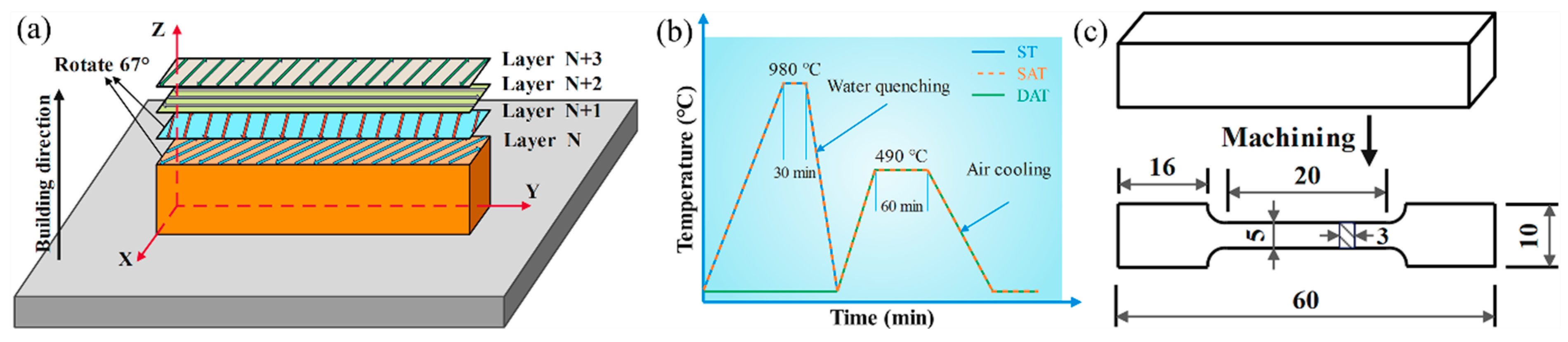
CuCrZr alloy specimens were fabricated using an LPBF machine (DiMetal-150, Guangzhou Leijia Additive Technology Co., Ltd., Guangzhou, China) equipped with a 500 W ytterbium fiber laser (wavelength λ ≈ 1064 nm). The laser focus spot diameter was fixed at 50 μm, and the layer thickness was maintained constant at 30 μm. The printing process was conducted under an argon protective atmosphere with oxygen levels below 0.05 vol.% (500 ppm). No build-plate preheating was applied (maintained at room temperature, ~25 °C). A 67° rotation-scanning strategy was employed between consecutive layers (Figure 2a).
Following the LPBF fabrication, three heat treatment protocols were applied using a muffle furnace (YTX 215-17, Shanghai Yetuo Technology Co., Ltd., Shanghai, China) at a heating rate of 10 K/min (Figure 2b): (1) Solution treatment (ST): heating to 980 °C for 30 min, followed by water quenching; (2) Solution followed by ageing treatment (SAT): solution treatment followed by ageing at 490 °C for 60 min with air cooling; (3) Direct ageing treatment (DAT): heating to 490 °C for 60 min, followed by air cooling. After heat treatment, dog-bone-shaped tensile specimens with a total length of 60 mm, a thickness of 3 mm, a gauge length of 20 mm, and a gauge width of 5 mm were machined from the fabricated blocks along the horizontal direction (parallel to the X-Y scanning plane), as illustrated in Figure 2c.

2.2. Microstructural, Mechanical, and Thermal Characterization

Powder morphology and microstructure were analyzed using a scanning electron microscope (SEM) machine (EM-30, COXEM Co., Ltd., Daejeon, Republic of Korea) equipped with an energy-dispersive X-ray spectrometer (EDS) and an electron backscatter diffraction (EBSD) detector (EDAX Velocity Super, AMETEK, Inc., Berwyn, PA, USA). The microstructural analysis was also carried out using an optical microscope (OM; NX30-HK830, Shenzhen Aosvi Optical Instrument Co., Ltd., Shenzhen, China). Specimens for OM and XRD analysis were polished according to ASTM E3-2011 standards. Metallographic bulk samples were polished to a mirror finish and etched for 10 s with ferric chloride solution (5 g FeCl3, 10 mL HCl, 90 mL H2O). EBSD specimens were prepared by electropolishing in accordance with ASTM E1558. The density of the as-fabricated CuCrZr alloys was measured with an electronic analytical balance (BSA224S, Sartorius AG, Göttingen, Germany) using the Archimedes method, with three repetitions. Phase identification was performed using an X-ray diffraction (XRD) system (Smartlab SE, Rigaku Corporation, Tokyo, Japan) equipped with Cu-Kα radiation, with a step size of 0.02° and a scanning range of 35–100°. TEM specimens were prepared by mechanical polishing followed by ion milling to achieve electron transparency. The nanoscale precipitation and interface characteristics were subsequently analyzed using a field-emission transmission electron microscope (TEM; JEM-F200, JEOL Ltd., Tokyo, Japan) equipped with an energy-dispersive X-ray spectrometer (EDS).
Mechanical properties were assessed through Vickers microhardness testing and room-temperature tensile testing. Microhardness was measured on polished surfaces using a microhardness tester (Laizhou Huayin Testing Instrument Co., Ltd., Laizhou, China) with a 200 gf load and a dwell time of 10 s, repeating 10 times. Tensile tests were performed with an electronic universal testing machine (CMT-5105, Zhuhai Sansi Taijie Electrical Equipment Co., Ltd., Zhuhai, China) at a strain rate of 0.2 mm/min, repeating 3 times, according to ISO 6892-1:2009. Thermal conductivity at 25.0 °C was determined by the laser flash method according to Parker et al. [33], using a NETZSCH HyperFlash system (LFA 467 HyperFlash, NETZSCH-Gerätebau GmbH, Selb, Germany) in compliance with the ASTM E1461 standard. Rectangular specimens with dimensions of 10 mm × 10 mm × 3 mm were prepared for thermal conductivity testing under an argon atmosphere. The thermal diffusivity (α) of the specimens was directly determined by the instrument. The specific heat capacity (Cp) was measured via the comparative method with a standard reference sample under identical test conditions. Finally, the thermal conductivity (K) was calculated via the relation K = α · ρ · C p , where ρ is the measured bulk density.

2.3. Statistical Experimental Design and Optimization

Based on theoretical considerations of laser-material interaction and melt pool dynamics, laser power (P), scanning speed (v), and hatch spacing (h) were identified as the primary factors influencing relative density. According to the CCD principle, each factor has five levels (− α , −1, 0, 1, and + α ). In this work, considering the rotatability of the experiment, which means the variance of the predicted value at a certain point depends only on its distance from the center of the experimental points and not on the direction, the value of α was determined to be 1.68. The factor levels for the central composite design were designed as shown in Table 1, with a core factor range (level −1 to +1) of 250–350 W for laser power, 200–600 mm/s for scanning speed, and 80–100 μm for hatch spacing. After the design of experiments, 20 experimental groups were designed with relative density as the response. Twenty cubic specimens (10 mm × 10 mm × 10 mm) were fabricated via the LPBF process.
Relative density was selected as the sole response variable for the RSM optimization because near-full densification is a necessary physical prerequisite for achieving both high mechanical strength and efficient thermal transport in LPBF-fabricated copper alloys. Residual porosity or lack-of-fusion defects would deteriorate these properties through stress concentration and localized electron/phonon scattering. Moreover, the LPBF process features a high cooling rate. The as-built alloy presents a supersaturated solid solution state with a low volume fraction of precipitates, making it difficult to achieve the synergistic optimization of strength and conductivity directly during the printing process. Such synergy can only be achieved by subsequent heat treatments (such as direct ageing), which rely on a nearly defect-free and dense matrix.

3. Results

3.1. Process Optimization

The measured relative densities are presented in Table 2. To determine the regression model for CCD response surface analysis, the fitting capabilities of different quadratic models were evaluated based on a p-value criterion of 0.05. The sequential model sum of squares indicates that the quadratic model substantially outperforms the two-factor interaction model (p-value = 0.0195). This indicates that quadratic terms greatly improve the model’s explanatory power. In contrast, the cubic model was aliased due to insufficient design points. The lack-of-fit test indicated that the quadratic model had a p-value of 0.1310, indicating adequate explanatory power and predictive stability.
A quadratic polynomial model, Equation (1), was used to fit the relationship between process parameters and relative density [34]:
Y r = a 0 + i = 1 k a i X i + i = 1 k a i i X i i 2 + i = 1 k 1 j = i + 1 k a i j X i X j + ε
where Y r represents the response value, a 0 is the constant term; a i , a i i and a i j are the linear, quadratic, and interaction coefficients, respectively; X i and X j ( i < j ) are i th and j th input parameters (laser power, scanning speed, hatch spacing); k is the number of factors and ε is the random errors.
Based on this mathematical model, the simplified quadratic regression equation (Equation (2)) relating process parameters to relative density was obtained by removing insignificant terms:
R = 100.26460 + 0.057581 P 0.019102 v 0.236028 h + 0.000050 P × v + 0.000672 P × h 0.000180 P × P
where R is the relative density (%). ANOVA was used to assess the significance of the quadratic polynomial regression model and the impact of each factor on the response value. The ANOVA results are presented in Table 3.
In a statistical significance test, the F-value is the ratio of the mean square for systematic variation to the mean square for random error, used to determine the significance of effects. The p-value represents the probability of observing the current F-value or a more extreme value under the null hypothesis (assuming no significant impact). When the p-value is less than the predetermined significance level (0.05, 95% confidence level), the null hypothesis is rejected, indicating the model is significant. The overall regression model p-value < 0.0001 suggests that the probability of obtaining such a large F-value (48.43) due to noise is less than 0.01%, demonstrating the model’s significance. According to Table 3, P, v, h, P × v, P × h, and P2 are significant model terms. The p-value for the lack-of-fit terms is 0.2271 > 0.05, indicating a 22.71% chance that a lack-of-fit F-value (2.02) this large could occur due to noise. The lack-of-fit term is not significant, and the model fits well. The model’s adjusted coefficient of determination is 0.9374, with an adequate signal-to-noise ratio of 22.3649, showing a proper signal.
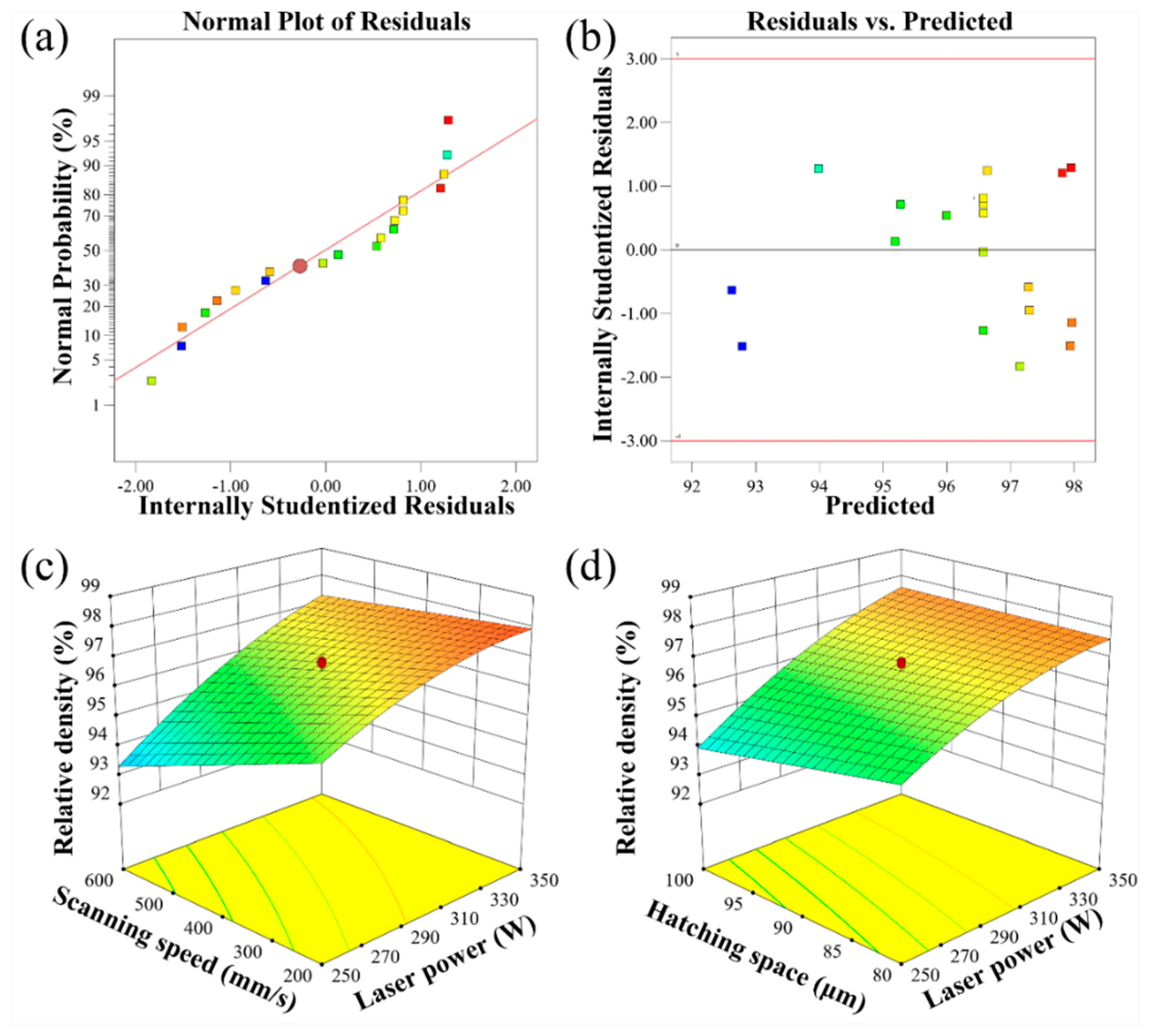
Figure 3a displays the normal probability plot of residuals, verifying the regression model’s accuracy through residual analysis. The residual points are evenly distributed along the theoretical line, with little deviation, indicating that the residuals follow a normal distribution and that the fit is accurate. Figure 3b shows the relationship between predicted responses and internally studentized residuals. The residuals are randomly and evenly distributed on both sides of the zero baseline, with all points within outlier thresholds, indicating no extreme outliers or abnormal distributions and supporting the model’s predictive ability.
Figure 3c,d shows the 3D surface plots of the effects of LPBF processing parameters on relative density. Figure 3c presents the influence of scanning speed and laser power on relative density at a fixed hatch spacing of 90 μm. The relative density increased with increasing laser power but decreased with increasing scanning speed. Figure 3d shows how laser power and hatch spacing affect relative density at a scanning speed of 400 mm/s. The result indicates that relative density increases with laser power and that the influence of hatch spacing is relatively limited. At a laser power of 250 W, relative density decreased as hatch spacing increased; however, at 350 W, the variation in relative density with hatch spacing is not significant.
Based on the multiple regression model, the optimal parameters were predicted to be: laser power = 430 W, scanning speed = 900 mm/s, and hatch spacing = 110 μm, with a corresponding predicted relative density of 99.65%. To experimentally verify this result, eight cubic specimens were fabricated under the above optimal settings. The measured average relative density was 99.25%, with a relative deviation of approximately 0.403% from the predicted value, showing the model is highly accurate and confirming the reliability of the optimization results.
Although these optimal parameters slightly exceed the initial factor level range (Table 1), this parameter combination is both mathematically and physically reasonable. As noted by Myers et al. [35], extrapolation beyond the original observation region requires caution, as regression models may not maintain predictive accuracy outside the training domain. To address this concern, we performed independent experimental validation at the predicted optimal parameters. Physically, laser power is the dominant factor in the densification of LPBF-fabricated copper alloys [36], and a laser power of 430 W is necessary to overcome the high reflectivity and thermal conductivity of the CuCrZr powder [37]. The measured average relative density is higher than the maximum value listed in Table 2 and slightly lower than the model’s prediction, demonstrating the reliability of both the regression model and the optimization results.

3.2. Microstructure and Phase Characterization

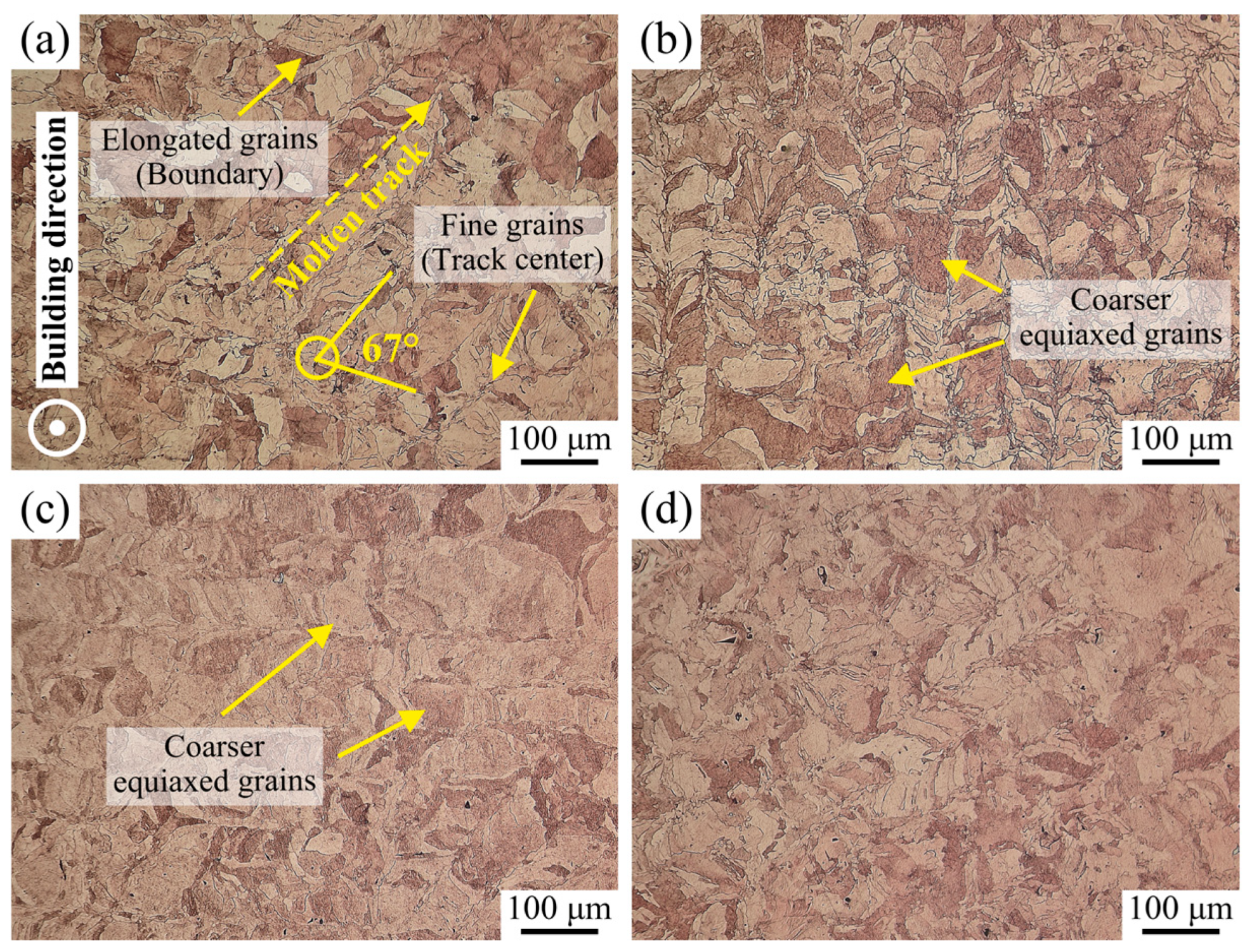
Figure 4 shows optical microscopy images of the microstructure in the horizontal plane perpendicular to the build direction (XOY plane) for LPBF-fabricated specimens under different heat-treatment conditions. The AB specimen exhibited distinct molten track patterns, with alternating orientations resulting from the 67° rotation scanning strategy, with no significant porosities (Figure 4a). Smaller grains were observed in the centers of the molten tracks, while the track boundaries contained numerous elongated and irregularly oriented grains. After heat treatment, some traces of molten tracks remained partially visible. The microstructures of the ST and SAT specimens showed similar features, with reduced elongated grains and the presence of partially coarser, equiaxed grains (Figure 4b,c), attributed to the transformation of elongated columnar grains into equiaxed grains during solution treatment. The microstructure of the DAT specimen (Figure 4d) showed minimal changes compared to the AB specimen.
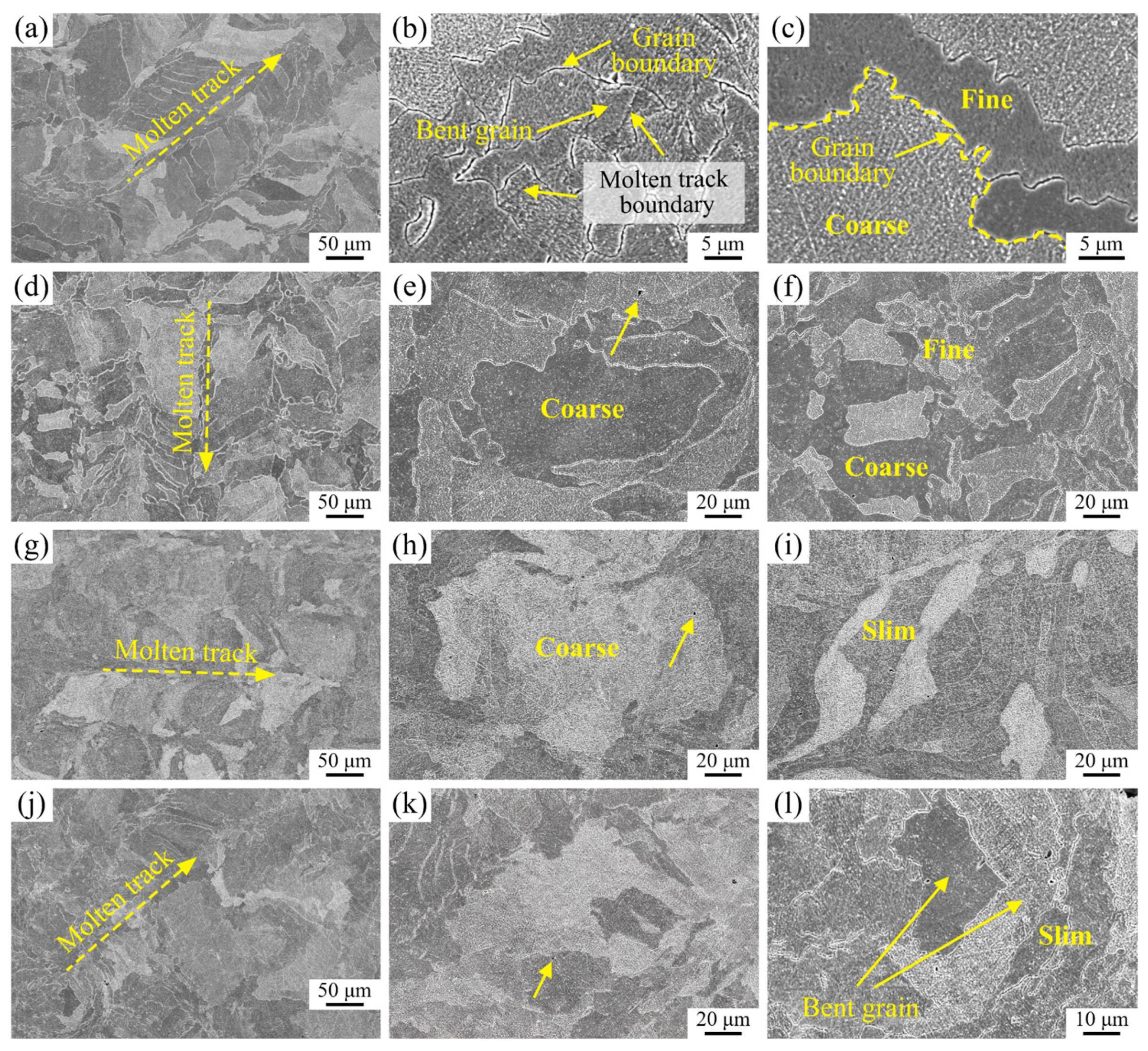
To further analyze the microstructure characteristics, SEM images were captured at different magnifications, as presented in Figure 5. Figure 5a shows fine and uniform grains in the center of the molten track, which result from the rapid temperature drop and high cooling rates during laser scanning. The temperature gradients between the center and boundary of the molten pool promoted preferential grain growth towards the center, mainly forming elongated columnar grains. In addition, the elongated grains exhibit a curved morphology at the molten track boundaries (Figure 5b). This occurs because adjacent tracks were designed to partially overlap to improve densification. When the laser moved to a new track, it partially remelted the previously solidified adjacent track, causing some columnar grains to reorient along the new temperature gradient, resulting in curved, irregular grain shapes. Furthermore, variations in brightness separated by grain boundaries appeared in the specimens (Figure 5c), attributable to differences in corrosion resistance among different grain types during etching.
After heat treatment, the boundaries of the molten track vanished, and fine precipitates (marked by yellow arrows) became visible in Figure 5e,h,k. Additionally, the ST and SAT specimens exhibited regions with coarser grains (Figure 5f,h,i), with more irregular grain arrangements. The DAT specimen showed no significant change in grain size or melt pool dimensions compared to the AB state.
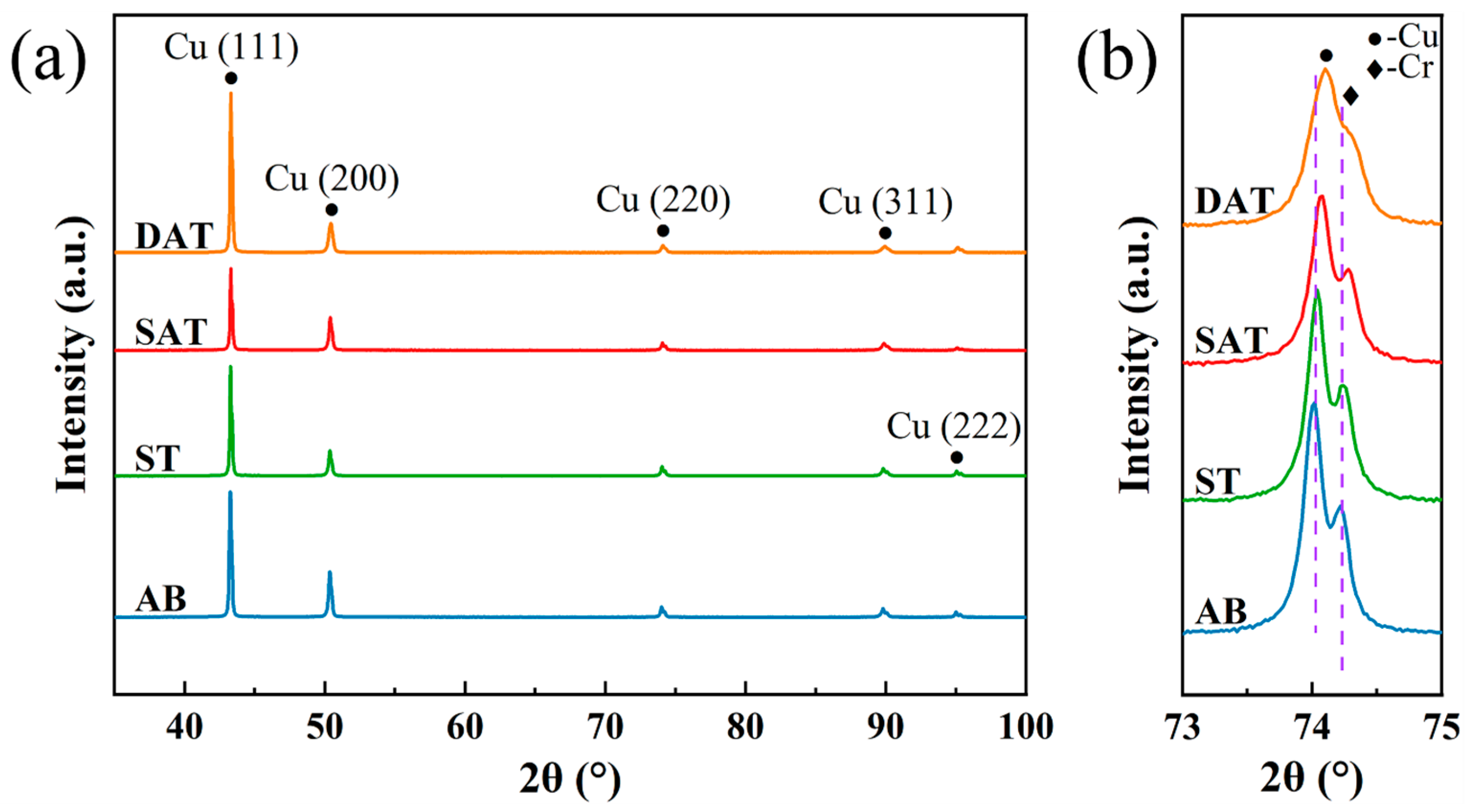
Figure 6 shows the XRD patterns of LPBF-fabricated CuCrZr specimens before and after heat treatment. The main diffraction peaks correspond to α-Cu, with Cr peaks also observed (Figure 6a). Few diffraction peaks for Zr phases appeared in either heat-treated or untreated samples, mainly because the low Zr content falls below XRD detection limits. In the magnified view (Figure 6b), the peak positions of Cu and Cr diffraction in the heat-treated specimens shifted toward higher angles compared to those in the AB specimen, indicating a decrease in the interplanar spacing. Such a peak shift is primarily attributed to solute redistribution and is also affected by residual stress relief and lattice defects [25,38]. In the AB state, the rapid cooling rate during the LPBF process generates high-density dislocations, lattice defects, and micro residual stresses. These factors collectively expand the Cu lattice and thus shift the diffraction peaks toward lower angles. After solution treatment at 980 °C, the original residual stress induced by LPBF is relieved and lattice defects are largely eliminated. Consequently, the diffraction peaks of the ST specimen shift slightly toward higher angles (rightward shift) compared with the AB state. However, the Cr and Zr solute atoms remain fully dissolved in solid solution due to water quenching. The resulting solid-solution lattice distortion is mostly retained, which restricts further peak shifting.
In contrast, during subsequent ageing treatments (both SAT and DAT at 490 °C), thermal activation prompts not only the relaxation of residual stresses, but also the precipitation of supersaturated Cr and Zr solute atoms. This solute depletion largely eliminates the lattice distortion of the solid solution and decreases the lattice constant of the Cu matrix [25,39]. Accordingly, diffraction peaks shift more markedly toward higher angles in both SAT and DAT specimens (Figure 6b).
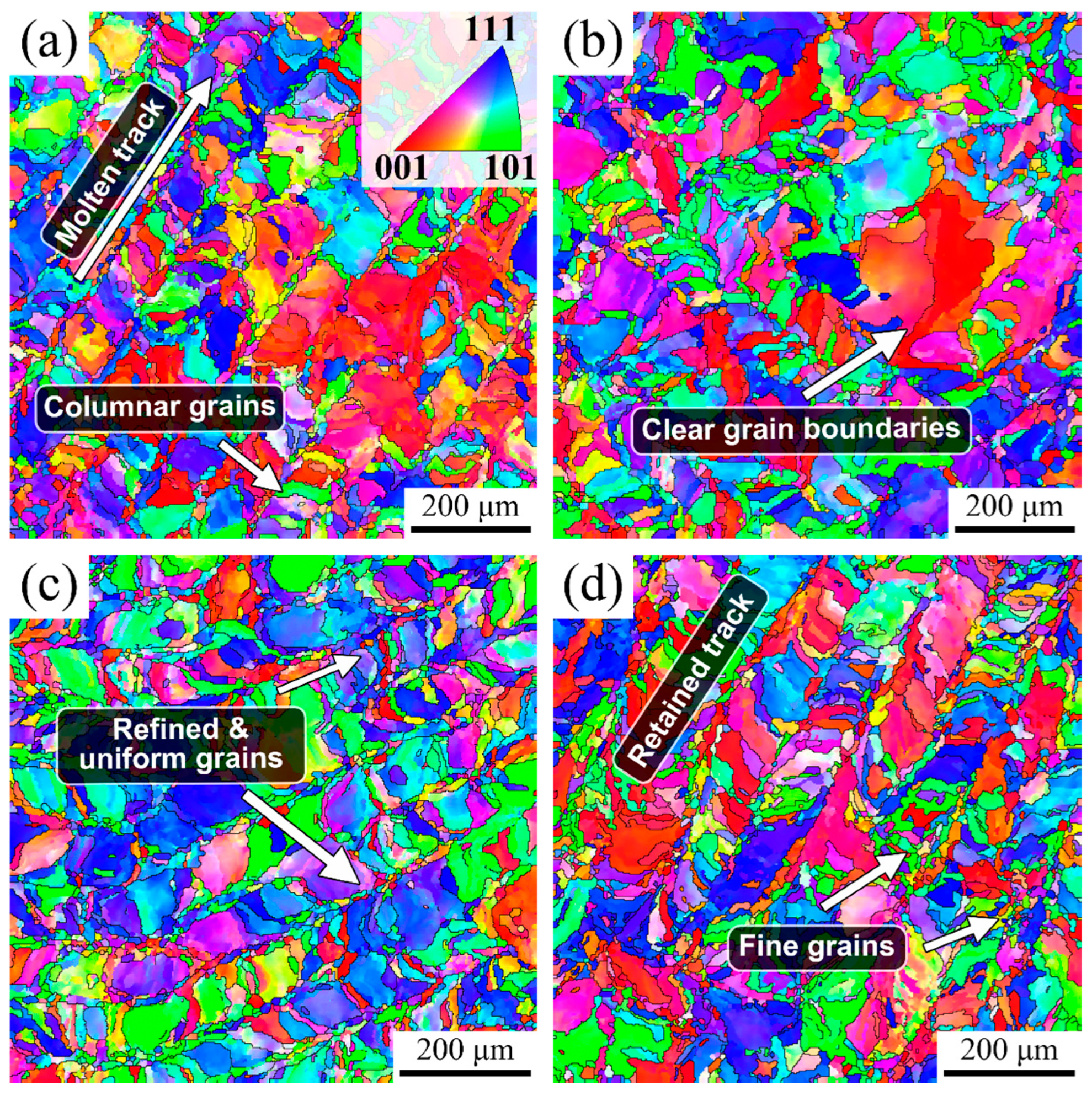
Figure 7 displays inverse pole figure (IPF) maps of the AB and various heat-treated specimens. The LPBF-fabricated alloy showed a distinct molten track pattern (Figure 7a). During solidification, the temperature gradient between the center and boundary of the molten pool drives preferential grain growth toward the center, forming elongated and columnar grains. Significant microstructural evolution occurred after heat treatment. The grain boundaries of the ST specimens became more continuous and distinct (Figure 7b), indicating that high temperature promoted grain rearrangement, resulting in partial refinement and reorganization of the original coarse grains. The SAT specimen exhibited more uniform grain orientation and smaller grain size (Figure 7c), because the formation of precipitates during ageing restrained grain growth, resulting in a refined and homogeneous microstructure. The DAT specimen, without prior solution treatment, retained the grain orientation characteristics inherited from the original LPBF microstructure and displayed finer grains with a more random orientation distribution (Figure 7d).
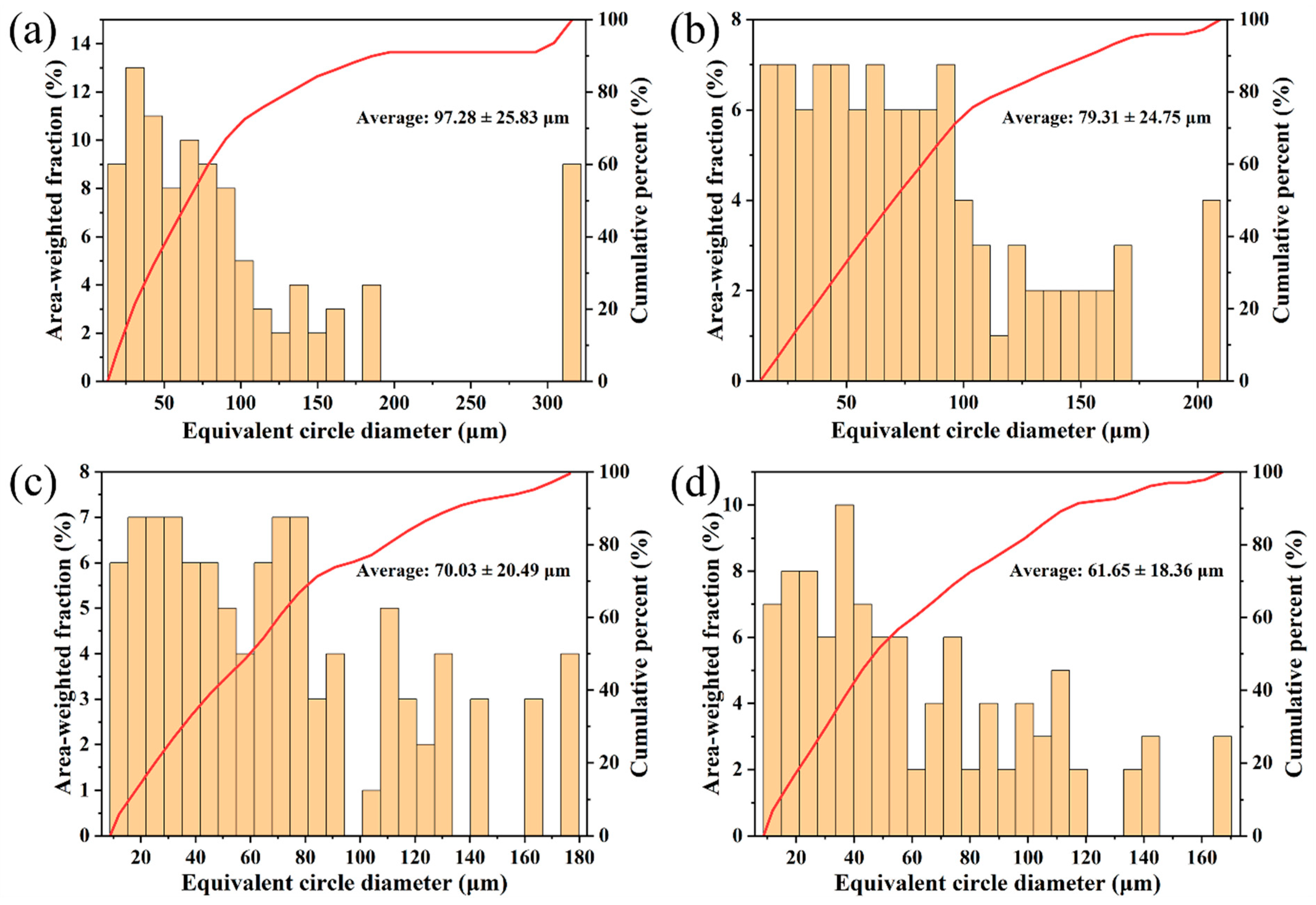
Based on the calculated area-weighted average equivalent circle diameter (ECD) (Figure 8), the AB specimen exhibited the largest average ECD of 97.28 μm. The grain size decreased to varying degrees after heat treatment. The average ECD values of the ST, SAT, and DAT specimens were 79.31 μm, 70.03 μm, and 61.65 μm, respectively. Although rapid solidification during LPBF tends to form elongated columnar grains or subgrains, the island scanning strategy may cause uneven local heat accumulation. Regions near island boundaries may have experienced continuous growth during multiple thermal cycles, leading to coarser grains in some areas, which explains the approximately 9% of grains larger than 300 μm shown in Figure 8a.
During the solution treatment of the ST specimen, the dissolution of Cr and Zr elements may have triggered recovery and recrystallization. High dislocation density and sub-grain boundaries created by rapid solidification and thermal stress in the AB state migrated via diffusion at high temperatures, which might have driven recrystallization. Although solution treatment generally promotes grain growth, the high dislocation density in the AB state provided abundant nucleation sites for recrystallization. The grain-refinement effect of recrystallization may have outweighed the coarsening effect, resulting in smaller grain sizes in the ST specimen than in the AB state.
During ageing, decreased solid solubility of Cr led to the formation of fine nano-sized precipitates at grain boundaries. The pinning effect of Cr phases hindered grain boundary migration [40]. Furthermore, the ageing temperature was substantially lower than the solution temperature, resulting in a weaker thermal-dynamic condition for grain growth, thus inhibiting grain coarsening. Grain boundary migration via atomic diffusion facilitated the transformation from columnar to equiaxed grains, thereby reducing the anisotropy of the alloy structure. The DAT specimen, which bypassed solution treatment, retained the high dislocation density characteristic of the AB state and had limited solute diffusion, restricting fine precipitation. It also avoided slight grain coarsening during solution treatment. Consequently, the DAT specimen exhibited the smallest grain size among all specimens, which contributes to favorable mechanical properties.

3.3. Mechanical and Thermal Properties

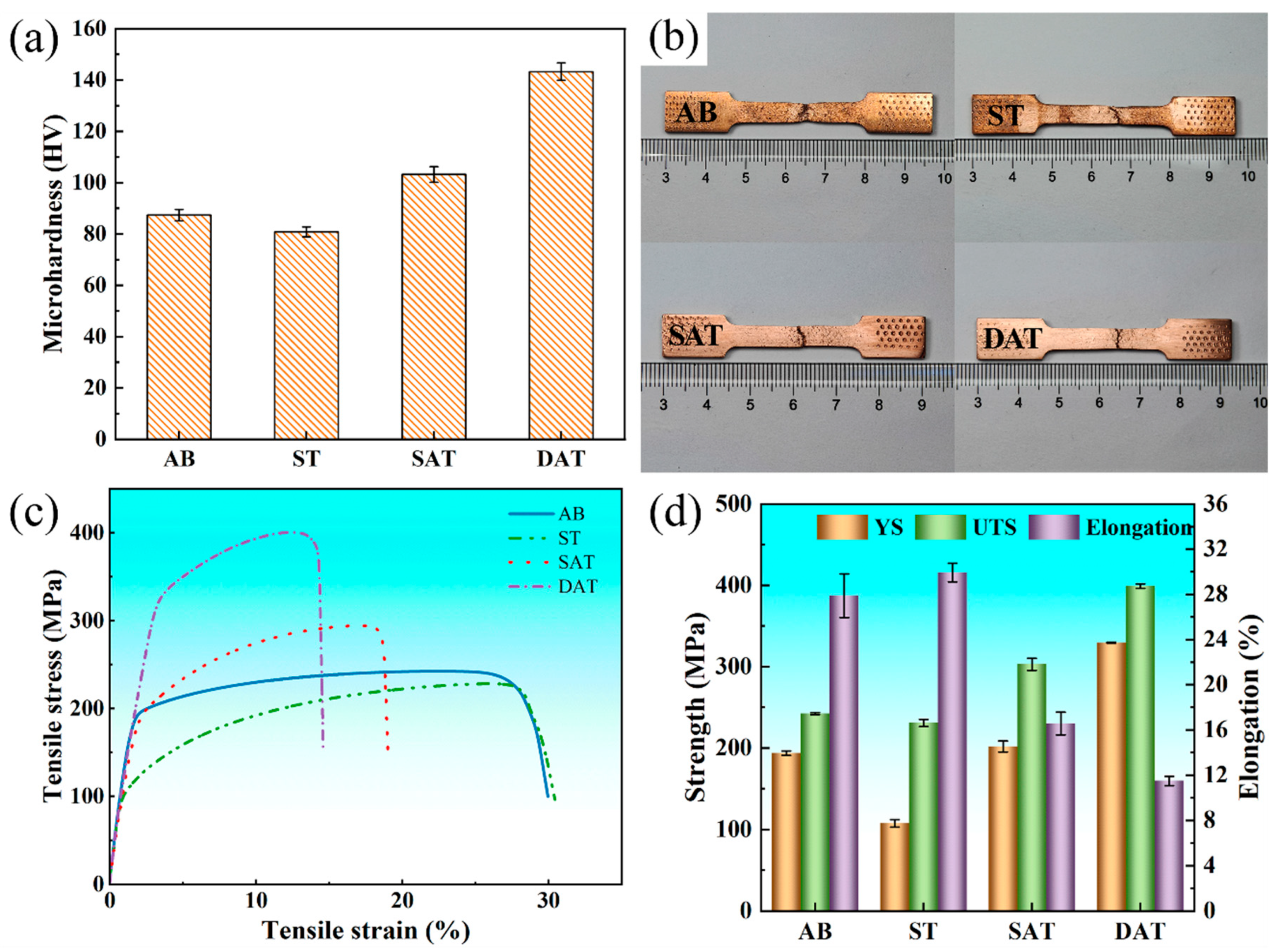
To evaluate the mechanical properties of LPBF-fabricated CuCrZr alloy, Vickers microhardness tests were performed on AB and heat-treated specimens (Figure 9a). The AB specimen showed a microhardness of 87.35 ± 2.23 HV. After solution treatment, the microhardness of the ST specimen decreased to 80.85 ± 1.95 HV. In contrast, subsequent ageing treatments led to a marked increase in hardness, with the DAT specimen achieving a peak value of 143.28 ± 3.42 HV, representing a 64% improvement compared with the AB state.
Figure 9b shows the morphology of the specimens after tensile testing, indicating that the AB and ST specimens exhibit notable ductility, while the SAT and DAT specimens show relatively low ductility. The engineering stress–strain curves for the LPBF-fabricated CuCrZr alloy in different heat-treated conditions are presented in Figure 9c. In comparison to the AB specimen, the ST specimen exhibited an ultimate tensile strength ( σ U T S ) of 231.06 ± 4.47 MPa (Figure 9d), slightly lower than the 242.48 ± 1.22 MPa of the AB state, but its ductility was improved with an elongation after fracture reaching 29.94 ± 0.82%. For the SAT specimen, the σ U T S increased to 303.1 ± 7.43 MPa, but plasticity decreased with elongation dropping to 16.58 ± 1.01%. Notably, the DAT specimen achieved the highest overall mechanical properties, with the σ 0.2 reaching 329.68 ± 0.64 MPa, which is approximately 1.7 times that of the AB specimen (193.95 ± 2.77 MPa), while maintaining a reasonable elongation of 11.5 ± 0.41%. This trend indicates that DAT is more effective than the conventional SAT route in enhancing the strength of LPBF-fabricated CuCrZr alloy.
Such strength-ductility trade-off behavior is closely correlated with microstructural evolution. For the AB and ST specimens, the absence of nanoscale precipitates enables dislocations to glide and pile up more uniformly, thus contributing to higher ductility. In contrast, for the DAT specimen, the combined effect of retained dislocation networks and newly formed nanoscale Cr precipitates acts as a strong barrier to dislocation motion. These obstacles markedly increase yield strength while restricting the mean free path of dislocations. During tensile deformation, lattice mismatch at the interfaces between precipitates and matrix often leads to local stress concentration and strain localization around precipitates, which eventually reduces the macroscopic elongation in precipitation-hardened alloys [41].
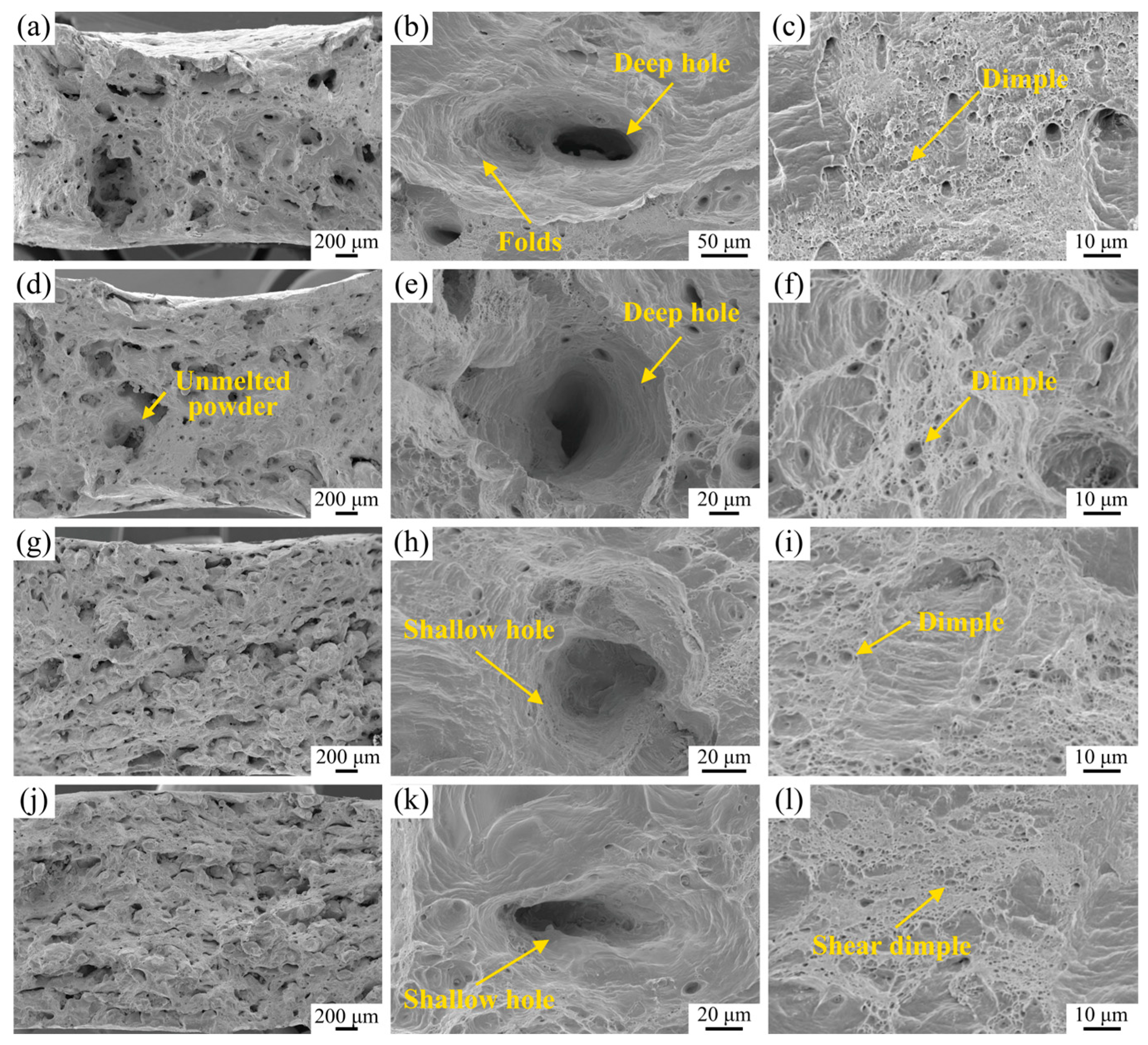
To further analyze tensile properties, the fracture morphologies of AB and heat-treated specimens were characterized (Figure 10). All samples exhibited typical ductile fracture modes with voids visible on the fracture surfaces (Figure 10b,e,h,k). Numerous voids were observed across all fracture surfaces. Voids in the AB and ST specimens were relatively deep and large in size, while those in the SAT and DAT specimens were shallower and smaller. The deep holes also displayed wrinkles from plastic deformation during tension (Figure 10b), and the dimples were mainly equiaxed without obvious orientation (Figure 10c,f,i,l), consistent with the observed ductility of the alloy. In the DAT specimen, some elongated shear dimples were observed (L), suggesting a transition in the plastic deformation scale induced by the precipitation process. Besides voids, near-spherical particles, mainly originating from unmelted powder and spatter, were seen within both deep and shallow dimples on the fracture surfaces.
Table 4 presents the thermal conductivity and calculated electrical conductivity of AB and heat-treated specimens. The AB specimen exhibited the lowest thermal conductivity of 122.01 ± 2.44 W/(m·K). After heat treatment, the thermal properties improved to varying degrees. The thermal conductivity of ST and SAT specimens increased markedly to 192.03 ± 1.58 W/(m·K) and 310.58 ± 2.39 W/(m·K), respectively. Specifically, the DAT specimen demonstrated the highest thermal performance, reaching a notable value of 326.53 ± 0.40 W/(m·K), which is a 167% increase over the AB state. It is worth noting that the DAT condition not only yields the highest mechanical strength but also provides the most favorable thermal transport capacity, achieving a favorable synergy of strength and conductivity.
To further evaluate the electrical transport properties, the calculated electrical conductivity values were derived from the measured thermal conductivity using the empirical Smith–Palmer relation [42]: K = 2.39 × 10 8 T σ + 7.5 [W/(m·K)], where T is the thermodynamic temperature expressed in Kelvins. The calculated conductivity values were converted into the International Annealed Copper Standard (% IACS), where 100% IACS is defined as 5.8 × 10⁷ S/m [43]. As listed in Table 4, the calculated electrical conductivity presents an increasing trend, rising from 27.7% IACS for the AB specimen to 77.2% IACS for the DAT specimen, indicating a substantial improvement.
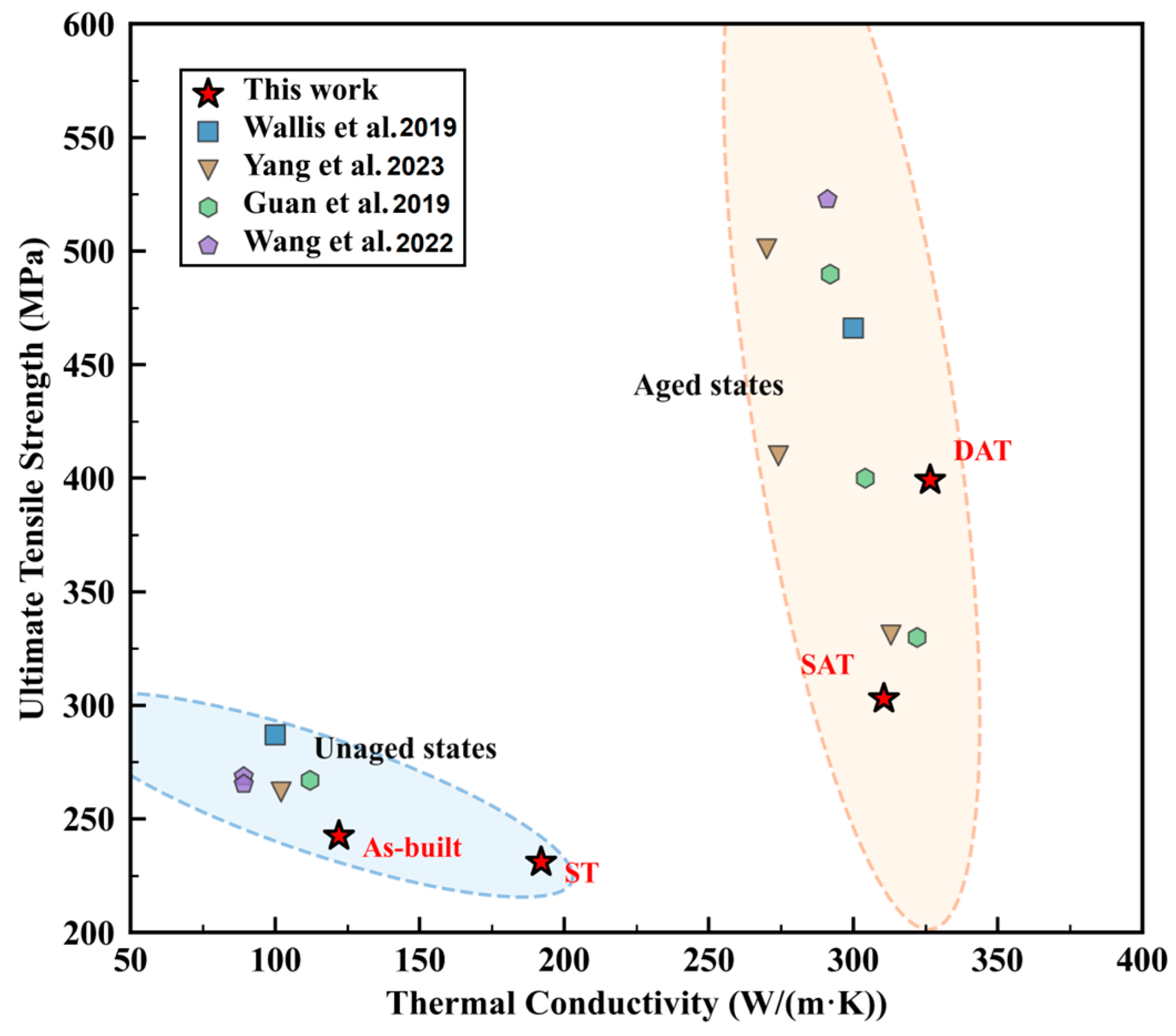
To further evaluate the strength–conductivity synergy, Figure 11 compares the ultimate tensile strength and thermal conductivity of the CuCrZr alloys fabricated in this work and similar copper alloys prepared via the same LPBF process reported in the literature [22,25,30,44]. In the unaged state, the combination of mechanical and thermal performance of the present specimens is comparable to that of the reported alloys in the unaged state. For the DAT specimen in this work, the thermal conductivity reaches 326.53 ± 0.40 W/(m·K), which is higher than most of the aged specimens reported in the literature. Although the ultimate tensile strength of the DAT specimen (399.31 ± 2.85 MPa) is moderate, it still exhibits a balance between mechanical strength and thermal transport. Compared with other reported LPBF-fabricated CuCrZr alloys, the DAT specimen in this work offers a notable and practical synergy of properties.

3.4. Nanoscale Precipitation and Interface Characteristics

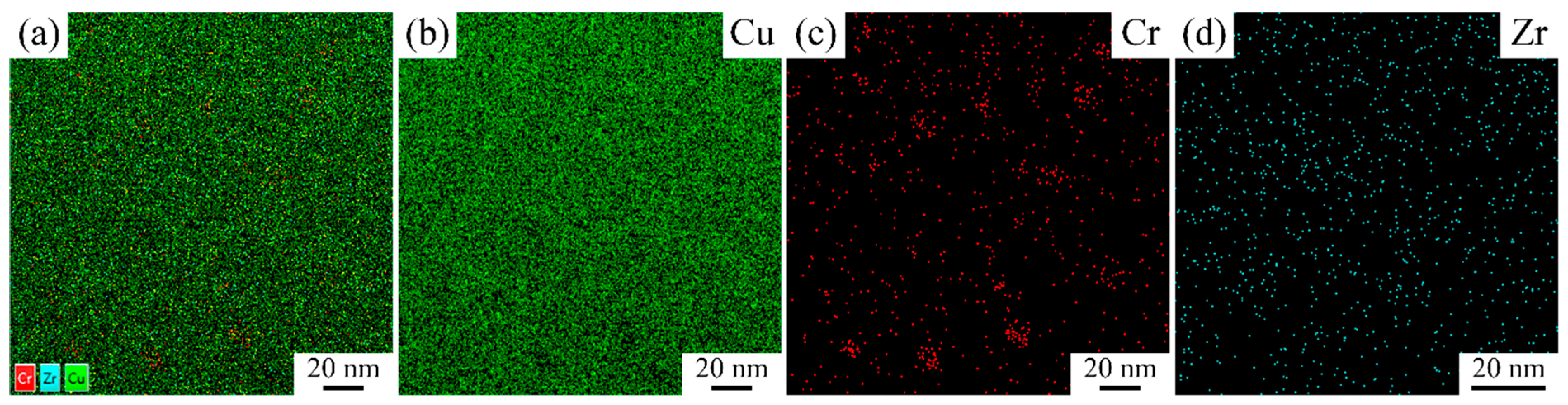
To further clarify the microstructural characteristics corresponding to the substantially improved overall properties of the DAT specimen, STEM and EDS analyses were performed. Figure 12 shows the EDS elemental mapping of the DAT specimen, with the overall elemental distribution and the individual maps of Cu, Cr, and Zr presented in Figure 12a–d. A number of nanoscale particles are uniformly dispersed in the Cu matrix. The corresponding individual elemental maps (Figure 12c,d) indicate that these finely dispersed nanoscale precipitates are rich in Cr, while the Zr element remains homogeneously distributed without forming coarse macroscopic segregations. This uniform distribution indicates that the high cooling rate of the LPBF process effectively restricts the long-range diffusion of solute atoms. Accordingly, a highly supersaturated solid solution is retained in the AB specimen [25], which provides abundant nucleation sites for the subsequent formation of nanoscale precipitates during direct ageing treatment.
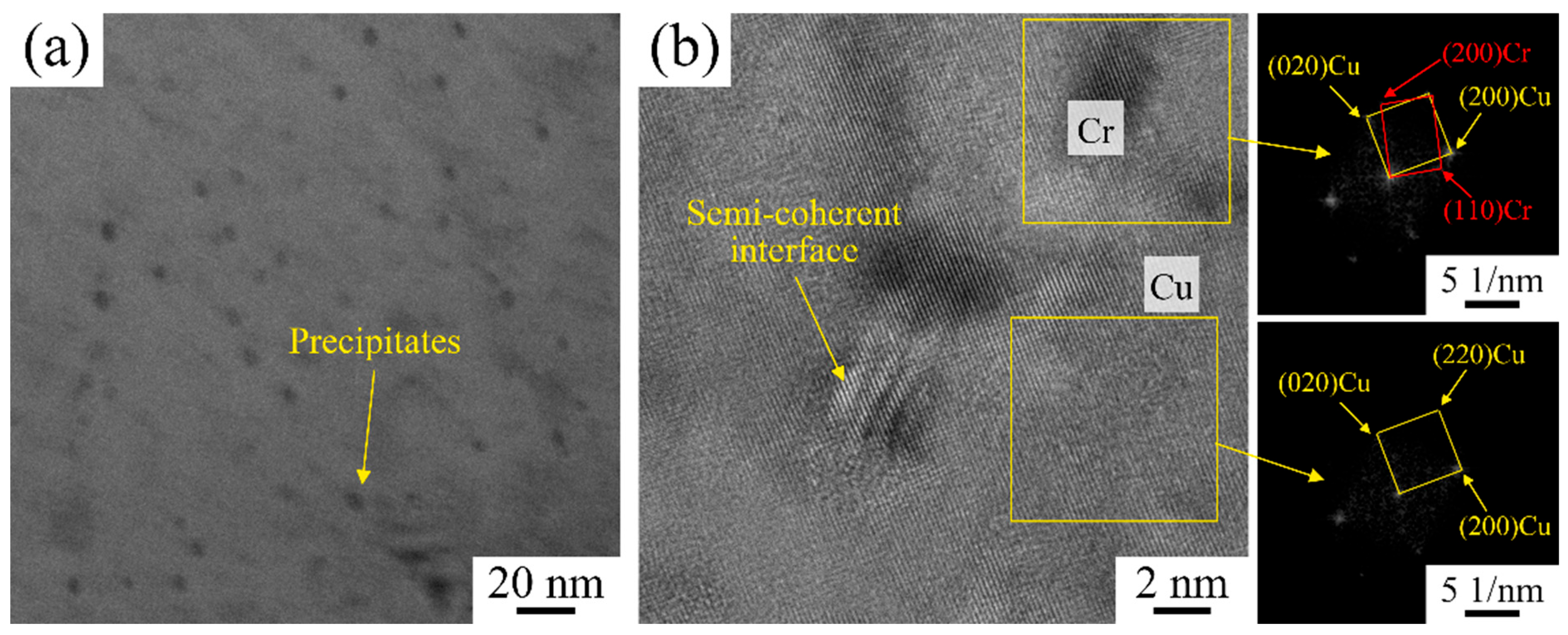
High-resolution TEM (HRTEM) was employed to characterize the crystal structure and interface characteristics of the Cr precipitates. As shown in Figure 13a, nanoscale Cr precipitates with sizes of only a few nanometers are embedded within the matrix. Parallel Moiré fringes can be observed at the interface between the Cr precipitates and the Cu matrix (Figure 13b). According to atomic-scale investigations on Cu-Cr alloys [45,46], such Moiré contrast is a typical morphological feature of body-centered cubic (BCC) Cr precipitates.
The corresponding fast Fourier transform (FFT) pattern (inset in Figure 13b) indicates this phase transformation process and exhibits specific crystallographic projection characteristics. In this FFT pattern, the main diffraction spots with the highest brightness originate from the face-centered cubic (FCC) Cu matrix, which can be indexed as the 001 C u zone axis. These distinct diffraction spots correspond to the ( 200 ) C u and ( 020 ) C u crystal planes. In addition to diffraction spots from the matrix, a set of additional diffraction spots originating from the BCC precipitates can be distinguished. These spots are projected along the 1 1 ¯ 0 C r zone axis and correspond to the ( 110 ) C r and ( 002 ) C r crystal planes. Notably, within the two-dimensional projection plane, an angular deviation of approximately 10.5° is observed between the ( 200 ) C u matrix plane and the ( 110 ) C r precipitate plane. According to the classic crystallographic phase transformation theory [47], FCC/BCC systems typically deviate from the perfectly matched Bain correspondence to minimize the interfacial energy, with the orientation relationship falling within the range between the Nishiyama–Wassermann (N-W) and Kurdjumov–Sachs (K-S) orientations. The measured projection deviation of 10.5° lies within the characteristic orientation interval of these two low-energy orientation relationships. This crystallographic deviation indicates that the uniformly dispersed BCC Cr precipitates undergo lattice rotation to accommodate lattice misfit, forming a strained semi-coherent interface with the FCC Cu matrix.

4. Discussions

4.1. Mechanism of Thermal Conductivity Enhancement

As described in Section 3.3, the AB specimen exhibits the lowest thermal conductivity, measuring 122.01 ± 2.44 W/(m·K). This limited thermal conductivity is primarily attributed to the high cooling rate inherent to the LPBF process, which results in a high dislocation density and significant residual stress. Moreover, rapid solidification forces Cr and Zr atoms into solid solution within the Cu matrix, forming a highly supersaturated solid solution. The resulting severe lattice distortion increases the scattering probability of electrons and phonons, reducing the thermal conduction efficiency [48].
After direct ageing treatment, the thermal conductivity of the DAT specimen is increased by 167% compared to the as-built state, reaching a notable level of 326.53 ± 0.40 W/(m·K). This marked improvement stems from microstructural evolution in multiple aspects. On one hand, TEM observations (Figure 13) indicate that supersaturated Cr atoms precipitate from the Cu matrix in the form of nanoscale particles, resulting in solute depletion of the matrix. By combining statistical analysis of residual solute derived from TEM results with Vegard’s law based on XRD peak shifts [49], the residual Cr solute concentration in the Cu matrix is estimated to have decreased from the initial fully supersaturated state (0.62 wt.%) to approximately 0.4 wt.%. On the other hand, the heat treatment reduces dislocation density (as quantitatively evaluated in Section 4.2.3), which further decreases the scattering probability of conduction electrons and phonons. The synergistic reduction in solute atoms and structural defects lowers thermal transport resistance, representing the dominant mechanism for the improved thermal conductivity [44].

4.2. Quantitative Analysis of Strengthening Mechanisms

To elucidate the underlying mechanisms of the notable strength of the DAT specimen, a quantitative analysis of the contributions from different strengthening mechanisms was conducted. The yield strength ( σ Y S ) of the CuCrZr alloy can be expressed as a linear superposition of the intrinsic friction stress of pure copper ( σ 0 ), grain boundary strengthening ( σ G B ), solid solution strengthening ( σ S S ), dislocation strengthening ( σ D S ), and precipitation strengthening ( σ P S ) [50]. The theoretical yield strength is calculated using Equation (3):
σ Y S = σ 0 + σ G B + σ S S + σ D S + σ P S
The specific material constants used in subsequent calculations are summarized in Table 5 (adapted from Ref. [23]). The detailed microstructural parameters extracted for the AB and DAT specimens are presented in Table 6.
Table 5. Material constants for pure copper used in the theoretical calculations (Adapted with permission from Ref. [23]. Copyright 2021 Elsevier).
ParametersValueUnitReference
σ 0 Peierls-Nabarro stress25MPa[51]
G Shear modulus of the matrix45.5GPa[52]
k Hall–Petch slope180MPa·μm1/2[23]
M Taylor factor3.06[53]
b Burgers vector0.256nm[54]
α 0.23[23]
ε Misfit strain0.015[22]
υ Poisson’s ratio0.34[52]
Table 6. Microstructural parameters of the AB and DAT specimens used for theoretical calculations.
Specimen D g r a i n (μm) D X R D (nm) ε
(10−3)
ρ
(1014 m−2)
c (wt.%) r (nm) f (%) λ (nm)
AB97.2875.441.502.690.62
DAT61.65568.914.150.99 0 1.490.2367.09

4.2.1. Grain Boundary Strengthening

Grain boundaries effectively hinder dislocation movement. The contribution of grain boundary strengthening ( σ G B ) is calculated according to the classic Hall–Petch relationship (Equation (4)) [55]:
σ G B = k D g r a i n 1 / 2
where k is the Hall–Petch coefficient for copper alloys, and D g r a i n is the average grain size. Based on EBSD results (Figure 8), the area-weighted average equivalent circle diameters ( D g r a i n ) of the AB and DAT specimens are 97.28 μm and 61.65 μm, respectively. Accordingly, the calculated σ G B values are 18.25 MPa for the AB specimen and 22.92 MPa for the DAT specimen. Due to the grain growth behavior of the LPBF process, the columnar grains in the fabricated specimens remained relatively coarse. Moreover, there is no significant grain coarsening during direct ageing treatment. Therefore, the contribution of grain boundary strengthening to the overall yield strength is limited and remains relatively stable under different specimen conditions.

4.2.2. Solid Solution Strengthening

Solute atoms dissolved in the Cu matrix can induce severe lattice distortion, generating local elastic strain fields that hinder dislocation motion. This solid-solution strengthening effect ( σ S S ) depends largely on the atomic fraction of solute elements and can be quantitatively calculated using the Fleischer equation (Equation (5)) [51]:
σ S S = M G ε 3 2 c 1 2
where M is the Taylor factor, G is the shear modulus of the Cu matrix, ε is the misfit strain caused by lattice distortion, and c is the atomic fraction of solid solution elements. In the as-built state, the extremely high cooling rate forces nearly all Cr and Zr elements into solid solution within the Cu matrix. Based on the initial composition of the powder, the weight percent of Cr in this highly supersaturated state is approximately 0.62%, which corresponds to an atomic fraction ( c ) of approximately 0.757%. Accordingly, the solid solution strengthening increment σ S S of the AB specimen is calculated to be 22.25 MPa.
For the DAT specimen, as discussed in Section 4.1, the direct ageing treatment provides a strong driving force for the nearly complete precipitation of supersaturated Cr atoms from the Cu matrix. Based on the original powder composition, the theoretical volume fraction of Cr in a fully supersaturated state is approximately 0.7%. However, statistical TEM analysis yields a precipitate volume fraction ( f ) of 0.23%. This difference indicates that, although the majority of Cr has precipitated, a small amount of Cr may remain dissolved in the matrix or exist as subnanometer clusters that cannot be detected by conventional TEM. According to Equation (5), the solid solution strengthening contribution ( σ S S ) is proportional to the square root of solute concentration ( c 1 2 ). Hence, the strengthening increment arising from this small residual solute concentration is substantially reduced (estimated to be much lower than 5 MPa). Therefore, it is reasonable to assume that the residual solute concentration c is approximately zero, and thus the contribution of solid solution strengthening can be neglected in theoretical calculations (taken as 0 MPa).

4.2.3. Dislocation Strengthening

During the LPBF process, the high cooling rate generates a high density of cellular substructures and dislocations, which contribute markedly to the yield strength of the material. In recent studies, the dislocation density of LPBF-fabricated copper alloys has often been estimated using the kernel average misorientation (KAM) derived from EBSD data [25,44]. However, this method mainly captures geometrically necessary dislocations (GNDs) that accommodate local lattice curvature, while neglecting statistically stored dislocations (SSDs) with a net Burgers vector of zero within the detected region [56]. This inherent limitation often leads to an underestimation of the total dislocation density.
To comprehensively evaluate the actual dislocation strengthening effect ( σ D S ), an XRD peak broadening analysis method was employed. Unlike EBSD, the XRD technique is sensitive to the overall microstrain field generated by both GNDs and SSDs, thus enabling a more accurate assessment of the total dislocation density in materials [57,58]. Specifically, each diffraction peak was fitted using a pseudo-Voigt function with a linear background. This analysis included the (111), (200), (220), (311), and (222) peaks for the AB specimen, while the (311) peak was excluded for the DAT specimen due to peak overlap.
The dislocation strengthening effect ( σ D S ) is typically calculated using the classic Bailey-Hirsch formula (Equation (6)):
σ D S = M α G b ρ 1 / 2
where M is the Taylor factor, α is a material-dependent constant (0.23 for Cu), b is the magnitude of the Burgers vector, and ρ is the dislocation density. The Williamson-Hall (W-H) method is commonly used to determine the dislocation density from XRD data. However, copper alloys exhibit significant elastic anisotropy, which usually causes severe data scattering in the conventional W-H plot and leads to unreliable linear fitting results.
To address this issue, the direct fitting (DF) method was adopted in this study to correct elastic anisotropy by introducing the orientation-dependent diffraction Young’s modulus [59]. Subsequently, the true total dislocation density ( ρ ) can be calculated using the classic Williamson-Smallman equation (Equation (7)) [24,60]:
ρ = 2 3 ε D X R D b
where D X R D represents the crystallite size derived from XRD peak broadening analysis, which often describes the size of subgrain or dislocation cell sizes and is fundamentally different from the macroscopic grain size measured by EBSD.
By using this modified Williamson-Hall approach, the microstrain (ε) can be accurately extracted, and the true dislocation density ρ of the AB specimen is calculated to be 2.69 × 10¹⁴ m−2. Accordingly, the dislocation strengthening contribution ( σ D S ) of the AB state reaches a notable 134.14 MPa. After direct ageing treatment, thermal activation promotes the rearrangement and partial annihilation of dislocations [61,62], reducing the dislocation density to 0.988 × 10¹⁴ m−2. Nevertheless, the remaining dislocation network still provides a considerable strengthening contribution of 81.36 MPa for the DAT specimen.

4.2.4. Precipitation Strengthening

During the direct ageing treatment of the CuCrZr alloy, highly dispersed nanoscale precipitates are formed, resulting in a pronounced precipitation hardening effect. TEM images (Figure 13) indicate that nanoscale Cr precipitates act as strong obstacles to dislocation movement. Generally, the interaction between gliding dislocations and precipitates occurs via either dislocation shearing or the Orowan bypassing mechanism. The shearing mechanism applies to fine, fully coherent precipitates with small radii, while the Orowan bypassing mechanism becomes dominant when the precipitated phase is semi-coherent or incoherent with the matrix [63,64,65]. Under the present ageing regime, these Cr precipitates possess an extremely fine size (with an average radius of approximately 1.49 nm), leading to very small inter-precipitate spacing. This effectively suppresses dislocation slip without entering the over-ageing and coarsening stage. HRTEM and FFT results indicate that these Cr precipitates exhibit a BCC structure and form a semi-coherent interface with the FCC Cu matrix. Due to the completely distinct crystal structures and slip systems between BCC Cr precipitates and FCC Cu matrix, the precipitates act as hard, unshearable obstacles. Previous studies on CuCrZr alloys have indicated that semi-coherent interfaces can effectively block dislocation shearing, making the Orowan bypassing mechanism the dominant strengthening mode [64]. This strengthening mechanism is generally described by the Orowan-Ashby equation, which is based on the interaction between precipitates and dislocation loops [66]. The precipitation strengthening increment ( σ P S ) can be calculated as follows (Equation (8)) [66,67]:
σ P S = 0.81 M G b 2 π ( 1 υ ) 1 / 2 l n ( d p / b ) λ d p
where υ is the Poisson’s ratio (taken as 0.34), and d p is the average diameter of precipitates ( d p = 2 r ). The parameter λ represents the center-to-center average spacing between the precipitates, and the denominator ( λ d p ) essentially defines the effective inter-particle spacing that gliding dislocations must bow through. Assuming that fine precipitates are uniformly distributed in the matrix, λ is determined by the precipitate diameter ( d p ) and volume fraction ( f ), and can be expressed by Equation (9) [53,65].
λ = 1 2 d p 3 π 2 f 1 2
Based on the statistical analysis of over 100 precipitates from three different TEM fields of view, the average radius of Cr precipitates in the DAT specimen is measured to be approximately 1.49 nm (precipitate diameter d p = 2.98 nm), with a calculated volume fraction f of 0.23%. The effective inter-particle spacing λ is determined to be 67.09 nm using Equation (9). Substituting these parameters into Equation (8), the precipitation strengthening contribution σ P S of the DAT specimen is calculated to reach 216.10 MPa.
Besides the geometric Orowan bypassing mechanism, the unique crystallographic characteristics of the phase interfaces contribute to the overall strengthening effect.
The distinct Moiré fringes in HRTEM analysis and the specific FFT angular deviation (approximately 10.5°) indicate that the newly formed BCC Cr precipitates maintain a semi-coherent interface with the FCC Cu matrix [46,64]. To maintain this interface while accommodating the inherent lattice mismatch and rigid-body crystallographic rotation between the BCC and FCC structures, intense local elastic strain fields and misfit dislocations are generated at the phase interfaces. The Moiré fringes (Figure 13b) arise from the interference between the overlapping lattices of the FCC Cu matrix and BCC Cr precipitates, demonstrating the semi-coherent interfacial characteristics and the lattice misfit between these two phases. To accommodate this misfit and the specific crystallographic rotation relationship, intense local elastic strain fields are exerted at these semi-coherent interfaces. These intense local coherent strain fields interact strongly with the stress fields of gliding dislocations, exerting additional long-range pinning forces and increasing the critical resolved shear stress. Therefore, the combination of ultrafine dispersion and semi-coherent misfit strain makes precipitation strengthening the dominant strengthening mechanism in the DAT specimen.

4.2.5. Synergy of Strengthening Mechanisms

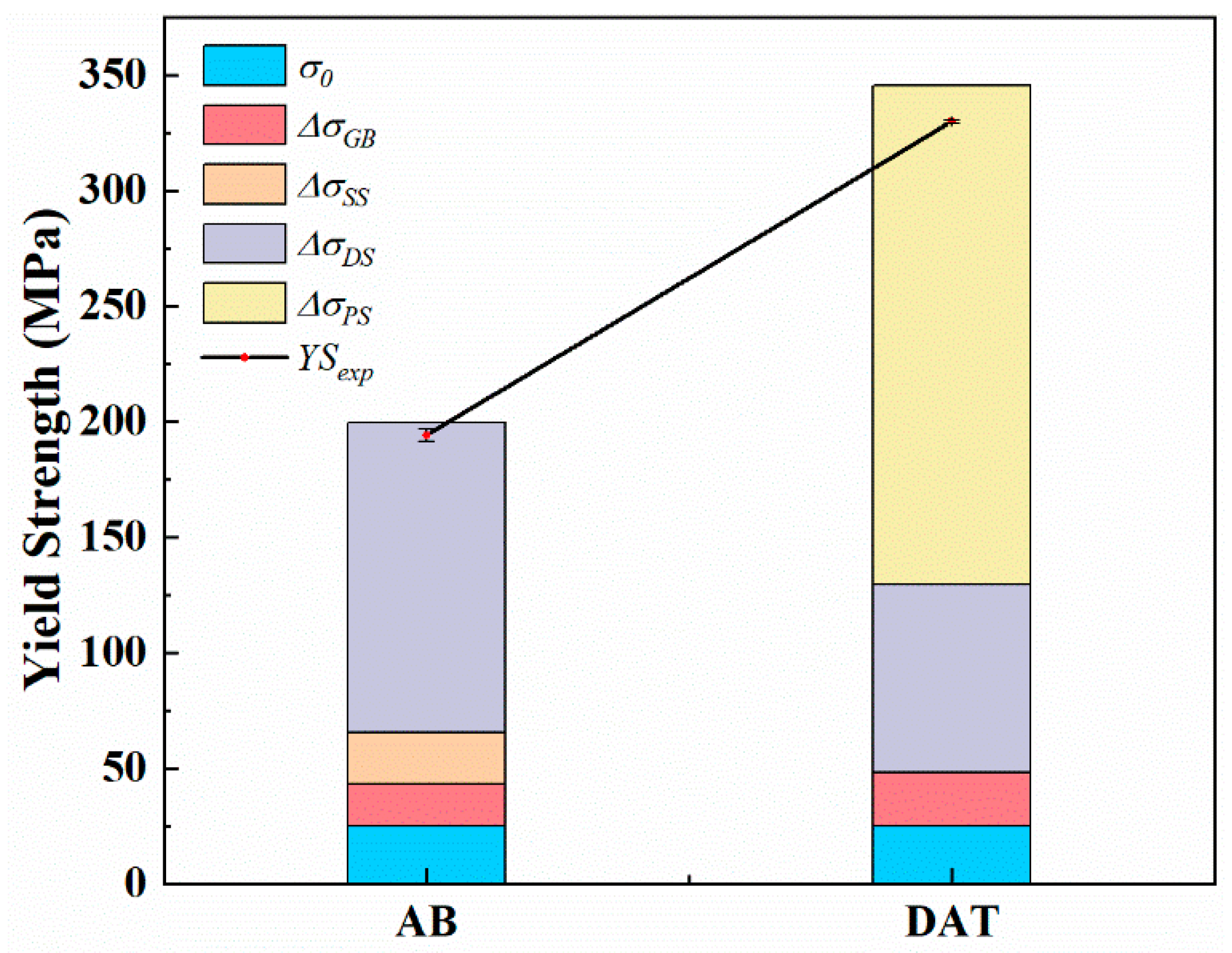
Table 7 comprehensively summarizes the theoretically calculated contributions of various strengthening mechanisms and the experimentally measured yield strengths for the AB and DAT specimens. To visually compare the strengthening effects, the calculated and experimentally measured yield strengths are plotted in a stacked column chart (Figure 14).
Regarding the AB specimen, the theoretical yield strength is calculated to be 199.64 MPa, which agrees well with the experimentally measured value of 193.95 MPa. As shown in Figure 14, the high strength of the AB state is dominated by dislocation strengthening (134.14 MPa). This indicates that rapid solidification during the LPBF process produces a high density of dislocations, which act as the main strengthening source before heat treatment.
In contrast, for the DAT specimen, the computed total yield strength is 345.39 MPa, showing good agreement with the experimental value of 329.68 MPa. The small calculation error verifies the reliability of the theoretical model. A pronounced transition in the dominant strengthening mechanism occurs after heat treatment. The key advantage of the LPBF process lies in its high initial dislocation density. In conventional manufacturing processes, high-temperature heat treatment usually leads to extensive annihilation of dislocations, resulting in the loss of the dislocation-strengthening contribution. The precipitation of semi-coherent BCC Cr phases not only provides a notable strengthening contribution of 216.10 MPa, but also generates strong elastic misfit strain fields that act as pinning centers. These local strain fields can effectively pin the pre-existing high-density dislocation network, hindering their complete annihilation under heat treatment. Therefore, the high strength of the DAT specimen originates from this synergistic effect of the microstructure: the pronounced Orowan precipitation strengthening is combined with the well-retained dislocation strengthening, with more than 60% of the initial dislocation strengthening contribution from the AB specimen preserved. This indicates that quantitative deconvolution of these coexisting mechanisms enables precise clarity of the micromechanical origins of the strength–conductivity synergy in additive-manufactured copper alloys.
From the perspective of industrial application, the DAT route completely eliminates the conventional high-temperature solution treatment and the subsequent water quenching step, which substantially reduces the overall manufacturing cost, energy consumption and post-processing cycle. Furthermore, removing rapid water quenching from high temperatures avoids the risk of warping or cracking induced by thermal stress. This enables complex parts to meet strict dimensional tolerance requirements [68]. As a single-step and low-temperature heat treatment, this process features a simplified metallurgical route. It ensures uniform thermal fields in industrial furnaces and substantially improves process reproducibility across different production batches. Consequently, this process offers multiple advantages in cost control, dimensional accuracy, and process stability. It demonstrates great potential for the large-scale LPBF production of high-temperature thermal management components.

5. Conclusions

This study developed a comprehensive strategy combining a statistical process optimization with subsequent heat treatments to fabricate high-performance CuCrZr alloys via LPBF. The underlying correlations among process parameters, microstructural evolution, and quantitative physical mechanisms were systematically elucidated. The main conclusions are as follows:
(1)
Based on the process parameters optimized by the response surface methodology (RSM), a CuCrZr alloy with near-fully densification (99.25%) was successfully fabricated, providing a sound microstructural foundation for the subsequent direct ageing treatment (DAT, 490 °C for 60 min). This enables the material to achieve a notable ultimate tensile strength of 399.31 ± 2.85 MPa and a thermal conductivity of 326.53 ± 0.40 W/(m·K).
(2)
Compared with the high-temperature solution treatment, where recrystallization and grain coarsening may occur, the low-temperature direct ageing treatment preserves high-density dislocation structures by bypassing this high-temperature process. Meanwhile, the precipitation of supersaturated Cr atoms substantially reduces lattice distortion, reducing electron scattering and restoring the thermal transport capability of the alloy.
(3)
Quantitative analysis indicates that the high yield strength of the DAT specimens is achieved through a synergistic strengthening mechanism. Within this mechanism, nanoscale BCC Cr precipitates form semi-coherent interfaces with a crystallographic misorientation of approximately 10.5° relative to the FCC Cu matrix. The local elastic strain fields exerted by these semi-coherent interfaces likely act as pinning obstacles to the movement of retained dislocations. This synergy combines the notable Orowan precipitation strengthening (~216.10 MPa) and partially retained dislocation strengthening (~81.36 MPa), preserving roughly 60% of the original dislocation-strengthening contribution from the as-built state.

Author Contributions

Z.Z.: Writing—original draft, investigation, formal analysis, data curation. Q.Y.: Methodology, formal analysis, data curation. C.Z.: Formal analysis, data curation. D.D.: Formal analysis. Y.B.: Writing—review and editing, resources, investigation, funding acquisition, conceptualization. F.P.: Writing—review and editing, formal analysis. All authors have read and agreed to the published version of the manuscript.

Funding

This work was supported under Guangdong Basic and Applied Basic Research Foundation (2023A1515110594, 2024A1515012049), China Postdoctoral Science Foundation (Grant No. 2025M774302), Shenzhen Science and Technology Program (Nos. JCYJ20241202123701003, JCYJ20250604145712017), and Guangdong Province Pearl River Talent Program—Young Top Talent Program (No. 507304475005).

Institutional Review Board Statement

Not applicable.

Informed Consent Statement

Not applicable.

Data Availability Statement

The original contributions presented in this study are included in the article. Further inquiries can be directed to the corresponding authors.

Conflicts of Interest

The authors declare that they have no known competing financial interests or personal relationships that could have appeared to influence the work reported in this paper.

References

  1. Shoukr, D.; Morcos, P.; Sundermann, T.; Dobrowolski, T.; Yates, C.; Jain, J.R.; Arróyave, R.; Karaman, I.; Elwany, A. Influence of layer thickness on the printability of nickel alloy 718:A systematic process optimization framework. Addit. Manuf. 2023, 73, 103646. [Google Scholar] [CrossRef]
  2. Thompson, S.M.; Bian, L.; Shamsaei, N.; Yadollahi, A. An overview of Direct Laser Deposition for additive manufacturing; Part I: Transport phenomena, modeling and diagnostics. Addit. Manuf. 2015, 8, 36–62. [Google Scholar] [CrossRef]
  3. Gu, D.D.; Meiners, W.; Wissenbach, K.; Poprawe, R. Laser additive manufacturing of metallic components: Materials, processes and mechanisms. Int. Mater. Rev. 2012, 57, 133–164. [Google Scholar] [CrossRef]
  4. Song, J.; Tang, Q.; Feng, Q.; Ma, S.; Setchi, R.; Liu, Y.; Han, Q.; Fan, X.; Zhang, M. Effect of heat treatment on microstructure and mechanical behaviours of 18Ni-300 maraging steel manufactured by selective laser melting. Opt. Laser Technol. 2019, 120, 105725. [Google Scholar] [CrossRef]
  5. Wang, Z.; Jiang, B.; Wu, S.; Liu, W. Anisotropic tension-compression asymmetry in SLM 316L stainless steel. Int. J. Mech. Sci. 2023, 246, 108139. [Google Scholar] [CrossRef]
  6. Tang, M.; Zhang, L.; Zhang, N. Microstructural evolution, mechanical and tribological properties of TiC/Ti6Al4V composites with unique microstructure prepared by SLM. Mater. Sci. Eng. A 2021, 814, 141187. [Google Scholar] [CrossRef]
  7. Wu, H.; Ren, Y.; Ren, J.; Liang, L.; Li, R.; Fang, Q.; Cai, A.; Shan, Q.; Tian, Y.; Baker, I. Selective laser melted AlSi10Mg alloy under melting mode transition: Microstructure evolution, nanomechanical behaviors and tensile properties. J. Alloys Compd. 2021, 873, 159823. [Google Scholar] [CrossRef]
  8. Li, J.; Liu, Z.; Zhou, H.; Ye, S.; Zhang, Y.; Liu, T.; Jiang, D.; Chen, L.; Zhou, R. Effect of Process Parameters on the Microstructure and Properties of Cu–Cr–Nb–Ti Alloy Manufactured by Selective Laser Melting. Materials 2023, 16, 2912. [Google Scholar] [CrossRef]
  9. Zhao, C.; Bai, Y.; Yan, Q.; Guo, Y.; Liu, Y.; Li, B. Microstructure evolution and enhanced corrosion resistance of additively manufactured 316L/18Ni300 multi-material parts by process optimization and heat treatment. J. Mater. Res. Technol. 2026, 40, 1882–1895. [Google Scholar] [CrossRef]
  10. Qin, Z.; Kang, N.; Mansori, M.E. Enhanced fatigue resistance through preheating control of additively manufactured H13 steel. Addit. Manuf. Front. 2025, 4, 200231. [Google Scholar] [CrossRef]
  11. Ordás, N.; Portolés, L.; Azpeleta, M.; Gómez, A.; Blasco, J.R.; Martinez, M.; Ureña, J.; Iturriza, I. Development of CuCrZr via Electron Beam Powder Bed Fusion (EB-PBF). J. Nucl. Mater. 2021, 548, 152841. [Google Scholar] [CrossRef]
  12. Wang, X.; Yao, P.; Li, Y.; Zhou, H.; Xiao, Y.; Deng, M.; Kang, L.; Zhou, P. Effects of material transfer evolution on tribological behavior in CuCrZr alloy paired with 7075 Al alloy under current-carrying. Tribol. Int. 2023, 179, 107960. [Google Scholar] [CrossRef]
  13. Zhang, Q.; Tang, X.; Liu, B.; Li, Z.; Bi, J.; Li, Y.; Huo, W.; Wei, M.; Yang, H.; Bai, P. Effect of heat treatment on mechanical properties of CuCrZr triply periodic minimal surface structures fabricated by selective laser melting. J. Mater. Res. Technol. 2023, 27, 7839–7851. [Google Scholar] [CrossRef]
  14. Mao, Q.; Liu, Y.; Zhao, Y. A review on copper alloys with high strength and high electrical conductivity. J. Alloys Compd. 2024, 990, 174456. [Google Scholar] [CrossRef]
  15. Kuai, Z.; Li, Z.; Liu, B.; Chen, Y.; Lu, S.; Tang, X.; Liu, T. Selective laser melting of CuCrZr alloy: Processing optimisation, microstructure and mechanical properties. J. Mater. Res. Technol. 2022, 19, 4915–4931. [Google Scholar] [CrossRef]
  16. Li, R.; Guo, E.; Chen, Z.; Kang, H.; Wang, W.; Zou, C.; Li, T.; Wang, T. Optimization of the balance between high strength and high electrical conductivity in CuCrZr alloys through two-step cryorolling and aging. J. Alloys Compd. 2019, 771, 1044–1051. [Google Scholar] [CrossRef]
  17. Sun, F.; Liu, P.; Chen, X.; Zhou, H.; Guan, P.; Zhu, B. Mechanical Properties of High-Strength Cu–Cr–Zr Alloy Fabricated by Selective Laser Melting. Materials 2020, 13, 5028. [Google Scholar] [CrossRef] [PubMed]
  18. Li, S.; Fu, G.; Li, H.; Ren, Z.; Li, S.; Xiao, H.; Peng, Q. Effect of layer thickness on the melt pool behavior and pore defects evolution of selective laser melting CuCrZr alloy. J. Alloys Compd. 2023, 967, 171778. [Google Scholar] [CrossRef]
  19. Kuai, Z.; Zhang, P.; Wu, H.; Li, Z.; Liu, B.; Suo, C.; Yang, Z.; Ren, J. Effect of plasma electrolytic polishing on the surface morphology and mechanical properties of CuCrZr porous structure fabricated by selective laser melting. J. Mater. Res. Technol. 2025, 35, 4315–4326. [Google Scholar] [CrossRef]
  20. Lassègue, P.; Salvan, C.; De Vito, E.; Soulas, R.; Herbin, M.; Hemberg, A.; Godfroid, T.; Baffie, T.; Roux, G. Laser powder bed fusion (L-PBF) of Cu and CuCrZr parts: Influence of an absorptive physical vapor deposition (PVD) coating on the printing process. Addit. Manuf. 2021, 39, 101888. [Google Scholar] [CrossRef]
  21. Ma, Z.; Zhang, K.; Ren, Z.; Zhang, D.Z.; Tao, G.; Xu, H. Selective laser melting of Cu–Cr–Zr copper alloy: Parameter optimization, microstructure and mechanical properties. J. Alloys Compd. 2020, 828, 154350. [Google Scholar] [CrossRef]
  22. Guan, P.; Chen, X.; Liu, P.; Sun, F.; Zhu, C.; Zhou, H.; Fu, S.; Wu, Z.; Zhu, Y. Effect of selective laser melting process parameters and aging heat treatment on properties of CuCrZr alloy. Mater. Res. Express 2019, 6, 1165c1. [Google Scholar] [CrossRef]
  23. Salvan, C.; Briottet, L.; Baffie, T.; Guetaz, L.; Flament, C. CuCrZr alloy produced by laser powder bed fusion: Microstructure, nanoscale strengthening mechanisms, electrical and mechanical properties. Mater. Sci. Eng. A 2021, 826, 141915. [Google Scholar] [CrossRef]
  24. Tang, X.; Chen, X.; Sun, F.; Li, L.; Liu, P.; Zhou, H.; Fu, S.; Li, A. A study on the mechanical and electrical properties of high-strength CuCrZr alloy fabricated using laser powder bed fusion. J. Alloys Compd. 2022, 924, 166627. [Google Scholar] [CrossRef]
  25. Wang, Q.; Zhang, Y.; Wang, K.; Liu, S.; Zhang, X.; Shao, H. Effect of process parameters and heat treatment on the microstructure and properties of CuCrZr alloy by selective laser melting. Mater. Sci. Eng. A 2022, 857, 144054. [Google Scholar] [CrossRef]
  26. Shamsaei, N.; Yadollahi, A.; Bian, L.; Thompson, S.M. An overview of Direct Laser Deposition for additive manufacturing; Part II: Mechanical behavior, process parameter optimization and control. Addit. Manuf. 2015, 8, 12–35. [Google Scholar] [CrossRef]
  27. Chia, H.Y.; Wu, J.; Wang, X.; Yan, W. Process parameter optimization of metal additive manufacturing: A review and outlook. J. Mater. Inform. 2022, 2, 16. [Google Scholar] [CrossRef]
  28. Elsayed, M.; Ghazy, M.; Youssef, Y.; Essa, K. Optimization of SLM process parameters for Ti6Al4V medical implants. Rapid Prototyp. J. 2019, 25, 433–447. [Google Scholar] [CrossRef]
  29. Oyesola, M.; Mpofu, K.; Mathe, N.; Fatoba, S.; Hoosain, S.; Daniyan, I. Optimization of selective laser melting process parameters for surface quality performance of the fabricated Ti6Al4V. Int. J. Adv. Manuf. Technol. 2021, 114, 1585–1599. [Google Scholar] [CrossRef]
  30. Wallis, C.; Buchmayr, B. Effect of heat treatments on microstructure and properties of CuCrZr produced by laser-powder bed fusion. Mater. Sci. Eng. A 2019, 744, 215–223. [Google Scholar] [CrossRef]
  31. Wang, Q.; Song, J.; Wang, W.; Zhang, Y.; Wang, K.; Du, Z. The Influence of Heat Treatment on Microstructure and Properties of Selective Laser Melting CuCrZr Alloy. Adv. Eng. Mater. 2024, 26, 2301680. [Google Scholar] [CrossRef]
  32. Bai, Y.; Zhao, C.; Zhang, Y.; Chen, J.; Wang, H. Additively manufactured CuCrZr alloy: Microstructure, mechanical properties and machinability. Mater. Sci. Eng. A 2021, 819, 141528. [Google Scholar] [CrossRef]
  33. Parker, W.J.; Jenkins, R.J.; Butler, C.P.; Abbott, G.L. Flash Method of Determining Thermal Diffusivity, Heat Capacity, and Thermal Conductivity. J. Appl. Phys. 1961, 32, 1679–1684. [Google Scholar] [CrossRef]
  34. Cavazzuti, M. Optimization Methods: From Theory to Design Scientific and Technological Aspects in Mechanics; Springer: Berlin/Heidelberg, Germany, 2013. [Google Scholar]
  35. Myers, R.H.; Montgomery, D.C.; Anderson-Cook, C. Response Surface Methodology: Process and Product Optimization Using Designed Experiments; John Wiley & Sons: Hoboken, NJ, USA, 2016; Volume 705. [Google Scholar]
  36. Tang, X.; Chen, X.; Sun, F.; Liu, P.; Zhou, H.; Fu, S. The current state of CuCrZr and CuCrNb alloys manufactured by additive manufacturing: A review. Mater. Des. 2022, 224, 111419. [Google Scholar] [CrossRef]
  37. Fang, X.; Xia, W.; Wei, Q.; Wu, Y.; Lv, W.; Guo, W. Preparation of Cu-Cr-Zr Alloy by Laser Powder Bed Fusion: Parameter Optimization, Microstructure, Mechanical and Thermal Properties for Microelectronic Applications. Metals 2021, 11, 1410. [Google Scholar] [CrossRef]
  38. Schröder, J.; Evans, A.; Mishurova, T.; Ulbricht, A.; Sprengel, M.; Serrano-Munoz, I.; Fritsch, T.; Kromm, A.; Kannengießer, T.; Bruno, G. Diffraction-Based Residual Stress Characterization in Laser Additive Manufacturing of Metals. Metals 2021, 11, 1830. [Google Scholar] [CrossRef]
  39. Zhang, S.; Zhu, H.; Zhang, L.; Zhang, W.; Yang, H.; Zeng, X. Microstructure and properties of high strength and high conductivity Cu-Cr alloy components fabricated by high power selective laser melting. Mater. Lett. 2019, 237, 306–309. [Google Scholar] [CrossRef]
  40. Zhang, Z.Y.; Sun, L.X.; Tao, N.R. Nanostructures and nanoprecipitates induce high strength and high electrical conductivity in a CuCrZr alloy. J. Mater. Sci. Technol. 2020, 48, 18–22. [Google Scholar] [CrossRef]
  41. Yang, H.; Li, K.; Bu, Y.; Wu, J.; Fang, Y.; Meng, L.; Liu, J.; Wang, H. Nanoprecipitates induced dislocation pinning and multiplication strategy for designing high strength, plasticity and conductivity Cu alloys. Scr. Mater. 2021, 195, 113741. [Google Scholar] [CrossRef]
  42. Siu, M.C.I.; Carroll, W.L.; Watson, T.W. Thermal Conductivity and Electrical Resistivity of Six Copper-Base Alloys; NBS IR 76-1003; National Bureau of Standards: Gaithersburg, MD, USA, 1976. [Google Scholar]
  43. Oh, W.-J.; Son, Y.; Kim, D.-H.; Kim, C.-S. High-power laser powder bed fusion of pure copper for simultaneous achievement of high density and electrical conductivity. Sci. Rep. 2025, 16, 2372. [Google Scholar] [CrossRef] [PubMed]
  44. Yang, X.; Qi, Y.; Zhang, W.; Wang, Y.; Zhu, H. Laser powder bed fusion of C18150 copper alloy with excellent comprehensive properties. Mater. Sci. Eng. A 2023, 862, 144512. [Google Scholar] [CrossRef]
  45. Chbihi, A.; Sauvage, X.; Blavette, D. Atomic scale investigation of Cr precipitation in copper. Acta Mater. 2012, 60, 4575–4585. [Google Scholar] [CrossRef]
  46. Fujii, T.; Nakazawa, H.; Kato, M.; Dahmen, U. Crystallography and morphology of nanosized Cr particles in a Cu–0.2% Cr alloy. Acta Mater. 2000, 48, 1033–1045. [Google Scholar] [CrossRef]
  47. Dahmen, U. Orientation relationships in precipitation systems. Acta Metall. 1982, 30, 63–73. [Google Scholar] [CrossRef]
  48. Zeng, C.; Wen, H.; Bernard, B.C.; Raush, J.R.; Gradl, P.R.; Khonsari, M.; Guo, S.M. Effect of temperature history on thermal properties of additively manufactured C-18150 alloy samples. Manuf. Lett. 2021, 28, 25–29. [Google Scholar] [CrossRef]
  49. Ye, S.; Liu, Z.; Feng, X.; Zhang, Y.; Jiang, D.; Liu, T.; Zhou, R. Heterostructure and multiple nano-phases achieve superior strength-ductility-conductivity synergy of laser additive manufacturing copper alloy. Virtual Phys. Prototyp. 2025, 20, e2437467. [Google Scholar] [CrossRef]
  50. Starink, M.J.; Wang, S.C. A model for the yield strength of overaged Al–Zn–Mg–Cu alloys. Acta Mater. 2003, 51, 5131–5150. [Google Scholar] [CrossRef]
  51. Zhang, S.; Zhu, H.; Zhang, L.; Zhang, W.; Yang, H.; Zeng, X. Microstructure and properties in QCr0.8 alloy produced by selective laser melting with different heat treatment. J. Alloys Compd. 2019, 800, 286–293. [Google Scholar] [CrossRef]
  52. Liu, Y.; Li, Z.; Jiang, Y.; Zhang, Y.; Zhou, Z.; Lei, Q. The microstructure evolution and properties of a Cu–Cr–Ag alloy during thermal-mechanical treatment. J. Mater. Res. 2017, 32, 1324–1332. [Google Scholar] [CrossRef]
  53. Huang, S.; Huang, W.; Xie, W.; Chen, H.; Wang, H.; Yang, B. Microstructure and strengthening mechanisms of CuCrZr alloy by two-step thermomechanical treatment. J. Mater. Sci. Mater. Electron. 2020, 31, 17798–17809. [Google Scholar] [CrossRef]
  54. Lei, Q.; Li, Z.; Zhu, A.; Qiu, W.; Liang, S. The transformation behavior of Cu–8.0Ni–1.8Si–0.6Sn–0.15Mg alloy during isothermal heat treatment. Mater. Charact. 2011, 62, 904–911. [Google Scholar] [CrossRef]
  55. Hansen, N. Hall–Petch relation and boundary strengthening. Scr. Mater. 2004, 51, 801–806. [Google Scholar] [CrossRef]
  56. Zisman, A.A.; Zolotorevsky, N.Y.; Petrov, S.N.; Ganin, S.V.; Ushanova, E.A.; Fedoseev, M.L. EBSD with fine steps versus XRD in evaluating the density of statistically stored dislocations: Comparison on cold rolled and annealed copper states. Lett. Mater. 2025, 15, 3–7. [Google Scholar] [CrossRef]
  57. Ungár, T. Microstructural parameters from X-ray diffraction peak broadening. Scr. Mater. 2004, 51, 777–781. [Google Scholar] [CrossRef]
  58. Gallet, J.; Perez, M.; Guillou, R.; Ernould, C.; Le Bourlot, C.; Langlois, C.; Beausir, B.; Bouzy, E.; Chaise, T.; Cazottes, S. Experimental measurement of dislocation density in metallic materials: A quantitative comparison between measurements techniques (XRD, R-ECCI, HR-EBSD, TEM). Mater. Charact. 2023, 199, 112842. [Google Scholar] [CrossRef]
  59. Takaki, S.; Jiang, F.; Masumura, T.; Tsuchiyama, T. Correction of Elastic Anisotropy in Williamson-Hall Plots by Diffraction Young’s Modulus and Direct Fitting Method. ISIJ Int. 2018, 58, 769–775. [Google Scholar] [CrossRef]
  60. Fu, S.; Liu, P.; Chen, X.; Zhou, H.; Ma, F.; Li, W.; Zhang, K. Effect of aging process on the microstructure and properties of Cu–Cr–Ti alloy. Mater. Sci. Eng. A 2021, 802, 140598. [Google Scholar] [CrossRef]
  61. Raabe, D. Recovery and Recrystallization: Phenomena, Physics, Models, Simulation. In Physical Metallurgy; Elsevier: Amsterdam, The Netherlands, 2014; pp. 2291–2397. [Google Scholar]
  62. Salman, O.O.; Gammer, C.; Chaubey, A.K.; Eckert, J.; Scudino, S. Effect of heat treatment on microstructure and mechanical properties of 316L steel synthesized by selective laser melting. Mater. Sci. Eng. A 2019, 748, 205–212. [Google Scholar] [CrossRef]
  63. Wu, Y.; Li, Y.; Lu, J.; Tan, S.; Jiang, F.; Sun, J. Correlations between microstructures and properties of Cu-Ni-Si-Cr alloy. Mater. Sci. Eng. A 2018, 731, 403–412. [Google Scholar] [CrossRef]
  64. Li, Z.a.; Zhou, M.; Jing, K.; Liu, Y.; Xin, G.a.; Hu, H.; Zou, J.; Tian, B.; Zhang, Y.; Li, X.; et al. Effects of different Cr contents on microstructure, mechanical and electrical properties of Cu-Zr-Cr alloy. Mater. Today Commun. 2024, 38, 108408. [Google Scholar] [CrossRef]
  65. Peng, L.; Xie, H.; Huang, G.; Xu, G.; Yin, X.; Feng, X.; Mi, X.; Yang, Z. The phase transformation and strengthening of a Cu-0.71 wt% Cr alloy. J. Alloys Compd. 2017, 708, 1096–1102. [Google Scholar] [CrossRef]
  66. Mabuchi, M.; Higashi, K. Strengthening mechanisms of Mg Si alloys. Acta Mater. 1996, 44, 4611–4618. [Google Scholar] [CrossRef]
  67. Ardell, A.J. Precipitation hardening. Metall. Trans. A 1985, 16, 2131–2165. [Google Scholar] [CrossRef]
  68. Schimbäck, D.; Kaserer, L.; Mair, P.; Mohebbi, M.S.; Staron, P.; Maier-Kiener, V.; Letofsky-Papst, I.; Kremmer, T.; Palm, F.; Montes, I.; et al. Advancements in metal additive manufacturing: In-situ heat treatment of aluminium alloys during the laser powder bed fusion process. Mater. Sci. Eng. A 2024, 905, 146102. [Google Scholar] [CrossRef]
Figure 1. SEM images of (a,b) the initial powders with corresponding (c) energy-dispersive X-ray spectrometry spectrum.
Coatings 16 00705 g001
Figure 2. Schematic diagrams for (a) scanning strategy, (b) heat treatment protocols of LPBF-fabricated CuCrZr alloy and (c) dimensions of tensile specimens.
Coatings 16 00705 g002
Figure 3. CCD experimental analysis results: (a) Normal probability plot of residuals, (b) residuals versus predicted values, (c) response surface plot of the interaction between laser power, scanning speed, and relative density, (d) response surface plot of the interaction between laser power, hatch spacing, and relative density.
Coatings 16 00705 g003
Figure 4. OM images of CuCrZr alloys under different heat treatments: (a) AB, (b) ST, (c) SAT, and (d) DAT.
Coatings 16 00705 g004
Figure 5. SEM images of CuCrZr alloy fabricated by LPBF: (ac) AB, (df) ST, (gi) SAT, and (jl) DAT.
Coatings 16 00705 g005
Figure 6. XRD patterns of LPBF-fabricated CuCrZr alloy: (a) full range, (b) magnified view showing peak shifts.
Coatings 16 00705 g006
Figure 7. IPF maps: (a) AB, (b) ST, (c) SAT, (d) DAT samples.
Coatings 16 00705 g007
Figure 8. Grain size distribution histograms: (a) AB, (b) ST, (c) SAT, (d) DAT.
Coatings 16 00705 g008
Figure 9. Properties of LPBF-fabricated CuCrZr alloy under different heat-treated conditions: (a) Vickers microhardness, (b) morphologies after tensile tests, (c) engineering stress–strain curves, and (d) tensile strength.
Coatings 16 00705 g009
Figure 10. Tensile fracture morphologies of LPBF-fabricated CuCrZr alloy observed by SEM: (ac) AB, (df) ST, (gi) SAT, and (jl) DAT.
Coatings 16 00705 g010
Figure 11. Comparison of ultimate tensile strength and thermal conductivity between the present and reported LPBF CuCrZr alloys [22,25,30,44].
Coatings 16 00705 g011
Figure 12. STEM-EDS elemental mapping of the DAT specimen, showing the dispersed distribution of nanoscale Cr precipitates in the Cu matrix: (a) all elements, (b) Cu element, (c) Cr element, and (d) Zr element.
Coatings 16 00705 g012
Figure 13. (a) Bright-field (BF) TEM image of the nanoscale Cr precipitates in the DAT specimen; (b) HRTEM image highlighting the semi-coherent interface with Moiré fringes and corresponding FFT pattern.
Coatings 16 00705 g013
Figure 14. Comparison between the theoretically calculated strengthening contributions and the experimentally measured yield strengths for the AB and DAT specimens.
Coatings 16 00705 g014
Table 1. Influencing factors and levels for response surface methodology.
Influencing FactorsLevel
−1.68−1011.68
Laser power (W)215.91250300350384.09
Scanning speed (mm/s)63.64200400600736.36
Hatch spacing (μm)73.188090100106.82
Table 2. Experiment design and results for response surface methodology.
Experiment NumberLaser Power (W)Scanning Speed (mm/s)Hatch Spacing (μm)Relative Density (%)
12502008096.98
22506008094.34
33502008098.31
43506008097.03
525020010095.47
625060010092.45
735020010097.52
835060010097.12
930063.649097.57
10300736.369095.23
11215.914009092.39
12384.094009098.13
1330040073.1896.53
14300400106.8296.18
153004009096.89
163004009096.85
173004009096.08
183004009096.56
193004009096.89
203004009096.80
Table 3. Analysis of Variance (ANOVA) for the model.
SourceSum of SquaresdfMean SquareF-Valuep-Value
Model47.2767.8848.43<0.0001significant
P30.48130.48187.35<0.0001 
v9.3019.3057.20<0.0001 
h1.6111.619.870.0078 
P × v1.9911.9912.250.0039 
P × h0.904410.90445.560.0347 
P22.9812.9818.330.0009 
Residual2.11130.1627   
Lack-of-fit1.6280.20192.020.2271not significant
Pure Error0.499250.0998   
Total49.3819    
Table 4. Thermal conductivity and calculated electrical conductivity of LPBF-fabricated CuCrZr alloy.
SampleThermal Conductivity [W/(m·K)]Calculated Electrical Conductivity (% IACS)
AB122.01 ± 2.4427.7
ST192.03 ± 1.5844.6
SAT310.58 ± 2.3973.3
DAT326.53 ± 0.4077.2
Table 7. Calculated strengthening contributions and comparison with the experimental yield strength.
Specimen σ G B (MPa) σ S S (MPa) σ D S (MPa) σ P S (MPa)Calculated YS (MPa)Average Experimental YS (MPa)Error (%)
AB18.2522.25134.140199.64193.952.9
DAT22.92081.36216.10345.39329.684.8
Disclaimer/Publisher’s Note: The statements, opinions and data contained in all publications are solely those of the individual author(s) and contributor(s) and not of MDPI and/or the editor(s). MDPI and/or the editor(s) disclaim responsibility for any injury to people or property resulting from any ideas, methods, instructions or products referred to in the content.