Silver Nanowire-Based Flexible Transparent Electrodes: Fabrication and Applications

Abstract
1. Introduction
2. Post-Treatment Techniques for Reducing the Contact Resistance
2.1. Thermal Annealing
2.2. Photonic Sintering
2.3. Laser Sintering
2.4. Electrodeposition Welding
3. Protective Coating Layers for Improving Stability
3.1. Metal Oxides
3.2. Noble Metals
3.3. PEDOT:PSS
4. Applications
4.1. OLEDs
4.2. Heaters
4.3. Electrochromic Devices
5. Conclusions
Funding
Institutional Review Board Statement
Informed Consent Statement
Data Availability Statement
Acknowledgments
Conflicts of Interest
References
- Zhu, Z.; Pang, Y.; Li, Y.; Gu, Y.; Wang, X.; Yu, A.; Liu, B.; Liu, S.; Huang, W.; Zhao, Q. The Rising of Flexible Organic Electrochemical Transistors in Sensors and Intelligent Circuits. ACS Nano 2025, 19, 4084–4120. [Google Scholar] [CrossRef]
- Zhao, Z.; Tian, Z.; Yan, F. Flexible organic electrochemical transistors for bioelectronics. Cell Rep. Phys. Sci. 2023, 4, 101673. [Google Scholar] [CrossRef]
- Zhou, K.; Zhou, Y.; Jia, Z.; Ding, G.; Ma, X.-Q.; Niu, W.; Yang, S.; Han, S.-T.; Zhao, J.; Zhou, Y. Single-crystal metal-organic frameworks for electronic and opto-electronic devices. Cell Rep. Phys. Sci. 2023, 4, 101656. [Google Scholar] [CrossRef]
- Zhang, H.; Jia, W.; Sun, M.; Chen, Y.; Zhang, X.; Li, H.; He, X.; Shi, P.; Xu, L. High-strength and fracture-resistant ionogels via solvent-tailored interphase cohesion in nanofibrous composite networks. Sci. Adv. 2025, 11, eaea6883. [Google Scholar] [CrossRef]
- Sun, M.; Zhang, H.; He, X.; Wei, X.; Cui, B.; Huang, H.; Li, H.; Lin, Y.; Zhang, S.; Li, Z.A.; et al. Ultrathin and ultrastrong hydrogel bioelectronic membranes. Natl. Sci. Rev. 2026, 13, nwag105. [Google Scholar] [CrossRef]
- Zhang, H.; Tian, Y. Single-atom modification strategy for highly stable electrochromism. Matter 2023, 6, 2591–2594. [Google Scholar] [CrossRef]
- Aftab, S.; Hussain, S.; Al-Kahtani, A.A. Latest Innovations in 2D Flexible Nanoelectronics. Adv. Mater. 2023, 35, 2301280. [Google Scholar] [CrossRef] [PubMed]
- Ahmed, G.; Hashim, A. Synthesis of PMMA/PEG/Si3N4 Nanostructures and Exploring the Structural and Dielectric Characteristics for Flexible Nanoelectronics Applications. Silicon 2023, 15, 3977–3985. [Google Scholar] [CrossRef]
- Ahmed, H.; Hashim, A. Design and tailoring the structural and spectroscopic characteristics of Sb2S3 nanostructures doped PMMA for flexible nanoelectronics and optical fields. Opt. Quantum Electron. 2023, 55, 280. [Google Scholar] [CrossRef]
- Tan, H.W.; Choong, Y.Y.C.; Kuo, C.N.; Low, H.Y.; Chua, C.K. 3D printed electronics: Processes, materials and future trends. Prog. Mater. Sci. 2022, 127, 100945. [Google Scholar] [CrossRef]
- Song, O.; Rhee, D.; Kim, J.; Jeon, Y.; Mazánek, V.; Söll, A.; Kwon, Y.A.; Cho, J.H.; Kim, Y.-H.; Sofer, Z. All inkjet-printed electronics based on electrochemically exfoliated two-dimensional metal, semiconductor, and dielectric. npj 2D Mater. Appl. 2022, 6, 64. [Google Scholar] [CrossRef]
- Rijo, P.C.; Vega, E.J.; Galindo-Rosales, F.J.; Montanero, J.M. On the electrohydrodynamic jet printing of two-dimensional material-based inks for printed electronics. Phys. Fluids 2024, 36, 112014. [Google Scholar] [CrossRef]
- Shen, C.; Chen, W.; Li, C.; Chen, X.; Cui, H.; Lin, L. 4D printing system stimulated by curcumin/whey protein isolate nanoparticles: A comparative study of sensitive color change and post-processing. J. Food Eng. 2023, 342, 111357. [Google Scholar]
- Li, M.; Feng, L.; Dai, Z.; Li, D.; Zhang, Z.; Zhou, C.; Yu, D. Improvement of 3D printing performance of whey protein isolate emulsion gels by regulating rheological properties: Effect of polysaccharides incorporation. Food Bioprocess Technol. 2025, 18, 633–647. [Google Scholar]
- Li, M.; Feng, L.; Xu, Y.; Nie, M.; Li, D.; Zhou, C.; Dai, Z.; Zhang, Z.; Zhang, M. Rheological property, β-carotene stability and 3D printing characteristic of whey protein isolate emulsion gels by adding different polysaccharides. Food Chem. 2023, 414, 135702. [Google Scholar] [CrossRef]
- Serbest, B.; Kara, S.G.; Alpay, R.; Ataşer, T.; Kınacı, B.; Akın Sönmez, N.; Özçelik, S. Aerosol jet printing of flexible transparent conductive silver nanowire electrodes: Effects of printing cycles. J. Electron. Mater. 2025, 54, 1245–1253. [Google Scholar]
- Guo, Z.; Yang, B.; Liang, N.; Huang, X.; Shi, J.; Li, Z.; Paximada, P.; Xiaobo, Z. 4D printing of Pickering emulsion: Temperature-driven color changes. J. Food Eng. 2025, 386, 112258. [Google Scholar] [CrossRef]
- Shukla, D.; Liu, Y.; Zhu, Y. Eco-friendly screen printing of silver nanowires for flexible and stretchable electronics. Nanoscale 2023, 15, 2767–2778. [Google Scholar] [CrossRef] [PubMed]
- Wang, S.; Wu, X.; Lu, J.; Luo, Z.; Xie, H.; Zhang, X.; Lin, K.; Wang, Y. Inkjet-printed silver nanowire ink for flexible transparent conductive film applications. Nanomaterials 2022, 12, 842. [Google Scholar] [CrossRef]
- Wang, B.; Hu, R.; Ye, D.; Pan, Y.; Huang, Y. Self-confined electrohydrodynamic printing on micro-structured substrate for flexible transparent electrodes with embedded metal mesh. Natl. Sci. Open 2025, 4, 20240016. [Google Scholar] [CrossRef]
- Zhang, L.; Song, T.; Shi, L.; Wen, N.; Wu, Z.; Sun, C.; Jiang, D.; Guo, Z. Recent progress for silver nanowires conducting film for flexible electronics. J. Nanostructure Chem. 2021, 11, 323–341. [Google Scholar] [CrossRef]
- Zhang, D.; Yin, R.; Zheng, Y.; Li, Q.; Liu, H.; Liu, C.; Shen, C. Multifunctional MXene/CNTs based flexible electronic textile with excellent strain sensing, electromagnetic interference shielding and Joule heating performances. Chem. Eng. J. 2022, 438, 135587. [Google Scholar] [CrossRef]
- Chang, C.-W.; Chen, J.-S.; Wang, C.-M.; Chang, T.-S.; Liao, W.-S. Switchable noncontinuous circuits for all pressure-range-sensitive units. Cell Rep. Phys. Sci. 2024, 5, 101887. [Google Scholar] [CrossRef]
- Bai, J.; Wang, R.; Wang, X.; Liu, S.; Wang, X.; Ma, J.; Qin, Z.; Jiao, T. Biomineral calcium-ion-mediated conductive hydrogels with high stretchability and self-adhesiveness for sensitive iontronic sensors. Cell Rep. Phys. Sci. 2021, 2, 100623. [Google Scholar]
- Liu, S.; Zhao, C.; Lin, Y.; Wen, Z. Microstructure-engineered shear thickening composites with controllable switching of rigid/flexible impact modes for adaptive protection. Compos. Part A Appl. Sci. Manuf. 2026, 206, 109750. [Google Scholar]
- Wang, K.; Zhu, J.; Zhang, R.; Ding, W.; Liu, H.; Chen, T. Magnetorheological intelligent chiral metamaterials with ultra-low frequency bandgap. Eng. Struct. 2026, 351, 122074. [Google Scholar] [CrossRef]
- Song, R.; Li, G.; Zhang, Y.; Rao, B.; Xiong, S.; He, G. Novel electrochromic materials based on chalcogenoviologens for smart windows, E-price tag and flexible display with improved reversibility and stability. Chem. Eng. J. 2021, 422, 130057. [Google Scholar] [CrossRef]
- Chen, J.; Liu, C.T. Technology Advances in Flexible Displays and Substrates. IEEE Access 2013, 1, 150–158. [Google Scholar] [CrossRef]
- Ito, H.; Oka, W.; Goto, H.; Umeda, H. Plastic Substrates for Flexible Displays. Jpn. J. Appl. Phys. 2006, 45, 4325. [Google Scholar] [CrossRef]
- Burrows, P.E.; Graff, G.L.; Gross, M.E.; Martin, P.M.; Shi, M.K.; Hall, M.; Mast, E.; Bonham, C.; Bennett, W.; Sullivan, M.B. Ultra barrier flexible substrates for flat panel displays. Displays 2001, 22, 65–69. [Google Scholar] [CrossRef]
- Zhang, H.; Wang, S.; Tian, Y.; Wen, J.; Hang, C.; Zheng, Z.; Huang, Y.; Ding, S.; Wang, C. High-efficiency extraction synthesis for high-purity copper nanowires and their applications in flexible transparent electrodes. Nano Mater. Sci. 2020, 2, 164–171. [Google Scholar] [CrossRef]
- Pagliaro, M.; Ciriminna, R.; Palmisano, G. Flexible Solar Cells. ChemSusChem 2008, 1, 880–891. [Google Scholar] [CrossRef]
- Li, X.; Li, P.; Wu, Z.; Luo, D.; Yu, H.-Y.; Lu, Z.-H. Review and perspective of materials for flexible solar cells. Mater. Rep. Energy 2021, 1, 100001. [Google Scholar] [CrossRef]
- Fu, X.; Xu, L.; Li, J.; Sun, X.; Peng, H. Flexible solar cells based on carbon nanomaterials. Carbon 2018, 139, 1063–1073. [Google Scholar] [CrossRef]
- Zhichu, C.; Tahir, M.; Muhammad, F.; Aziz, F.; Ayub, A.; Badshah, F.; Refat, M.S.; Cakmak, S.M.; Rehan, S.; Adam, A.M.A.; et al. InP/ZnS core/shell quantum dots: Synthesis, characterization and their application in fullerene derivative based flexible solar cells. Results Phys. 2025, 69, 108120. [Google Scholar] [CrossRef]
- Li, Y.; Qu, K.; Jiang, R.; Wang, H.; Zhao, X.; Yang, Z.; Tian, B.; Tao, J.; Chu, J.; Duan, C. Atomic-Scale Defect Reconfiguration via Thermally Induced Structural Ordering for High-Efficiency Sb2Se3 Solar Cells. ACS Nano 2025, 19, 33460–33472. [Google Scholar]
- Tazwar, H.T.; Antora, M.F.; Nowroj, I.; Rashid, A.B. Conductive polymer composites in soft robotics, flexible sensors and energy storage: Fabrication, applications and challenges. Biosens. Bioelectron. X 2025, 24, 100597. [Google Scholar] [CrossRef]
- Ali, S.M.; Noghanian, S.; Khan, Z.U.; Alzahrani, S.; Alharbi, S.; Alhartomi, M.; Alsulami, R. Wearable and Flexible Sensor Devices: Recent Advances in Designs, Fabrication Methods, and Applications. Sensors 2025, 25, 1377. [Google Scholar] [CrossRef] [PubMed]
- Liu, S.; Liang, X.; Su, H.; Zhang, W.; Gu, S.; Shen, J.; Chen, J.; Wu, Q.; Liu, X.; Lu, Y.; et al. Machine-learning integrated strain/pressure dual-mode flexible sensor for assistance of unable-phonation scenarios. Chem. Eng. J. 2025, 503, 158364. [Google Scholar] [CrossRef]
- Hu, W.; Wang, C.; Fei, F.; Wang, R.; Wang, J.; Tian, H.; Zhu, Y.; Zhang, H. Self-healing epoxidized natural rubber flexible sensors based on hydrogen bonding interactions. J. Mater. Chem. C 2025, 13, 1824–1834. [Google Scholar]
- Ding, S.; Chen, J.; Li, K.; Zhang, H. Fabrication strategies for metallic nanowire flexible transparent electrodes with high uniformity. J. Mater. Chem. A 2024, 12, 18815–18831. [Google Scholar] [CrossRef]
- Zhang, H.; Wang, S.; Hang, C.; Tian, Y. Joining of copper nanowires by electrodepositing silver layer for high-performance transparent electrode. Weld. World 2021, 65, 1021–1030. [Google Scholar] [CrossRef]
- Shinde, M.A.; Kim, H. Flexible electrochromic device with simple solution processed stable silver: Nanowire based transparent conductive electrodes. Synth. Met. 2019, 254, 97–105. [Google Scholar]
- Zhao, L.; Yu, S.; Li, X.; Wu, M.; Li, L. High-performance flexible transparent conductive films based on copper nanowires with electroplating welded junctions. Sol. Energy Mater. Sol. Cells 2019, 201, 110067. [Google Scholar] [CrossRef]
- Ye, S.; Rathmell, A.R.; Chen, Z.; Stewart, I.E.; Wiley, B.J. Metal nanowire networks: The next generation of transparent conductors. Adv. Mater. 2014, 26, 6670–6687. [Google Scholar] [CrossRef]
- Jiao, X.; Li, S.; Lv, Z.; Jiao, H.; He, J.; Song, J. Advances of indium tin oxide in catalysis and cell. Mater. Today Commun. 2025, 44, 112058. [Google Scholar] [CrossRef]
- Cairns, D.R.; Witte, R.P., II; Sparacin, D.K.; Sachsman, S.M.; Paine, D.C.; Crawford, G.P.; Newton, R.R. Strain-dependent electrical resistance of tin-doped indium oxide on polymer substrates. Appl. Phys. Lett. 2000, 76, 1425–1427. [Google Scholar] [CrossRef]
- Ranka, A.; Layek, M.; Kochiyama, S.; López-Pernia, C.; Chandler, A.M.; Kocoj, C.A.; Magliano, E.; Di Carlo, A.; Brunetti, F.; Guo, P.; et al. Cracking in polymer substrates for flexible electronic devices and its mitigation. npj Flex. Electron. 2025, 9, 92. [Google Scholar] [CrossRef]
- Brochu, P.; Stoyanov, H.; Chang, R.; Niu, X.; Hu, W.; Pei, Q. Capacitive Energy Harvesting Using Highly Stretchable Silicone–Carbon Nanotube Composite Electrodes. Adv. Energy Mater. 2014, 4, 1300659. [Google Scholar]
- Xu, F.; Zhu, Y. Highly Conductive and Stretchable Silver Nanowire Conductors. Adv. Mater. 2012, 24, 5117–5122. [Google Scholar] [CrossRef]
- Duong, T.-H.; Tran, N.-H.; Kim, H.-C. Low cost fabrication of flexible transparent electrodes using copper nanowires. Thin Solid Films 2017, 622, 17–22. [Google Scholar] [CrossRef]
- Zhang, H.; Feng, J.; Sun, F.; Zhou, D.; Cao, G.; Wu, Z.; Wang, S.; Su, F.; Tian, Y.; Tian, Y. An electrochemically stable Ag@Au–Co core–shell nanowire network-based transparent conductor for flexible self-powered Zn-based electrochromic smart devices. Mater. Adv. 2023, 4, 995–1004. [Google Scholar] [CrossRef]
- Dimngaihvungi, E.; Kumar Singh, A.; Pani, B.; Kumar Singh, A.; Singh, M. Polyimide impregnated silver nanowire-titanium oxide core–shell nanostructures as ultra-stable flexible transparent electrode for multiple applications. J. Ind. Eng. Chem. 2025, 142, 262–271. [Google Scholar]
- Zuo, W.; Ding, S. Combination of electrical and photonic sintering of silver nanowires for flexible transparent electrode with high transmittance. Mater. Lett. 2025, 383, 137991. [Google Scholar] [CrossRef]
- Jeong, S.Y.; Lee, T.W.; Choi, K.C.; Jeong, E.G. Flexible Transparent Multifunctional Electrodes With Enhanced Stability for OLEDs: Integration of Electrode and Encapsulation Functions. IEEE Electron Device Lett. 2025, 46, 620–623. [Google Scholar] [CrossRef]
- Chen, X.; Liu, J.; Zhu, H.; Qiu, L.; Wang, X. Stretchable, flexible, transparent PEDOT:PSS electrodes by doping strategy. Org. Electron. 2025, 143, 107260. [Google Scholar] [CrossRef]
- Zhou, Y.; Zhao, L.; Song, Z.; Chang, C.; Yang, L.; Yu, S. Foldable and highly flexible transparent conductive electrode based on PDMS/Ag NWs/PEDOT: PSS. Opt. Mater. 2022, 126, 112175. [Google Scholar] [CrossRef]
- Guan, X.; Pan, L.; Fan, Z. Flexible, Transparent and Highly Conductive Polymer Film Electrodes for All-Solid-State Transparent Supercapacitor Applications. Membranes 2021, 11, 788. [Google Scholar]
- Zhang, W.; Xu, Y.; Zou, X. Rapid determination of cadmium in rice using an all-solid RGO-enhanced light addressable potentiometric sensor. Food Chem. 2018, 261, 1–7. [Google Scholar]
- Zhao, Y.; Ma, Y.; Zhou, R.; He, Y.; Wu, Y.; Yi, Y.; Zhu, G. Highly sensitive electrochemical detection of paraoxon ethyl in water and fruit samples based on defect-engineered graphene nanoribbons modified electrode. J. Food Meas. Charact. 2022, 16, 2596–2603. [Google Scholar] [CrossRef]
- Xu, Y.; Liu, J. Graphene as transparent electrodes: Fabrication and new emerging applications. Small 2016, 12, 1400–1419. [Google Scholar] [CrossRef]
- Kamel, M.S.A.; Oelgemöller, M.; Jacob, M.V. Chemical vapor deposition-grown graphene transparent conducting electrode for organic photovoltaics: Advances towards scalable transfer-free synthesis. Renew. Sustain. Energy Rev. 2024, 203, 114740. [Google Scholar]
- Ali, A.Y.; Holmes, N.P.; Ameri, M.; Feron, K.; Thameel, M.N.; Barr, M.G.; Fahy, A.; Holdsworth, J.; Belcher, W.; Dastoor, P.; et al. Low-temperature CVD-grown graphene thin films as transparent electrode for organic photovoltaics. Coatings 2022, 12, 681. [Google Scholar] [CrossRef]
- Ullah, S.; Yang, X.; Ta, H.Q.; Hasan, M.; Bachmatiuk, A.; Tokarska, K.; Trzebicka, B.; Fu, L.; Rummeli, M.H. Graphene transfer methods: A review. Nano Res. 2021, 14, 3756–3772. [Google Scholar] [CrossRef]
- Zeng, K.; Wei, W.; Jiang, L.; Zhu, F.; Du, D. Use of carbon nanotubes as a solid support to establish quantitative (centrifugation) and qualitative (filtration) immunoassays to detect gentamicin contamination in commercial milk. J. Agric. Food Chem. 2016, 64, 7874–7881. [Google Scholar] [CrossRef]
- Ma, S.; Wang, M.; You, T.; Wang, K. Using Magnetic Multiwalled Carbon Nanotubes as Modified QuEChERS Adsorbent for Simultaneous Determination of Multiple Mycotoxins in Grains by UPLC-MS/MS. J. Agric. Food Chem. 2019, 67, 8035–8044. [Google Scholar] [CrossRef]
- Wang, X.; Xu, Y.; Li, Y.; Li, Y.; Li, Z.; Zhang, W.; Zou, X.; Shi, J.; Huang, X.; Liu, C.; et al. Rapid detection of cadmium ions in meat by a multi-walled carbon nanotubes enhanced metal-organic framework modified electrochemical sensor. Food Chem. 2021, 357, 129762. [Google Scholar] [CrossRef] [PubMed]
- Zeng, K.; Chen, B.; Li, Y.; Meng, H.; Wu, Q.; Yang, J.; Liang, H. Gold nanoparticle-carbon nanotube nanohybrids with peroxidase-like activity for the highly-sensitive immunoassay of kanamycin in milk. Int. J. Food Sci. Technol. 2022, 57, 6028–6037. [Google Scholar] [CrossRef]
- Han, E.; Li, L.; Gao, T.; Pan, Y.; Cai, J. Nitrite determination in food using electrochemical sensor based on self-assembled MWCNTs/AuNPs/poly-melamine nanocomposite. Food Chem. 2024, 437, 137773. [Google Scholar]
- Kim, K.-H.; Yao, W.; Koo, B.-K.; Lee, J.-W.; Cho, Y.-R. Effects of copper metal organic decomposition ink on properties of single-walled carbon nanotube based flexible transparent electrodes. Synth. Met. 2024, 301, 117528. [Google Scholar] [CrossRef]
- Kim, U.; Nam, J.-S.; Yoon, J.; Han, J.; Choi, M.; Jeon, I. Enhanced performance of solution-processed carbon nanotube transparent electrodes in foldable perovskite solar cells through vertical separation of binders by using eco-friendly parylene substrate. Carbon Energy 2024, 6, e471. [Google Scholar]
- Shi, G.; Fan, H.; Wang, W.; Hou, C.; Zhang, Q.; Li, Y.; Xiao, H.; Dai, G.; Li, K.; Wang, H. Carbon nanotube-grid infrared transparent electrodes for flexible electrochromic devices with visible to mid-infrared dual-band modulation. Mater. Today Chem. 2024, 39, 102166. [Google Scholar]
- Hwang, B.; An, C.-H.; Becker, S. Highly robust Ag nanowire flexible transparent electrode with UV-curable polyurethane-based overcoating layer. Mater. Des. 2017, 129, 180–185. [Google Scholar]
- Yoon, H.; Shin, D.S.; Babu, B.; Kim, T.G.; Song, K.M.; Park, J. Control of copper nanowire network properties and application to transparent conducting layer in LED. Mater. Des. 2017, 132, 66–71. [Google Scholar] [CrossRef]
- Li, Z.; Zhang, X.; Shan, J.; Liu, C.; Guo, X.; Zhao, X.; Yang, H. Facile fabrication of large-scale silver nanowire transparent conductive films by screen printing. Mater. Res. Express 2022, 9, 066401. [Google Scholar] [CrossRef]
- Wu, Q.; Zhong, Y.; Chen, R.; Ling, G.; Wang, X.; Shen, Y.; Hao, C. Cu-Ag-C@Ni3S4 with core shell structure and rose derived carbon electrode materials: An environmentally friendly supercapacitor with high energy and power density. Ind. Crops Prod. 2024, 222, 119676. [Google Scholar]
- Bob, B.; Machness, A.; Song, T.B.; Zhou, H.P.; Chung, C.H.; Yang, Y. Silver nanowires with semiconducting ligands for lowtemperature transparent conductors. NANO Res. 2016, 9, 392–400. [Google Scholar]
- Tseng, J.-Y.; Lee, L.; Huang, Y.-C.; Chang, J.-H.; Su, T.-Y.; Shih, Y.-C.; Lin, H.-W.; Chueh, Y.-L. Pressure Welding of Silver Nanowires Networks at Room Temperature as Transparent Electrodes for Efficient Organic Light-Emitting Diodes. Small 2018, 14, 1800541. [Google Scholar]
- Ahn, Y.; Jeong, Y.; Lee, Y. Improved thermal oxidation stability of solution-processable silver nanowire transparent electrode by reduced graphene oxide. ACS Appl. Mater. Interfaces 2012, 4, 6410–6414. [Google Scholar] [CrossRef]
- Li, Y.; Li, Y.; Shi, J.; Li, Z.; Wang, X.; Hu, X.; Gong, Y.; Zou, X. A Novel Gas Sensor for Detecting Pork Freshness Based on PANI/AgNWs/Silk. Foods 2022, 11, 2372. [Google Scholar] [CrossRef]
- Kang, H.; Song, S.-J.; Sul, Y.E.; An, B.-S.; Yin, Z.; Choi, Y.; Pu, L.; Yang, C.-W.; Kim, Y.S.; Cho, S.M.; et al. Epitaxial-Growth-Induced Junction Welding of Silver Nanowire Network Electrodes. ACS Nano 2018, 12, 4894–4902. [Google Scholar] [CrossRef]
- Chung, W.-H.; Kim, S.-H.; Kim, H.-S. Welding of silver nanowire networks via flash white light and UV-C irradiation for highly conductive and reliable transparent electrodes. Sci. Rep. 2016, 6, 32086. [Google Scholar] [CrossRef] [PubMed]
- Li, J.; Tao, Y.; Chen, S.; Li, H.; Chen, P.; Wei, M.-Z.; Wang, H.; Li, K.; Mazzeo, M.; Duan, Y. A flexible plasma-treated silver-nanowire electrode for organic light-emitting devices. Sci. Rep. 2017, 7, 16468. [Google Scholar] [CrossRef] [PubMed]
- Li, D.; Wang, L.; Ji, W.; Wang, H.; Yue, X.; Sun, Q.; Li, L.; Zhang, C.; Liu, J.; Lu, G.; et al. Embedding Silver Nanowires into a Hydroxypropyl Methyl Cellulose Film for Flexible Electrochromic Devices with High Electromechanical Stability. ACS Appl. Mater. Interfaces 2021, 13, 1735–1742. [Google Scholar] [CrossRef] [PubMed]
- Lee, H.; Hong, S.; Lee, J.; Suh, Y.D.; Kwon, J.; Moon, H.; Kim, H.; Yeo, J.; Ko, S.H. Highly Stretchable and Transparent Supercapacitor by Ag-Au Core-Shell Nanowire Network with High Electrochemical Stability. ACS Appl. Mater. Interfaces 2016, 8, 15449–15458. [Google Scholar] [CrossRef]
- Khan, A.; Nguyen, V.H.; Muñoz-Rojas, D.; Aghazadehchors, S.; Jiménez, C.; Nguyen, N.D.; Bellet, D. Stability enhancement of silver nanowire networks with conformal ZnO coatings deposited by atmospheric pressure spatial atomic layer deposition. ACS Appl. Mater. Interfaces 2018, 10, 19208–19217. [Google Scholar] [CrossRef]
- Li, J.; Luo, J.; Liu, Y. Recent Advances in Silver Nanowire-Based Transparent Conductive Films: From Synthesis to Applications. Coatings 2025, 15, 858. [Google Scholar] [CrossRef]
- Xu, J.; Gu, H. Synthesis and applications of silver nanowires. iScience 2025, 28, 114135. [Google Scholar] [CrossRef]
- You, W.; Liao, B.; Wan, S.; Guo, X. Research progress on the stability of transparent conductive films for silver nanowires. Microelectron. Reliab. 2024, 156, 115394. [Google Scholar] [CrossRef]
- Xi, W.; Ping, Y. Bibliometric analysis of global pyrite research: Trends, collaborations, and emerging frontiers (2005–2024). Earth Sci. Inform. 2026, 19, 52. [Google Scholar] [CrossRef]
- Ding, Y.; Xiong, S.; Sun, L.; Wang, Y.; Zhou, Y.; Li, Y.; Peng, J.; Fukuda, K.; Someya, T.; Liu, R.; et al. Metal nanowire-based transparent electrode for flexible and stretchable optoelectronic devices. Chem. Soc. Rev. 2024, 53, 7784–7827. [Google Scholar] [CrossRef]
- Huang, Y.; Tian, Y.; Hang, C.; Liu, Y.; Wang, S.; Qi, M.; Zhang, H.; Zhao, J. Self-Limited Nanosoldering of Silver Nanowires for High-Performance Flexible Transparent Heaters. ACS Appl. Mater. Interfaces 2019, 11, 21850–21858. [Google Scholar]
- Lee, J.-Y.; Connor, S.T.; Cui, Y.; Peumans, P. Solution-Processed Metal Nanowire Mesh Transparent Electrodes. Nano Lett. 2008, 8, 689–692. [Google Scholar] [CrossRef]
- Lagrange, M.; Langley, D.P.; Giusti, G.; Jiménez, C.; Bréchet, Y.; Bellet, D. Optimization of silver nanowire-based transparent electrodes: Effects of density, size and thermal annealing. Nanoscale 2015, 7, 17410–17423. [Google Scholar] [CrossRef]
- Garnett, E.C.; Cai, W.; Cha, J.J.; Mahmood, F.; Connor, S.T.; Christoforo, M.G.; Cui, Y.; McGehee, M.D.; Brongersma, M.L. Self-limited plasmonic welding of silver nanowire junctions. Nat. Mater. 2012, 11, 241–249. [Google Scholar] [CrossRef]
- Gerlein, L.F.; Benavides-Guerrero, J.A.; Cloutier, S.G. High-performance silver nanowires transparent conductive electrodes fabricated using manufacturing-ready high-speed photonic sinterization solutions. Sci. Rep. 2021, 11, 24156. [Google Scholar]
- Dai, S.; Li, Q.; Liu, G.; Yang, H.; Yang, Y.; Zhao, D.; Wang, W.; Qiu, M. Laser-induced single point nanowelding of silver nanowires. Appl. Phys. Lett. 2016, 108, 121103. [Google Scholar] [CrossRef]
- Nian, Q.; Saei, M.; Xu, Y.; Sabyasachi, G.; Deng, B.; Chen, Y.P.; Cheng, G.J. Crystalline Nanojoining Silver Nanowire Percolated Networks on Flexible Substrate. ACS Nano 2015, 9, 10018–10031. [Google Scholar] [CrossRef]
- Wang, T.; Yan, Y.; Zhu, L.; Li, Q.; He, J.; Zhang, X.; Li, X.; Zhang, X.; Pan, Y.; Wang, Y. High-performance flexible transparent electrodes fabricated via laser nano-welding of silver nanowires. Crystals 2021, 11, 996. [Google Scholar] [CrossRef]
- Hu, Y.; Liang, C.; Sun, X.; Zheng, J.; Duan, J.A.; Zhuang, X. Enhancement of the Conductivity and Uniformity of Silver Nanowire Flexible Transparent Conductive Films by Femtosecond Laser-Induced Nanowelding. Nanomaterials 2019, 9, 673. [Google Scholar] [CrossRef]
- Eom, H.; Lee, J.; Pichitpajongkit, A.; Amjadi, M.; Jeong, J.H.; Lee, E.; Lee, J.Y.; Park, I. Ag@Ni core-shell nanowire network for robust transparent electrodes against oxidation and sulfurization. Small 2014, 10, 4171–4181. [Google Scholar] [CrossRef]
- Wang, S.; Tian, Y.; Hang, C.; Wang, C. Cohesively enhanced electrical conductivity and thermal stability of silver nanowire networks by nickel ion bridge joining. Sci. Rep. 2018, 8, 5260. [Google Scholar] [CrossRef]
- Zhang, H.; Sun, F.; Feng, J.; Ling, H.; Zhou, D.; Cao, G.; Wang, S.; Su, F.; Tian, Y.; Tian, Y. A stable, self-regulating, flexible, ITO-free electrochromic smart window for energy-efficient buildings. Cell Rep. Phys. Sci. 2022, 3, 101193. [Google Scholar] [CrossRef]
- Zhu, Y.; Kim, S.; Ma, X.; Byrley, P.; Yu, N.; Liu, Q.; Sun, X.; Xu, D.; Peng, S.; Hartel, M.C.; et al. Ultrathin-shell epitaxial Ag@Au core-shell nanowires for high-performance and chemically-stable electronic, optical, and mechanical devices. Nano Res. 2021, 14, 4294–4303. [Google Scholar]
- Seong, M.; Park, C.; Kim, J.; Kim, M.; Song, J.; Kim, H.N.; Ok, J.G.; Jeong, H.E. Oxidation-resistant self-adhesive flexible transparent electrodes based on Ag–Au core-shell nanowires and heterogeneous microarchitectures. Mater. Today Nano 2024, 27, 100488. [Google Scholar] [CrossRef]
- Liu, W.; Hu, Y.; Chen, Y.; Hu, Z.; Zhou, K.; Min, Z.; Liu, H.; Zhan, L.; Dai, Y. Improvement of electrical properties of silver nanowires transparent conductive by metal oxide nanoparticles modification. Coatings 2022, 12, 1816. [Google Scholar] [CrossRef]
- Garshasbi, P.; Alikarami, N.; Vahed, F.L.; Dare, M.T.; Jafari, A.; Fakhri, V. Fakhri, Polyol-Synthesized silver nanowires: Strategies, structure-property control, and emerging applications. Surf. Interfaces 2025, 80, 108245. [Google Scholar] [CrossRef]
- Yu, J.; Yang, L.; Jiang, J.; Dong, X.; Cui, Z.; Wang, C.; Lu, Z. Scalable production of high-quality silver nanowires via continuous-flow droplet synthesis. Nanomaterials 2022, 12, 1018. [Google Scholar] [CrossRef]
- Du, X.; Li, L.; Wang, X.; Liu, X.; Xiong, Y.; Yang, J. Effects of Intrinsic Factors on the Stability of Silver Nanowire-Based Flexible Electrodes. Appl. Sci. 2025, 15, 1997. [Google Scholar] [CrossRef]
- Liu, R.; Tan, M.; Zhang, X.; Xu, L.; Chen, J.; Chen, Y.; Tang, X.; Wan, L. Solution-processed composite electrodes composed of silver nanowires and aluminum-doped zinc oxide nanoparticles for thin-film solar cells applications. Sol. Energy Mater. Sol. Cells 2018, 174, 584–592. [Google Scholar] [CrossRef]
- Spechler, J.A.; Koh, T.W.; Herb, J.T.; Rand, B.P.; Arnold, C.B. A transparent, smooth, thermally robust, conductive polyimide for flexible electronics. Adv. Funct. Mater. 2015, 25, 7428–7434. [Google Scholar] [CrossRef]
- Zhu, R.; Chung, C.-H.; Cha, K.C.; Yang, W.; Zheng, Y.B.; Zhou, H.; Song, T.-B.; Chen, C.-C.; Weiss, P.S.; Li, G.; et al. Fused silver nanowires with metal oxide nanoparticles and organic polymers for highly transparent conductors. ACS Nano 2011, 5, 9877–9882. [Google Scholar] [CrossRef]
- Song, T.-B.; Rim, Y.S.; Liu, F.; Bob, B.; Ye, S.; Hsieh, Y.-T.; Yang, Y. Highly robust silver nanowire network for transparent electrode. ACS Appl. Mater. Interfaces 2015, 7, 24601–24607. [Google Scholar] [CrossRef] [PubMed]
- Kim, A.; Won, Y.; Woo, K.; Jeong, S.; Moon, J. All-solution-processed indium-free transparent composite electrodes based on Ag nanowire and metal oxide for thin-film solar cells. Adv. Funct. Mater. 2014, 24, 2462–2471. [Google Scholar]
- Kim, A.; Lee, H.; Kwon, H.-C.; Jung, H.S.; Park, N.-G.; Jeong, S.; Moon, J. Fully solution-processed transparent electrodes based on silver nanowire composites for perovskite solar cells. Nanoscale 2016, 8, 6308–6316. [Google Scholar] [CrossRef] [PubMed]
- Duan, Y.-H.; Duan, Y.; Chen, P.; Tao, Y.; Yang, Y.-Q.; Zhao, Y. High-performance flexible Ag nanowire electrode with low-temperature atomic-layer-deposition fabrication of conductive-bridging ZnO film. Nanoscale Res. Lett. 2015, 10, 90. [Google Scholar] [CrossRef]
- Weng, Y.; Chen, G.; Zhou, X.; Zhang, Y.; Yan, Q.; Guo, T. Stability enhancement and patterning of silver nanowire networks by conformal TiO2 coating for flexible transparent conductive electrodes. J. Mater. Sci. 2023, 58, 17816–17828. [Google Scholar] [CrossRef]
- Qin, C.; Guo, W.; Liu, Y.; Liu, Z.; Qiu, J.; Peng, J. A novel electrochemical sensor based on graphene oxide decorated with silver nanoparticles–molecular imprinted polymers for determination of sunset yellow in soft drinks. Food Anal. Methods 2017, 10, 2293–2301. [Google Scholar] [CrossRef]
- Xu, Y.; Zhang, W.; Shi, J.; Zou, X.; Li, Y.; Elrasheid, T.H.; Huang, X.; Li, Z.; Zhai, X.; Hu, X. Electrodeposition of gold nanoparticles and reduced graphene oxide on an electrode for fast and sensitive determination of methylmercury in fish. Food Chem. 2017, 237, 423–430. [Google Scholar] [CrossRef]
- Xu, Y.; Wei, X.; Wang, C.; Cao, J.; Chen, Y.; Ma, Z.; You, Y.; Wan, J.; Fang, X.; Chen, X. Silver Nanowires Modified with PEDOT: PSS and Graphene for Organic Light-Emitting Diodes Anode. Sci. Rep. 2017, 7, 45392. [Google Scholar] [CrossRef] [PubMed]
- Wang, X.; Zhou, J.; Zhu, Y.; Cheng, W.; Zhao, D.; Xu, G.; Yu, H. Assembly of silver nanowires and PEDOT:PSS with hydrocellulose toward highly flexible, transparent and conductivity-stable conductors. Chem. Eng. J. 2020, 392, 123644. [Google Scholar] [CrossRef]
- Hao, Z.; Zhang, Y.; Zhu, Y.; Sun, B.; Jiao, H.; Hu, Y.; Lin, Z.; Feng, L.; Wang, A.; Xiao, S.; et al. Compound metalens-based miniature two-photon microscope for large-FOV imaging in freely behaving animals. PhotoniX 2025, 6, 57. [Google Scholar] [CrossRef]
- Cao, Y.; Liu, Y.; Xie, H.; Kong, X.; Cong, T.; Gu, X.; Xi, Z. An electrothermally actuated high-power MOEMS optical switch with a state-latching mechanism. Appl. Phys. Lett. 2026, 128. [Google Scholar] [CrossRef]
- Lee, H.; Kim, M.; Kim, I.; Lee, H. Flexible and stretchable optoelectronic devices using silver nanowires and graphene. Adv. Mater. 2016, 28, 4541–4548. [Google Scholar] [CrossRef]
- Lee, H.; Lee, D.; Ahn, Y.; Lee, E.-W.; Park, L.S.; Lee, Y. Highly efficient and low voltage silver nanowire-based OLEDs employing a n-type hole injection layer. Nanoscale 2014, 6, 8565–8570. [Google Scholar] [CrossRef]
- Lee, D.J.; Oh, Y.; Hong, J.-M.; Park, Y.W.; Ju, B.-K. Light sintering of ultra-smooth and robust silver nanowire networks embedded in poly(vinyl-butyral) for flexible OLED. Sci. Rep. 2018, 8, 14170. [Google Scholar] [CrossRef]
- Zhang, H.; Wang, S.; Tian, Y.; Liu, Y.; Wen, J.; Huang, Y.; Hang, C.; Zheng, Z.; Wang, C. Electrodeposition fabrication of Cu@Ni core shell nanowire network for highly stable transparent conductive films. Chem. Eng. J. 2020, 390, 124495. [Google Scholar] [CrossRef]
- Sun, B.; Xu, R.; Han, X.; Xu, J.; Hong, W.; Xu, Y.; Fu, Z.; Zhu, H.; Sun, X.; Wang, J.; et al. Ultra-high temperature tolerant flexible transparent electrode with embedded silver nanowires bundle micromesh for electrical heater. npj Flex. Electron. 2022, 6, 48. [Google Scholar] [CrossRef]
- Zhang, H.; Tian, Y.; Wang, S.; Feng, J.; Hang, C.; Wang, C.; Ma, J.; Hu, X.; Zheng, Z.; Dong, H. Robust Cu-Au alloy nanowires flexible transparent electrode for asymmetric electrochromic energy storage device. Chem. Eng. J. 2021, 426, 131438. [Google Scholar] [CrossRef]
- Zhang, H.; Tian, Y.; Wang, S.; Huang, Y.; Wen, J.; Hang, C.; Zheng, Z.; Wang, C. Highly stable flexible transparent electrode via rapid electrodeposition coating of Ag-Au alloy on copper nanowires for bifunctional electrochromic and supercapacitor device. Chem. Eng. J. 2020, 399, 125075. [Google Scholar] [CrossRef]
- Zhang, H.; Feng, J.; Sun, F.; Zhou, D.; Cao, G.; Wang, S.; Hu, X.; Ma, J.; Su, F.; Tian, Y.; et al. Self-Driven Ni-Based Electrochromic Devices for Energy-Efficient Smart Windows. Adv. Mater. Technol. 2023, 8, 2201688. [Google Scholar] [CrossRef]
- Zhang, H.; Sun, F.; Cao, G.; Zhou, D.; Zhang, G.; Feng, J.; Wang, S.; Su, F.; Tian, Y.; Liu, Y.J.; et al. Bifunctional flexible electrochromic energy storage devices based on silver nanowire flexible transparent electrodes. Int. J. Extrem. Manuf. 2023, 5, 015503. [Google Scholar] [CrossRef]
- Shinde, M.A.; Kim, H. Highly stable silver nanowire-based transparent conductive electrodes for electrochromic devices. Mater. Today Commun. 2021, 26, 102147. [Google Scholar] [CrossRef]
- Meng, Q.; Zhang, H.; Feng, J.; Yu, M.; Sun, Y.; Wang, S.; Sun, Y.; Sun, M.; Xu, J.; Xie, H.; et al. Interfacial Engineering for High-Output, Mechanically Robust Fully Stretchable Moisture-Electric Generators. Nano-Micro Lett. 2026, 18, 379. [Google Scholar] [CrossRef] [PubMed]
- Ma, J.; Feng, J.; Sa, Z.; Meng, F.; Feng, Z.; Sun, Q.; Sun, Y.; Wen, J.; Wang, S.; Tian, Y. High-precision electrohydrodynamic printing of EGaIn-AgNPs biphasic conductive ink for conformal and lightweight bioelectrodes. Soft Sci. 2025, 5, 50. [Google Scholar] [CrossRef]
- Zhou, W.; Li, C.; Sun, C.; Yang, X. Simultaneously determination of trace Cd2+ and Pb2+ based on l-cysteine/graphene modified glassy carbon electrode. Food Chem. 2016, 192, 351–357. [Google Scholar] [CrossRef]
- Toybou, D.; Celle, C.; Aude-Garcia, C.; Rabilloud, T.; Simonato, J.-P. A toxicology-informed, safer by design approach for the fabrication of transparent electrodes based on silver nanowires. Environ. Sci. Nano 2019, 6, 684–694. [Google Scholar] [CrossRef]
- Xi, W.; Ping, Y.; Cai, H.; Tan, Q. Levels, Distribution, and Sources of Heavy Metals in Tobacco-Growing Soils of Liancheng County: Insights From PCA and PMF Models. Int. J. Anal. Chem. 2026, 2026, 6078185. [Google Scholar] [CrossRef]
- Xu, B.; Wang, X.; Chitrakar, B.; Xu, Y.; Wei, B.; Wang, B.; Lin, L.; Guo, Z.; Zhou, C.; Ma, H. Effect of various physical modifications of pea protein isolate (PPI) on 3D printing behavior and dysphagia properties of strawberry-PPI gels. Food Hydrocoll. 2025, 158, 110498. [Google Scholar] [CrossRef]
- Guo, Z.; Li, Z.; Cen, S.; Liang, N.; Shi, J.; Huang, X.; Zou, X. Preparation of Pangasius hypophthalmus protein-stabilized pickering emulsions and 3D printing application. J. Food Eng. 2023, 341, 111333. [Google Scholar] [CrossRef]
- Guo, Z.; Arslan, M.; Li, Z.; Cen, S.; Shi, J.; Huang, X.; Xiao, J.; Zou, X. Application of protein in extrusion-based 3D food printing: Current status and prospectus. Foods 2022, 11, 1902. [Google Scholar] [CrossRef]
- Ma, Y.; Sim, G.W.; Jo, S.; Hyun, D.C.; Roh, J.-S.; Ko, D.; Kim, J. Stability of silver-nanowire-based flexible transparent electrodes under mechanical stress. Appl. Sci. 2024, 14, 420. [Google Scholar] [CrossRef]
- Kwon, Y.-B.; Cho, S.; Min, D.-H.; Kim, Y.-K. Durable silver nanowire transparent electrodes enabled by biorenewable nanocoating using chitin and cellulose nanofibers for flexible electronics. Nanoscale Horiz. 2024, 9, 2051–2059. [Google Scholar] [CrossRef]
- Devaraju, S.; Mohanty, A.K.; Won, D.-H.; Paik, H.-J. One-step fabrication of highly stable, durable, adhesion enhanced, flexible, transparent conducting films based on silver nanowires and neutralized PEDOT:PSS. Mater. Adv. 2023, 4, 1769–1776. [Google Scholar] [CrossRef]
- Xi, W.; Ping, Y.; Cai, H.; Tan, Q. Source Identification and Apportionment of Heavy Metals in Tobacco Farmland Soils via Positive Matrix Factorization and Geochemical Indices. Pol. J. Environ. Stud. 2026. [Google Scholar] [CrossRef] [PubMed]
- Huang, X.; Kang, N.; Wang, Q.; El Mansori, M.; Guittonneau, F. Wear of directed energy deposited H13 steel as a function of its graded microstructure. Tribol. Int. 2025, 207, 110617. [Google Scholar] [CrossRef]
- Xu, C.; Guo, L.; Hui, J.; Zhu, L.; Liu, X.; Jin, Q.; Yang, S. Material Removal Mechanisms in Hybrid Fixed-loose Abrasive Machining of SiC. Int. J. Mech. Sci. 2026, 312, 111270. [Google Scholar] [CrossRef]
- Li, K.; Shen, P.; Cheng, L.; Chen, W.; Wang, L.; Gao, J.; Yu, M.; Zhang, Z.; Xie, Y.; Lu, L. Lu, Multiphysics-driven surgical electrode-tissue interactions: Phenomena, mechanisms, and insights. Int. J. Mech. Sci. 2026, 311, 111179. [Google Scholar] [CrossRef]
- Sakorikar, T.; Mihaliak, N.; Krisnadi, F.; Ma, J.; Kim, T.-I.; Kong, M.; Awartani, O.; Dickey, M.D. A guide to printed stretchable conductors. Chem. Rev. 2024, 124, 860–888. [Google Scholar] [CrossRef]
- Mi, X.; Liu, L.; Yang, S.; Wu, P.; Zhan, W.; Ji, X.; Liang, J. Ink formulation of functional nanowires with hyperbranched stabilizers for versatile printing of flexible electronics. Nat. Commun. 2025, 16, 2590. [Google Scholar] [CrossRef]
- Wang, Z.; Zhou, H.; Liu, H. Physics-informed neural networks based digital volume correlation for displacement and strain measurements. Mech. Syst. Signal Process. 2026, 248, 113998. [Google Scholar] [CrossRef]
- Tong, T.; Qu, W.; Hua, J.; Chen, D.; Tan, J.; Lin, J. Delamination detection in composite laminates using Lamb wave tomographic method based on sparse and probabilistic reconstruction. NDT E Int. 2026, 160, 103650. [Google Scholar] [CrossRef]
- Yang, H.; Liu, J.; Mu, W. A novel crack depth quantification index based on acoustic emission modeling of thin plate cracks. Measurement 2026, 270, 120888. [Google Scholar] [CrossRef]





| Method | Refs. | Processing Condition | Sheet Resistance/Transmittance | FOM | Compatibility and Scalability | Stability/Durability | Advantages and Limitations |
|---|---|---|---|---|---|---|---|
| Thermal annealing | Lee et al. [93]; Lagrange et al. [94] | Thermal treatment at ca. 200 °C; optimized annealing of AgNW networks. | Rs decreased from >1 kΩ sq−1 to ca. 100 Ω sq−1 after 20 min; optimized electrodes can reach 16 Ω sq−1 at 86% T or 2.9–9.5 Ω sq−1 depending on network density and wire geometry. | ca. 0.014–0.11 Ω−1, depending on T/Rs combination. | Simple and scalable heating process, but only moderately compatible with flexible substrates; high temperature may damage PET or other low-Tg polymers. | Excessive annealing may cause AgNW degradation, spheroidization, or increased resistance. | Advantage: simple, low-cost and chemical-free. Limitation: strict temperature/time control and limited compatibility with heat-sensitive substrates. |
| Photonic sintering/plasmonic welding | Garnett et al. [95]; Gerlein et al. [96] | Broadband light or pulsed photonic irradiation; plasmon-induced localized heating at AgNW junctions. | 9.81 Ω sq−1 at 88.27% T. | 0.031 Ω−1. | Good compatibility with flexible substrates because heating is localized at junctions; suitable for high-speed and roll-to-roll processing. | Junction resistance can decrease by more than three orders of magnitude after plasmonic welding; rapid treatment improves network conductivity. | Advantage: rapid, non-contact and large-area compatible. Limitation: pulse energy, exposure time and nanowire density must be carefully optimized. |
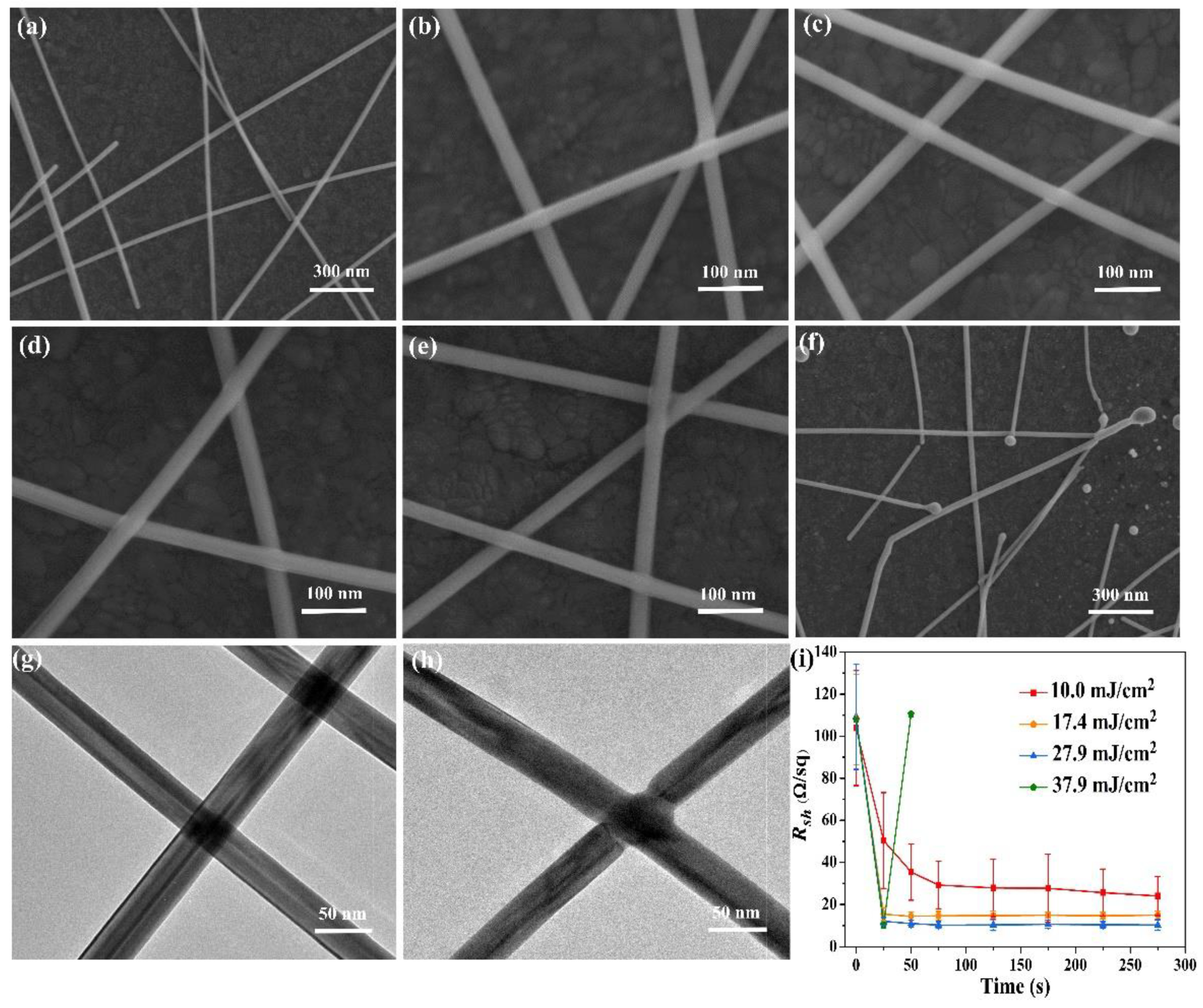
| Laser welding | Dai et al. [97]; Nian et al. [98]; Wang et al. [99]; Hu et al. [100] | Continuous-wave, nanosecond or femtosecond laser irradiation; localized melting/recrystallization at AgNW junctions. | 16.1 Ω sq−1 at 91% T. | ca. 0.024 Ω−1. | Good substrate compatibility under optimized laser parameters; more suitable for patterned or local treatment than whole-area low-cost processing. | Stable after 10,000 bending cycles; stable for 30 days at 85 °C and 85% RH in the reported femtosecond-laser-welded film. | Advantage: high spatial precision and improved adhesion/uniformity. Limitation: relatively high equipment cost and scanning-dependent throughput. |
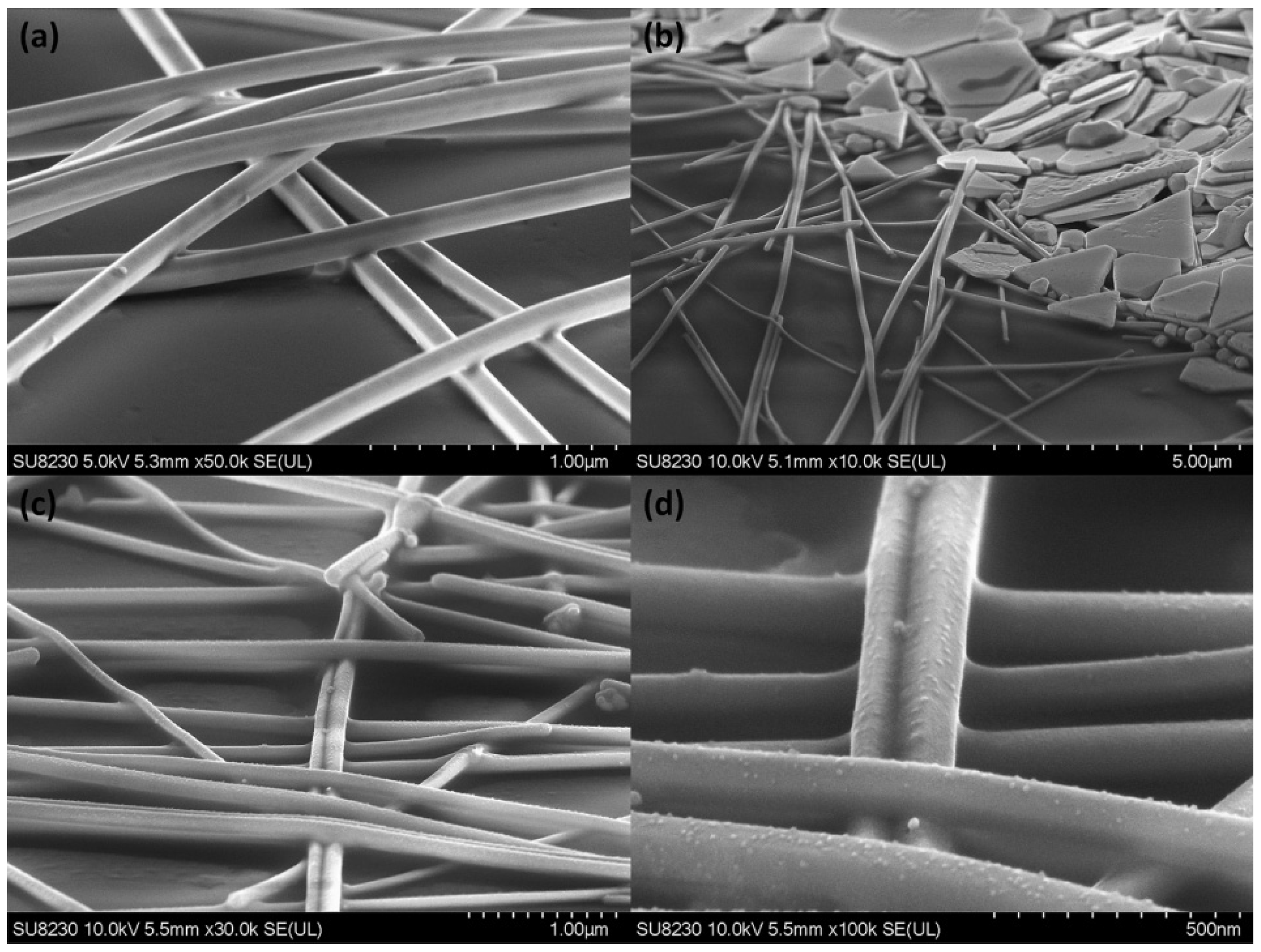
| Ni electrodeposition welding | Eom et al. [101]; Wang et al. [102] | Ni electroplating on AgNW networks; representative deposition time of 5–100 s. | Pristine AgNW: 31.07 Ω sq−1, 85.27% T. After 5, 20, 50 and 100 s Ni deposition: 28.98, 26.03, 21.09 and 9.92 Ω sq−1; T decreases to 81.41%, 74.99%, 48.66% and 37.01%, respectively. | Reported FoM values: 72.62 for pristine AgNW; 60.04, 46.79, 20.62 and 29.51 after 5, 20, 50 and 100 s deposition, respectively. | Solution-based process compatible with flexible substrates when electrolyte and deposition time are controlled; scalable but needs electrochemical equipment. | After 14 days at 80 °C/85% RH, Ni-coated samples showed only 1.18–1.54-fold resistance increase; one sample showed only 6.44-fold increase after 300 s in Na2S solution. | Advantage: reduces junction resistance and improves oxidation/sulfurization resistance. Limitation: excessive Ni deposition strongly reduces optical transparency. |
| Ag epitaxial electrodeposition | Kang et al. [81] | Roll-to-roll galvanostatic Ag electroplating; epitaxial Ag growth on AgNWs and junctions. | ca. 19 Ω sq−1 at 90% T550. | ca. 0.018 Ω−1. | Good compatibility with PET-based flexible electrodes; roll-to-roll electroplating demonstrates high scalability. | Improves junction bonding and network integrity; applied to OLEDs, triboelectric nanogenerators and resistive touch panels. | Advantage: smooth Ag deposition reduces junction resistance while maintaining transparency. Limitation: excessive Ag growth may reduce transparency and requires precise process control. |
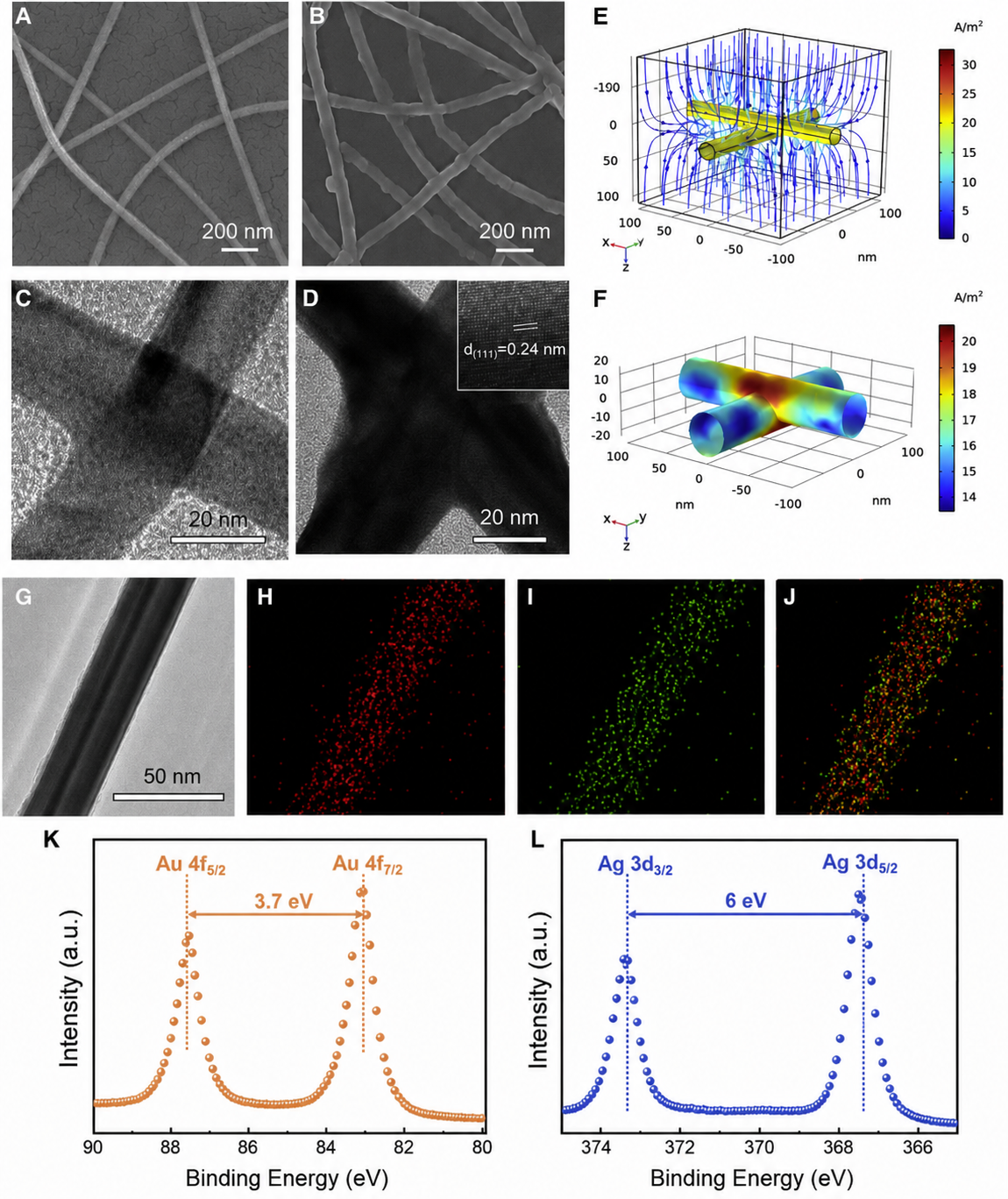
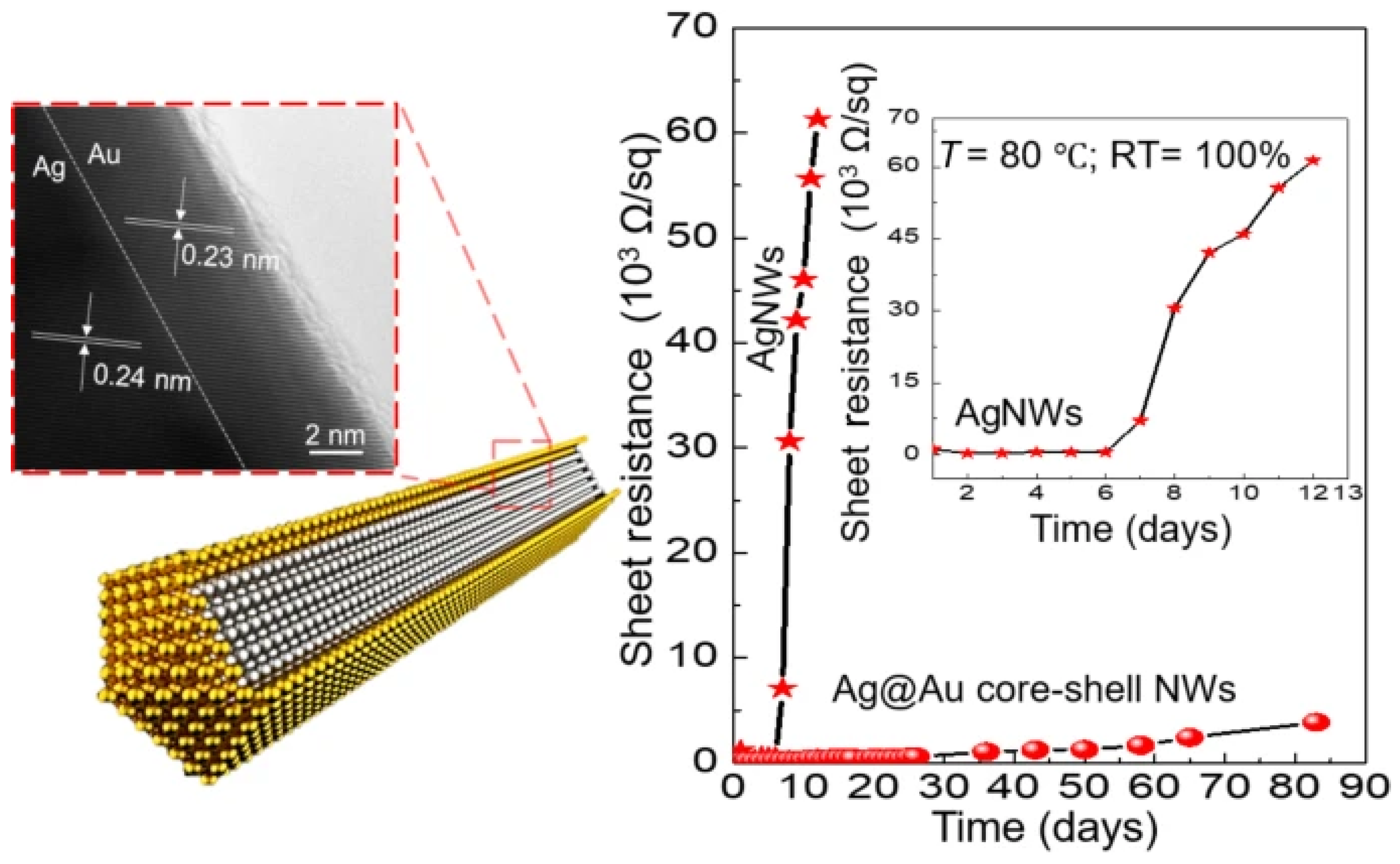
| Au shell/Ag@Au structure | Zhang et al. [103]; Zhu et al. [104]; Seong et al. [105] | Au coating or ultrathin epitaxial Ag@Au core–shell nanowire formation; Au shell thickness typically only several nanometers. | 9.88 Ω sq−1 at 85% T; 17.52 Ω sq−1 at 90% T; 37.41 Ω sq−1 at 95% T. | ca. 0.020 Ω−1 at 90% T and 17.52 Ω sq−1. | Good compatibility with flexible PET after transfer; solution synthesis is feasible, but Au cost should be considered for scale-up. | No significant Rs change for 84 days at 80 °C/100% humidity; stable in PBS for more than 21 days and in air for more than 6 months. | Advantage: excellent chemical, thermal and humidity stability. Limitation: high noble-metal cost and possible optical/plasmonic loss if the Au layer is too thick. |
| Self-limited nanosoldering | Huang et al. [92] | Room-temperature self-limited nanosoldering through selective Ag nanosolder deposition at AgNW junctions. | AgNW film decreased from 18.6 to 7.7 Ω sq−1 at 90% T; heater electrode reached 3.7 Ω sq−1 at 82.5% T. | ca. 0.045 Ω−1 at 90% T and 7.7 Ω sq−1; ca. 0.039 Ω−1 for heater electrode. | Good compatibility with flexible substrates because the process occurs at room temperature; large-area 210 × 297 mm2 electrodes were demonstrated. | Transparent heater reached 145 °C at 6 V within 30 s with a heating rate of 4.8 °C s−1. | Advantage: room-temperature, simple and effective for transparent heaters. Limitation: optical transmittance decreases when very low sheet resistance is targeted. |
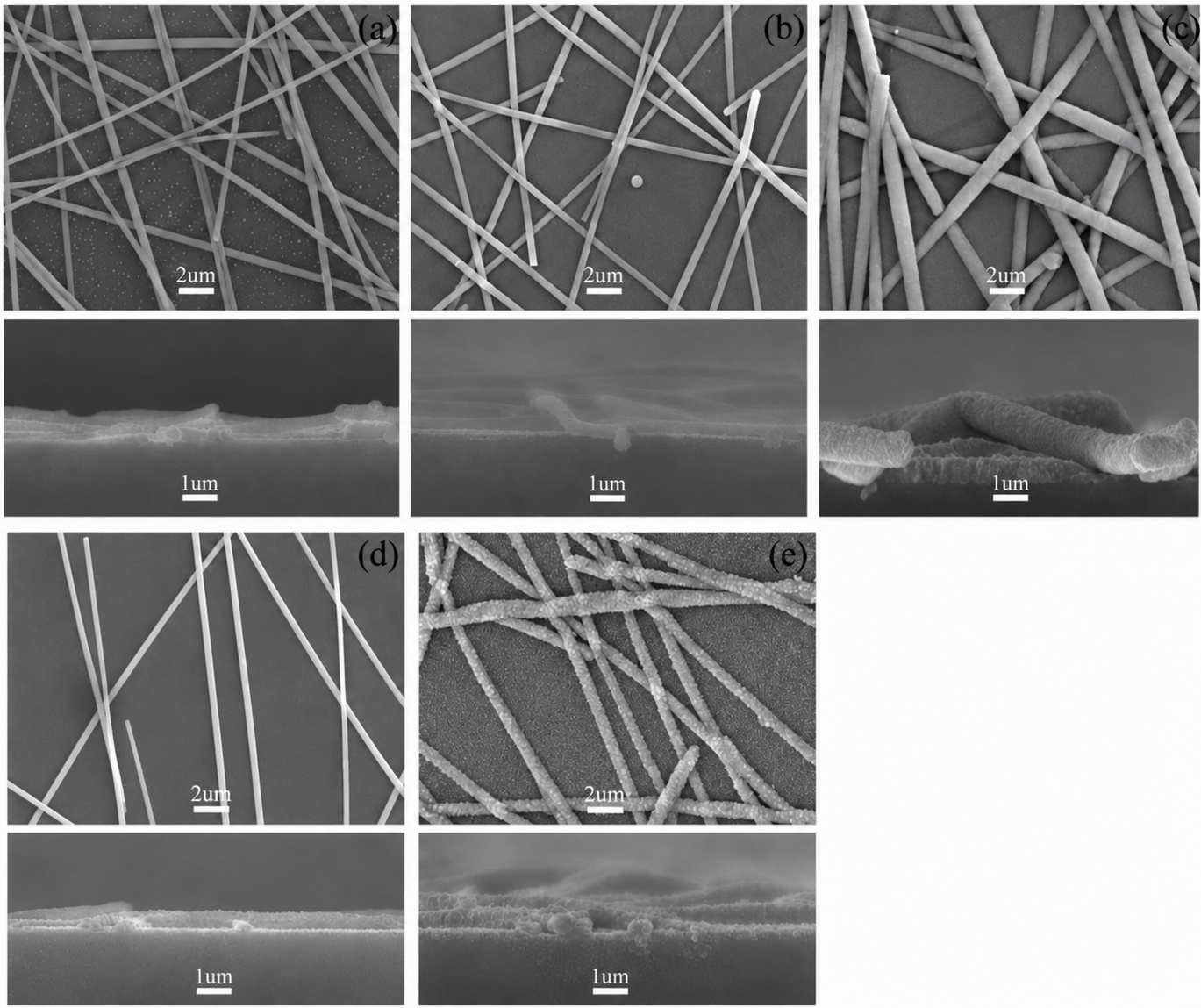
| Metal oxide nanoparticle modification | Liu et al. [106] | Modification of AgNW networks with ZnO, SnO2, Al2O3 or TiO2 nanoparticles generated by magnetron sputtering. | Resistance reduction: 75.6% for ZnO, 70.4% for SnO2, 53.2% for Al2O3 and 59.8% for TiO2 modification. Exact comparable T/Rs values depend on oxide type and thickness. | Not reported using the same FOM format. | Compatible with flexible transparent conductive films; sputtering is scalable but requires vacuum equipment. | Failure voltage increased up to 16 V; temperature non-uniformity decreased to 8.7%–10.4% compared with 40.6% for pristine AgNW films. | Advantage: improves electrical uniformity, thermal distribution and current-loading stability. Limitation: vacuum equipment and thickness control are required. |
Disclaimer/Publisher’s Note: The statements, opinions and data contained in all publications are solely those of the individual author(s) and contributor(s) and not of MDPI and/or the editor(s). MDPI and/or the editor(s) disclaim responsibility for any injury to people or property resulting from any ideas, methods, instructions or products referred to in the content. |
© 2026 by the authors. Licensee MDPI, Basel, Switzerland. This article is an open access article distributed under the terms and conditions of the Creative Commons Attribution (CC BY) license.
Share and Cite
Cao, G.; Liang, H.; Xiong, J.; Huang, T.; Yang, M.; Zhang, H.; Wang, Z. Silver Nanowire-Based Flexible Transparent Electrodes: Fabrication and Applications. Coatings 2026, 16, 704. https://doi.org/10.3390/coatings16060704
Cao G, Liang H, Xiong J, Huang T, Yang M, Zhang H, Wang Z. Silver Nanowire-Based Flexible Transparent Electrodes: Fabrication and Applications. Coatings. 2026; 16(6):704. https://doi.org/10.3390/coatings16060704
Chicago/Turabian StyleCao, Ge, Haixian Liang, Jiali Xiong, Tianhong Huang, Min Yang, He Zhang, and Zhenyu Wang. 2026. "Silver Nanowire-Based Flexible Transparent Electrodes: Fabrication and Applications" Coatings 16, no. 6: 704. https://doi.org/10.3390/coatings16060704
APA StyleCao, G., Liang, H., Xiong, J., Huang, T., Yang, M., Zhang, H., & Wang, Z. (2026). Silver Nanowire-Based Flexible Transparent Electrodes: Fabrication and Applications. Coatings, 16(6), 704. https://doi.org/10.3390/coatings16060704