Article

The Role of Temperature Field Distribution in the Microstructural Evolution of High-Strength Aluminum Alloys During Laser Powder Bed Fusion

1
Center for Advanced Laser Manufacturing (CALM), School of Mechanical Engineering, Shandong University of Technology, Zibo 255000, China
2
Shandong Key Laboratory of High-Performance Precision Manufacturing and Hybrid Machining, Shandong University of Technology, Zibo 255000, China
3
School of Transportation and Vehicle Engineering, Shandong University of Technology, Zibo 255000, China
4
Shanghai Key Laboratory of Materials Laser Processing and Modification, School of Materials Science and Engineering, Shanghai Jiao Tong University, Shanghai 200240, China
5
Analytical Testing Center, Shandong University of Technology, Zibo 255000, China
*
Author to whom correspondence should be addressed.
Coatings 2026, 16(6), 706; https://doi.org/10.3390/coatings16060706 (registering DOI)
Submission received: 11 April 2026 / Revised: 29 May 2026 / Accepted: 10 June 2026 / Published: 12 June 2026
(This article belongs to the Special Issue Advances in Protective Coatings for Metallic Surfaces)

Abstract

Laser powder bed fusion (LPBF) of high-strength aluminum alloy 7075 (AA7075) is severely limited by hot cracking. However, the underlying mechanisms, particularly the coupling between thermal fields, solidification microstructure, and cracking behavior, remain insufficiently clarified. This study elucidates these mechanisms by integrating experimental characterization with thermal simulation to investigate the temperature field, microstructure, and cracking relationships in both AA7075 and a crack-resistant 7075-Er-Zr alloy. Results show that coarse hot crack morphology is highly dependent on linear energy density EL. In AA7075, EL < 450 J/m promotes laterally inclined cracks (short, narrow cracks extending from the melt pool boundary toward the track center), whereas EL higher than that value leads to the continuous centerline cracks (long, wide cracks along the track center). Fine microcracks are also observed at melt pool boundaries. The 7075-Er-Zr alloy demonstrates superior crack resistance. At EL = 600 J/m, longitudinal centerline cracks still penetrate along the track, but the alloy achieves crack-free tracks at 200 W with scanning speeds above 1000 mm/s, otherwise exhibiting only short discontinuous cracks. Microcracks at melt pool boundaries are markedly suppressed in the modified alloy. The enhanced crack resistance is attributed to Er/Zr-induced grain refinement and a transition to an equiaxed grain structure, which disrupts intergranular gaps. Critically, thermal simulations identify an annular region with a peak temperature gradient. In AA7075, this region develops aligned columnar grains that facilitate both microcracks and centerline cracks. In the 7075-Er-Zr alloy, microcracks are fully eliminated within this region. However, a residual crystallographic texture persists in the annular region, which promotes the continued occurrence of centerline cracks under high energy density (e.g., EL = 600 J/m). The annular region remains a critical weak link, and its microstructural control determines the prevailing crack type. This work provides a fundamental understanding of the thermal-microstructural origins of cracking and offers a theoretical foundation for developing crack-resistant aluminum alloys via LPBF.

1. Introduction

Laser powder bed fusion (LPBF) is an additive manufacturing technique that enables one-step, near-net-shape fabrication of complex geometries, offering significant advantages in lightweight engineering fields such as aerospace [1,2]. However, high-strength aluminum alloys (e.g., aluminum alloy 7075, AA7075) are highly susceptible to hot cracking during LPBF, which severely limits their practical application [3,4]. The high cracking susceptibility of the AA7075 alloy arises from its intrinsic properties, including a wide solidification range [5], a large solidification shrinkage (≈6.6%) [6], and limited eutectic liquid films [7]. In addition, the extremely high temperature gradient (G) and solidification velocity (R) within the melt pool promote the epitaxial growth of coarse columnar grains [8]. These columnar grains tend to align their grain boundaries parallel to the build direction, creating long, continuous liquid-film channels that facilitate strain localization and hinder liquid feeding through the mushy zone. According to the RDG model [9], crack susceptibility is related to the pressure drop in the mushy zone and liquid feeding capability.
Modulating the solidification microstructure to promote the columnar-to-equiaxed transition (CET) is an effective strategy to suppress hot cracking [10,11]. According to the criterion, CET occurs for:
G n R < C s t
With
C s t = a 4 π N 0 3 ln 1 φ 3 · 1 n + 1 n
where φ is the prediction probability of columnar morphology (0 being fully equiaxed and 1 being fully columnar), N0 is nucleation density of the alloy, and n and a are material-dependent constants. Reducing the temperature gradient or increasing the solidification velocity favors the formation of equiaxed grains. An alternative and more practically feasible approach in LPBF is to introduce heterogeneous nucleation sites through alloy modification. Elements such as Sc, Zr, Ti, and Er have been added to aluminum alloys to generate in situ Al3X particles [12,13,14,15], which lower the nucleation barrier and induce equiaxed grains even at relatively high Gn/R values. This breaks the continuous growth of columnar grains, relieves stress, and thereby inhibits cracking. For instance, Al3Sc has been recognized as the most potent nucleant for α-Al due to its low lattice mismatch (≈1.32%) and high thermal stability. Al3Zr provides coherent nucleation sites with a lattice mismatch of about 0.75%, effectively refining grains under LPBF conditions [16,17]. Al3Ti can exist as a metastable L12 phase under the high cooling rates of LPBF, which also promotes α-Al nucleation [18]. More recently, Er has drawn attention as a potential grain refiner [19]. However, their application in LPBF often requires additional powder homogenization [20,21], which is costly.
It is noted that even in the presence of additional nucleation particles, inappropriate processing conditions can still lead to crack formation [22,23]. This indicates that the mesoscale distribution of the thermal field, i.e., the spatial variation in temperature gradient and cooling rate within and around the melt pool, plays a critical role in microstructure evolution and cracking behavior. Nevertheless, existing research has mostly focused on composition optimization [24,25], and a systematic understanding of how the mesoscale thermal field distribution influences microstructure and cracking has not yet been fully clarified. In particular, it is unclear which region of the thermal field is most critical for promoting equiaxed grain formation and inhibiting crack propagation.
In situ thermal monitoring during LPBF, such as infrared thermography or pyrometry, can provide real-time temperature data [26,27]. However, these methods are often limited to surface measurements, suffer from low spatial resolution, and cannot capture the full temperature field inside the melt pool, especially its mesoscale distribution. Moreover, systematic experimental optimization involving numerous process parameters is time consuming and costly. Therefore, a well-calibrated finite element method (FEM) offers an efficient alternative to predict the thermal field and its evolution during LPBF [28,29].
In the present study, a finite element model is established to simulate the melt pool temperature fields of the original AA7075 and a 7075-Er-Zr modified alloy during LPBF. Key thermal parameters such as temperature gradient and cooling rate are extracted, and combined with microstructural characterization to systematically analyze the influence of the thermal field on solidification microstructures and crack formation in the two alloys. The results reveal a non-uniform distribution of temperature gradient within the melt pool, characterized by a peak-ring area. Interestingly, the annular region outside this peak ring contributes more significantly to crack suppression than the inner region. The role of Er and Zr addition in crack suppression under the influence of the thermal field is discussed, aiming to provide a theoretical basis for process optimization of LPBF-fabricated high-strength aluminum alloys guided by thermal field control.

2. Experiments and Modeling

2.1. Preparation of LPBF Samples

2.1.1. Materials

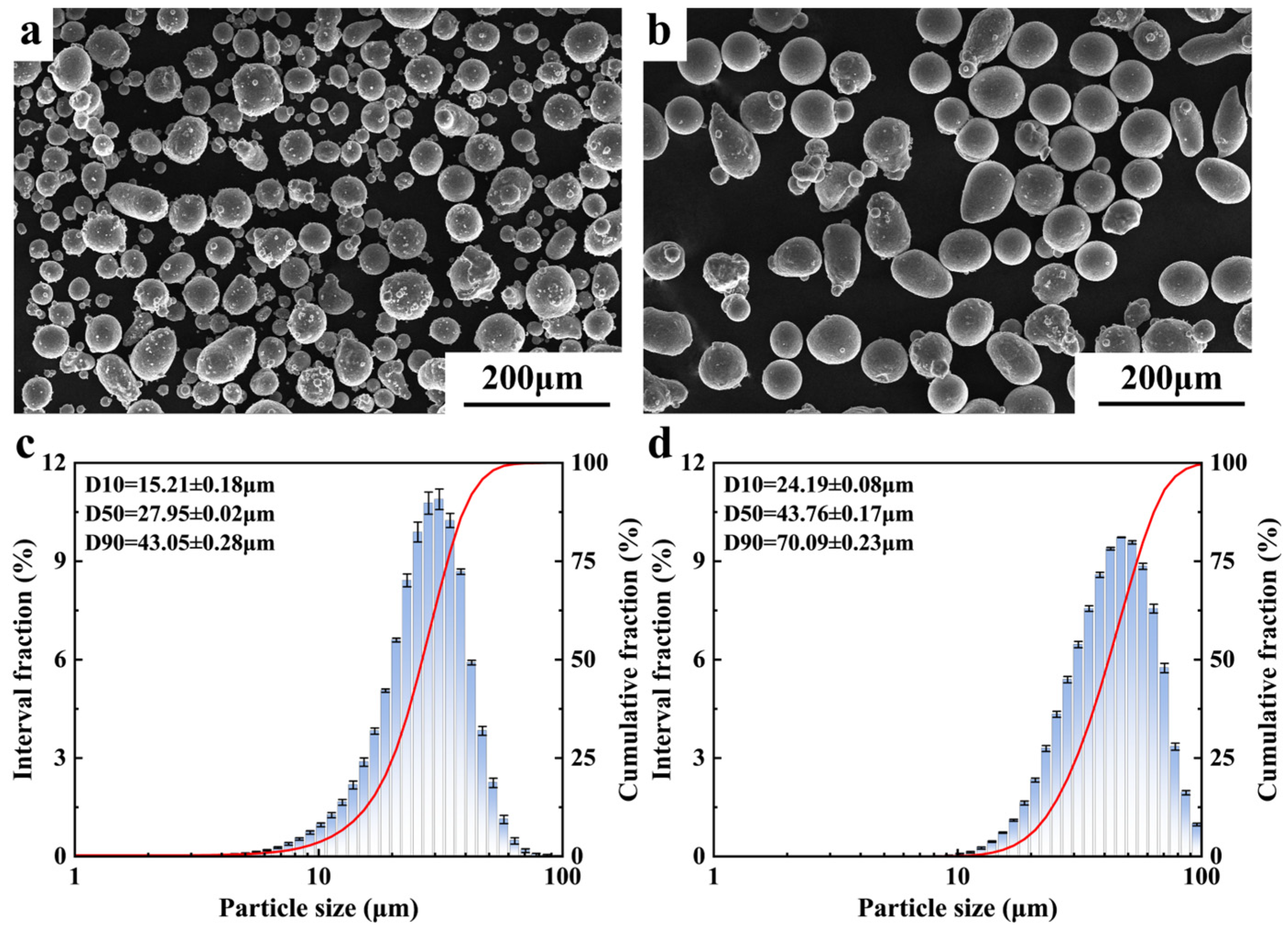
The AA7075 and 7075-Er-Zr alloy powders used in this study were provided by Beijing Crigoo Materials Technology Co., Ltd. (Beijing, China). The 7075-Er-Zr alloy was customized by adding approximately 0.55 wt.% Er and 0.35 wt.% Zr to the base AA7075 composition. The chemical compositions of both powders, listed in Table 1, were measured by inductively coupled plasma optical emission spectroscopy using a Thermo Scientific iCAP PRO X Duo instrument (Thermo Fisher Scientific, Waltham, MA, USA). As shown in the scanning electron microscopy (SEM) images in Figure 1a,b, both powders consist predominantly of spherical or near-spherical particles. Particle size distribution analysis indicates that the D10, D50, and D90 values of the AA7075 powder are 15.21 ± 0.18 μm, 27.95 ± 0.02 μm, and 43.05 ± 0.28 μm, respectively, as shown in Figure 1c. For the 7075-Er-Zr powder, the corresponding values are 24.19 ± 0.08 μm, 43.76 ± 0.17 μm, and 70.09 ± 0.23 μm, as shown in Figure 1d. The laser transparency and reflectivity were measured using a PerkinElmer Lambda 750 UV/Vis/NIR spectrophotometer (PerkinElmer, Shelton, CT, USA). The laser absorptivity at 1064 nm was calculated to be 0.46 for the AA7075 powder and 0.49 for the 7075-Er-Zr powder.

2.1.2. LPBF Fabrication

Single-track configuration was adopted to reduce the influence of track overlap and layer-by-layer thermal accumulation, thereby allowing a clearer analysis of the relationship among processing parameters, melt pool thermal field, solidification microstructure, and crack formation. Powders on an AA7075 substrate were scanned using an SLM 125 HL system (SLM Solutions Group AG, Lübeck, Germany), equipped with a 1064 nm fiber laser delivering a maximum power of 400 W and a beam diameter of 80 μm. To minimize oxidation and contamination from interstitial elements, all samples were produced under a high-purity argon atmosphere with the oxygen content maintained below 0.1%. The detailed processing parameters are listed in Table 2. Five groups of single tracks for each parameter were printed.

2.1.3. Microstructure Characterization

After printing, the specimens were vertically sectioned by electrical discharge machining. The cross-sections were sequentially ground with SiC papers up to 2000 grit, followed by fine polishing with diamond suspension to obtain a smooth surface. For microstructural characterization, the polished surfaces were etched using Keller’s reagent (95 mL H2O + 2.5 mL HNO3 + 1.5 mL HCl + 1 mL HF) for 15 s, followed by rinsing with distilled water and ethanol. In contrast, samples for electron backscatter diffraction (EBSD) analysis were subjected to electropolishing in a solution of perchloric acid and ethanol (volume ratio 1:9) at 20 V, with a current maintained between 0.2 and 0.3 A. The electrolyte temperature was kept between −20 °C and −30 °C for a total polishing duration of 30 s. High-magnification microstructural imaging was performed using an Apreo S (Thermo Fisher Scientific, Waltham, MA, USA) field-emission scanning electron microscope, while EBSD diffraction patterns were collected through an HKL-EBSD system (Oxford Instruments, Abingdon, UK). The phase constitution of samples was examined by X-ray diffraction (XRD, Bruker D8 Advance, Bruker Corporation, Karlsruhe, Germany) using Cu Kα radiation at 40 kV and 40 mA. Transmission electron microscopy (TEM) and high-resolution TEM (HRTEM) were performed at 200 kV on a Tecnai G2 Spirit TWIN (Thermo Fisher Scientific, Waltham, MA, USA) using specimens prepared by ion milling with a Gatan 691 (Gatan, Inc., Pleasanton, CA, USA).

2.2. Numerical Model

2.2.1. Modeling and Meshing

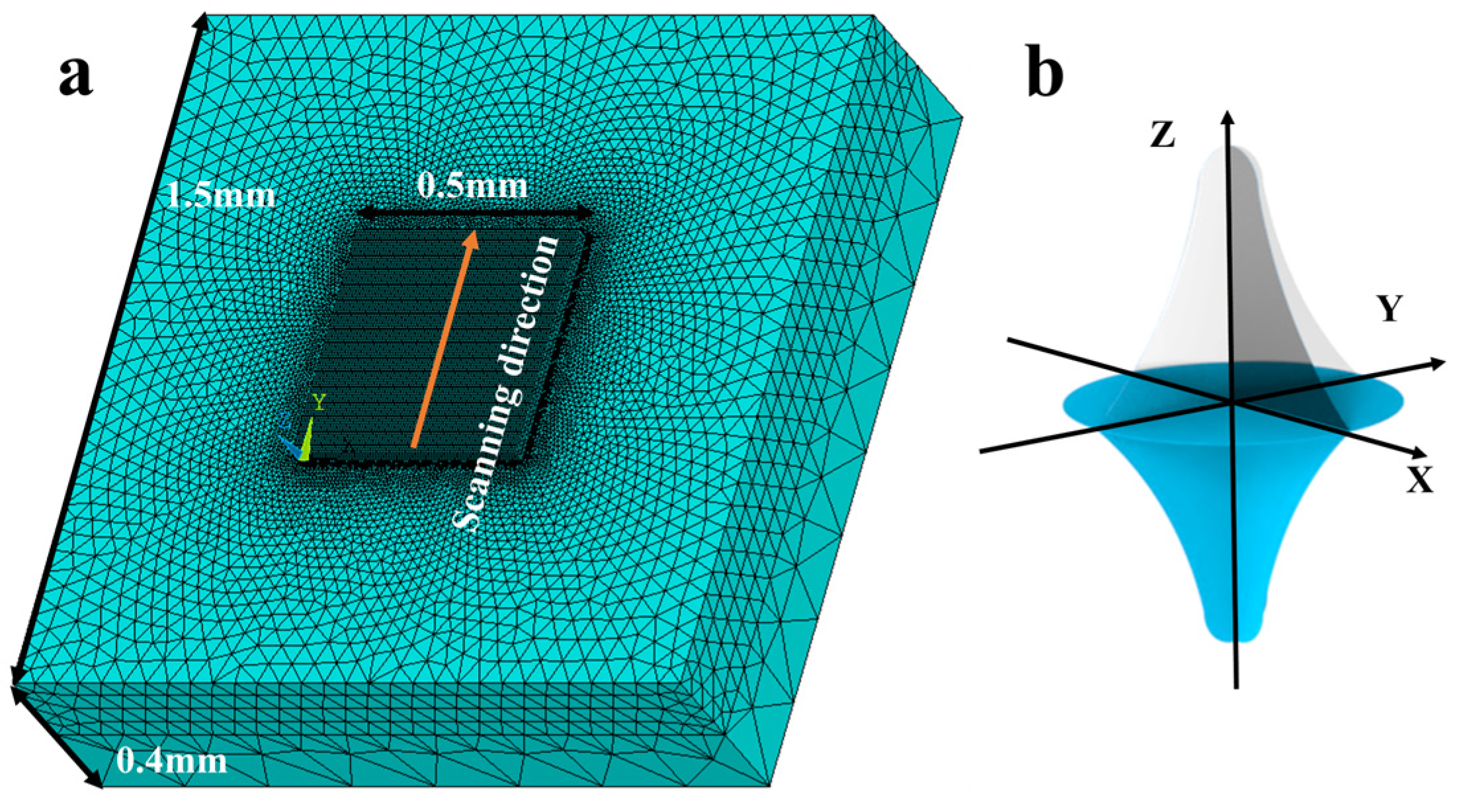
A three-dimensional (3D) finite element model, comprising a solid substrate and a single powder layer, was developed in ANSYS APDL (ANSYS 2024 R2), as illustrated in Figure 2a. The substrate was defined as AA7075 with dimensions of 1.50 mm × 1.50 mm × 0.40 mm, while the powder layer measured 0.50 mm × 0.50 mm × 0.03 mm. To balance computational accuracy and efficiency, a transition meshing strategy with local refinement was employed within the melt pool region, with hexahedral elements utilized throughout the computational domain. The final mesh consisted of 83,286 nodes and 76,392 elements. Given the inherent complexity of the LPBF process, the following reasonable simplifications were adopted in the model.
(1)
The powder bed was modeled as a continuous and homogeneous medium. This homogenization approach is a common practice in LPBF thermal simulations for predicting mesoscale temperature fields [30,31].
(2)
The thermophysical properties of the materials were considered temperature-dependent, whereas the convective heat transfer coefficient and surface emissivity were assumed constant.
(3)
The laser absorptivity was experimentally measured for both powders and used as a constant in the FEM simulation.
(4)
Powder evaporation and the associated vapor recoil pressure were not considered. This simplification is further justified by the experimental observation that the LPBF process operated in the stable conduction regime without keyhole formation, where evaporation-induced effects are limited.

2.2.2. Governing Equation for Heat Transfer

The heat transfer in the LPBF process is governed by a 3D transient heat conduction equation, as shown in Equation (3) [32].
x k x T x + y k y T y + z k z T z + Q = ρ C d T d t
where kx, ky, and kz denote the thermal conductivities along the x, y, and z directions (W/m·K), T represents temperature (K), Q describes the volumetric heat input as a function of the fixed coordinates and time (J/m3), ρ is the density (kg/m3), C is the specific heat capacity (J/kg·K), and t is time (s).
The initial thermal condition at t = 0 s is defined as Equation (4).
T x , y , z t = 0 = T 0
where T0 is set to the ambient temperature of 298.15 K. The heat transfer within the powder layer involves thermal conduction, convection, and radiation. The thermal boundary condition at the top surface is governed by a balance between the incident laser energy and convective and radiative losses to the surroundings. This balance is mathematically expressed by Equation (5) [33].
k T n = Q x , y , z , t h T T 0 ε σ T 4 T 0 4
where k denotes the thermal conductivity of alloy, n is the normal vector to the top surface of the powder bed, h is the natural convection coefficient, ε is the emissivity, and σ is the Stefan–Boltzmann constant.

2.2.3. Heat Source Model

The laser energy density in this model is described by a Gaussian profile in the x-y plane and an exponential decay along the z-axis, as illustrated in Figure 2b. For a laser beam scanning along the positive y-direction at a constant velocity v for time t, the transient thermal flux Q is defined as Equation (6) [34].
Q = 2 A P π R 2 H exp 2 x x 0 2 + y y 0 v t 2 R 2 exp z H
where A denotes the laser absorptivity of the powder bed, P is the laser power, R is the laser radius, and H is the penetration depth of the laser into the powder bed.

2.2.4. Thermophysical Properties of Materials

In the simulations, the thermophysical properties are defined as a function of temperature, corresponding to the materials’ solid, liquid, or powder state. An element transitions permanently from a powder to a liquid state once its temperature surpasses the liquidus point, and subsequently solidifies upon cooling without reverting to the powder phase. The properties for the 7075-Er-Zr alloy were estimated by adjusting the well-established properties of the AA7075 baseline alloy to reflect its compositional modifications. The key thermophysical properties of materials, including density, thermal conductivity, specific heat, and experimentally measured laser absorptivity, are summarized in Table 3 [35,36].

3. Results and Discussion

3.1. Crack Characteristics

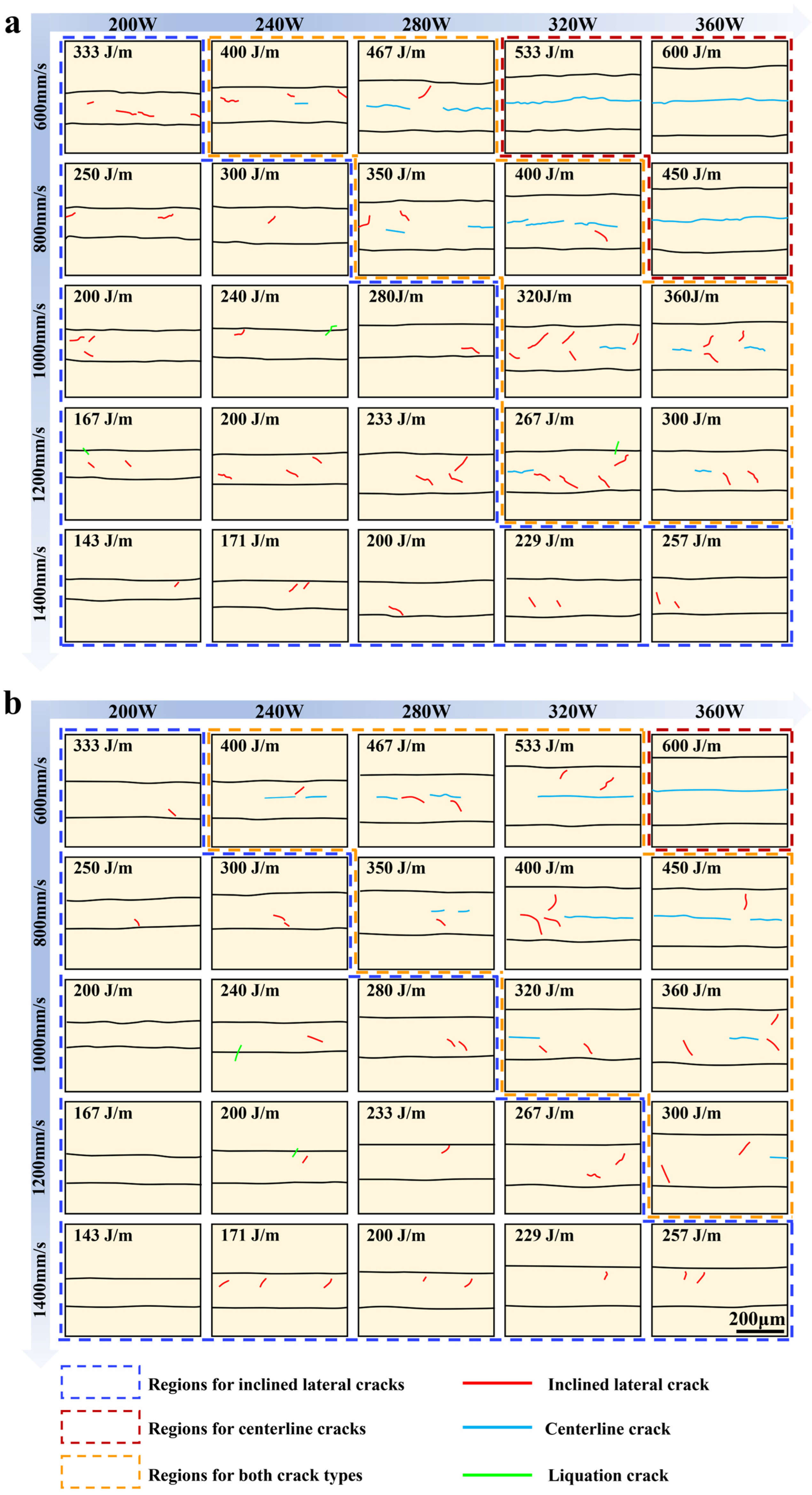
Figure 3 presents a one-to-one crack-distribution map extracted from the original optical micrographs of the top surfaces of single tracks for AA7075 and the 7075-Er-Zr alloy under different laser power and scanning speed combinations. The original optical micrographs are provided in the Supplementary Information (Figure S1), with enlarged views shown in Figure S2. In Figure 3, only melt-track boundaries and crack information are retained, which allows a clearer comparison of crack types and their distributions across processing conditions. The corresponding linear energy density EL = P/v (where P is the laser power and v is the scanning speed) is annotated for each condition.
Two distinct crack morphologies are identified. The first type consists of long, wide longitudinal cracks propagating along the track centerline, marked by blue solid lines. Based on their location and orientation, these are characteristic of hot (solidification) cracks [37]. The second type comprises short, narrow, inclined lateral cracks extending between the melt pool boundary and the track center, indicated by red solid lines, most of which are hot cracks, while a few of which extend further into the substrate beyond the track edge as liquation cracks (indicated by green solid lines) [38]. Given the rarity of the liquation cracks and the difficulty in distinguishing them from hot cracks using only top-surface morphology, the present study does not separate the two crack types. Instead, all cracks are collectively considered for cracking susceptibility evaluation.
In Figure 3, dashed outlines in blue, orange, and red denote the predominant regions of different crack types: blue for inclined lateral cracks, red for centerline cracks, and orange for the coexistence of both. For AA7075, the red-outline region (centerline cracks) occupies a relatively large parameter area, especially at EL above 450 J/m. In contrast, the 7075-Er-Zr alloy exhibits fewer continuous centerline cracks, and the blue-outline region (dominated by short inclined lateral cracks) becomes more pronounced. These results indicate that Er/Zr modification reduces crack propagation tendency and improves crack resistance of AA7075, although cracking is not completely eliminated.
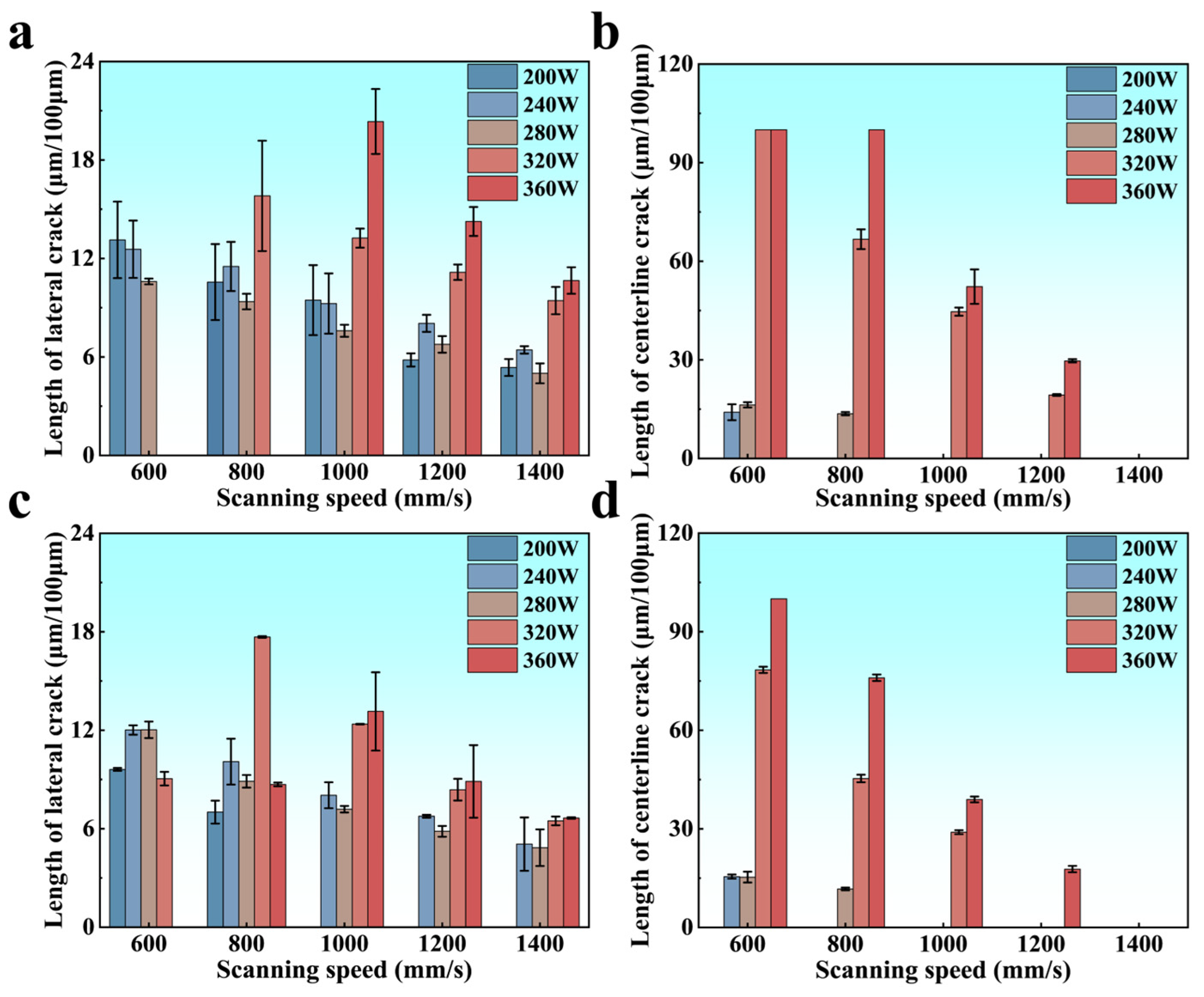
The lengths of both lateral and centerline cracks were quantitatively measured from over ten micrographs acquired from different regions of the corresponding tracks using ImageJ v1.49t, as shown in Figure 4. A consistent trend is observed across all processing conditions: crack lengths in the 7075-Er-Zr alloy are significantly shorter than those in the AA7075 baseline. For example, at 200 W and scanning speeds 1000~1400 mm/s, inclined lateral cracks are completely suppressed in the modified alloy, while they persist with lengths of 30.3–52.7 μm per 100 μm in AA7075. With increasing linear energy density via higher power or lower speed, the crack length increases in both alloys, and longitudinal centerline cracking emerges. Notably, at 360 W and 800 mm/s, centerline cracks propagate continuously along the entire track in AA7075, but become discontinuous in the 7075-Er-Zr alloy. The data further reveal a power-dependent trend in both alloys: at lower powers (<280 W), inclined lateral crack lengths decrease with increasing speed, whereas at higher powers (>320 W), they peak at intermediate speeds (800~1000 mm/s), coinciding with the onset of significant centerline cracking. For longitudinal centerline cracks, their lengths generally diminish with increasing scanning speed. This quantitative evidence underscores the superior crack resistance imparted by Er/Zr microalloying.
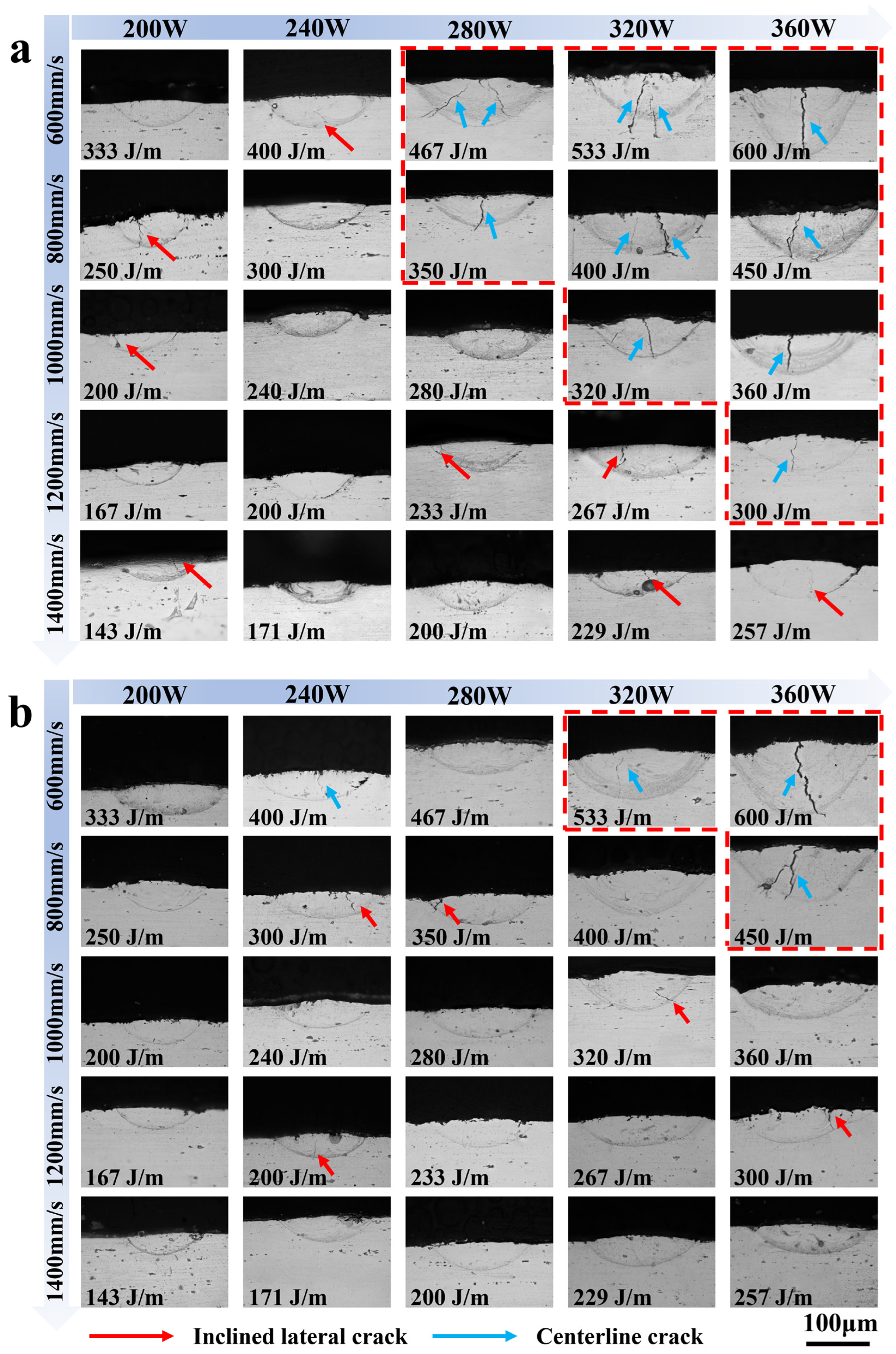
The cross-sectional views in Figure 5 reveal the distribution of two crack types within the melt pools. The first type (blue arrows), corresponding to the centerline cracks in Figure 3, propagates along the melt pool centerline and is prevalent with EL exceeding 300 J/m in AA7075 and 450 J/m in 7075-Er-Zr. The fewer occurrences of these centerline cracks in the cross-section than on the top surface suggest discontinuity along the scanning direction. The second type (red arrows), representing the cross-section of the inclined lateral cracks, appears along the pool sides. Their limited presence in these views indicates either restricted propagation or partial capture by individual cross-sections.
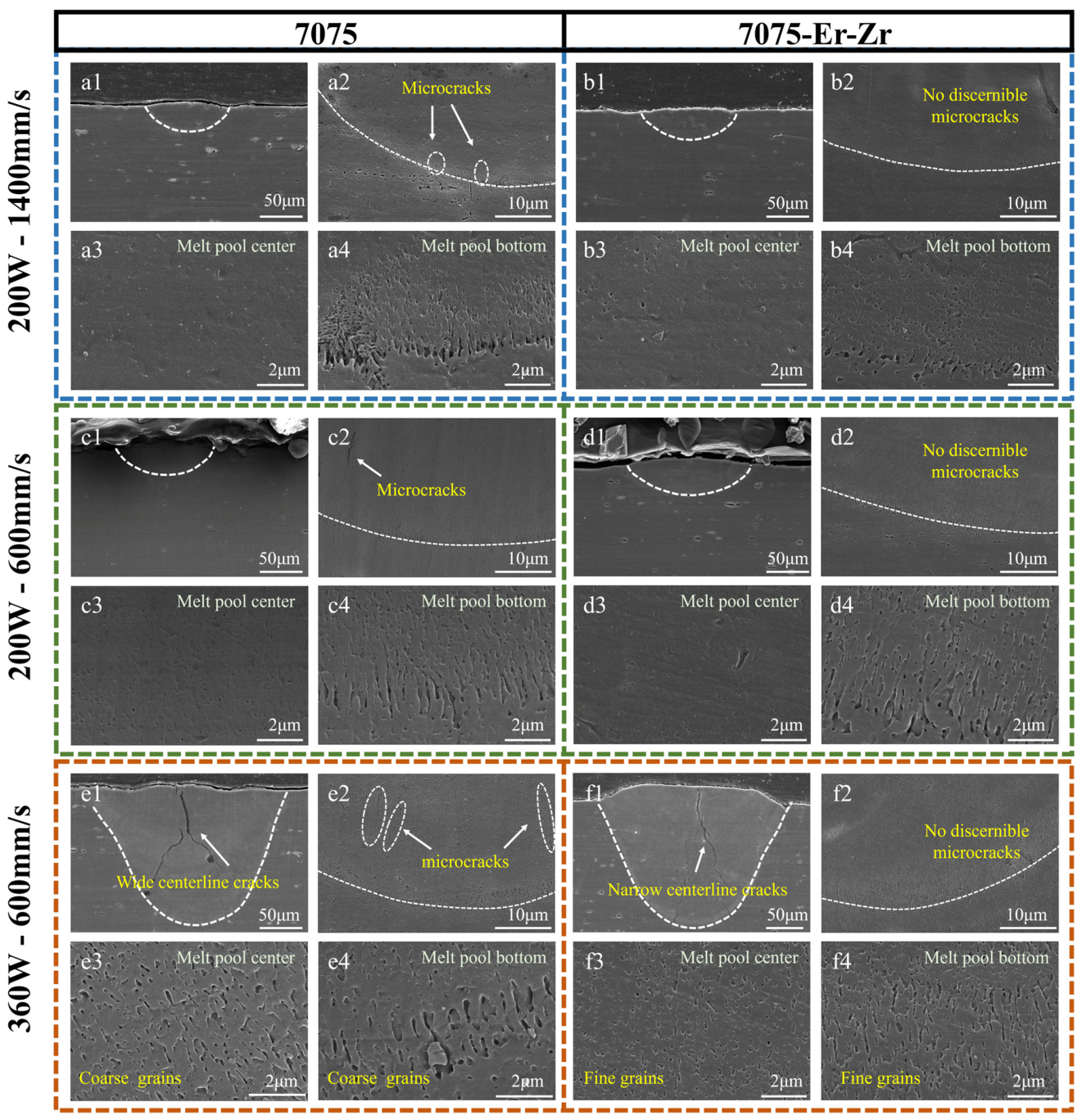
SEM analysis was performed to examine the characteristics of cracks and the microstructure, as shown in Figure 6. At low laser power (200 W, Figure 6a1–d1), no centerline cracks are evident. However, in the AA7075 samples (Figure 6a2,c2), small cracks at the melt pool bottom, hereafter referred to as microcracks, are observed (marked by white arrows). These microcracks are not discernible in the 7075-Er-Zr alloy (Figure 6b2,d2). The microstructures at the melt pool center and bottom show comparable grain sizes. When EL increases to 600 J/m (360 W/600 mm/s, Figure 6e1–e4,f1–f4), centerline cracks become pronounced in both alloys, but are narrower in the modified alloy. Nevertheless, microcracks remain absent in the modified alloy with EL of 600 J/m. In Figure 6e3,e4,f3,f4, the modified alloy exhibits finer grains compared to the coarse grains in the AA7075 alloy. Lateral cracks are rarely observed in these cross-sectional views, consistent with the sampling limitation discussed in Figure 5.
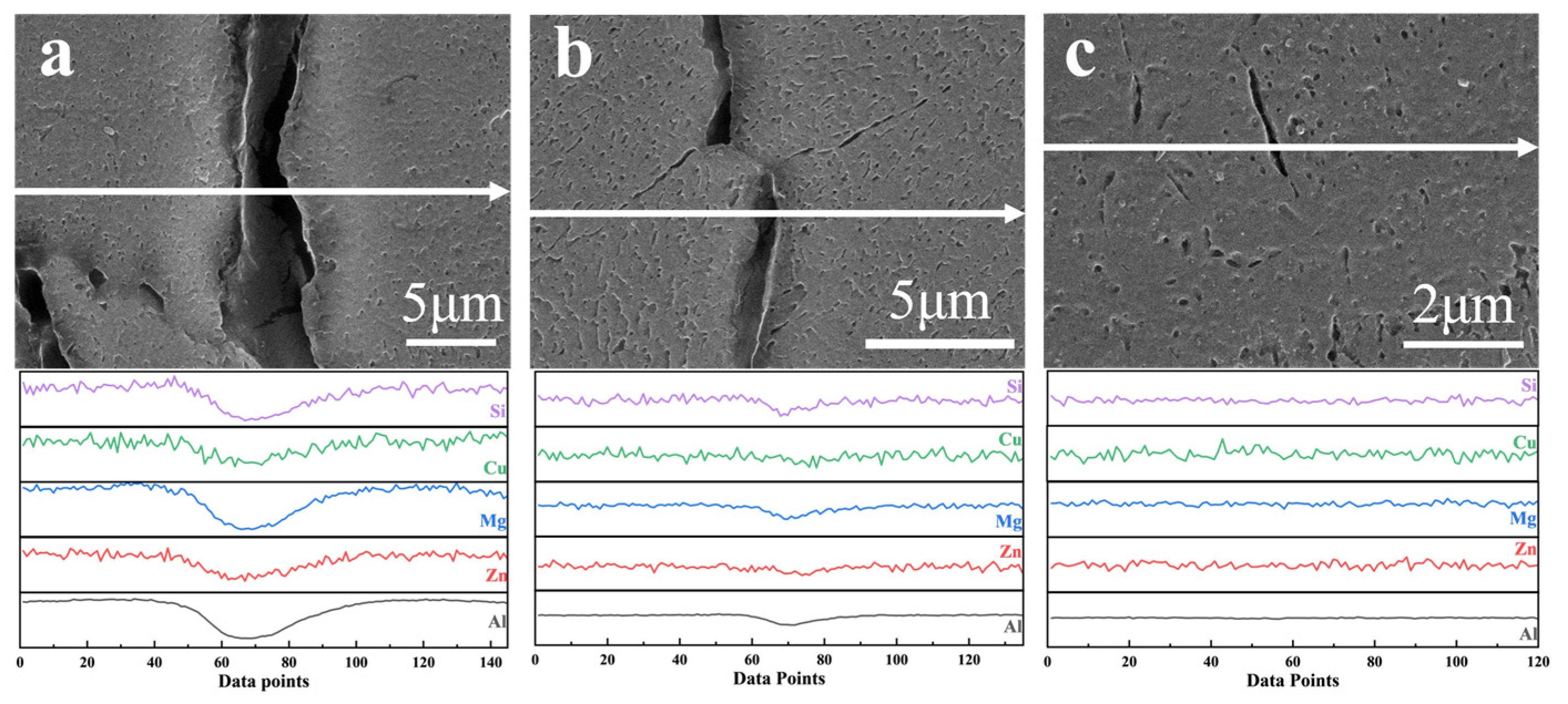
EDS composition analysis was performed near the cracks. As shown in Figure 7a, only a minor increase in silicon is detected adjacent to large cracks. For the centerline crack tail (Figure 7b), no clear silicon enrichment is observed; instead, a signal drop appears at the crack location. In the case of microcracks (Figure 7c), the crack is too narrow to resolve any compositional variation. This indicates that low-melting-point phases tend to segregate to the final solidification regions where wide cracks form, but such segregation is marginal and only detectable in relatively large cracks. Given the very low overall silicon content in the alloys, the observed silicon enrichment is subtle and not present in all crack types.

3.2. Microstructural Characterization

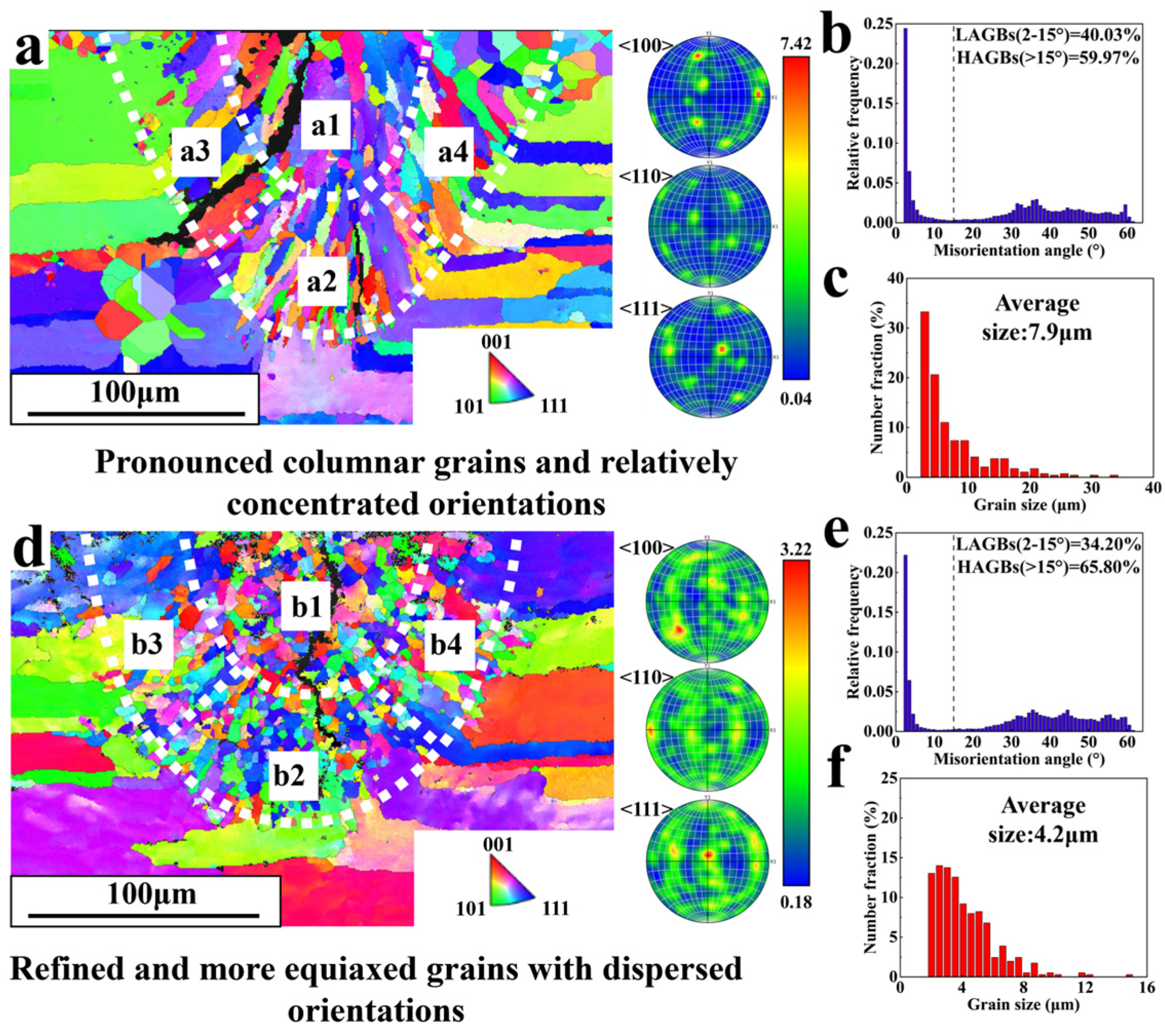
To further understand the effect of Er/Zr addition on grain structure and crystallographic texture, EBSD analysis was performed on samples fabricated at 360 W and 600 mm/s, as shown in Figure 8. The inverse pole figure maps reveal a clear difference in grain morphology between the two alloys. AA7075 is mainly characterized by columnar grains with relatively concentrated crystallographic orientations, whereas the 7075-Er-Zr alloy exhibits a finer and more equiaxed grain structure with more dispersed orientations (Figure 8a,d), as corroborated by the pole figures of the melt pool region. Grain boundary misorientation is a key microstructural indicator as well. Based on the misorientation angle θ, grain boundaries are typically classified into low-angle grain boundaries (LAGBs, 2° ≤ θ ≤ 15°) and high-angle grain boundaries (HAGBs, θ ≥ 15°) [39]. The grain boundary misorientation angle distributions (Figure 8b,e) show that the fraction of HAGBs increases from 59.97% in AA7075 to 65.80% in the 7075-Er-Zr alloy, indicating enhanced microstructural randomization. The grain size distributions further show that the average grain size decreases from 7.9 μm in AA7075 to 4.2 μm in the modified alloy (Figure 8c,f). These results indicate that Er/Zr modification promotes grain refinement and disrupts the preferential orientation of columnar grains.
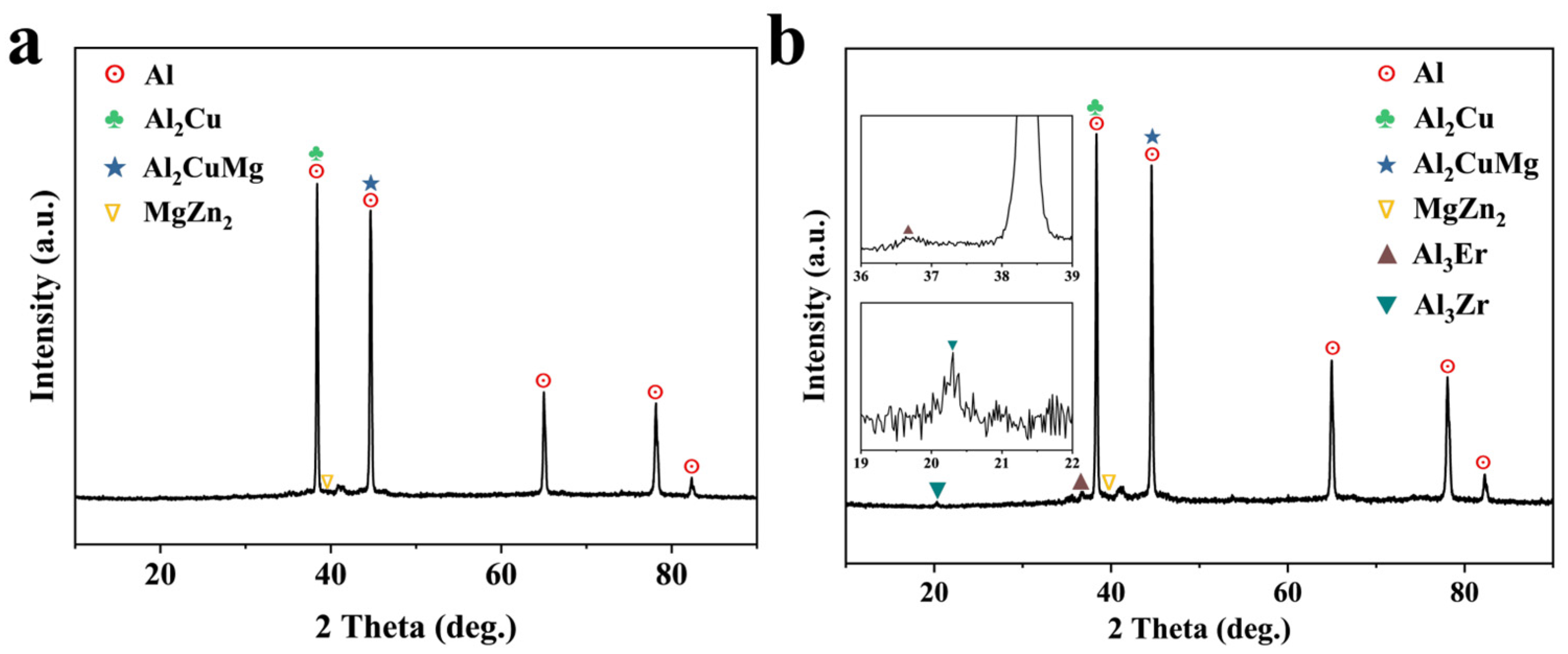
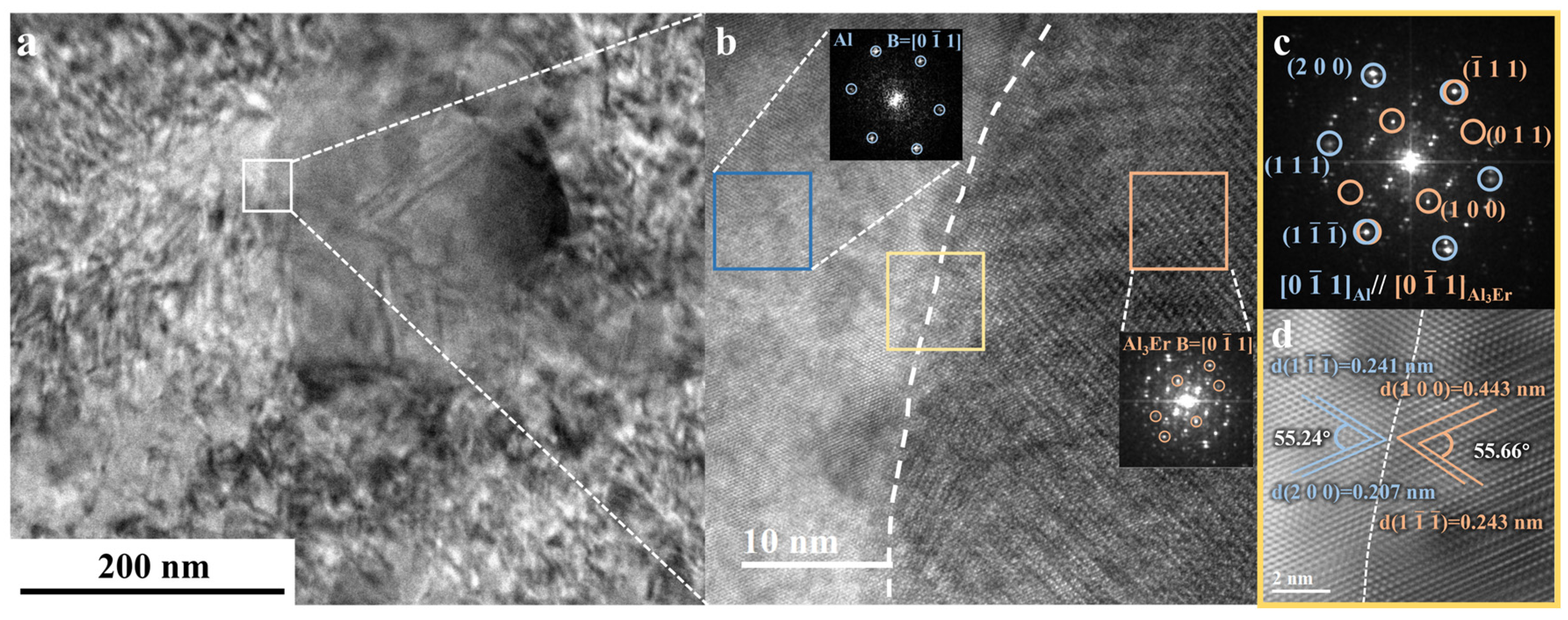
XRD analysis reveals peaks consistent with Al3Er and/or Al3Zr phases, suggesting the possible formation of L12-structured precipitates, as shown in Figure 9. TEM analysis was further conducted, as shown in Figure 10. Figure 10a reveals a particle in the matrix, which are identified as Al3Er and α-Al by the Fast Fourier Transform (FFT) images in the HRTEM (Figure 10b). The coherent orientation relationship (OR) between Al and Al3Er was determined: (1 1 ˉ 1 ˉ )α-Al//( 1 ˉ 11)Al3Er, [011]α-Al//[011]Al3Er (Figure 10c). The measured interplanar angles between (200) and (1 1 ˉ 1 ˉ ) in α-Al, and between (100) and ( 1 ˉ 11) in Al3Er, are consistent with the theoretical values for FCC and L12 structures, respectively, further confirming the presence of the Al3Er phase (Figure 10d). The interplanar distances calculated via inverse Fast Fourier Transform (IFFT) images indicated that the (1 1 ˉ 1 ˉ ) interplanar spacing of α-Al matrix and L12-Al3Er was 0.241 and 0.243 nm, respectively. A coherent interface is clearly visible in Figure 10d. Although the presence of Al3(Er, Zr) was not accessed in this study, it was widely reported [40]. Based on the XRD and TEM analysis, together with the literature [41], Al3Er, Al3Zr, and Al3(Er, Zr), are all considered responsible for the grain refinement in the modified alloys.

3.3. Temperature Field Analysis

Having addressed the refinement mechanism, it is noted that while microcracks are completely suppressed in the modified alloy, centerline cracks are not fully eliminated. This indicates that under the present processing conditions, microstructural refinement alone is insufficient to fully suppress centerline cracking, and the thermal field appears to play a significant role. Therefore, numerical simulations were performed to analyze the temperature fields of both alloys under different processing parameters.
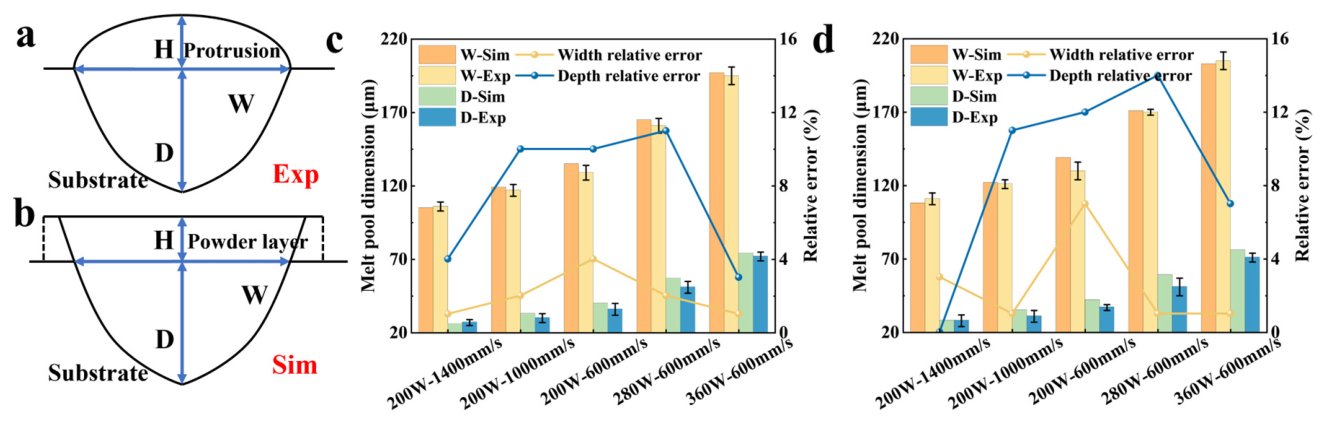
To evaluate the reliability of the thermal simulation, the simulated melt pool width and depth were compared with the experimentally measured values obtained from cross-sectional views. It should be noted that the dimensions compared are the width W and depth D indicated in Figure 11a,b. The protruding region of the track is prone to artifacts from sectioning, polishing, or local damage during sample preparation. Therefore, the melt pool region within the substrate served as the reference. As plotted in Figure 11c,d, the simulated values are in good overall agreement with the experimental results within the selected processing parameter range. For the AA7075 alloy, the relative errors for melt pool width and depth range from 1% to 4% and from 3% to 11%, respectively. For the 7075-Er-Zr alloy, the corresponding relative errors are 1%–7% and 0%–14%, respectively. These error levels are comparable to those reported in previous LPBF thermal simulation studies, where melt pool depth errors typically range from 5% to 15% [42,43]. It is also noted that within the experimental parameter range investigated, no keyhole-mode melt pool morphology was observed. Therefore, despite the various simplifications made in the model, e.g., neglecting evaporation and vapor recoil pressure, the simulation results are considered sufficiently accurate.
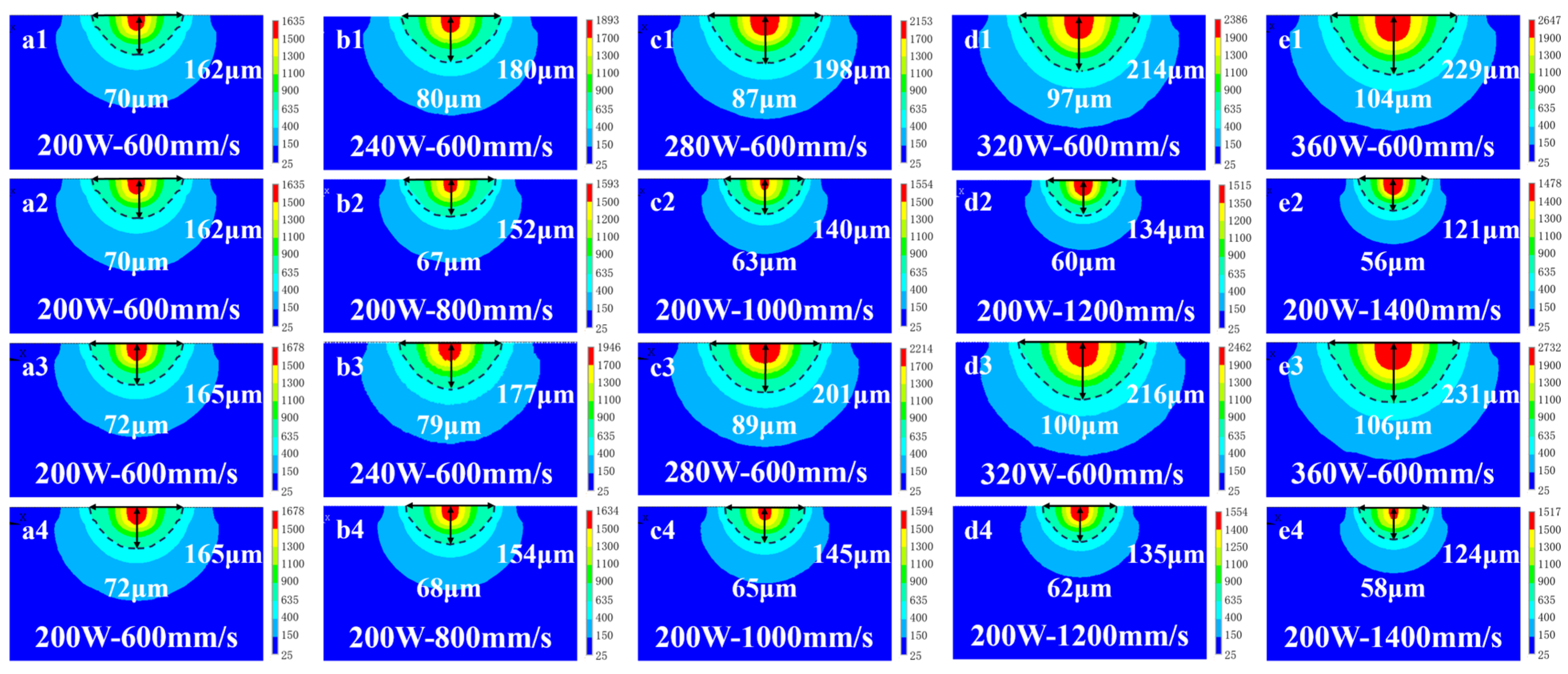
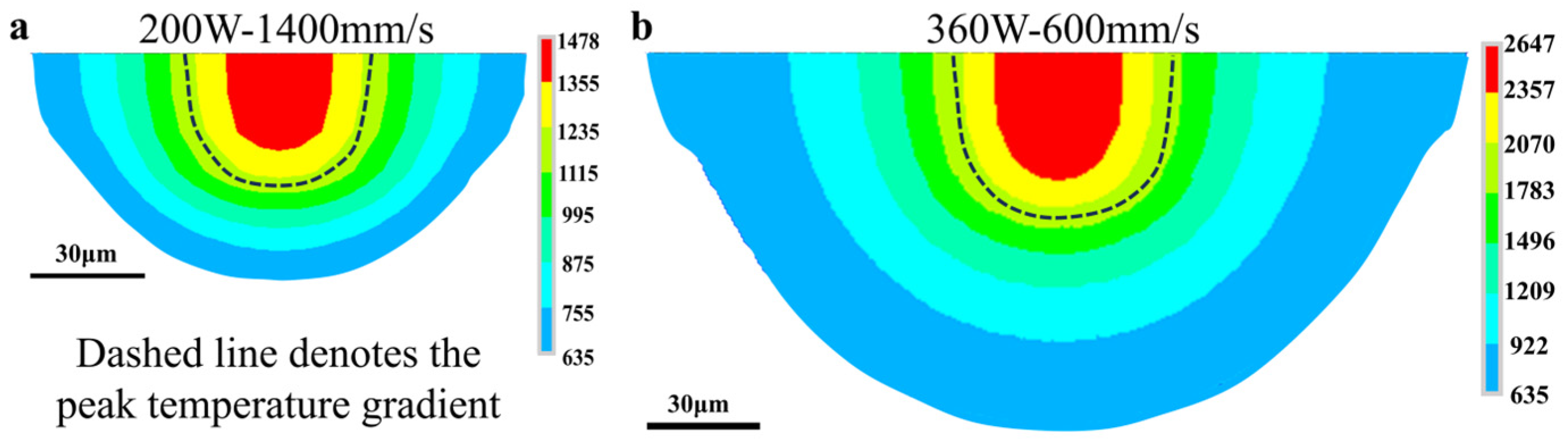
Figure 12 presents the simulated cross-sectional temperature distributions, with melt pool boundaries marked by black dashed lines. The results show that melt pool dimensions (width and depth) increase with decreasing scanning speed or rising laser power. For AA7075 (Figure 12a1–e1,a2–e2), for example, the dimensions increase from 121 μm × 56 μm (200 W, 1400 mm/s) to 162 μm × 70 μm (200 W, 600 mm/s), and further to 229 μm × 104 μm (360 W, 600 mm/s). Under identical processing conditions, the 7075-Er-Zr alloy exhibits slightly larger melt pools, with minimum dimensions of 124 μm × 58 μm and maximum of 231 μm × 106 μm, attributable to its higher laser absorptivity.
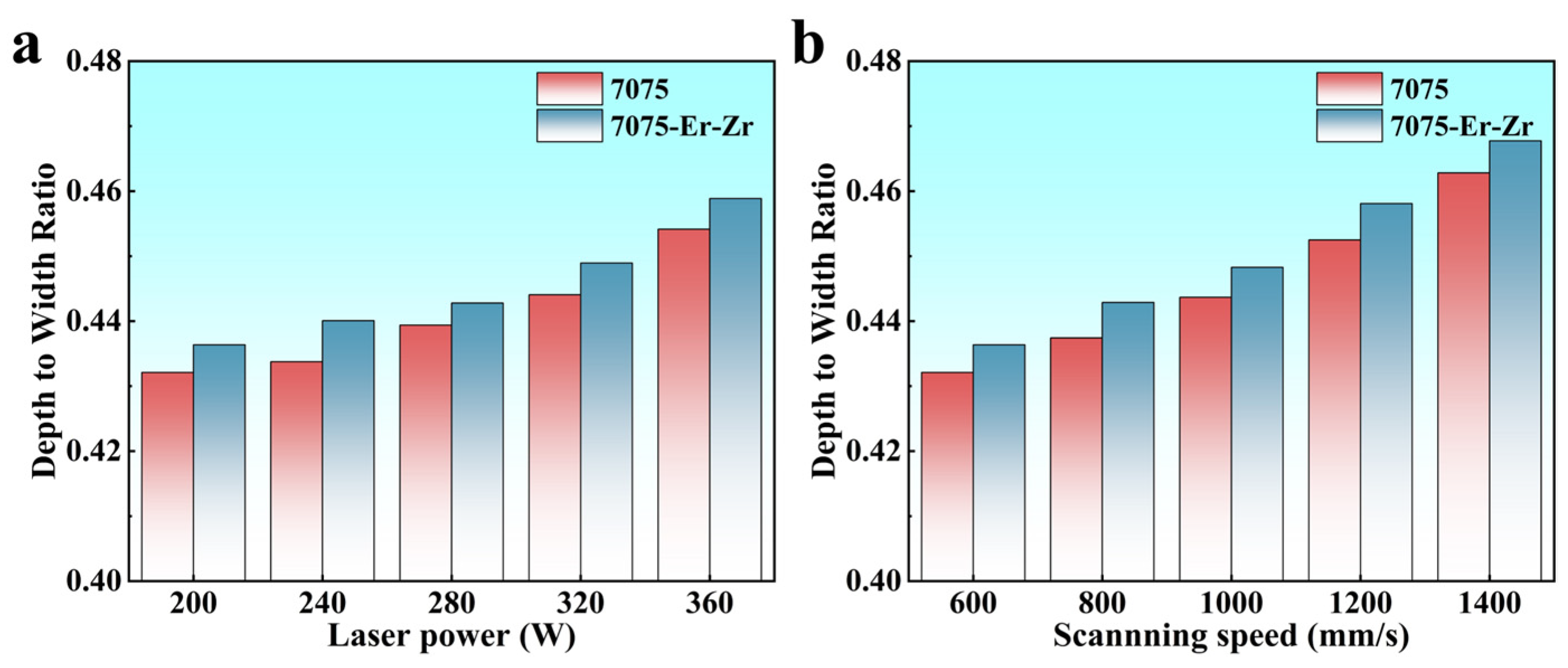
Figure 13 reveals that the 7075-Er-Zr alloy exhibits higher melt pool depth to width ratios than AA7075 under identical processing conditions, with the ratio increasing with laser power and scanning speed. According to the literature [37,44], a higher depth-to-width ratio is often associated with increased solidification stress and higher cracking susceptibility. Nevertheless, the 7075-Er-Zr alloy displays superior crack resistance despite its less favorable melt pool geometry. This indicates that the beneficial microstructural optimization induced by Er/Zr addition effectively counteracts the negative influence of the less favorable melt pool geometry, with the microstructural effect dominating the cracking behavior.
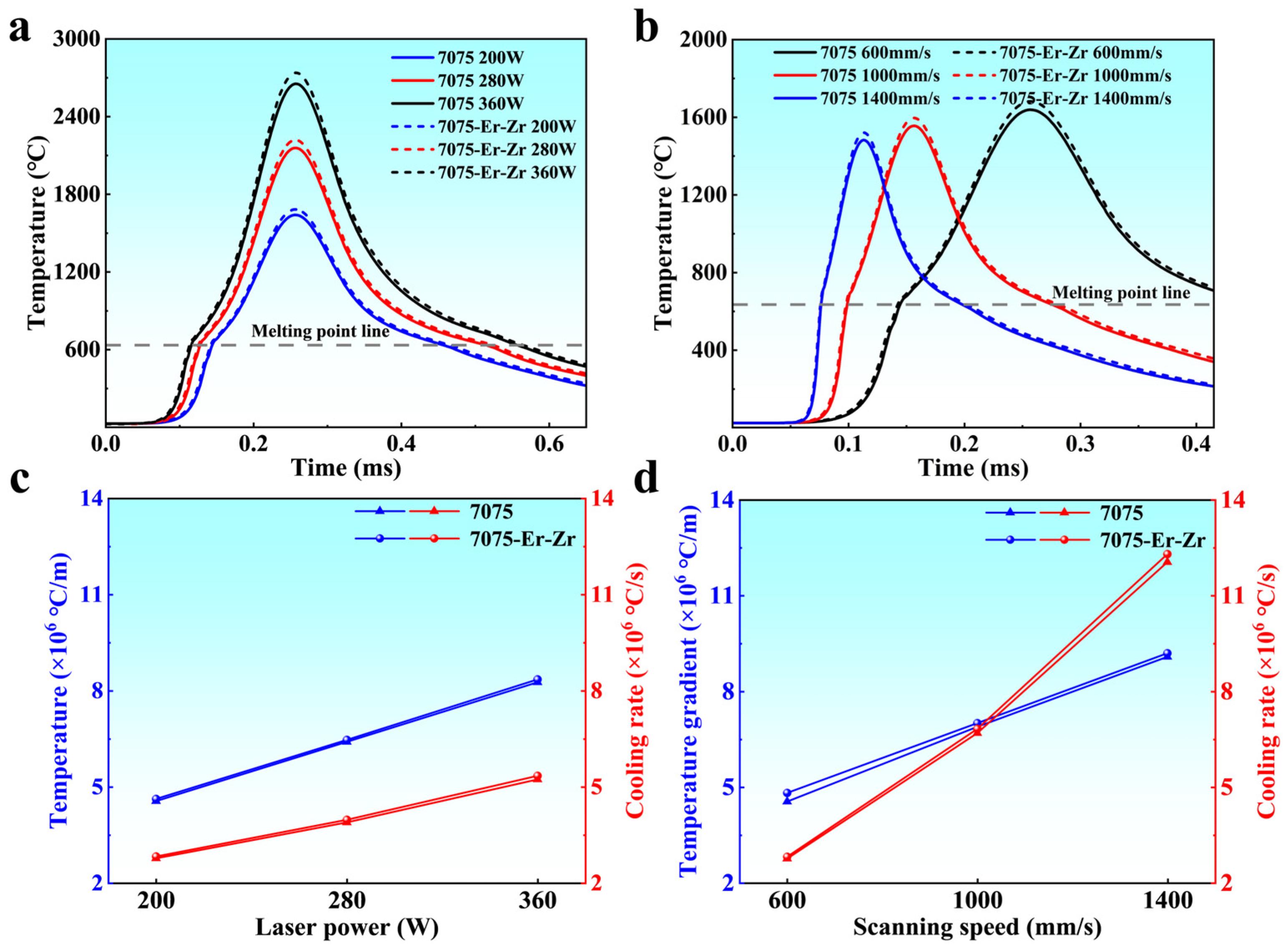
The transient temperature profiles at the designated monitoring point on the top surface, crucial for solidification behavior, are shown in Figure 14a,b. The peak of each curve corresponds to the instant of laser passage, while the duration above the melting point defines the liquid lifetime. At a fixed scanning speed of 600 mm/s, increasing the laser power from 200 W to 360 W raises the peak temperature from 1555 °C to 2493 °C for AA7075 and from 1596 °C to 2573 °C for the 7075-Er-Zr alloy. Similarly, at a fixed laser power of 200 W, reducing the scanning speed from 1400 mm/s to 600 mm/s increases the peak temperature from 1482 °C to 1638 °C for AA7075 and from 1520 °C to 1681 °C for the 7075-Er-Zr alloy. These trends confirm that increasing energy input elevates peak temperatures and extends liquid lifetimes, leading to larger melt pools. Furthermore, the steeper slopes of the cooling curves indicate that higher laser power and scanning speed collectively result in increased cooling rates.
An analysis of the calculated cooling rates and temperature gradients at the monitoring point is presented in Figure 14c,d. As shown in Figure 14c, increasing the laser power leads to a moderate rise in cooling rates and temperature gradients for both alloys. In contrast, increasing the scanning speed resulted in a much more pronounced increase (Figure 14d). For instance, the cooling rate of AA7075 rises from 2.76 × 10⁶ °C/s to 1.21 × 10⁷ °C/s as the speed increases from 600 mm/s to 1400 mm/s, a change far exceeding that induced by varying the laser power, from 2.76 × 10⁶ °C/s to 5.22 × 10⁶ °C/s. This demonstrates that scanning speed is the dominant factor governing the thermal cycling rate and solidification cooling conditions, exerting a more significant influence on thermal gradients and cooling rates than laser power.
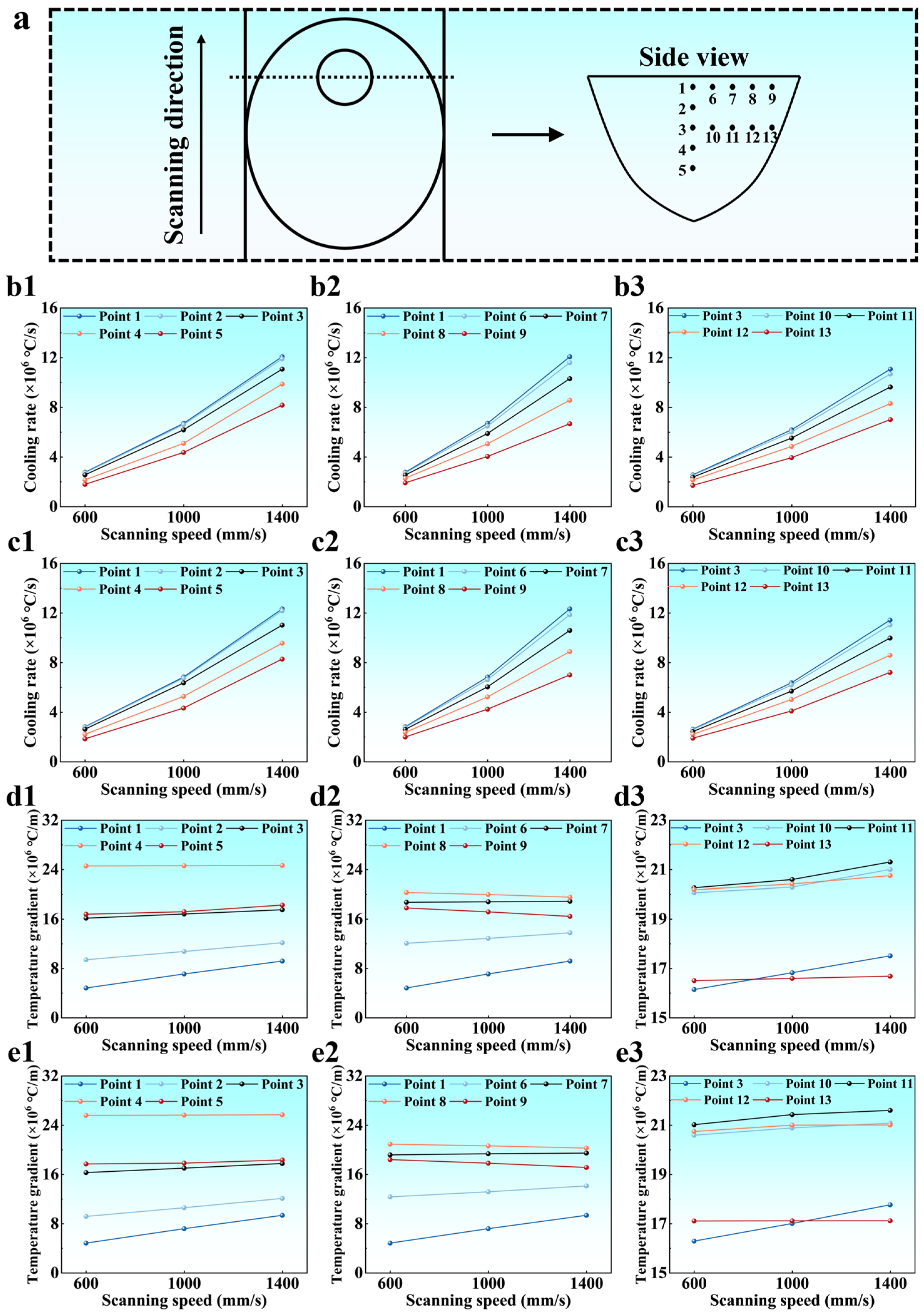
The spatial evolution of solidification microstructure is governed by the distributions of cooling rate and temperature gradient within the melt pool. Analysis of additional points (labeled in Figure 15a) reveals that both parameters generally increase with scanning speed at all locations (Figure 15b–e). Radially from the center to the boundary, cooling rates gradually decrease. The AA7075 shows significant spatial variation in cooling rate, whereas the 7075-Er-Zr alloy exhibits uniformly higher cooling rates with markedly reduced positional variation, indicating enhanced heat-transfer efficiency. The temperature gradient displays a non-uniform distribution, peaking at an intermediate radial position (Point 4) rather than at the center or edge. This pattern, attributable to the Gaussian energy profile of the laser beam and the fast heat transfer to the surroundings, creates a region of steepest thermal gradient. Remapping the temperature distribution (Figure 16) confirms this, showing the closest spacing of iso-temperature lines around Point 4. Furthermore, increasing the scanning speed expands the region between this peak gradient location and the melt pool boundary, a factor that critically influences the resultant microstructure distribution.
To predict the solidification morphology from the thermal field, the parameter G/R was calculated under the condition of 360 W and 600 mm/s using the simulated thermal fields. Values were extracted along the depth direction (Points 1–5) and transverse direction (Points 1, 6–9), as listed in Table 4.
As listed in Table 4, the G/R values are lowest at the melt pool center and increase toward the annular region. Along the depth direction, the maximum occurs at Point 4, 2.82 × 10⁸ °C·s·m−2 for AA7075 and 2.97 × 10⁸ °C·s·m−2 for the 7075-Er-Zr alloy. Transversely, G/R gradually increases from the center outward, remaining high near Points 8 and 9, with values of 1.81 × 10⁸ °C·s·m−2 and 1.66 × 10⁸ °C·s·m−2 for AA7075, and 1.85 × 10⁸ °C·s·m−2 and 1.70 × 10⁸ °C·s·m−2 for 7075-Er-Zr. These results suggest a stronger tendency for directional solidification in the region outside the melt pool center toward the annular periphery.

3.4. Influence of Temperature Field Distribution on Microstructure

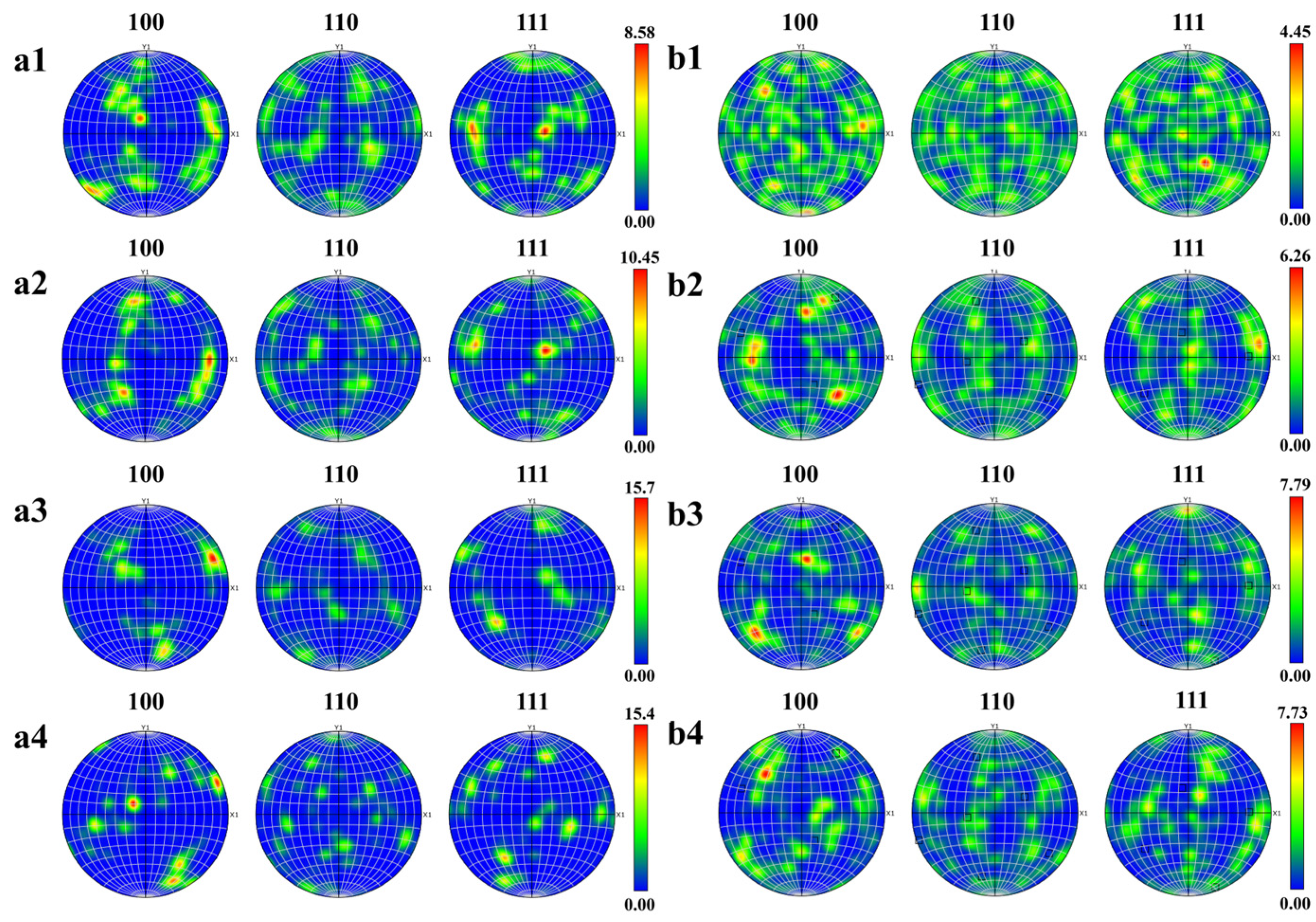
To experimentally verify the influence of such thermal field distribution on microstructural evolution, EBSD analysis was performed on different regions of the melt pool. The melt pool was divided into four sub-regions, labeled a1-a4 for AA7075 and b1-b4 for the 7075-Er-Zr alloy (Figure 8). Pole figures extracted from these sub-regions are presented in Figure 17. Based on the local pole figures, the innermost regions (Figure 17a1,b1) exhibit relatively dispersed crystallographic orientations, whereas the outer regions (Figure 17a2–a4,b2–b4) show a more evident preferred orientation. For AA7075, this local difference is less pronounced because columnar epitaxial growth dominates across the melt pool, leading to relatively concentrated orientations in most regions. In the 7075-Er-Zr alloy, however, the orientation difference between the central and outer regions becomes more evident, underscoring the role of spatial variations in the temperature gradient. This indicates that, although Er/Zr modification promotes grain refinement and weakens the overall texture of columnar grains, local thermal conditions have a pronounced effect on grain orientation in different regions of the melt pool.
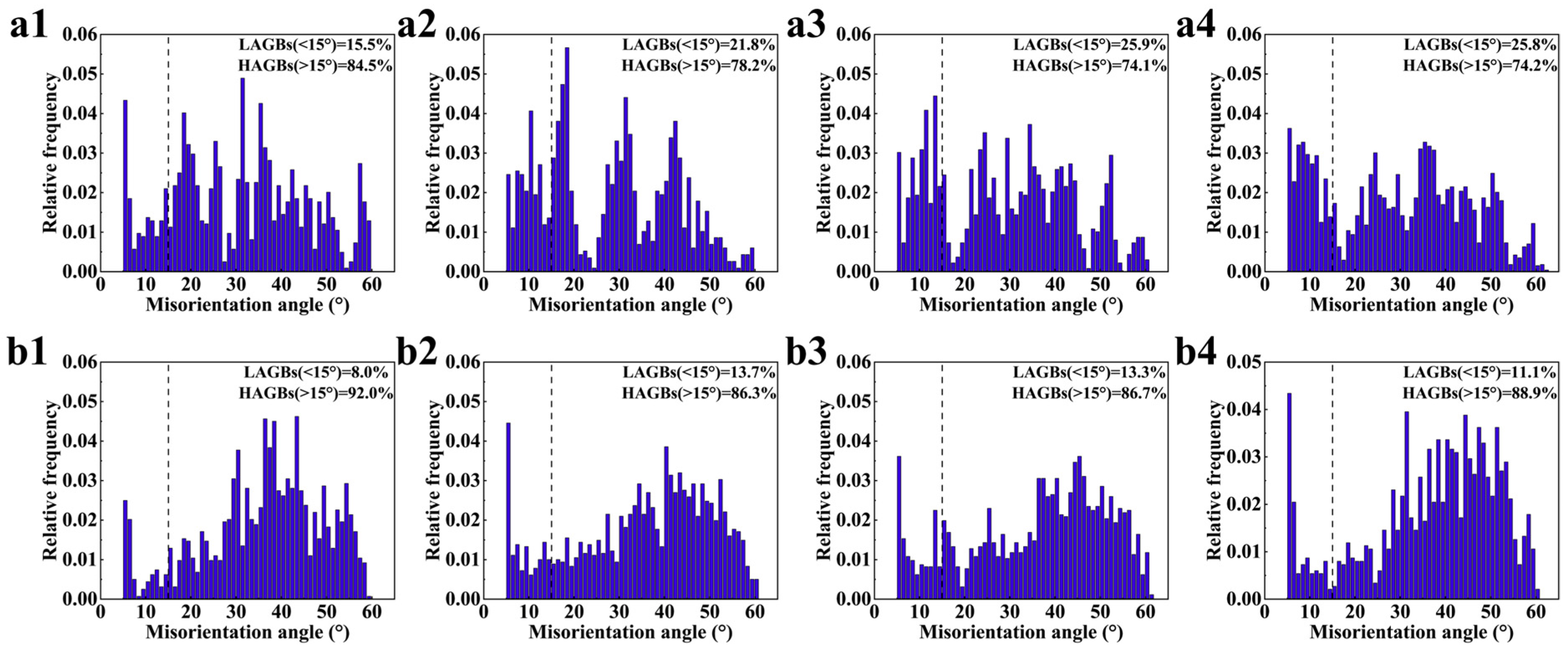
Figure 18 compares the HAGB fractions of regions Figure 18a1–a4 (AA7075) and Figure 18b1–b4 (7075-Er-Zr). For AA7075, the HAGB fraction decreases from 84.5% (Figure 18a1, center) to 78.2%, 74.1%, and 74.2% (Figure 18a2–a4, outer regions), indicating stronger orientation concentration toward the melt pool boundary. In contrast, the 7075-Er-Zr alloy maintains high HAGB fractions across all regions: 92.0% (Figure 18b1), 86.3% (Figure 18b2), 86.7% (Figure 18b3), and 88.9% (Figure 18b4). The outer regions (Figure 18b2–b4) have slightly lower values than the center but remain higher than their AA7075 counterparts. This suggests that Er/Zr modification weakens local orientation concentration in the outer annular region, and that spatial variations in the thermal field influence grain orientation distribution.
In welding and laser-directed energy deposition (L-DED), where high-power lasers (e.g., 10 kW) with millimeter-scale beams are used, the spatial variation in grain morphology across the melt pool is well established [45,46]. The CET model has been employed to describe this phenomenon [10,11]. It was also explained by two competing solidification mechanisms: heterogeneous nucleation on partially melted powder particles (promoting equiaxed grains) and epitaxial growth from the melt pool bottom (leading to columnar grains).
Such a spatially resolved microstructure distribution has rarely been reported in unmodified alloys fabricated by LPBF [10]. Consequently, the influence of the annular region on cracking has received little attention. In effective modified alloys such as Sc-containing high-strength aluminum alloys, a bimodal grain structure is typically observed. Primary Al3Sc precipitates form near the melt pool boundary and act as nucleation sites for equiaxed grains, whereas the steep thermal gradient in the upper central region promotes columnar grain growth because nucleation sites are depleted there [47]. In such a bimodal structure, the equiaxed grain layer at the melt pool boundary can interrupt the continuous growth of columnar grains, thereby suppressing crack propagation even if columnar grains remain in the central region [48]. This explains why certain Sc-modified alloys exhibit improved crack resistance despite not being fully equiaxed, although a fully equiaxed structure is more desirable [49].
However, in the present 7075-Er-Zr alloy, even though a fully equiaxed grain structure is achieved throughout the entire melt pool, centerline cracks are still observed under high energy density conditions (e.g., 360 W, 600 mm/s). This seemingly contradictory result, having equiaxed grains yet showing persistent cracking, cannot be explained by the global equiaxed fraction alone, a metric commonly relied upon in studies [50,51]. Instead, the results reveal that the ring-shaped peak of the temperature gradient (Figure 16) creates an annular region where solidification is most directional. Within this region, despite an equiaxed morphology, the HAGB fraction is lower and the pole figures show a stronger texture than at the melt pool center. Such residual crystallographic orientation provides potential crack paths, making the annular region the critical weak link.
The identification of this annular region shifts the focus from bulk microstructure control to spatially targeted refinement. Under high energy density (e.g., EL = 600 J/m), the severe thermal gradient in this region partially overrides the nucleation effect of Er/Zr, leading to coarser or more oriented grains that facilitate cracking. This finding suggests that further optimization should not merely aim for overall grain refinement, but rather specifically enhance nucleation within the annular region, for instance, by increasing the density of nucleation particles or by tailoring the energy input to reduce the temperature gradient peak (e.g., decreasing laser power or increasing scanning speed). More broadly, the concept of a thermally dictated critical annular region may be applicable to other crack-susceptible alloys in LPBF, offering a new perspective for process parameter optimization.

3.5. Crack Suppression Mechanism

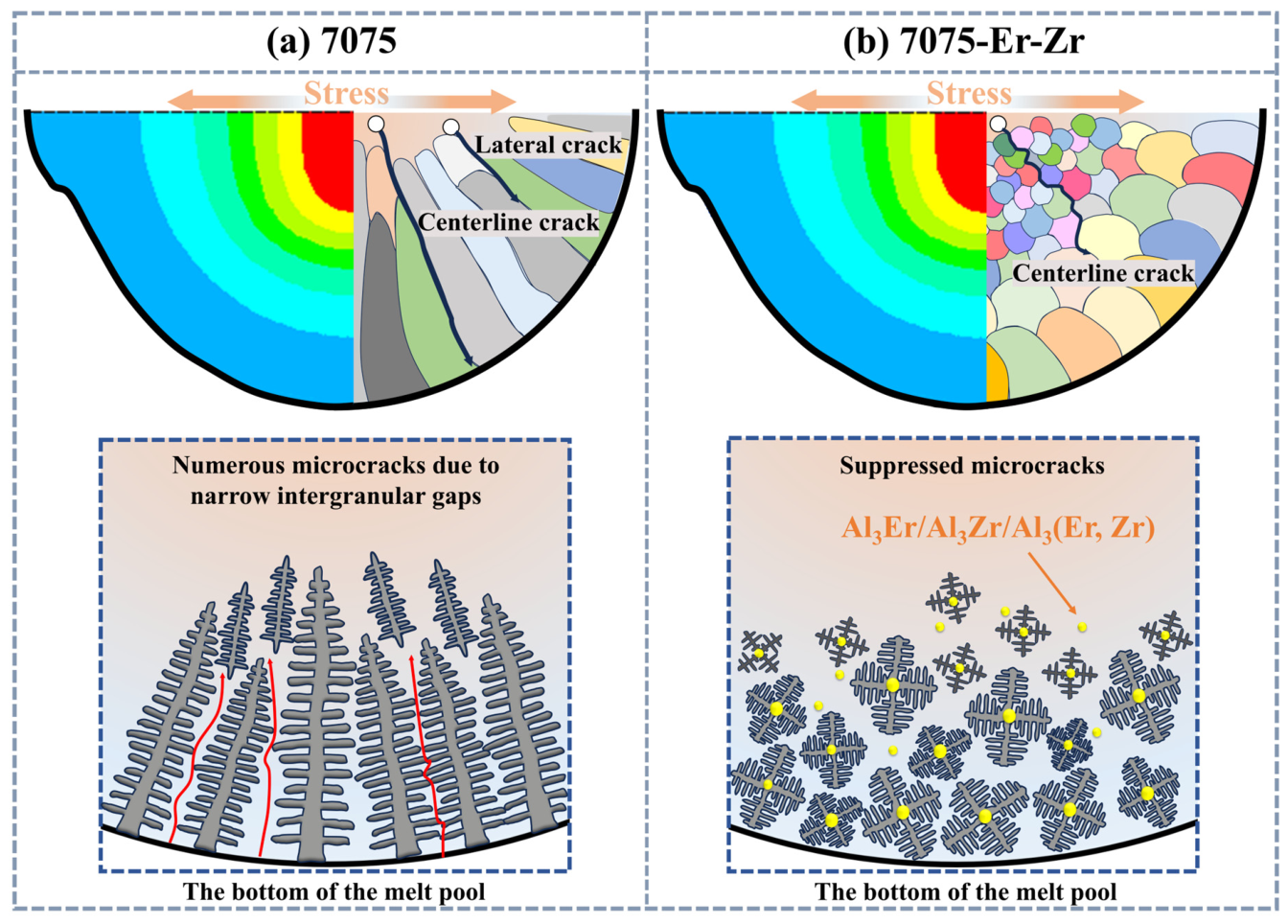
In summary, this study elucidates the intrinsic relationship between the temperature gradient, solidification microstructure, and crack susceptibility in aluminum alloys processed by LPBF. The melt pool exhibits a characteristic temperature gradient distribution: high at the periphery, peaking in an intermediate annular region, and relatively lower at the center, as illustrated in Figure 19. Correspondingly, the cooling rate is higher in the central region than at the periphery. AA7075 develops coarse columnar grains in the peripheral region, which transition to relatively thinner columnar grains near the center. These aligned grains provide continuous paths for crack propagation, leading to severe centerline cracking. At the melt pool bottom, the coarse columnar grains grow in a less organized manner, leaving narrow intergranular gaps that appear as microcracks.
The introduction of Er/Zr modifiers fundamentally alters this microstructural evolution, as shown in Figure 19b. The resultant Al3Er, Al3Zr, and Al3(Er, Zr) particles, which have been widely reported as effective nucleants in recent studies [40,52], significantly enhance the heterogeneous nucleation and lead to a refined equiaxed grain structure. Although equiaxed grains form throughout the melt pool, a steeper thermal gradient and a lower cooling rate near the boundary facilitate a higher degree of crystallographic orientation with larger grain size, whereas more random fine-grain orientations are observed in the central region. This refined and randomized microstructure disrupts the continuous grain boundary network, resulting in tortuous crack propagation paths. However, the microcracks were suppressed because the equiaxed grains and the randomized grain boundaries prevent the formation of continuous intergranular gaps.

4. Conclusions

This study integrates experimental characterization with thermal field simulation to elucidate the coupled effects of processing parameters and microstructure evolution on the cracking behavior of AA7075 and 7075-Er-Zr alloys during single-track scanning of LPBF. The principal findings are as follows:
(1)
Three characteristic crack modes are identified, showing a strong correlation with energy density. For AA7075, with EL < 450 J/m, cracks propagated laterally. As energy density increases to above this value, deep centerline penetration becomes dominant. Microcracks are always observed at the bottom of the melt pool.
(2)
The 7075-Er-Zr alloy exhibits significantly improved cracking resistance. At EL = 600 J/m, longitudinal centerline cracks still penetrate along the track. Crack-free fabrication is achieved at 200 W with scanning speeds above 1000 mm/s, while only short and discontinuous cracks form otherwise. Microcracks in 7075-Er-Zr are eliminated. The hot crack resistance enhancement is attributed to grain refinement and a transition to an equiaxed grain structure induced by microalloying, which randomizes grain orientation and disrupts long-range crack propagation.
(3)
A critical annular region dictated by the peak temperature gradient is identified in both alloys. In AA7075, this region contains aligned columnar grains that facilitate both microcracks and centerline cracks. In the 7075-Er-Zr alloy, microcracks are completely suppressed due to grain refinement and orientation randomization in this region. However, the annular region still retains a certain degree of crystallographic orientation, which grain refinement alone cannot fully eliminate. This residual texture is responsible for the continued occurrence of centerline cracks under high power densities.

Supplementary Materials

The following supporting information can be downloaded at: https://www.mdpi.com/article/10.3390/coatings16060706/s1, Figure S1. Top surface morphology of the single-track laser melt pools manufactured using (a) AA7075 powder and (b) 7075-Er-Zr powder; Figure S2. Enlarged top surface morphology of the single-track laser melt pools manufactured using (a) AA7075 powder and (b) 7075-Er-Zr powder.

Author Contributions

Conceptualization, M.D. and W.Y.; methodology, M.D. and W.Y.; software, M.D.; validation, Z.X., J.S., D.Q., L.Z. and W.X.; formal analysis, M.D.; investigation, M.D., J.X. and W.X.; resources, J.X., D.Q., L.Z., W.X. and W.Y.; data curation, M.D.; writing—original draft preparation, M.D.; writing—review and editing, M.D., Z.X., J.S., H.Z. and W.Y.; visualization, M.D.; supervision, H.Z. and W.Y.; project administration, H.Z. and W.Y.; funding acquisition, Z.X., D.Q., L.Z., H.Z. and W.Y. All authors have read and agreed to the published version of the manuscript.

Funding

This work was financially supported by the National Key Research and Development Program of China [grant numbers 2022YFB4600402, 2022YFB460040201], Shandong Provincial Natural Science Foundation [grant numbers ZR2023QE105, ZR2022ZD07, ZR2024ME068], and Shanghai Key Laboratory of Materials Laser Processing and Modification [grant number MLPM2025-4].

Institutional Review Board Statement

Not applicable.

Informed Consent Statement

Not applicable.

Data Availability Statement

The original contributions presented in this study are included in the article. Further inquiries can be directed to the corresponding author.

Conflicts of Interest

The authors declare no conflicts of interest.

Abbreviations

The following abbreviations are used in this manuscript:
LPBFLaser Powder Bed Fusion
AA7075Aluminum Alloy 7075
CETColumnar-to-equiaxed Transition
FEMFinite Element Method
SEMScanning Electron microscopy
EBSDElectron Backscatter Diffraction
XRDX-ray Diffraction
TEMTransmission Electron Microscopy
HRTEMHigh-Resolution Transmission Electron Microscopy
3DThree-Dimensional
LAGBsLow-Angle Grain Boundaries
HAGBsHigh-Angle Grain Boundaries

References

  1. Kotadia, H.R.; Gibbons, G.; Das, A.; Howes, P.D. A review of Laser Powder Bed Fusion Additive Manufacturing of aluminium alloys: Microstructure and properties. Addit. Manuf. 2021, 46, 102155. [Google Scholar] [CrossRef]
  2. Zhang, J.; Song, B.; Wei, Q.; Bourell, D.; Shi, Y. A review of selective laser melting of aluminum alloys: Processing, microstructure, property and developing trends. J. Mater. Sci. Technol. 2019, 35, 270–284. [Google Scholar] [CrossRef]
  3. Stopyra, W.; Gruber, K.; Smolina, I.; Kurzynowski, T.; Kuźnicka, B. Laser powder bed fusion of AA7075 alloy: Influence of process parameters on porosity and hot cracking. Addit. Manuf. 2020, 35, 101270. [Google Scholar] [CrossRef]
  4. Wimmer, A.; Panzer, H.; Zoeller, C.; Adami, S.; Adams, N.A.; Zaeh, M.F. Experimental and numerical investigations of the hot cracking susceptibility during the powder bed fusion of AA 7075 using a laser beam. Prog. Addit. Manuf. 2023, 9, 1589–1603. [Google Scholar] [CrossRef]
  5. Li, G.; Jadhav, S.D.; Martín, A.; Montero-Sistiaga, M.L.; Soete, J. Investigation of Solidification and Precipitation Behavior of Si-Modified 7075 Aluminum Alloy Fabricated by Laser-Based Powder Bed Fusion. Metall. Mater. Trans. A 2021, 52, 194–210. [Google Scholar] [CrossRef]
  6. Abdollahi, A.; Nganbe, M.; Kabir, A.S. On the elimination of solidification cracks in fusion welding of Al7075 by TiC-nanoparticle enhanced filler metal. J. Manuf. Process. 2022, 81, 828–836. [Google Scholar] [CrossRef]
  7. Yuan, G.; Wang, Y.; Niu, G.; Mao, J. A review: Investigation, insights and perspectives on current hot tearing criteria of aluminum alloys. Proc. Inst. Mech. Eng. Part L J. Mater. Des. Appl. 2025, 240, 409–435. [Google Scholar] [CrossRef]
  8. Tan, Q.; Fan, Z.; Tang, X.; Yin, Y.; Li, G.; Huang, D. A Novel Strategy to Additively Manufacture 7075 Aluminium Alloy with Selective Laser Melting. Mater. Sci. Eng. A 2021, 821, 141638. [Google Scholar] [CrossRef]
  9. Rappaz, M.; Drezet, J.-M.; Gremaud, M. A new hot-tearing criterion. Metall. Mater. Trans. A 1999, 30, 449–455. [Google Scholar] [CrossRef]
  10. Roy, A.; Singh, A.K.; Arora, A.; McWilliams, B.A.; Mock, C.; Cho, K.C.; Mishra, R.S. Columnar-to-equiaxed transition in laser fusion additive manufacturing. Scr. Mater. 2025, 259, 116565. [Google Scholar] [CrossRef]
  11. He, Y.; Zhong, M.; Jones, N.; Beuth, J.; Webler, B. The Columnar-to-Equiaxed Transition in Melt Pools During Laser Powder Bed Fusion of M2 Steel. Metall. Mater. Trans. A 2021, 52, 4206–4221. [Google Scholar] [CrossRef]
  12. Bayoumy, D.; Kan, W.; Wu, X.; Zhu, Y.; Huang, A. The latest development of Sc-strengthened aluminum alloys by laser powder bed fusion. J. Mater. Sci. Technol. 2023, 149, 1–17. [Google Scholar] [CrossRef]
  13. Yu, W.; Xiao, Z.; Zhang, X.; Sun, Y.; Xue, P.; Tan, S.; Wu, Y.; Zheng, H. Processing and characterization of crack-free 7075 aluminum alloys with elemental Zr modification by laser powder bed fusion. Mater. Sci. Addit. Manuf. 2022, 1, 4. [Google Scholar] [CrossRef]
  14. Liang, Y.; Han, Q.; Sui, Z.; Zhang, Z.; Zhang, H.; Gu, H.; Wu, D.; Wang, L.; Liu, H.; Setchi, R. Laser powder bed fusion of high-strength crack-free Al7075 alloy with the in-situ formation of TiB2/Al3Ti-reinforced phases and nucleation agents. Compos. Part B Eng. 2025, 289, 111940. [Google Scholar] [CrossRef]
  15. Li, M.; Yao, S.; Wang, J.; Chen, Z.; Zhang, G.; Zhang, S.; Li, Y. Role of Er on the densification, microstructure and mechanical properties of 7075 aluminium alloys manufactured by laser powder bed fusion. J. Mater. Res. Technol. 2022, 20, 2021–2033. [Google Scholar] [CrossRef]
  16. Griffiths, S.; Croteau, J.R.; Rossell, M.D.; Erni, R.; De Luca, A.; Vo, N.Q.; Dunand, D.C.; Leinenbach, C. Coarsening- and creep resistance of precipitation-strengthened Al–Mg–Zr alloys processed by selective laser melting. Acta Mater. 2020, 188, 192–202. [Google Scholar] [CrossRef]
  17. Knipling, K.E.; Dunand, D.C.; Seidman, D.N. Criteria for developing castable, creep-resistant aluminum-based alloys—A review. Int. J. Mater. Res. 2022, 97, 246–265. [Google Scholar] [CrossRef]
  18. Wen, T.; Li, Z.; Wang, J.; Yang, F.; Zhu, M.; Luo, Y. CALPHAD aided design of a crack-free Al-Mg-Si-Ti alloy with high strength: Heterogeneous nucleation and eutectic filling during additive manufacturing. Virtual Phys. Prototyp. 2024, 19, e2378930. [Google Scholar] [CrossRef]
  19. Geng, Y.; Jia, C.; Xu, J.; Zhang, Z.; Ju, H.; Wang, D. Selective laser melting of a novel high-strength Er- and Zr-modified Al-Mn-Mg alloy. Mater. Lett. 2022, 313, 131762. [Google Scholar] [CrossRef]
  20. Bi, J.; Lei, Z.; Chen, Y.; Chen, X.; Tian, Z.; Liang, J.; Zhang, X.; Qin, X. Microstructure and mechanical properties of a novel Sc and Zr modified 7075 aluminum alloy prepared by selective laser melting. Mater. Sci. Eng. A 2019, 768, 138478. [Google Scholar] [CrossRef]
  21. Wang, T.; Zeng, W.; Wang, R.; Xia, T. A novel inoculation strategy combined with mechanical alloying for preparing crack-free 7075 alloy in laser powder bed fusion. J. Alloys Compd. 2025, 1040, 183364. [Google Scholar] [CrossRef]
  22. Choe, J.; Kim, K.T.; Yu, J.H.; Park, J.M.; Yang, D.Y.; Jung, S.h.; Jo, S.; Joo, H.; Kang, M.; Ahn, S.Y.; et al. A novel route for predicting the cracking of inoculant-added AA7075 processed via laser powder bed fusion. Addit. Manuf. 2023, 62, 103370. [Google Scholar] [CrossRef]
  23. Patel, M.; Aggarwal, A.; Kumar, A. Investigation of Cracking Susceptibility and Porosity Formation and Its Mitigation Techniques in Laser Powder Bed Fusion of Al 7075 Alloy. Met. Mater. Int. 2023, 29, 2358–2373. [Google Scholar] [CrossRef]
  24. Mosleh, A.O.; Khalil, A.M.; Loginova, I.S.; Solonin, A.N. Influence of Adding Modifying Elements and Homogenization Annealing on Laser Melting Process of the Modified AlZnMgCu with 4%Si Alloys. Materials 2021, 14, 6154. [Google Scholar] [CrossRef]
  25. Montero-Sistiaga, M.L.; Mertens, R.; Vrancken, B.; Wang, X.; Hooreweder, B.V. Changing the alloy composition of Al7075 for better processability by selective laser melting. J. Mater. Process. Technol. 2016, 238, 437–445. [Google Scholar] [CrossRef]
  26. Grasso, M.; Remani, A.; Dickins, A.; Colosimo, B.M.; Leach, R.K. In-situ measurement and monitoring methods for metal powder bed fusion: An updated review. Meas. Sci. Technol. 2021, 32, 112001. [Google Scholar] [CrossRef]
  27. Vallabh, C.K.P.; Zhao, X. Melt pool temperature measurement and monitoring during laser powder bed fusion based additive manufacturing via single-camera two-wavelength imaging pyrometry (STWIP). J. Manuf. Process. 2022, 79, 486–500. [Google Scholar] [CrossRef]
  28. Luo, Z.; Zhao, Y.F. A survey of finite element analysis of temperature and thermal stress fields in powder bed fusion Additive Manufacturing. Addit. Manuf. 2018, 21, 318–332. [Google Scholar] [CrossRef]
  29. Ricci, S.; Testa, G.; Iannitti, G.; Ruggiero, A. Laser powder bed fusion of AlSi10Mg alloy: Numerical investigation on the temperature field evolution. Forces Mech. 2022, 8, 100109. [Google Scholar] [CrossRef]
  30. Hussein, A.; Hao, L.; Yan, C.; Everson, R. Finite element simulation of the temperature and stress fields in single layers built without-support in selective laser melting. Mater. Des. (1980–2015) 2013, 52, 638–647. [Google Scholar] [CrossRef]
  31. Elahi, S.M.; Tavakoli, R.; Boukellal, A.K.; Isensee, T.; Romero, I.; Tourret, D. Multiscale simulation of powder-bed fusion processing of metallic alloys. Comput. Mater. Sci. 2022, 209, 111383. [Google Scholar] [CrossRef]
  32. Zagade, P.; Gautham, B.P.; De, A.; DebRoy, T. Analytical estimation of fusion zone dimensions and cooling rates in part scale laser powder bed fusion. Addit. Manuf. 2021, 46, 102222. [Google Scholar] [CrossRef]
  33. Mishra, A.K.; Kumar, A. Effect of Different Powder Bed Thermal Conductivity Models on the Melt Pool Characteristics and Solidification Parameters during Laser Powder Bed Fusion of Ti6Al4V. Trans. Indian Inst. Met. 2023, 77, 2971–2975. [Google Scholar] [CrossRef]
  34. Yin, J.; Zhu, H.; Ke, L.; Hu, P.; He, C.; Zhang, H.; Zeng, X. A finite element model of thermal evolution in laser micro sintering. Int. J. Adv. Manuf. Technol. 2015, 83, 1847–1859. [Google Scholar] [CrossRef]
  35. Zhao, Z.; Wang, J.; Du, W.; Bai, P.; Wu, X. Numerical simulation and experimental study of the 7075 aluminum alloy during selective laser melting. Opt. Laser Technol. 2023, 167, 109814. [Google Scholar] [CrossRef]
  36. Yanpu, C.; Lehua, Q.; Zhengmin, B. 3D Dynamic Simulation Analysis of Thermal-Mechanical Coupling during 7075 Aluminum Alloy Micro-droplet Deposition Manufacture. Rare Met. Mater. Eng. 2016, 45, 1924–1930. [Google Scholar] [CrossRef]
  37. Sonawane, A.; Roux, G.; Blandin, J.-J.; Despres, A.; Martin, G. Cracking mechanism and its sensitivity to processing conditions during laser powder bed fusion of a structural aluminum alloy. Materialia 2021, 15, 100976. [Google Scholar] [CrossRef]
  38. Dasgupta, S.; Thoma, D.; Kou, S. A Test for Susceptibility to Solidification Cracking and Liquation Cracking in Additive Manufacturing. Metals 2025, 15, 1147. [Google Scholar] [CrossRef]
  39. Tang, L.; Xiao, C.; Ni, S.; Jiang, W.; Fan, C.; Chen, Z. Enhanced mechanical properties of LPBF-fabricated CoCrNi/TiN composites via in-situ nanoparticle reinforcement. Intermetallics 2026, 188, 109084. [Google Scholar] [CrossRef]
  40. Guo, Y.; Wei, W.; Shi, W.; Zhang, B.; Zhou, X.; Wen, S.; Wu, X.; Gao, K.; Rong, L.; Huang, H.; et al. Effect of Er and Zr additions and aging treatment on grain refinement of aluminum alloy fabricated by laser powder bed fusion. J. Alloys Compd. 2022, 912, 165237. [Google Scholar] [CrossRef]
  41. Li, X.; Sun, G.; Ren, B.; Li, W.; Zhao, X.; Chen, C. Microstructure and mechanical properties of 7075 aluminum alloy welded joints fabricated by MIG welding with 7085-Sc welding wire. Mater. Sci. Eng. A 2025, 944, 148969. [Google Scholar] [CrossRef]
  42. Ullah, R.; Lian, J.; Akmal, J.; Wu, J.; Niemi, E. Prediction and validation of melt pool dimensions and geometric distortions of additively manufactured AlSi10Mg. Int. J. Adv. Manuf. Technol. 2023, 126, 3593–3613. [Google Scholar] [CrossRef]
  43. Coen, V.; Goossens, L.; Hooreweder, B.V. Methodology and experimental validation of analytical melt pool models for laser powder bed fusion. J. Mater. Process. Technol. 2022, 304, 117547. [Google Scholar] [CrossRef]
  44. Karimi, P.; Sadeghi, E.; Ålgårdh, J.; Olsson, J.; Colliander, M.H.; Harlin, P.; Toyserkani, E.; Andersson, J. Tailored grain morphology via a unique melting strategy in electron beam-powder bed fusion. Mater. Sci. Eng. A 2021, 824, 141820. [Google Scholar] [CrossRef]
  45. Wang, T.; Zhu, Y.Y.; Zhang, S.Q.; Tang, H.B.; Wang, H.M. Grain morphology evolution behavior of titanium alloy components during laser melting deposition additive manufacturing. J. Alloys Compd. 2015, 632, 505–513. [Google Scholar] [CrossRef]
  46. Jin, K.; Yang, Z.; Chen, P.; Huang, G.; Qiao, X. Dynamic solidification process during laser cladding of IN718: Multi-physics model, solute suppressed nucleation and microstructure evolution. Int. J. Heat Mass Transf. 2022, 192, 122907. [Google Scholar] [CrossRef]
  47. He, P.; Webster, R.F.; Yakubov, V.; Kong, H.; Yang, Q.; Huang, S.; Ferry, M.; Kruzic, J.J.; Li, X. Fatigue and dynamic aging behavior of a high strength Al-5024 alloy fabricated by laser powder bed fusion additive manufacturing. Acta Mater. 2021, 220, 117312. [Google Scholar] [CrossRef]
  48. Huang, G.; Shen, T.; Li, B. Microstructural evolution modelling and low-stress fatigue performance of bimodal-structured Al-Mg-Sc-Zr alloy produced by laser powder bed fusion additive manufacturing. Virtual Phys. Prototyp. 2024, 19, e2346287. [Google Scholar] [CrossRef]
  49. Sun, J.e.; Kumar, P.; Wang, P.; Ramamurty, U.; Qu, X.; Zhang, B. Effect of columnar-to-equiaxed microstructural transition on the fatigue performance of a laser powder bed fused high-strength Al alloy. J. Mater. Sci. Technol. 2025, 227, 276–288. [Google Scholar] [CrossRef]
  50. Zhang, D.; Han, Y.; Sun, Z.; Gao, Y.; Sun, S.; Li, J.; Qi, X.; He, Y.; Yu, Y. Coherent interface and synergistic regulation of CeB6 for achieving crack-free and high-strength 7075 aluminum alloy fabricated by LPBF. Mater. Lett. 2026, 413, 140465. [Google Scholar] [CrossRef]
  51. Sun, Z.; Soh, V.; Lee, C.; Wuu, D.; Lau, D.; Wei, S.; Ng, C.K.; Sing, S.L.; Tan, D.; Wang, P. Effects of carbon content on precipitate evolution and crack susceptibility in additively manufactured IN738LC. Mater. Sci. Addit. Manuf. 2024, 3, 2264. [Google Scholar] [CrossRef]
  52. Yu, H.; Huang, H.; Nie, Z.; Wen, S.; Gao, K.; Wang, W. Effect of Al–Er–Zr Master Alloy on Grain Refinement After Heat Treatment. In Physics and Engineering of Metallic Materials; Springer Proceedings in Physics; Springer: Singapore, 2019; pp. 231–240. [Google Scholar]
Figure 1. (a,b) SEM images of the AA7075 (a) and 7075-Er-Zr (b) powders. (c,d) Particle size distributions of the AA7075 (c) and 7075-Er-Zr (d) powders.
Coatings 16 00706 g001
Figure 2. (a) Finite element model and meshing. (b) Gaussian volumetric heat source. The blue region represents the volumetric distribution, while the grey surfaces correspond to the Gaussian distribution along x- and y- directions.
Coatings 16 00706 g002
Figure 3. The crack-distribution map extracted from the original optical micrographs of the top surfaces of single tracks for (a) AA7075 and (b) 7075-Er-Zr alloy under different laser power and scanning speed combinations.
Coatings 16 00706 g003
Figure 4. Statistical analysis of surface crack lengths per 100 μm. (a,b) AA7075, (c,d) 7075-Er-Zr alloy.
Coatings 16 00706 g004
Figure 5. Cross-sectional views of the melt pools for (a) AA7075 and (b) 7075-Er-Zr alloys under various processing parameters. Red outlines indicate the parameter region with centerline cracks.
Coatings 16 00706 g005
Figure 6. SEM images of AA7075 and 7075-Er-Zr alloys under different parameters: (a1f1) overall melt pools, (a2f2) melt pool boundaries; (a3f3,a4f4) melt pool center and bottom at higher magnification. White dot lines indicate the melt pool boundary.
Coatings 16 00706 g006
Figure 7. EDS composition analysis near (a) a wide centerline crack, (b) a narrow centerline crack tail, and (c) a microcrack.
Coatings 16 00706 g007
Figure 8. EBSD analysis of AA7075 and 7075-Er-Zr alloys fabricated at 360 W and 600 mm/s: (ac) AA7075 alloy and (df) 7075-Er-Zr alloy. (a,d) Inverse pole figure maps with corresponding pole figures; (b,e) grain boundary misorientation angle distributions; and (c,f) grain size distributions. Areas a1-a4 and b1-b4 represent different regions of the melt pools: a1 and b1 are the central region, a2 and b2 are the bottom region, and a3, b3, a4 and b4 refer to the two side bottom regions of the melt pools.
Coatings 16 00706 g008
Figure 9. XRD spectrum of (a) AA7075 and (b) 7075-Er-Zr alloy fabricated via LPBF.
Coatings 16 00706 g009
Figure 10. TEM analysis of the 7075-Er-Zr alloy. (a) Bright-field TEM image showing a particle in the α-Al matrix. (b) HRTEM image of the interface between the particle and the matrix. (c) Fast Fourier Transform (FFT) of the interface area. (d) Inverse FFT (IFFT) image revealing the coherent interface.
Coatings 16 00706 g010
Figure 11. (a,b) Definition of melt pool width (W) and depth (D) on cross-sectional images from experiment and simulation; H denotes the height of protrusion in (a) and the thickness of powder layer in (b); (c,d) correlation between simulated and experimentally measured W and D for both alloys under different processing parameters.
Coatings 16 00706 g011
Figure 12. Simulated cross-sectional temperature distributions and melt pool geometries (dashed boundaries) for (a1e1,a2e2) AA7075 and (a3e3,a4e4) 7075-Er-Zr alloy under varying laser powers and scanning speeds. The color bars indicate temperature.
Coatings 16 00706 g012
Figure 13. Variation in melt pool depth-to-width ratio with (a) laser power and (b) scanning speed for AA7075 and 7075-Er-Zr alloys.
Coatings 16 00706 g013
Figure 14. Transient temperature (a,b) and variations in temperature gradient and cooling rate (c,d) at the melt pool surface center for AA7075 and 7075-Er-Zr alloys. (a,c) Effect of laser power at a fixed scanning speed of 600 mm/s. (b,d) Effect of scanning speed at a fixed laser power of 200 W.
Coatings 16 00706 g014
Figure 15. (a) Cross-sectional melt pool morphology with selected points from the center to the boundary. Cooling rate distributions at the selected points in panel a for (b) AA7075 and (c) 7075-Er-Zr alloy, and temperature gradient distributions for (d) AA7075 and (e) 7075-Er-Zr alloy under different scanning speeds.
Coatings 16 00706 g015
Figure 16. Temperature gradient distribution in melt pools with (a) EL = 143 J/m and (b) EL = 600 J/m.
Coatings 16 00706 g016
Figure 17. Local pole figures extracted from white dashed regions in Figure 8a,d. (a1a4) Regions from the melt pool center to the outer regions in AA7075; (b1b4) corresponding regions in the 7075-Er-Zr alloy.
Coatings 16 00706 g017
Figure 18. Grain-boundary misorientation angle distributions and corresponding HAGB fractions of regions in Figure 8a,d. (a1a4) Regions from the melt pool center to the outer regions in AA7075; (b1b4) corresponding regions in the 7075-Er-Zr alloy.
Coatings 16 00706 g018
Figure 19. Illustration of temperature gradient, microstructure, and cracks in the melt pool of (a) AA7075, and (b) 7075-Er-Zr alloy.
Coatings 16 00706 g019
Table 1. Chemical compositions of AA7075 and 7075-Er-Zr alloy powder (wt.%).
ElementsSiFeCuMnMgZnCrTiOErZrAl
wt.%0.060.061.57<0.022.535.90.210.0050.046//Bal.
wt.%0.090.851.740.022.394.20.310.0860.0790.650.29Bal.
Table 2. LPBF processing parameters.
Process ParametersSetting
Laser power (W)200, 240, 280, 320, 360
Scanning speed (mm/s)600, 800, 1000, 1200, 1400
Layer thickness (μm)30
Laser spot diameter (μm)80
Table 3. Thermophysical properties of AA7075 and 7075-Er-Zr.
Temperature
(°C)
Density
(kg/m3)
Thermal Conductivity
(W/m·K)
Specific Heat
(J/kg·K)
Laser Absorptivity
AA7075/
7075-Er-Zr
AA7075/
7075-Er-Zr
AA7075/
7075-Er-Zr
AA7075/
7075-Er-Zr
252811282614.014.7860856.70.460.49
1002797281216.116.9901894.7
2002776279217.518.4944937
3002753276918.919.8984977
4002730274619.920.910241017
500270527213031.811371130
600263026815052.256985733
70024782496181188.512801273
80022502260220229.113501343
Table 4. Calculated G/R values at monitoring points under 360 W and 600 mm/s.
DirectionPointG/R Values for AA7075
(×106 °C·s·m−2)
G/R Values for 7075-Er-Zr
(×106 °C·s·m−2)
Depth direction18.388.25
232.5630.26
3102.35101.26
4282.11297.17
5158.15170.35
Transverse direction18.388.25
653.9955.20
7138.48141.20
8181.14185.49
9166.47170.42
Disclaimer/Publisher’s Note: The statements, opinions and data contained in all publications are solely those of the individual author(s) and contributor(s) and not of MDPI and/or the editor(s). MDPI and/or the editor(s) disclaim responsibility for any injury to people or property resulting from any ideas, methods, instructions or products referred to in the content.