Article

GA/KH792 Surface Chemical Co-Modification for Enhancing Performance and Interfacial Properties of PET Fiber-Reinforced Asphalt Mastic


1
School of Transportation and Civil Engineering, Shandong Jiaotong University, Jinan 250357, China
2
Weihai Municipal Highway Development Center, Weihai 264200, China
3
School of Engineering, Australian National University, Canberra, ACT 2601, Australia
*
Authors to whom correspondence should be addressed.
Coatings 2026, 16(6), 703; https://doi.org/10.3390/coatings16060703 (registering DOI)
Submission received: 7 May 2026 / Revised: 10 June 2026 / Accepted: 10 June 2026 / Published: 11 June 2026

Abstract

Polyester (PET) fibers are widely used to reinforce asphalt materials; however, their smooth and hydrophobic surfaces limit interfacial bonding and restrict their reinforcing efficiency. This study develops an eco-friendly surface modification method based on the chemical modification of gallic acid (GA) and aminosilane (KH792) to enhance the compatibility between PET fibers and asphalt. Modified fibers with various molar ratios of GA/KH792 were prepared and incorporated into asphalt mastic. Their performance was evaluated using softening point, cone penetration, dynamic shear rheometer (DSR), multiple stress creep recovery (MSCR), linear amplitude sweep (LAS), and bending beam rheometer (BBR) tests, combined with interfacial interaction analysis and scanning electron microscopy (SEM). The results show that surface modification significantly improves the reinforcing effect of PET fibers. In particular, the co-modified fiber with a GA/KH792 ratio of 1:1 exhibits the best performance, with increases of 27% in softening point and 105% in shear strength, as well as notable improvements in rutting resistance, fatigue performance, and temperature stability. Interfacial indices and SEM observations confirm enhanced adhesion, dispersion, and load transfer capacity. However, the improvement in low-temperature performance is limited. Overall, GA/KH792 chemical modification effectively enhances fiber asphalt interfacial interaction and provides a simple and sustainable approach for developing high-performance asphalt materials.

1. Introduction

Polyester (PET) fiber, a synthetic organic fiber, has attracted increasing interest as a reinforcing material for asphalt pavements due to its high tensile strength, flexibility, and low cost [1,2]. In highway engineering, improving the service life and rutting resistance of asphalt pavements is critical, particularly under rising traffic volumes, heavier axle loads, and higher driving speeds [3,4]. PET fibers exhibit favorable mechanical properties, including a fracture strength of 500–800 MPa and an elastic modulus of 10–15 GPa, which can enhance the deformation resistance of asphalt binders [5,6]. Accordingly, PET fiber reinforced asphalt mastic has demonstrated improved high-temperature stability and crack resistance compared with neat asphalt [2,7]. However, the smooth and hydrophobic surface of PET fibers results in weak interfacial adhesion with asphalt, limiting their reinforcing efficiency [8,9]. Therefore, surface modification is essential to improve fiber matrix compatibility and bonding performance [10].
According to composite theory, interfacial interactions between fillers and the asphalt matrix govern the overall performance of asphalt mastic [11]. Enhancing fiber matrix bonding through surface modification is thus an effective strategy to improve mechanical properties and durability [12,13]. Existing modification methods for synthetic fibers include chemical etching, irradiation, and coating [14,15]. Chemical etching increases surface roughness but often reduces tensile strength. Irradiation (e.g., gamma or ultraviolet) introduces reactive functional groups but requires specialized equipment and high energy input, limiting scalability [16]. In contrast, coating methods, particularly those using silane coupling agents or bio-inspired polyphenols, offer advantages such as preserving fiber integrity, simplicity, low cost, and environmental compatibility [17]. Developing a simple and environmentally friendly coating approach to functionalize PET fibers is therefore highly desirable [18].
Recently, bio-inspired polyphenols have emerged as versatile surface modifiers due to their strong adhesion to diverse substrates and abundant reactive sites [19,20]. Gallic acid (GA), a naturally occurring polyphenol with three adjacent hydroxyl groups, exhibits strong antioxidant activity and binding capability via hydrogen bonding and π–π interactions [21,22]. Compared with tannic acid and dopamine, GA features a simpler structure, lower cost, and higher density of phenolic hydroxyl groups, making it an attractive alternative for surface modification [23,24]. Aminosilane coupling agents, such as KH792 [H2N(CH2)2NH(CH2)3Si(OCH3)3], can form siloxane networks through hydrolysis and condensation, while their amino groups can react with polyphenols via pheno-lamine chemistry [25]. Chemical modification of polyphenols and aminosilanes can form robust hybrid coatings through synergistic interactions (e.g., hydrogen bonding and siloxane crosslinking), thereby significantly enhancing surface hydrophilicity and chemical reactivity [26,27]. However, most studies focus on dopamine or tannic acid-based systems, and the use of GA with aminosilanes for modifying synthetic fibers remains underexplored [28]. Furthermore, the application of GA/KH792-modified PET fibers in asphalt mastic and the associated interfacial reinforcement mechanisms have not been systematically investigated [29].
This study proposes a novel and eco-friendly surface functionalization strategy for PET fibers based on the chemical modification of gallic acid (GA) and KH792 aminosilane. Unlike conventional single-modification methods, the proposed approach integrates bio-inspired polyphenol chemistry with silane coupling reactions to construct a hybrid coating with enhanced surface activity and interfacial reactivity. The synergistic effects of phenolic hydroxyl groups and siloxane networks are expected to improve fiber hydrophilicity, surface roughness, and chemical bonding capability, thereby promoting stronger interfacial interactions with asphalt components. To systematically evaluate the effectiveness of this modification strategy, PET fibers with different GA/KH792 molar ratios were incorporated into asphalt mastic, and their performance was assessed through conventional and rheological tests, including softening point, cone penetration, temperature sweep, MSCR, LAS, and BBR analyses. In addition, interfacial interaction indices and SEM observations were employed to elucidate the reinforcement mechanisms. This study aims to establish a clear relationship between surface functionalization, interfacial interaction, and macroscopic performance, while providing a simple, sustainable, and cost-effective approach for the development of high-performance fiber-reinforced asphalt materials.

2. Materials and Methods

2.1. Materials

Gallic acid (GA), tris(hydroxymethyl)aminomethane (Tris), and hydrochloric acid (0.1 mol/L) were purchased from China National Pharmaceutical Group Corporation (Beijing, China). N-(β-aminoethyl)-γ-amino propyl trimethoxysilane (KH792) was obtained from Nanjing Chuangshi Chemical Reagents Co., Ltd. (Nanjing, China). Anhydrous ethanol was supplied by Shanghai Macklin Biochemical Technology Co., Ltd. (Shanghai, China). All reagents were of analytical grade and used without further purification. The Polyester (PET) fibers used in this study were short-cut fibers for asphalt reinforcement with a cut length of 6 mm. This length was selected to ensure good dispersion within the asphalt binder and to achieve an effective reinforcing network without compromising workability. PET were purchased from Shandong Daitian Engineering Materials Co., Ltd. (Taian, China), and their basic properties are listed in Table 1. The asphalt used in this study was 70# base asphalt obtained from Qingdao Refining & Chemical Company (Qingdao, China), with its technical performance specifications presented in Table 2. Mineral powder was provided by Shandong Hongyuan Industrial Group Co., Ltd. (Weifang, China) and its technical properties is in Table 3.

2.2. Preparation of Modified Fibers and Asphalt Mastic

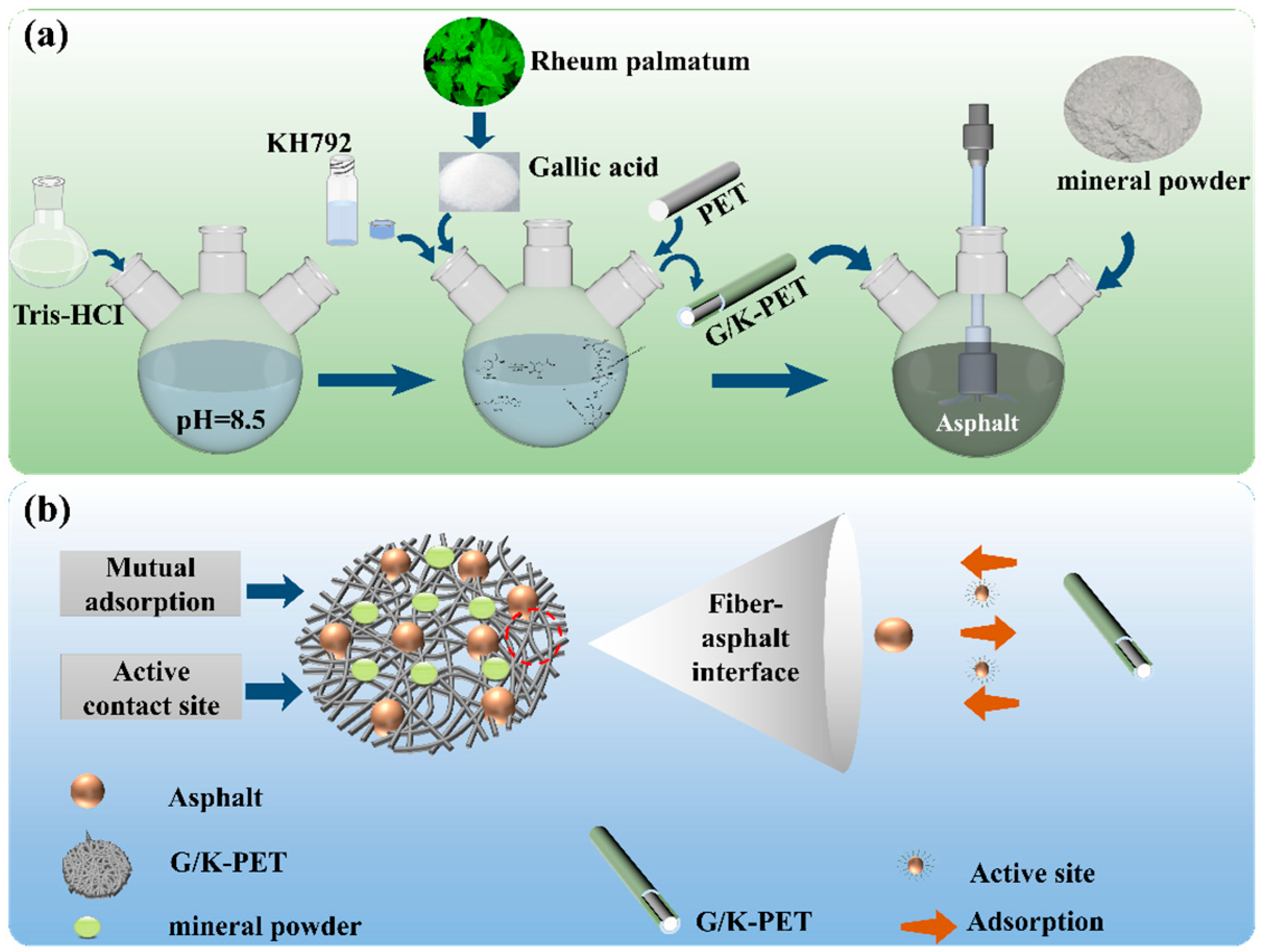
Figure 1 illustrates the preparation of PET fiber-modified asphalt binder. GA was dissolved in 150 mL Tris-HCl buffer (pH 8.5), and PET fibers were immersed for 8 h at room temperature, followed by filtration and drying at 65 °C to obtain GA-PET. For KH792 modification, PET fibers were treated in 1.5 wt% KH792 ethanol solution for 2 h, then filtered and dried to obtain KH 792-PET. For combined modification, KH792 was dissolved in 20 mL anhydrous ethanol at specified GA:KH792 molar ratios, mixed with the GA solution, and reacted with PET fibers for 8 h. The resulting fibers were filtered and dried at 65 °C to obtain G/K-PET. Asphalt mastic was prepared at 160 °C with a mineral powder/asphalt ratio of 1.0. PET fibers (3 wt%) were then incorporated and mixed at 1100 rpm for 30 min. G/K-PET with GA:KH792 ratios of 2:1, 1:1, and 1:2 were denoted as G/K-PET-1, G/K-PET-2, and G/K-PET-3, respectively, while the control mastic containing only mineral powder was labeled FA. To ensure a fair comparison of the effects of different surface modification methods (GA, KH792, and GA/KH792 co-deposition), the fiber dosage was kept constant at 3 wt% for all asphalt mastics. This eliminates the influence of fiber content as a variable and allows the observed performance differences to be attributed solely to surface modification effects.

2.3. Performance Characterization

2.3.1. Softening Point Test

The softening point of the fiber-modified asphalt binder was determined using the ring-and-ball method in accordance with JTG 3410-2025. Asphalt samples were poured into standard rings, cooled, and tested in a water bath with a heating rate of 5 ± 0.5 °C/min. The softening point was recorded as the temperature at which the steel ball dropped 25 mm. The reported value was the average of at least three parallel tests.

2.3.2. Cone Penetration Test

The consistency and hardness of the fiber-modified asphalt binder were evaluated using the cone penetration test. In this method, a standard penetration needle was replaced with a stainless steel cone (30° apex angle, 30 mm height). The combined mass of the cone, sliding rod, and additional weight was 150 g. The sample container was identical to that used in the standard penetration test. During testing, the cone was allowed to penetrate the asphalt sample under its own weight for a specified time, and the penetration depth was recorded. Higher penetration values indicate greater fluidity and lower viscosity of the binder. Based on the measured penetration depth, the shear strength of the asphalt binder was calculated using the corresponding empirical equation, namely Equation (1):
τ = 981 Q C o s 2 ( α 2 ) π h 2 t a n ( α 2 )
In the formula, τ represents the shear strength; Q is the total mass of the cone, sliding rod and weight (150 g); α is the cone angle (30°); and h is the depth of cone penetration (0.1 mm).

2.3.3. Rheological Testing

The rheological properties of the fiber-modified asphalt binder were characterized using a dynamic shear rheometer (DSR) in accordance with AASHTO T315-19 [31]. Temperature sweep tests were conducted from 58 °C in increments of 6 °C until the rutting factor (G*/sin δ) decreased below 1 kPa. The angular frequency and strain were set to 10 rad/s and 12%, respectively. Key rheological parameters, including complex shear modulus (G*), phase angle (δ), and rutting factor (G*/sin δ), were recorded.
The Multiple Stress Creep Recovery (MSCR) test was performed at 64 °C under stress levels of 0.1 kPa and 3.2 kPa to evaluate high-temperature deformation resistance. Fatigue performance was assessed using the Linear Amplitude Sweep (LAS) test at 25 °C and 10 Hz. The strain amplitude increased linearly from 0.1% to 30% over 310 s, following an initial frequency sweep (0.2–30 Hz) at 0.1% strain.
Low-temperature performance was evaluated using a bending beam rheometer (BBR) at −6 °C, −12 °C, and −18 °C. In addition, the viscosity–temperature susceptibility was quantified using the VTS index. The logarithmic relationship between corrected dynamic viscosity (η′) and temperature was fitted on a lg(lg(η′)) − lg(T) scale, and the slope of the fitted line was defined as the VTS value. The calculation of η′ is given in Equation (2):
η = ( s i n δ ) 4.8628 G * ω
In the formula, η′ denotes the corrected dynamic shear viscosity, δ is the phase angle, G is the complex shear modulus, and ω represents the angular frequency.
The interface interaction between the fibers and the asphalt binder was evaluated using two types of interaction indices: K. Ziegel-B and Luis Ibarra-A. These formulas, named Equations (3) and (4), are as follows:
t a n δ c = t a n δ m 1 + φ B
A = 1 1 V f × t a n δ c t a n δ m 1
In the equation, A and B are evaluation parameters; tan δc and tan δm denote the tangent of the phase angle of the base asphalt and fiber-modified asphalt binders, respectively; and Vf represents the fiber volume fraction. Vf was defined as the volume fraction of fibers in the fiber-modified asphalt binder and was calculated from the mass dosage and density of fibers and asphalt binder, according to Equation (5):
V f = m f ρ f m f ρ f + m a ρ a + m p ρ p
where Vf is the fiber volume fraction in the asphalt binder; mf, ma and mp are the mass of fibers, asphalt binder and mine powder, respectively; and ρf, ρa and ρp represent the density of fibers, asphalt binder and mine powder, respectively.

2.3.4. FT-IR

The chemical structures of PET fibers before and after modification were character-ized using a VERTEX 80 V Fourier Transform Infrared (FT-IR) spectrometer (Bruker, Karlsruhe, Germany). Prior to analysis, fiber samples were thoroughly cleaned and dried to remove surface contaminants. Each sample was scanned in the range of 4000–400 cm−1 at a resolution of 4 cm−1, accumulating 32 scans per spectrum to enhance signal-to-noise ratio.

2.3.5. SEM

The surface microstructure of fiber was researched by scanning electron microscopy (Gemini SEM 500, Zeiss, Jena, Germany). After mechanical testing, representative specimens were selected and manually fractured to expose fresh internal surfaces. The fractured samples were cut into small pieces (appropriate for SEM mounting). The samples were then dried under ambient or low-temperature conditions to remove moisture and avoid thermal alteration of the asphalt microstructure. Prior to SEM observation, the sample surfaces were coated with a thin conductive layer (e.g., gold sputtering) to prevent charging during imaging.

3. Results and Discussion

3.1. Softening Point Performance Analysis

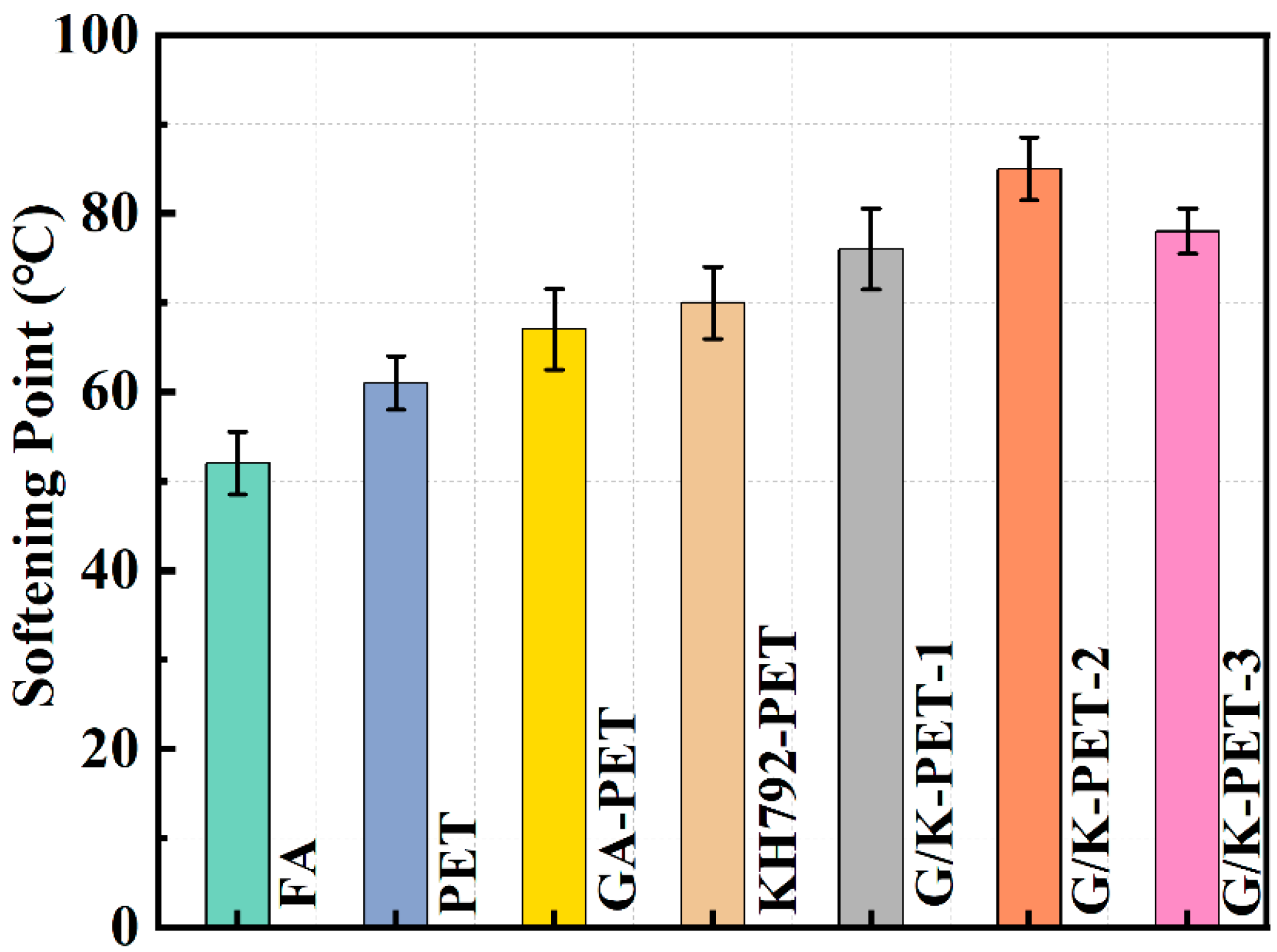
Figure 2 illustrates the softening points of asphalt mastic with different types of fibers. As shown in Figure 2, the incorporation of PET fiber significantly increased the softening point of asphalt mastic compared with FA, indicating an improvement in high-temperature stability. However, the softening point of GA-PET was slightly lower than that of PET, suggesting that GA modification alone did not further enhance the high-temperature performance of the PET-modified asphalt mastic under the present conditions. This may be attributed to the interaction between the oxygen-containing functional groups of GA and asphalt components, which altered the interfacial characteristics between the fiber and asphalt phase [32].
In contrast, KH792-PET, G/K-PET-1, G/K-PET-2, and G/K-PET-3 exhibited softening point increases of 4%, 13%, 27%, and 16%, respectively, relative to PET. Among them, G/K-PET-2 showed the highest softening point, indicating the most pronounced improvement in thermal stability. This result suggests that the combined modification of GA and KH792 was more effective than single modification in enhancing the fiber–asphalt interaction. Compared with KH792-PET, the co-modified G/K-PET fibers likely provided more active surface sites, thereby strengthening the adsorption of light asphalt fractions and improving interfacial bonding [33,34]. Meanwhile, compared with G/K-PET-1 and G/K-PET-3, G/K-PET-2 may have formed a denser and more uniform surface coating, which increased fiber surface roughness and promoted the physical anchoring and adsorption of asphalt components [35].
As a result, the synergistic effects of chemical interaction and physical adsorption enhanced the structural stability of the asphalt mastic, leading to a higher softening point. Overall, the results indicate that the GA/KH792 co-modification, particularly at a GA:KH792 molar ratio of 1:1, was the most effective approach for improving the high-temperature performance of PET fiber-modified asphalt mastic.

3.2. Cone Penetration Performance Analysis

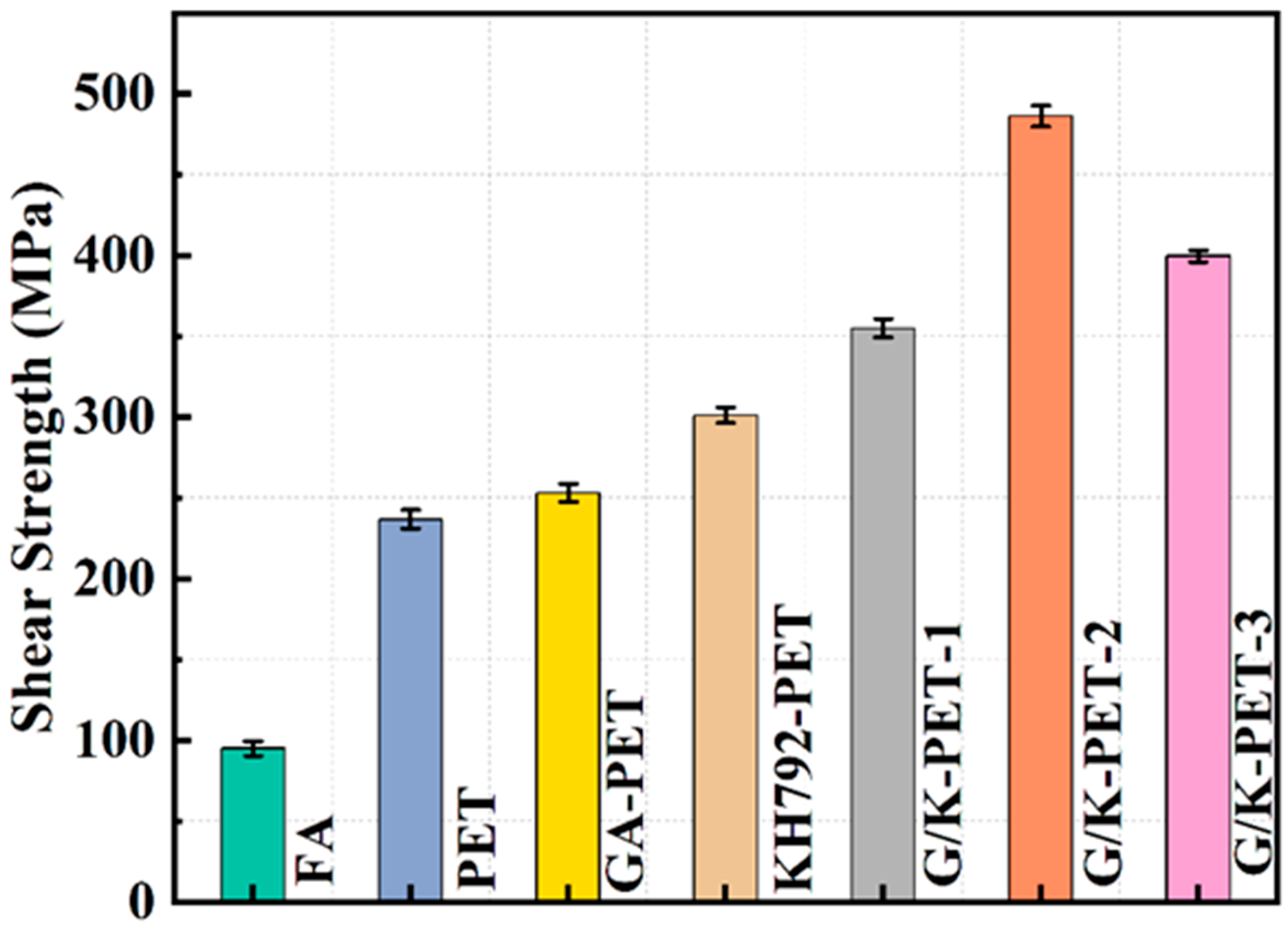
Figure 3 provides penetration shear strength of asphalt mastic with different types of fibers. All surface-modified fiber asphalt binders exhibited higher penetration shear strength than the PET asphalt binder, indicating that fiber surface treatment further improved the reinforcing effect of PET in asphalt mastic. Relative to PET, the shear strength of GA-PET, KH792-PET, G/K-PET-1, G/K-PET-2, and G/K-PET-3 increased by approximately 7%, 27%, 50%, 105%, and 69%, respectively, with G/K-PET-2 showing the highest value. This improvement is mainly attributed to the enhanced interfacial interaction between the modified fibers and asphalt matrix [36]. Previous studies have shown that the reinforcing effect of fibers is closely related to their surface characteristics and interfacial compatibility with asphalt, while silane coupling treatment can further improve interfacial adhesion and mechanical performance [37]. The superior performance of G/K-PET-2 suggests that the combined modification of GA and KH792 generated a more effective surface structure, thereby promoting stress transfer and improving the structural stability of the asphalt mastic under shear loading.

3.3. Analysis of High-Temperature Rheological Performance

3.3.1. Temperature Scan Analysis

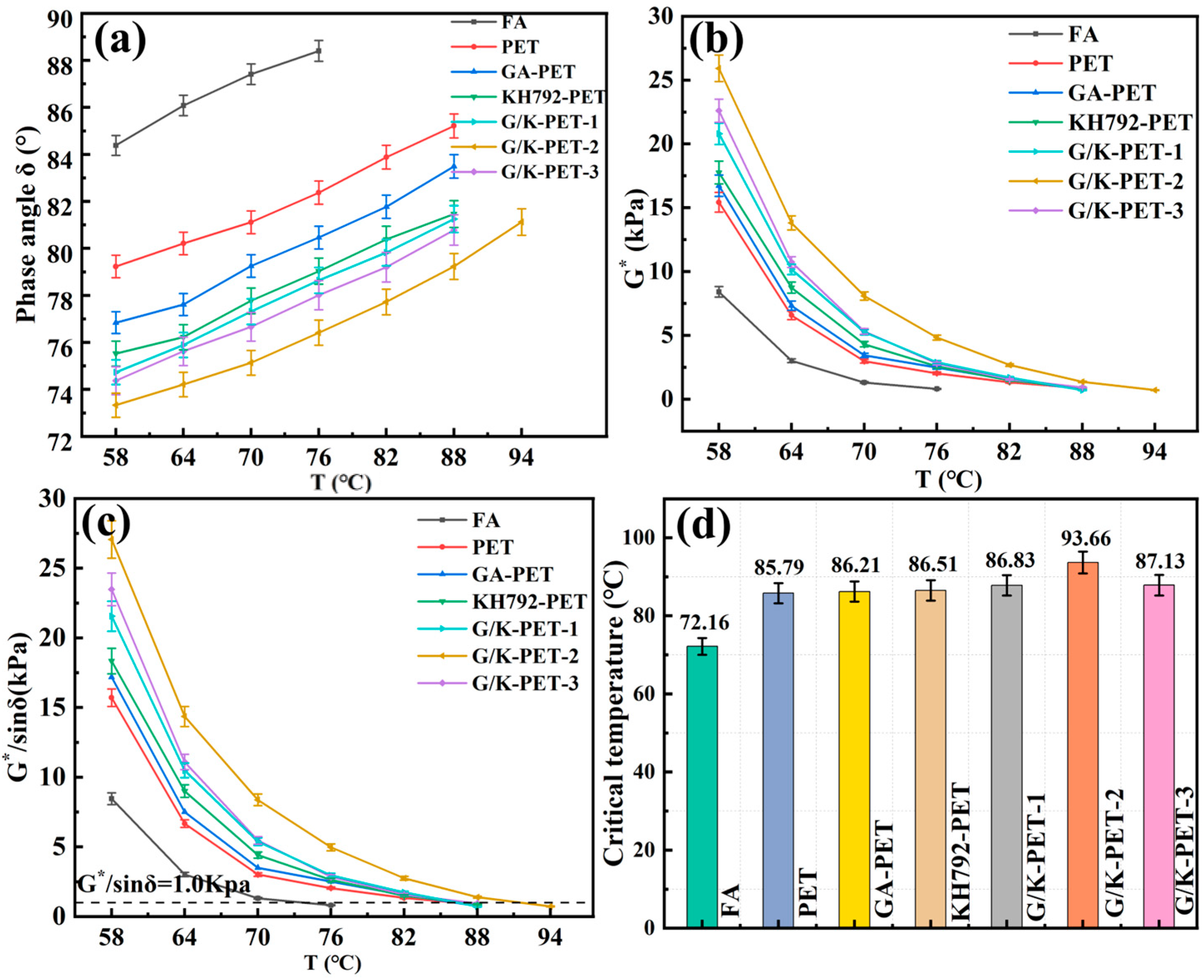
Figure 4 depicts the temperature scan results of asphalt mastic with different types of fibers. As shown in Figure 4a, the δ of all asphalt mastics increases with temperature, indicating a gradual transition from elastic-dominated to viscous-dominated behavior. This is mainly attributed to the increased molecular mobility and weakened intermolecular interactions at elevated temperatures, which reduce the elastic response of the asphalt binder [38]. Compared with the FA sample without fibers, all fiber-modified asphalt mastics exhibit lower δ over the entire temperature range, suggesting an enhanced elastic component and improved resistance to deformation. This result is consistent with previous studies showing that fiber incorporation can restrict the flow of asphalt components and improve viscoelastic performance by forming a reinforcing structure within the binder [39]. Among the modified samples, G/K-PET-2 shows the lowest δ, indicating the strongest elastic response. This improvement can be attributed to the enhanced interfacial interaction between the modified fibers and the asphalt matrix. The co-modified G/K-PET fibers likely provide a more active and roughened surface, which promotes the adsorption of asphalt components and reduces the proportion of free asphalt. In addition, the improved interfacial bonding enhances stress transfer efficiency and limits molecular mobility, thereby increasing the stiffness of the asphalt mastic and reducing the phase angle [40].
As shown in Figure 4b, the G* of all asphalt mastics decreases with increasing temperature, indicating a reduction in stiffness and load-bearing capacity at elevated temperatures. This behavior is consistent with the typical thermorheological characteristics of asphalt binders, where increased temperature enhances molecular mobility and weakens intermolecular interactions [41]. Compared with the FA sample, all fiber-modified asphalt mastics exhibit higher G* values over the entire temperature range, demonstrating that fiber incorporation improves the stiffness and deformation resistance of the asphalt binder. Among the modified samples, G/K-PET-2 shows the highest G* values, followed by G/K-PET-3 and G/K-PET-1, while GA-PET and KH792-PET exhibit relatively lower values. This result indicates that the GA/KH792 co-modification is more effective than single modification in enhancing the rheological performance of PET fiber-modified asphalt. The superior performance of G/K-PET-2 can be attributed to the improved interfacial interaction between the modified fibers and the asphalt matrix. The combined modification likely produces a more uniform and chemically active surface, which enhances the adsorption of asphalt components and restricts molecular mobility. In addition, silane coupling reactions can improve interfacial bonding and promote stress transfer efficiency, resulting in a more stable internal structure under loading [39]. The presence of functional groups on the modified fiber surface may further strengthen intermolecular interactions at the interface, contributing to a denser and more cohesive network structure within the asphalt mastic.
Figure 4c,d present the rutting factor and critical temperature of asphalt mastics containing different types of fibers. According to the SHRP specification, the critical temperature is defined as the temperature at which G*/sin(δ) = 1 kPa [35]. Based on the data in Figure 4c, the critical temperatures were determined by exponential fitting, and the results are summarized in Table 4. As shown in Figure 4c, the rutting factor of all asphalt mastics decreases with increasing temperature, indicating a gradual reduction in high-temperature deformation resistance. However, all fiber-reinforced samples exhibit higher G*/sin(δ) values than the FA control over the entire temperature range, confirming that fiber incorporation improves the rutting resistance of asphalt mastic. Compared with PET, all surface-modified fiber samples show further improvement, among which G/K-PET-2 exhibits the highest rutting factor. At 58 °C, its rutting factor is approximately 72% higher than that of PET. This improvement can be attributed to two main factors. First, the biomimetic coating on the surface of G/K-PET-2 fibers enhances interfacial interactions with asphalt components, promoting the formation of a more stable network structure. Second, the modified fibers exhibit a stronger ability to adsorb light (oily) components in the asphalt, facilitating the development of an effective interlocking structure. The combined effects of these mechanisms improve the high-temperature rheological performance of the binder.
The critical temperature results in Figure 4d show a similar trend. The critical temperature increases markedly after fiber addition, increasing from 72.16 °C for FA to 85.79 °C for PET, indicating that PET fibers significantly enhance the thermal stability of the asphalt mastic. Surface modification leads to a further increase in critical temperature, with G/K-PET-2 reaching the highest value of 93.66 °C, which is about 9% higher than that of PET. This improvement indicates that the co-modified fibers provide a more effective reinforcing structure within the asphalt matrix. A more compatible and active fiber surface likely promotes better dispersion and stronger interfacial bonding, thereby limiting binder flow and improving resistance to rutting at high temperatures [42,43].

3.3.2. Temperature Sensitivity Analysis

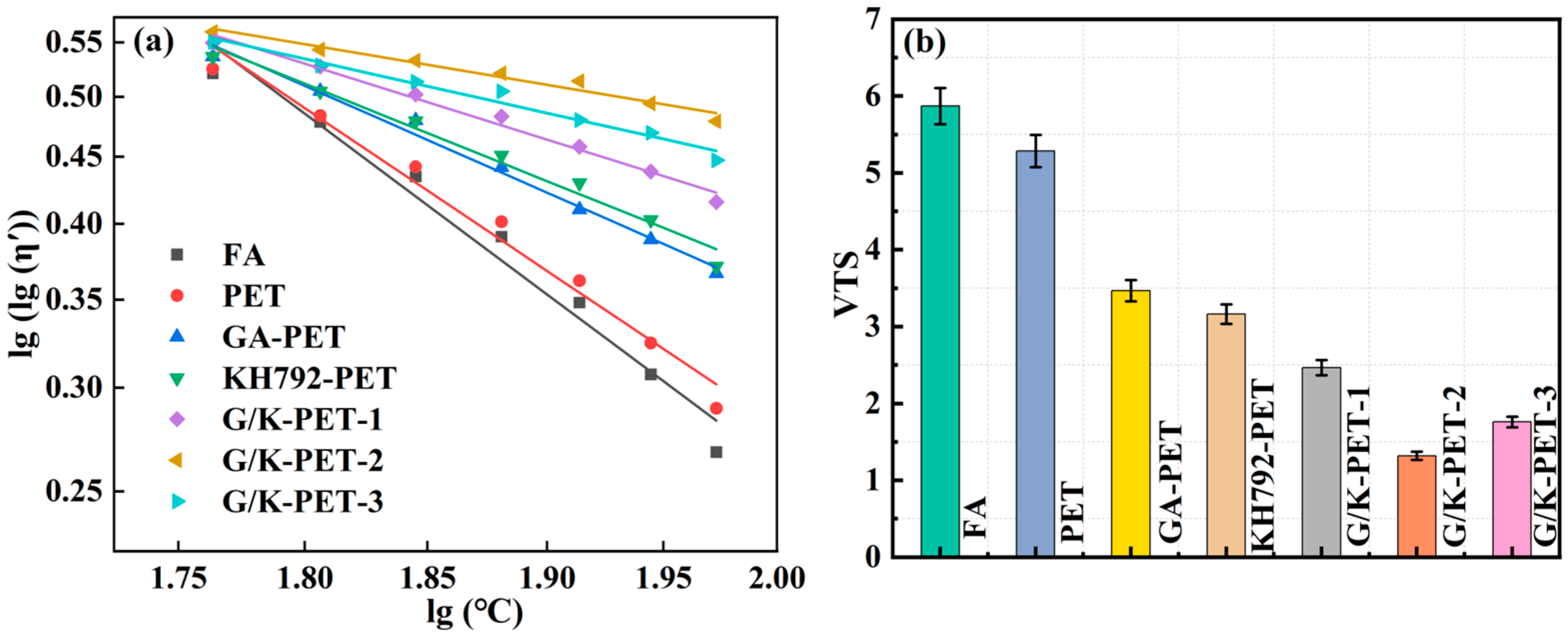
The corrected dynamic shear viscosity (η′) was plotted against temperature on a lg(lg(η′)) – lg(°C) scale, and linear fitting was performed to determine the Viscosity–Temperature Sensitivity (VTS) index [44], as shown in Figure 5a. The fitting results are provided in Table 5. Figure 5b displays the absolute values of the VTS index. A lower VTS value indicates reduced temperature sensitivity of the fiber-modified asphalt binder. Compared to FA sample, the VTS value of PET is lower due to the incorporation of PET fibers, which improve the binder’s adhesion properties. The fibers help form a stable asphalt membrane, thereby reducing the binder’s temperature sensitivity. Among the five modified PET fiber binders, all show lower VTS values than PET alone. While GA-PET and KH792-PET exhibit some reduction in VTS, the decrease is more pronounced in G/K-PET-2. This is attributed to the biomimetic coating on the surface of G/K-PET-2 fibers, which enhances fiber wettability and improves interfacial bonding with the asphalt resins. As a result, the fibers better adsorb asphalt, leading to thicker asphalt films and stronger fiber–asphalt bonding. Furthermore, the ordered structure of the biomimetic coating creates a functional gradient, coupling mechanical and thermal properties and ultimately reducing the binder’s temperature sensitivity [45].

3.3.3. MSCR Analysis

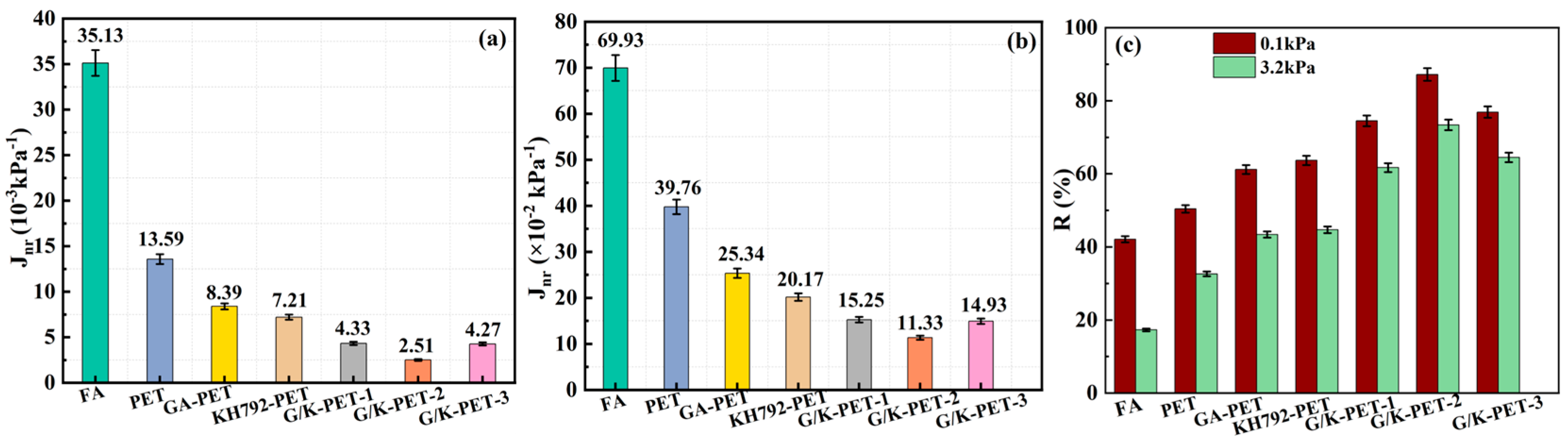
Figure 6a–c present the non-recoverable creep compliance (Jnr) and recovery rate (R) of the asphalt binders under stress levels of 0.1 and 3.2 kPa. The incorporation of PET fibers reduced Jnr and increased R, indicating improved resistance to permanent deformation and enhanced elastic recovery. This improvement can be attributed to the adsorption of light asphalt components by the fibers and the formation of a reinforcing network structure within the binder, which restricts asphalt flow at high temperatures. Under both stress levels, all five surface-modified PET fiber asphalt binders exhibited higher R and lower Jnr than the PET asphalt binder. A lower Jnr indicates less permanent deformation under loading. After GA modification, the Jnr of the PET asphalt binder decreased, and a further reduction was observed after KH792 modification, suggesting that KH792-PET was more effective than GA-PET in enhancing high-temperature deformation resistance. Among all samples, the G/K-PET-2 asphalt binder exhibited the highest R and the lowest Jnr. Compared with the PET asphalt binder, under 0.1 kPa, R increased by 36.8% and Jnr decreased by 81.5%; under 3.2 kPa, R increased by 40.8% and Jnr decreased by 71.5%. These results demonstrate that G/K-PET-2 provided the greatest improvement in high-temperature performance. This enhancement is likely related to the biomimetic GA/KH792 coating, which strengthened the interfacial interaction between PET fibers and asphalt. The active functional groups and increased surface roughness of the modified fibers likely promoted mechanical interlocking and interfacial bonding, thereby improving the deformation resistance of the asphalt binder [46].

3.4. Medium-Temperature Fatigue Resistance Performance Analysis

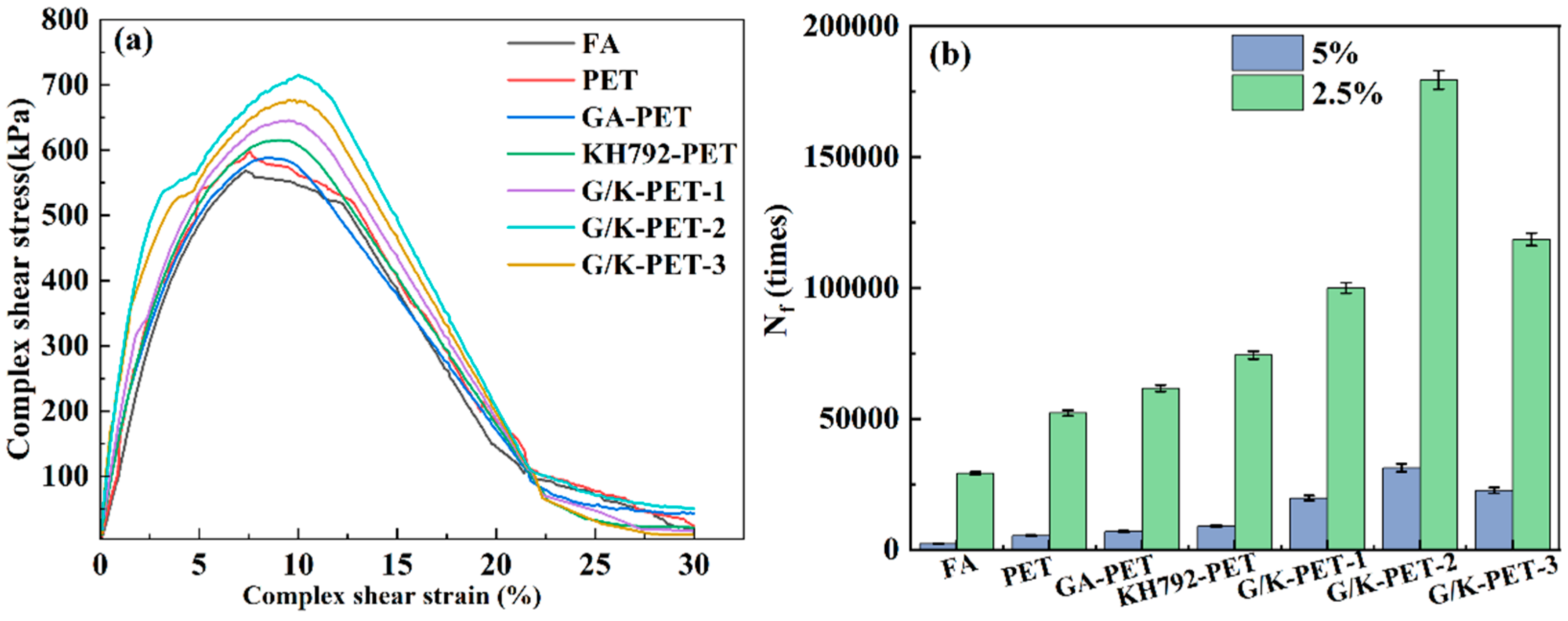
The fatigue performance of asphalt binders containing different fiber types was evaluated at 25 °C using the LAS test. Figure 7a shows the stress–strain response of the binders under loading. As the strain increased, the shear stress first rose and then declined. The strain corresponding to the peak stress was defined as the fatigue failure strain; a higher value indicates better fatigue resistance. Figure 7b presents the fatigue life of the binders, calculated from the LAS data using the Viscoelastic Continuum Damage (VECD) theory and dissipated energy approach. The fatigue life prediction equations and LAS parameters are listed in Table 5.
As shown in Table 5 and Figure 7a, all five surface-modified PET fiber asphalt binders exhibited higher fatigue failure strain and ultimate shear stress than the PET asphalt binder, indicating improved fatigue resistance. KH792-PET showed higher fatigue failure strain and ultimate shear stress than GA-PET, suggesting that KH792 modification was more effective than GA modification in enhancing fatigue performance. Among all samples, G/K-PET-2 exhibited the most pronounced improvement, with fatigue failure strain and ultimate shear stress increasing by 3.87% and 19%, respectively, compared with PET. This enhancement is likely associated with the biomimetic coating, which strengthened the interfacial bonding between the fibers and asphalt and improved their compatibility [47]. In addition, the modified fibers may have formed a more uniform three-dimensional reinforcing network within the binder, which helped absorb and dissipate stress under loading and thereby improved toughness and crack resistance [48].
According to Bahia, a strain level of 2.5% is recommended for higher-strength pavements, whereas 5.0% is more appropriate for lower-strength pavements. Therefore, the fatigue lives of the different fiber asphalt binders at strain levels of 2.5% and 5.0% were calculated using the fatigue equations in Table 6. As shown in Figure 7b, the fatigue life followed the order PET < GA-PET < KH792-PET < G/K-PET-1 < G/K-PET-3 < G/K-PET-2. These results indicate that co-modification of PET fibers significantly improved the fatigue resistance of the asphalt binder, with G/K-PET-2 showing the best performance. This improvement was likely due to enhanced interfacial interaction between the modified fibers and asphalt, which promoted stress transfer and reduced local stress concentration [49]. As a result, the binder exhibited greater resistance to fatigue damage under repeated loading.

3.5. Low-Temperature Rheological Performance Analysis

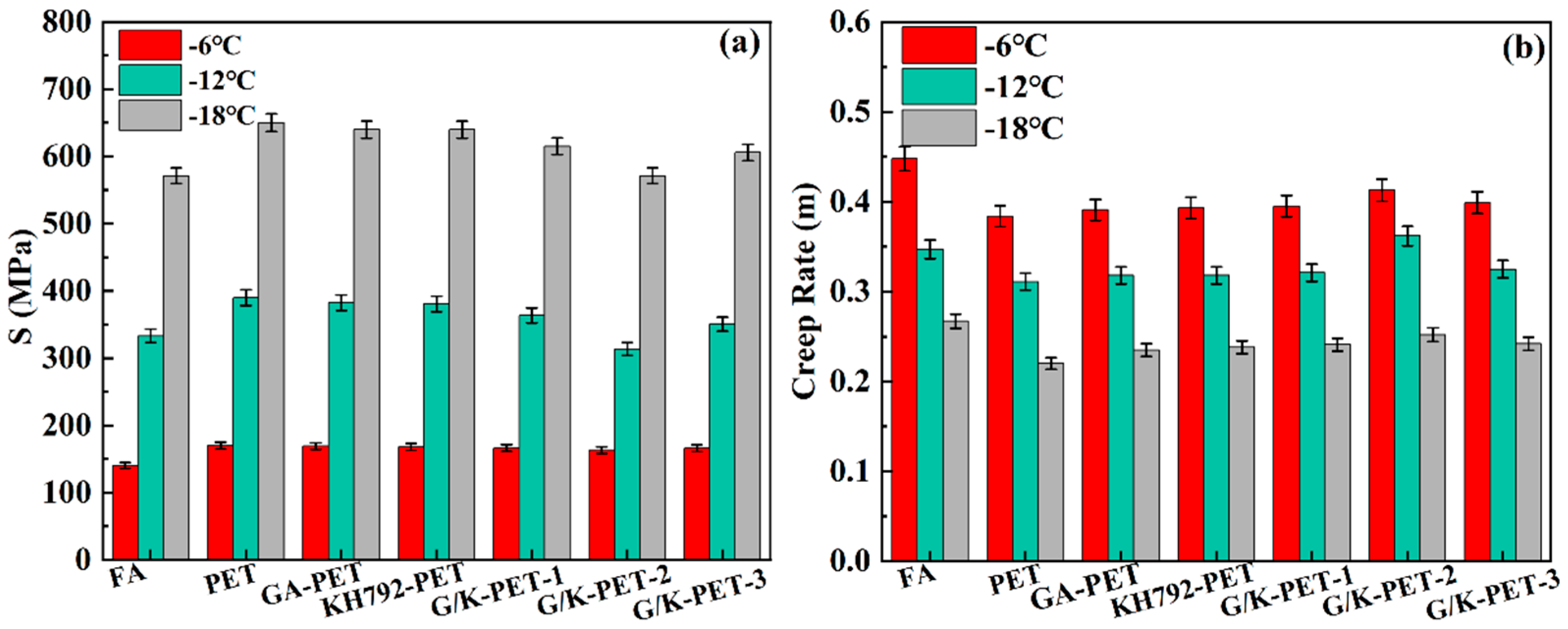
The low-temperature rheological properties of asphalt mastics containing different types of fibers were evaluated using the BBR, as shown in Figure 8a,b. For all samples, the creep modulus (S) increased markedly as the temperature decreased from −6 °C to −18 °C, while the creep rate (m) decreased correspondingly, indicating a progressive increase in stiffness and a reduction in stress relaxation capacity at lower temperatures. At the same test temperature, the PET asphalt mastic exhibited the highest S values and the lowest m values among all samples, suggesting that the incorporation of unmodified PET fibers increased binder stiffness and reduced low-temperature relaxation ability.
Surface modification of PET fibers partially mitigated this adverse effect. Compared with PET, both GA-PET and KH792-PET showed slightly lower S values and slightly higher m values, indicating a limited improvement in low-temperature rheological behavior. Among the co-modified samples, G/K-PET-2 exhibited the lowest creep modulus and the highest creep rate, particularly at −12 °C and −18 °C, where its S values were reduced to levels close to those of FA. At −18 °C, for example, the S value of G/K-PET-2 was approximately comparable to that of the control, whereas PET, GA-PET, and KH792-PET remained noticeably higher. A similar trend was observed for the m value: although all fiber-containing mastics showed lower m values than FA, G/K-PET-2 retained the highest m among the fiber-modified groups.
These results indicate that fiber incorporation improved structural reinforcement but tended to increase low-temperature stiffness, which is unfavorable for thermal stress relaxation [50]. The superior performance of G/K-PET-2 suggests that the combined GA/KH792 surface treatment enhanced fiber–asphalt interfacial compatibility and dispersion, thereby alleviating excessive stiffening at low temperatures. Nevertheless, the low-temperature performance of all fiber-modified mastics remained generally inferior to that of FA, indicating that the reinforcing effect of the fibers at low temperature was still dominant. Overall, G/K-PET-2 showed the best balance between reinforcement and crack resistance among the fiber-modified systems.
The temperature-dependent performance of the modified asphalt mastic reveals that GA/KH792 functionalization significantly enhances high-temperature deformation resistance, while the improvement at low temperatures remains relatively limited. At elevated temperatures, the introduction of active functional groups strengthens fiber–asphalt interfacial bonding and promotes the formation of a stable three-dimensional reinforcing network, which effectively restricts molecular mobility and improves resistance to permanent deformation. However, at low temperatures, the increased interfacial interaction and enhanced stiffness of the system reduce the material’s ability to relax thermal stresses. The stronger bonding between fibers and asphalt limits interfacial slippage and internal adjustment, leading to higher stress concentration under thermal contraction. In addition, the fiber reinforcement mechanism is inherently stiffness-dominated, which, while beneficial for rutting resistance, may compromise flexibility and crack resistance at low temperatures. Therefore, the observed behavior reflects a trade-off between improved structural integrity at high temperatures and reduced stress relaxation capacity at low temperatures.

3.6. Analysis of Interface Interactions

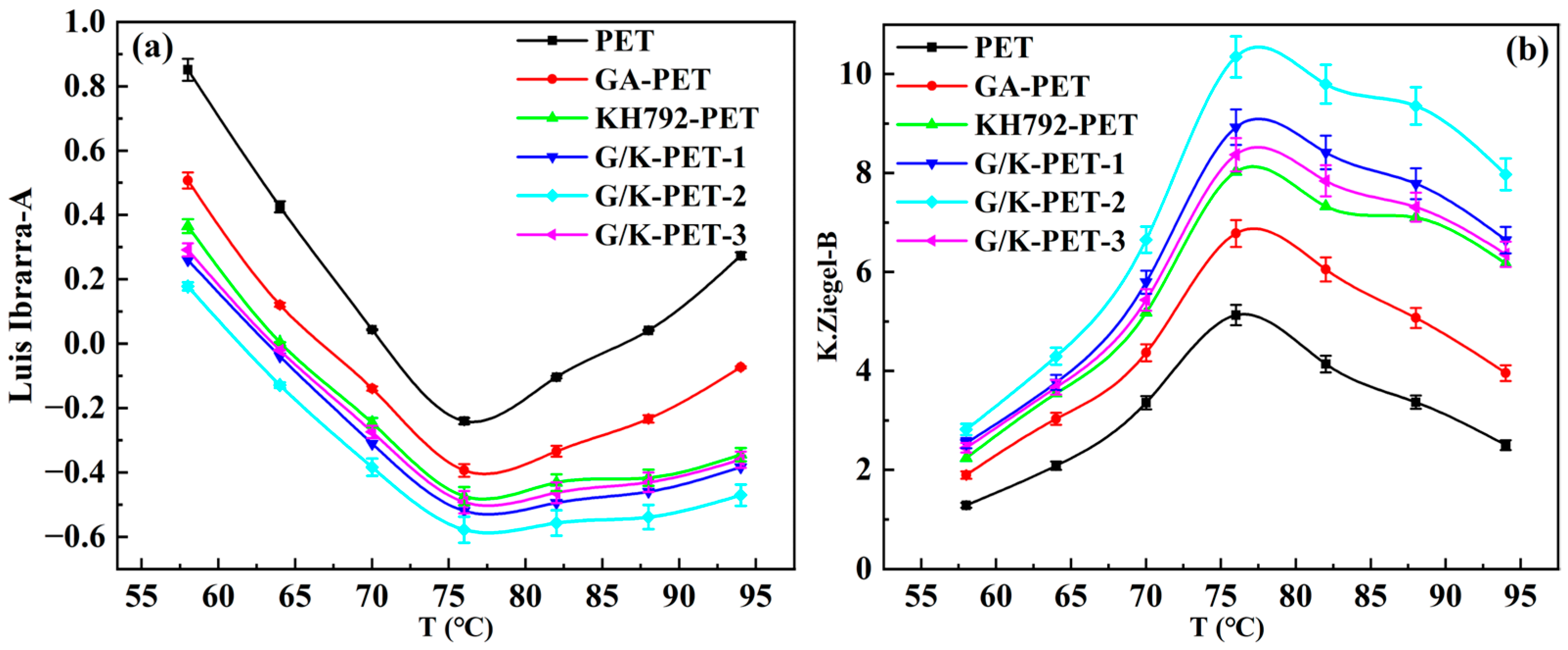
Temperature scanning tests were performed to measure the δ value of different types of PET fiber asphalt binders. Based on the δ value, the interface interaction between the asphalt binder and PET fibers was evaluated using the indicators K. Ziegel-B and Luis Ibrarra-A [51]. A smaller A value and a larger B value indicate stronger interaction between the PET fibers and the asphalt binder. The interface interaction evaluation indicators for different types of PET fiber asphalt binders are shown in Figure 9a,b. According to both Luis Ibrarra-A and K. Ziegel-B, the interface interaction between fibers and asphalt binder first increases and then decreases as the temperature rises. At 76 °C, the interface interaction reaches its maximum strength. This is due to the increased molecular activity between 58 °C and 76 °C, which leads to thermal expansion, causing volume changes between the fibers and asphalt binder. This reduces voids and defects in the interface, resulting in closer contact between the asphalt binder and fibers, thereby strengthening the interface interaction. However, between 76 °C and 94 °C, the binder softens excessively, its internal cohesion significantly decreases, and it is no longer able to provide sufficient support for the interface interaction, which reduces the stability of the entire interface system and weakens the interface interaction. According to both Luis Ibrarra-A and K. Ziegel-B, KH792-PET fibers exhibit a stronger interface interaction with the asphalt binder compared to GA-PET fibers. PET fibers modified by chemical modification of both modifiers further enhance the interface interaction with the asphalt binder, with G/K-PET-2 fibers showing the highest improvement in interface interaction strength compared to unmodified PET.

3.7. SEM Analysis

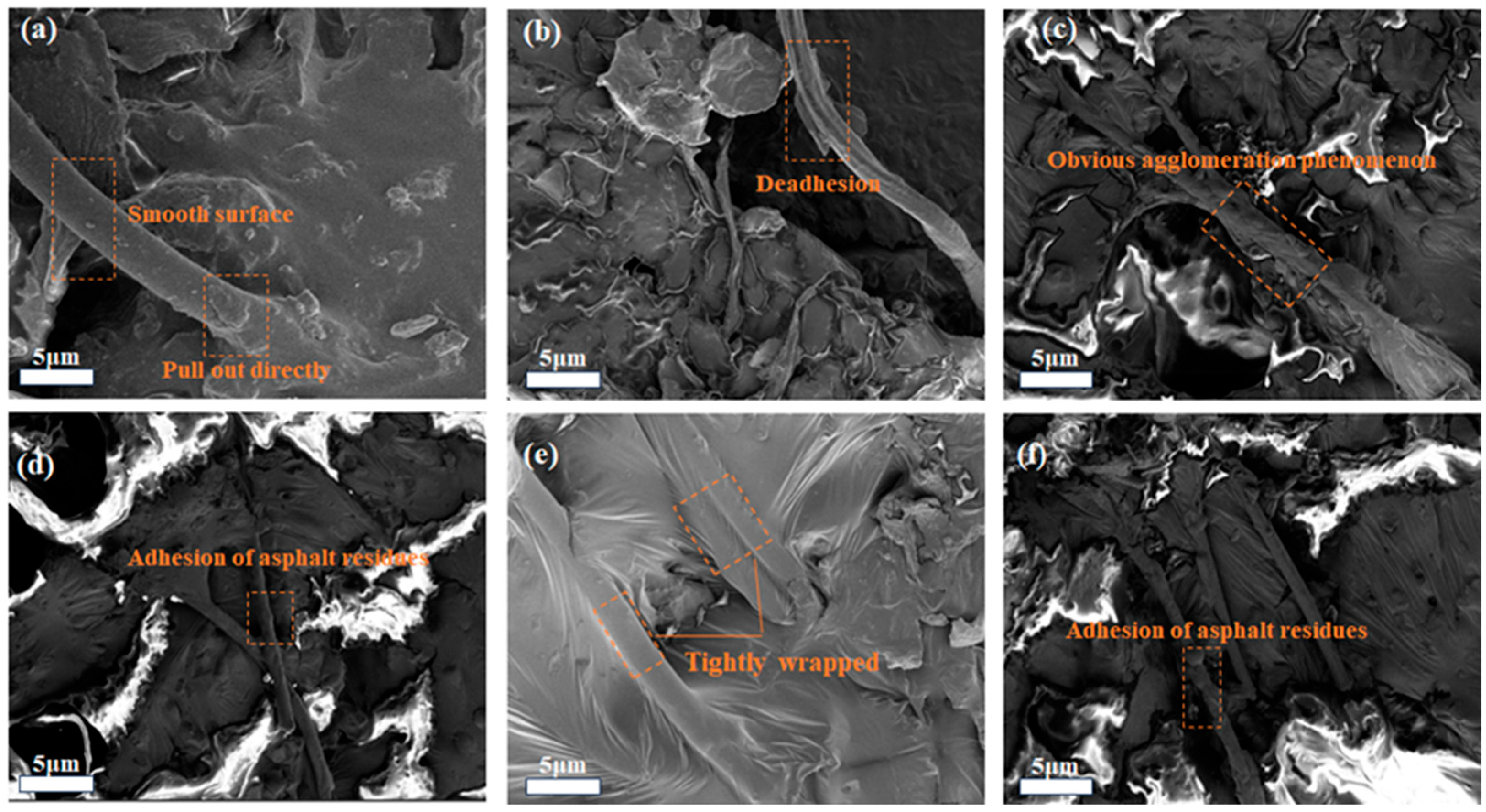
The cross-sectional microstructures of asphalt mastics containing different types of PET fibers were characterized by SEM, as shown in Figure 10. For the PET asphalt mastic (Figure 10a), the fibers exhibit a typical single-filament pull-out morphology with smooth surfaces and little to no asphalt residue, indicating weak interfacial bonding and poor adhesion between the fibers and asphalt matrix, which is consistent with previous studies where fiber pull-out behavior reflects insufficient interfacial adhesion [38]. A similar pull-out feature is observed in the GA-PET sample (Figure 10b); although a small amount of asphalt adheres to the fiber surface, the interfacial bonding remains limited, suggesting that GA modification alone provides only a slight improvement in adhesion. In contrast, KH792-PET (Figure 10c) shows increased asphalt coverage on the fiber surface and no obvious interfacial debonding, indicating improved interfacial bonding due to silane-induced chemical interactions and enhanced surface activity [52]. However, fiber agglomeration is evident, which may negatively affect dispersion and stress distribution within the binder. For the co-modified samples (Figure 10d–f), the degree of fiber agglomeration is reduced and the amount of asphalt adhering to the fiber surfaces increases significantly, indicating improved dispersion and stronger fiber–asphalt interaction, which agrees with findings that biomimetic or coupling-modified fibers enhance interfacial compatibility and structural uniformity [53]. Among them, G/K-PET-2 (Figure 10e) exhibits the most notable characteristics: the fibers are tightly embedded within the asphalt matrix and are uniformly wrapped by a continuous asphalt film, with no apparent pull-out features. This morphology suggests a substantially enhanced interfacial bonding and load transfer capability. The improved performance of the co-modified fibers can be attributed to the synergistic effect of GA and KH792 surface treatments. The modification likely increases fiber surface roughness and introduces more active sites, thereby promoting mechanical interlocking and interfacial interaction with asphalt components. As a result, a more stable and integrated microstructure is formed, which is beneficial for stress transfer and structural integrity. Overall, the G/K-PET-2 sample, corresponding to a GA:KH792 ratio of 1:1, exhibits the strongest fiber–asphalt interfacial interaction among all groups.

3.8. FT-IR Analysis

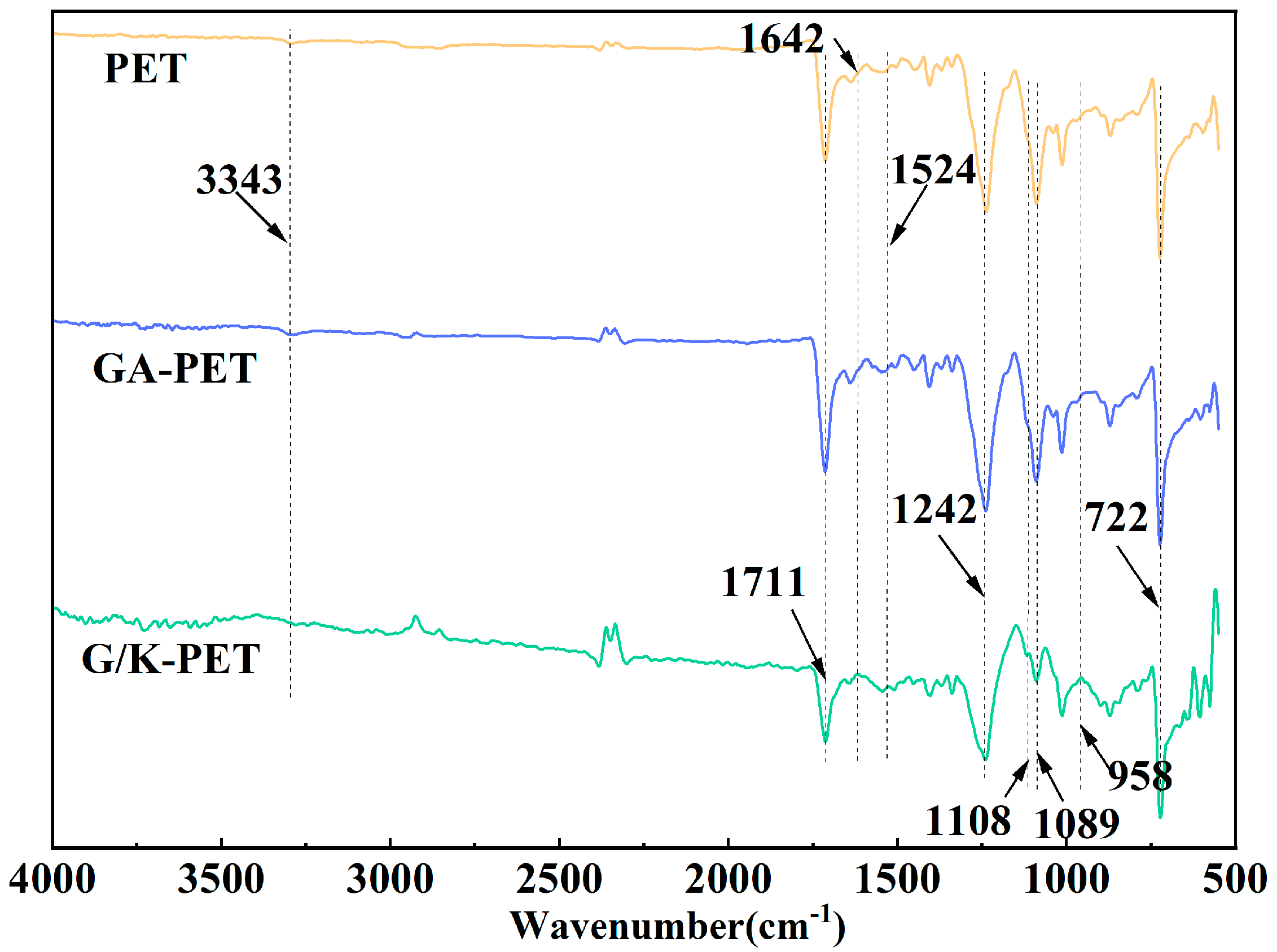
In Figure 11, the FTIR spectra of PET fibers before and after modification reveal changes in the surface chemical structure. For pristine PET fibers, the characteristic absorption bands at 1711 and 1242 cm−1 are assigned to the stretching vibration of ester C=O groups, while the peak at 1089 cm−1 corresponds to the asymmetric stretching vibration of C-O-C bonds. The absorption band at 722 cm−1 is attributed to the bending vibration of -CH2- groups, and the weak band at 3343 cm−1 is related to O-H stretching vibration, confirming the typical molecular structure of PET [54].
After GA modification, a weak spectral variation appears around 1524 cm−1, which can be associated with quinone/aromatic-related structures formed by the oxidation of phenolic groups in GA. The GA-related O-H absorption is not clearly separated in the GA-PET spectrum, probably because it overlaps with the inherent O-H stretching band of PET and is broadened by hydrogen bonding. After further modification with KH792, the absorption band around 1642 cm−1 is attributed to C=N stretching vibration generated by the Schiff base reaction between oxidized GA and amino groups of KH792 [55]. Meanwhile, the band near 1108 cm−1 is related to N-H bending vibration and may also include contributions from Si-O-Si structures. The absorption band at 958 cm−1 is assigned to Si-OH groups derived from hydrolyzed KH792, while the band near 1089 cm−1 may result from the overlap of PET C-O-C and KH792-derived Si-O-Si vibrations.
Although the newly formed bands at 1524 and 1642 cm−1 are relatively weak due to the thin surface-modified layer and overlap with the strong characteristic peaks of PET, their appearance, together with the Si-OH/Si-O-Si-related bands and the literature-reported assignments, supports the successful GA/KH792 surface chemical modification of PET fibers. Overall, the FTIR results indicate that GA is oxidized to quinone-like structures and subsequently reacts with KH792 through Schiff base reaction and Michael addition, while KH792 undergoes hydrolysis and condensation to form a siloxane network on the PET surface. This functional coating introduces phenolic, imine, amine, and siloxane groups, thereby improving the interfacial interaction between PET fibers and the asphalt matrix.
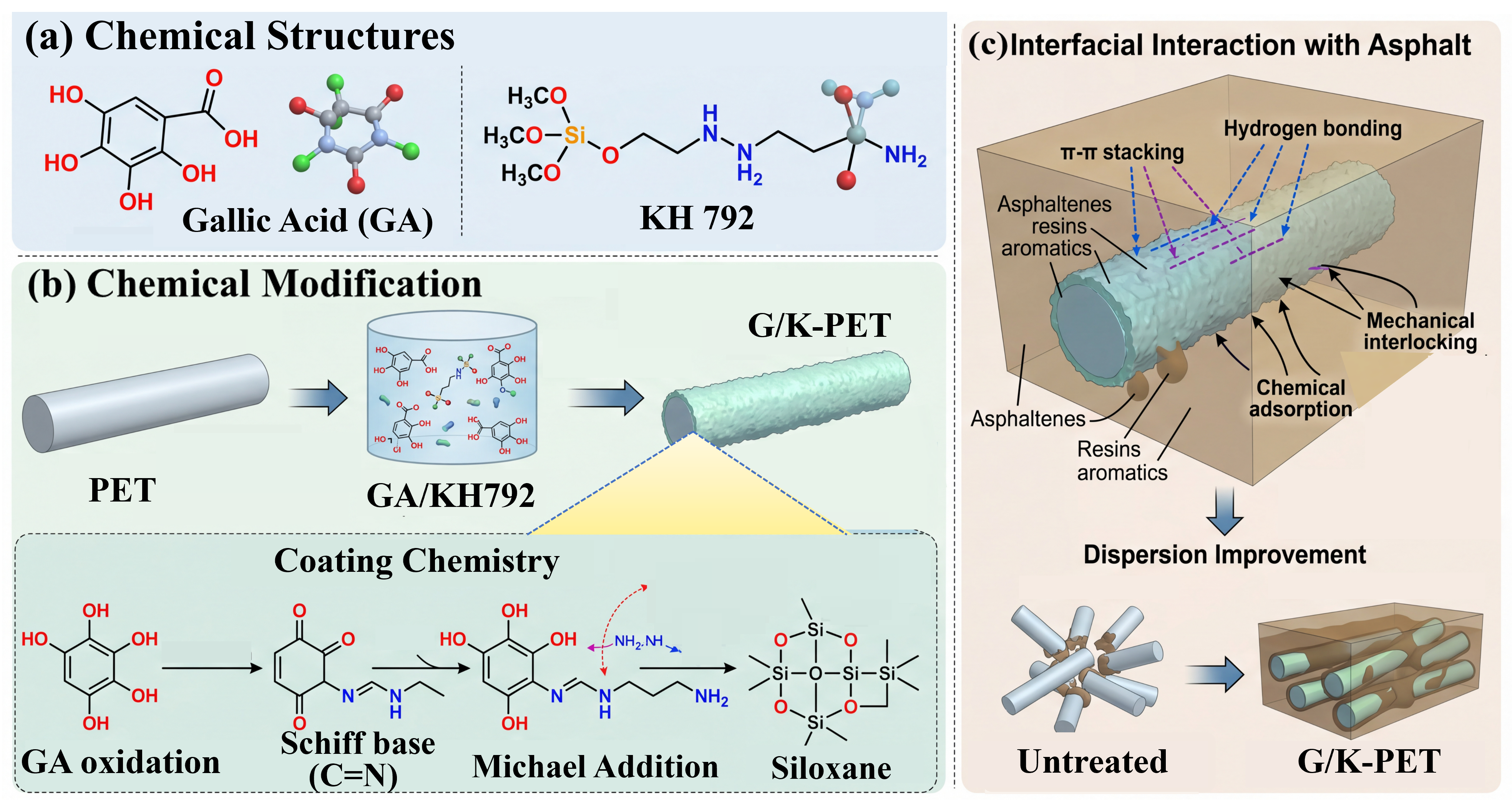
Combining these spectral changes with the modification mechanism, it can be inferred that GA is first oxidized to quinone structures, which subsequently participate in Schiff base reactions and Michael addition with KH792, forming a chemically bonded interfacial layer (Figure 12). Simultaneously, the hydrolyzed silane groups of KH792 undergo condensation to generate a Si-O-Si network, which further anchors the modification layer onto the PET surface. As a result, multiple functional groups, including phenolic hydroxyl, imine (C=N), amine (N-H), and siloxane (Si-O-Si), are introduced onto the fiber surface. These groups significantly enhance intermolecular interactions such as hydrogen bonding, chemical bonding, and π–π interactions with asphalt components. Therefore, the FTIR results not only confirm the successful surface chemical co-modification of PET fibers by GA and KH792, but also reveal the formation of a synergistic interfacial structure that is responsible for the improved compatibility and performance of the modified asphalt mastic.

4. Conclusions

This study systematically investigated the effects of GA/KH792 chemical modification surface modification on the performance and interfacial behavior of PET fiber-reinforced asphalt mastic. The main conclusions are summarized as follows:
(1)
A novel bio-inspired chemical modification approach combining gallic acid and KH792 was successfully developed for PET fiber surface functionalization. The synergistic interaction between polyphenol chemistry and silane coupling reactions enabled the formation of a hybrid coating with enhanced surface activity, providing a more effective alternative to conventional single-modification methods.
(2)
The co-modified fibers, particularly G/K-PET-2 (GA:KH792 = 1:1), exhibited the most pronounced improvement in asphalt mastic performance. Compared with PET-modified mastic, the softening point and penetration shear strength increased by 27% and 105%, respectively, while the rutting factor and critical temperature increased by approximately 72% and 9%. In addition, fatigue resistance was significantly improved, demonstrating enhanced durability under repeated loading.
(3)
Rheological analysis, interfacial indices, and SEM observations confirmed that the performance improvements were primarily attributed to enhanced fiber–asphalt interfacial interaction. The co-deposited coating increased surface roughness, introduced active functional groups, and improved fiber dispersion, thereby promoting mechanical interlocking, chemical bonding, and efficient stress transfer within the asphalt matrix.
(4)
The GA/KH792 modification effectively reduced temperature sensitivity and improved high-temperature deformation resistance, although the improvement in low-temperature performance remained limited due to the inherent stiffening effect of fiber reinforcement.
(5)
The proposed modification method is environmentally friendly, utilizing naturally derived gallic acid and a simple, low-energy processing route. This approach not only enhances the performance of PET fiber-reinforced asphalt but also provides a sustainable pathway for developing high-performance pavement materials with improved durability and resource efficiency.

Author Contributions

Data curation, Formal analysis, Writing—review and editing, software Y.G. and H.Y. (Huiling Yu); Resources, Data curation, Writing—original draft, Y.Z.; Resources, Data curation, Writing—original draft, Methodology Q.D. and J.K.; Project administration, Investigation and Data curation, W.C.; Methodology, Writing—review and editing, Funding acquisition, S.S. and H.Y. (Hong Yin); Writing—original draft, Writing—review & editing, Supervision, Project administration, Y.D. and H.S.; Methodology, Writing—review and editing, K.Z. All authors have read and agreed to the published version of the manuscript.

Funding

This research was funded by the Shandong Provincial Transportation Science and Technology Program (grant numbers 2025BAI14-02, 2022B101 and 2023B89) and the Shandong Province Science and Technology-based Small and Medium-sized Enterprises Innovation Capacity Enhancement Project (grant number 2022TSGC2056).

Institutional Review Board Statement

Not applicable.

Informed Consent Statement

Not applicable.

Data Availability Statement

The original contributions presented in this study are included in the article. Further inquiries can be directed to the corresponding authors.

Acknowledgments

Sincere appreciation is extended to all supporting institutions and funding agencies.

Conflicts of Interest

The authors declare no conflicts of interest.

References

  1. Liu, L.; Liu, Z.H.; Liu, J.Y. Effects of silane-coupling agent pretreatment on basalt fibers: Analyzing the impact on interfacial properties and road performance. J. Mater. Civ. Eng. 2020, 32, 04020041. [Google Scholar] [CrossRef]
  2. Xia, L.; Cao, D.W.; Zhang, H.L.; Zhang, M.M.; Shan, L.Y.; Zhang, H.Y.; Wang, T.W. Surface modification of recycled polyester fiber and performance evaluation of its asphalt mastic and mixture. Sustainability 2024, 16, 278. [Google Scholar]
  3. Jia, H.C.; Sheng, Y.P.; Guo, P.; Underwood, S.; Chen, H.X.; Kim, Y.R.; Li, Y.; Ma, Q.W. Effect of synthetic fibers on the mechanical performance of asphalt mixture: A review. J. Traffic Transp. Eng. 2023, 10, 331–348. [Google Scholar] [CrossRef]
  4. Xie, T.T.; Wang, L.B. Optimization of carbon fiber length and content for asphalt mastics based on rheological measurements. J. Mater. Civ. Eng. 2023, 35, 04023414. [Google Scholar] [CrossRef]
  5. Luo, J.W.; Cheng, C.; Cai, M.; Zhao, Y.H.; Su, Y. Investigating recycled pulp fiber reinforcement mechanisms on asphalt mastic. Constr. Build. Mater. 2024, 451, 138751. [Google Scholar] [CrossRef]
  6. Xie, T.T.; Zhao, K.; Wang, L.B. Reinforcement effect of different fibers on asphalt mastic. Materials 2022, 15, 8304. [Google Scholar] [CrossRef] [PubMed]
  7. Shi, C.L.; Wang, J.A.; Sun, S.; Lv, D.Y.; Xu, L.A.; Zhang, S.F. Research on properties of basalt fiber-reinforced asphalt mastic. Front. Mater. 2023, 10, 1277634. [Google Scholar] [CrossRef]
  8. Mohammed, M.; Rahman, R.; Mohammed, A.M.; Betar, B.O.; Osman, A.F.; Adam, T.; Dahlham, O.S.; Gopinath, S.C.B. Improving hydrophobicity and compatibility between kenaf fiber and polymer composite by surface treatment with inorganic nanoparticles. Arab. J. Chem. 2022, 15, 104233. [Google Scholar] [CrossRef]
  9. Niu, D.; Zhang, Z.; Gao, Y.; Li, Y.; Yang, Z.; Niu, Y. Effect of pretreated cow dung fiber on rheological and fatigue properties of asphalt binder. Cellulose 2023, 30, 3773–3791. [Google Scholar] [CrossRef]
  10. Lou, K.; Xiao, P.; Tang, Q.; Wu, Y.H.; Wu, Z.G.; Pan, X.H. Research on the micro-nano characteristic of basalt fiber and its impact on the performance of relevant asphalt mastic. Constr. Build. Mater. 2022, 318, 126048. [Google Scholar] [CrossRef]
  11. Wu, W.J.; Jiang, W.; Yuan, D.D.; Lu, R.; Shan, J.H.; Xiao, J.J.; Ogbon, A.W. A review of asphalt-filler interaction: Mechanisms, evaluation methods, and influencing factors. Constr. Build. Mater. 2021, 299, 124279. [Google Scholar] [CrossRef]
  12. Guo, M.; Tan, Y.Q. Interaction between asphalt and mineral fillers and its correlation to mastics’ viscoelasticity. Int. J. Pavement Eng. 2021, 22, 1–10. [Google Scholar] [CrossRef]
  13. Xing, X.Y.; Liu, T.; Pei, J.Z.; Huang, J.Y.; Li, R.; Zhang, J.P.; Tian, Y.F. Effect of fiber length and surface treatment on the performance of fiber-modified binder. Constr. Build. Mater. 2020, 248, 118702. [Google Scholar] [CrossRef]
  14. Ni, S.W.; Luo, W.B.; Wang, Z.C. Investigating the influence of acid-base/KH550 composite surface modified BF on the properties of fiber-reinforced SBS-modified asphalt mastic. Constr. Build. Mater. 2024, 448, 138290. [Google Scholar] [CrossRef]
  15. Jiu, X.Y.; Kang, A.H.; Lou, K.K.; Xiao, P.; Kou, C.J. Identification and physicochemical characterization of the transition zone at the fiber-asphalt mastic-aggregate interface. Constr. Build. Mater. 2025, 501, 144341. [Google Scholar] [CrossRef]
  16. Wang, Z.T.; Luo, H.J.; Zhang, L.; Zhang, J.; Chen, H.W.; Jiang, H. Mechanical properties of basalt fiber improved by starch phosphates sizing agent. Appl. Surf. Sci. 2020, 521, 146196. [Google Scholar] [CrossRef]
  17. Wang, S.; Mallick, R.B.; Rahbar, N. Toughening mechanisms in polypropylene fiber-reinforced asphalt mastic at low temperature. Constr. Build. Mater. 2020, 248, 118690. [Google Scholar] [CrossRef]
  18. Barrett, D.G.; Sileika, T.S.; Messersmith, P.B. Molecular diversity in phenolic and polyphenolic precursors of tannin-inspired nanocoatings. Chem. Commun. 2014, 50, 7265–7268. [Google Scholar] [CrossRef]
  19. Yan, W.; Shi, M.; Dong, C.; Liu, L.; Gao, C. Applications of tannic acid in membrane technologies: A review. Adv. Colloid Interface Sci. 2020, 284, 102267. [Google Scholar] [CrossRef]
  20. Xiang, Z.; Guan, H.; Zhao, X.; Xie, Q.; Xie, Z.; Cai, F.; Dang, R.; Li, M.; Wang, C. Dietary gallic acid as an antioxidant: A review of its food industry applications, health benefits, bioavailability, nano-delivery systems, and drug interactions. Food Res. Int. 2024, 180, 114068. [Google Scholar] [CrossRef]
  21. Wang, H.; Yao, J.; Hou, Y.; Liu, Z.; Yang, D. Gallic acid-grafted chitosan and pullulan as a hydrogen bonding assembled, multifunctional coating for fruit preservation. Int. J. Biol. Macromol. 2026, 354, 151394. [Google Scholar] [CrossRef]
  22. Singh, A.S.; Halder, S.; Kumar, A.; Chen, P.Y. Tannic acid functionalization of bamboo micron fibres: Its capability to toughen epoxy based biocomposites. Mater. Chem. Phys. 2020, 243, 122112. [Google Scholar] [CrossRef]
  23. Chen, C.; Yang, X.; Li, S.J.; Ma, F.J.; Yan, X.; Ma, Y.N.; Ma, Y.X.; Ma, Q.H.; Gao, S.Z.; Huang, X.J. Red wine-inspired tannic acid-KH561 copolymer: Its adhesive properties and its application in wound healing. RSC Adv. 2021, 11, 5182–5191. [Google Scholar] [CrossRef]
  24. Xiang, Y.; Xie, Y.J.; Long, G.C. Effect of basalt fiber surface silane coupling agent coating on fiber-reinforced asphalt: From macro-mechanical performance to micro-interfacial mechanism. Constr. Build. Mater. 2018, 179, 107–116. [Google Scholar] [CrossRef]
  25. Du, J.; Zhang, X.; Li, W.; Wang, M.; Zhou, X.; Ren, L. Generalized multifunctional coating strategies based on polyphenol-amine-inspired chemistry and layer-by-layer deposition for blood contact catheters. ACS Biomater. Sci. Eng. 2024, 10, 3057–3068. [Google Scholar] [CrossRef] [PubMed]
  26. Su, R.; Feng, G.; Yan, Z.; Xu, M.; Wang, C.; Li, Y. Low MWCO nanofiltration membranes prepared by stepwise depositing polyphenol and aminosilane coupling agent with the assistance of ethanol-regulated oxidation for antibiotic removal. Sep. Purif. Technol. 2025, 376, 133909. [Google Scholar] [CrossRef]
  27. Fakhri, M.; Hadi, A.; Shahrabadi, A.N. The effect of basalt, cellulose and blend fibers on deformation strength of stone mastic asphalt (SMA) containing reclaimed asphalt pavement (RAP). Innov. Infrastruct. Solut. 2025, 10, 390. [Google Scholar] [CrossRef]
  28. Lou, K.K.; Xiao, P.; Ong, G.P.; Li, B.; Kang, A.H.; Wu, Z.G. Micromechanical behavior of single fiber-asphalt mastic interface: Experimental studies by self-designed innovative pullout test. Constr. Build. Mater. 2024, 414, 134873. [Google Scholar] [CrossRef]
  29. Yang, L.; Luo, W.; Muhammad, Y.; Meng, F.; Li, J.; Zhao, Z.; Li, J. Surface modification of bagasse fibers based on polyphenol-induced self-supplied lignin for the creation of composite SBS-modified asphalt. Ind. Crops Prod. 2024, 208, 117835. [Google Scholar]
  30. JTG 3410-2025; Standard Test Methods of Asphalt and Asphalt Mixture for Highway Engineering. Ministry of Transport of the People’s Republic of China: Beijing, China, 2025.
  31. AASHTO T315-19; Standard Method of Test for Determining the Rheological Properties of Asphalt Binder Using a Dynamic Shear Rheometer (DSR). American Association of State Highway and Transportation Officials: Washington, DC, USA, 2019.
  32. Tan, Y.; Xu, J.; Xie, J.; Wei, D.; Yin, P. Properties and mechanisms of mussel-inspired biomimetic treatment of basalt fiber modified asphalt. Constr. Build. Mater. 2024, 435, 136872. [Google Scholar] [CrossRef]
  33. Lv, S.; Hu, L.; Xia, C.; Peng, X.; Cabrera, M.B.; Guo, S.; You, L. Surface-treated fish scale powder with silane coupling agent in asphalt for performance improvement: Conventional properties, rheology, and morphology. J. Clean. Prod. 2021, 311, 127772. [Google Scholar] [CrossRef]
  34. Lu, Z.; Kong, L.; He, Z.; Xu, H.; Yang, K.; Shen, Z.; Huang, Z. Modification mechanism and rheological properties of emulsified asphalt evaporative residues reinforced by coupling-modified fiber. Materials 2021, 14, 7363. [Google Scholar] [CrossRef] [PubMed]
  35. Zhu, Z.R.; Liu, Y.; Muhammad, Y.; Lu, W.Q.; Zhao, Z.X.; Li, J. Study on the modified fiber with nacre layer structure based on bionic coating and molybdenum disulfide co-construction incorporated asphalt. Polym. Compos. 2021, 42, 5374–5387. [Google Scholar]
  36. Jing, L.; Zhibin, S.; Junxian, H.; Feng, W.J.; Wei, T.Y.; Meng, K.; Muhammad, Y. Performance of biomimetic coating modified fiber incorporated styrene butadiene styrene modified asphalt. J. Appl. Polym. Sci. 2020, 138, e49967. [Google Scholar] [CrossRef]
  37. Li, Y.; Xu, F.; Wang, Y.; Liu, H.; Peng, L.; Xiao, Y.; Liang, Q.; Li, X. Study on viscoelastic properties of various fiber-reinforced asphalt binders. Materials 2024, 17, 1085. [Google Scholar] [CrossRef] [PubMed]
  38. Li, C.; Liu, H.; Xiao, Y.; Li, J.; Wang, T.; Peng, L. Modification and enhancing contribution of fiber to asphalt binders and their corresponding mixtures: A study of viscoelastic properties. Materials 2023, 16, 5727. [Google Scholar] [CrossRef]
  39. Zhang, N.; Wang, X.; Sun, P.; Zheng, N.; Sun, A. Performance of bamboo bark fiber asphalt mortar modified with surface-grafted nano-SiO2. Polymers 2024, 16, 2850. [Google Scholar] [CrossRef]
  40. Liu, Y.; Fang, Y.C.; Liu, X.; Wang, X.L.; Yang, B. Mussel-inspired modification of carbon fiber via polyethyleneimine/polydopamine co-deposition for the improved interfacial adhesion. Compos. Sci. Technol. 2017, 151, 164–173. [Google Scholar]
  41. Xu, L.; Li, X.R.; Zong, Q.D.; Xiao, F.P. Chemical, morphological and rheological investigations of SBR/SBS modified asphalt emulsions with waterborne acrylate and polyurethane. Constr. Build. Mater. 2021, 272, 121972. [Google Scholar] [CrossRef]
  42. Xing, S.S.; Muhammad, Y.; Chen, Y.C.; Li, Z.; Ren, D.H.; Zhao, Z.X.; Li, J. Preparation and performance evaluation of surface-modified polyacrylonitrile fiber and SBS composite modified asphalt binder based on bionic hierarchy. Constr. Build. Mater. 2022, 326, 126866. [Google Scholar] [CrossRef]
  43. Yin, P.; Pan, B. Evaluation of temperature sensitivity of recycled asphalt based on numerical analysis model and thermal analysis kinetics. Constr. Build. Mater. 2022, 344, 128153. [Google Scholar] [CrossRef]
  44. Wei, Y.H.; Hu, C.W.; Muhammad, Y.; Chen, L.S.; Zhou, D.L.; Wang, S.S.; Li, J.; Chen, Q.H. Fabrication and performance evaluation of aminopropyl triethoxysilane-dopamine-MoS2 incorporated SBS modified asphalt. Constr. Build. Mater. 2020, 265, 120346. [Google Scholar] [CrossRef]
  45. Zheng, L.; Qiu, R.; Ma, Z.; Liu, W.; Zou, X.; Liu, X.; Zhang, H.; Tang, W.; Zheng, X. Silane and plasma modification of recycled PET fiber sourced from plastic bottle waste for reinforcing asphalt binders: Performance, mechanism, and comparison. Constr. Build. Mater. 2026, 522, 146240. [Google Scholar] [CrossRef]
  46. Fei, M.; Cai, Q.; Wu, W.; Yan, X.; Zhao, H.; Yu, K.; Yu, H.; Wu, S.; Zheng, X.; Liu, W.; et al. Surface modified slag fiber reinforced asphalt mixture: Enhancement of pavement performance and field validation. Case Stud. Constr. Mater. 2025, 22, e04505. [Google Scholar] [CrossRef]
  47. Zeng, Q.; Liu, Y.; Liu, Q.; Xu, Z. Research on the synergistic modification effect and the interface mechanism of GO/SBS compound-modified asphalt based on experiments and molecular simulations. Sci. Rep. 2023, 13, 3496. [Google Scholar] [CrossRef]
  48. Chen, G.; Wang, T.; Yao, Y. Research on the pavement performance of fiber-reinforced high modulus asphalt concrete. Polymers 2026, 18, 365. [Google Scholar] [CrossRef] [PubMed]
  49. Shi, X.; Si, C.; Yan, K.; Zhu, Y. Research on the low-temperature performance of basalt fiber-rubber powder modified asphalt mixture under freeze-thaw cycles. Sci. Rep. 2024, 14, 30580. [Google Scholar] [CrossRef]
  50. Hou, J.; Ma, X.; Chen, H.; Wang, Z. A comparison of indices used to evaluate asphalt-filler interactions. Constr. Build. Mater. 2022, 359, 129501. [Google Scholar] [CrossRef]
  51. Cheng, X.; Liu, J.; Han, C.; Zhang, X.; Wu, Z. Silane coupling agent impact on surface features of fibers and the rheological properties of fiber-reinforced asphalt. Constr. Build. Mater. 2023, 366, 130182. [Google Scholar] [CrossRef]
  52. Zhao, H.Y.; Li, G.; Ma, Y.W.; Yu, X.X.; Chen, Y.H.; Li, W.H. Long-term performance of chemically modified cotton straw fibers in micro-surfacing asphalt mixtures. Case Stud. Constr. Mater. 2024, 20, e03294. [Google Scholar] [CrossRef]
  53. Telli, A.; Taş, M. The Use of Mussel-Inspired Polydopamine Interlayer for High-Efficiency Surface Functionalization of PET Fabrics. J. Polym. Res. 2022, 29, 128. [Google Scholar] [CrossRef]
  54. Shao, Y.; Han, Z.; Wang, G.; Niu, K. In Situ Grafting Coupling Agent on Polyester Fabric to Significantly Improve the Interfacial Adhesion to Silicone Rubber. Colloids Surf. A 2021, 629, 127384. [Google Scholar]
  55. Wang, L.; Shi, Y.X.; Sa, R.N.; Ning, N.Y.; Wang, W.C.; Tian, M.; Zhang, L.Q. Surface Modification of Aramid Fibers by Catechol/Polyamine Codeposition Followed by Silane Grafting for Enhanced Interfacial Adhesion to Rubber Matrix. Ind. Eng. Chem. Res. 2016, 55, 12547–12556. [Google Scholar] [CrossRef]
Figure 1. (a,b) Schematic illustration of the preparation process for fiber-modified asphalt mastic.
Coatings 16 00703 g001
Figure 2. Softening points of asphalt mastic with different types of fibers.
Coatings 16 00703 g002
Figure 3. Penetration shear strength of asphalt mastic with different types of fibers.
Coatings 16 00703 g003
Figure 4. Temperature scan results of asphalt mastic with different types of fibers: (a) phase angle; (b) complex shear modulus; (c) rutting factor; (d) critical temperature.
Coatings 16 00703 g004
Figure 5. Viscosity–temperature index of asphalt mastic with different types of fibers: (a) fitting curve; (b) absolute value of the viscosity–temperature (VTS) index.
Coatings 16 00703 g005
Figure 6. MSCR results of asphalt mastic with different types of fibers: (a) Jnr (0.1 kPa); (b) Jnr (3.2 kPa); (c) R.
Coatings 16 00703 g006
Figure 7. Stress–strain and fatigue performance of asphalt mastic with different types of fibers: (a) complex shear stress; (b) Nf.
Coatings 16 00703 g007
Figure 8. Low-temperature rheological performance of asphalt mastic with different types of fibers: (a) creep modulus (S); (b) creep rate (m).
Coatings 16 00703 g008
Figure 9. Interfacial interactions of asphalt mastic with different types of fibers: (a) Luis Ibrarra-A; (b) K. Ziegel-B.
Coatings 16 00703 g009
Figure 10. Cross-sectional microstructure of asphalt mastic with different types of PET fibers: (a) PET; (b) GA-PET; (c) KH792-PET; (d) G/K-PET-1; (e) G/K-PET-2; (f) G/K-PET-3.
Coatings 16 00703 g010
Figure 11. FT-IR spectra of PET, GA-PET and G/K-PET samples.
Coatings 16 00703 g011
Figure 12. Schematic illustration of the surface chemical co-modification mechanism of PET fibers using GA and KH792, with the chemical structures of GA and KH792 (a); the modification process of PET fiber (b); and the interfacial interactions between G/K-PET and asphalt (c).
Coatings 16 00703 g012
Table 1. Basic Properties of PET Fibers.
IndicatorsDiameterElongation
at Break
Tensile
Strength
Lengths
Test value17 μm16.3%567 MPa6 mm
Table 2. Performance Indicators of 70# Matrix Asphalt.
IndicatorsUnitValueRequirementTest
Method
Ductility(5 cm/min, 15 °C)/cm≥150≥100JTG 3410-2025 [30]
Penetration(25 °C, 5 s, 100 g)/0.1 mm7260–80
Softening point°C48≥46
Flash point°C261≥260
Solubility%99.9≥99.5
Mass Change%0.8≤0.8
Table 3. Technical properties of mineral powder used in asphalt mastic.
Test ItemMeasured Value (Mean ± SD)Specification Requirement
Apparent relative density2.7 ± 0.05≥2.5
Moisture content (%)0.1 ± 0.02≤1.0
Hydrophilic coefficient0.4 ± 0.03≤1.0
Plasticity index2.8 ± 0.1≤4.0
Heating stabilityOff-white to light brownRecord
Table 4. Fitting results of the critical temperature for asphalt mastic with different types of fibers.
SamplesFitting EquationCorrelation
Coefficient (R2)
Critical
Temperature
FAy = 565,205.6 × exp(−x/5.13) + 0.560.999972.16
PETy = 84,052.6 × exp(−x/6.21) + 0.930.998885.79
GA-PETy = 7881.9 × exp(−x/9.45) + 0.050.996086.21
KH792-PETy = 14,075.7 × exp(−x/9.71) + 0.310.997486.51
G/K-PET-1y = 7266.4 × exp(−x/9.99) − 0.230.998186.8
G/K-PET-2y = 18,456.5 × exp(−x/8.94) + 0.480.997893.66
G/K-PET-3y = 29,015.1 × exp(−x/8.13) + 0.360.999387.11
Table 5. Linear fitting results of lg (lg(η′)) − lg(°C).
SamplesFitting EquationCorrelation
Coefficient (R2)
VTS
F/A 1.0y = 1.1843 − 5.869x0.96758−5.869
PETy = 1.0395 − 5.285x0.97593−5.285
GA-PETy = 0.5927 − 3.468x0.98729−3.468
KH792-PETy = 0.5163 − 3.162x0.97639−3.162
G/K-PET-1y = 0.3541 − 2.467x0.98419−2.467
G/K-PET-2y = 0.0758 − 1.319x0.96009−1.319
G/K-PET-3y = 0.1769 − 1.759x0.96901−1.759
Table 6. Fatigue life prediction equations and LAS test data for asphalt mastic with different types of fibers.
SamplesShear Ultimate StressFatigue Failure StrainFatigue Equation
FA568.57.32648Nf = 0.843 × 10⁶ × (γmax) − 3.67
PET597.88.14501Nf = 1.055 × 10⁶ × (γmax) − 3.28
GA-PET588.29.15366Nf = 1.105 × 10⁶ × (γmax) − 3.15
KH792-PET615.39.24245Nf = 1.204 × 10⁶ × (γmax) − 3.04
G/K-PET-1644.110.7254Nf = 0.853 × 10⁶ × (γmax) − 2.35
G/K-PET-2714.912.0129Nf = 1.806 × 10⁶ × (γmax) − 2.52
G/K-PET-3677.610.8423Nf = 1.059 × 10⁶ × (γmax) − 2.39
Disclaimer/Publisher’s Note: The statements, opinions and data contained in all publications are solely those of the individual author(s) and contributor(s) and not of MDPI and/or the editor(s). MDPI and/or the editor(s) disclaim responsibility for any injury to people or property resulting from any ideas, methods, instructions or products referred to in the content.